

Pollinator Post 7/30/25
I seek clean air and coolness at the Padre Picnic Area in Tilden Regional Parks this morning.
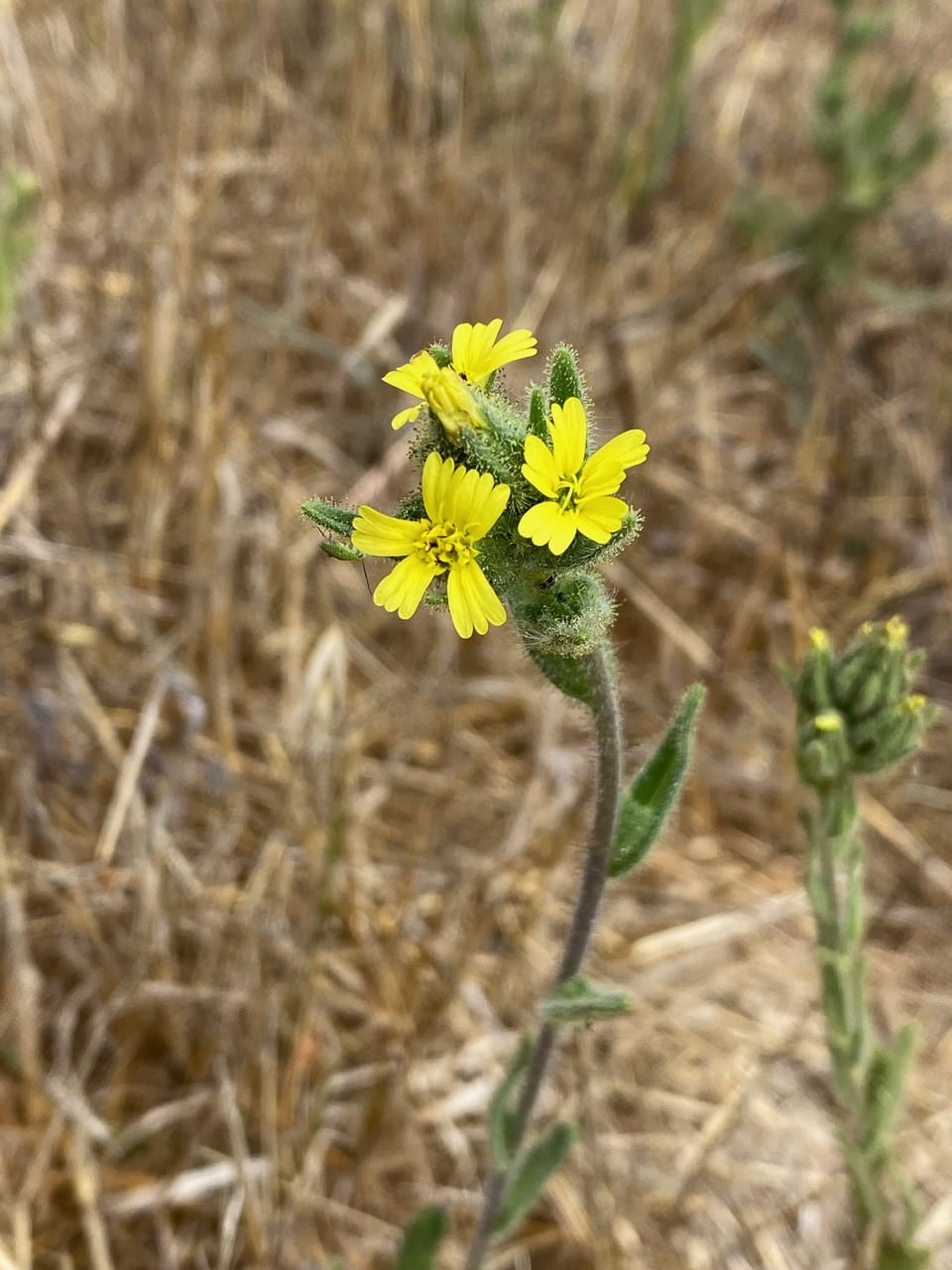
The place looks quite different from the last time I visited. The vegetation has all turned brown. On the diligently mown grassy areas, Coast Tarweed, Madia sativa has taken over. The young plants have started to bloom.
The Coast Tarweed, Madia sativa is native to the Americas, where it is distributed in two main areas: the west coast of North America, and South America in Chile and Argentina. The plant grows in many types of habitats, including disturbed areas. In western North America, it is most common on coastal grasslands and nearby areas.
Madia sativa is an annual herb that can reach 2 meters tall. It is coated densely with sticky resin glands and it has a strong scent. The inflorescence is generally a cluster of flowerheads lined with bristly, glandular phyllaries. Each head bears approximately 8 yellowish ray florets a few millimeters long around a center of several disc florets tipped with dark anthers.

A Carrot Plant Bug, Orthops scutellatus (family Miridae) surveys the surrounding areas from an immature flowerhead of Coast Tarweed. I always wonder how these bugs manage to navigate the sticky terrain of tarweed without getting stuck.
Mirid bugs are also referred to as plant bugs or leaf bugs. Miridae is one of the largest family of true bugs in the order Hemiptera. Like other Hemipterans, Mirids have piercing, sucking mouthparts to extract plant sap. Some species are predatory. One useful feature in identifying members of the family is the presence of a cuneus; it is the triangular tip of the corium, the firm, horny part of the forewing, the hemielytron. The cuneus is visible in nearly all Miridae.

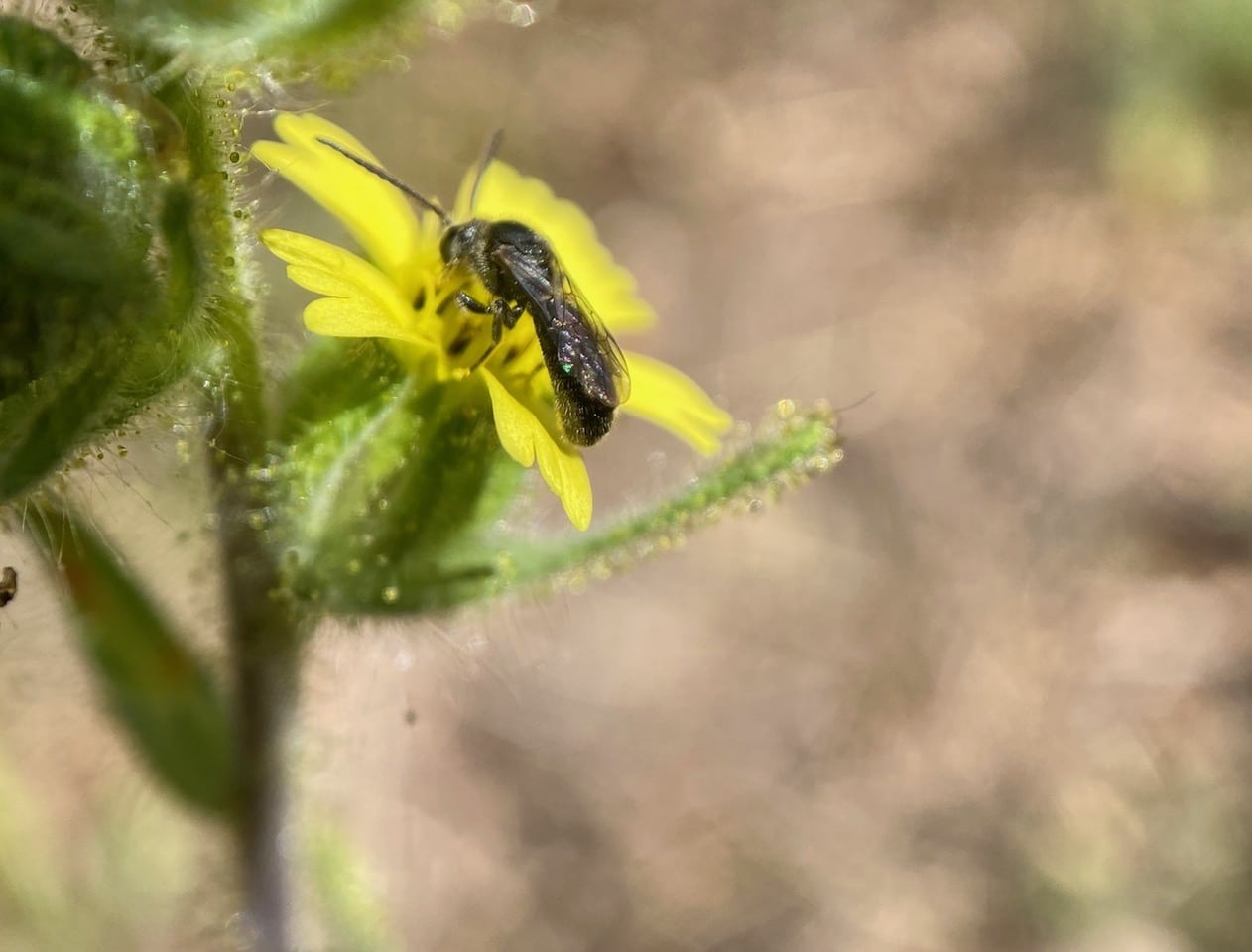
A male Sweat Bee (family Halictidae) has landed on a tarweed flowerhead to take nectar. Note his long antennae, slender build, and absence of scopae on his hind legs.
The antennae of male bees are often much longer than their female counterparts. Male antennae have an extra segment and the segments themselves are longer. This is because male antennae are specialized to pick up the subtle scent of female pheromones. Male bees do not collect pollen to provision the nest, neither do they have the anatomical equipment (scopae or special pollen collecting hairs) for the job.
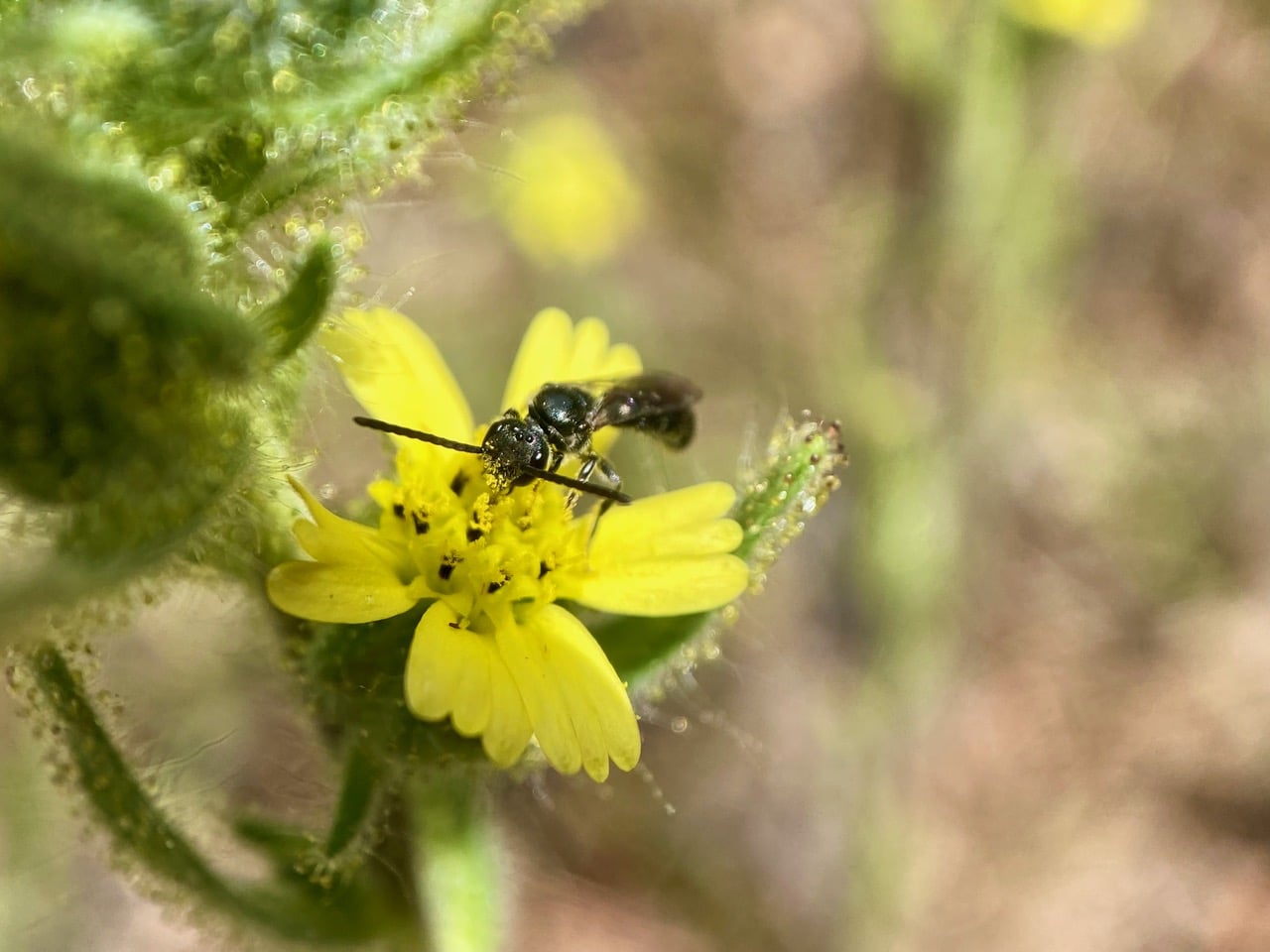

The bee dips his head into each floret to sip nectar, one by one.
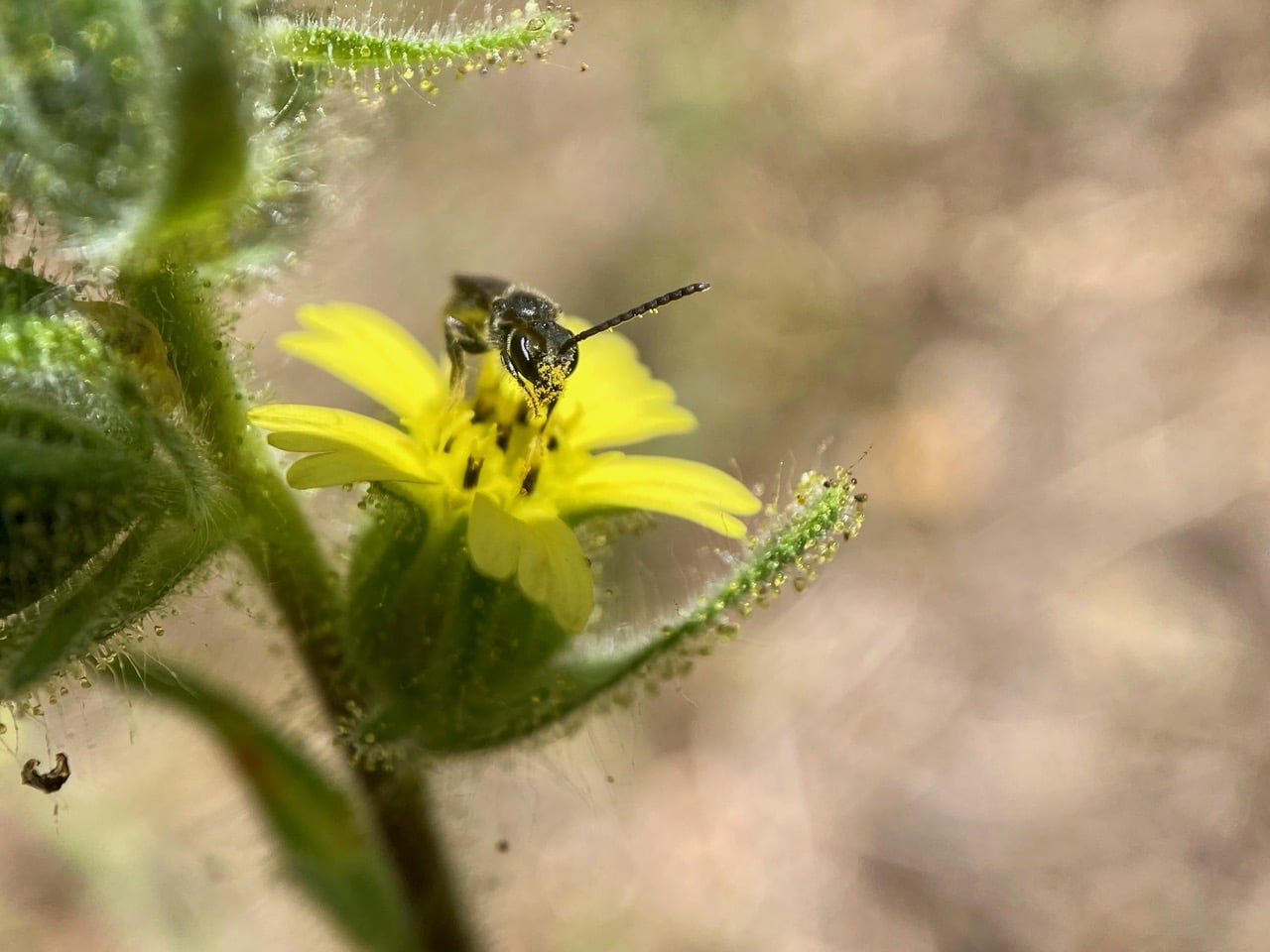
The sticky pollen of the tarweed flowers has adhered to the face and antennae of the bee. Although male bees do not intentionally collect pollen, their hairy bodies often transfer pollen from flower to flower as they seek nectar, making them good pollinators.

A female Forked Globetail, Sphaerophoria sulphuripes (family Syrphidae) is foraging on a freshly opened flowerhead of Coast Tarweed.
The Forked Globetail, Sphaerophoria sulphuripes (family Syrphidae) is a hover fly native to western North America. Adults visit flowers for nectar and pollen. Larvae feed on aphids and other soft-bodied insects. There is marked sexual dimorphism in the species – the males have a slender abdomen with a reddish, swollen tip.

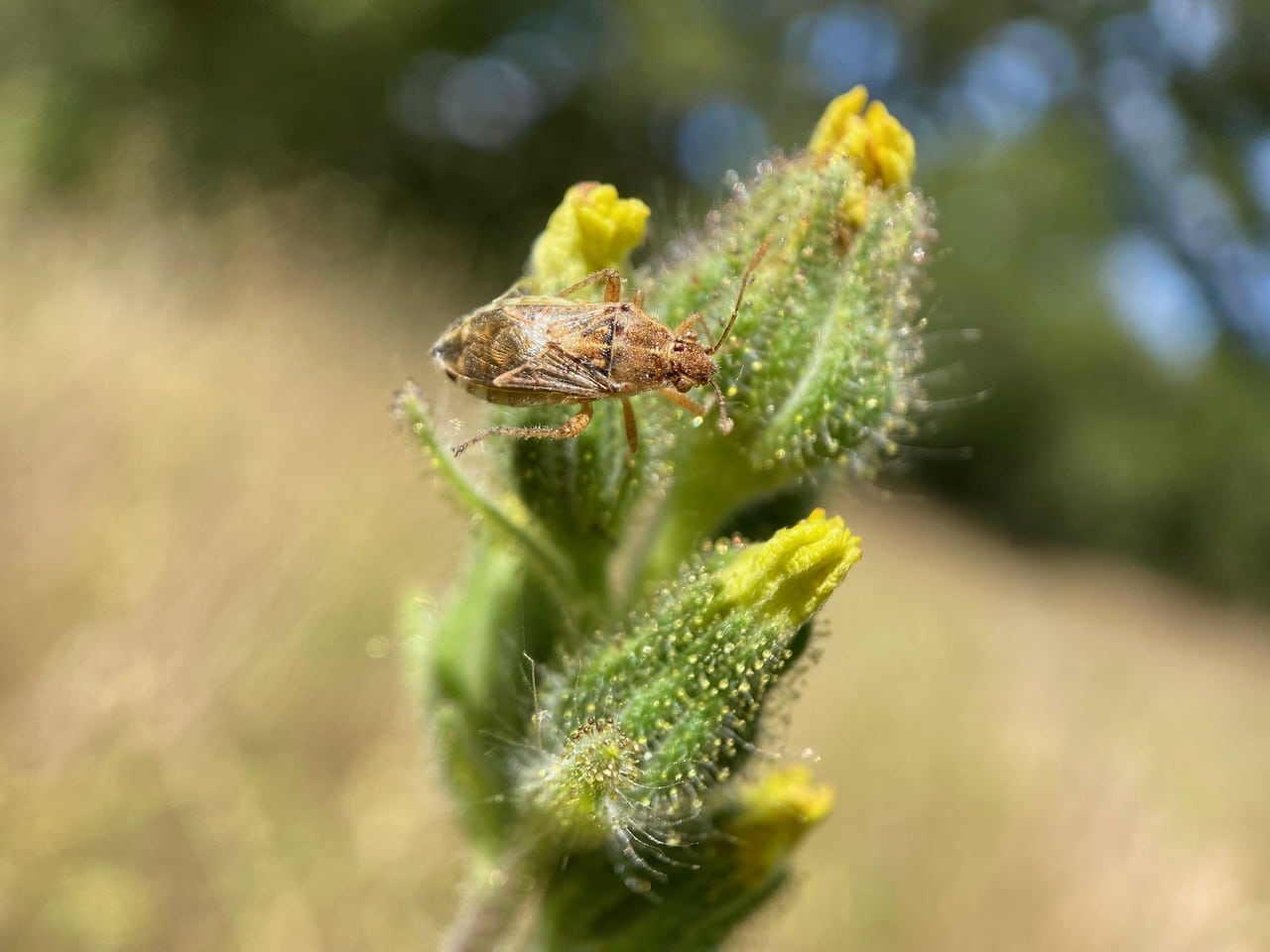
A Scentless Plant Bug (family Rhopalidae) is perched on a terminal cluster of Coast Tarweed flowerheads.
The Rhopalidae are distinguished by many veins on the membranous portion of the forewings. They differ from coreids and other hemipterans in lacking functional scent glands. All are plant-feeders, usually on ripe seeds. Like other “true bugs” in the order Hemiptera, Rhopalids have piercing-sucking mouthparts that they use to extract plant tissues. They are able to feed on seeds by injecting digestive juices into the seeds and sucking up the digested contents as a liquid. The mouthparts, collectively called a rostrum, is folded under the body when not in use.
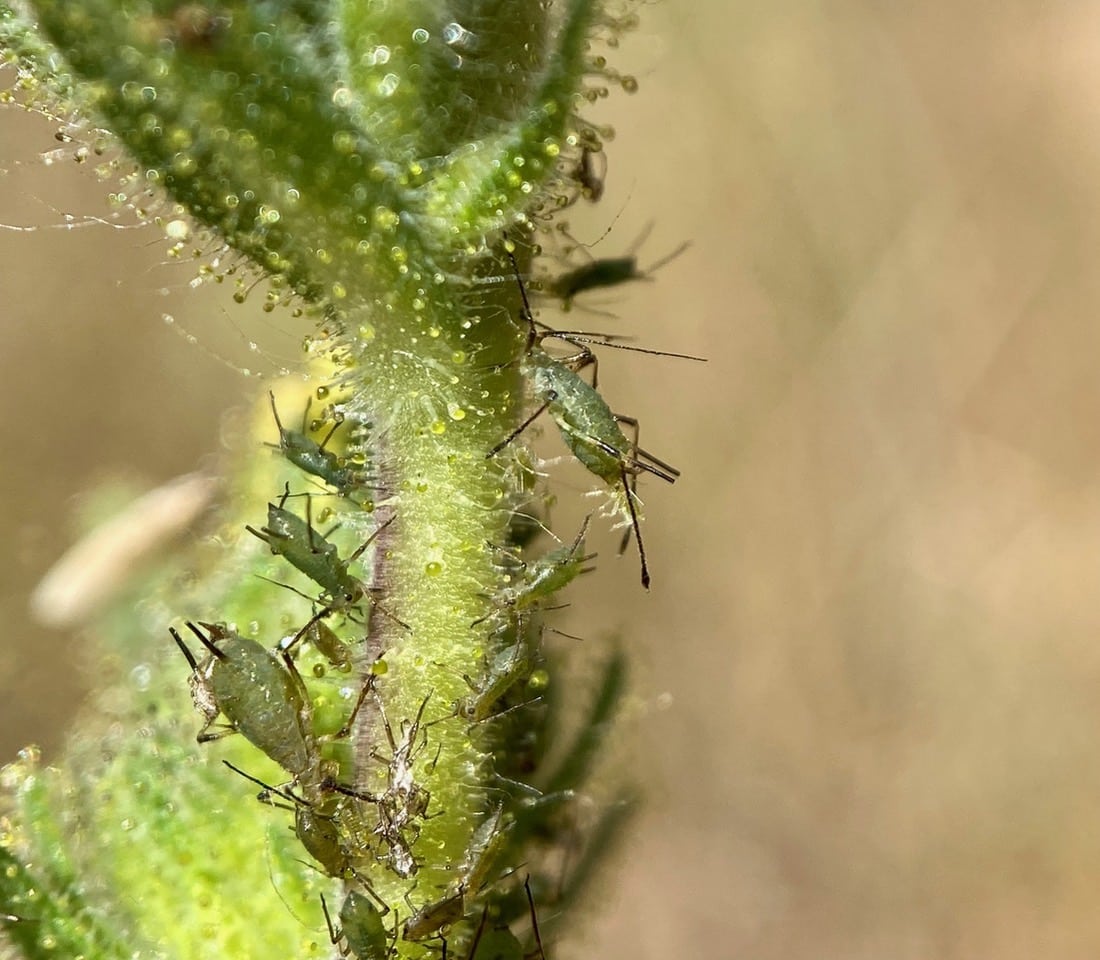
This Coast Tarweed is infested with aphids in the genus Macrosiphum (family Aphididae). Even these tiny insects are amazingly tolerant of the sticky tarweed exudates.
Aphids (family Aphididae) are small sap-sucking insects in the order Hemiptera. Aphids usually feed passively on phloem of plants. Once the phloem vessel is punctured, the sap, which is under pressure, is forced into the aphid’s food canal. Aphids produce large amounts of a sugary liquid waste called “honeydew”. A fungus called sooty mold can grow on honeydew deposits that accumulate on leaves and branches, turning them black.
A typical life cycle involves flightless females giving live birth to female nymphs, – who may also be already pregnant, an adaptation called telescoping generations – without the involvement of males. Maturing rapidly, females breed profusely so that the population multiplies quickly. Winged females may develop later in the season, allowing the insects to colonize new plants. In temperate regions, a phase of sexual reproduction occurs in the autumn, with the insects often overwintering as eggs. The life cycle of some species involves an alternation between two species of host plants. Some species feed on only one type of plant, while others are generalists, colonizing many plant groups. Some ants have a mutualistic relationship with aphids, tending them for their honeydew and protecting them from predators.
The genus Macrosiphum consists of large spindle-shaped pink or green aphids, with long legs, cornicles, and antennae. Adults may be winged or wingless. They usually do not host alternate. During the summer populations are made of pathenogenetic females. In the fall, males and females are produce; they mate and females lay eggs that overwinter.
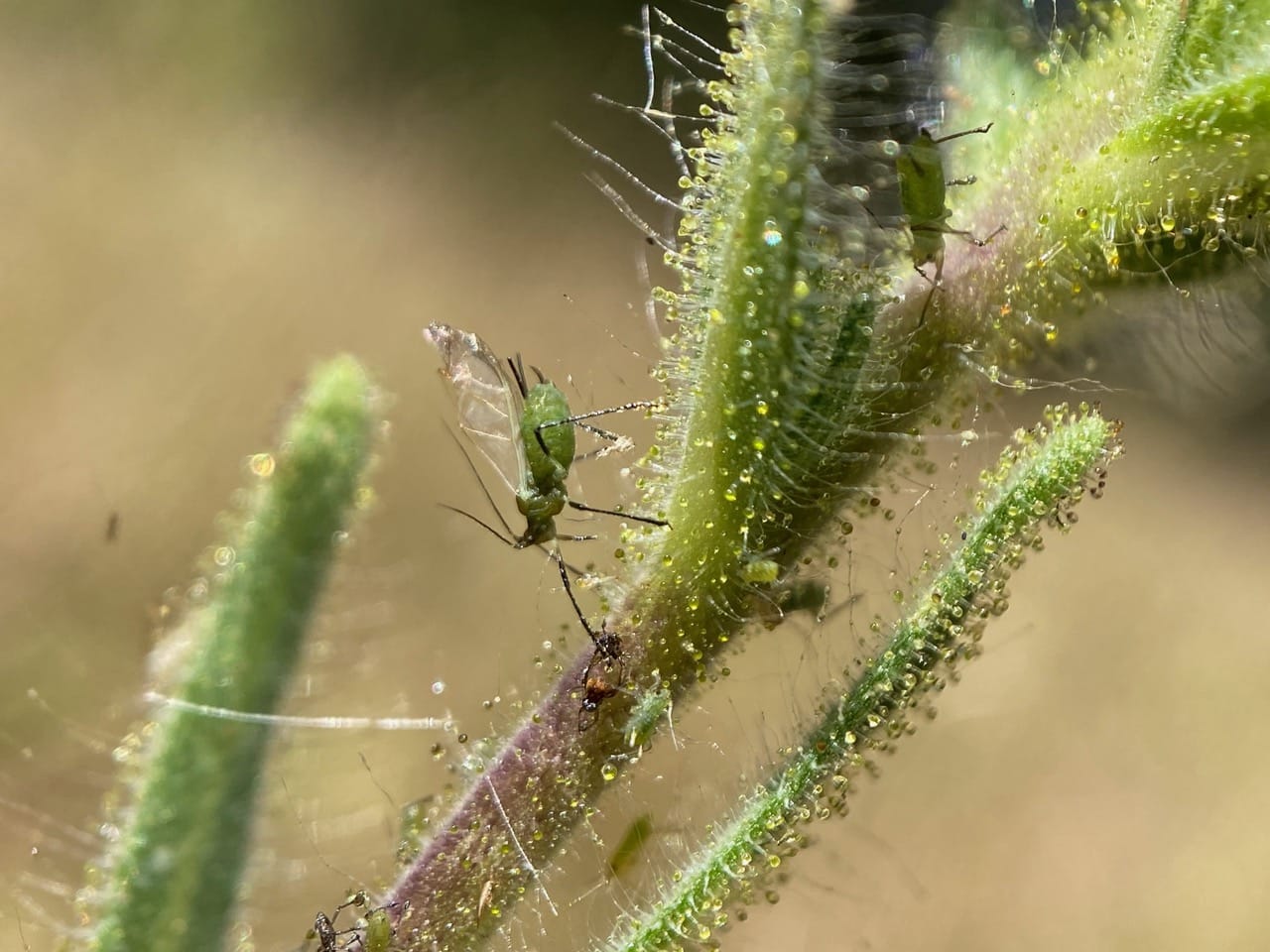
The aphid colony has produced some alates (winged reproductives), ready for dispersal to new plants.
Generally adult aphids are wingless, but most species also occur in winged forms, especially when populations are high or during spring and fall. The ability to produce winged individuals provides the aphids with a way to disperse to other plants when the quality of the food source deteriorates, or when predation pressure is high.
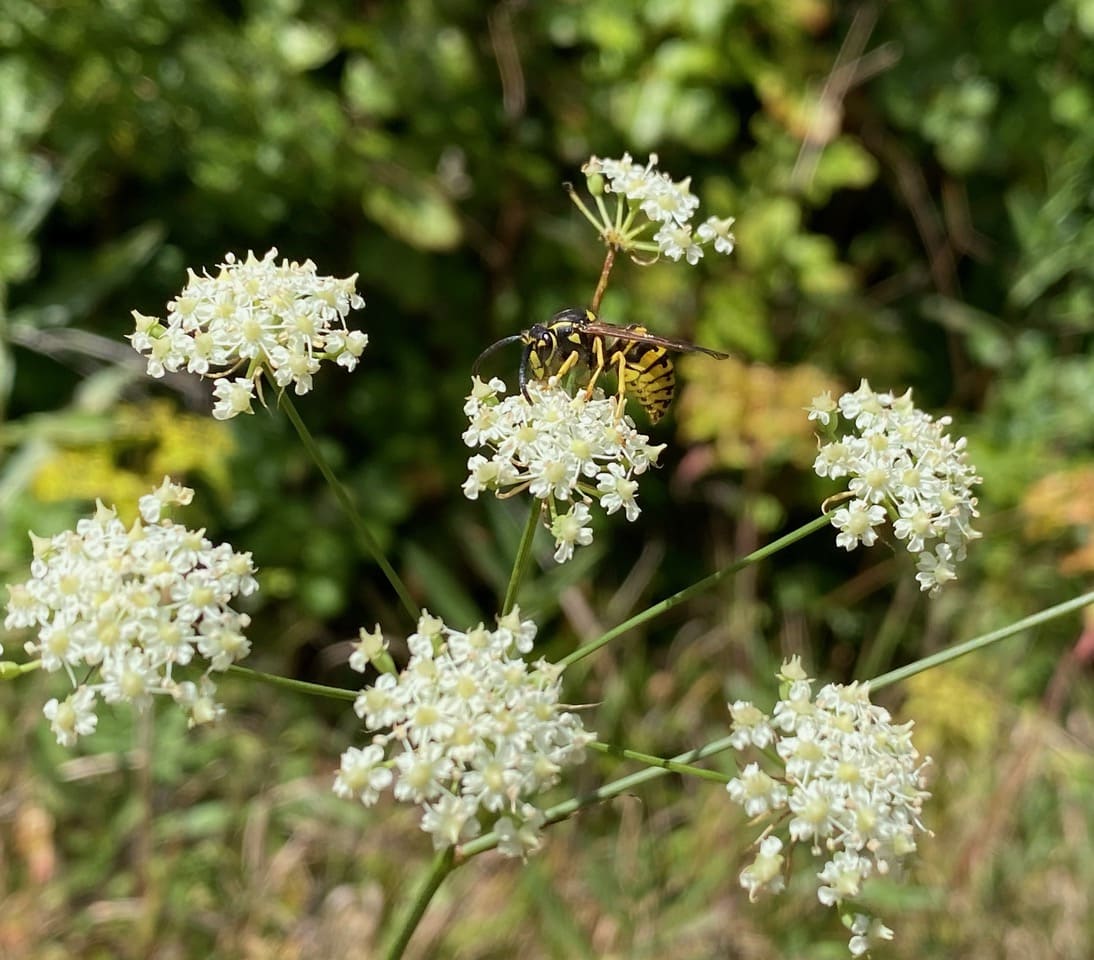
The only other native plant in bloom now at the Padre Picnic Area is the Yampah, Perideridia californica. The delicate umbels of white flowers have attracted numerous Yellowjacket wasps.
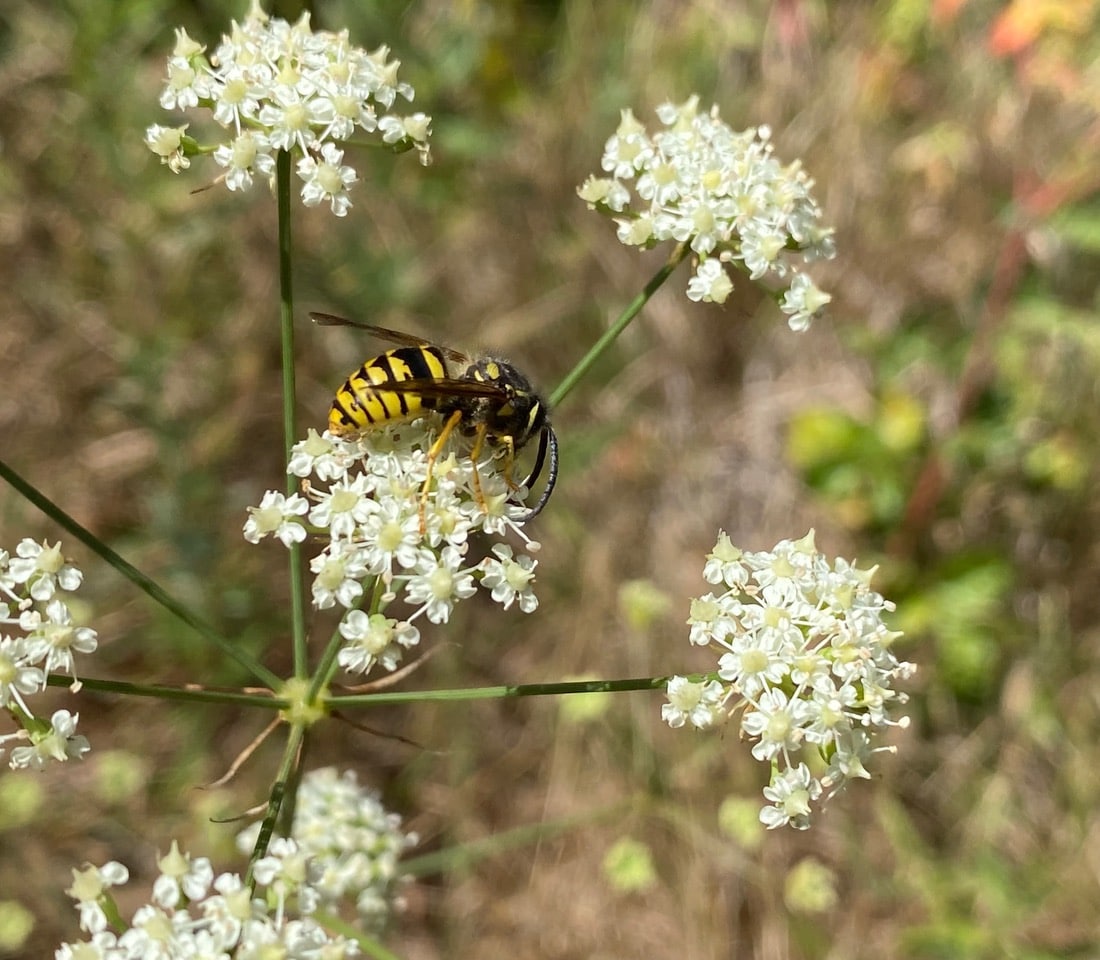
Yellowjacket is the common name for predatory social wasps of the genera Vespula and Dolicovespula (family Vespidae). Yellowjackets are social hunters living in colonies containing workers, queens, and males (drones). Colonies are annual with only inseminated queens overwintering. Queens emerge during the warm days of late spring or early summer, select a nest site, and build a small paper nest in which they lay eggs. They raise the first brood of workers single-handedly. Henceforth the workers take over caring for the larvae and queen, nest expansion, foraging for food, and colony defense. The queen remains in the nest, laying eggs. Later in the summer, males and queens are produced. They leave the parent colony to mate, after which the males quickly die, while fertilized queens seek protected places to overwinter. Parent colony workers dwindle, usually leaving the nest to die, as does the founding queen. In the spring, the cycle is repeated.
Yellowjackets have lance-like stingers with small barbs, and typically sting repeatedly. Their mouthparts are well-developed with strong mandibles for capturing and chewing insects, with probosces for sucking nectar, fruit, and other juices. Yellowjacket adults feed on foods rich in sugars and carbohydrates such as plant nectar and fruit. They also search for foods high in protein such as insects and fish. These are chewed and conditioned in preparation for larval consumption. The larvae secrete a sugary substance that is eaten by the adults.
The Western Yellowjackets typically build nests underground, often using abandoned rodent burrows. The nests are made from wood fiber that the wasps chew into a paper-like pulp. The nests are completely enclosed except for a small entrance at the bottom. The nests contain multiple, horizontal tiers of combs within. Larvae hang within the combs.
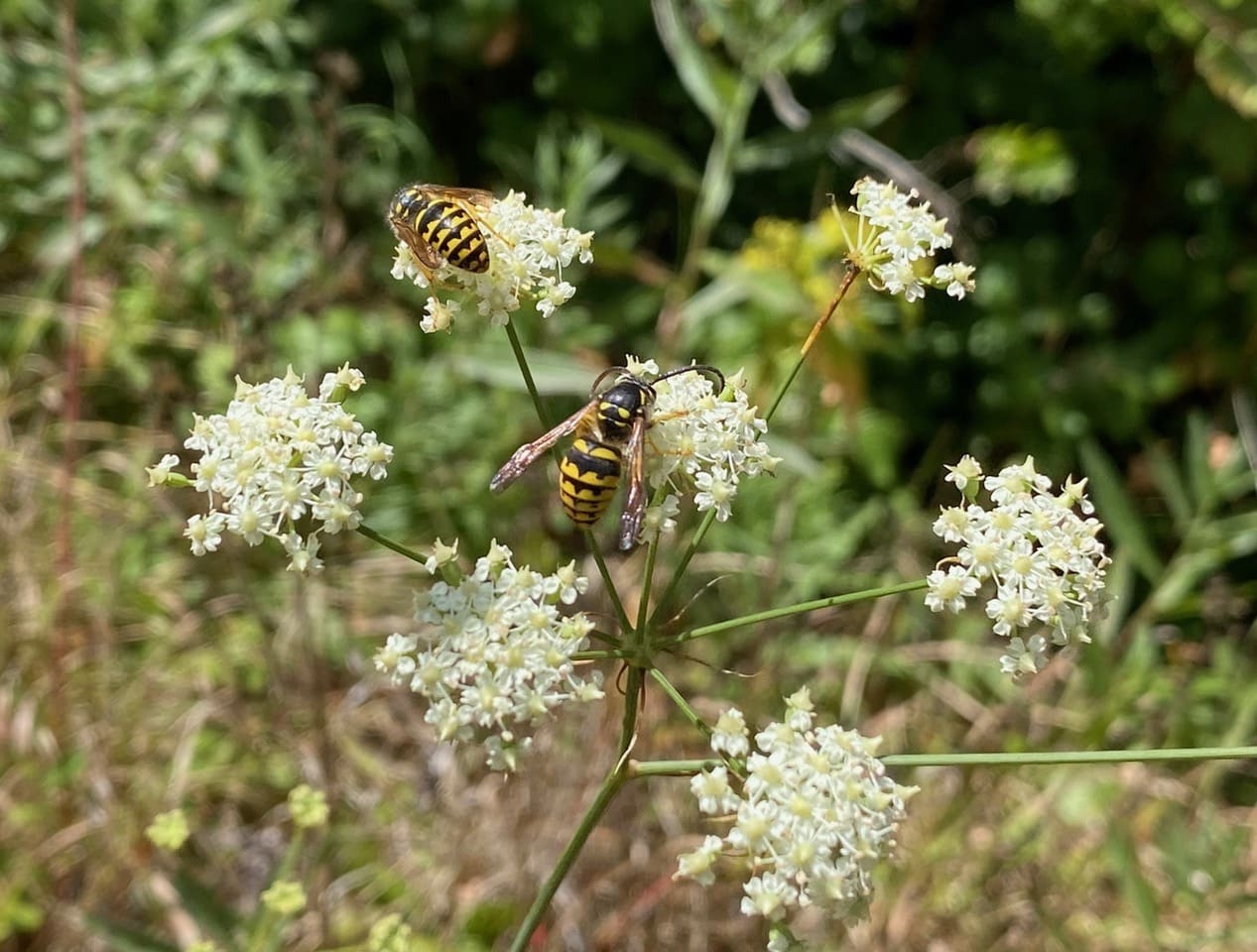
There are so many Yellowjackets foraging on the Yampah flowers I have to give up looking for caterpillars of the Anise Swallowtail butterfly. It is hardly likely that any caterpillars would survive this onslaught of the carnivorous wasps constantly on the look out for caterpillars to feed their young. See the umbel that has been partially eaten on the upper right with a brown, scarred stalk? Those are tell-tale signs that an Anise Swallowtail caterpillar has been feeding there before.
Anise Swallowtail caterpillars primarily feed on plants in the carrot family, Apiaceae. Common host plants used to be natives such as Queen Anne’s Lace, Lomatium species, Yampah, Angelica, and Cow Parsnip. The caterpillars have more recently adapted to feeding on non-natives, such as Fennel, parsley, carrots, and dill.

A small black beetle with a long, pointed tail is perched on a Yampah inflorescence. It is easily recognizable as the Tumbling Flower Beetle (family Mordellidae).
The Tumbling Flower Beetles (family Mordellidae) are named for the characteristic irregular movements they make when escaping predators. They are also sometimes called Pintail Beetles for their abdominal tip which aids them in performing these tumbling movements. Mordellids are small, wedge-shaped, hump-backed beetles with head bent downward. The body is densely covered with fine silky hairs, usually black, but often very prettily spotted or banded with silvery hues. The adults feed on pollen, occurring on flowers or on dead trees, flying or running with rapidity. The larvae live in old wood or in the pith of plants, and those of some species are said to be carnivorous, feeding on the young of Lepidopterans and Diptera which they find in the plant stems.

A Sweat Bee, Lasioglossum sp. (family Halictidae) is foraging on the flowerheads of Catsear, its body dusted with pollen.
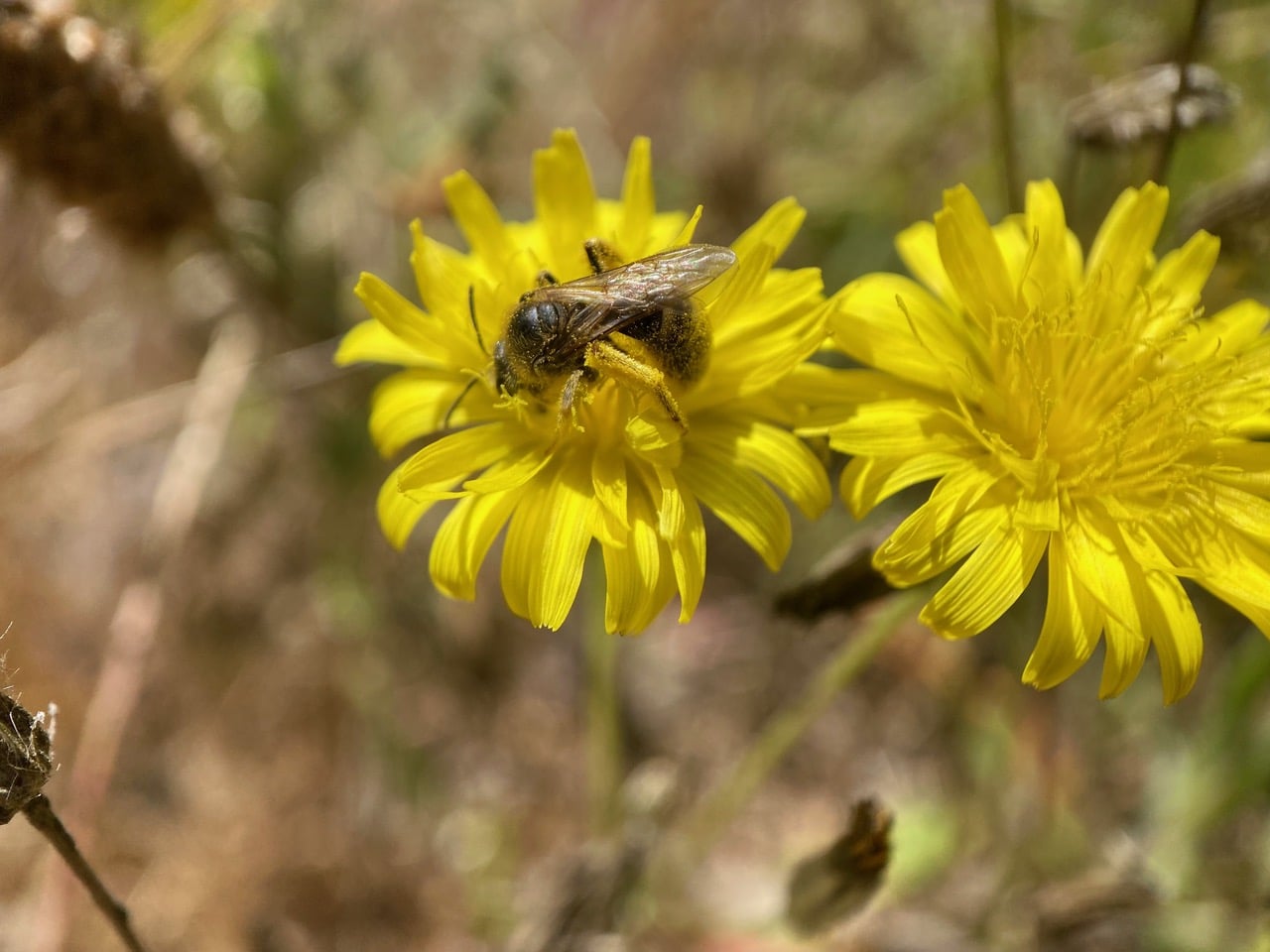
Lasioglossum species are found worldwide, and they constitute the largest bee genus. The majority of Lasioglossum are generalists. Because they are so abundant throughout the flowering season, the bees are often important pollinators. Their sheer numbers are enough to achieve excellent pollination of many wild flowers, especially of plants in the Asteraceae, which have shallow floral tubes that are easily accessed by these minute bees.
Lasioglossum are closely related to the genera Halictus and Agapostemon. These genera are commonly called “sweat bees” because of their attraction to human sweat, which they drink for its salt content. Lasioglossum are dusky black to brown slender bees with bands of hair on their abdomen. Female Sweat Bees (family Halictidae) carry pollen in the scopae on their entire hind legs and underside of their abdomen.
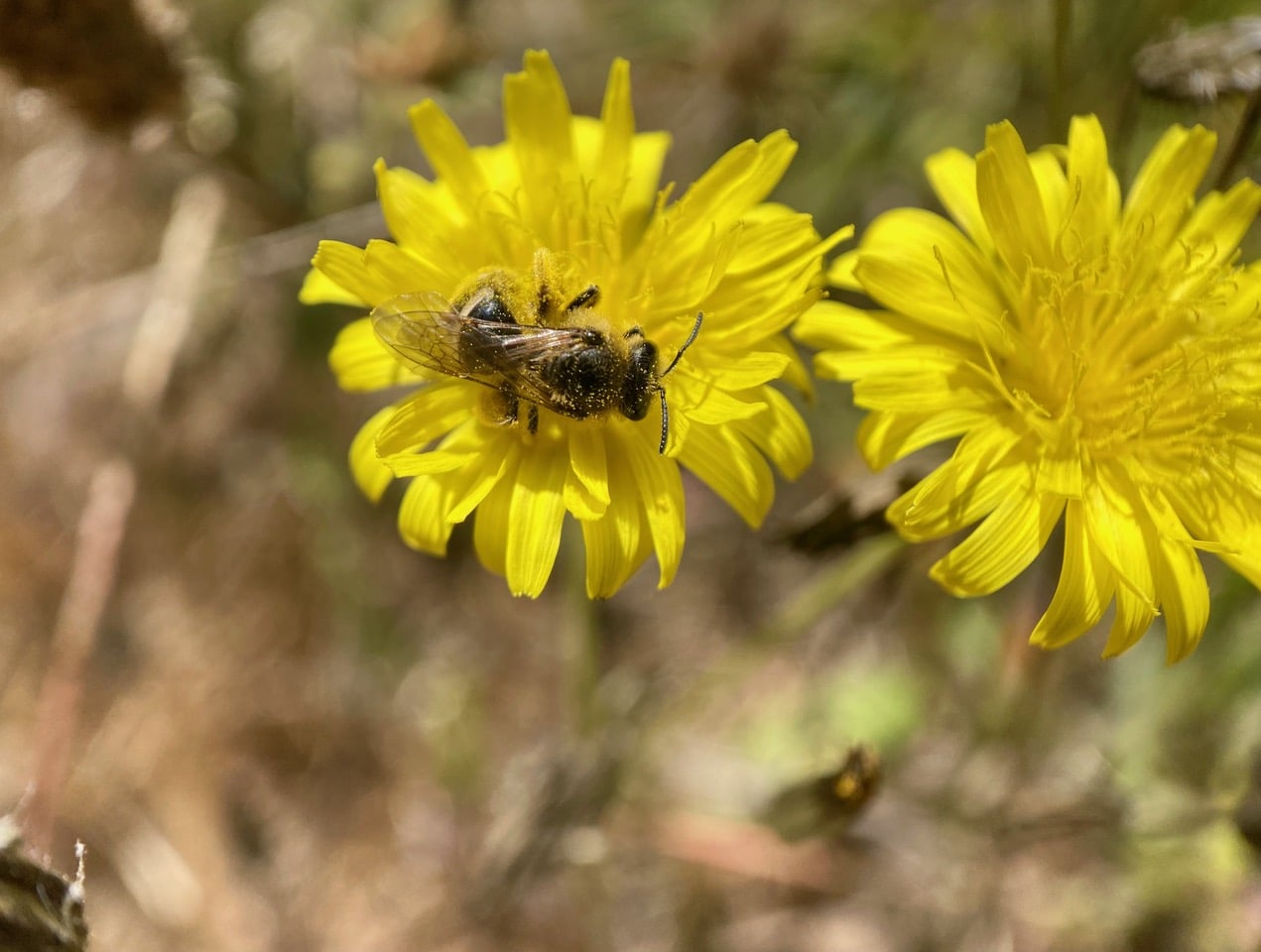
Lasioglossum exhibit a range of social behaviors; the genus includes solitary, communal, semi social, primitively eusocial, and even parasitic species. Almost all Lasioglossum in the U.S. nest in the ground. Generally these nests are built in the spring by fertilized females (called foundresses) that spent the winter in hibernation. In social species, the foundresses behave much like the queen bumble bees – they lay the first batch of eggs that develop into the first generation of female workers. The nest grows with each additional generation of bees. Later broods may consist of both males and females. They mate, and at the end of the season the fertilized females hibernate till the following spring, repeating the life cycle of the colony.
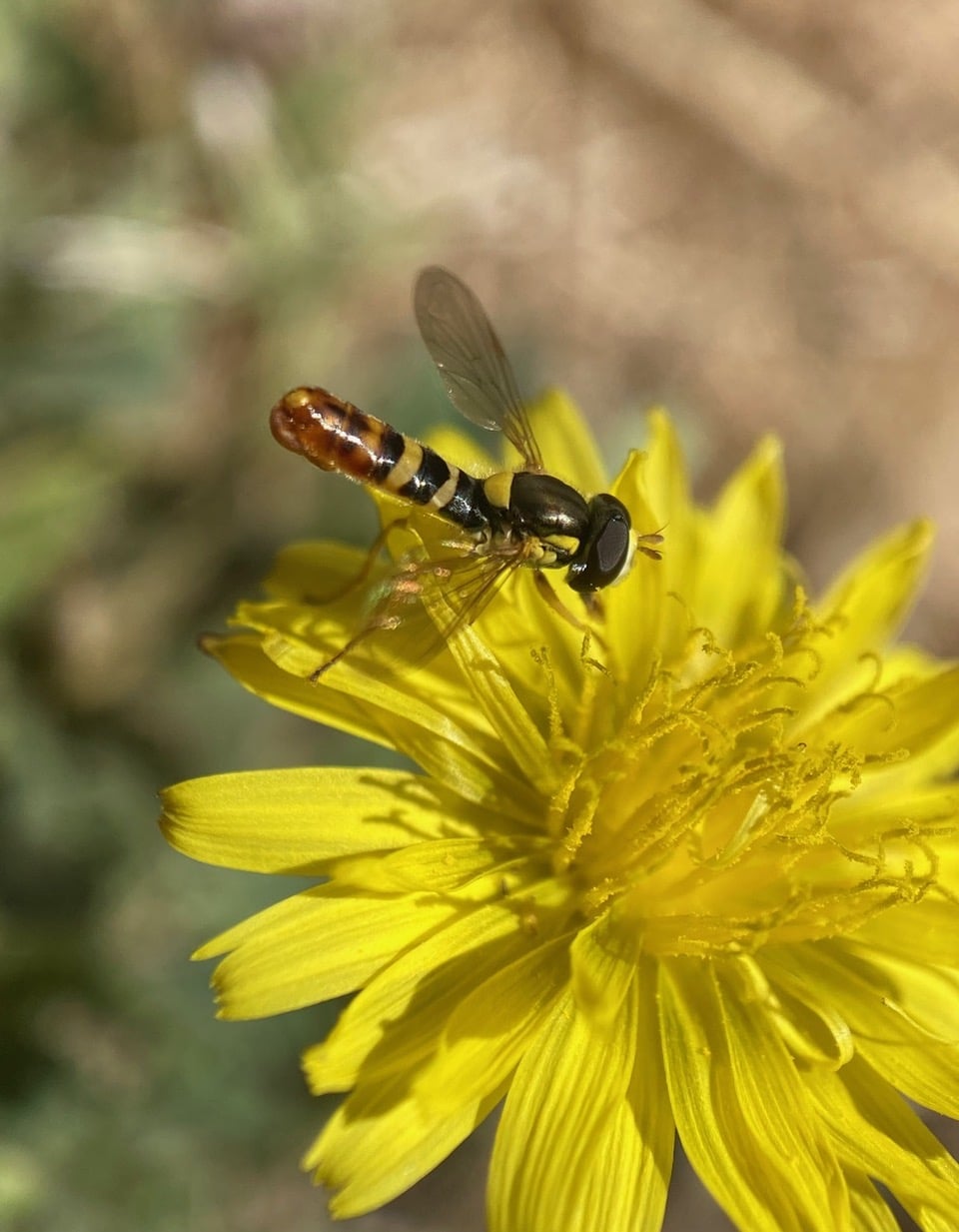
A male Forked Globetail, Sphaerophoria sulphuripes (family Syrphidae) has landed on a Catsear flowerhead.
The Forked Globetail, Sphaerophoria sulphuripes (family Syrphidae) is a hover fly native to western North America. Adults visit flowers for nectar and pollen. Larvae feed on aphids and other soft-bodied insects. There is marked sexual dimorphism in the species – the males have a slender abdomen with a reddish, swollen tip.
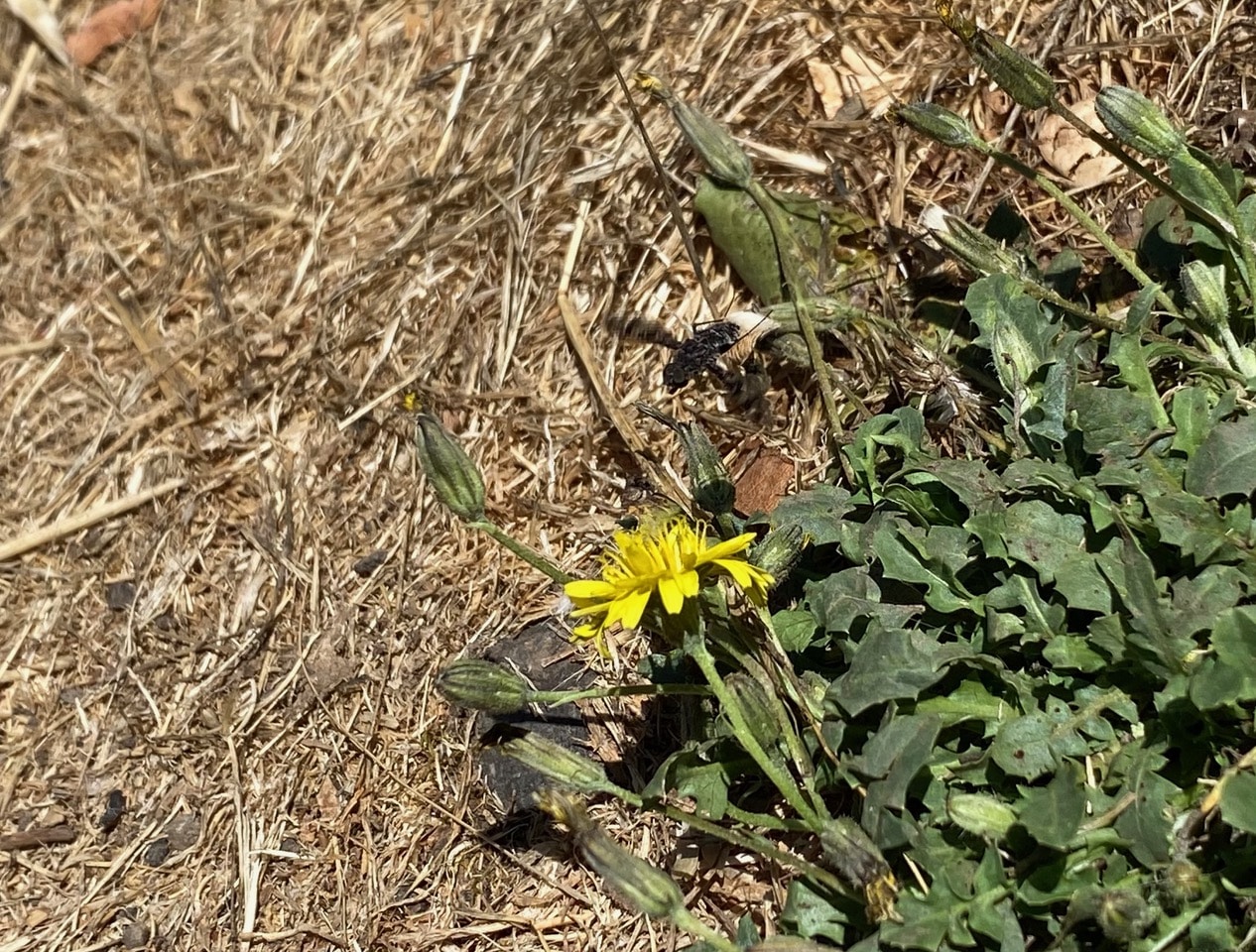
A dark, mottled Bee Fly (family Bombyliidae) is hovering in a conspicuous bobbing manner over a flowerhead of Catsear, Hypochaeris radicata. What is going on? Is it dropping eggs onto the flowerhead? I have never seen such behavior before. I quickly turn on the video to record the action.
When I review the video at home, I realize that the fly is actually feeding, lowering its long proboscis into the flowerhead each time it dips down. While feeding most Bee Flies hover steadily with very fast wing beats that appear as a blur, but this Bee Fly has a much slower, flapping wingbeat. It seems energetically costly to be feeding like this.
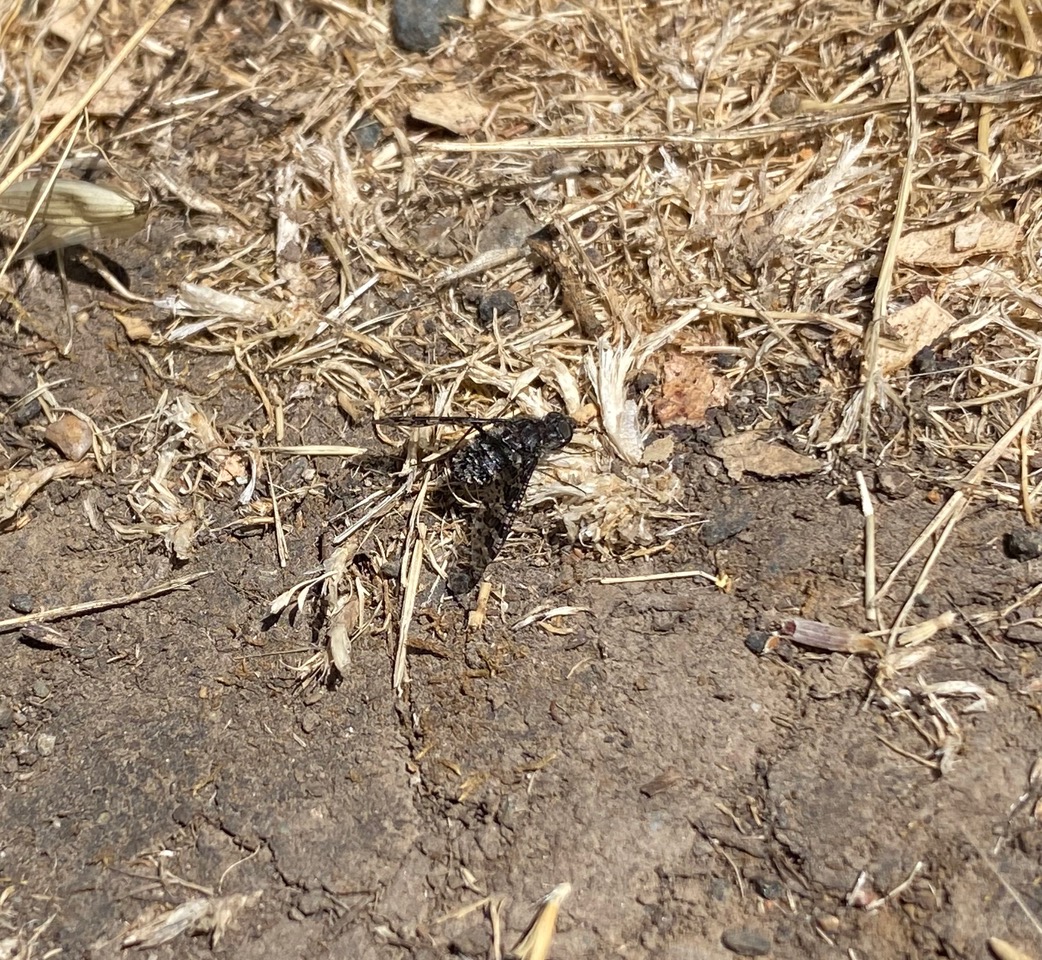
I watch as the same Bee Fly hover over three Catsear flowerheads in quick succession, taking a break on the ground after each bout of feeding. Even when the fly is staying still, it is hard to make out its outline. It has dark, heavily spotted wings and its body appears to be covered with black and gray scales. iNaturalist has helped identify the Bee Fly as a member of the genus Lepidanthrax (family Bombyliidae).
The Bee Flies belong to the family Bombyliidae. Adults generally visit flowers for nectar and pollen, some being important pollinators. Larvae generally are parasitoids of other insects. When at rest, many species of bee flies hold their wings at a characteristic “swept back” angle. The adult females usually deposit eggs in the vicinity of possible hosts, quite often in the burrows of beetles or ground-nesting bees/wasps. Bombyliidae parasitism is not host-specific, but rather opportunistic, using a variety of hosts.
Lepidanthrax is a genus of Bee Flies consisting of at least 50 described species, primarily found in the New World. In the continental U.S. they are found mainly in the southwestern region. Most are small, ranging from 5-9 mm, with one species reaching 11 mm. Lepidanthrax is distinguished by characteristic covering of broad scales and the shape of the third antennal segment.
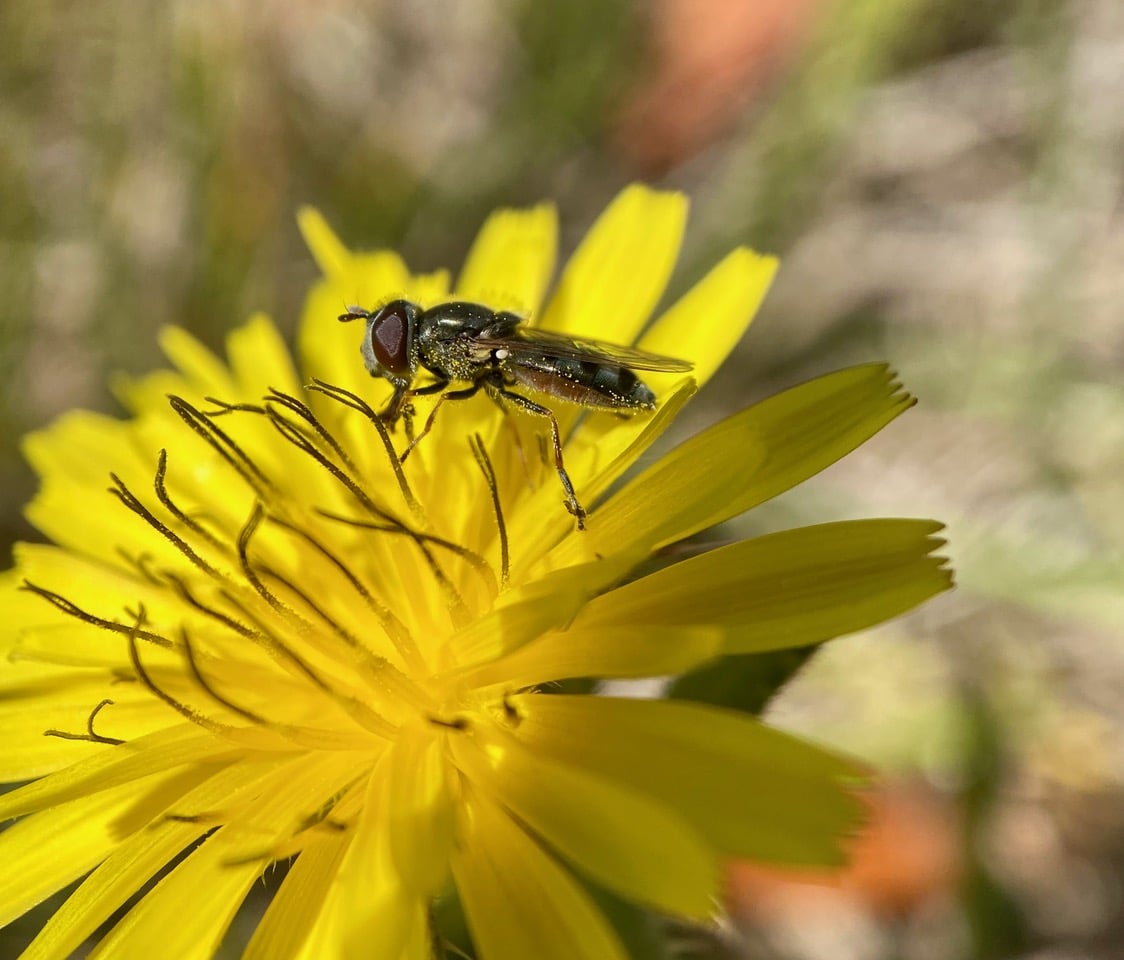
A Sedgesitter, Platycheirus sp. (family Syrphidae) is feeding on pollen on a flowerhead of Bristly Oxtongue, Helminthotheca echioides.
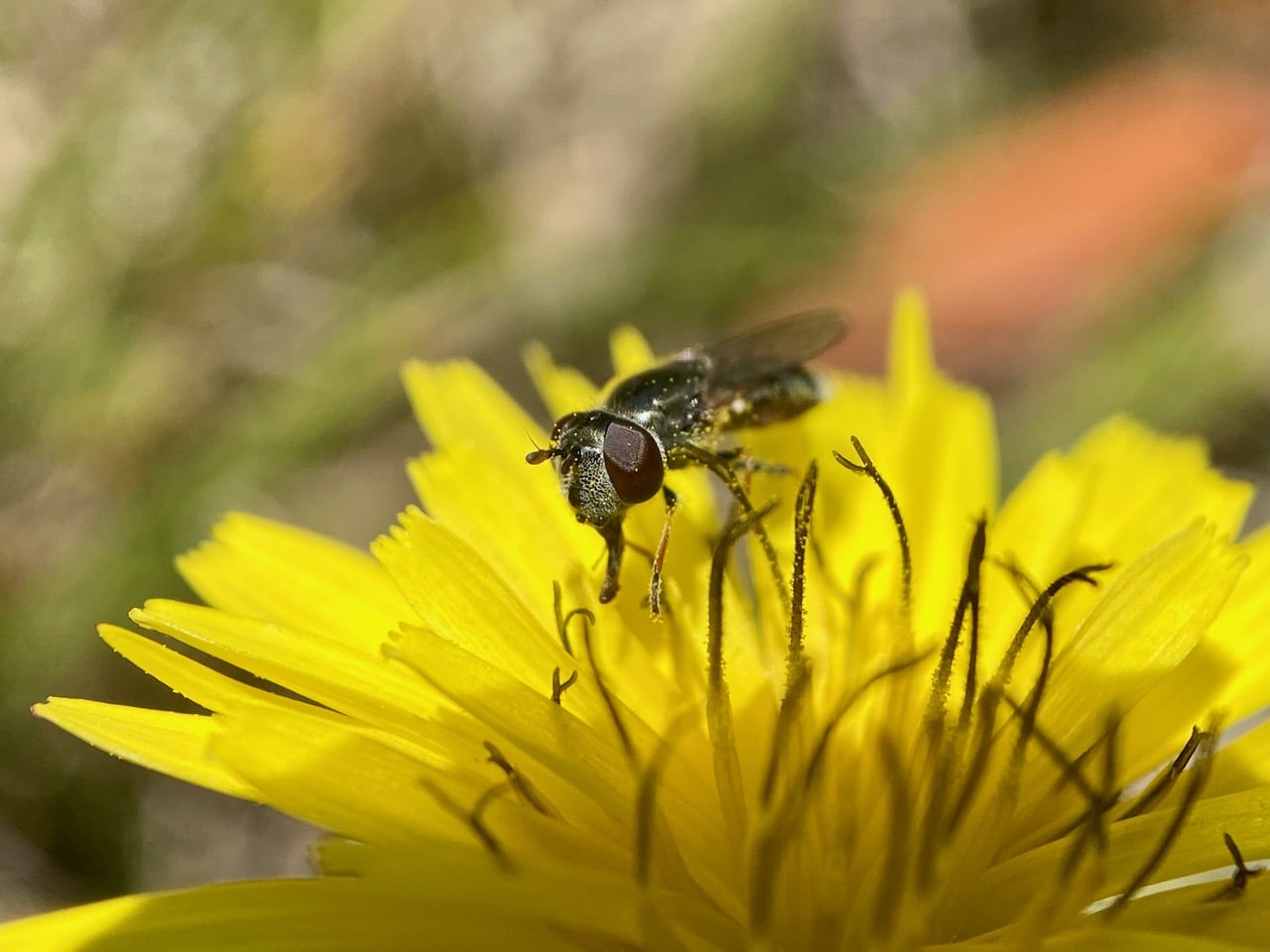
Platycheirus is found in grass and herb vegetation. Adults of many species feed on pollen of wind-pollinated plants, such as Salix, Plantago, Poaceae, Cyperaceae, but they visit other flowers also. Many stay active during cold and rainy weather. Larvae feed on aphids.
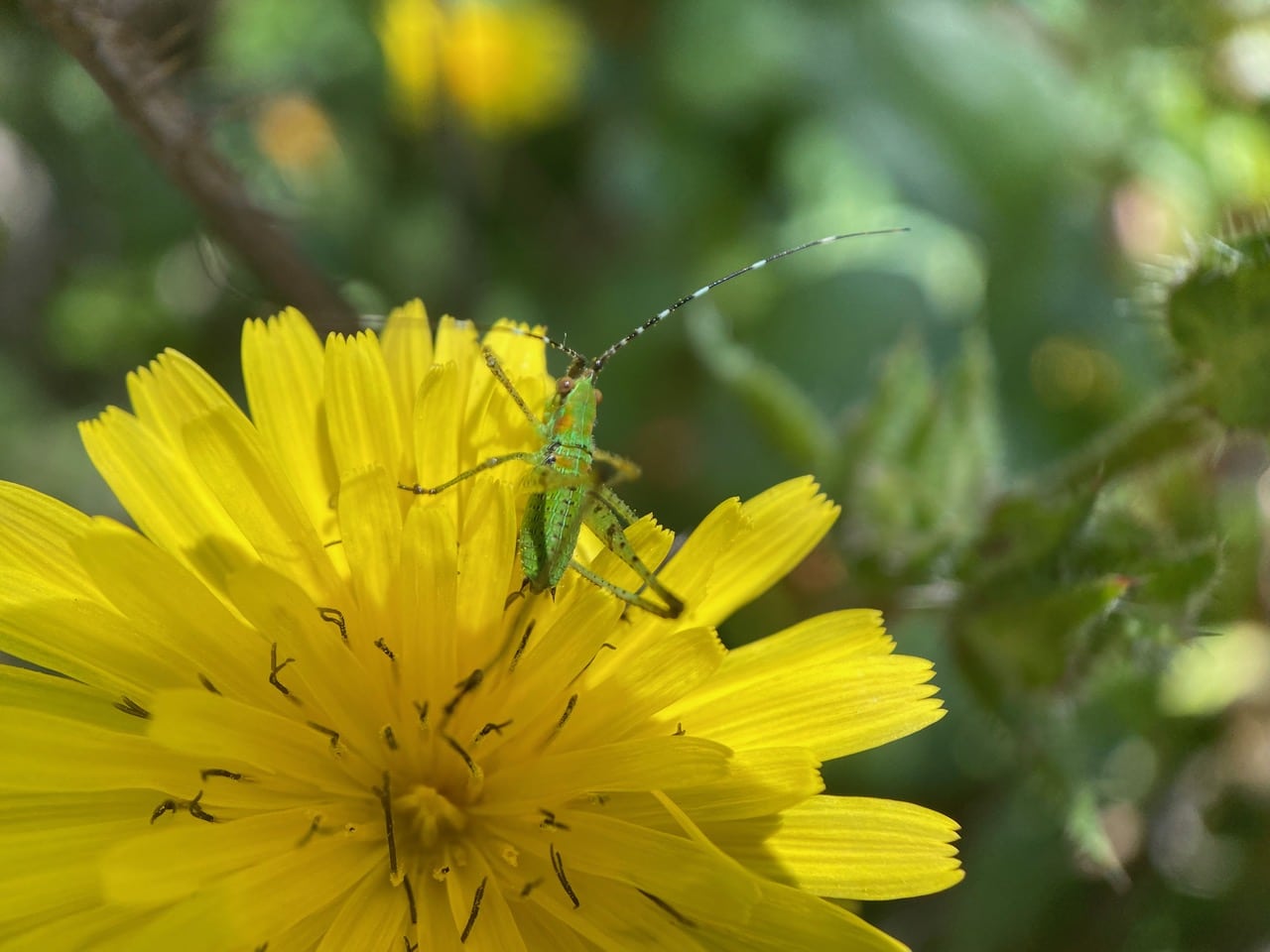
A nymph of Scudder’s Bush Katydid, Scudderia sp. (family Tettigoniidae) is perched on a Bristly Oxtongue flowerhead.
Scudderia is a genus of katydids in the family Tettigoniidae, mostly found in North America. They are sometimes called bush katydids and are 30-38 mm in length. They are herbivores, with nymphs feeding primarily on flowers and green, leaf-mimicking adults preferring woody deciduous plants.

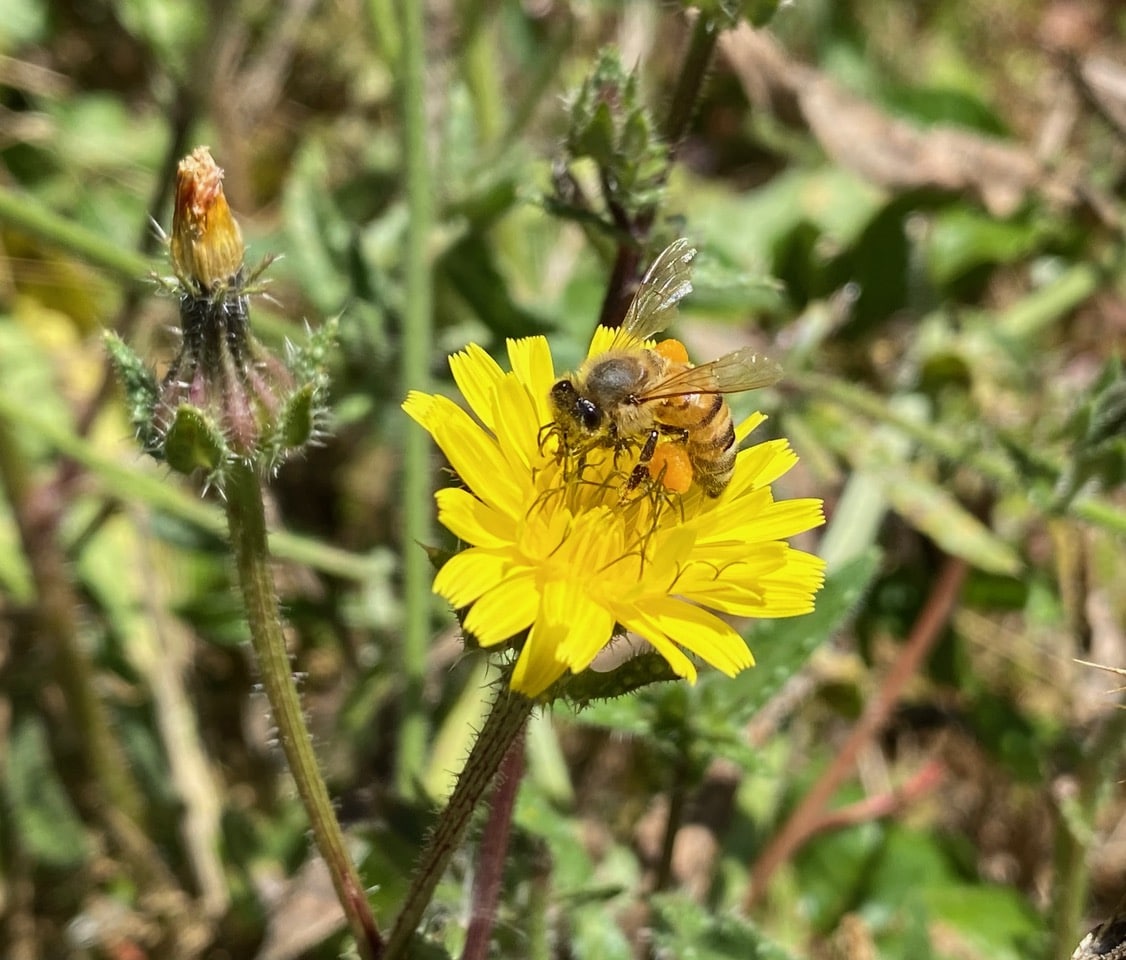
Toting impressive pollen loads in her corbiculae, a Honey Bee, Apis mellifera (family Apidae) is foraging on a Bristly Oxtongue flowerhead.
The pollen collecting apparatus in Apidae bees, which include honey bees and bumble bees, is commonly called a “pollen basket” or corbicula. This region is located on the tibia of the hind legs and consists of hairs surrounding a concave region. After the bee visits a flower, she begins to groom herself and brushes the pollen down toward her hind legs and packs the pollen into her pollen basket. A little nectar mixed with the pollen keeps it all together like putty, and the stiff hairs surrounding the pollen basket hold it in place. Remarkably bees are able to fly while carrying up to a third of their body weight in pollen.
.jpg)
Honey bees fill ‘saddlebags’ with pollen. Here’s how they keep them gripped tight | Science | AAAS
Watching honey bees forage, I am reminded of a fellow docent at the Oakland Museum Natural Sciences Gallery many years ago. Bud, a retired entomologist, taught me that every honey bee worker out foraging should be treated with respect – they are all little old ladies. Bud was absolutely correct. All Honey Bee foragers are female, and they are the oldest members of their hive. How do honey bees get their job assignments within their social organization?
“A bee’s job is, first of all, determined by its sex. Male bees, or drones, don’t do any work. Making up roughly 10% of the colony’s population, they spend their whole lives eating honey and waiting for the opportunity to mate with the queen. The queen mates with up to 20 drones and will store their sperm in her spermatheca for the rest of her life. That’s where male duties end. Female bees, known as worker bees, make up the vast majority of a hive’s population, and they do all the work to keep it functioning. Females are responsible for the construction, maintenance, and proliferation of the nest and the colony. When a worker bee emerges as an adult, she immediately starts cleaning the cell from which she hatched. Her first 3 days are spent cleaning cells to prepare them for the queen’s next round of eggs. Then her hormones kick in to initiate the next phase of work: nursing the young. The worker bee spends about a week nursing the brood, feeding larvae with royal jelly. Next, the worker bee enters the third phase, as a sort of utility worker, moving farther away from the nest’s center. Here she builds cells and stores food in the edge of the nest for about a week. A worker’s hormone shifts into the final phase of work at around 41st day: foraging. This work is the most dangerous and arguably the most important. It’s only done by older bees who are closer to death. As the worker bee approaches her fourth week of nonstop work, she senses her end of days, and removes herself from the hive, so as not the become a burden to the colony. If she dies in the hive, her hive mates would have to remove her corpse. Thus is the life of a female honey bee during the active seasons of spring and summer, compulsively working from the day she’s born until the day she expires.” – excerpt from an article in National Geographic by Richie Hertzberg.
So, don’t forget to tip your hat to the “little old ladies” you see in the garden!