

Pollinator Post 7/3/24
As temperatures are forecast to go beyond 90 F today, the coolness of a redwood forest beckons to me. I am grateful that although most of the east bay parks are closed due to fire danger, the Reinhardt Redwood Regional Park remains open.
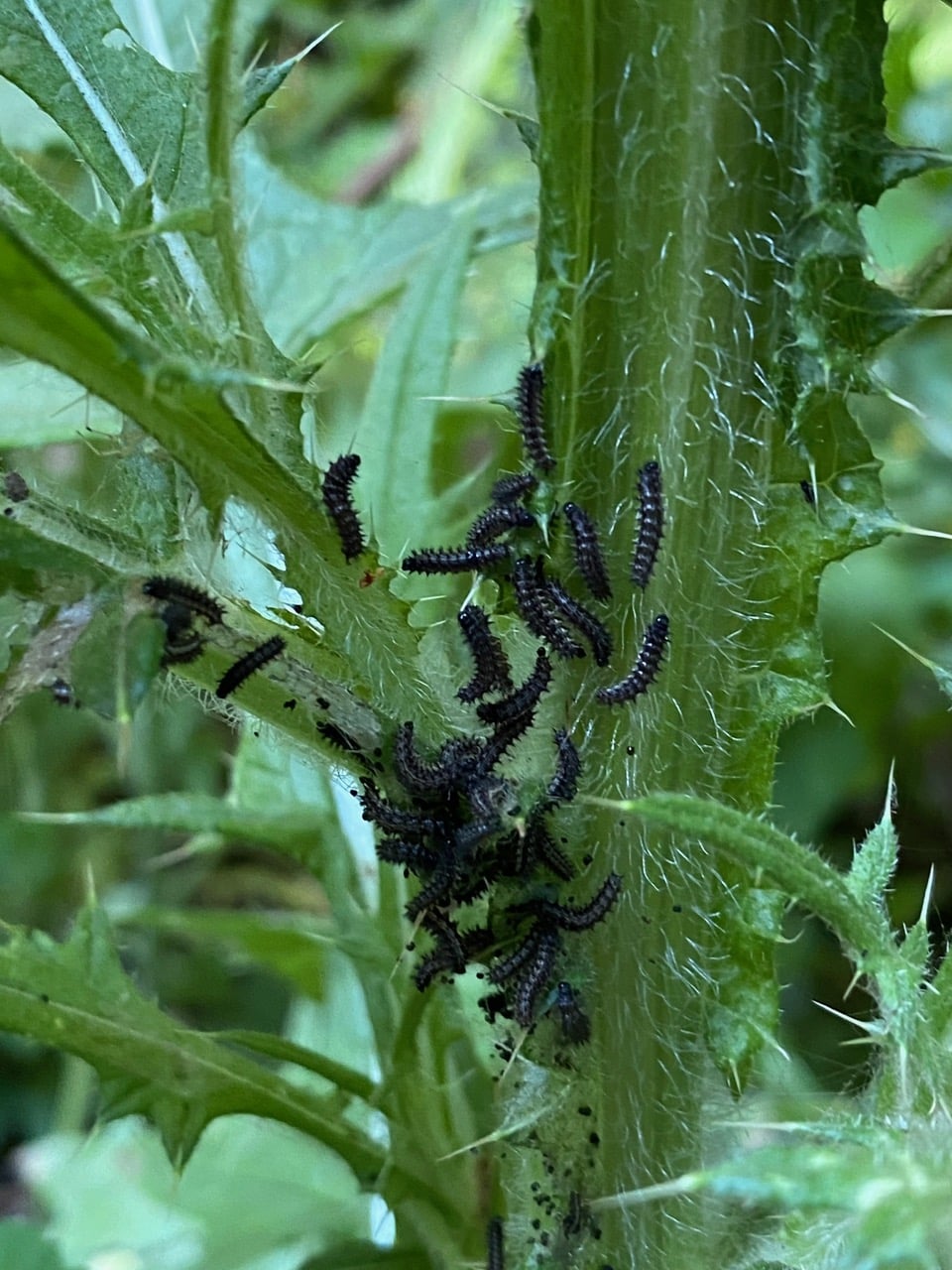
I haven’t expected to take any pictures today, but this large cluster of black caterpillars on an Italian Thistle stops me in my tracks. While the first thought that comes to mind is Painted Ladies (the quintessential “thistle butterfly”), I realize that these caterpillars can’t be that species, as Painted Lady butterflies lay eggs singly, not in clusters.
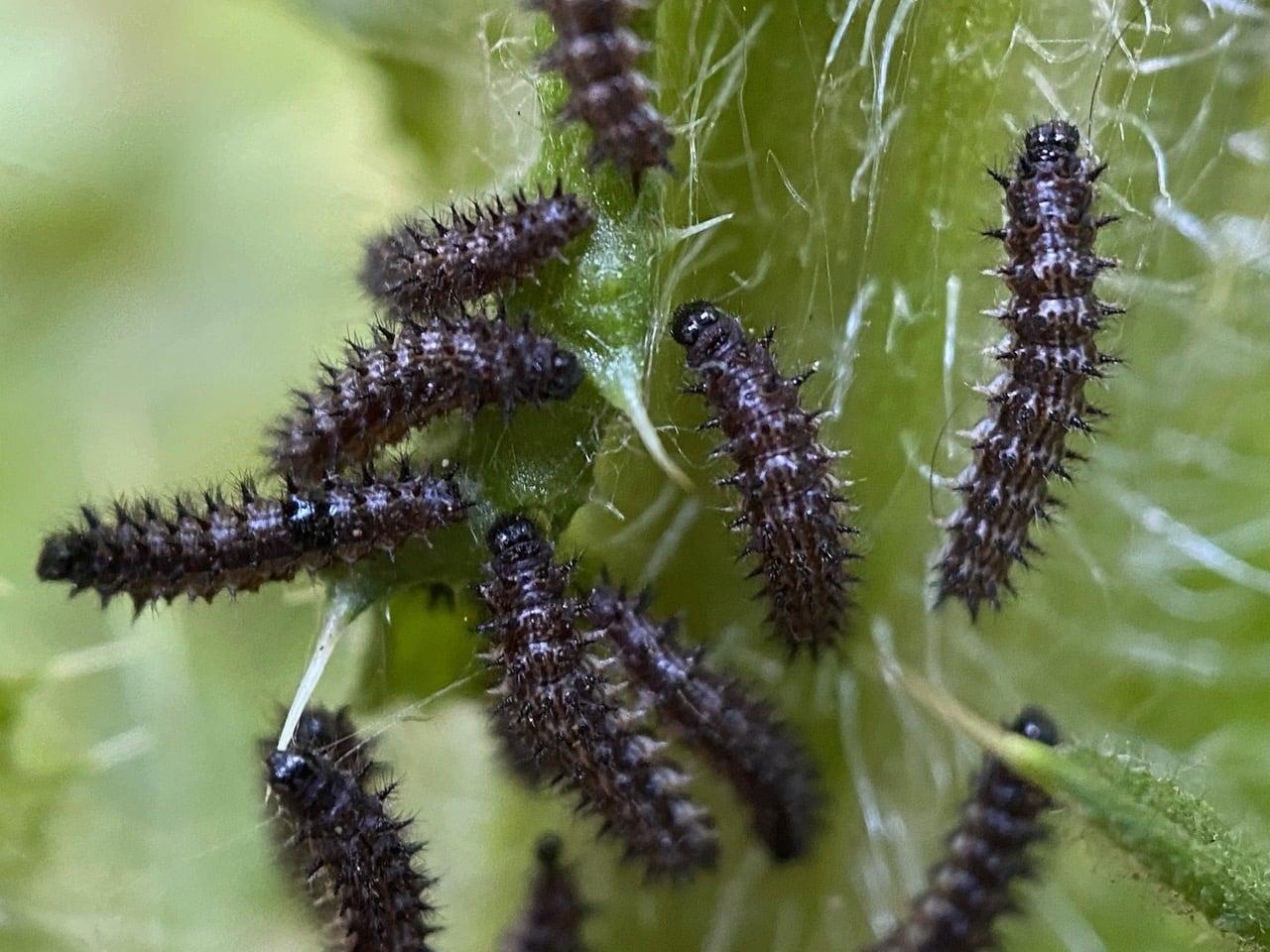

I think these might be very young caterpillars of the Variable Checkerspot, Euphydryas chalcedona (family Nymphalidae). The butterfly uses a wide range of host plants, and the young caterpillars feed in large, loose groups.
The Variable Checkerspot, Euphydryas chalcedona (family Nymphalidae) is found across western North America. The butterfly occupies a wide range of habitats, including sagebrush flats, desert hills, prairies, open forests and alpine tundra. Males perch or patrol around larval host plants to encounter females. Eggs are laid in large groups on underside of leaves of host plants. Host plants include California Bee Plant, Scrophularia californica, and Sticky Monkeyflower, Diplacus aurantiacus. These plants provide the caterpillars with iridoid glycoside, a chemical that imparts unpalatable taste to birds, protecting the caterpillars from predators. Larvae feed in large, loose groups on the host plants. Individuals overwinter (enter diapause or hibernation) as third or fourth instar larvae in sheltered sites under bark or dead branches, in hollow stems and in rock crevices. Pupation begins in early to mid April and the adult flight season begins between mid-April and May and continues into June. The adults feed exclusively on nectar, and have a life span of about 15 days.
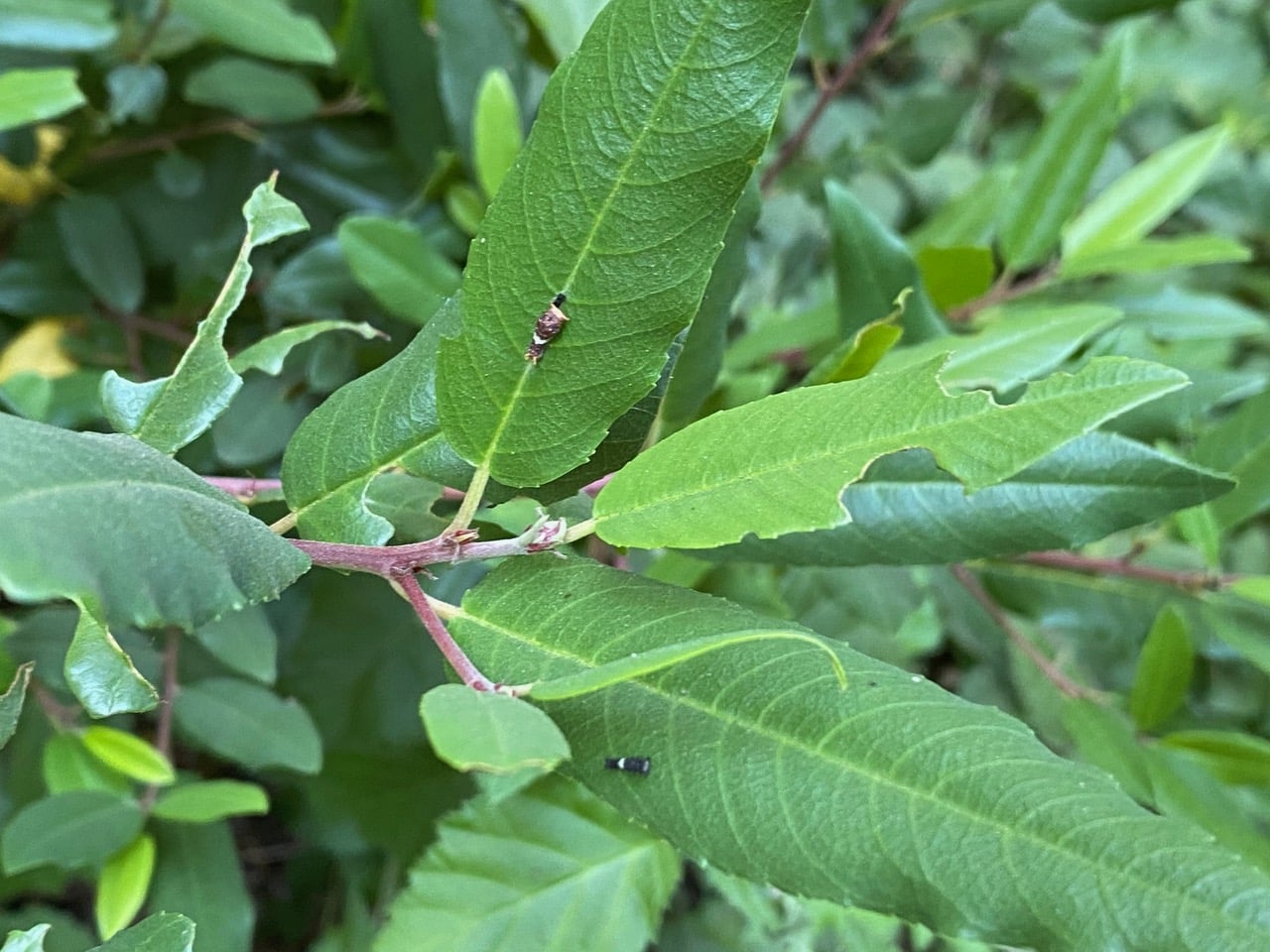
As I approach the end of the paved path, I notice a large shrub of Coffeeberry, Frangula californica with many chewed leaves. Then my eyes spot what appear to be debris on two adjacent terminal leaves of a branch.
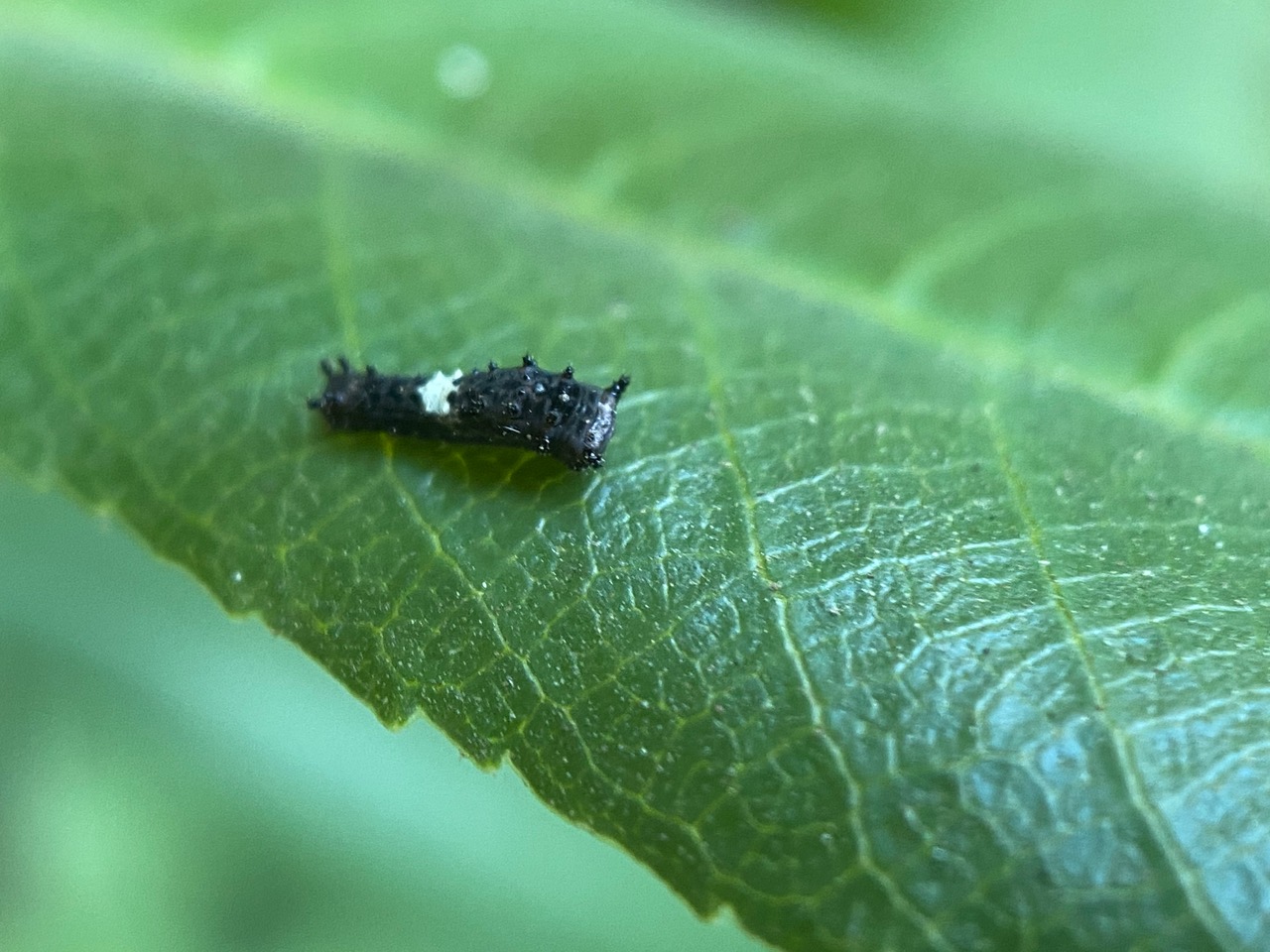
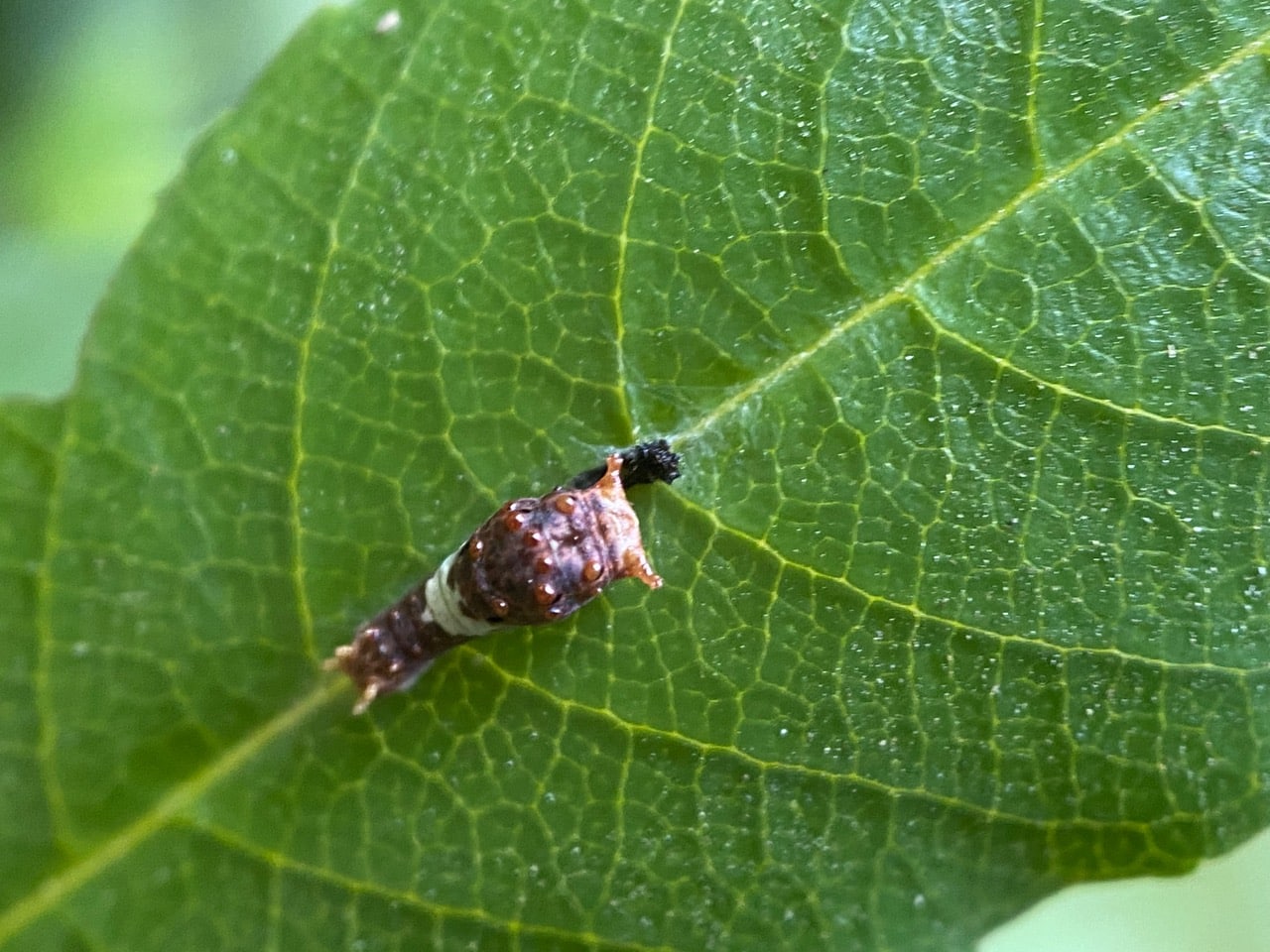
Zooming in on the lower speck, I realize that it is a tiny (first instar?) caterpillar of Pale Swallowtail. It is black with a white patch in its mid section. This is the youngest Pale Swallowtail caterpillar I have ever seen, probably hatched from its egg not too long ago. Coffeeberry is one of the butterfly’s major food plants.
The large speck on the upper leaf turns out to be a slightly older Pale Swallowtail caterpillar. It is brown with numerous shiny bumps on its body, and the characteristic white patch in the mid section. It is resting on its exuvia (old skin shed during a molt) that is black. It must have recently molted! I mark the branch so that I can track the caterpillars’ development in the coming weeks.
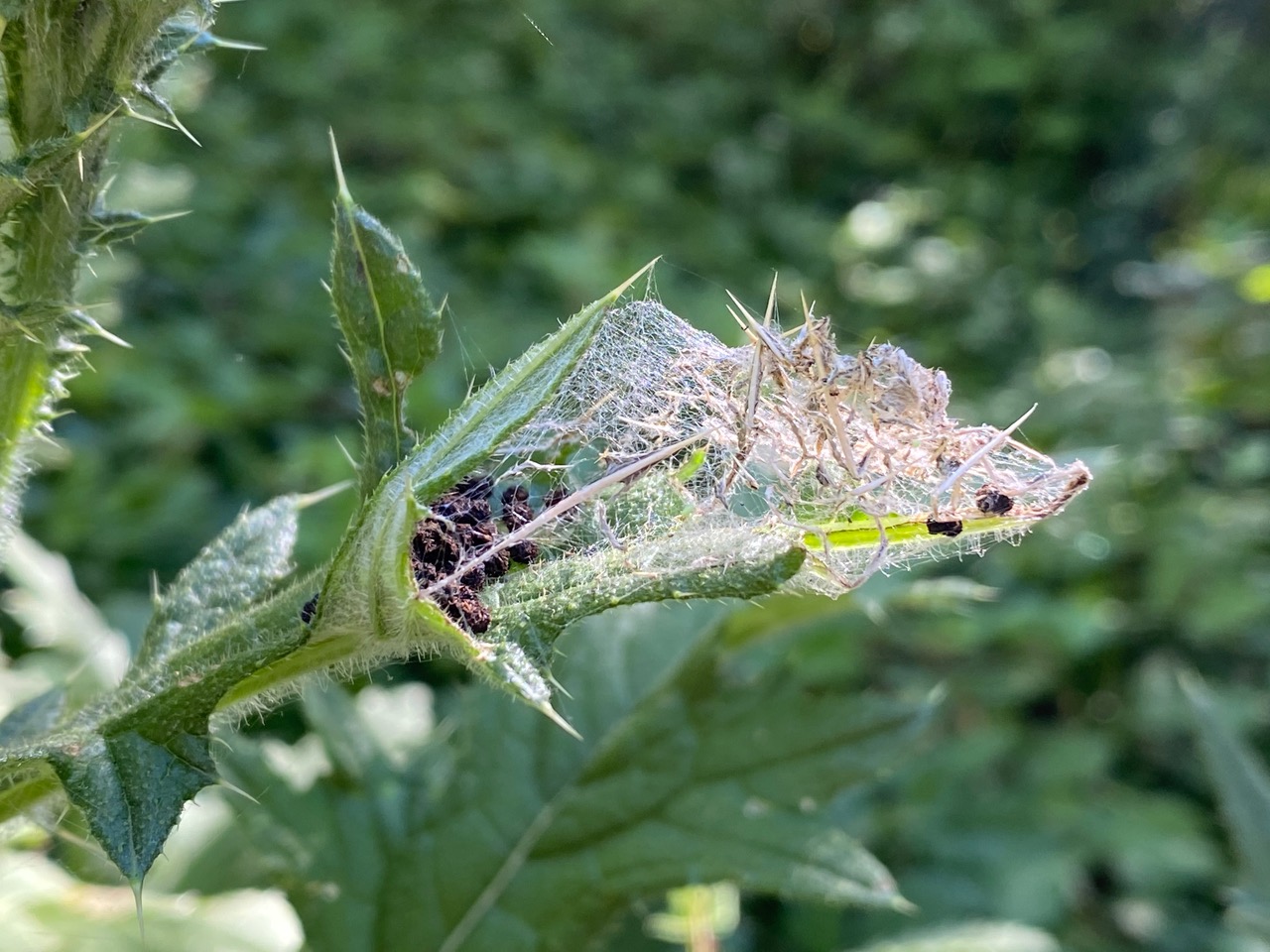
Now, that’s a typical shelter of a Painted Lady caterpillar! It is constructed of silk and plant fibers at the leaf axil of a tall Italian Thistle. The caterpillar is no longer in the shelter within which it has been feeding. Note the pellets of frass (insect poop) left at the bottom of the shelter.
The Painted Lady, Vanessa cardui (family Nymphalidae) is the most widespread of all butterflies. They are found on every continent except Antarctica and Australia. The butterfly also goes by the name thistle butterfly; its scientific name Vanessa cardui means “butterfly of thistle”. Although more than 100 host plants have been recorded for the species, the caterpillars’ favorites include thistles (Asteraceae), hollyhock and mallow (Malvaceae), and various legumes (Fabaceae).
Female Painted Lady butterflies lay eggs singly on the upper side of host plant leaves, sometimes on the thistle flowerheads. When small the caterpillars live for most of the time within a tent of leaves loosely spun together with silk. Only when larger are the larvae more likely to be found feeding outside a leaf tent on the food plant.
Here’s another empty silken retreat of a Painted Lady caterpillar, constructed on a leaf of the same Italian Thistle.
Painted Lady butterflies are known for their distinct migratory behavior. They are an irruptive migrant, meaning that they migrate independently of any seasonal or geographical pattern. The populations that migrate from North Africa to Europe may include millions of butterflies. The distance covered rivals that of the better known Monarch butterflies. The butterflies can cover up to 100 miles per day during their migration; the round trip may take up to 6 successive generations.
In California, the butterflies are usually seen flying from north to north-west. These migrations appear to be partially initiated by heavy winter rains in the desert where rainfall controls the growth of larval food plants. In the spring of 2019, the butterflies migrated by the millions across the state.