

Pollinator Post 7/3/23 (2)
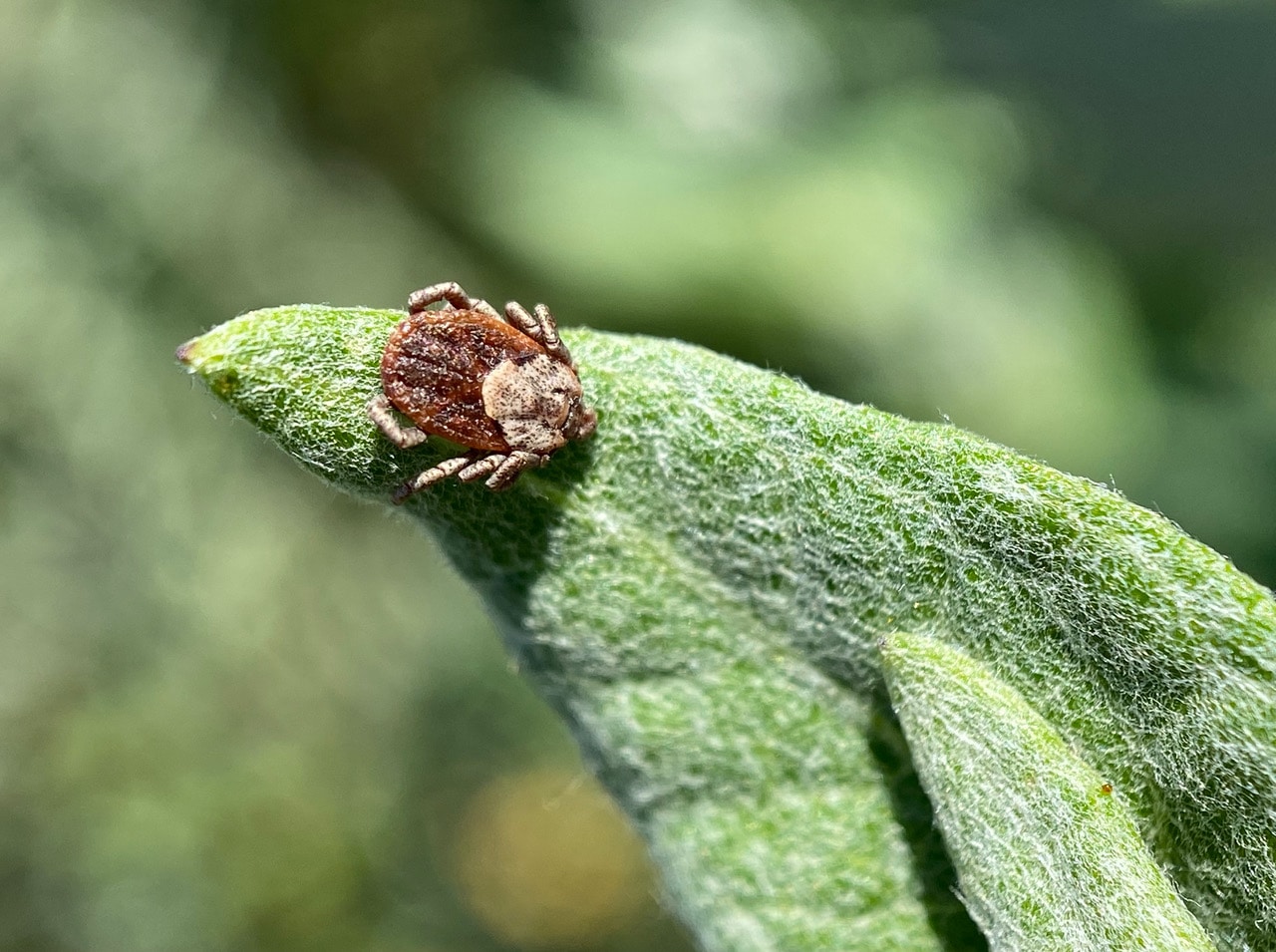
An adult female Pacific Coast Tick, Dermacentor occidentalis (Ixodidae) is resting on the tip of a California Mugwort leaf, Artemisia douglasiana.
This species is widely distributed throughout California. The immature stages feed on rodents, especially squirrels, while the adults prefer large mammals such as cattle, horses, deer and humans.
A new study reported on June 30 in Current Biology suggests that you don’t need to touch a tick for it to latch on to you. The blood-sucking parasites may be able to catapult themselves from vegetation to their hosts thanks to static electricity. Mammals, birds and reptiles carry considerable electrostatic charges – equivalent to voltages of hundreds to tens of thousands of volts. And ticks seem to respond to that. Tick nymphs brought close to various objects charged to voltages encountered in nature frequently whoosh across the gap to land on those surfaces.

A Leafhopper in the palest shade of green is perched on a California Mugwort leaf. In one glance, you can tell it is a Leafhopper, from the neat rows of comb-like spines on its hind legs characteristic of the family Cicadellidae.
Leafhopper is the common name given to true bugs in the family Cicadellidae. The bugs are plant feeders that suck plant sap from grass, shrubs, or trees. Their hind legs are modified for jumping, and are covered with hairs that facilitate the spreading of a secretion over their bodies that act as a water repellent and carrier of pheromones. They undergo partial metamorphosis, and have various host associations, varying from very generalized to very specific.
While sucking the sap of plants, these insects excrete any extra sugar as a sticky liquid commonly called honeydew. This is a serious hazard for small insects, possibly sticking the insect to a leaf, or gluing its body parts together. Some bugs deal with this problem by shooting the waste away from their bodies at high speed. Leafhoppers have a unique solution – they make brochosomes, a proteinaceous material within a special gland in their guts, and secrete them by the billions in a milky anal fluid, and spread them over their bodies using their legs. When the fluid dries, the brochosomes form a powdery coating, and the leafhoppers spread them even further using comb-like hairs on their legs. The brochosomal coat is superhydrophobic, and acts as a water-repellent, non-stick coating protecting the leafhoppers from their own sticky exudates.
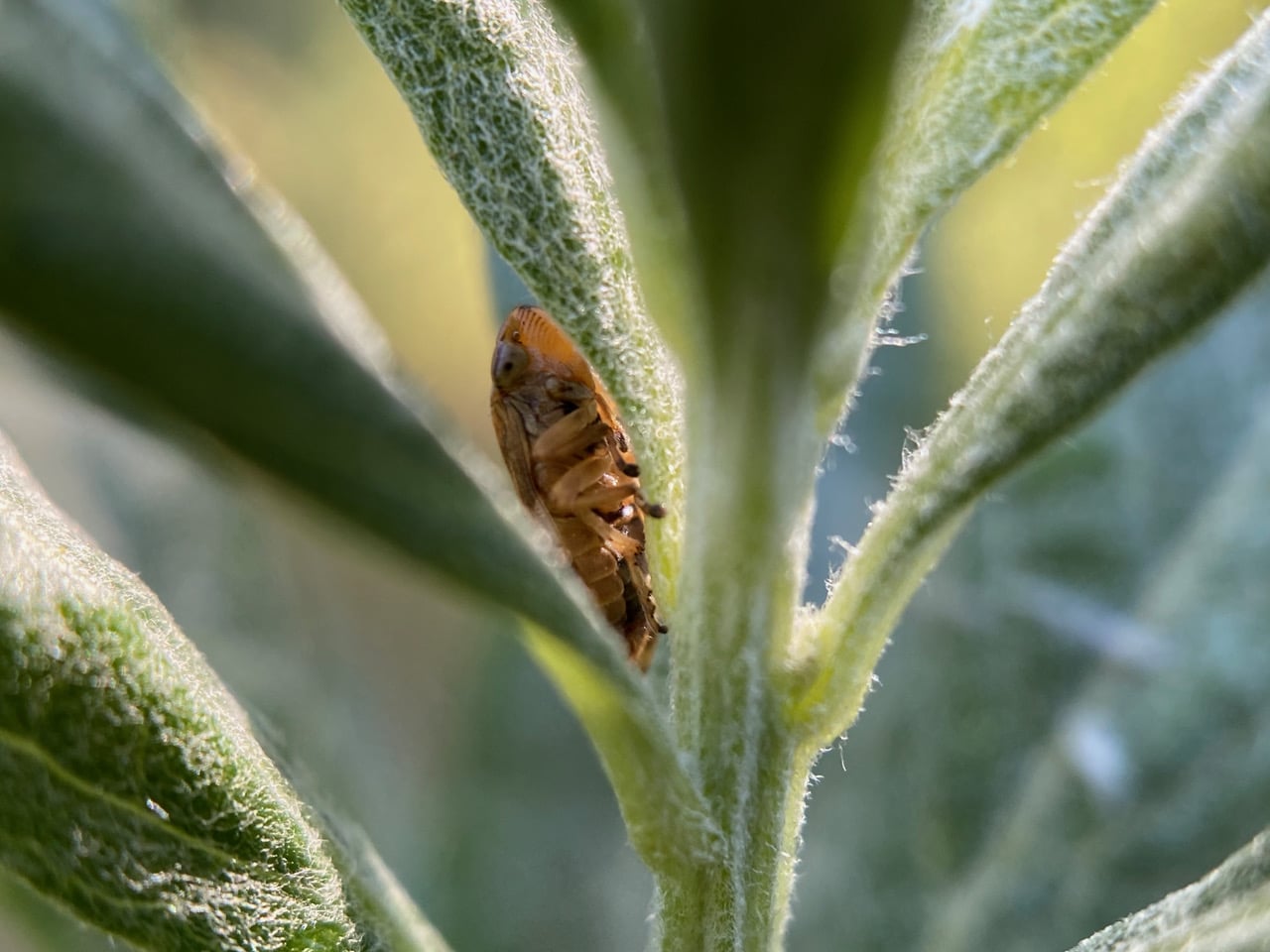
Just a few steps away, another bug is hidden between the leaves of another California Mugwort. It is a Meadow Froghopper, Philaenus spumarius (family Aphrophoridae).
The Froghopper is a “true bug” in the order Hemiptera, family Aphrophoridae. Froghoppers are champion jumpers among insects, out-performing even the fleas. The bug can leap the human equivalent of a skyscraper without a running start! The muscles in its hind legs act like a “catapult” to release energy explosively. Its athletic prowess not withstanding, the Froghopper is better known for its young, the “spittle bugs”. The nymphs produce foamy white masses on plants within which they feed on plant sap. Froghoppers have piercing-sucking mouthparts, and feed on plant sap as both nymphs and adults. A recent report claims, “Froghoppers are the super-suckers of the animal world. The tiny insects produce negative pressures equivalent to people sucking a 100-meter-long straw.” So the little bug has two titles under its belt – champion jumper, and super-sucker!

I tilt the stem to get better light on the Froghopper, fully expecting it to hop away instantly. This does not happen. Instead the insect quietly sidles to the other side of the leaf. This has been my experience with most Froghoppers I have encountered, despite their reputation for their jumping prowess. They are the sweetest, most long-suffering bug with a sad froggy face.

Hey, that’s an adult Plant Bug, Closterocoris amoenus (family Miridae)! All the ones I come across today are adults. The ant-mimicking nymphs I have been seeing over the past month have all transformed into adults! Both the nymphs and adults have the same habit of sitting at the entrance of the Sticky Monkeyflower. Adorable!

Close-up view of the Plant Bug, Closterocoris amoenus (family Miridae). Note the rostrum, the piercing-sucking mouthpart that is folded under its body when not in use.
Mirid bugs are also referred to as plant bugs or leaf bugs. Miridae is one of the largest family of true bugs in the order Hemiptera. Like other Hemipterans, Mirids have piercing, sucking mouthparts to extract plant sap. Some species are predatory. The literature is mum on the dietary habits of Closterocoris.
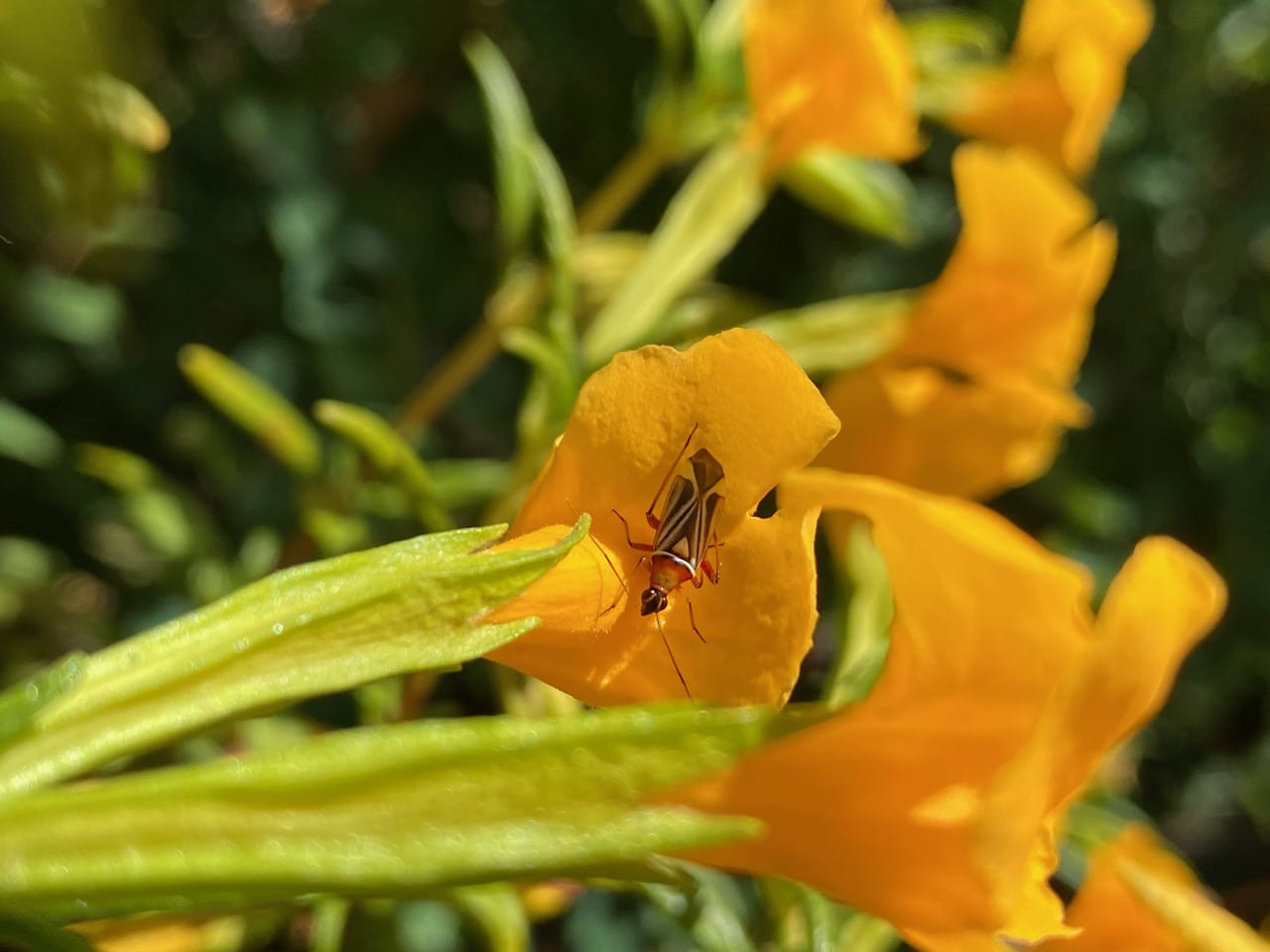
The bug finally runs away. Here’s a view of the whole bug, showing the striking pattern on its back.

A metallic Sweat Bee, Lasioglossum (Dialictus) sp. (family Halictidae) has just landed on a Sticky Monkeyflower.
Lasioglossum are closely related to the genera Halictus and Agapostemon. These genera are commonly called “sweat bees” because of their attraction to human sweat, which they drink for its salt content. Lasioglossum are dusky black to brown slender bees with bands of hair on their abdomen.
Dialictus is a subgenus of Sweat Bees belonging to the genus Lasioglossum. Most of the members of this subgenus have a subtly metallic appearance, and are small, about 3.4-8.1 mm in size. They are commonly found in Northern Hemisphere and are found in abundance in North America. As in the other members of the family Halictidae, the bees have very diverse forms of social structure, making them model organisms for studying the social behavior of bees.

Our Scudder’s Bush Katydid nymphs seem to be growing up. I am seeing increasing color on their body and legs as the days go by.
Scudderia is a genus of katydids in the family Tettigoniidae. They are sometimes called bush katydids and are 30-38 mm in length. They are mostly found in North America. Scudder’s Bush Katydids are herbivores, with nymphs feeding primarily on flowers and adults preferring woody deciduous plants. Eggs are usually laid singly or in a row along the edge of a leaf, with at least the base inserted within the leaf. Eggs overwinter, hatch in spring. There is one generation per year.
Tettigoniidae is a family within the order of “true bugs” or Hemiptera. Members of the order undergo incomplete metamorphosis without a pupal stage. The nymphs, which look like adults, develop through a series of molts, each time getting bigger after shedding their old exoskeleton. At the last molt, they transform into adults with functional wings and reproductive parts.
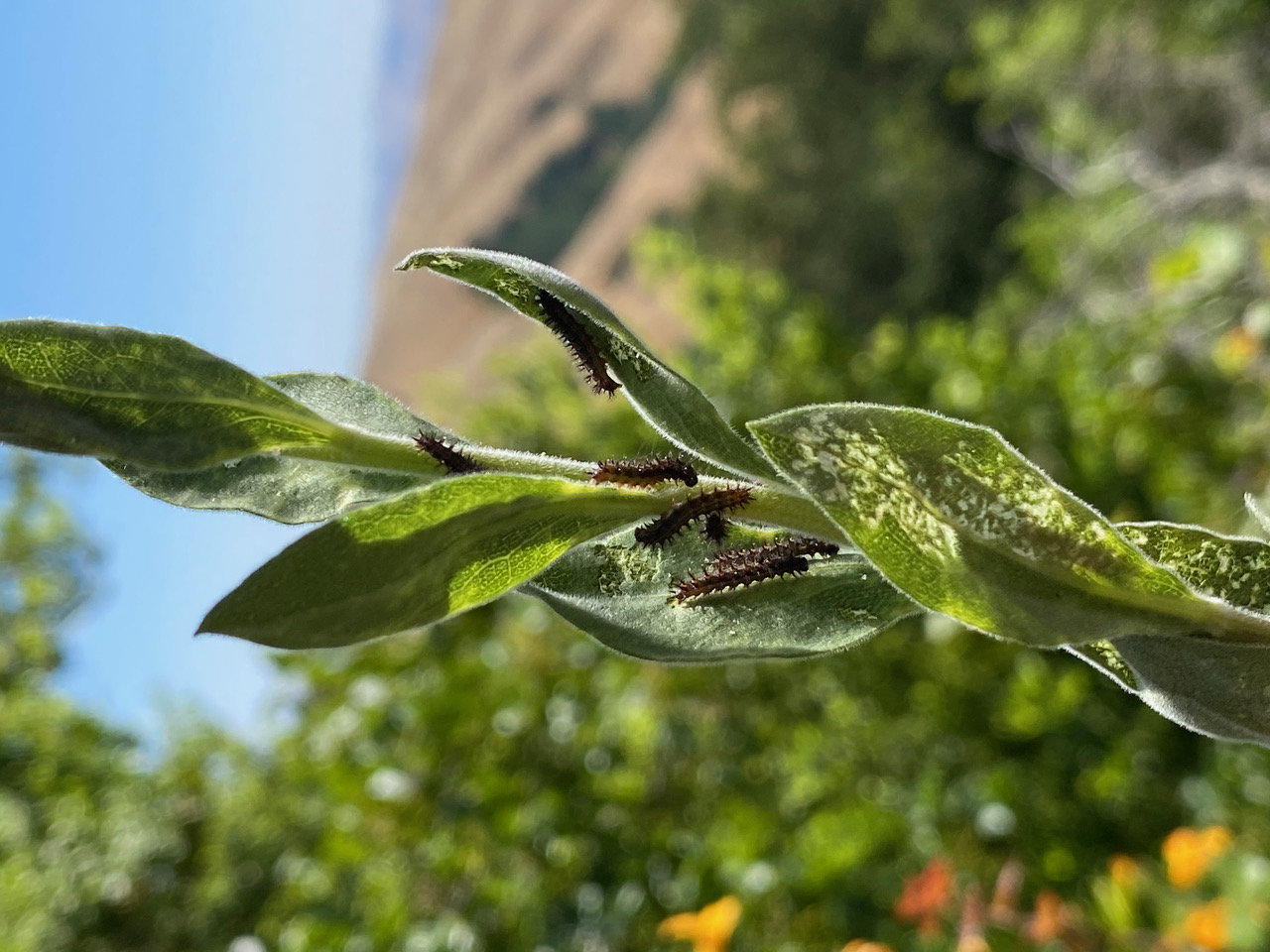
The little black caterpillars on the California Goldenrod, Solidago velutina ssp. californica seem to have spread among neighboring plants, devastating and killing quite a few. The munched leaves curl up around the stem, turn brown and dry up. I never see any caterpillars bigger than this size, so apparently they are a small species (probably of a moth?). I don’t find any cocoons on the plants, so the mature caterpillars probably pupate in the ground or leaf litter? The caterpillar is probably specific to the goldenrod, as I don’t see them on any other plants in the vicinity. The only way to resolve the mystery is to rear these caterpillars to adulthood. But that means having to harvest the plants, which we don’t have that many of here….
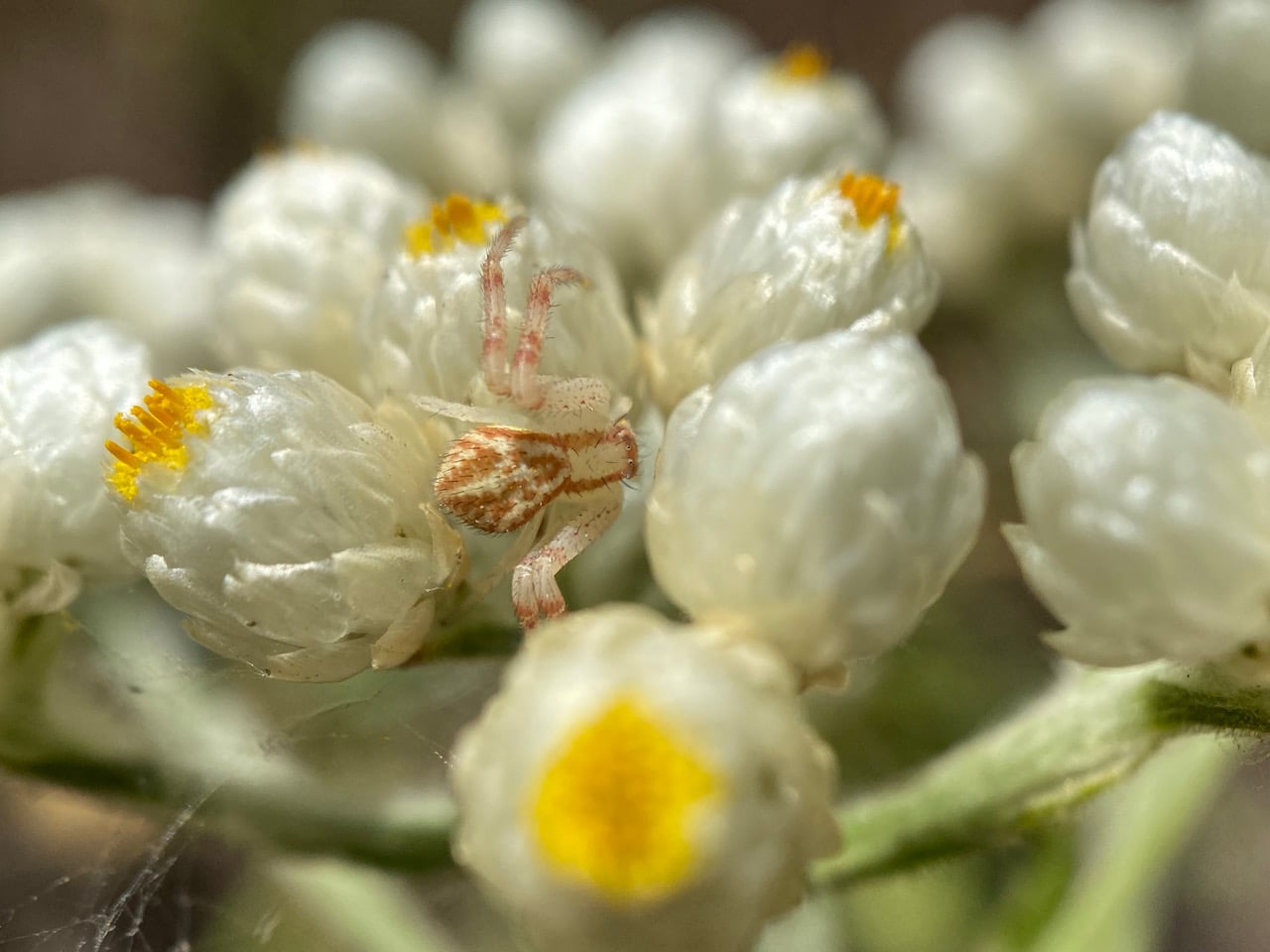
A young Crab Spider, Mecaphesa sp. (family Thomisidae) is waiting in ambush among the blooming flowerheads of California Everlasting, Pseudognaphalium californicum.
Members of the family Thomisidae do not spin webs, and are ambush predators. The two front legs are usually long and more robust than the rest of the legs. Their common name derives from their ability to move sideways or backwards like crabs. Most Crab Spiders sit on or beside flowers, where they grab visiting insects.
Mecaphesa is distinguished from the other genera of Crab Spider by the size and arrangement of the eight eyes (in two curved rows of four). Mecaphesa is also often hairy, with tiny hairs protruding from the head, legs, and body.
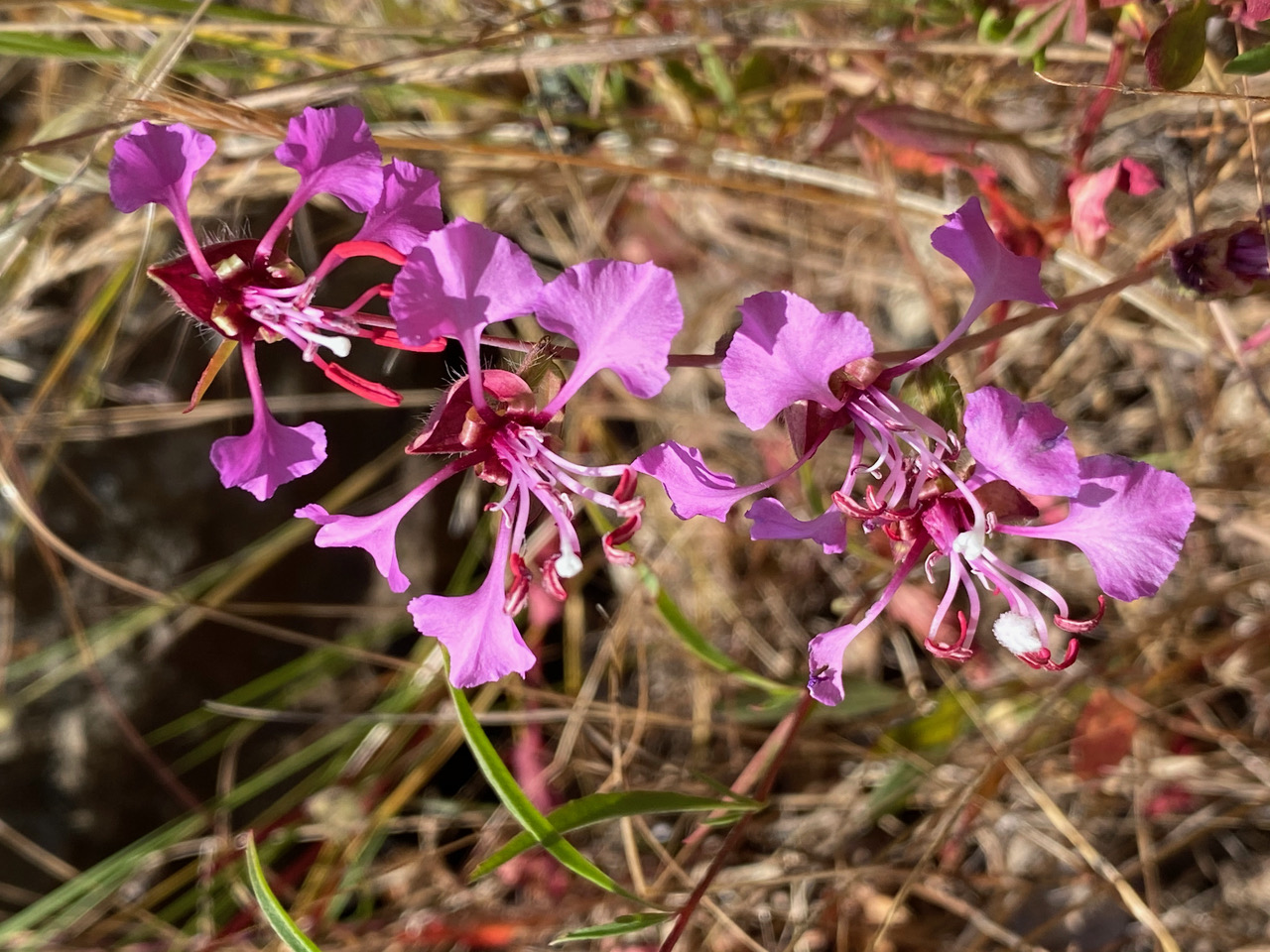
I look up at the steep hillside between Diablo Bend and Yampah Bowl, and see many pink flowers among the dried grass. Some, with bigger flowers are obviously the Farewell-to-Spring, Clarkia rubicunda. The others are harder to discern. Then, right by the trail I find a single plant of the Elegant Clarkia, Clarkia unguiculata. Ah, this is what is giving the pink show up there!
I am delighted to see the Elegant Clarkia because historically it has occupied a prominent place in the study of pollination. It displays a pollination strategy involving flowers with two distinct sets of anthers that differ in color, size, and position. The phenomenon, called heteranthery has puzzled Charles Darwin to his dying days. In 2021, a research team at UCSC showed that heteranthery in Clarkia is a way for flowers to gradually dole out their pollen to bees over multiple visits as the anthers open at different times.
There are about 41 species of Clarkia in California, and about half of them have two types of anthers. These tend to be pollinated by specialized species of native solitary bees. In the heterantherous clarkias, an inner whorl of shorter stamens stands erect in the center of the flower, and matures early, releasing its pollen first. An outer whorl of longer anthers lies back against the petals until after the inner anthers have opened. The outer anthers then move toward the center of the flower and begin to release their pollen gradually. A few days later, the stigma becomes erect and sticky, ready to receive pollen from another flower.
This plant I find by Skyline Trail has a series of four flowers in bloom, the oldest at the bottom, and the youngest on top. As in all clarkias, these flowers are protandrous, the male parts maturing before the female parts. The top two flowers are in their male phase, and the bottom two in their female phase.

Here’s a closer look at the two top flowers, both in the male phase. There is a total of eight stamens in the flower, four short in an inner whorl and four long in an outer whorl. The long anthers are colored red and they open up to offer pollen later than the short anthers. In the youngest flower on the top, the shorter anthers have split open to release pollen, while the longer, red anthers have yet to open up. On the lower flower, all the eight anthers are releasing pollen. Note that as the flower matures, the long anthers converge on the white stigma in the middle of the flower, almost touching it.
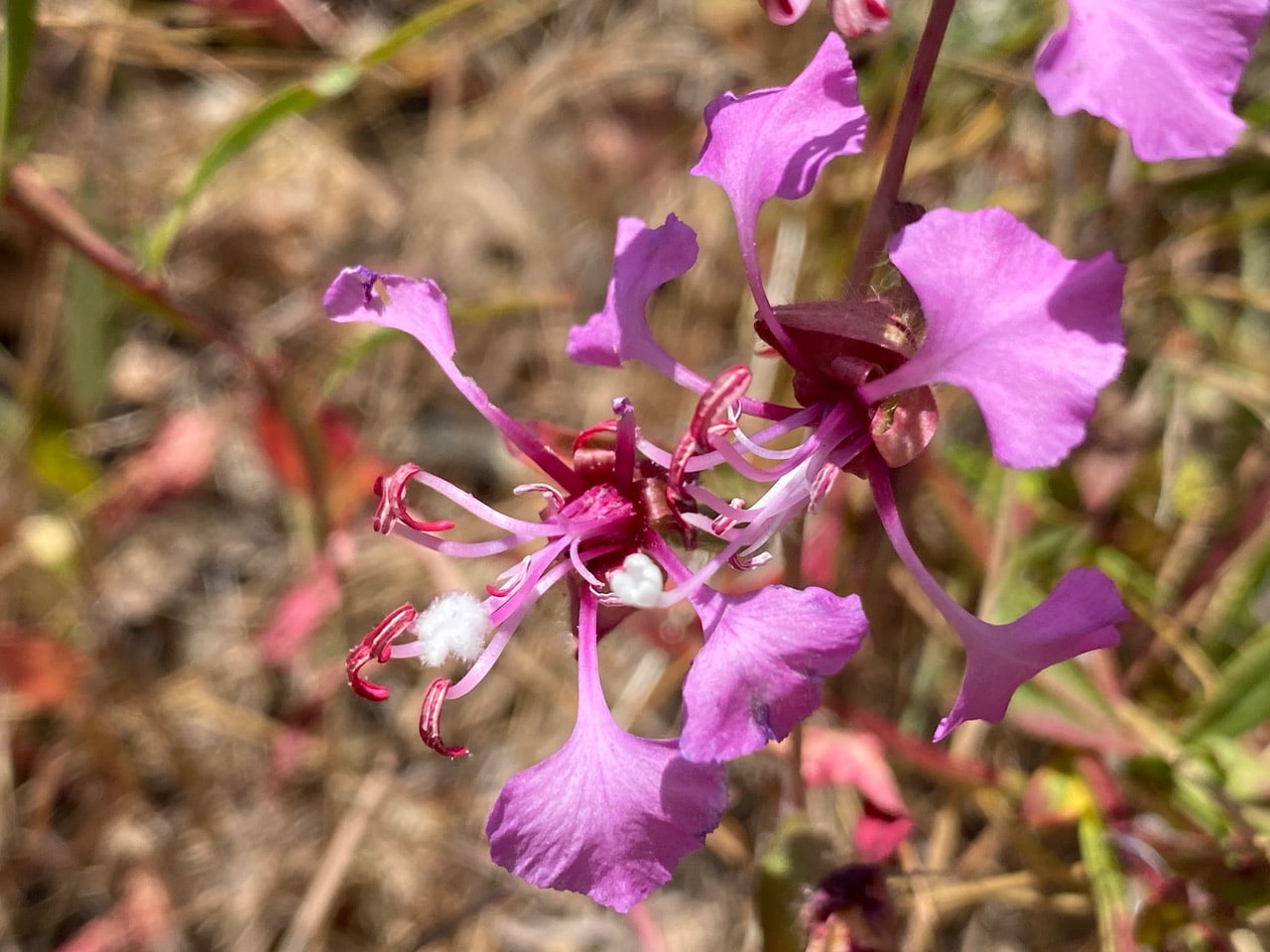
Here are the two bottom, older flowers in the female phase. Note that there’s hardly any pollen left on the anthers. The four lobes of the white stigmas have unfurled to receive pollen. Note also that the long anthers are at the same level as the stigmas.
While the conclusion of the UCSC team may be correct, it fails to explain several of the other features of the clarkia flower. Why are there two different types of pollen from the distinct anthers? Maybe they are qualitatively different besides having different colors? Why do the long anthers converge towards the center of the flower as they mature, almost touching the stigma as they release their pollen? I hazard a guess that the second set of anthers is a way to ensure self-pollination in case cross-pollination by the bees have failed. After all, self-pollination is better than no pollination at all.

Hey, that’s an unfamiliar hover fly visiting the Sticky Monkeyflower! The dusky appearance is similar to that of the Sedgesitter, Platycheirus sp., but the abdominal pattern is distinct!
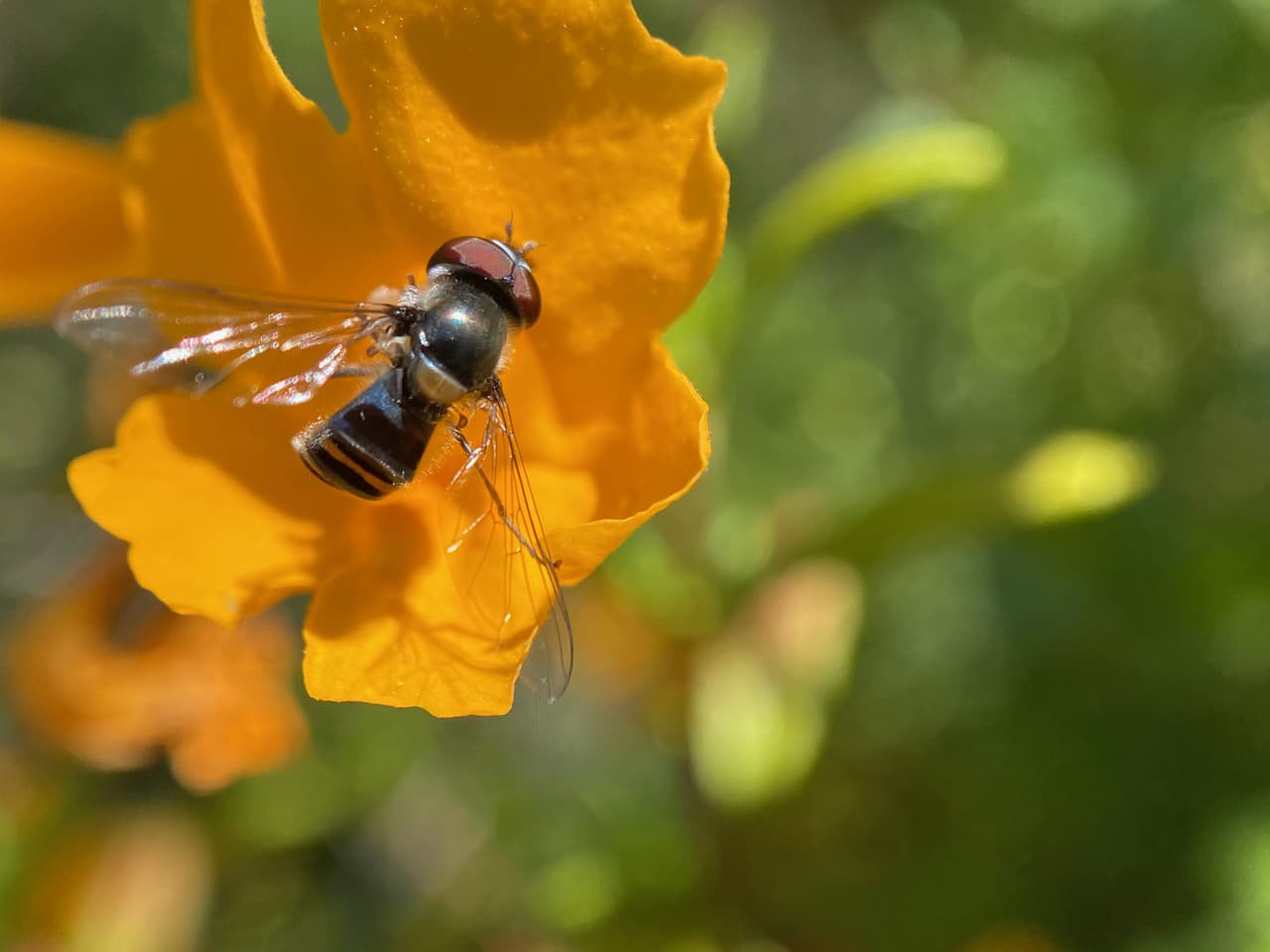
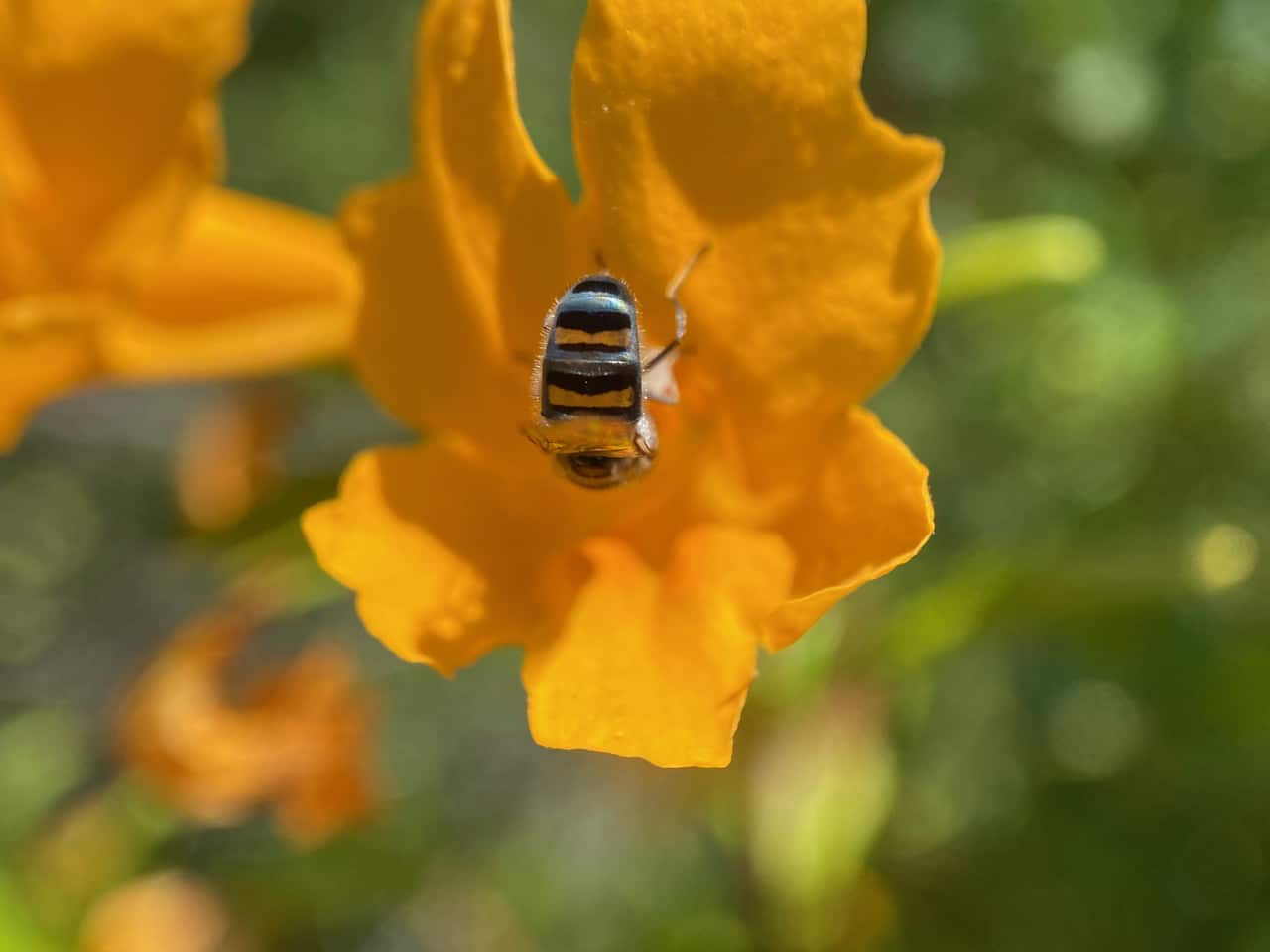 As the abdomen catches the light, it flashes bands of silver!
Two hover fly experts from iNaturalist have identified the fly – the Silver-banded Hover Fly, Pseudoscaeva diversifasciata (family Syrphidae).
Yay, another new species for Skyline Gardens and for me! Unfortunately there’s hardly any information out there on the natural history of the species. Since it is in the subfamily Syrphinae, I would assume that the larvae are aphidophagous (feeding on aphids)?
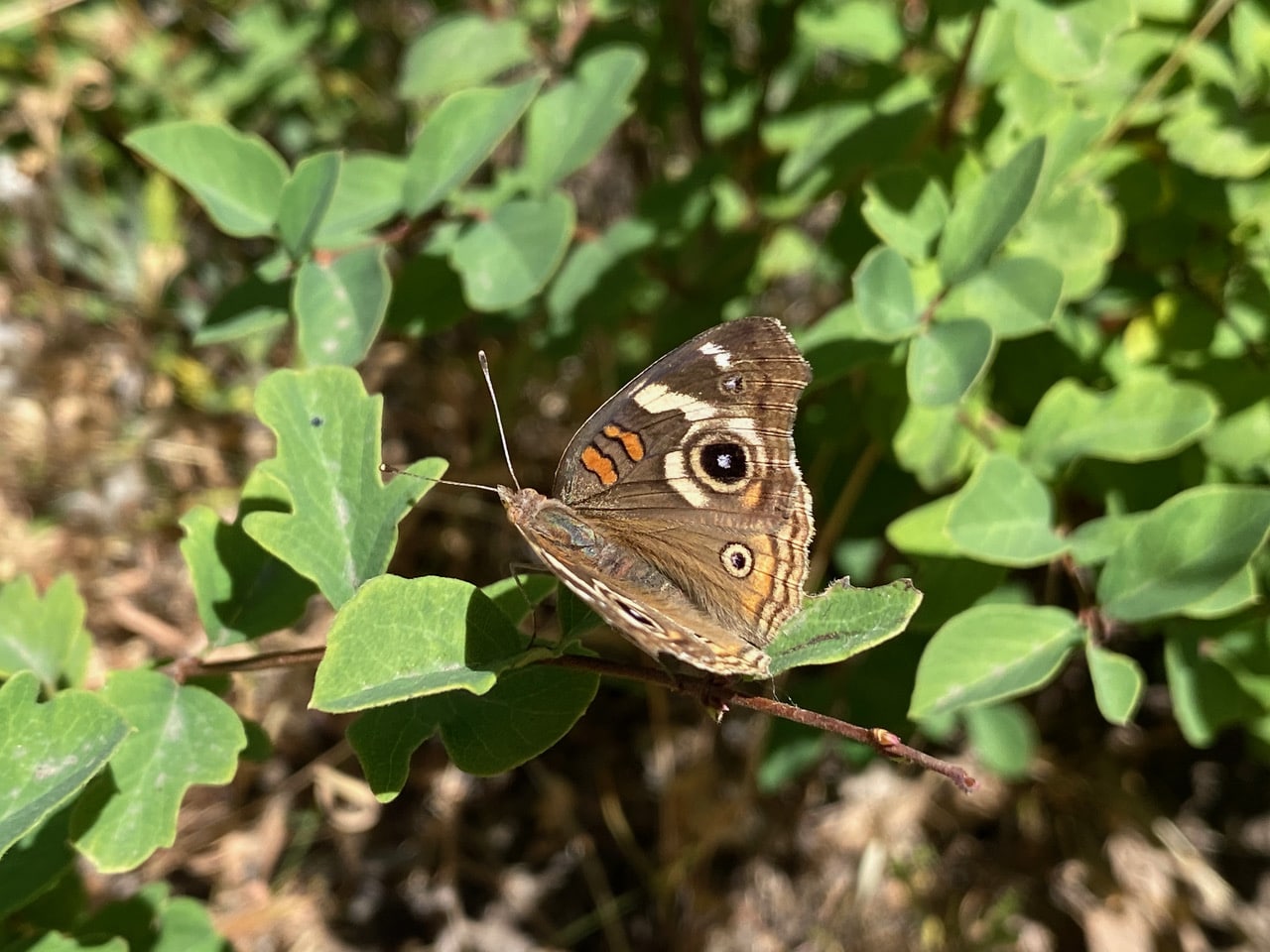
As I head back towards Siesta Gate, a Common Buckeye butterfly flits in front of me, occasionally stopping on the Narrowleaf Plantain on the side of the trail. Ah, it must be a female looking to lay her eggs! She finally comes to rest on a sprig of Snowberry where this picture is taken.
Named for its conspicuous target-shaped eyespots, the mainly brown Common Buckeye is readily identifiable. The butterfly favors open, sunny areas with low vegetation and some bare ground. Males perch during the day on low plants or bare ground to watch for females, flying periodically to patrol or to chase other flying insects. Females lay eggs singly on leaf buds or on upper side of host plant leaves. Caterpillars feed on a variety of plants including the narrowleaf plantain (Plantago lanceolata).
Narrowleaf Plantain is native to Eurasia, but has been introduced to North America where it now thrives in dry meadows and open, disturbed areas. The plant is a rosette-forming perennial herb that contains the iridoid glycosides aucubin and catalpa. These compounds make the plant inedible to some herbivores, but others are unperturbed by them – for example, the Buckeye butterfly, Junonia coenia (family Nymphalidae) whose larvae eat the leaves and sequester the iridoid glycosides, rendering themselves unpalatable to predators. Females are able to detect the iridoid glycosides and prefer to lay their eggs on leaves that contain higher levels of the chemicals.