

Pollinator Post 7/29/26 (1)

I arrive early at Crab Cove and head straight to the spit stretching into Ballena Bay to check on the blooming Oregon Gumweed, Grindelia stricta growing by the water. The sky is heavily overcast, and there’s hardly any insect in flight.

This male Summer Longhorn Bee, Melissodes sp. (family Apidae) is still asleep on a Grindelia flowerhead.
The Summer Longhorn Bees, Melissodes sp. (family Apidae) are medium to large bees, stout-bodied, usually with gray hair on the thorax and pale hair bands on the abdomen. Males usually have yellow markings on their faces and have very long antennae from which their common name is derived. They are active May to September, with peak flight in late June to early August. The females prefer flat, bare ground for digging their solitary nests, though they sometimes nest in aggregations. Pollen is transported in scopae on the hind legs. Pollen loads are often copious and brightly colored and thus very distinguishable. Melissodes are specialists on Asteraceae – females gather pollen from flowers of Aster, Bidens, Coreopsis, Cosmos, Encelia, Gaillardia, Helianthus, and Rudbeckia ssp.
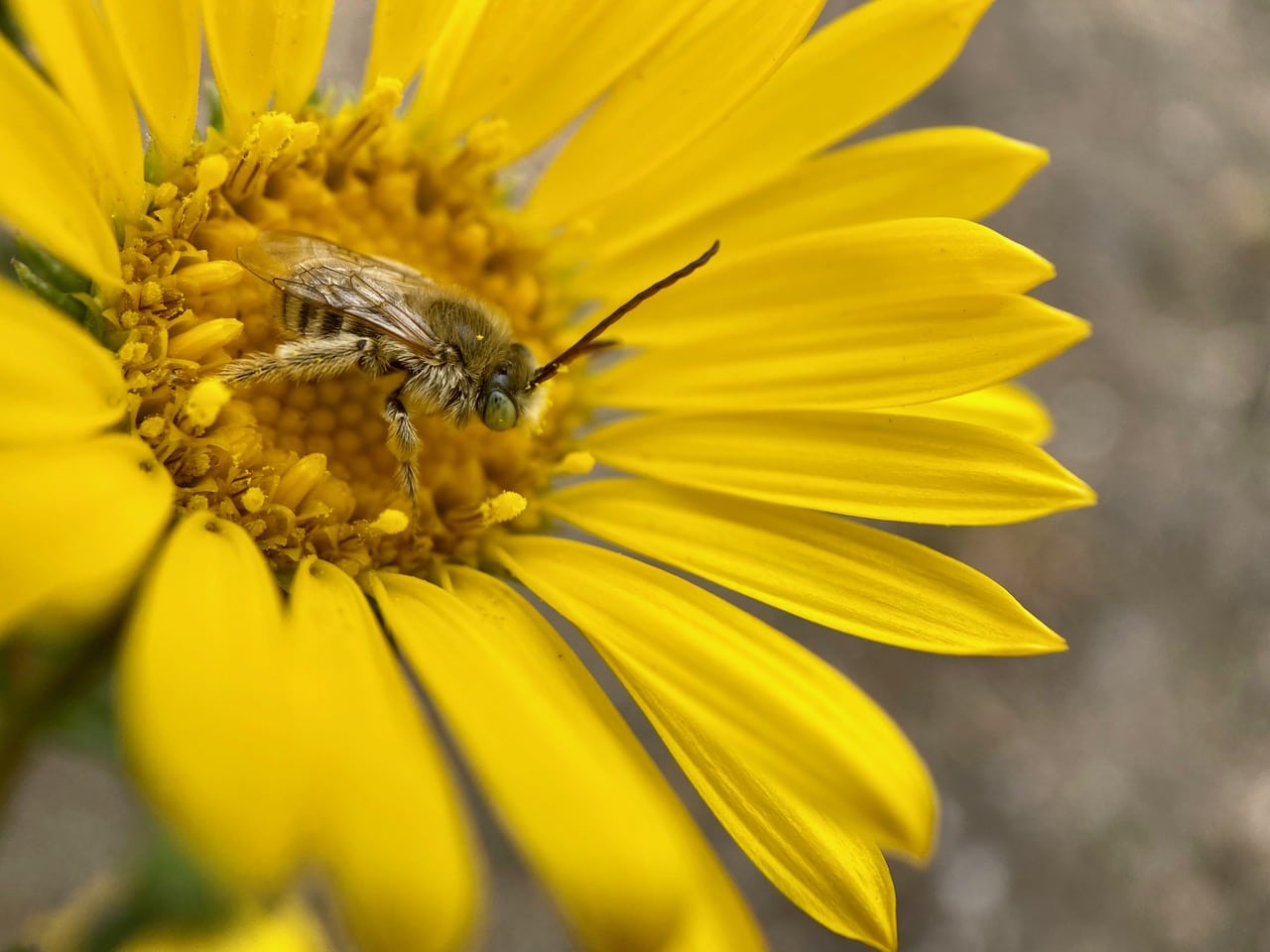
As I inch forward for a close-up shot, the bee does not flinch. Bees sleep with their eyes wide open because they don’t have eyelids.
Because male bees do not participate in nest construction, they do not have a home to return to at the end of the day. Instead, they spend their nights sleeping outdoors, often hanging onto or curled up inside flowers, under petals, or on tall vegetation. Sleeping on or near Grindelia flowers allows the male Melissodes to stay close to food sources and potential mates. They are often found sleeping in aggregations, purportedly for safety. But so far I have not seen this behavior on the Grindelia flowerheads around here.

Here’s another male Longhorn Bee on his bed of Grindelia flowers. Unlike bumble bees that sleep with droopy antennae, Melissodes males somehow manage to keep their long antennae perky while snoozing.
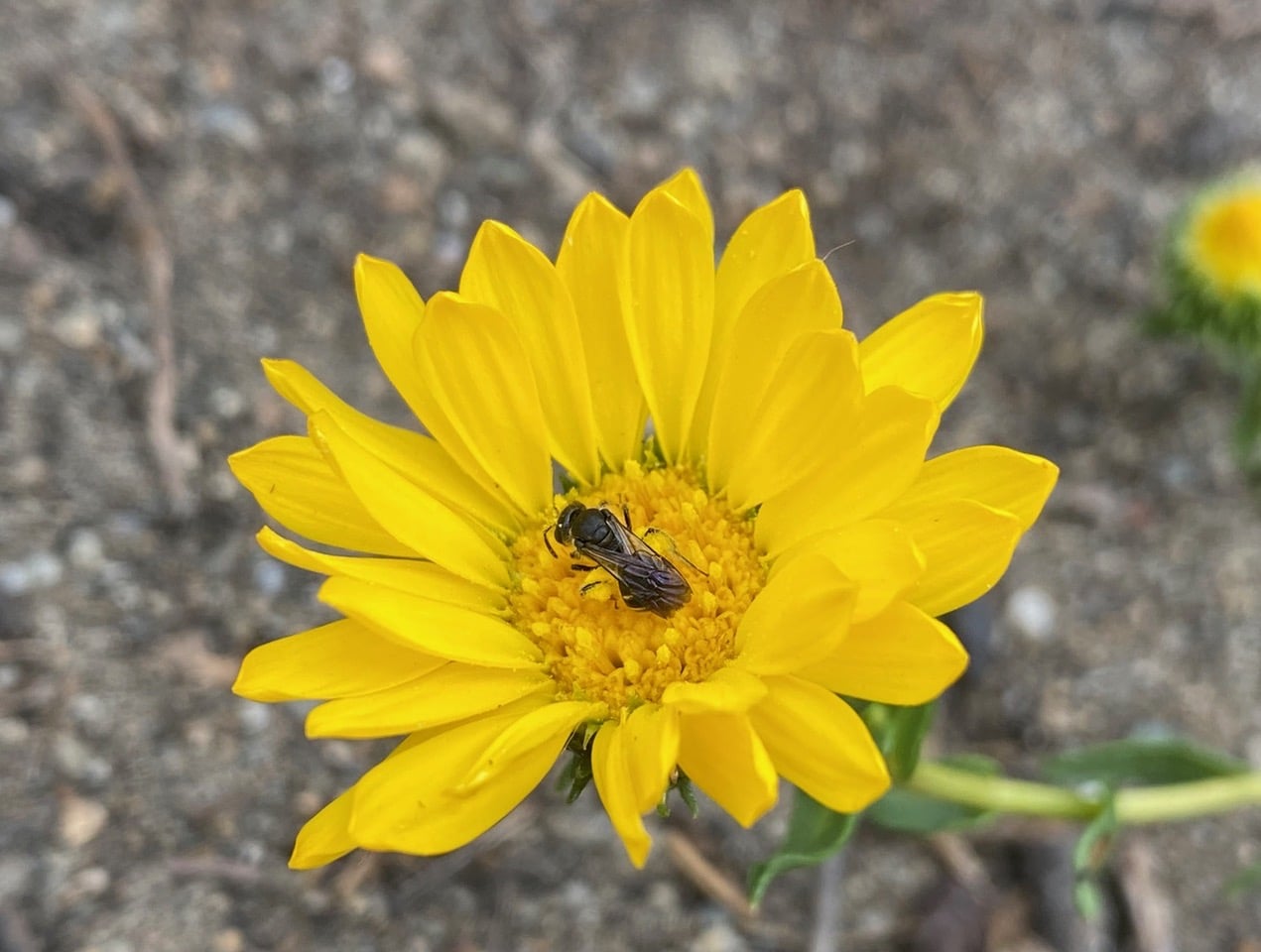
Ooh, this little black bee is already actively foraging. Note the bulging load of pollen on the scopae of her hind legs. With a jet-black body, smoky black wings, and faint white bands on the abdomen, she is easily recognized as the Kincaid’s Sweat Bee, Lasioglossum kincaidii (family Halictidae).

Sweat Bees (family Halictidae) earn their nickname from their habit of landing on skin to sip salty minerals from human sweat. Lasioglossum species are found worldwide, and they constitute the largest bee genus. The majority of Lasioglossum are generalists. Because they are so abundant throughout the flowering season, the bees are often important pollinators. Their sheer numbers are enough to achieve excellent pollination of many wild flowers, especially of plants in the Asteraceae, which have shallow floral tubes that are easily accessed by these minute bees.
Lasioglossum exhibit a range of social behaviors; the genus includes solitary, communal, semi social, primitively eusocial, and even parasitic species. Almost all Lasioglossum in the U.S. nest in the ground. Generally these nests are built in the spring by fertilized females (called foundresses) that spent the winter in hibernation. In social species, the foundresses behave much like the queen bumble bees – they lay the first batch of eggs that develop into the first generation of female workers. The nest grows with each additional generation of bees. Later broods may consist of both males and females. They mate, and at the end of the season the fertilized females hibernate till the following spring, repeating the life cycle of the colony.
Kincaid’s Sweat Bee, Lasioglossum kincaidii is a small, jet-black solitary bee with black smoky wings and faint white bands on the abdomen. Widely found in urban/suburban gardens and natural habitats in California, they are highly active foragers that emerge as early as spring to pollinate smaller flowers. The bees are polylectic generalists, meaning they will visit a wide variety of flora, and are especially fond of smaller flowers. Like most sweat bees, they are ground-nesting.

As the sun peeks through the clouds, the Longhorn bees begin to stir and fly around. This one is taking Grindelia nectar for breakfast. While the bees can take nectar from any flower, the males tend to hang around the Grindelias, waiting for the females to arrive. Female Melissodes are pollen specialists on members of the sunflower family, collecting pollen only from Asteraceae. The Melissodes populations along the Alameda coast are heavily dependent on Grindelia.

A few male Fine Striped Sweat Bees, Agapostemon subtilior (family Halictidae) are already flying around, playing tag and bumping each other off perches.
The genus Agapostemon is widespread and abundant throughout North America. They are most diverse and abundant in temperate regions and southwestern U.S. deserts. Agapostemon are commonly called “sweat bees” because they are closely related to, and resemble bees in the Halictus and Lasioglossum genera. Unlike those bees however, Agapostemon are not attracted to human sweat.
Agapostemon are brightly colored metallic green or blue bees measuring 7 to 14.5 mm long. Most species have a metallic green head and thorax, and black-and-yellow striped abdomen; some females are entirely bright green or blue. Females carry pollen on scopal hairs located on their hind legs. Agapostemon are ground-nesters and generalist foragers. Like other members of the family Halictidae, they are short-tongued and thus have difficulty extracting nectar from deep flowers. Males are often seen flying slowly around flowers looking for females. The bees favor flowers with high densities. They are active summer through fall.

A female Fine Striped Sweat Bee, Agapostemon subtilior (family Halictidae) is foraging on a Grindelia flowerhead. Note where she carries the pollen she has collected – on the underside of her abdomen as well as on the scopae of her hind legs.
The Fine Striped Sweat Bee, Agapostemon subtilior is a small, widespread species found across North America. They are active from late spring to fall, with all-green females measuring roughly 11 mm, and males (slightly smaller) displaying a black-and-yellow striped abdomen. Like other Agapostemon bees, they are solitary ground-nesters, and are polylectic, foraging from a wide variety of flowers.
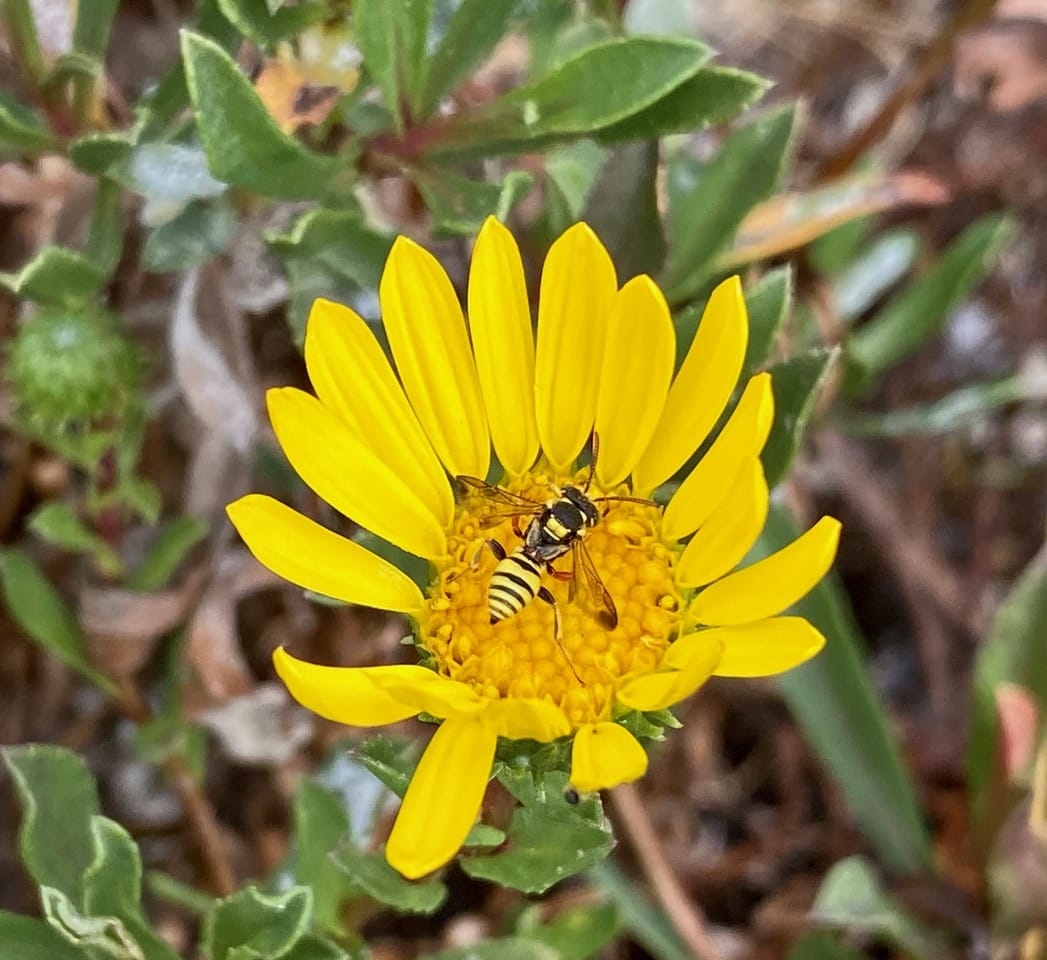
Ooh, a Mason Wasp? No, that’s actually a cuckoo bee in the genus Nomada (family Apidae).
Nomad bees are a group of wasp-like bees that survive by exploiting the hard work of other solitary bees. They are wasp-like in appearance, do not collect pollen and are virtually hairless. Their name Nomada is derived from the Greek word meaning “wandering”. All Nomad Bees are kleptoparasites or “cuckoo bees” that lay eggs in the nest of other bees, especially Mining Bees (genus Andrena).

On a sunnier day, the eyes of the Nomad Bee would be a mottled grayish-blue.
Female Nomad Bees detect a host nest by scent and visual cues, and wait until the nest is unoccupied. She then enters the nest burrow and lays an egg in an unsealed nest cell. When it hatches, the larva kills the host egg or larva, and proceeds to feed on the pollen/nectar food store of the host. In the following year, the Nomad Bee will emerge as an adult and the process repeats.
While we might take offense at the cuckoo bees’ parasitic lifestyle, their presence in the garden is actually an indicator of a good population of the host species – something to celebrate!

Ooh, we know who that is half-hidden in the Grindelia flowerhead – the familiar Spotted Cucumber Beetle, Diabrotica undecimpunctata (family Chrysomelidae).
The specific epithet undecimpunctata is a Latin-derived biological term that means “eleven-spotted”. Native to North America, the Spotted Cucumber Beetles are generalist feeders, consuming a wide variety of foods, although they have a preference for cucurbits (plants in the gourd family), causing damage to crops in the larval as well as adult stages of their life cycle. Larvae, sometimes known as rootworms feed on the roots of emerging plants. In the adult stage the beetles cause damage by eating the flowers, leaves, stems and fruits of the plant.
Various birds, mammals, and amphibians feed on the spotted cucumber beetle, while the beetle’s eggs are targeted by spiders, ground beetles, ants, and crickets.
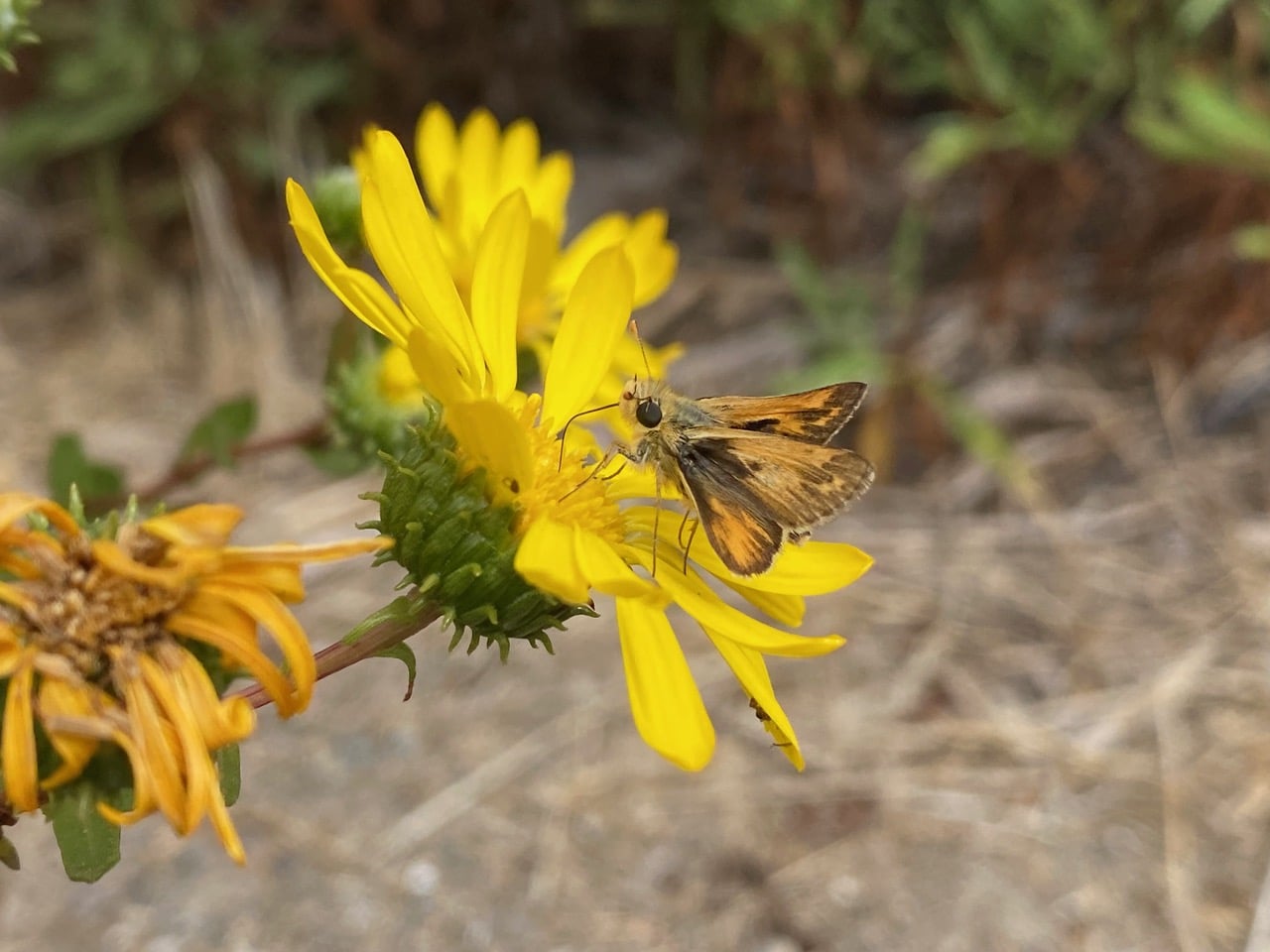
A Skipper butterfly has alighted on a Grindelia flowerhead to take nectar. iNaturalist has helped identify it as a Field Skipper, Atalopedes campestris (family Hesperiidae).
Skippers are a family, the Hesperiidae, of the order Lepidoptera (butterflies and moths). They are named for their quick, darting flight habits. Most have the antenna clubs hooked backwards like a crochet hook. They also have generally stockier bodies and larger compound eyes than the other butterflies. Their wings are usually small in proportion to their bodies. When at rest, skippers keep their wings usually angled upwards or spread out, and only rarely fold them up completely. Californian species are mostly “grass skippers” in the subfamily Hesperiinae. They are usually orange, rust, or brown in color and have pointed forewings. Hesperiinae larvae feed on many different types of grasses, sedges and palms.
Grass Skipper caterpillars are usually green or brown, sometimes yellowish, never brightly colored. They have a distinctive “collar”, a narrow ring around the body right behind the head. Caterpillars are camouflaged and often hide during the day. Many species make nests of leaves and silk for additional protection. Most North American species feed on grasses, but some common species eat shrubs and trees, especially in the bean family. Most species are limited to a single group of food plants. Adult skippers are only active during the day, but Skipper caterpillars feed mainly when it is dark or partly light.
The Field Skipper, also known as Sachem, is common in the southern United States ranging south through central to south America. During the warmer months, it can be found in northern parts of North America. The Field Skipper has expanded its range northward rapidly during the beginning of the 21st century. This expansion is attributed to the winter warming trend of climate change. The butterfly is found in open, disturbed areas such as roadsides, lawns, pastures, parks, and landfills. Larval host plants include a variety of native and non-native grasses.

What a delightful surprise! It’s a Short Sun-digger Bee, Anthophora curta (family Apidae).

The Short Sun-digger Bee, Anthophora curta is a species of solitary, ground-nesting bee native to North America. It is well-adapted to dry, desert-like environments and arid regions, and it frequently inhabits gardens and open sandy areas throughout the western United States. They are relatively small species of Anthophora, (subgenus Micranthophora), but feature distinct large heads that give them a slightly comical, stuffed-toy appearance. They are well covered with small, short, densely branched hairs. They have prominent milky greenish-blue eyes, and a profusion of fuzz on the head and thorax. The bees are highly active and fast flyers, preferring to forage on composite flowers (family Asteraceae). Females carry pollen on scopae on their hind legs.
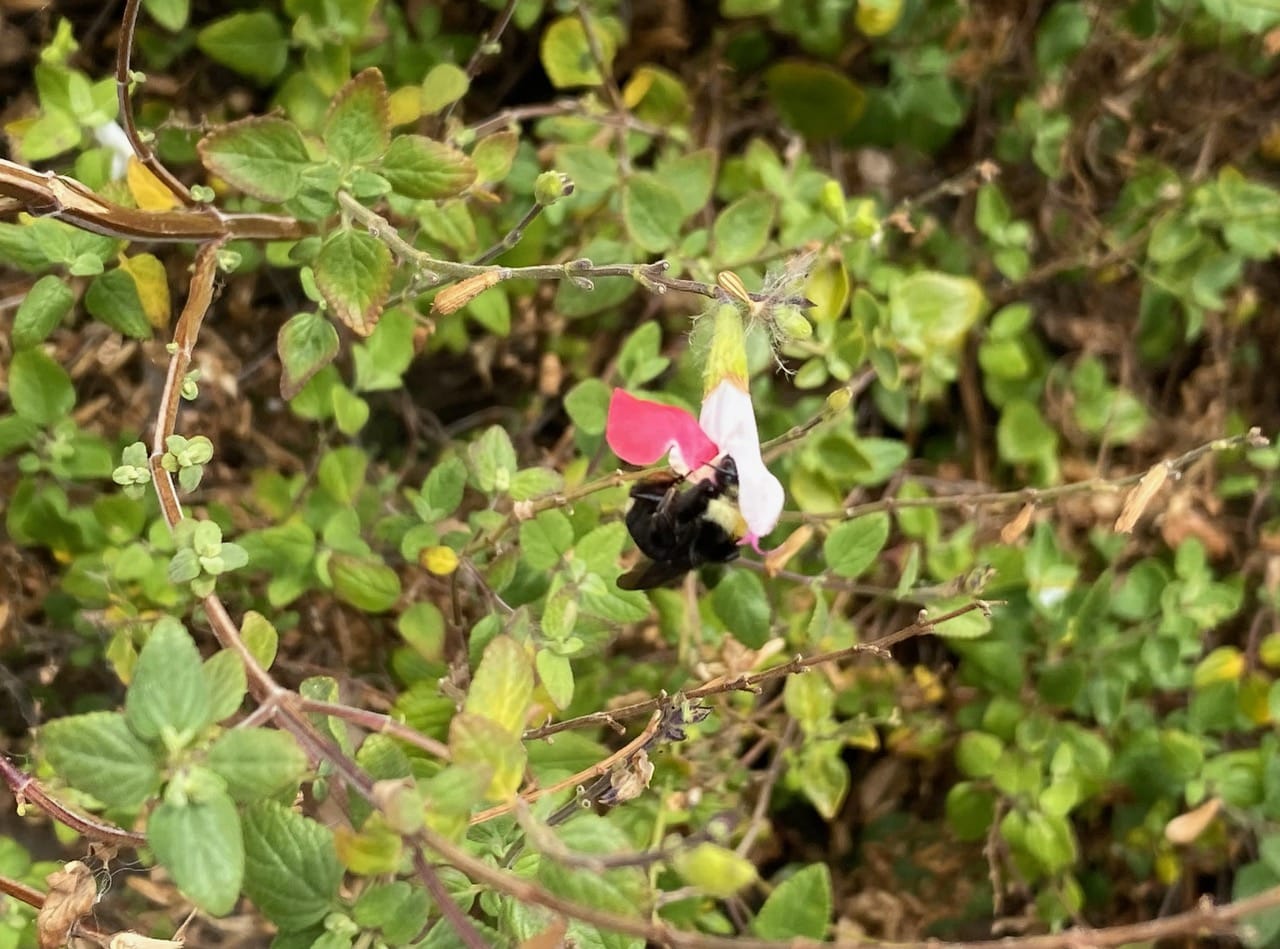
Passing through the butterfly garden near the visitor center, I spot a small Yellow-faced Bumble Bee, subgenus Pyrobombus (genus Bombus, family Apidae) foraging on the flowers of Hot-lips Salvia, Salvia microphylla ‘hot-lips’. The bee’s weight invariably causes the flowers to droop, and she hangs on for dear life while probing for nectar. Apparently her tongue is long enough to reach the nectar at the base of the flower. I am rather surprised that instead of “robbing nectar”, it is actually taking nectar the legitimate way from the front of the corolla. Often times, large bees such as bumble bees and carpenter bees are unable to enter the tubular flowers of Salvia. Instead, they cut a slit at the base of the flower to access nectar directly. Without touching the reproductive parts of the flowers, the sneaky behavior does not contribute to pollination.

I next visit the beach. A Beach Fly (family Canacidae) is cleaning its sponging mouthparts on a flower of European Searocket, Cackile maritima. The pruinescence of the fly makes it look dull and dark without direct sunlight.
The Beach Flies (family Canacidae) are minute (1.6-5 mm) yellow, gray or gray-brown pruinose flies with whitish to grayish markings. The head is large with small antenna bearing bare to pubescent arista. The “mouth” is a large oval opening. The Canacidae are found along the sea coasts, on the surface of small bodies of water, saline and fresh, in places protected from the wind. They feed on infusoria and other tiny organisms. Infusoria is a word used to describe various freshwater microorganisms, including ciliates, copepods, euglenoids, planktonic crustaceans, protozoa, unicellular algae and small invertebrates.
Pruinescence or pruinosity on an insect is caused by a powdery or waxy “bloom” secreted by the insect’s body that sits on top of its hard outer shell (cuticle). This waxy layer masks the underlying coloration, giving the insect a dusty, frosted, or “hoarfrost” appearance. The waxy coating can serve several functions: it can reflect sunlight and ultraviolet (UV) radiation, helping the insect avoid overheating in hot, sunny environments. The wax is also highly water-repellent (hydrophobic), which prevents the insect from losing moisture and protects against desiccation. In some insects the reflected UV light from waxy coating can serve as a vibrant visual signal for mate recognition, species identification and territorial threat displays.

Here in a different angle to the sun, the Beach Fly actually looks shiny and reflective. Impossible creature to photograph!