

Pollinator Post 7/29/25 (1)

I arrive at the East Bay Regional Parks Botanic Garden early this morning while it is still cool, in the hopes of avoiding insect pandemonium when the temperatures rise.
There are already insects buzzing around the blooming Woolly Bluecurls, Trichostema lanatum near the front gate. I am not sure why a Yellowjacket would be interested in the stamens of the Woolly Bluecurls flower. While the wasps do take nectar, they are not known to show interest in pollen.
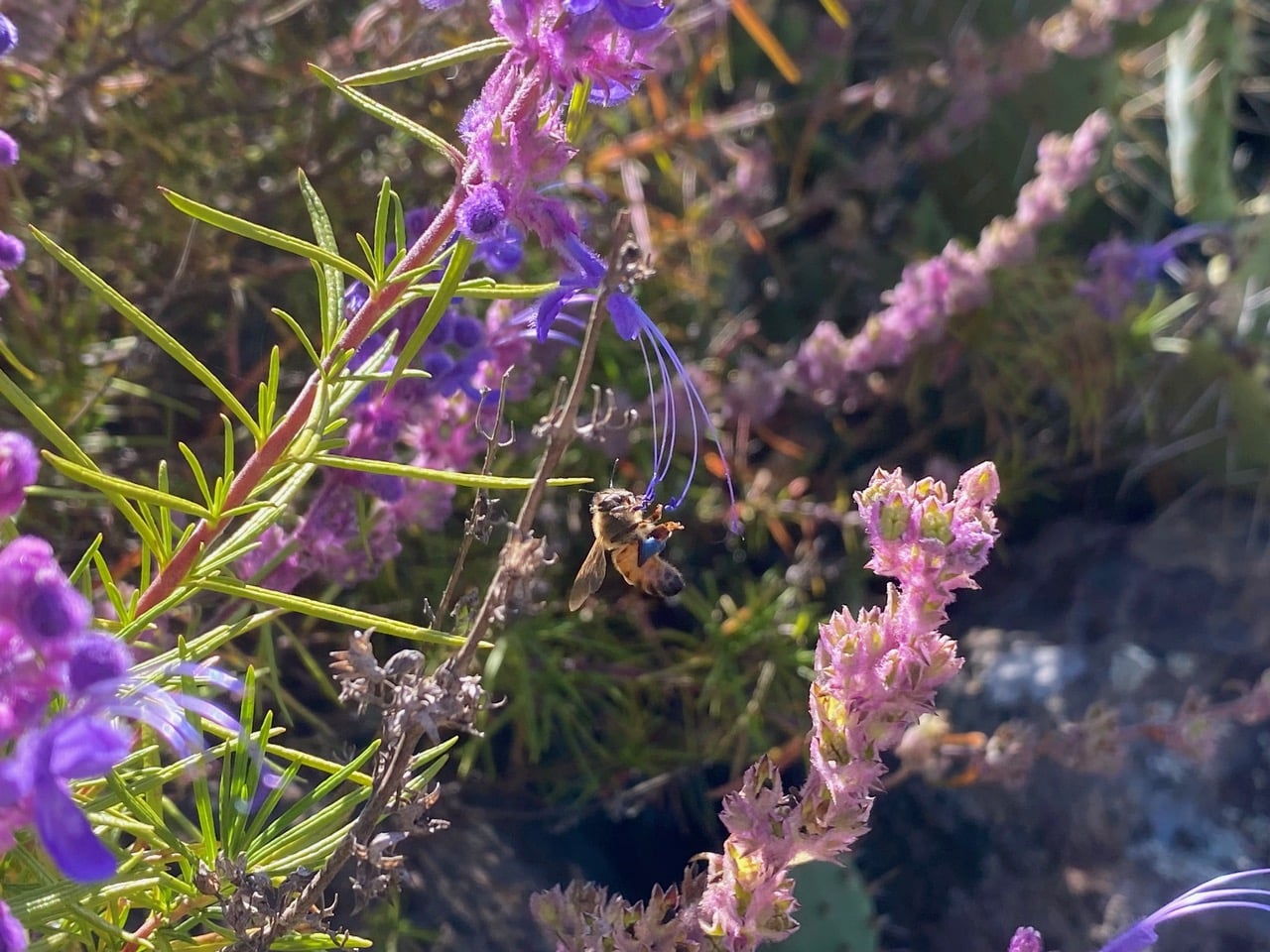
A few Honey Bees, Apis mellifera (family Apidae) are diligently collecting pollen off the tips of the long, curved stamens, causing the whole flowers to droop.

Note the blue pollen in the Honey Bee’s corbiculae (pollen baskets) on the hind legs. The bees are agile enough to land on the delicate stamens, grasping all four filaments skillfully in their legs.

I have seen bumble bees perform this feat. It is fun to watch the Honey Bees do it too. Woolly Bluecurls is apparently pollinated by bees, as well as by butterflies and hummingbirds.
A Honey Bee gathers pollen from the stamens of a Woolly Bluecurls flower. – YouTube

Besides the bumble bees and Honey Bees, the Woolly Bluecurls flowers are also visited by much smaller bees. Here a tiny Metallic Sweat Bee, Lasioglossum (Dialictus) sp. (family Halictidae) is gathering pollen from the individual anthers of the flower. She uses her mandibles to open the mature anthers to extract the sky-blue pollen within. Note the forked style right next to the stamens and the bee. It is conceivable that pollen transfer can happen, and thus pollination may be accomplished by the little bees.

The little bee clambers up the filament to steady herself before flying off. Note where she has packed the blue pollen – along the length of her hind legs as well as on the underside of her abdomen.
Lasioglossum species are found worldwide, and they constitute the largest bee genus. The subgenus Dialictus are the most likely to be seen in the U.S., with over 300 species of these tiny metallic bees. The majority of Lasioglossum are generalists. Because they are so abundant throughout the flowering season, the bees are often important pollinators. Their sheer numbers are enough to achieve excellent pollination of many wild flowers, especially of plants in the Asteraceae, which have shallow floral tubes that are easily accessed by these minute bees.
Lasioglossum are closely related to the genera Halictus and Agapostemon. These genera are commonly called “sweat bees” because of their attraction to human sweat, which they drink for its salt content. Lasioglossum are dusky black to brown slender bees with bands of hair on their abdomen. Female Sweat Bees (family Halictidae) carry pollen in the scopae on their entire hind legs and underside of their abdomen.
Lasioglossum exhibit a range of social behaviors; the genus includes solitary, communal, semi social, primitively eusocial, and even parasitic species. Almost all Lasioglossum in the U.S. nest in the ground. Generally these nests are built in the spring by fertilized females (called foundresses) that spent the winter in hibernation. In social species, the foundresses behave much like the queen bumble bees – they lay the first batch of eggs that develop into the first generation of female workers. The nest grows with each additional generation of bees. Later broods may consist of both males and females. They mate, and at the end of the season the fertilized females hibernate til the following spring, repeating the life cycle of the colony.
Dialictus is a subgenus of sweat bees belonging to the genus Lasioglossum. Most of the members of this subgenus have a metallic appearance. They are commonly found in the Northern Hemisphere and are found in abundance in North America. Members of this subgenus also have very diverse forms of social structure making them model organisms for studying the social behavior of bees.
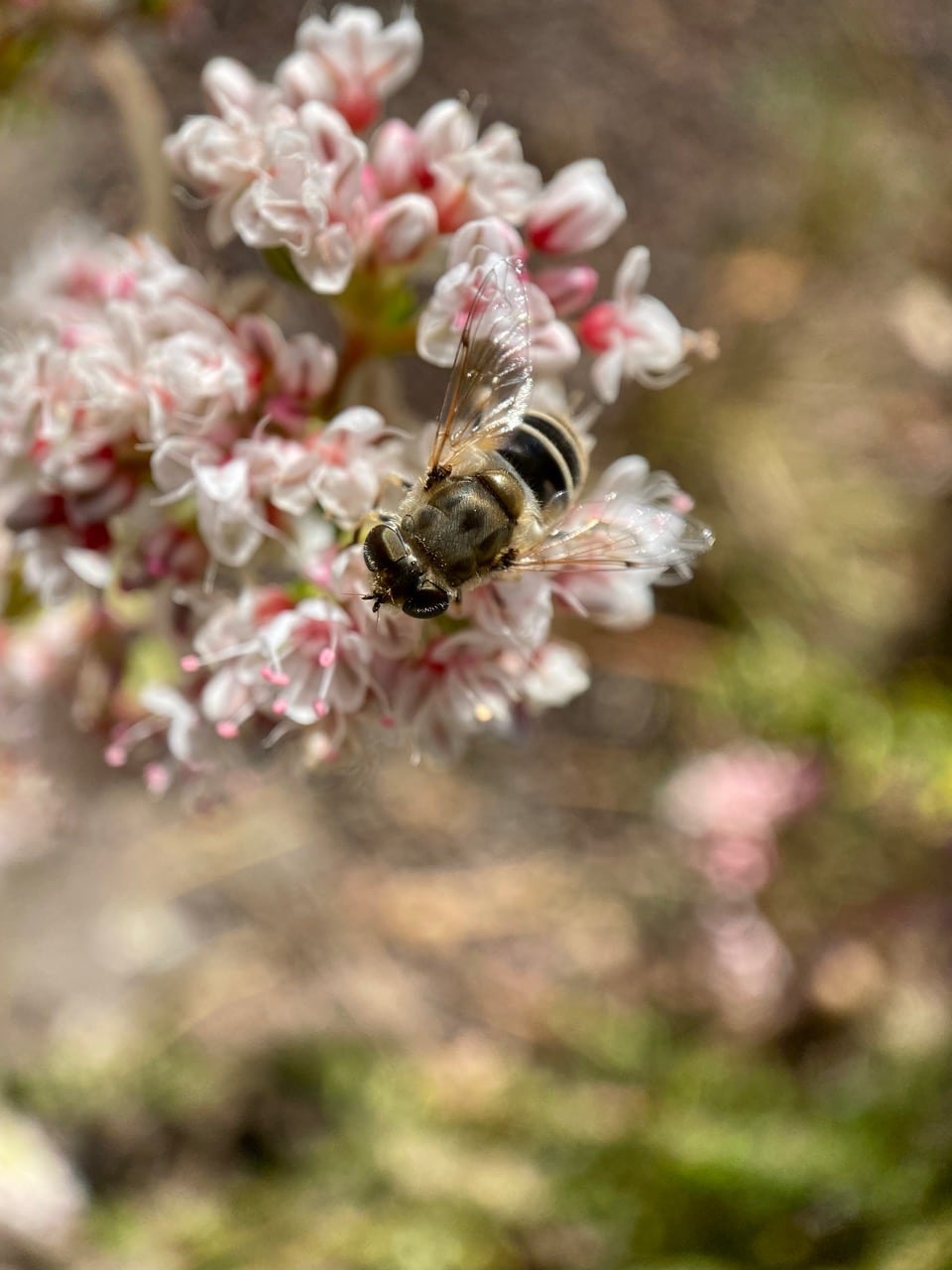
A Eurasian Drone Fly, Eristalis arbustorum (family Syrphidae) is foraging on an inflorescence of California Buckwheat, Eriogonum fasciculatum.
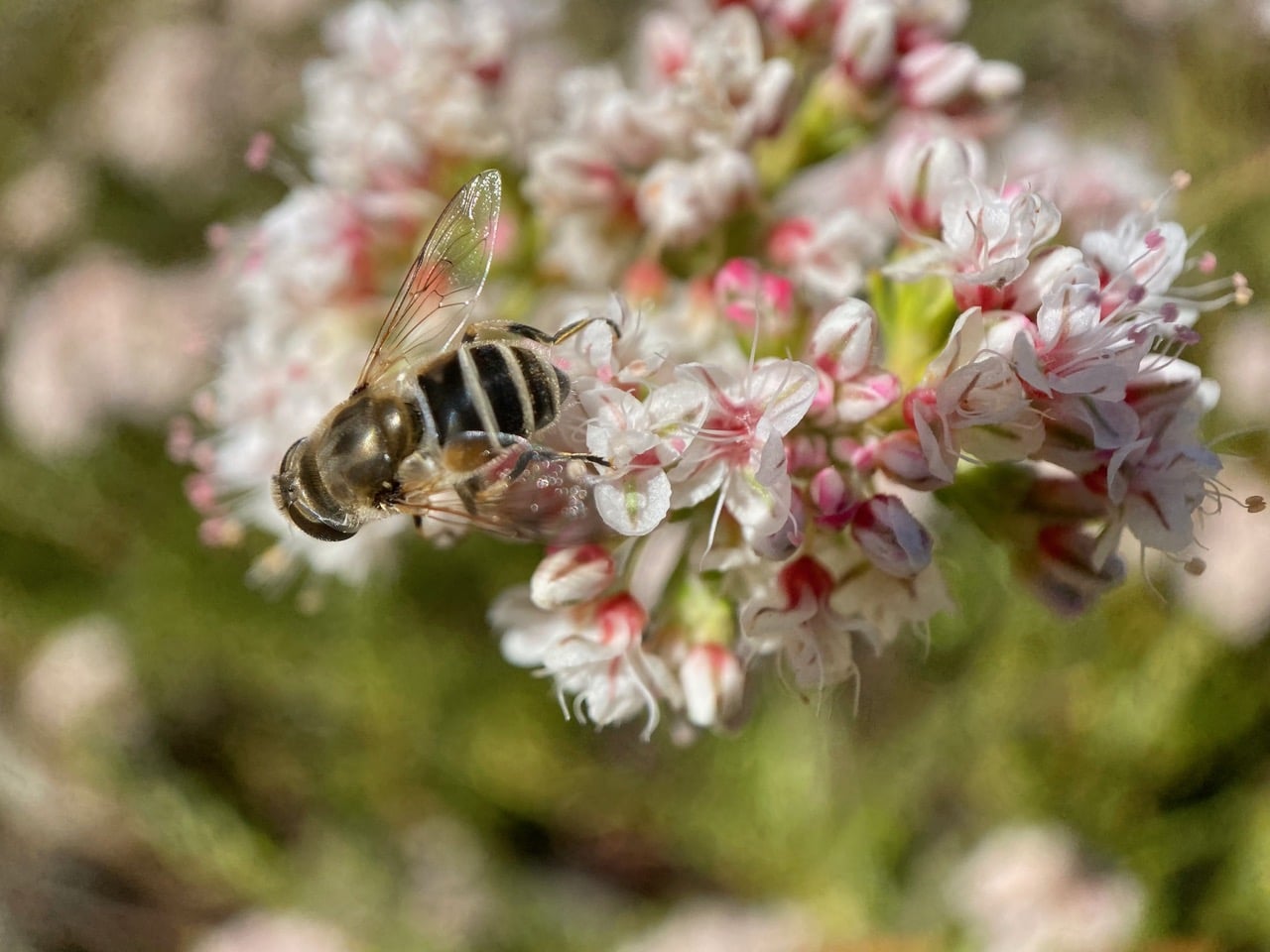
The Eurasian Drone Fly, Eristalis arbustorum is an abundant species of hover fly that occurs throughout the northern hemisphere, including Europe, North Africa and North India. It was introduced to North America in the mid 1800’s and is now ubiquitous throughout much of the United States and Canada. The common name “drone fly” refers to its resemblance to the drone of the honeybee. Hoverflies get their names from the ability to remain nearly motionless while in flight. The adults are also known as flower flies as they are commonly found on and around flowers feeding on nectar and pollen. The Eurasian Drone Fly is found in a diversity of habitats, including wetland, forests, montane tundra, as well as farmland, urban parks and gardens. It visits the flowers of a wide range of low-growing plants and shrubs. The larvae are aquatic, occurring in shallow, nutrient rich standing water and in cow manure and compost heaps. Also known as “rat-tailed maggots”, the larvae have a siphon on their rear end that acts like a snorkel, helping them breathe under water. The siphon can be several times the length of the larva’s body. The larvae are saprophagous, feeding on bacteria in stagnant water rich in decomposing organic matter.

Numerous Honey Bees are foraging on the California Buckwheat. Most gardeners think they know a Honey Bee when they see one. And yet I have come across websites that sell bee products showing pictures of flies misidentified as honey bees.
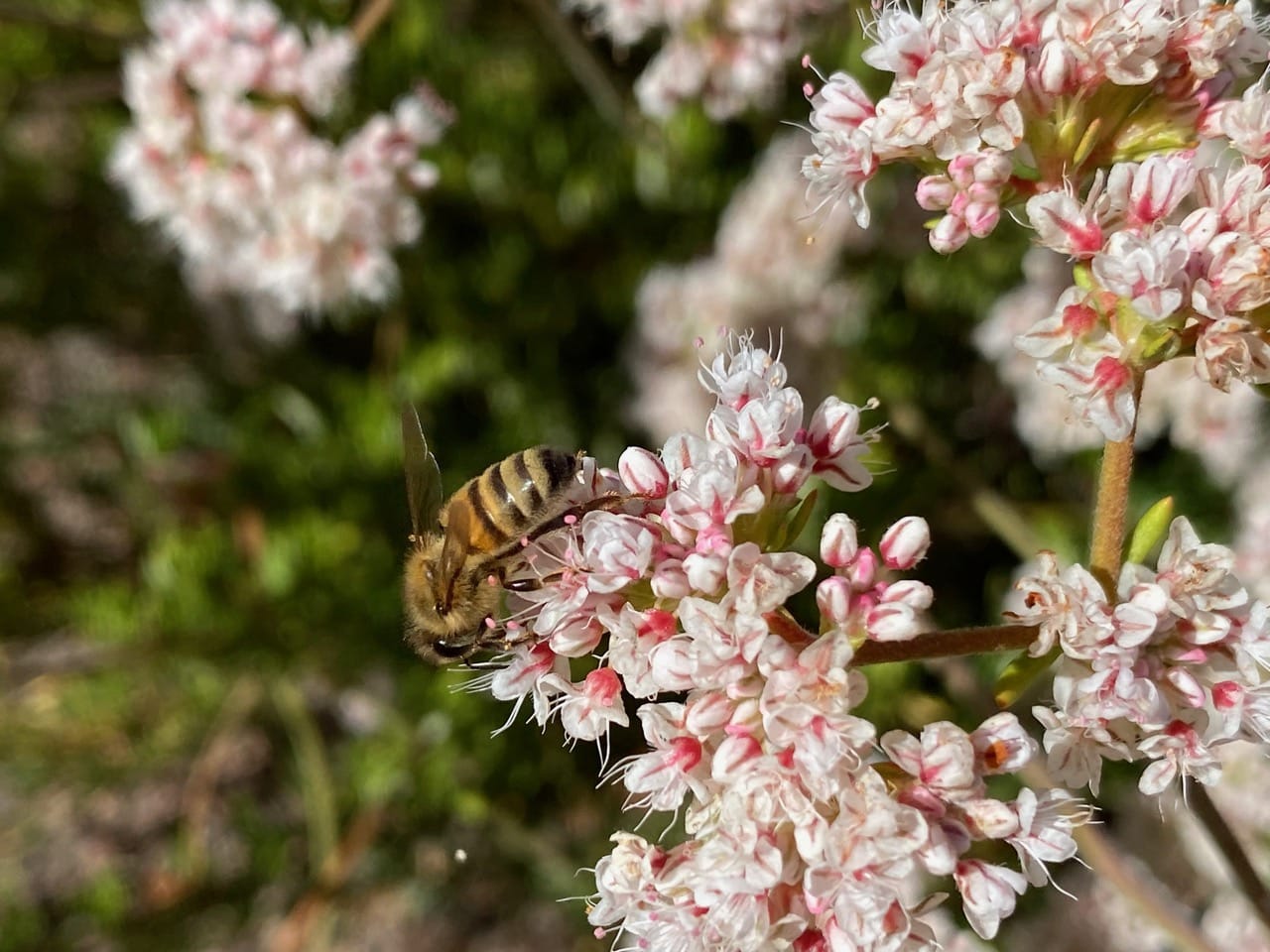
Is this a Honey Bee?
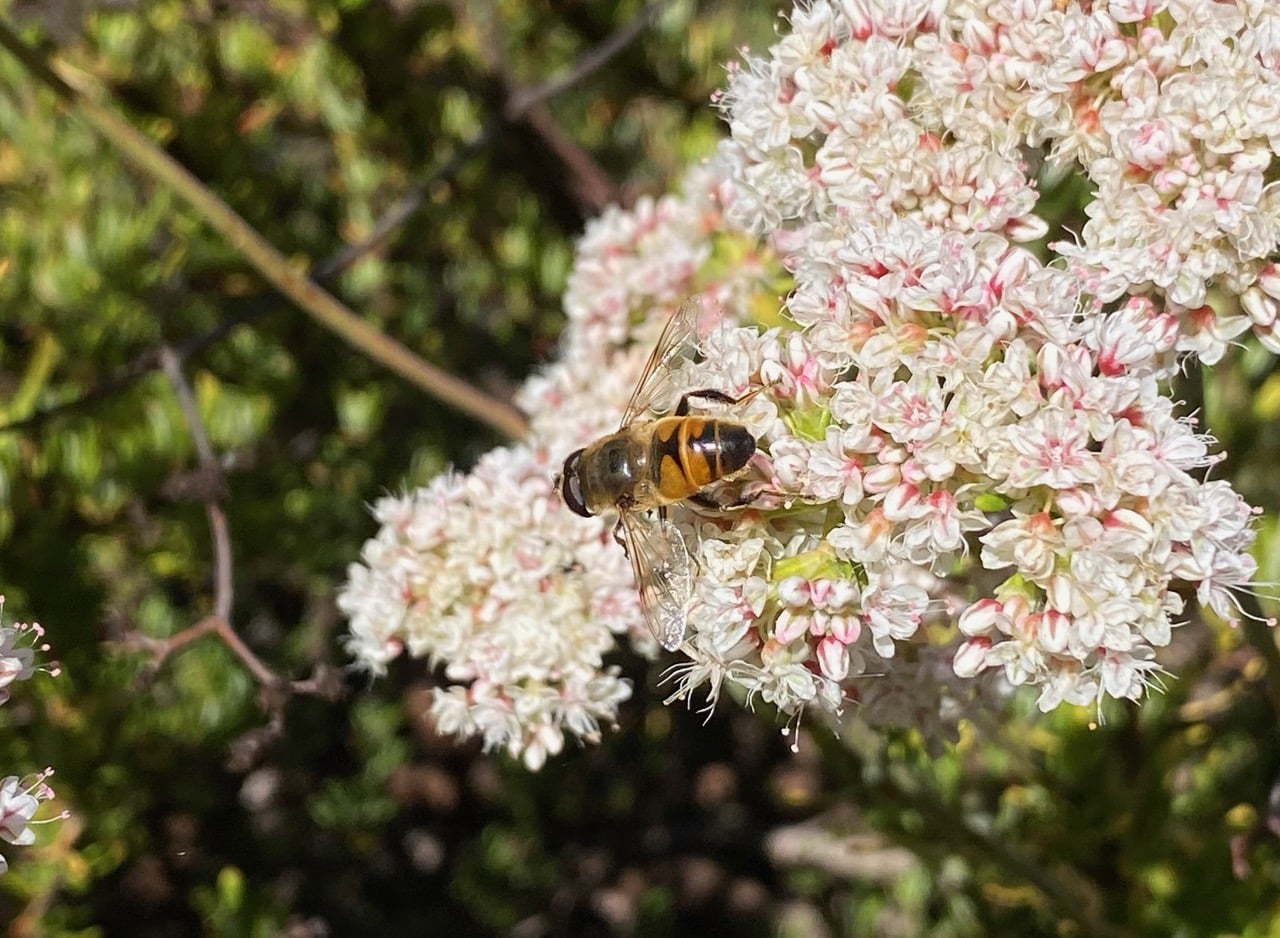
Is this a Honey Bee? It is actually the Common Drone Fly, Eristalis tenax (family Syrphidae) a hover fly most often mistaken for a Honey Bee.
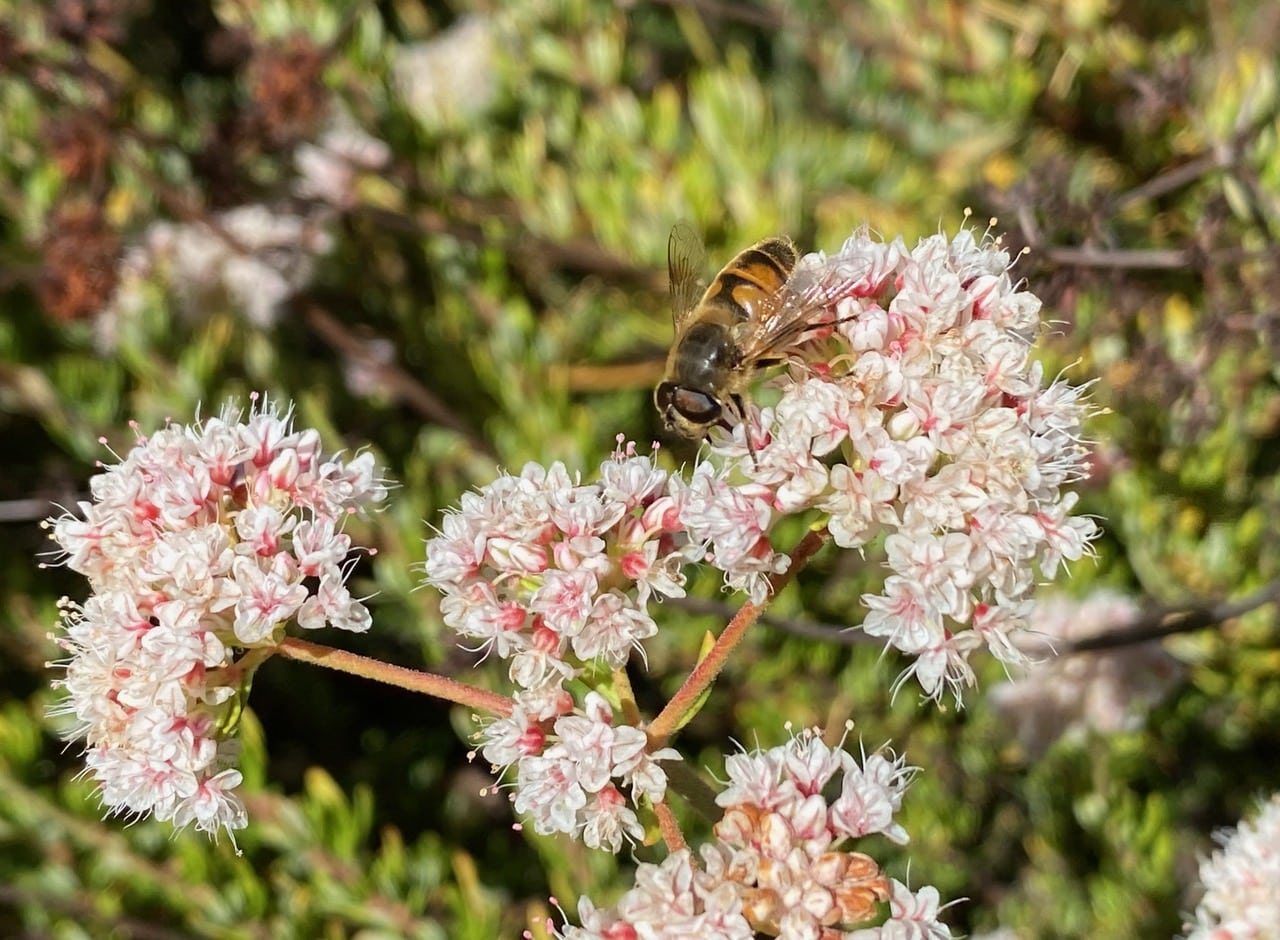
Of all the hover flies, the Common Drone Fly, Eristalis tenax best mimics the Honey Bee. Why would a fly evolve to look like a bee? Any animal will think twice before attacking a bee because the bee can sting, and it can bring the wrath of the whole colony upon a predator. The fly is stingless and otherwise defenseless. This kind of mimicry is called Batesian Mimicry, after the English naturalist, Henry Walter Bates. Both the Honey Bee and the Drone Fly are originally from Europe. It makes sense that both insects evolved in the same place.
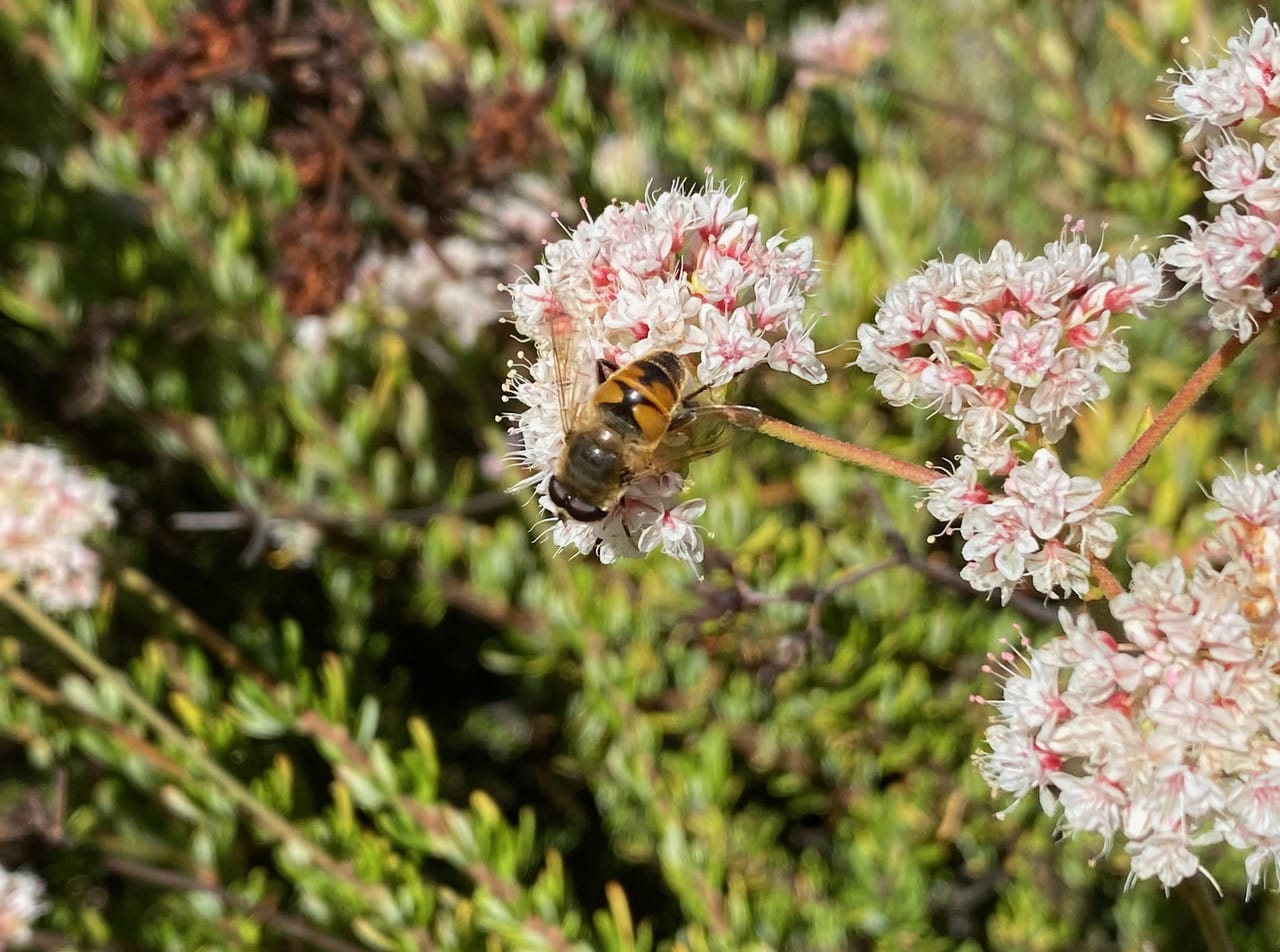
The Common Drone Fly, Eristalis tenax (family Syrphidae) is the most widely distributed Syrphid species in the world, occurring in all regions except the Antarctic. It was introduced into North America from Europe and is widely established. Adults visit flowers for nectar and pollen, and are significant pollinators. They are called drone flies because of their resemblance to a drone Honey Bee. The larva is aquatic. It has a siphon on its rear end that acts like a snorkel, helping it breathe under water. The siphon can be several times the length of the larva’s body, hence the common name, rat-tailed maggot. The larvae are saprophagous, feeding on bacteria in stagnant water rich in decomposing organic matter.
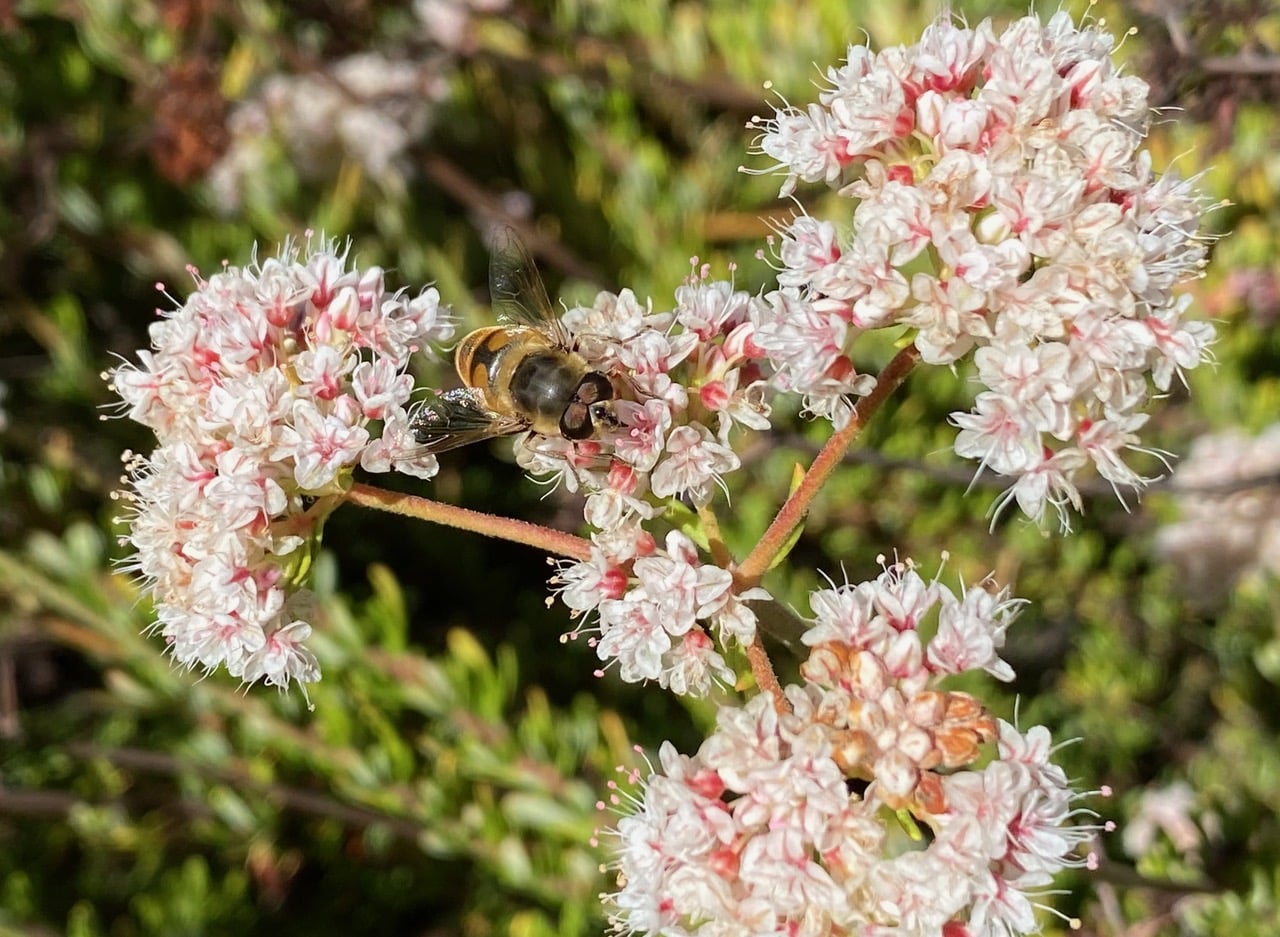
So, how do you tell a fly from a bee?

As the day warms up, more and more insects visit the buckwheat flowers, a great source of both nectar and pollen. Is that a Honey Bee sharing the flowers with a Yellow-faced Bumble Bee?

A Thick-legged Hover Fly, Syritta pipiens (family Syrphidae) is foraging on the flowers of California Buckwheat.

The Thick-legged Hover Fly, Syritta pipiens (family Syrphidae) originates from Europe and is currently distributed across Eurasia and North America. The species is distinguished by its enlarged hind femora (thighs). They are fast and nimble fliers. The fly is about 6.5 – 9 mm long. The species flies at a very low height, rarely more than 1 m above the ground. Adults visit flowers – males primarily to feed on nectar, and females to feed on protein-rich pollen to produce eggs. The species is found wherever there are flowers. It is also anthropophilic, occurring in farmland, suburban gardens, and urban parks. Larvae are found in wetlands that are close to bodies of freshwater such as lakes, ponds, rivers, ditches. Larvae feed on decaying organic matter such as garden compost and manure. Males often track females in flight, ending with a sharp dart towards them after they have settled, aiming to attempt forced copulation.

That looks like a male Sweat Bee (family Halictidae). Male bees are often easy to spot as they have extra long antennae. The antennae of male bees are often much longer than their female counterparts. Male antennae have an extra segment and the segments themselves are longer. This is because male antennae are specialized to pick up the subtle scent of female pheromones.
Note also the absence of scopae (special pollen-collecting hairs) on the bee’s hind legs. Male bees do not collect pollen to provision the nest, and they do not have the equipment for the job

A Yellowjacket wasp is foraging on an inflorescence of California Buckwheat.
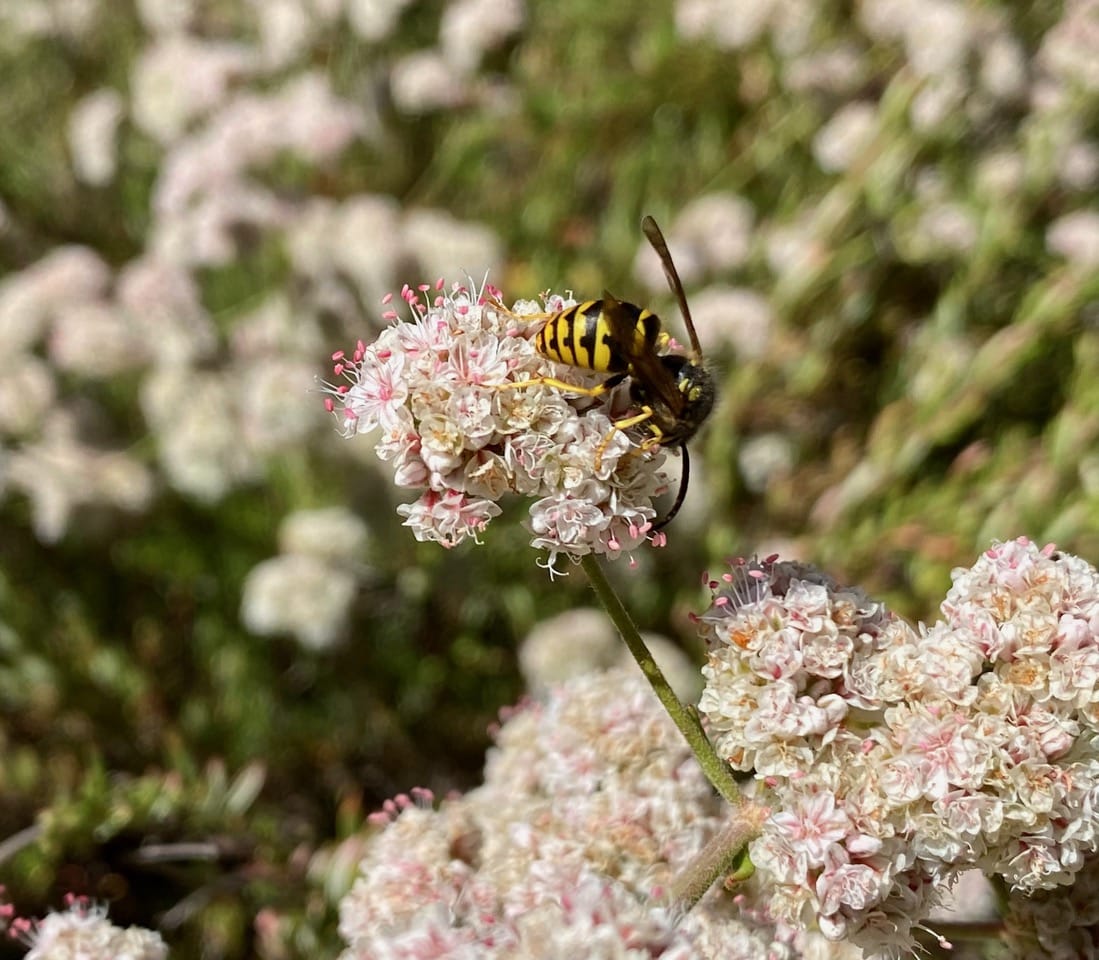
Yellowjacket is the common name for predatory social wasps of the genera Vespula and Dolicovespula (family Vespidae). Yellowjackets are social hunters living in colonies containing workers, queens, and males (drones). Colonies are annual with only inseminated queens overwintering. Queens emerge during the warm days of late spring or early summer, select a nest site, and build a small paper nest in which they lay eggs. They raise the first brood of workers single-handedly. Henceforth the workers take over caring for the larvae and queen, nest expansion, foraging for food, and colony defense. The queen remains in the nest, laying eggs. Later in the summer, males and queens are produced. They leave the parent colony to mate, after which the males quickly die, while fertilized queens seek protected places to overwinter. Parent colony workers dwindle, usually leaving the nest to die, as does the founding queen. In the spring, the cycle is repeated.
Yellowjackets have lance-like stingers with small barbs, and typically sting repeatedly. Their mouthparts are well-developed with strong mandibles for capturing and chewing insects, with probosces for sucking nectar, fruit, and other juices. Yellowjacket adults feed on foods rich in sugars and carbohydrates such as plant nectar and fruit. They also search for foods high in protein such as insects and fish. These are chewed and conditioned in preparation for larval consumption. The larvae secrete a sugary substance that is eaten by the adults.
The Western Yellowjackets typically build nests underground, often using abandoned rodent burrows. The nests are made from wood fiber that the wasps chew into a paper-like pulp. The nests are completely enclosed except for a small entrance at the bottom. The nests contain multiple, horizontal tiers of combs within. Larvae hang within the combs.

A metallic blue Blowfly, Compsomyiops callipes (family Calliphoridae) is foraging on the flowers of California Buckwheat.
The Calliphoridae are variously known as blow flies, carrion flies, greenbottles, and bluebottles. Adults are usually brilliant with metallic sheen, often with blue, green, or black thoraces and abdomens. There are three cross-grooves on the thorax; calypters are well developed. Females visit carrion both for proteins and egg laying. The larvae that hatch feed on dead or necrotic tissue, passing through three instars before pupation. After the third instar, the larva leaves the corpse and burrows into the ground to pupate. Adult blow flies are occasional pollinators, being attracted to flowers with strong odors resembling rotting meat. The flies use nectar as a source of carbohydrates to fuel flight.

The Blowfly, Compsomyiops callipes (family Calliphoridae) is a warm weather fly that can be found in southwestern parts of the United States and parts of South America. The species serves an important role in the field of forensic entomology, by determining post mortem intervals (PMI). The fly is attracted to carrion and has been involved in case studies in California where it has been the primary fly found on human remains. The species is extensively studied and its life cycle is used to solve crimes by determining the time of death.