

Pollinator Post 7/29/23

Passing the tall Soap Plant, Chlorogalum pomeridianum on Skyline Trail, I pause to check for the Two-tubercled Web-weaver Spider that I have found on the plant on 7/9/23. It is on the exact same immature fruit in pretty much the same position. An amazingly sedentary spider! The hunting must be good here.
Gibbaranea bituberculata is a species of ‘orbweavers’ belonging to the family Araneidae. They are found in sunny habitats on shrubs, edges and low plants, where they can make their webs near the ground. Their basic color is very variable, but usually it is brownish, with whitish shades. The cephalothorax is covered with lying down hairs.
Orb-weaver spiders are members of the spider family Araneidae. They are the most common group of builders of spiral wheel-shaped webs often found in gardens, fields, and forests. Generally, orb-weavers are three-clawed builders of flat webs with sticky spiral capture silk. The third claw is used to walk on the non-sticky part of the web. Typically, the prey insect that blunders into the sticky lines is stunned by a quick bite, and then wrapped in silk.

A female parasitoid wasp, Torymus sp. (family Torymidae) is standing stock still on the calyx of a Sticky Monkeyflower, her antennae vibrating continuously. Is she looking for a place to lay her eggs?
Torymidae is a family of wasps in the superfamily Chalcidoidea. Most species in this family are small with attractive metallic coloration, and females generally have long ovipositors. Many are parasitoids on gall-forming insects, and some are phytophagous (plant-eating) species, sometimes using the galls formed by other insects. Over 960 species in about 70 genera are found worldwide. They are best recognized in that they are one of the few groups of chalcidoidea in which the cerci are visible.

Here’s a bug that has a special interest in the Sticky Monkeyflower calyces, and are seldom found away from them. The Seed Bug, Kleidocerys franciscanus (family Lygaeidae) has sunk its rostrum into the calyx to feed on the developing seeds within. The brown bug is well camouflaged, appearing like a blemish on the aging calyx.
The defining feature of Hemipterans or “true bugs” is their “beak” or rostrum in which the modified mandibles and maxillae form a “stylet” which is sheathed within a modified labium. The stylet is capable of piercing tissues and sucking liquids, while the labium supports it. The stylet contains a channel for outward movement of saliva and digestive enzymes, and another channel for the inward movement of pre-digested liquid food. The rostrum is usually folded under the body when not in use. Seed bugs are able to feed on seeds by injecting digestive juices into the seeds and sucking up the digested contents as a liquid.


Empty pupal cases are protruding from a mature Coyote Brush Bud Gall. The gall-maker midges have emerged from these pupa skins.
The Coyote Brush Bud Gall Midge, Rhopalomyia californica lays eggs into the flowerbuds of Baccharis pilularis, inducing lumpy, fleshy galls. Female midges lay clusters of eggs on terminal buds. The larvae that hatch out burrow between bud scales and commence feeding. The gall tissue swells around each of the larvae. When fully grown, larvae burrow to the surface of the gall, where they develop their partially protruding white cocoons and pupate. Adults look like miniature mosquitoes. The species, Rhopalomyia californica (family Cecidomyiidae) represents one of the rare situations among all gall insects where fresh galls and emergence of adults occur throughout the year.

Wow, what happened to this Coyote Brush Bud Gall? It appears someone has chewed through part of the gall to get at the gall insects within. The gall was packed with the developing midge larvae, as seen from the exposed holes or tunnels of the gall makers. The gall is a concentrated source of protein for any predator clever and skillful enough to access it. A bird? An insect with strong mandibles?

Numerous alates (winged insects) have been produced by this small colony of aphids on a small Soap Plant. The white things on the flower bud are the exuviae (shed exoskeletons) left by the aphids as they molt.
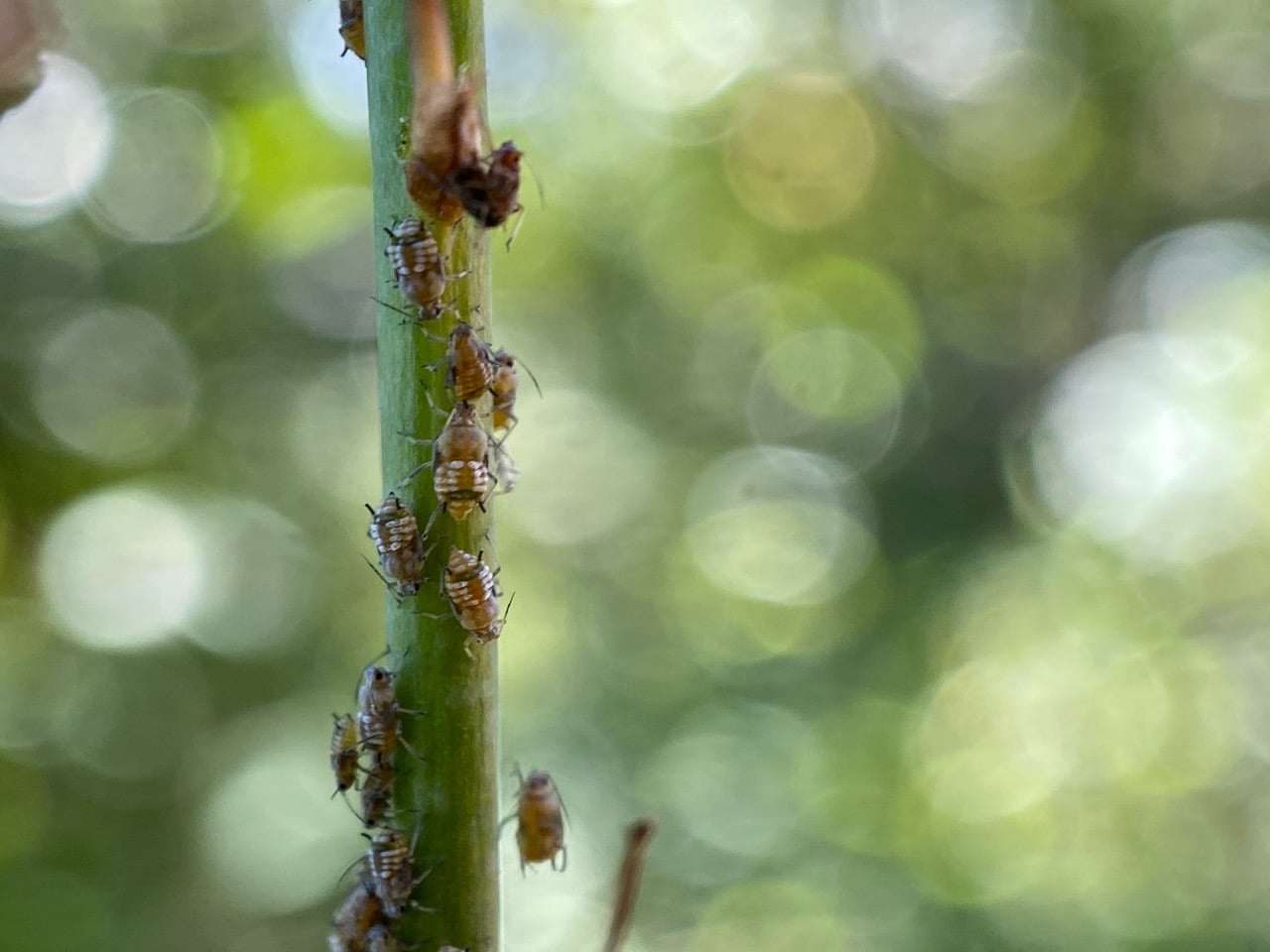
Many of the young aphids are developing into alates, as evidenced by the wing pads on the nymphs. There’s going to be a mass exodus from this plant.
Alates are usually produced when the colony is over-crowded, or when food resources dwindle. The winged aphids are better able to disperse to greener pastures to establish new colonies.

A Lacewing larva is resting head-down on a broken stem of the Soap Plant. It must have had its fill of aphids!
Lacewings are insects in the large family Chrysopidae of the order Neuroptera. Adults are crepuscular or nocturnal. They feed on pollen, nectar and honeydew supplemented with mites, aphids and other small arthropods. Eggs are deposited at night, hung on a slender stalk of silk usually on the underside of a leaf. Immediately after hatching, the larvae molt, then descend the egg stalk to feed. They are voracious predators, attacking most insects of suitable size, especially soft-bodied ones (aphids, caterpillars and other insect larvae, insect eggs). Their maxillae are hollow, allowing a digestive secretion to be injected in the prey. Lacewing larvae are commonly known as “aphid lions” or “aphid wolves”. In some countries, Lacewings are reared for sale as biological control agents of insect and mite pests in agriculture and gardens.
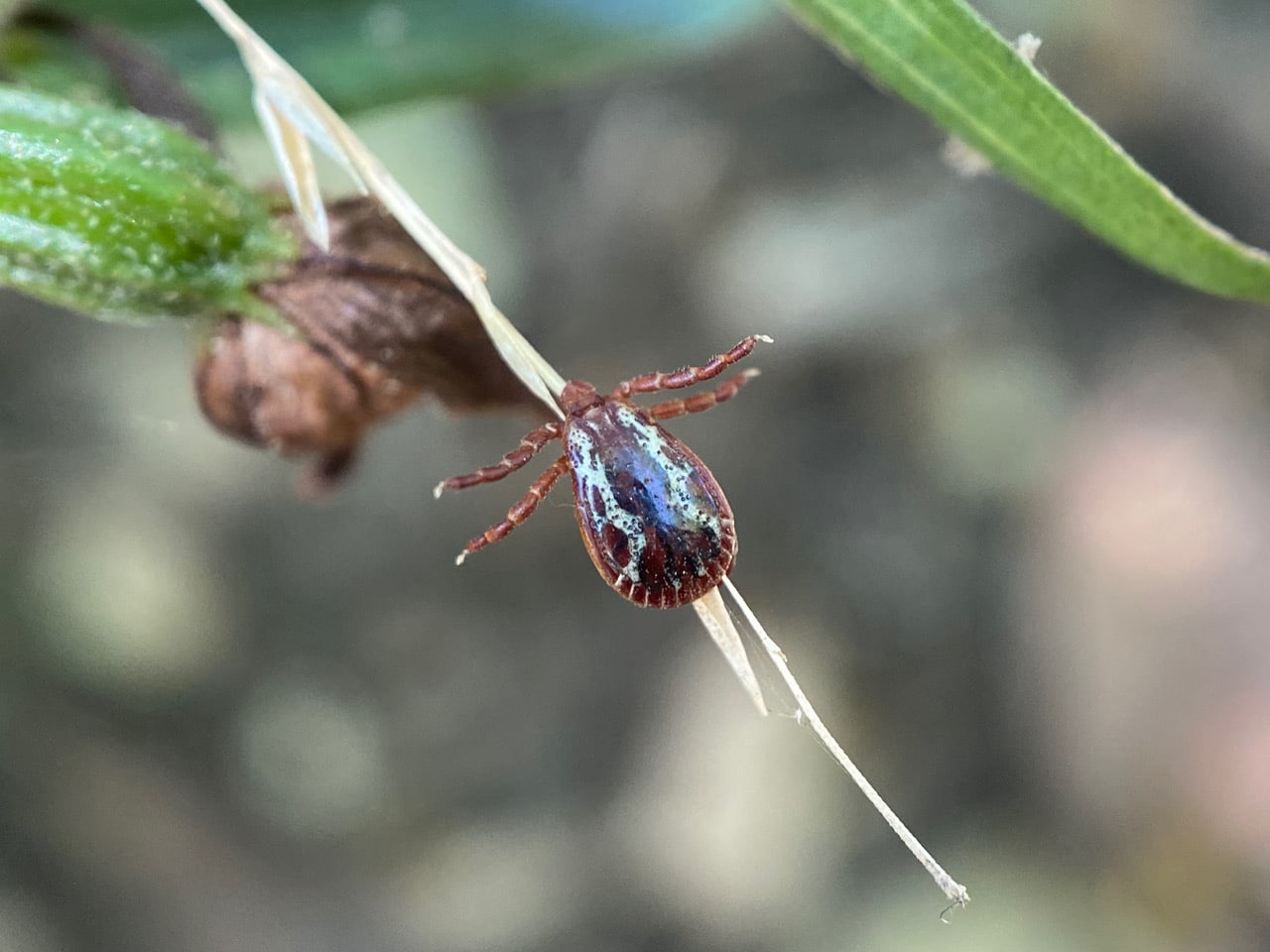
Oh wow, just when I thought tick season is behind us, here’s an adult male American Dog Tick, Dermacentor variables questing on a blade of dried grass.

A Lacewing egg is attached to a leaf of the “weedy orchid”, Broadleaf Helleborine, Epipactis helleborine by a strand of silk. Immediately after hatching, the larvae molt, then descend the egg stalk to feed. They are voracious predators, attacking most insects of suitable size, especially soft-bodied ones (aphids, caterpillars and other insect larvae, insect eggs). The egg stalks are believed to prevent larval cannibalism when the eggs are laid close to each other.

These colorful blister galls keep appearing on the leaves of the California Goldenrod, Solidago velutina ssp. californica.
The blisters are actually a well-known goldenrod gall, induced by the gall midge Asteromyia carbonifera (family Cecidomyiidae). The midge induces flat, circular galls in the leaves of various goldenrods (Solidago). One to ten or more larvae develop in each gall. Color and size of the gall vary by host species and number of larvae. The galls contain a symbiotic fungus, Botryosphaeria dothidea, which the larva apparently does not eat. The fungus seems to confer some protection against parasitoid wasps. Females carry spores of the fungus.

Yampah, Perideridia californica (family Apiaceae) has started to bloom on the steep hillside of Yampah Bowl. The small fly on the left of this floral umbel is a Woodlouse Fly, family Rhinophoridae. As a larva, it is an internal parasitoid of pill bugs.
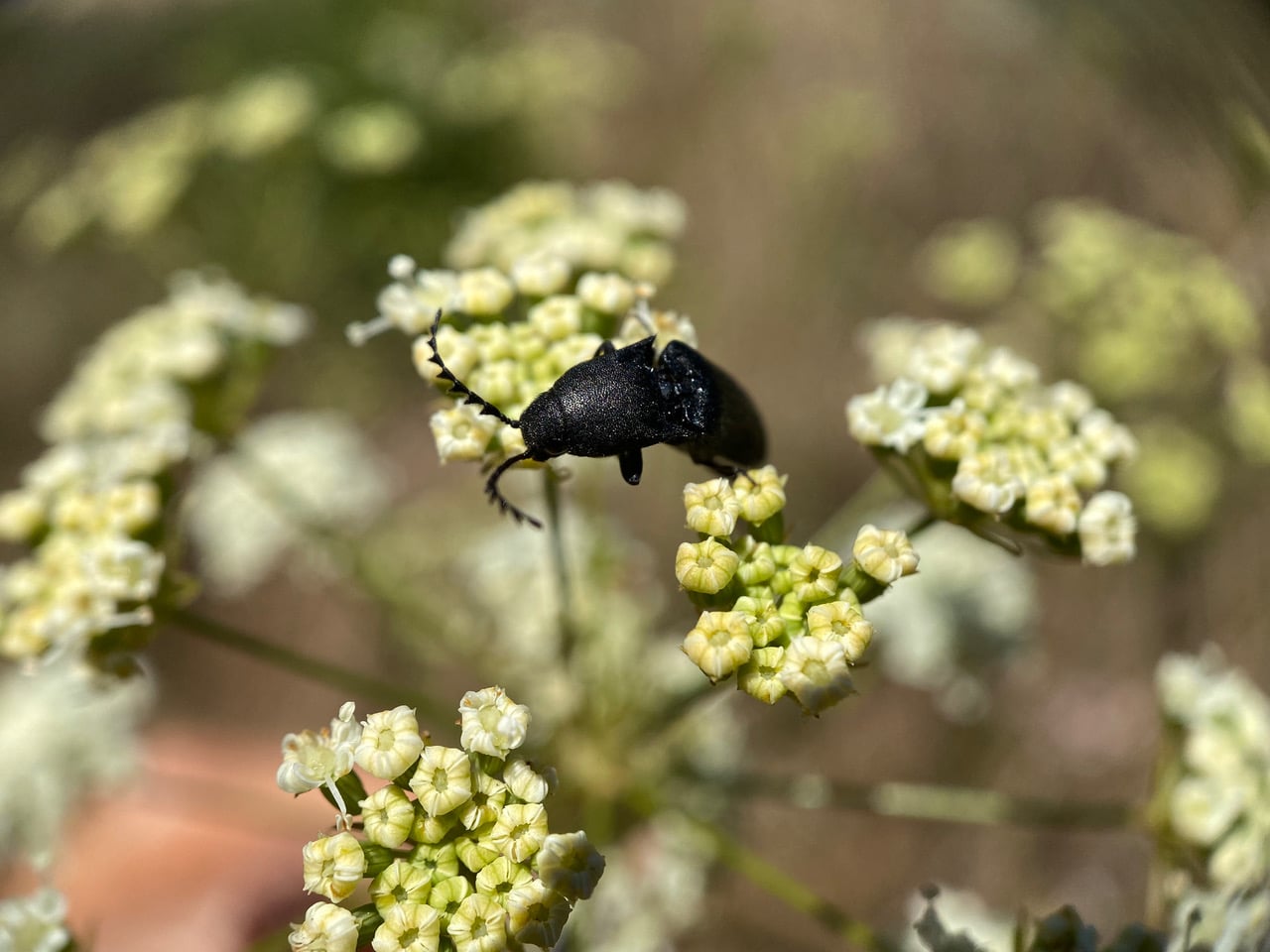
The larger insect with serrate antennae is a Click Beetle (family Elateridae).
Click Beetles are long, narrow, straight sided beetles. Most are drab brown, black, or gray. The pronotum (shield-like part between the head and the wings) is extended into sharp points on each side toward the rear The antennae are usually serrate (the segments appearing sawtoothed).
Adult Click Beetles are typically nocturnal and phytophagous (feeding on plants). Their larvae, called wireworms, are usually saprophagous, living on dead organisms, but some species are agricultural pest, and others are active predators of other insect larvae.
Behavior helps identify Click Beetles. By snapping a spikelike structure into a groove on the underside of the thorax (beneath the pronotum), click beetles that find themselves on their backs can flip suddenly into the air. This startles predators and helps the beetle escape, in addition to helping them get back on their feet.
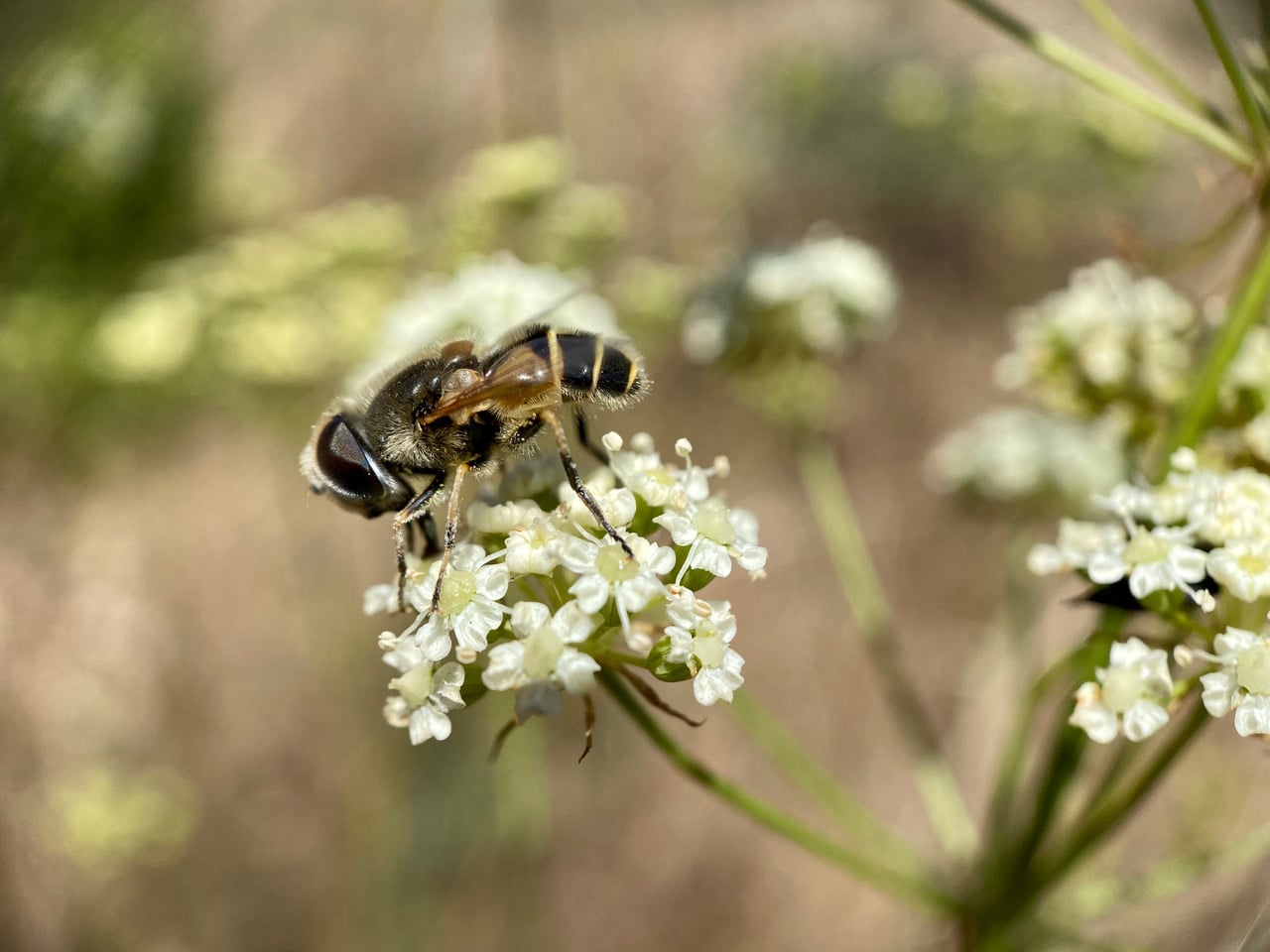
A Black-footed Drone Fly is foraging on the flowers of Yampah.
The Black-footed Drone Fly, Eristalis hirta (family Syrphidae) is a common Western North American species of hoverfly. The adults visit flowers for nectar and pollen. Larvae are aquatic filter-feeders of the rat-tailed type.

Ooh, an early (third?) instar of Anise Swallowtail caterpillar is resting on the stalk of Yampah flower buds.
The Anise Swallowtail, Papilio zelicaon (family Papilionidae), is a common swallowtail butterfly of western North America. It is found in fairly open country, most likely seen on bare hills or mountains, in fields oar at the roadside. Adult females lay eggs singly on the underside of host plant leaves. In the first two instars, the caterpillar is a bird poop mimic – dark brown, almost black, with an irregular white band at its middle. After that it becomes more green at each successive molt until, in the fifth (last) instar, it is predominantly green, with markings in black, orange, and light blue. Its major food plants are members of the carrot family, Apiaceae (including fennel), and also some members of the citrus family, Rutaceae. Young caterpillars eat leaves, while older ones eat flowers.

In the dappled shade under the grove of Eucalyptus trees, a Australian Tortoise Beetle, Trachymela sloanei (family Chrysomelidae) is resting on a Coffeeberry leaf.
The beetle is native to Australia, but is now widespread in much of California. Their host plants include several species of Eucalyptus. Eggs are laid in crevices in or under bark. Both adults and the caterpillar-like larvae feed on foliage during the night, resulting in semicircular holes or irregular notches along edges of Eucalyptus leaves. The unsightly feeding scars do not appear to threaten Eucalyptus survival or health.

Ooh, I don’t think we have this fly on Skyline’s list yet!
Called the Common Cluster Fly, Pollenia rudis (family Polleniidae) is slightly larger than house flies. It is dull gray with checkered black and silvery-black abdomens. A newly emerged fly has many golden hairs on its thorax which may be lost throughout the life of the fly. The common name comes from the tendency of the flies to aggregate near windows when they are trapped in human dwellings. The immature stages – eggs and larvae – are seldom seen because they are deposited on the soil where they burrow into earthworms which they parasitize. The Cluster Fly is a European species. They may have found their way to America in the ballast of ships containing soil, probably along with introduced earthworms.

Walking briskly past a dense Coffeeberry bush, Frangula californica under the shade of a Bay Tree, I spot two bird droppings on two adjacent leaves, only inches apart. They look almost identical. What are the chances that bird droppings would land so uniformly? I turn around to take a closer look…

Under the macro lens, the bird droppings resolve into tiny caterpillars on the Coffeeberry leaves. They are brownish black with an irregular band of white across the mid section – just like wet bird droppings!
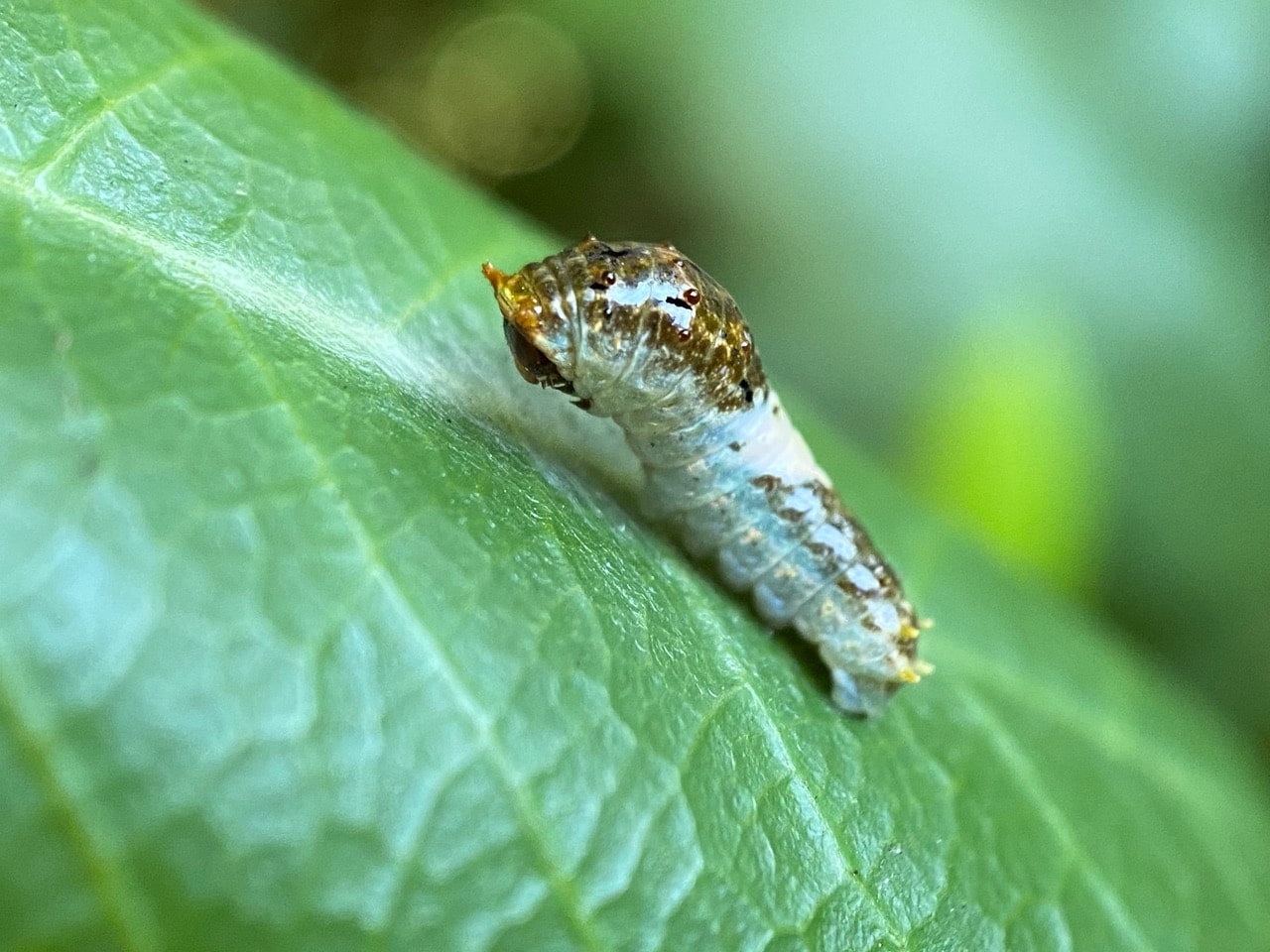
The caterpillars are not very active, and their heads are well hidden under the broader end (thorax?). As this caterpillar rears up, I can see a faint patch of white silk on the leaf under its body. It has made a bed of silk for itself! I have heard of caterpillars that mimic bird droppings to avoid predation, but have never been impressed by the early instars of the Anise Swallowtail caterpillar, reputedly one of these. They are too tiny and spiny to be convincing mimics, but these two caterpillars nearly fooled me! A different species of Swallowtail?
An entomologist on iNaturalist has helped identify our caterpillars as Pale Swallowtail, Papilio eurymedon (family Papilionidae). Alan added that this caterpillar instar is rarely seen, and is on his personal “bucket list”. Since he lives in the Bay Area, we immediately made arrangement for him to come see the caterpillars at Skyline Gardens. What a beautiful coincidence!

On both young caterpillars I notice what look like a pair of puncture wounds along the mid-line of the broad thorax. I was afraid that the caterpillars might have been parasitized by a wasp. Alan assured me that they are actually a normal part of the caterpillar’s anatomy. Phew!
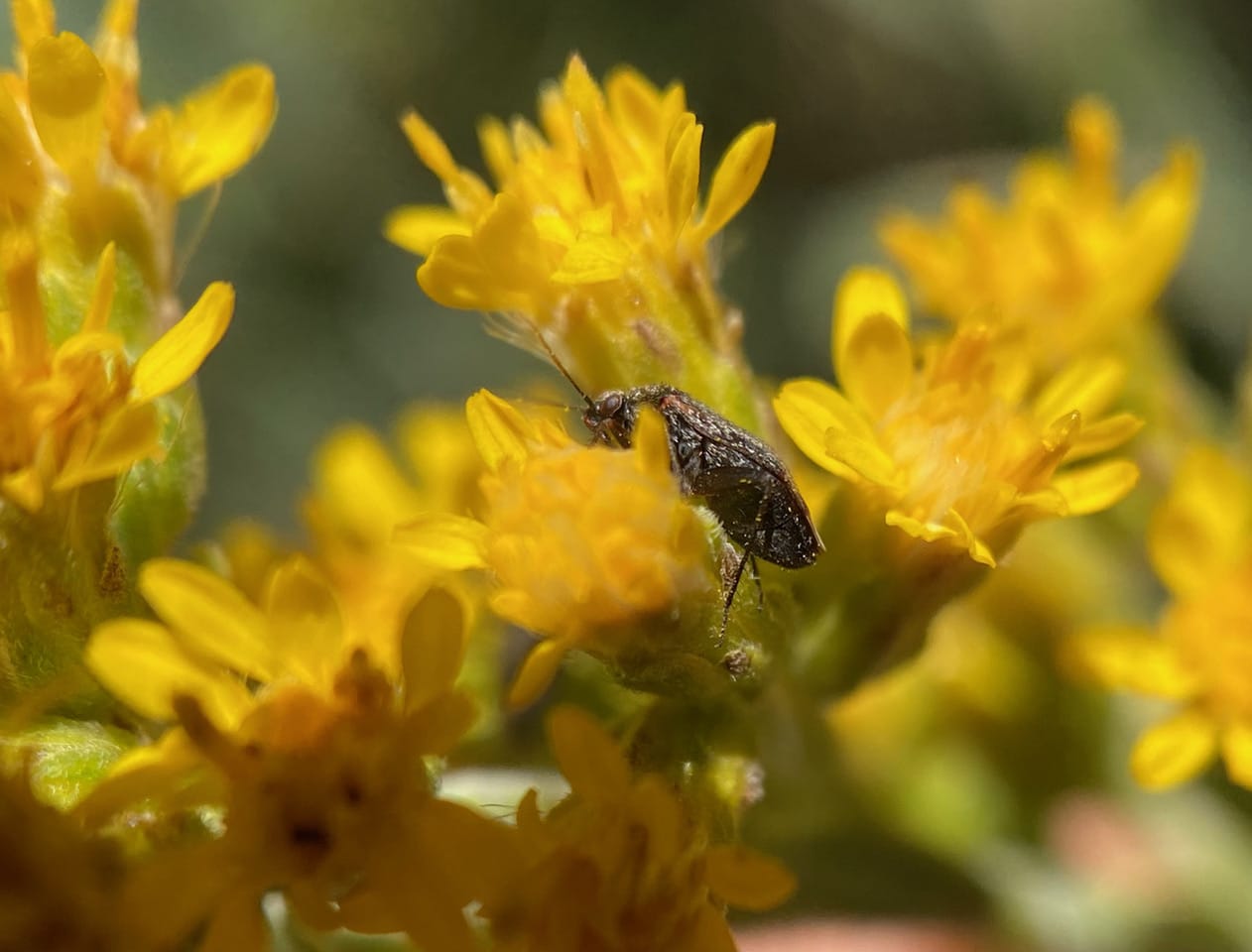
A dark insect is moving around among the flowers of the California Goldenrod, Solidago velutina ssp. californica. It is a Black Grass Bug, Irbisia sp. (family Miridae).
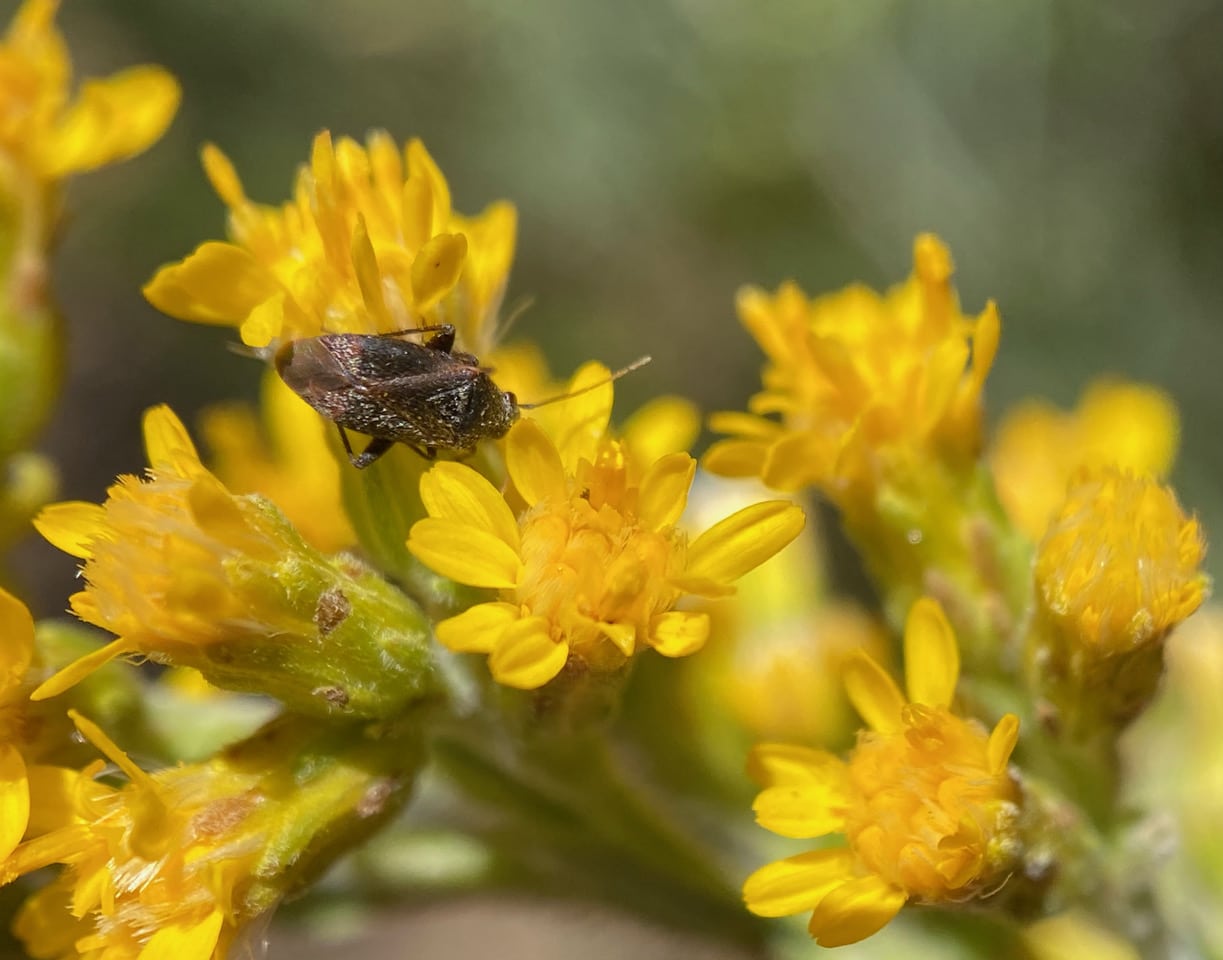
Found in western North America, in chaparral, open woodland and grasslands, Irbisia is a genus of plant bugs in the family Miridae. They are 5-8 mm in length. The wings and body are covered with silvery scales. They are also called Black Grass Bugs as they are commonly found in spring feeding on a variety of grasses. Later in the season the adults disperse to many other plants.