

Pollinator Post 7/28/25 (1)
I am back at Crab Cove for an afternoon walk with Fred.
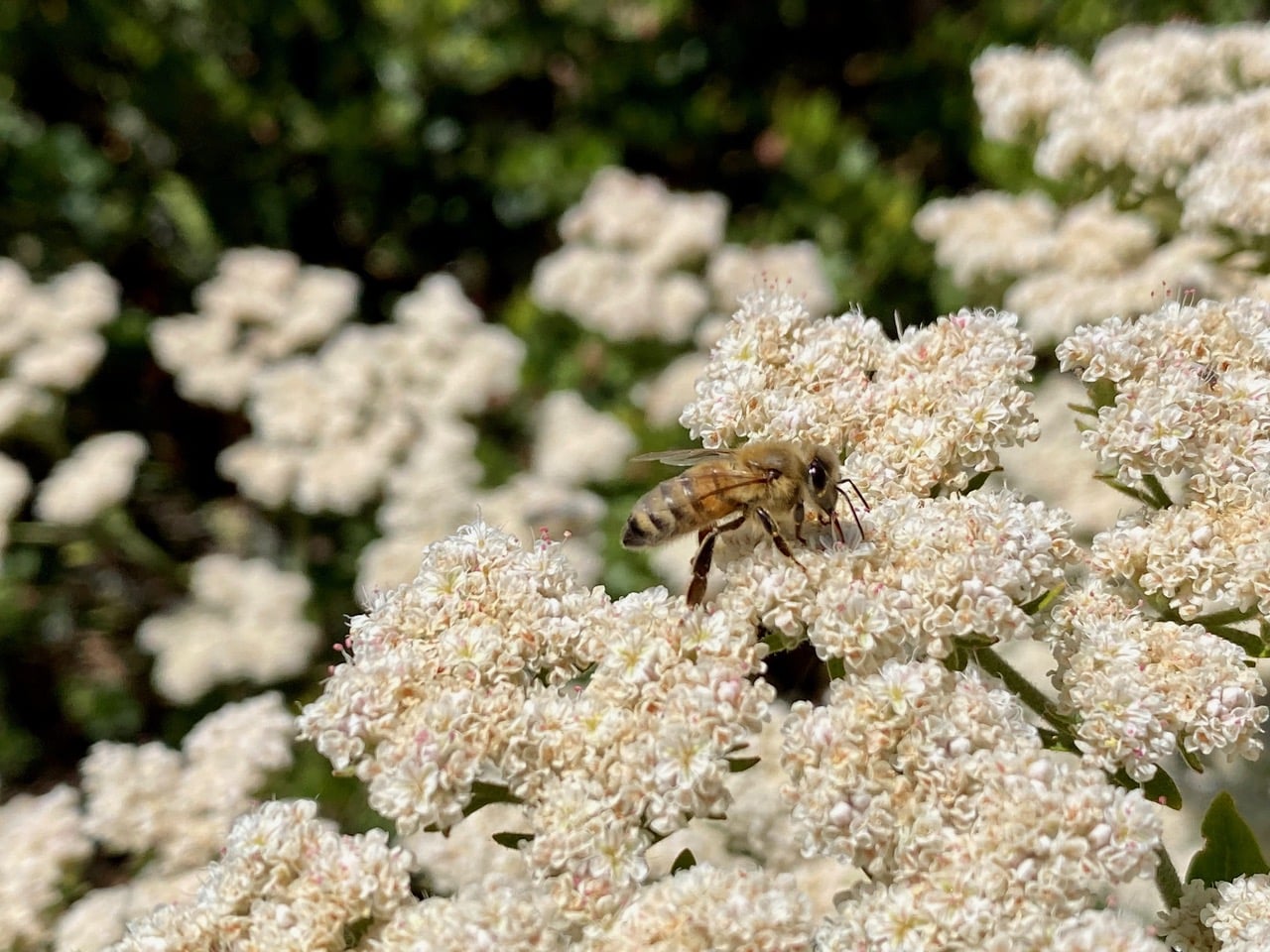
The large shrubs of St. Catherine’s Lace, Eriogonum giganteum near the visitor center are a center of insect activity right now. The Honey Bees, Apis mellifera (family Apidae) seem to be the most prevalent among the visitors to the small, densely clustered flowers.

Ooh, that looks like a male Metallic Sweat Bee, Lasioglossum (Dialictus) sp. (family Halictidae).
Lasioglossum species are found worldwide, and they constitute the largest bee genus. The subgenus Dialictus are the most likely to be seen in the U.S., with over 300 species of these tiny metallic bees. The majority of Lasioglossum are generalists. Because they are so abundant throughout the flowering season, the bees are often important pollinators. Their sheer numbers are enough to achieve excellent pollination of many wild flowers, especially of plants in the Asteraceae, which have shallow floral tubes that are easily accessed by these minute bees.
Lasioglossum are closely related to the genera Halictus and Agapostemon. These genera are commonly called “sweat bees” because of their attraction to human sweat, which they drink for its salt content. Lasioglossum are dusky black to brown slender bees with bands of hair on their abdomen. Female Sweat Bees (family Halictidae) carry pollen in the scopae on their entire hind legs and underside of their abdomen.
Lasioglossum exhibit a range of social behaviors; the genus includes solitary, communal, semi social, primitively eusocial, and even parasitic species. Almost all Lasioglossum in the U.S. nest in the ground. Generally these nests are built in the spring by fertilized females (called foundresses) that spent the winter in hibernation. In social species, the foundresses behave much like the queen bumble bees – they lay the first batch of eggs that develop into the first generation of female workers. The nest grows with each additional generation of bees. Later broods may consist of both males and females. They mate, and at the end of the season the fertilized females hibernate til the following spring, repeating the life cycle of the colony.
Dialictus is a subgenus of sweat bees belonging to the genus Lasioglossum. Most of the members of this subgenus have a metallic appearance. They are commonly found in the Northern Hemisphere and are found in abundance in North America. Members of this subgenus also have very diverse forms of social structure making them model organisms for studying the social behavior of bees.
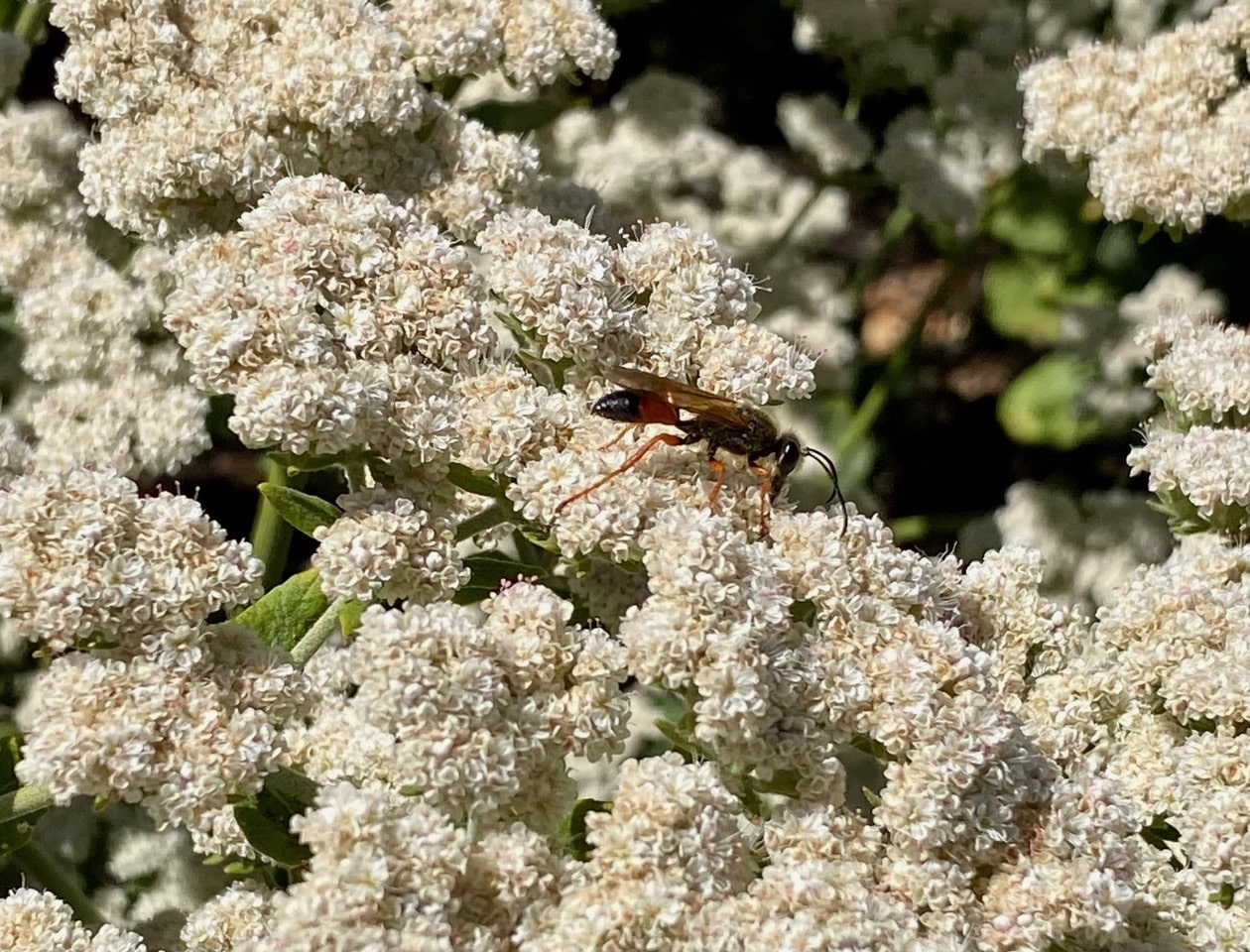
A Large wasp is making its way around the large masses of flowers of St. Catherine’s Lace, its head down constantly seeking nectar. It is a Great Golden Digger Wasp, Sphex ichneumoneus (family Sphecidae).

Sphex ichneumoneus, known commonly as the Great Golden Digger Wasp is a wasp in the family Sphecidae. It is identified by the golden pubescence on its head and thorax, its reddish orange legs, and partly reddish orange body. Size 15-27 mm. Found in fields, meadows, the wasp is native to the Western Hemisphere, from Canada to South America. The female digs a chambered tunnel in open ground, and proceeds to stock it with food for her young. She hunts for insects from the family of long-horned grasshoppers that include various crickets, katydids and grasshoppers. She stings to paralyze her prey, then flies or drags it back to the nest. A single egg is laid on the prey. The wasp larvae have fresh food to sustain them until they emerge as adults. One tunnel entrance may lead to as many as eight or ten separate larval chambers. The Great Golden Digger Wasps are not aggressive, but do sting if handled.
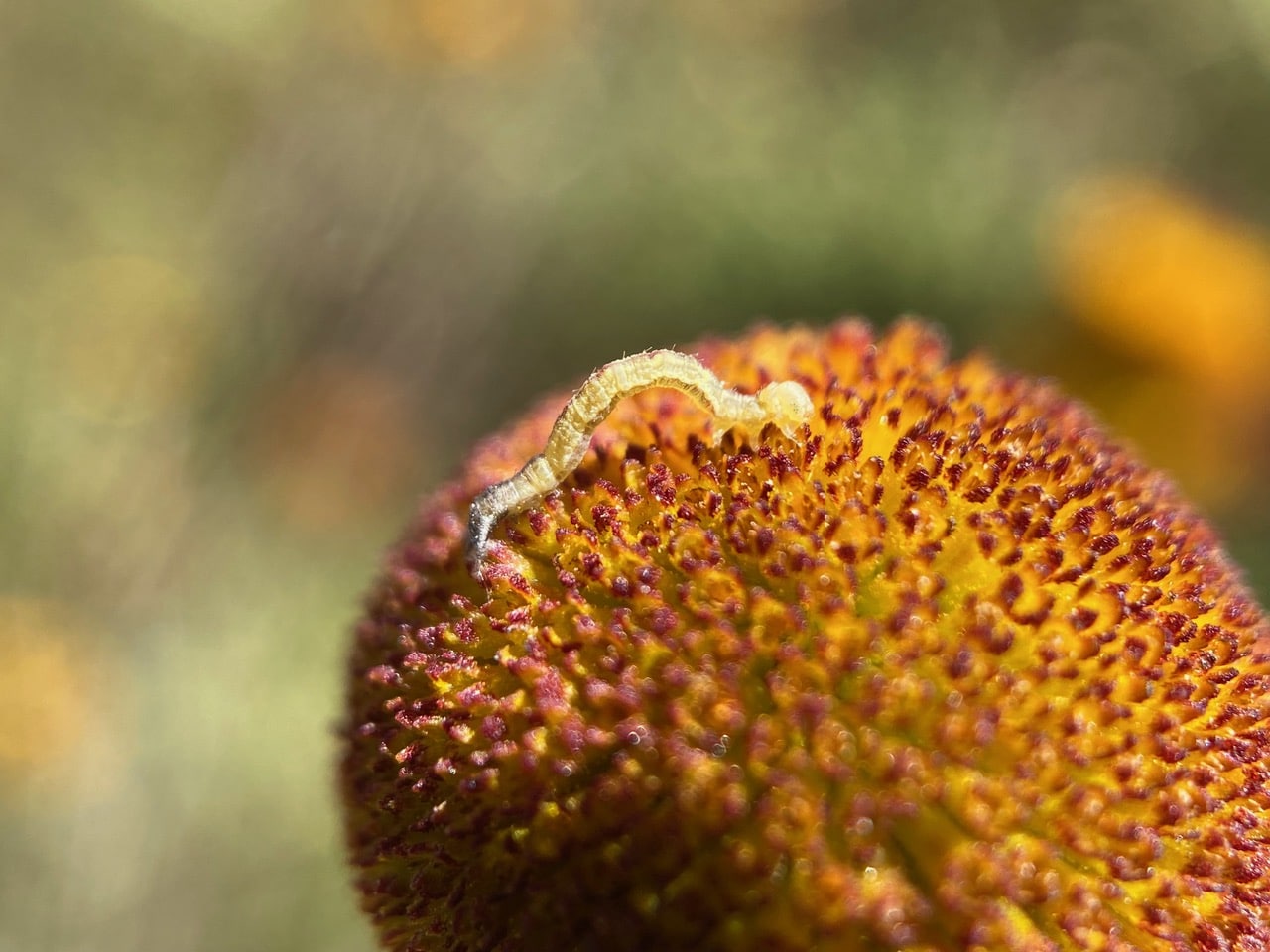
A tiny inchworm caterpillar is “inching” its way on the surface of a globular flowerhead of Sneezeweed, Helenium puberulum.
Inchworms are also called loopers and measuring worms. The majority of the inchworms are the larvae of moths in the family Geometridae. The name comes from the Greek “geo” for earth and “metro” from measure, because the caterpillars seem to be measuring the surface on which they are walking.
All caterpillars have three pairs of jointed legs behind their heads. These legs are called true legs because they will become the six legs of the adult butterfly or moth. There are additional appendages, called prolegs, along their bodies. Prolegs are not true legs, they are just outgrowths of the body wall and will be lost at metamorphosis. They have little hooks on their soles to help the caterpillar walk and grip onto things.
Most caterpillars have five sets of prolegs, four in the middle of the body and one pair at the hind end. Inchworms have the normal six true legs but only two or three pairs of prolegs, all located at the tail end of the body, with none in the middle. When an inchworm walks, it moves its tail-end prolegs up behind its true legs, causing the center of its body to loop upward. Then it stretches its front end forward to take another step.

A female Fine Striped Sweat Bee, Agapostemon subtilior (family Halictidae) is foraging on a Sneezeweed, focusing on the strip around the globular flowerhead where the florets are fully opened and offering nectar and pollen.
Agapostemon are brightly colored metallic green or blue bees measuring 7 to 14.5 mm long. Most species have a metallic green head and thorax, and black-and-yellow striped abdomen; some females are entirely bright green or blue. Females carry pollen on scopal hairs located on their hind legs. Agapostemon are ground-nesters and generalist foragers. Like other members of the family Halictidae, they are short-tongued and thus have difficulty extracting nectar from deep flowers. Males are often seen flying slowly around flowers looking for females. The bees favor flowers with high densities.
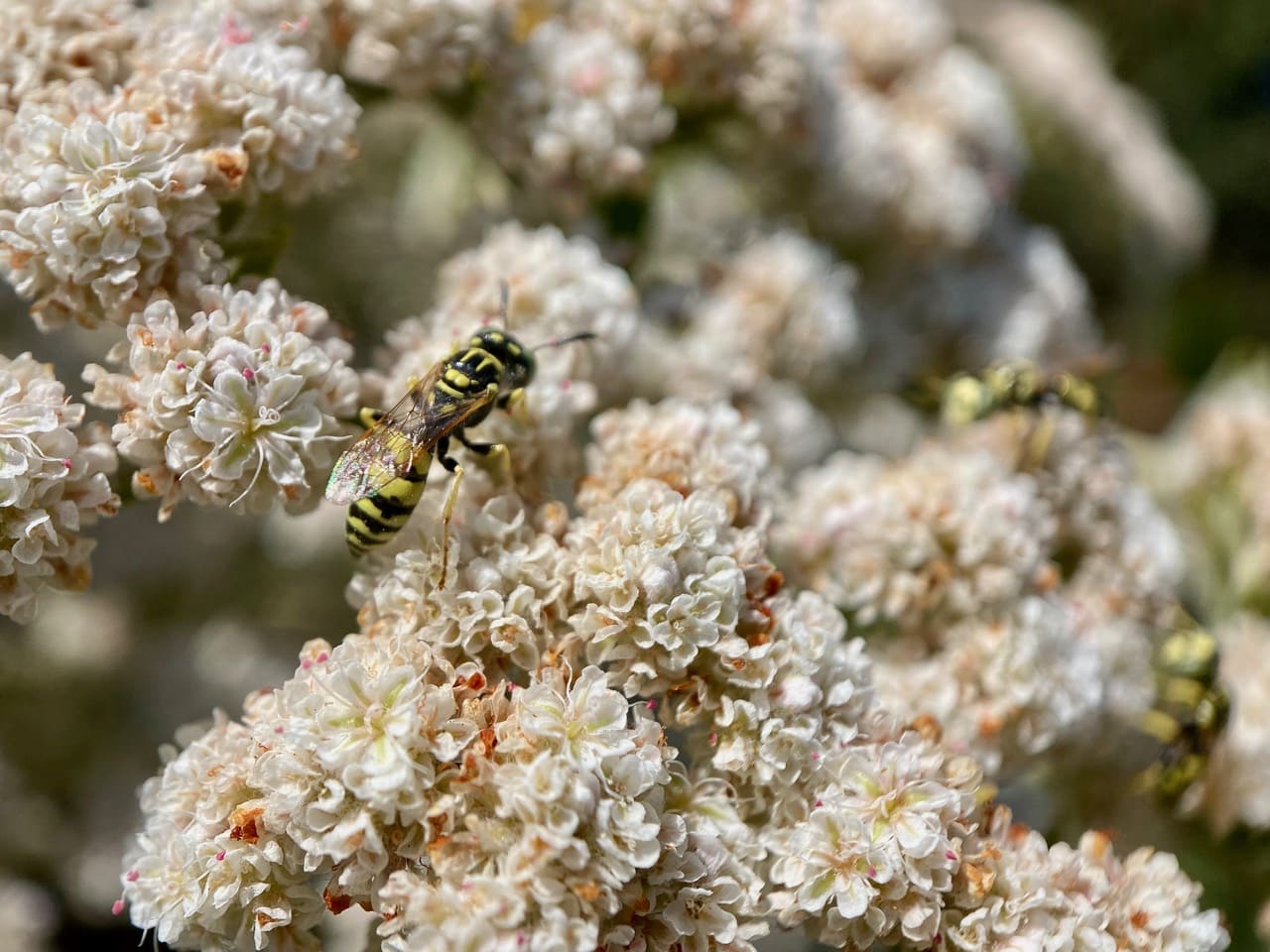
Wow, I have never seen such a concentration of Beewolves! There are three in this picture, two are blurry in the background to the right. These are Philanthus multimaculatus (family Crabronidae).

Beewolves (genus Philanthus) are solitary, predatory wasps, most of which prey on bees, hence their common name. The adult females dig tunnels in the ground for nesting, while the territorial males mark twigs and other objects with pheromones to claim the territory from competing males. As with all other spheroid wasps, the larvae are carnivorous, forcing the inseminated females to hunt for bees on which she lays her eggs, supplying the larvae with prey when they emerge. To prevent fungal growth on the stored prey, female Philanthus wasps secrete symbiotic bacteria from specialized antennal glands. Some Philanthus species specialize on certain bee species, others may be generalists that prey on a wide variety of bees. The adults visit flowers for nectar. The best known beewolf is the species that prey on honey bees.

It is not surprising that the Beewolves are here in droves. They are seeking nectar while also on the hunt for bees!
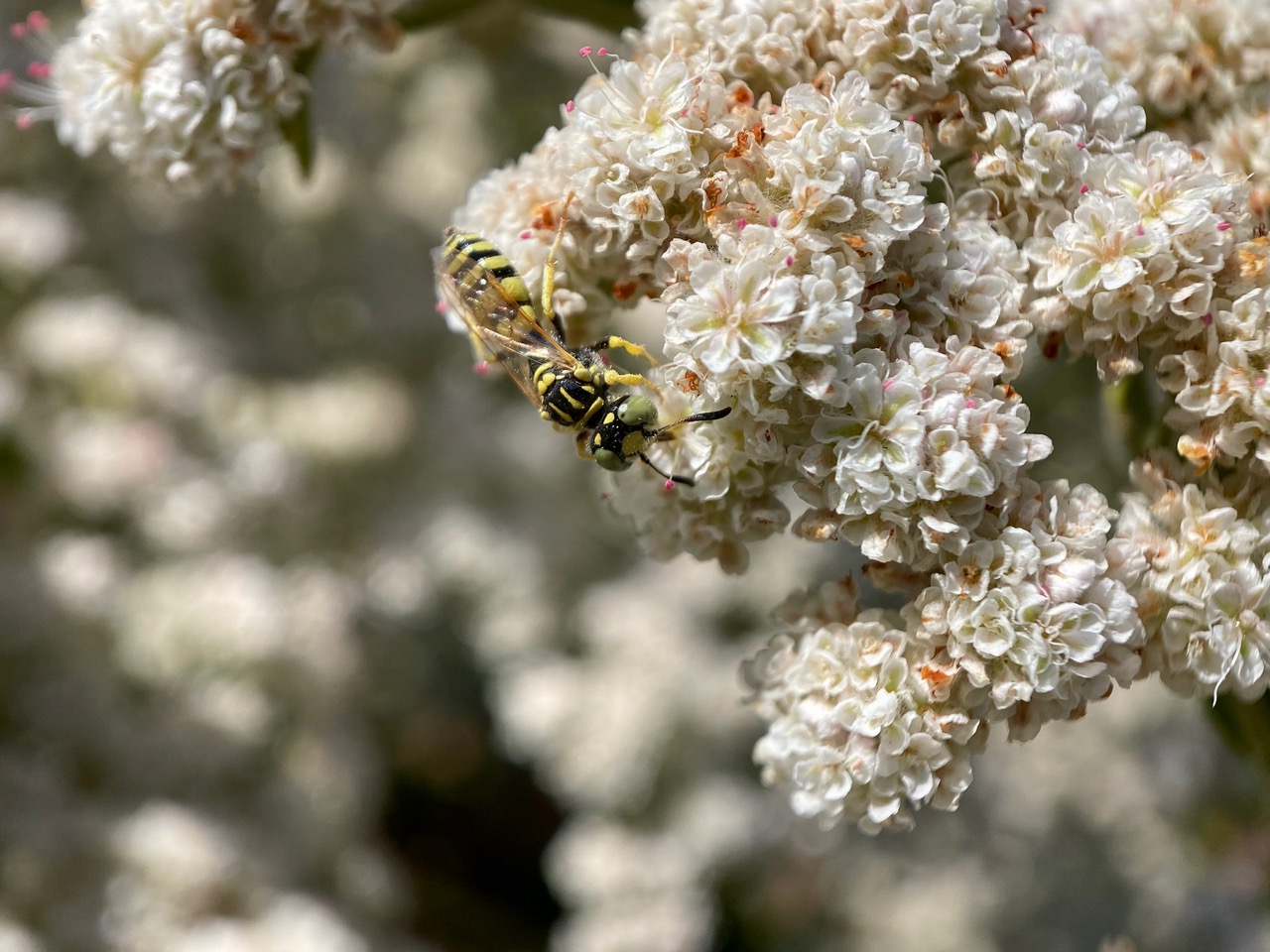

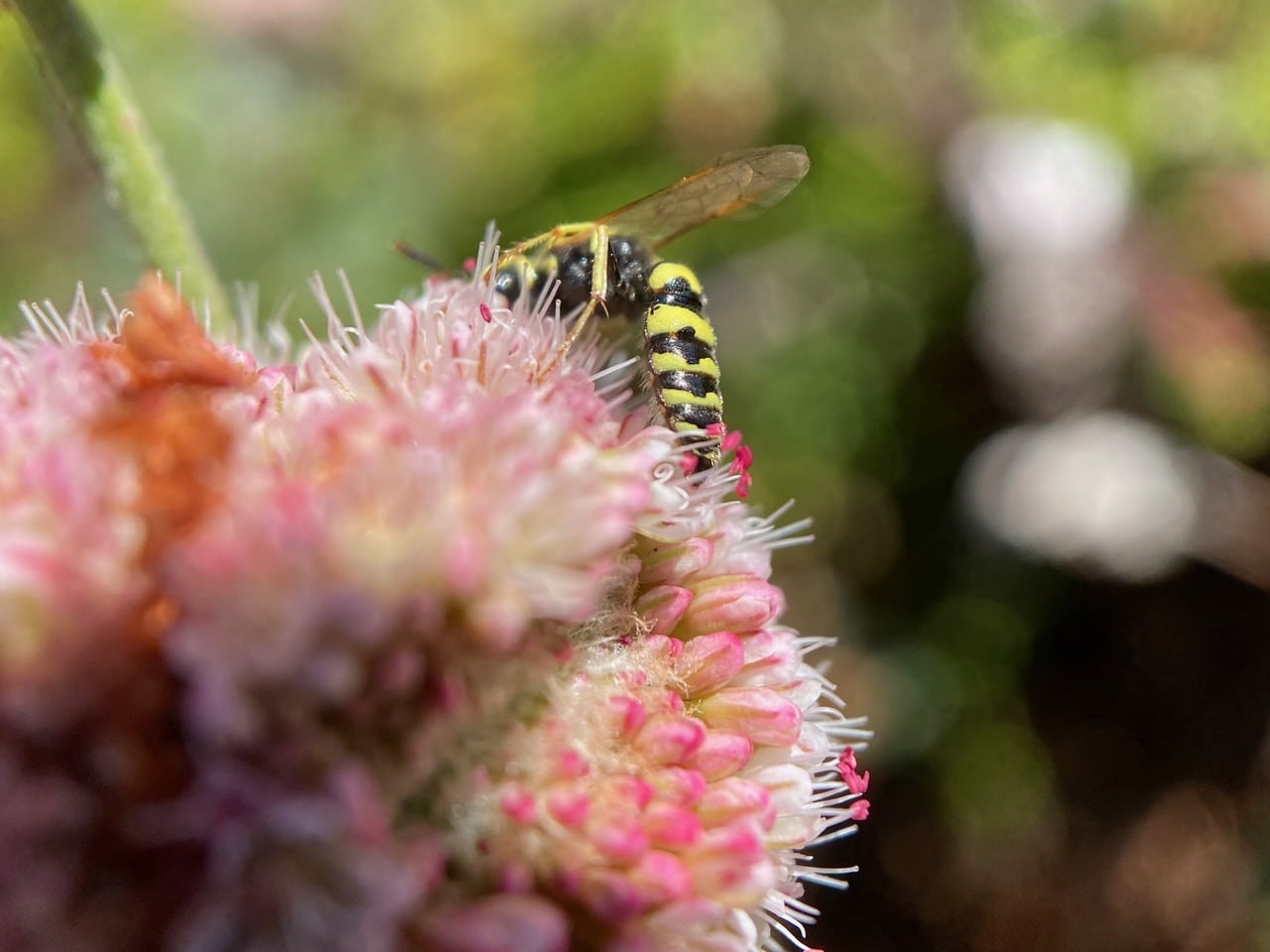


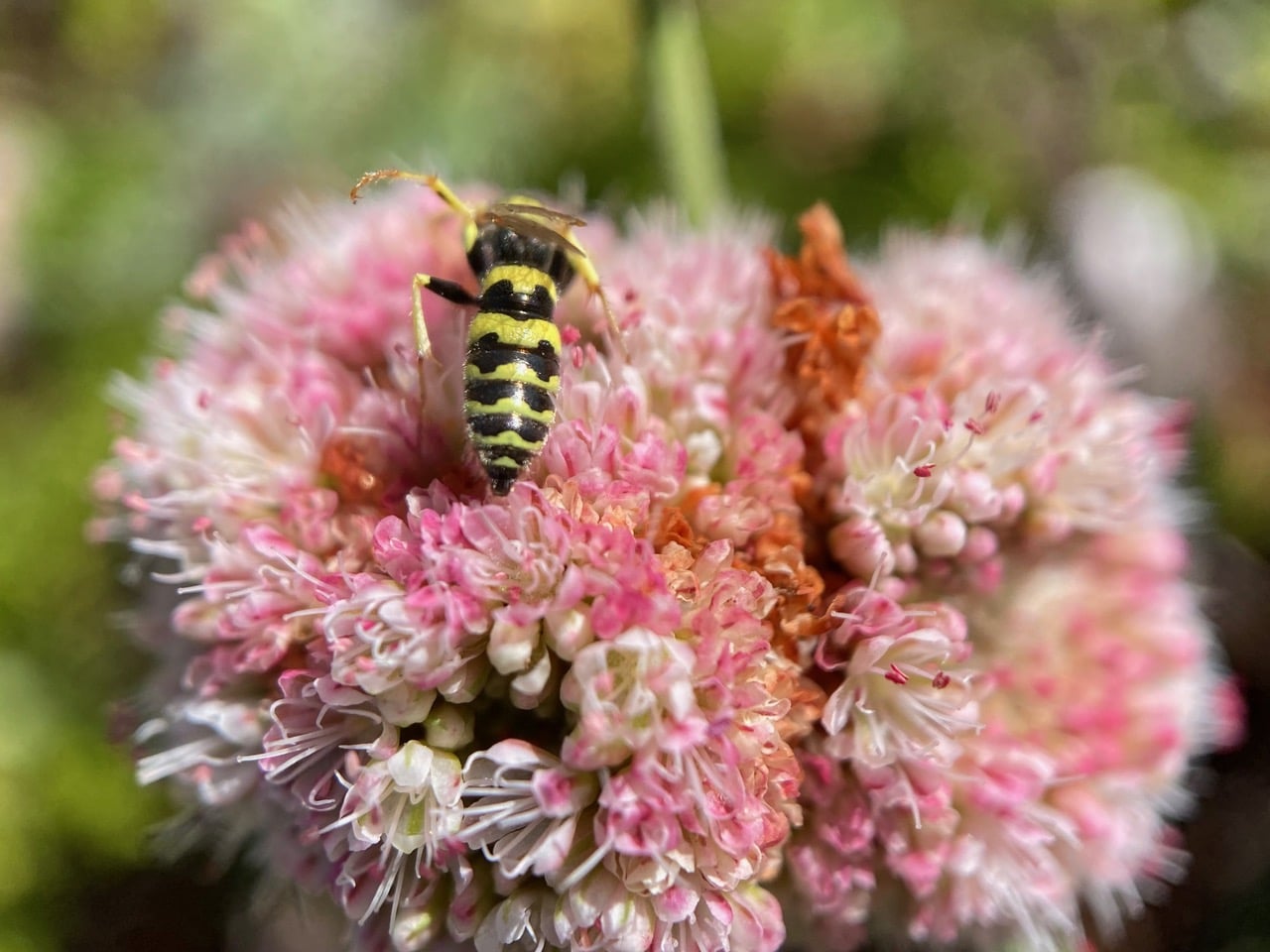
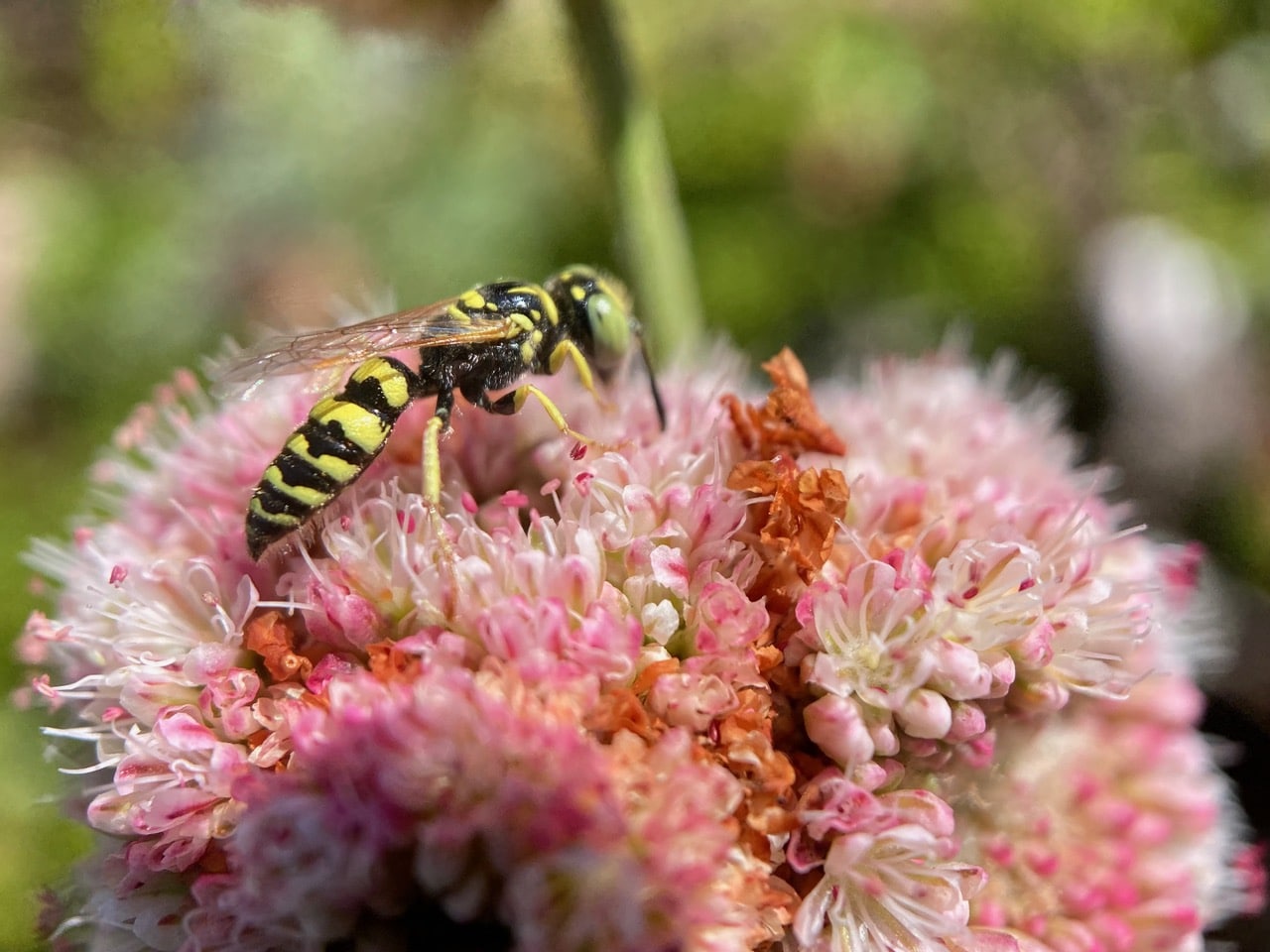

The prevalence of Beewolves at Crab Cove is due in large part to the favorable nesting sites for these bee predators as well as their prey. The sandy upper beach of certain sections of the cove is pocked with nesting burrows of both bees and wasps.
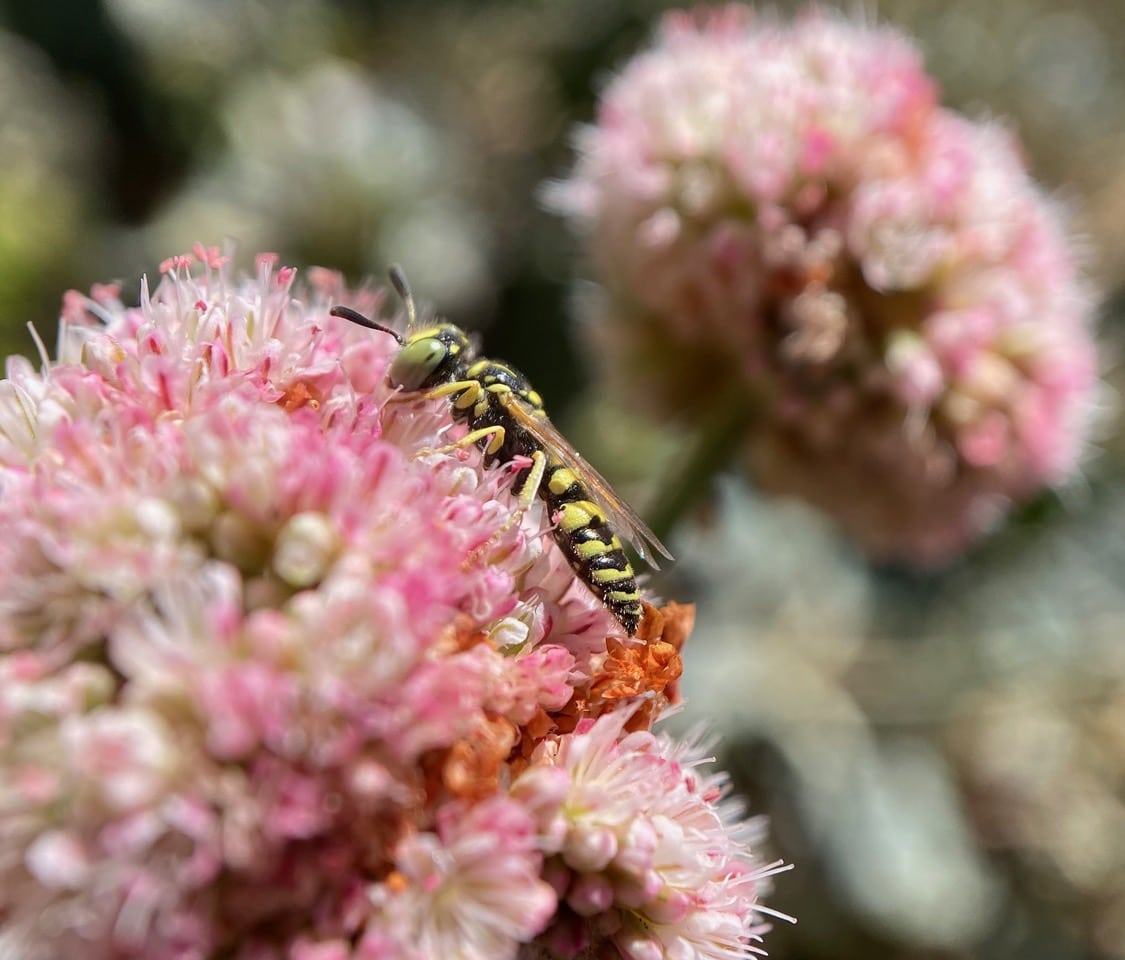

Here’s another dune dweller that frequents the flowers in the native garden. An American Sand Wasps, Bembix americana (family Crabronidae) is taking nectar from an inflorescence of Red-flowered Buckwheat, Eriogonum grande ssp. rubescens.
Sand wasps in the genus Bembix are familiar and common throughout North America, digging their burrows in dunes, on beaches, and other habitats with loose, deep sand. The female rapidly kicks out large quantities of sand using a “tarsal rake” of spines on each front leg. The burrow is excavated before the wasp goes hunting. Bembix are generalist, opportunistic hunters. True flies in the order Diptera are the usual prey. A victim is paralyzed or killed by the wasp’s sting, and is then flown back to the nest. Most species will lay an egg on the first victim, while some species lay an egg in the empty cell before starting to hunt. Once the egg hatches, mama wasp brings flies to her larva as needed. This “progressive provisioning” is rare in the insect world. When the larva reaches maturity, mama wasp closes the cell. Inside, the larva spins an oblong cocoon, weaving sand grains into the structure and resulting in a hardened capsule. Overwintering takes place as a prepupa inside this cocoon, but there are usually two generations a year.
Male sand wasps often engage in an elaborate flight ritual called “sun dances”. Males emerge before females, and fly erratically at dizzying speed one or two inches above the ground attempting to detect virgin females about to emerge from their underground nests. Both sexes are often seen taking nectar at flowers, especially from Asteraceae family. Bembix wasps are often victims of other insects such as cuckoo wasps (Chrysididae), velvet ants (Mutillidae), satellite flies (Sarcophagidae), bee flies (Bombyliidae), and thick-headed flies (Conopidae).

A male Fine Striped Sweat Bee, Agapostemon subtilior (family Halictidae) is foraging on the flowers of Red-flowered Buckwheat. Note that unlike the all-green female we saw earlier on the Sneezeweed, he has a black-and-yellow striped abdomen. You can easily tell the genders apart in this species at first glance.
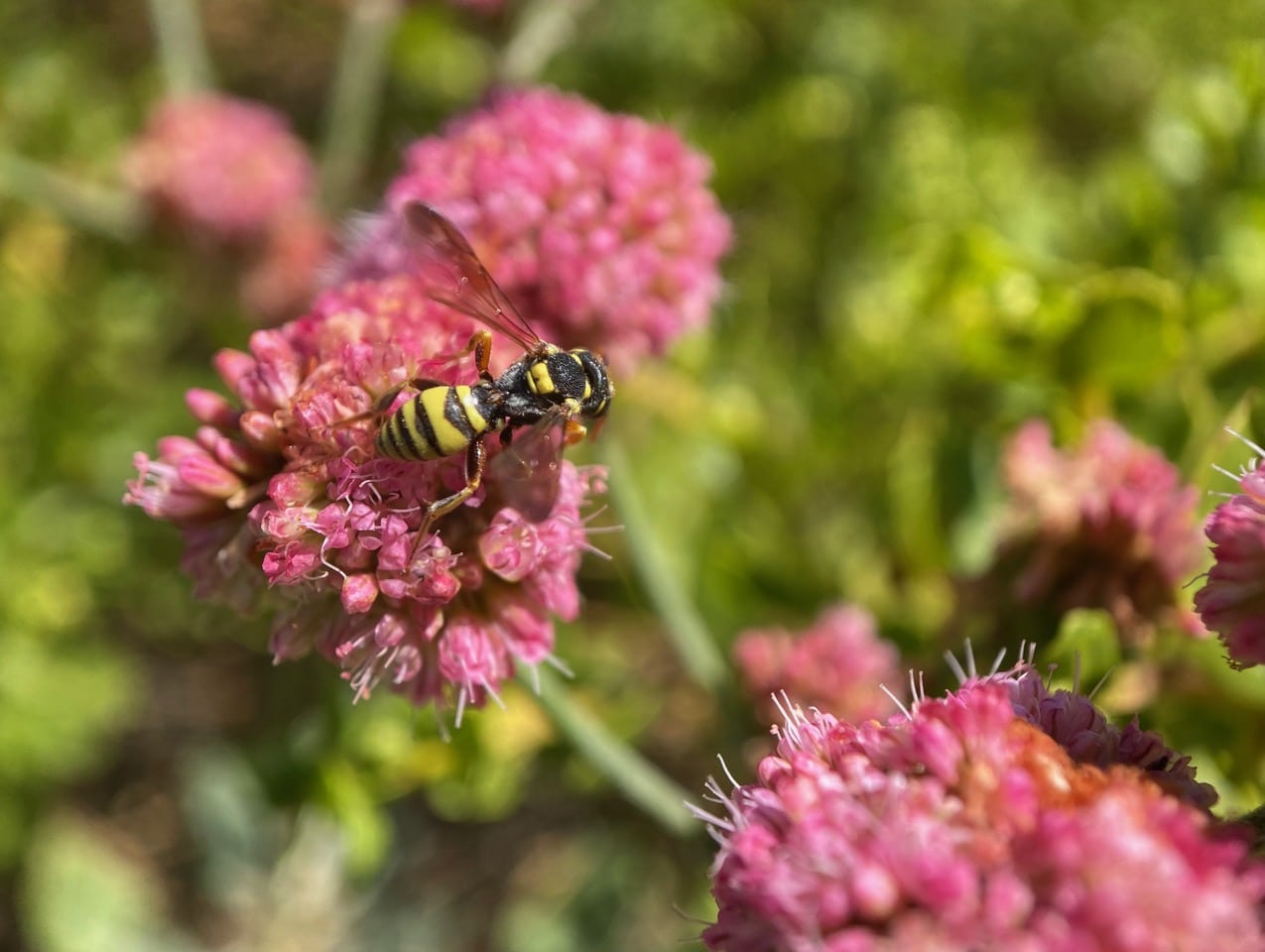
That looks like a mason wasp, but I know by now that it is actually a Cuckoo Bee, Complex Nomada vegana. I have learned to rely on the black-and-yellow pattern on the abdomen as well as the eyes for distinguishing the two. Both the cuckoo bee and the mason wasp frequent this patch of buckwheat, making the learning process fun and rapid.

Nomad Bees in the genus Nomada is one of the largest genera in the family Apidae, and the largest genus of Cuckoo Bees. Nomada are kleptoparasites of many different types of ground-nesting bees as hosts, primarily the genus Andrena. They lack a pollen-carrying scopa, and are mostly hairless, as they do not collect pollen to feed their offspring. Adults visit flowers for nectar. The bees are extraordinarily wasp-like in appearance, often with yellow or white integumental markings on their abdomen.
Nomad Bees occur worldwide. All known species parasitize ground-nesting bees, and their habitats and seasonality correlate closely with their hosts. In early spring, females scout out their hosts, searching for nests to parasitize. The female Nomada sneaks into the host’s nest while the resident female is out foraging, then lays eggs in the nest. The parasite larva that hatches out kills the host offspring and feeds on the host’s provisions. This type of parasitism is termed brood parasitism. The parasites pupate in the host cell and finally emerge as adults the following season along with the hosts.
While we might shudder at the thought of cuckoo bees in our garden, the presence of cuckoo bees actually indicates a healthy population of their host bees, suggesting a diverse and thriving ecosystem. Parasitism is a natural part of many ecosystems, and cuckoo bees play a role in regulating the populations of their host species. Cuckoo bees, while not collecting pollen for their own young, still visit flowers for nectar and inadvertently pollinate plants in the process. Cuckoo bees are also a food source for other animals, further contributing to the food web.
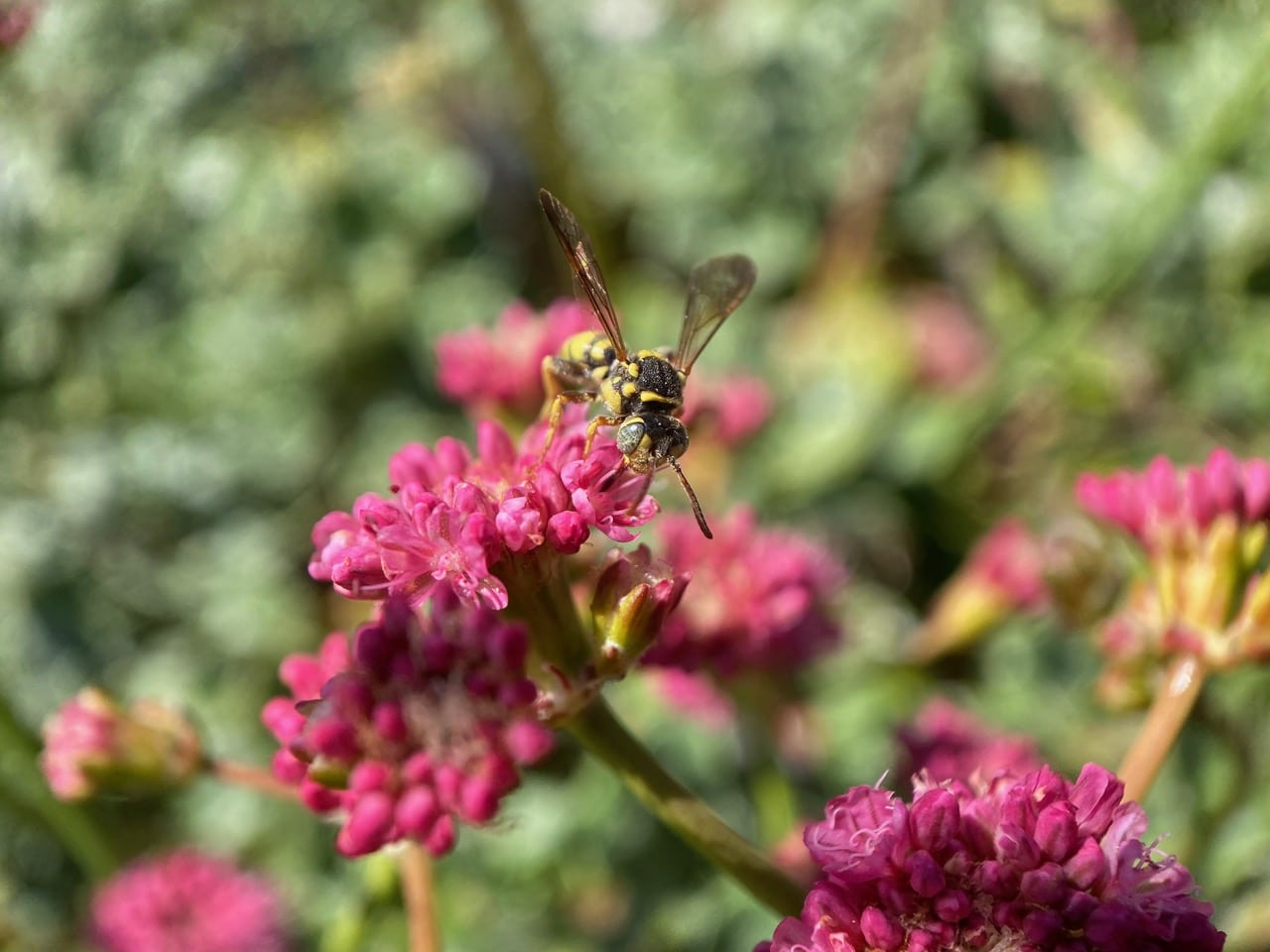
Note the mottled blue eyes of the Nomad Bee. The mason wasp that it resembles has black, notched eyes.

A quick swipe of its antenna and the Cuckoo Bee is off to another cluster of flowers.
