

Pollinator Post 7/28/23 (1)
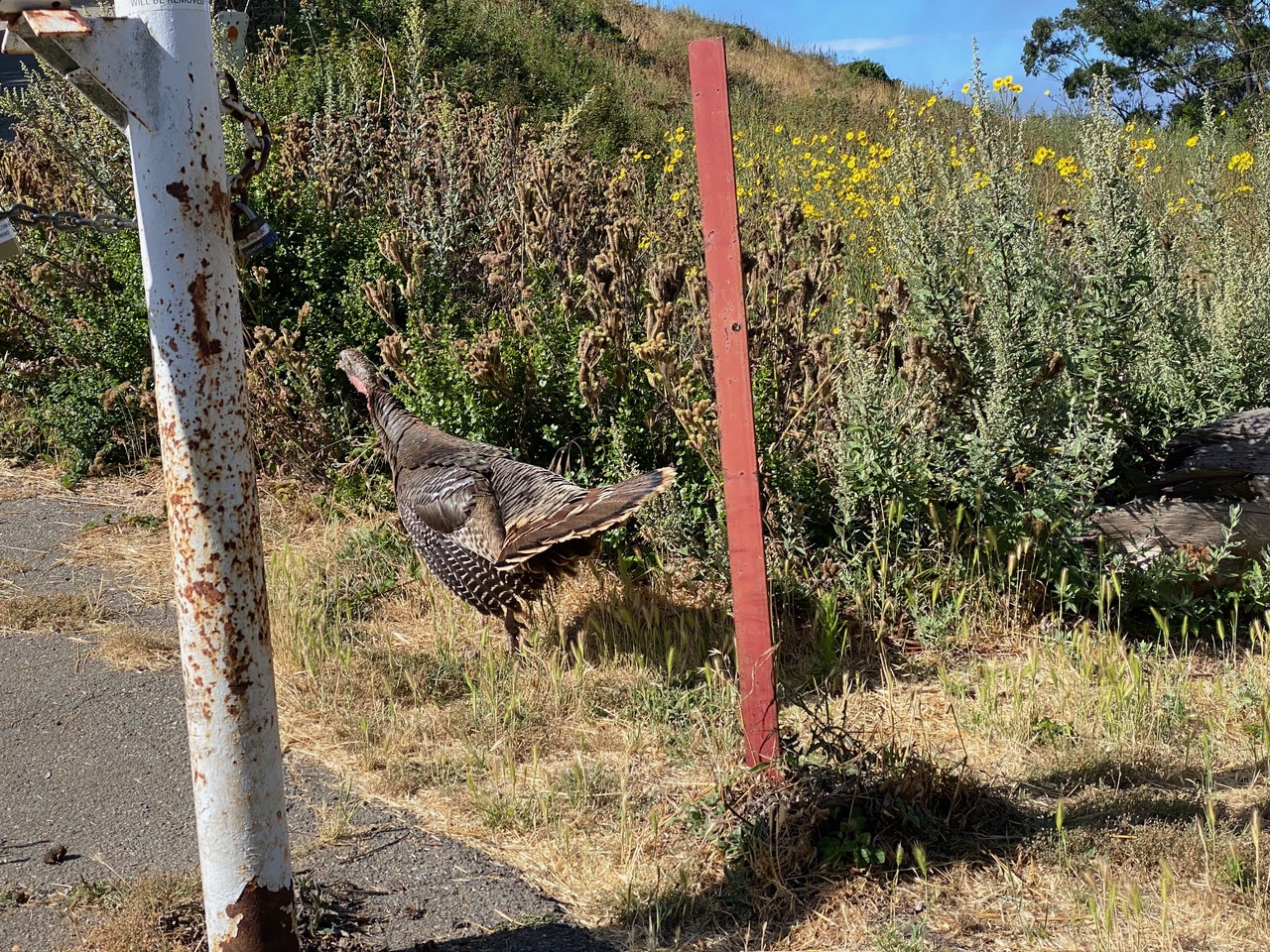
This photo was taken yesterday morning, when I came to the tarweed patch at Siesta Gate, hoping to collect one of the parasitoid wasp pupae to rear out at home. As soon as I stepped over the log (visible on the right) into the patch, I came face to face with a furious female turkey. She lunged at me almost immediately, flapping her huge wings. I quickly turned around to get out, with the big bird fast on my heel. At one point, I could feel her wing feathers brush against my cheek! When I was far away enough, mama turkey finally calmed down and returned to the bushes. She must be protecting her brood hidden in the thicket.
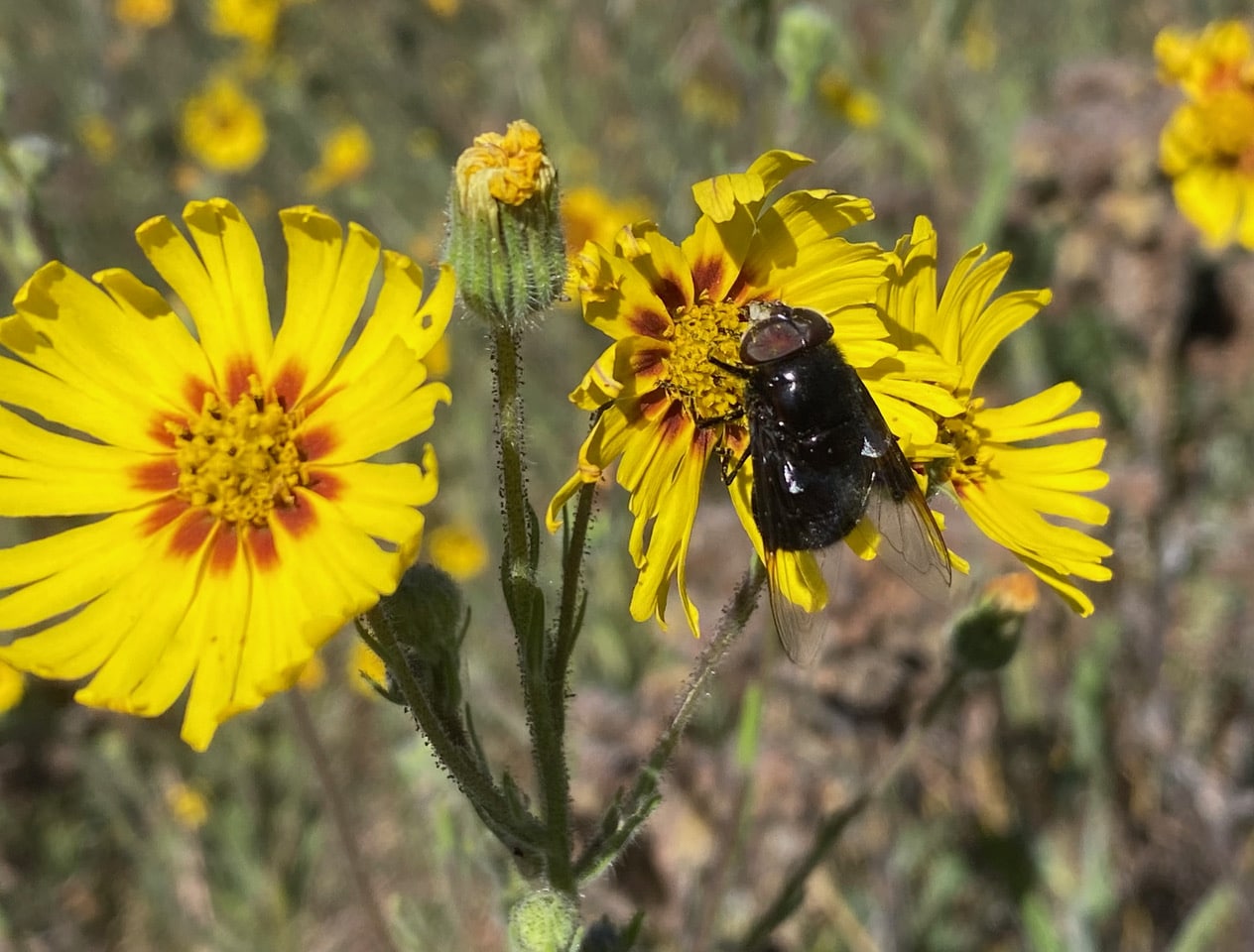








Peace has returned this morning. Looking left and right, I step cautiously into the tarweed patch. No sight or sound of mama turkey. A large hoverfly lands on an Elegant Tarweed flowerhead in front of me and all my trepidations disappear. I have regained my focus.
The Purple Bromeliad Hoverfly, Copestylum violaceum (family Syrphidae) is by far the largest hover fly we have at Skyline Gardens. At a distance and in flight, it is easily mistaken for a Carpenter Bee. Copestylum females lay eggs in rotting plant materials. Adults visit a wide range of flowers for nectar and pollen. Not much else is known about the fly’s biology.
See those two white flaps under the smokey black base of its wings? Those are calypters. The calypters are small membranous flaps or lobes that are located at the base of the wing in some species of fly (order Diptera). The presence of calypters is an important diagnostic feature and is often used by entomologist to help identify different species of fly. It has been hypothesized that the calypters prevent wind turbulence from affecting haltere movements, allowing more precise detection of body position, but this idea has yet to be formally tested.
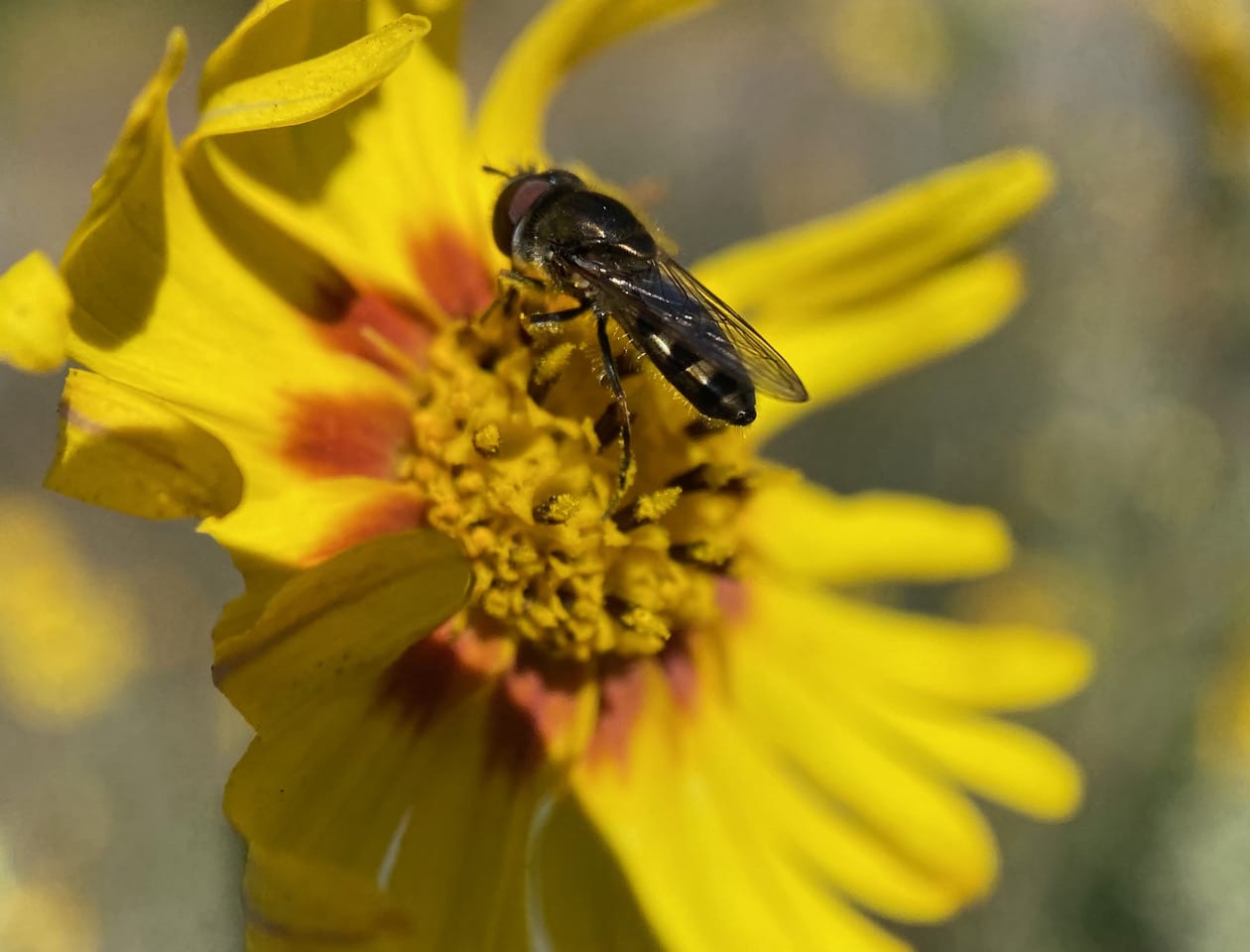
This is another hover fly that bucks the trend of the black-and-yellow bee/wasp mimicry commonly seen in the family Syrphidae. The Sedgesitter, Platycheirus sp. wears a metallic garb instead. Its metallic sheen is only appreciated in certain incident light.
It is a male with holoptic eyes (that meet along a central line on top of the head). Stepping through the florets to feed on nectar and pollen, Platycheirus is covered with the sticky pollen of Madia elegans on its face and legs. The fly is a good pollinator.
Platycheirus is found in grass and herb vegetation. Adults of many species feed on pollen of wind-pollinated plants, such as Salix, Plantago, Poaceae, Cyperaceae, but they visit other flowers as well. Many stay active during cold and rainy weather. Larvae feed on aphids.
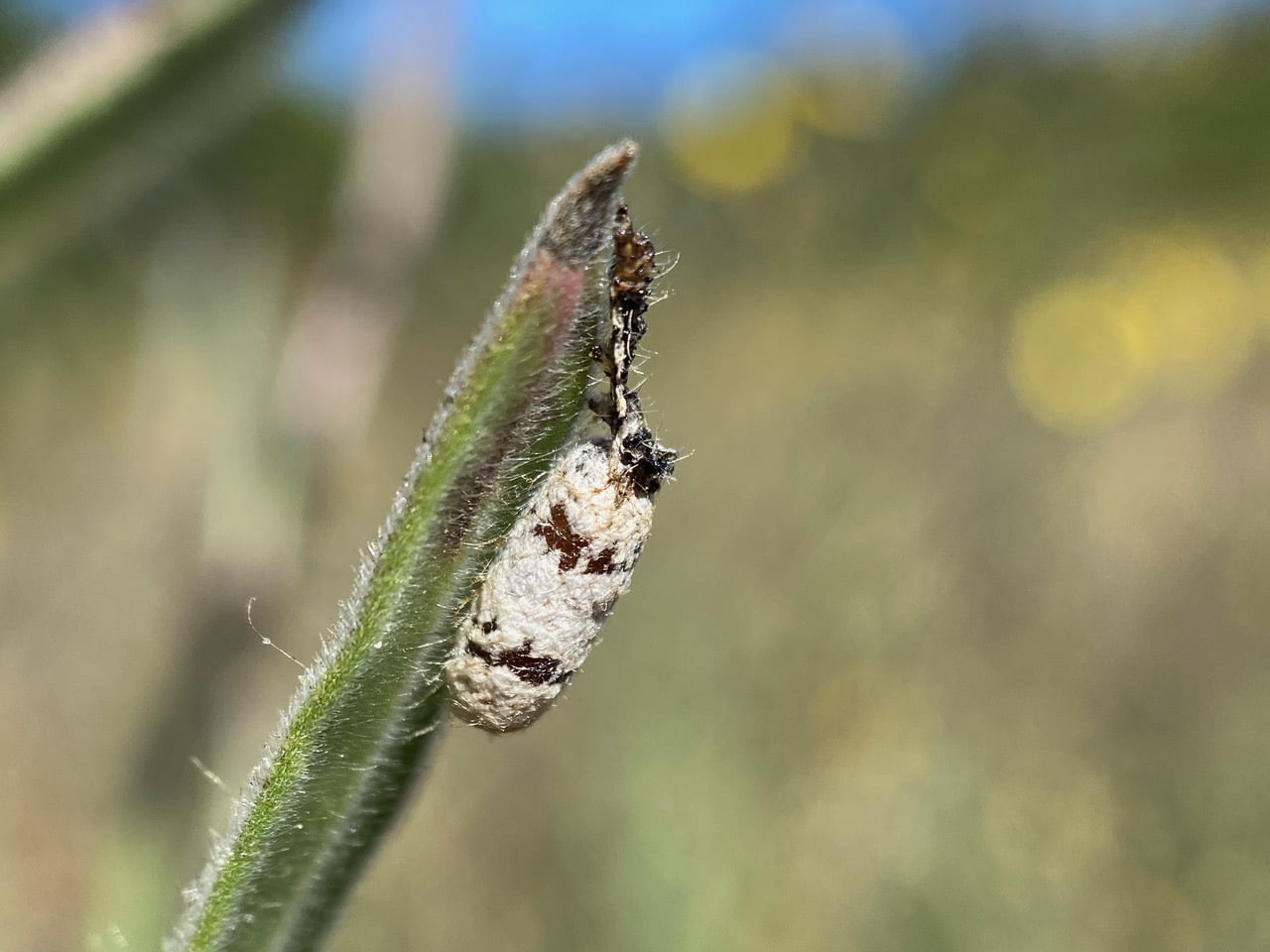
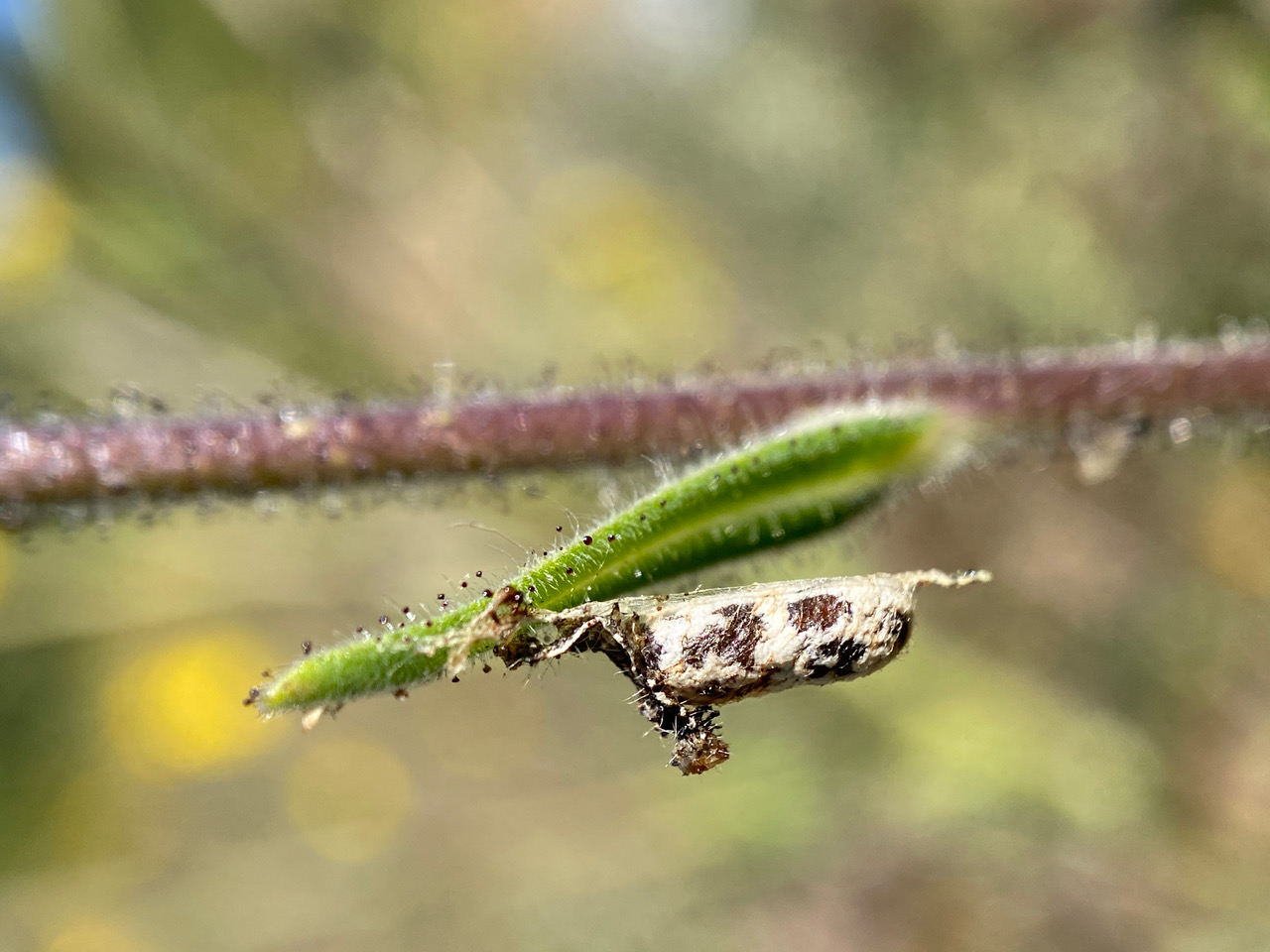
I quickly locate one of the two parasitoid wasp pupae I found on 7/26. I clip the leaf with the pupa, and place them in a glass vial, plugging the vial with a piece of cotton gauze. The pupa will go home with me to be reared out – the only way to definitively identify the wasp.
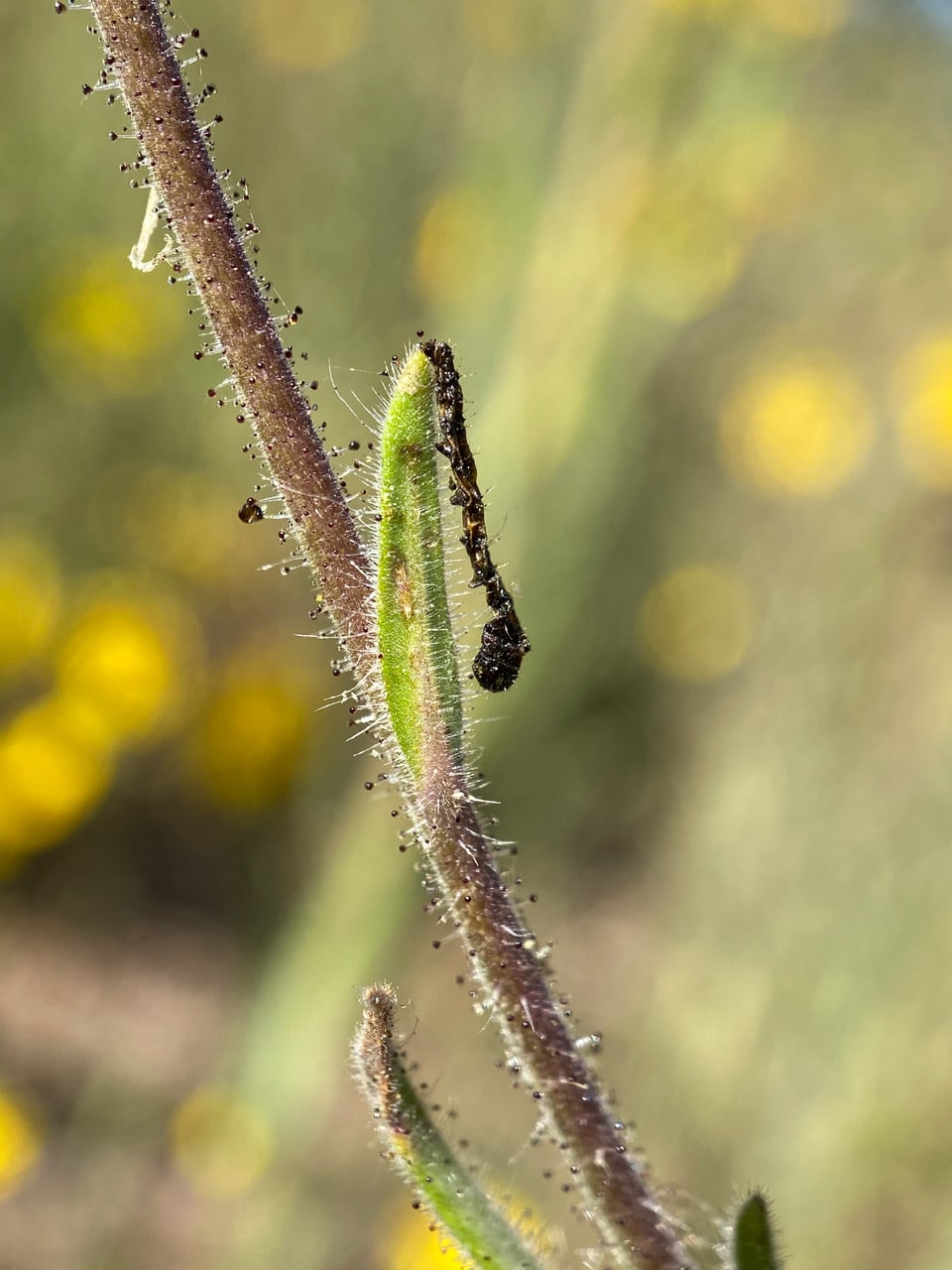
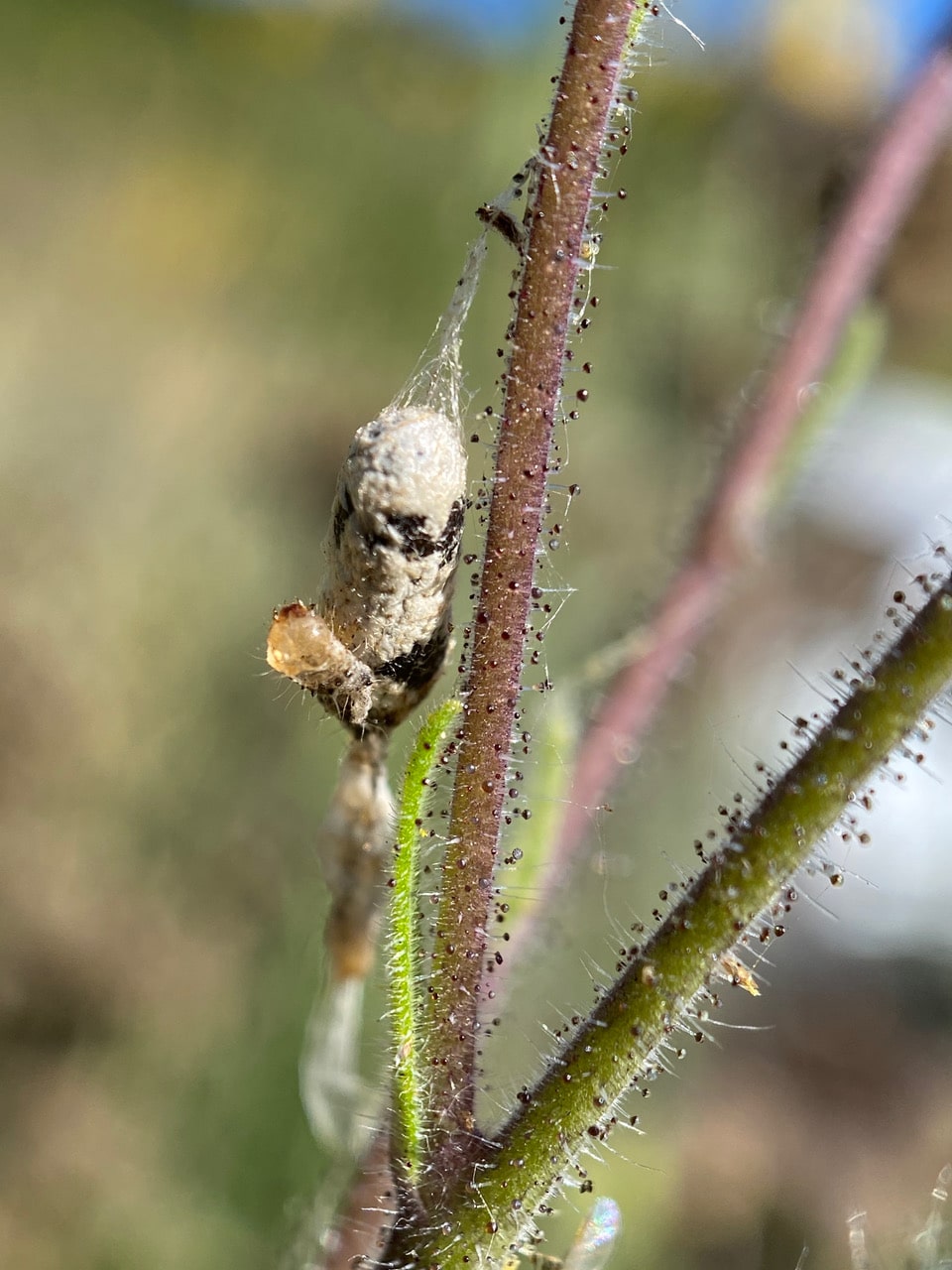
Hyposoter is a large cosmopolitan genus of parasitoid wasps belonging to the family Ichneumonidae. Obvious evidence that Hyposoter is present is its black-and-white pupal cocoon. These commonly occur on foliage attached to the shriveled skin of the caterpillar in which the parasitoid fed during its larval stage.
Hyposoter undergoes complete metamorphosis. The adult wasp lays its egg in the caterpillar. After hatching, the larva feeds inside on the caterpillar’s hemolymph (blood) while developing through three, increasingly larger instars. The wasp larva then feeds on the caterpillar’s tissues consuming the entire body except for the skin and head capsule. The host caterpillar shrinks and becomes a hard and brittle, shriveled skin. The parasitoid emerges from the host skin as a mature third instar (prepupa). The wasp then spins a silken cocoon commonly attached to the dead caterpillar’s skin. The cocoon is about 1/4 in. long, oblong with dense white silk and blackish patches. Parasite development time from oviposition until adult emergence is about one month. There may be several generations per year. Hyposoter is used in the biological control of caterpillars in many crops.
Mission accomplished, I begin to look around the tarweed patch for more Hyposoter pupae. Here’s one, with the dead caterpillar still attached!
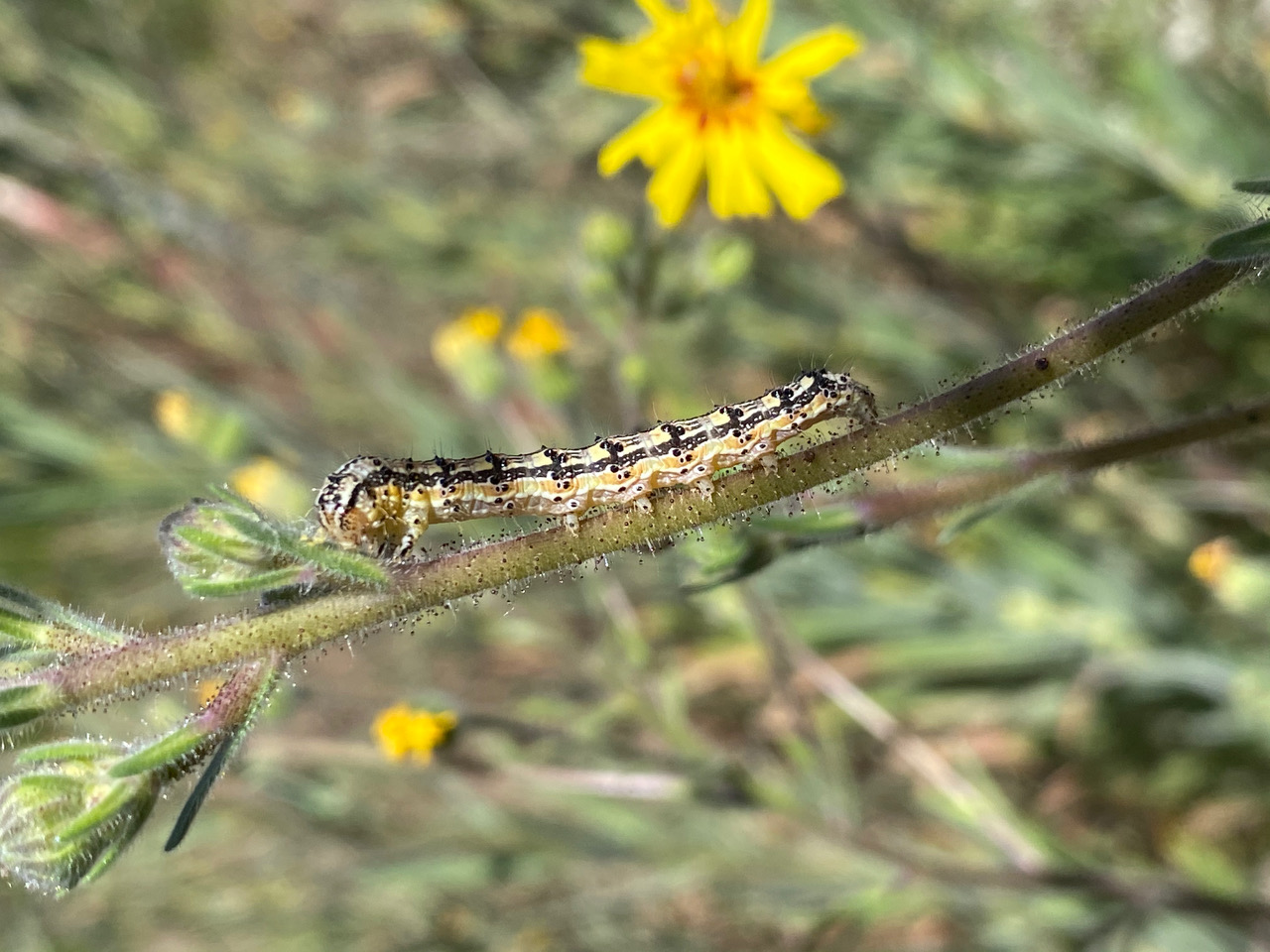
I wonder if this caterpillar is aware that there are parasitoids coming after it? This one is probably safe, as it is probably past the stage that the Hyposoter wasps attack. The wasps generally only attack the early instars.
Ooh, here’s a shriveled caterpillar hanging solo from a leaf. The wasp pupa to which it was attached has fallen off?
Another Hyposoter wasp pupa.
A lucky caterpillar that has escaped parasitism by Hyposoter wasps – too big.
Wow, this caterpillar has devastated the Elegant Tarweed, having devoured most of the flowerheads on the top branches.
Newly hatched Stink Bug nymphs (family Pentatomidae) are still clustered on their empty egg shells on the underside of an Elegant Tarweed leaf. Stink Bug eggs hatch synchronously, and the nymphs stay together until their first molt.
A cluster of empty Stink Bug egg shells on a leaf axil. Note the typical barrel shape and pop tops of the eggs. There are also exuviae (shed exoskeletons) left by the nymphs when they molted.
Here’s a withered caterpillar with a detached head capsule. Maybe the Hyposoter larva did not succeed in exiting from the caterpillar? Various gruesome scenarios could have played out here.
This Hyposoter pupa is hanging loose on what looks like a bed of silk, not attached to the leaf.
Yet another one. Obviously the wasp larva that erupts from the caterpillar is able to adapt to the situation it finds outside the host, and can spin its cocoon in a variety of orientations. Awesome!
A young caterpillar is hanging listlessly on an Elegant Tarweed leaf. Has it been parasitized by a Hyposoter wasp?
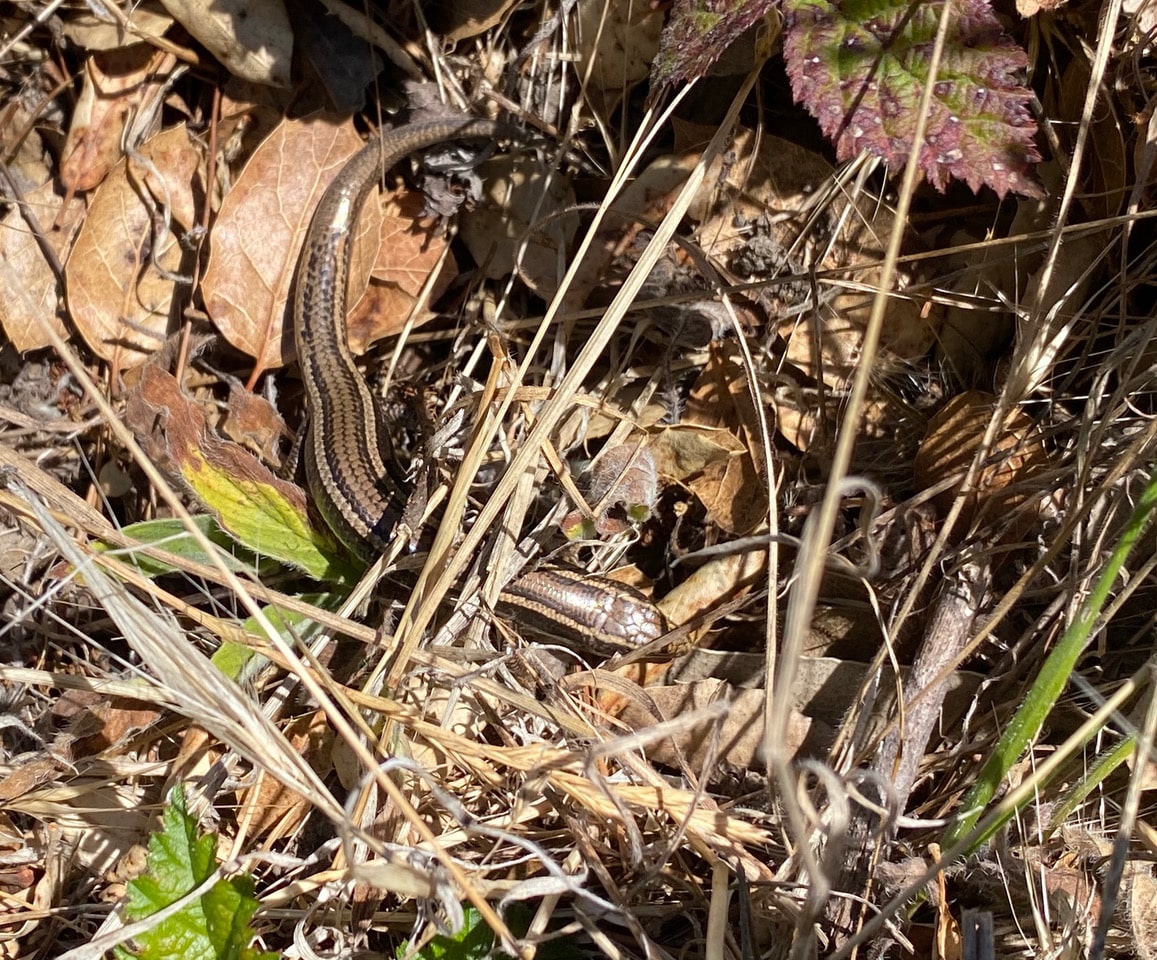
Heading uphill on the paved road, I hear some scuttling noises in the leaf litter on the edge of the road. The Western Skink, about 7 ins.long, comes to a stop and actually stays put for a photo!
The Western Skink, Plestiodon skiltonianus is a species of small, smooth-scaled lizard with relatively small limbs. It is widespread in northern California but primarily restricted to the coast in central and southern California. Found in a variety of habitats, this lizard is most common in early successional stages or open areas of late successional stages. The diurnal reptile is active during the warm seasons. The lizards spend much of their day basking in the sun. Their diet ranges widely, including spiders and beetles. The species is secretive and very agile, foraging actively through leaf litter and dense vegetation. It is a good burrower and sometimes constructs burrows several times its own body length. Females take great care of their eggs, guarding the nest until the young leave the nest. Young Western Skinks have a bright blue tail with color that fades with age. Skinks can perform autotomy; if seized by a predator its tail is deliberately cast and wriggles violently to attract attention while the lizard may escape. Skinks reach sexual maturity at around 3 years, and live up to 9 years.