

Pollinator Post 7/27/26

It’s a mild summer morning at Bay Farm Island. The shoreline is ablaze with the sunny blooms of Oregon Gumweed, Grindelia stricta.
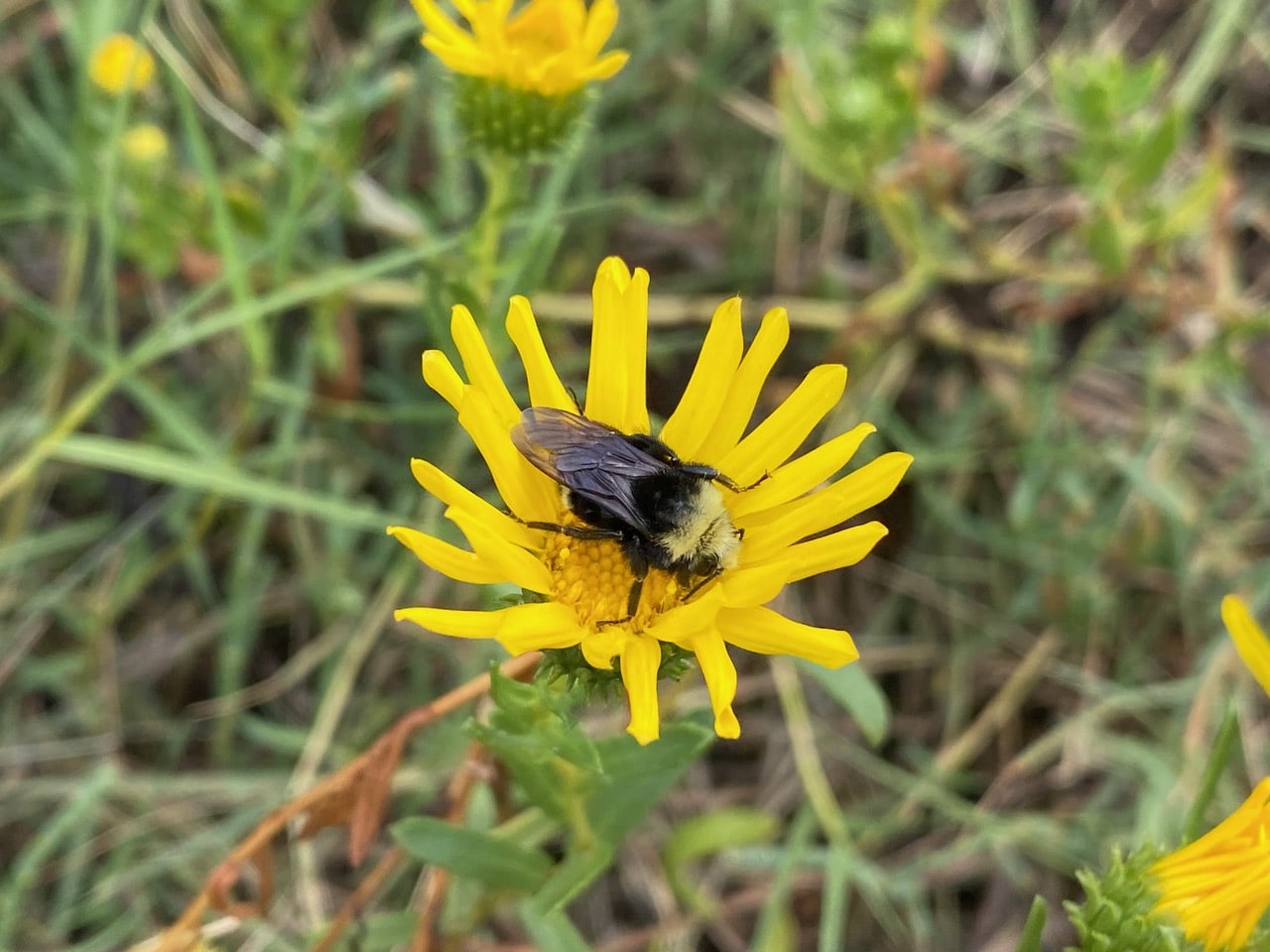
At 11:20 am, a Yellow-faced Bumble Bee, subgenus Pyrobombus (genus Bombus, family Apidae) is still fast asleep on a Grindelia flowerhead. Judging from its slender hind legs with no corbiculae (pollen baskets), I gather that it is a male.
Male bumble bees (drones) leave their colony permanently once they mature, so they do not return to the nest to sleep. Instead, they spend their nights sleeping outdoors, often hanging onto or curled up inside flowers, under petals, or on tall vegetation. This behavior is driven by the male bumble bee’s sole purpose in life: to find a queen to mate with. Because males do not help with colony duties like foraging, raising young, or maintaining the nest, they have no reason to return. Sleeping on or under plants allows them to stay close to food sources and potential mates while staying securely anchored out of the wind.
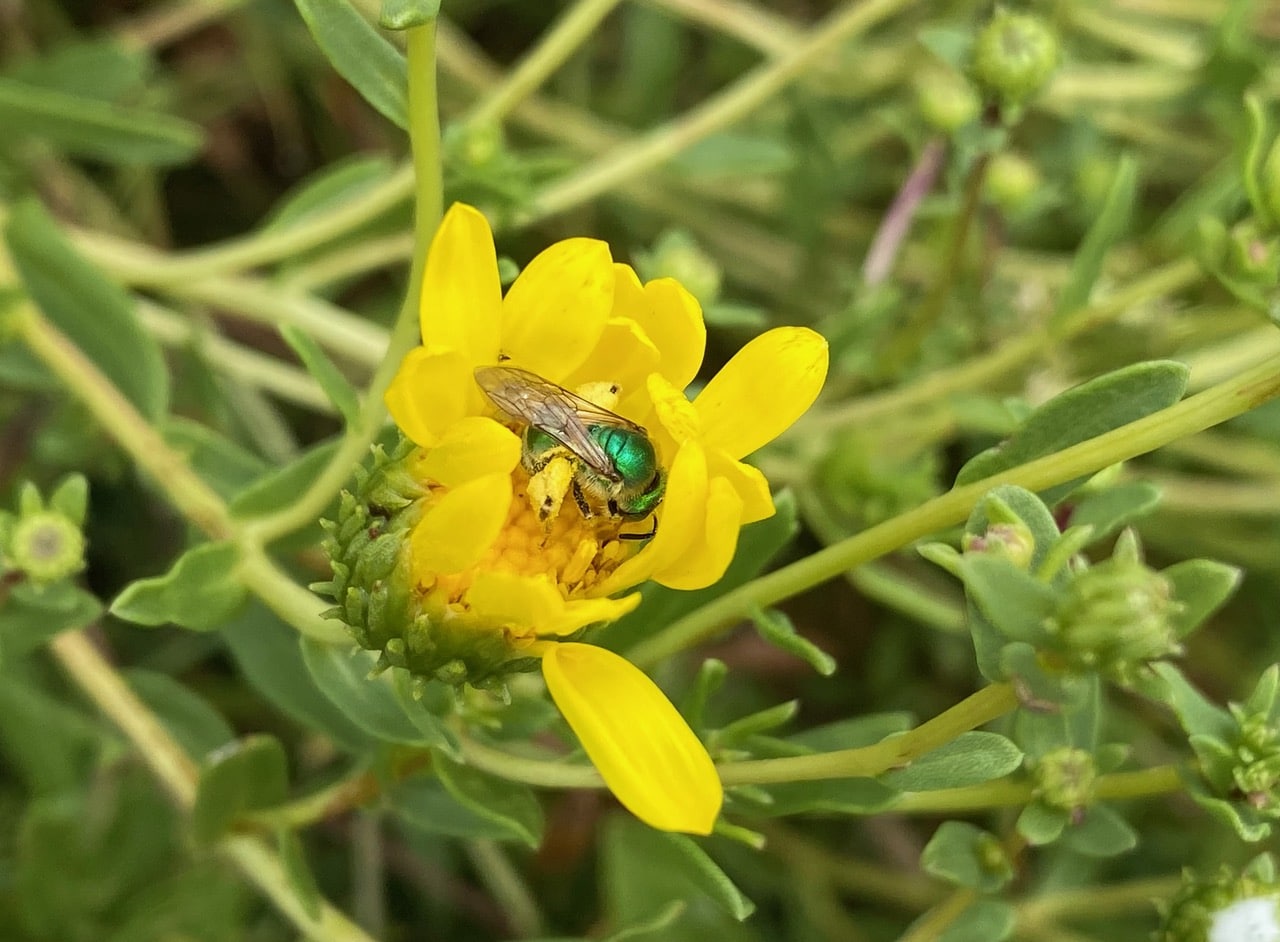
Her scopae (special pollen collecting hairs) bulging with pollen, a female Fine Stripe Sweat Bee, Agapostemon subtilior (family Halictidae) is busy foraging on a newly opened Grindelia flowerhead she can barely fit in.
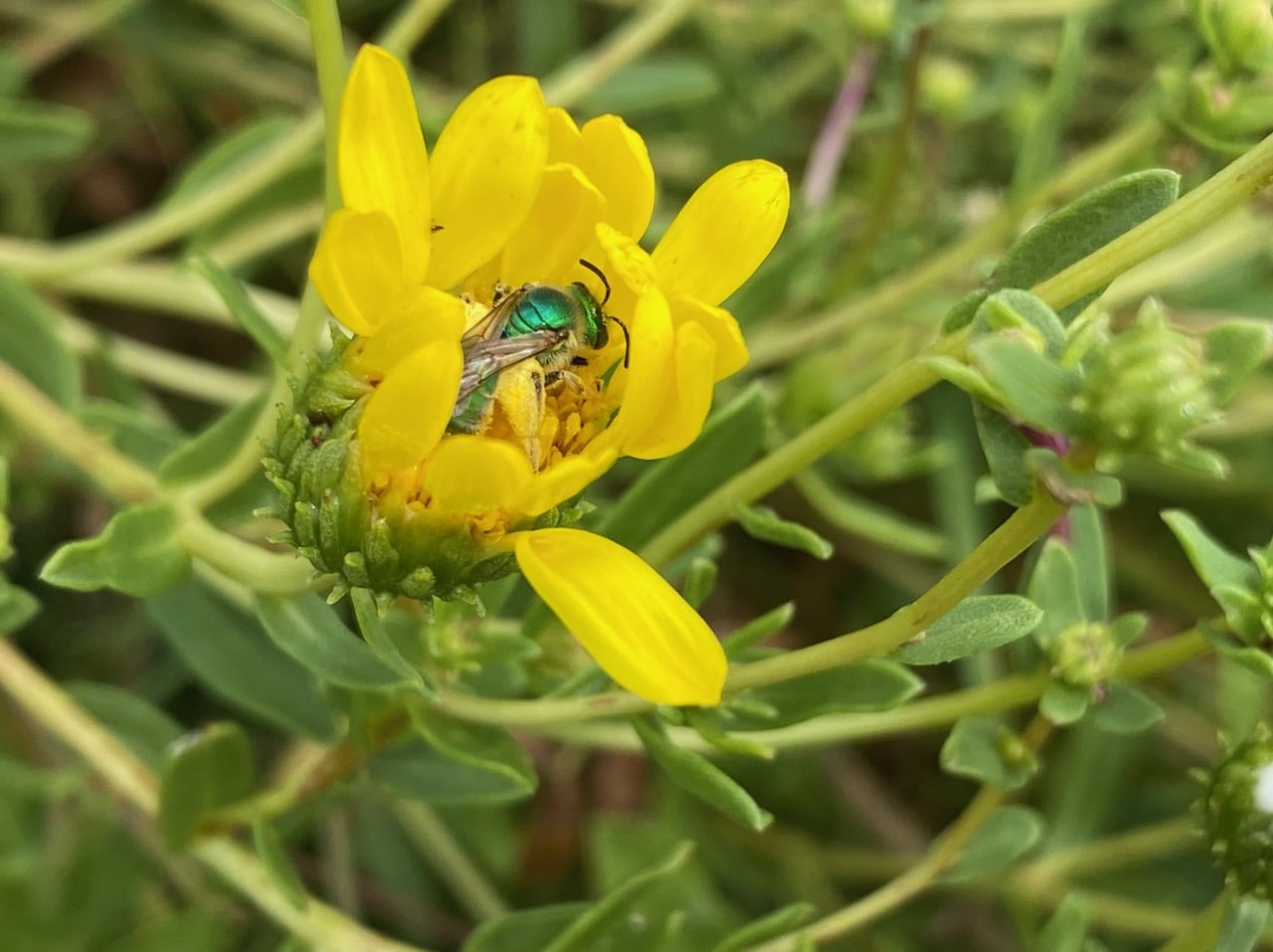
The Fine Striped Sweat Bee, Agapostemon subtilior is a small, widespread species found across North America. They are active from late spring to fall, with all-green females measuring roughly 11 mm, and males (slightly smaller) displaying a black-and-yellow striped abdomen. Like other Agapostemon bees, they are solitary ground-nesters, and are polylectic, foraging from a wide variety of flowers.
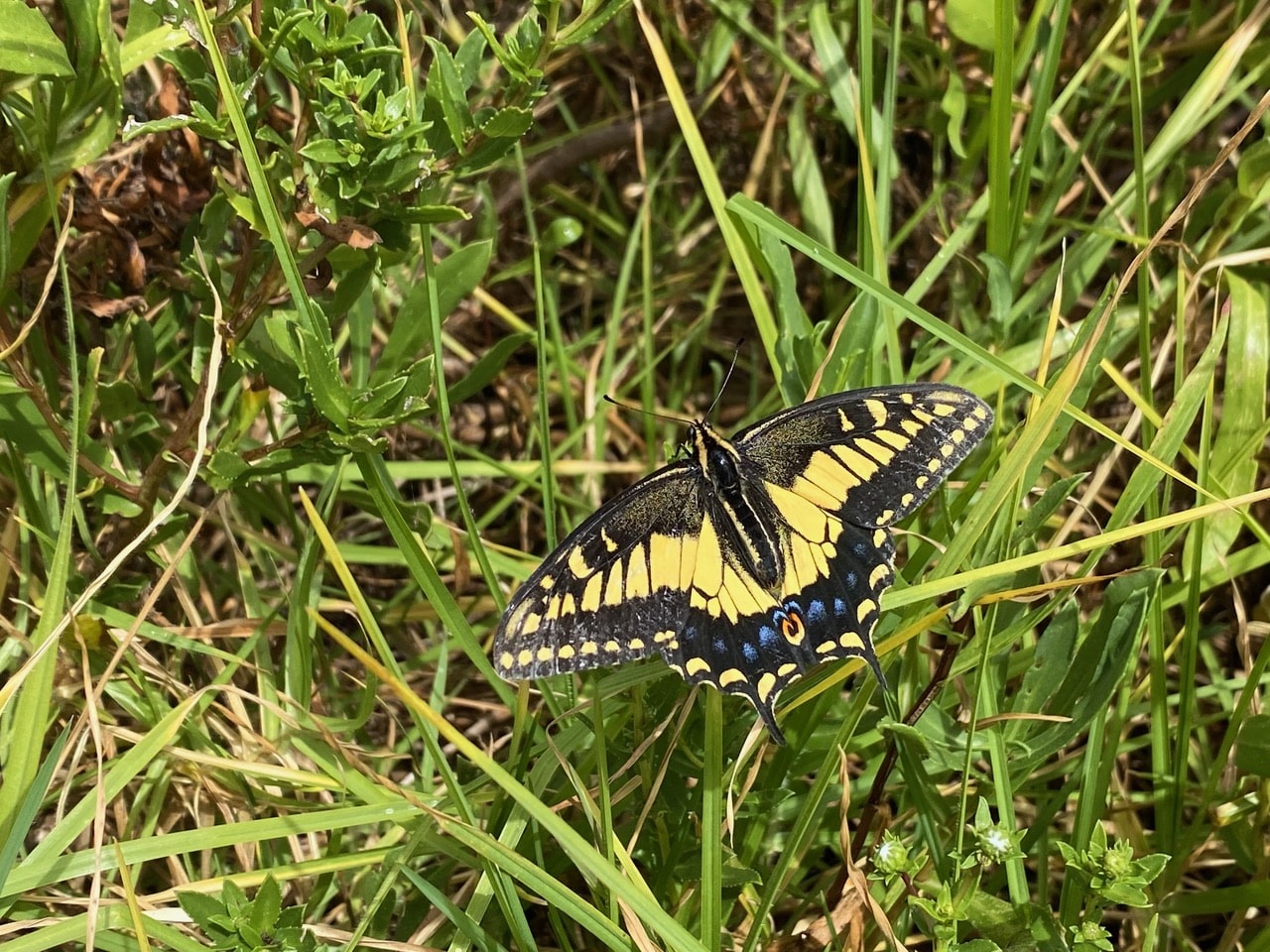
An Anise Swallowtail is perched stock-still on the tall grasses. The butterfly has seen better days, its wings missing a lot of scales. It has spread its wings to warm up in the sun before it can take flight.
The Anise Swallowtail, Papilio zelicaon (family Papilionidae), is a common swallowtail butterfly of western North America. It is found in fairly open country, most likely seen on bare hills or mountains, in fields oar at the roadside. Adult females lay eggs singly on the underside of host plant leaves. In the first two instars, the caterpillar is a bird poop mimic – dark brown, almost black, with an irregular white band at its middle. After that it becomes more green at each successive molt until, in the fifth (last) instar, it is predominantly green, with markings in black, orange, and light blue. Its major food plants are members of the carrot family, Apiaceae (including Fennel), and also some members of the citrus family, Rutaceae.
Butterflies are essentially solar-powered, relying completely on the sun’s heat to warm their flight muscles to gain the energy needed to fly. They position their bodies toward the sun, often opening their wings flat or tilting them in a V-shape to catch maximum sunlight. Microscopic scales and shingle-like layers on their wings act as natural solar collectors to direct and absorb light and heat efficiently.
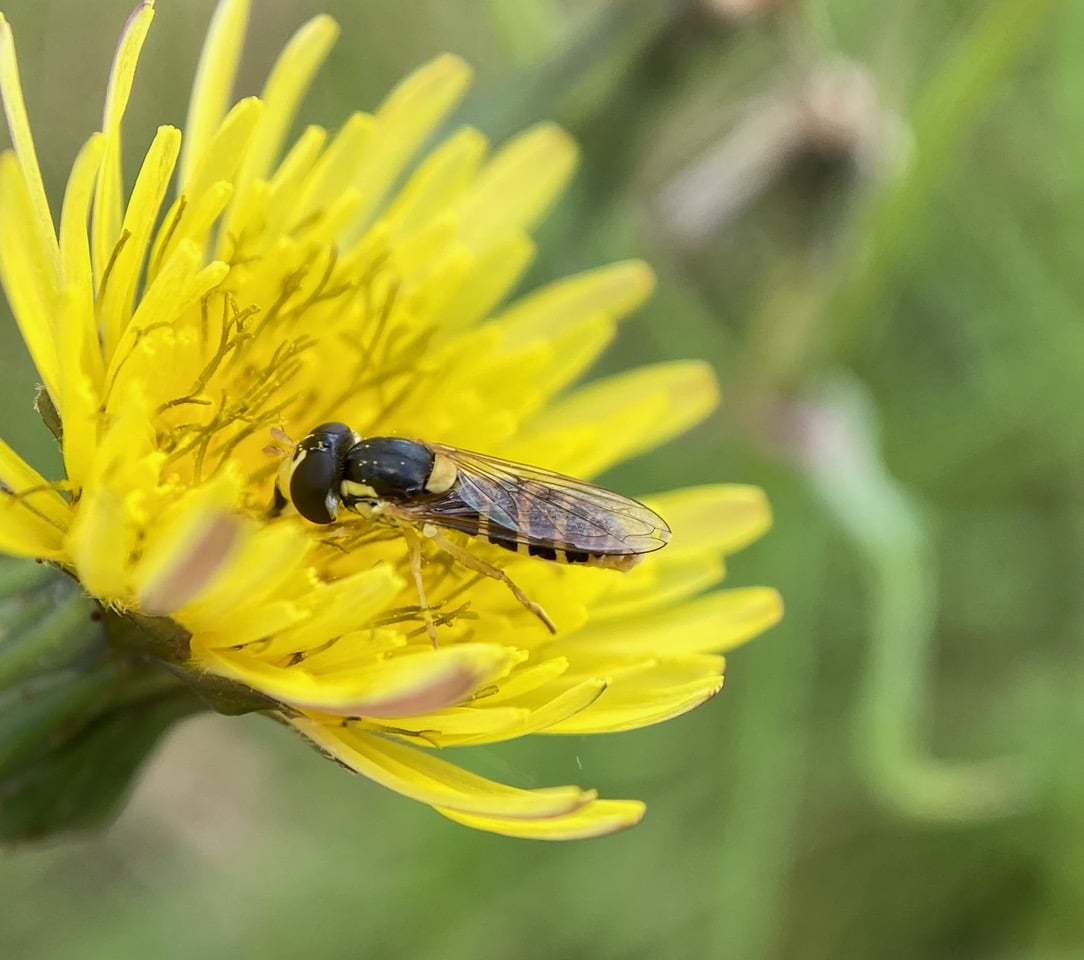
A female Forked Globetail, Sphaerophoria sulphuripes (family Syrphidae) is foraging on a Bristly Oxtongue flowerhead.
The Forked Globetail, Sphaerophoria sulphuripes (family Syrphidae) is a hover fly native to western North America. Adults visit flowers for nectar and pollen. Larvae feed on aphids and other soft-bodied insects. There is marked sexual dimorphism in the species – the males have a slender abdomen with a reddish, swollen tip.

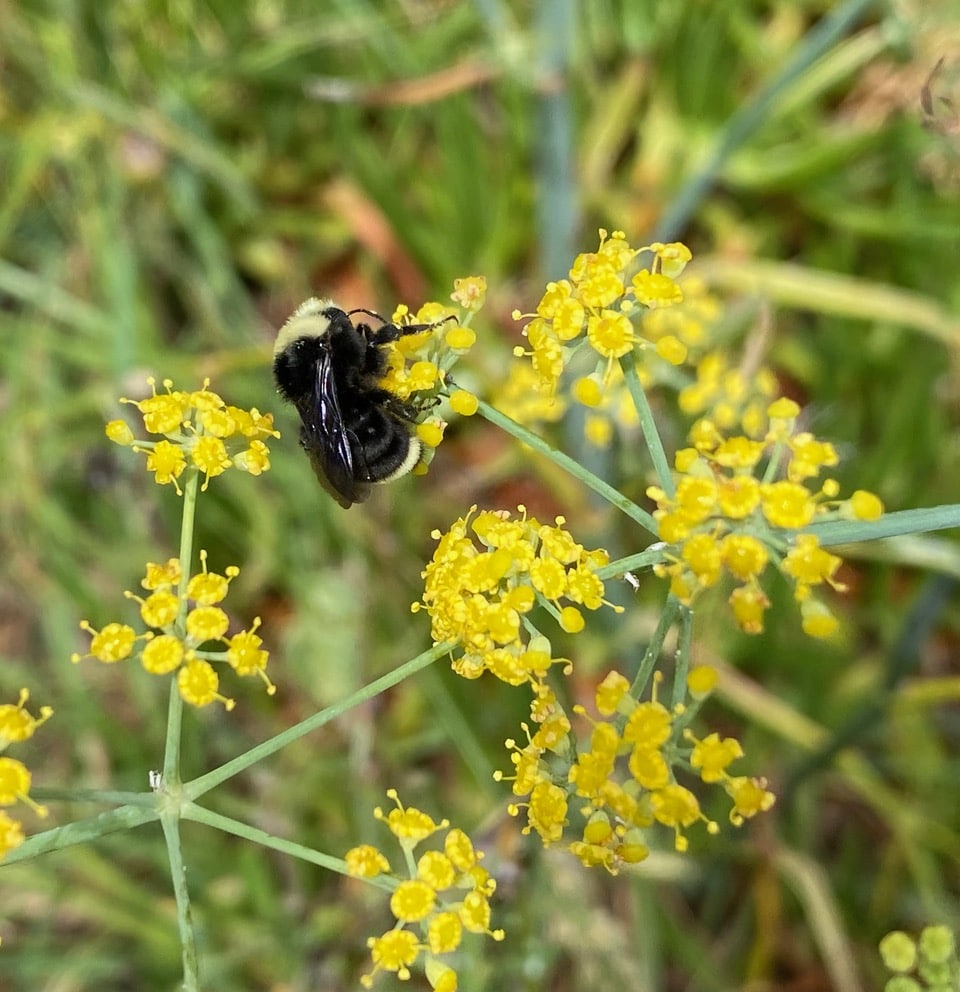
A Yellow-faced Bumble Bee, subgenus Pyrobombus (genus Bombus, family apidae) struggles to hold onto the small flowers of Fennel, Foeniculum vulgare as the wind blows.
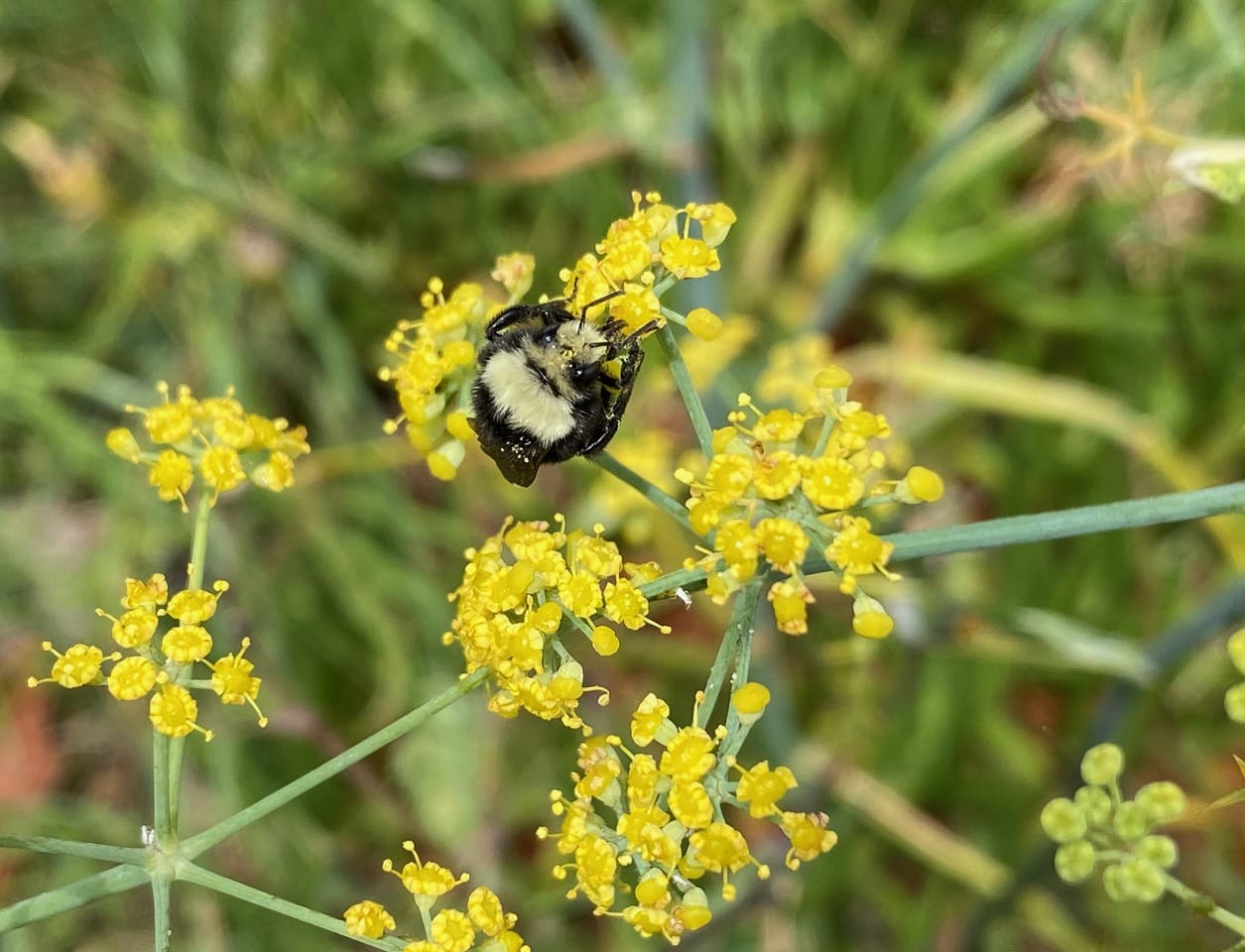
Although the bee is only taking nectar, her hairy body has attracted some pollen which she can later gather into her pollen baskets.
Pollen grains are attracted and stick to a bee’s hairs through a mix of electrostatic forces and physical trapping by branched, feathery hairs. As a bee flies, friction builds a positive electrical charge on its body, which pulls in the oppositely charged pollen grains like a magnet when it nears a flower. What’s more, many pollen grains have a sticky oily layer called pollenkitt that helps them grip tightly to the hair surface.

Many of the Oregon Gumweed, Grindelia stricta are studded with immature flowerheads that exude a white gummy latex before the bright yellow petals open. The exudate is a mixture of protective terpenes, resins, and milky latex. These help shield the delicate flowerheads from intense ultraviolet radiation, drying winds, and hungry herbivores or insects.

Not everything that is white on the Grindelia plants is an immature flowerhead. Many of these plants have been infested with Spittlebugs whose larvae create these white foamy shelters for themselves as they feed. I first encountered these spittlebugs on this patch of Grindelia three years ago, and the infestation has returned every summer since.
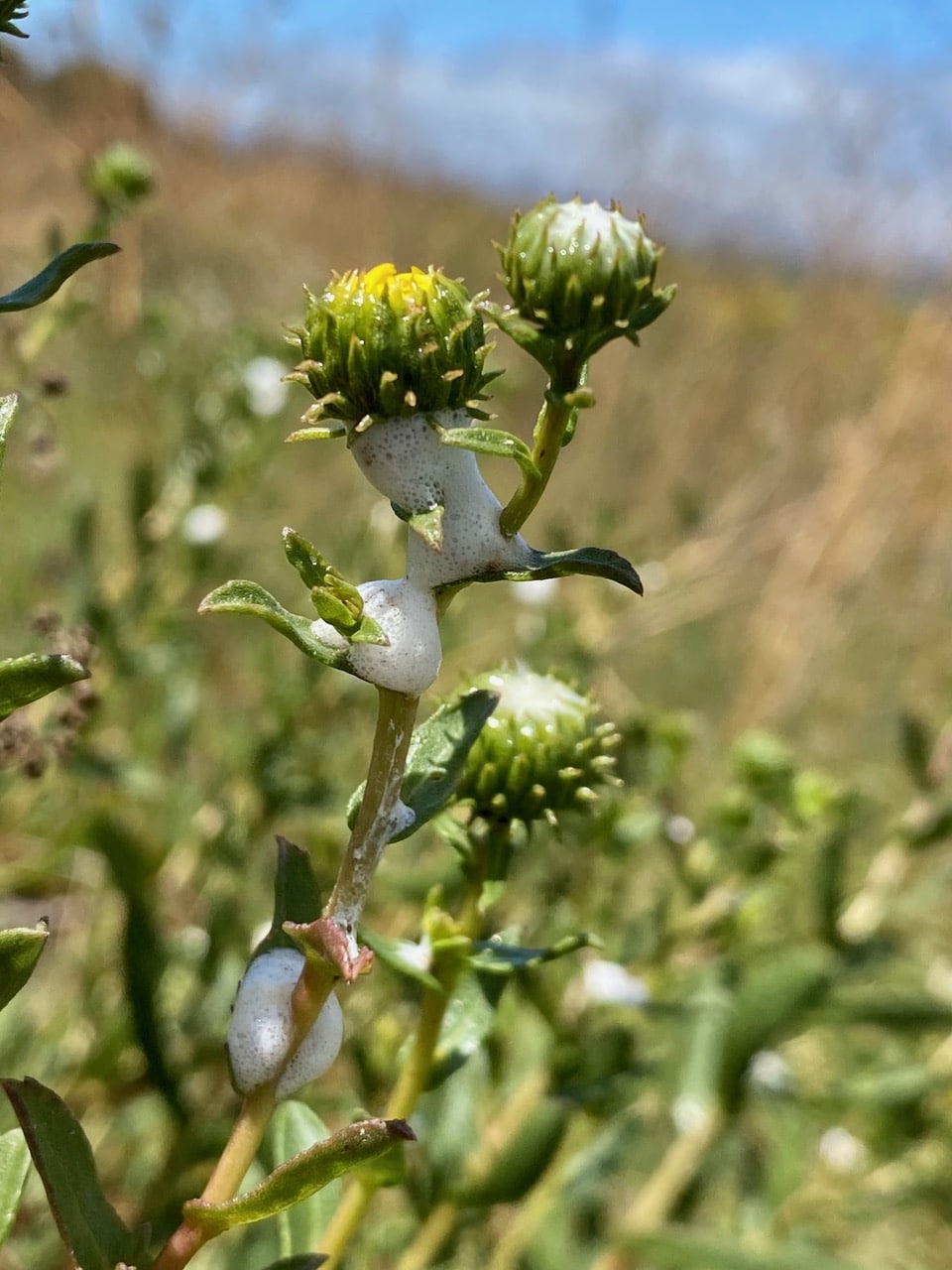
Spittlebugs, also known as Froghoppers belong to the superfamily Cercopoidea within the order Hemiptera (true bugs). While sometimes generally referred to as the family Cercopidae, they are scientifically divided into several families, primarily Aphrophoridae (common spittlebugs), Cercopidae (froghopper), and Clastopteridae.
Why the common name of “spittlebug”? The nymphs (immatures) of these bugs create foam masses on plants in which they live and feed. Like the adults, the nymphs use their piercing, sucking mouthparts to feed on plant juices. The nymph produces a cover of foamed-up plant sap reminiscent of saliva, hence the common name of spittlebug. Whereas most insects that feed on sap feed on the nutrient-rich fluid from the phloem, Spittlebugs tap into the much more dilute sap flowing upward via the xylem. The large amount of excess water that must be excreted and the evolution of special breathing tubes allow the young spittlebug nymphs to grow in the relatively protective environment of the spittle. Symbiotic bacteria in the insects’ digestive system provides them with the essential amino acids that their diet lacks. The foam serves a number of purposes. It hides the nymph from the view of predators and parasites, and it insulates against heat and cold, and protects the delicate nymphs from desiccation. Moreover, the foam has an acrid taste that deters predators.
Unlike their young, adult spittlebugs (also known as Froghoppers) are efficient flyers and hoppers, feeding on diverse plant species. They pierce plant stems to feed on xylem. To get enough nutrients, they consume massive quantities of sap, drinking up to 280 times their body weight daily, resulting in high waste excretion. Froghoppers can cause damage by distorting plant leaves and causing shoot tips to die back.
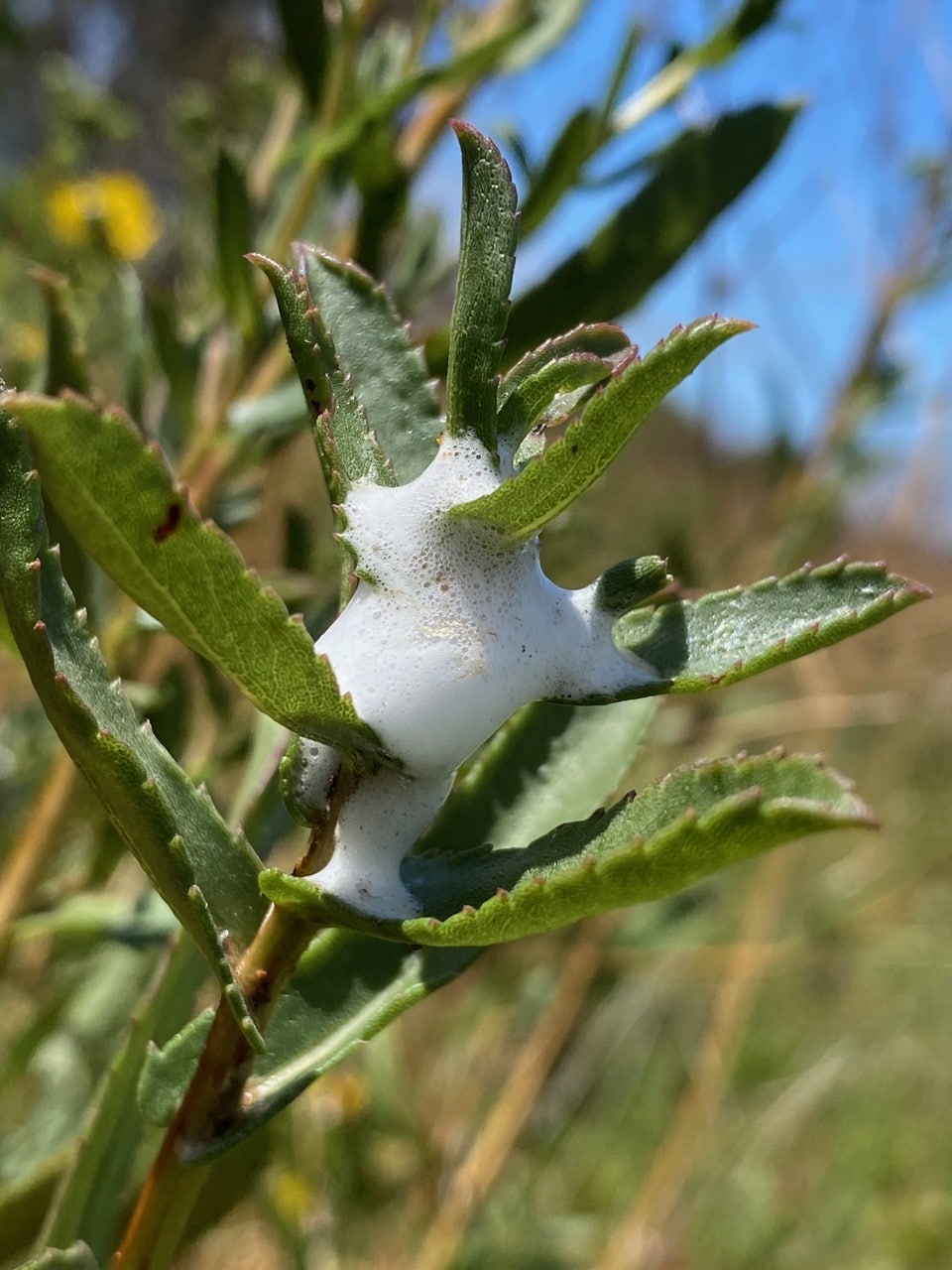
This big spittle mass should harbor a large, mature larva. I gently scoop up some of the foam with a finger.

I carefully part the foam to reveal a large Spittlebug nymph. The front half of the nymph is black, while the hind part is cream-colored. Note the tiny, spigot-like structure at the tip of its abdomen, which the nymph uses to create its frothy home. I return the nymph to its home, none the worst for wear. It will stick its mouthpart into the stem again and create more foam to cover itself. The adult Spittlebugs should be emerging from the foam masses here through the next couple of weeks! Never a dull moment observing insect life among the Grindelia at Bay Farm!
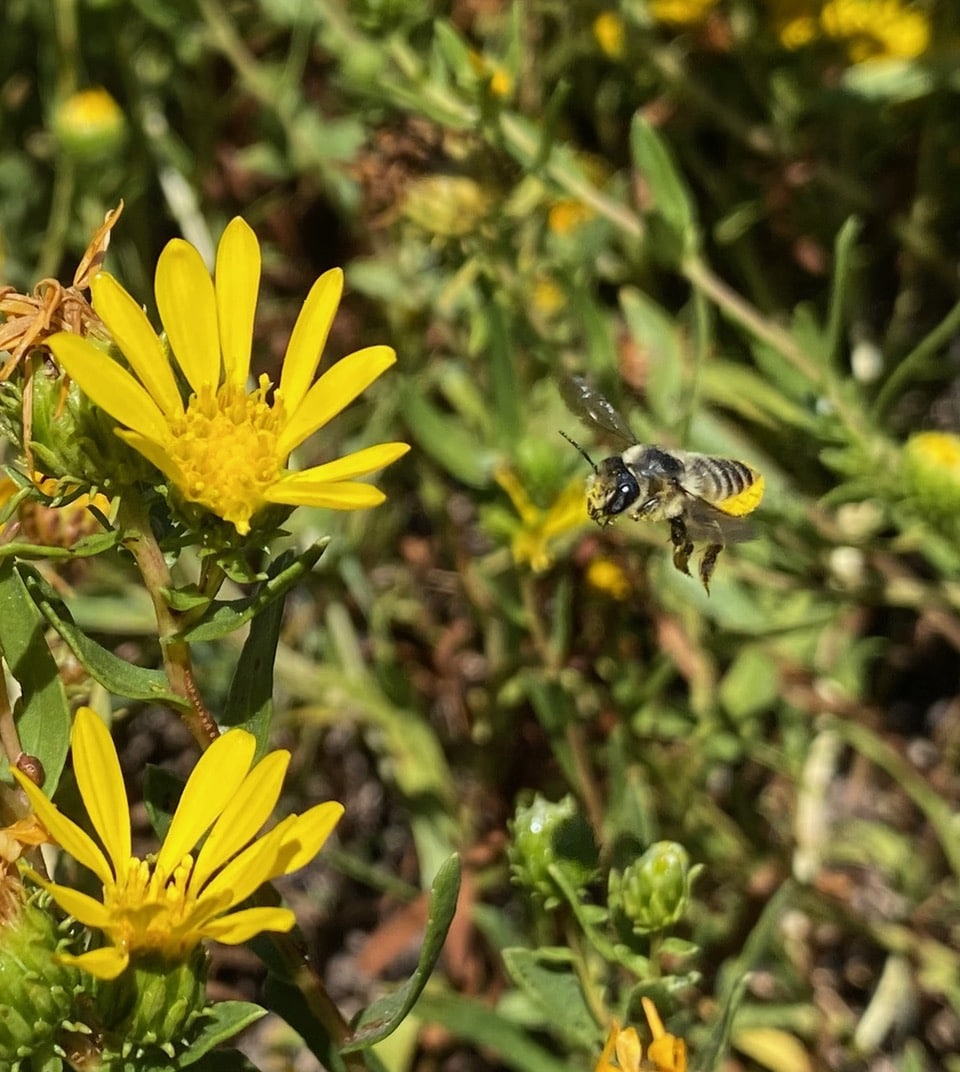
Here comes a female Western Leafcutter Bee, Megachile perihirta (family Megachilidae) approaching a dense patch of Grindelia flowerheads.
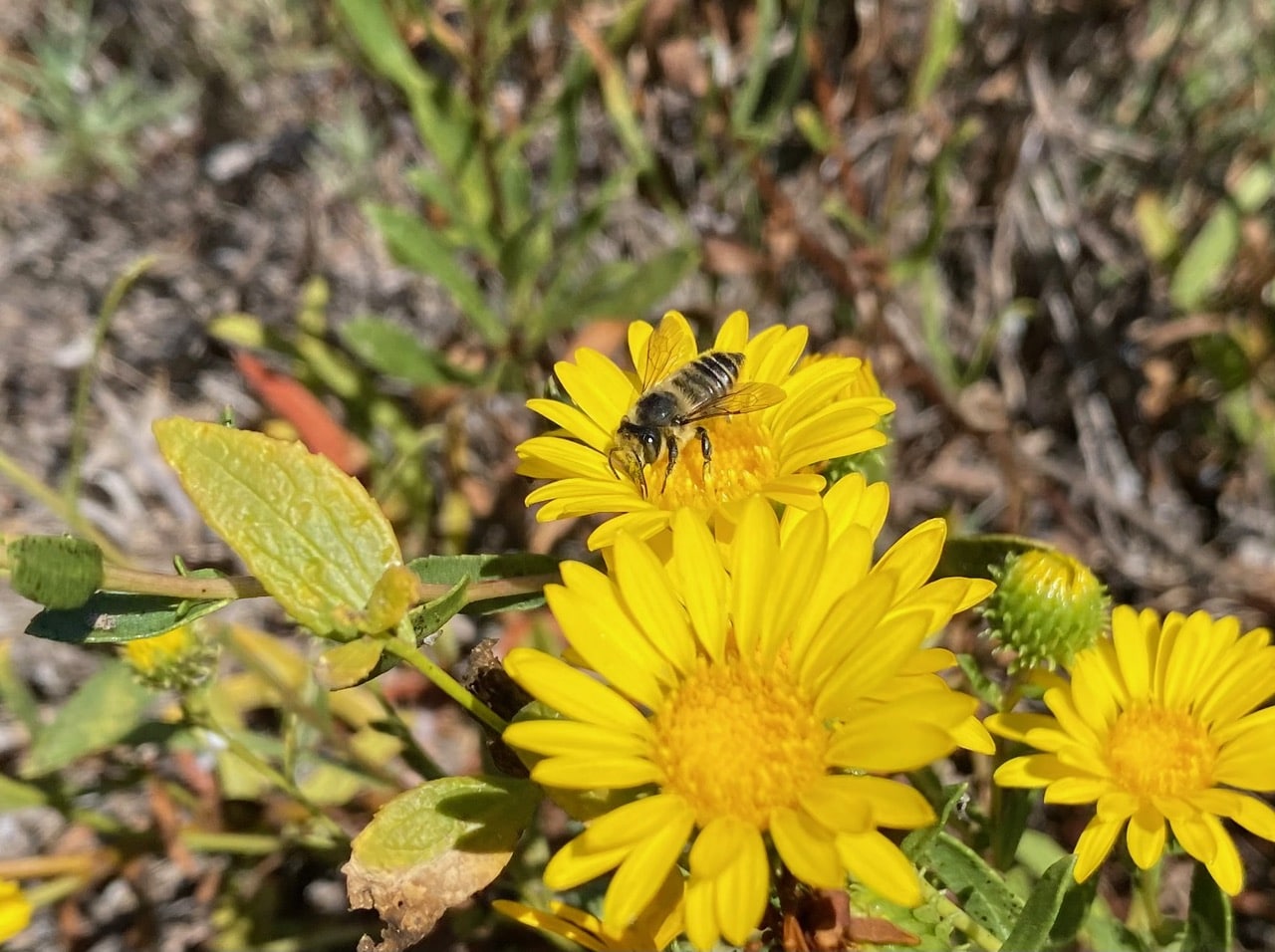
Leaf-cutter Bees, Megachile sp. (family Megachilidae) are stout-bodied, usually with pale hair on the thorax and stripes of white hairs on the abdomen. Females usually have a triangular abdomen with a pointed tip, and males’ faces are covered with dense, pale hair. Flight season is from May into September, with peak activity from June to August. Solitary females construct nests in tubular cavities, including hollow stems, tree holes, and abandoned beetle burrows in wood. Many use holes drilled into wood, straws, or other manufactured tunnels. Females cut pieces from leaves or flower petals for use in the construction of brood cells. Most Megachile females are generalist foragers, but prefer flowers in the family Asteraceae. Pollen is transported in dense scopae (special pollen collecting hairs) on the underside of the abdomen.
North America is home to many leafcutter bees, but the Western Leafcutter, Megachile perihirta is one of the largest. The species ranges on the west coast from British Columbia south to northern Mexico. From a distance, the female can be mistaken for a honey bee. She is about the same size as a worker honey bee and enjoys many of the same flowers, but her head is disproportionately large because it houses the bulky muscles that operate her large mandibles. While most leafcutter bees nest above ground in tubes and tunnels, the Western Leafcutter nests underground. Often a small group of females live in a community and burrow into soil, gravel, or sand.

That female Western Leafcutter Bee, Megachile perihirta (family Megachilidae) has collected quite a large load of pollen which is bulging from under her abdomen.
Leafcutter bees (genus Megachile) carry pollen on a dense brush of stiff hairs on the underside of their abdomen, known as a scopa. As the bee flies, her fuzzy body builds up a positive static charge. When she lands on a flower, this static electricity pulls pollen grains from the anthers, causing them to cling all over her body. Rather than landing and simply walking around, leafcutter bees often dive directly onto the flower and raise their abdomen, rubbing their hairy underside aggressively against the flower’s reproductive parts. She uses a coordinated grooming motion to brush pollen off her body with her forelegs, passing it to her middle legs, and then uses her hind legs to rake and pack the pollen grains securely into the scopa on her belly. When she returns to her nesting cavity, she scrapes the pollen off her abdomen using her hind legs and mixes it with regurgitated nectar to form a nutrient-rich “bee bread” on which she lays an egg.
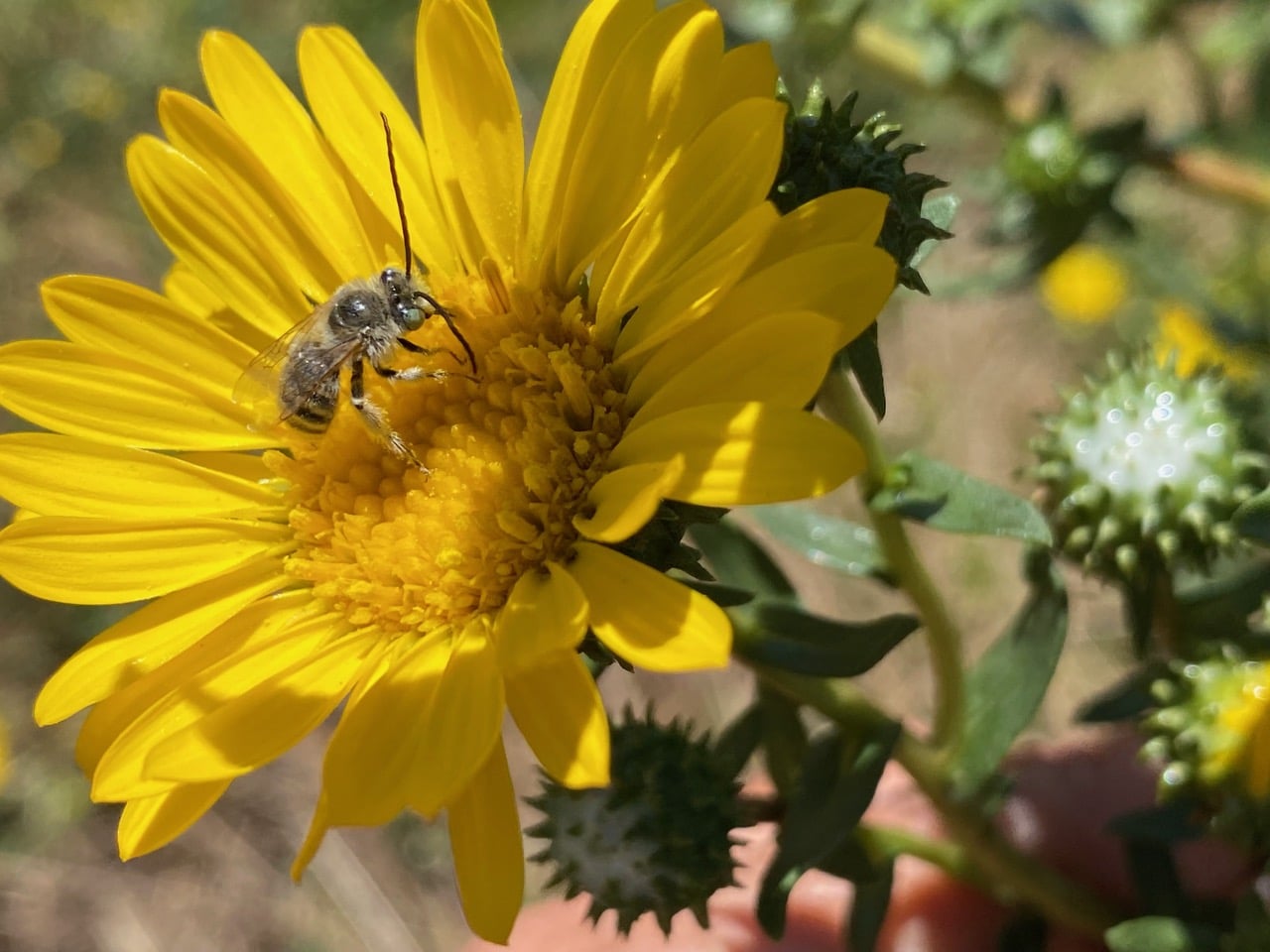
Insects are swarming over the Grindelia flowerheads along a particular stretch of the trail. When one lands, I realize that it is a male Summer Longhorn Bee, Melissodes sp. (family Apidae). There must be a nest aggregation here. Although males do not live in nests once they leave their natal nest, to better their chances of finding a mate, they tend to hang out around the flowers that the females will be foraging from.

Although male bees do not collect pollen, their hairy body picks up pollen easily when they visit flowers for nectar, making them good pollinators.
The Summer Longhorn Bees, Melissodes sp. (family Apidae) are medium to large bees, stout-bodied, usually with gray hair on the thorax and pale hair bands on the abdomen. Males usually have yellow markings on their faces and have very long antennae from which their common name is derived. They are active May to September, with peak flight in late June to early August. The females prefer flat, bare ground for digging their solitary nests, though they sometimes nest in aggregations. Pollen is transported in scopae on the hind legs. Pollen loads are often copious and brightly colored and thus very distinguishable. Melissodes are specialists on Asteraceae – females gather pollen from flowers of Aster, Bidens, Coreopsis, Cosmos, Encelia, Gaillardia, Helianthus, and Rudbeckia ssp.
Male bees do not participate in nest construction, so at the end of the day they don’t have a home to return to. They usually sleep out in the open, mainly on vegetation. The male Longhorn Bees are well-known to gather and sleep in aggregations. Apparently there is safety in numbers – when one is attacked by a predator, the others are alerted right away and are able to escape.
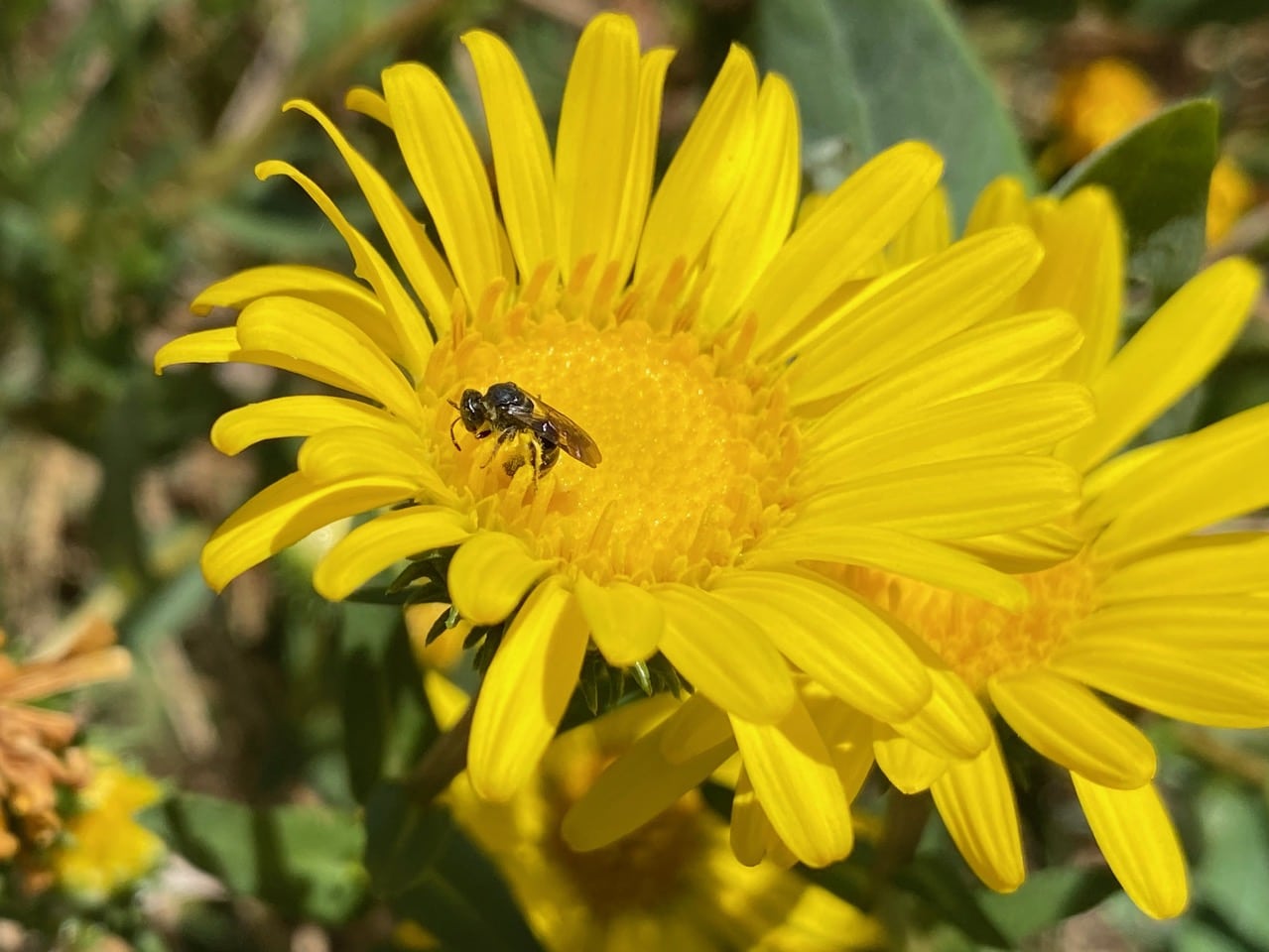
A small black bee is foraging on a Grindelia flowerhead. She is concentrating her efforts on the stamens that have emerged from the florets around the rim of the flowerhead.
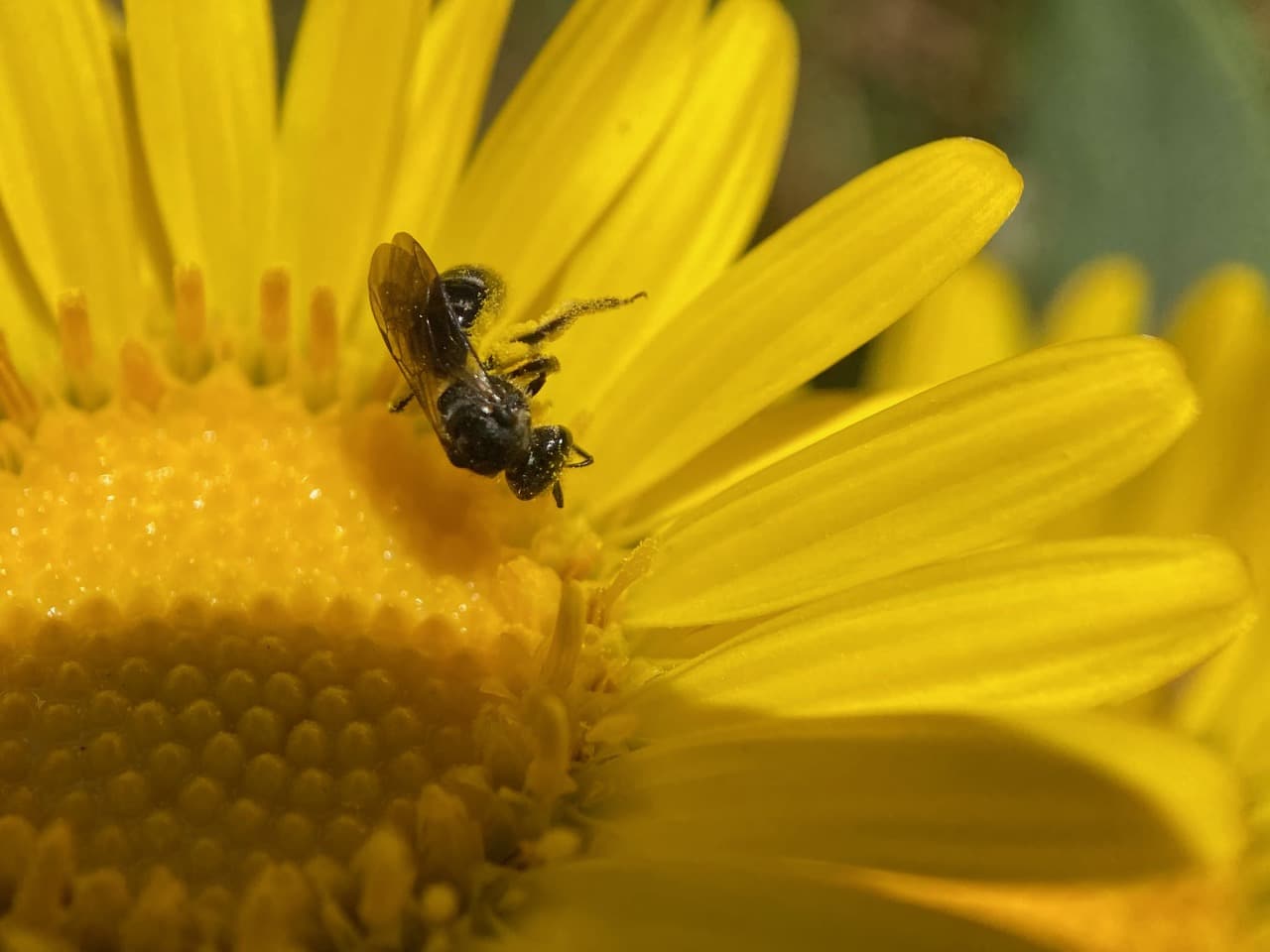
I close in with the macro lens to observe the bee’s behavior a little better. She is working each staminal cylinder individually to collect pollen. Ah, there are faint narrow white bands on her abdomen. She is probably a Kincaid’s Sweat Bee, Lasioglossum kincaidii (family Halictidae). Note that she is carrying pollen on the underside of her abdomen as well as on the scopae of her hind legs.
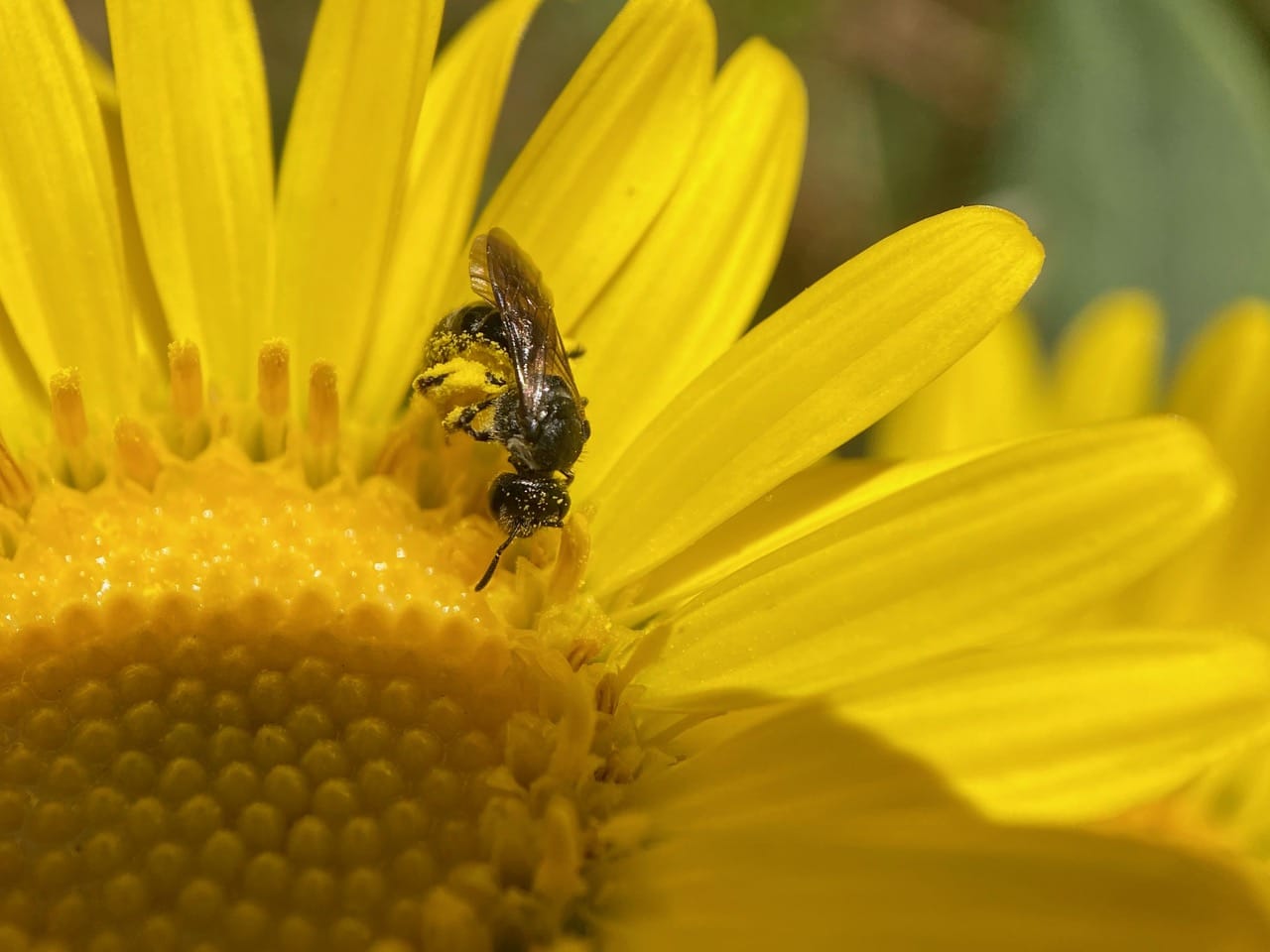
Sweat Bees (family Halictidae) earn their nickname from their habit of landing on skin to sip salty minerals from human sweat. Lasioglossum species are found worldwide, and they constitute the largest bee genus. The majority of Lasioglossum are generalists. Because they are so abundant throughout the flowering season, the bees are often important pollinators. Their sheer numbers are enough to achieve excellent pollination of many wild flowers, especially of plants in the Asteraceae, which have shallow floral tubes that are easily accessed by these minute bees.
Lasioglossum exhibit a range of social behaviors; the genus includes solitary, communal, semi social, primitively eusocial, and even parasitic species. Almost all Lasioglossum in the U.S. nest in the ground. Generally these nests are built in the spring by fertilized females (called foundresses) that spent the winter in hibernation. In social species, the foundresses behave much like the queen bumble bees – they lay the first batch of eggs that develop into the first generation of female workers. The nest grows with each additional generation of bees. Later broods may consist of both males and females. They mate, and at the end of the season the fertilized females hibernate till the following spring, repeating the life cycle of the colony.
Kincaid’s Sweat Bee, Lasioglossum kincaidii is a small, jet-black solitary bee with black smoky wings and faint white bands on the abdomen. Widely found in urban/suburban gardens and natural habitats in California, they are highly active foragers that emerge as early as spring to pollinate smaller flowers. The bees are polylectic generalists, meaning they will visit a wide variety of flora, and are especially fond of smaller flowers. Like most sweat bees, they are ground-nesting.
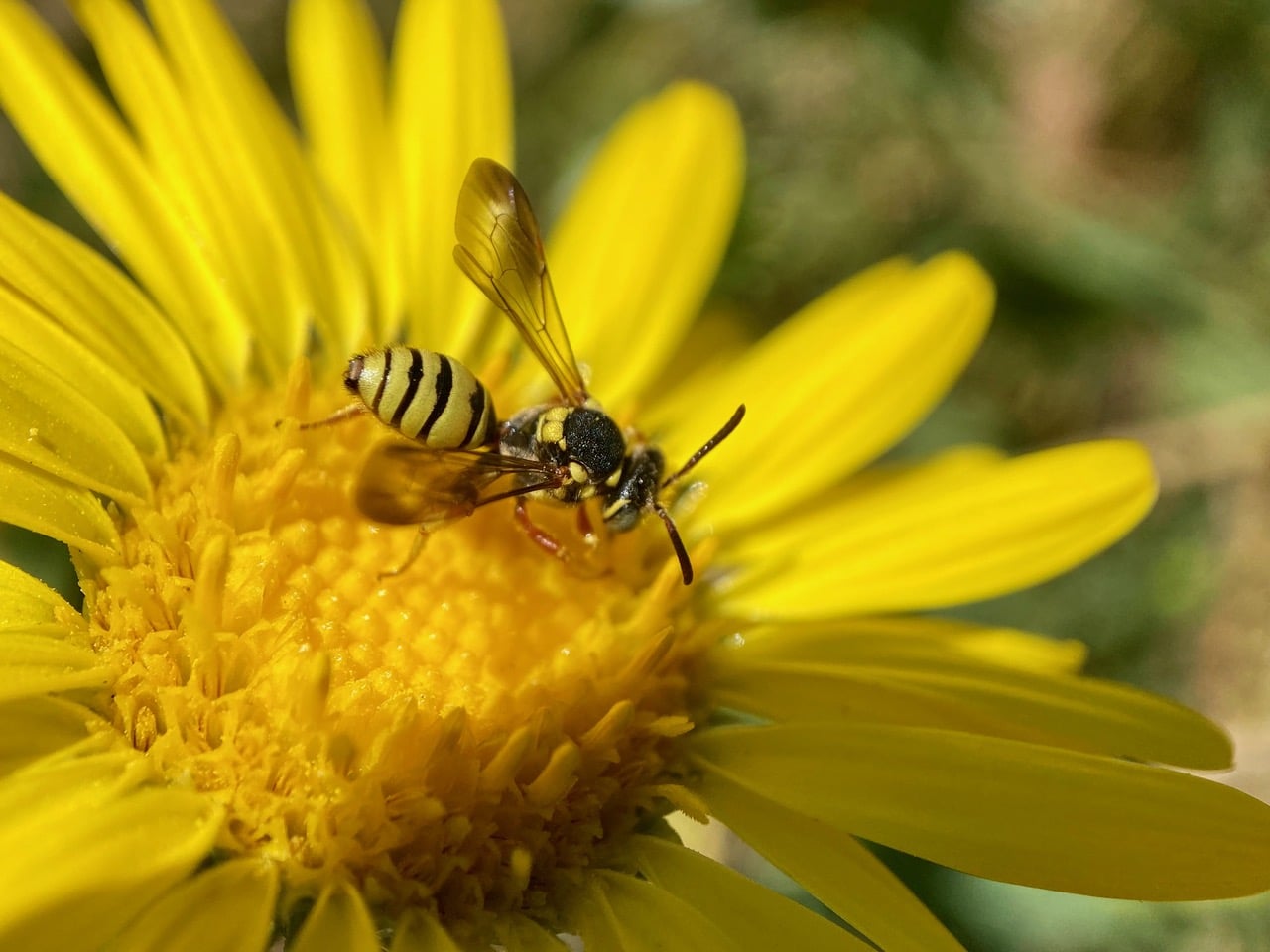
A Nomad Bee, Nomada sp. (family Apidae) has landed to forage on a Grindelia flowerhead. It’s always exciting to see a cuckoo bee!
Nomad bees are a group of wasp-like bees that survive by exploiting the hard work of other solitary bees. They are wasp-like in appearance, do not collect pollen and are virtually hairless. Their name “Nomada” is derived from the Greek word meaning “wandering”. All Nomad Bees are kleptoparasites or “cuckoo bees” that lay eggs in the nest of other bees, especially Mining Bees (genus Andrena).
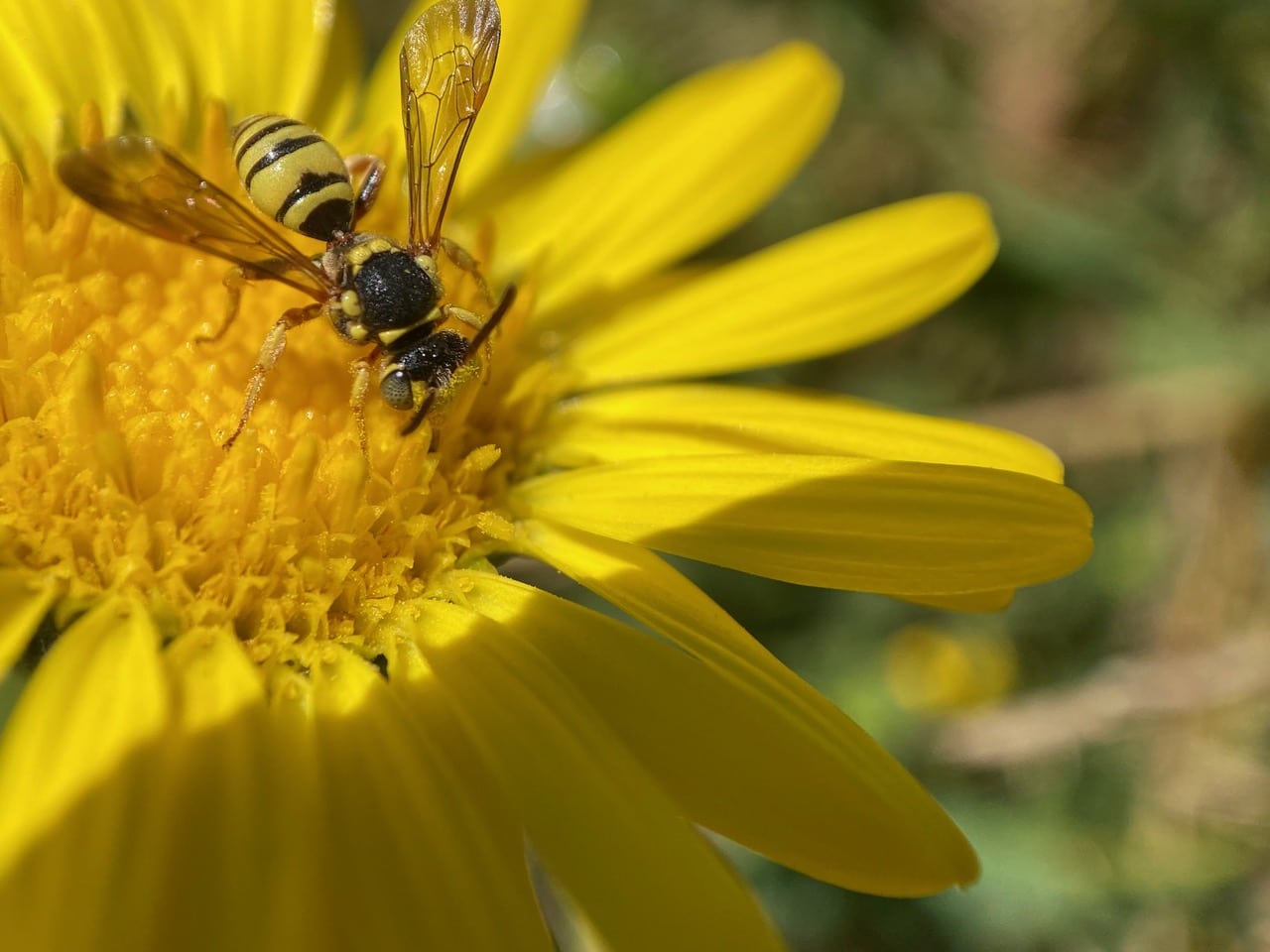
Female Nomad Bees detect a host nest by scent and visual cues, and wait until the nest is unoccupied. She then enters the nest burrow and lays an egg in an unsealed nest cell. When it hatches, the larva kills the host egg or larva, and proceeds to feed on the pollen/nectar food store of the host. In the following year, the Nomad Bee will emerge as an adult and the process repeats.
While we might take offense at the cuckoo bees’ parasitic lifestyle, their presence in the garden is actually an indicator of a good population of the host species – something to celebrate!
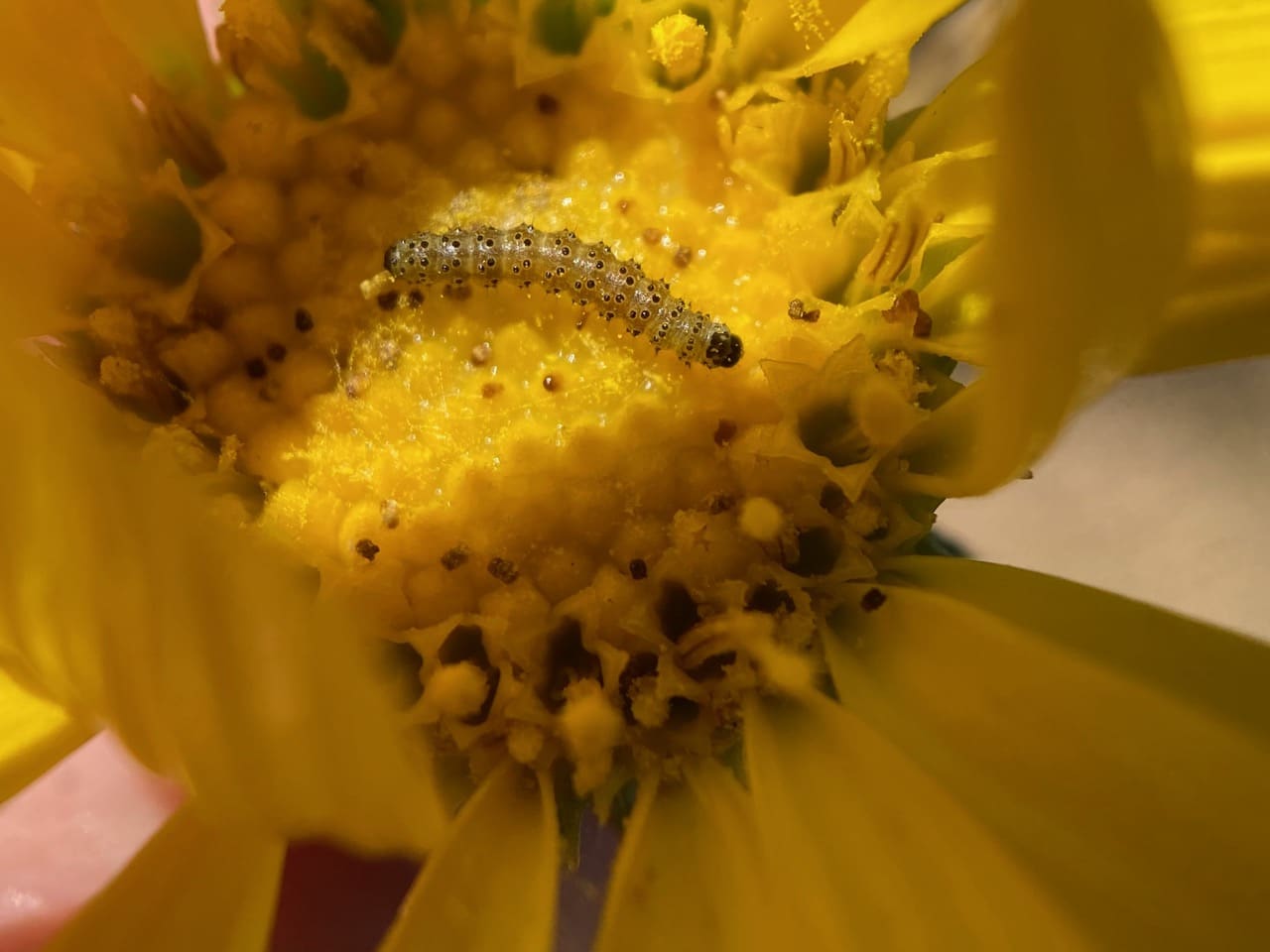
Ooh, that looks like a caterpillar of the Darker-spotted Straw Moth, Heliothis phloxiphaga on the Grindelia flowerhead. Note the open florets on the rim that have been emptied of their reproductive parts, and the dark frass (insect poop) that has been dropped by the caterpillar as it fed.
The Darker-spotted Straw Moth, Heliothis phloxiphaga (family Noctuidae) is a medium-sized light yellow-brown or tan moth with darker markings. It is found across the United States and southern Canada. The moth frequents wooded edges, meadows, and other open areas. The species is active March through October. Adults are known to be both nocturnal and diurnal in activity, often found feeding and ovipositing during the day. The caterpillars have a wide host range. Like other species of the genus, the caterpillars feed on the flowering parts and seeds of the host plant.

An American Sand Wasp, Bembix americana (family Crabronidae) is taking nectar on a Grindelia flowerhead.
Sand wasps in the genus Bembix are familiar and common throughout North America, digging their burrows in dunes, on beaches, and other habitats with loose, deep sand. The female rapidly kicks out large quantities of sand using a “tarsal rake” of spines on each front leg. The burrow is excavated before the wasp goes hunting. Bembix are generalist, opportunistic hunters. True flies in the order Diptera are the usual prey. A victim is paralyzed or killed by the wasp’s sting, and is then flown back to the nest. Most species will lay an egg on the first victim, while some species lay an egg in the empty cell before starting to hunt. Once the egg hatches, mama wasp brings flies to her larva as needed. This “progressive provisioning” is rare in the insect world. When the larva reaches maturity, mama wasp closes the cell. Inside, the larva spins an oblong cocoon, weaving sand grains into the structure and resulting in a hardened capsule. Overwintering takes place as a prepupa inside this cocoon, but there are usually two generations a year.
Male sand wasps often engage in an elaborate flight ritual called “sun dances”. Males emerge before females, and fly erratically at dizzying speed one or two inches above the ground attempting to detect virgin females about to emerge from their underground nests. Both sexes are often seen taking nectar at flowers, especially from Asteraceae family. Bembix wasps are often victims of other insects such as cuckoo wasps (Chrysididae), velvet ants (Mutillidae), satellite flies (Sarcophagidae), bee flies (Bombyliidae), and thick-headed flies (Conopidae).
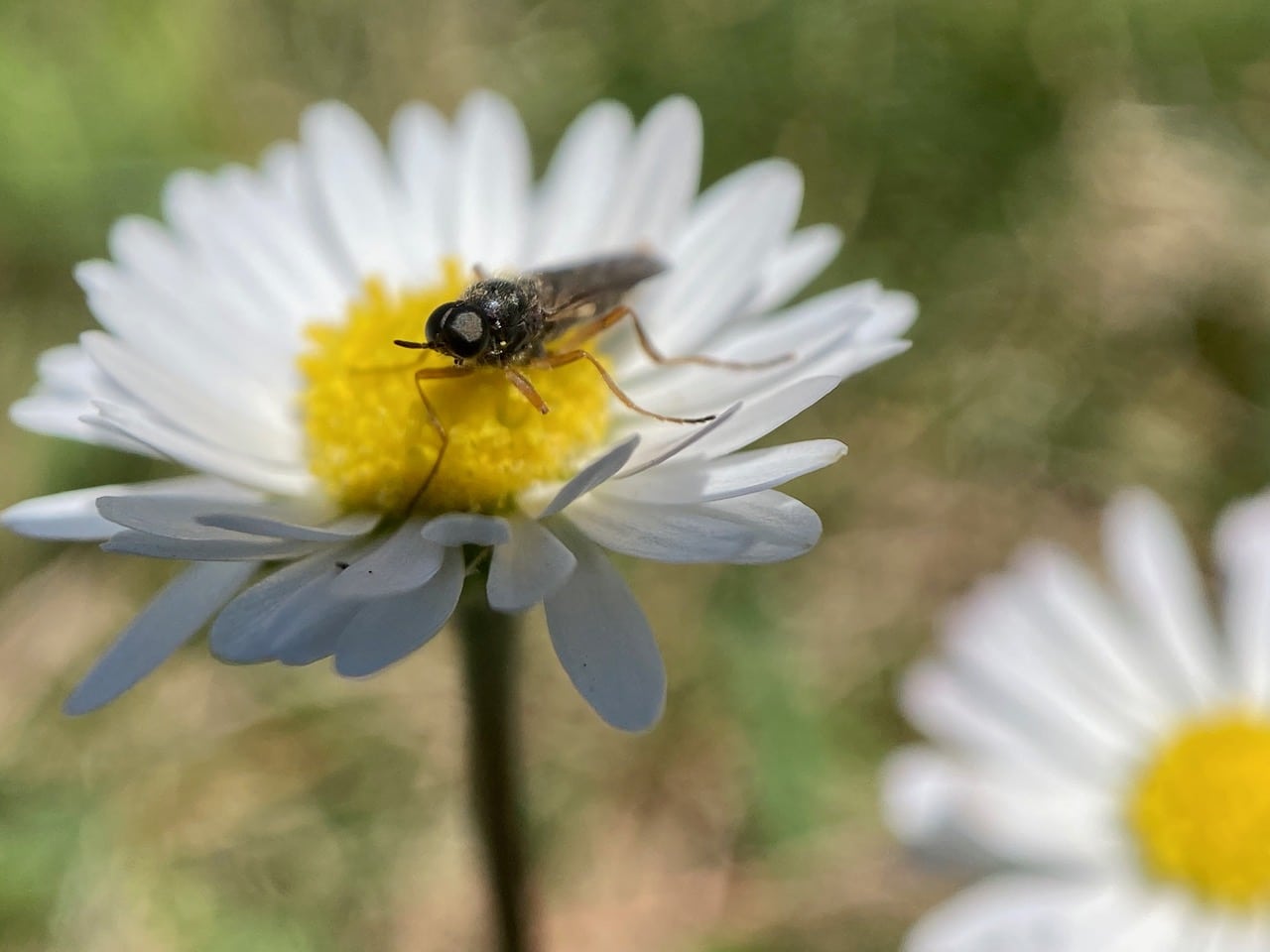
A small insect is resting on a flowerhead of English Daisy growing on the lawn. Its head appears to be entirely made up of its eyes. iNaturalist has helped identify it as a Sugarcane Soldier Fly, Inopus rubriceps (family Stratiomyidae). It is a male of the sexually dimorphic species.
The Sugarcane Soldier Fly, Inopus rubriceps (family Stratiomyidae) is native to eastern Australia where it infests such crops as corn, pastures, and sugarcane. The fly was accidentally introduced into California over 50 years ago. It is now infesting lawns in San Francisco and other Bay Area counties. Damage to turf and other members of the grass family results from withdrawal of sap from roots of host plants by the larvae and possibly, injection of a toxin into the plant.
In California adults occur in large numbers from late September to early November each year. Eggs are deposited in crevices in the soil. The adults are sexually dimorphic. Females have tiny red heads with eyes set far apart. The smaller males have large eyes that occupy the whole surface of the head. Adults are non-feeding or drink only liquids such as flower nectar and honeydew. They are strictly focused on mating and laying eggs during their short, few-day lifespan.