

Pollinator Post 7/26/23 (1)
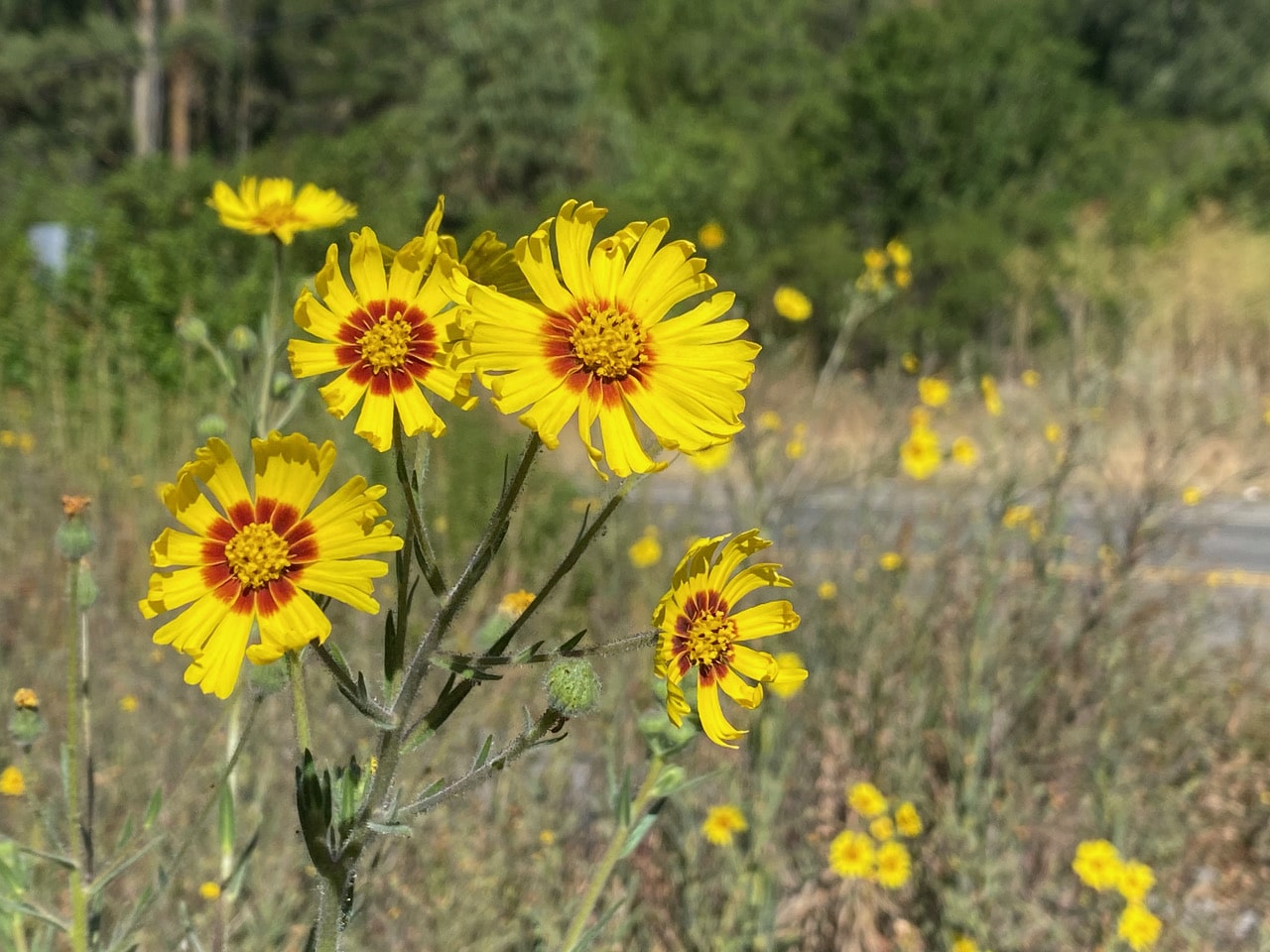
It’s great to catch the Elegant Tarweed, Madia elegans in bloom on a bright, cool morning. The cheery flowerheads will close as the day heats up in late morning.




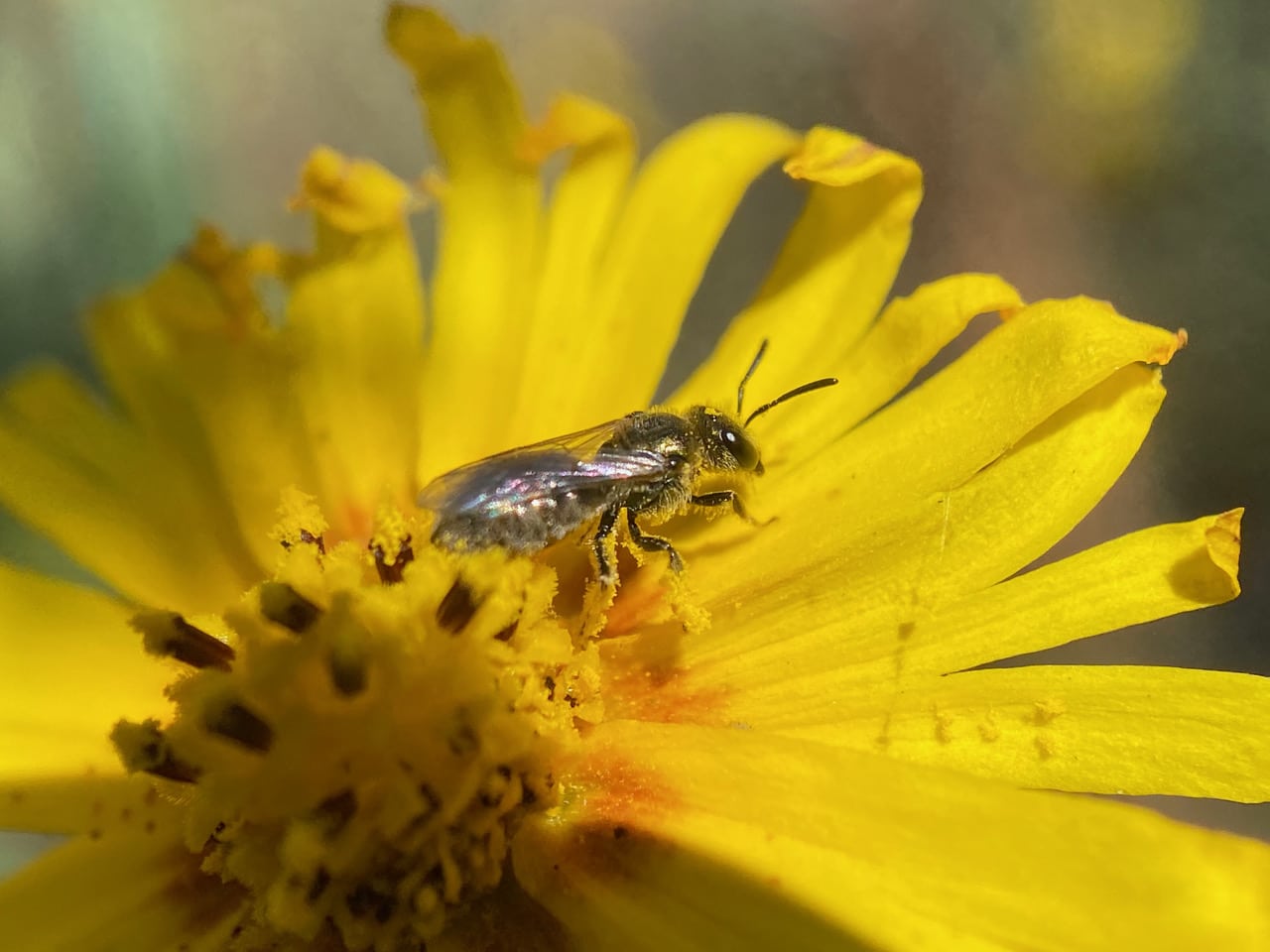
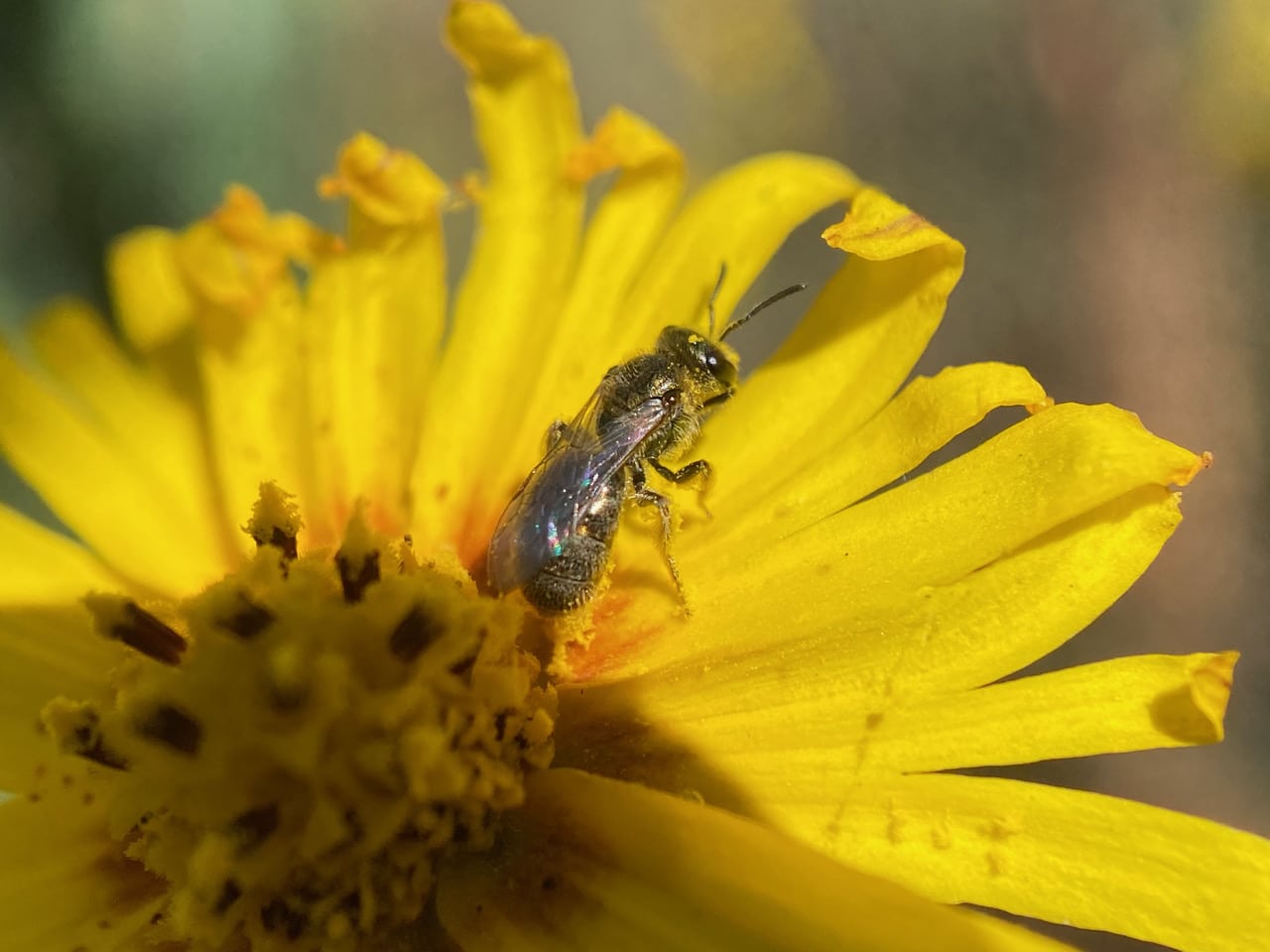




A Metallic Sweat Bee, Lasioglossum sp. (family Halictidae) has been busy collecting pollen from Madia elegans – there’s quite a bit of pollen in the scopae (special pollen collecting hairs) on her hind legs.
The bee has also gathered pollen on the underside of her abdomen. Sweat Bees (family Halictidae) carry pollen on their entire hind leg and abdomen.
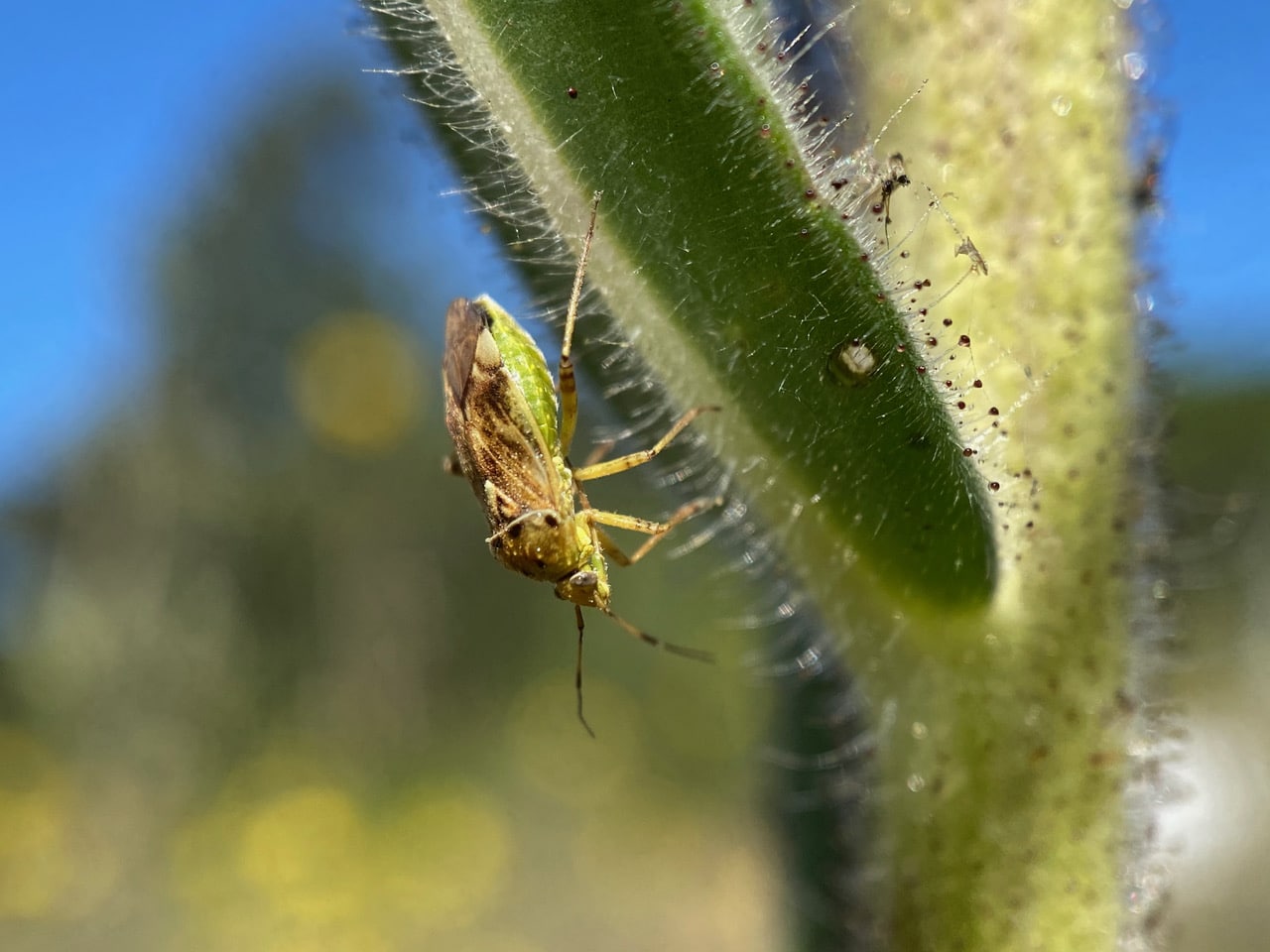
A Lygus Bug is feeding on an Elegant Tarweed flowerhead.
The term lygus bug is used for any member of the genus Lygus, in the family of plant bugs, Miridae. Adult lygus are approximately 3 mm wide and 6 mm long, colored from pale green to reddish brown or black. They have a distinctive triangle or V-shape on their backs. Lygus bugs are known for their destructive feeding habits – they puncture plant tissues with their piercing mouthparts, and feed by sucking sap. Both the physical injury and the plant’s own reaction to the bug’s saliva cause damage to the plant. Many lygus bugs are well-known agricultural pests.
Another Lygus Bug is walking on the foliage of Elegant Tarweed.
Some insect has laid eggs on the Elegant Tarweed stem under a flowerhead. They look like they are about to hatch. Lygus Bugs?
On another plant, among the glandular hairs of the stem, another cluster of bug eggs has been deposited. Some of the eggs have either hatched or been predated.
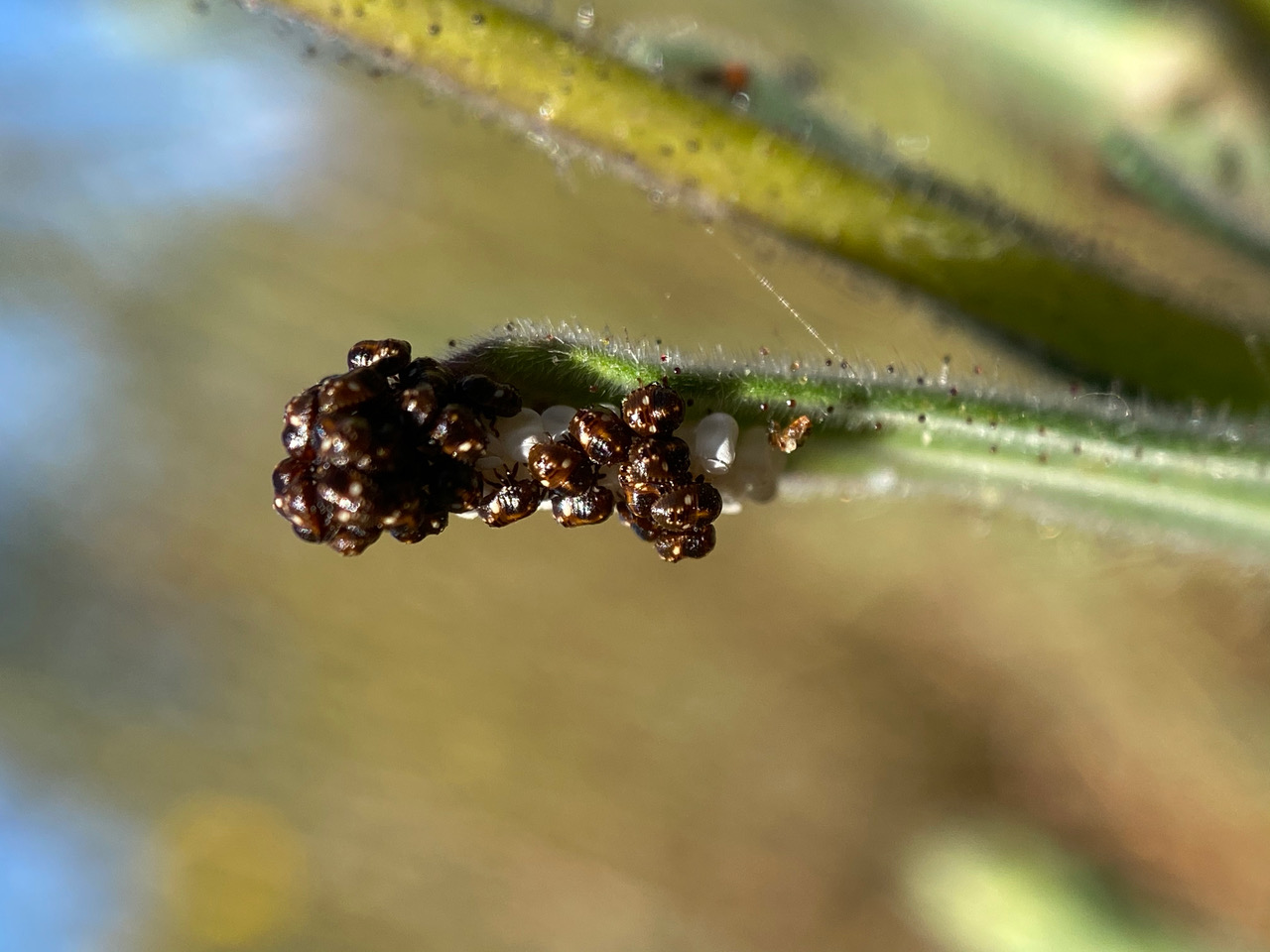
Newly hatched Stink Bugs (family Pentatomidae) are still clustered on their egg shells. Stink Bug eggs are easily recognizable – they are barrel-shaped with pop tops. The eggs hatch synchronously, and the nymphs stay together until their first molt.
Ooh! Another cluster of Stink Bug nymphs (family Pentatomidae) on the back of an Elegant Tarweed leaf.
Pentatomidae is a family of insects belonging to the order Hemiptera or “true bugs”. As hemipterans, the pentatomids have piercing-sucking mouthparts, and most are phytophagous, including several species that are severe pests on agricultural crops. Both nymphal and adult stink bugs feed on plant fluids by inserting their needlelike mouthparts into stems, leaves or seed pods. While feeding, they inject materials into the plant to aid in digestion and sap removal. Penetration by the mouthparts can cause physical damage, much like stabbing the plant with a fine needle.
A Metallic Sweat Bee, Lasioglossum (Dialictus) sp. (family Halictidae) is foraging on an Elegant Tarweed flowerhead.
Lasioglossum are closely related to the genera Halictus and Agapostemon. These genera are commonly called “sweat bees” because of their attraction to human sweat, which they drink for its salt content. Lasioglossum are dusky black to brown slender bees with bands of hair on their abdomen.
Dialictus is a subgenus of Sweat Bees belonging to the genus Lasioglossum. Most of the members of this subgenus have a subtly metallic appearance, and are small, about 3.4-8.1 mm in size. They are commonly found in Northern Hemisphere and are found in abundance in North America. As in the other members of the family Halictidae, the bees have very diverse forms of social structure, making them model organisms for studying the social behavior of bees.
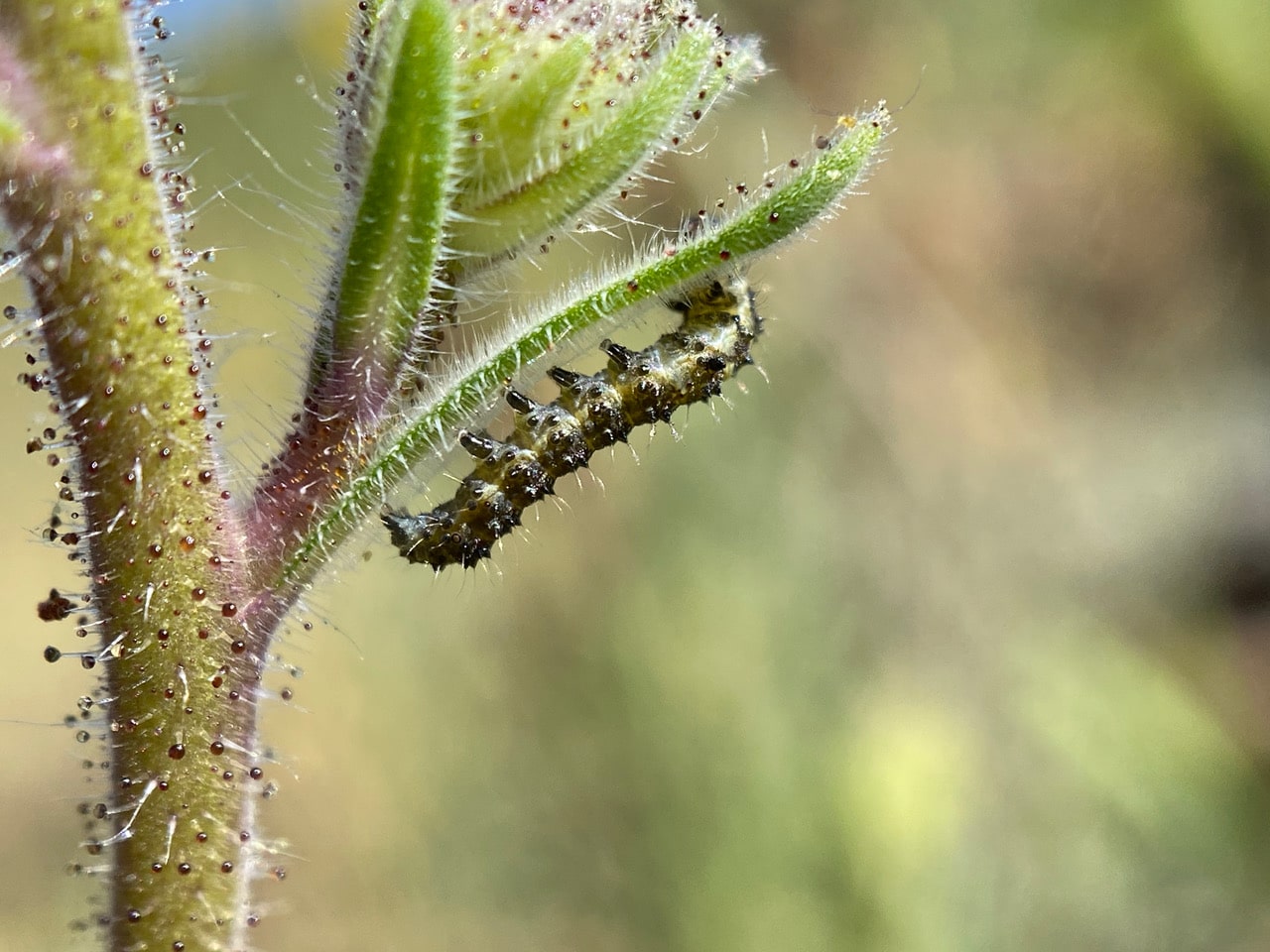
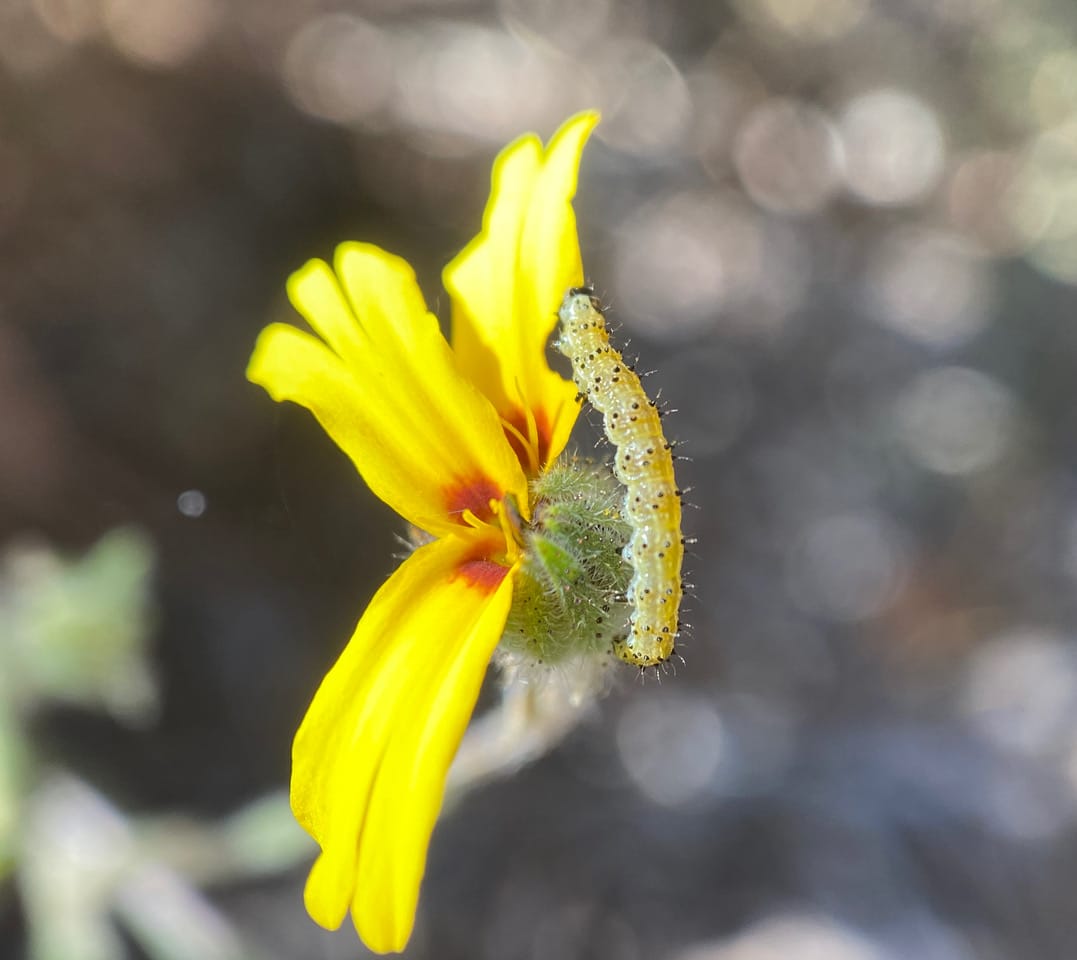
A tiny caterpillar of the Small Owlet Moth, Heliothodes diminutiva (family Noctuidae) has crawled out of the closed flowerhead it has been feeding in.
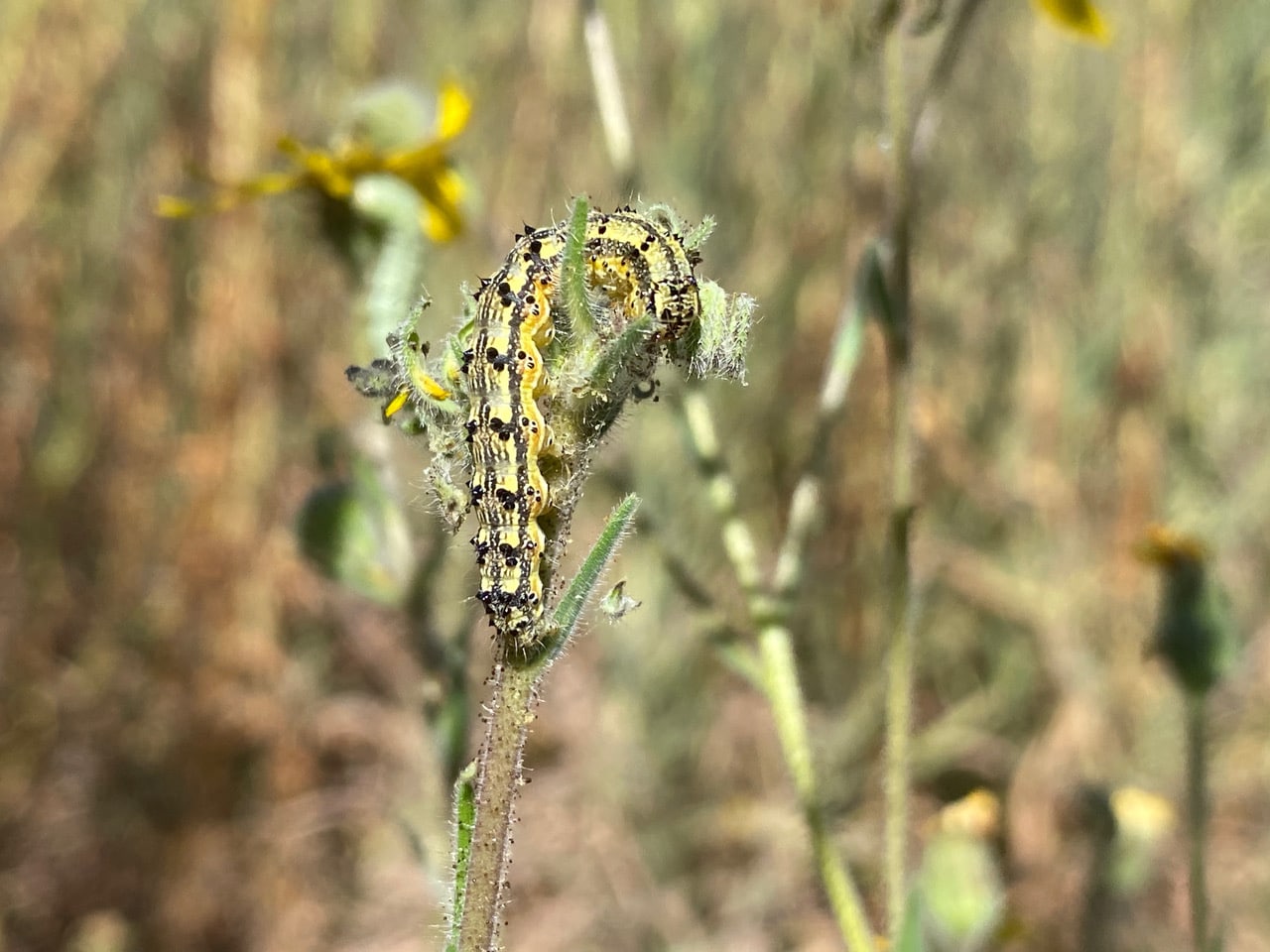
An older caterpillar is feeding on an unopened flowerhead. Heliothodes diminutiva is an Asteraceae specialist; eggs are laid on or near immature flowerheads, larvae feed on the reproductive parts of the flowers.
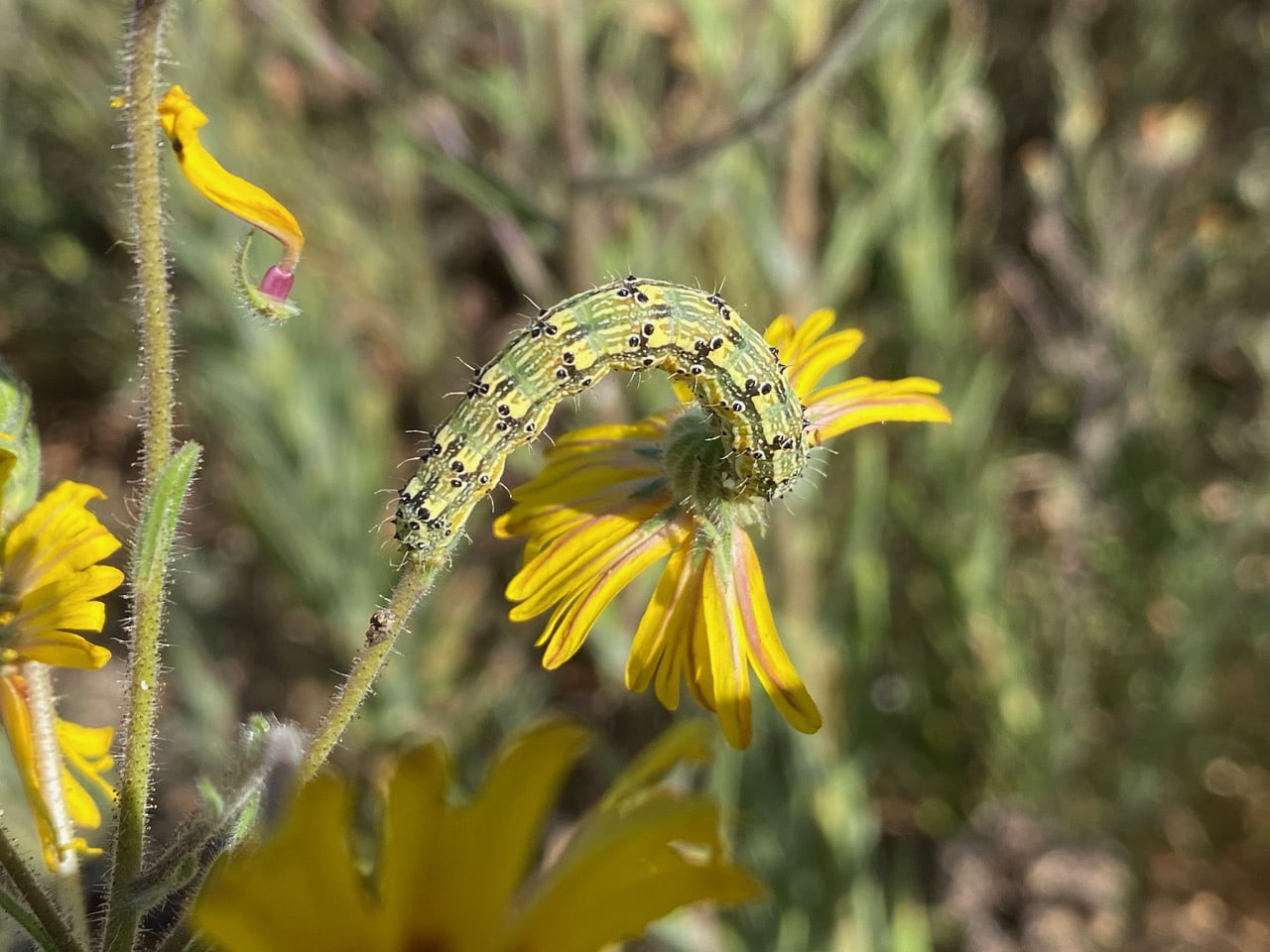
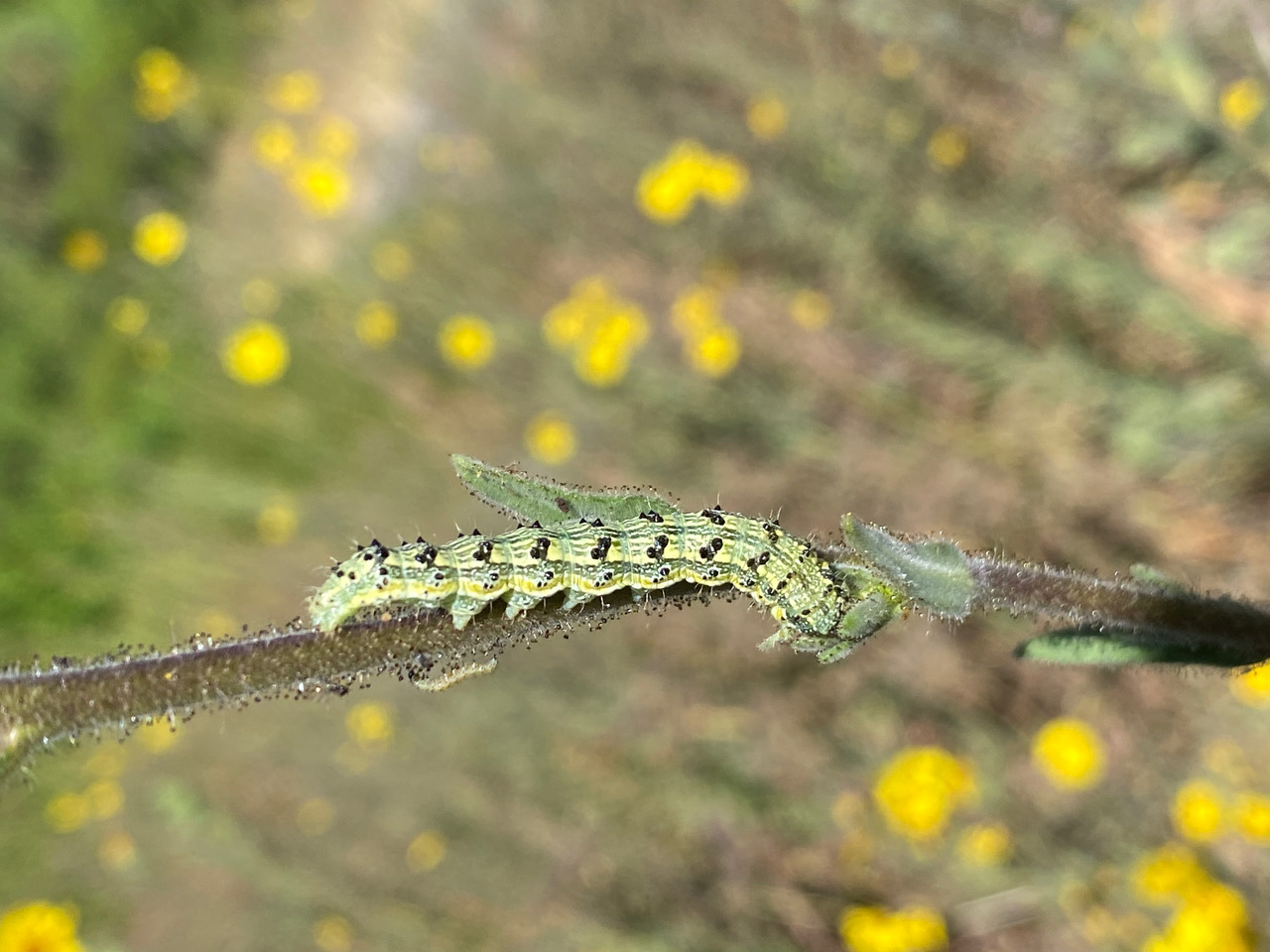
This caterpillar is rather large – might be another species, the Darker-spotted Straw Moth, Heliothis phloxiphaga?
Everywhere I look in the Siesta Gate tarweed patch, there are caterpillars of all ages and sizes…. This is definitely a major infestation! Something is out of balance here.
A cautious caterpillar has woven a web of silk across the rolled up ligules (“petals”) of the flowerhead so it can feed in safety, sheltered from predators and parasites.
There are actually two caterpillars on the stem. Do you see the tiny one on the left?
I am astounded by the severity of the moth infestation. Where are the natural pest control – the predators and parasites? A few Yellowjacket wasps are flying around, apparently hunting caterpillars. But Madia will need a battalion of these predators to rid the plants of the caterpillars. In fact some of the caterpillars are already too big for the Yellowjackets to tackle.
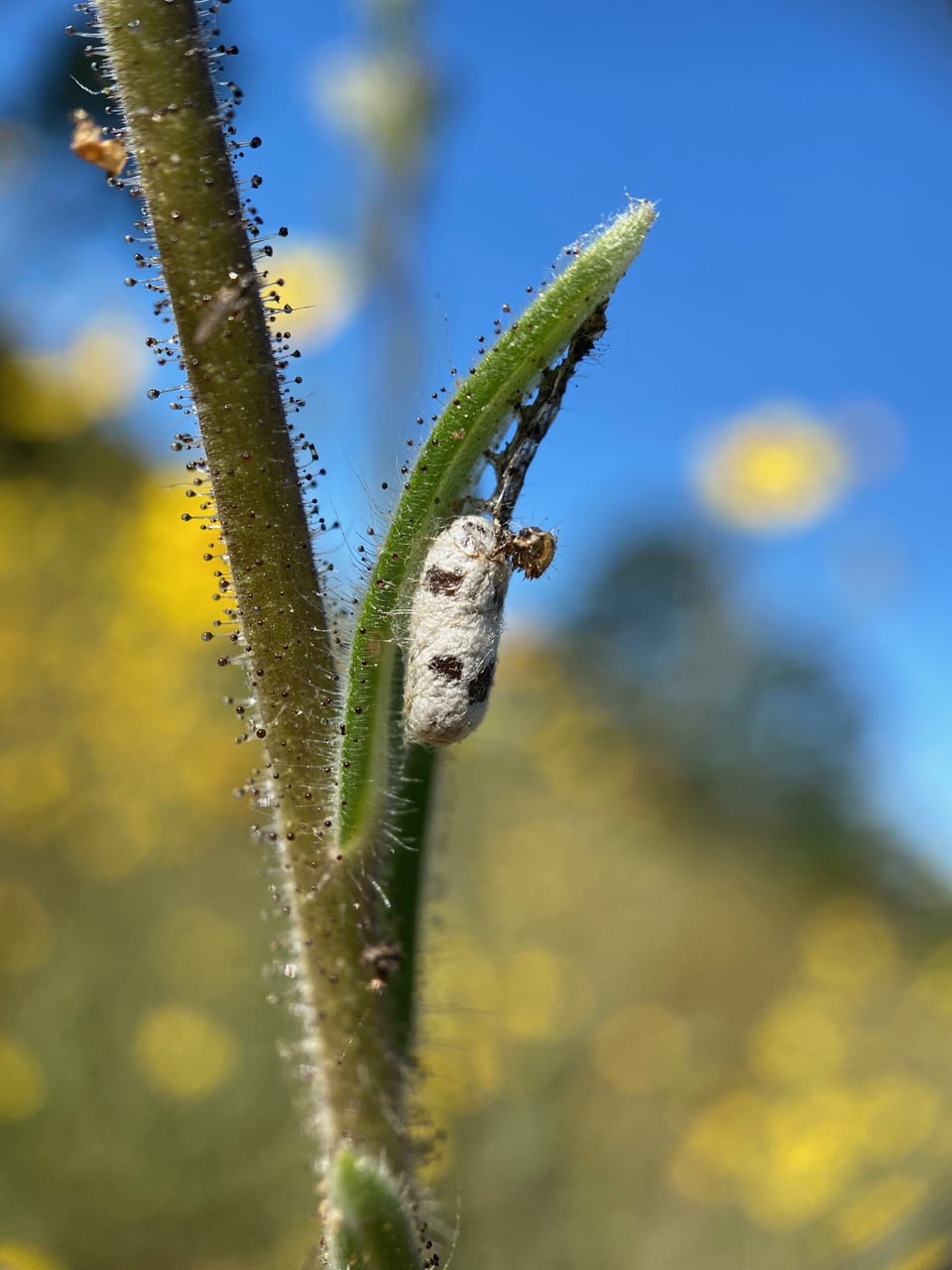
Just then my eyes are attracted to something black-and-white on the back of an Elegant Tarweed leaf, about 1/4 in. in length. Under the macro lens, it appears to be some kind of cocoon. And most curious of all, there’s a withered caterpillar attached to it! Ooh, it must be a parasitoid that has killed the caterpillar! Madia is getting help from a caterpillar parasitoid!
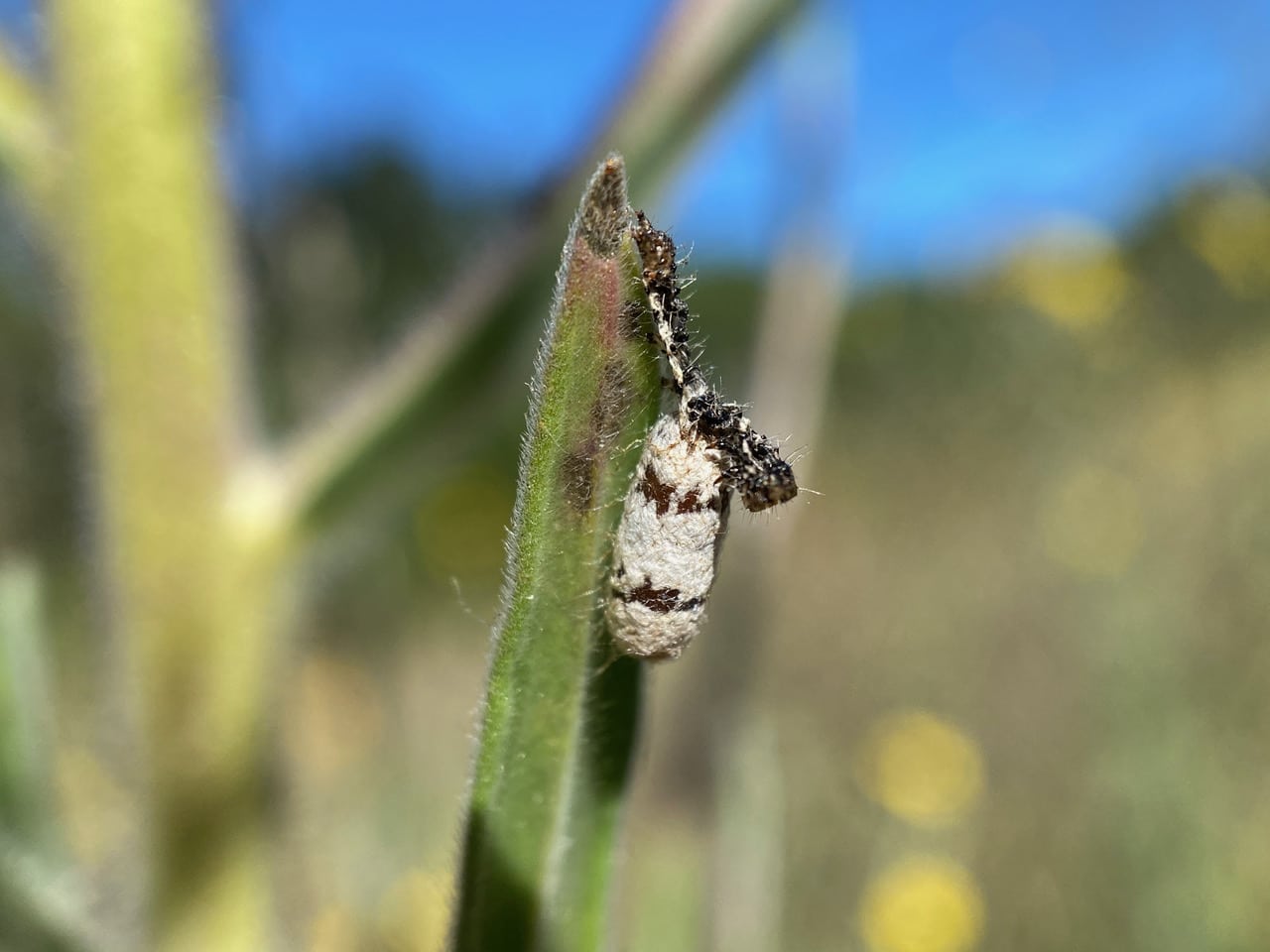
On a leaf lower down on the same plant, an identical situation is playing out! Wow!
The cocoon has been identified by iNaturalist as the pupa of a parasitoid wasp in the family Ichneumonidae, subfamily Campopleginae. It is most likely a member of the genus Hyposoter.
Hyposoter is a large cosmopolitan genus of parasitoid wasps belonging to the family Ichneumonidae. Obvious evidence that Hyposoter is present is its black-and-white pupal cocoon. These commonly occur on foliage attached to the shriveled skin of the caterpillar in which the parasitoid fed during its larval stage.
Hyposoter undergoes complete metamorphosis. The adult wasp lays its egg in the caterpillar. After hatching, the larva feeds inside on the caterpillar’s hemolymph (blood) while developing through three, increasingly larger instars. The wasp larva then feeds on the caterpillar’s tissues consuming the entire body except for the skin and head capsule. The host caterpillar shrinks and becomes a hard and brittle, shriveled skin. The parasitoid emerges from the host skin as a mature third instar (prepupa). The wasp then spins a silken cocoon commonly attached to the dead caterpillar’s skin. The cocoon is about 1/4 in. long, oblong with dense white silk and blackish patches. Parasite development time from oviposition until adult emergence is about one month. There may be several generations per year. Hyposoter is used in the biological control of caterpillars in many crops.