

Pollinator Post 7/24/25 (2)
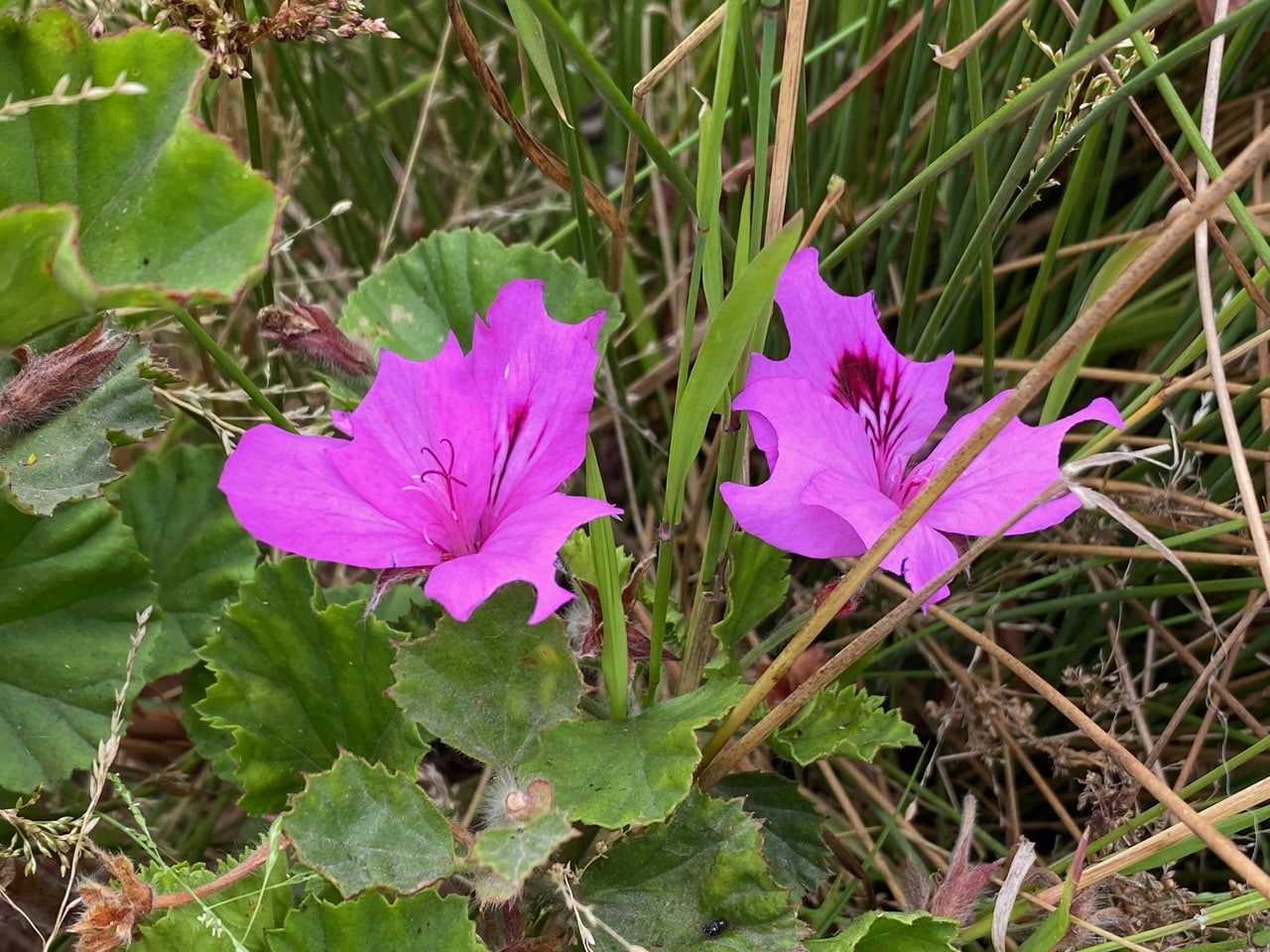
I scan for insects on the plants that spill onto the salt marsh beyond the neighbors’ private gardens. These predominantly non-native ornamentals add some welcome color along the trail. Hey, look, the petals of those flowers of the Rose-scented Geranium, Pelargonium sp. have all been cut! Note the rounded pieces cleanly cut from the edges. This is undoubtedly the work of Leafcutter Bees, Megachile sp. (family Megachilidae). Interestingly, the leaves are untouched.

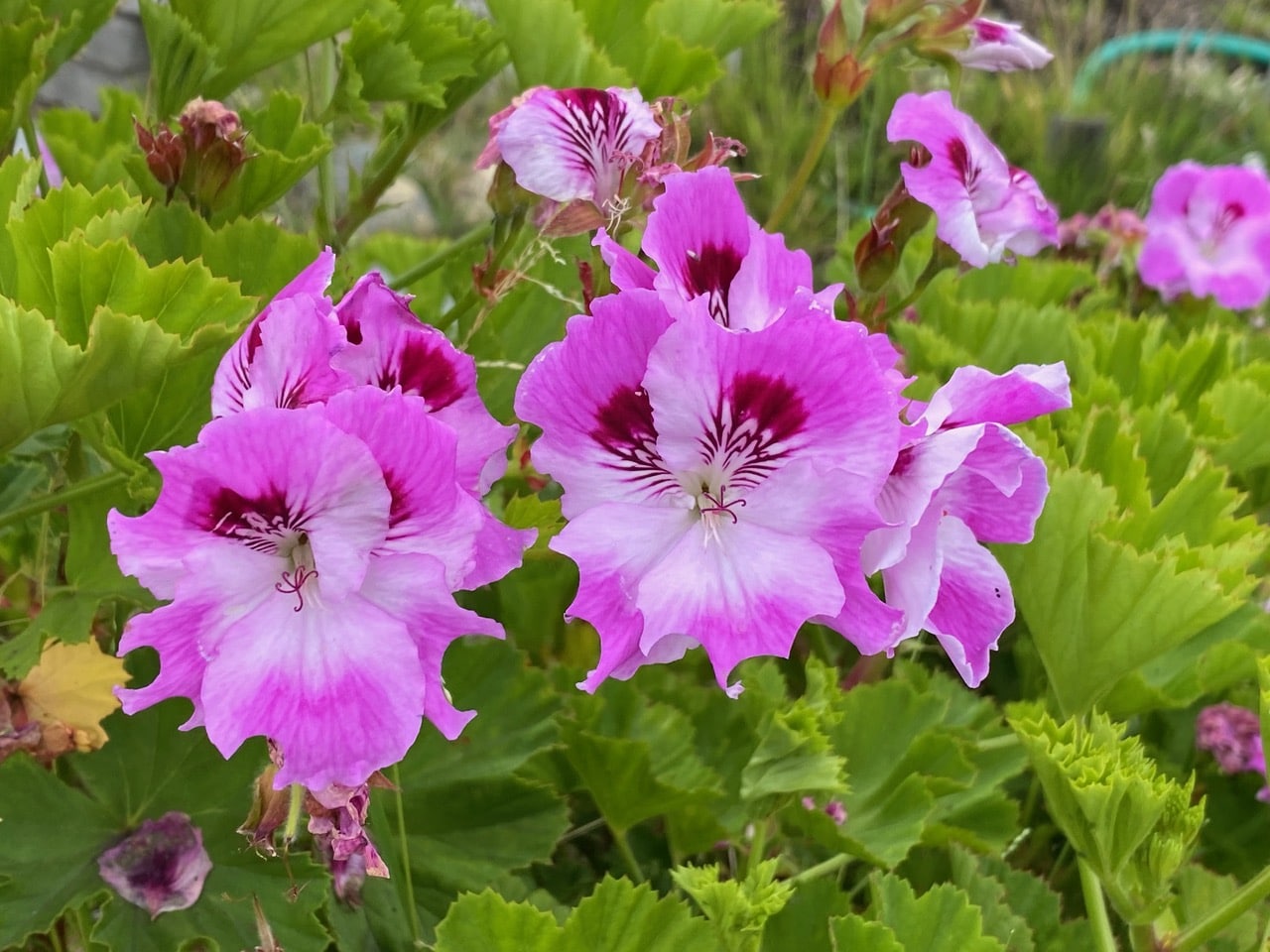
This Rose-scented Geranium is in a different garden.
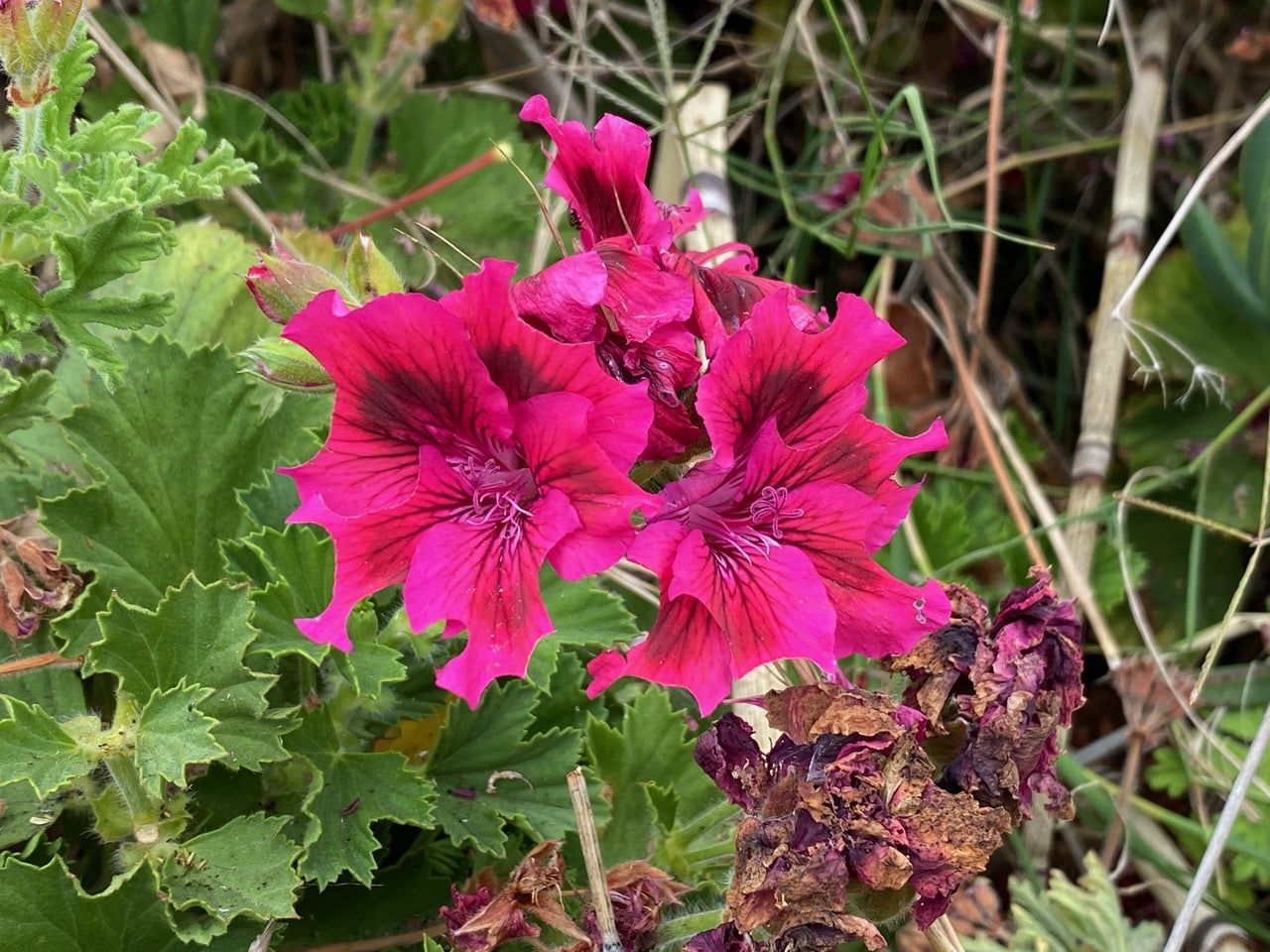
This one too! The leafcutters obviously favor the petals of the Rose-scented Geranium for nest construction. The bees are often seen foraging for nectar and pollen on the native Grindelia stricta on the salt marsh. The bees have apparently adapted to using the large non-native geranium flowers for nesting purposes.
It is well-known among gardeners that Leafcutter Bees often cut these rounded pieces from Rose leaves. I have wondered why – does the rose plant produce some chemicals that the bees select for? Some scents, pathogen-repellents, or preservatives that might protect their brood? What do the Rose-scented Geraniums have in common with the true Rose? A brief search online yields the following information:
Rose-scented geraniums owe their characteristic fragrance to a combination of terpenes, primarily geraniol, nerol, and citronellol. These compounds are also found in roses, contributing to the shared rosy scent. The compounds have proven anti-bacterial and anti-fungal properties that serve well as natural preservative in food and cosmetic applications. Wow!

In another garden, some colorful flowers peek from a planter, including our native Farewell-to-spring, Clarkia amoena.
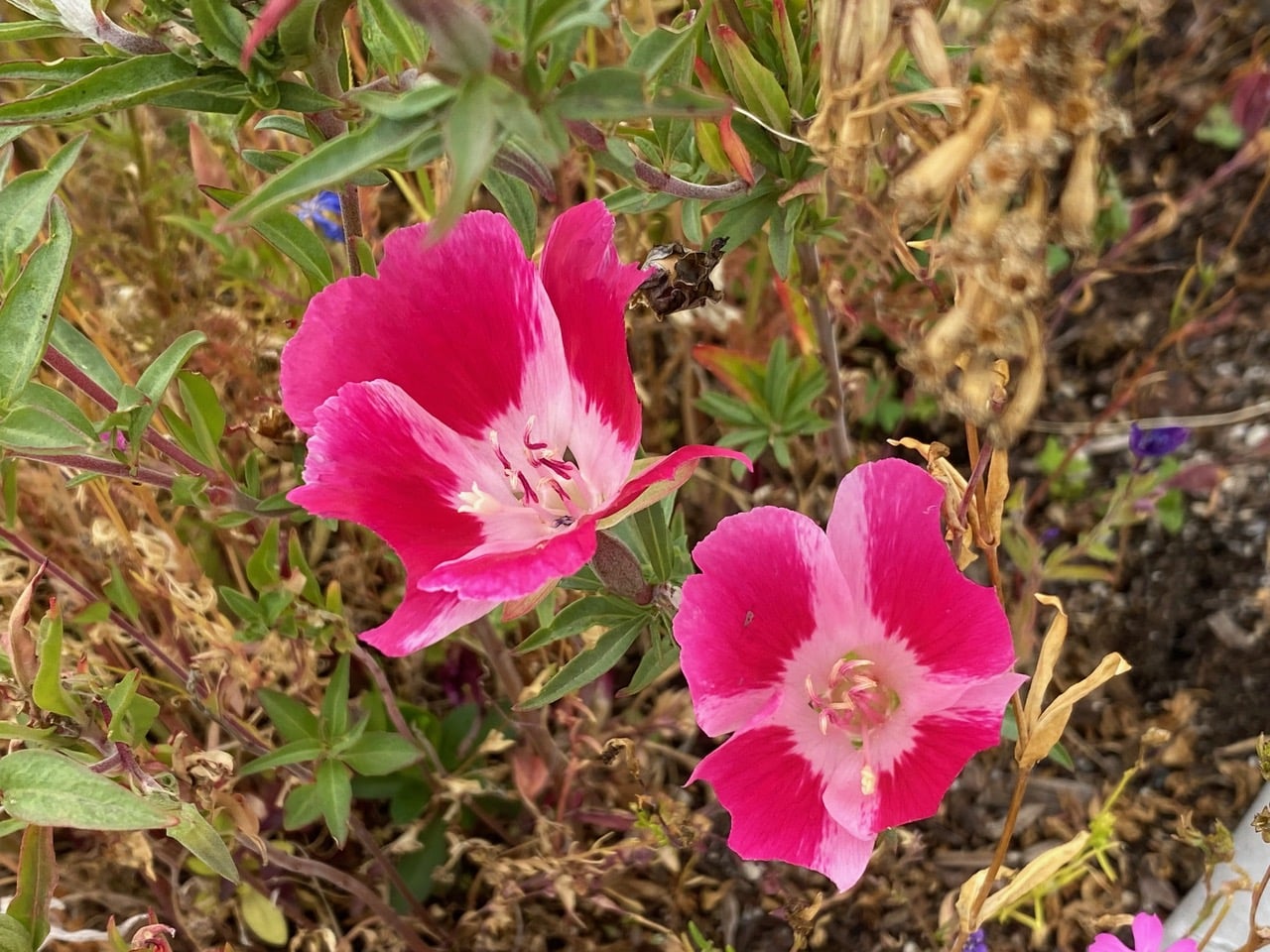
Look, the flowers of Farewell-to-spring also bear the same tell-tale signs of having been visited by the Leafcutter Bees. I often see this phenomenon in the Ruby Chalice Clarkia, Clarkia rubicunda in local parks and gardens. Just recently, I was fortunate to witness a Leafcutter Bee cut the petals of our native Tall Evening Primrose, Oenothera elata. Both Clarkia and Oenothera belong to the evening primrose family Onagraceae. I have wondered if the two plants produce the same chemicals sought after by the bees for nesting purposes.
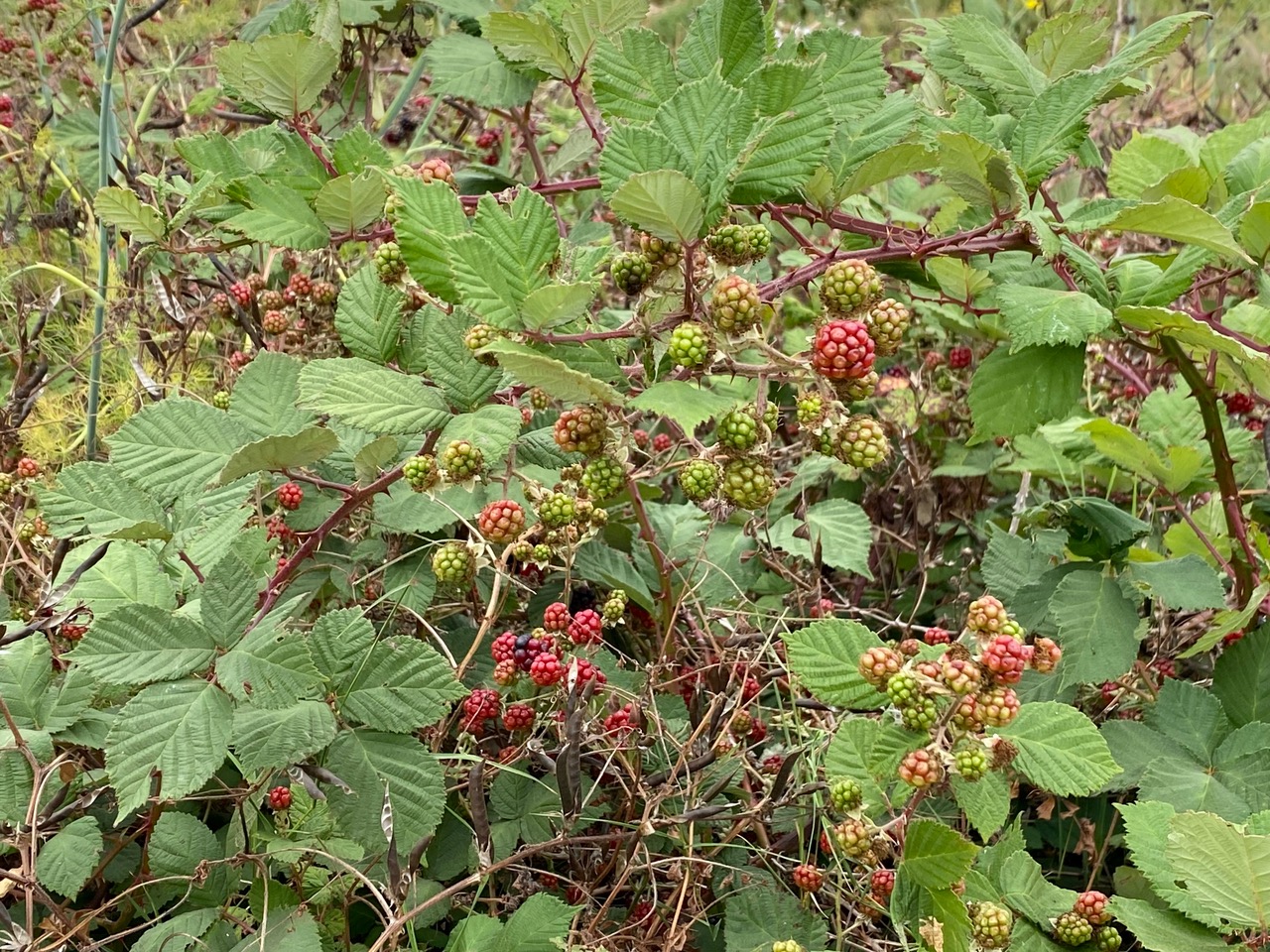
The Armenian Blackberry, Rubus armeniacus has produced a bumper crop of fruits.
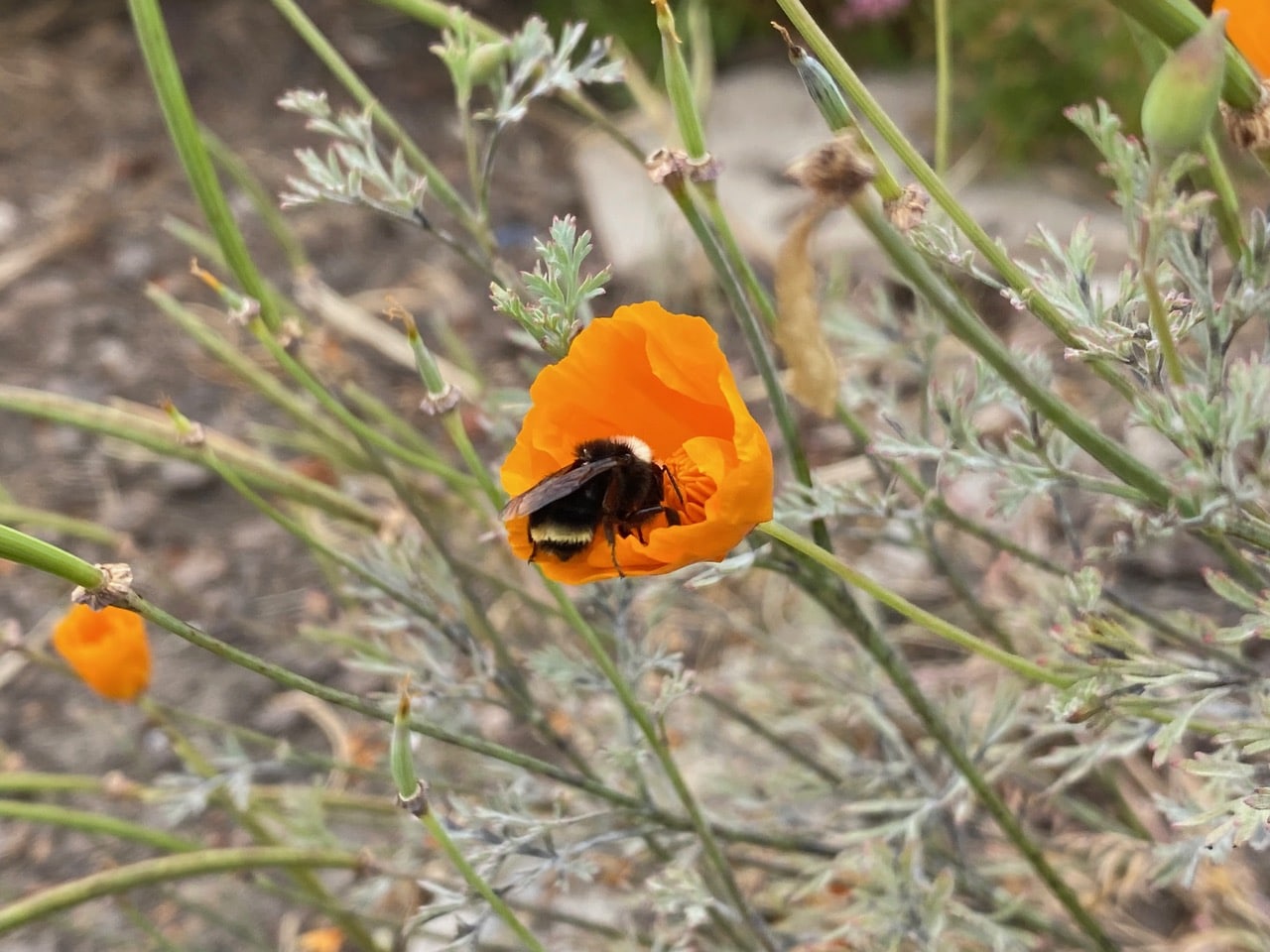
Perched motionless on a California Poppy, Eschscholzia californica, a Yellow-faced Bumble Bee, subgenus Pyrobombus (genus Bombus, family Apidae) appears to be taking a nap.

Now that the morning is warming up, I begin to see some bee activities on the vegetation. A male Fine Striped Sweat Bee, Agapostemon subtilior (family Halictidae) lands momentarily on a leaf of Armenian Blackberry.
Agapostemon are brightly colored metallic green or blue bees measuring 7 to 14.5 mm long. Most species have a metallic green head and thorax, and black-and-yellow striped abdomen; some females are entirely bright green or blue. Females carry pollen on scopal hairs located on their hind legs. Agapostemon are generalists. Like other members of the family Halictidae, they are short-tongued and thus have difficulty extracting nectar from deep flowers. Males are often seen flying slowly around flowers looking for females. The bees favor flowers with high densities. Females excavate nests in the ground. These are summer to fall bees.
Fine striped sweat bee (Agapostemon subtilior) · iNaturalist
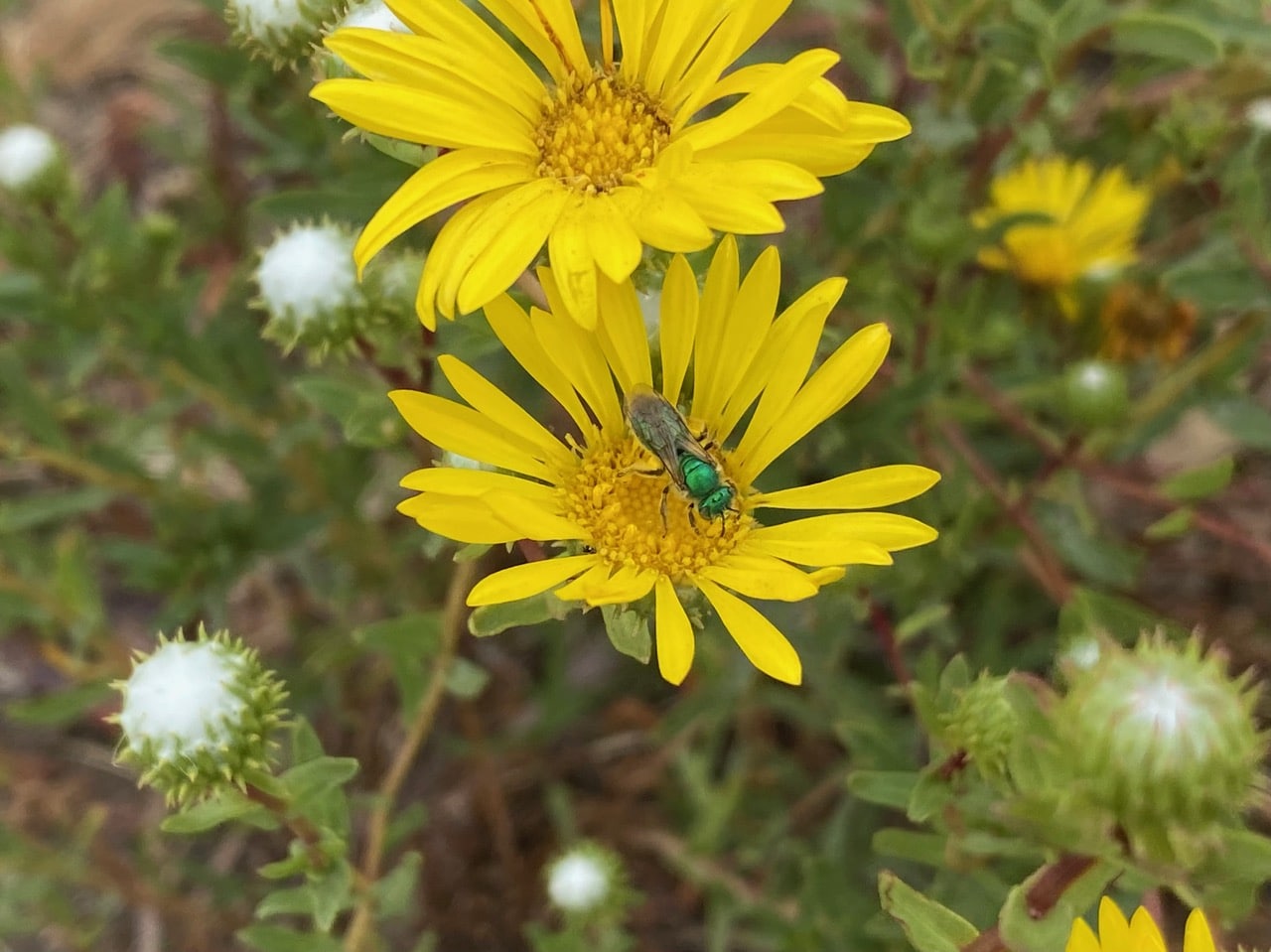
A female Fine Striped Sweat Bee, Agapostemon subtilior (family Halictidae) is foraging on a flower of Oregon Gumweed, Grindelia stricta.
Agapostemon females dig deep vertical burrows in flat or sloping soil, or sometimes in banks. Most species are solitary, but some species nest communally. Up to two dozen females may share a single nest entrance, but each individual builds and provisions its own cluster of brood cells. Where a communal nest gallery shares a single entrance, one bee usually guards the hole, with only her head visible from above ground. Unlike other social bees, in communal bees there is no reproductive division of labor. In cool temperate regions, there is one generation per year, with females active in the early summer and males and pre-diapausing females active in the late summer. Only mated females survive the winter. This is probably because unmated females cannot enter diapause (insect version of hibernation).
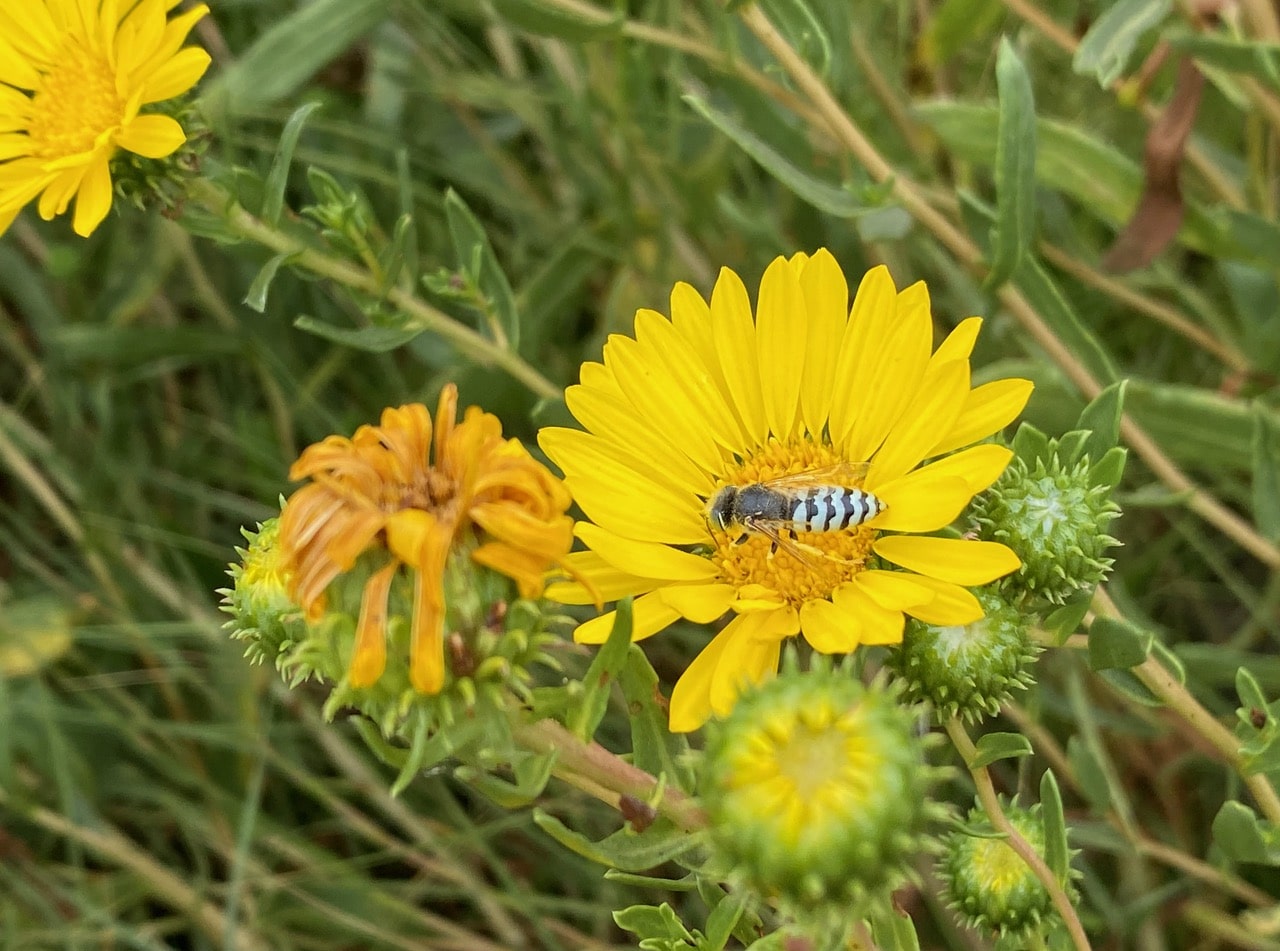
An American Sand Wasp, Bembix americana (family Crabronidae) is foraging on a Grindelia flowerhead.
Sand wasps in the genus Bembix are familiar and common throughout North America, digging their burrows in dunes, on beaches, and other habitats with loose, deep sand. The female rapidly kicks out large quantities of sand using a “tarsal rake” of spines on each front leg. The burrow is excavated before the wasp goes hunting. Bembix are generalist, opportunistic hunters. True flies in the order Diptera are the usual prey. A victim is paralyzed or killed by the wasp’s sting, and is then flown back to the nest. Most species will lay an egg on the first victim, while some species lay an egg in the empty cell before starting to hunt. Once the egg hatches, mama wasp brings flies to her larva as needed. This “progressive provisioning” is rare in the insect world. When the larva reaches maturity, mama wasp closes the cell. Inside, the larva spins an oblong cocoon, weaving sand grains into the structure and resulting in a hardened capsule. Overwintering takes place as a prepupa inside this cocoon, but there are usually two generations a year.
Male sand wasps often engage in an elaborate flight ritual called “sun dances”. Males emerge before females, and fly erratically at dizzying speed one or two inches above the ground attempting to detect virgin females about to emerge from their underground nests. Both sexes are often seen taking nectar at flowers, especially from Asteraceae family. Bembix wasps are often victims of other insects such as cuckoo wasps (Chrysididae), velvet ants (Mutillidae), satellite flies (Sarcophagidae), bee flies (Bombyliidae), and thick-headed flies (Conopidae).

A Weevil (family Curculionidae) is resting on the involucre of a Grindelia flowerhead.
Weevils, family Curculionidae, are also called snout beetles. Curculionidae is one of the largest beetle families (about 40,000 species). Most weevils have long, distinctly elbowed antennae that may fold into special grooves on the snout. The snout is used not only for penetration and feeding but also for boring holes in which to lay eggs. The mouthparts are quite small and located at the end of the rostrum (snout), designed for chewing. Many weevils have no wings, while others are excellent fliers. Most are less than 6 mm in length. The majority of weevils feed exclusively on plants. The fleshy, legless larvae of most species feed only on a certain part of a plant – i.e., the flower head, seeds, fleshy fruits, stems, or roots. Many larvae feed either on a single plant species or on closely related ones. Adult weevils tend to be less specialized in their feeding habits. The family includes some very destructive agricultural pests.
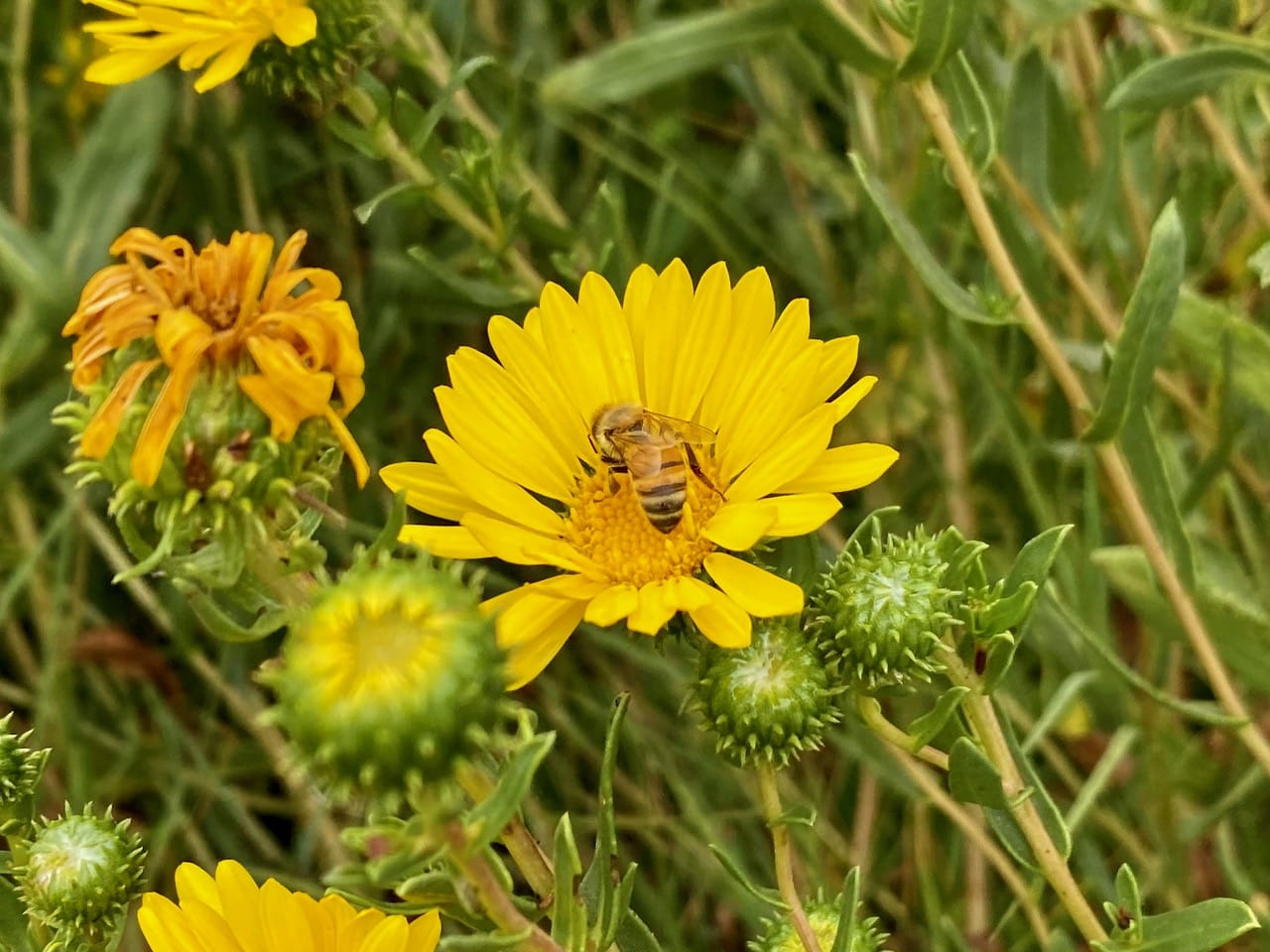
A Honey Bee, Apis mellifera (family Apidae) is foraging on a Grindelia flowerhead. She does not seem to be collecting pollen.
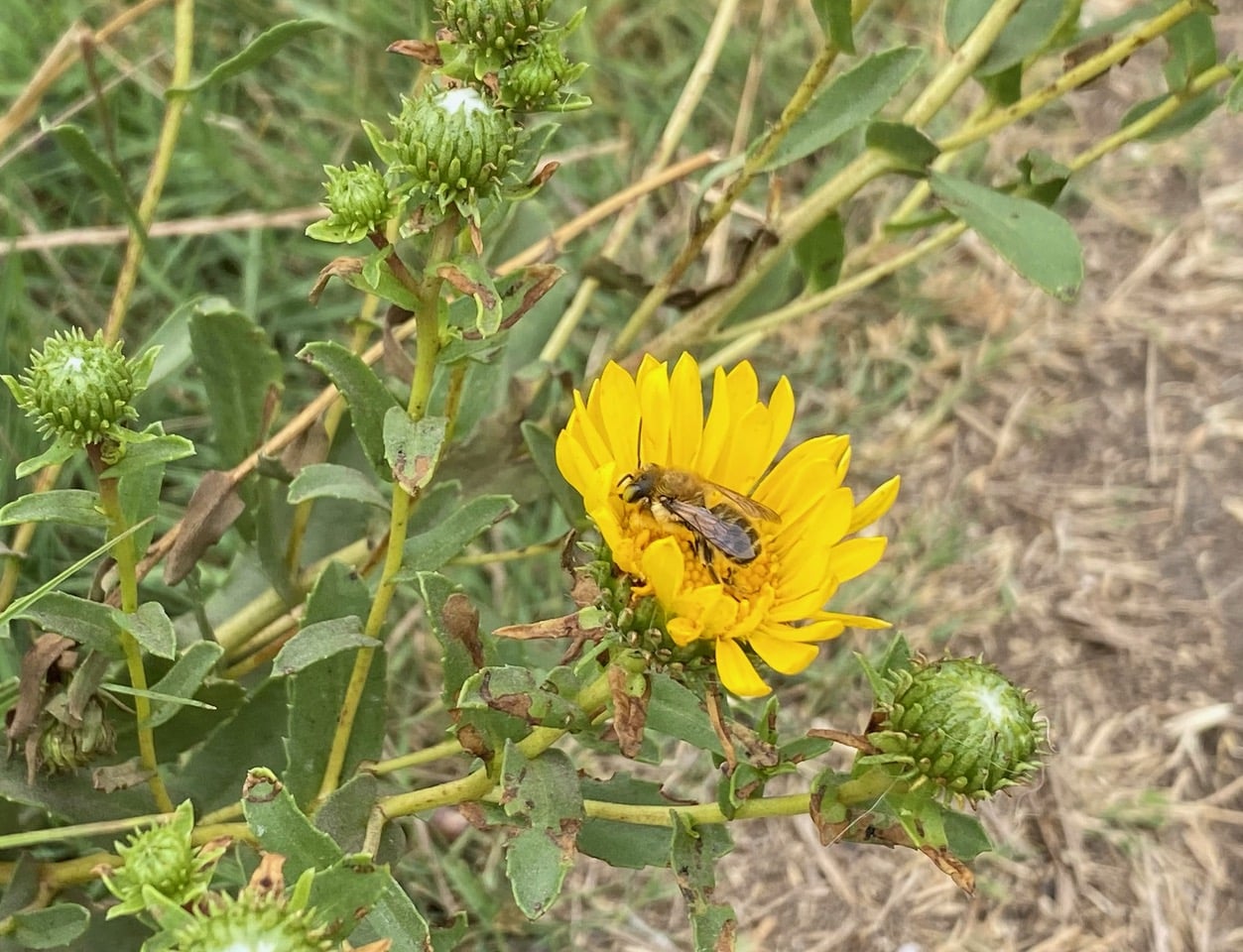
About the size of a Honey Bee but more stocky, a male Western Leafcutter Bee, Megachile perihirta (family Megachilidae) is taking nectar on a Grindelia flowerhead.
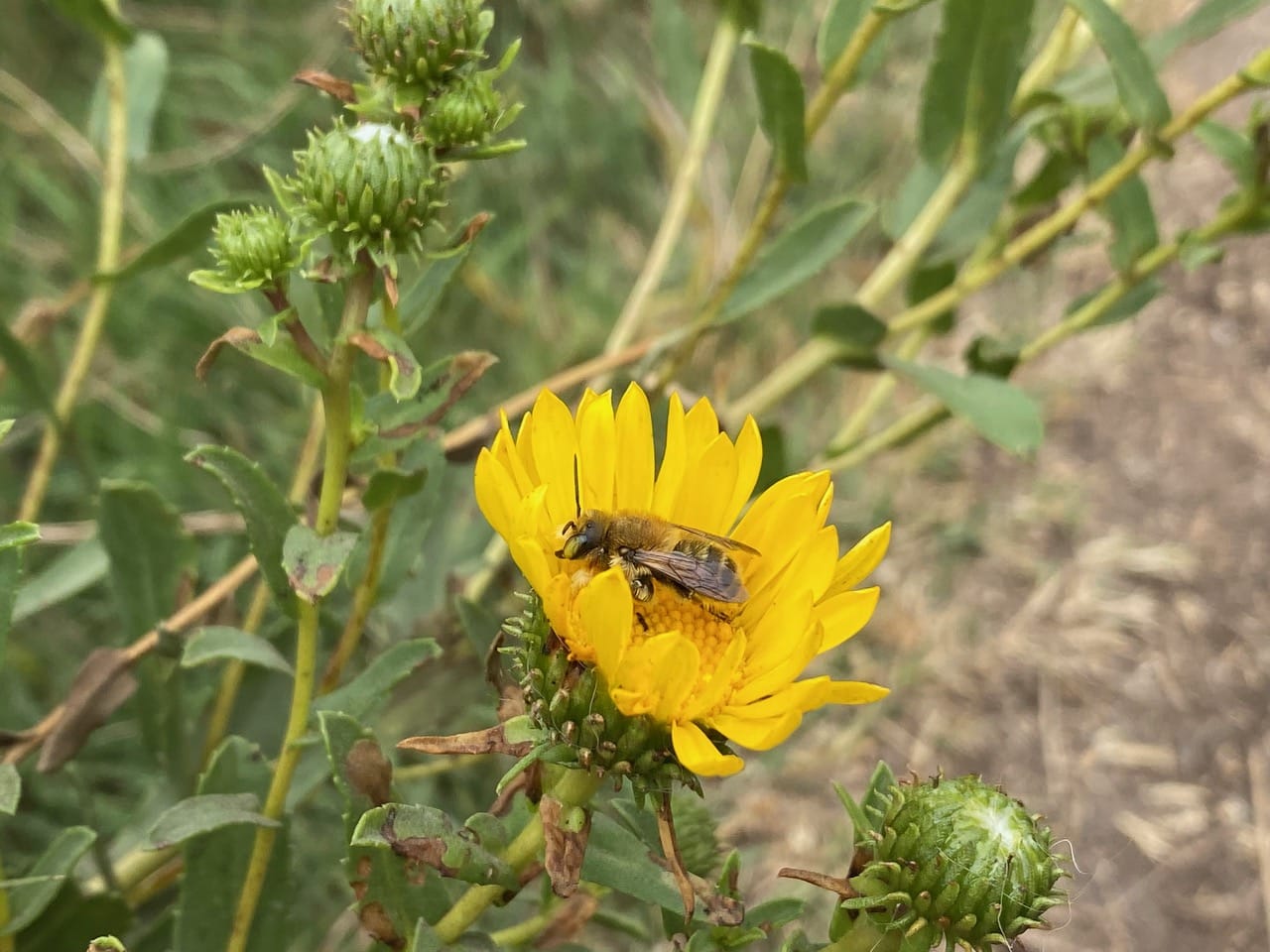
Leaf-cutter Bees, Megachile sp. (family Megachilidae) are stout-bodied, usually with pale hair on the thorax and stripes of white hairs on the abdomen. Females usually have a triangular abdomen with a pointed tip, and males’ faces are covered with dense, pale hair. Flight season is from May into September, with peak activity from June to August.
Solitary females construct nests in tubular cavities, including hollow stems, tree holes, and abandoned beetle burrows in wood. Many use holes drilled into wood, straws, or other manufactured tunnels. Females cut pieces from leaves or flower petals for use in the construction of brood cells. Most Megachile females are generalists when foraging for pollen. Pollen is transported in dense scopae on the underside of the abdomen.
Photos of Western Leafcutter Bee (Megachile perihirta) · iNaturalist
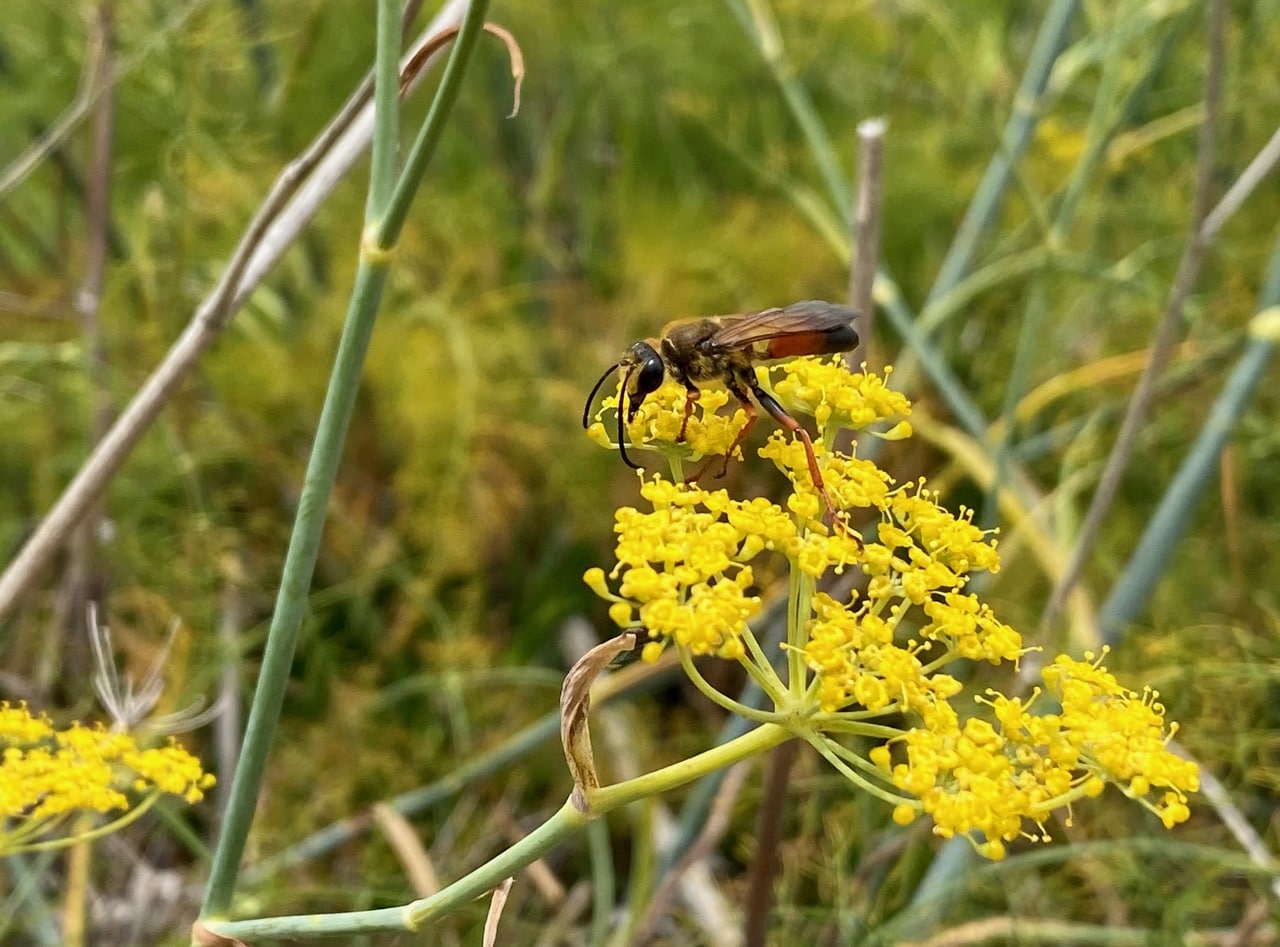
A Great Golden Digger Wasp, Sphex ichneumoneus (family Sphecidae) is seeking nectar on a umbel of Fennel flowers.
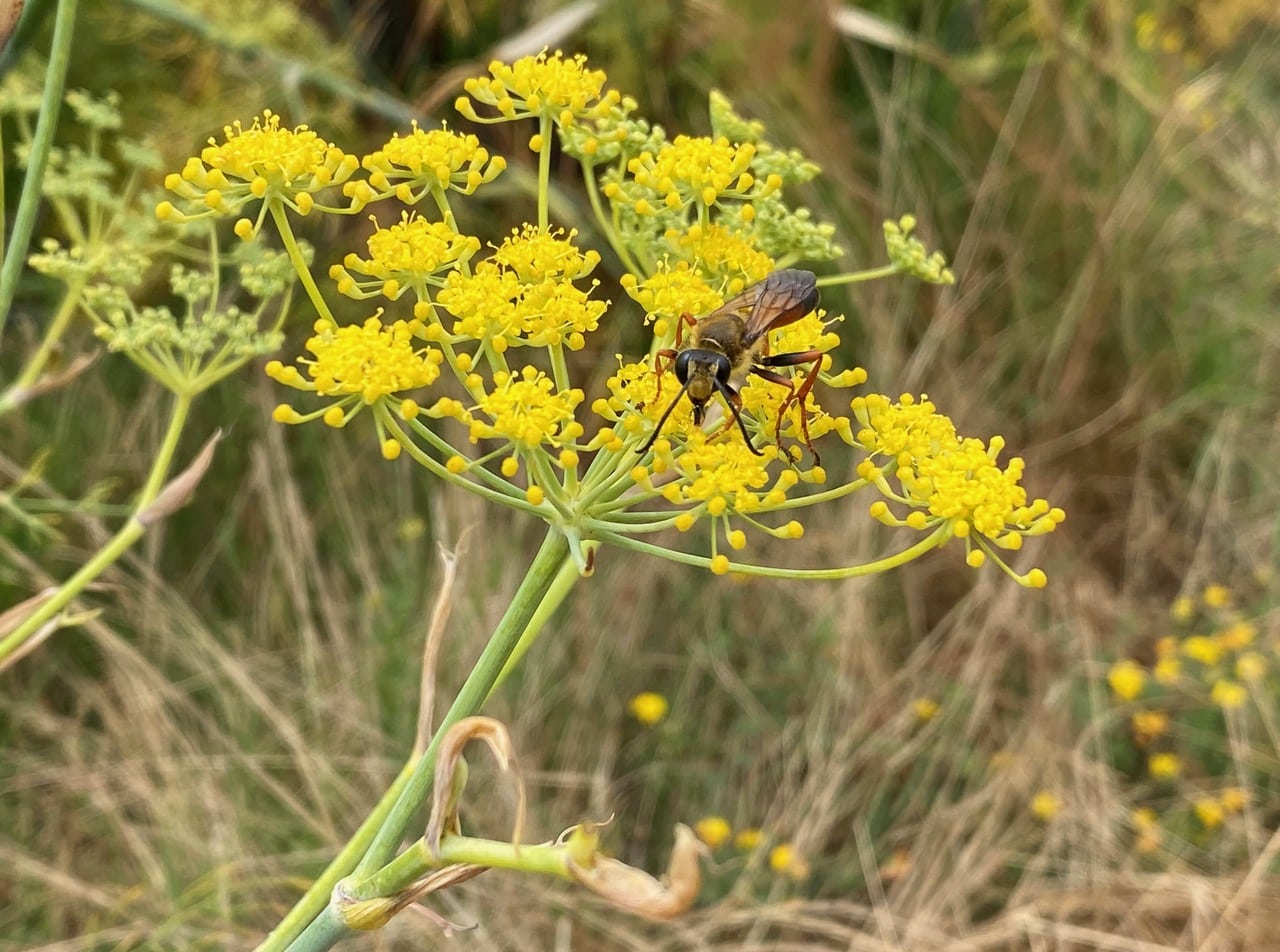

Sphex ichneumoneus, known commonly as the Great Golden Digger Wasp is a wasp in the family Sphecidae. It is identified by the golden pubescence on its head and thorax, its reddish orange legs, and partly reddish orange body. Size 15-27 mm. Found in fields, meadows, the wasp is native to the Western Hemisphere, from Canada to South America. The female digs a chambered tunnel in open ground, and proceeds to stock it with food for her young. She hunts for insects from the family of long-horned grasshoppers that include various crickets, katydids and grasshoppers. She stings to paralyze her prey, then flies or drags it back to the nest. A single egg is laid on the prey. The wasp larvae have fresh food to sustain them until they emerge as adults. One tunnel entrance may lead to as many as eight or ten separate larval chambers. The Great Golden Digger Wasps are not aggressive, but do sting if handled.

If this were a sunny day, the hairs on the head and thorax of the large wasp would be reflecting a bright golden glow.