

Pollinator Post 7/24/25 (1)

The blooming Oregon Gumweed, Grindelia stricta brightens up a gloomy, sunless morning at the salt marsh south of the Elsie Roemer Bird Sanctuary, Alameda.








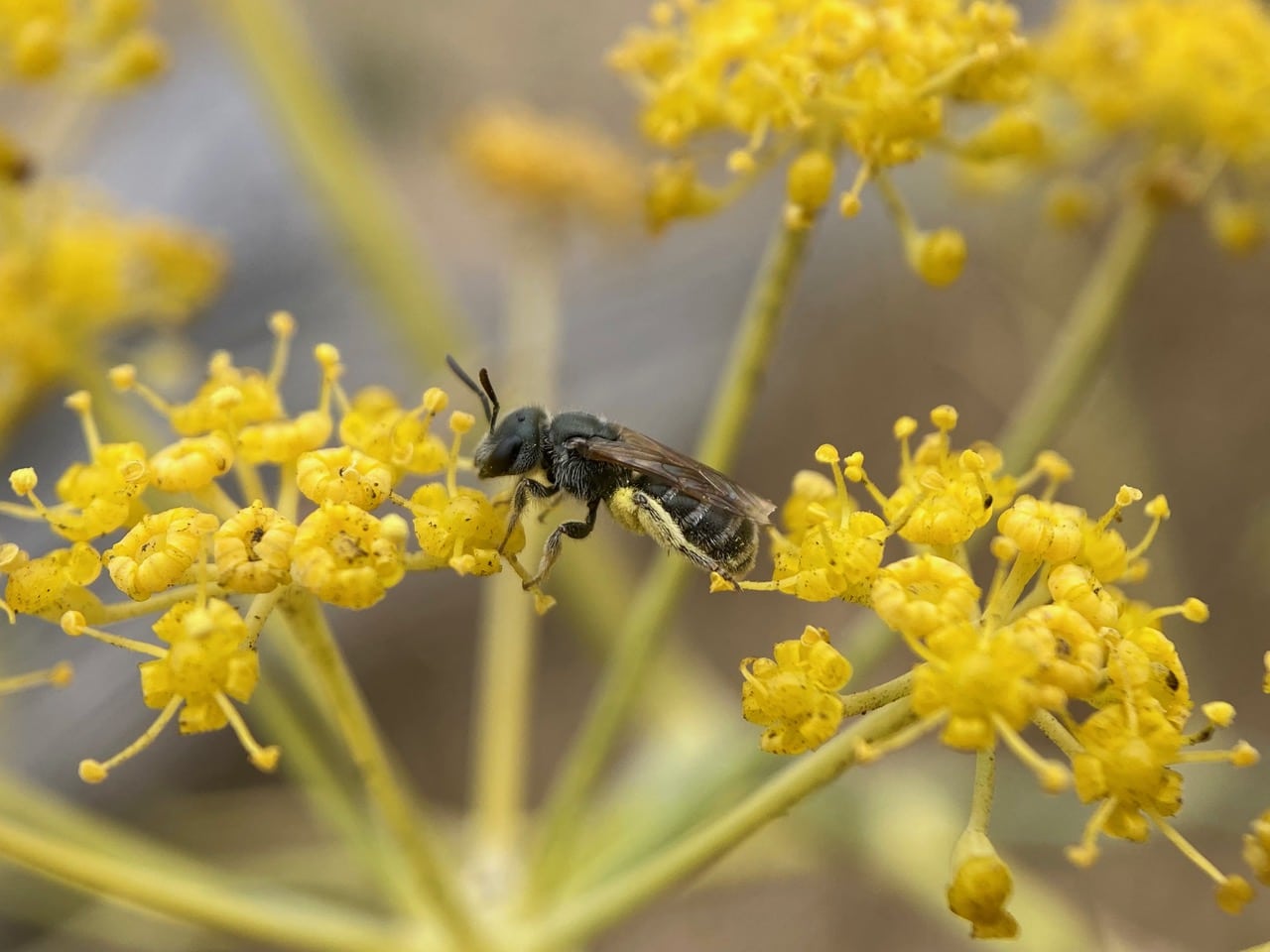
A small Weevil (family Curculionidae) is roaming the florets on a Grindelia flowerhead.
Weevils, family Curculionidae, are also called snout beetles. Curculionidae is one of the largest beetle families (about 40,000 species). Most weevils have long, distinctly elbowed antennae that may fold into special grooves on the snout. The snout is used not only for penetration and feeding but also for boring holes in which to lay eggs. The mouthparts are quite small and located at the end of the rostrum (snout), designed for chewing. Many weevils have no wings, while others are excellent fliers. Most are less than 6 mm in length. The majority of weevils feed exclusively on plants. The fleshy, legless larvae of most species feed only on a certain part of a plant – i.e., the flower head, seeds, fleshy fruits, stems, or roots. Many larvae feed either on a single plant species or on closely related ones. Adult weevils tend to be less specialized in their feeding habits. The family includes some very destructive agricultural pests.
I am rather surprised that the foliage of Fennel, Foeniculum vulgare along the trail is already turning yellow.
Th Fennel, however, is still blooming nicely and attracting numerous insects. The hardworking Honey Bees, Apis mellifera (family Apidae) are out foraging before anybody else.
A spotless Convergent Lady Beetle, Hippodamia convergens (family Coccinellidae) is resting on an umbel of Fennel flowers. The species is easily recognizable from the two converging white lines on the black pronotum. The red elytra are usually spotted, but spotless individuals are often seen. Both adults and larvae are voracious predators of aphids and other soft-bodied insects.
What a delightful find – a 5th instar Anise Swallowtail caterpillar! It is characterized by a green body with black and orange or yellow markings, distinctly different from the younger instars. This is the last larval stage before the caterpillar forms a chrysalis. The caterpillar appearance has shifted from dark and spiny to smooth and green with black bands and yellow spots. It also develops thick, “marshmallow-like” prolegs.
Instar is the term given to the developmental stage of an insect between molts. For example, after hatching from the egg an insect is said to be in its first instar. When the insect molts it is then a second instar and so on. Anise Swallowtail caterpillars go through five instars, meaning they molt (shed their skin) four times as they grow and develop.
The Anise Swallowtail, Papilio zelicaon (family Papilionidae), is a common swallowtail butterfly of western North America. It is found in fairly open country, most likely seen on bare hills or mountains, in fields oar at the roadside. Adult females lay eggs singly on the underside of host plant leaves. In the first two instars, the caterpillar is a bird poop mimic – dark brown, almost black, with an irregular white band at its middle. After that it becomes more green at each successive molt until, in the fifth (last) instar, it is predominantly green, with markings in black, orange, and light blue. Its major food plants are members of the carrot family, Apiaceae (including fennel), and also some members of the citrus family, Rutaceae.
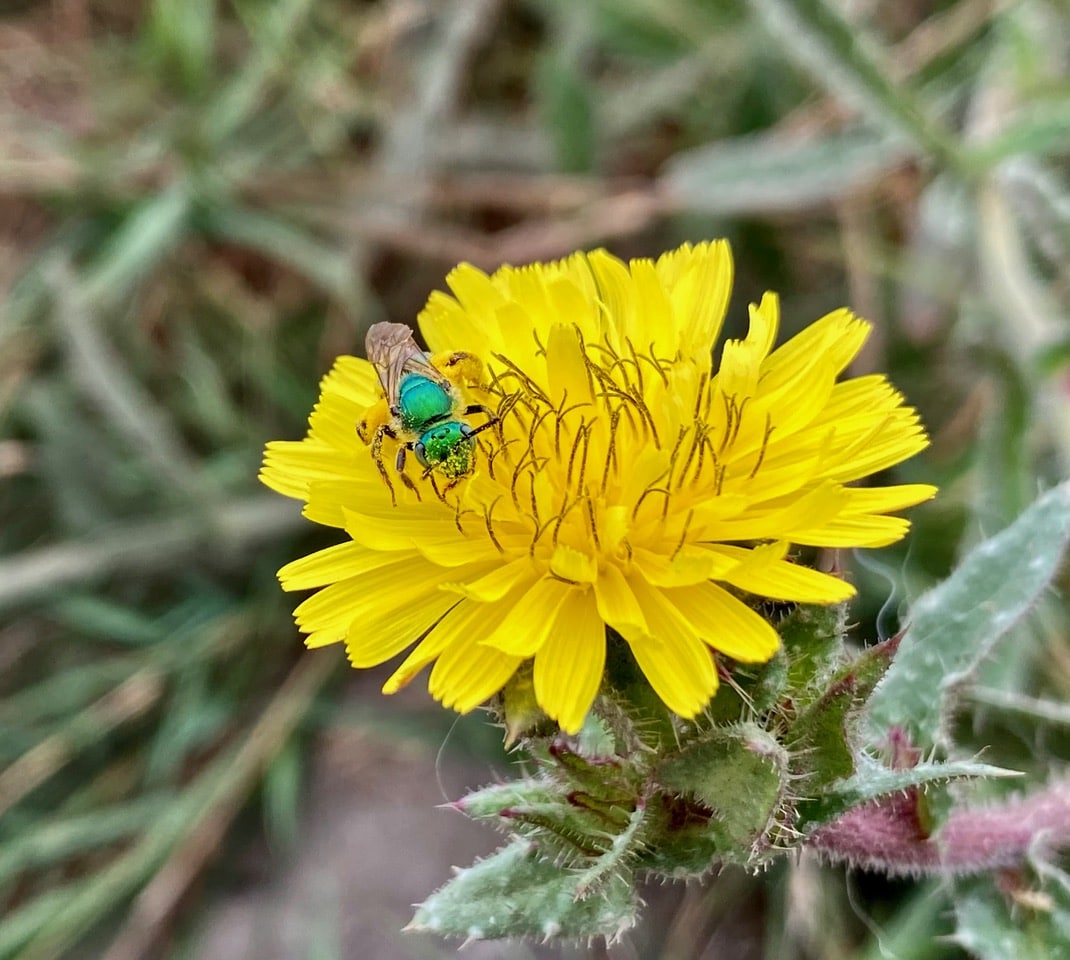
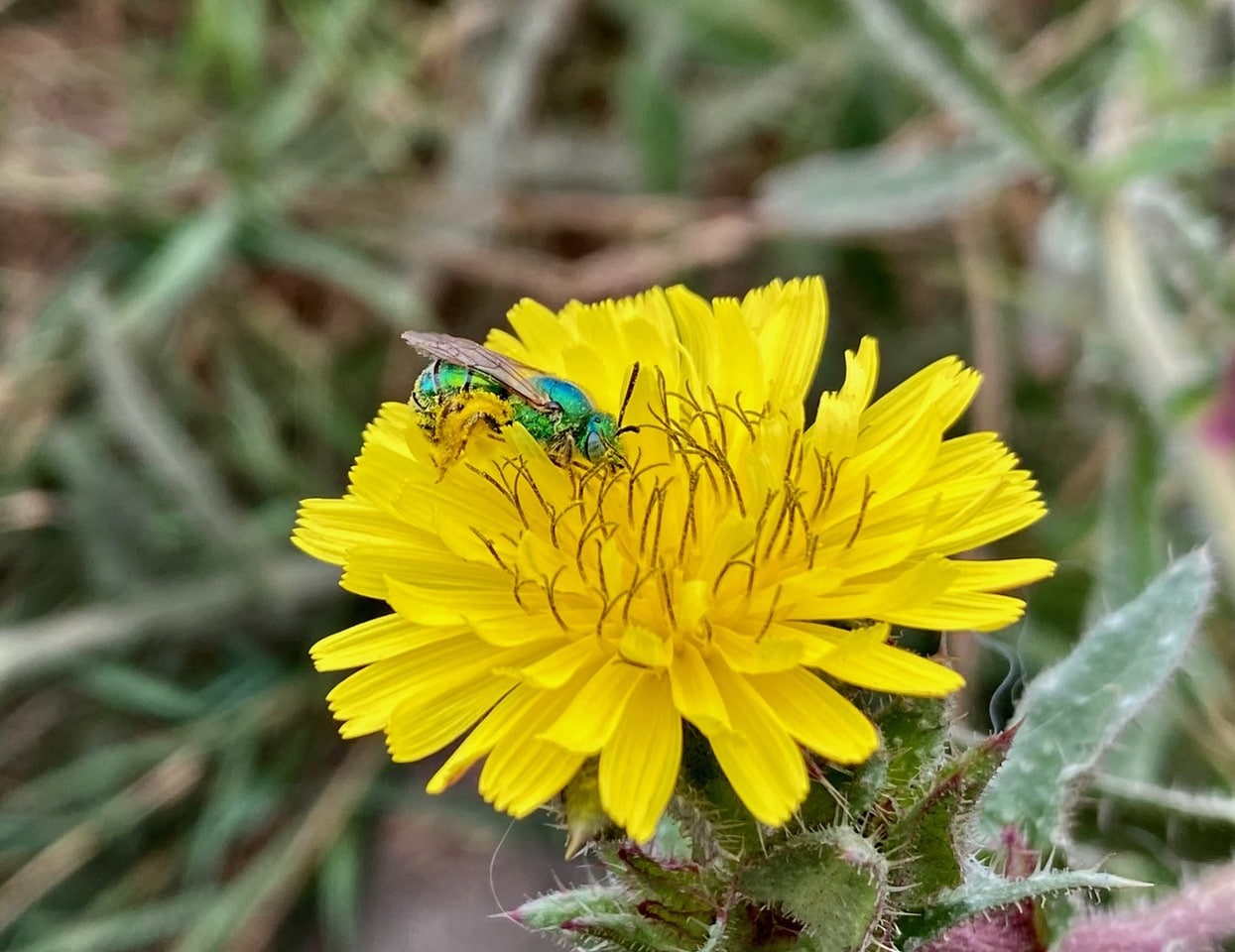
A female Fine Striped Sweat Bee, Agapostemon subtilior (family Halictidae) is foraging on a flowerhead of Bristly Oxtongue, Helminthotheca echioides.
Agapostemon are brightly colored metallic green or blue bees measuring 7 to 14.5 mm long. Most species have a metallic green head and thorax, and black-and-yellow striped abdomen; some females are entirely bright green or blue. Females carry pollen on scopal hairs located on their hind legs. Agapostemon are generalists. Like other members of the family Halictidae, they are short-tongued and thus have difficulty extracting nectar from deep flowers. Males are often seen flying slowly around flowers looking for females. The bees favor flowers with high densities. Females excavate nests in the ground. These are summer to fall bees.
Fine striped sweat bee (Agapostemon subtilior) · iNaturalist
Agapostemon females dig deep vertical burrows in flat or sloping soil, or sometimes in banks. Most species are solitary, but some species nest communally. Up to two dozen females may share a single nest entrance, but each individual builds and provisions its own cluster of brood cells. Where a communal nest gallery shares a single entrance, one bee usually guards the hole, with only her head visible from above ground. Unlike other social bees, in communal bees there is no reproductive division of labor. In cool temperate regions, there is one generation per year, with females active in the early summer and males and pre-diapausing females active in the late summer. Only mated females survive the winter. This is probably because unmated females cannot enter diapause (insect version of hibernation).
Look, there’s a little Anise Swallowtail caterpillar on that large umbel of Fennel flowers. It is crawling away from the smaller umbel that is missing some flowers – the ones that it has eaten!
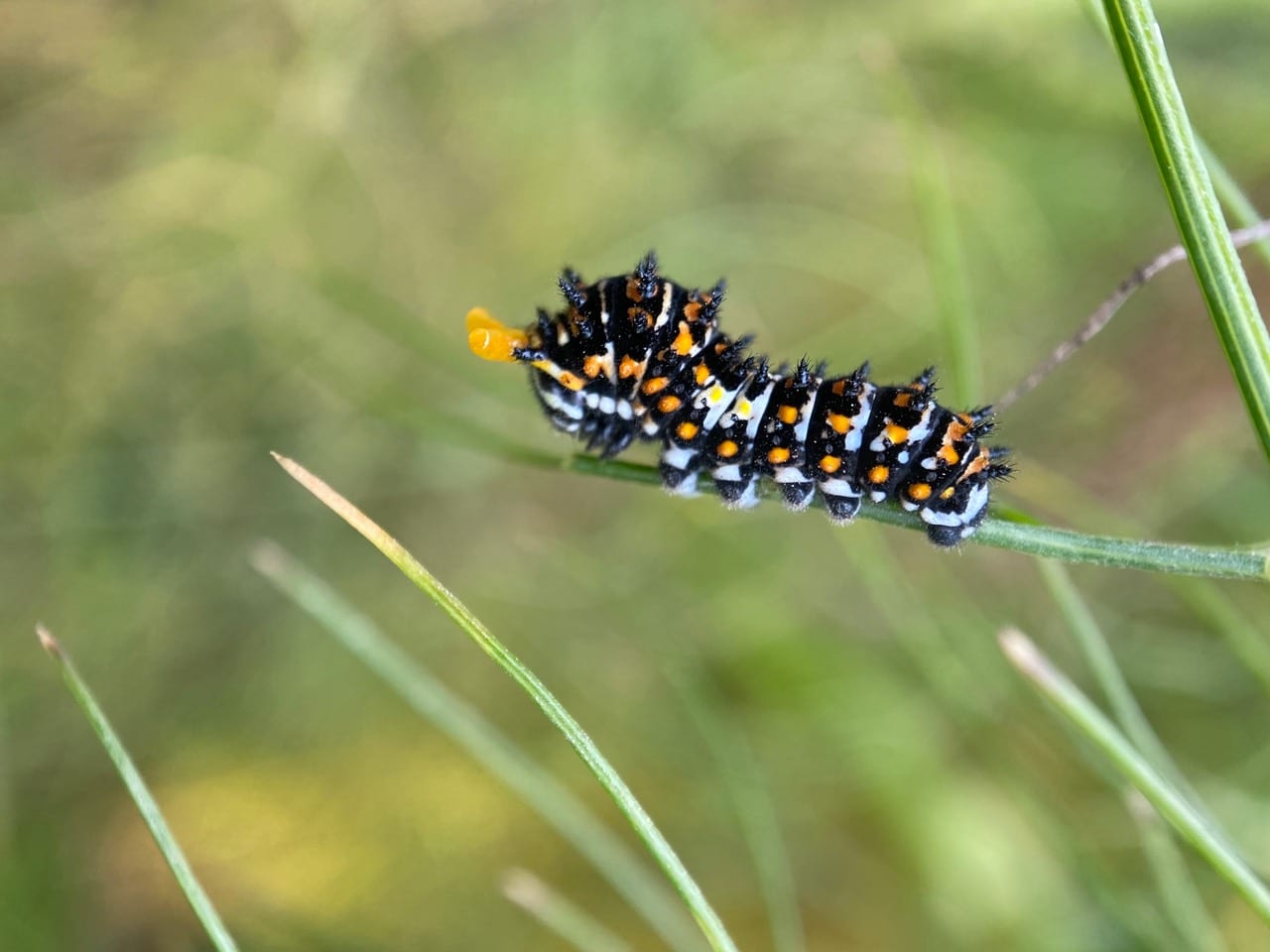
Disturbed by the sudden movement when I grasp the flower stalk, the startled caterpillar extrudes its osmeterium located right behind its head.
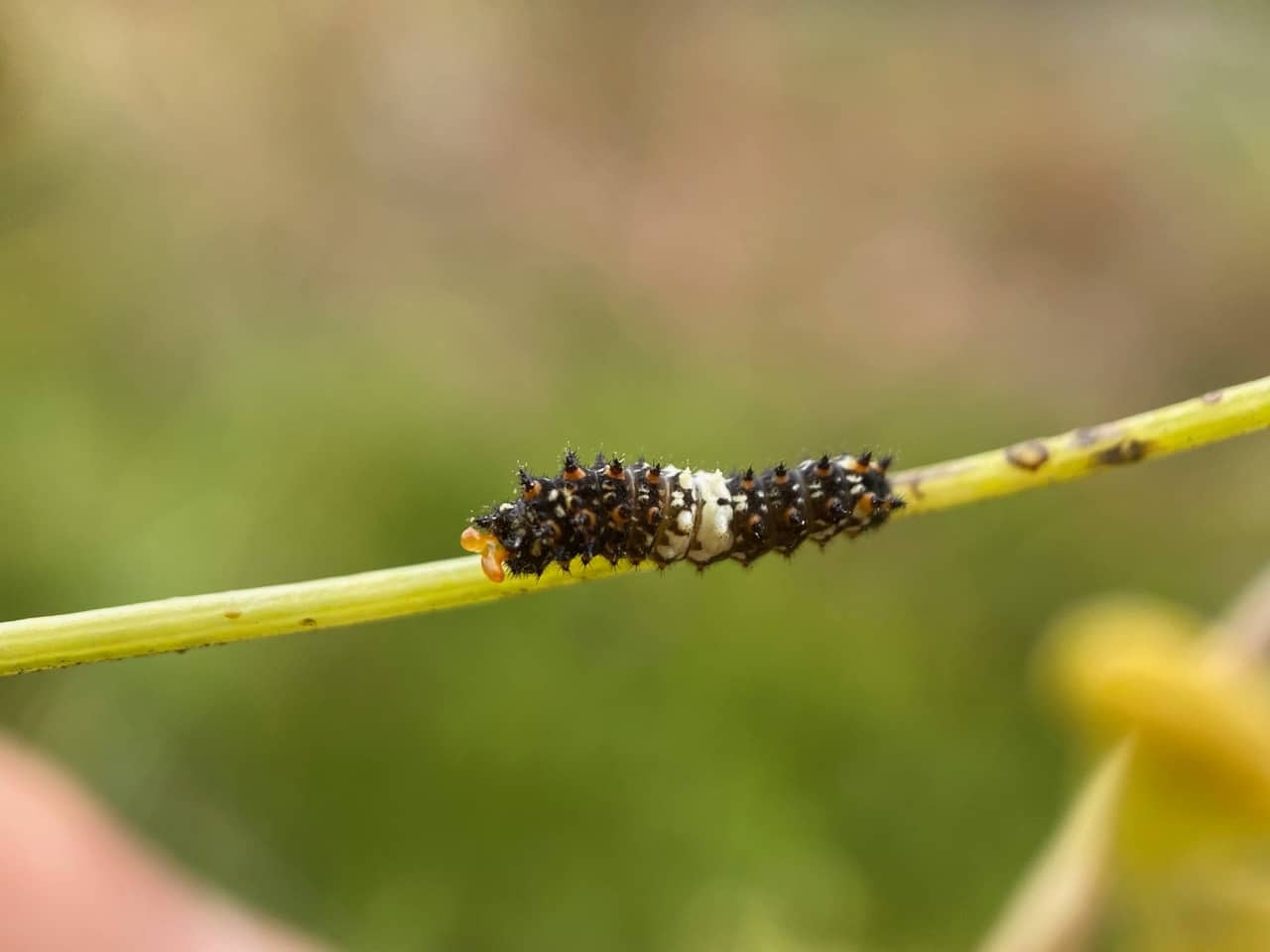
Swallowtail caterpillars are well-known for their bird-poop mimicking larvae in their early instars, complete with white middle section. The disguise likely keeps the caterpillars safe from hungry birds until they are more mobile. The Anise Swallowtail caterpillar will undergo drastic changes in appearance as it grows, eventually acquiring a green camouflage to blend in with its host plant.
The osmeterium is a defensive organ found in Swallowtail butterfly caterpillars (family Papilionidae). It is a fleshy, forked structure that can be everted from the caterpillar right behind its head when it feels threatened. When extended, the osmeterium releases a foul-smelling secretion, often containing terpenes (essential oils) extracted from the caterpillar’s host plants.
Here’s an even younger caterpillar on the Fennel foliage. It too extrudes its osmeterium when I grasp the stalk to steady the foliage against the wind.
Gee, all the caterpillars are sensitive and alert today, extruding their osmeteria at the slightest touch of their perches.
Uh oh, what happened here? A Fennel stalk is broken and leaning over the grasses. An Anise Swallowtail caterpillar is hanging motionless from a Fennel peduncle. Is it alive? It is hanging on by only its anal prolegs.
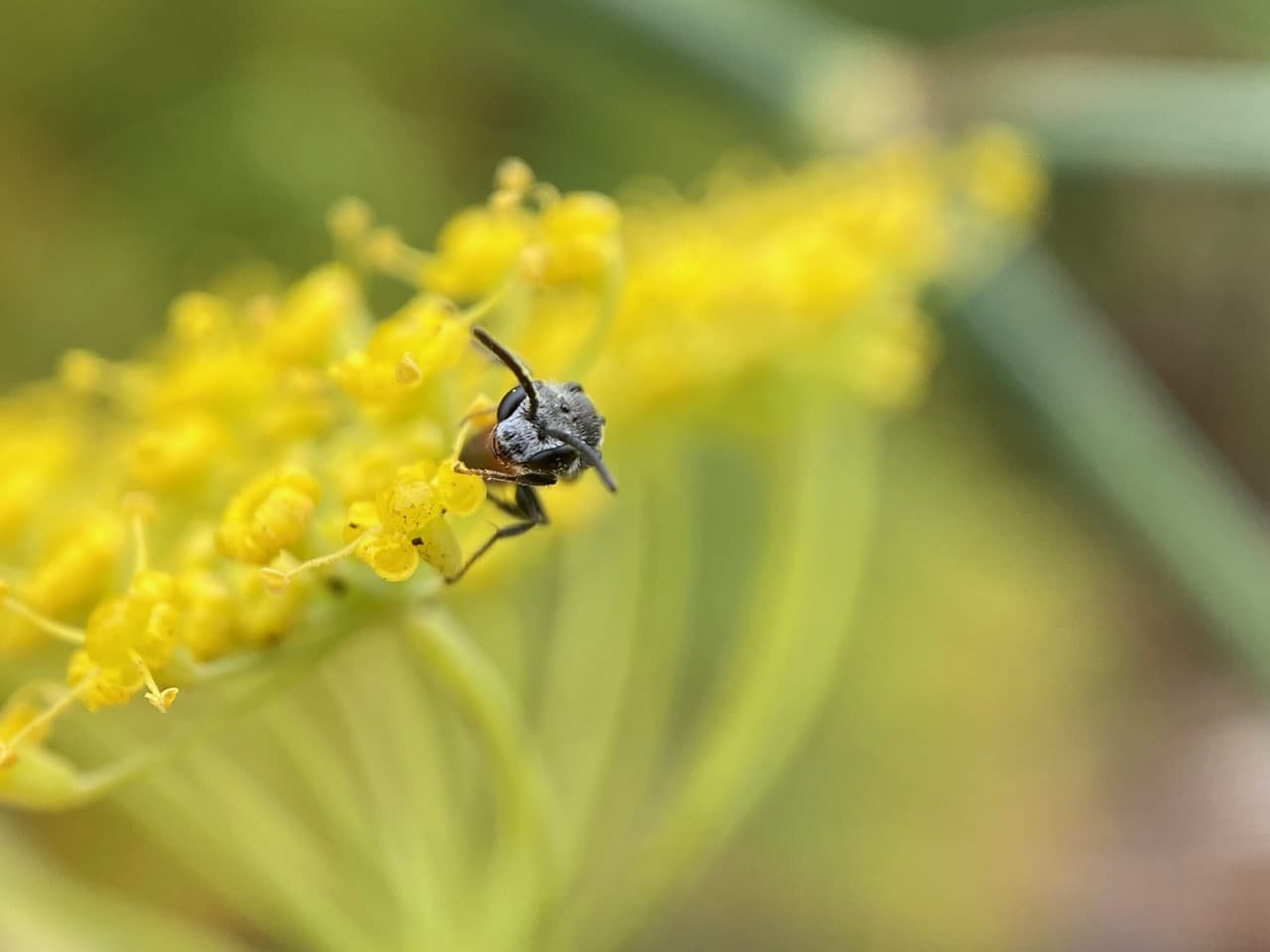
My heart misses a beat when I spot this little bee with red abdomen on the Fennel flowers. I’m sure I haven’t seen it before and that it is a new species for me.
iNaturalist has helped identify it as the Oval-headed Sweat Bee, Lasioglossum ovaliceps (family Halictidae).
Lasioglossum species are found worldwide, and they constitute the largest bee genus. The subgenus Dialictus are the most likely to be seen in the U.S., with over 300 species of these tiny metallic bees. The majority of Lasioglossum are generalists. Because they are so abundant throughout the flowering season, the bees are often important pollinators. Their sheer numbers are enough to achieve excellent pollination of many wild flowers, especially of plants in the Asteraceae, which have shallow floral tubes that are easily accessed by these minute bees.
Lasioglossum are closely related to the genera Halictus and Agapostemon. These genera are commonly called “sweat bees” because of their attraction to human sweat, which they drink for its salt content. Lasioglossum are dusky black to brown slender bees with bands of hair on their abdomen. Female Sweat Bees (family Halictidae) carry pollen in the scopae on their entire hind legs and underside of their abdomen.
Lasioglossum exhibit a range of social behaviors; the genus includes solitary, communal, semi social, primitively eusocial, and even parasitic species. Almost all Lasioglossum in the U.S. nest in the ground. Generally these nests are built in the spring by fertilized females (called foundresses) that spent the winter in hibernation. In social species, the foundresses behave much like the queen bumble bees – they lay the first batch of eggs that develop into the first generation of female workers. The nest grows with each additional generation of bees. Later broods may consist of both males and females. They mate, and at the end of the season the fertilized females hibernate til the following spring, repeating the life cycle of the colony.
Apparently not much is known about this Sweat Bee, Lasioglossum ovaliceps (family Halictidae). The only thing I found is that it lives in western North America. I’ll be sure to recognize it when I see it again, as there aren’t many bees with red abdomen.
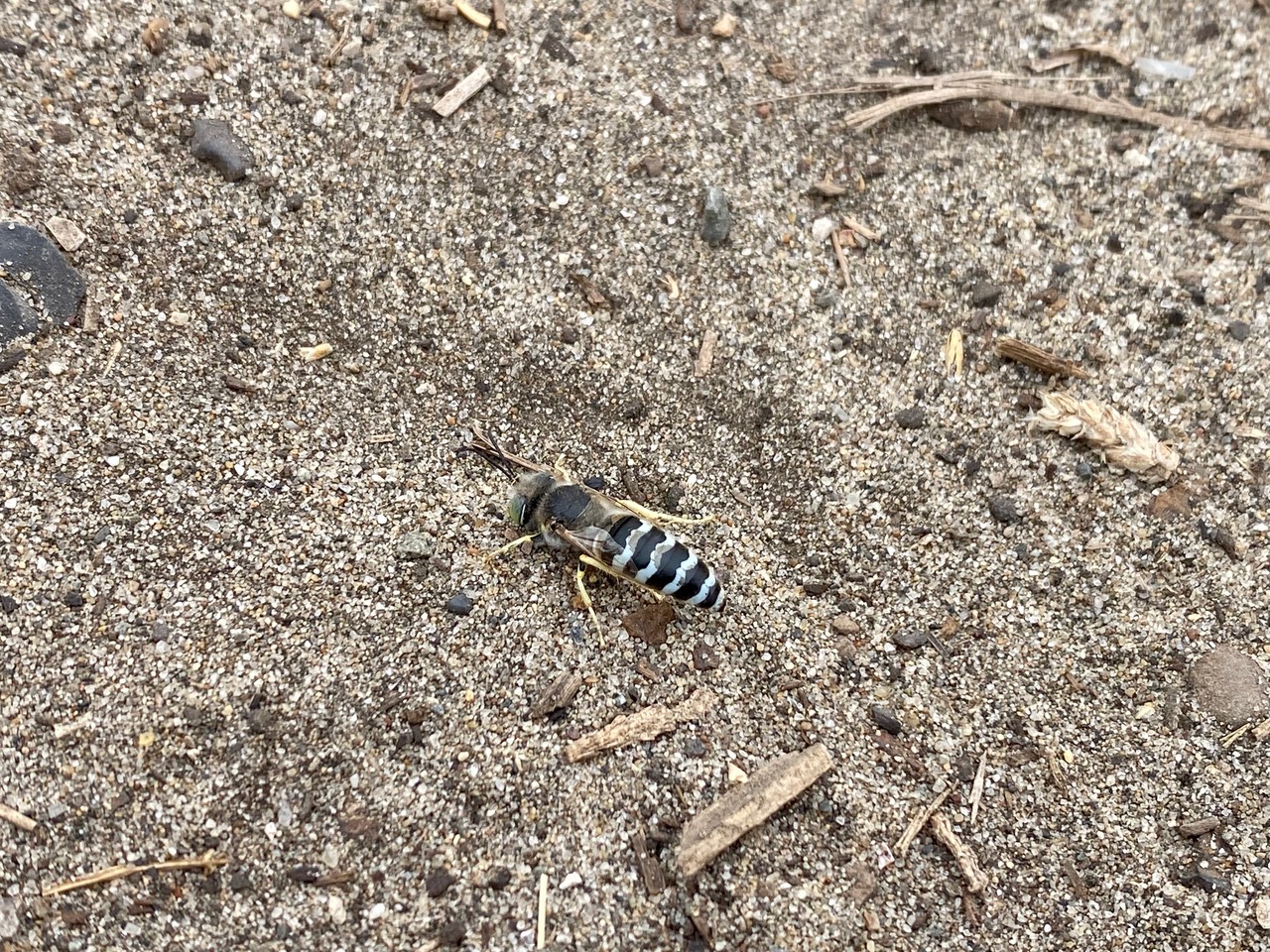
it is so overcast and cool this morning, even the American Sand Wasps, Bembix americana (family Crabronidae) are not very active. This one is slowly grooming itself on the sandy trail.
Sand wasps in the genus Bembix are familiar and common throughout North America, digging their burrows in dunes, on beaches, and other habitats with loose, deep sand. The female rapidly kicks out large quantities of sand using a “tarsal rake” of spines on each front leg. The burrow is excavated before the wasp goes hunting. Bembix are generalist, opportunistic hunters. True flies in the order Diptera are the usual prey. A victim is paralyzed or killed by the wasp’s sting, and is then flown back to the nest. Most species will lay an egg on the first victim, while some species lay an egg in the empty cell before starting to hunt. Once the egg hatches, mama wasp brings flies to her larva as needed. This “progressive provisioning” is rare in the insect world. When the larva reaches maturity, mama wasp closes the cell. Inside, the larva spins an oblong cocoon, weaving sand grains into the structure and resulting in a hardened capsule. Overwintering takes place as a prepupa inside this cocoon, but there are usually two generations a year.
Male sand wasps often engage in an elaborate flight ritual called “sun dances”. Males emerge before females, and fly erratically at dizzying speed one or two inches above the ground attempting to detect virgin females about to emerge from their underground nests. Both sexes are often seen taking nectar at flowers, especially from Asteraceae family. Bembix wasps are often victims of other insects such as cuckoo wasps (Chrysididae), velvet ants (Mutillidae), satellite flies (Sarcophagidae), bee flies (Bombyliidae), and thick-headed flies (Conopidae).
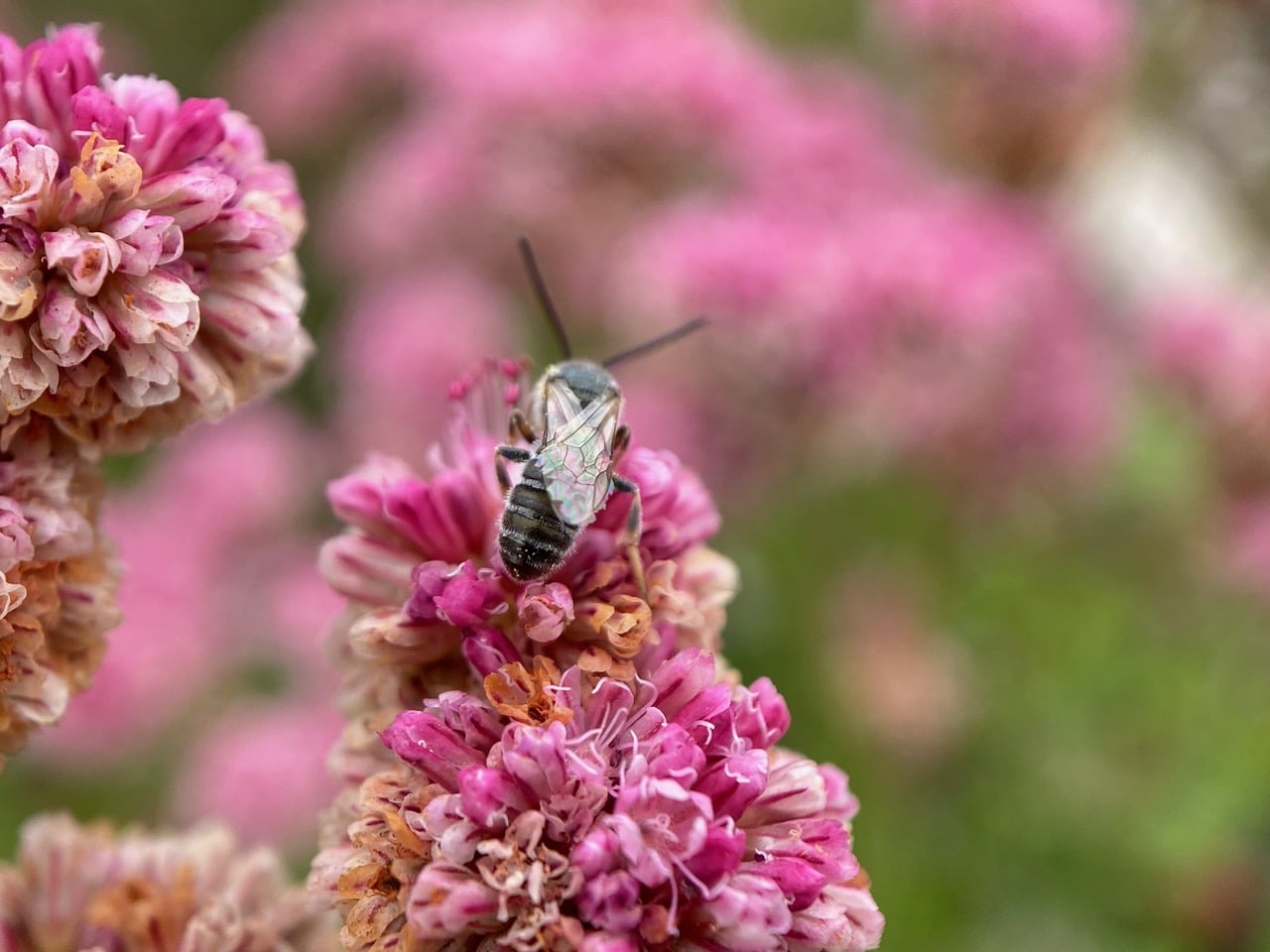
A male Tripartite Sweat Bee, Halictus tripartitus (family Halictidae) lands on a cluster of flowers of Red-flowered Buckwheat, Eriogonum grande ssp. rubescens. Note his long antennae, slender build, and the absence of scopa on his hind legs.
The Sweat Bee family Halictidae comprises two main genera, Halictus and Lasioglossum, which can be tricky to separate. Females of both genera have a groove, or furrow at the tip of the abdomen, called a rima. The two genera differ in the position of the hair bands on the abdomen. In Halictus these are on the hind margin of the each tergite (body segment), but in Lasioglossum they are at the front of each tergite, often partly covered by the hind edge of the preceding tergite.
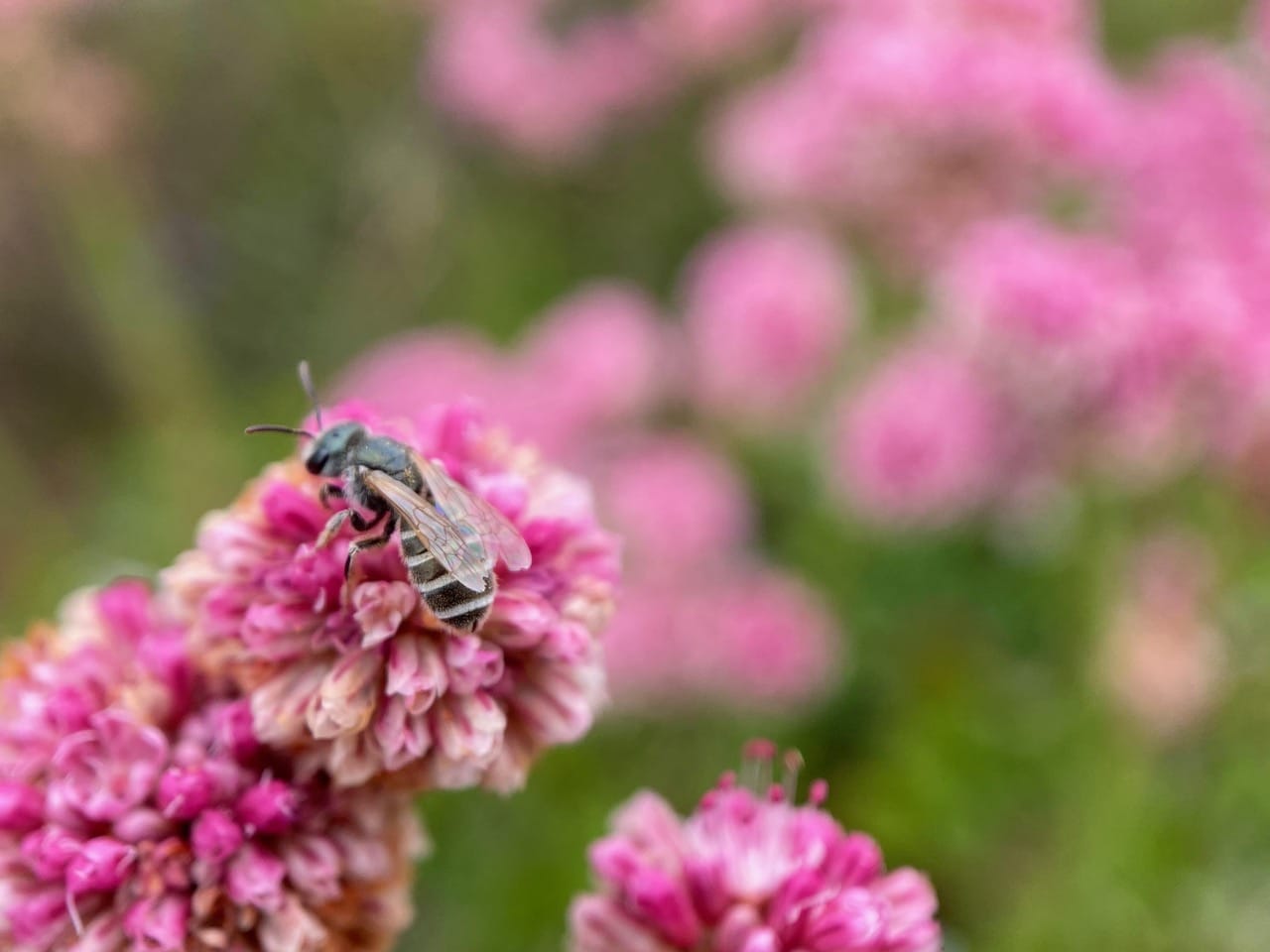
Here’s a female Tripartite Sweat Bee, Halictus tripartitus (family Halictidae). Note the groove or “rima” near the tip of her abdomen. The function of the rima is not clear, but since it only occurs in females, it is thought to be involved in egg laying.
A female Tripartite Sweat Bee, Halictus tripartitus (family Halictidae) is foraging on Fennel flowers. She is carrying some pollen on the scopa of her hind legs.