

Pollinator Post 7/23/23 (3)
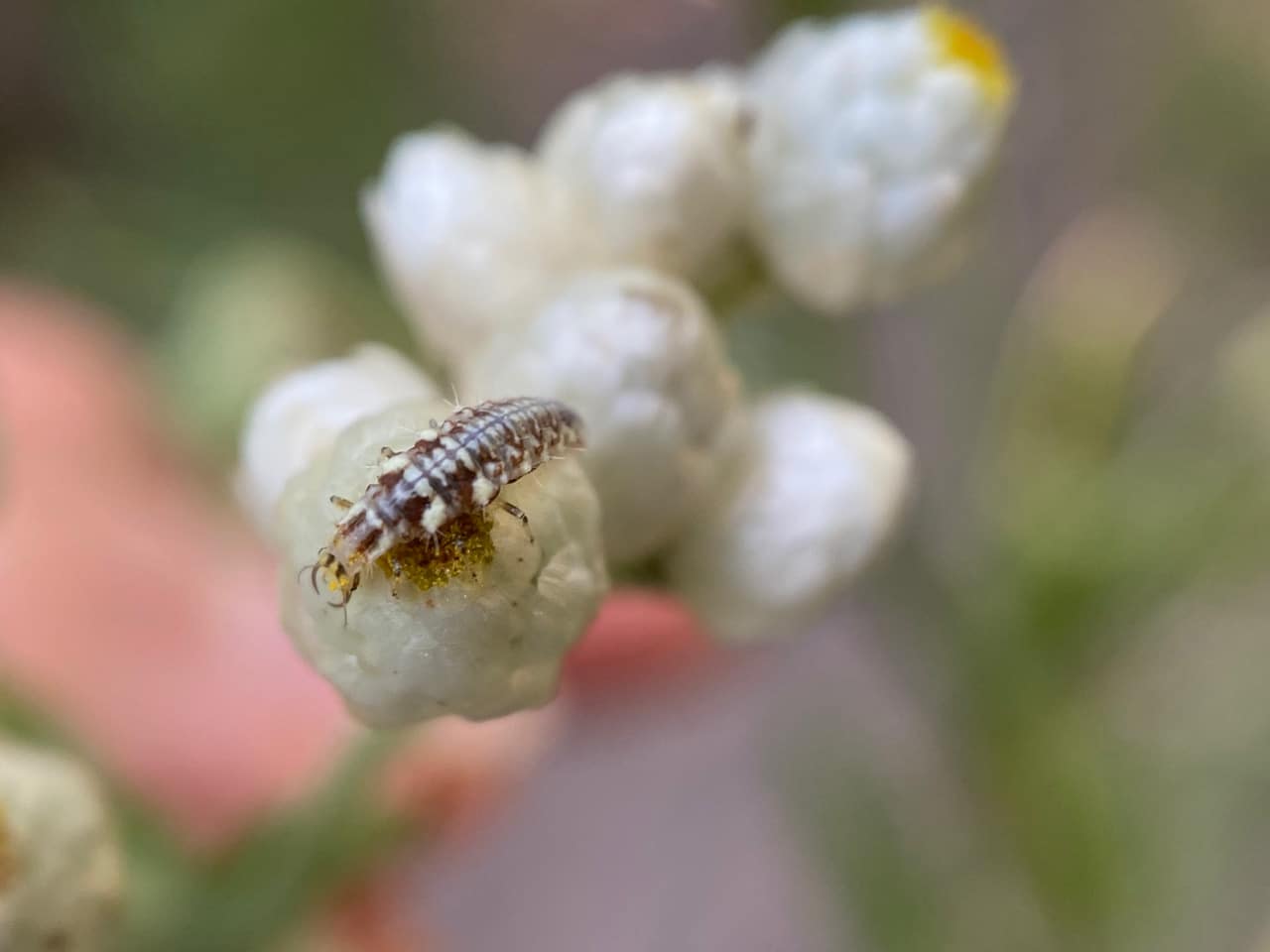
A Green Lacewing larva is roaming the flowerheads of California Everlasting. Note its sickle-shaped mandibles.
Lacewings are insects in the large family Chrysopidae of the order Neuroptera. Adults are crepuscular or nocturnal. They feed on pollen, nectar and honeydew supplemented with mites, aphids and other small arthropods. Eggs are deposited at night, hung on a slender stalk of silk usually on the underside of a leaf. Immediately after hatching, the larvae molt, then descend the egg stalk to feed. They are voracious predators, attacking most insects of suitable size, especially soft-bodied ones (aphids, caterpillars and other insect larvae, insect eggs). Their maxillae are hollow, allowing a digestive secretion to be injected in the prey. Lacewing larvae are commonly known as “aphid lions” or “aphid wolves”. In some countries, Lacewings are reared for sale as biological control agents of insect and mite pests in agriculture and gardens.
Lacewings – YouTube
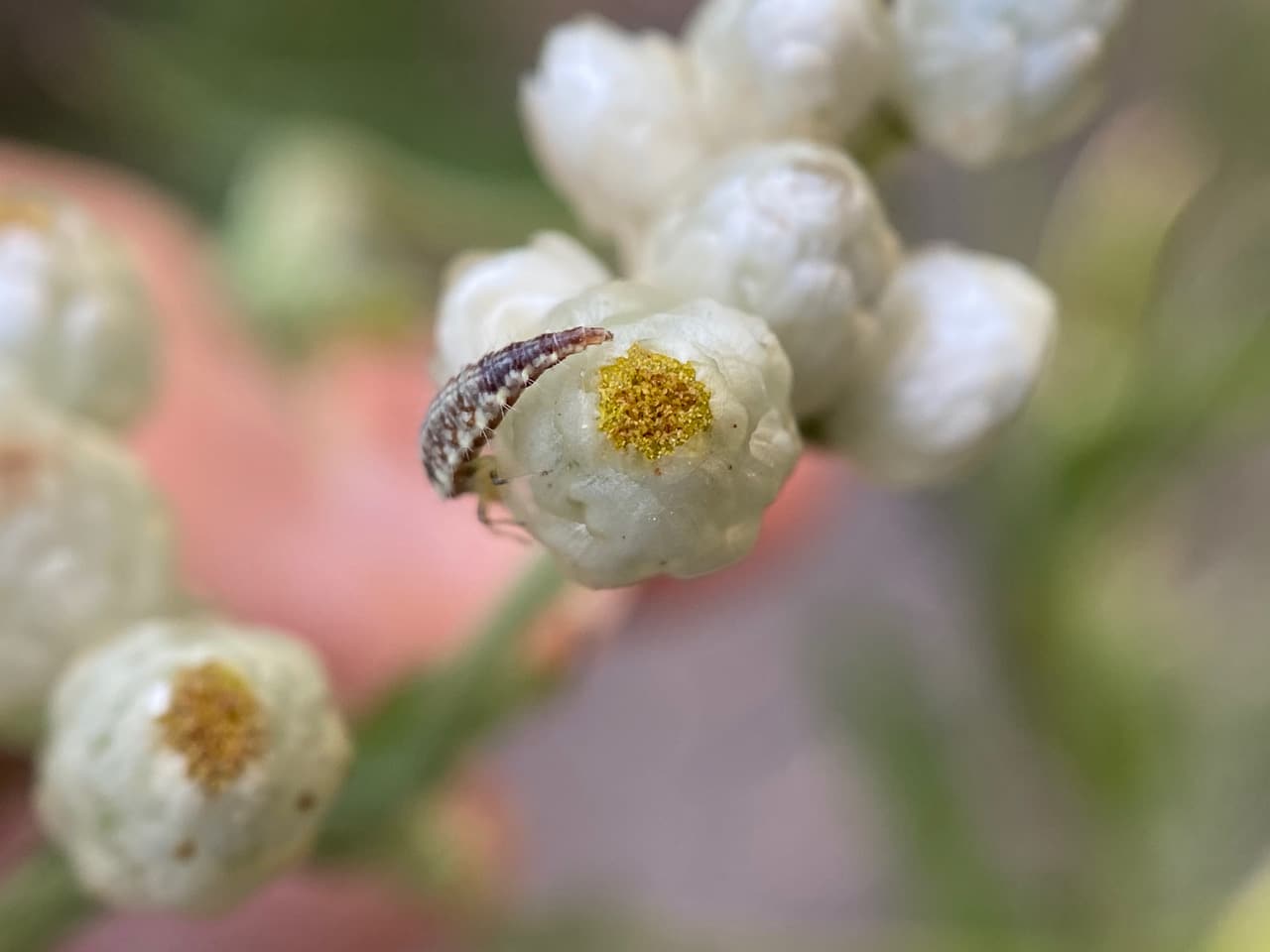


Hind end of the Lacewing larva.
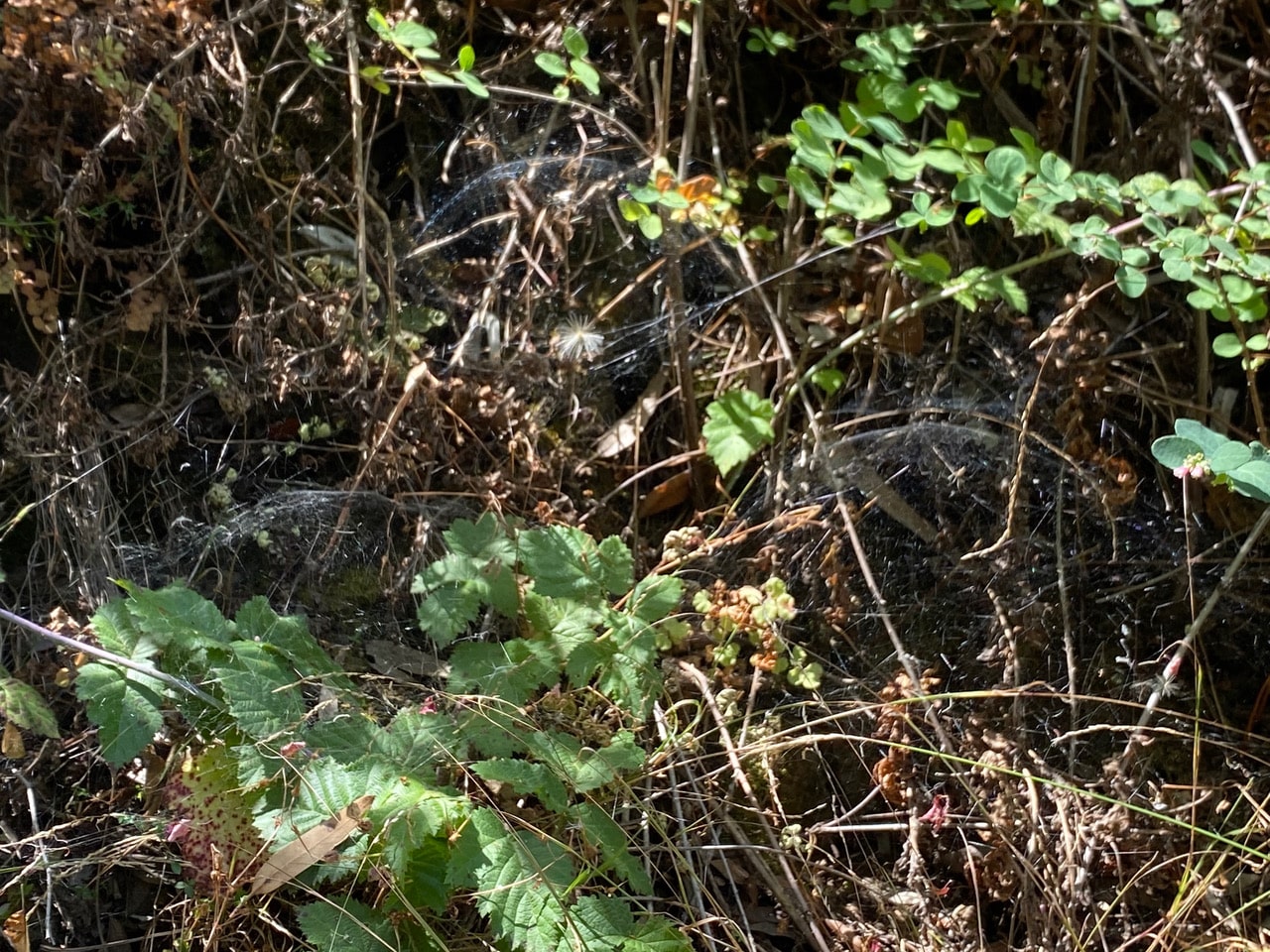
The webs of three Filmy Dome Spiders, Neriene sp. (family Linyphiidae) glisten in the sunlight next to each other on the steep bank of Skyline Trail.
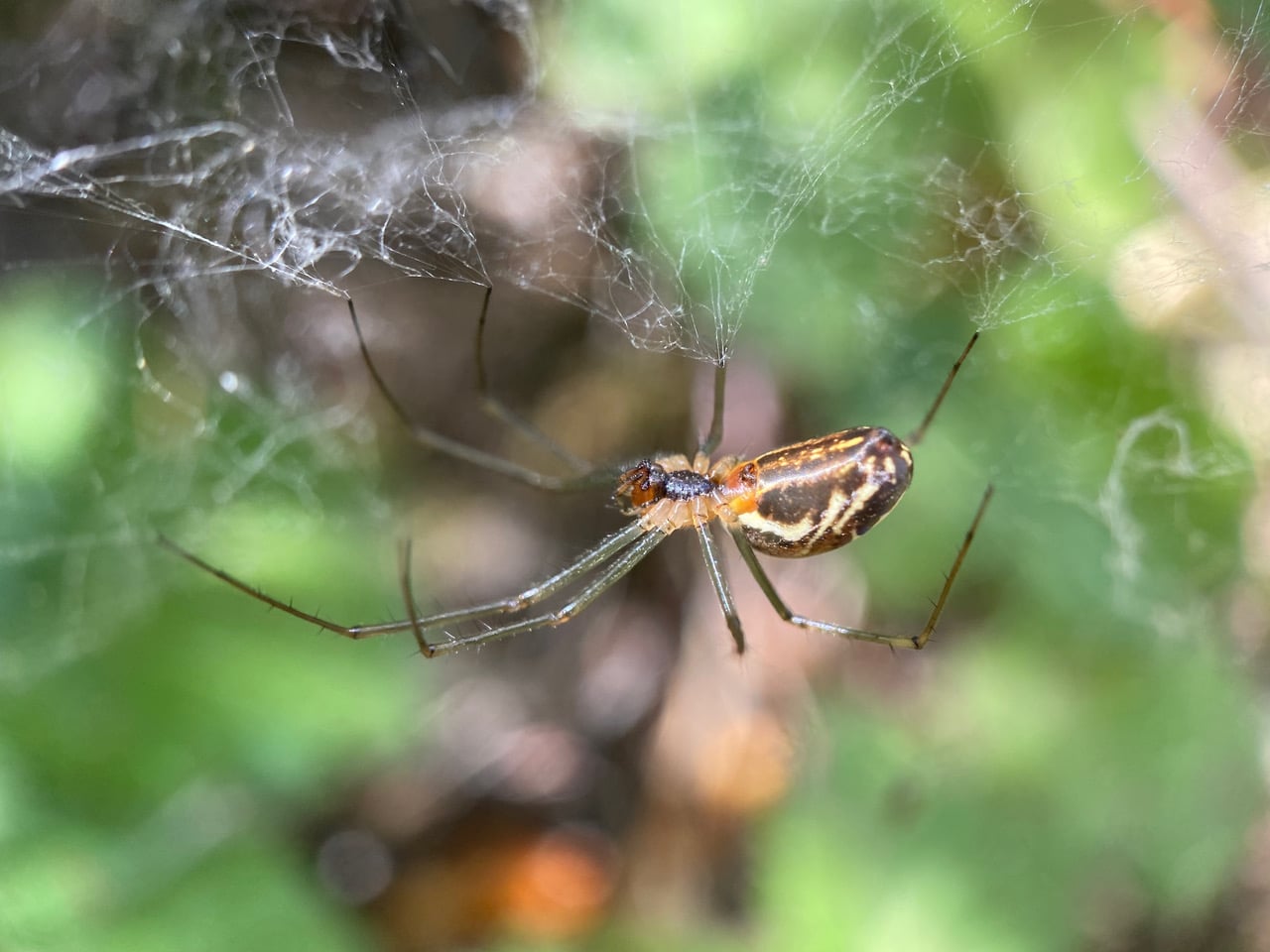
The Filmy Dome Spider, Neriene sp. is a sheet weaver, a spider in the family Linyphiidae. These spiders construct a dome of fine spider silk and hang upside-down under it, waiting for their prey. The spider weaves a single sheet of webbing with loose tangles of silk above the dome-shaped sheet. Insects hit the loose threads and fall into the domed sheet below for the spider to capture.
A Filmy Dome Spider, Neriene sp. (family Linyphiidae) hangs upside-down under its domed web waiting for prey to fall onto the silken trap.
A bumble bee stops for nourishment at a flower of Farewell-to-spring, Clarkia rubicunda. The bee looks somewhat unusual for a bumble bee, with a somewhat elongated body, and sparse hairs on its shiny abdomen. Two of its abdominal segments are covered with yellow hair – is it a California Bumble Bee? Without a good look at its head, I can’t be sure.
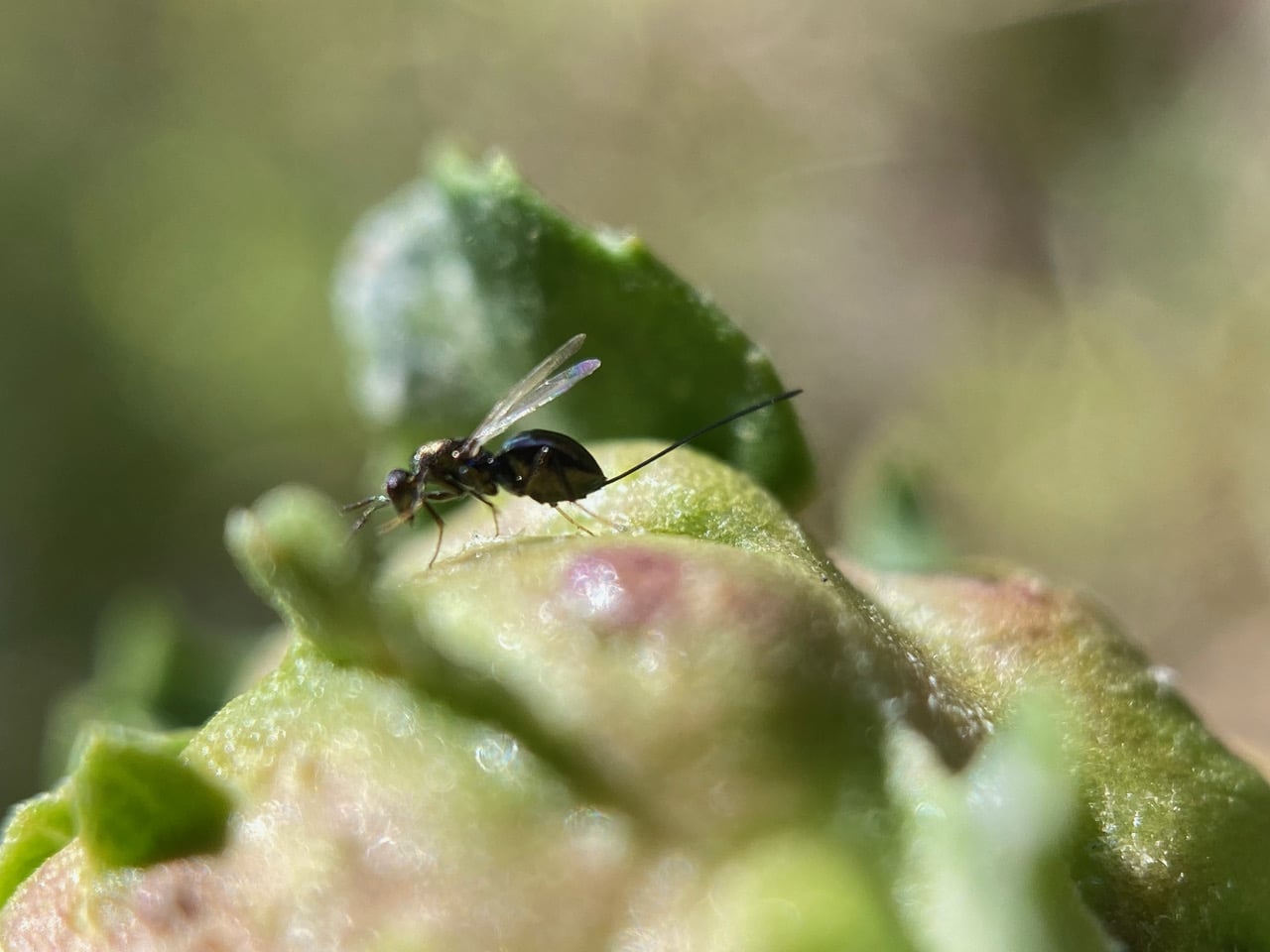
Approaching Siesta Gate in a hurry to get home, I glance at the big bud galls on a young Coyote Brush by the trail. A glint of tiny wings on a leaf catches my attention. It is not the gall fly that makes the galls (family Cecidomyiidae), but a parasitoid wasp (superfamily Chalcidoidea)!
The tiny fly eludes my camera several times, but always returns to investigate the bud gall. Through my macro lens, I see that it is a female with a ovipositor as long as its body! Is it here to lay eggs in the gall?
An expert on parasitic wasps, Robert Zuparko formerly from the Cal. Acad. of Sciences has kindly helped identify our little wasp thus:
“This is a member of the family Torymidae. I can’t be 100% positive, but it is most likely in the genus Torymus, which encompasses over 400 species, worldwide.”
From Wikipedia:
“Torymidae is a family of wasps in the superfamily Chalcidoidea. Most species in this family are small with attractive metallic coloration, and females generally have long ovipositors. Many are parasitoids on gall-forming insects, and some are phytophagous (plant-eating) species, sometimes using the galls formed by other insects. Over 960 species in about 70 genera are found worldwide. They are best recognized in that they are one of the few groups of chalcidoidea in which the cerci are visible.”
From WaspWeb:
“Torymidae are ectoparasitoids or phytophagous inquilines of gall-forming insects usually Cynipidae and Cecidomyiidae. Or primary parasitoids or hyperparasitoids of various Diptera, Hymenoptera, Lepidoptera, Coleoptera, or Coccoidea.”
Robert provided further insights into the complexity of the plant gall food web:
“There is a whole community of insects associated with galls. First are the gall makers (most of these are in the family Cynipidae). Then there are the primary parasitoids – these attack the gall makers (besides Torymidae, there are the species from the Chalcidoidea families Eulophidae, Pteromalidae, Eurytomidae, Eupelmidae, and Ormyridae). Then there are the secondary parasitoids – these attack the primaries. Then there are the inquilines – these don’t attack the others, they just like living in the galls (which provide them with a more secure space). But then you may find some parasitoids that attack the inquilines as well.”
It’s a jungle in there!