

Pollinator Post 7/23/23 (2)
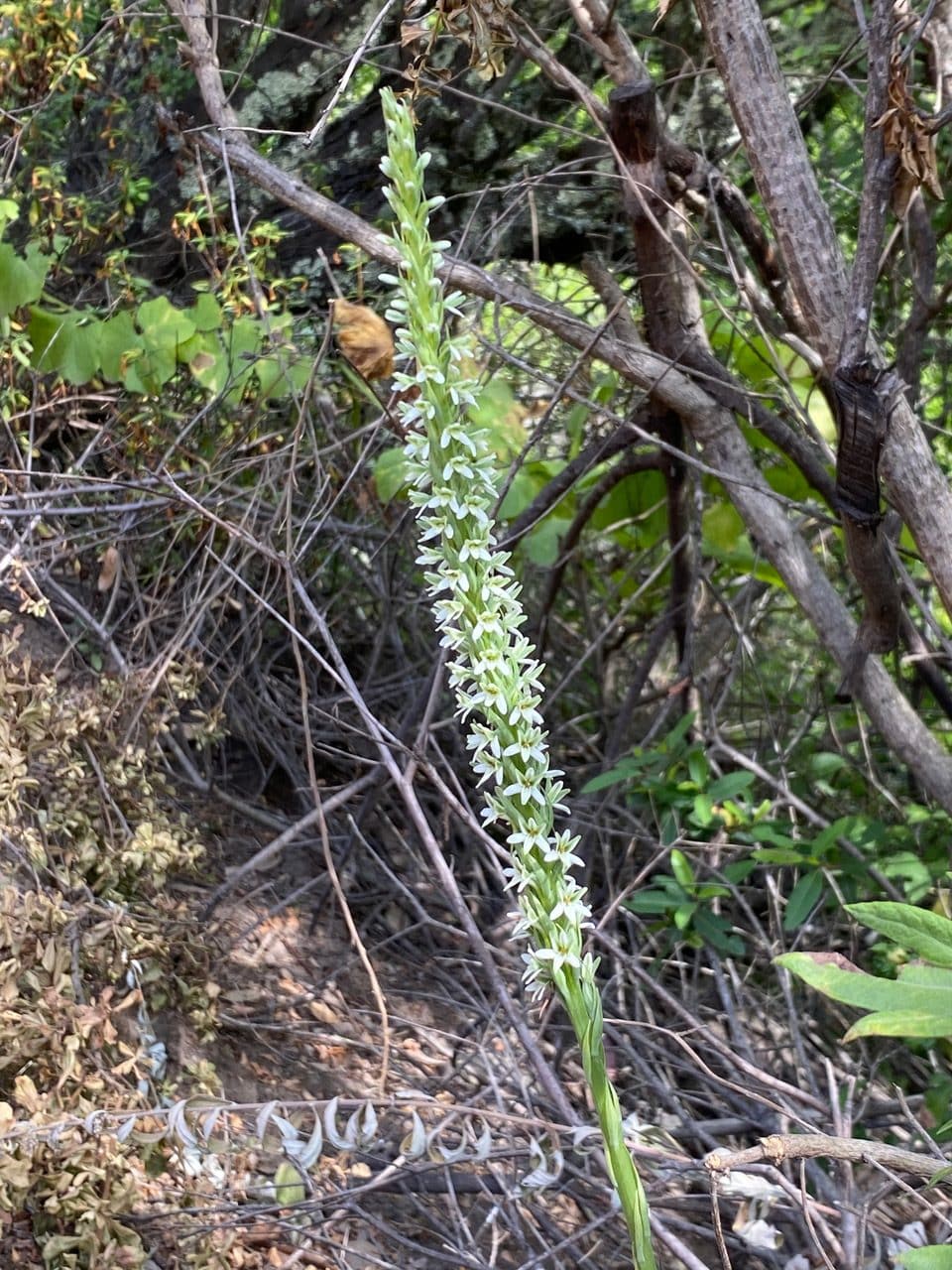
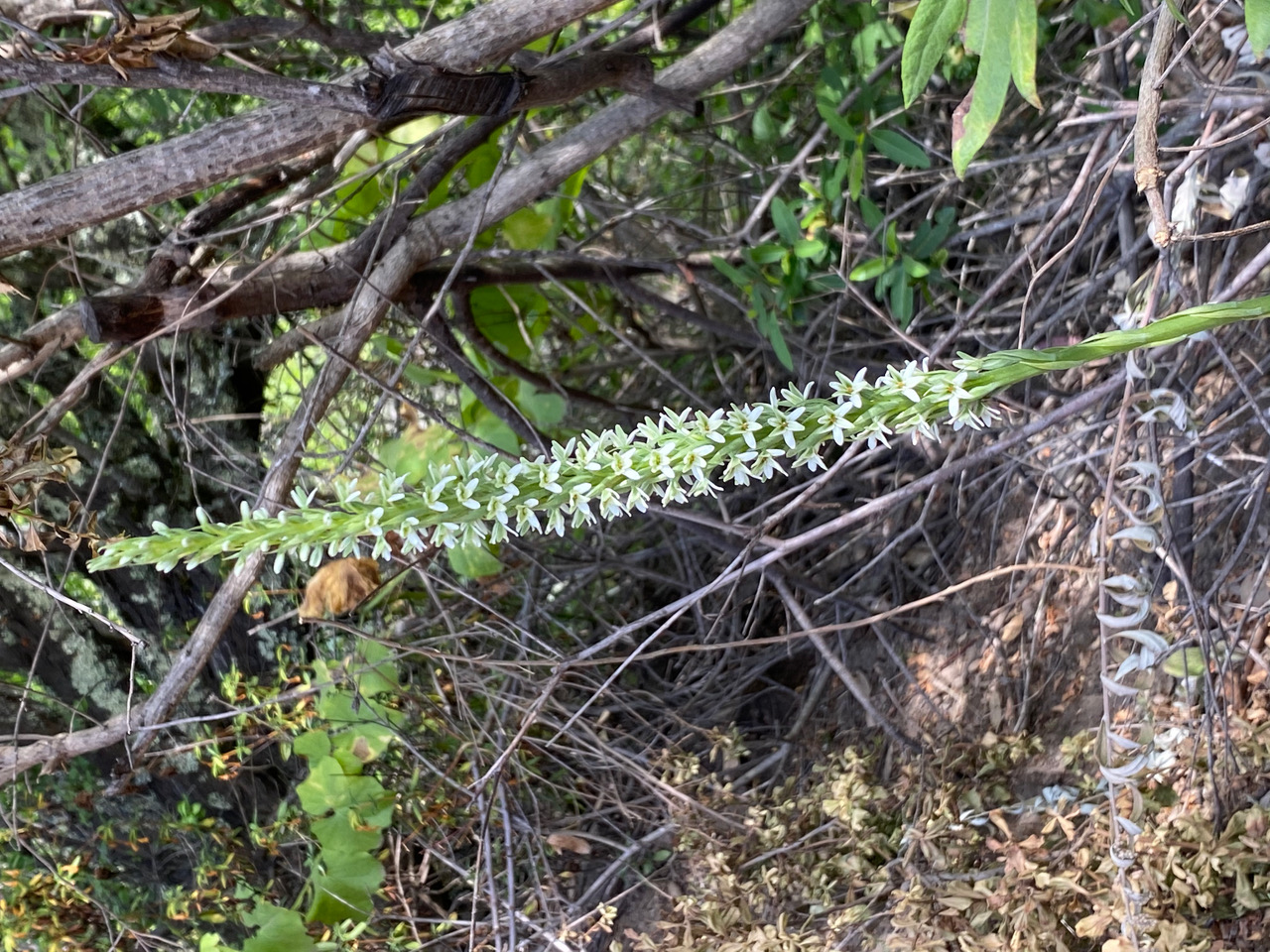
What a delight! A flower spike of Hillside Rein Orchid, Piperia elegans shows up on the brushy side of the trail. The tiny green-white flowers emit a fragrance at night to attract pollinating moths.
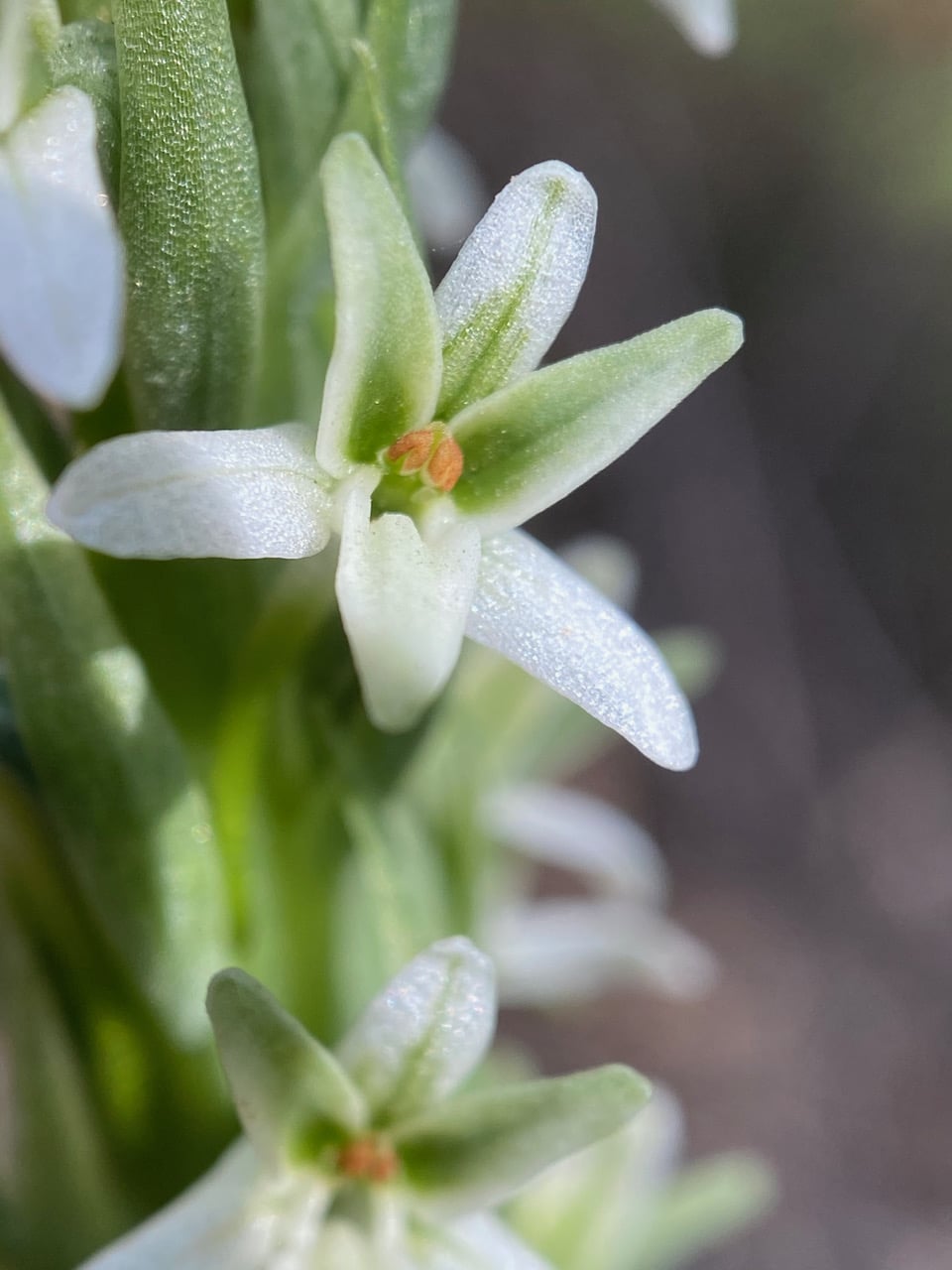
Most orchids disperse pollen in clumps, rather than as loose pollen grains (as in most flowers). The clumps of pollen grains are generally held together by sticky material and elastic threads, and often come in pairs. The clumps or sacs are called pollinia. They often come with sticky pads that help them adhere to the pollinators.
Orchids in the genus Piperia typically live in open woods. The flowering stem bears a number of small, green or white flowers that are reported to be fragrant especially at night, when they attract moths. The flowers have nectar spurs where nectar is produced and stored. A visiting moth can poke its head and proboscis a short distance into the flower for nectar, and often inadvertently pick up pollinia on the proboscis. An older flower is more open, and a visiting moth bearing pollinia can insert its head far enough to deposit pollinia on the stigma. Piperia elegans is known to be pollinated by several species of moths. Pollinia attach to the moth’s proboscis as it probes for nectar.
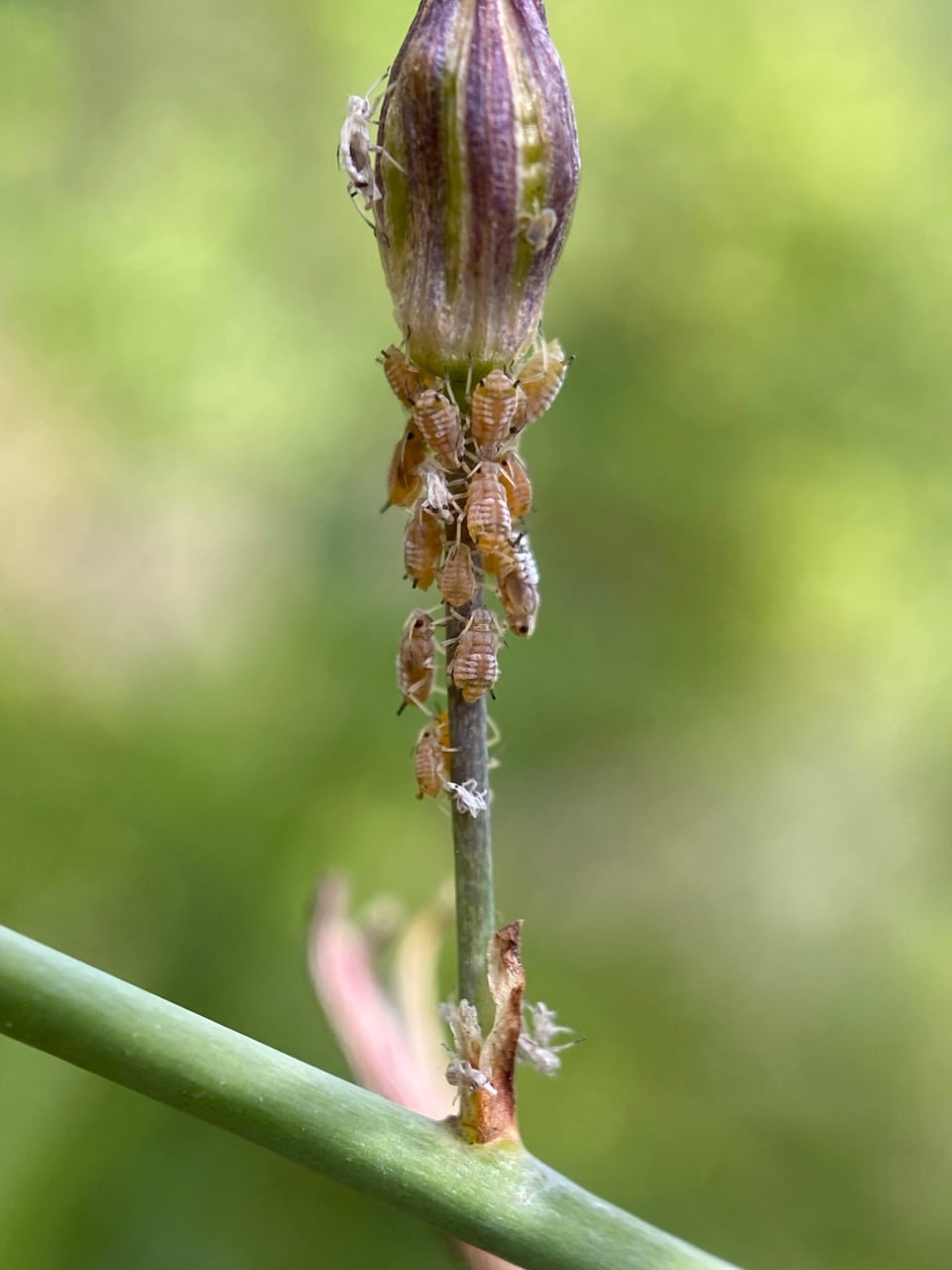
Whoa, I have never seen aphids on the Soap Plant, Chlorogalum pomeridianum!
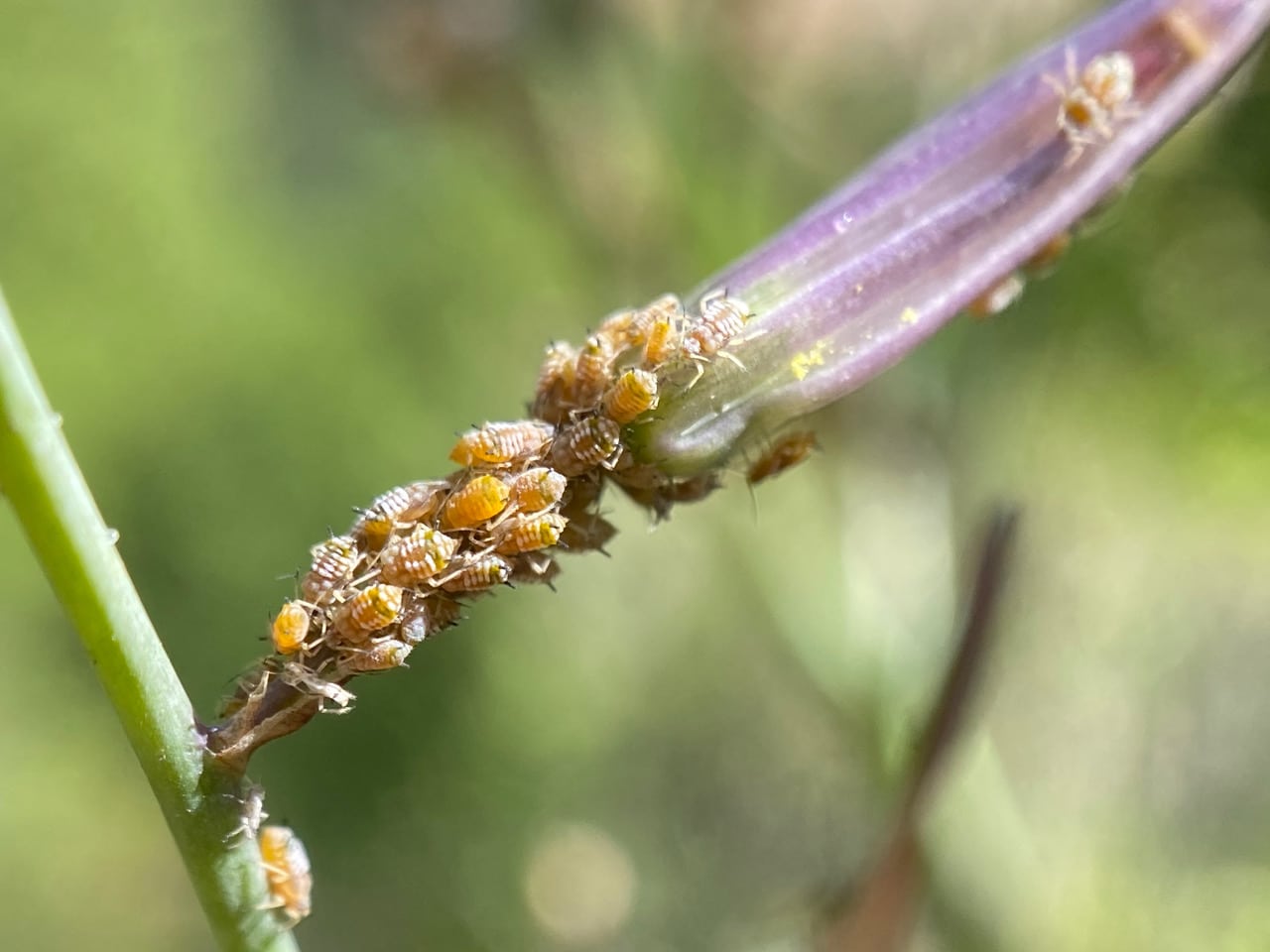
These tiny aphids look like they have raised “ribs” across their abdomen covered with wax.
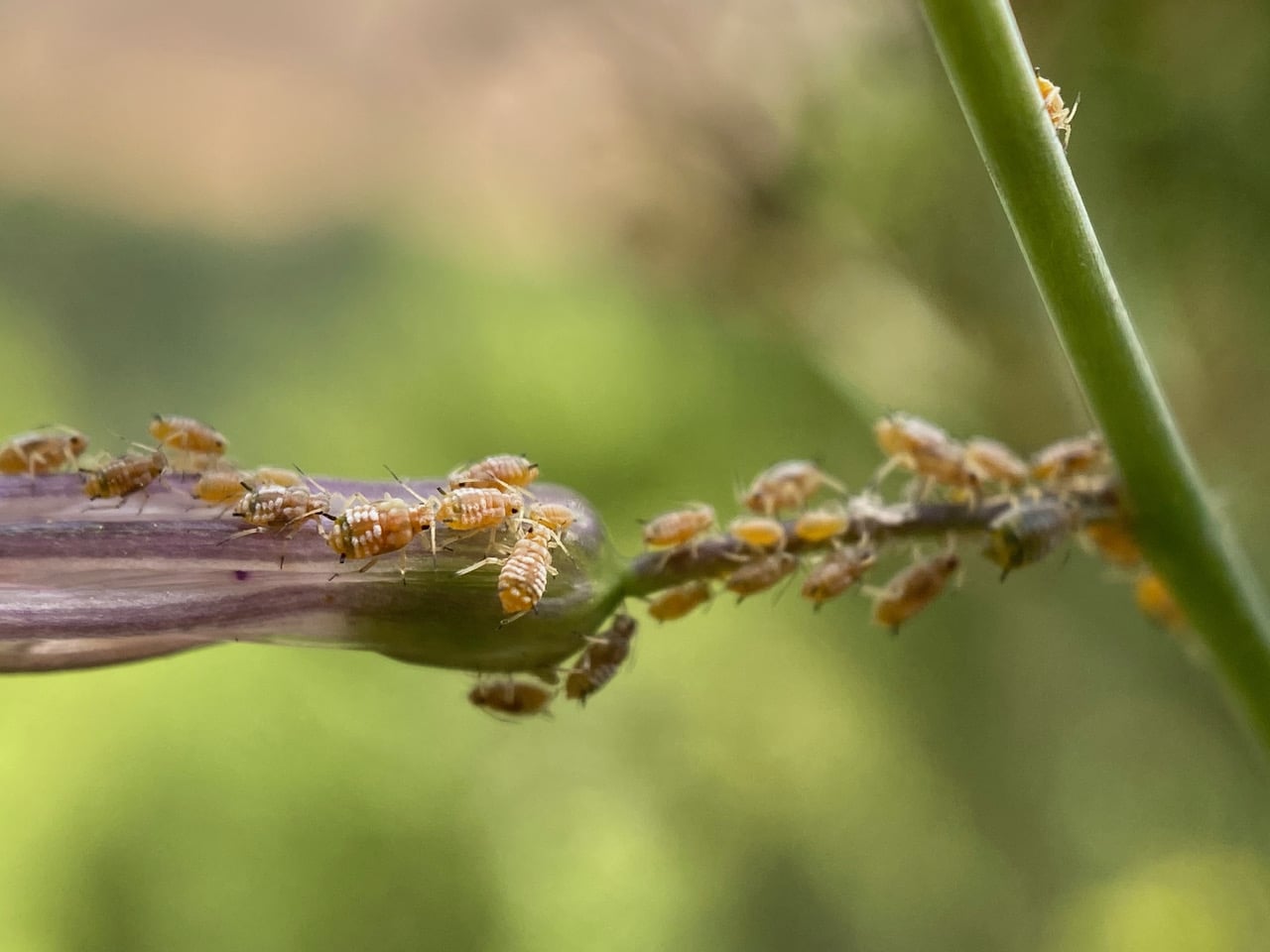
The aphids are found mostly on the flower buds or pedicels.
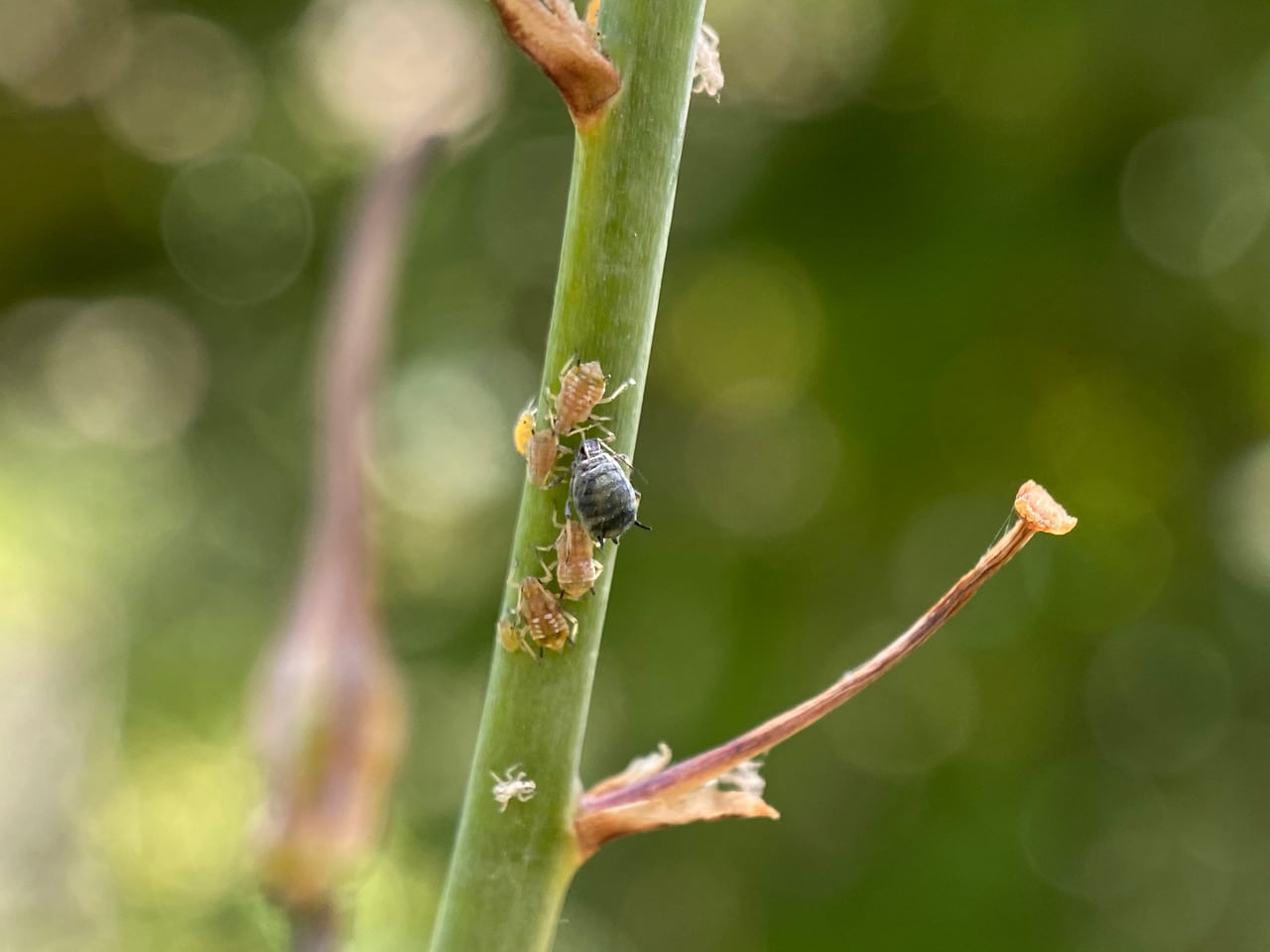
Oh, here’s an adult, in dark green. This must be a fairly young colony, with very few adults.
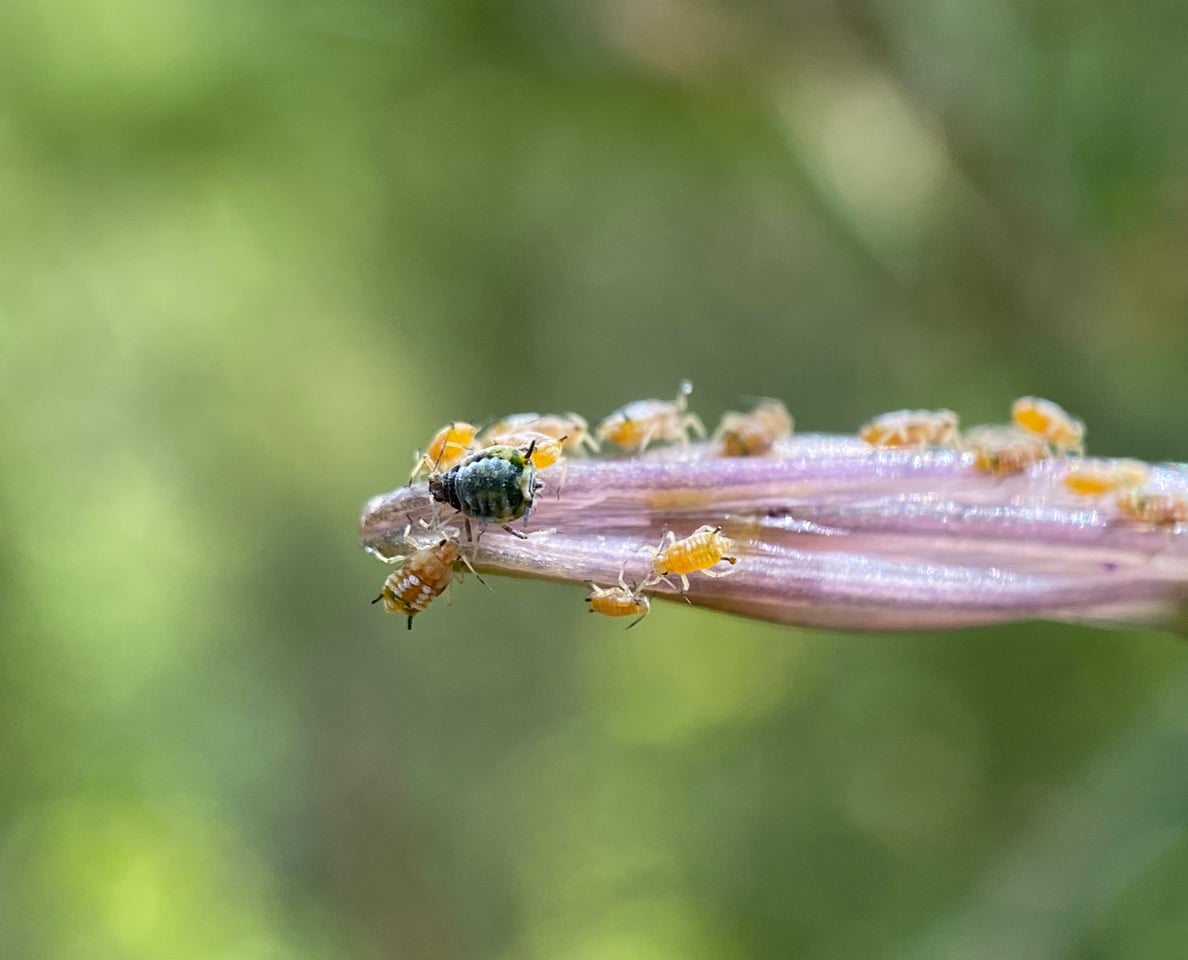
Here’s another adult, on the tip of a flower bud.

An alate – a winged adult. Alates are usually produced for dispersal purposes, for spreading from plant to plant. Are the few alates I see responsible for the establishment of the colony on this plant? The aphid species is yet to be identified.
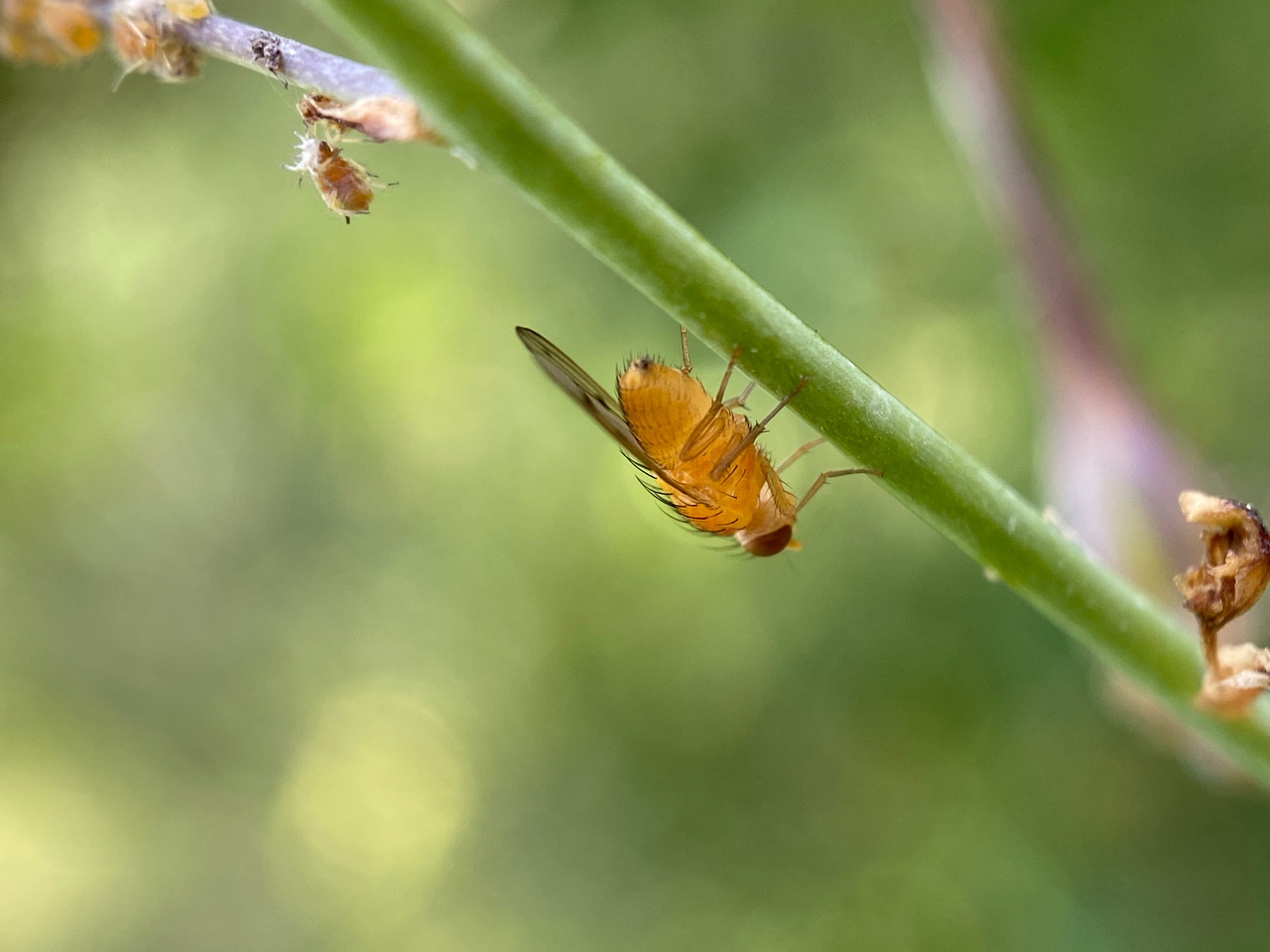
A small fly, Meiosimyza sp. (family Lauxaniidae) is perched on the stem of Soap Plant.
Lauxaniidae are small flies (2-7 mm in length). They are often rather plump and dull, the body color varying from yellow-brown to black, or with a combination of these colors. They are characterized by strong, backward pointing bristles on the front (top of the head right above the eyes). The larvae are mostly saprophages, feeding in leaf litter, soil, bird nests, etc. Larvae of some mine fallen leaves, others live in rotten wood.

The fly lands on my left hand, resulting in this picture.
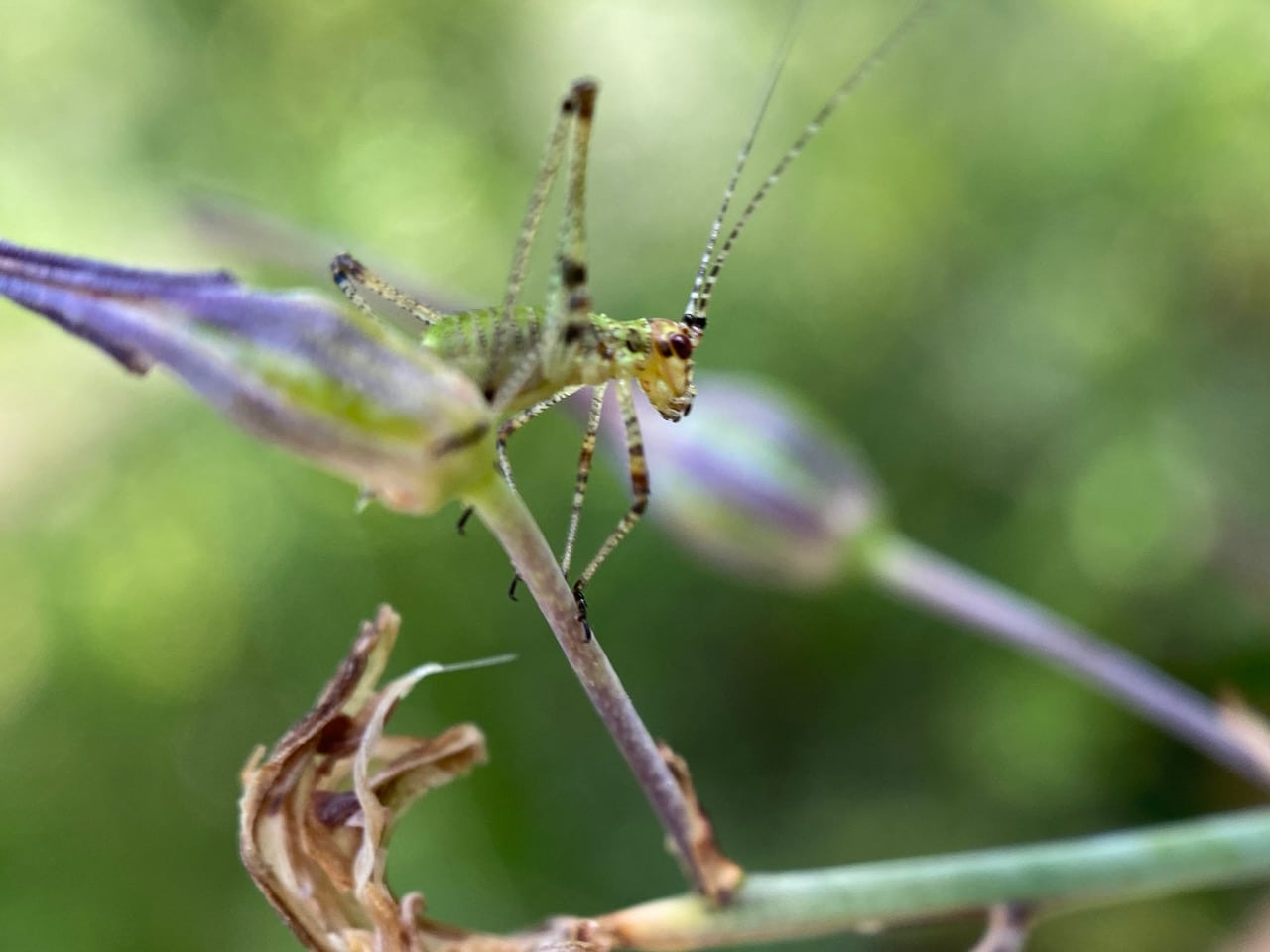
A nymph of a Scudder’s Bush Katydid, Scudderia sp. (family Tettigoniidae) is moving around among the Soap Plant flowers.
Scudderia is a genus of katydids in the family Tettigoniidae. They are sometimes called bush katydids and are 30-38 mm in length. They are mostly found in North America. They are herbivores, with nymphs feeding primarily on flowers and adults preferring woody deciduous plants.
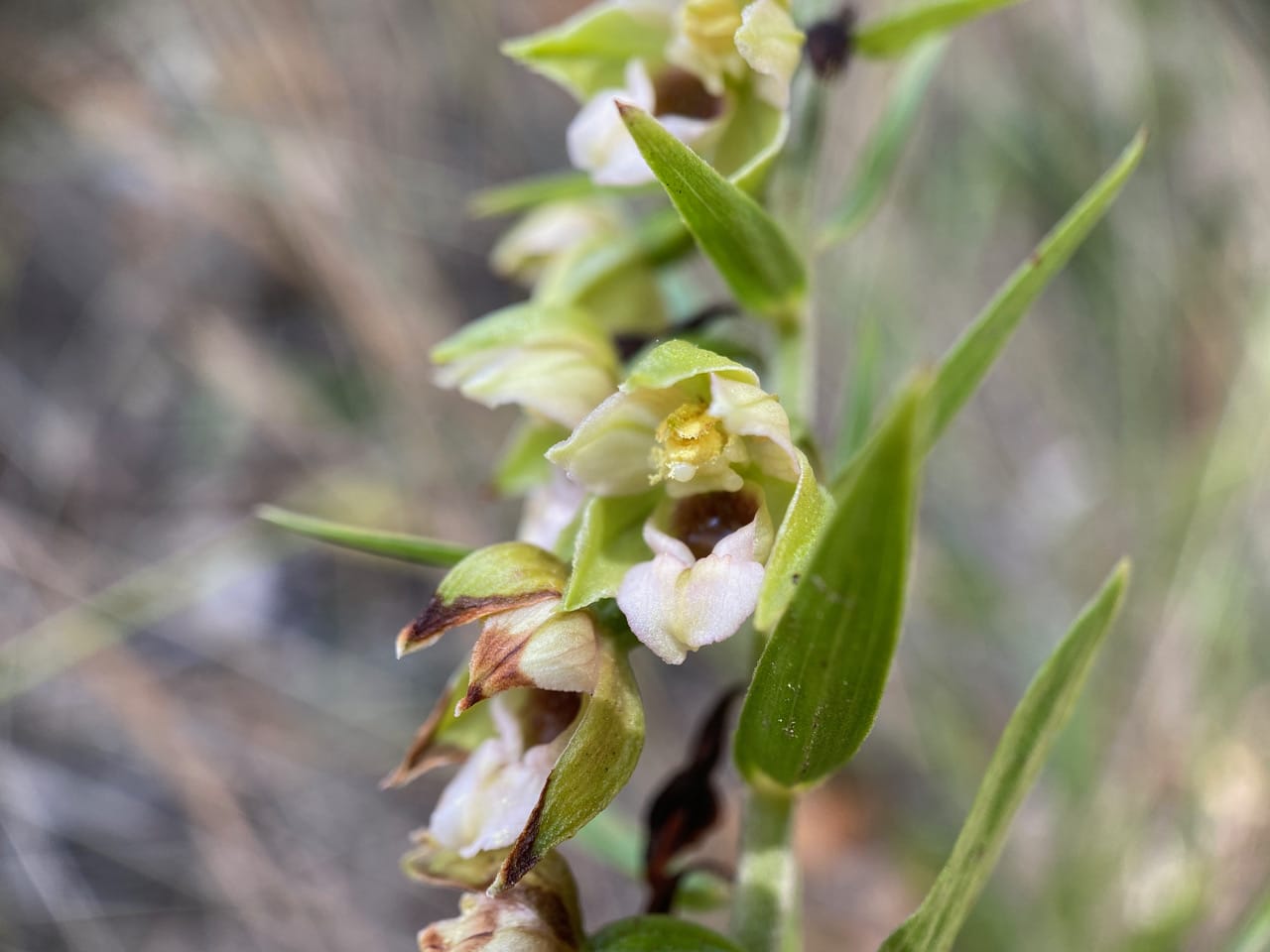
The “weedy orchid”, Broadleaf Helleborine, Epipactis helleborine has started to bloom along the shady sections of Skyline Trail. Native to Europe and Asia, the species is introduced to North America, and is now widely naturalized.
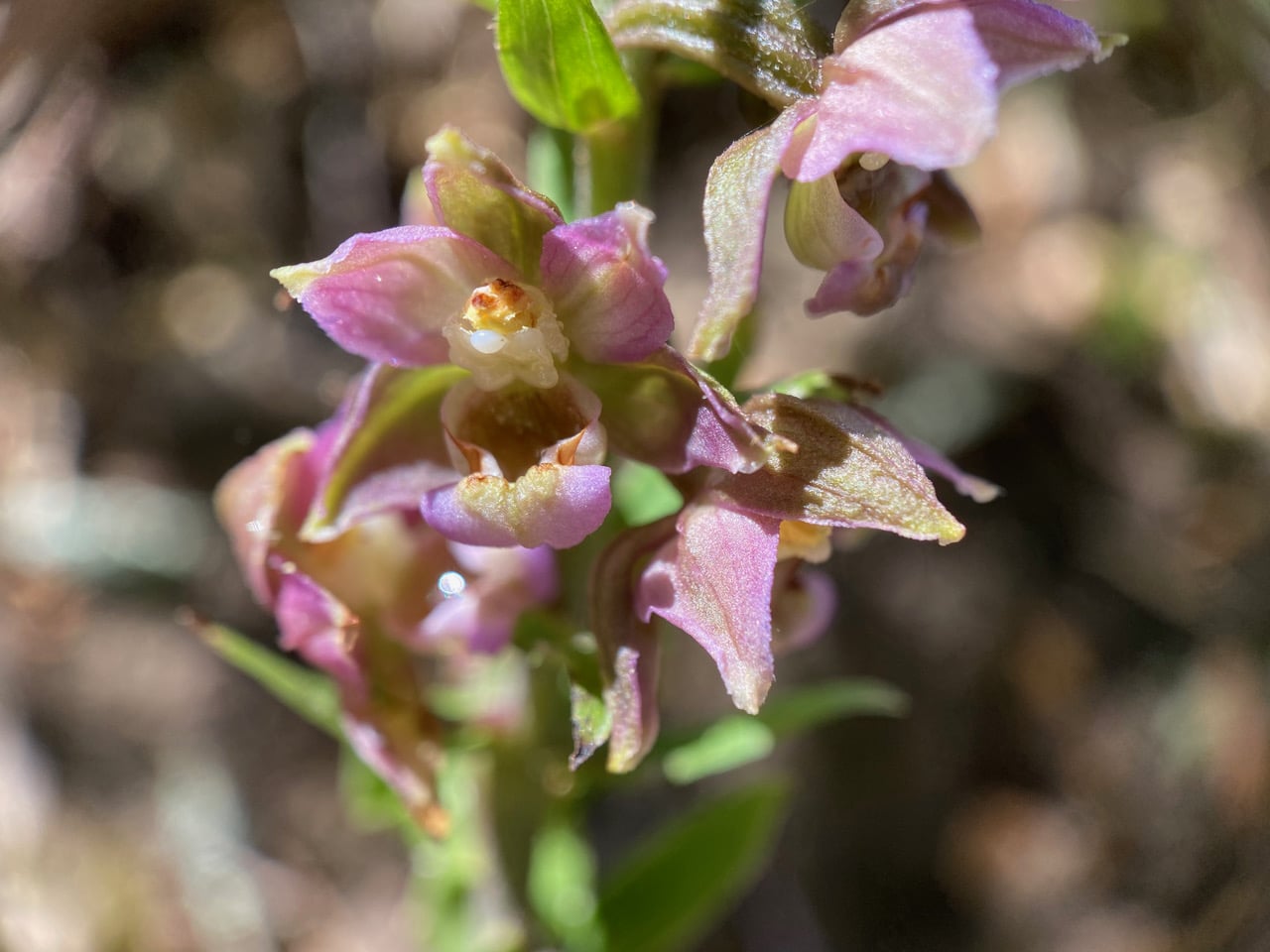
The flowers of Epipactis helleborine are small and inconspicuous – nothing to write home about. But the species has an interesting pollination biology. It uses chemical mimicry to attract its pollinators, the Yellowjackets!
Green-leaf volatiles are a group of compounds that are typically produced by plants when they are being fed on by herbivores such as caterpillars, and are used by Vespid wasps as a cue to find caterpillar prey. Some orchids, including E. helleborine have evolved a chemical-mimicry system in which their flowers release green-leaf volatiles (GLV) to attract Vespid pollinators. E. helleborine also packs a substantial reservoir of nectar in the cup-shaped lip. The nectar is laced with alcohol, and Oxycodone-like narcotics. After a few sips of this concoction, the Yellowjackets get tipsy and sluggish, and fail to remove the orchid pollinia that might have attach to their heads. They also spend more time at each flower, increasing the likelihood of successful pollination.
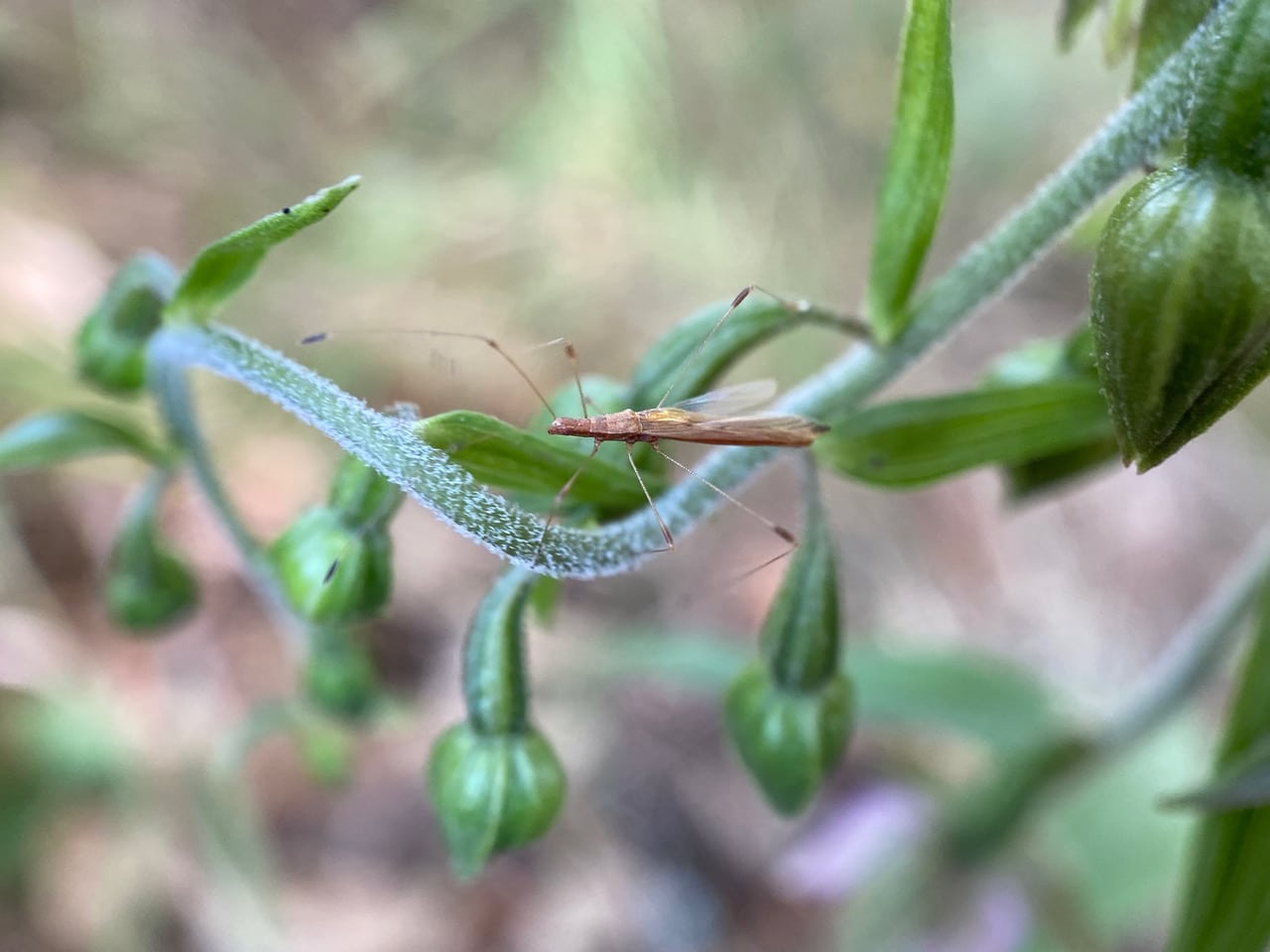
A slender, long-legged Stilt Bug (family Berytidae) is walking among the developing fruits of the Broadleaf Helleborine.
The Berytidae are extremely gracile insects with legs so long and slender as to suggest common names such as “thread bugs” and “stilt bugs”. In this they resemble the Assassin Bugs in the subfamily Emesinae with which they are easily confused. However, the forelegs of the predatory Emesinae are raptorial, while those of the Berytidae are roughly similar to those of their other legs. What’s more, the antennae of most Berytidae though long, geniculate (elbowed), and in other ways generally similar to Emesinae, tend to have a swelling at the tip. Antennae have 4 segments, the fourth enlarged.
Stilt Bugs occur worldwide and throughout North America. Most are phytophagous (plant-feeders); many may be host-specific, often associated with plants with glandular hairs in Geraniaceae, Onagraceae, Scrophulariaceae, and Solanaceae. Some are occasionally omnivorous, feeding opportunistically on insects entrapped in plant exudates or on lepidopteran eggs or aphids.

There are at least 6 of these adult Stilt Bugs on the same plant.

Note the needle-like rostrum (piercing-sucking mouthpart of Hemiptera) that is folded under the body of the Stilt Bug when not feeding.
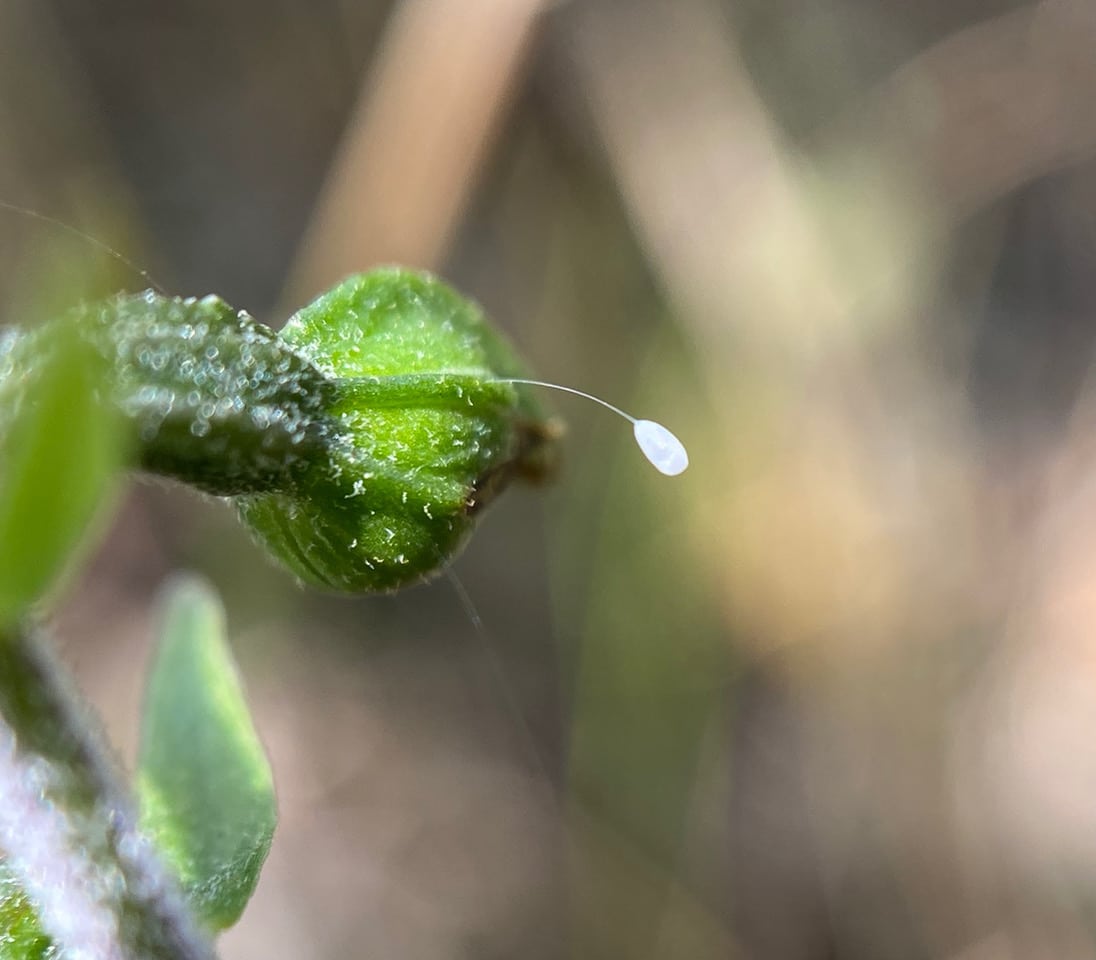
Ooh, a Lacewing egg attached to a developing fruit of Broadleaf Helleborine!
Green Lacewings are insects in the family Chrysopidae of the order Neuroptera. The adult is about 3/4 inch long, light green and has a delicate appearance with lacy wings. The compound eyes are conspicuously golden in many species. The insects are weak fliers, and are commonly found near aphid colonies. The adults feed mostly on nectar pollen, and honeydew but some species feed on insects as well. The eggs are either laid singly or in small groups at night. Each is perched on the tip of a hairlike stalk that is about 1/2 inch long. This helps to reduce cannibalism of the eggs by sibling larvae when they hatch.
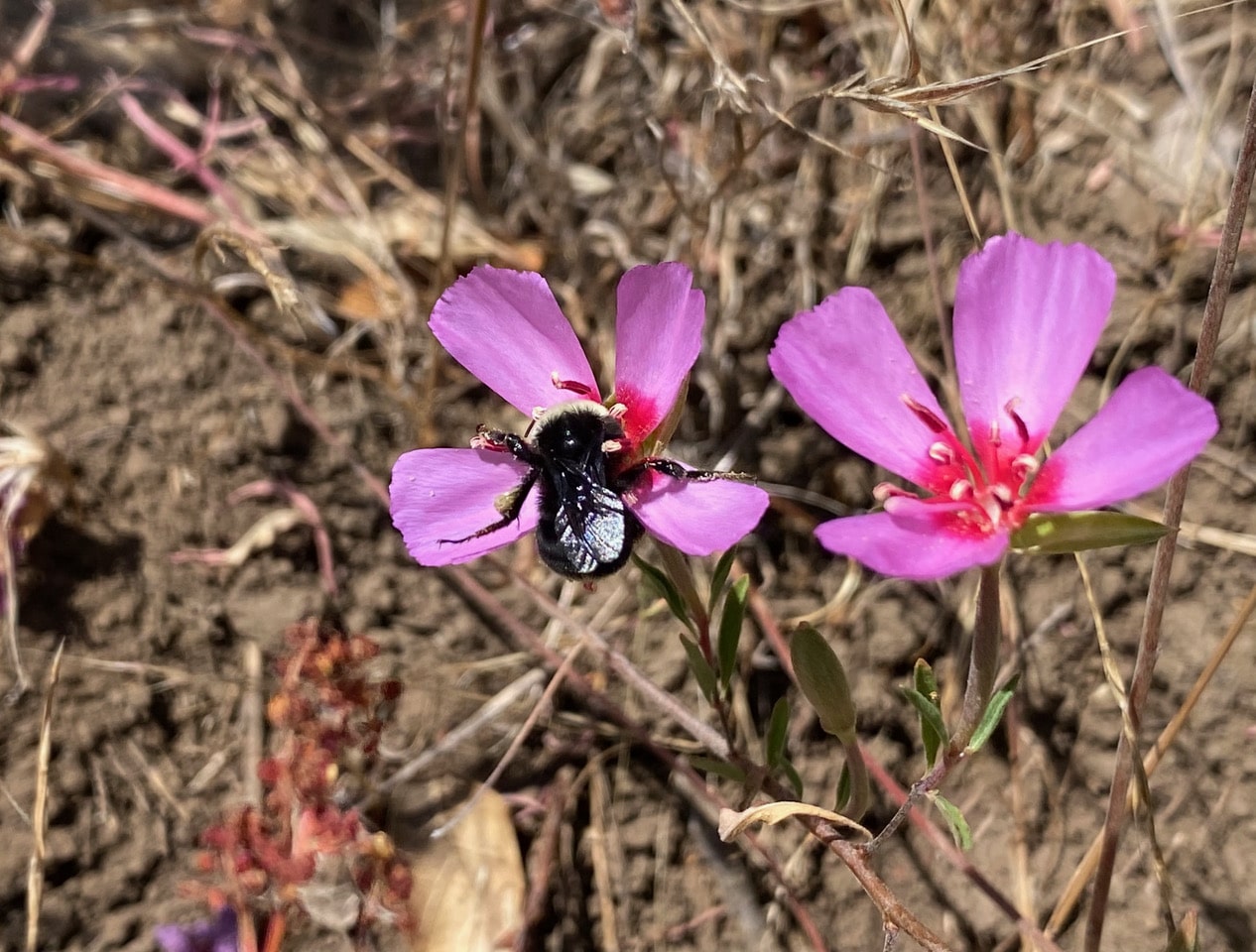
A Yellow-faced Bumble Bee, Bombus vosnesenskii is taking nectar from a Farewell-to-spring flower, Clarkia rubicunda. She has apparently been collecting pollen as well, as evidenced by the bit of purplish putty-like lump in the pollen basket on her hind leg. With floral resources dwindling, the summer blooming Clarkia is a real blessing for these late season bumble bees.
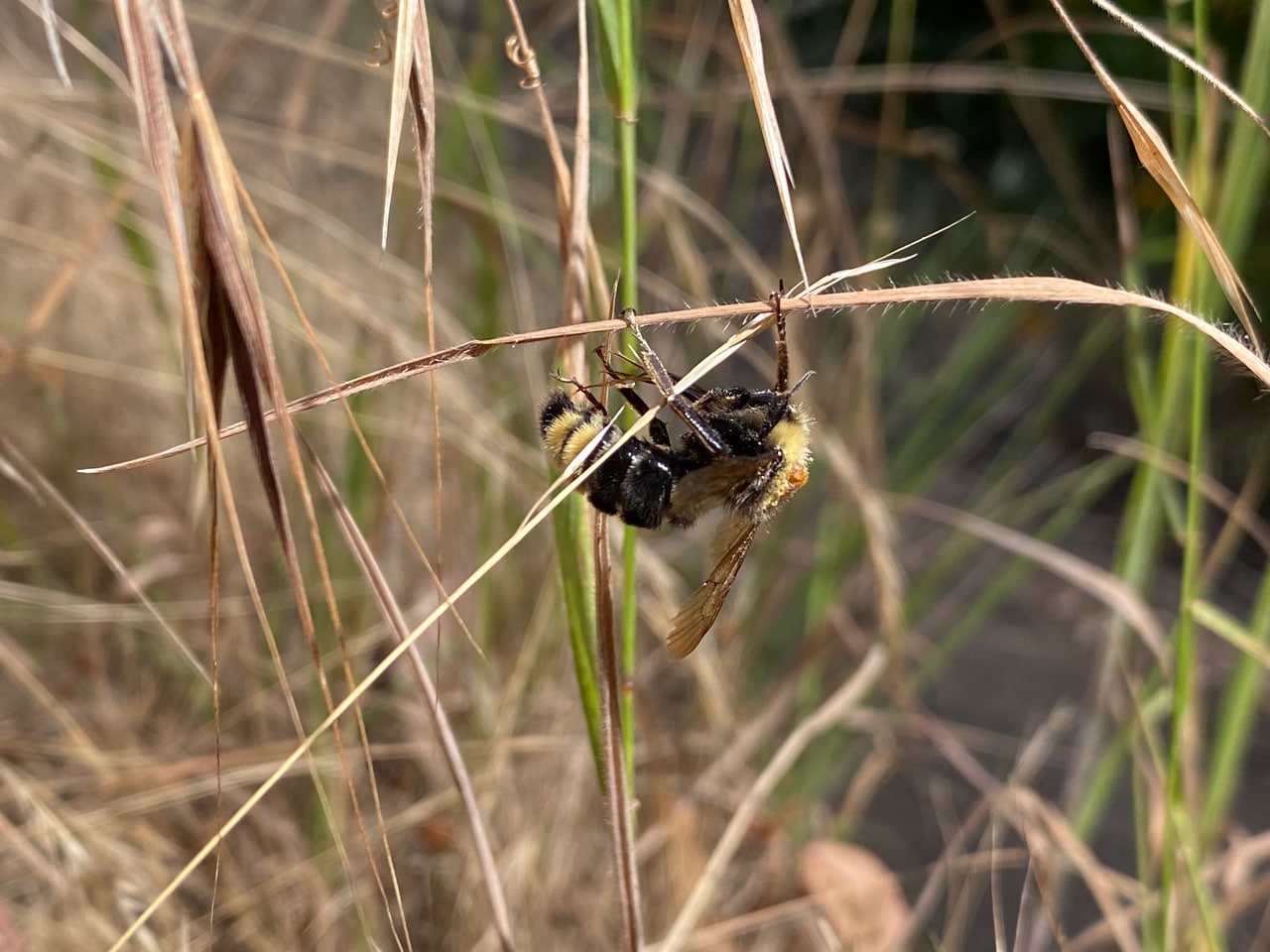
I stop to check some movements in the tall grasses along the trail. A bumble bee seems to be in trouble, struggling to get a perch on a grass stem. She is disheveled, somewhat emaciated, her wings are frayed on the edges, and there seems to be mites attached to her thorax. She has two distinct bands of yellow hairs on her abdomen – a California Bumble Bee? I can’t be sure until I see a black head.
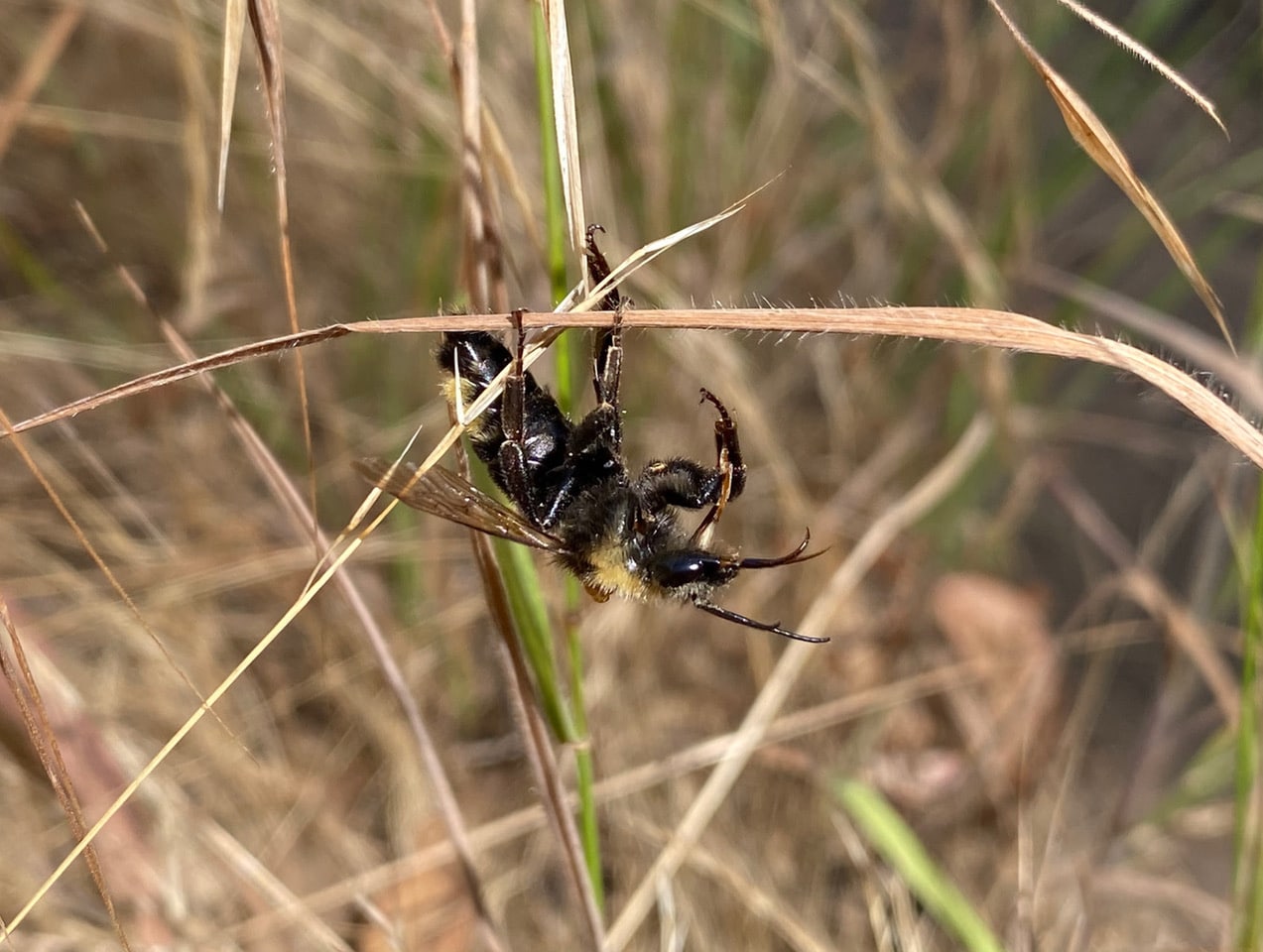 The agitated bee finally stabilizes herself, hanging up-side-down on the grass. She furiously grooms her tongue. Where has she been sticking that into?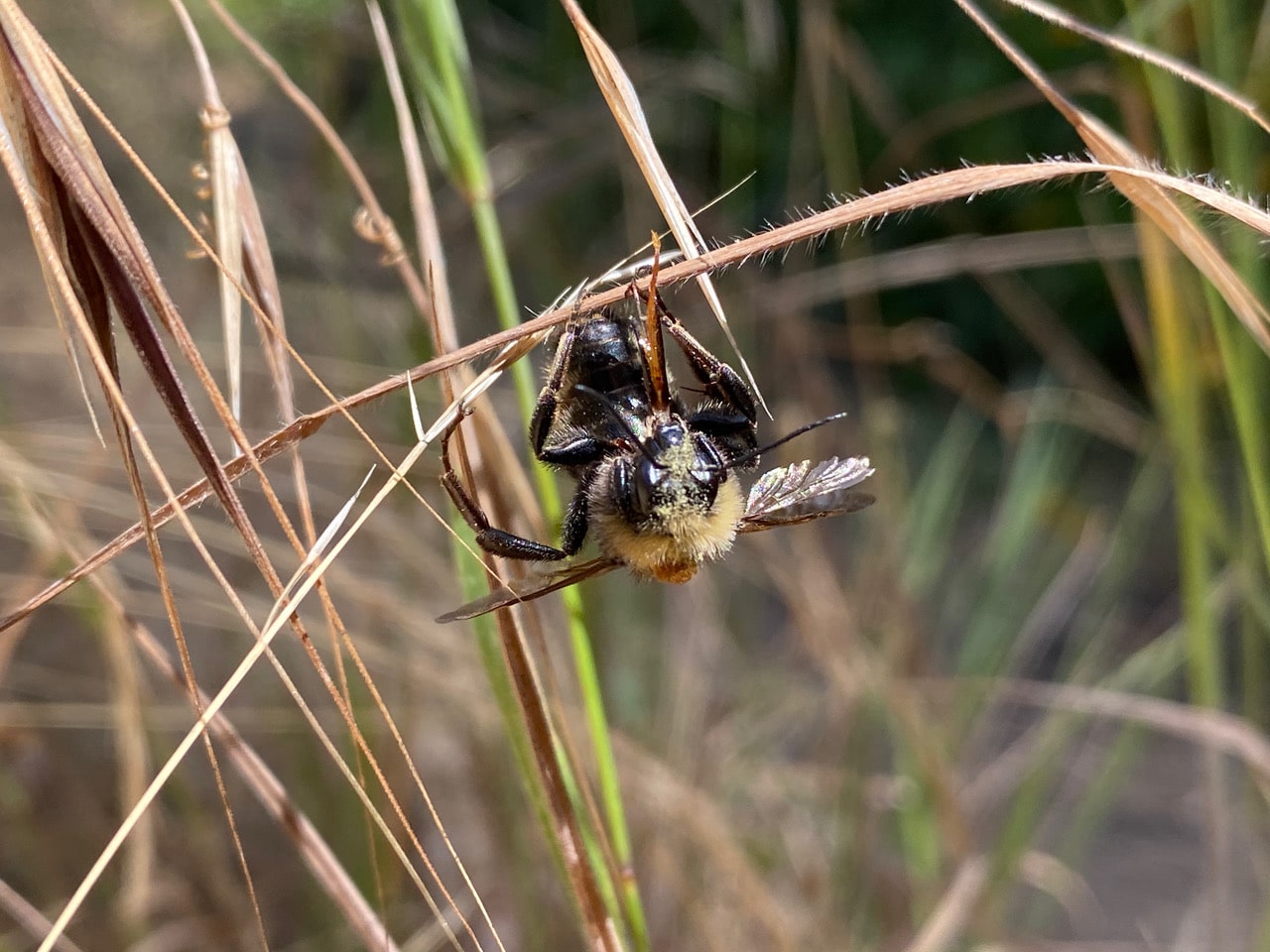
I wonder where she’s been sticking her head into – there seems to be pollen on her head, making it difficult to see if she has a yellow or black face. She is focused on cleaning her tongue. I am astonished to see how long her tongue is (it is the reddish structure that is visible when the two black sheaths are parted). I take a short video of her tongue cleaning process.
The various mouth parts that enable bumble bees to collect food are hidden behind the large lip that you see when you face a bumble bee head on. Behind this lip, there are multiple structures that are adapted to grasp, shape, and collect food. These include jaws, or mandibles, which clasp pollen and wax used to form cells for eggs. Under the mandibles are two long sheaths that also grasp and shape food called maxillae. Two labial palps located under the maxillae serve as taste sensors. Both of these structures, the maxillae and labial palps, form a horny sheath which protects the bee’s tongue.
Nectar is accessed with a proboscis which is basically a tube that is protected by the mandible, maxillae and labial palms. A tongue-like structure called a glossa protrudes from the proboscis. Its hairy tip is well suited for collecting nectar. The whole apparatus is jointed, made to fold up inside the mouth cavity like the pleats of an accordion. Bees with long tongues fold them away under their body when not in use.
Members of the family Apidae (which includes the bumble bees and honey bees) have some of the longest tongues among bees. The length of a bee’s tongue is of vital importance, as it determines what types of flowers it can extract food resources from.
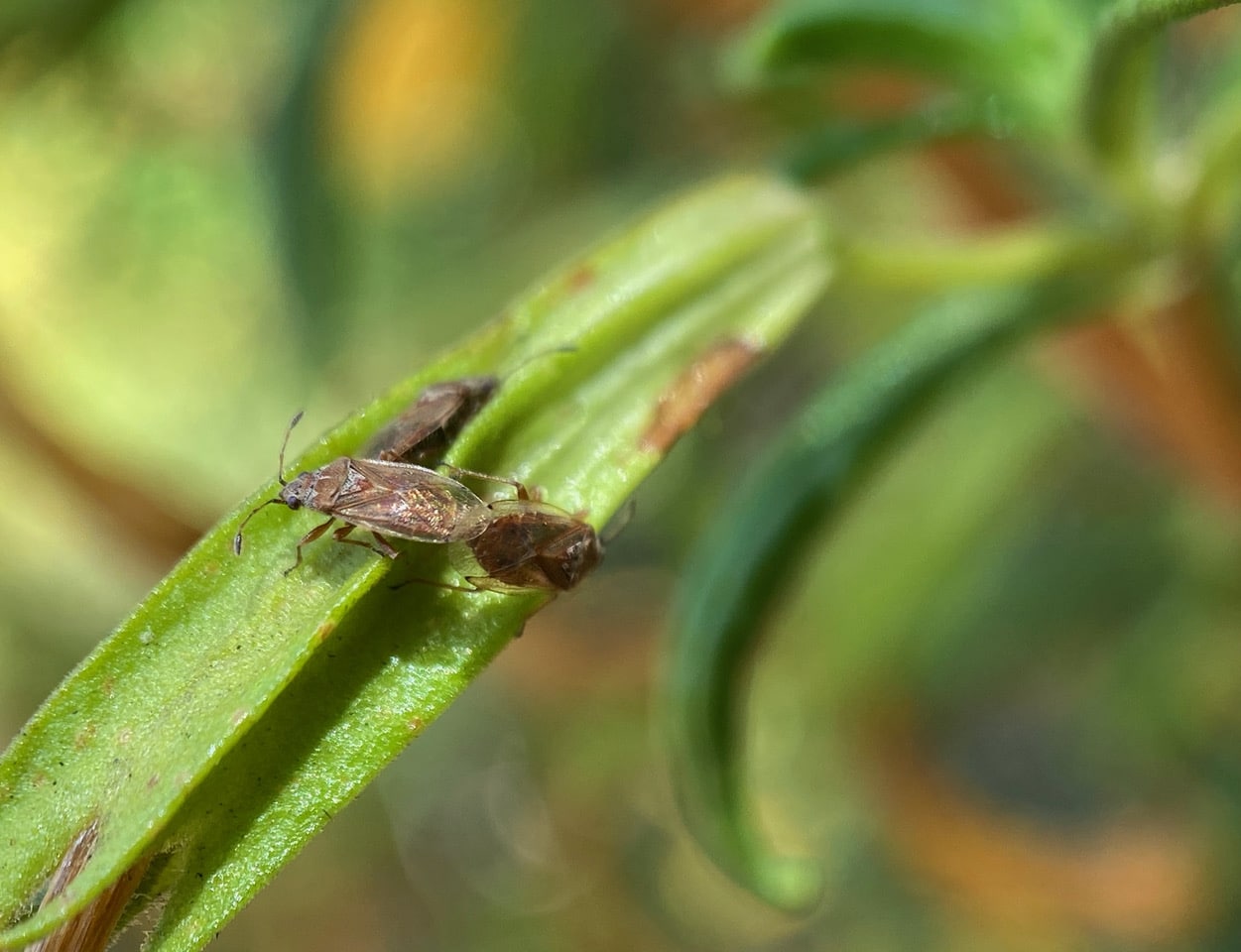
A Seed Bug, Kleidocerys franciscanus (family Lygaeidae) is cradled in the folds of the calyx of a Sticky Monkeyflower while a pair of the bugs are mating. These bugs are closely associated with Diplacus aurantiacus, apparently extracting nourishment from the young seeds within the calyces. Seed bugs are able to feed on seeds by injecting digestive juices into the seeds with their piercing-sucking mouthparts and sucking up the digested contents as a liquid. Both immature and adult bugs feed on plants this way.

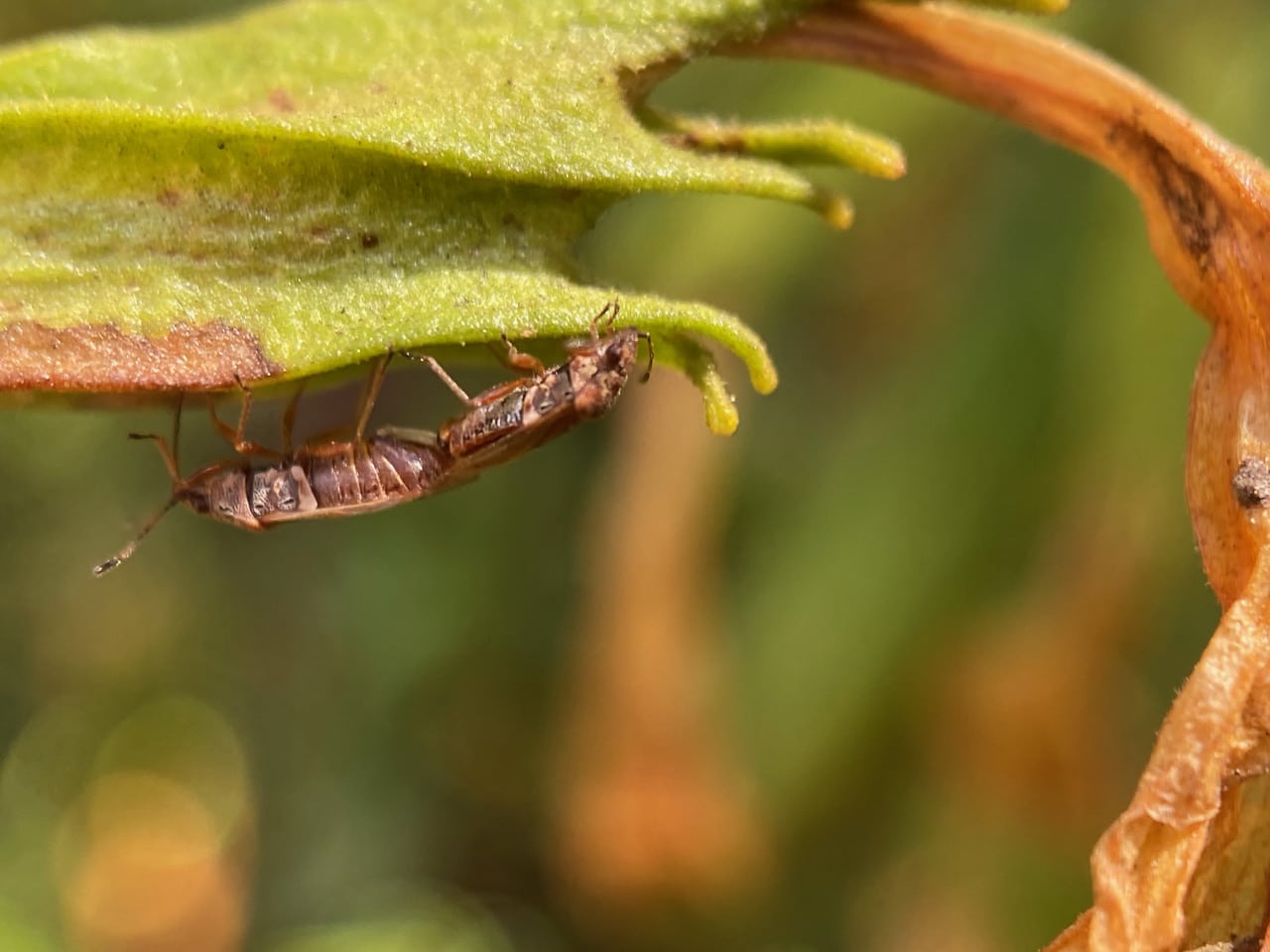
Another mating pair of the Seed Bugs, Kleidocerys franciscanus (family Lygaeidae) on the calyx of a wilted Sticky Monkeyflower in which seeds are maturing.