

Pollinator Post 7/23/23 (1)

A Sedgesitter, Platycheirus sp. (family Syrphidae) visits a flower of Farewell-to-Spring, Clarkia rubicunda. The hover fly is easily distinguished from most other species by its dusky, metallic sheen.
Platycheirus is found in grass and herb vegetation. Adults of many species feed on pollen of wind-pollinated plants, such as Salix, Plantago, Poaceae, Cyperaceae, but they visit other flowers also. Many stay active during cold and rainy weather. Larvae feed on aphids.

The Clarkia flowers along Skyline Trail continue to be cut by the Leafcutter Bees, Megachile sp. (family Megachilidae). All four petals of this flower have been cut. But wait, there are signs that other insects are using the Clarkia petals. See the irregular hole in the lower petal? That is not made by a Leafcutter Bee for lining their nest cells. Someone is feeding on the flower.

Nearby I find the culprit – a nymph of the California Chaparral Katydid, Platylyra californica (family Tettigoniidae)!
The species is endemic to California. It is a common but seldom seen southern Calfornia katydid. The secretive insect inhabits native chaparral vegetation throughout the state. It is similar to Scudderia but smaller, not as slender and with shorter wings.
Insects in the family Tettigoniidae are commonly called katydids or bush crickets. They are primarily nocturnal in habit with strident mating calls. Many species exhibit mimicry and camouflage, commonly with shapes and colors resembling leaves. The diet of most katydids includes leaves, flowers, bark, and seeds, but many species are predatory, feeding on other insects, snails, or even small vertebrates such as snakes and lizards. Some are considered agricultural pests.
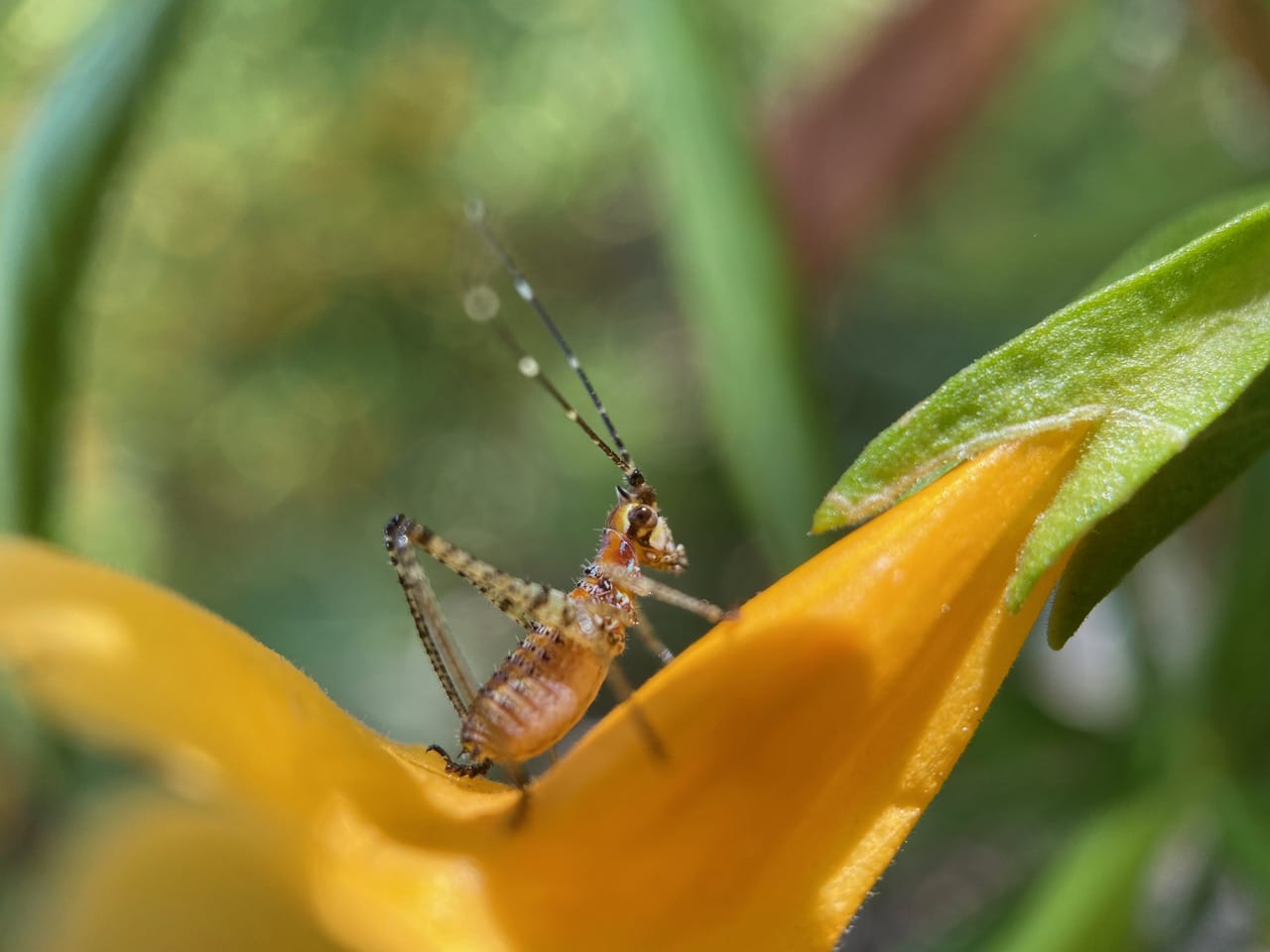
A nymph of Scudder’s Bush Katydid, Scudderia sp. (family Tettigoniidae) is perched on the back of a Sticky Monkeyflower, Diplacus aurantiacus.
Scudderia is a genus of katydids in the family Tettigoniidae. They are sometimes called bush katydids and are 30-38 mm in length. They are mostly found in North America. They are herbivores, with nymphs feeding primarily on flowers and adults preferring woody deciduous plants.
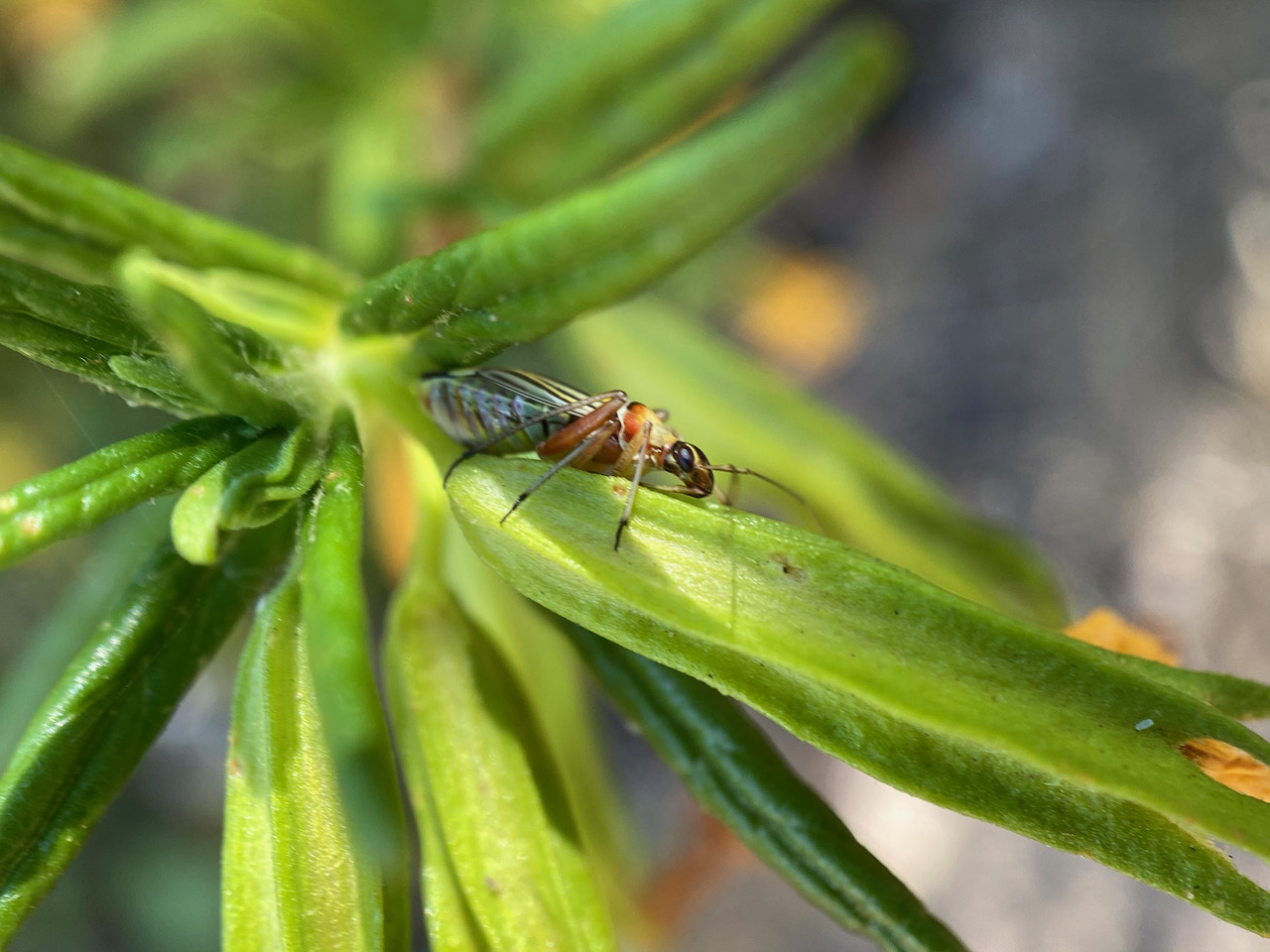
A Plant Bug, Closterocoris amoenus (family Miridae) is resting on the calyx of a Sticky Monkeyflower.

Mirid bugs are also referred to as plant bugs or leaf bugs. Miridae is one of the largest family of true bugs in the order Hemiptera. Like other Hemipterans, Mirids have piercing, sucking mouthparts to extract plant sap. Some species are predatory. The literature is mum on the dietary habits of Closterocoris. Both adults and nymphs are closely associated with the Sticky Monkeyflower.
One useful feature in identifying members of the family is the presence of a cuneus; it is the triangular tip of the corium, the firm, horny part of the forewing, the hemielytron. The cuneus is visible in nearly all Miridae.

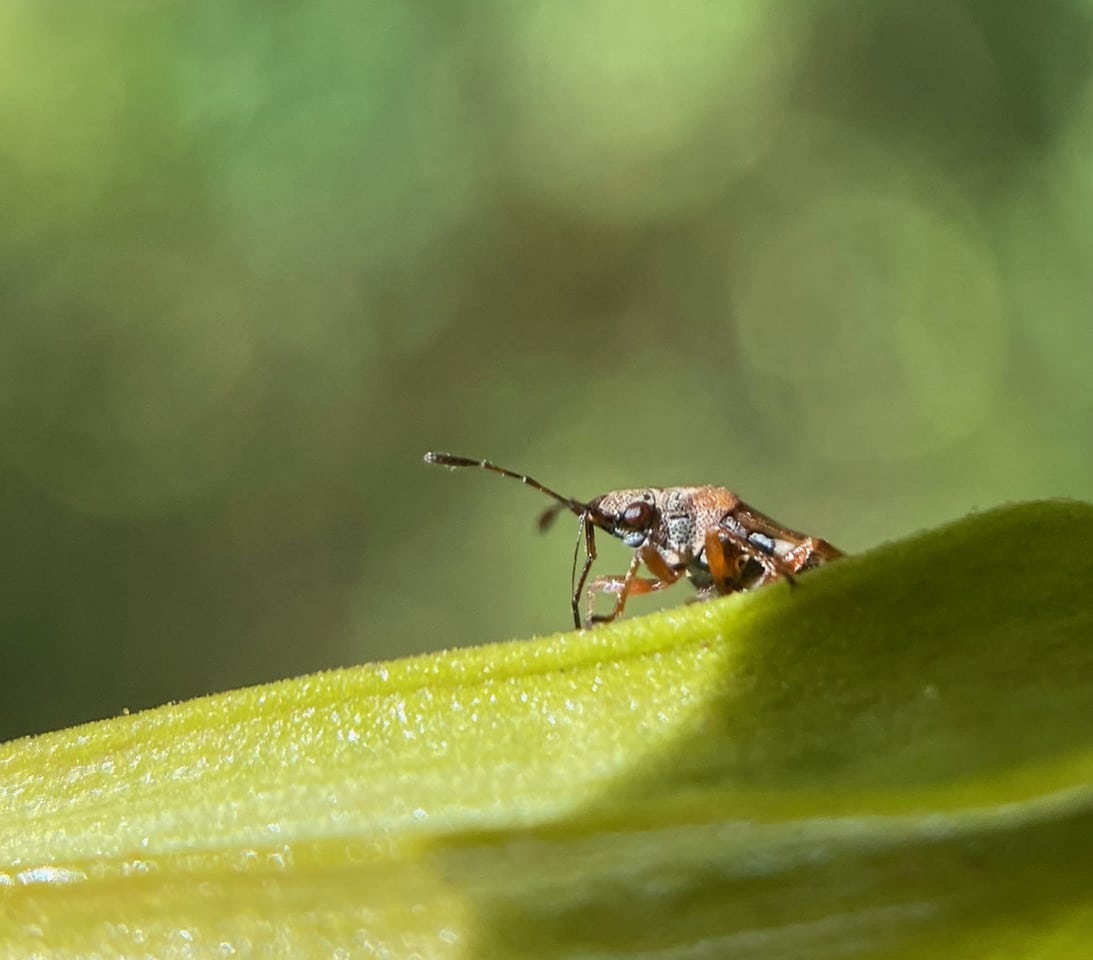
A Seed Bug, Kleidocerys franciscanus (family Lygaeidae) is using its rostrum to feed on the calyx of a Sticky Monkeyflower.
The defining feature of Hemipterans or “true bugs” is their “beak” or rostrum in which the modified mandibles and maxillae form a “stylet” which is sheathed within a modified labium. The stylet is capable of piercing tissues and sucking liquids, while the labium supports it. The stylet contains a channel for outward movement of saliva and digestive enzymes, and another channel for the inward movement of pre-digested liquid food. The rostrum is usually folded under the body when not in use. Seed bugs are able to feed on seeds by injecting digestive juices into the seeds and sucking up the digested contents as a liquid.

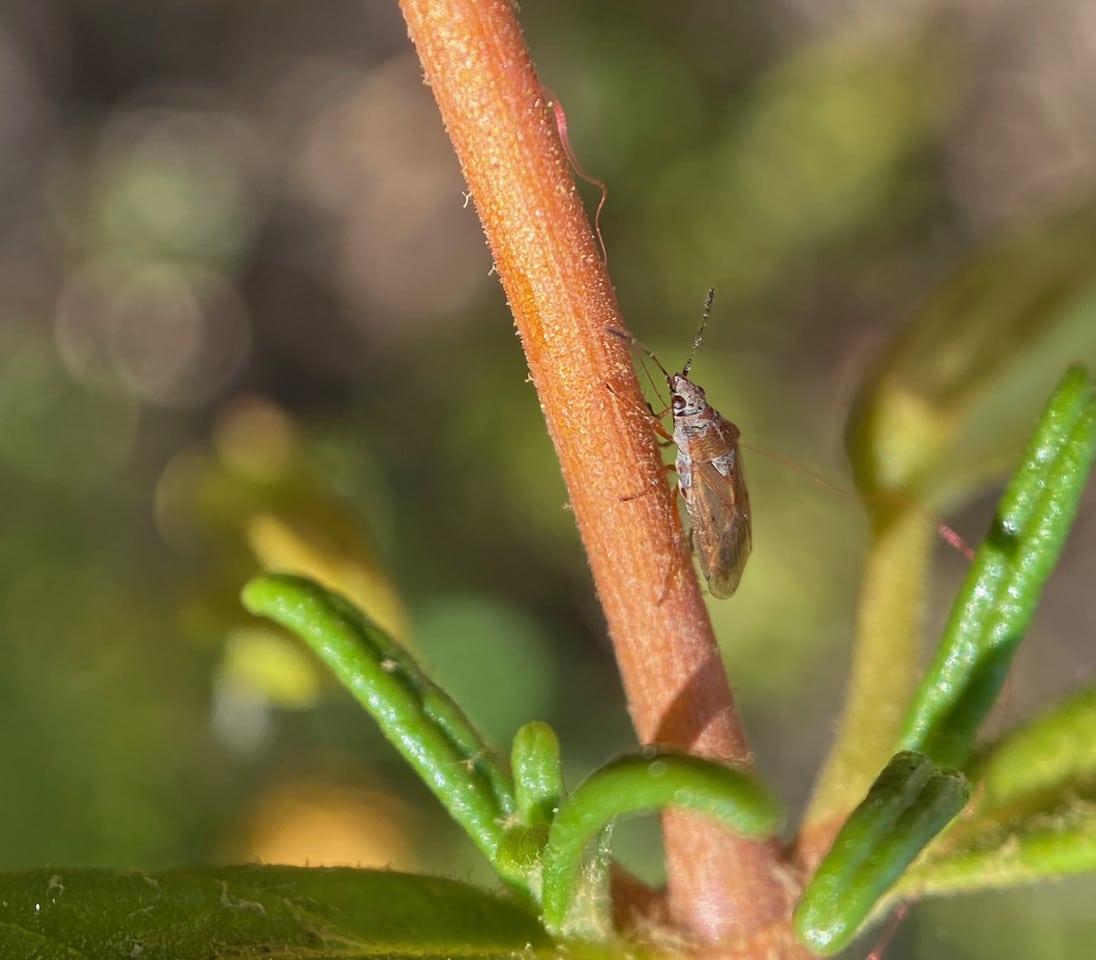
The family Lygaeidae is commonly referred to as seed bugs. However, while many of the species feed on seeds, some feed on sap or seed pods, others are omnivores and a few are carnivores. Lygaeidae are oval or elongate in body shape and have four-segmented antennae. They are distinguished from Miridae (plant bugs) by the presence of ocelli, or simple eyes.
Herbivorous bugs in the order Hemiptera feed on plants through a proboscis, a hypodermic-needlelike structure they use to probe into plant tissue and drink up plant fluids. Seeds are predigested with injected digestive enzymes, then sucked up through the same mouthparts.

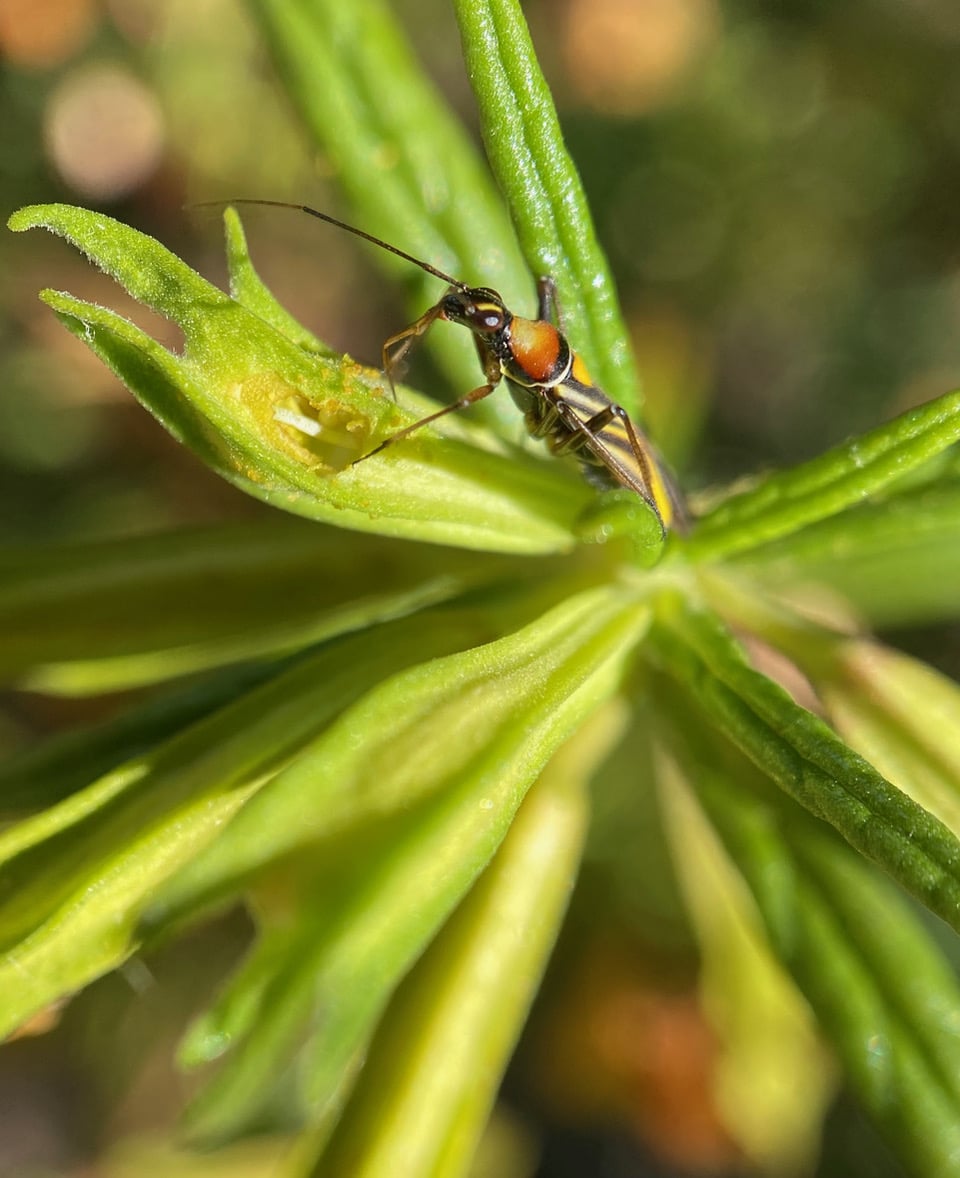
As I approach with the camera, the Plant Bug, Closterocoris amoenus (family Miridae) retracts its rostrum from the Sticky Monkeyflower bud it is feeding on. I am not sure if the bug is capable of making that big hole with its rostrum. Perhaps it is opportunistically using the hole previously made by someone else?

Here the bug has folded its rostrum under its body.

Can you locate the cuneus on the forewings of the Mirid bug? (Hint: they are yellow.)
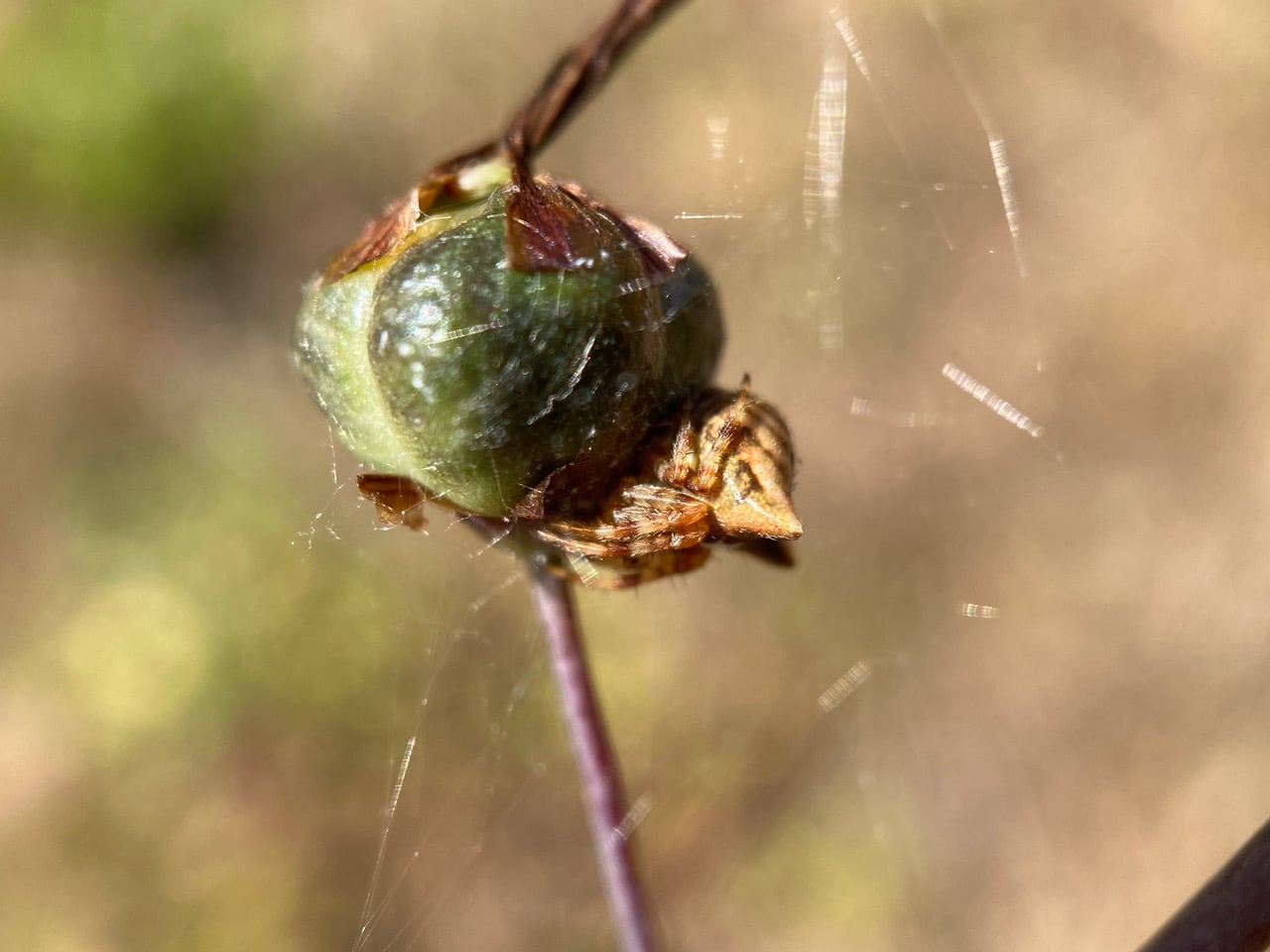
All its legs folded against the body, a Two-tubercled Orb-weaver, Gibbaranea bituberculata (family Araneidae) is resting under a young seed capsule of Soap Plant, Chlorogalum pomeridianum.
Gibbaranea bituberculata is a species of ‘orbweavers’ belonging to the family Araneidae. They are found in sunny habitats on shrubs, edges and low plants, where they can make their webs near the ground. Their basic color is very variable, but usually it is brownish, with whitish shades. The cephalothorax is covered with lying down hairs.
Orb-weaver spiders are members of the spider family Araneidae. They are the most common group of builders of spiral wheel-shaped webs often found in gardens, fields, and forests. Generally, orb-weavers are three-clawed builders of flat webs with sticky spiral capture silk. The third claw is used to walk on the non-sticky part of the web. Typically, the prey insect that blunders into the sticky lines is stunned by a quick bite, and then wrapped in silk.

A Masked Bee, Hylaeus sp. (family Colletidae) is taking nectar from a Naked Buckwheat flower, Eriogonum nudum.
Hylaeus (family Colletidae) are shiny, slender, hairless, and superficially wasp-like bees. They are small, 5 to 7 mm long, usually black with bright yellow or white markings on their face and legs. These markings are more pronounced on the males. Hylaeus do not carry pollen and nectar externally, they instead store their food in the crop and regurgitate it upon returning to their nests. They are primarily generalist foragers. Hylaeus are short-tongued, but their small body size enables them to access deep flowers. Hylaeus nest in stems and twigs, lining their brood cells with self-secreted cellophane-like material. They lack strong mandibles and other adaptations for digging, using instead pre-existing cavities made by other insects.

The same bee on the buckwheat inflorescence. I find the “broken yellow collar” on Hylaeus useful in identification when the facial markings are not visible.
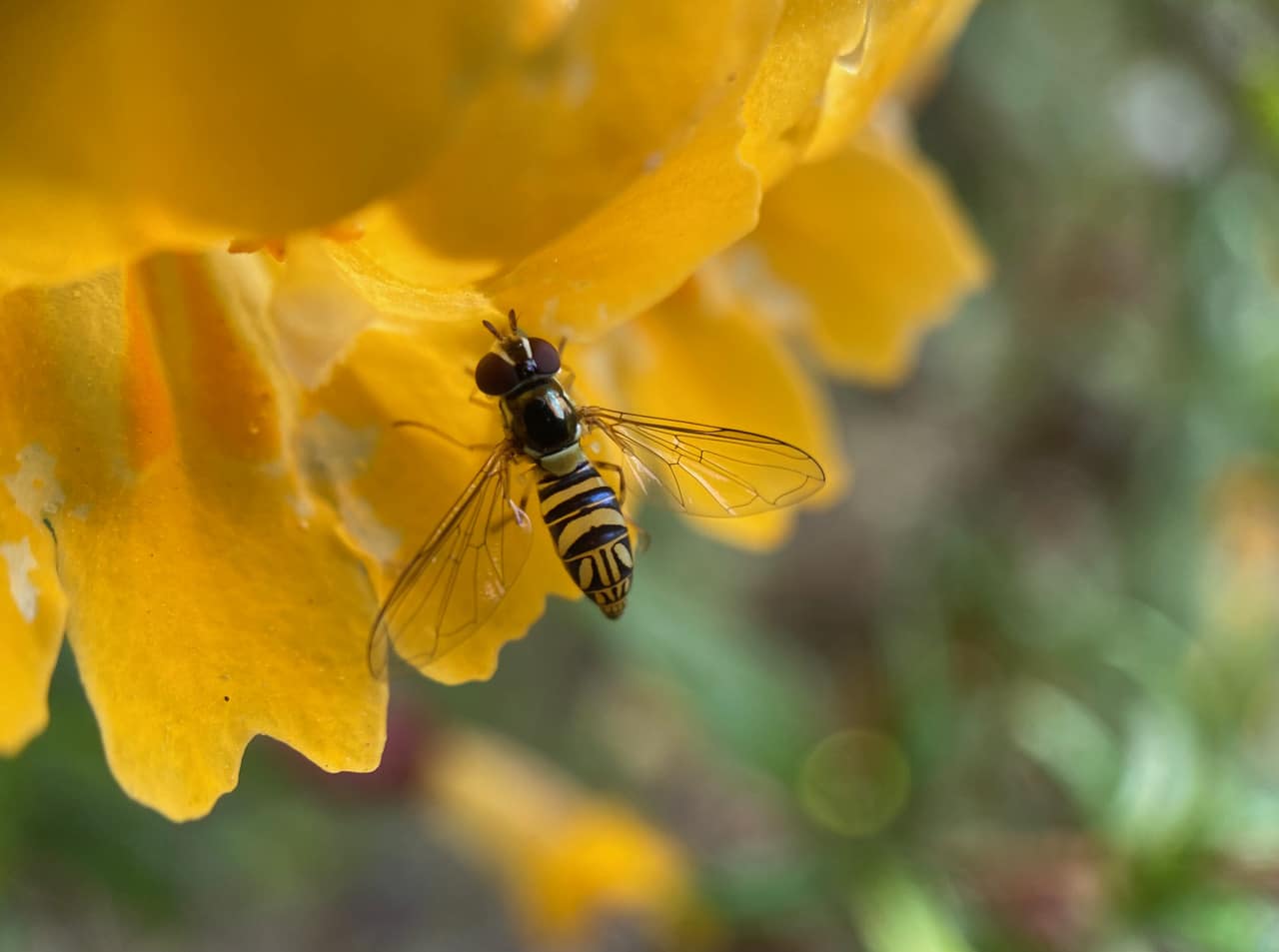
A female Oblique Streaktail, Allograpta obliqua (family Syrphidae) visits a Sticky Monkeyflower, Diplacus aurantiacus. Although small, it is one of the most easily recognizable hoverflies because of its distinct abdominal pattern.
The Oblique Streaktail is a common North American species of hoverfly. Adults are 6-7 mm long. Males have holoptic eyes (that meet on top of the head), while females have dichoptic eyes. Eggs are laid on surfaces of leaves or stems near aphids. The larvae are important predators of aphids while adults are pollinators.
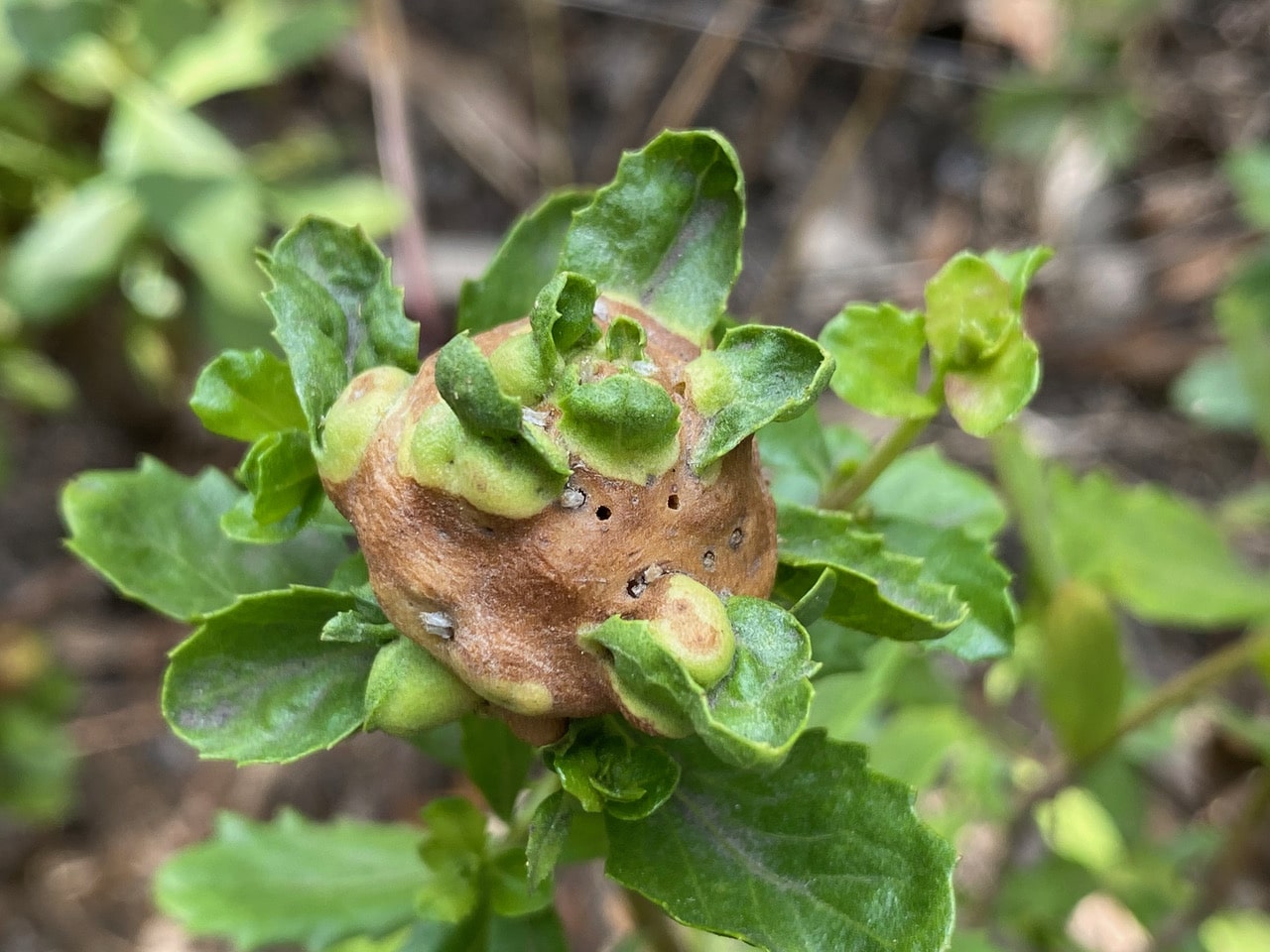
A large Coyote Brush Bud Gall has turned brown, and there are exit holes on the surface!
The Coyote Brush Bud Gall Midge, Rhopalomyia californica lays eggs into the flowerbuds of Baccharis pilularis, inducing lumpy, fleshy galls. Female midges lay clusters of eggs on terminal buds. The larvae that hatch out burrow between bud scales and commence feeding. The gall tissue swells around each of the larvae. When fully grown, larvae burrow to the surface of the gall, where they develop their partially protruding white cocoons and pupate. Adults look like miniature mosquitoes. The species, Rhopalomyia californica (family Cecidomyiidae) represents one of the rare situations among all gall insects where fresh galls and emergence of adults occur throughout the year.

These papery things protruding from the gall are the pupal cases left behind by the midges that have emerged.

A Froghopper Philaenus sp.(family Aphrophoridae) is resting on the stem of a California Mugwort, Artemisia douglasiana.
The Froghopper is a “true bug” in the order Hemiptera, family Aphrophoridae. Froghoppers are champion jumpers among insects, out-performing even the fleas. The bug can leap the human equivalent of a skyscraper without a running start! The muscles in its hind legs act like a “catapult” to release energy explosively. Its athletic prowess not withstanding, the Froghopper is better known for its young, the “spittle bugs”. The nymphs produce foamy white masses on plants within which they feed on plant sap. Froghoppers have piercing-sucking mouthparts, and feed on plant sap as both nymphs and adults. A recent report claims, “Froghoppers are the super-suckers of the animal world. The tiny insects produce negative pressures equivalent to people sucking a 100-meter-long straw.” So the little bug has two titles under its belt – champion jumper, and super-sucker!
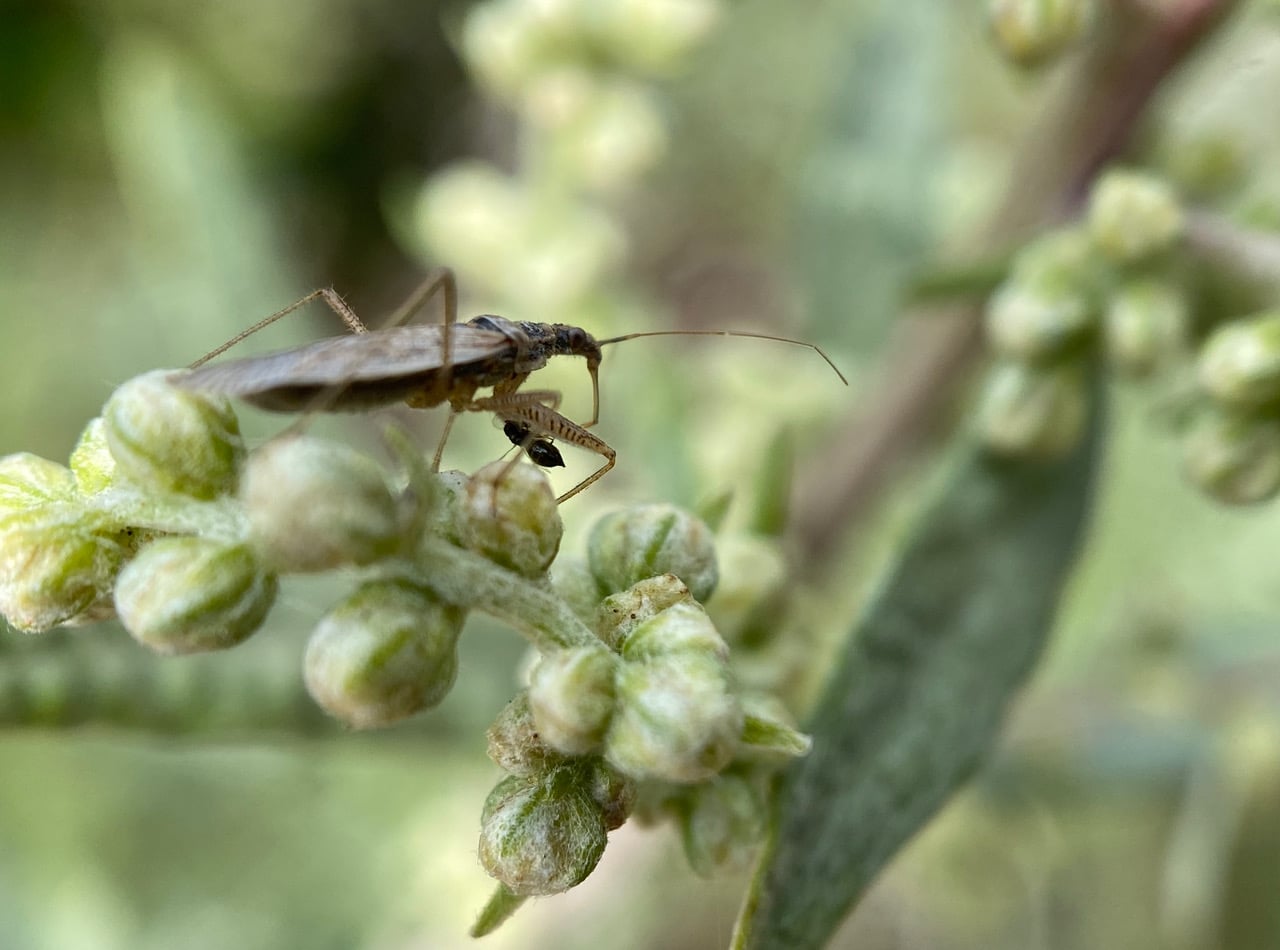
In the shadows of a California Mugwort, a Common Damsel Bug, Nabis americoferus (family Nabidae) is feeding on what appears to be a Chalcid Wasp that it has captured.

At the approach of my camera, the Damsel Bug moves away, its prey firmly attached to its rostrum.
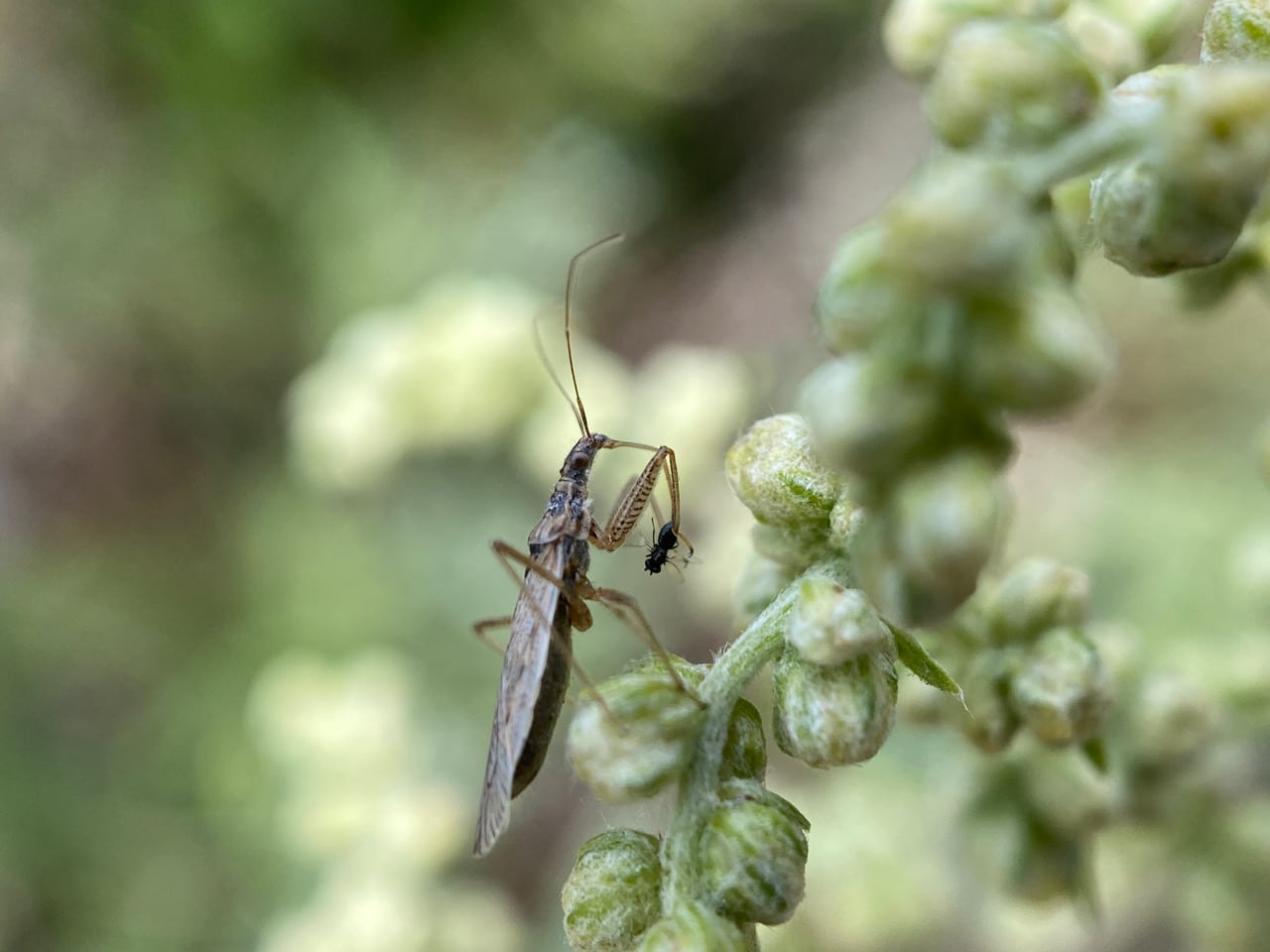
Damsel Bugs are slender, tan-colored, soft-bodied, elongate, winged predators. They generally have large, round eyes and long legs. They are generalist predators, catching almost any insect smaller than themselves, and cannibalizing each other when no other food is available. They use their thickened raptorial front legs that are lined with spines to catch and hold prey, then suck out the body contents with their piercing mouthparts. Females deposit their tiny eggs in plant stems or other tissue, and immatures (nymphs) go through five instars before becoming adults.

A member of the order Hemiptera (“true bugs”), the Damsel Bug feeds with piercing-sucking mouthparts.