

Pollinator Post 7/22/25 (2)

Lavender seems to be a very popular garden plant in this residential neighborhood of Alameda. Here a male Summer Longhorn Bee, Melissodes sp. (family Apidae) is taking nectar from one of the inconspicuous flowers on an inflorescence.
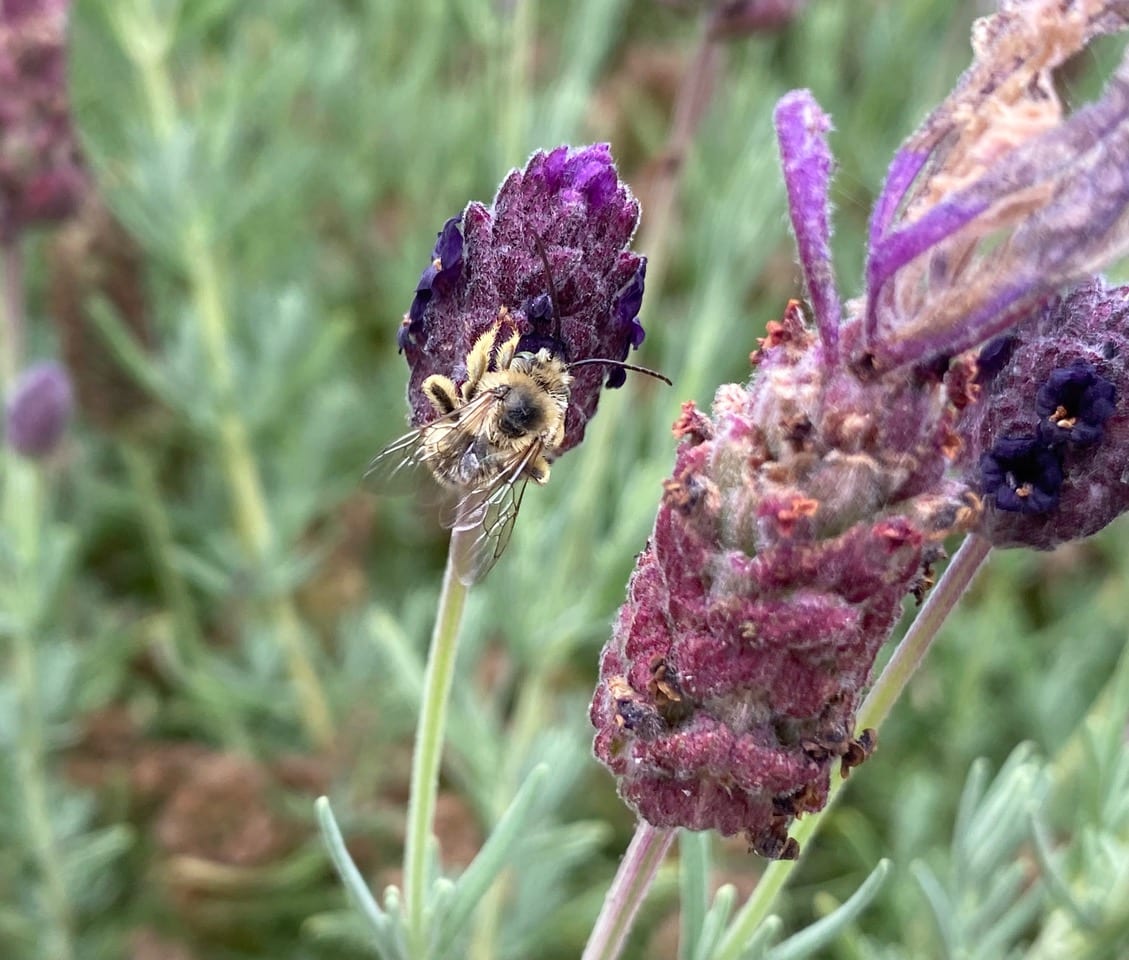

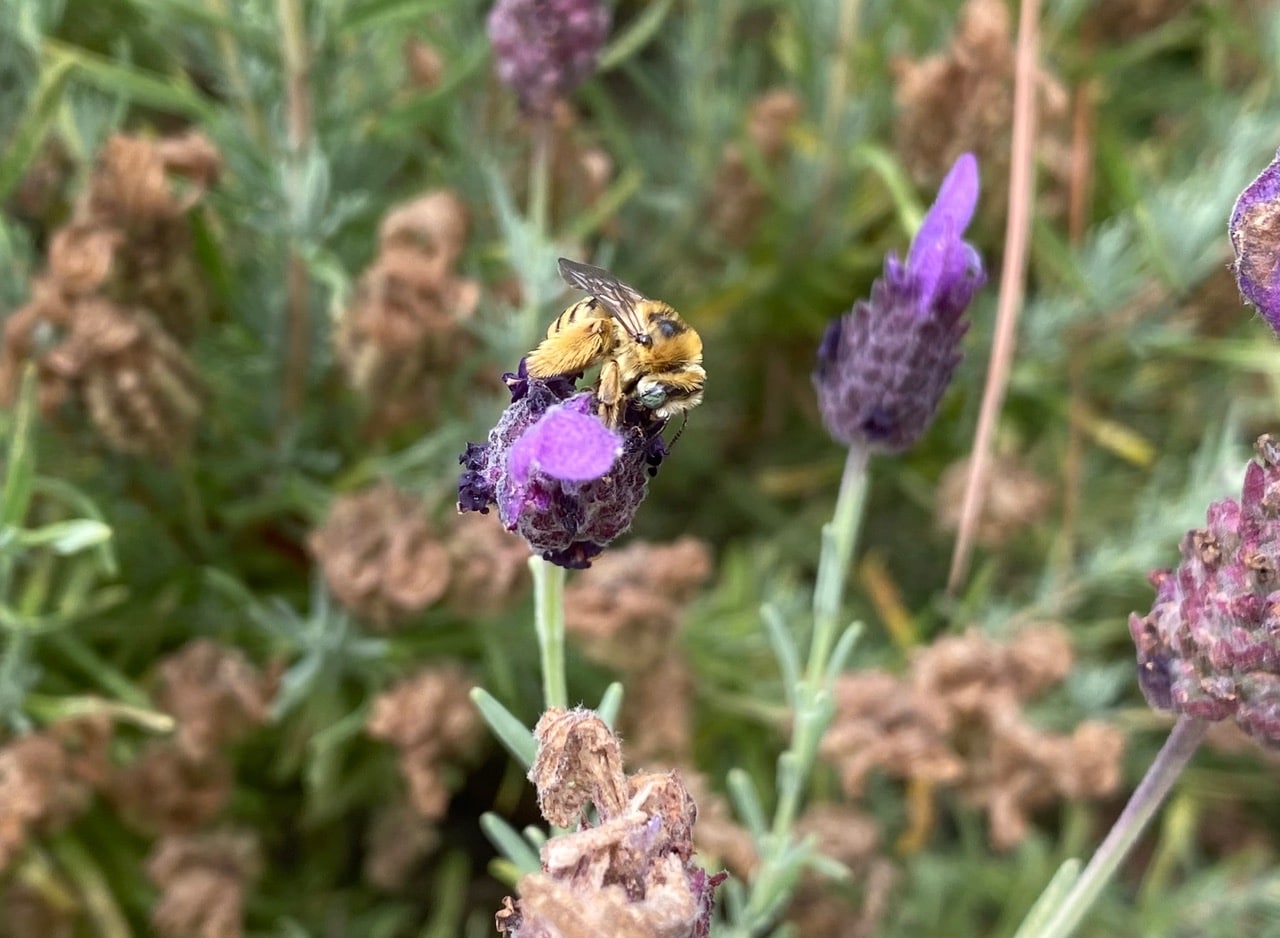
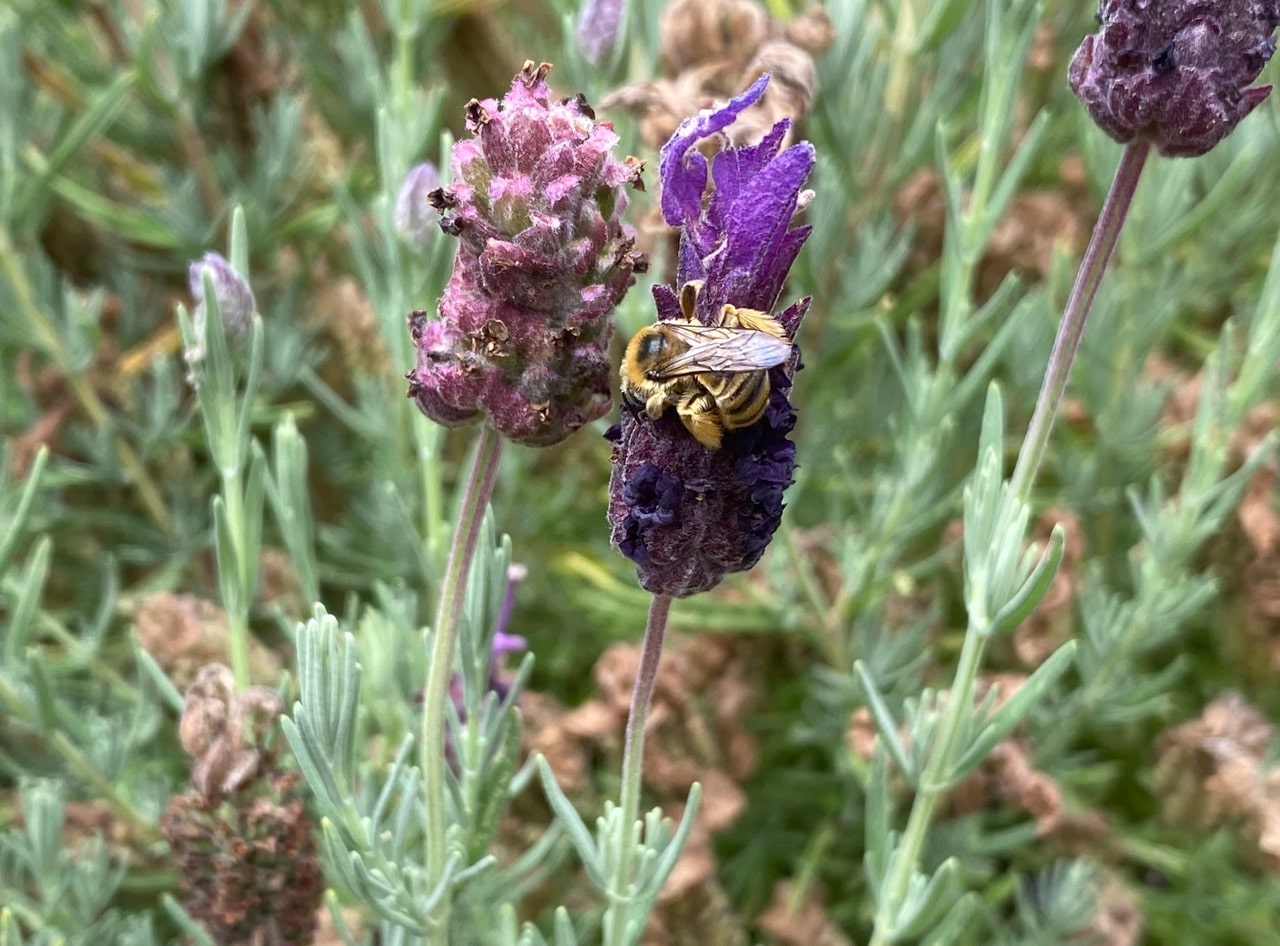
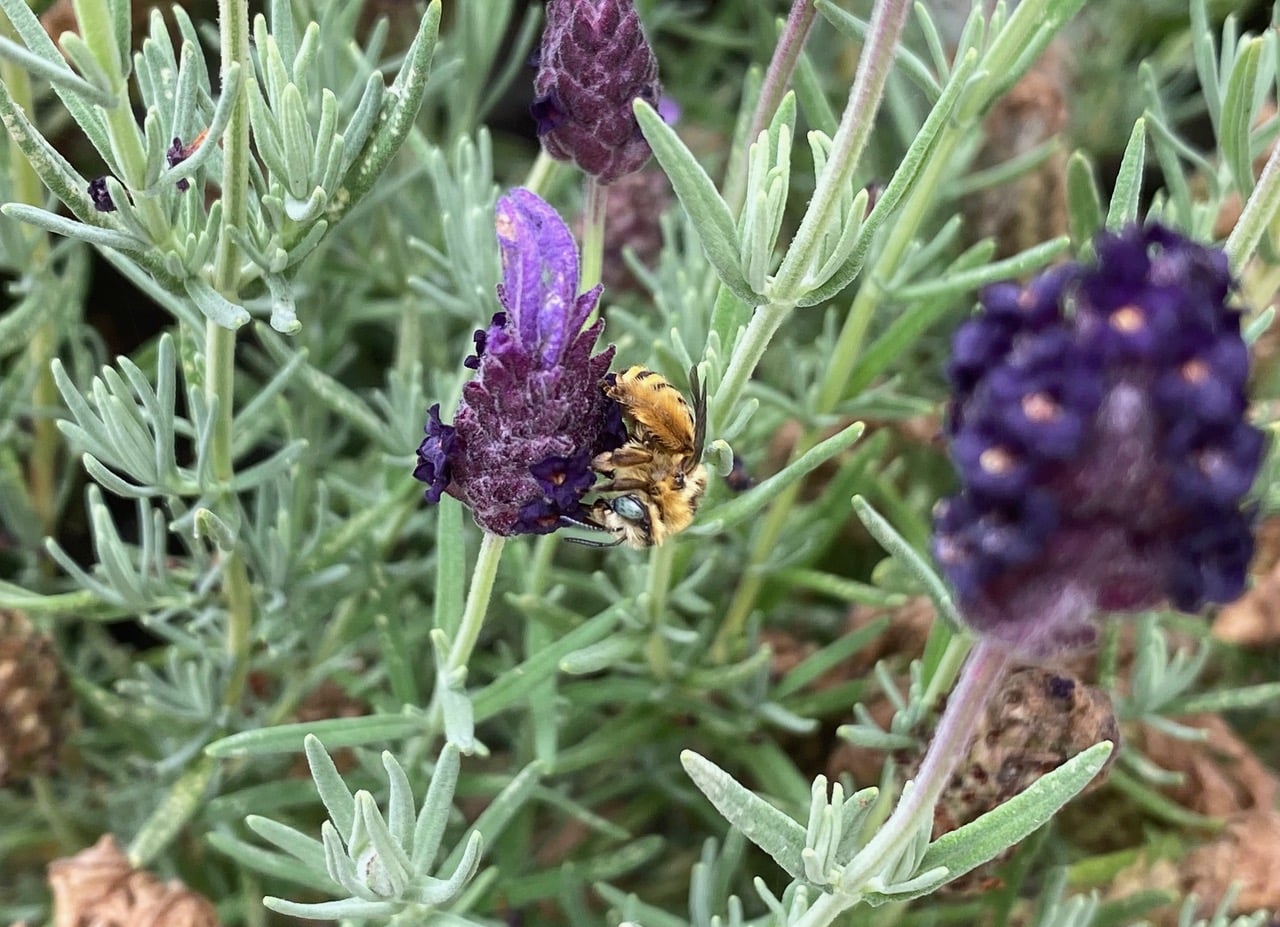





The Summer Longhorn Bees, Melissodes sp. (family Apidae) are medium to large bees, stout-bodied, usually with gray hair on the thorax and pale hair bands on the abdomen. Males usually have yellow markings on their faces and have very long antennae from which their common name is derived. They are active May to September, with peak flight in late June to early August. The females prefer flat, bare ground for digging their solitary nests, though they sometimes nest in aggregations. Pollen is transported in scopae on the hind legs. Pollen loads are often copious and brightly colored and thus very distinguishable. Melissodes are specialists on Asteraceae – females gather pollen from flowers of Aster, Bidens, Coreopsis, Cosmos, Encelia, Gaillardia, Helianthus, and Rudbeck
A female Summer Longhorn Bee, Melissodes sp. (family Apidae) is taking nectar from a spike of Lavender flowers. Note that the scopa on her hand leg is empty of pollen. It is rare to see female Melissodes on flowers other than members of the Asteraceae family as the species is oligolectic, with females collecting pollen from only Asteraceae. While we most often see the females on Asteraceae, the bees do occasionally take nectar from other flowers. The specificity is restricted to their pollen selection. Pollen is a high-protein food that is used to feed the young. Nectar is a source of energy that fuels flight and other activities for the adults.
Female Longhorn Bees, Melissodes sp. have distinctly long scopal hairs on their hind legs, able to carry an incredible amount of pollen. In fact, I often recognize them in the field from the prodigious pollen loads they carry around.
A fast-flying bee with black-and-white striped abdomen is zipping around the spikes of Lavender flowers, landing for a split second to take nectar. It is an Urbane Digger Bee, Anthophora urbana (family Apidae).
Anthophora, commonly called Digger Bees, are entertaining, unusually noisy bees with a distinctive way of flying. They zip speedily around flowers, stopping abruptly to hover in front of a blossom, sometimes angling their long tongues down a flower’s throat without landing. Or they buzz raucously while clinging to the flowers, and thrust their faces so deeply into them that their bodies get coated in pollen.
Anthophora are generally somewhat larger than honey bees and robustly built like bumble bees, but with black or black-and-white-striped abdomens and furry thorax. Typically, digger bees have “Roman noses” or concave profiles. Male digger bees of many species have white or yellow integuments on their faces. Females have shaggy hairs on their back legs, used to carry pollen.
Anthophora are solitary bees, i.e. each female builds and provisions its own nest. However, digger bees are often gregarious, preferring to build their nests close by one another, sometimes forming large aggregations that number in the hundreds. As their name suggests, digger bees typically nest in the soil, either in level ground or vertical banks. Female Anthophora construct ground nests by digging with their front legs and using their mandibles to loosen dirt. The males often hang around nest entrances, awaiting the emergence of a female for a chance to mate with her. When she appears, the males jump on her en masse, sometimes creating chaotic “mating balls”. It’s a boisterous affair!
Female Anthophora are capable of buzz pollination – i.e. they vibrate their wing muscles to shake pollen from the anthers of some flowers. Digger bees are generalist pollinators that visit an impressively wide range of plants. They are exceptionally effective pollinators and play an important role in maintaining wildflower diversity, in part because their long tongues allow them to pollinate deep-throated and tubular blossoms inaccessible to other bees.
The Urbane Digger Bee, Anthophora urbana (family Apidae) is the most commonly found member of the Anthophora genus in the Bay Area gardens. Its flight season is from May until October, with peak flight activity from June into September.
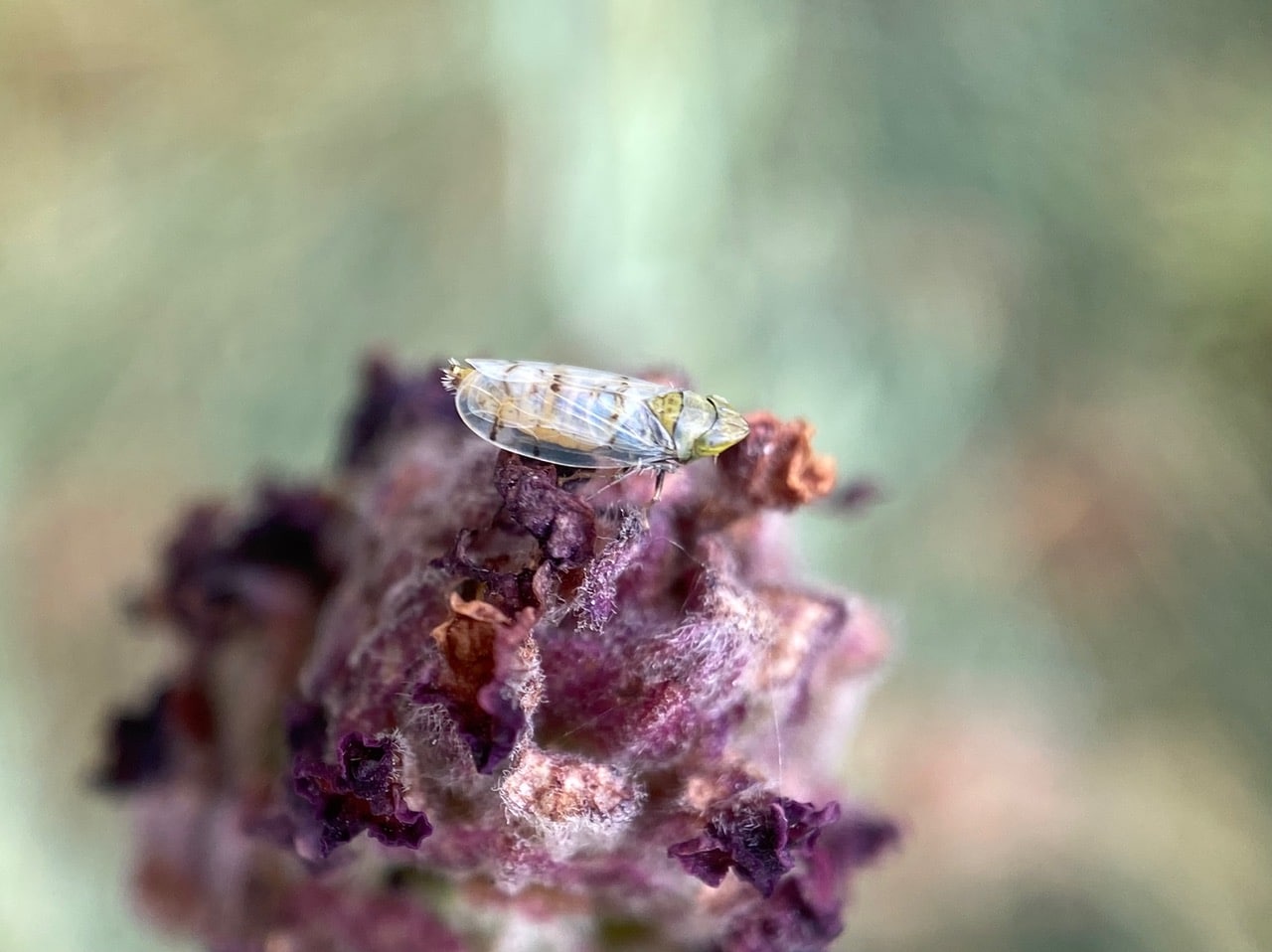
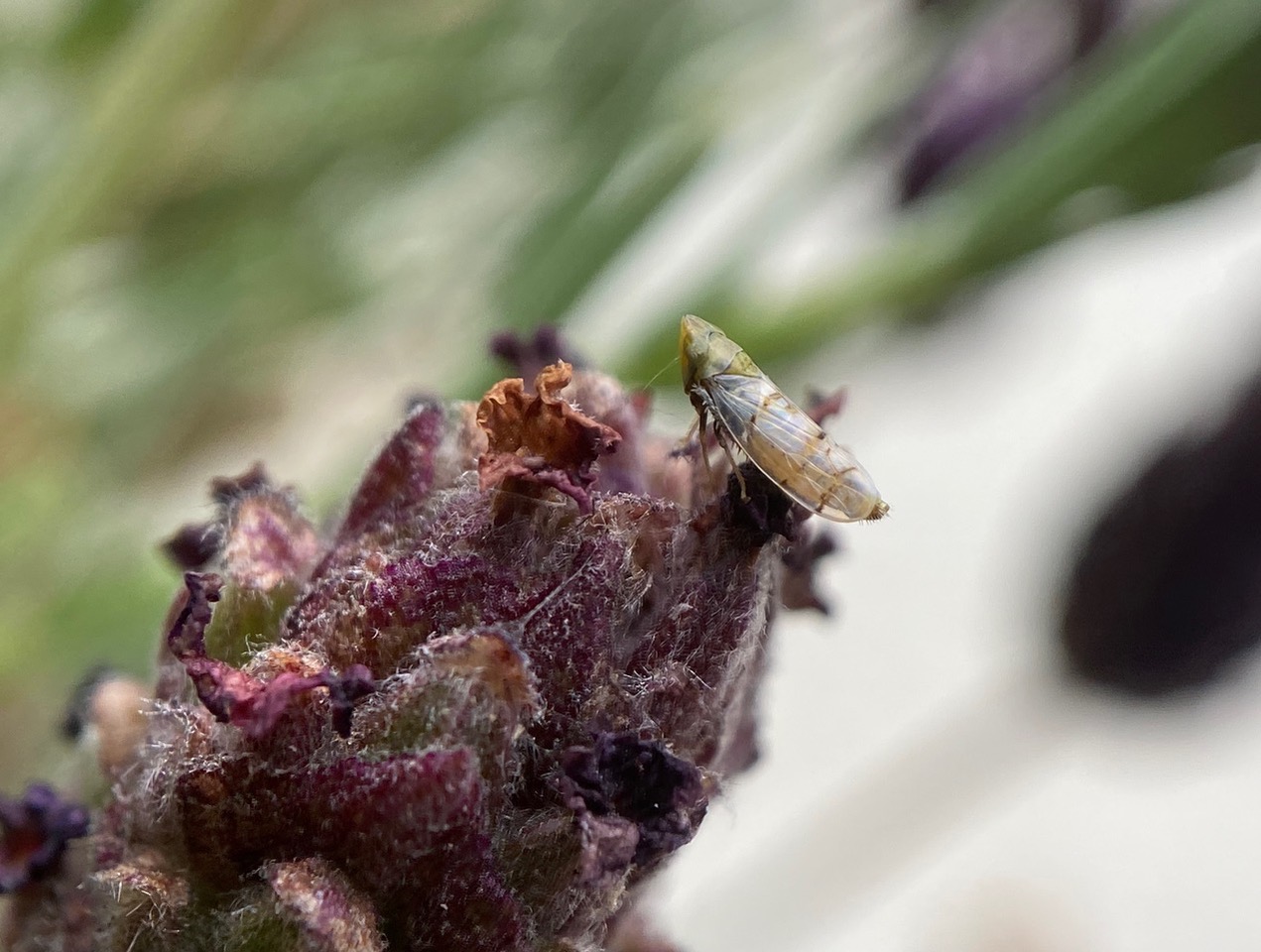
A tiny Leafhopper is perched atop a spent inflorescence of Lavender. iNaturalist has helped identify it as a Japanese Maple Leafhopper, Japananus hyalinus (family Cicadellidae).
Leafhopper is the common name given to true bugs in the family Cicadellidae. The bugs are plant feeders that suck plant sap from grass, shrubs, or trees. Their hind legs are modified for jumping, and are covered with hairs that facilitate the spreading of a secretion over their bodies that act as a water repellent and carrier of pheromones. They undergo partial metamorphosis, and have various host associations, varying from very generalized to very specific.
While sucking the sap of plants, these insects excrete any extra sugar as a sticky liquid commonly called honeydew. This is a serious hazard for small insects, possibly sticking the insect to a leaf, or gluing its body parts together. Some bugs deal with this problem by shooting the waste away from their bodies at high speed. Leafhoppers have a unique solution – they make brochosomes, a proteinaceous material within a special gland in their guts, and secrete them by the billions in a milky anal fluid, and spread them over their bodies using their legs. When the fluid dries, the brochosomes form a powdery coating, and the leafhoppers spread them even further using comb-like hairs on their legs. The brochosomal coat is superhydrophobic, and acts as a water-repellent, non-stick coating protecting the leafhoppers from their own sticky exudates.
The Japanese Maple Leafhopper, Japananus hyalinus (family Cicadellidae) is native to eastern Asia, but is now widely found in Europe, North America, and Australis, due to trade in cultivated maples. Females are 5.5 mm long, males are slightly smaller. It is a fairly distinctive leafhopper with its greenish-yellow head and whitish/translucent wings that have three faint rusty to dark brown bands across them. The insects are very active and move readily when disturbed. The eggs are inserted into the nodes of young branches. There is normally one generation per year, with the eggs over-wintering. Nymphs and adults feed from the phloem tissue on the lower surfaces of leaves in the shadier parts of the tree. The Japanese maples are readily infested, but the leafhopper has also adapted to other maple species such as boxelder, Norway maple, sycamore, silver maple and others.
A male Summer Longhorn Bee, Melissodes sp. (family Apidae) is taking nectar on a Coreopsis flowerhead.
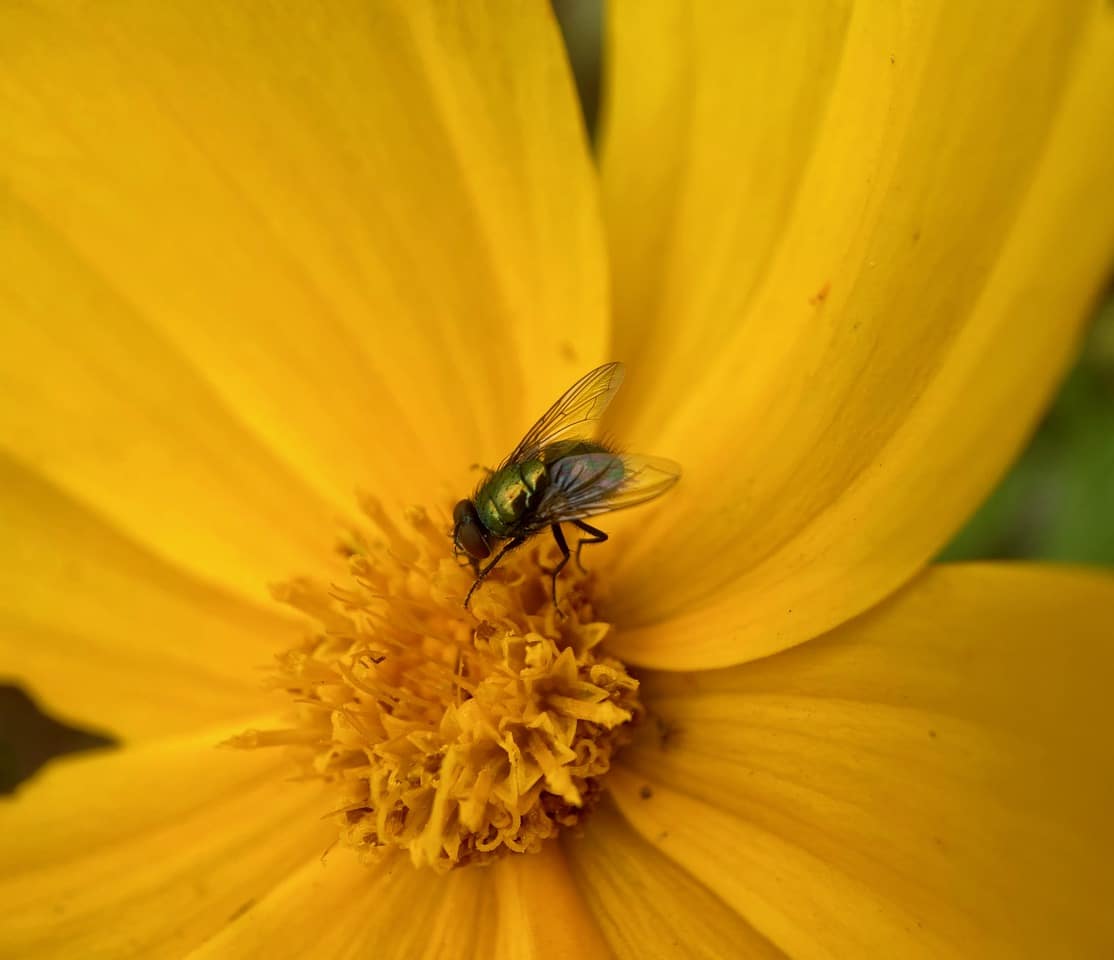
A Common European Greenbottle Fly, Lucilia sericata (family Calliphoridae) lands on a Coreopsis flowerhead to take nectar.
The Common European Greenbottle Fly is a Blowfly found in most areas of the world and is the most well-known of the numerous green bottle fly species. The lifecycle of Lucilia sericata is typical of blowflies. Females lay masses of eggs in fresh carrion. The flies are extremely prolific – a single female may produce 2,000 to 3,000 eggs in her lifetime. The larvae feed on dead or necrotic tissue, passing through 3 larval instars. Third-instar larvae drop off the host to pupate in the soil. The adults feed opportunistically on nectar, pollen, feces, or carrion; they are important pollinators as well as important agents of decomposition. Pollen is used as an alternative protein source, especially for gravid females who need large amounts of protein and cannot reliably find carrion.
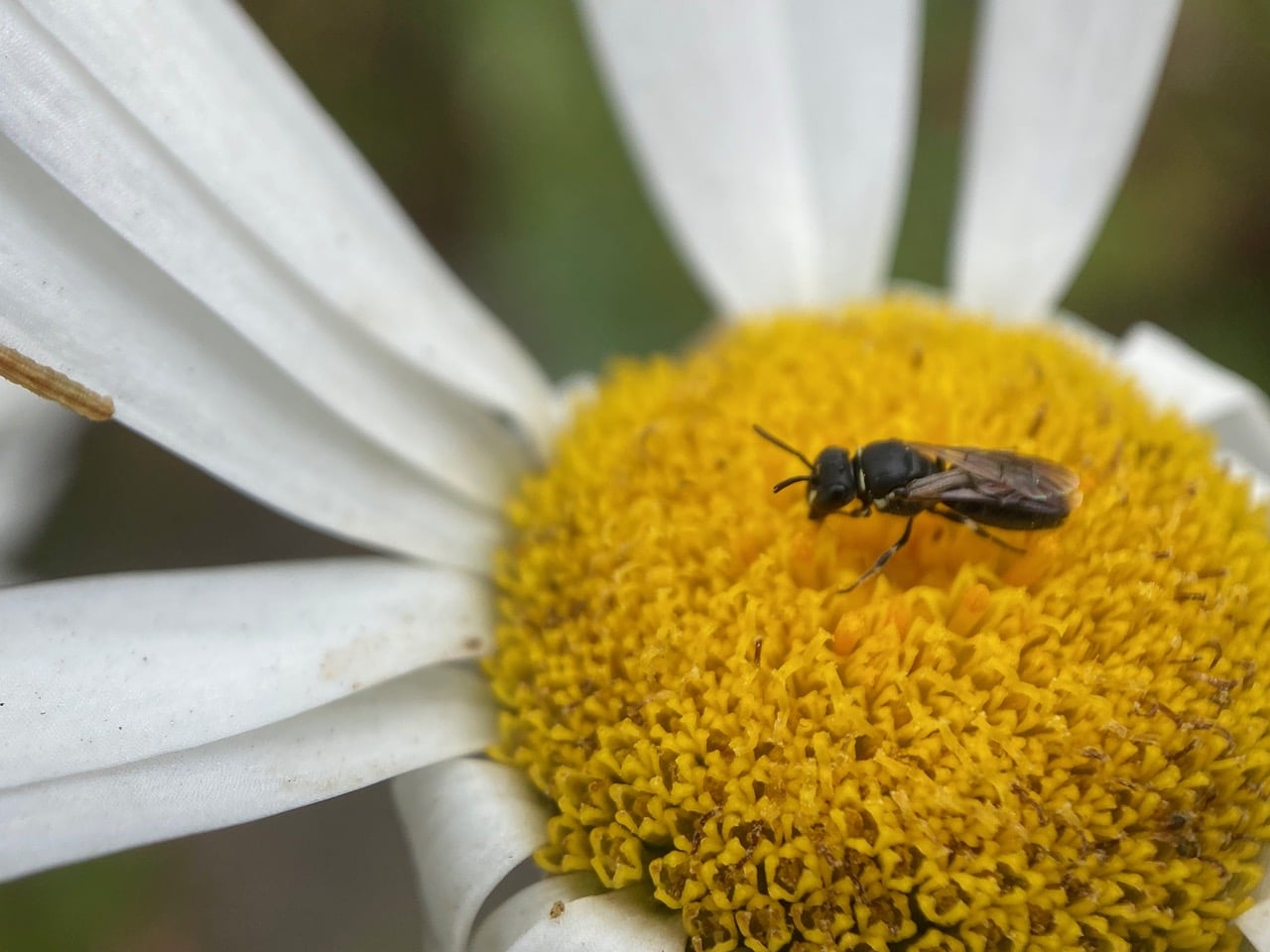
A female Masked bee, Hylaeus sp. (family Colletidae) is foraging on a flowerhead of Max Chrysanthemum, Leucanthemum maximum. She is concentrating on the fresher florets in the middle of the flowerhead where pollen is still being offered.
Hylaeus (family Colletidae) are shiny, slender, hairless, and superficially wasp-like bees. They are small, 5 to 7 mm long, usually black with bright yellow or white markings on their face and legs. These markings are more pronounced on the males. Hylaeus do not carry pollen and nectar externally, they instead store their food in the crop and regurgitate it upon returning to their nests. They are primarily generalist foragers. Hylaeus are short-tongued, but their small body size enables them to access deep flowers. Hylaeus nest in stems and twigs, lining their brood cells with self-secreted cellophane-like material. They lack strong mandibles and other adaptations for digging, using instead pre-existing cavities made by other insects.
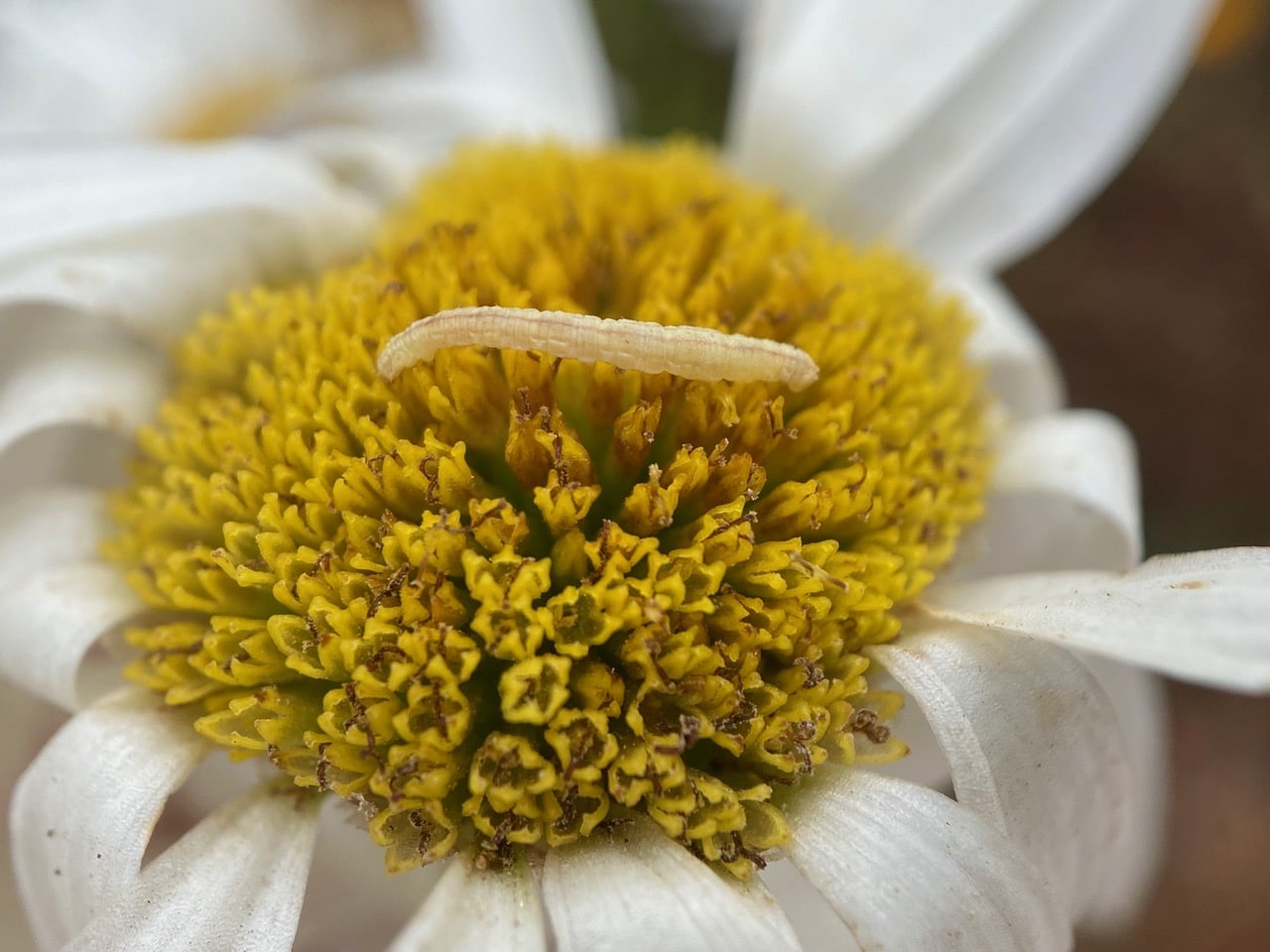
A very pale Inchworm (family Geometridae) is moving around on a Max Chrysanthemum flowerhead.
Inchworms are also called loopers and measuring worms. The majority of the inchworms are the larvae of moths in the family Geometridae. The name comes from the Greek “geo” for earth and “metro” from measure, because the caterpillars seem to be measuring the surface on which they are walking.
All caterpillars have three pairs of jointed legs behind their heads. These legs are called true legs because they will become the six legs of the adult butterfly or moth. There are additional appendages, called prolegs, along their bodies. Prolegs are not true legs, they are just outgrowths of the body wall and will be lost at metamorphosis. They have little hooks on their soles to help the caterpillar walk and grip onto things.
Most caterpillars have five sets of prolegs, four in the middle of the body and one pair at the hind end. Inchworms have the normal six true legs but only two or three pairs of prolegs, all located at the tail end of the body, with none in the middle. When an inchworm walks, it moves its tail-end prolegs up behind its true legs, causing the center of its body to loop upward. Then it stretches its front end forward to take another step.
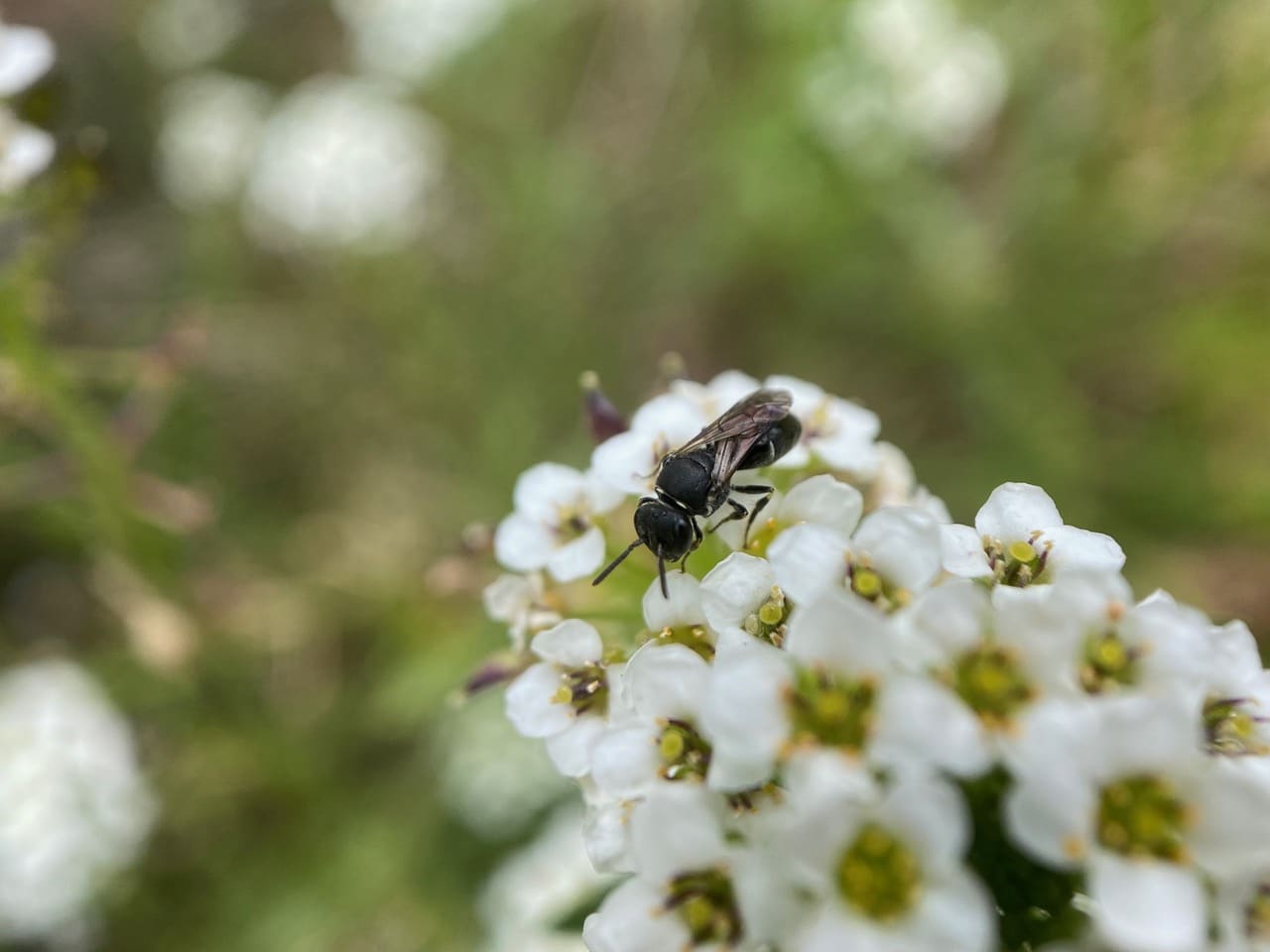
A Masked Bee, Hylaeus sp. (family Colletidae) is foraging on a cluster of Alyssum flowers.
Hylaeus (family Colletidae) are shiny, slender, hairless, and superficially wasp-like bees. They are small, 5 to 7 mm long, usually black with bright yellow or white markings on their face and legs. These markings are more pronounced on the males. Hylaeus do not carry pollen and nectar externally, they instead store their food in the crop and regurgitate it upon returning to their nests. They are primarily generalist foragers. Hylaeus are short-tongued, but their small body size enables them to access deep flowers. Hylaeus nest in stems and twigs, lining their brood cells with self-secreted cellophane-like material. They lack strong mandibles and other adaptations for digging, using instead pre-existing cavities made by other insects.