

Pollinator Post 7/22/25 (1)
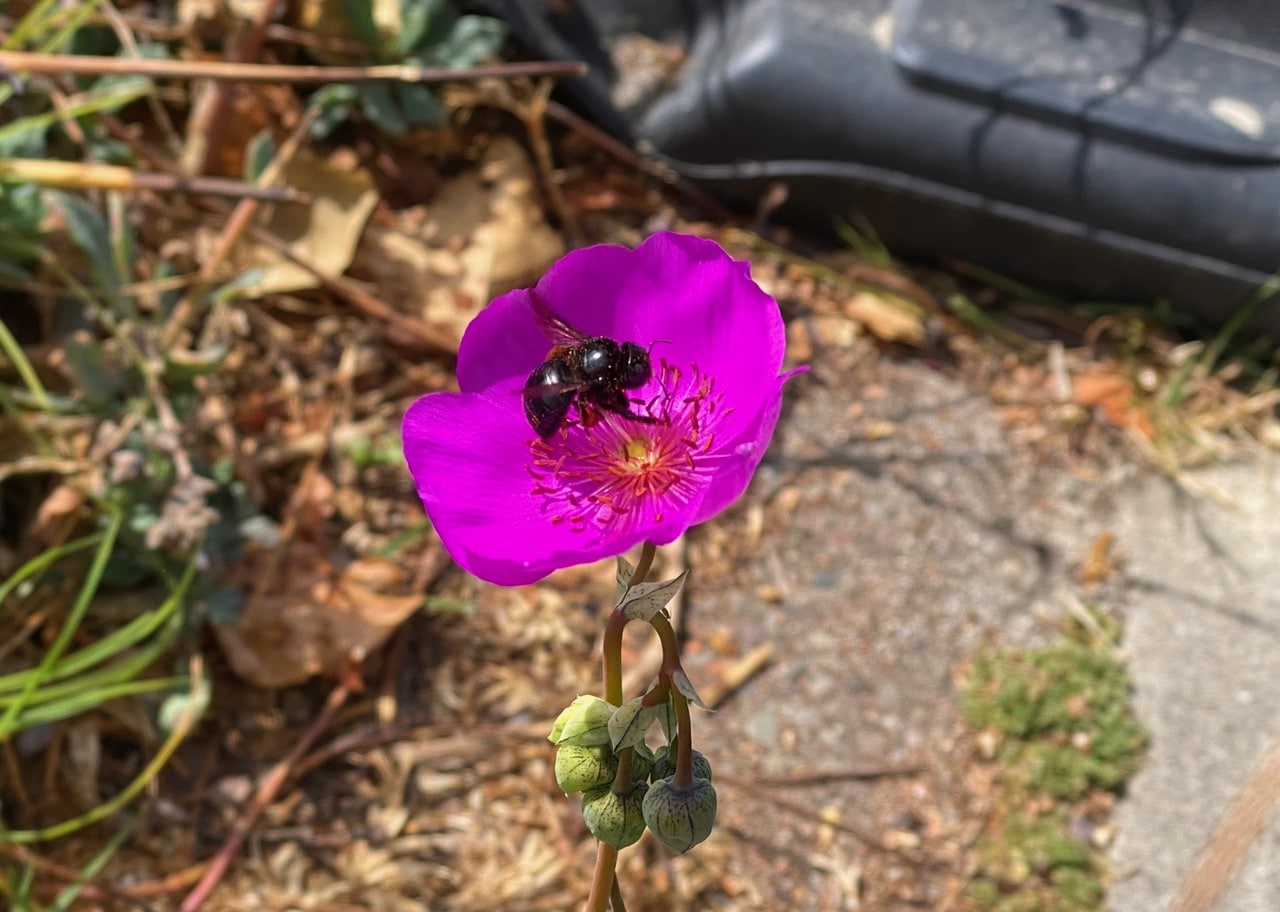
I am taking my walk in a leafy neighborhood in south eastern Alameda. Just about all plants in the gardens here are non-native ornamentals. I am curious to see what kind of insects live here.
The very first insect that crosses my path on the sidewalk is a large, glossy bee that is collecting red pollen from the brilliant magenta flowers of Calandrinia. It is a female Foothill Carpenter Bee, Xylocopa tabaniformis ssp. orpifex (family Apidae).
The common name “carpenter bees” derives from their nesting behavior; nearly all species burrow into hard plant material such as dead wood or bamboo. These robust bees are often mistaken for bumble bees. The simplest way to tell them apart is that most carpenter bees have a shiny abdomen, whereas bumble bees abdomens are completely covered with dense hair. Males of some species of carpenter bees have a white or yellow face, unlike bumble bees, while females lack the bare corbicula (pollen baskets) of bumble bees; the hind leg is entirely hairy and includes the scopa.
Carpenter Bees are traditionally considered solitary bees, though some species, including our Foothill Carpenter Bee, have simple social nests in which mothers and daughters may cohabit. Carpenter Bees make nests by tunneling into wood, bamboo and similar hard plant materials. They vibrate their bodies as they rasp their mandibles against the wood, each nest having a single entrance which may have many adjacent tunnels. The entrance is often a perfect circular hole measuring about 0.6in. on the underside of a beam, bench, or tree limb. Carpenter Bees do not eat wood; they discard the bits of wood, or reuse the sawdust to build partitions between cells. The tunnel functions as a nursery for brood and storage for the pollen/nectar upon which the brood subsists. Carpenter can be timber pests, and cause substantial damage to buildings.
Carpenter Bees have short mouthparts and are important pollinators on some open-faced or shallow flowers. They also are important pollinators of flowers with various forms of lids, such as Salvia species, and some members of the Fabaceae such as Lupinus. Many Carpenter Bees are known to “rob” nectar by cutting slits on the sides of flowers with deep corolla that they cannot enter. In doing so, the bees can access the nectar directly with their short tongue. This move precludes contact with the reproductive parts of the flower, and results in no pollination.
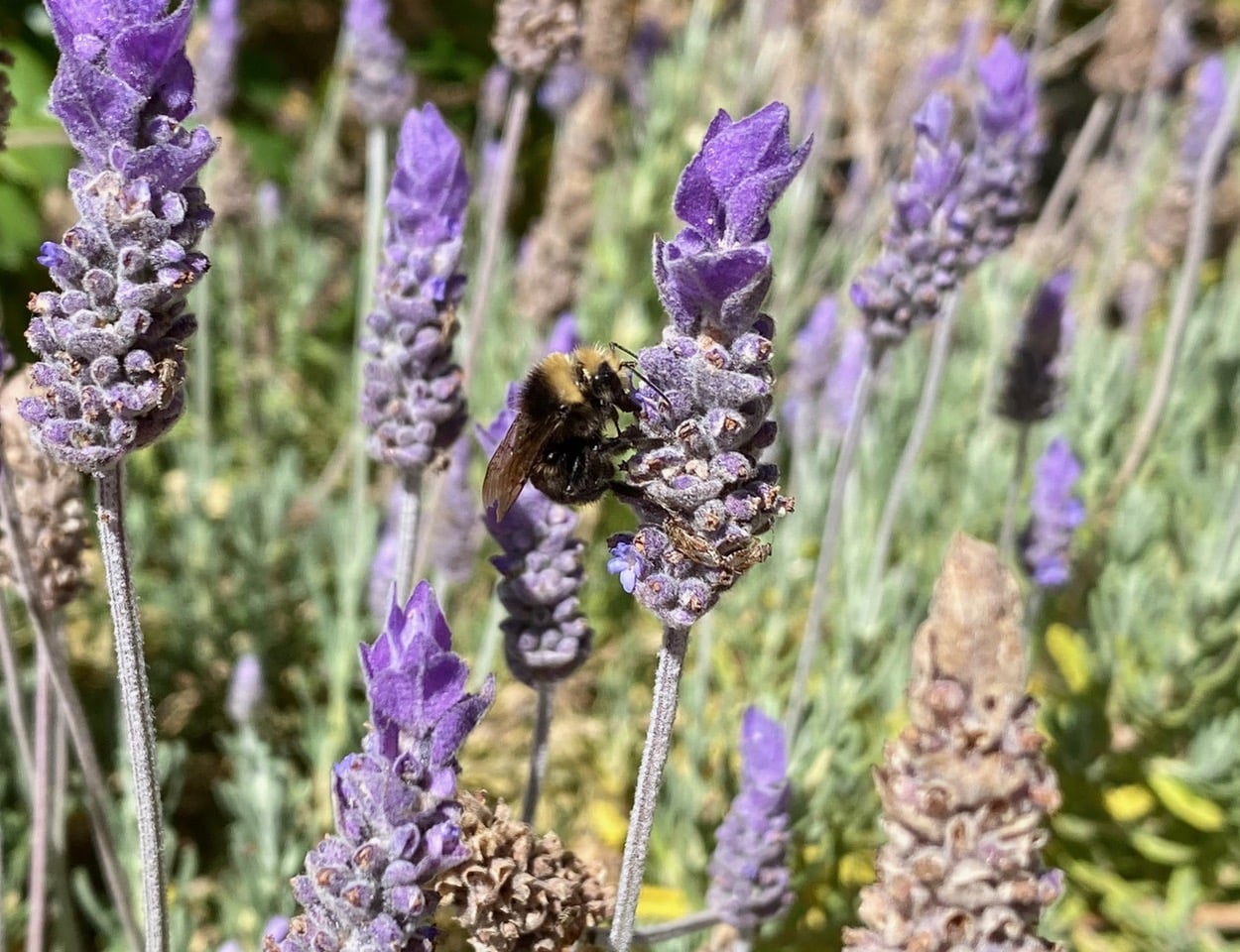
A male Yellow-faced Bumble Bee, subgenus Pyrobombus (genus Bombus, family Apidae) is seeking nectar from a flower spike of Topped Lavender, Lavandula stoechas. Male bees have longer antennae than their female counterparts, and in this bumble bee species, males tend to have more yellow bands on the abdomen. Males and new queens are usually produced by the bumble bee colony late in the season. After mating, the new queens are the only members of the hive to over-winter. They seek out safe sites to hibernate until next spring. The rest of the colony, including the old queen dies.

A male Fine Striped Sweat Bee, Agapostemon subtilior (family Halictidae) is foraging on a spike of lavender flowers. Note his long antennae, and his black-and-yellow striped abdomen.
Agapostemon are brightly colored metallic green or blue bees measuring 7 to 14.5 mm long. Most species have a metallic green head and thorax, and black-and-yellow striped abdomen; some females are entirely bright green or blue. Females carry pollen on scopal hairs located on their hind legs. Agapostemon are generalists. Like other members of the family Halictidae, they are short-tongued and thus have difficulty extracting nectar from deep flowers. Males are often seen flying slowly around flowers looking for females. The bees favor flowers with high densities. Females excavate nests in the ground. These are summer to fall bees.
Fine striped sweat bee (Agapostemon subtilior) · iNaturalist
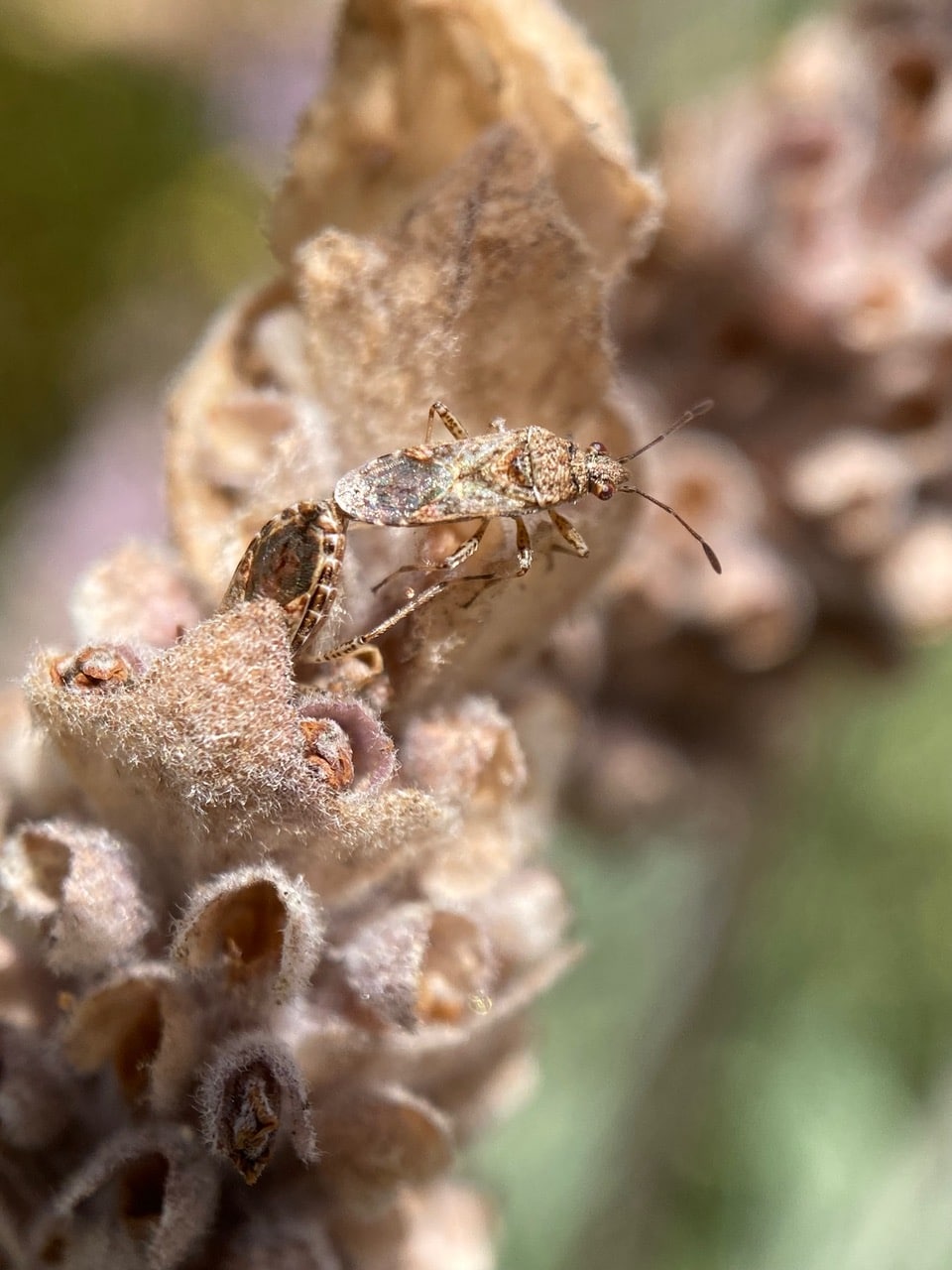
It takes me a while to see these tiny bugs on the dried lavender flower spikes. This is a mating pair, with the larger female half hidden in the seed pods. iNaturalist has helped identify the bugs as Scentless Plant Bugs, Arhyssus sp.(family Rhopalidae). It’s no wonder that they are here – these bugs are seed eaters.
Most species of Arhyssus are found in the western states, often in fields, weedy areas and savanna. The Rhopalidae are distinguished by many veins on the membranous portion of the forewings. They differ from coreids and other hemipterans in lacking functional scent glands. All are plant-feeders, usually on ripe seeds. Like other “true bugs” in the order Hemiptera, Rhopalids have piercing-sucking mouthparts that they use to extract plant tissues. They are able to feed on seeds by injecting digestive juices into the seeds and sucking up the digested contents as a liquid. The mouthparts, collectively called a rostrum, is folded under the body when not in use.
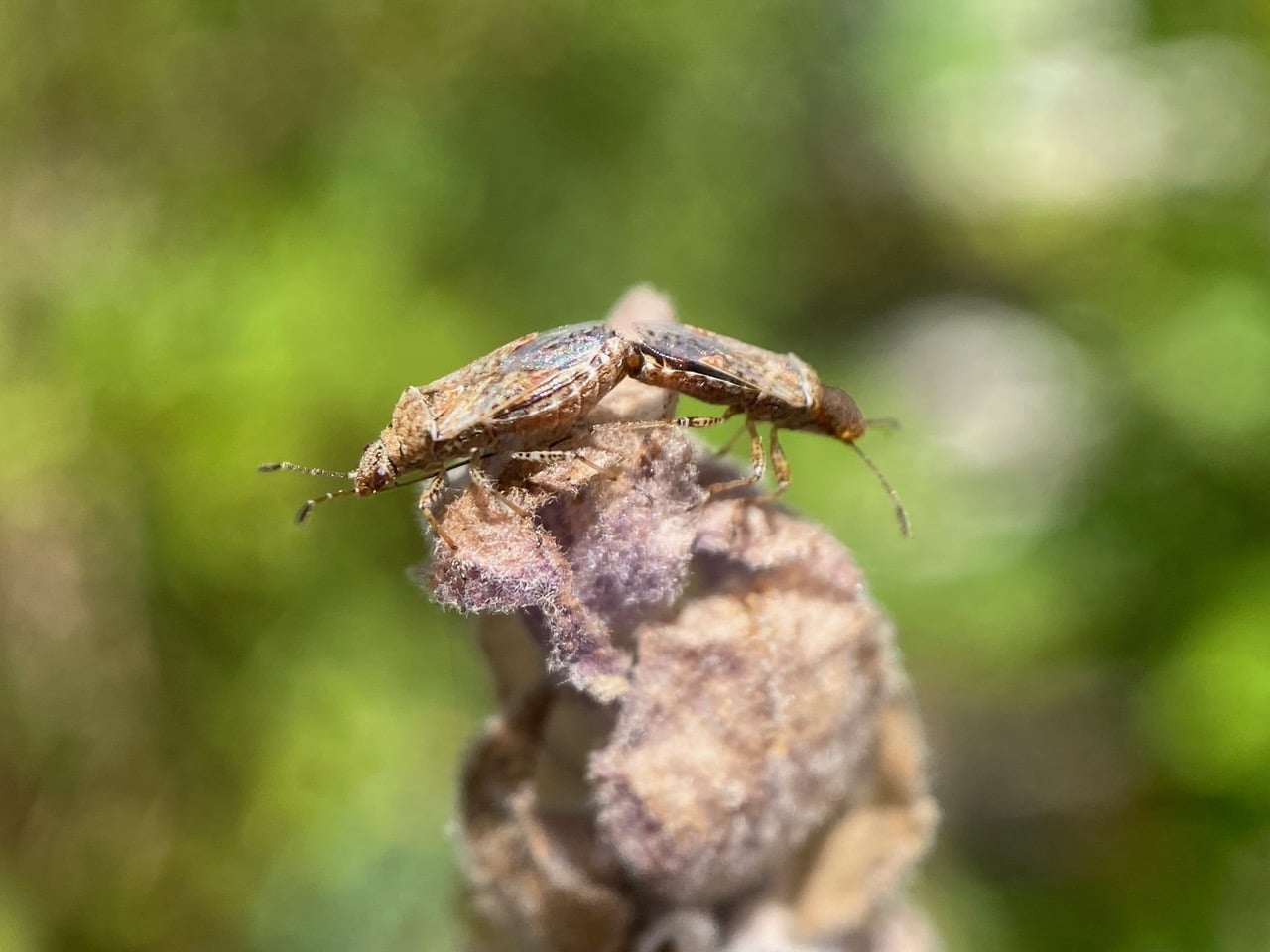
Here’s another mating pair of the Scentless Plant Bugs, Arhyssus sp. (family Rhopalidae). Note the needle-like rostrum or mouthparts of the female that is folded under her body.

Numerous male Summer Longhorn Bees, Melissodes sp. (family Apidae) are visiting the lavender flowers, but mostly the dried spikes. I wonder why? The bees would land further down on the spike and make their way up quickly before flying away to another spike. Are they scent-marking?

A female Summer Longhorn Bee, Melissodes sp. (family Apidae) is taking nectar from an inflorescence of Perez’s Sea Lavender, Limonium perezii.
The Summer Longhorn Bees, Melissodes sp. (family Apidae) are medium to large bees, stout-bodied, usually with gray/brown hair on the thorax and pale hair bands on the abdomen. Males usually have yellow markings on their faces and have very long antennae from which their common name is derived. They are active May to September, with peak flight in late June to early August. The females prefer flat, bare ground for digging their solitary nests, though they sometimes nest in aggregations. Pollen is transported in scopae on the hind legs. Pollen loads are often copious and brightly colored and thus very distinguishable. Melissodes are specialists on Asteraceae – females gather pollen from flowers of Aster, Bidens, Coreopsis, Cosmos, Encelia, Gaillardia, Helianthus, and Rudbeckia ssp.
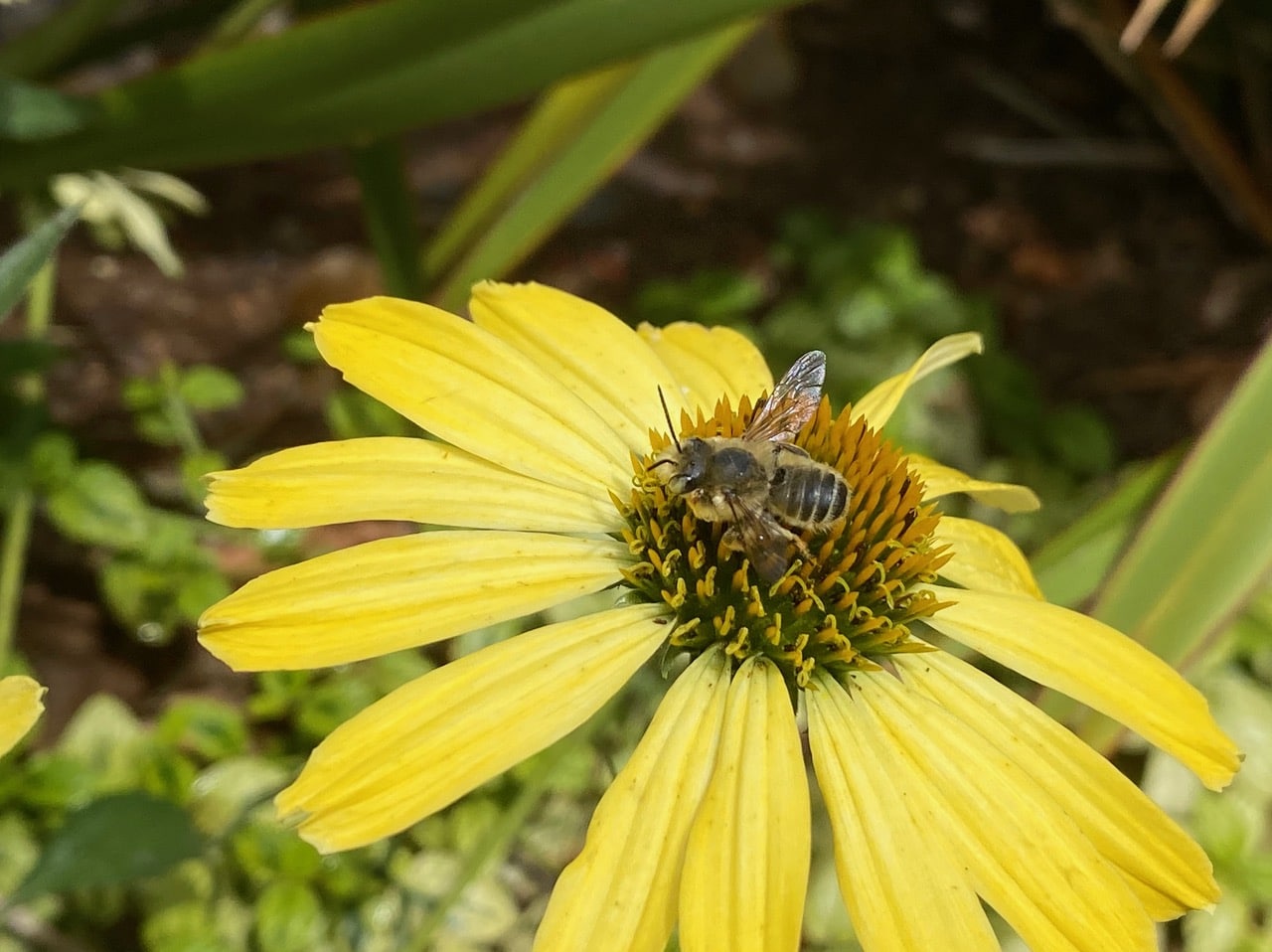
A male Western Leafcutter Bee, Megachile perihirta (family Megachilidae) is taking nectar from an unknown Asteraceae.
The family Megachilidae includes some of our charismatic bees such as the Leafcutter Bees (Megachile), the Mason Bees (Osmia), and the Woolcarder Bees (Anthidium). Their common names reflect the materials with which the bees build their nest cells (leaves, soil, plant fibers respectively). The scientific name Megachilidae translates as “large lipped” in Greek, referring to their large lips and strong jaws that are well-suited for collecting of nest-building materials. The family represents 15-20% of named species of bees. Most build their nests in above-ground cavities; they all are solitary bees. Characteristic traits of this family are their typically elongated labrum, and the way the females carry pollen – in a scopa (special pollen-collecting hairs) on the underside of the abdomen. (The labrum, often called the “upper lip”, is a flap-like structure that helps hold food in place during feeding. It is located at the front of the insect’s head, above the mouth opening.) The motion of Megachilidae in pollen gathering is energetic and swimming-like; this agitation releases large amounts of pollen from the flower’s reproductive structures.
Because they are mostly above-ground nesters and more easily attracted to artificial nests, megachilid bees (especially Osmia) are extensively studied for their commercial possibilities.
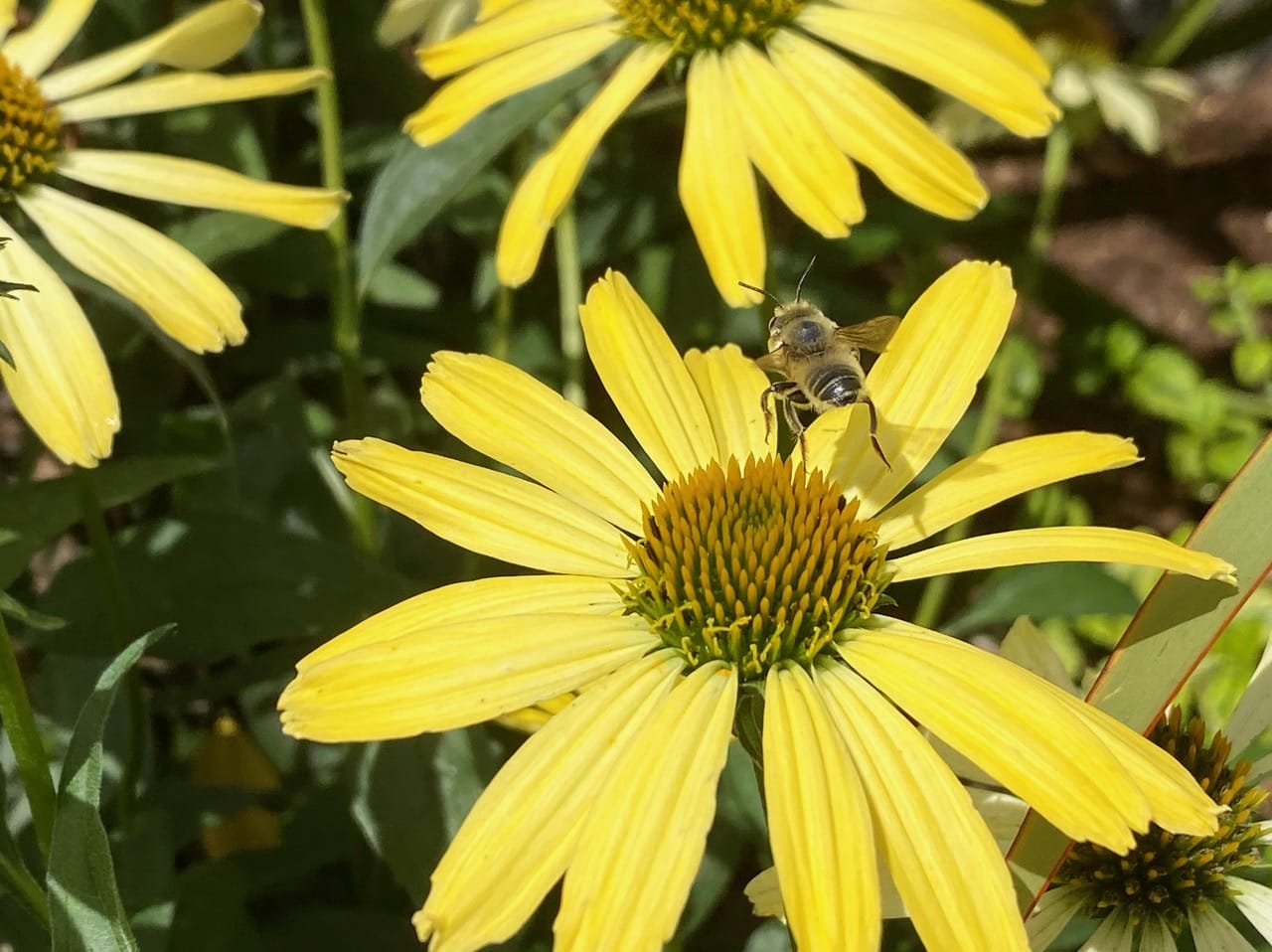
Leaf-cutter Bees, Megachile sp. (family Megachilidae) are stout-bodied, usually with pale hair on the thorax and stripes of white hairs on the abdomen. Females usually have a triangular abdomen with a pointed tip, and males’ faces are covered with dense, pale hair. Flight season is from May into September, with peak activity from June to August.
Solitary females construct nests in tubular cavities, including hollow stems, tree holes, and abandoned beetle burrows in wood. Many use holes drilled into wood, straws, or other manufactured tunnels. Females cut pieces from leaves or flower petals for use in the construction of brood cells. Most Megachile females are generalists when foraging for pollen. Pollen is transported in dense scopae on the underside of the abdomen.
Photos of Western Leafcutter Bee (Megachile perihirta) · iNaturalist
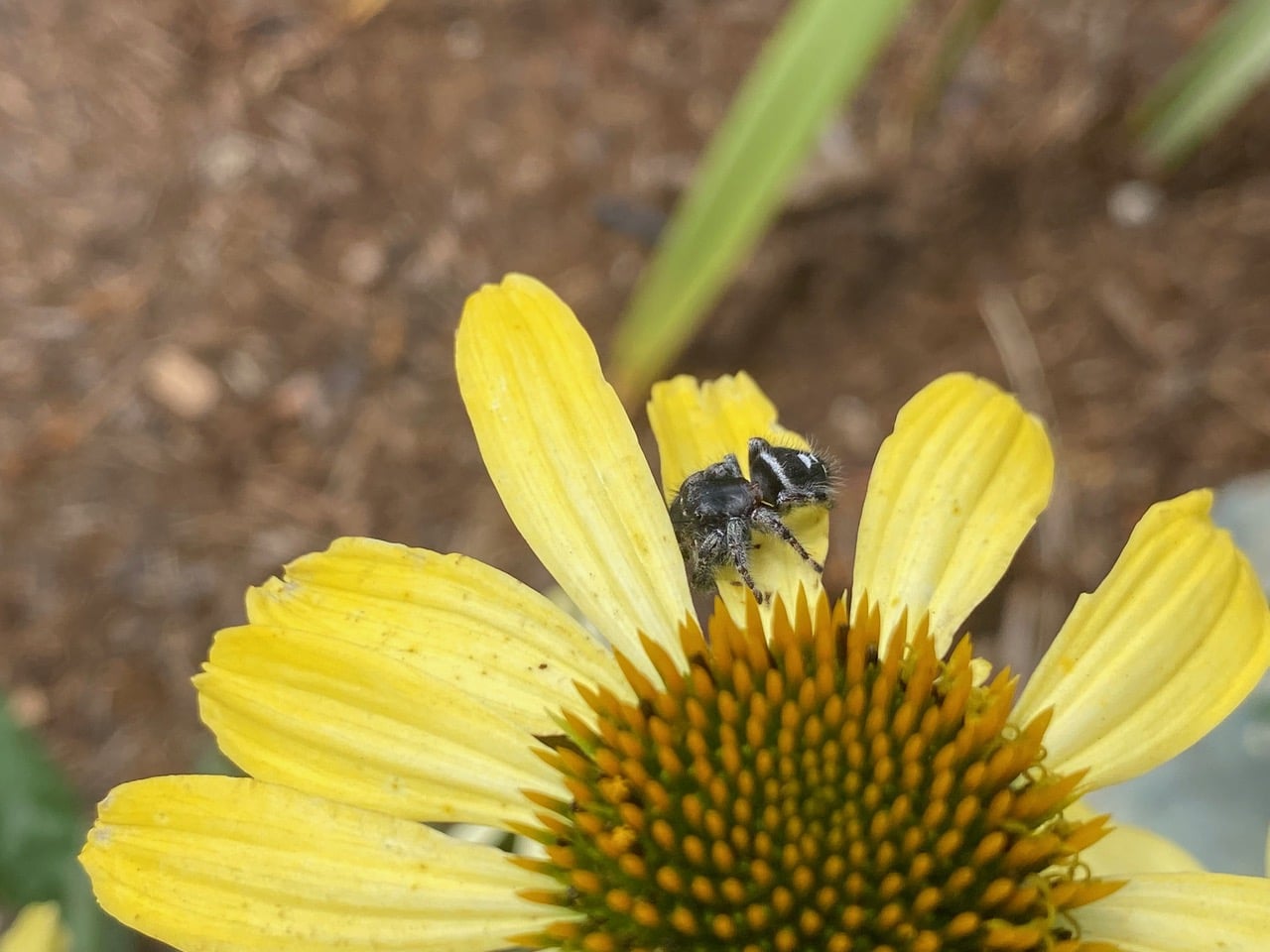
A large black Jumping Spider (family Salticidae) is lurking on a ray petal of an unidentified Asteraceae flowerhead.
Jumping spiders (family Salticidae) are free-roaming hunting spiders. They do not weave a web to catch prey. They stalk, then pounce on their prey. Just before jumping, the spider fastens a safety line to the substrate. It can leap 10-20 times their body length to capture prey. Their movement is achieved by rapid changes in hydraulic pressure of the blood. Muscular contractions force fluids into the hind legs, which cause them to extend extremely quickly. Jumping spiders are visual hunters. Their excellent vision has among the highest acuities in invertebrates. Since all their 8 eyes are fixed in place and cannot pivot independently from the body like human eyes can, jumping spiders must turn to face whatever they want to see well. This includes moving their cephalothorax up and down, an endearing behavior.

iNaturalist has helped identify it as a Bold Jumping Spider, Phidippus audax (family Salticidae).

The spider spins around to face me, an endearing behavior typical of these bold and intelligent spiders. Its pair of iridescent blue chelicerae is partially covered by her hairy pedipalps. The chelicerae are articulated fangs that are hollow and contain venom glands, used to inject venom into prey. The pedipalps are jointed appendages, much like small legs. They are used by the spider to sense objects, shape their webs, and to aid in prey capture and feeding. In male spiders, the pedipalps are also used to deliver sperm during mating.
Jumping spiders have excellent vision, with among the highest acuities in invertebrates. The 8 eyes are grouped four on the face (the two big Anterior Median Eyes in the middle, and two smaller Anterior Lateral eyes to the side), and four on top of the carapace. The anterior median eyes provide high acuity but small field of view, while the other six eyes act like our peripheral vision, with lower resolution but broad field of view. Since all eight eyes are fixed in place and can’t pivot independently from the body like human eyes can, jumping spiders must turn to face whatever they want to see well. This includes moving their cephalothorax up and down, an endearing behavior.

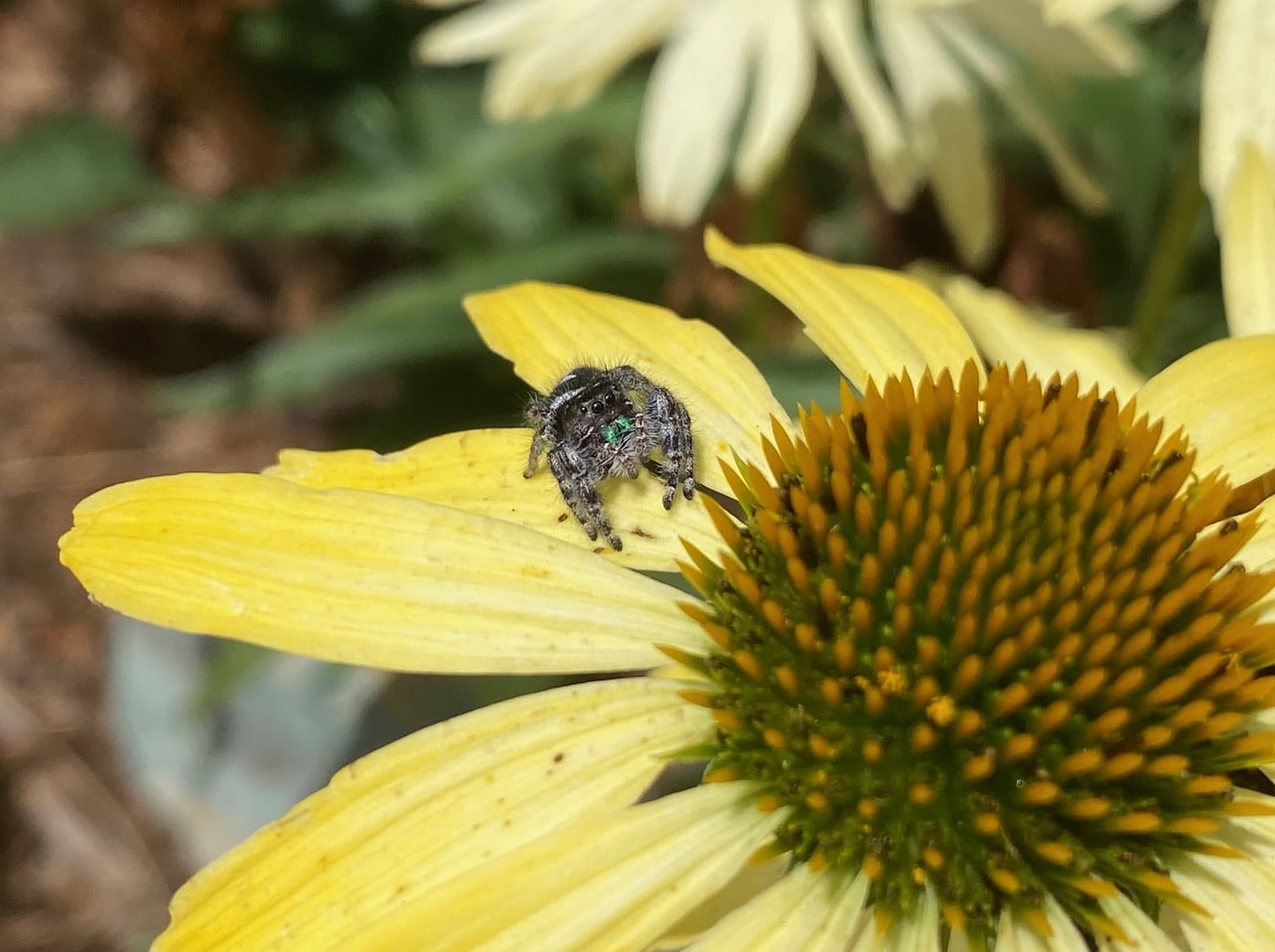
The genus Phidippus comprises some of the largest jumping spiders, and many species are characterized by their brilliant, iridescent green chelicerae. Phidippus is distributed almost exclusively in North America.
Phidippus audax (family Salticidae) is commonly referred to as Bold Jumping Spider. The species name, audax, is a Latin adjective meaning “audacious” or “bold”. These spiders are commonly found in grasslands, chaparrals, open woodlands, and agricultural fields. It is one of the most commonly occurring spider species within its range and is often found living in close proximity to humans. The adult female ranges from 8-15 mm in body length; the smaller males range from 6-13 mm. They are typically black with an ovoid abdomen and round cephalothorax. The presence of a large triangular white spot in the center of the abdomen with two smaller spots below it is often used to distinguish this species. These spiders are diurnal hunters, using their excellent eyesight for hunting, courtship and observational learning. They are often found hunting on fence posts and plant leaves, stems, and branches. At night, they hide in a crevice or small cavity and make a silk retreat to avoid predators. Bold jumpers prey on a variety of insects including caterpillars, dragonflies and grasshoppers, and other spiders. The species overwinters as immatures in sac-like silk shelters hidden underneath rocks and bark. Spiders emerge in the spring to complete their final molts, mating in late spring and early summer.
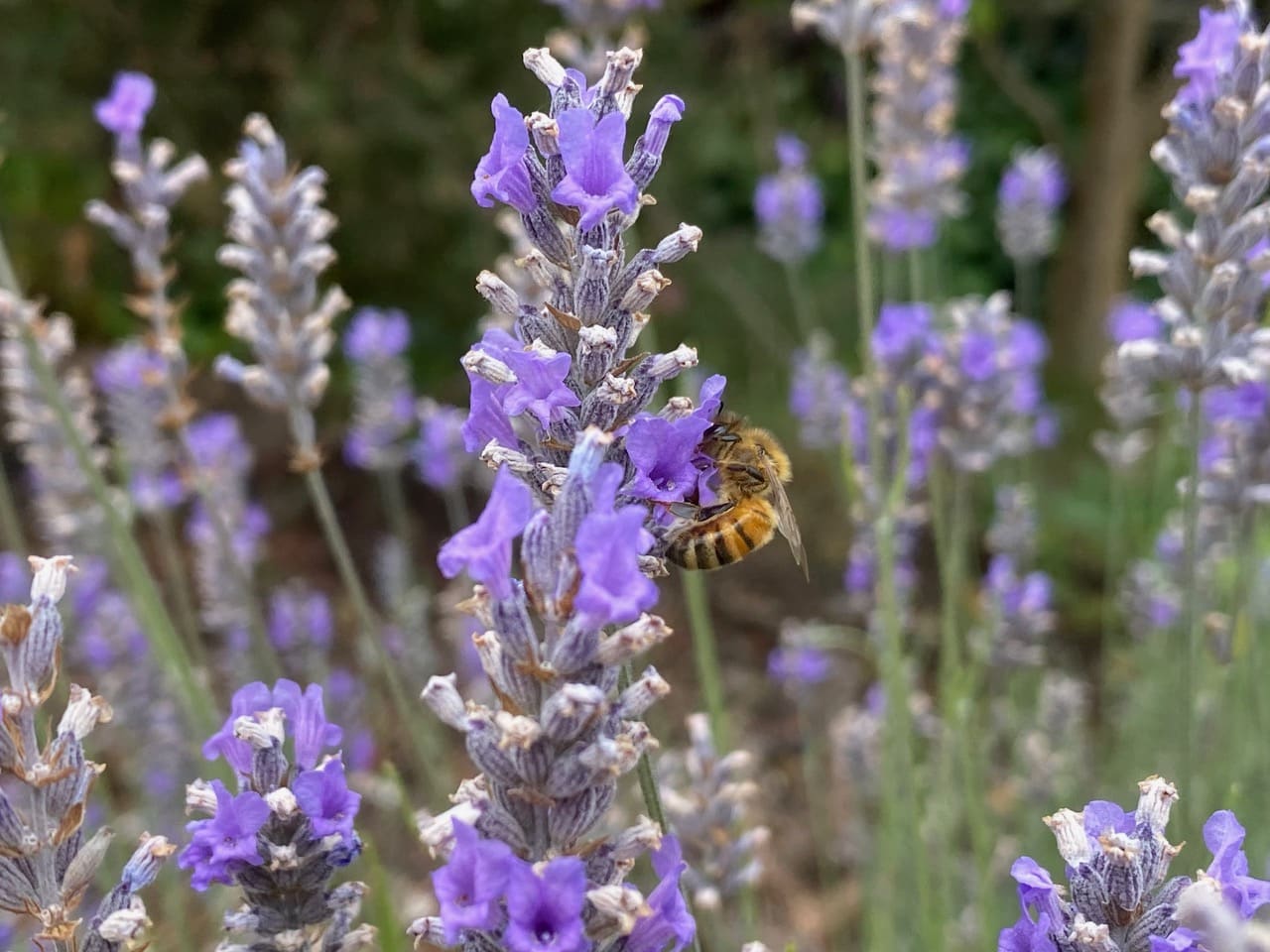
A Honey Bee, Apis mellifera (family Apidae) is taking nectar from a flower of Common Lavender, lavandula angustifolia.
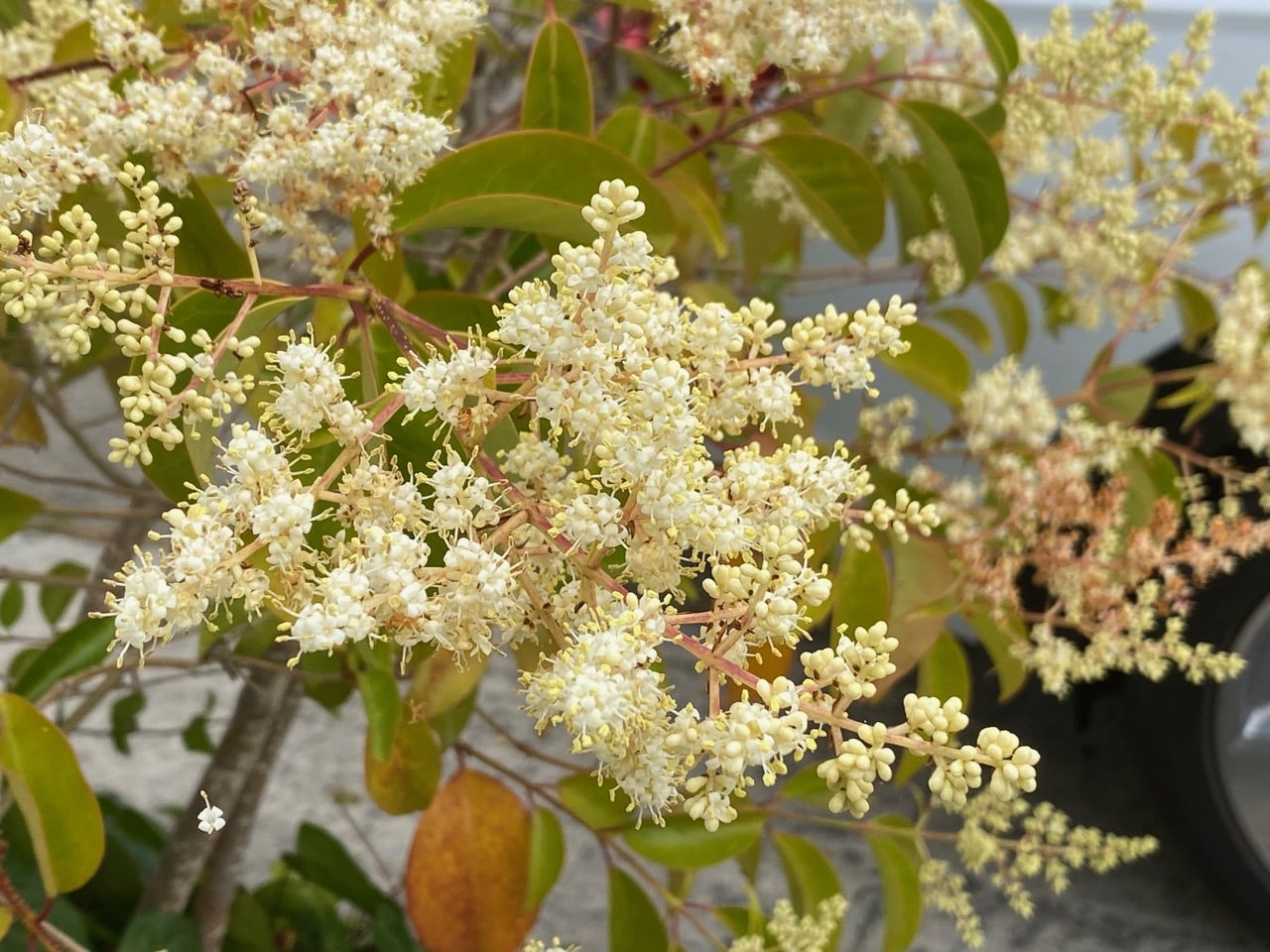
A Tree Privet, Ligustrum lucidum (family Oleaceae) is blooming profusely on a sidewalk strip. From a distance it resembles our native Ocean Spray, Holodiscus discolor in the structural arrangements of its inflorescence.
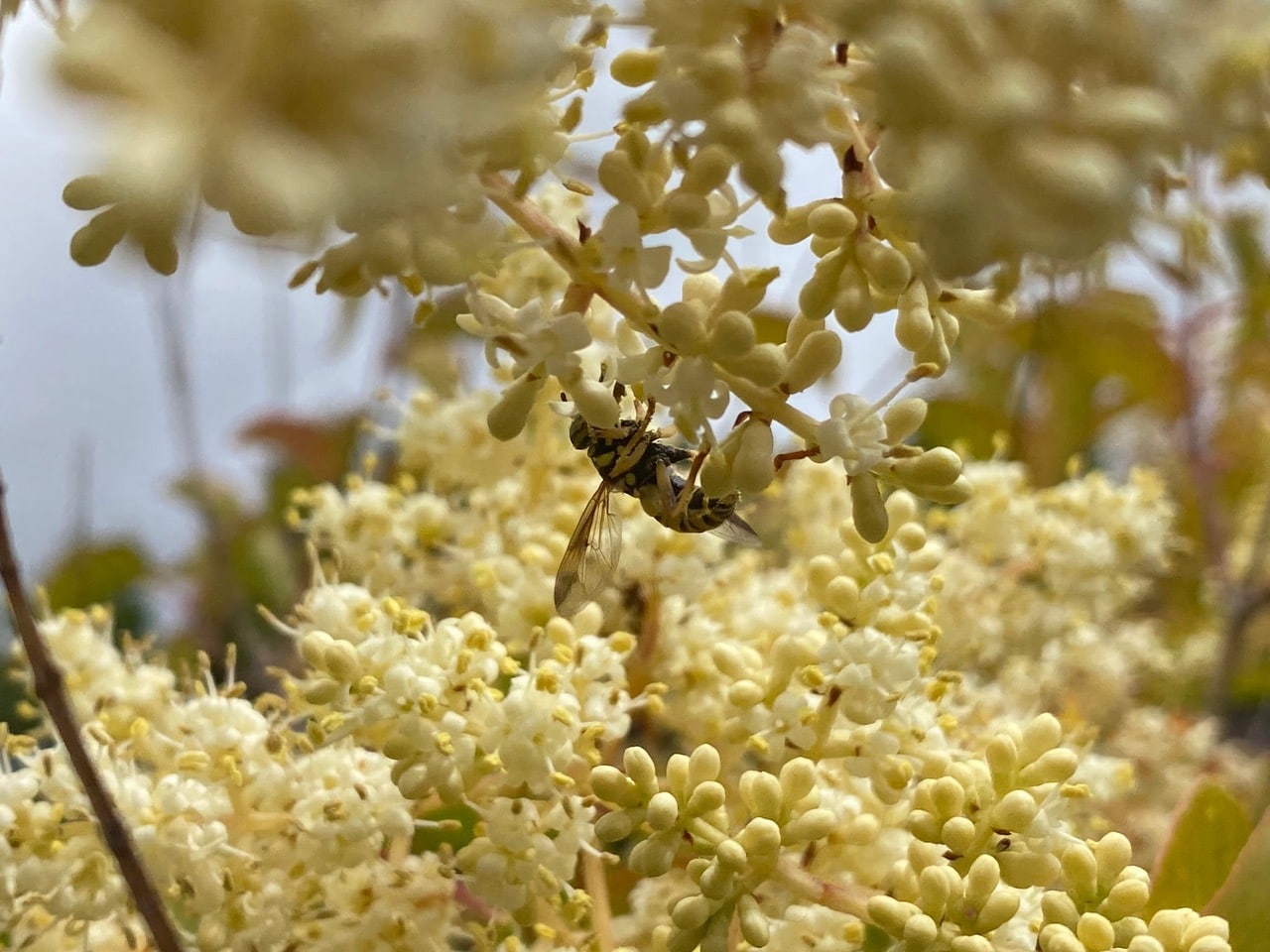
Much to my frustration, a Yellowjacket-like insect is foraging on the flowers on the higher branches of the Tree Privet, out of my reach. From its behavior, I gather that it is not a Yellowjacket wasp, but its deadringer, the Interrupted Hornet Fly, Spilomyia interrupta (family Syrphidae).
Many Syrphid flies mimic Hymenoptera (bees and wasps) species. Spilomyia is a remarkable mimic of Vespid species including Yellowjacket wasps. They mimic Yellowjackets both physically as well as behaviorally. The yellow-and-black outfit is only a start. The anterior portion of the forewings of Spilomyia are a darker brown than the rest of the wings, reminiscent of the Yellowjackets that fold their wings longitudinally at rest. The fly has a habit of resting on their back four legs and moving their two front black legs above their head, mimicking the way common wasps move their antennae. When threatened, the fly is able to produce a buzz in a frequency similar to some hymenopteran species. What’s more, Spilomyia is active during the same time of year as its model wasp, and frequently visits the same plants.
Adult Hornet Flies are often seen on flowers seeking nectar and pollen. Larvae develop in rot holes in live trees. These damp environments provide a food source as well as protection for the larvae.
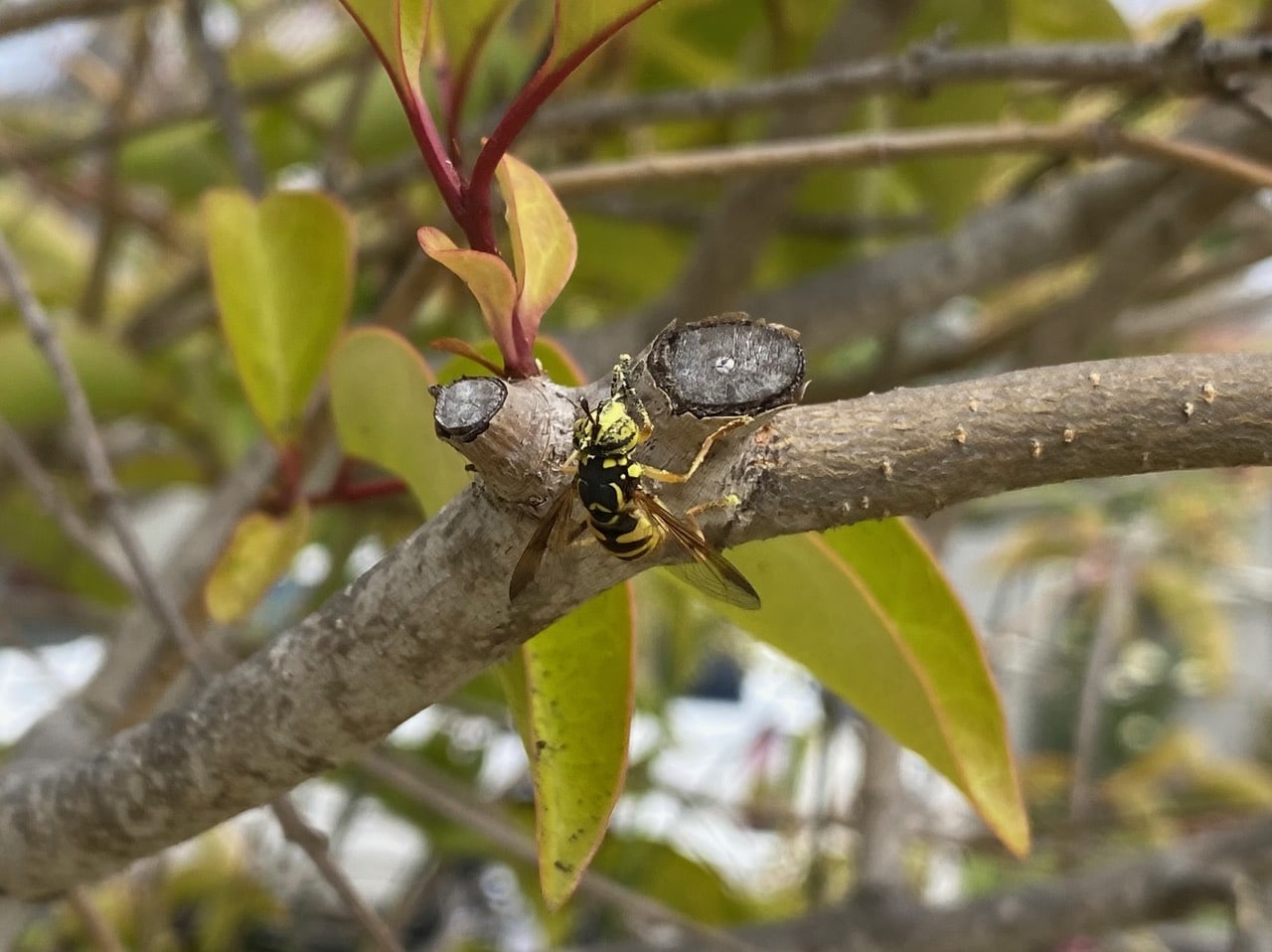
The hover fly finally comes down to groom itself on a lower branch where I can see it clearly. Again, it engages in that odd behavior of swinging its wings from side to side – something I never see a Yellowjacket do. I switch my camera to video mode to record the behavior.
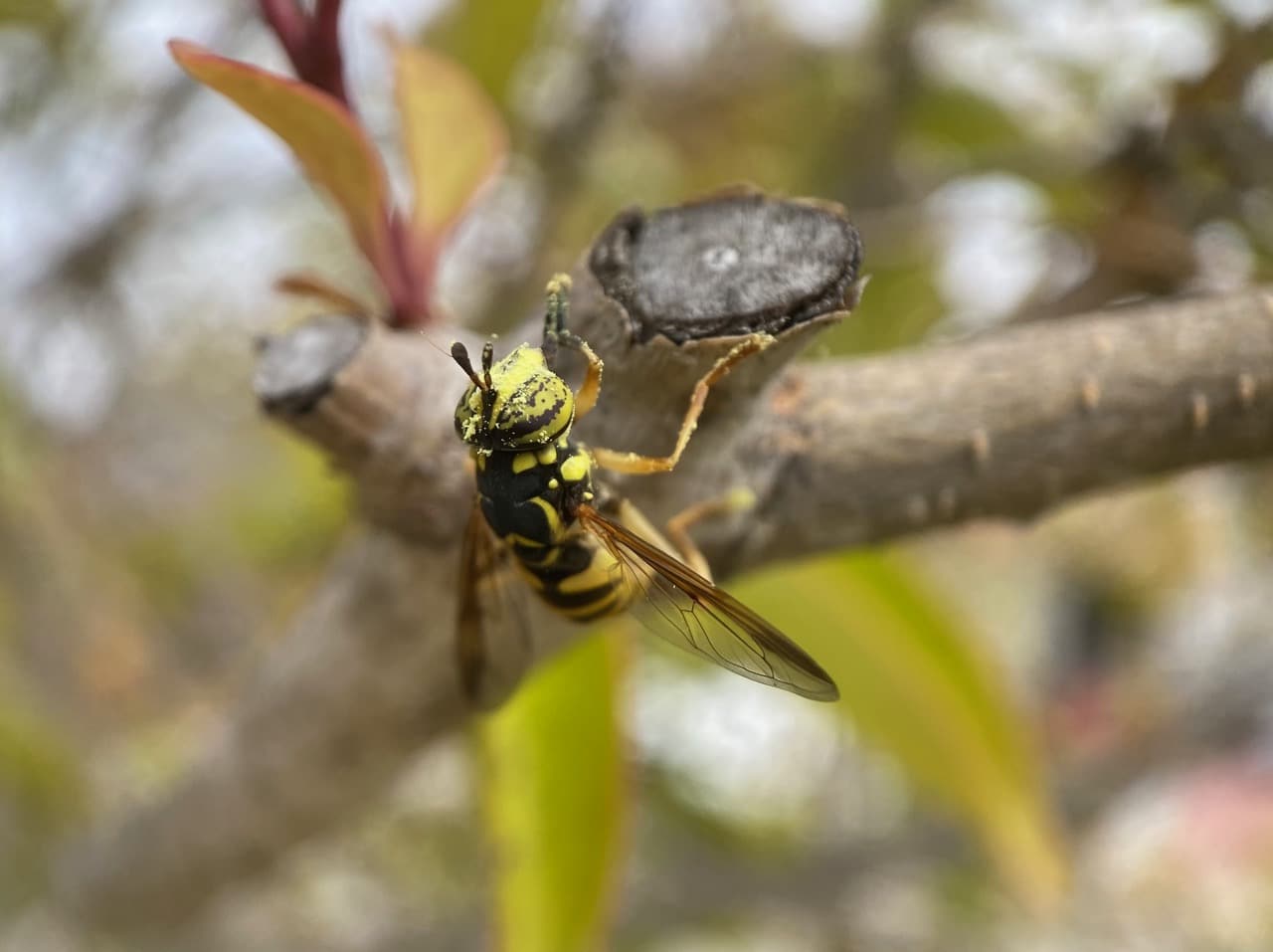
The other feature that distinguishes the Hornet Fly from a real Yellowjacket is its eyes, which are yellow patterned with black spots. The fly’s face and eyes are covered with the sticky pollen of Privet flowers.
Pollenkitt is a sticky covering found on the surface of pollen grains. It is also sometimes called “pollen coat”. It is found in some plant families more often than others, but it is especially common in plants that are pollinated by insects. Because of this scientists believe that one of the major functions of pollenkitt is to help the pollen stick to the insect pollinators. The pollen from many wind-pollinated plants, such as grass, is much drier and not nearly so sticky. The insects benefit from lots of pollen that is easy to carry home. What’s more, pollenkitt contains lipids, proteins, and phenolic compounds that are important to bee health. For the plant, pollenkitt may prevent the pollen from blowing away or drying out, or it may protect the pollen from ultra-violet radiation and certain pathogens.
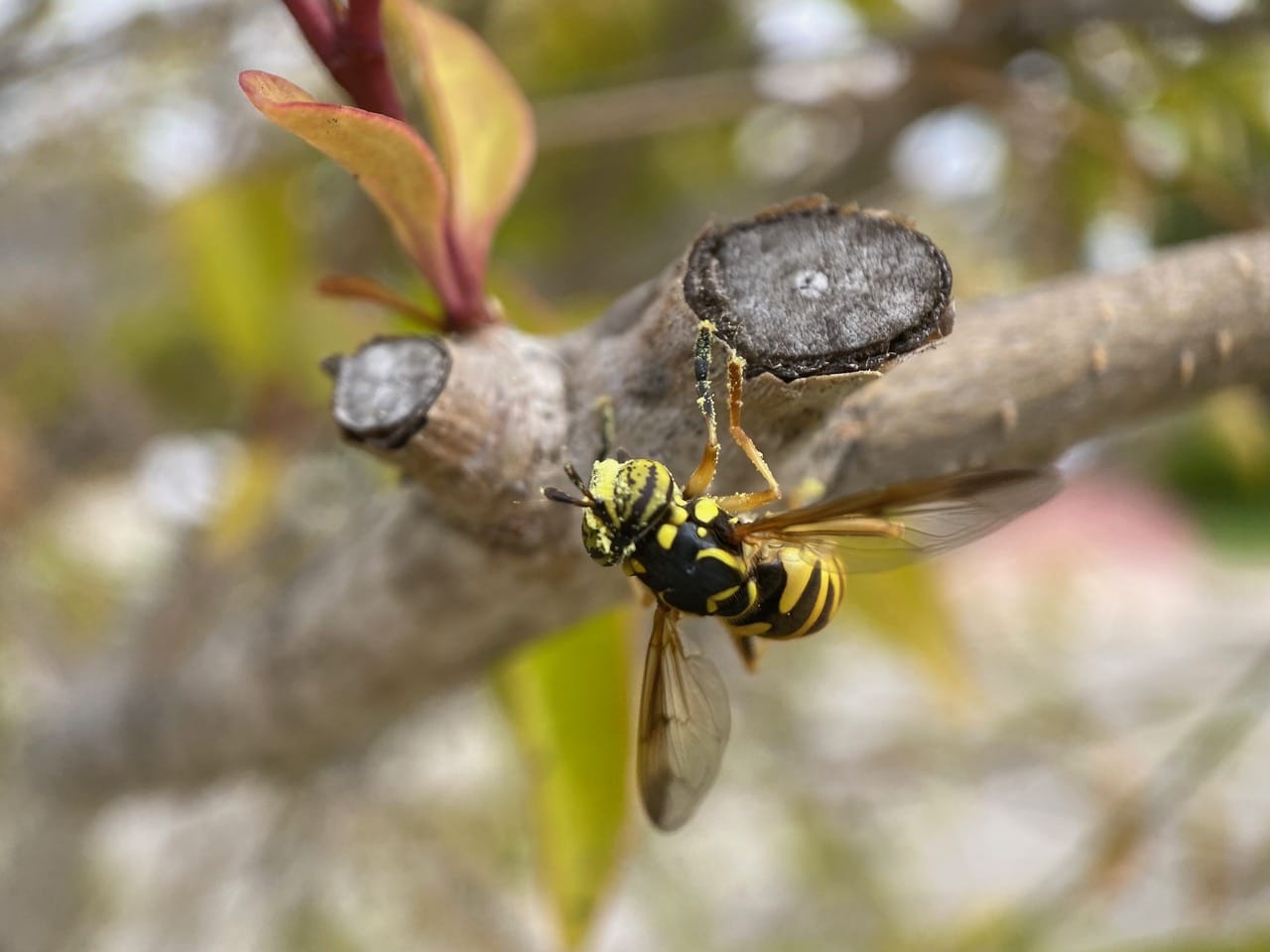
Many hover flies resemble wasps with their yellow and black stripes. This is a form of Batesian mimicry wherein a harmless species has evolved to imitate the warning signals of a harmful species to deter their mutual predators. The term is named after the English naturalist Henry Walter Bates, who worked on butterflies in the rainforests of Brazil. For Batesian mimicry to work, the model species (e.g. the wasp) must be relatively common and easily found by predators, and the mimic species (hover fly) must be less common than the model species. Both model and mimic must occur in the same habitat and are active in the same season.
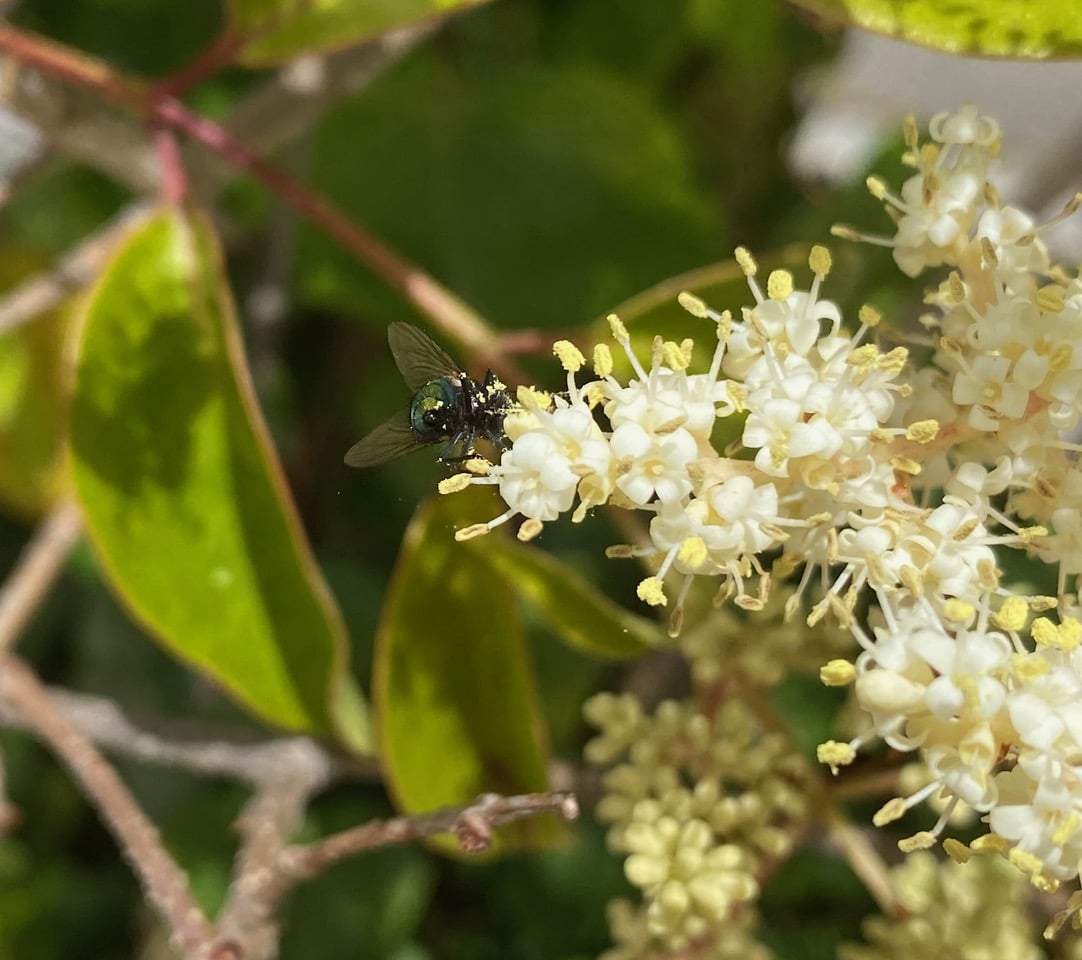
Covered with pollen, a Common European Greenbottle fly, Lucilia sericata (family Calliphoridae) is foraging on an inflorescence of the Tree Privet.
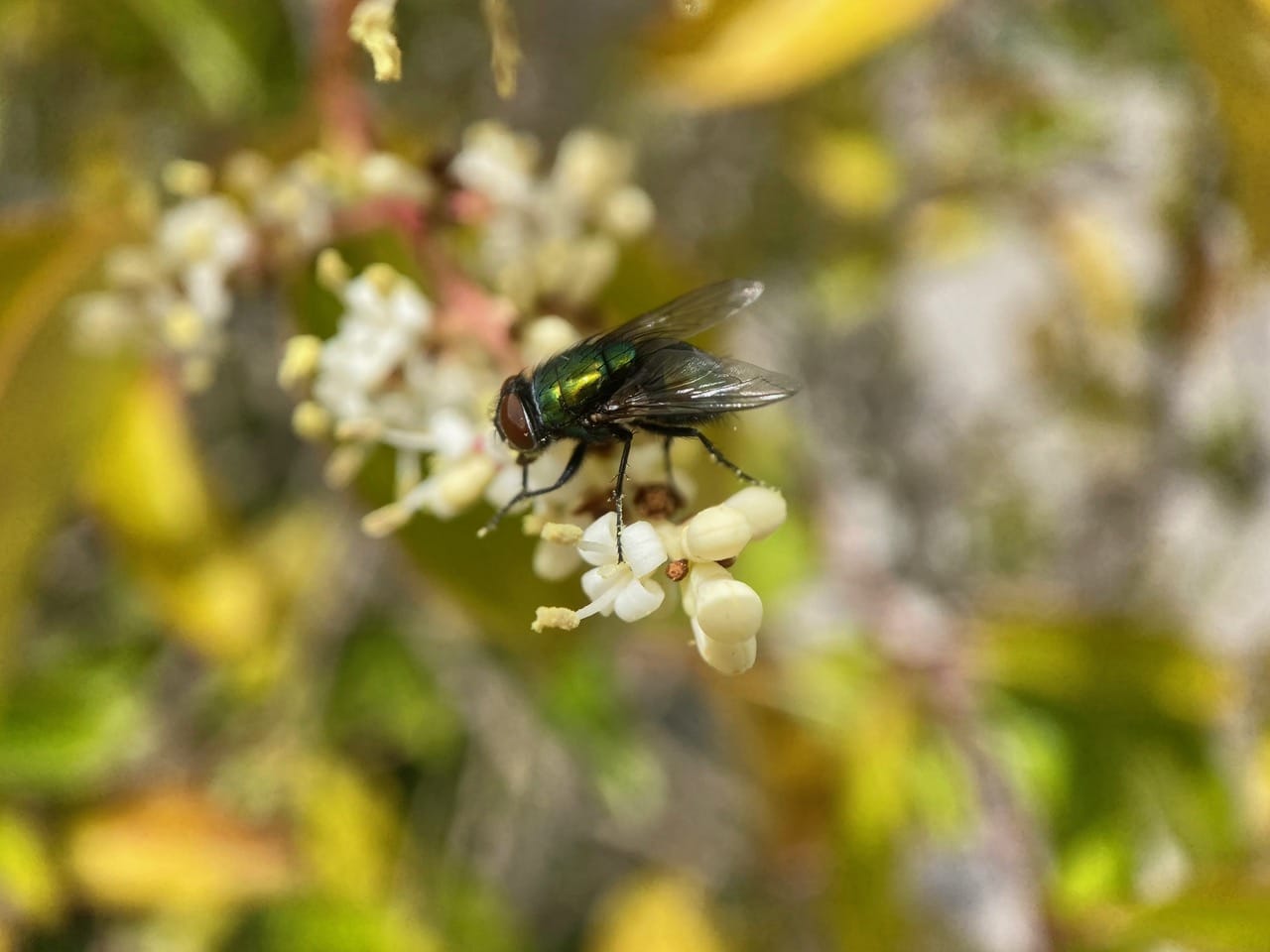
The Common European Greenbottle Fly is a Blowfly found in most areas of the world and is the most well-known of the numerous green bottle fly species. The lifecycle of Lucilia sericata is typical of blowflies. Females lay masses of eggs in fresh carrion. The flies are extremely prolific – a single female may produce 2,000 to 3,000 eggs in her lifetime. The larvae feed on dead or necrotic tissue, passing through 3 larval instars. Third-instar larvae drop off the host to pupate in the soil. The adults feed opportunistically on nectar, pollen, feces, or carrion; they are important pollinators as well as important agents of decomposition. Pollen is used as an alternative protein source, especially for gravid females who need large amounts of protein and cannot reliably find carrion.
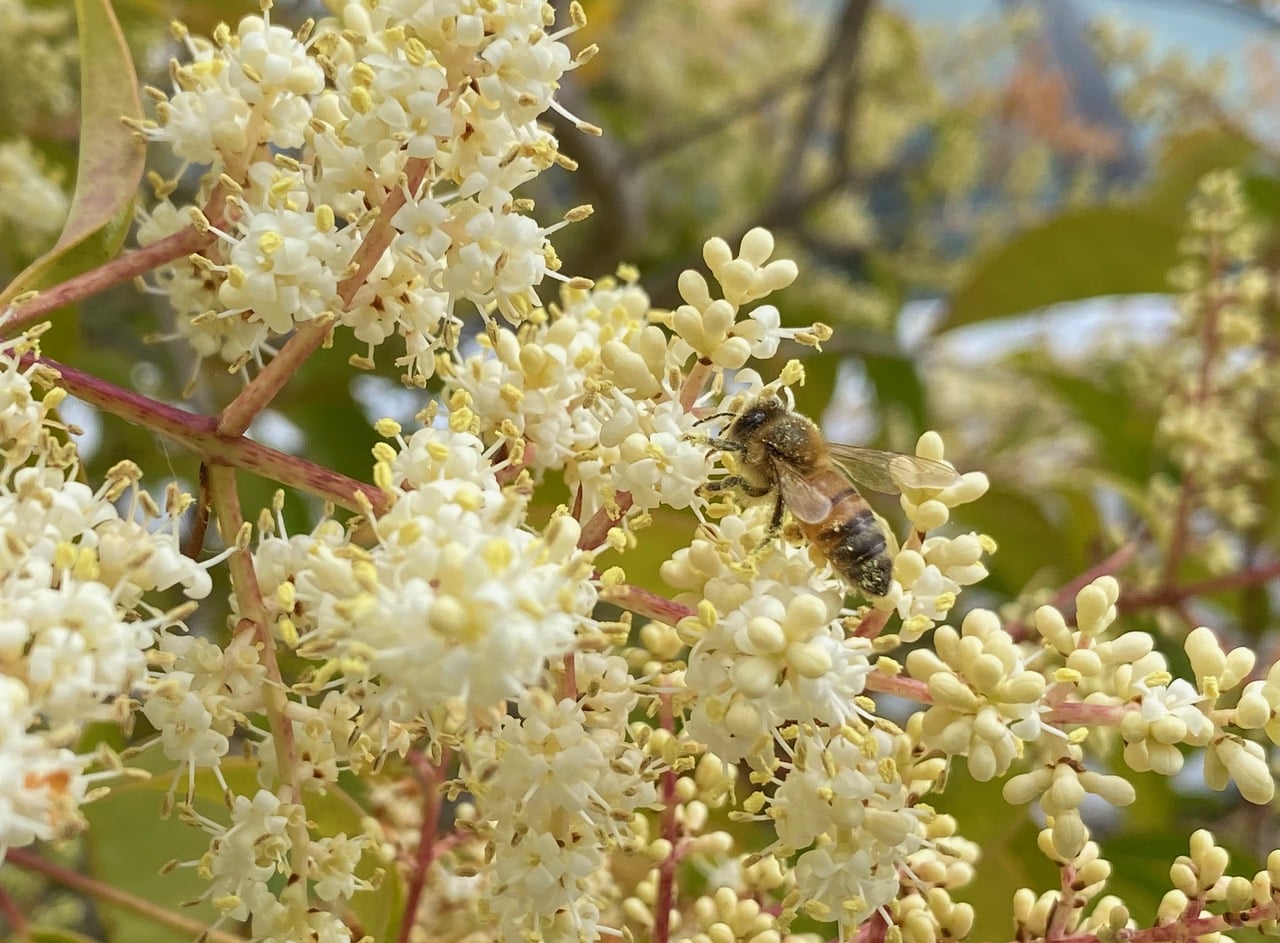
So prolific is the pollen production of the Tree Privet that this foraging Honey Bee, Apis mellifera (family Apidae) is covered with its sticky pollen.

A Thick-legged Hover Fly, Syritta pipiens (family Syrphidae) is foraging on the flowers of Tree Privet.
Syritta pipiens originates from Europe and is currently distributed across Eurasia and North America. They are fast and nimble fliers. The fly is about 6.5 – 9 mm long. The species flies at a very low height, rarely more than 1 m above the ground. Adults visit flowers – males primarily to feed on nectar, and females to feed on protein-rich pollen to produce eggs. The species is found wherever there are flowers. It is also anthropophilic, occurring in farmland, suburban gardens, and urban parks. Larvae are found in wetlands that are close to bodies of freshwater such as lakes, ponds, rivers, ditches. Larvae feed on decaying organic matter such as garden compost and manure. Males often track females in flight, ending with a sharp dart towards them after they have settled, aiming to attempt forced copulation.