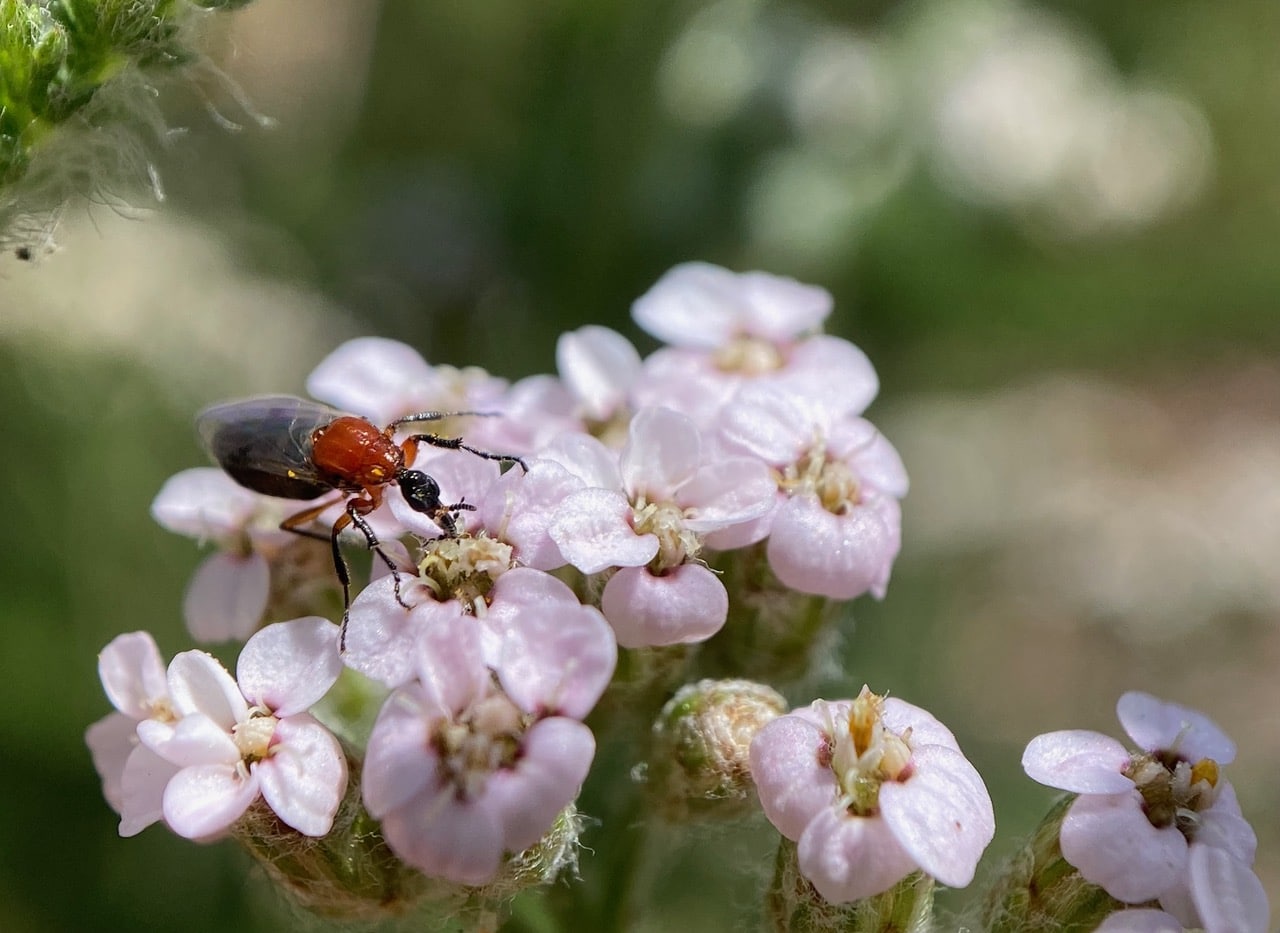
Pollinator Post 7/2/26

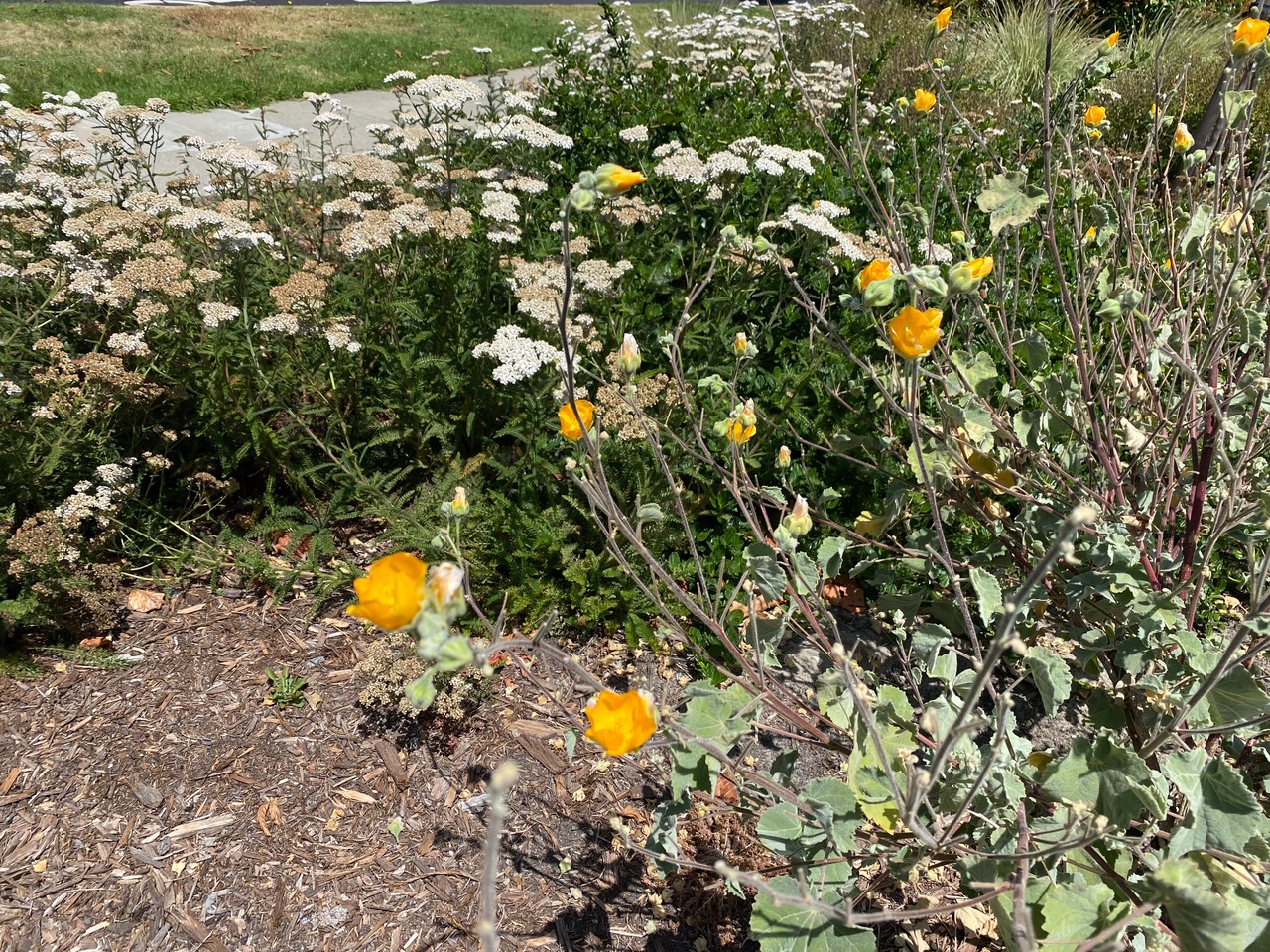
After dropping Fred off at Shoreline Park in Bay Farm for his walk, I decide to visit a garden nearby on Aughinbaugh Way. Passing it several times previously I have noticed many California native plants in the garden, rather unusual for Alameda in general. About the size of a single home lot, the garden is bisected by a path linking two streets in this upscale neighborhood. The slightly sloping ground has been planted with several mature Ceanothus, a couple of Manzanita, Toyon, and Coyote Brush. There are a couple of plants I don’t recognize and the bunch grasses don’t look familiar. A few non-native Salvias are at the end of their bloom.





A plaque on the ground issues a stern warning, not exactly friendly. Surely no one would mind if I looked at insects here?
The only plants in bloom now are the extensive stand of Yarrow, Achillea millefolium and a Palmer’s Indian Mallow, Abutilon palmeri. I will have to be content with these today.
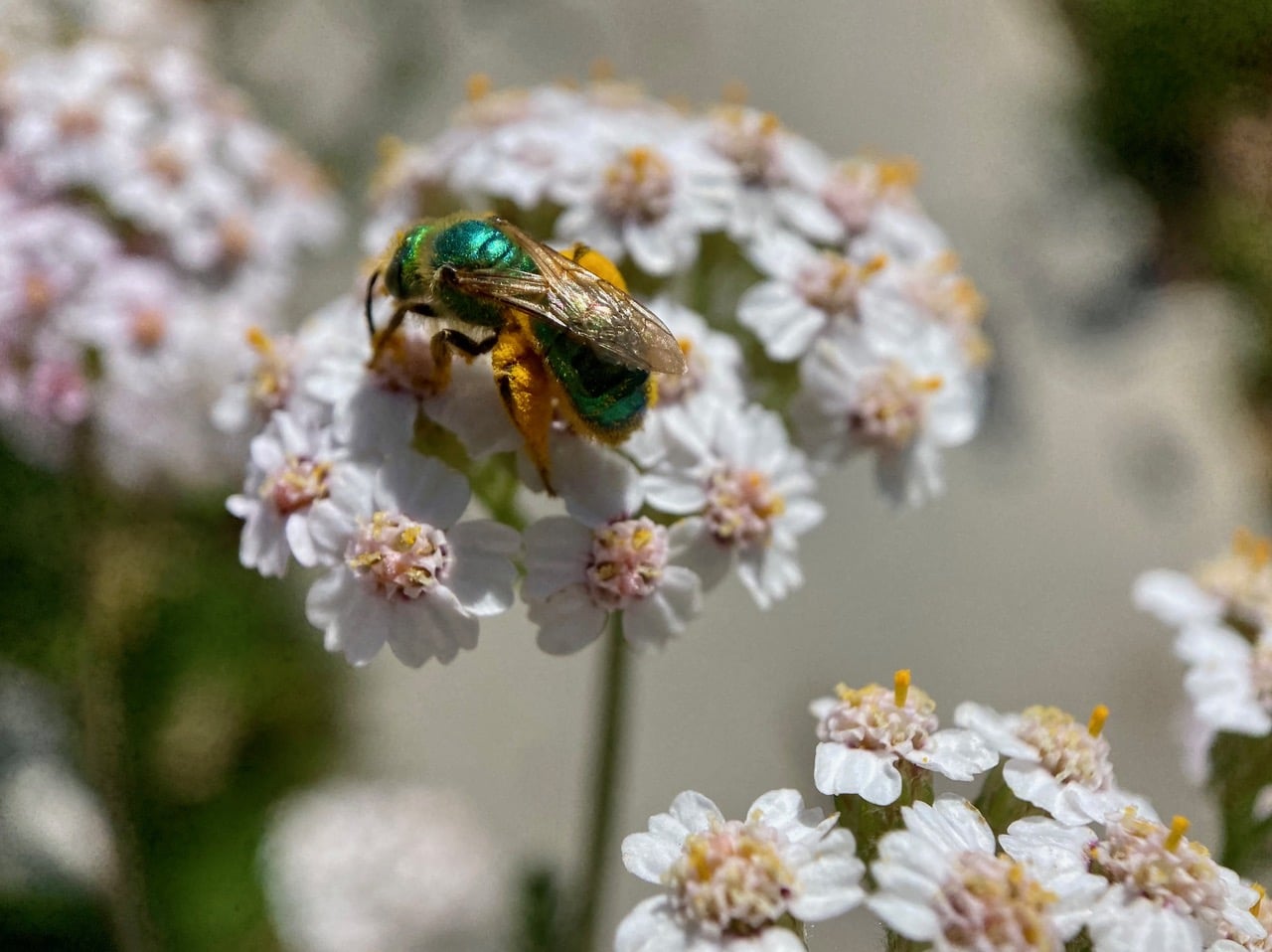
Look at the pollen load on that female Fine Striped Sweat Bee, Agapostemon subtilior (family Halictidae)! She has been busy working on the tiny Yarrow flowers.
The Fine Striped Sweat Bee, Agapostemon subtilior is a North American species of sweat bees in the family Halictidae. Adult females are entirely iridescent green, about 11 mm in length, while males are slightly smaller at 9-10 mm and have black abdomens striped with yellow. The bees may change color based on atmospheric humidity, varying from bluish to pale green. The bees are generalist foragers, collecting pollen from a wide variety of plants. They nest in the ground in solitary burrows. Females carry pollen on the scopae on their hind legs.
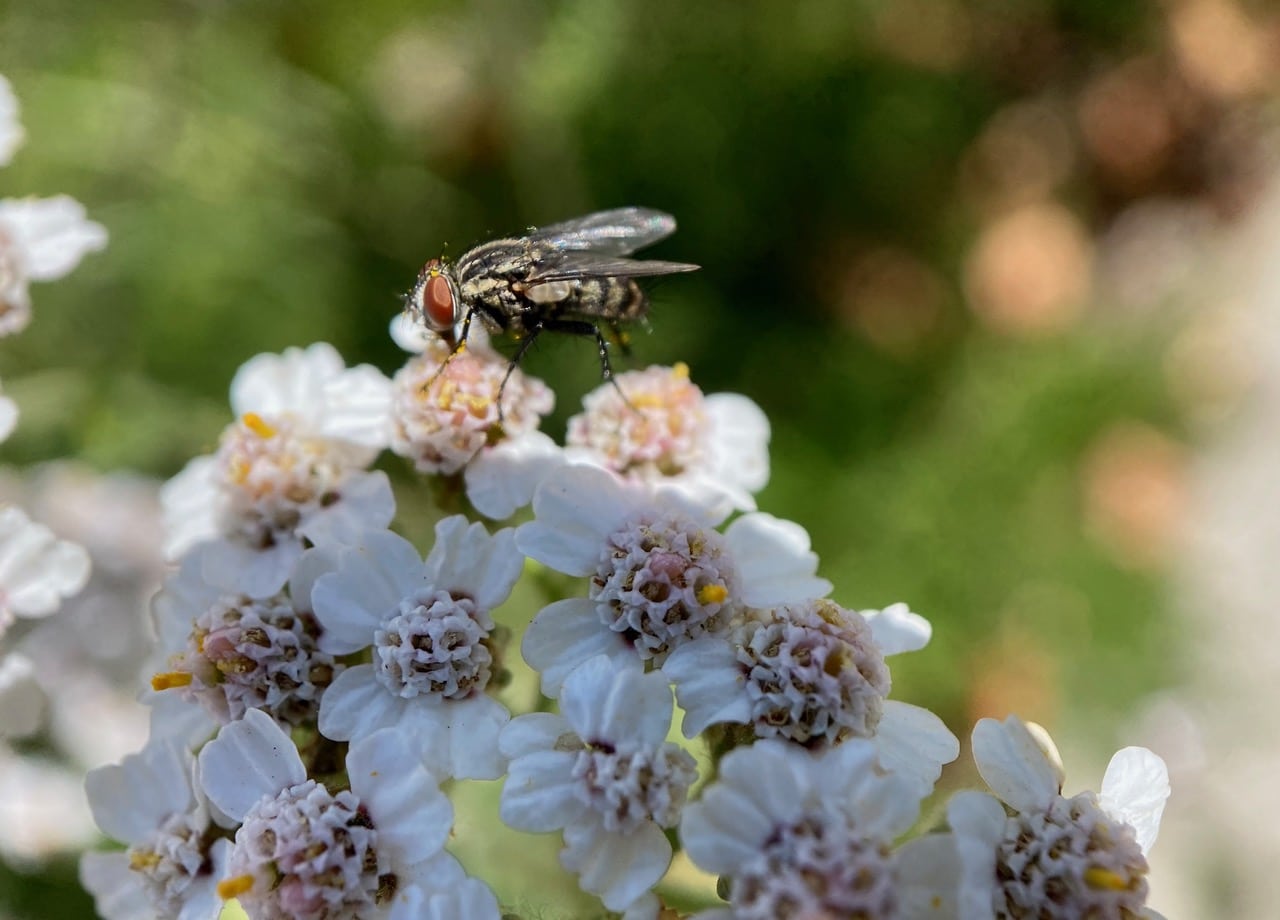
A small fly is taking nectar on a Yarrow flowerhead. iNaturalist has helped identify it as a Satellite Fly (subfamily Miltogramminae, family Sarcophagidae).
Satellite Flies are members of subfamily Miltogramminae, in the flesh fly family Sarcophagidae. Notorious kleptoparasites, they are often called “satellite flies” or “bee-burglars”. Females utilize the nests of ground-nesting bees and wasps to raise their young, stealing their food.
These small flies are generally found in sandy, light-soil areas like coastal dunes, frequently visiting flowers to feed on nectar. They are small flies (usually 5-12 mm) and are heavily dusted with gray and brown patterning. They have unusually large eyes and low-set antennae. Females stealthily trail behind potential host, often with a narrow range as though tethered to the bee/wasp (hence the name “satellite”). The female sneaks into the nest of bee/wasp to lay her eggs inside the host’s burrow or directly on the host’s paralyzed prey which can include a variety of arthropods. In some species, the Satellite Fly larviposits in the entrance of the host burrows, and the fly larvae wriggle down the burrow.
A Common European Greenbottle Fly, Lucilia sericata (family Calliphoridae) is foraging on Yarrow. While most members of the species have a green iridescent shine, this individual gives off a deep coppery luster.
The Common European Greenbottle Fly, Lucilia sericata (family Calliphoridae) is a Blowfly found in most areas of the world and is the most well-known of the numerous green bottle fly species. The lifecycle of Lucilia sericata is typical of blowflies. Females lay masses of eggs in fresh carrion. The flies are extremely prolific – a single female may produce 2,000 to 3,000 eggs in her lifetime. The larvae feed on dead or necrotic tissue, passing through 3 larval instars. Third-instar larvae drop off the host to pupate in the soil. The adults feed opportunistically on nectar, pollen, feces, or carrion; they are important pollinators as well as important agents of decomposition. Pollen is used as an alternative protein source, especially for gravid females who need large amounts of protein and cannot reliably find carrion.
While we may find the blowflies disgusting for their association with filth and carrion, they are important decomposers/ recyclers in the ecosystem. What’s more, their larvae are used in maggot therapy to clean wounds by consuming only dead and infected tissue, helping to promote faster healing and prevent infection.
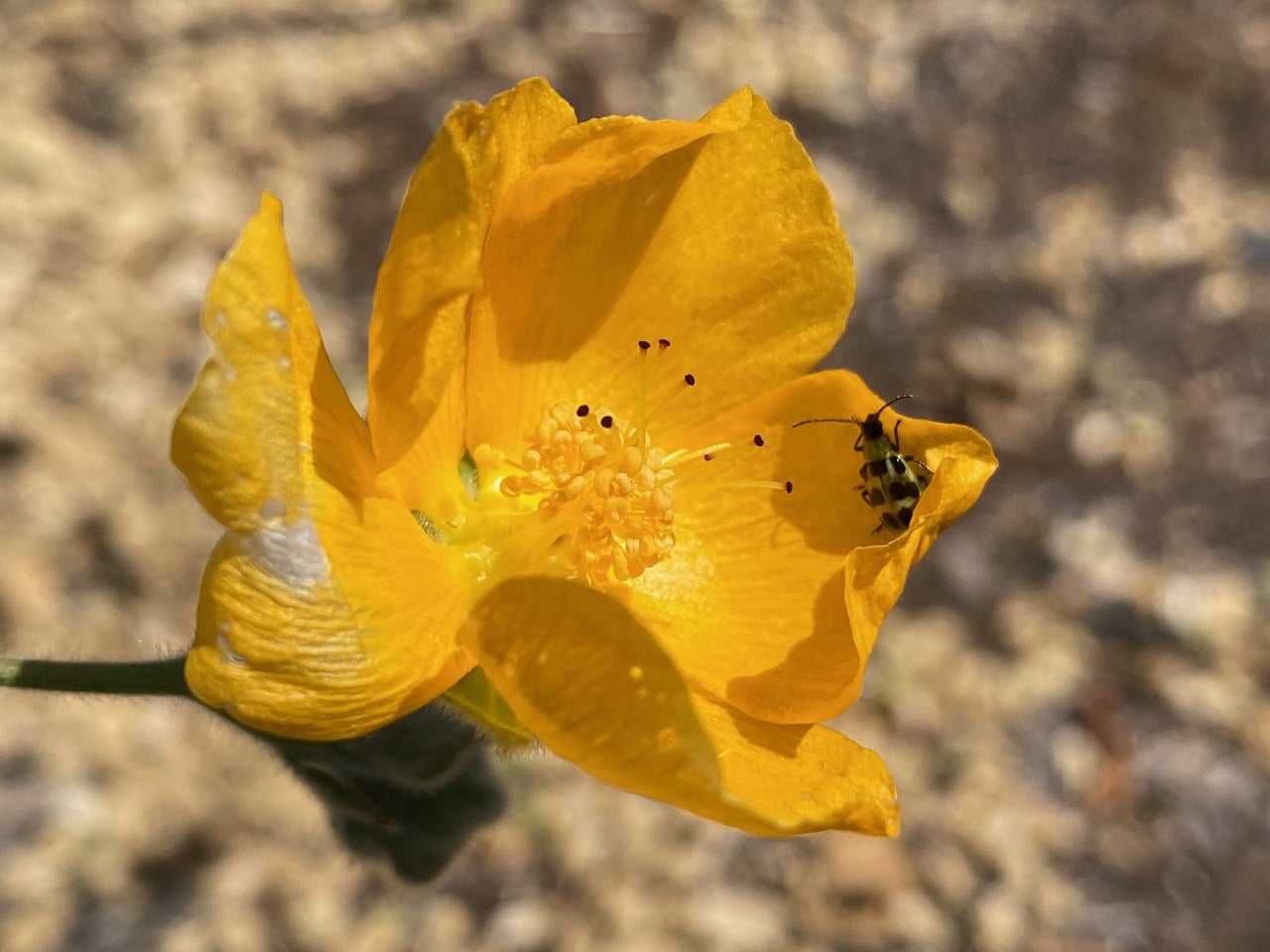
A Spotted Cucumber Beetle, Diabrotica undecimpunctata (family Chrysomelidae) is resting on a flower of Palmer’s Indian Mallow, Abutilon palmeri. Note the dark red stigmas of the flower that emerge from the tip of the central column, above the numerous stamens.
Because mallow flower anthers and stigmas are often arranged in a prominent central column, pollination typically occurs as insects push past these reproductive parts to reach the nectar at the base of the petals. Mallow flowers can also undergo “delayed selfing” if the weather is too wet or cloudy for insect activity. As the day progresses, the pistil droops until it touches its own anthers, allowing the plant to successfully breed with itself and set seed without a pollinator.
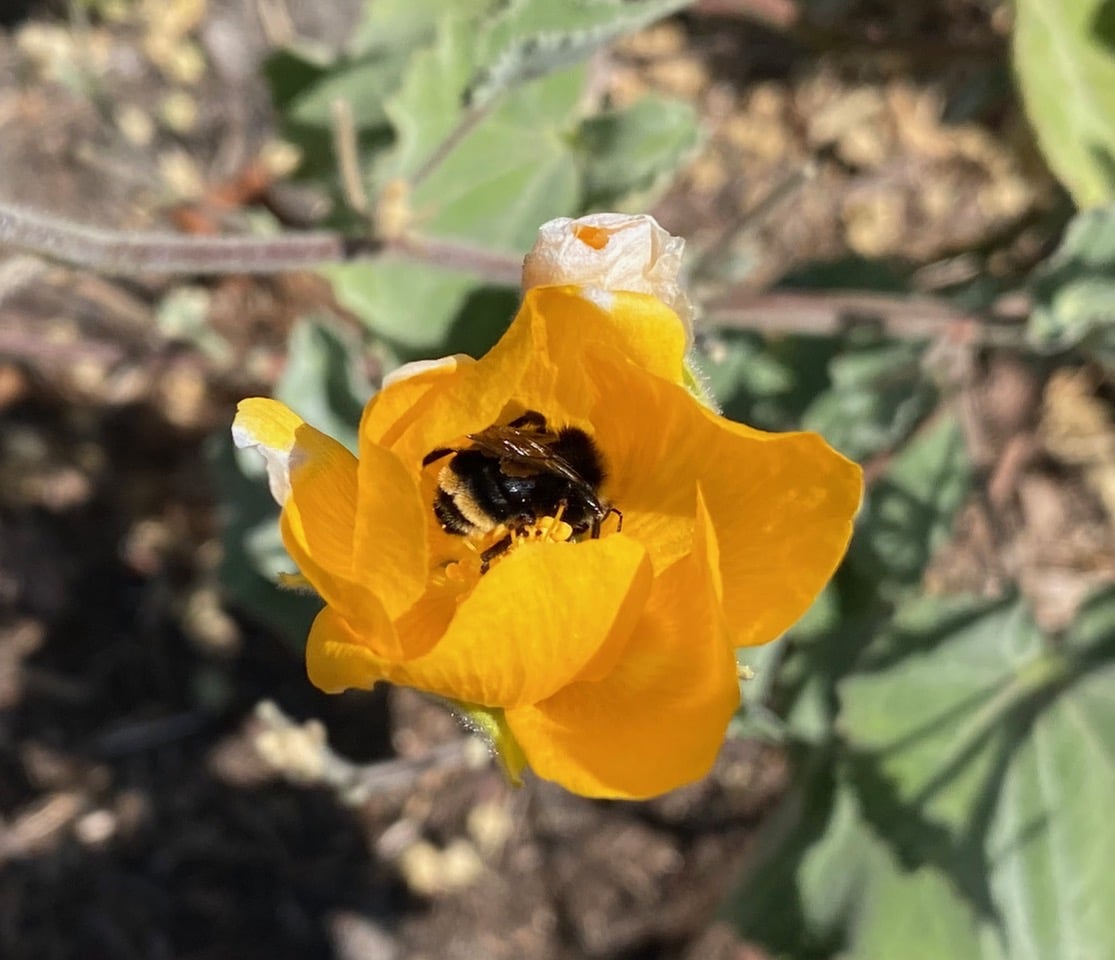
A Bumle Bee is foraging inside a flower of Palmer’s Indian Mallow. Note that it has more than one yellow band near the tip of its abdomen. Is it a male Yellow-faced Bumble Bee, subgenus Pyrobombus (genus Bombus, family Apidae)?

Yes, it could very well be a male Yellow-faced Bumble Bee. Note the long antennae.
The antennae of male bees are often much longer than their female counterparts. Male antennae have an extra segment (13 in all) and the segments themselves are longer. This is because male antennae are specialized to pick up the subtle scent of female pheromones.
While male bees do not intentionally collect pollen to provision the nest, they can be good pollinators because their hairy body is capable of transferring lots of pollen when they visit flowers for nectar.
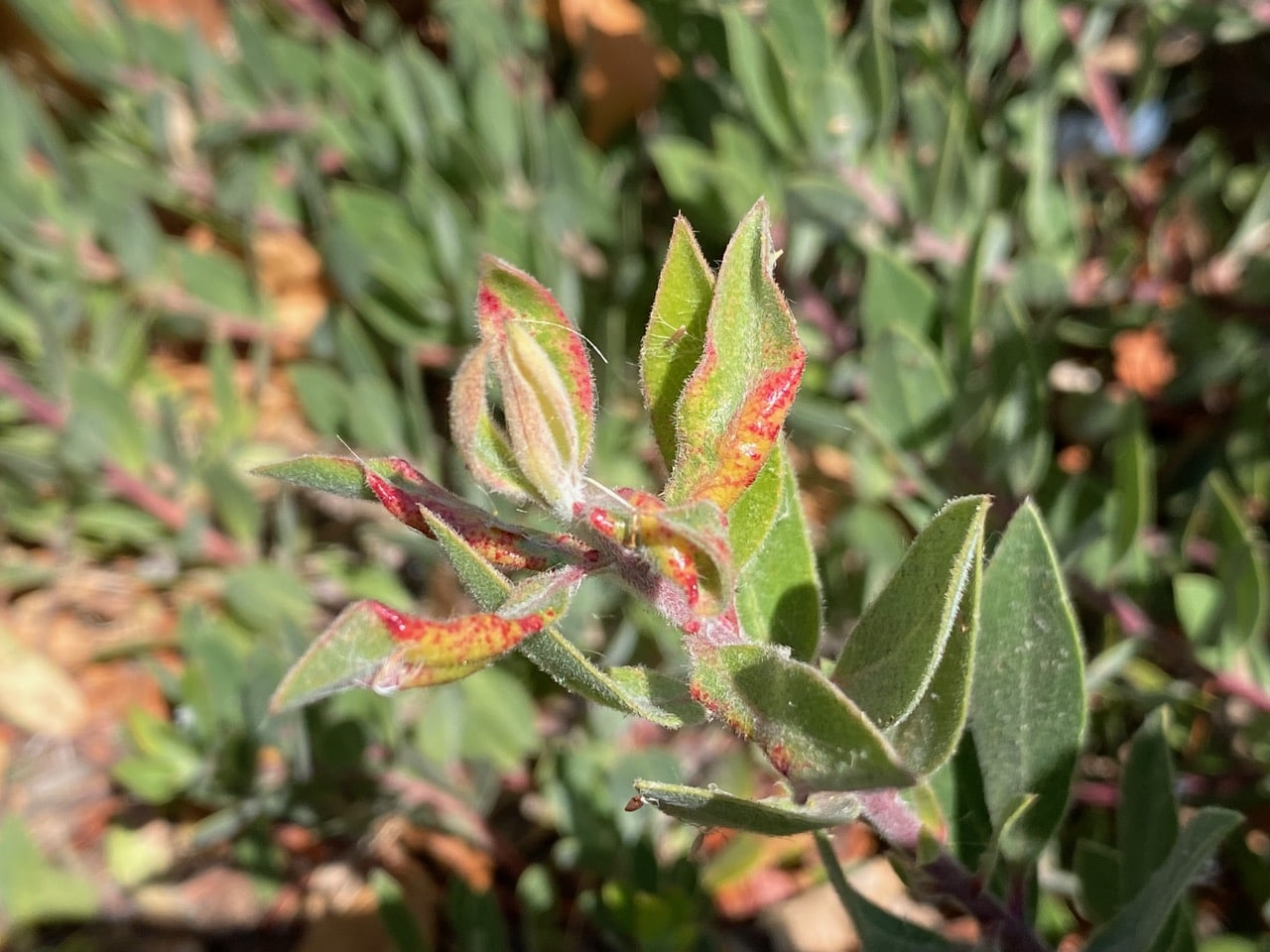
Grotesque red-spotted swellings have deformed the margins of many young leaves of this Manzanita. They are galls induced by the Manzanita Leafgall Aphid, Tamalia coweni (family Aphididae).
The Manzanita Leaf-gall Aphid, Tamalia coweni (family Aphididae) is a widespread species native to the west coast of North America. Feeding by the aphid on Arctostaphylos leaves induces red or reddish-green pod-shaped galls within which the aphids feed and develop. The tiny, gray or greenish aphids feed by sucking on tissue within the leaf galls. These aphids feed only on manzanita. Throughout most of the year adult females (which may be winged or wingless) give birth to live young without mating. In the fall, a sexual generation of winged males and females is produced. The winged aphids disperse, mate, and the females lay overwintering eggs on the bark at the base of the plant. Eggs hatch in late winter or spring and the emerging aphids walk up to the leaves, settle to feed, and initiate galls. They have several generations per year. While some consider them aesthetically objectionable, the galls do not significantly affect the health of the plant .
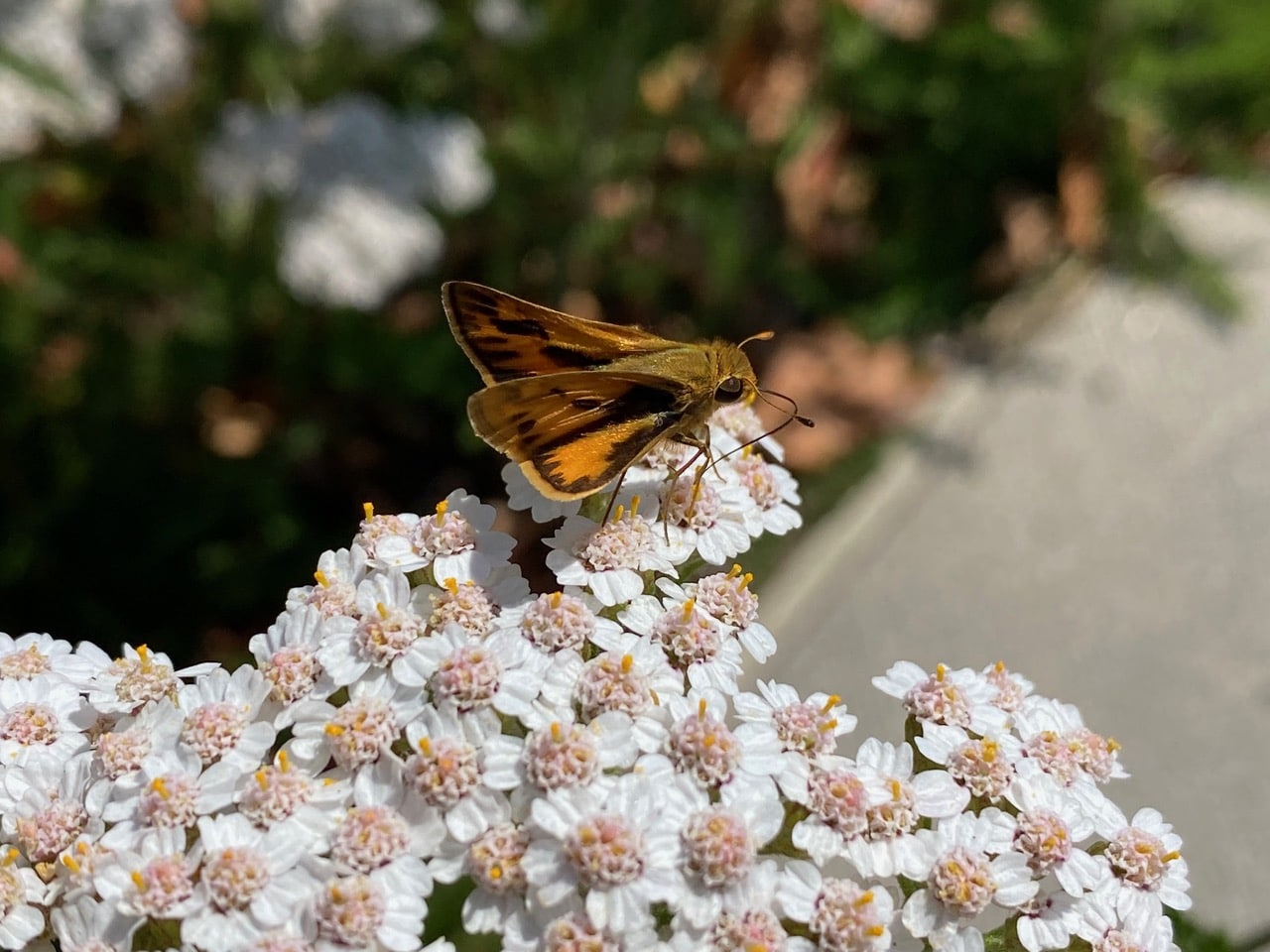
A Fiery Skipper, Hylephila phyleus (family Hesperiidae) is taking nectar on an inflorescence of Yarrow.
Skippers are a family, the Hesperiidae, of the order Lepidoptera (butterflies and moths). They are named for their quick, darting flight habits. Most have the antenna clubs hooked backwards like a crochet hook. They also have generally stockier bodies and larger compound eyes than the other butterflies. Their wings are usually small in proportion to their bodies. When at rest, skippers keep their wings usually angled upwards or spread out, and only rarely fold them up completely. Californian species are mostly brown or tan, with black, orange, or yellow markings.
Skipper caterpillars are usually green or brown, sometimes yellowish, never brightly colored. They have a distinctive “collar”, a narrow ring around the body right behind the head. Caterpillars are camouflaged and often hide during the day. Many species make nests of leaves and silk for additional protection. Most North American species feed on grasses, but some common species eat shrubs and trees, especially in the bean family. Most species are limited to a single group of food plants. Adult skippers are only active during the day, but Skipper caterpillars feed mainly when it is dark or partly light.
Fiery Skippers, Hylephila phyleus (family Hesperiidae) is a small butterfly, with a wingspan of 1.25 to 1.5 in. It can be seen from March to November. Host plants include various species of grasses. Fiery Skipper is the most abundant grass skipper in California, mostly due to its dominance in urban areas, thanks to the ubiquity of the Great American Lawn. Originally found only in North and South America, it has been introduced into Hawaii and Bali.
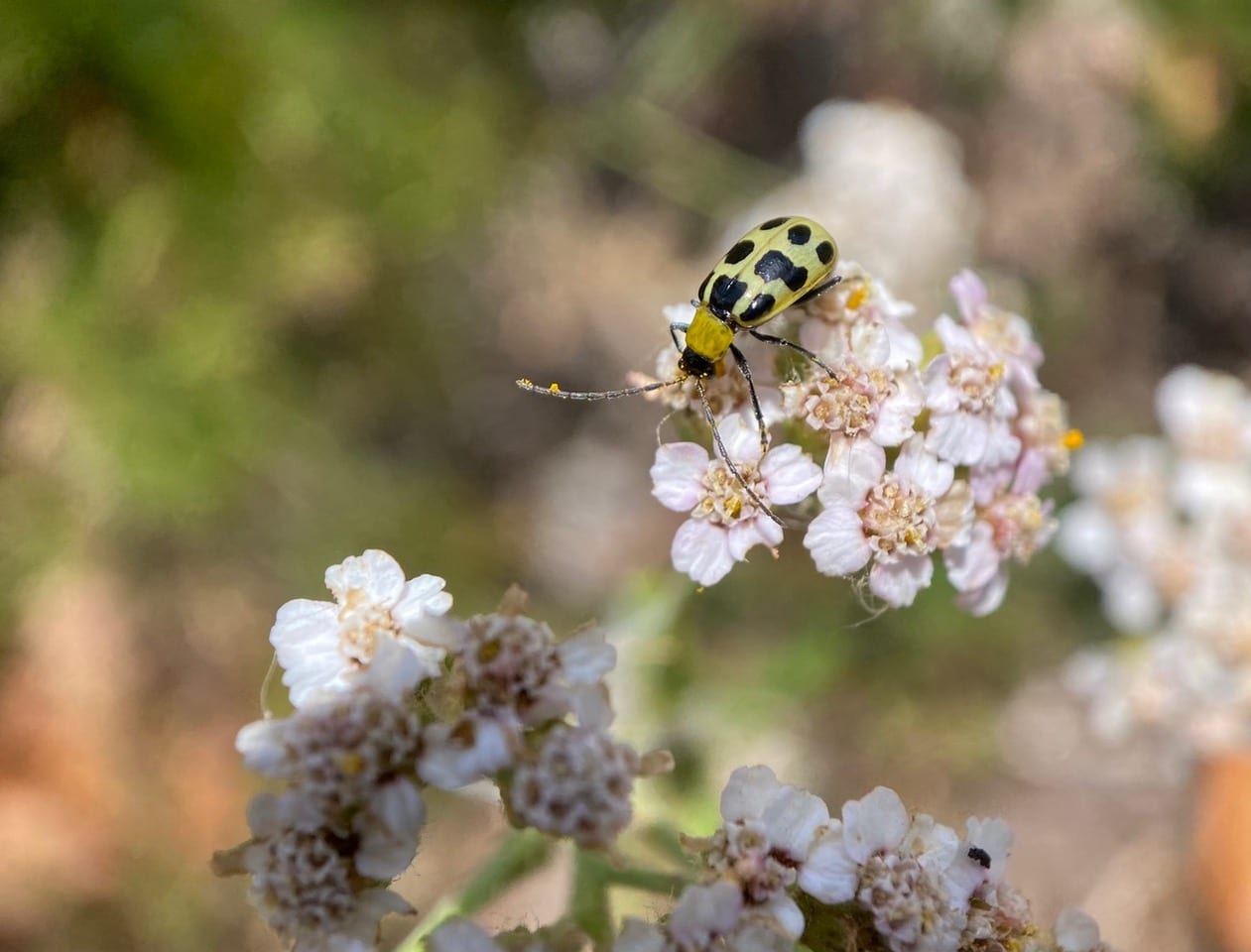
A Spotted Cucumber Beetle, Diabrotica undecimpunctata (family Chrysomelidae) is foraging on a Yarrow inflorescence.
The specific epithet undecimpunctata is a Latin-derived biological term that means “eleven-spotted”. Native to North America, the Spotted Cucumber Beetles are generalist feeders, consuming a wide variety of foods, although they have a preference for cucurbits (plants in the gourd family), causing damage to crops in the larval as well as adult stages of their life cycle. Larvae, sometimes known as rootworms feed on the roots of emerging plants. In the adult stage the beetles cause damage by eating the flowers, leaves, stems and fruits of the plant.
Various birds, mammals, and amphibians feed on the spotted cucumber beetle, while the beetle’s eggs are targeted by spiders, ground beetles, ants, and crickets.
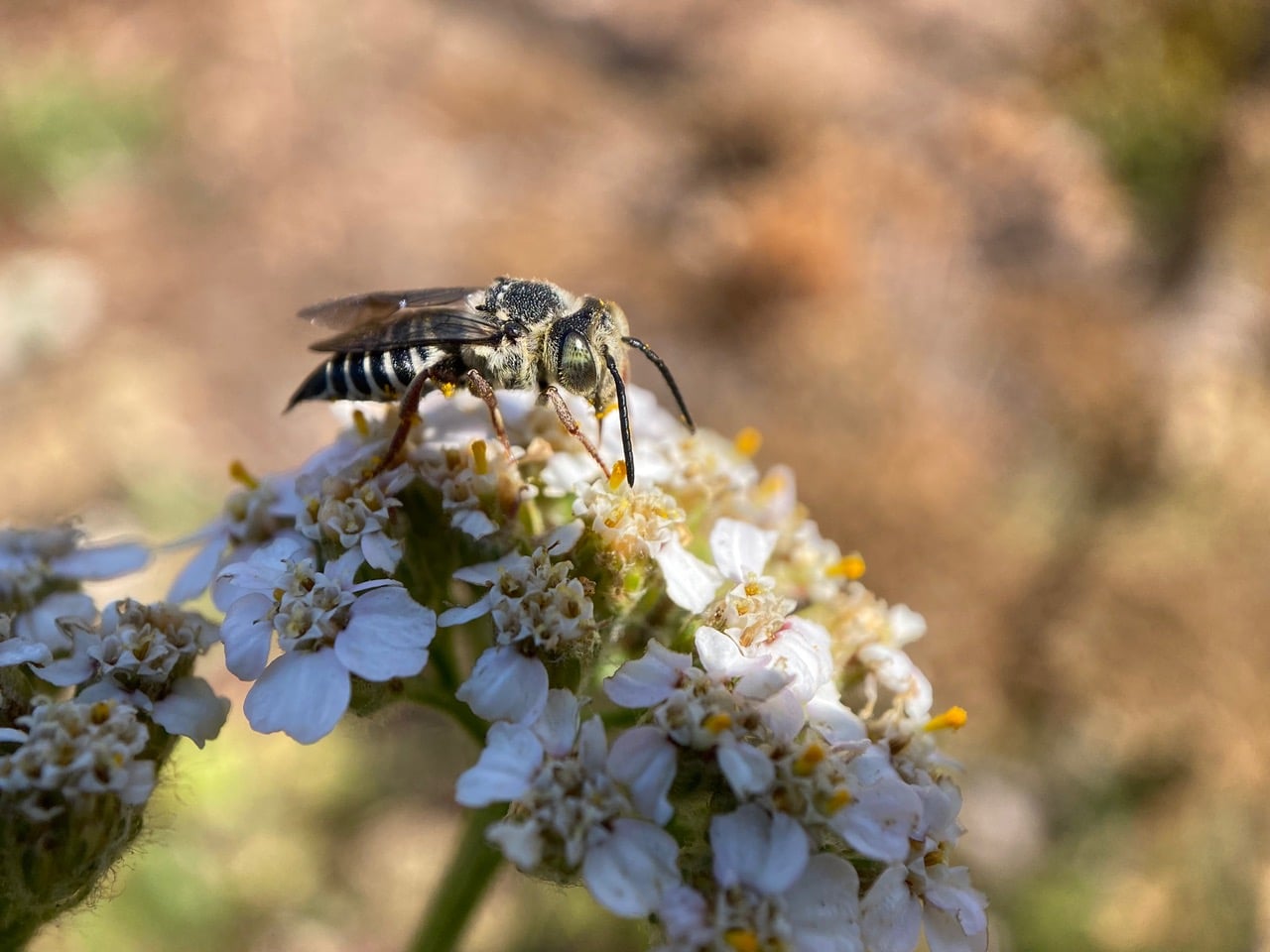
A male Western Leafcutter Bee, Megachile perihirta (family Megachilidae) has landed on an inflorescence of Yarrow. Note that the end of his abdomen is rounded.
Leaf-cutter Bees, Megachile sp. (family Megachilidae) are stout-bodied, usually with pale hair on the thorax and stripes of white hairs on the abdomen. Females usually have a triangular abdomen with a pointed tip, and males’ faces are covered with dense, pale hair. Flight season is from May into September, with peak activity from June to August. Solitary females construct nests in tubular cavities, including hollow stems, tree holes, and abandoned beetle burrows in wood. Many use holes drilled into wood, straws, or other manufactured tunnels. Females cut pieces from leaves or flower petals for use in the construction of brood cells. Most Megachile females are generalist foragers, but prefer flowers in the family Asteraceae. Pollen is transported in dense scopae (special pollen collecting hairs) on the underside of the abdomen.
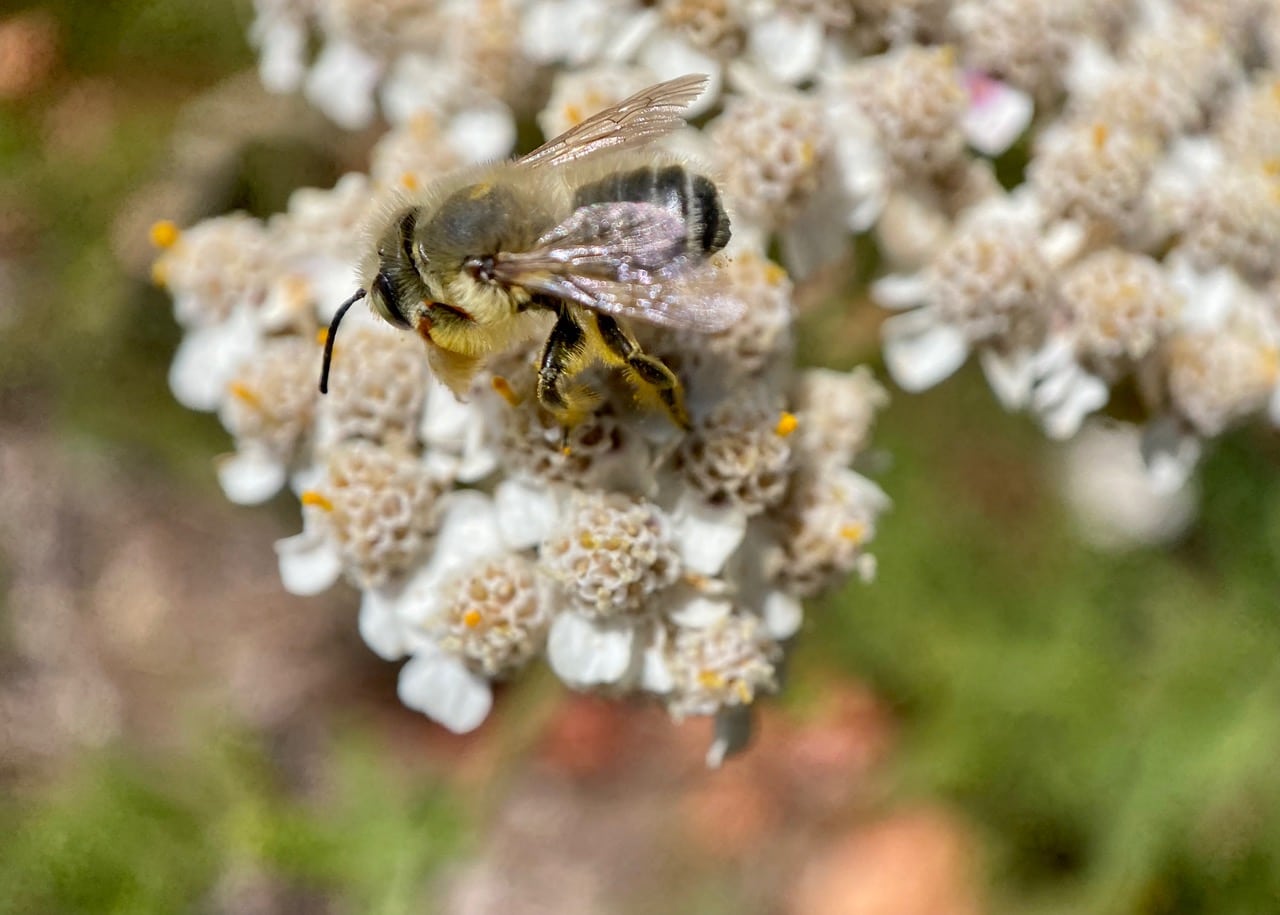
Note the fringe of long hairs on his front legs.
Male Western Leafcutter Bees, Megachile perihirta (family Megachilidae) feature enlarged, modified front legs lined with a dense fringe of long, feathery hairs. They use these hair-lined forelegs during courtship to partially cover the female’s eyes, while using hidden odor glands near their front legs to emit pheromones close to her antennae.
Hey, isn’t that a female Sharptail Bee, Coelioxys sp. (family Megachilidae)? It’s always a thrill to find a Cuckoo Bee!
The term cuckoo bee refers to a variety of different bee lineages which have evolved the kleptoparasitic behavior of laying their eggs in the nests of other bees, similar to the behavior of cuckoo birds. Female cuckoo bees lack pollen-collecting structures and do not construct their own nests. Cuckoo bees typically enter the nests of pollen-collecting species, and lay their eggs in cells provisioned by the host bee. When the cuckoo bee larva hatches, it consumes the provision in the nest, and kills the host larva. Many cuckoo bees are closely related to their hosts, and may bear similarities in appearance reflecting this relationship. Others parasitize bees in families different from their own.
The Cuckoo Leafcutter Bees, also known as Sharptail Bees, belong to the genus Coelioxys, in the same family as their hosts, Megachilidae. Members of the genus Coelioxys share the distinctive trait of having hairs on their eyes. In addition, the back rim of the bee’s scutellum (the second segment of the thorax) has prominent toothlike protrusions called axillae. In Greek, Coelioxys means “sharp belly”, referring to the tapered, pointed abdomens of cuckoo leaf cutters. The bees have dark abdomens banded by short pale hairs; thorax with prominent axillae; red, black or red-and-black legs; and green eyes. Female Coelioxys have pointed, conical abdomens with spearlike tips. The spade-shaped abdominal tips allow the female cuckoos to break through the brood-cell walls that leafcullters construct with leaves, petals and other materials. Males have abdomens armed with multiple pronged tips.
These bees are known to sometimes sleep upside down on vegetation, holding on with their mandibles.
While we might be alarmed by the presence of cuckoo bees with unsavory behavior in our garden, we really have nothing to worry about. The presence of cuckoo bees is a clear indication of a thriving population of their host bees. By parasitizing specific species, cuckoo bees prevent dominant host bees from pushing out less competitive, rarer bee species, allowing for greater biodiversity. The arms race between cuckoo bees and their hosts drives genetic diversity and adaptation. Hosts evolve defenses against parasites, which naturally strengthens the resilience of the bee community. What’s more, although they do not intentionally collect pollen, cuckoo bees must visit flowers to forage for nectar, which sometimes leads to incidental pollen transfer.
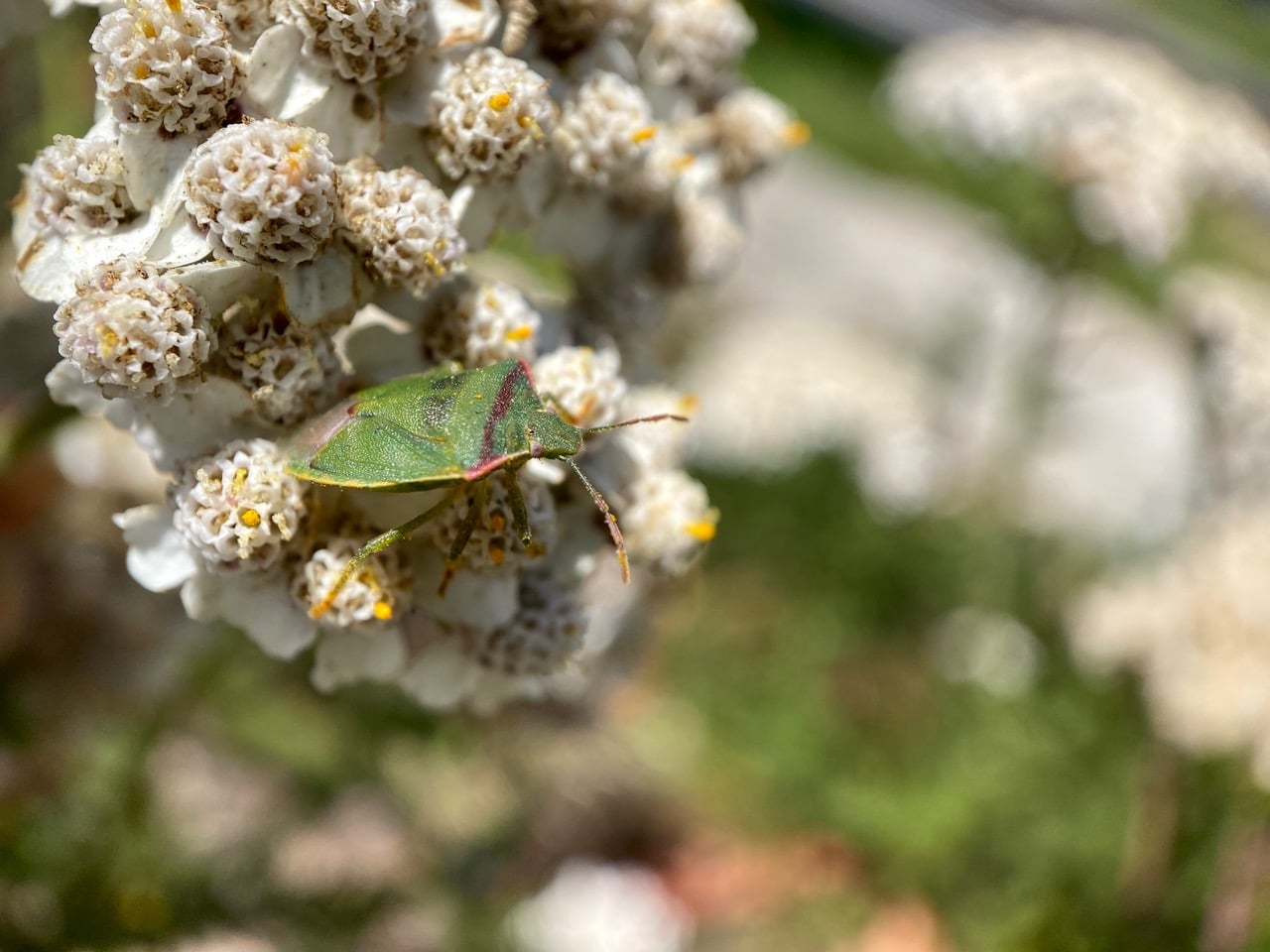
A Red-shouldered Stink Bug, Thyanta pallidovirens (family Pentatomidae) is perched on a Yarrow inflorescence.
Pentatomidae is a family of insects belonging to the order Hemiptera or “true bugs”. As hemipterans, the pentatomids have piercing-sucking mouthparts, and most are phytophagous, including several species that are severe pests on agricultural crops. Stink Bugs feed on plant fluids by inserting their needlelike mouthparts into stems, leaves or seed pods. While feeding, they inject materials into the plant to aid in digestion and sap removal. Penetration by the mouthparts can cause physical damage, much like stabbing the plant with a fine needle.
All Pentatomids have 5-segmented antennae (hence their family name, Penta – five and tomos – section.) They generally have a large triangular scutellum in the center of the back. The adult is generally shield-shaped when viewed from above. The common name of Stink Bug refers to their ability to release a pungent defensive spray when threatened, disturbed, or crushed.
#/media/File:Heteroptera_morphology-d.svg)
Thyanta pallidovirens is a common relatively small stink bug (10-12 mm in length) found in Central and North America. It is predominantly green with a narrow red band across the shoulder; sometimes the band is absent. There is also a brown-colored phase, usually found in overwintering bugs. Eggs are laid in clusters, are barrel-shaped, and have pop-tops. Immature stages of this species range widely in coloration, often marked brightly with red, yellow, green and black or brown, different from the adult stage and changing as the nymphs develop. Adults are found from May to October in open meadows and at the borders of agricultural fields. They feed on the foliage of plants from a wide variety of species in 14 plant families. They are a minor pest on a variety of agricultural crops, including beans, corn, peaches, wheat and nuts.
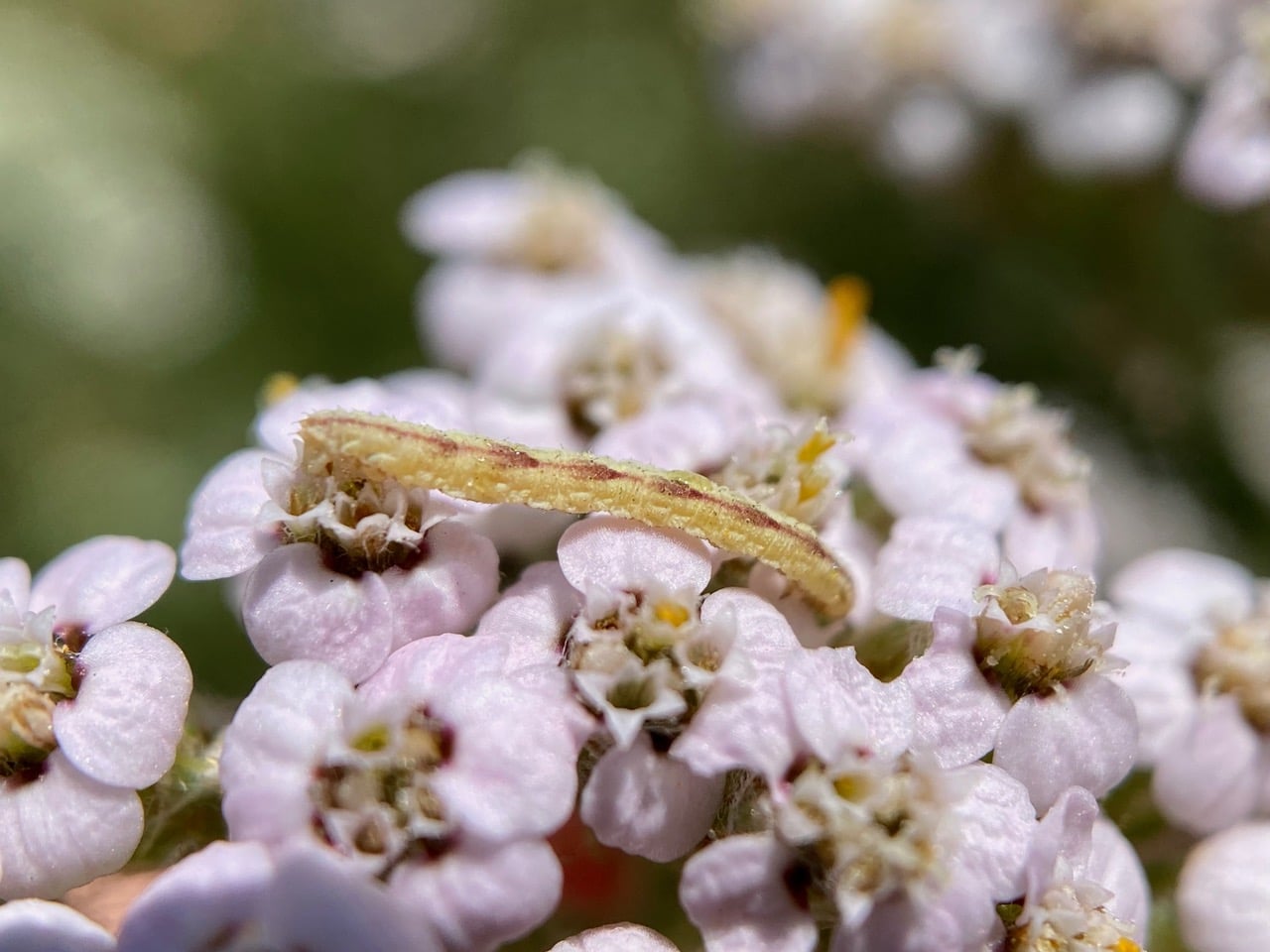
A Pug Moth caterpillar, Eupithecia sp. (family Geometridae) is stretched across an inflorescence of Yarrow, feeding on the flowers. It is an inchworm, lacking prolegs in the middle section of its body.
Inchworms are also called loopers and measuring worms. The majority of the inchworms are the larvae of moths in the family Geometridae. The name comes from the Greek “geo” for earth and “metro” from measure, because the caterpillars seem to be measuring the surface on which they are walking. The “looping” locomotion is mandated by the absence of prolegs in the middle section of the caterpillar’s body.
Eupithecia is the largest genus of moths of the family Geometridae. Occurring worldwide except for Australasia, species in the genus are commonly known as pugs. The caterpillars move in a looping manner and are commonly called inchworms. Adults are typically small, 12 – 35 mm, with muted colors. Most species rest with forewings held flat at right angles to the body, while the hindwing are largely covered by the forewings. They are generally nocturnal. Larvae mostly feed from the flowers and seeds of their food plants rather than the foliage. Many species have a very specific food plant. Many are commonly found on Asteraceae flowers.
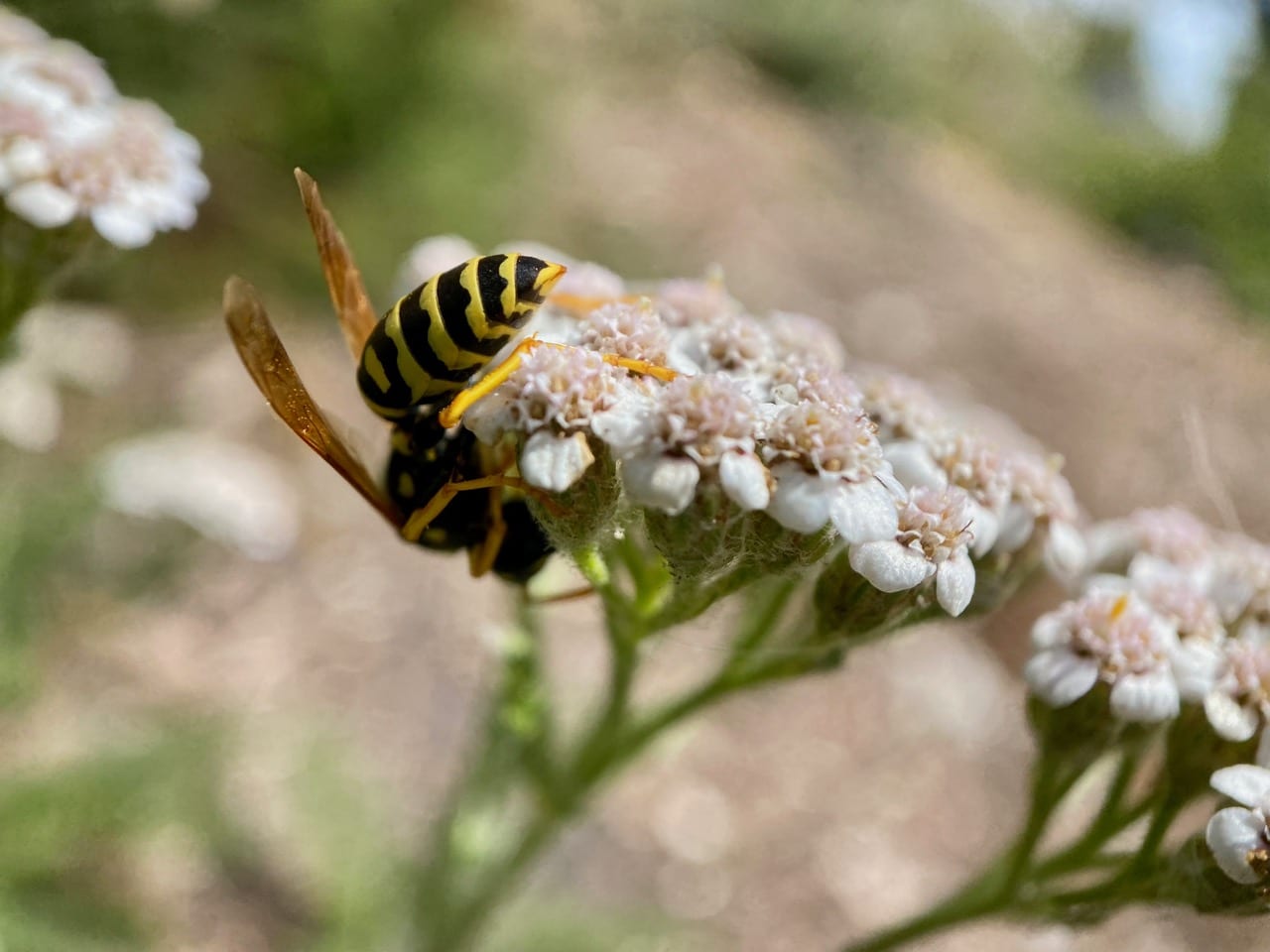
A European Paper Wasp, Polistes dominula (family Vespidae) is hunting for prey on an inflorescence of Yarrow. She would be quite happy to find the caterpillar we saw earlier.
Native to Europe, the European Paper Wasp, Polistes dominula, is a social insect that produces an annual colony in a paper nest. Individual colonies are established anew each spring. The overwintering stage are mated females (queens). The overwintered queens emerge from sheltered spots in spring and search out sites to establish a new colony. Nests are constructed of paper, produced from chewed wood fibers of weathered fences, porch decks and other similar sources. Larvae are fed crushed insects, usually caterpillars. As the population increases, the original queen increasingly remains in the nest as new workers take over colony activities. A few of the wasps produced later in summer are males and increasing numbers of the females become sexually mature. Mating occurs and the mated females are the surviving overwintering stage. Males and non-reproductive females do not survive winter and the nest is abandoned by late fall. European Paper Wasps will sometimes feed on sweet materials, including honeydew produced by aphids. They may also feed on damaged ripe fruits. Because of their habit of hunting caterpillars, the wasps have become one of the most important natural controls of garden pests.
A large, bristly fly has landed on an inflorescence of Yarrow. It is a Bristle Fly, Archytas marmoratus (family Tachinidae).
The family Tachinidae is by far the largest and most important group of parasitoid flies. All species are parasitic in the larval stage. Most adults have distinct abdominal bristles, hence the common name. Adults feed on liquids such as nectar and honeydew. They can be found resting on foliage, feeding at flowers or searching for hosts.
Most Tachinids attack caterpillars, adult and larval beetles, true bugs, grasshoppers, and other insects. Females lay eggs in or on the host. Tachinid larvae live as internal parasites, consuming their hosts’ less essential tissues first and not finishing off the vital organs until they are ready to pupate. The larvae leave the host and pupate on the ground. Tachinids are very important in natural control of many pests, and many have been used in biological control programs.
Archytas marmoratus is a species of Bristle Fly in the family Tachinidae. The flies feature a distinct “marbled” pattern on their abdomen. The species is found primarily in the Americas. Females lay microscopic maggots (planidia) on or near the larvae of moths, particularly the fall army worm (Spodoptera frugiperda) and Corn Earworm (Helicoverpa zea). The maggots penetrate the host, develop internally, and eventually emerge from the host’s pupa as adult flies. As a natural parasitoid, it is frequently used in biological control of target agricultural pests.
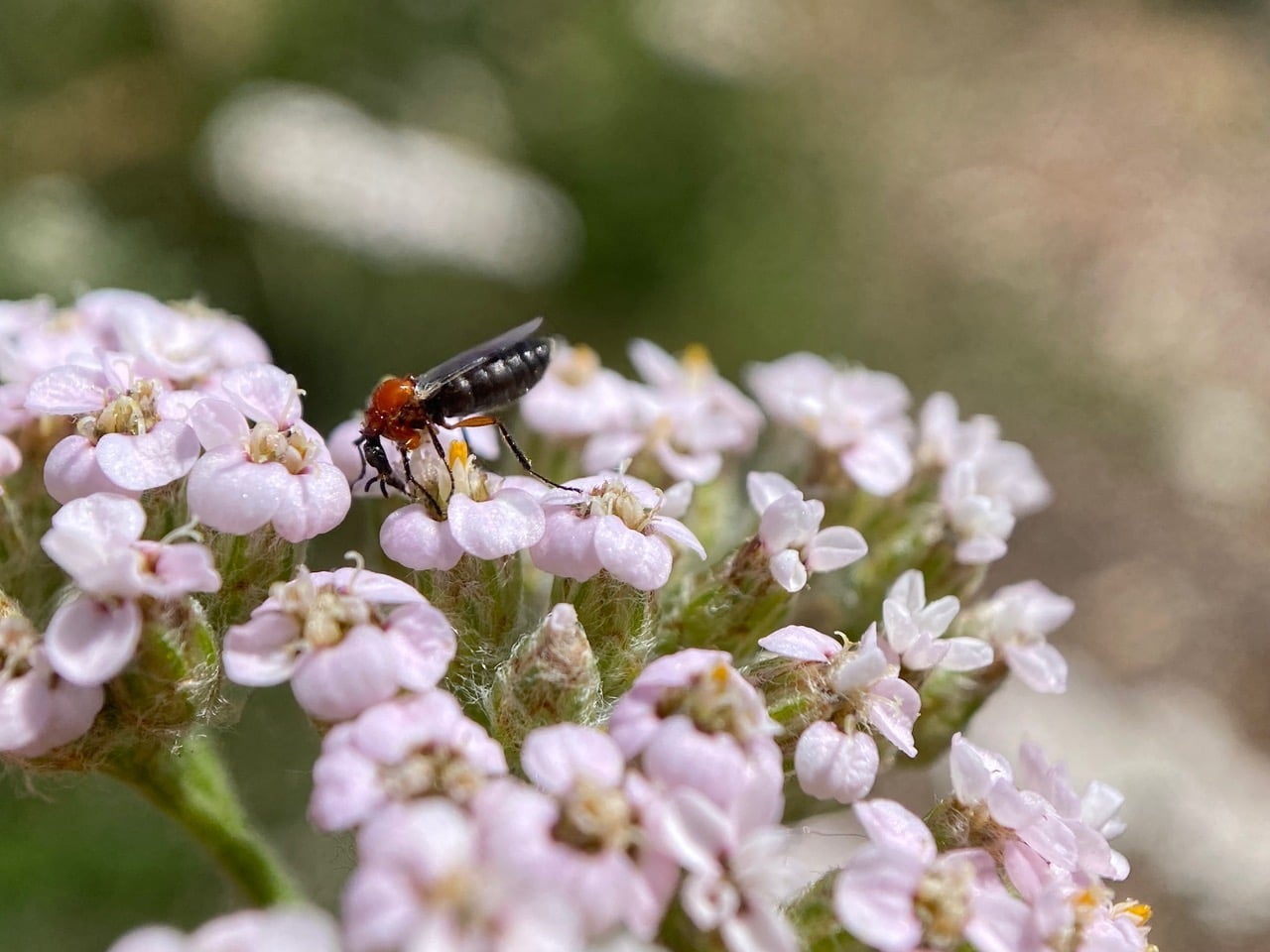
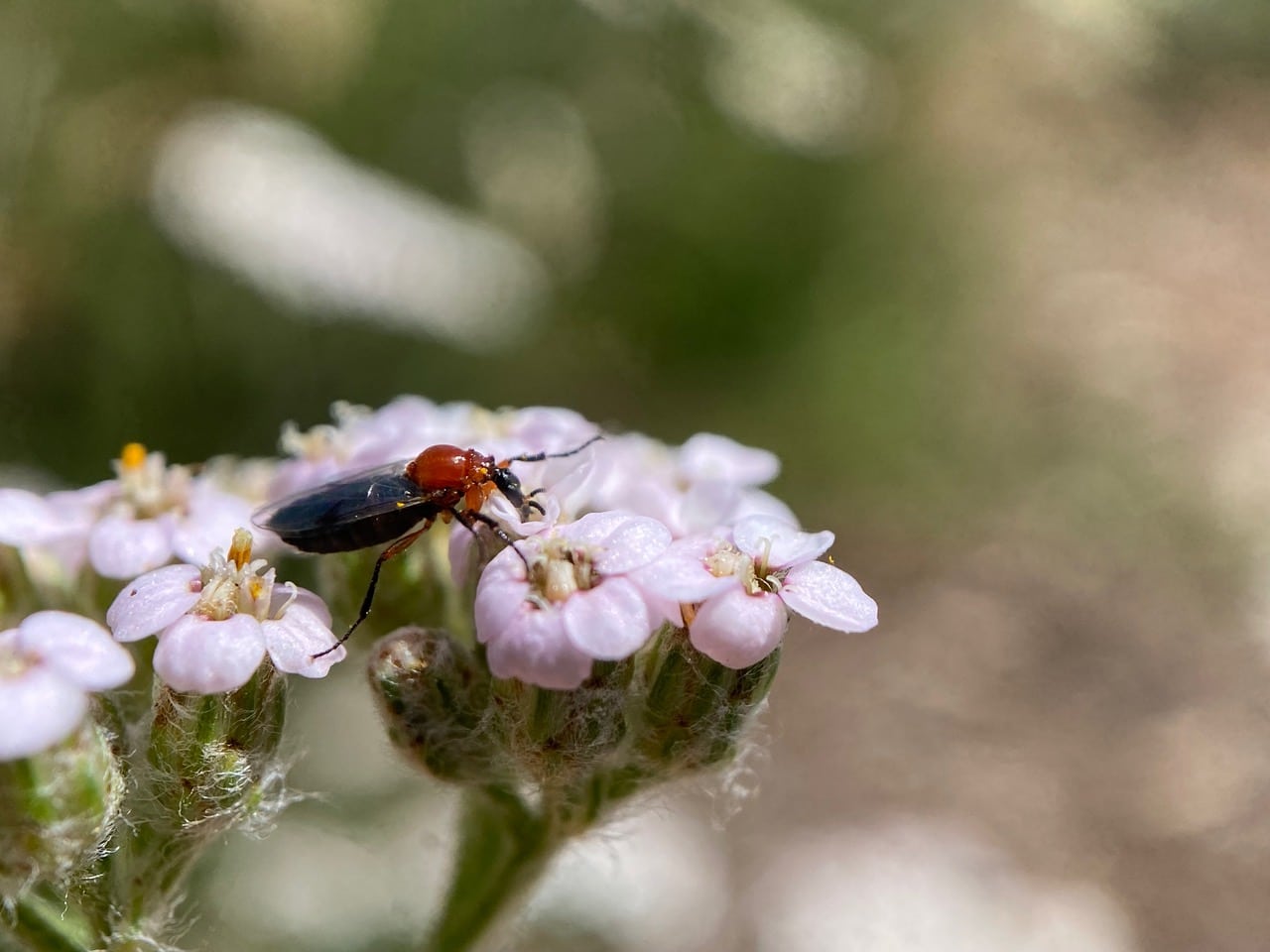
Isn’t that a female March Fly (family Bibionidae) on that Yarrow flowerhead? A March Fly in July? I have never seen these flies so late in the year! iNaturalist has helped identify it as Dilophus sp. (family Bibionidae).
March Flies (family Bibionidae) generally live in wooded areas and are often found on flowers – adults of some species feed on nectar, pollen, and honeydew, while adults of other species don’t feed at all; and in either case, they are very short-lived. They are considered important pollinators in orchards. They are also important food for other insects and spiders. The larvae feed en masse on rotting organic materials like leaves, wood, compost, and rich soil.
March flies exhibit extreme sexual dimorphism – the sexes are morphologically distinct. The female is usually more colorful, has small eyes on the sides of long, narrow head, while the all-black males have huge eyes that touch in the middle and are split in half horizontally. Scientists speculate that the split makes it easier for them to see the other males that are above and below them in a mating swarm. Males gather in swarms that can blanket the ground and low vegetation. Female are attracted to the party and select mates in the frenzy of fly bodies.