

Pollinator Post 7/19/26 (2)
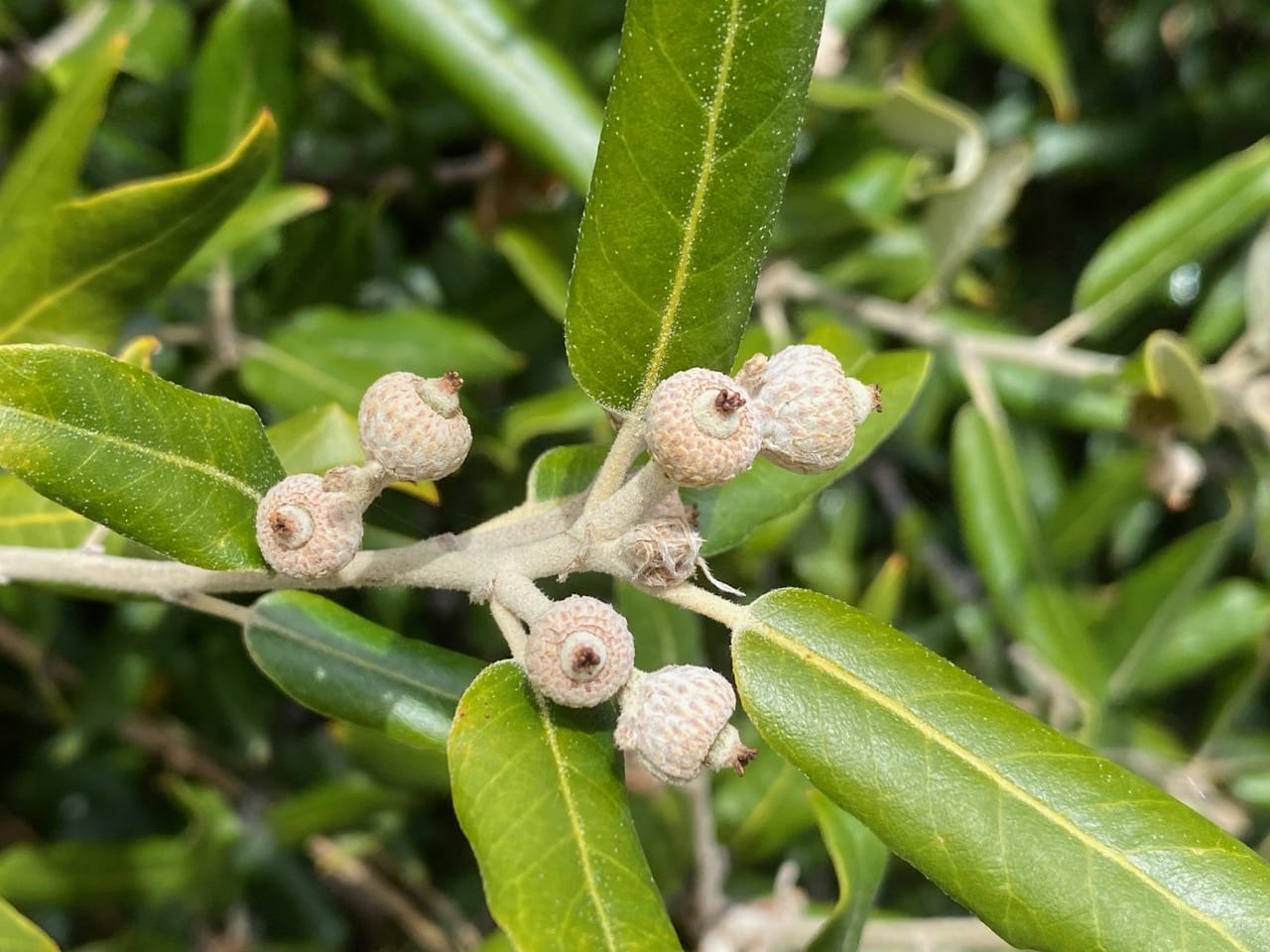
The Holm Oak, Quercus ilex at the Shoreline Park on Bay Farm Island has produced an impressive crop of small acorns. Native to the Mediterranean region, the evergreen oak has been pruned and shaped into two large bushes at the park.
Quercus ilex – Wikipedia
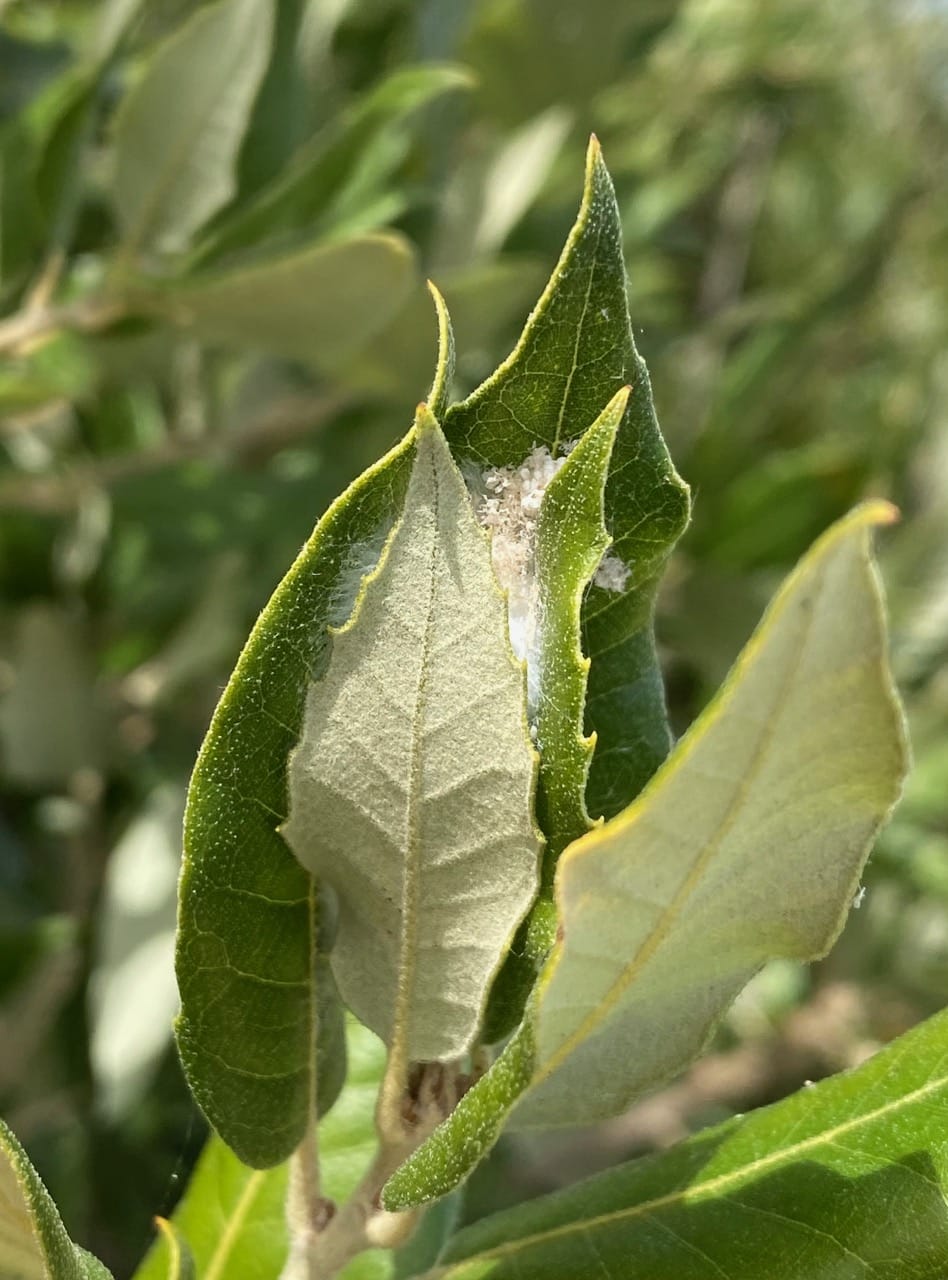
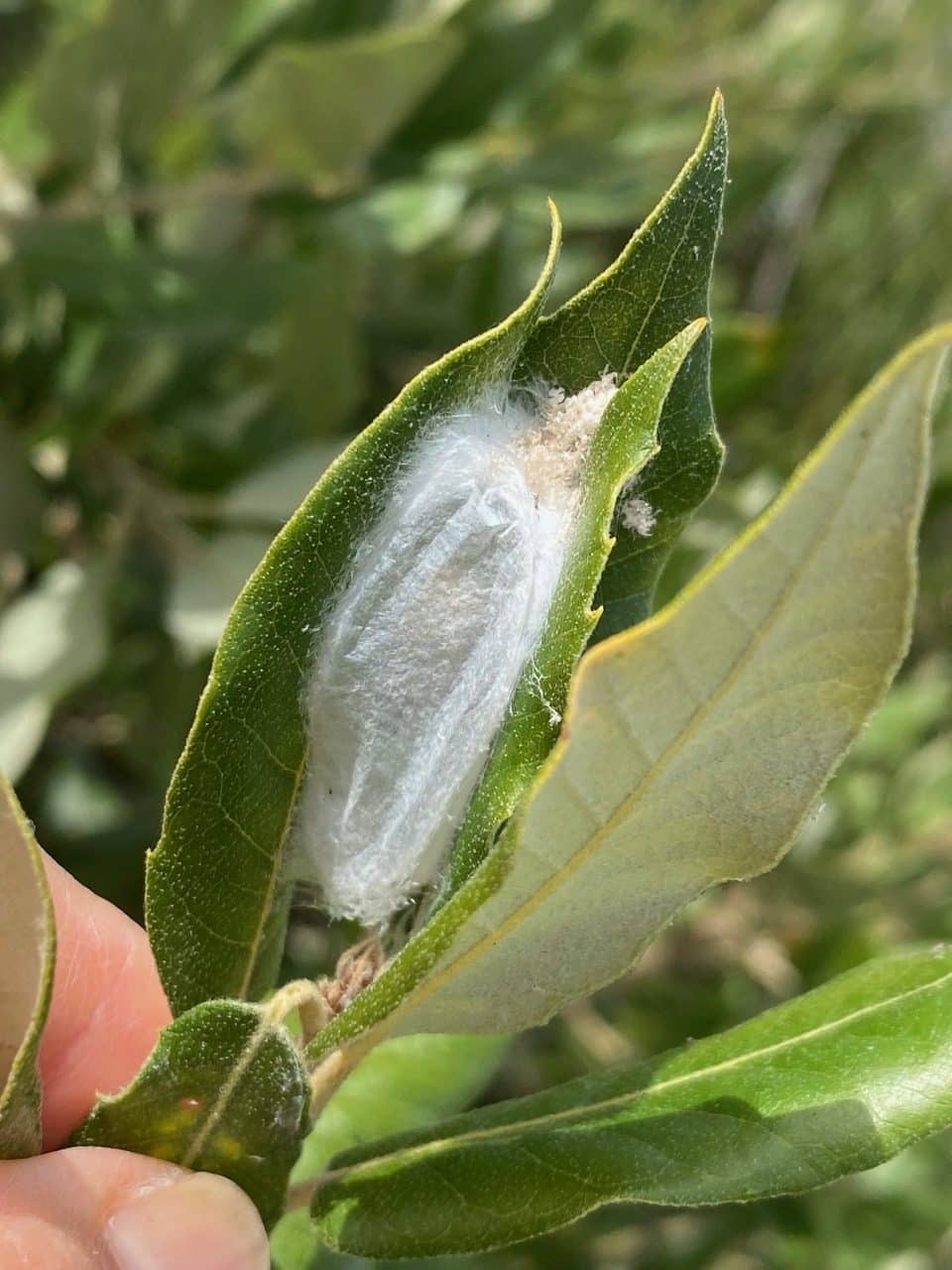
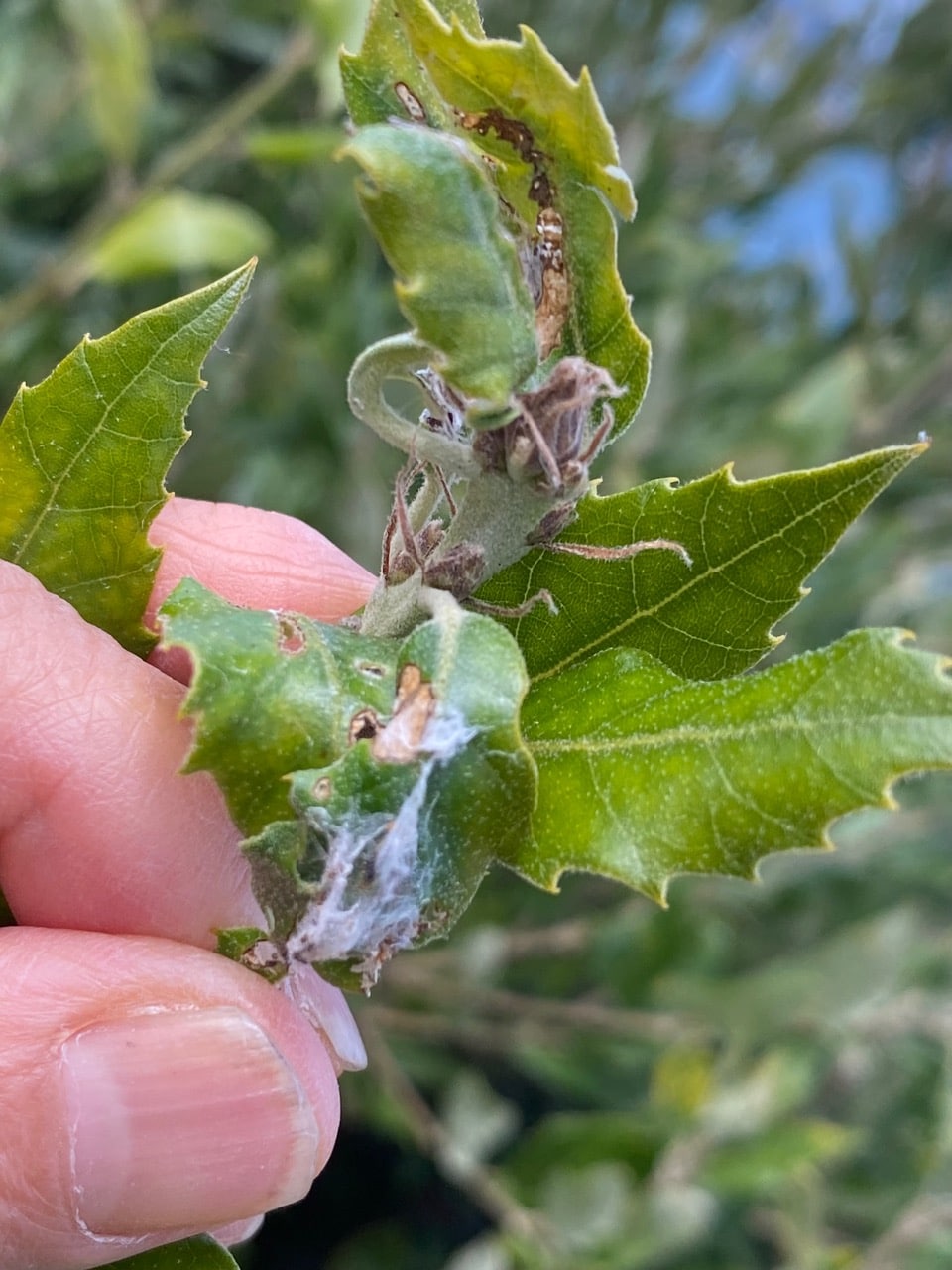






Many of the terminal leaves of the Holm Oak have been bound together with silk. Is it the work of spiders or caterpillars? I decide to find out, starting with this cluster. Note that all the leaves that are tied together are whole, with no feeding scars.
I gently pull down one of the bound leaves. It parts cleanly with some resistance, revealing a large silken sac. It is a spider’s retreat or egg sac. The debris spilling out from the top is probably the shed skins of spiderlings that have left. I am willing to bet that the spider that made this shelter was an Agrarian Sac Spider, Cheiracanthium inclusum (family Cheiracanthiidae). A few years ago, I was actually lucky enough to observe such a spider in the process of constructing a similar shelter in the terminal leaves of Mugwort.
Cheiracanthium spiders, commonly known as Yellow Sac Spiders, are wandering nighttime hunters that do not build traditional prey-catching webs. Instead, they construct distinct, silk “sac” retreats during the day to rest, molt, mate, and guard their eggs. In gardens and on foliage, these spiders frequently draw terminal leaves together, silking the edges to form a protective tube, “tent”, or folded retreat. These retreats are built almost daily, often completed in a single night. The silken sacs provide camouflage and protection from predators, and they also serve as a crucial, protected nursery where the female will lay and guard her eggs.
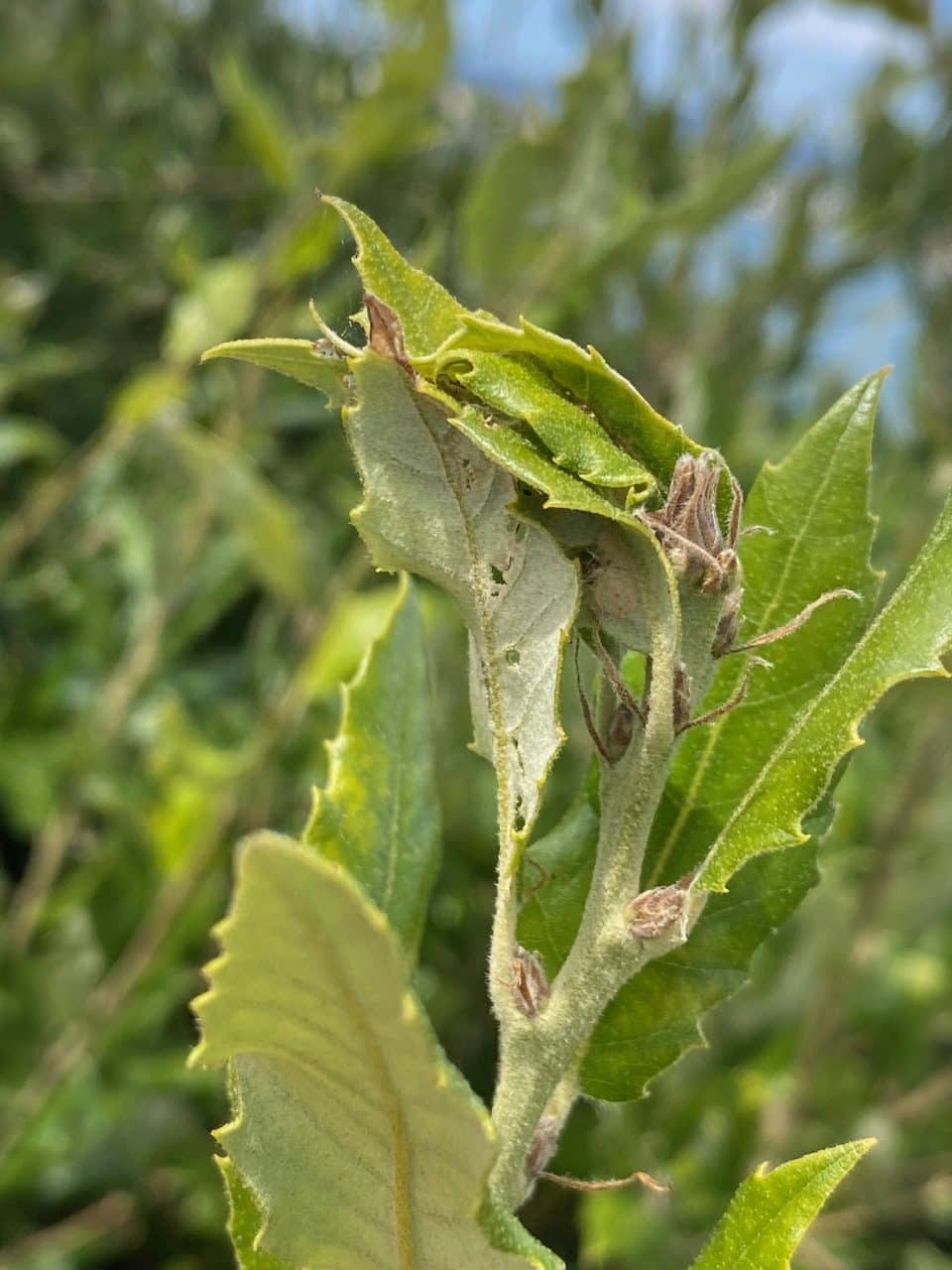
Here’s another cluster of bound terminal leaves on the Holm Oak. Note the feeding scars on the leaves.
Opening the cluster, I find silk that is littered with frass (insect poop) inside. A caterpillar must have constructed this shelter so it could feed on the leaves without being exposed to predators and parasites. I don’t see the caterpillar; It has probably left the shelter to pupate elsewhere. It is interesting that both spiders and caterpillars use their silk to bind together terminal leaves in very similar ways, but the resulting shelters serve entirely different functions.
The foliage of this tall Fennel, Foeniculum vulgare has all but turned brown, blowing in the wind like shredded rags. So much for looking for caterpillars on the leaves!
The Anise Swallowtail butterflies haven’t given up laying eggs even when the Fennel leaves have died back. They now lay their eggs on the flowers instead. Here’s a very young caterpillar, probably a first instar, still a bird-poop mimic.
The Anise Swallowtail, Papilio zelicaon (family Papilionidae), is a common swallowtail butterfly of western North America. It is found in fairly open country, most likely seen on bare hills or mountains, in fields oar at the roadside. Adult females lay eggs singly on the underside of host plant leaves. In the first two instars, the caterpillar is a bird poop mimic – dark brown, almost black, with an irregular white band at its middle. After that it becomes more green at each successive molt until, in the fifth (last) instar, it is predominantly green, with markings in black, orange, and light blue. Its major food plants are members of the carrot family, Apiaceae (including Fennel), and also some members of the citrus family, Rutaceae.
Here’s yet another young Anise Swallowtail caterpillar on the flower buds of Fennel.
Introduced from Europe, Fennel, Foeniculum vulgare haș become a primary host for Anise Swallowtails in California. Because the plant stays green all year, it allows the butterfly to successfully produce multiple generations annually, unlike native hosts that go dormant in the dry summer months. While this shift has helped the butterfly thrive in urban environments, it presents a complex ecological dynamic. Originally, Anise Swallowtails relied on native members of the carrot family like Cow Parsnip, Yampah, and Lomatium species. Besides being host plants for the butterfly, these displaced natives probably serve various other ecological functions in their habitats.
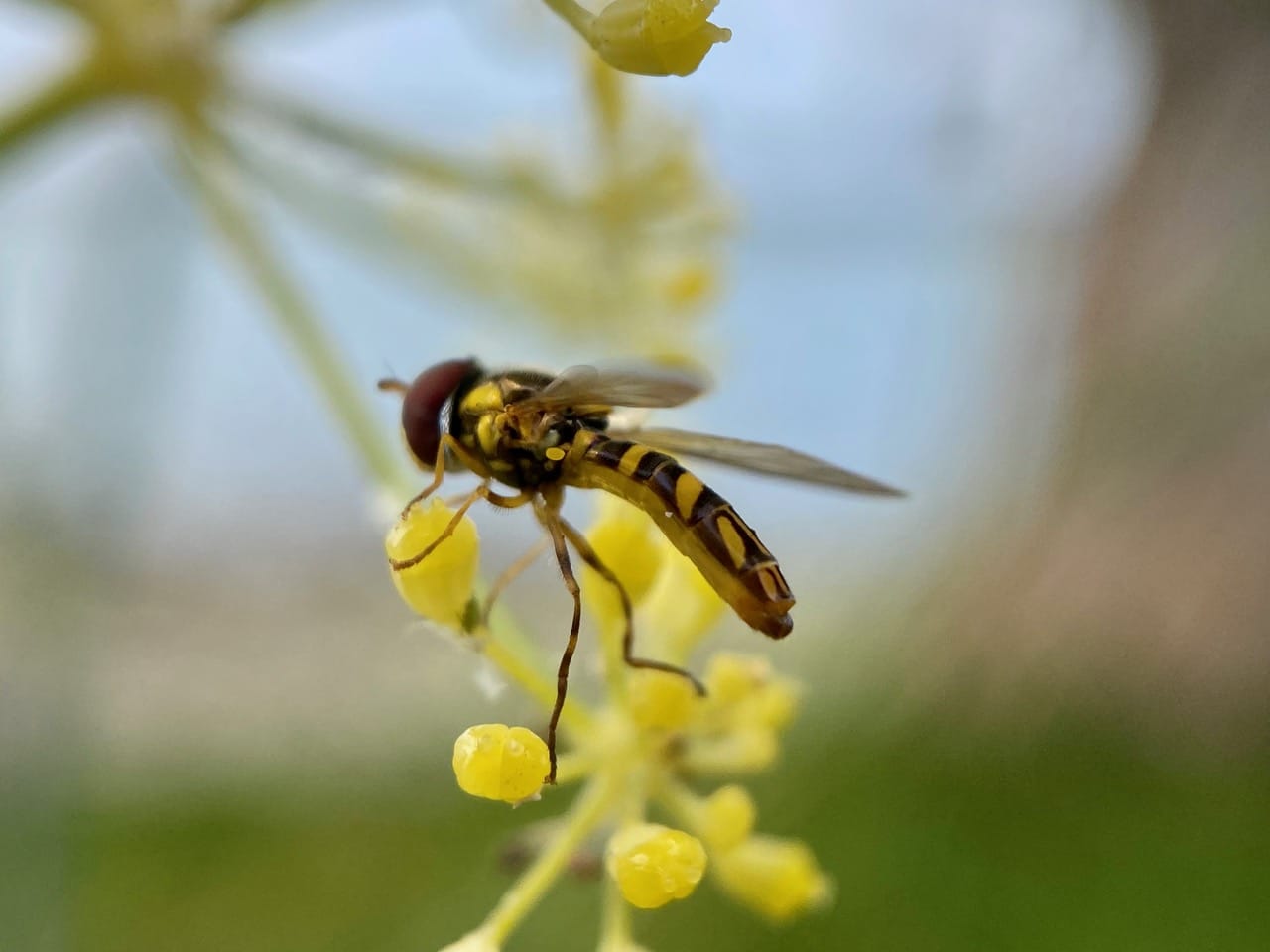
A male Oblique Streaktail, Allograpta obliqua (family Syrphidae) has landed on a floral umbel of Fennel.
Although small in size (6-7 mm long), the Oblique Streaktail is easily recognizable for the unique pattern on its black-and-yellow abdomen. It is a common North American species of hover fly. Adults visit flowers for nectar and pollen, and are pollinators. Females lay eggs on plant surfaces near aphids. Larvae feed on the aphids.
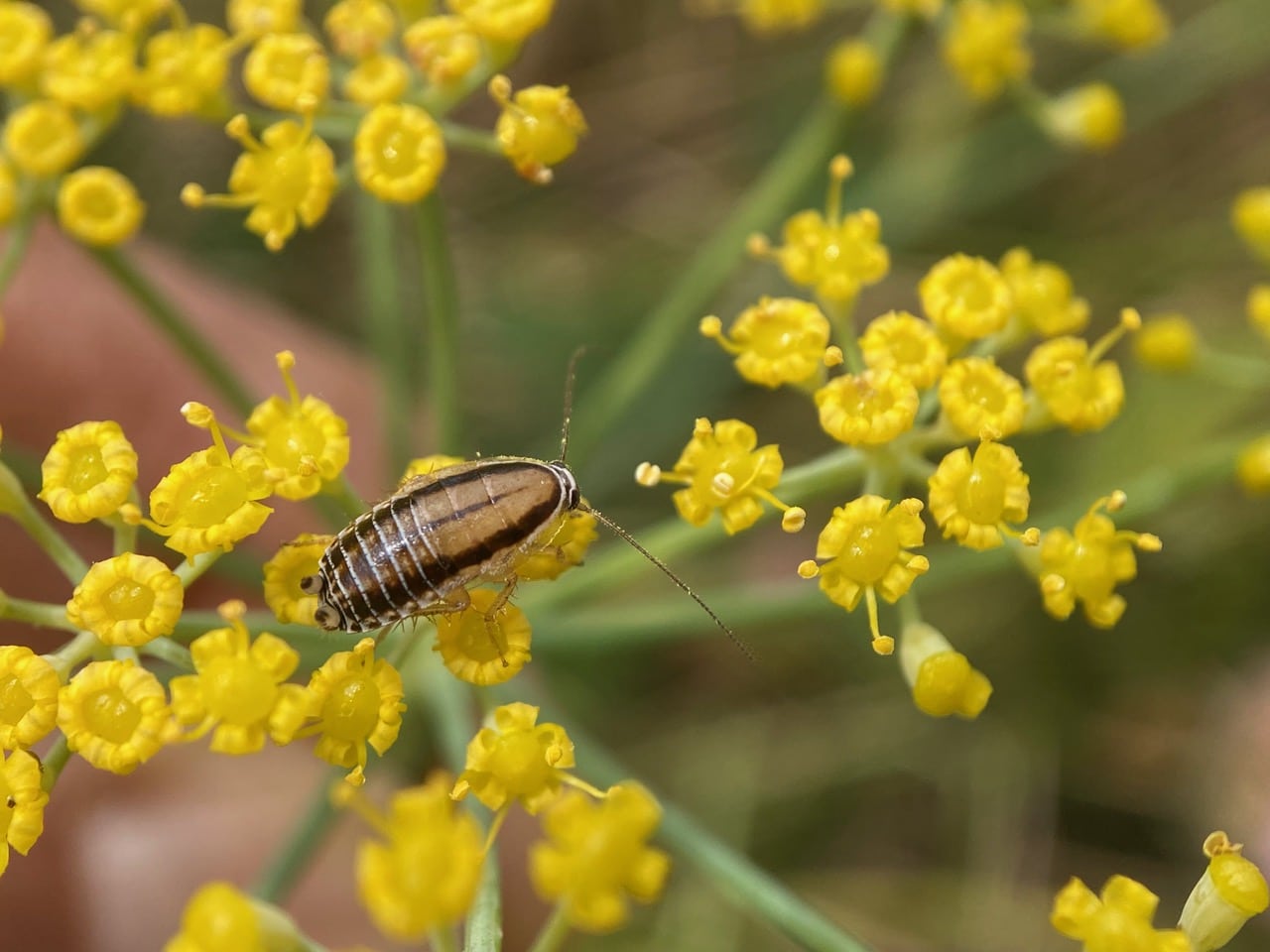
A Three-lined Cockroach, Luridiblatta trivittata is foraging on the flowers of Fennel.
The Three-lined Cockroach, Luridiblatta trivittata (order Blatodea) is a tiny, outdoor-dwelling insect native to the Mediterranean. Measuring about 5 mm long, it features three distinct dark stripes on its back. In the Bay Area, they often wander indoors searching for moisture during late summer. Unlike German or American cockroaches, they do not form indoor colonies. They live outdoors in leaf litter, compost, mulch and heavy vegetation. They are omnivorous scavengers that primarily feed on decaying organic plant matter (detritus), fallen fruit, and leaf litter. When wandering indoors, they are attracted to sugary, starchy, or protein-rich foods.
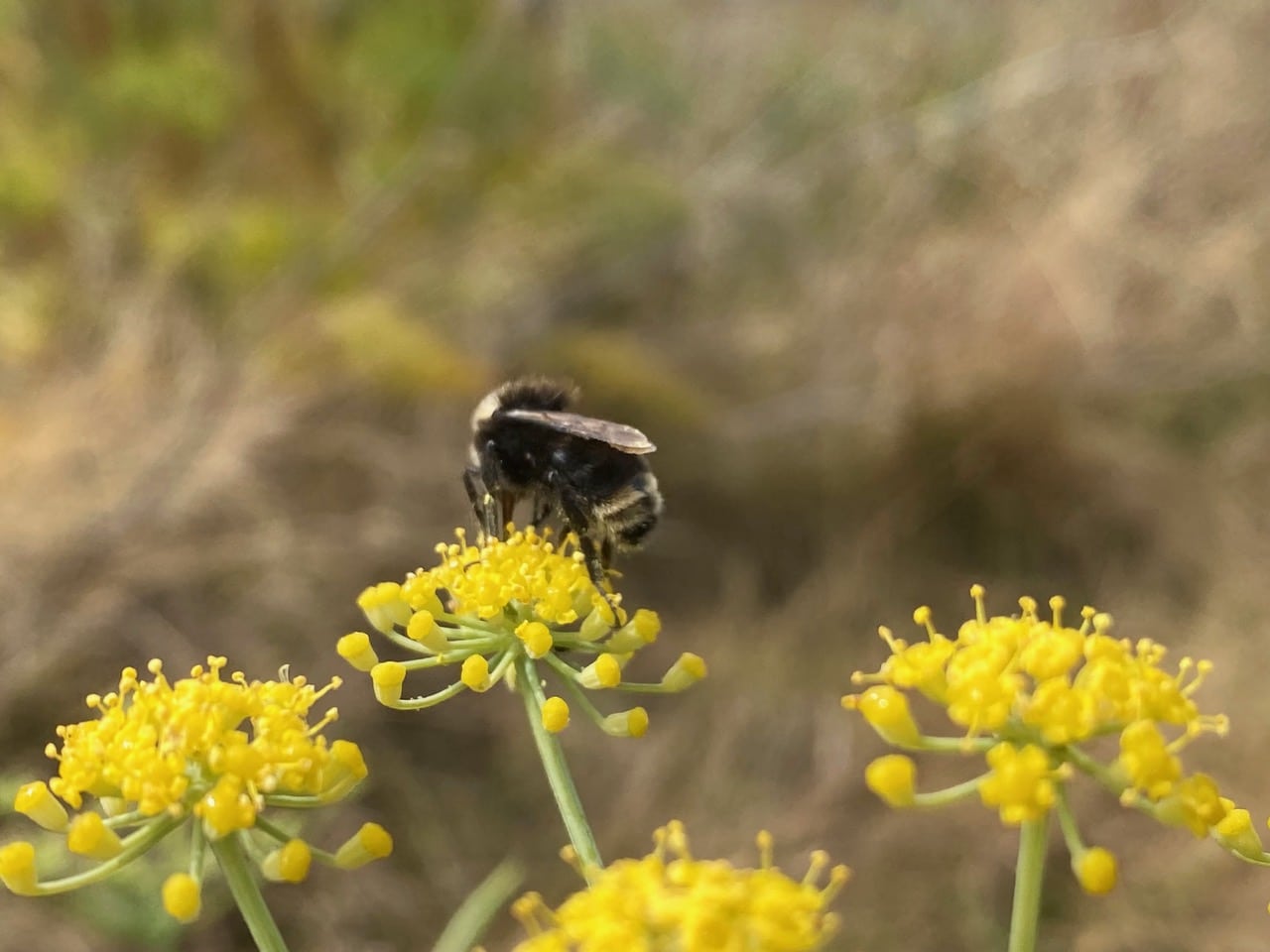
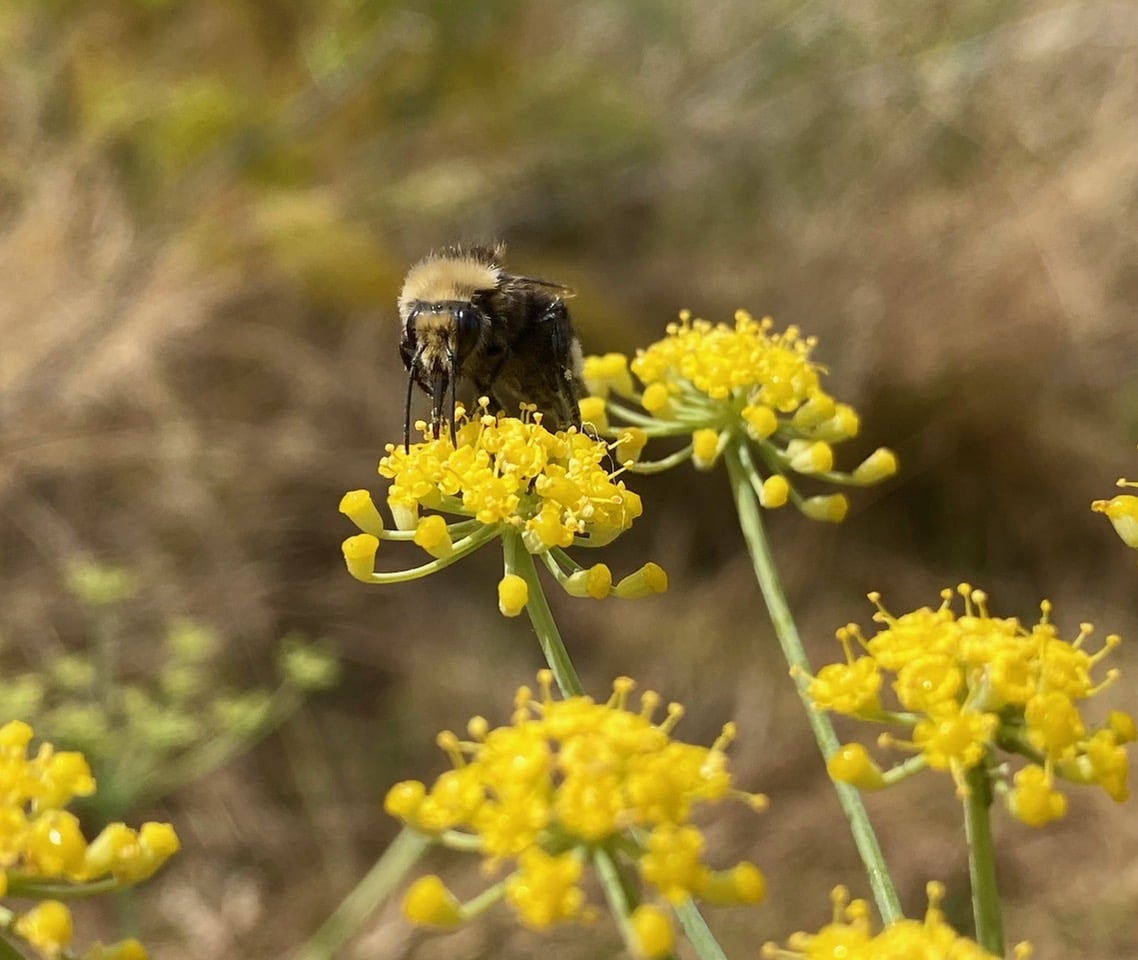
Ooh, that bumble bee shows more than one yellow band on its abdomen. A male Yellow-faced Bumble Bee?
As the bee turns around, I see that it has long antennae. Yep, probably a male Yellow-faced Bumble Bee, subgenus Pyrobombus (genus Bombus, family Apidae). We tend to see more and more male bumble bees these days as the summer progresses. It’s bumble bee mating season!
Late in the season (usually mid-to-late summer or fall), a bumble bee colony reaches its peak population and the queen switches from laying worker eggs to producing males (drones) and new queens (gynes). These newly produced males and queens leave the nest to mate. Shortly after, the original foundress queen, the workers, and the males all die naturally. Only the newly mated queens survive the winter by hibernating in the ground or in leaf litter, emerging the following spring to start entirely new colonies.
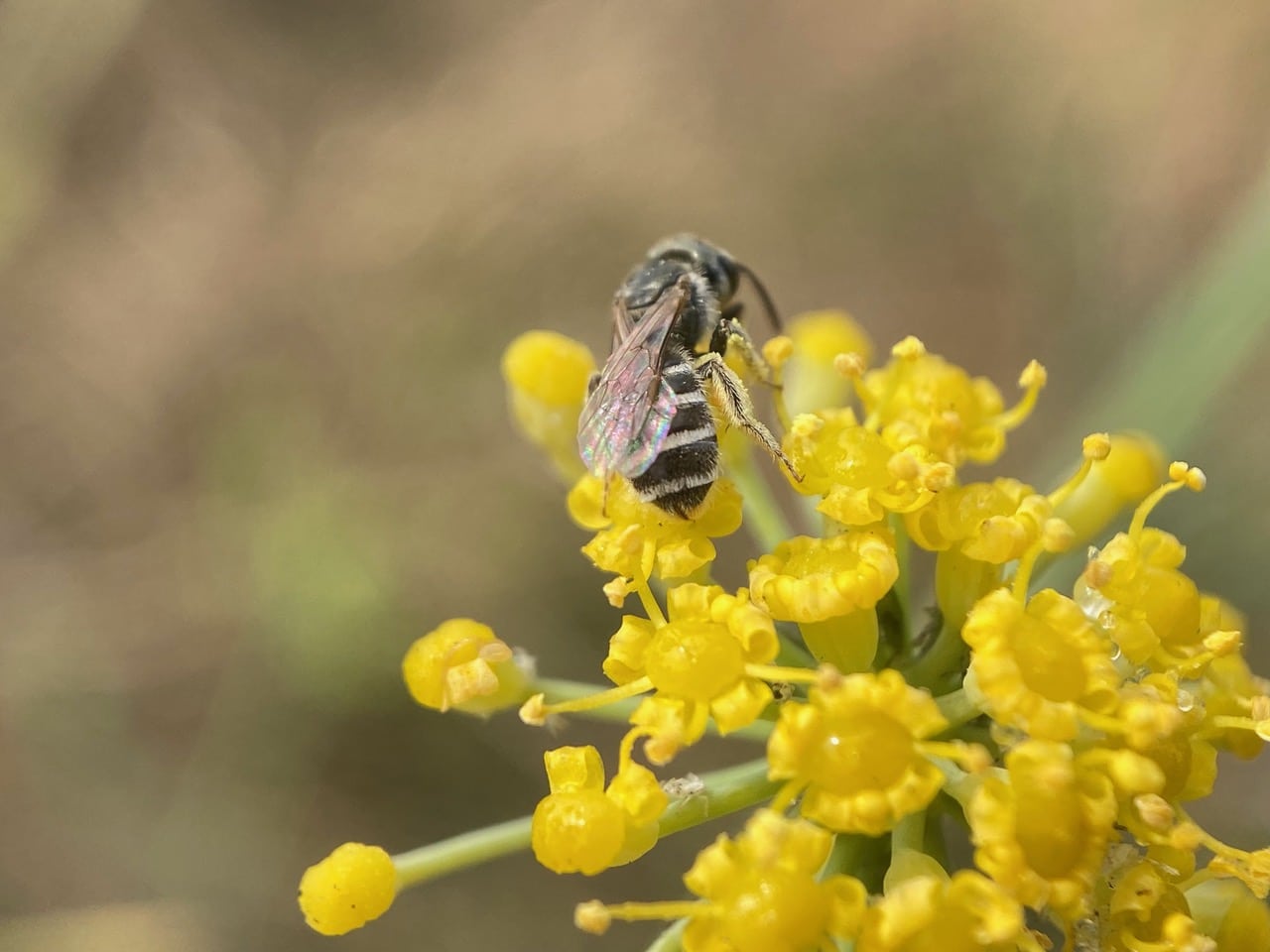
A little bee with black-and-white striped abdomen and a “furrow” at the tip of its abdomen. All that tells me that it is probably a Tripartite Sweat Bee, Halictus tripartitus (family Halictidae).
Furrow Bees are a group of ground-nesting, solitary, or primitively social bees. They get their name from a distinct longitudinal groove or “furrow” found on the abdomen of the females. They are also commonly known as Sweat Bees (family Halictidae) due to their habit of landing on humans to drink sweat for moisture and salts. These bees are generally small to medium (6 -14 mm long). They often have dark, metallic, or matte bodies with thin white or pale hair bands across the abdomen. The “furrow” on the female’s final abdominal segment is used for digging and nesting. While most furrow bees are solitary, each female digging her own tunnel in soil to lay her eggs, some species, such as the Tripartite Sweat Bee exhibit primitively social behavior. They form small colonies with a single queen and a few non-reproductive workers who forage for pollen. Their life cycle is akin to that of the bumble bees. Mated females spend the winter hibernating deep in the soil. In the spring they emerge, construct nests, and lay eggs in small chambers stocked with pollen. By the fall, the next generation of mated queens (gynes) prepare to overwinter, completing the annual cycle. These bees are crucial generalist pollinators that visit a wide variety of flowering plants and crops. Because they are short-tongued, they heavily favor easily accessible, open blooms like daisies, asters, and goldenrods.
Halictus is found worldwide; they are most common in the Northern Hemisphere. All are generalists, foraging from a wide variety of flowering plants. Many species are social and produce several generations per year. This is not surprising as most blooming plants are season-specific; a bee that requires pollen and nectar across multiple seasons would not thrive as a specialist. All Halictus in North America nest in the ground, often in aggregations; and they may nest in the same area for decades.
Tripartite Sweat Bees, Halictus tripartitus are social, forming annual colonies in the soil where a queen lays eggs and daughter bees act as workers. They are considered a “primitively social” species, meaning they have a social organization with a queen and workers, but with simpler colonies compared to more complex eusocial insects such as honey bees.
A tiny wasp has landed on a spent Fennel flower. iNaturalist has helped identify it as a member of the superfamily Chalcidoidea.
Most Chalcid species are parasitoids of other insects, attacking the eggs or larval stage of their host, though many other life cycles are known. These hosts are to be found in at least 12 different insect orders including Lepidoptera (butterflies and moths), Diptera (true flies), Coleoptera (beetles), Hemiptera (true bugs), and other Hymenoptera, as well as two orders of Arachnida. When the host is itself a parasitoid, the wasps are referred to as hyperparasitoids. Generally beneficial to humans as a group, chalcidoids help keep various crop pests under control, and many species have been used as biocontrol agents.
I spot a Harvestman resting on a leaf of Bristly Oxtongue. Sensing my approach, it quickly clambers onto an adjacent Fennel. Uh oh, how to follow the harvestman through this tangle of foliage? Note that the arachnid is using its second pair of extra long legs like antennae to navigate
The Opiliones are an order of arachnids commonly known as harvestmen or daddy longlegs. They are known for having exceptionally long legs relative to their body size. They are distinguished from the spiders in several ways. In the harvestmen, the connection between the cephalothorax and abdomen is broad, so the body appears as a single oval structure. Unlike spiders, Opiliones have no venom glands in their chelicerae, so pose no danger to humans. They also lack silk glands and therefore do not build webs.
Most Harvestman species are omnivorous, eating primarily small insects and all kinds of plant material and fungi. Some are scavengers, feeding on dead organisms and fecal material. Because their eyes cannot form images, they use their second pair of legs as antennae to explore their environment.
As the harvestman turns around, I get a glimpse of its bizarre face. Note the pair of protruding pedipalps at the front end of the arachnid, and the small knob-like structure on top of the “head” where the eyes are located.
Harvestmen (often called “daddy longlegs”) typically have just two eyes, situated on a raised, spine-covered turret in the middle of their fused body called an ocularium. Because these eyes do not form clear images, harvestmen rely on their long second pair of legs as sensory antennae to navigate and hunt for small, soft-bodied insects and avoid predators.
Like all arachnids, harvestmen have a pair of pedipalps – small leg-like appendages located near their mouthparts. They use their pedipalps to feel their surroundings, hunt and grab prey, or even manipulate food.
Ooh, the Oregon Gumweed, Grindelia stricta is off to a good start, with countless more immature flowerheads to open up!
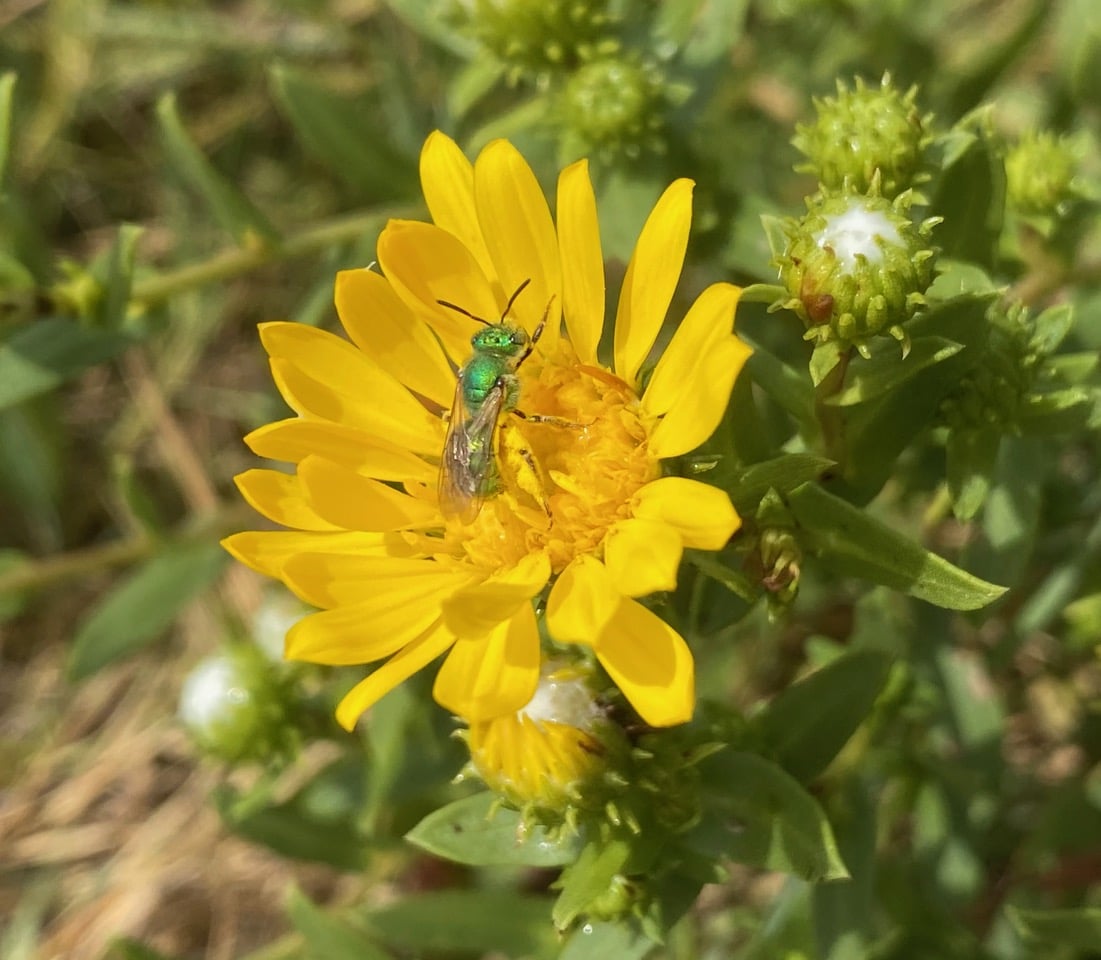
A female Fine Striped Sweat Bee, Agapostemon subtilior (family Halictidae) is foraging on a Grindelia flowerhead. The underside of her abdomen and her hind legs are packed with pollen.
The Fine Striped Sweat Bee, Agapostemon subtilior is a small, widespread species found across North America. They are active from late spring to fall, with all-green females measuring roughly 11 mm, and males (slightly smaller) displaying a black-and-yellow striped abdomen. Like other Agapostemon bees, they are solitary ground-nesters, and are polylectic, foraging from a wide variety of flowers.
A Grindelia Weevil, Anthonomus sp. (family Curculionidae) is foraging on a Grindelia flowerhead.
Weevils, family Curculionidae, are also called snout beetles. Curculionidae is one of the largest beetle families (about 40,000 species). Most weevils have long, distinctly elbowed antennae that may fold into special grooves on the snout. The snout is used not only for penetration and feeding but also for boring holes in which to lay eggs. The mouthparts are quite small and located at the end of the rostrum (snout), designed for chewing. Many weevils have no wings, while others are excellent fliers. Most are less than 6 mm in length. The majority of weevils feed exclusively on plants. The fleshy, legless larvae of most species feed only on a certain part of a plant – i.e., the flower head, seeds, fleshy fruits, stems, or roots. Many larvae feed either on a single plant species or on closely related ones. Adult weevils tend to be less specialized in their feeding habits. The family includes some very destructive agricultural pests.
The small (usually 3-6 mm) ribbon-snouted beetles, Anthonomus sp. (family Curculionidae) have a strong specialized relationship with the Asteraceae family. The most common ones found on gum plants (Grindelia) are Anthonomus ater and A. squamosus; both species are native to North America. The adults feed on the flower petals and anthers. Females lay their eggs directly in the flower buds, and the larvae safely mature inside the developing seed heads. The weevils cause very little damage to the overall health of the plant.
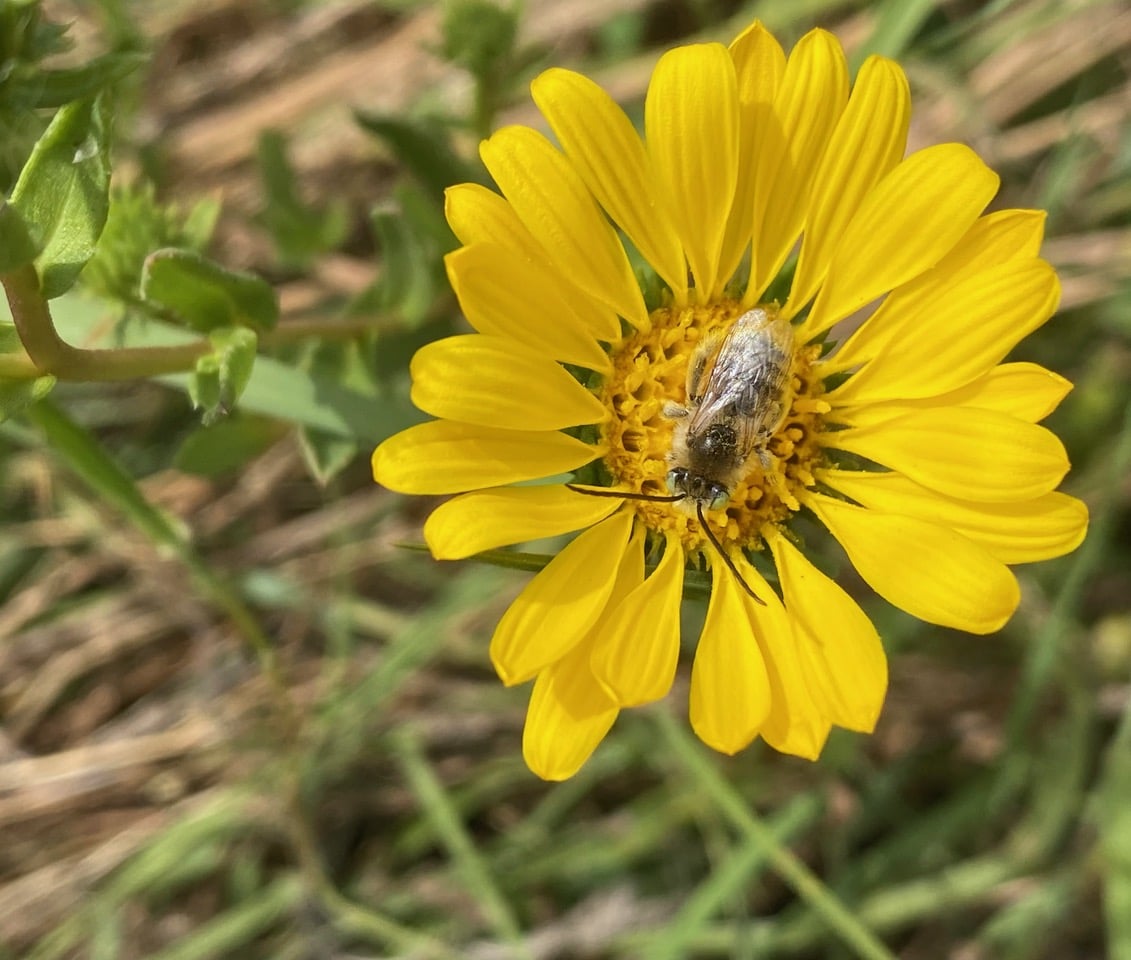
A male Summer Longhorn Bee, Melissodes sp. (family Apidae) is taking nectar on a Grindelia flowerhead.
The Summer Longhorn Bees, Melissodes sp. (family Apidae) are medium to large bees, stout-bodied, usually with gray hair on the thorax and pale hair bands on the abdomen. Males usually have yellow markings on their faces and have very long antennae from which their common name is derived. They are active May to September, with peak flight in late June to early August. The females prefer flat, bare ground for digging their solitary nests, though they sometimes nest in aggregations. Pollen is transported in scopae on the hind legs. Pollen loads are often copious and brightly colored and thus very distinguishable. Melissodes are specialists on Asteraceae – females gather pollen from flowers of Aster, Bidens, Coreopsis, Cosmos, Encelia, Gaillardia, Helianthus, and Rudbeckia ssp.
Male bees do not participate in nest construction, so at the end of the day they don’t have a home to return to. They usually sleep out in the open, mainly on vegetation. The male Longhorn Bees are well-known to gather and sleep in aggregations. Apparently there is safety in numbers – when one is attacked by a predator, the others are alerted right away and are able to escape.
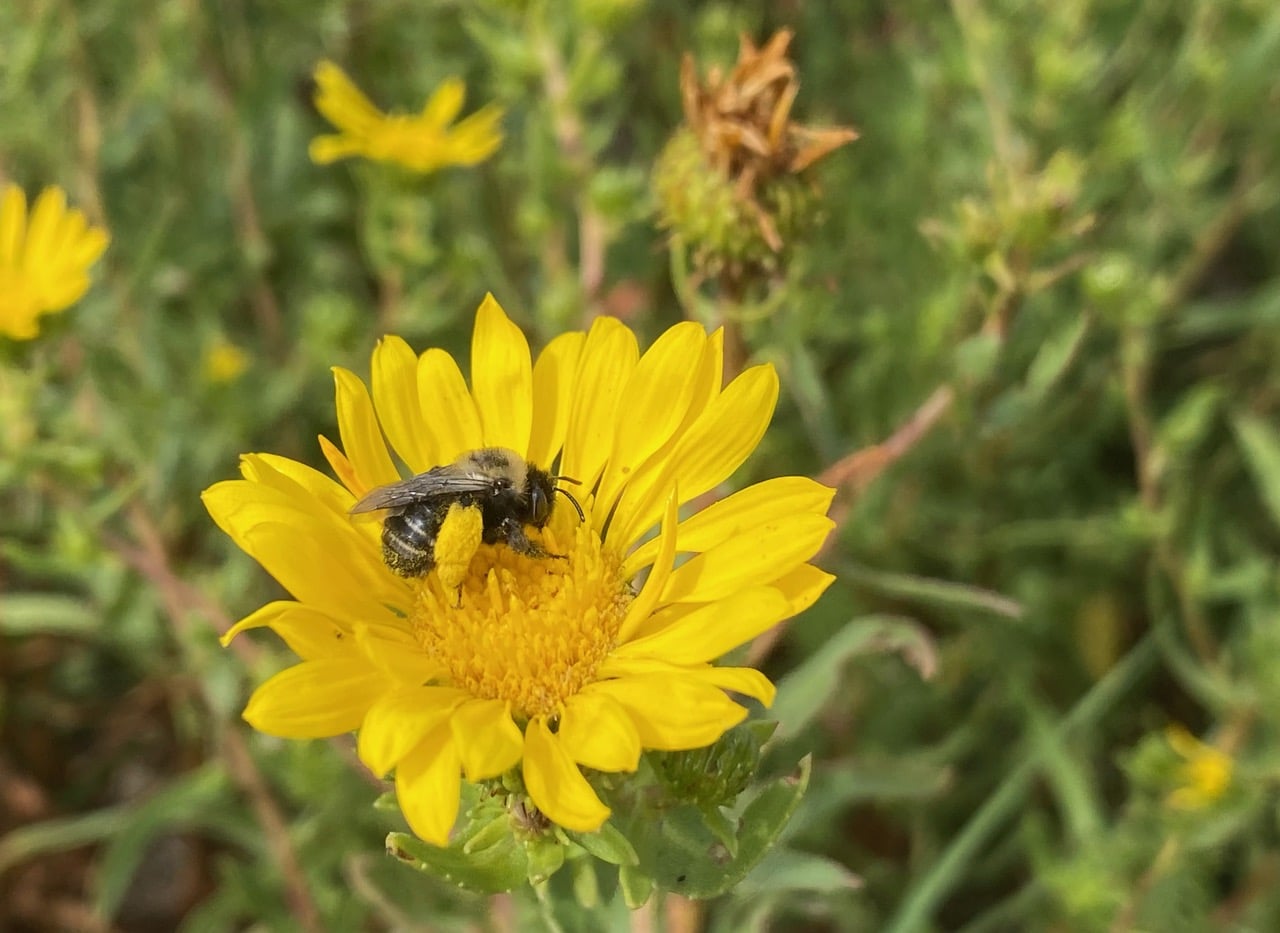
A dark, robust bee just landed on a Grindelia flowerhead. Whoa, look at the size of her pollen load! A female Longhorn Bee, Melissodes sp.? I have never seen one that is black.
My bee guru, Emil has confirmed that the black bee with the huge pollen load is indeed a female Melissodes. He calls it Dark Melissodes. Though much less common than the brown Melissodes we often see, Emil has photographed this species foraging on Grindelia and digging nests in the ground around Alameda. Yay, a new species of Melissodes for me!