

Pollinator Post 7/19/26 (1)

Fred and I are happy to return for our walk at Shoreline Park on Bay Farm Island this cool, mild afternoon.
I stop by this wild Hooker’s Evening Primrose, Oenothera elata to admire its fresh blooms. It is amazing that this native has managed to survive the extensive human alterations of the coastline here.

Hey, there’s a little bee inside that flower, apparently seeking nectar at the base of the flower. I am almost sure that it is a Tripartite Sweat Bee, Halictus tripartitus (family Halictidae).
Halictus is found worldwide; they are most common in the Northern Hemisphere. All are generalists, foraging from a wide variety of flowering plants. Many species are social and produce several generations per year. This is not surprising as most blooming plants are season-specific; a bee that requires pollen and nectar across multiple seasons would not thrive as a specialist. All Halictus in North America nest in the ground, often in aggregations; and they may nest in the same area for decades.
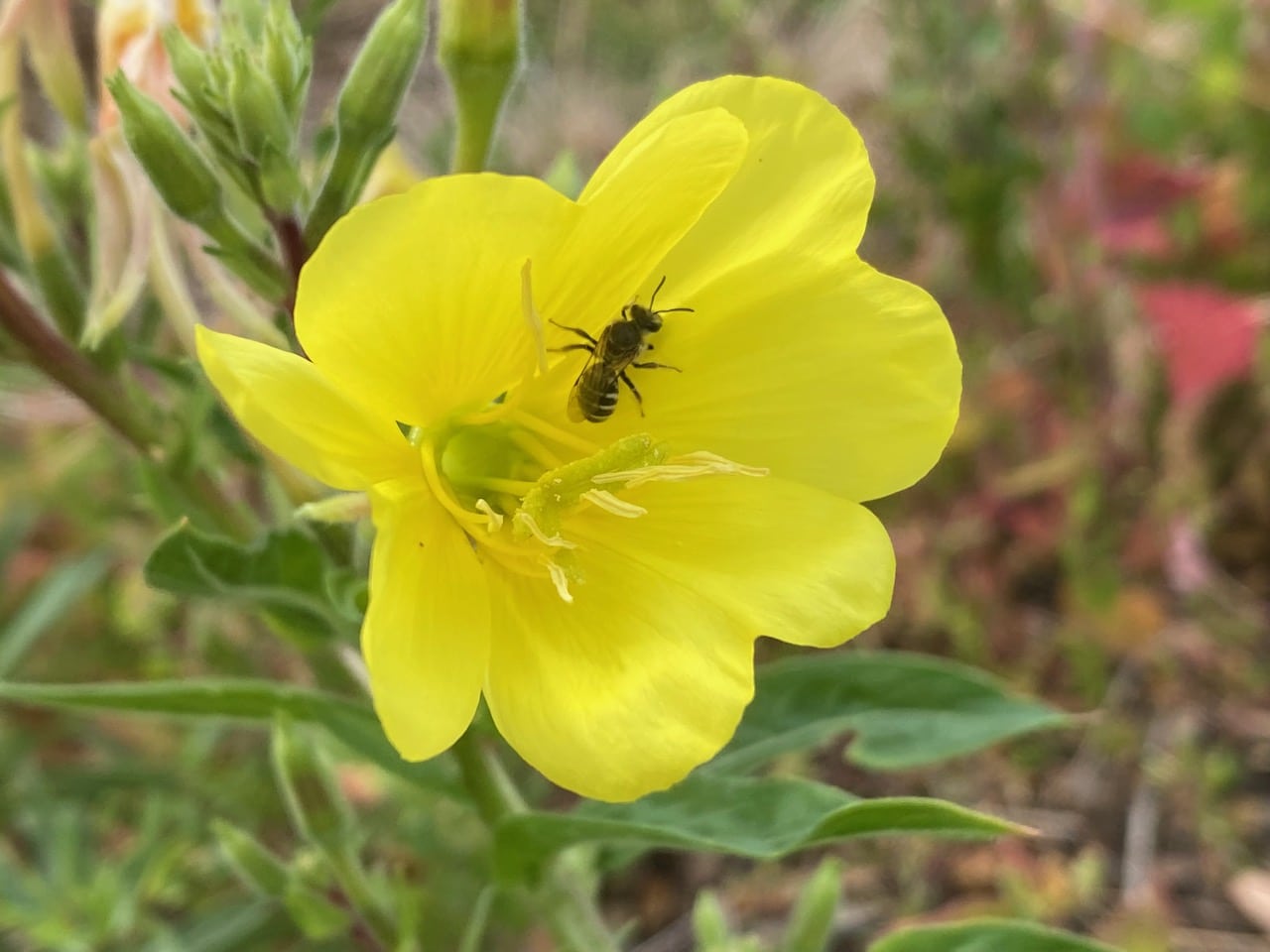
After a while, the little bee crawls up a petal to launch itself into the air, never having touched any of the flower’s reproductive structures. It is obviously not contributing to pollination. Anyway, these small bees are not the plant’s intended pollinators, and apparently the flower can afford to lose some nectar to some thieves without major consequences. All the anthers on this flower are spent, with none of their usual pollen strung up in viscin threads remaining. The flower has entered its female phase, its large green, four-lobed stigma now receptive to incoming pollen. The temporal separation of the male and female structures, known as dichogamy, serves to prevent self-pollination.
Hooker’s Evening Primrose, Oenothera elata (family Onagraceae) is usually biennial, completing its life cycle in two growing seasons. It can reach 6 feet in height. Native to California, it is found along roadsides, in moist meadows, or in woodland. At the top of reddish stems are open clusters of 2-4 inch wide yellow flowers with 4 large petals and protruding yellow stamens and 4-branched pistil. The fragrant flowers open at dusk and close up during mid-morning the next day, turning orange with age.
The flowers of Evening Primrose open at night and have most of the characteristics associated with night-pollination by moths: they are large with nectar glands at the bottom of a deep flower cup, and their reproductive parts extend beyond the petals. The pale flowers are visible to night-pollinators; they are also sweetly scented as an additional guide at night. Pollinators brush against the reproductive structures when they go into the base of the flower after nectar. Sphinx moths are the most significant pollinators for the evening primrose that bloom at night. Their long tongues enable them to reach the nectar deep within the flower. As they feed, pollen is transferred from one flower to another. Oenothera elata is also pollinated by specialist bees active at dawn and dusk such as the twilight-foraging Evening Primrose Sweat Bees. These bees have evolved specialized hairs on their legs to collect the distinctive stringy pollen.
Viscin threads are thread-like structures composed of sporopollenin, a tough, resilient material also found in the outer layer of pollen grains (exile). These threads are produced by some plants, notably within the Onagraceae and Ericaceae families, and they bind individual pollen grains together and also help them adhere to pollinators. The threads are not just sticky, but also exhibit a cobweb-like quality, making them difficult to handle.
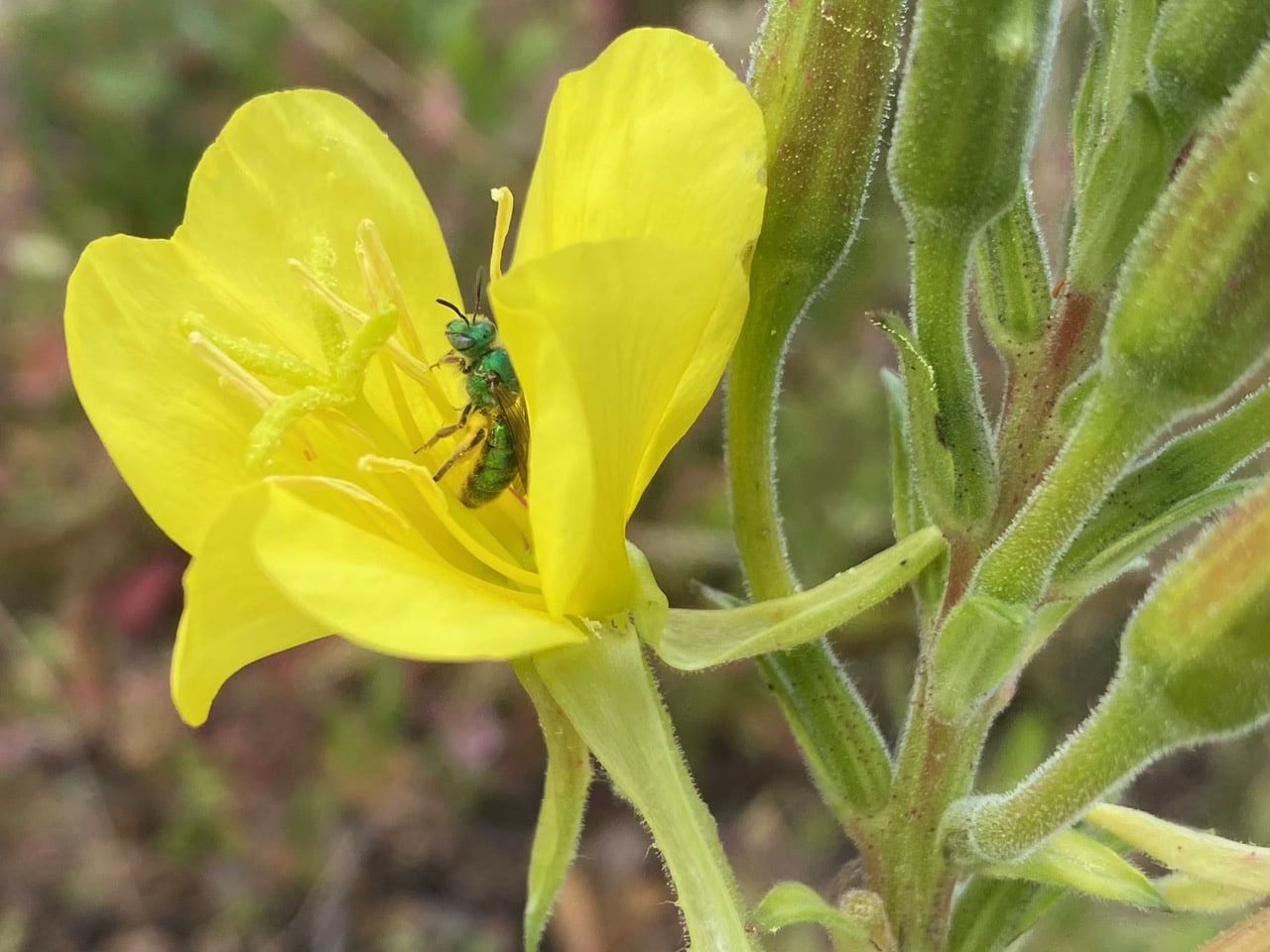
After taking nectar at the base of a different flower, a female Fine Striped Sweat Bee, Agapostemon subtilior (family Halictidae) climbs up a stamen to gather pollen that remains on the fading anther. I am suddenly aware of an anomaly – is this plant a mutant? Its stigma is at the same level as the anthers! Most Oenothera flowers have much longer styles that hold their 4-lobed stigma way beyond the anthers, making self-pollination less likely.
The Fine Striped Sweat Bee, Agapostemon subtilior is a small, widespread species found across North America. They are active from late spring to fall, with all-green females measuring roughly 11 mm, and males (slightly smaller) displaying a black-and-yellow striped abdomen. Like other Agapostemon bees, they are solitary ground-nesters, and are polylectic, foraging from a wide variety of flowers.
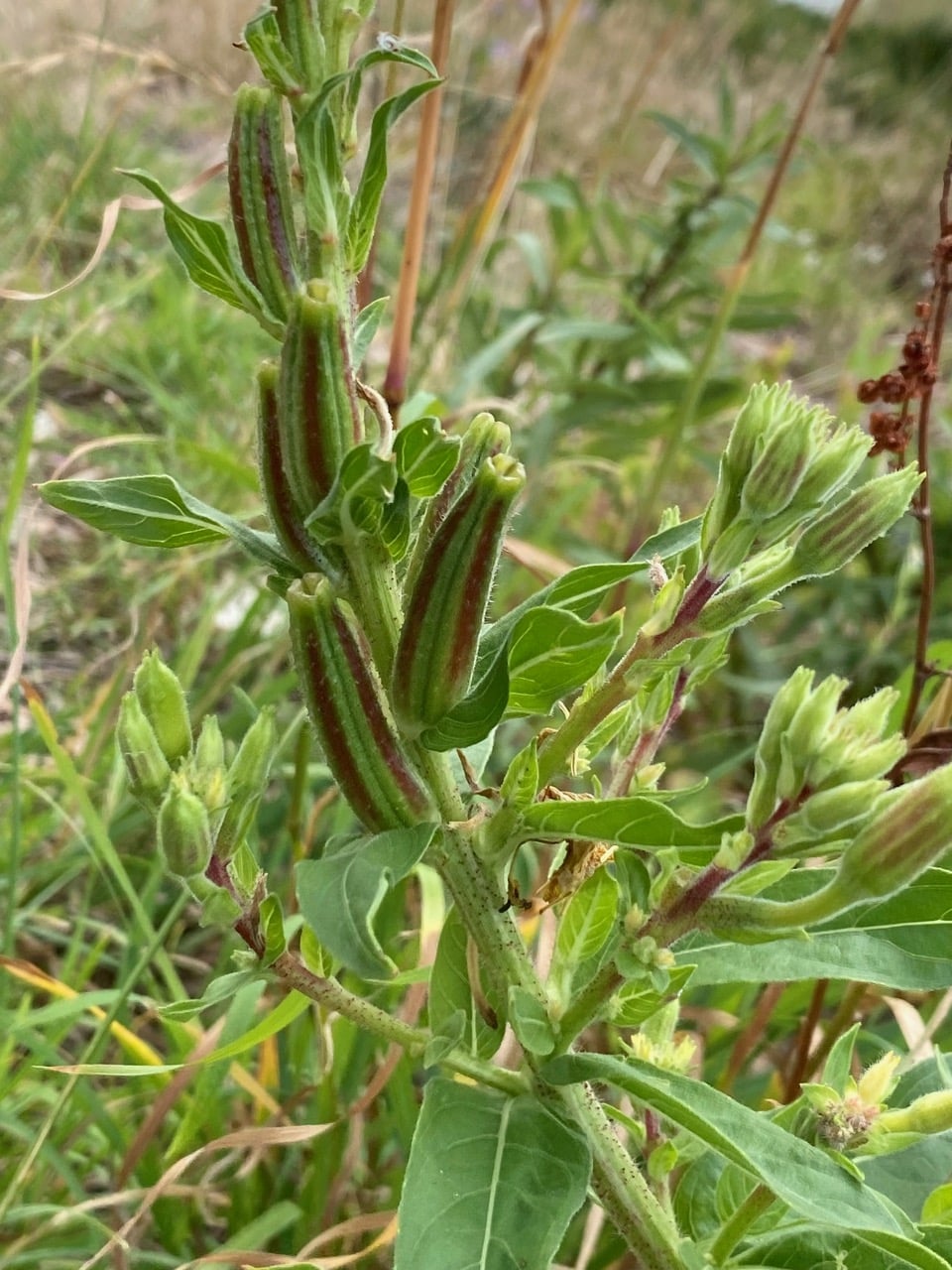
Lower down on the Hooker’s Evening Primrose, beautiful red-striped seed capsules are already developing along the stem. They are elongated, cylindrical pods that turn woody and brown as they mature in autumn. Each capsule contains numerous small seeds and splits open to disperse them, while also providing a winter food source for birds.

I am happy to see that the Oregon Gumweed, Grindelia stricta has started to bloom. The hardy plant is one of the few natives that still thrive along the salty shoreline here. It is a magnet for pollinators and other insects through the summer.
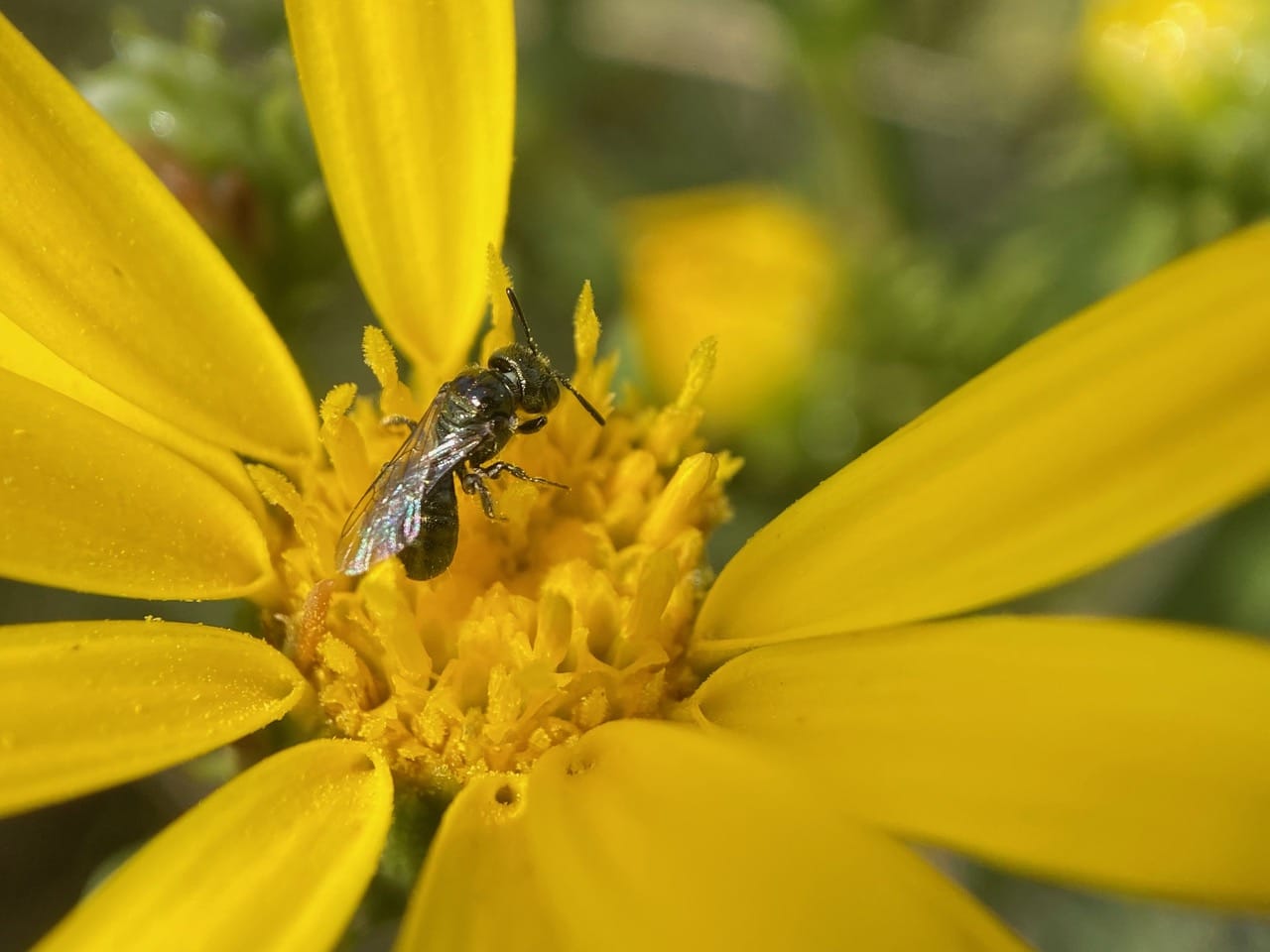
A Small Carpenter Bee, Ceratina sp. (family Apidae) is foraging on a Grindelia flowerhead.

The Small Carpenter Bee genus Ceratina is closely related to the more familiar, and much larger Carpenter Bees (genus Xylocopa). Ceratina are typically dark, shiny, even metallic bees, with fairly sparse body hairs and a weak scopa on the hind leg. The shield-shaped abdomen comes to a point at the tip. Some species have yellow markings, often on the face.
Females excavate nests with their mandibles in the pith of broken or burned plant twigs and stems. While many species are solitary, a number are subsocial. Both male and female carpenter bees overwinter as adults within their old nest tunnels, emerging in the spring to mate. In the spring, this resting place (hibernaculum) is modified into a brood nest by further excavation. The female collects pollen and nectar, places this mixture (called bee bread) inside the cavity, lays an egg on the provision, and then caps off the cell with chewed plant material. Several cells are constructed end to end in each plant stem.


Blooming along side the Grindelia are the soft lavender flowers of Algerian Sea Lavender, Limonium ramosissimum.

Pretty and delicate flowers belie the fact that the Algerian Sea Lavender is an invasive Mediterranean perennial that poses a major threat to coastal marshes and wetlands across the SF Bay and Southern California. Spreading rapidly from tidal lagoons to inland wetlands, the plant forms dense monocultures that crowd out native flora and alter delicate salt marsh ecosystems. Its seeds can float in saltwater and remain viable for germination for up to two weeks, allowing it to easily spread via ocean tides.

A male Small White or Cabbage White butterfly stops momentarily to sip nectar from the flowers of Algerian Sea Lavender.
The Cabbage White, Pieris rapae (family Pieridae) was introduced to the US along with European cabbage imports in the 1860’5. The caterpillars feed on plants in the mustard or Brassicaceae family, and occasionally some in the caper family. The butterflies have a darkened, yellowish underside of the hind wings, which enables them to heat up quickly in the sun. The butterfly’s white wings reflect ultraviolet light, which we can’t see but the butterflies can. To our eyes the butterflies seem plain and drab, but to each other, females are a gentle lavender and males shine with a deep royal purple. Brighter males are more attractive to females as the color’s strength reflects the amount of protein the males consumed as caterpillars.
To tell a male and female Cabbage White butterfly apart, look at the black spots on their upper forewings. Males have one single spot, while females have two.
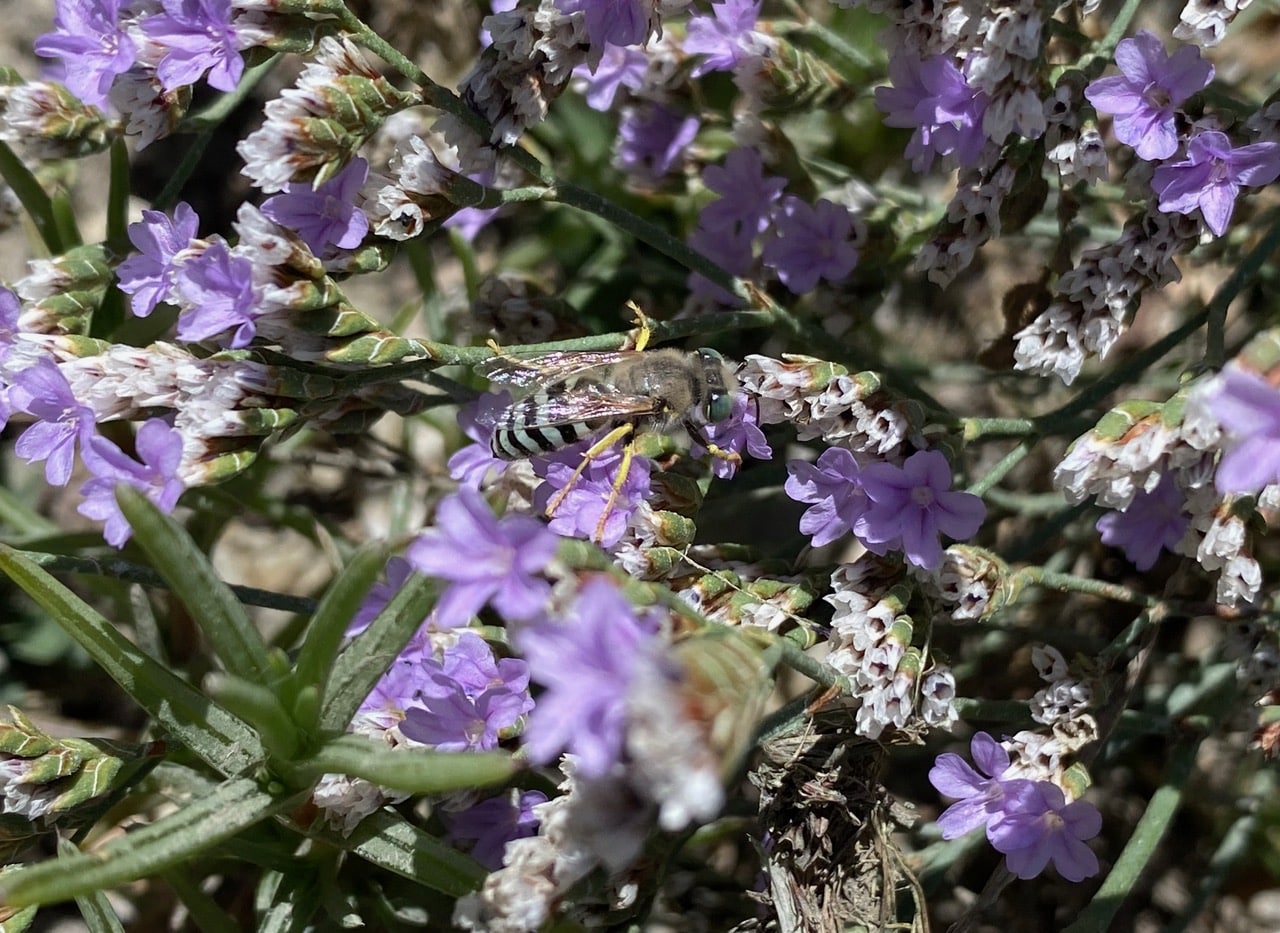
The most avid visitors to the flowers of the Algerian Sea Lavender are the American Sand Wasps, Bembix americana (family Crabronidae). Even their distinctive black-and-white abdomen is difficult to discern from the busy flowers of the plant.
Sand wasps in the genus Bembix are familiar and common throughout North America, digging their burrows in dunes, on beaches, and other habitats with loose, deep sand. The female rapidly kicks out large quantities of sand using a “tarsal rake” of spines on each front leg. The burrow is excavated before the wasp goes hunting. Bembix are generalist, opportunistic hunters. True flies in the order Diptera are the usual prey. A victim is paralyzed or killed by the wasp’s sting, and is then flown back to the nest. Most species will lay an egg on the first victim, while some species lay an egg in the empty cell before starting to hunt. Once the egg hatches, mama wasp brings flies to her larva as needed. This “progressive provisioning” is rare in the insect world. When the larva reaches maturity, mama wasp closes the cell. Inside, the larva spins an oblong cocoon, weaving sand grains into the structure and resulting in a hardened capsule. Overwintering takes place as a prepupa inside this cocoon, but there are usually two generations a year.
Male sand wasps often engage in an elaborate flight ritual called “sun dances”. Males emerge before females, and fly erratically at dizzying speed one or two inches above the ground attempting to detect virgin females about to emerge from their underground nests. Both sexes are often seen taking nectar at flowers, especially from Asteraceae family. Bembix wasps are often victims of other insects such as cuckoo wasps (Chrysididae), velvet ants (Mutillidae), satellite flies (Sarcophagidae), bee flies (Bombyliidae), and thick-headed flies (Conopidae).

A dusky, long-legged fly is perched on spike of developing Seaside Arrowgrass seed pods. iNaturalist has helped identify it as a Stiletto Fly, Ozodiceromyia sp. (family Therevidae).
Ozodiceromyia is a genus of Stiletto Flies in the family Therevidae, consisting of about 7 described species found across North America, Central America, and northern South America. These flies are generally grayish with narrow abdomens, often resembling robber flies, and are found in open, sunny habitats. Adults are nectar-feeders, while larvae are predators of insect larvae in soil.

This young Coast Live Oak, Quercus agrifolia has produced a cluster of shoots that are whitish with very small leaves. What is happening here?

Live Oak Witch’s Broom Fungus, primarily caused by the powdery mildew Cystotheca lanestris (family Erysiphaceae) produces dense, stunted clusters of twigs on oaks in the Western United States. This fungal infection often results from cool, moist spring conditions, causing deformed, crowded, and sometimes discolored growth on branches. The fungus is fairly host-specific and only infects species in the genus Quercus, notably Coast Live Oak, Interior Live Oak, and Canyon Live Oak. High humidity and fog often drive the growth of this fungus. While generally not fatal, it can weaken the tree, reduce growth, and detract from its appearance. To manage the spread, prune the affected branches at least 6-12 inches below the infected growth.
Live Oak Witches’ Broom Fungus (Cystotheca lanestris) · iNaturalist