

Pollinator Post 7/19/24

In the low light of early morning, I find this stocky bee asleep on a flowerhead of Elegant Tarweed, Madia elegans in my garden, in the company of a Scentless Plant Bug (family Rhopalidae). I figure that the bee is probably male, as females normally sleep in their own nests. Its antennae are not very long, so it is not a male Longhorn Bee. What’s that white stuff on its front legs?
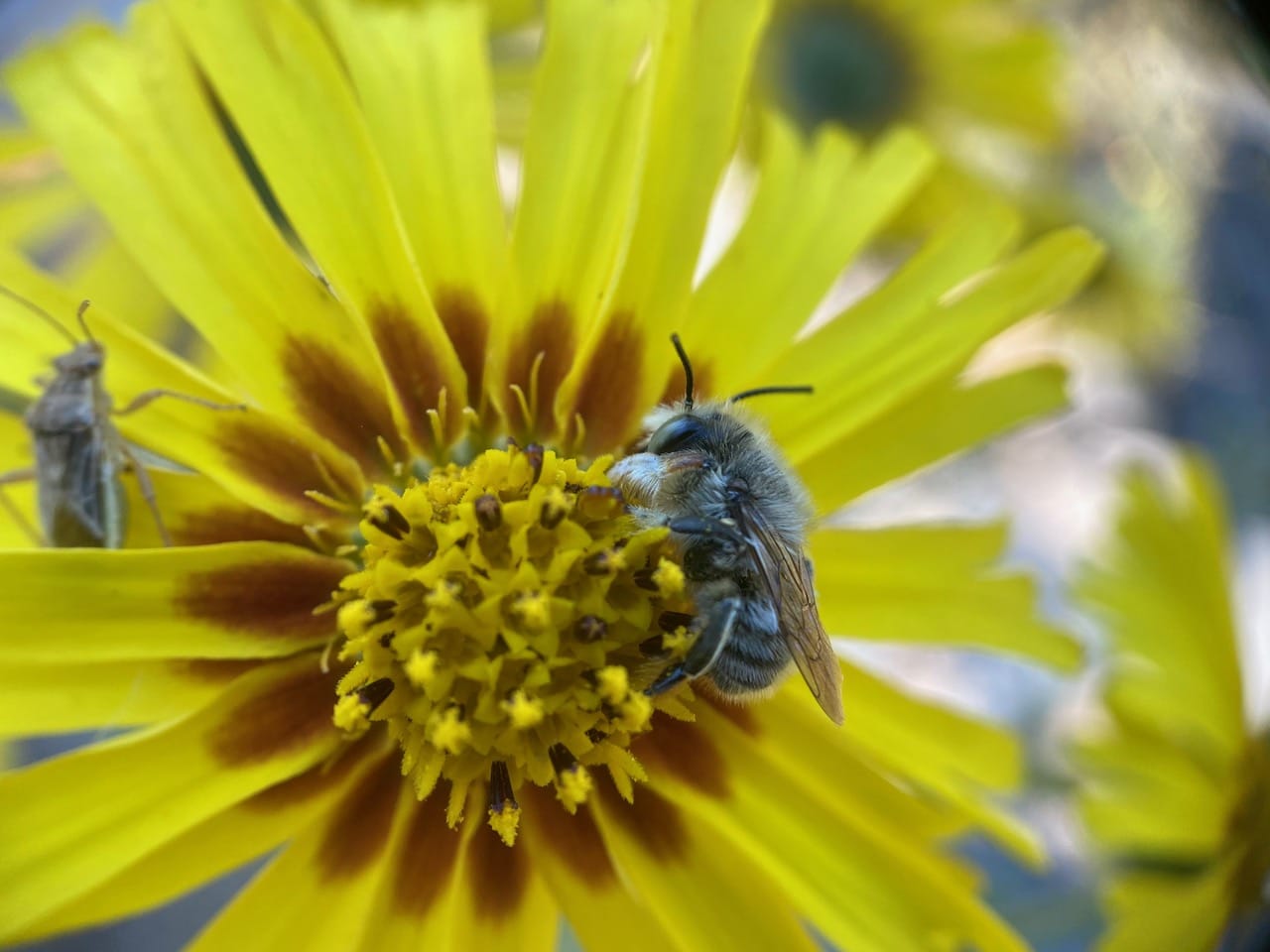
Closing in with the macro lens, I realize that the bee has tufts of long white hairs on its front legs. Aha, a male Western Leafcutter Bee, Megachile perihirta (family Megachilidae)? The males of this species use their “mittens” to cover the eyes of females while mating, presumably as blinders to calm them and increase receptivity.
Leaf-cutter Bees, Megachile sp. (family Megachilidae) are stout-bodied, usually with pale hair on the thorax and stripes of white hairs on the abdomen. Females usually have a triangular abdomen with a pointed tip, and males’ faces are covered with dense, pale hair. Flight season is from May into September, with peak activity from June to August.
Solitary females construct nests in tubular cavities, including hollow stems, tree holes, and abandoned beetle burrows in wood. Many use holes drilled into wood, straws, or other manufactured tunnels. Females cut pieces from leaves or flower petals for use in the construction of brood cells. Most Megachile females are generalists when foraging for pollen. Pollen is transported in dense scopae on the underside of the abdomen.

Later in the morning, I take a walk in the Reinhardt Redwood Regional Park. It’s a deja vu moment as I pause at an Italian Thistle flowerhead with a little bee on it – haven’t I encountered this scene before (7/5/24) at this spot? It is the same plant on the side of the paved path near the parking lot. Is it the same bee? It is conceivable that the same bee is still collecting pollen from the same plant as long as the thistle flowerhead is still providing copious amounts of pollen. The tiny bee can spend a whole day foraging from the same flowerhead.
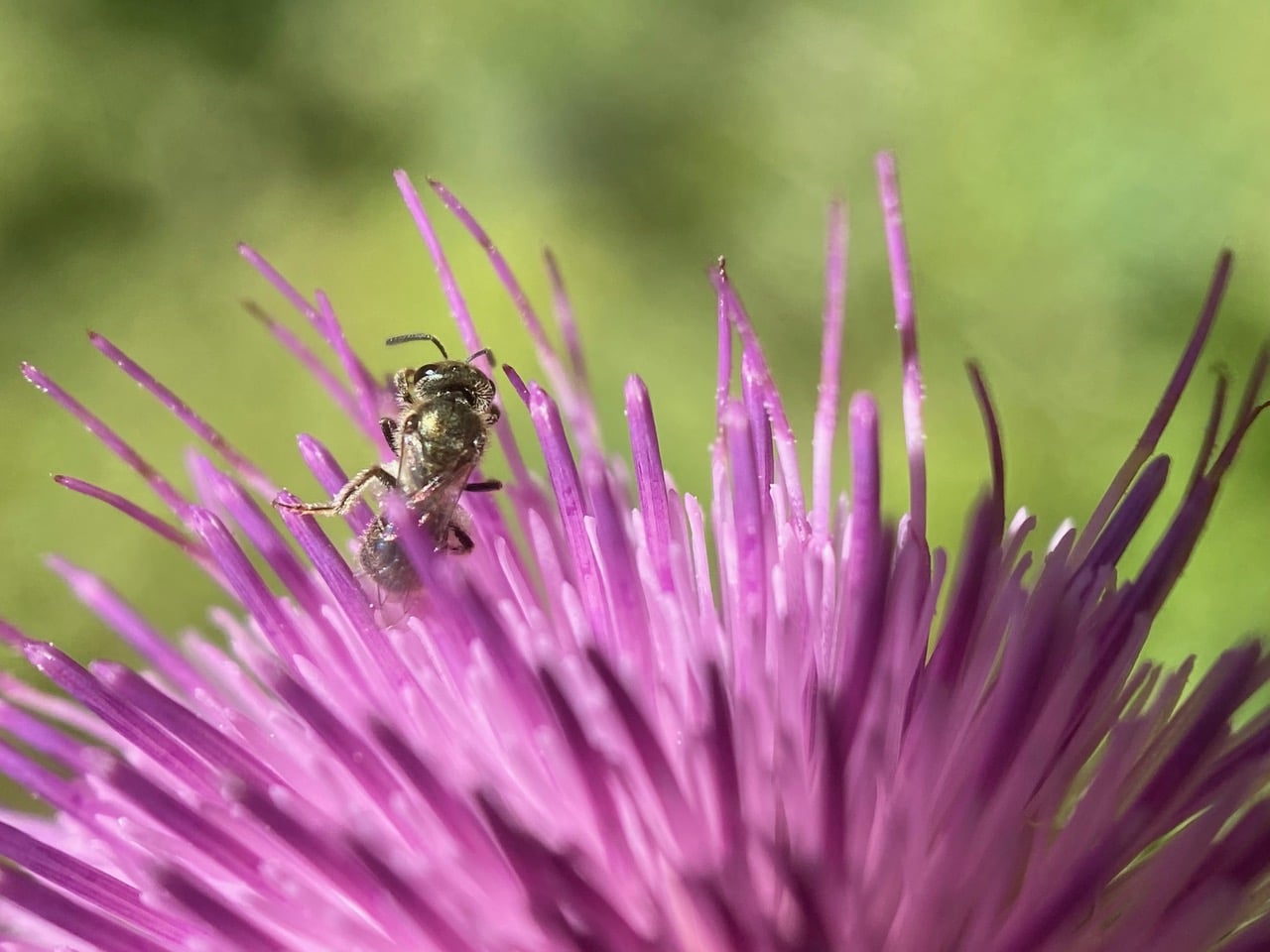
The bee is a female Metallic Sweat Bee, Lasioglossum (Dialictus) sp. (family Halictidae).
Lasioglossum species are found worldwide, and they constitute the largest bee genus. The subgenus Dialictus are the most likely to be seen in the U.S., with over 300 species of these tiny metallic bees. The majority of Lasioglossum are generalists. Because they are so abundant throughout the flowering season, the bees are often important pollinators. Their sheer numbers are enough to achieve excellent pollination of many wild flowers, especially of plants in the Asteraceae, which have shallow floral tubes that are easily accessed by these minute bees.
Lasioglossum are closely related to the genera Halictus and Agapostemon. These genera are commonly called “sweat bees” because of their attraction to human sweat, which they drink for its salt content. Lasioglossum are dusky black to brown slender bees with bands of hair on their abdomen. Female Sweat Bees (family Halictidae) carry pollen in the scopae on their entire hind legs and underside of their abdomen.
Lasioglossum exhibit a range of social behaviors; the genus includes solitary, communal, semi social, primitively eusocial, and even parasitic species. Almost all Lasioglossum in the U.S. nest in the ground. Generally these nests are built in the spring by fertilized females (called foundresses) that spent the winter in hibernation. In social species, the foundresses behave much like the queen Bumble Bees – they lay the first batch of eggs that develop into the first generation of female workers. The nest grows with each additional generation of bees. Later broods may consist of both males and females. They mate, and at the end of the season the fertilized females hibernate til the following spring, repeating the life cycle of the colony.

Using her mandibles and front legs, the little bee is extracting pollen from the long anther tubes one at a time.
Thistle flowers have a special pollination mechanism. The thistle flowerhead is composed of only disk flowers. Like other Asteraceae, thistle flowers are protandrous, the male parts maturing before the female parts. When visited by an insect the flowers react to the insect’s touch and the stamen filaments contract over a few seconds, pulling the anther tube down and forcing the style to extrude, pushing out pollen like a piston. Once the pollen is shed, the styles grow out of the anther tube and the pair of stigmas open out and become receptive. It has been observed that electrical stimulation can induce the movement, suggesting that it is an electrochemical phenomenon. Similar movements are observed in many other Asteraceae. With or without excitability, the pollen is generally presented when the style extends from the anther tube, by growth if not by a touch-elicited movement.
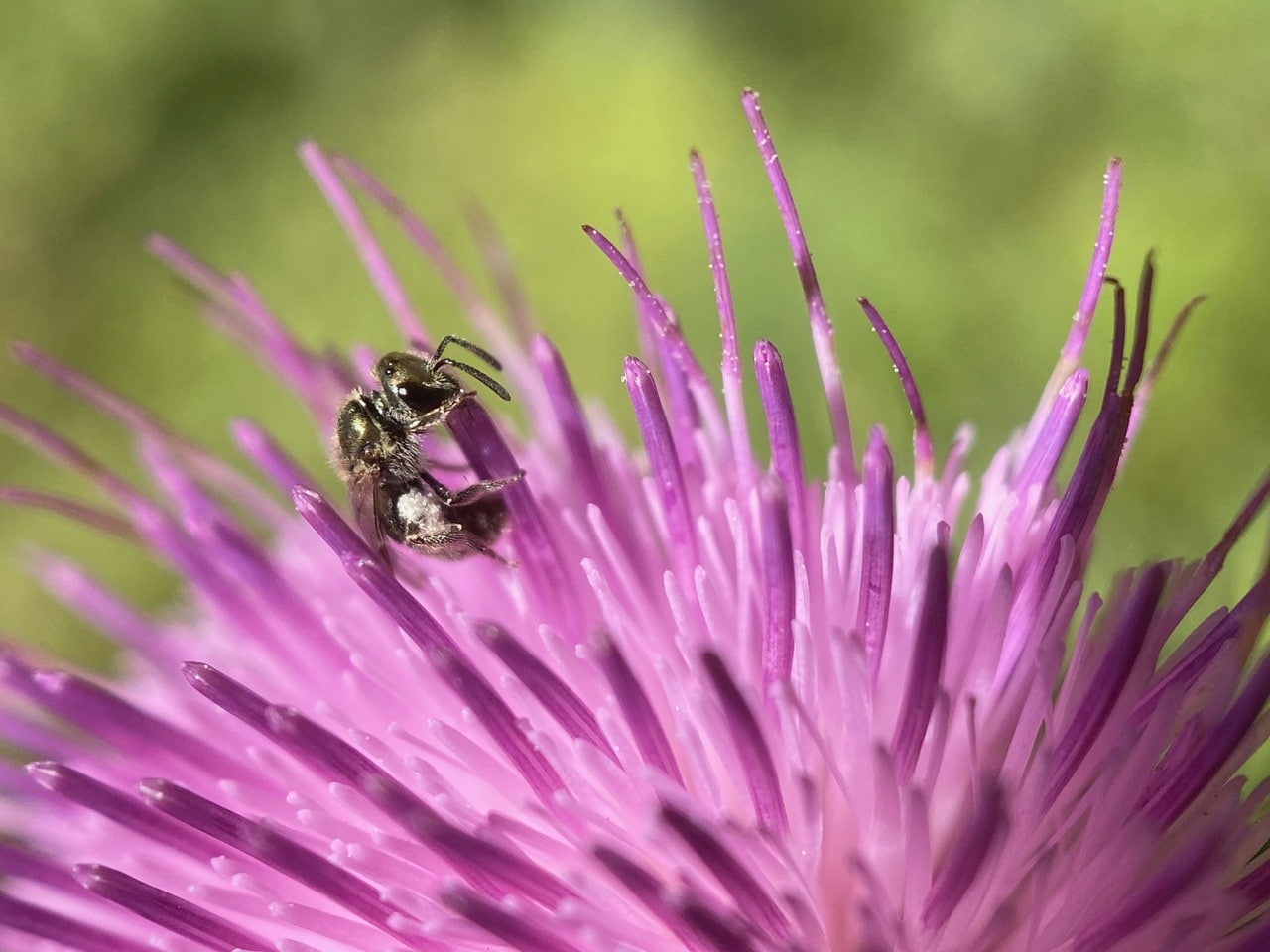

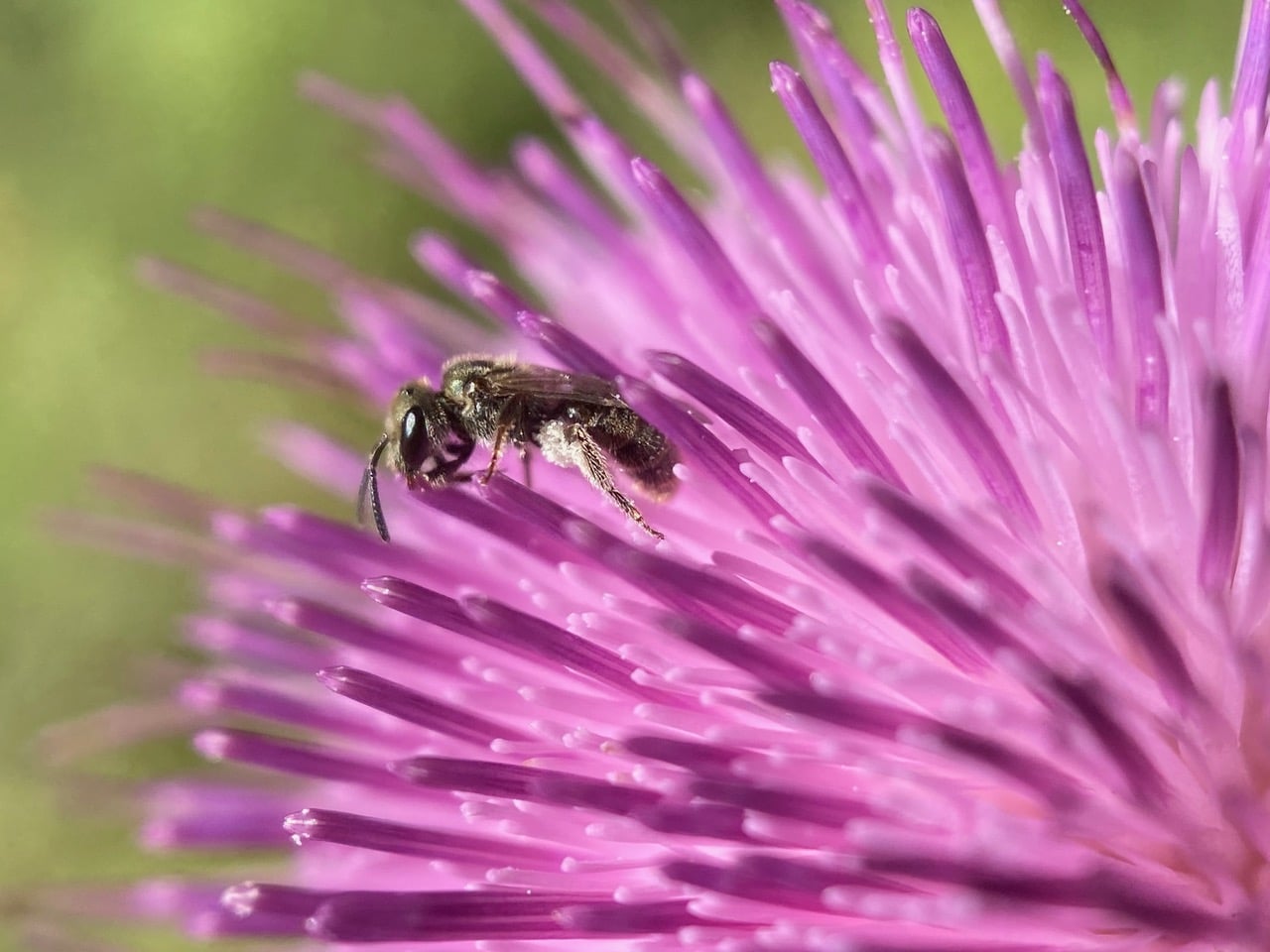
Pollen is then transferred to the scopae on her hind legs.
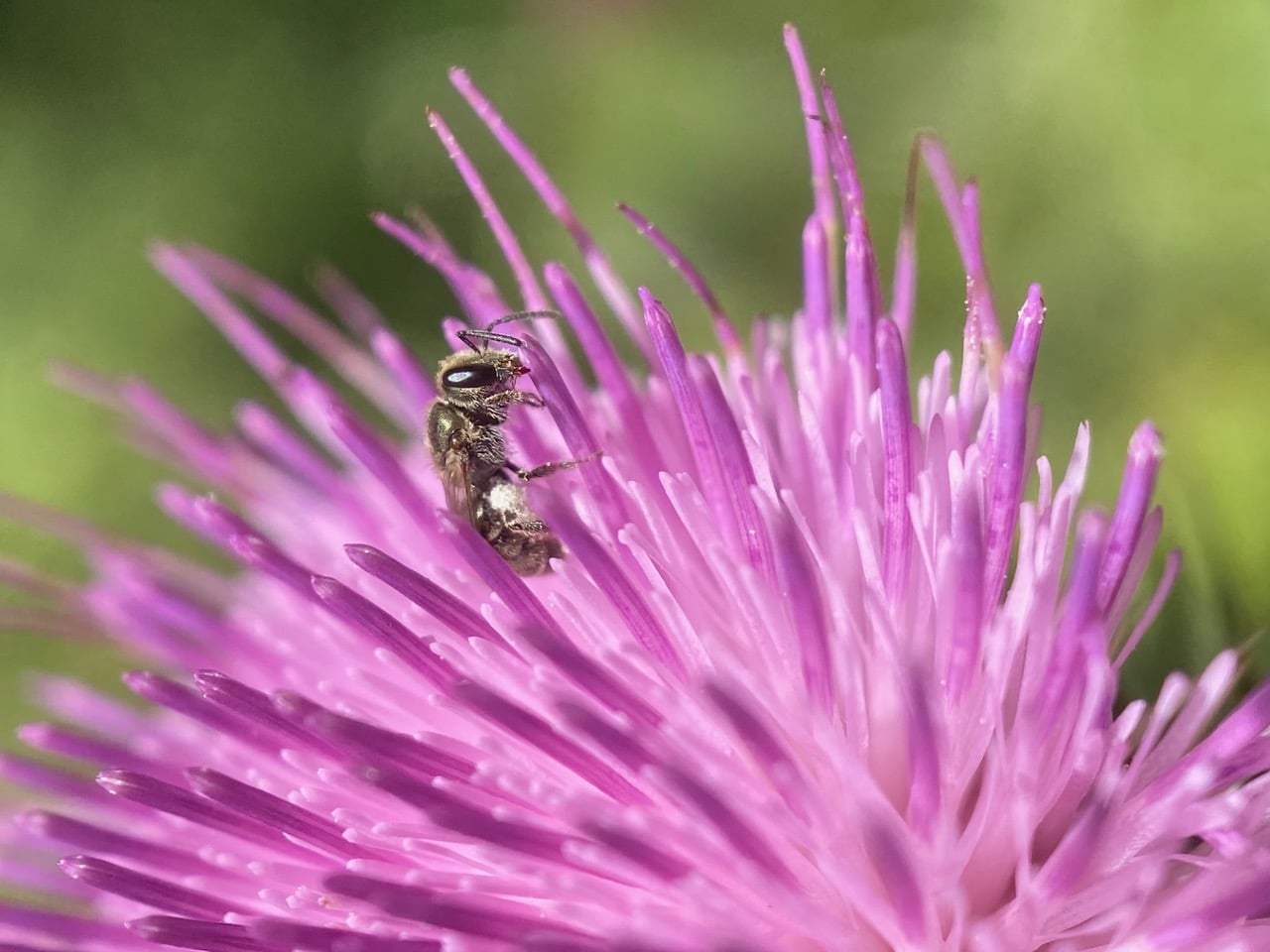
I can happily watch the little bee do this all day, but I am here on a mission, and I’d better move on…

A Yellowjacket wasp has landed on a cluster of Snowberry flowers and fruits, Symphoricarpos albus. Is she hunting for caterpillars to feed the young, or is she seeking nectar for herself?

The wasp seems to be taking nectar from the Snowberry flowers. iNaturalist has identified the wasp as a Common Aerial Yellowjacket, Dolichovespula arenaria (family Vespidae). Gee, I didn’t know that you can visually distinguish between the aerial yellowjackets from the ones that nest in the ground!
Dolichovespula arenaria, also known as the Common Aerial Yellowjacket, is widely distributed in the North American continent, commonly found in forested areas. They are important pollinators that contribute to the production of certain fruits. They transfer pollen as they forage for nectar. The wasp can also be a biological control agent as it helps to reduce populations of pests that damage crops.
Like the other yellowjackets, the D. arenaria is eusocial, meaning it lives in a colony with a division of labor and cooperative care of the young. The colony consists of a queen, who is the only fertile female, and workers, who are sterile females. The queen has the ability to control the sex of the offspring through haplodiploid sex determination, laying fertilized or unfertilized eggs. Early in the season she typically produces female workers who help build the nest and forage for food. As winter approaches, she starts to produce males and future queens. The queens overwinter.
The Aerial Yellowjackets builds their nests by transforming chewed wood into a paper-like substance, which is why they are considered paper wasps. The nests are usually located above the ground, on trees, shrubs, or buildings, hence the name “aerial”.

I have finally reached my destination – the large Aroyo Willow, Salix lasiolepis on which I have found sinuous leaf mines on 7/5/24. Since I posted about the finding, the photos have been passed along to a leaf-miner expert on the east coast, Charley Eisman, coauthor of Tracks and Signs of Insects and Other Invertebrates. Charley contacted me to let me know that my identification of the leaf-miner was probably wrong. He suggested that it might be an as yet undescribed species of moth in the family Gracillariidae. Charley also kindly provided me with tips on how to collect the mined leaves and rear out the adults. Short of that, he said that even dead larvae or pupae could be used for identification. How could I possibly turn down such a challenge?
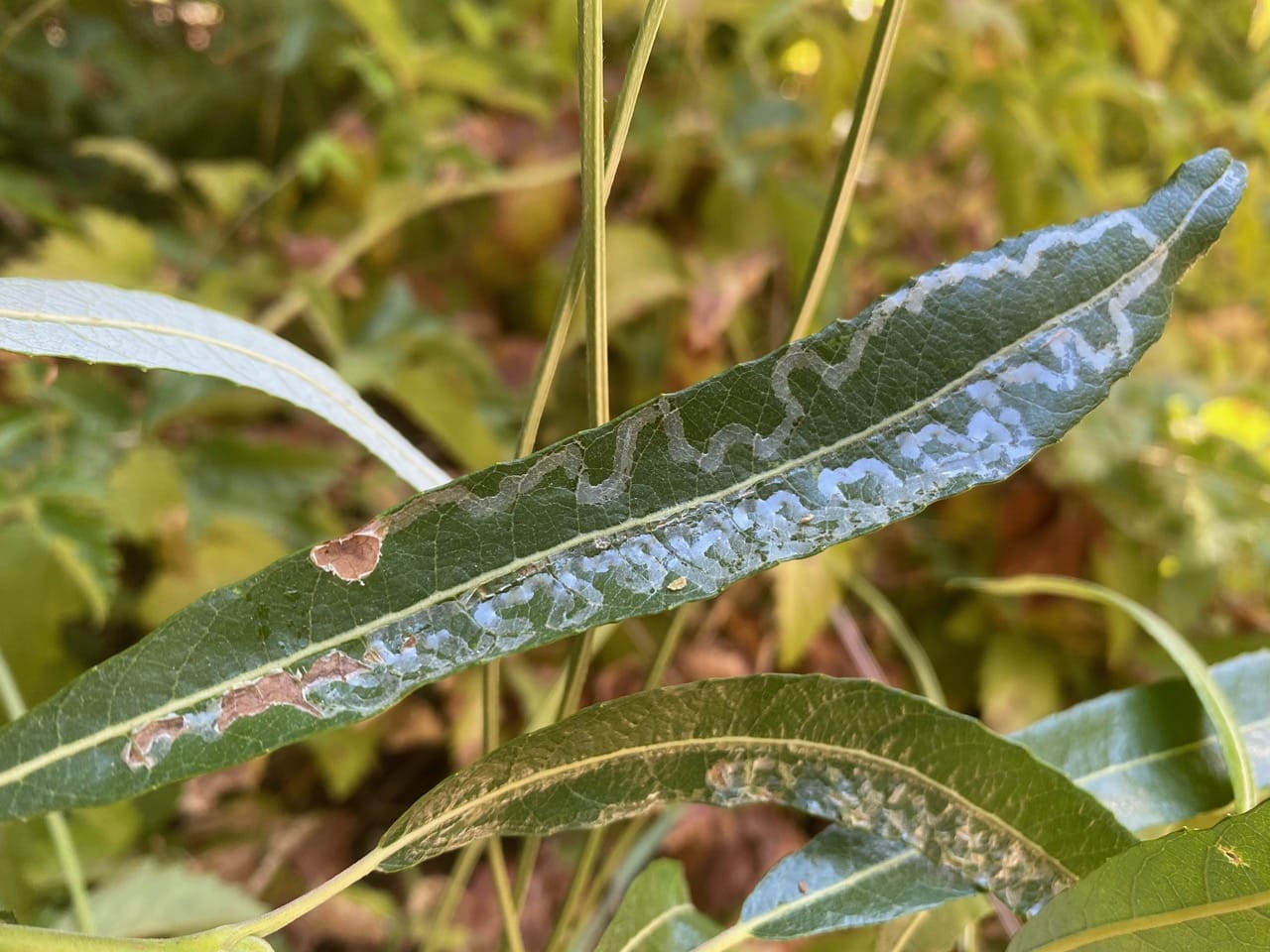
Much to my delight, many more leaves on the same willow tree are showing up with the silvery mines today. Some, like this one, have already successfully produced adults after pupating at the end of their tunnel.
A leaf miner is any one of numerous species of insects in which the larval stage lives in, and eats, the leaf tissue of plants. The vast majority of leaf-mining insects are moths (Lepidoptera), sawflies (Symphyta), and flies (Diptera). Some beetles also exhibit this behavior. Leaf miners are protected from many predators and plant defenses by feeding within the tissues of the leaves, selectively eating only the layers that have the least amount of cellulose, and lowest levels of defensive chemicals.
Some of the smallest moths have larvae that feed inside the foliage of their host plants, eating the soft tissue between the tougher upper and lower leaf epidermis. They often cause distinctive discolored areas where the internal leaf tissues have been consumed. Leaf-mining moths occur in several families within the Lepidoptera. The pattern of the mine is fairly constant and characteristic for the species of moth. Leaf-mining moths lay their eggs on or in the foliage of suitable host plants. After hatching, the larvae tunnel through the internal leaf tissues. When they have completed their feeding, the larvae exit the mines and pupate elsewhere on the plant or in the soil. The moths overwinter as pupae, larvae or adults, depending on the species. Damage by leaf-miners is mainly cosmetic, and is unlikely to affect the plant’s health.
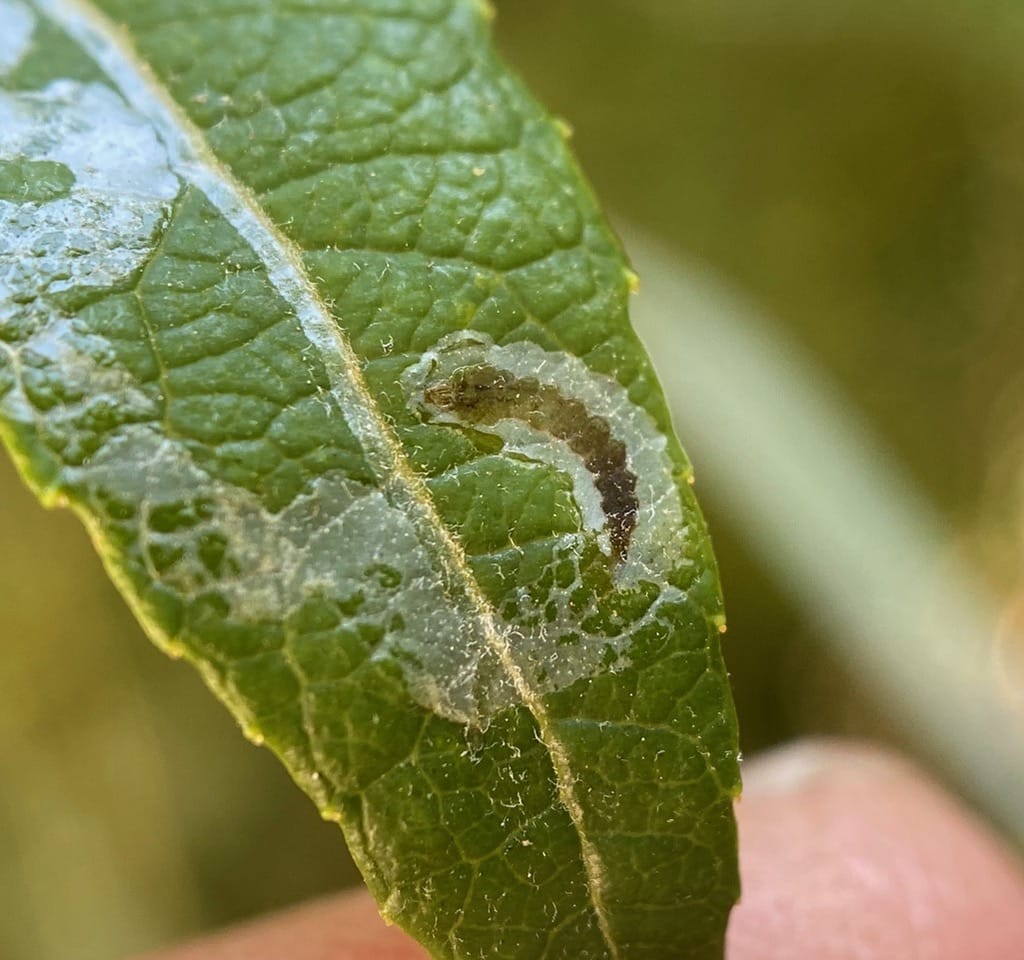
Hey, I can actually see the larva in this leaf mine!
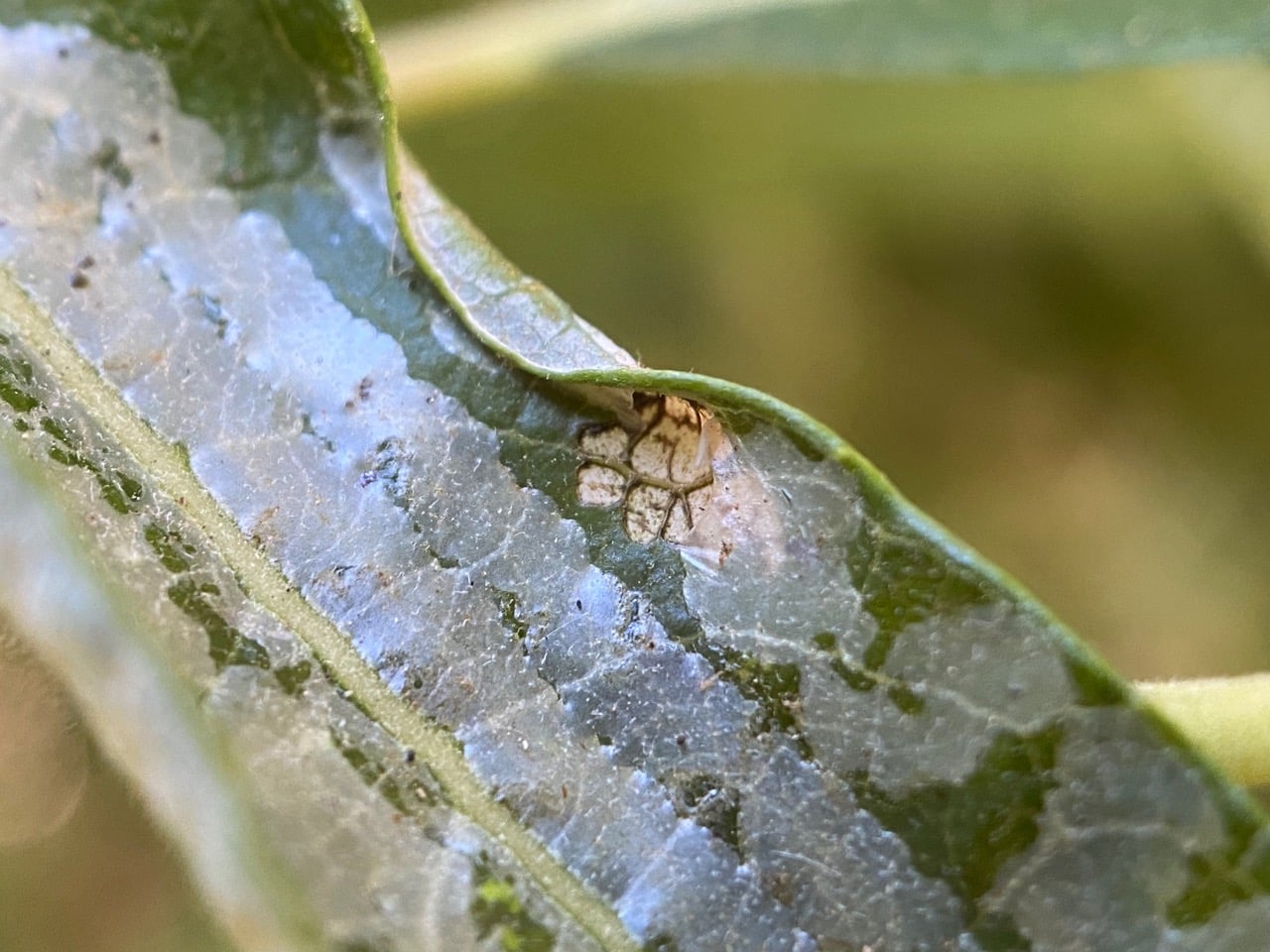
Charley told me that when the caterpillar pupates near the edge of the leaf, it may cause the side to fold over a little. But this one here looks like the adult might have emerged through the torn epidermis.
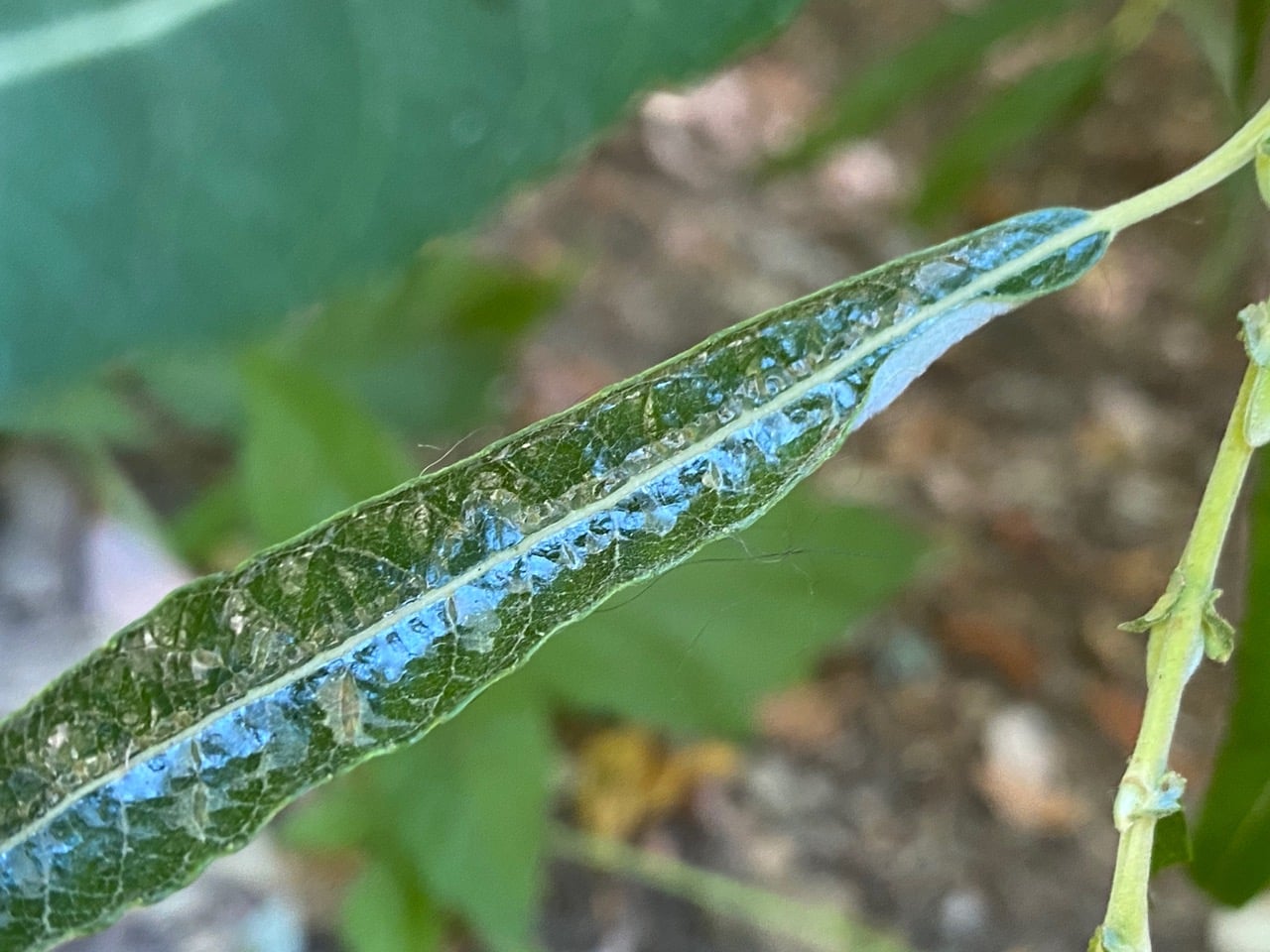
There are many mined leaves I can pick from, but I am particularly looking for ones with pupae. Here’s one with a folded edge near the petiole!
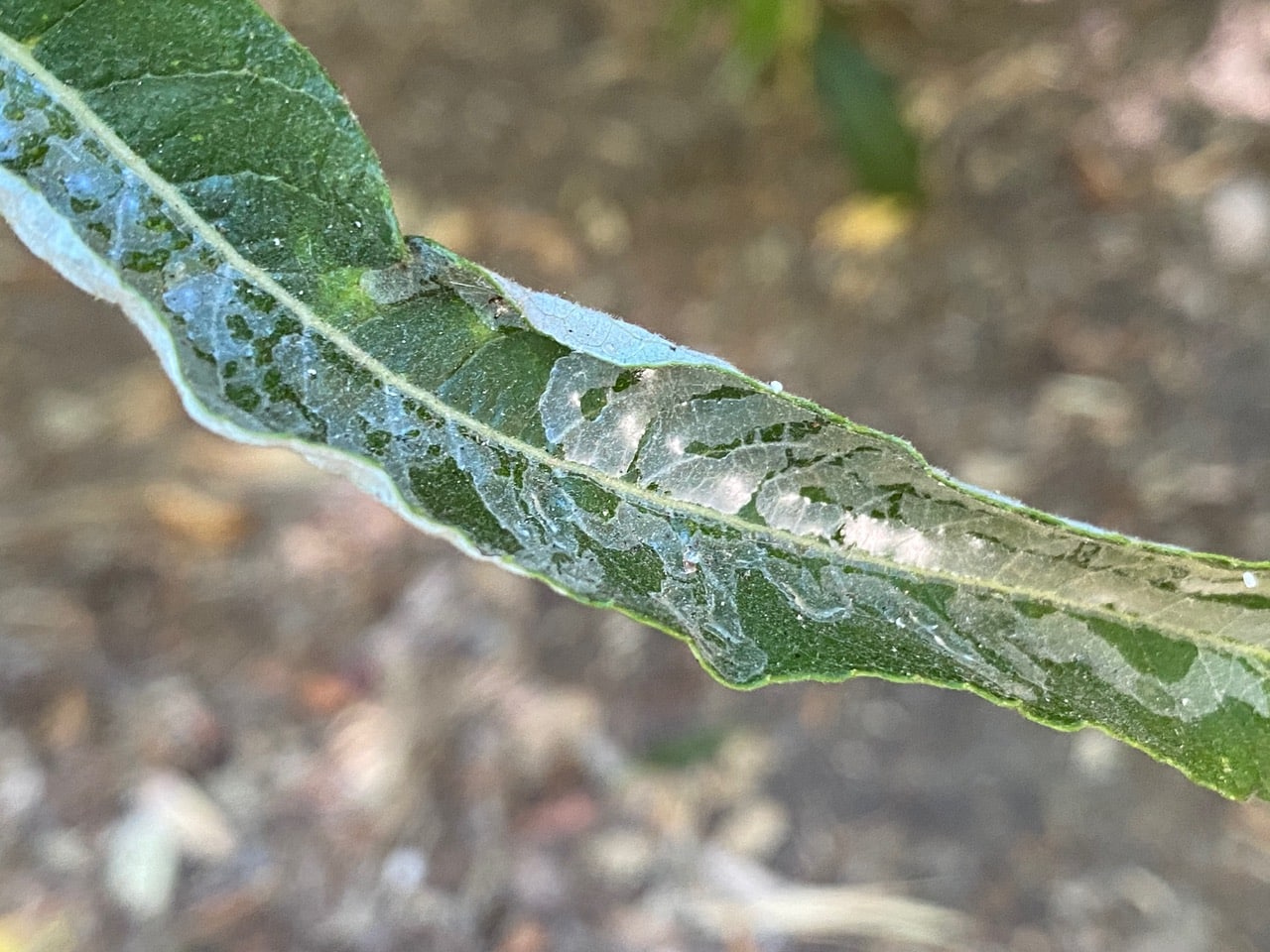
Here’s another good one! In all I collect four mined leaves with folded edges. I place them in a plastic container with a piece of wet tissue to keep the air moist.

A Lacewing has laid an egg on a mined leaf. It looks cloudy, maybe hatching soon? Lacewing larvae are voracious predators of aphids and other soft-bodied insects. Will the larva that hatches out feed on the leaf-miner caterpillar?
Lacewings are insects in the large family Chrysopidae of the order Neuroptera. Adults are crepuscular or nocturnal. They feed on pollen, nectar and honeydew supplemented with mites, aphids and other small arthropods. Eggs are deposited at night, hung on a slender stalk of silk usually on the underside of a leaf. Immediately after hatching, the larvae molt, then descend the egg stalk to feed. They are voracious predators, attacking most insects of suitable size, especially soft-bodied ones (aphids, caterpillars and other insect larvae, insect eggs). Their maxillae are hollow, allowing a digestive secretion to be injected in the prey. Lacewing larvae are commonly known as “aphid lions” or “aphid wolves”. In some countries, Lacewings are reared for sale as biological control agents of insect and mite pests in agriculture and gardens.
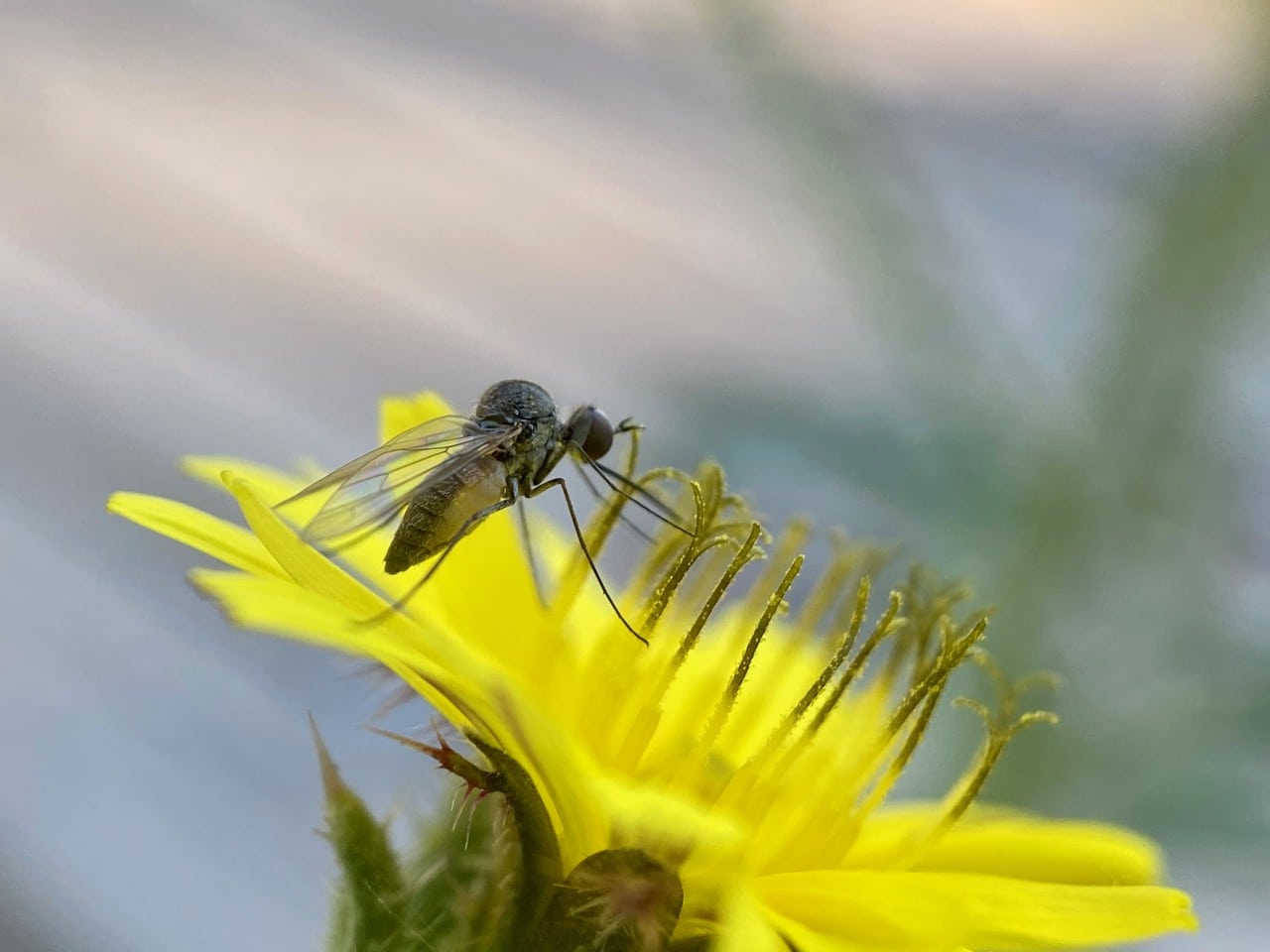
A small patch of Bristly Oxtongue, Picris echioides has sprung up where the grasses have been mowed down along the paved trail. I notice a tiny insect with a familiar hunched posture and long proboscis on a flowerhead.

It is a Bee Fly in the genus Geron (family Bombyliidae).
“Geron” is Greek for “old man” (imagine a humpbacked man carrying a cane). The fly is easily recognizable from its humpbacked appearance, conical abdomen and shiny, golden pubescence. Like many bee flies, it flies around with a long proboscis that cannot be folded up. Larvae are parasitoids of the immature stages (caterpillars) of various moths in concealed situations. Some are also hyperparasitoids. Adults take nectar at flowers, preferring members of the sunflower family, Asteraceae. Unusual for bee flies, Geron often bobs up and down above an inflorescence before landing to nectar. Males often form loose swarms.

Note Geron’s long proboscis which cannot be folded away. The fly’s hairy body is likely to attract pollen, rendering it a probable pollinator.
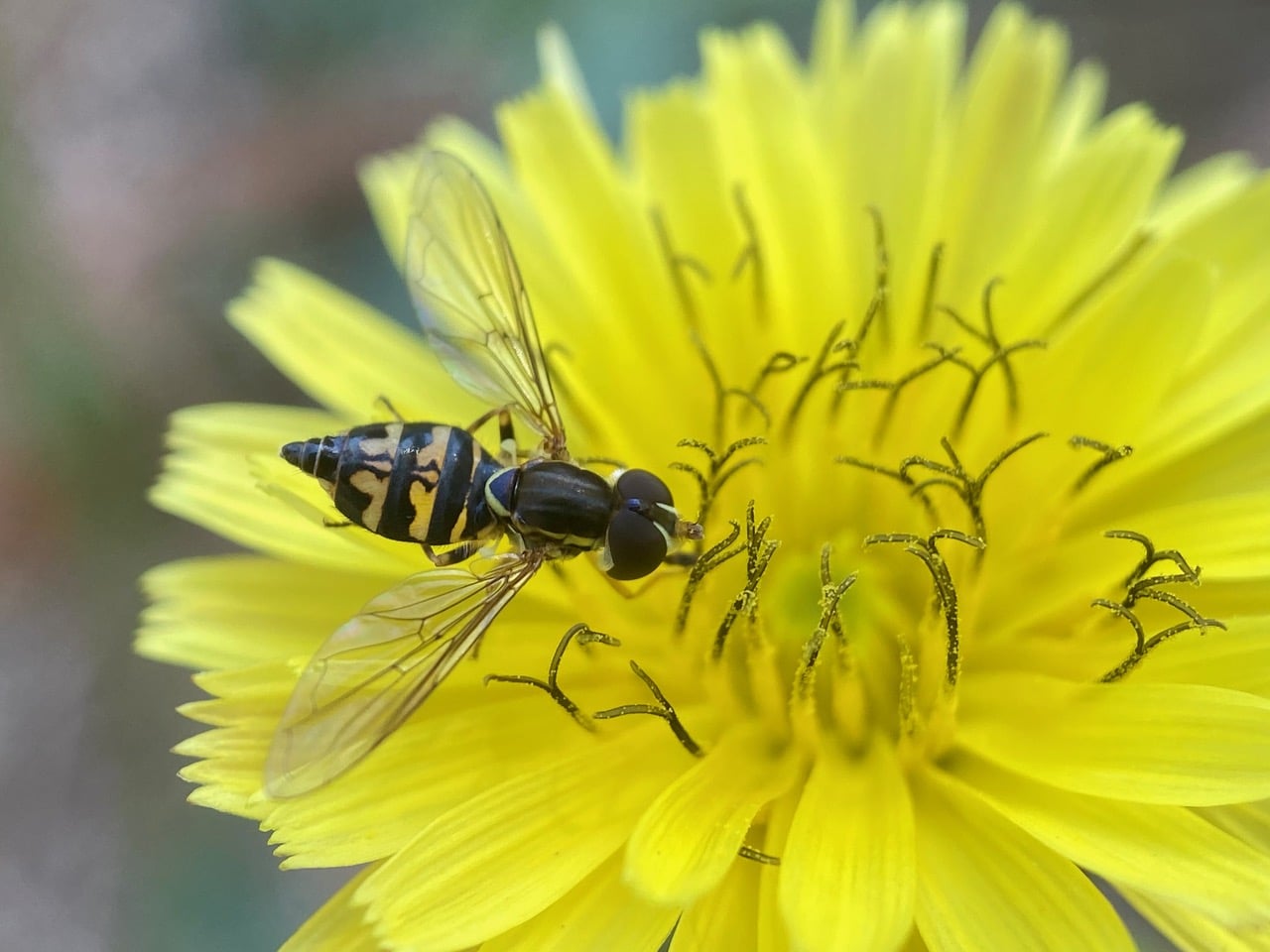
A female Western Calligrapher, Toxomerus occidentalis (family Syrphidae) is foraging on a flowerhead of Bristly Oxtongue. Note the copious amounts of pollen that has been pushed out of the anther tubes by the bilobed stigmas of the individual flowers.
Toxomerus is a very large genus of Hover Flies. They are found in North and South America. The majority of species are only 6-9 mm in length. They are notable for their mimicry of stinging Hymenoptera to avoid predators. Their unique abdominal patterns are diagnostic at the species level within the genus. Most larvae feed on soft bodied insects, such as aphids; a few feed on pollen. Adults feed on the pollen of a wide range of flowers. A female can lay up to hundreds of eggs at a time and will place them where prey or pollen food sources are readily available. They can be found in a wide variety of habitats, often in dense ground cover.
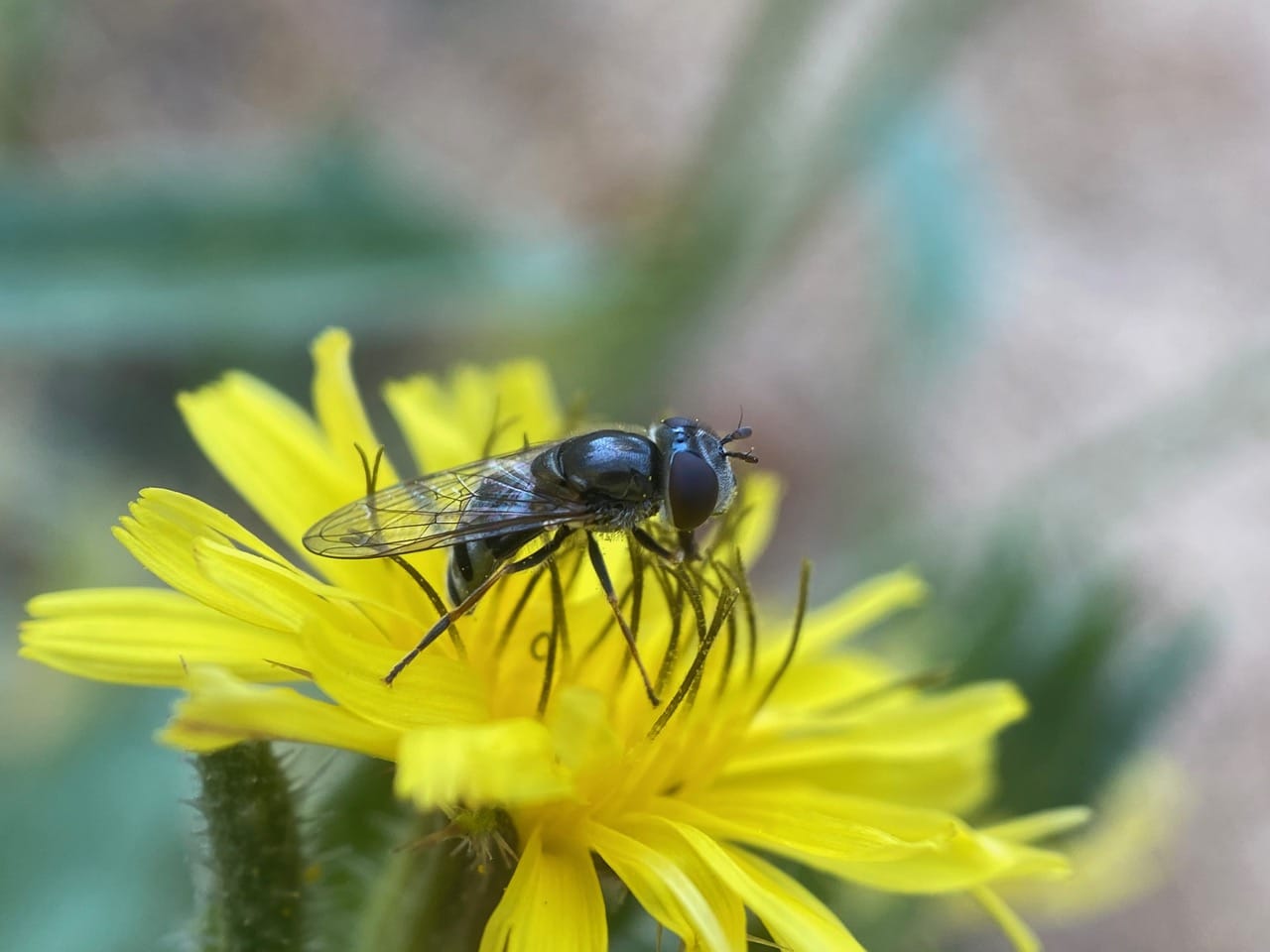
Another hover fly, the Sedgesitter, Platycheirus sp. (family Syrphidae) is foraging on a Bristly Oxtongue flowerhead.
Platycheirus is found in grass and herb vegetation. Adults of many species feed on pollen of wind-pollinated plants, such as Salix, Plantago, Poaceae, Cyperaceae, but they visit other flowers also. Many stay active during cold and rainy weather. Larvae feed on aphids.

Hey, that’s a Small Carpenter Bee, Ceratina sp. (family Apidae)! I haven’t seen one for a while.
The Small Carpenter Bee genus Ceratina is closely related to the more familiar, and much larger Carpenter Bees (genus Xylocopa). Ceratina are typically dark, shiny, even metallic bees, with fairly sparse body hairs and a weak scopa on the hind leg. The shield-shaped abdomen comes to a point at the tip. Some species have yellow markings, often on the face.
Females excavate nests with their mandibles in the pith of broken or burned plant twigs and stems. While many species are solitary, a number are subsocial. Both male and female carpenter bees overwinter as adults within their old nest tunnels, emerging in the spring to mate. In the spring, this resting place (hibernaculum) is modified into a brood nest by further excavation. The female collects pollen and nectar, places this mixture (called bee bread) inside the cavity, lays an egg on the provision, and then caps off the cell with chewed plant material. Several cells are constructed end to end in each plant stem.

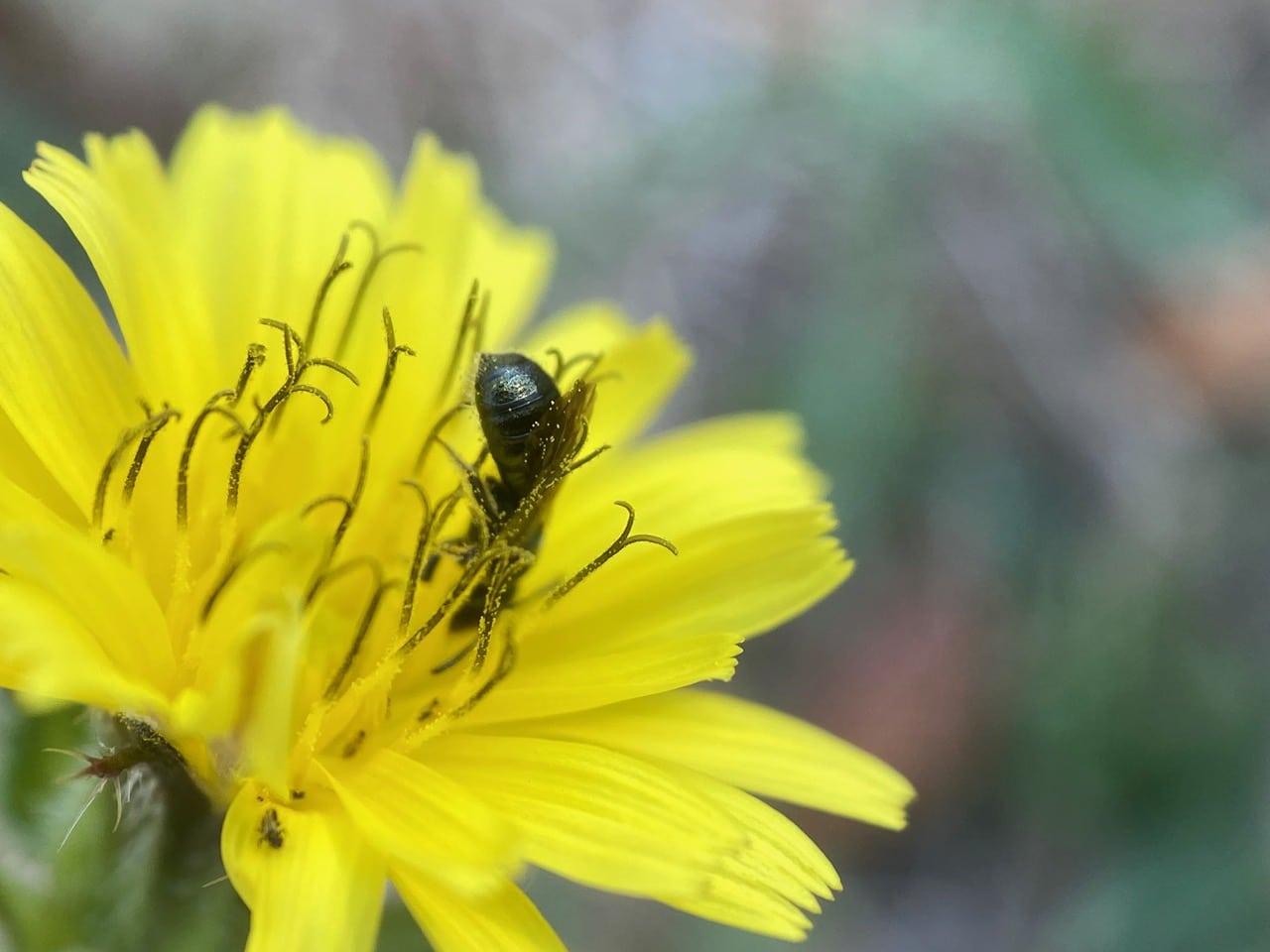
As the bee dives down for nectar at the base of the flowers, I get a glimpse of its rear end. Note that Ceratina’s shield-shaped abdomen comes to a point at the tip.
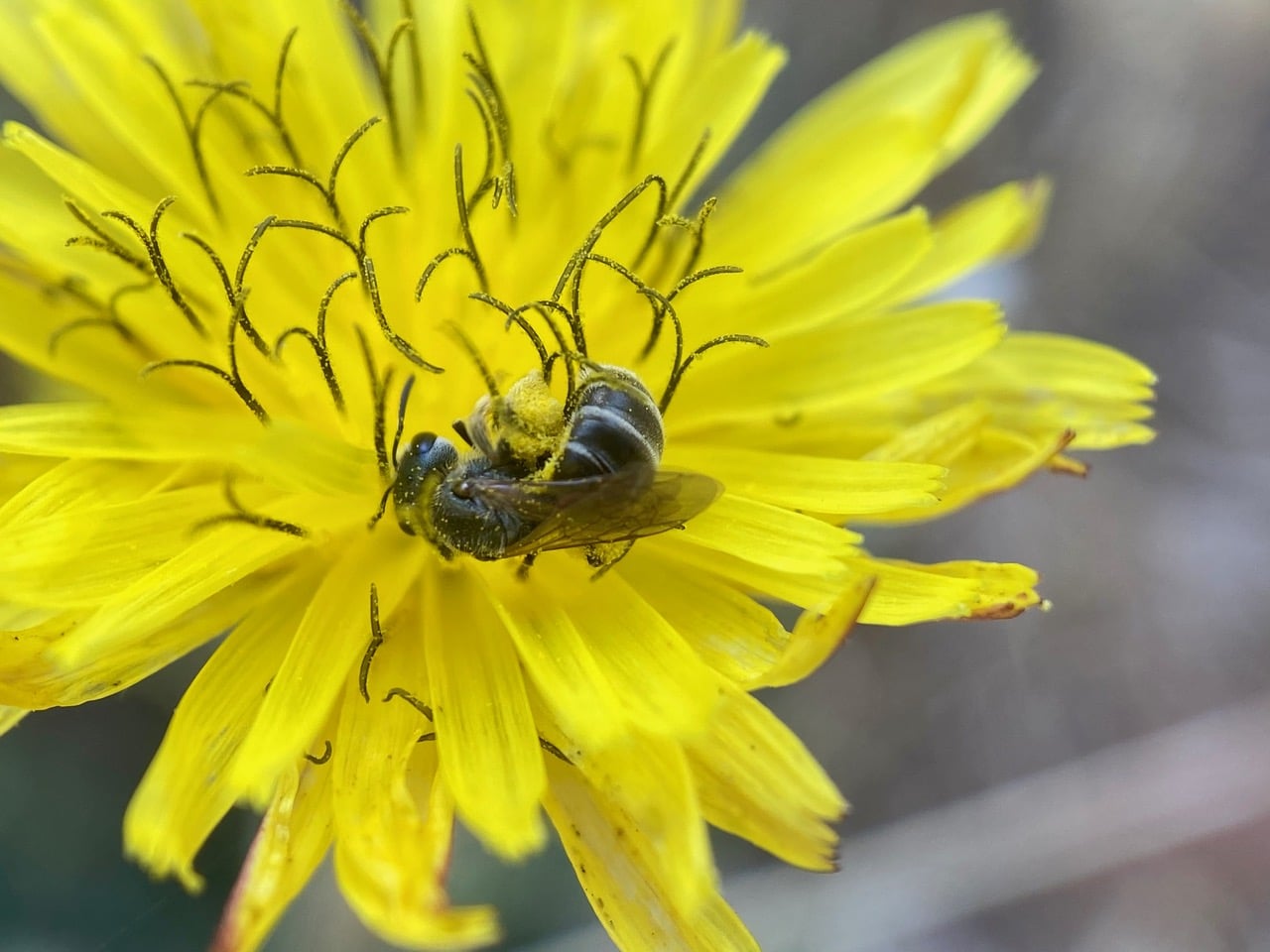
The most prevalent bees on the Bristly Oxtongue now are the Sweat Bees, Halictus sp. (family Halictidae).
Halictus is found worldwide; they are most common in the Northern Hemisphere. All are generalists, foraging from a wide variety of flowering plants. Many species are social and produce several generations per year. This is not surprising as most blooming plants are season-specific; a bee that requires pollen and nectar across multiple seasons would not thrive as a specialist. All Halictus in North America nest in the ground, often in aggregations; and they may nest in the same area for decades.
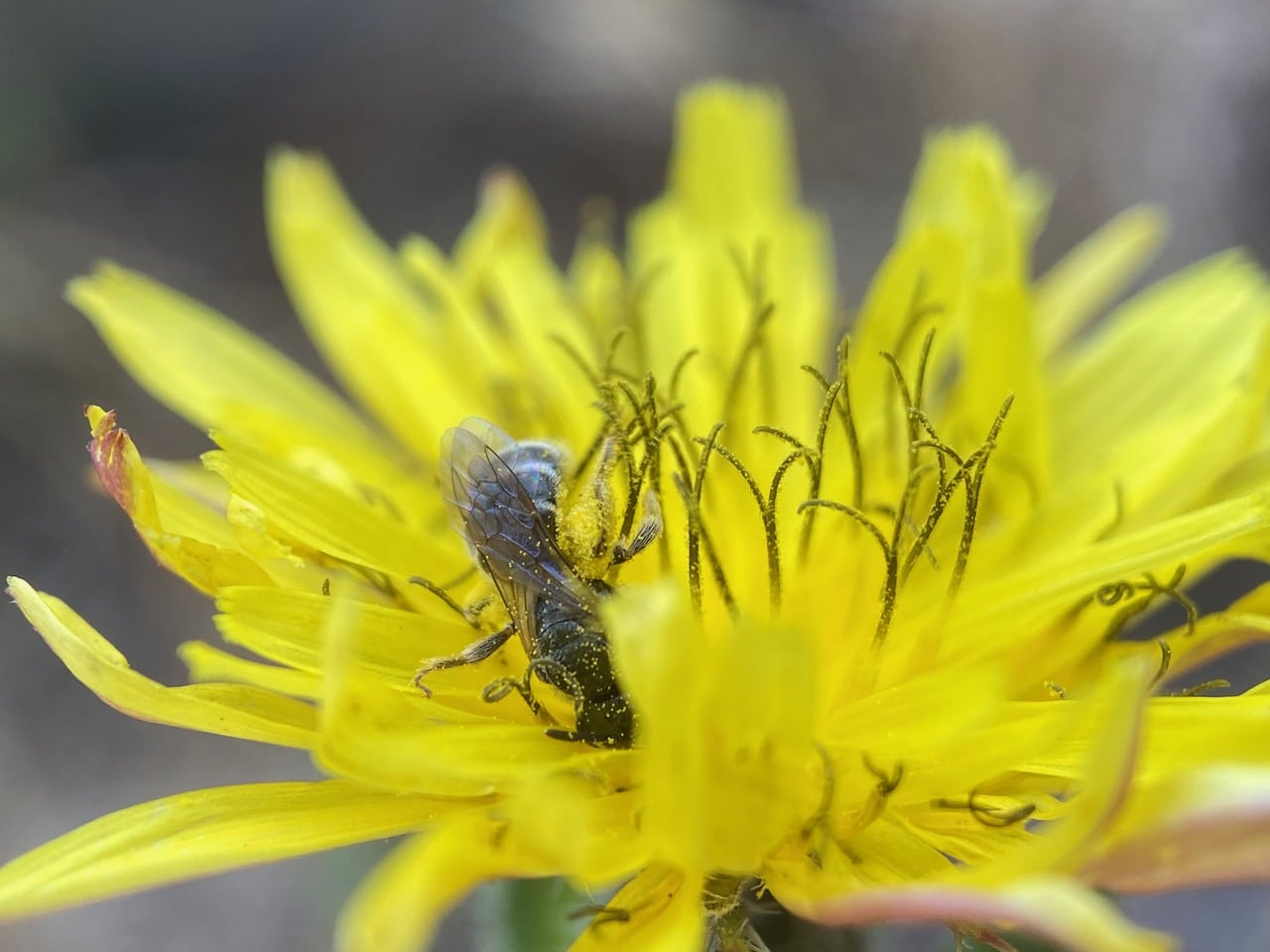
The little bees toil tirelessly to collect nectar and pollen from the flowers.

A large bumble bee is going from one Bristly Oxtongue to the next, seeking nectar. A Yellow-faced Bumble bee queen at this time of year? Curious, I follow its movements visually. As the bee gets closer, I realize that it is a California Bumble Bee, Bombus californicus (family Apidae). Note that unlike the Yellow-faced Bumble Bee, it has no yellow on its head.
I will never again disparage the plant as a “weed”. This small patch of Bristly Oxtongue, with only two dozen plants, is supporting the dire needs of these bees and hover flies at a time when no other floral resources can be found within sight. Even the native plants have been removed or hacked back in a drastic effort at “fuel reduction”.

Bombus californicus, the California Bumble Bee, is found in Central and the western half of North America. The species is now classified as Vulnerable by the IUCN. It was the most common bumble bee in California until about the 1990s when its numbers and distribution began to decline. Many factors may have contributed to its decline, including invasive species, pesticide use, commercial bumble bee rearing, habitat destruction, and climate change.
Although morphologically the species is quite variable, the “typical” color pattern of female B. californicus is black with only a single strong yellow band anteriorly on the thorax, and another single yellow band near the apex of the abdomen. Males exhibit considerably more variation.
The California Bumble Bee is an important pollinator in alpine environments in its native range. They are social bees having a queen and workers. Their colonies last for one year. New queens overwinter, usually underground, and found new colonies from scratch the following year. Queens emerge from April through mid July. Workers are present from April to September. The species is known to pollinate sage, blueberry bushes, red clover, California poppies, and many other species of flowers.
———————————
The Pollinator Post will be taking a break, hopefully not for very long. My husband is going in for spinal surgery today, and I will be busy taking care of him for a while during his recovery. Have a great summer, and continue to enjoy the little wonders in your garden!
– May