

Pollinator Post 7/18/26
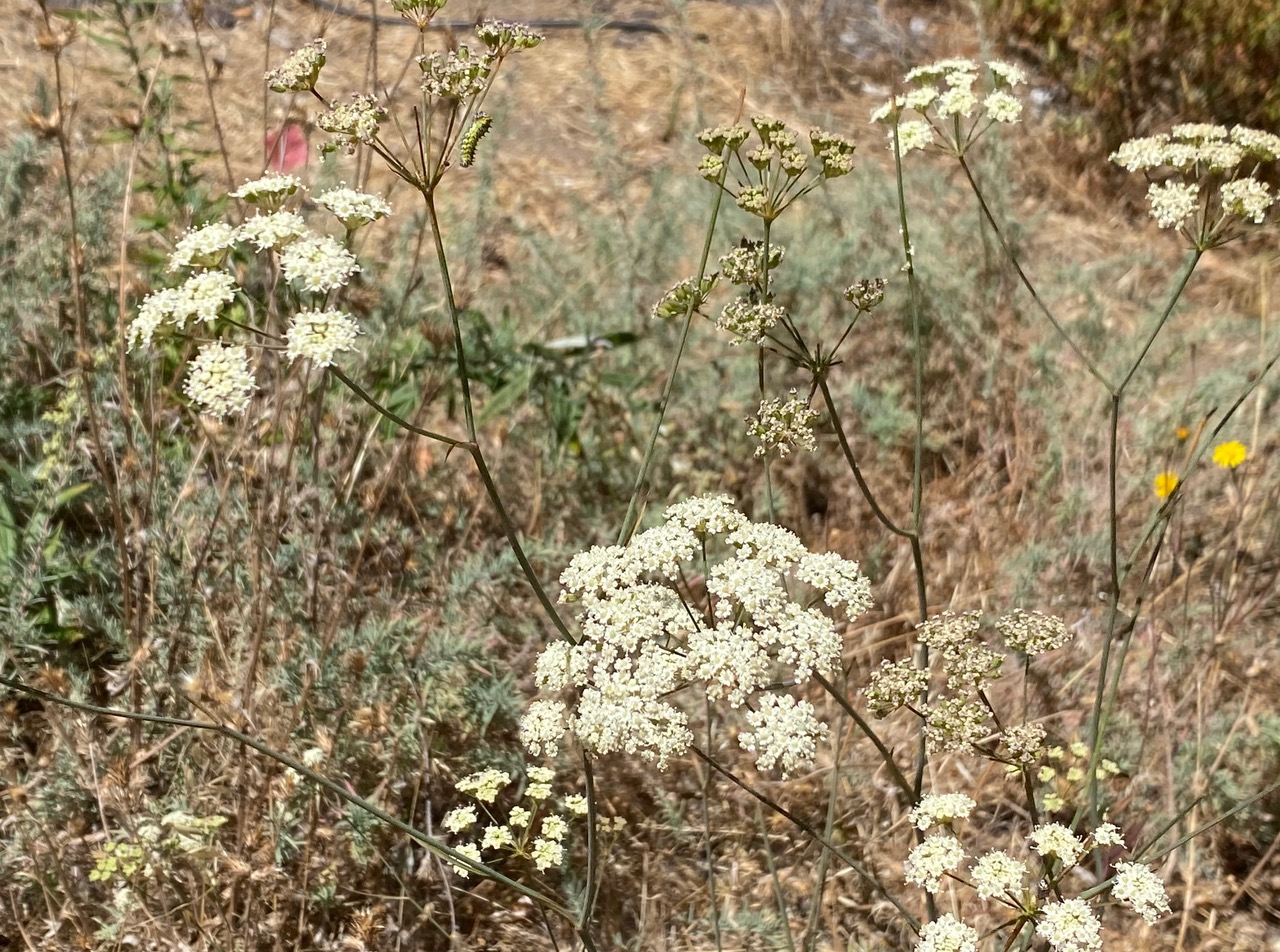
I participated in a Grass Walk this afternoon at Joaquin Miller Park led by botanist/ecologist Saumitra Kelkar. The group makes our way slowly down Sanborn Drive, occasionally stepping off road into the low brushes. We look for dried or drying grasses, native and exotic, and try to identify them by their seed heads in a kind of forensic botany, while Saumitra regales us with their biology and ecological roles. As we occasionally pass insect-pollinated plants that are in bloom, I can’t help but step aside quickly to check for insects.
California Yampah, Perideridia californica is blooming beautifully on the side of the road, their tall, spindly stalks bearing delicate umbels of white flowers barely noticeable by casual park visitors.

Uh oh, the lifeless body of a very young caterpillar of Anise Swallowtail lies next to a silk cocoon on a Yampah flower stalk. The dead caterpillar is merely a scrunched-up shriveled mess, while the cocoon looks like a miniature loofah sponge. The strange pairing is a sure sign of parasitism. I know from past experiences rearing out these cocoons that they each eventually yield a single Braconid Wasp (family Braconidae) that makes its way out by cutting a neat circular hole at one end of the cocoon.
The Braconidae are a family of parasitoid wasps. After the closely related Ichneumonidae, braconids make up the second-largest family in the order Hymenoptera, with about 17,000 recognized species. Females often have long ovipositors to lay eggs on or in their hosts. The larvae of most braconids are internal primary parasitoids of other insects, especially the larval stages of Coleoptera, Diptera, and Lepidoptera. Generally, the braconid life cycle begins when the female wasp deposits her eggs in the host insect, and the braconid larvae develop in the host body, eating it from the inside out. When the wasp larvae are ready to pupate, they may do so in or on the host insect. The new generation of adult braconid wasps emerges from their cocoons and begins the life cycle again.
Braconid wasps use a remarkable weapon to disable the defenses of their host insects – a virus. These parasitic wasps coevolved with polydnaviruses (read poly-DNA-virus), which they carry and inject into the host insects along with their eggs. The virus attacks the host’s immune system and renders it unable to encapsulate the wasp egg; it also halts the host’s development, so it can’t pupate and transform into an adult. Amazingly, the “bracovirus” also changes the host’s metabolism so that it can survive longer without food or water – thus ensuring a nurturing environment for all the young wasps to come.
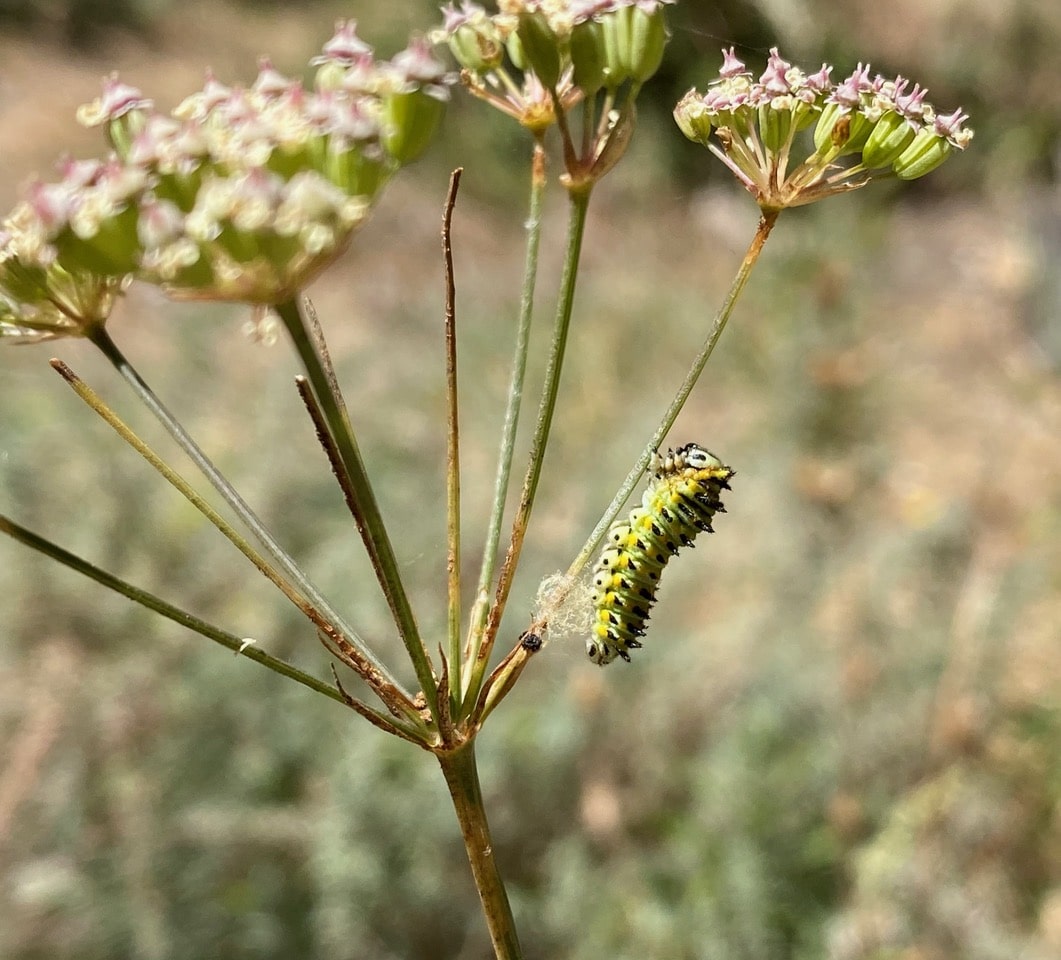
Ooh, here’s another Anise Swallowtail caterpillar that has been parasitized. Note that the caterpillar has already demolished several umbels of the Yampah flowers before its untimely demise. It is a later instar, having already turned predominantly green. There is a cluster of loose silk under the lifeless body. I envision that the wasp larva which has exited the caterpillar must have been nabbed by a predator before it could successfully spin a cocoon around itself. Larger wasps like Yellowjackets are always on the lookout for such morsels. It’s a jungle out there!
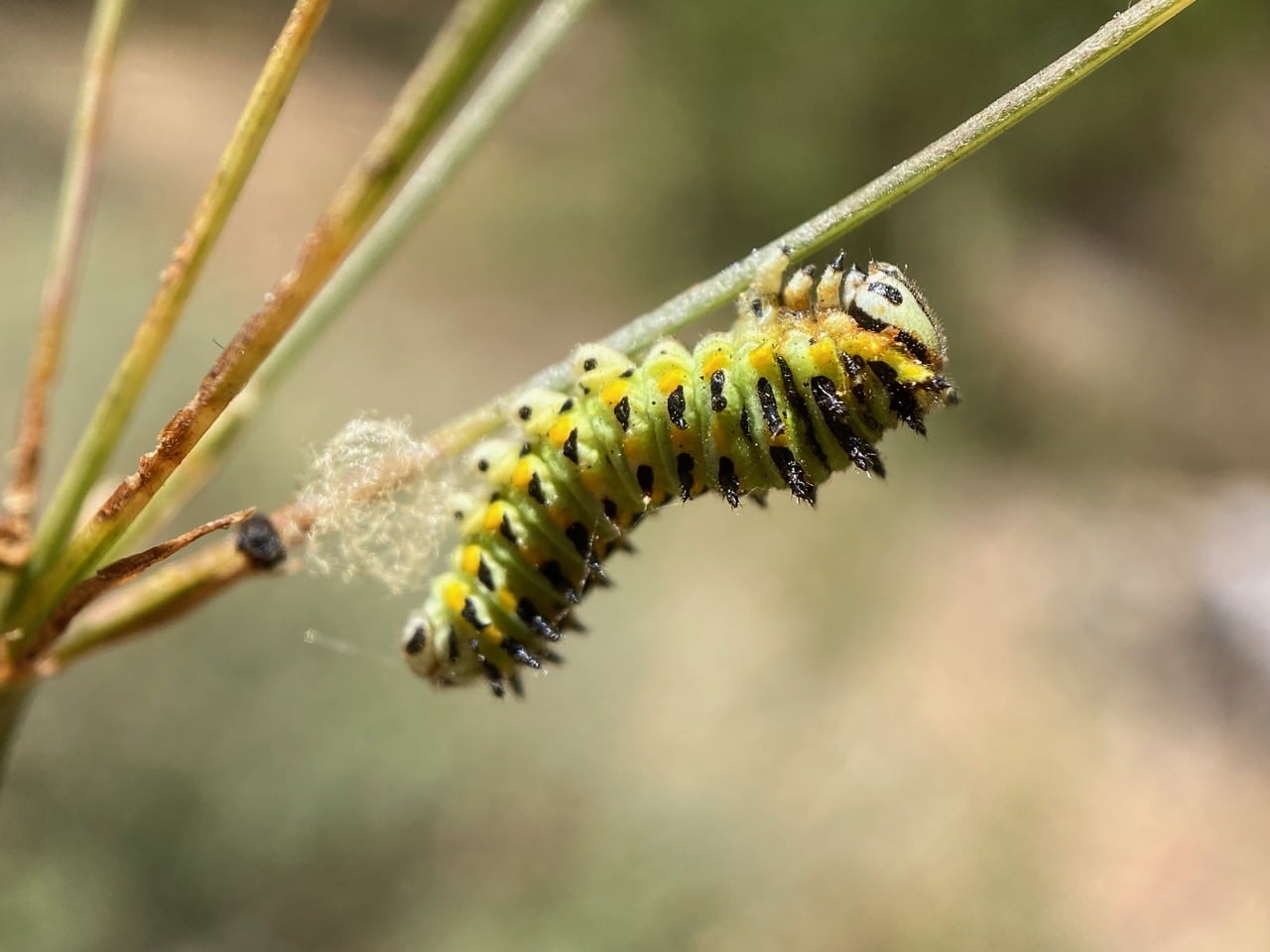
Although I see this phenomenon quite often on Yampah (and less often on Fennel), I find little information about it online. As far as I know, the identity of the culprit Braconid wasp is unknown, and I wonder if it is even host-specific. But the modus operandi is eerily consistent.
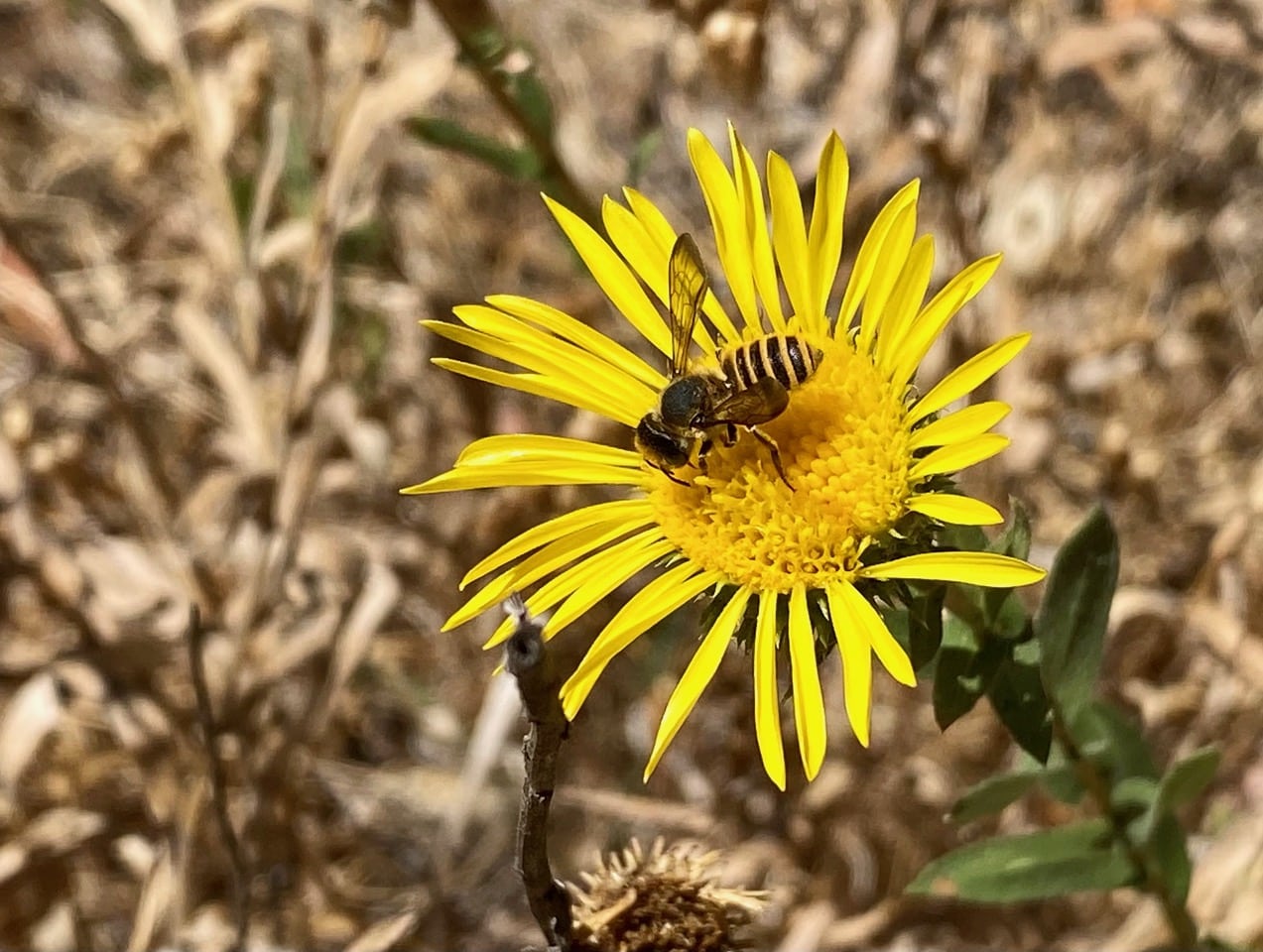
A Horn-faced Leafcutter Bee, Megachile fidelis (family Megachilidae) is foraging on one of the last Gumweed, Grindelia hirsutula still in bloom.
Leaf-cutter Bees, Megachile sp. (family Megachilidae) are stout-bodied, usually with pale hair on the thorax and stripes of white hairs on the abdomen. Females usually have a triangular abdomen with a pointed tip, and males’ faces are covered with dense, pale hair. Flight season is from May into September, with peak activity from June to August. Solitary females construct nests in tubular cavities, including hollow stems, tree holes, and abandoned beetle burrows in wood. Many use holes drilled into wood, straws, or other manufactured tunnels. Females cut pieces from leaves or flower petals for use in the construction of brood cells. Most Megachile females are generalist foragers, but prefer flowers in the family Asteraceae. Pollen is transported in dense scopae (special pollen collecting hairs) on the underside of the abdomen.
The Horn-faced Leafcutter Bee, also known as the Faithful Leafcutter Bee, Megachile fidelis (family Megachilidae) gets its specific name from the Latin fidelis (meaning loyal or faithful). The name reflects the bee’s unique nesting behavior: adult bees exhibit fierce loyalty to their brood by remaining steadfastly inside their nests until all the developing young have successfully vacated. The species is native to western North America. The bee features very prominent golden and yellow hair bands across its black abdomen. The bees frequently forage on flowers in the sunflower family, Asteraceae.
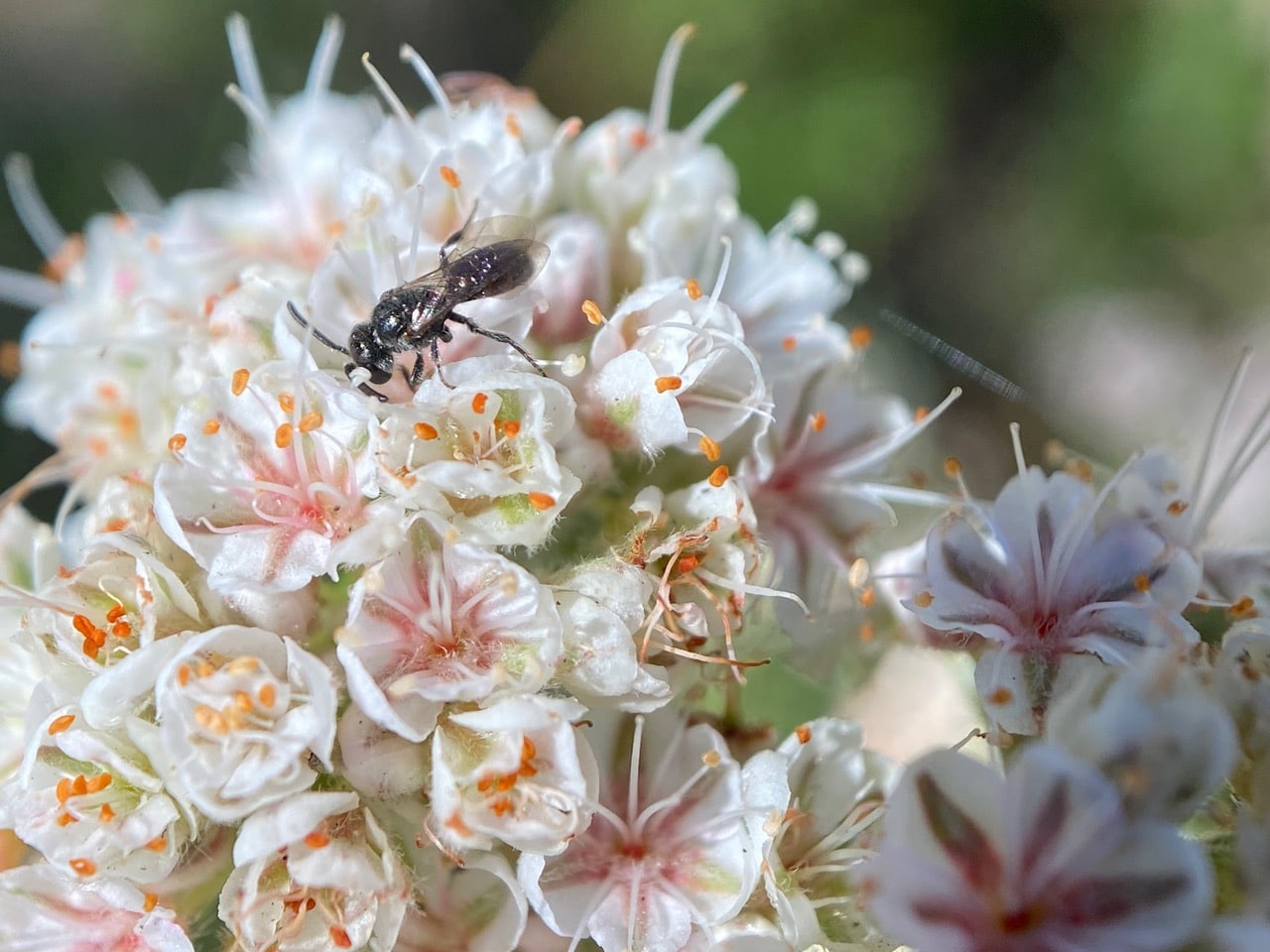
A small patch of California Buckwheat, Eriogonum fasciculatum is blooming gloriously by the side of the road. Some very small insects are flying over the clusters of pink flowers. When one lands, I realize that it is a seriously small Metallic Sweat Bee, Lasioglossum (Dialictus) sp. (family Halictidae).

Lasioglossum species are found worldwide, and they constitute the largest bee genus. The subgenus Dialictus are the most likely to be seen in the U.S., with over 300 species of these tiny metallic bees. The majority of Lasioglossum are generalists. Because they are so abundant throughout the flowering season, the bees are often important pollinators. Their sheer numbers are enough to achieve excellent pollination of many wild flowers, especially of plants in the Asteraceae, which have shallow floral tubes that are easily accessed by these minute bees.
Lasioglossum exhibit a range of social behaviors; the genus includes solitary, communal, semi social, primitively eusocial, and even parasitic species. Almost all Lasioglossum in the U.S. nest in the ground. Generally these nests are built in the spring by fertilized females (called foundresses) that spent the winter in hibernation. In social species, the foundresses behave much like the queen bumble bees – they lay the first batch of eggs that develop into the first generation of female workers. The nest grows with each additional generation of bees. Later broods may consist of both males and females. They mate, and at the end of the season the fertilized females hibernate til the following spring, repeating the life cycle of the colony.
These bees have short tongues and are unable to access nectar from deep, tubular flowers. Instead, they rely on smaller, shallow flowers where the nectar and pollen are easy to reach. Tongue length dictates a bee’s foraging niche. While long-tongued bees (like bumble bees, carpenter bees, or digger bees) are specifically adapted to exploit deep flowers, short-tongue bees (like sweat bees, miner bees, and cellophane bees) are specifically adapted to flatter blossoms.
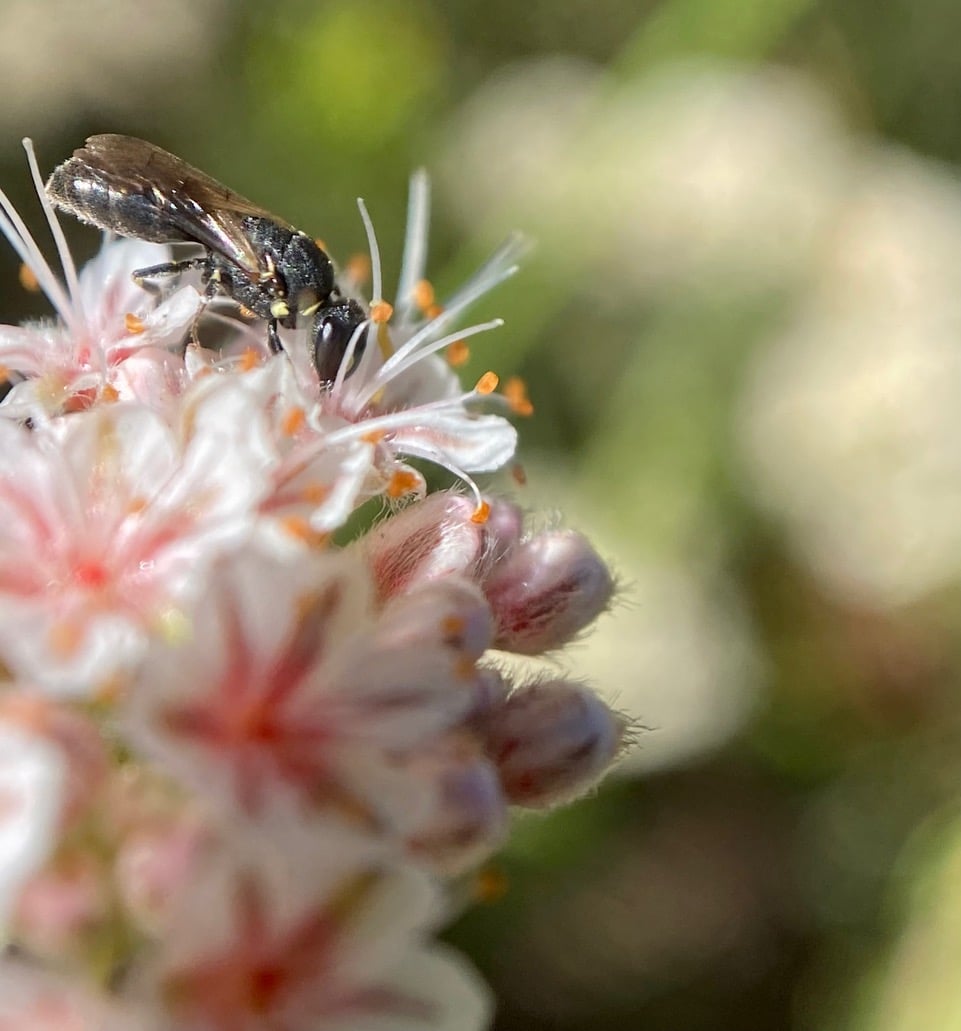
Is that a Masked Bee?

Yes, indeed it is a Masked Bee, Hylaeus sp. (family Colletidae)! Note the yellow markings on this female’s face as she lifts her head from a buckwheat flower.
Hylaeus (family Colletidae) are shiny, slender, hairless, and superficially wasp-like bees. They are small, 5 to 7 mm long, usually black with bright yellow or white markings on their face and legs. These markings are more pronounced on the males. Hylaeus do not carry pollen and nectar externally, they instead store their food in the crop and regurgitate it upon returning to their nests. They are primarily generalist foragers. Hylaeus are short-tongued, but their small body size enables them to access deep flowers. Hylaeus nest in stems and twigs, lining their brood cells with self-secreted cellophane-like material. They lack strong mandibles and other adaptations for digging, using instead pre-existing cavities made by other insects.

A tiny fly is foraging on an inflorescence of California Buckwheat. iNaturalist has helped identify it as a Satellite Fly, Metopia sp. (family Sarcophagidae, subfamily Miltogramminae).
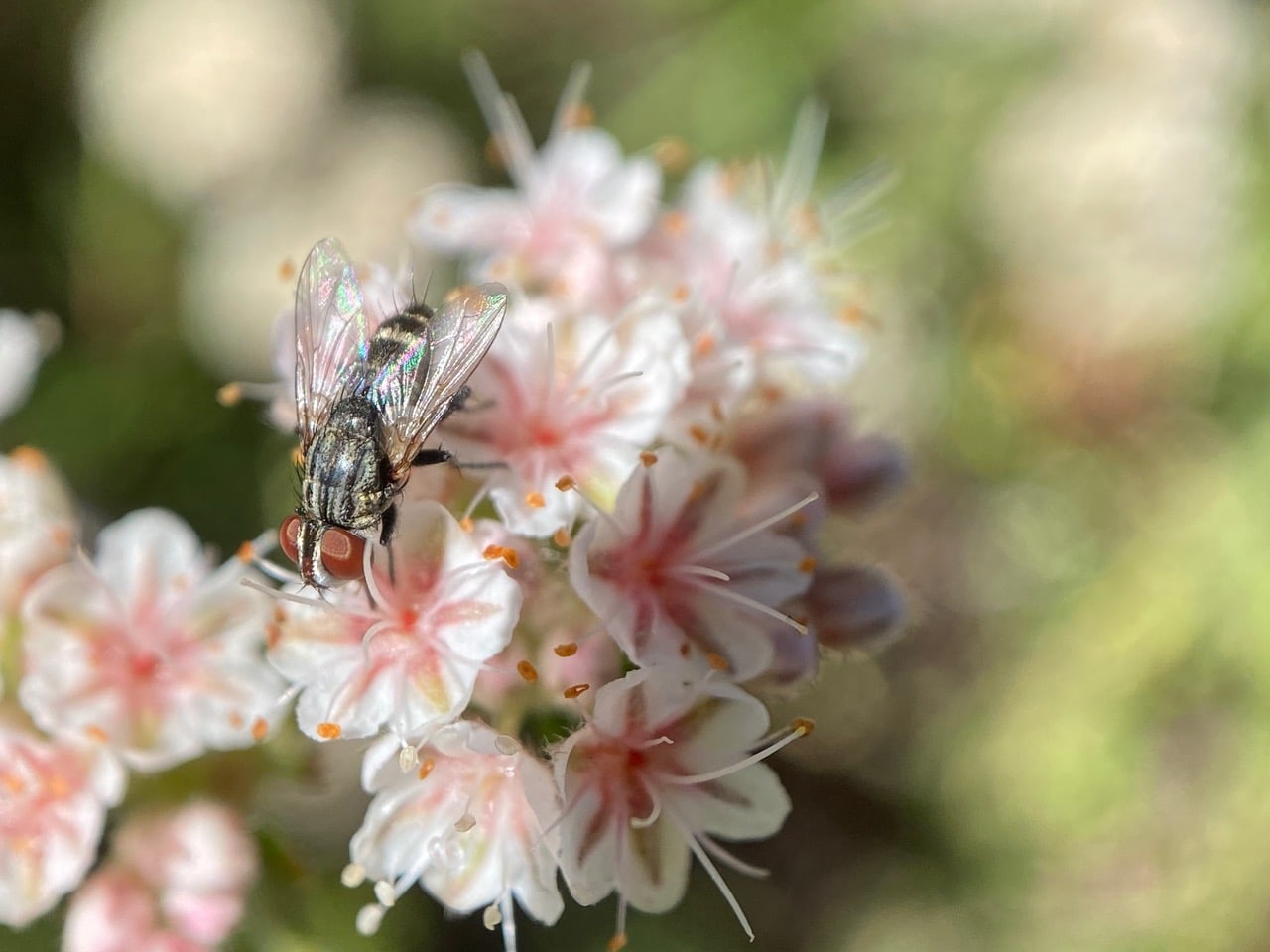
Members of the family Sarcophagidae are commonly called Flesh Flies. Many have black and gray longitudinal stripes on the thorax and checkering on the abdomen, red eyes, and a bristled abdomen sometimes with a red tip. They differ from most flies in that they are ovoviviparous, opportunistically depositing hatched or hatching maggots instead of eggs on carrion, dung, decaying material, open wounds of mammals, hence their common name. The adults mostly feed on fluids from animal bodies, nectar, sweet foods, fluids from animal waste and other organic substances. While we may find their habits revolting, Flesh Flies perform important roles in the ecosystem – the larvae as decomposers/recyclers, and the adults as pollinators.
Metopia is not your ordinary Flesh Flies (family Sarcophagidae). Its larvae occupy a special niche. As kleptoparasites, they develop in the nests of bees and wasps, feeding on the provisions that the females have prepared for their own young. The female Metopia enters the nest of its host to deposit its larvae.