

Pollinator Post 7/18/25 (3)

This robust, sprawling patch of Everlasting Pea, Lathyrus latifolius has been blooming for a while along the shore, but I never seem to see much insect activity on these showy flowers.
The plant is a sprawling herbaceous perennial vine, climbing on neighboring vegetations by means of twining tendrils. Short racemes of 4-10 flowers are produced from the axils of the leaves. Each flower is about 3/4-1” across and has a typical pea-like structure characteristic of Fabaceae – consisting of an upper pair of petals (banners), and a lower keel that is enclosed by lateral petals (wings). The keel is an envelope-like structure housing the reproductive structures. The 5 petals of the flower are varying shades of purplish pink and become faded with age. There is no floral scent. The flowers are known to be pollinated by bumble bees that are heavy enough to depress the wing petals, causing the reproductive structures to spring up from the keel, dusting the bees’ belly with pollen. Butterflies occasionally suck nectar from the flowers, but they are not effective as pollinators.
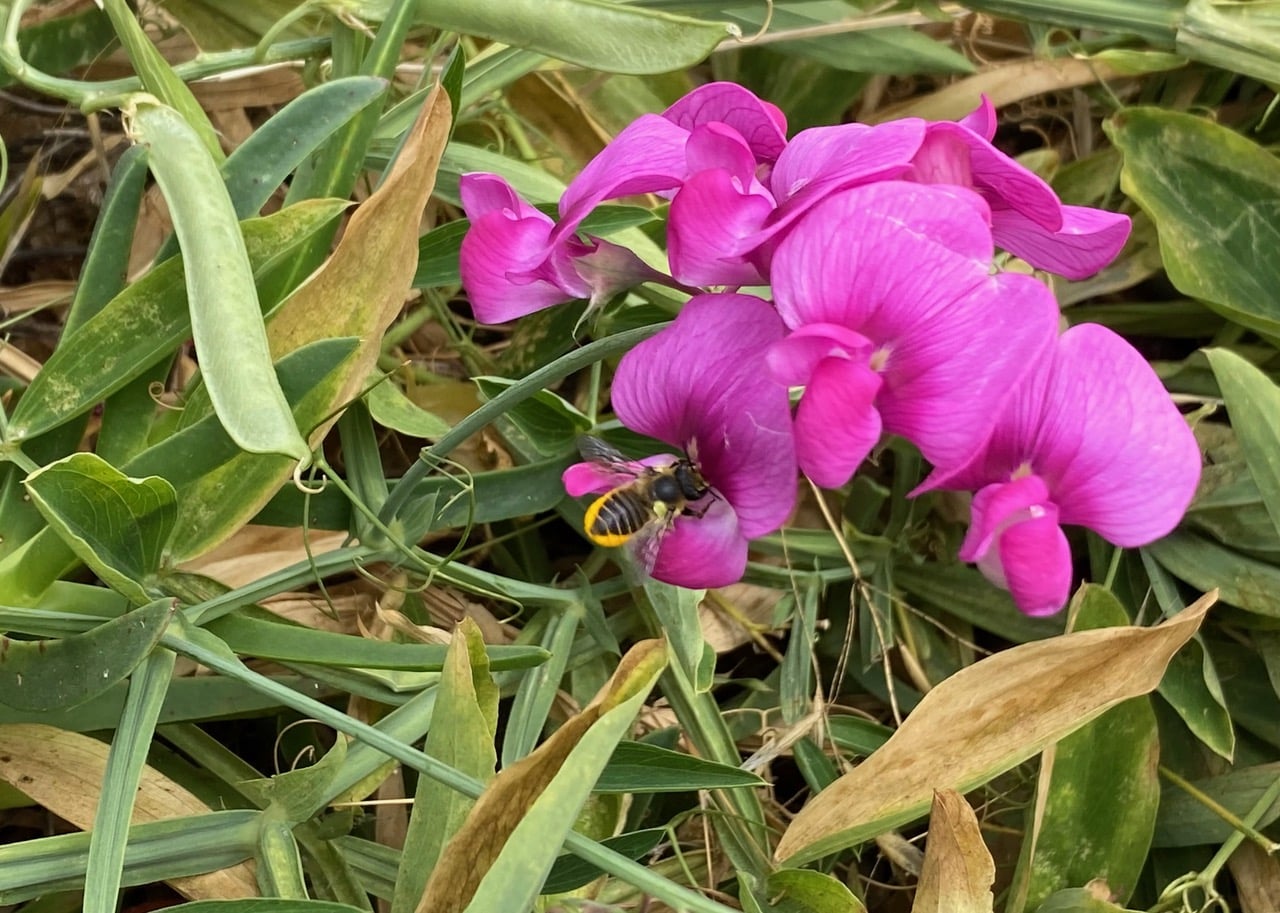
A female Western Leafcutter Bee, Megachile perihirta (family Megachilidae) lands on the lower petals of an Everlasting Pea flower to take nectar. See the whitish knobbed structure that brushes up against the side of the bee? I think that is the stigma and style of the flower. Apparently the impact of the bee’s landing is enough to trigger the pollination mechanism. The pollen from the flower’s anthers would be deposited just where the leafcutter bee usually carries her pollen! The bee already has a load of yellow pollen on the underside of her abdomen.
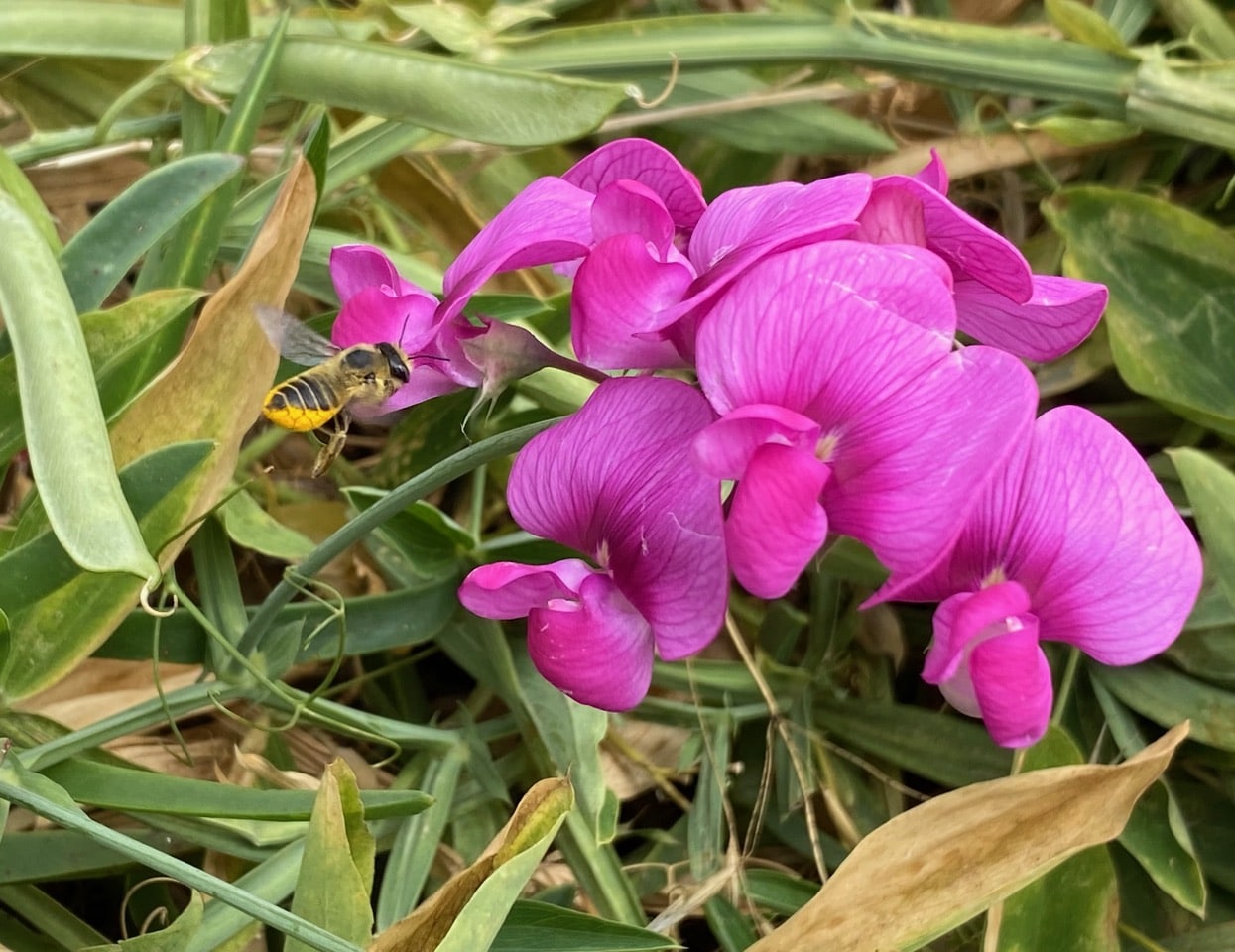
The female Western Leafcutter Bee lifts off from the flower, giving us a good look at her abdominal scopa loaded with yellow pollen.

The bee next lands on an adjacent flower, her weight spreading the wing petals apart. Note that the dark lines on the two upper petals (banners) converge at the base of the petals, serving as ‘nectar guides’ for pollinators. There is even a contrasting white patch to guide the visitors. Bees’ eyes are more sensitive to white and yellow, in contrast to the red colors. What a nice demonstration of how pollination works on the Everlasting Pea flower.
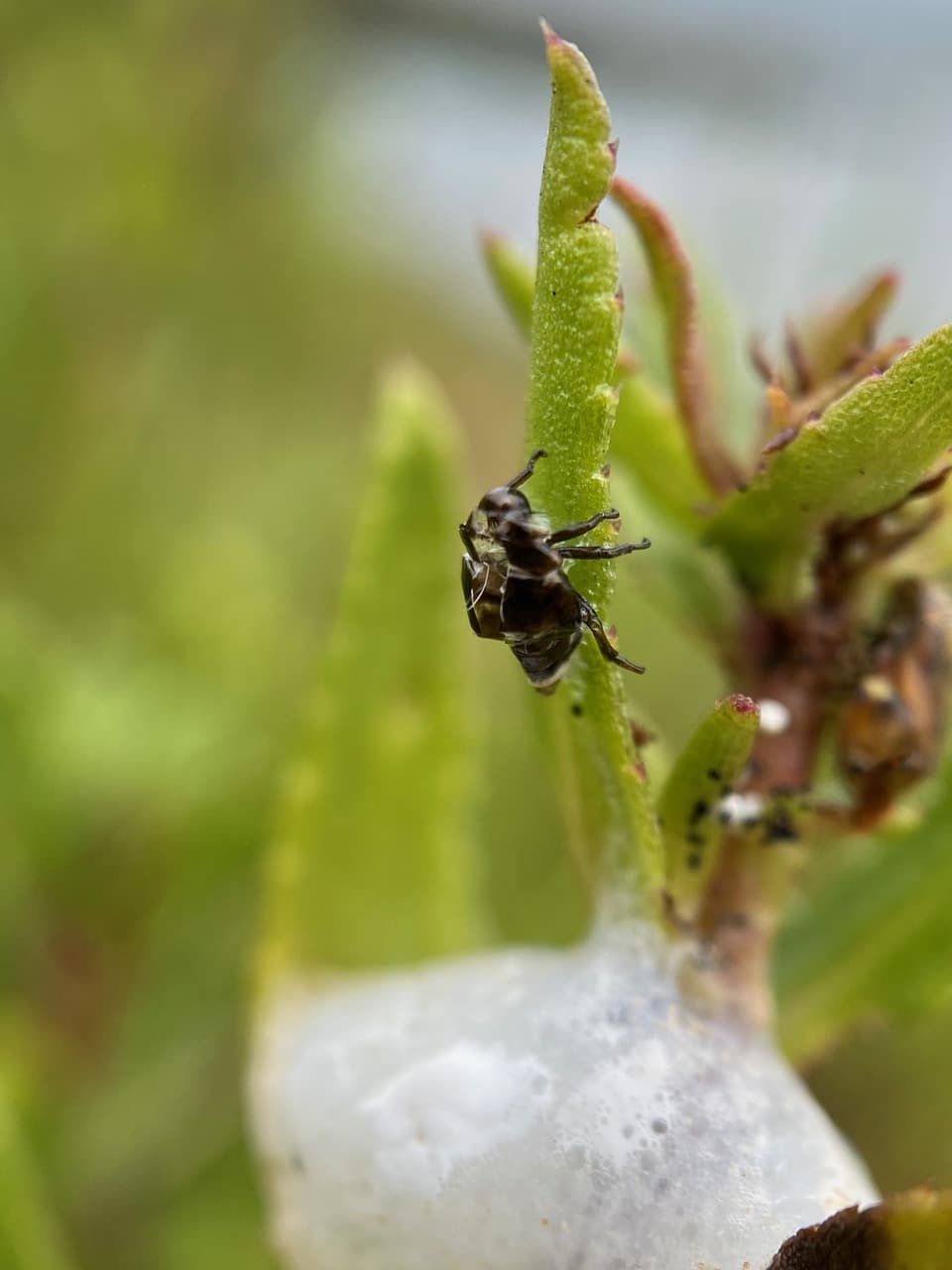
A Spittlebug exuvia has been left on a leaf of Oregon Gumweed, Grindelia stricta above a white foam mass at the leaf axil. An exuvia (plural exuviae) is the cast-off skin or exoskeleton of an arthropod after a molt. The mature Spittlebug nymph has crawled out from its foamy home to molt for the last time, transforming into an adult.
The foam mass is made by a nymph of a bug called the Spittlebug (superfamily Cercopoidea). Like the adults, the nymphs use their piercing, sucking mouthparts to feed on plant juices. The nymph produces a cover of foamed-up plant sap reminiscent of saliva, hence the common name of spittlebug. Whereas most insects that feed on sap feed on the nutrient-rich fluid from the phloem, Spittlebugs tap into the much more dilute sap flowing upward via the xylem. The large amount of excess water that must be excreted and the evolution of special breathing tubes allow the young spittlebug nymphs to grow in the relatively protective environment of the spittle. Symbiotic bacteria in the insects’ digestive system provides them with the essential amino acids that their diet lacks. The foam serves a number of purposes. It hides the nymph from the view of predators and parasites, and it insulates against heat and cold, and protects the delicate nymphs from desiccation. Moreover, the foam has an acrid taste that deters predators.

Hey, an adult Spittlebug is still perched on the stem above the foam mass next to its exuvia! It is a brown individual of Complex Clastoptera lineatocollis (family Clastopteridae). Whenever we see the term “complex” included in the scientific name, we know that the taxonomy of the organism is still in a state of flux, with several similar species not fully resolved.
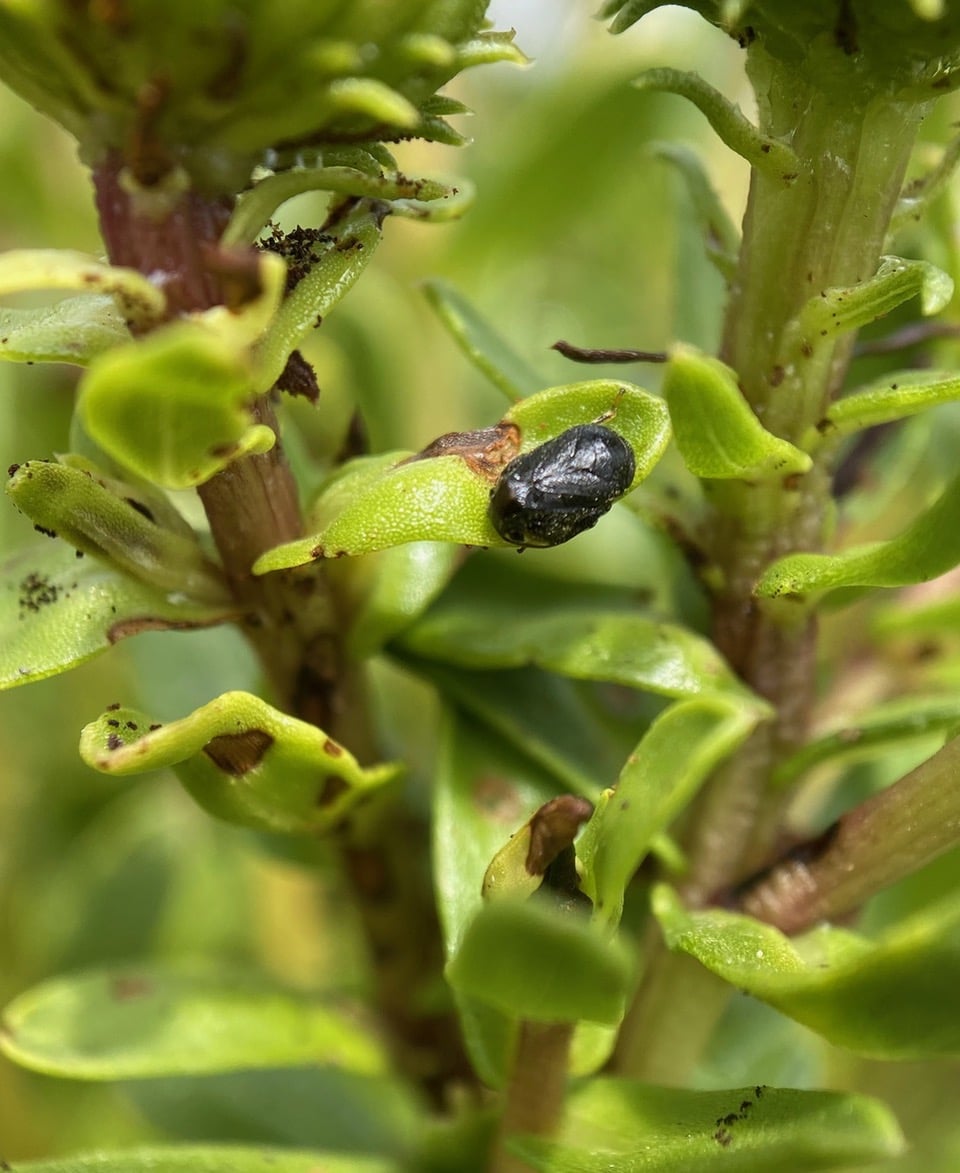
Here’s another one of the adult Spittlebug, Complex Clastoptera lineatocollis (family Clastopteridae). It is smaller than the brown ones and is almost all black. It is highly unlikely that we have two different species of Spittlebugs infesting the Grindelia at the same time. I think both the brown and black individuals are the same species exhibiting sexual dimorphism, the larger brown ones being females.

Note the frog-like posture of the adult Spittlebug. This is why they are commonly called Froghoppers.
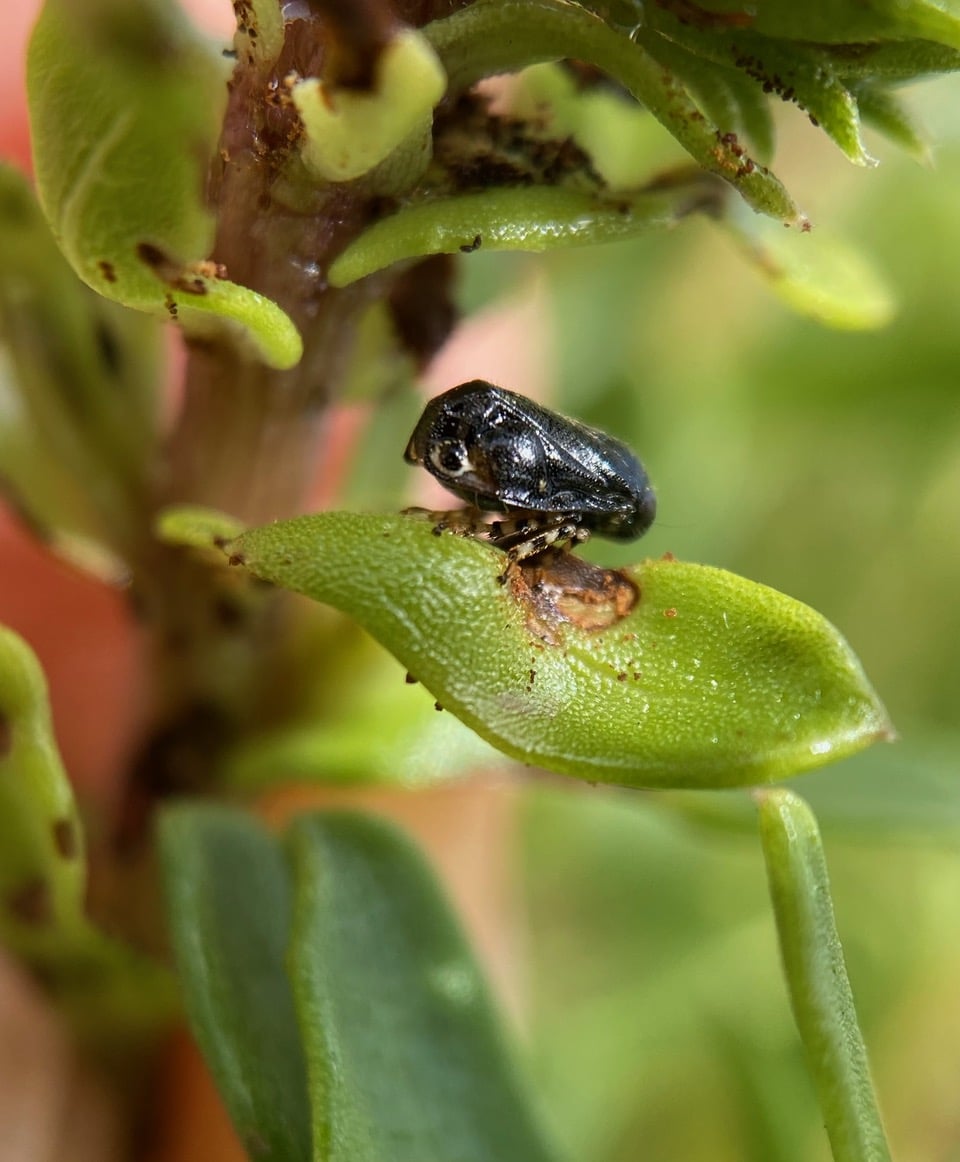

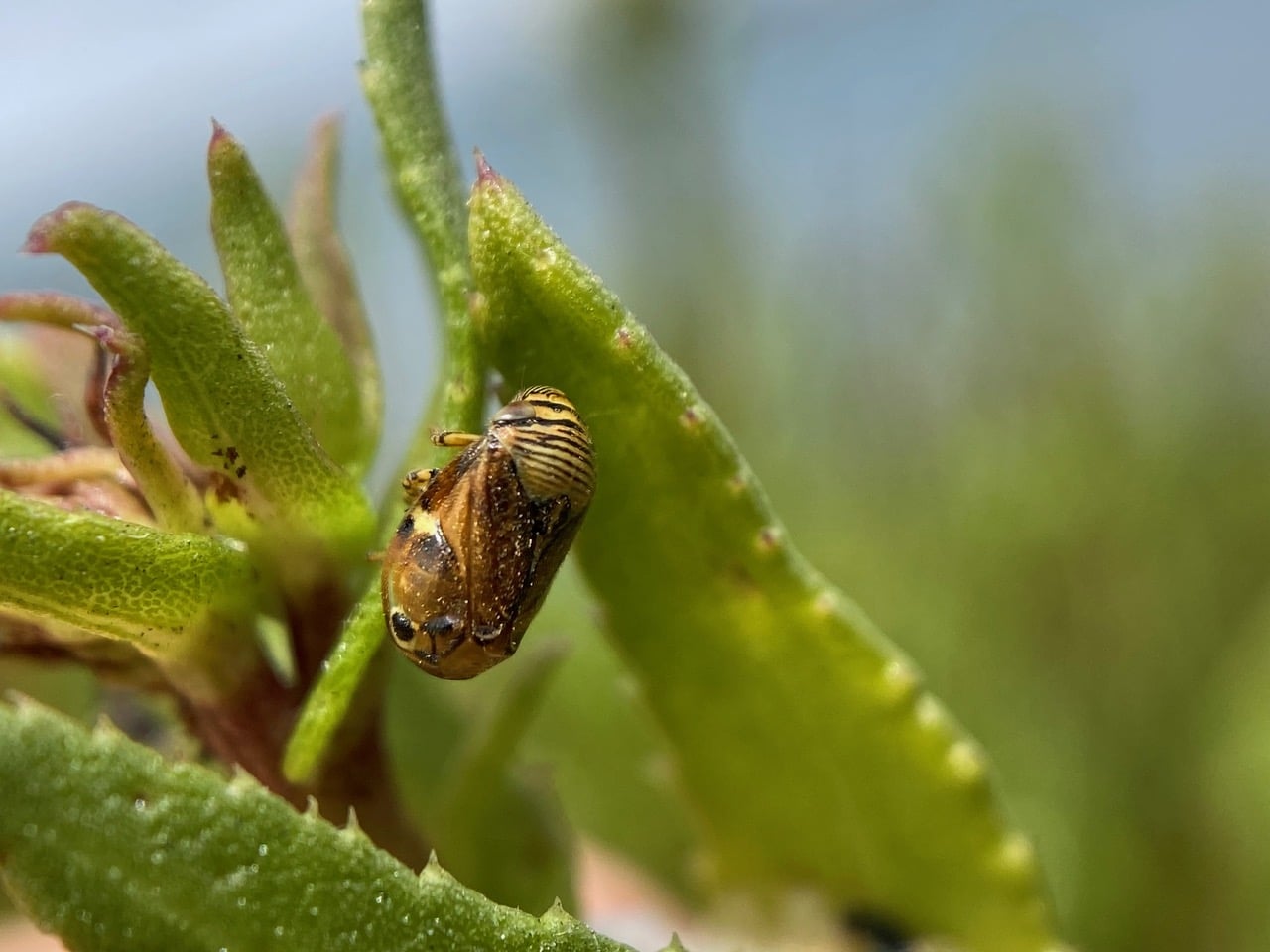

Don’t be fooled by that shiny, eye-like structure on the rear of the insect. It is actually on the bug’s hind wing, masquerading as an eye. A confused predator might expect the Spittlebug to run away in the direction of the fake eyes.
Here’s a brown individual of Complex Clastoptera lineatocollis with bulging abdomen. Note the fake eye spot on the rear.
This view of the Spittlebug shows its paddle-shaped hindwing that bears the fake eye spot.
These wings don’t look like they are made for flying. Perhaps these bugs don’t fly, as they can jump instead.
Adult spittlebugs are commonly called Froghoppers. The Froghopper is a “true bug” in the order Hemiptera. Froghoppers are champion jumpers among insects, out-performing even the fleas. The bug can leap the human equivalent of a skyscraper without a running start! The muscles in its hind legs act like a “catapult” to release energy explosively. Its athletic prowess not withstanding, the Froghopper is better known for its young, the “spittle bugs”. The nymphs produce foamy white masses on plants within which they feed on plant sap. Froghoppers have piercing-sucking mouthparts, and feed on plant sap as both nymphs and adults. A recent report claims, “Froghoppers are the super-suckers of the animal world. The tiny insects produce negative pressures equivalent to people sucking a 100-meter-long straw.” So the little bug has two titles under its belt – champion jumper, and super-sucker!