

Pollinator Post 7/14/25 (2)

The Oregon Gumweed, Grindelia stricta on the upper salt marsh have come into bloom. I am assured of a good morning “bugging” here!
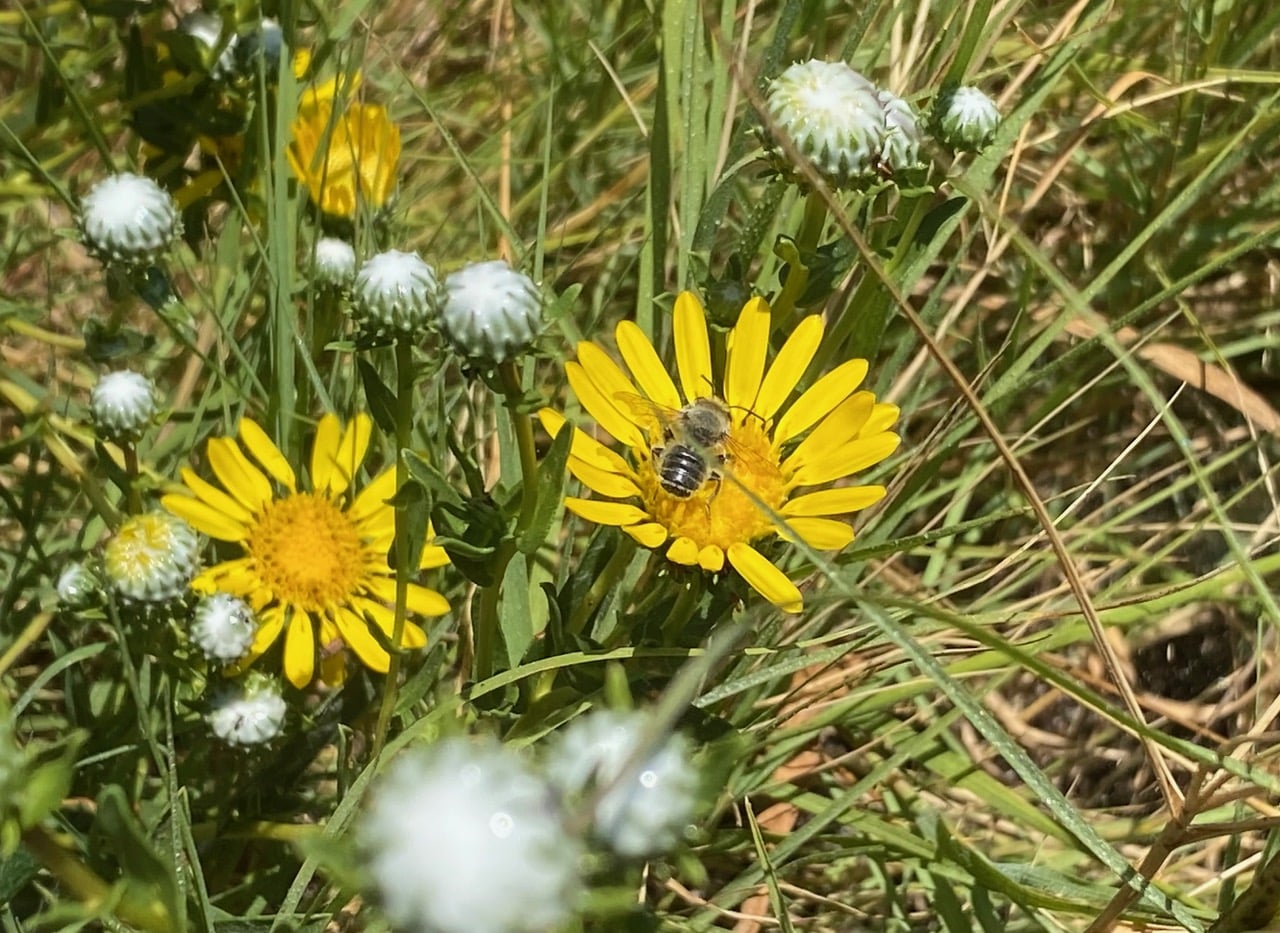
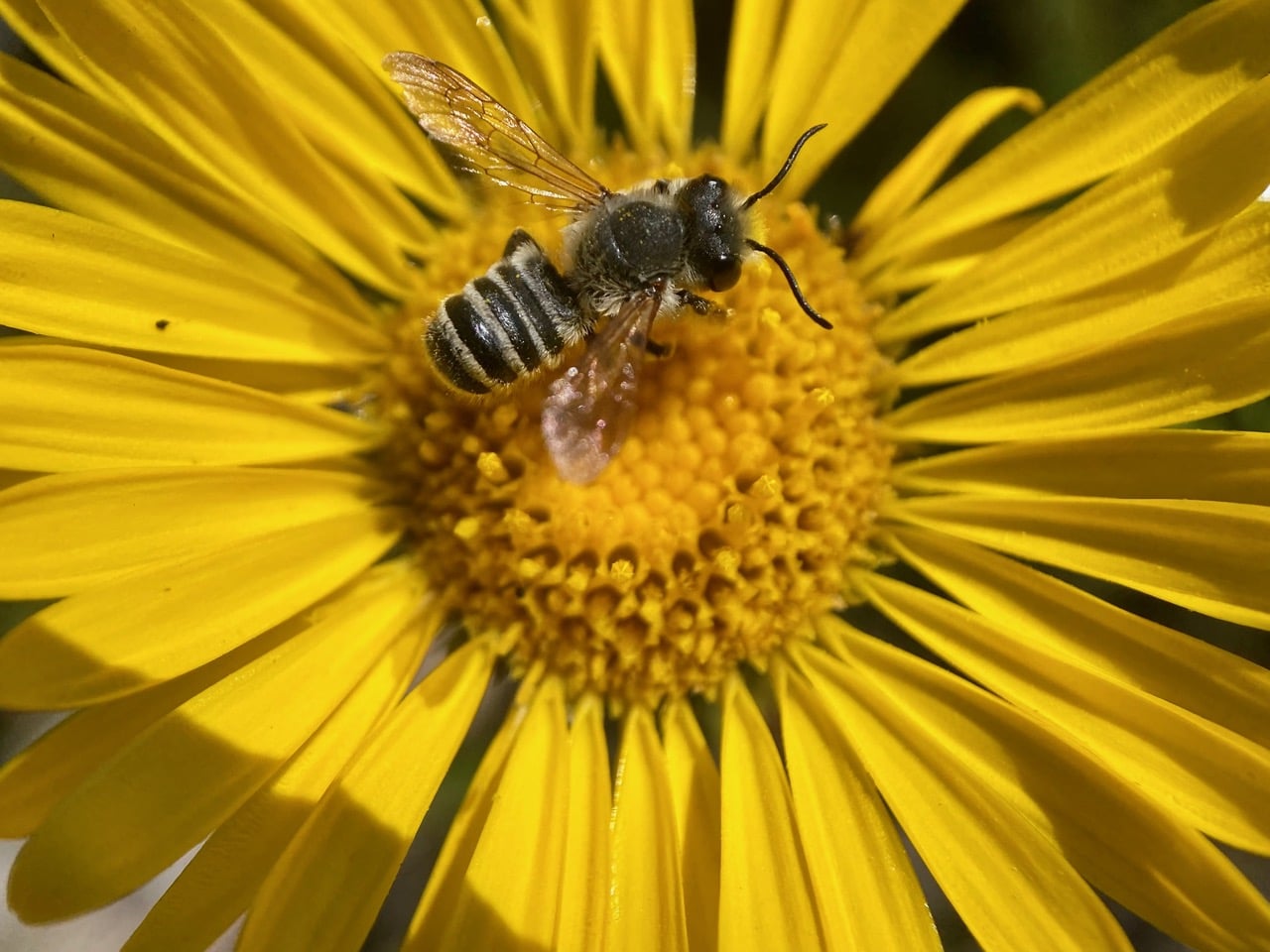
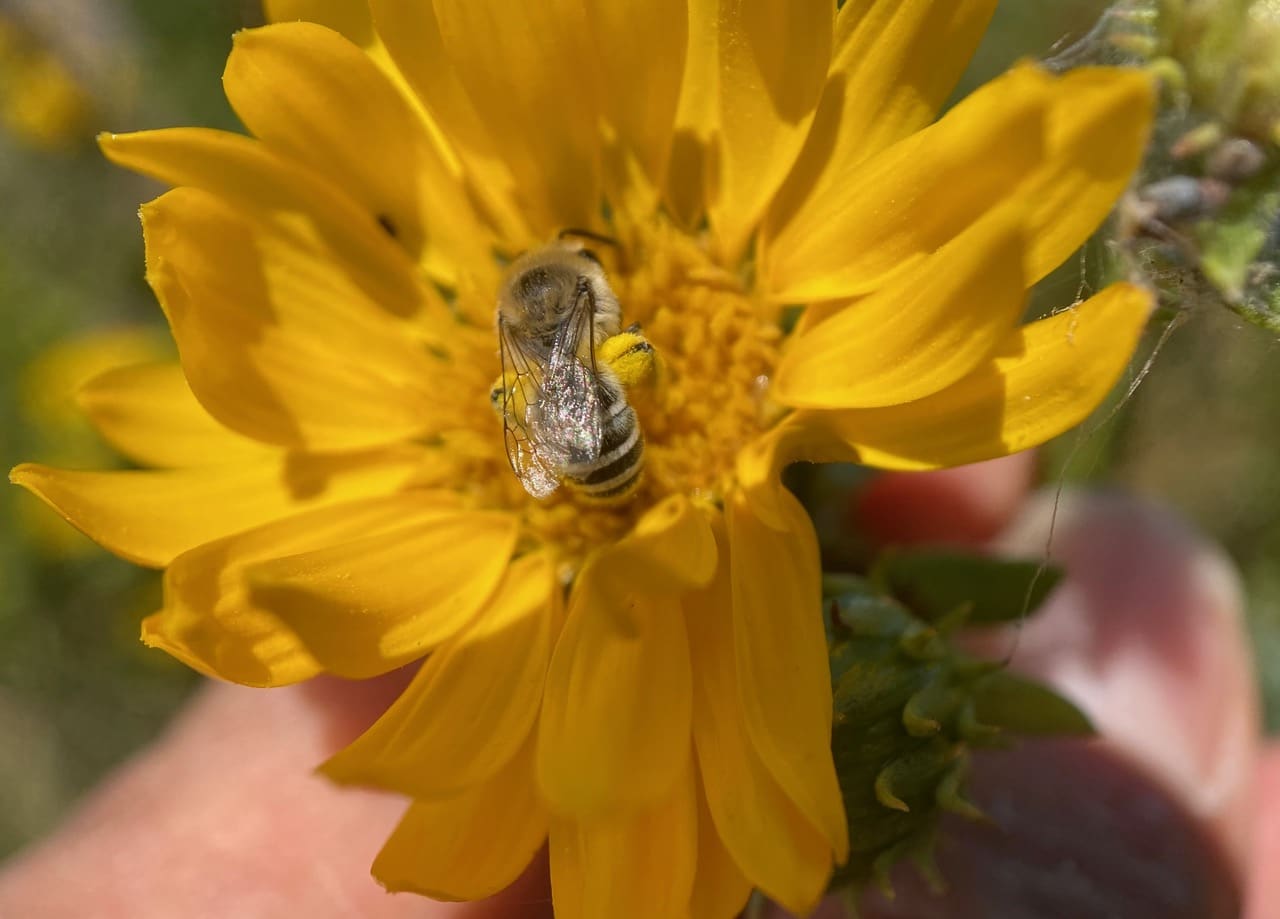
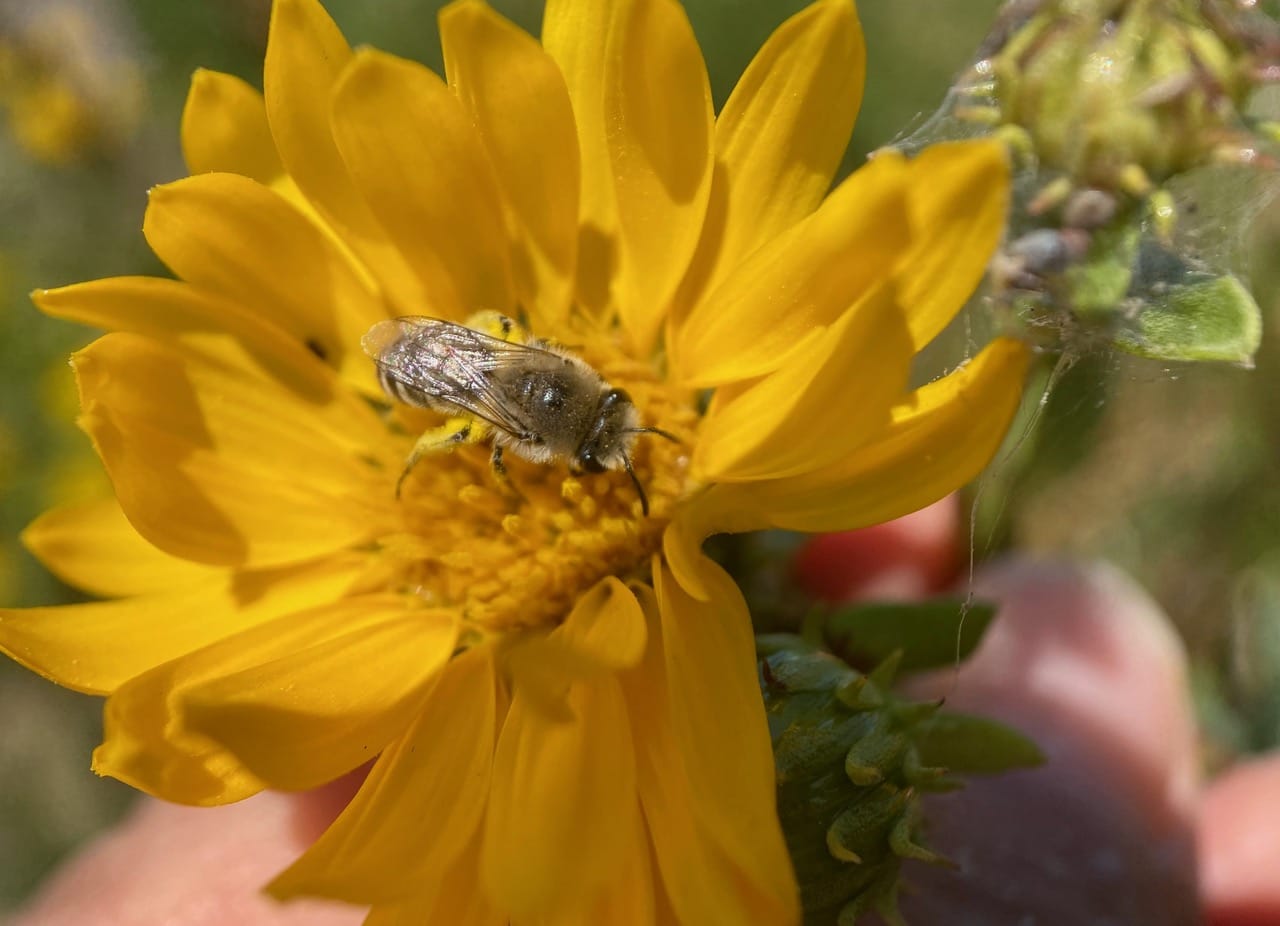
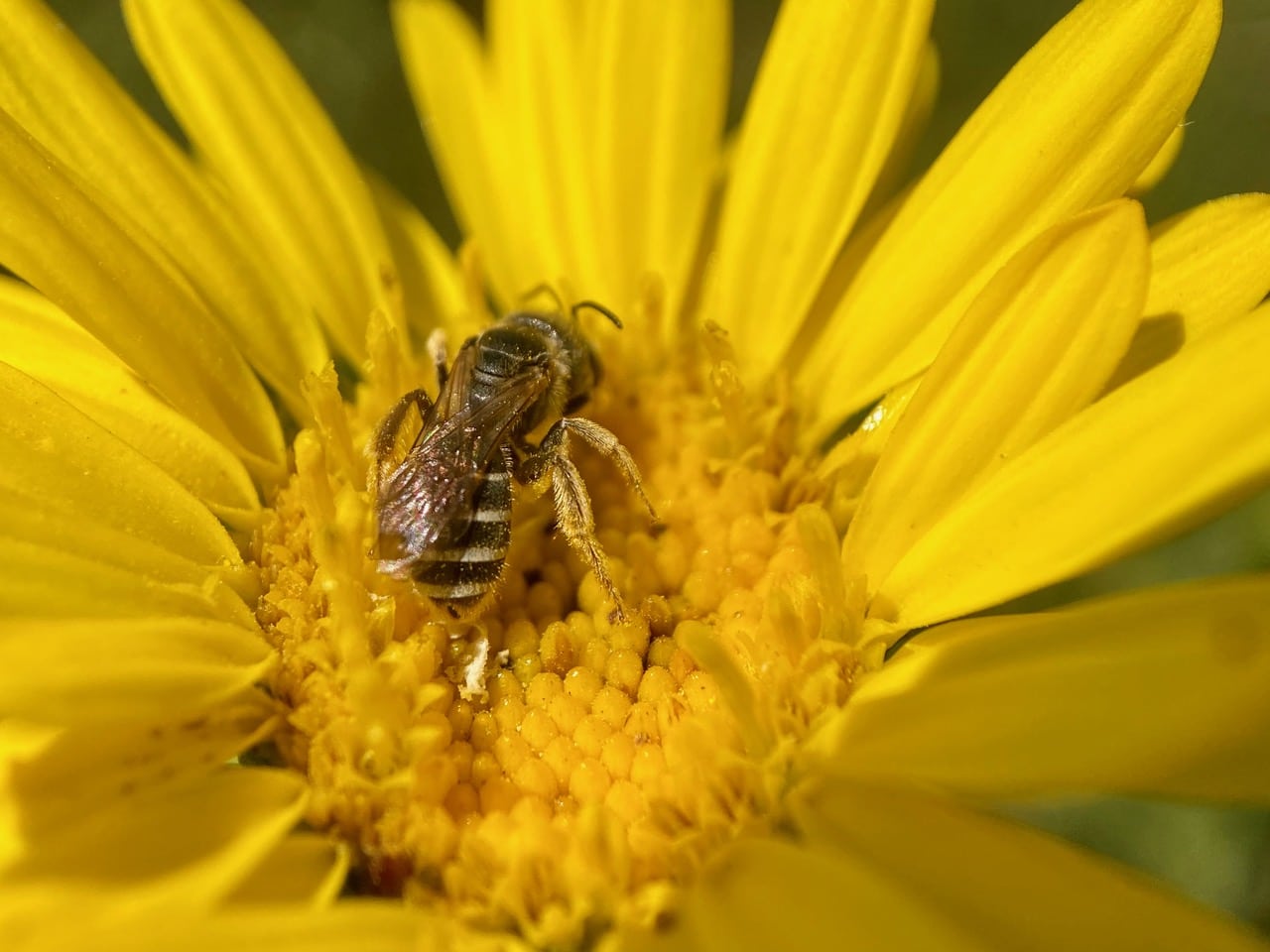






A male Western Leafcutter Bee, Megachile perihirta (family Megachilidae) is foraging on a fresh Grindelia flowerhead.
Leaf-cutter Bees, Megachile sp. (family Megachilidae) are stout-bodied, usually with pale hair on the thorax and stripes of white hairs on the abdomen. Females usually have a triangular abdomen with a pointed tip, and males’ faces are covered with dense, pale hair. Flight season is from May into September, with peak activity from June to August.
Solitary females construct nests in tubular cavities, including hollow stems, tree holes, and abandoned beetle burrows in wood. Many use holes drilled into wood, straws, or other manufactured tunnels. Females cut pieces from leaves or flower petals for use in the construction of brood cells. Most Megachile females are generalists when foraging for pollen. Pollen is transported in dense scopae on the underside of the abdomen.
Photos of Western Leafcutter Bee (Megachile perihirta) · iNaturalist
Close-up of a male Western Leafcutter Bee, Megachile perihirta (family Megachilidae) on Grindelia. He seems to have lost some hairs on his thorax. The species is usually quite hairy. Note the brush of pale hairs on his face.
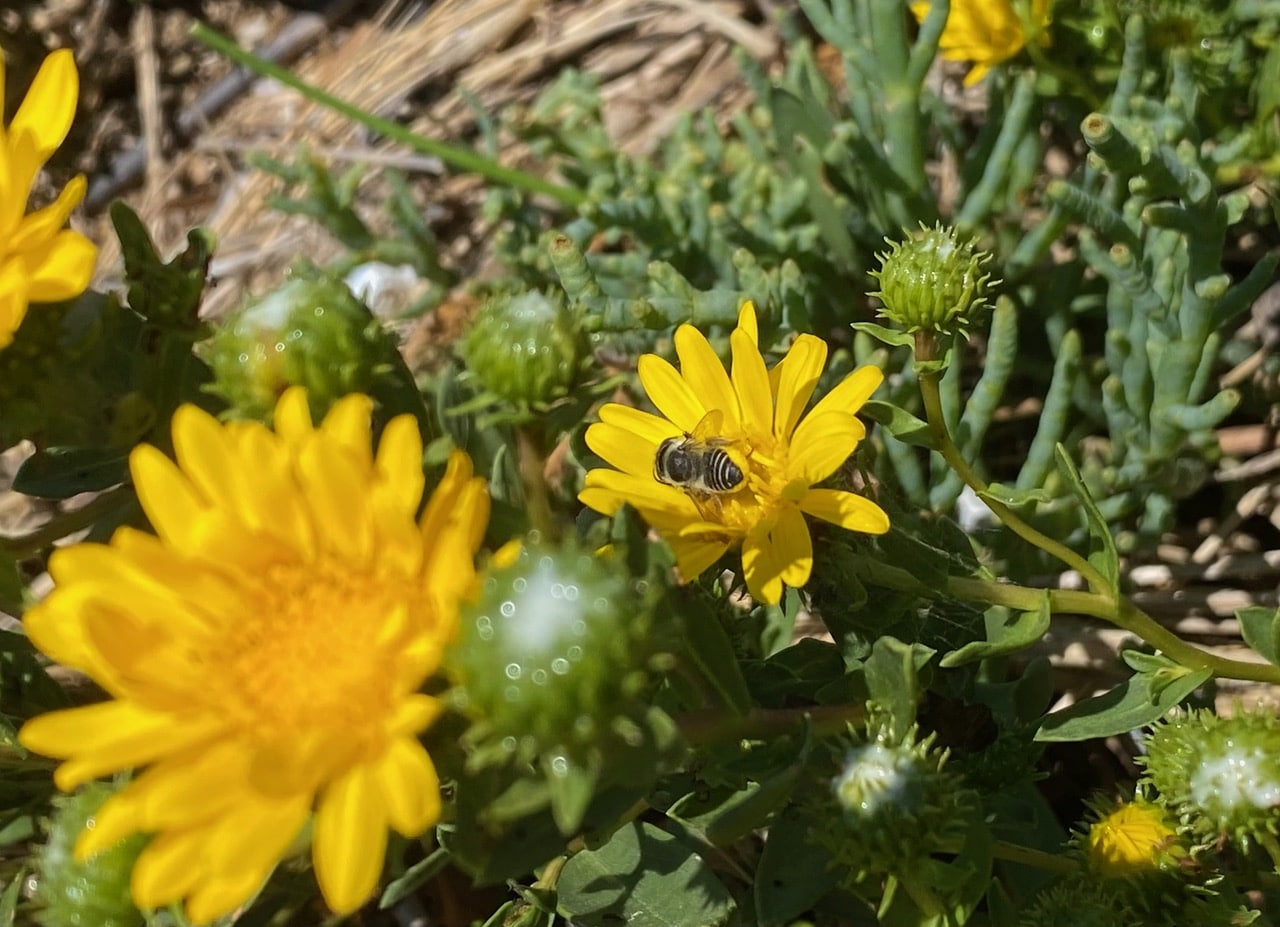
Hey, that’s a female Western Leafcutter Bee, Megachile perihirta (family Megachilidae) on another Grindelia flowerhead. Note the yellow pollen on the underside of her abdomen.
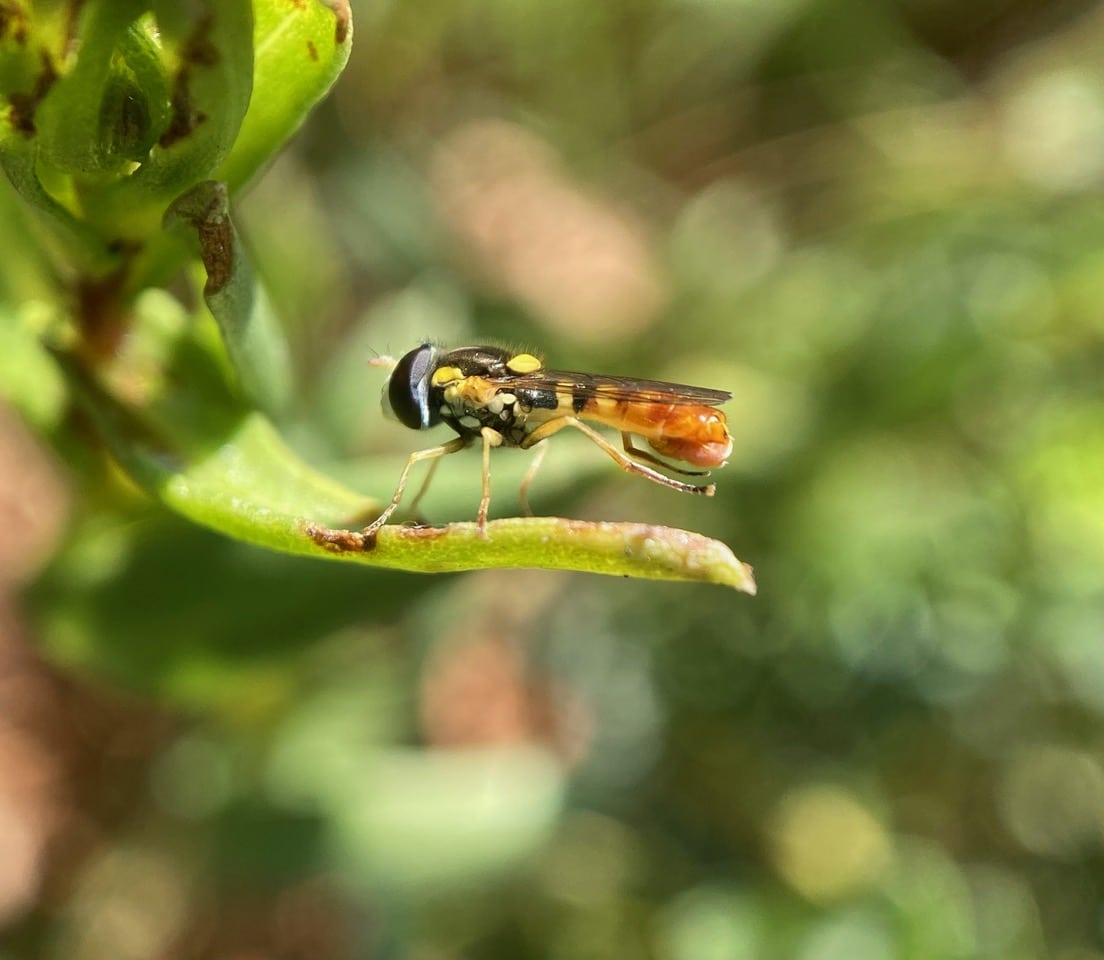
A male Forked Globetail has landed on a Grindelia leaf to groom himself. Note his genitalia that is curled under the end of his abdomen, forming a bulbous structure. This is what gives rise to the common name of “globetail”.
The Forked Globetail, Sphaerophoria sulphuripes (family Syrphidae) is a hover fly native to western North America. Adults visit flowers for nectar and pollen. Larvae feed on aphids and other soft-bodied insects. There is marked sexual dimorphism in the species – the males have a slender abdomen with a reddish, swollen tip.

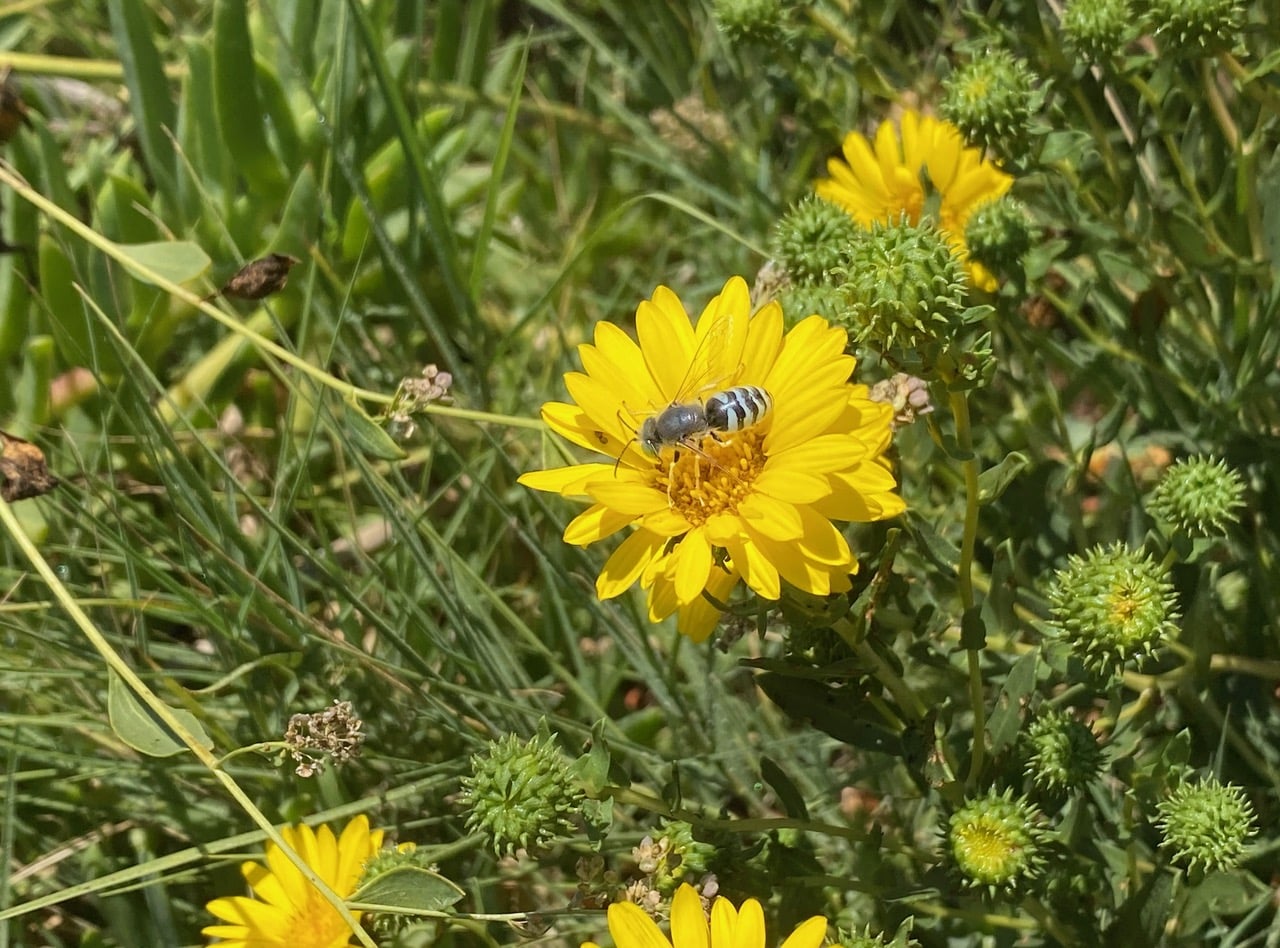
A fuzzy little bee with black-and-white striped abdomen is foraging on a Grindelia flowerhead. It is a Cellophane Bee, Colletes sp. (family Colletidae).
The bee family Colletidae includes generalists and specialists, and they are likely important pollinators of many wildflowers. All Colletidae in North America are solitary ground nesters, but some species nest in large aggregations. There are two major genera of Colletidae in North America: the Masked Bees (genus Hylaeus) and Cellophane Bees (genus Colletes). The most obvious shared characteristics of Colletidae is also the hardest to see: their short tongue. Colletes are moderately hairy, slender bees, ranging in size from 7 to 16 mm. Distinct features include a hairy head and thorax, pale bands of hair on the abdomen, and a heart-shaped head. The eyes of Colletes are angled (rather than being parallel), making the face slightly heart-shaped.
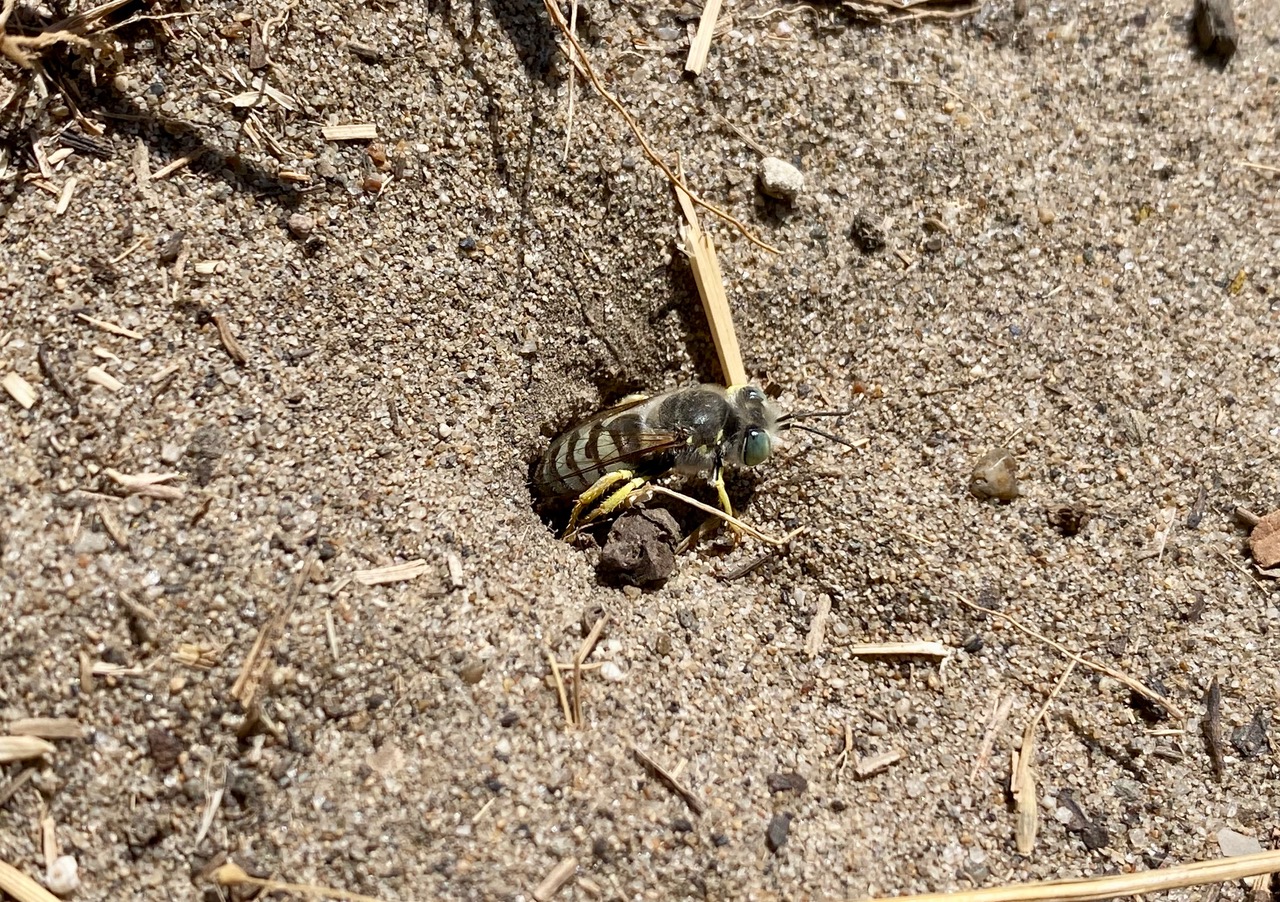
Numerous American Sand Wasps, Bembix americana (family Crabronidae) fly low over a stretch of the sandy trail that is pitted with half-moon-shaped burrows. As a wasp enters a burrow, I wait for its exit to capture this picture.
Sand wasps in the genus Bembix are familiar and common throughout North America, digging their burrows in dunes, on beaches, and other habitats with loose, deep sand. The female rapidly kicks out large quantities of sand using a “tarsal rake” of spines on each front leg. The burrow is excavated before the wasp goes hunting. Bembix are generalist, opportunistic hunters. True flies in the order Diptera are the usual prey. A victim is paralyzed or killed by the wasp’s sting, and is then flown back to the nest. Most species will lay an egg on the first victim, while some species lay an egg in the empty cell before starting to hunt. Once the egg hatches, mama wasp brings flies to her larva as needed. This “progressive provisioning” is rare in the insect world. When the larva reaches maturity, mama wasp closes the cell. Inside, the larva spins an oblong cocoon, weaving sand grains into the structure and resulting in a hardened capsule. Overwintering takes place as a prepupa inside this cocoon, but there are usually two generations a year.
Male sand wasps often engage in an elaborate flight ritual called “sun dances”. Males emerge before females, and fly erratically at dizzying speed one or two inches above the ground attempting to detect virgin females about to emerge from their underground nests. Both sexes are often seen taking nectar at flowers, especially from Asteraceae family. Bembix wasps are often victims of other insects such as cuckoo wasps (Chrysididae), velvet ants (Mutillidae), satellite flies (Sarcophagidae), bee flies (Bombyliidae), and thick-headed flies (Conopidae).
An American Sand Wasp, Bembix americana (family Crabronidae) is taking nectar on Grindelia.
A Tripartite Sweat Bee, Halictus tripartitus (family Halictidae) is foraging on a Grindelia flowerhead.
Halictus is found worldwide; they are most common in the Northern Hemisphere. All are generalists, foraging from a wide variety of flowering plants. Many species are social and produce several generations per year. This is not surprising as most blooming plants are season-specific; a bee that requires pollen and nectar across multiple seasons would not thrive as a specialist. All Halictus in North America nest in the ground, often in aggregations; and they may nest in the same area for decades.
The species Halictus tripartitus (family Halictidae) is partially eusocial, with nests connected underground and some workers capable of reproducing. It is a very successful species in our area, making up the majority of bees in many gardens right now, collecting floral resources from a large variety of plants.
The prolific stand of Fennel, Foeniculum vulgare is blooming gloriously along the narrow trail.
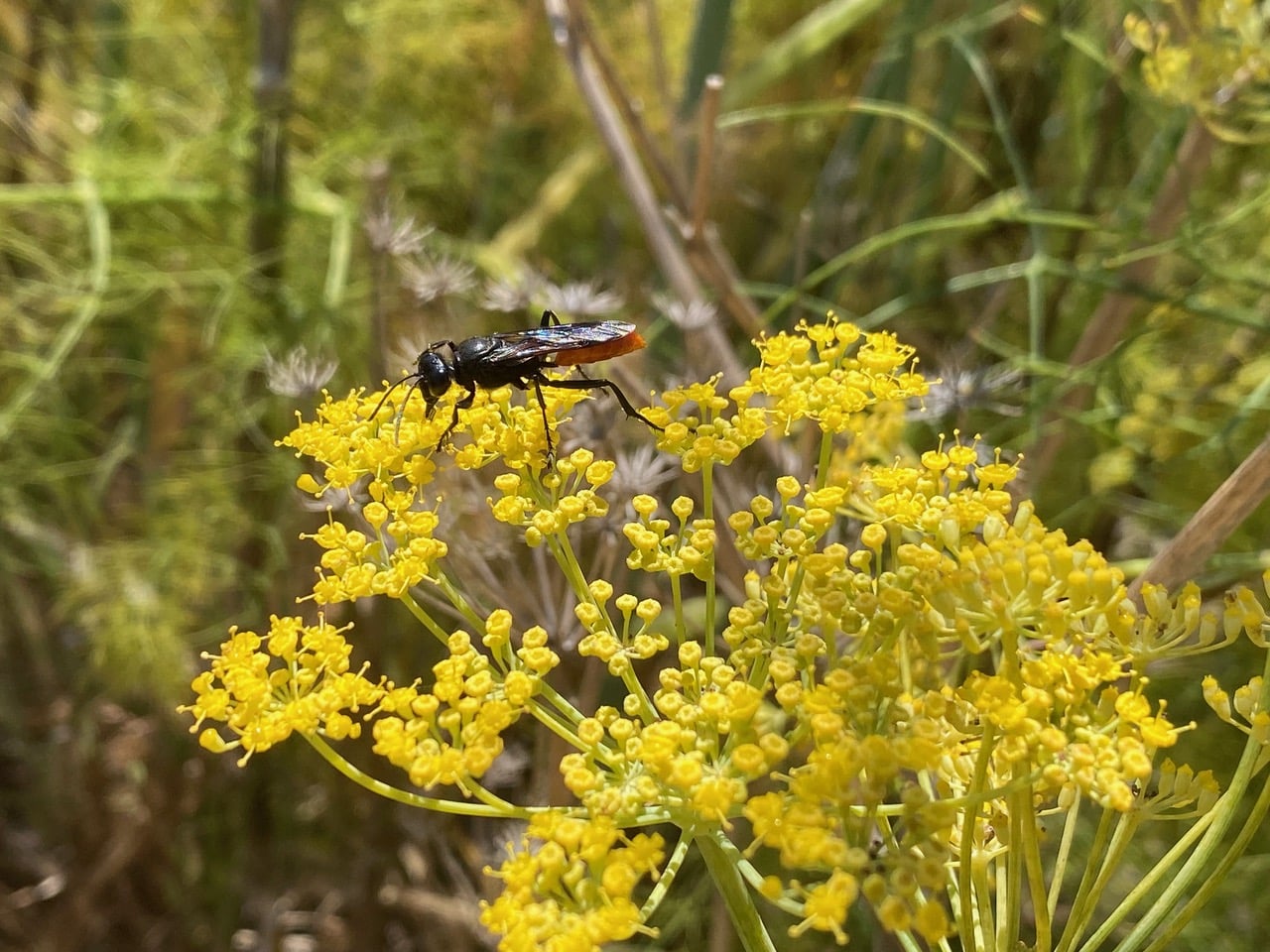
A large black wasp with an orange-red abdomen is taking nectar on a flower umbel of Fennel. It is a female Thread-waisted Burrowing Wasp, Sphex lucae (family Sphecidae).
The Sphecidae are solitary wasps with elongated and narrow first abdominal segment, giving rise to the common name Thread-waisted Wasps. Sphex lucae is a widespread western species, ranging from WA in the north, south to CA, and east to TX. The species exhibits sexual dimorphism – females are black with a red abdomen, while the males are all black. Adults visit many types of flowers for nectar. Females hunt katydids and grasshoppers as food for their young. The wasp excavates a single-celled burrow in the soil in advance of hunting activities. She drags her paralyzed prey back to the burrow, laying a single egg on the victim. The nest entrance is then sealed and the process is repeated. Males of this species spend nights in sleeping aggregations in sheltered places such as beneath a rock overhang.
The female wasp might also be on the lookout for potential prey to provision her nest.
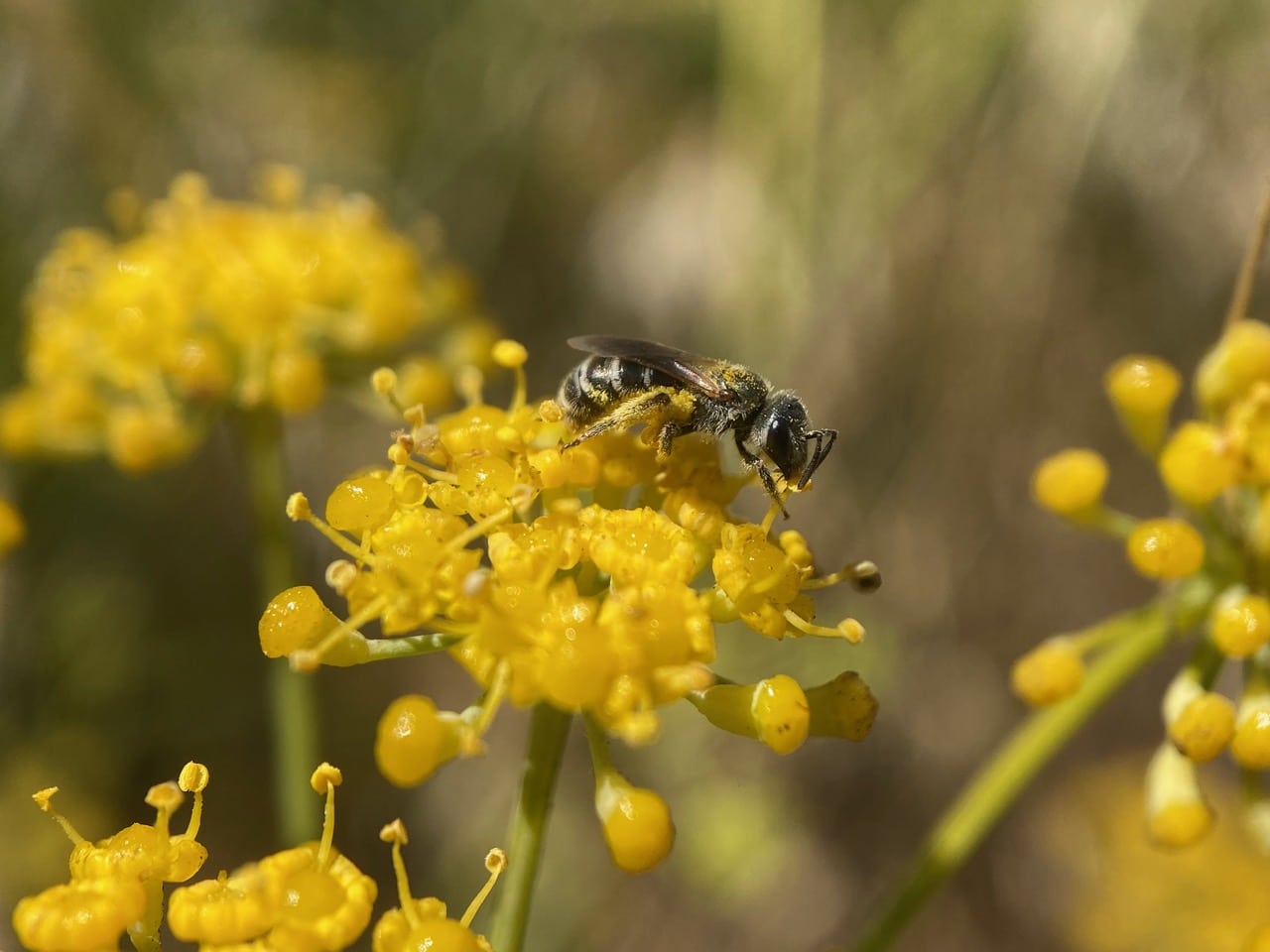
A Tripartite Sweat Bee, Halictus tripartitus (family Halictidae) is collecting pollen on an umbel of Fennel flowers.
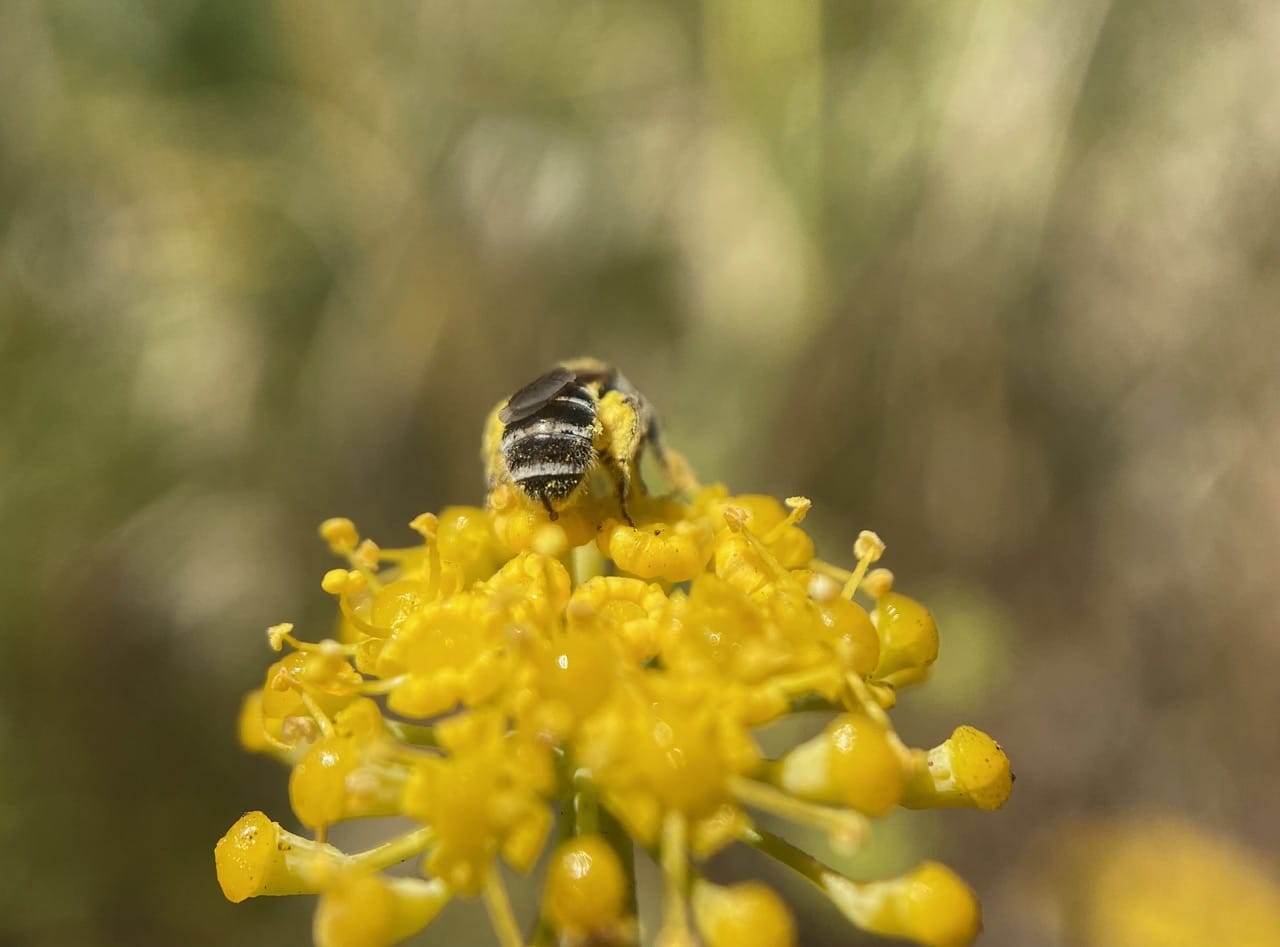
Note where the female Sweat Bee is carrying the pollen she has gathered – on the scopae of her hind legs, as well as on the underside of her abdomen. The pollen grains are held loosely by electrostatic attraction to the hairs of the scopae, unlike the situation with the corbiculate bees like the Honey Bees and Bumble Bees who pack their pollen moistened with nectar into their corbiculae or pollen baskets.
Note the groove-like structure or “rima” at the tip of the female Sweat Bee’s abdomen. Female Sweat Bees in the genera Halictus and Lasioglossum have this feature, and they are commonly called Furrow Bees. The function of the rima is not clear, but since it occurs only on females, it is believed that it might be associated with egg laying.
A male Summer Longhorn Bee, Melissodes sp. (family Apidae) is taking nectar from a Grindelia flowerhead.
The Summer Longhorn Bees, Melissodes sp. (family Apidae) are medium to large bees, stout-bodied, usually with gray/brown hair on the thorax and pale hair bands on the abdomen. Males usually have yellow markings on their faces and have very long antennae from which their common name is derived. They are active May to September, with peak flight in late June to early August. The females prefer flat, bare ground for digging their solitary nests, though they sometimes nest in aggregations. Pollen is transported in scopae on the hind legs. Pollen loads are often copious and brightly colored and thus very distinguishable. Melissodes are specialists on Asteraceae – females gather pollen from flowers of Aster, Bidens, Coreopsis, Cosmos, Encelia, Gaillardia, Helianthus, and Rudbeckia ssp.
His head and thorax glinting in iridescent green, a male Fine Striped Sweat Bee, Agapostemon subtilior (family Halictidae) is foraging on a Grindelia flowerhead.
Agapostemon are brightly colored metallic green or blue bees measuring 7 to 14.5 mm long. Most species have a metallic green head and thorax, and black-and-yellow striped abdomen; some females are entirely bright green or blue. Females carry pollen on scopal hairs located on their hind legs. Agapostemon are generalists. Like other members of the family Halictidae, they are short-tongued and thus have difficulty extracting nectar from deep flowers. Males are often seen flying slowly around flowers looking for females. The bees favor flowers with high densities. Females excavate nests in the ground. These are summer to fall bees.
Fine striped sweat bee (Agapostemon subtilior) · iNaturalist
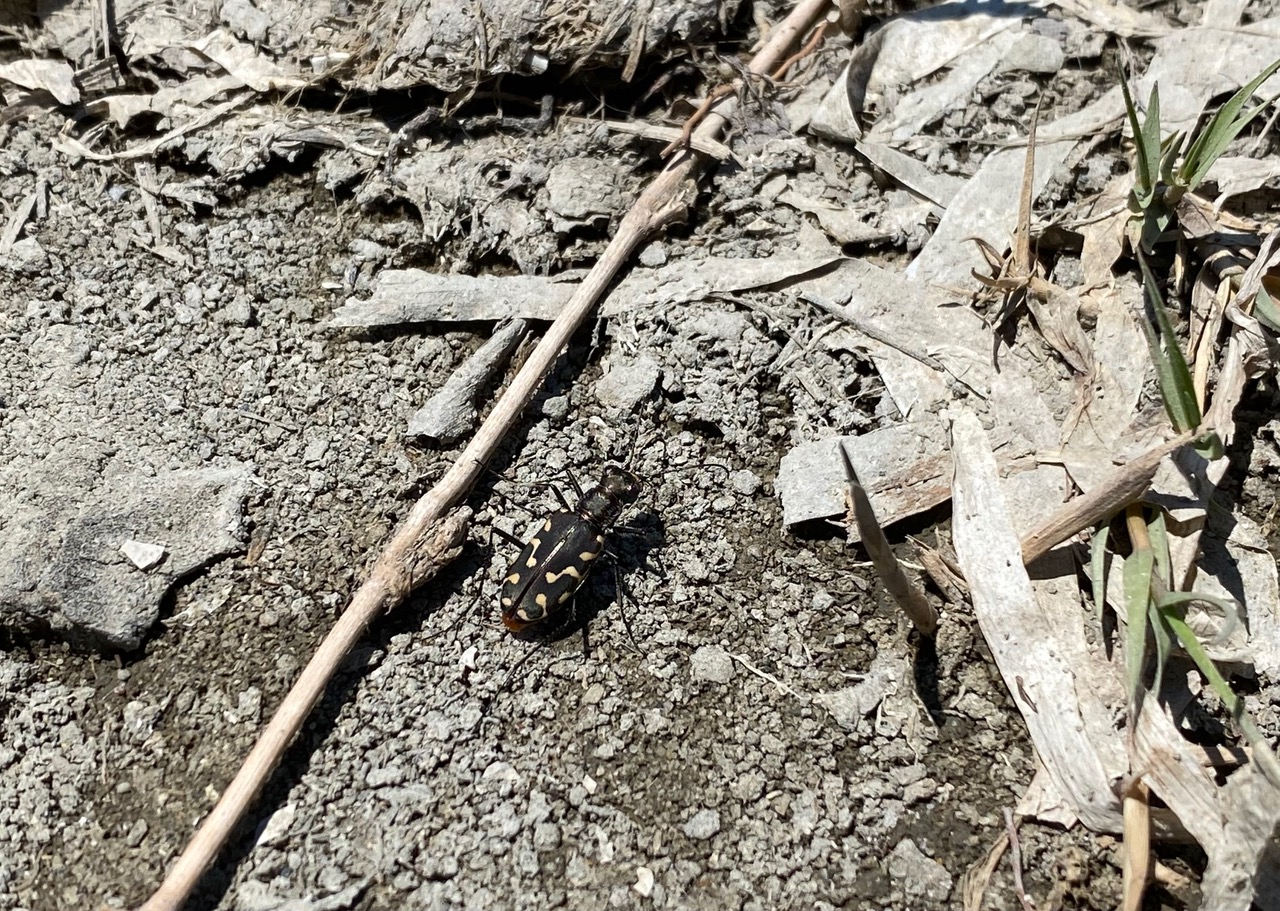
I veer off on a side trail into the lower salt marsh, and almost right away found my quarry, a Wetsalt Tiger Beetle, Cicindela haemorrhagica (family Cicindelidae). And a cooperative one – the fast-running beetle actually stops for a moment for a picture!
Tiger Beetles are a family of beetles, Cicindelidae, known for their aggressive predatory habits and running speed. The fastest known species can run at about 125 body lengths per second! Tiger Beetles often have large bulging eyes, long, slender legs and large curved mandibles. All are predatory, both as adults and as larvae. The genus Cicindela has a cosmopolitan distribution, is usually diurnal and may be out on the hottest days. The fast-moving adults run down their prey and are extremely fast on the wing. Apparently their running speed exceeds their brain’s ability to process visual images – occasionally the beetles have to abruptly stop in mid-chase to visually reorient. What a riot to watch!
The larvae of tiger beetles live in cylindrical burrows as much as a meter deep. The grubs have a large head, armored on top with up to six small eyes and formidable mandibles beneath. A flat plate right behind their head fills the burrow flush with the surface while they wait at the entrance in ambush for passing prey. There is a prominent hump on their fifth abdominal segment with two pairs of backward pointing hooks to anchor them in their burrow against struggling prey. Danger lurks at every turn, both on and below ground for the other little creatures that make their home in this sandy habitat.