

Pollinator Post 7/14/25 (1)

I spend some time exploring the restored sand dunes of Alameda Beach this morning. Several of the plants are currently in peak bloom, including buckwheats (Eriogonum), and the Coastal Sagebrush, Artemisia pycnocephala.

A female Fine Striped Sweat Bee, Agapostemon subtilior (family Halictidae) is foraging on a flower of Beach Evening Primrose, Camissoniopsis cheiranthifolia.
Agapostemon are brightly colored metallic green or blue bees measuring 7 to 14.5 mm long. Most species have a metallic green head and thorax, and black-and-yellow striped abdomen; some females are entirely bright green or blue. Females carry pollen on scopal hairs located on their hind legs. Agapostemon are generalists. Like other members of the family Halictidae, they are short-tongued and thus have difficulty extracting nectar from deep flowers. Males are often seen flying slowly around flowers looking for females. The bees favor flowers with high densities. Females excavate nests in the ground. These are summer to fall bees.
Fine striped sweat bee (Agapostemon subtilior) · iNaturalist
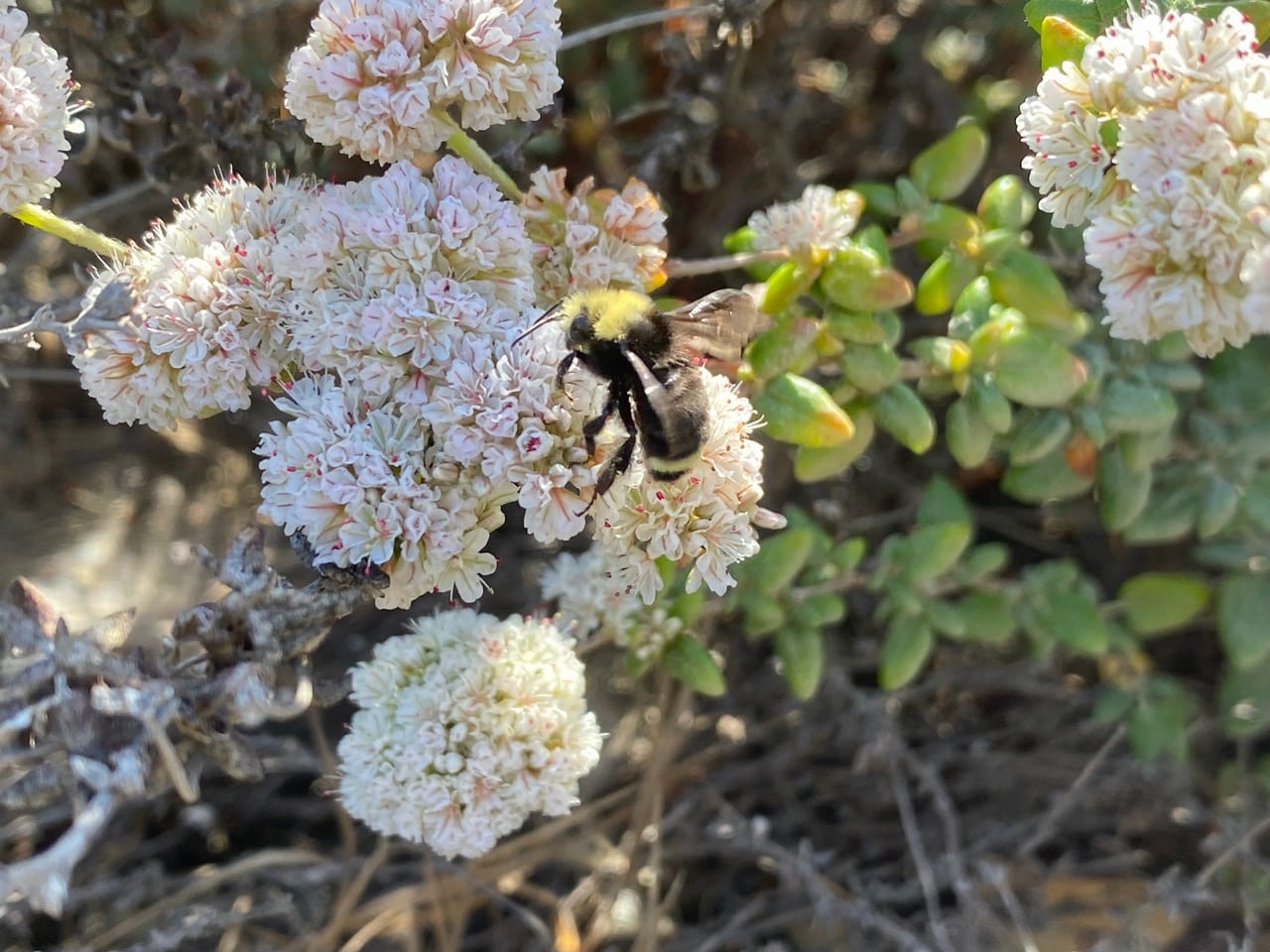
A Yellow-faced Bumble Bee, subgenus Pyrobombus (genus Bombus, family Apidae) is foraging on the flowers of Seacliff Wild Buckwheat, Eriogonum parviflolium.
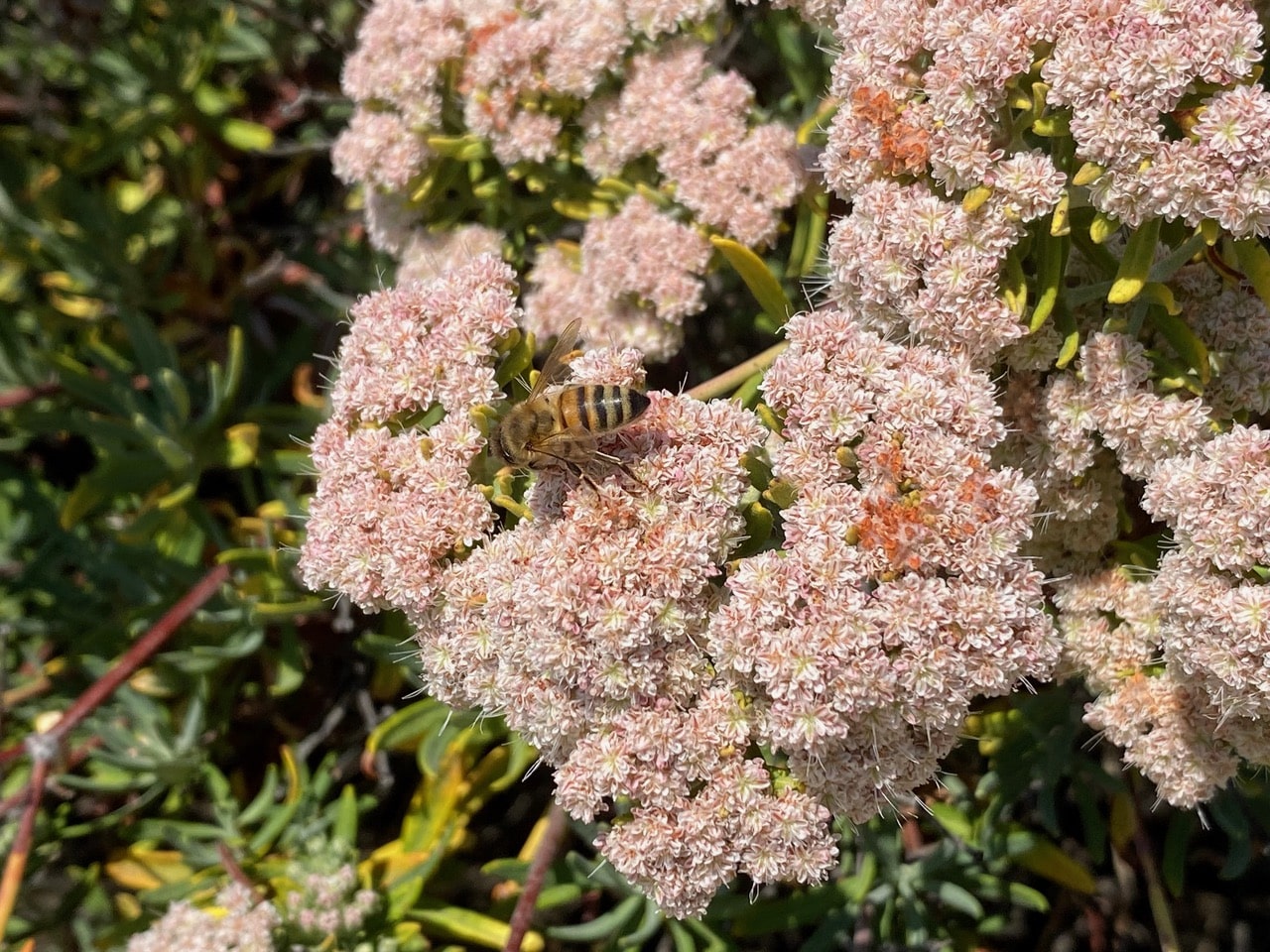
Although the flowers on the Santa Cruz Island Wild Buckwheat, Eriogonum arborescens are on the way out, they are still attracting the pollinators, including the Honey Bee…
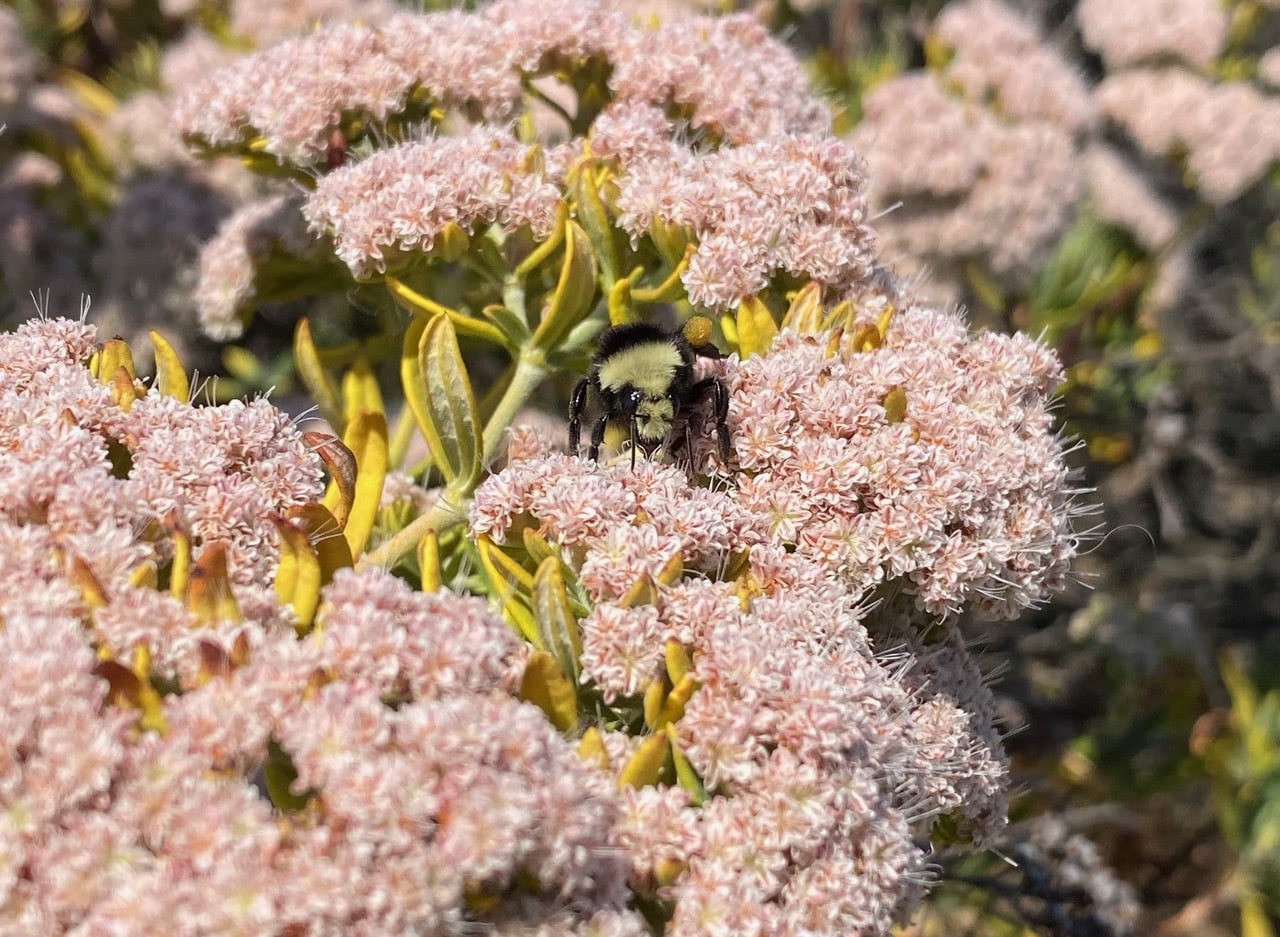
… and the Yellow-faced Bumble Bee.

A Thick-legged Hover Fly, Syritta pipiens (family Syrphidae) hovers unwaveringly over an inflorescence of buckwheat flowers for a long time, fixated on another fly nectaring below. Anticipating what is to come, I have my camera focused on fly on the flower. I am impressed by the precision with which the male swoops in to mate with the female. There is no struggle, and it is over quickly.
Syritta pipiens originates from Europe and is currently distributed across Eurasia and North America. They are fast and nimble fliers. The fly is about 6.5 – 9 mm long. The species flies at a very low height, rarely more than 1 m above the ground. Adults visit flowers – males primarily to feed on nectar, and females to feed on protein-rich pollen to produce eggs. The species is found wherever there are flowers. It is also anthropophilic, occurring in farmland, suburban gardens, and urban parks. Larvae are found in wetlands that are close to bodies of freshwater such as lakes, ponds, rivers, ditches. Larvae feed on decaying organic matter such as garden compost and manure. Males often track females in flight, ending with a sharp dart towards them after they have settled, aiming to attempt forced copulation.

A Honey Bee is foraging on one of the last remaining flowers of the Sage-leaved Rock-Rose, Cistus salvifolius.
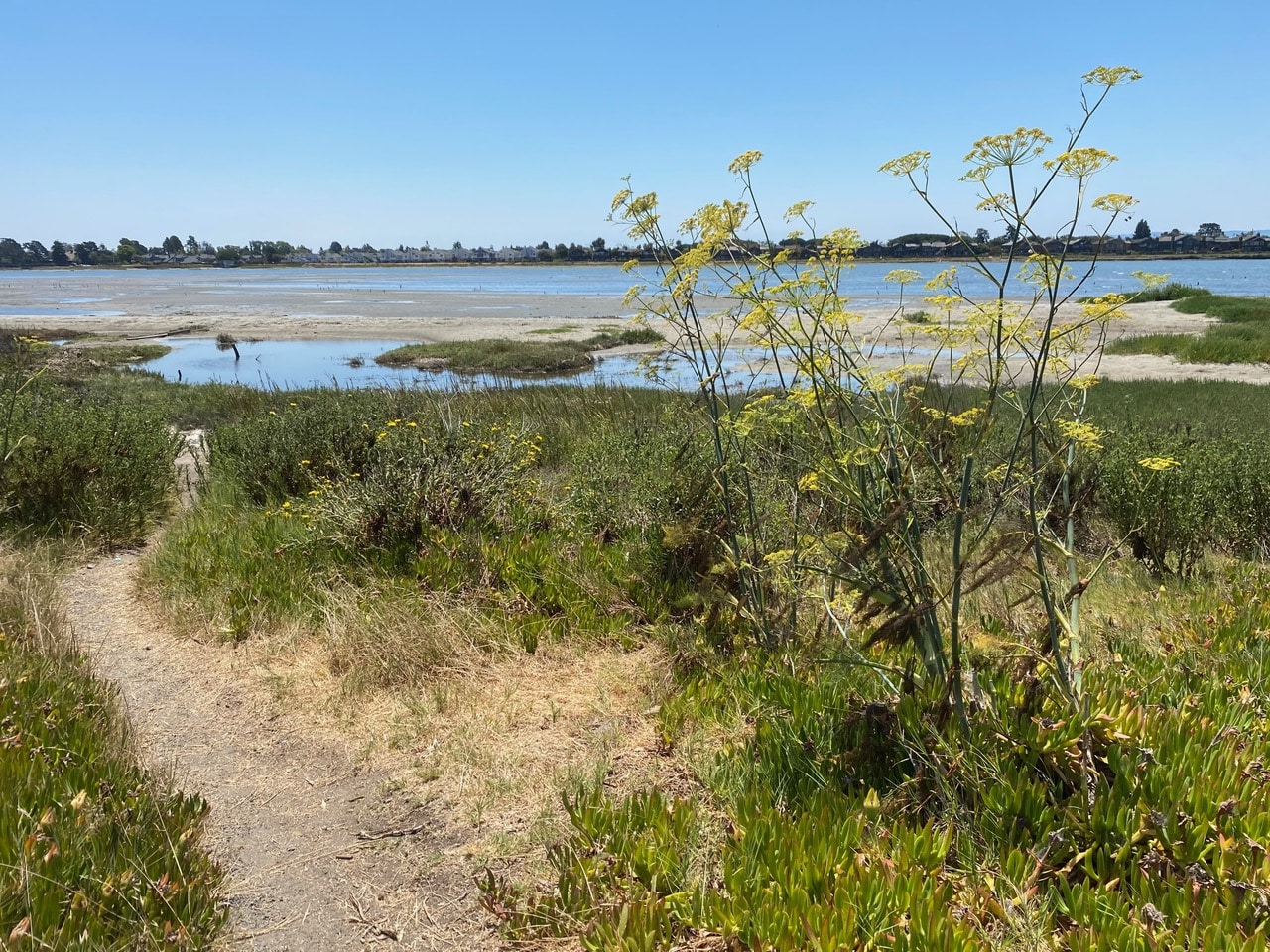
I end up on the trail south of the Elsie Roemer Bird Sanctuary that winds through the salt marsh. The place is more colorful now, with Grindelia and Fennel in bloom.
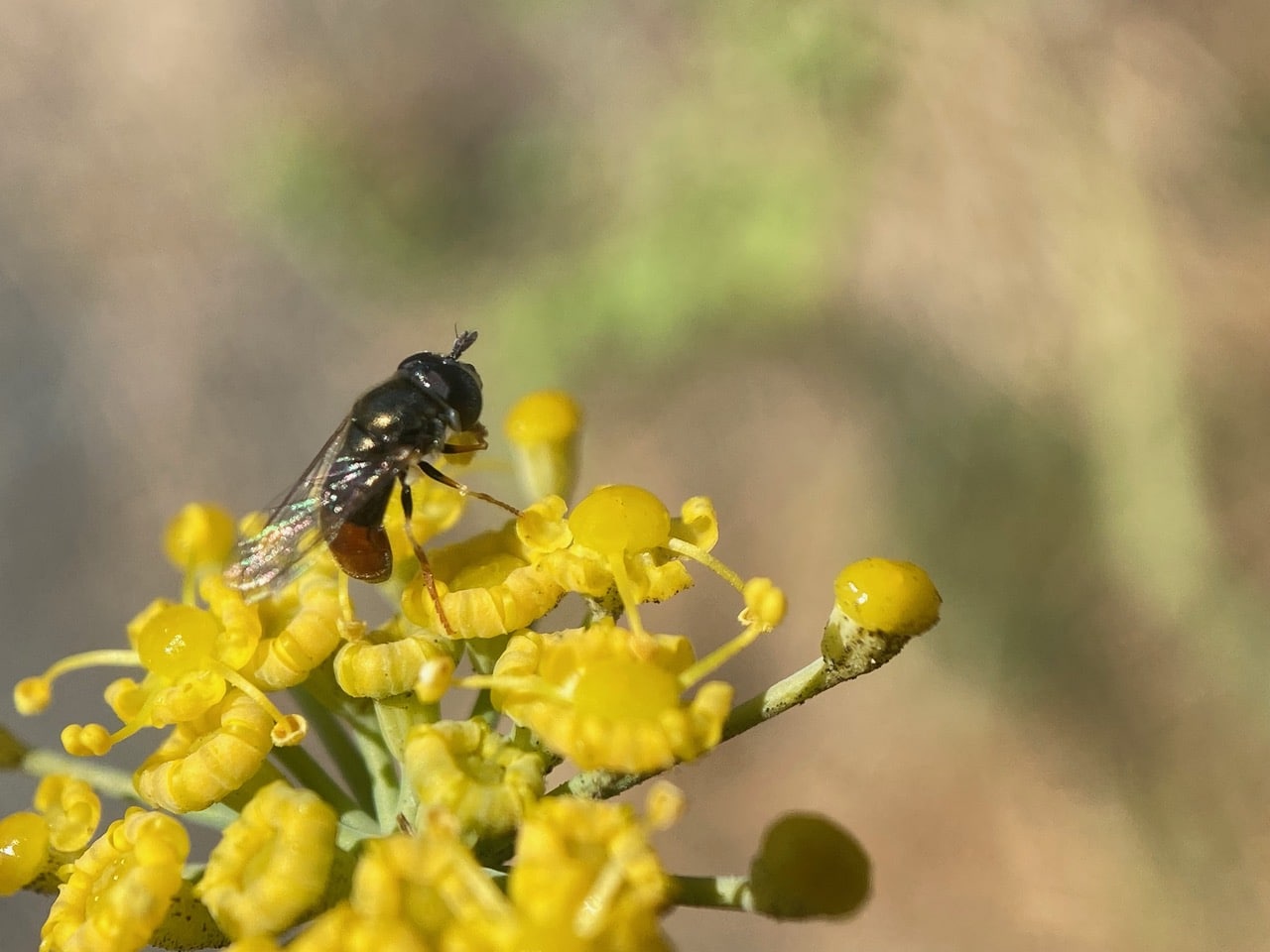
A Common Grass Skimmer, Paragus haemorrhous (family Syrphidae) is feeding on pollen of Fennel flowers, Foeniculum vulgare.
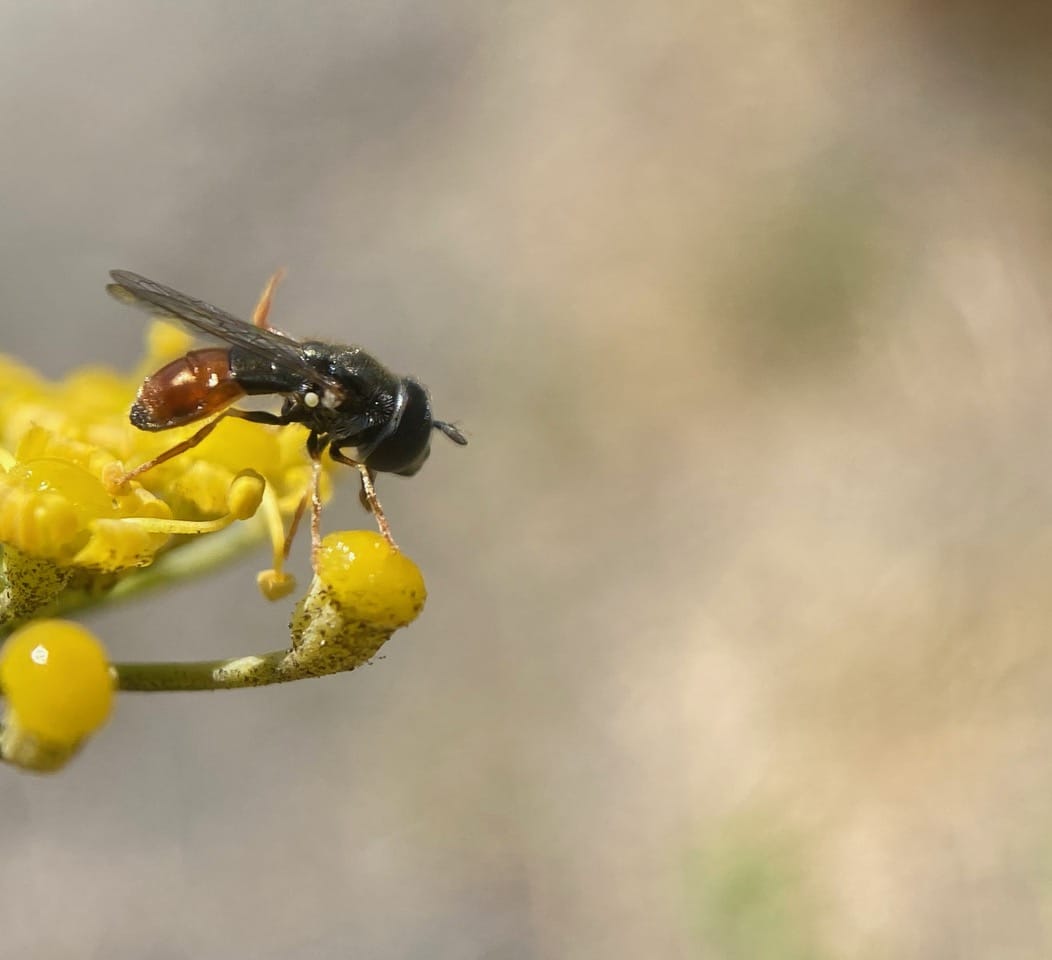
The tiny hover fly typically has a droopy red abdomen and an oversized head.
The Common Grass Skimmer, Paragus haemorrhous (family Syrphidae) is easily the smallest hover fly I know, measuring only about 4 mm in length. The species has a world-wide distribution, found in unimproved grassland, dune grass, open areas and pathsides in forest, and meadows. Adults visit flowers for nectar and pollen. Larvae feed on aphids on low herbaceous plants.
Photos of Common Grass Skimmer (Paragus haemorrhous) · iNaturalist


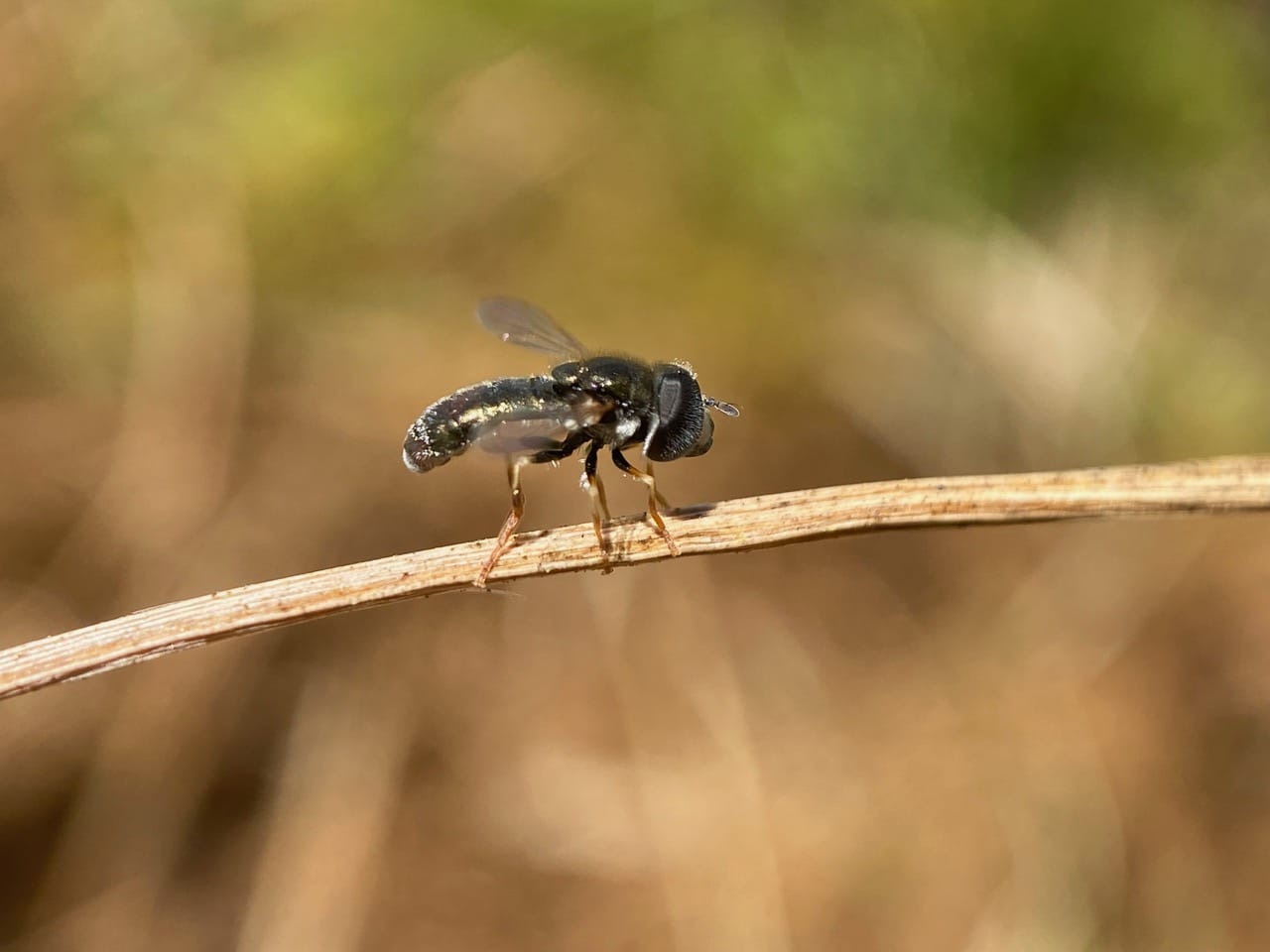
Another Common Grass Skimmer, Paragus haemorrhous (family Syrphidae) lands on a piece of dried grass. Note that this individual has no red on its abdomen. It’s a common variation within the species.
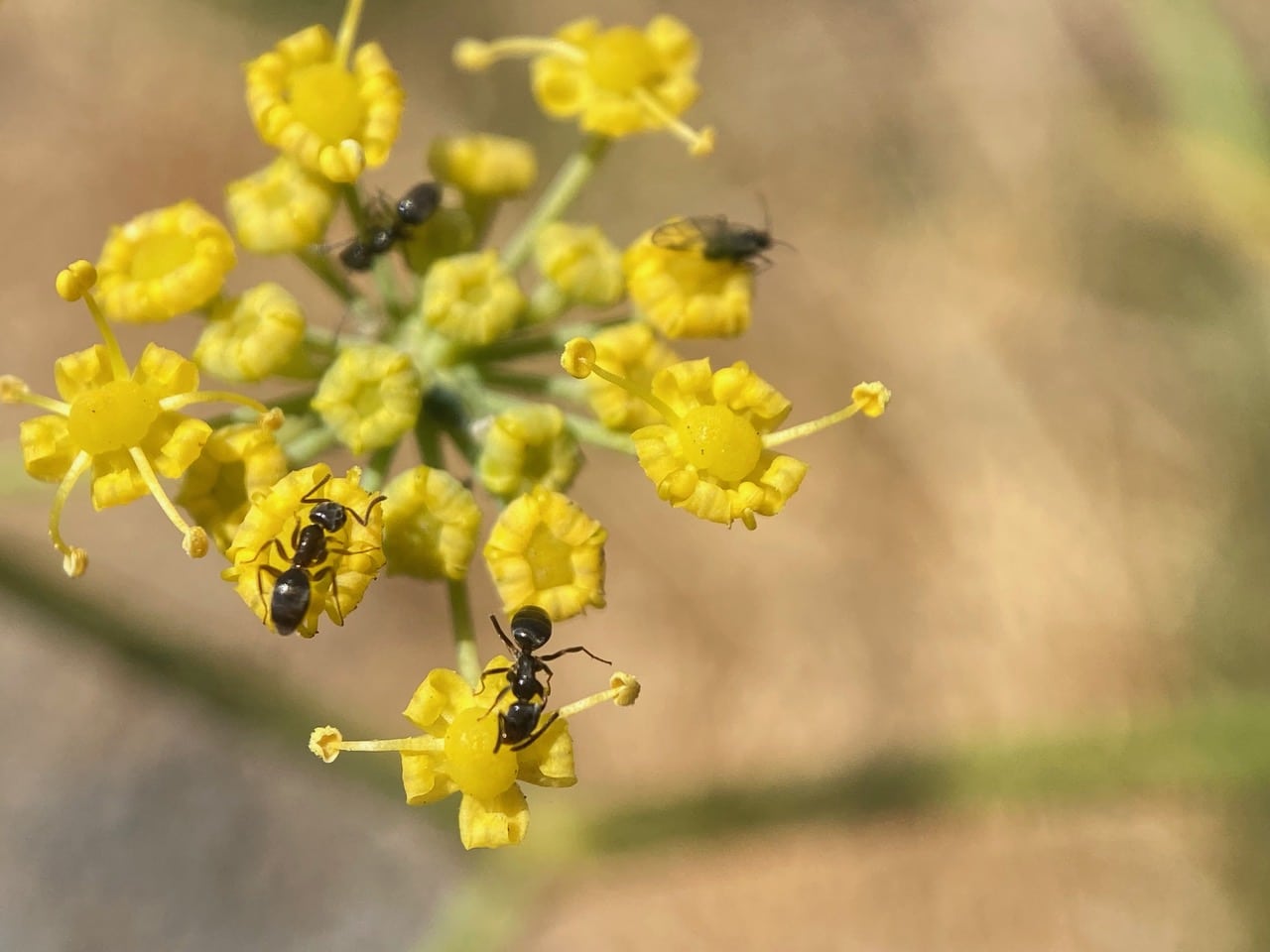
Argentine Ants, Linepithema humile (family Formicidae) are foraging on the Fennel flowers.
The Argentine Ant, Linepithema humile (family Formicidae) is native to Northern Argentina, but it has been inadvertently introduced by humans to many countries, and is now an established invasive species in many Mediterranean climate areas worldwide. The success of the species can be attributed to their lack of aggression between the colonies. There is no apparent antagonism between separate colonies of its own kind, resulting in “super-colonies” that extend across hundreds or thousands of kilometers in different parts of the their range. Genetic, behavioral, and chemical analyses show that introduced Argentine Ants on separate continents actually represent a single global supercolony.
The Argentine Ants are ranked among the world’s worst invasive animal species. In its introduced range, the Argentine ant often displaces most or all native ants and can threaten native invertebrates and even small vertebrates that are not accustomed to defending against the aggressive ants. This can, in turn, imperil other species in the ecosystem, such as native plants that depend on native ants for seed dispersal, or lizards that depend on native ants for food.
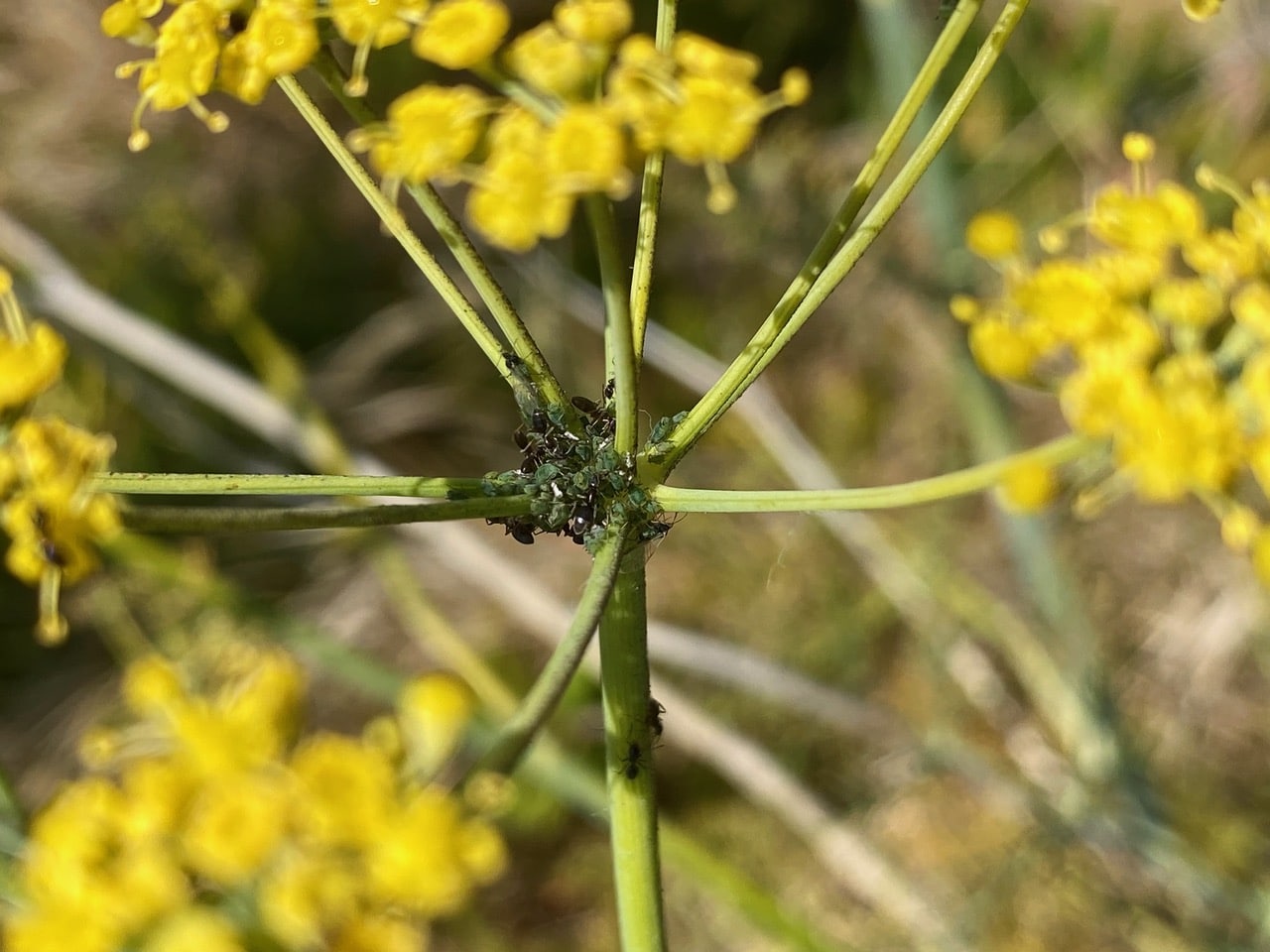
At the base of the flower umbel, more ants are tending a colony of green aphids.
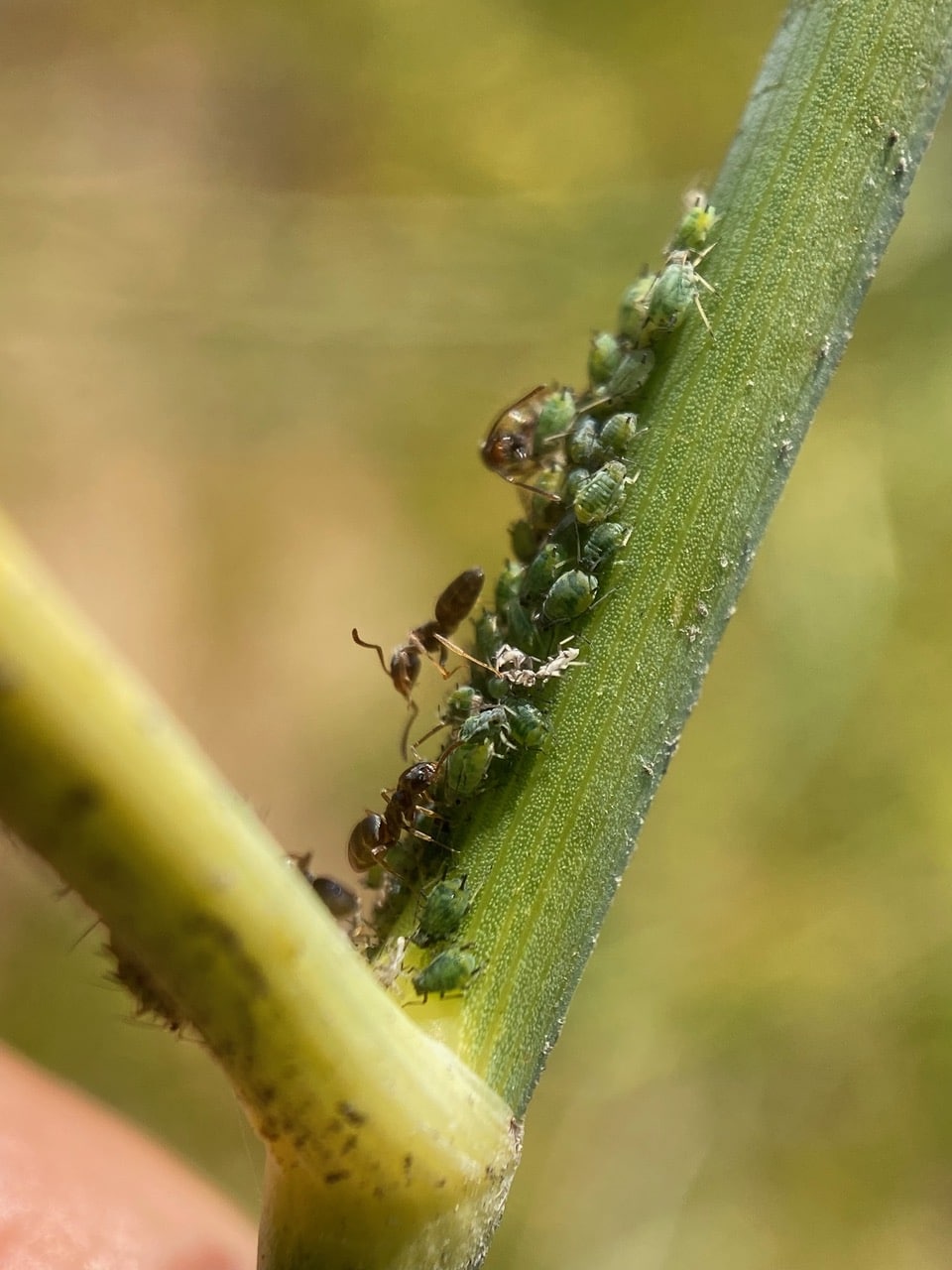
Aphids (family Aphididae) are small sap-sucking insects in the order Hemiptera. Aphids usually feed passively on phloem of plants. Once the phloem vessel is punctured, the sap, which is under pressure, is forced into the aphid’s food canal. Aphids produce large amounts of a sugary liquid waste called “honeydew”. A fungus called sooty mold can grow on honeydew deposits that accumulate on leaves and branches, turning them black.
A typical life cycle involves flightless females giving live birth to female nymphs, – who may also be already pregnant, an adaptation called telescoping generations – without the involvement of males. Maturing rapidly, females breed profusely so that the population multiplies quickly. Winged females may develop later in the season, allowing the insects to colonize new plants. In temperate regions, a phase of sexual reproduction occurs in the autumn, with the insects often overwintering as eggs. The life cycle of some species involves an alternation between two species of host plants. Some species feed on only one type of plant, while others are generalists, colonizing many plant groups. Some ants have a mutualistic relationship with aphids, tending them for their honeydew and protecting them from predators.
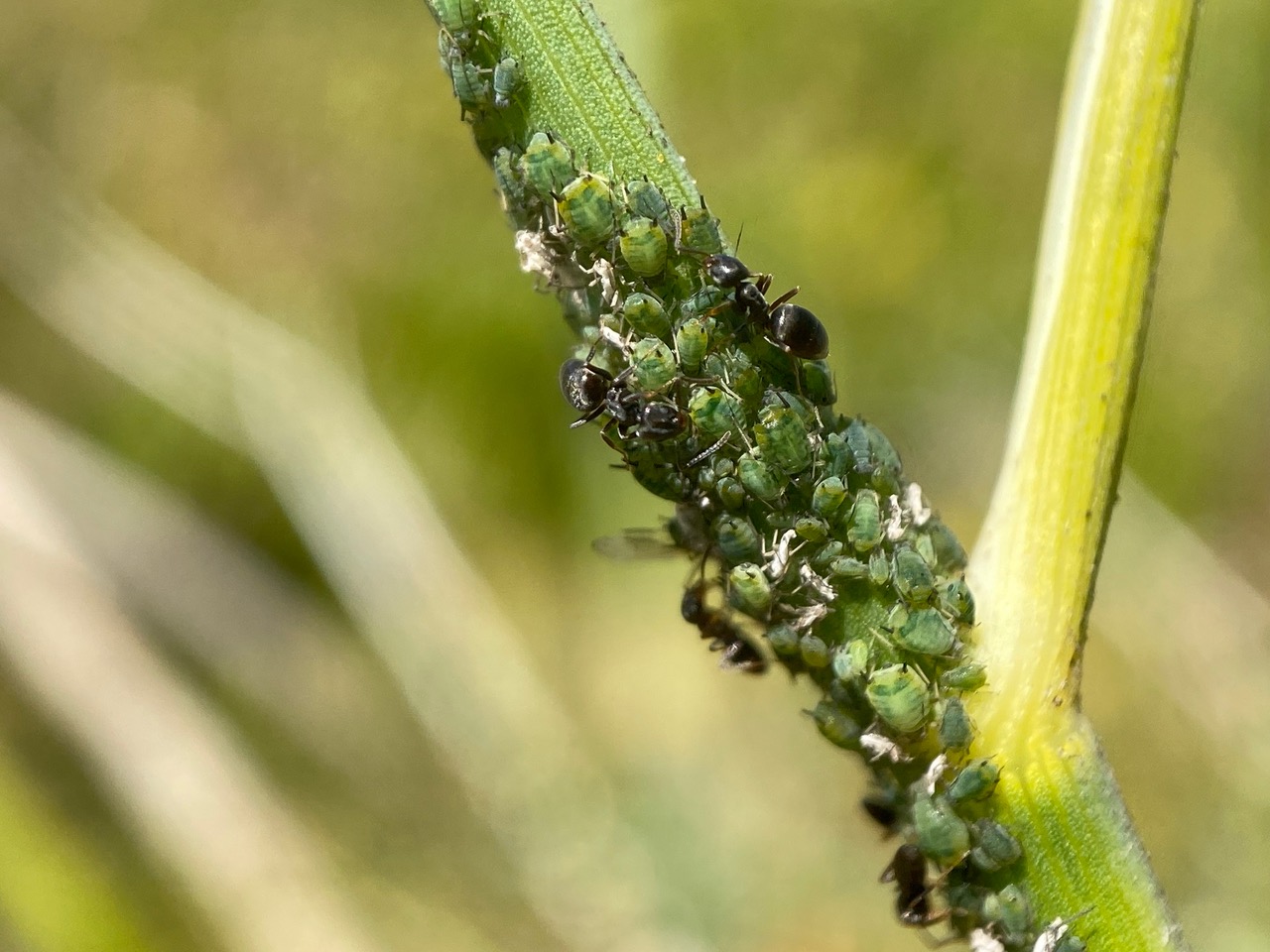
Ants and aphids share a well-known mutualistic relationship. The aphids produce honeydew, a sugary food for the ants; in exchange, the ants care for and protect the aphids from predators and parasites. Some ants will “milk” the aphids to make them excrete the sugary substance. The ants stroke the aphids with their antennae, stimulating them to release the honeydew. Aphid-herding ants make sure the aphids are well-fed and safe. When the host plant is depleted of nutrients, the ants carry their aphids to a new food source. If predatory insects or parasites attempt to harm the aphids, the ants will defend them aggressively. Some species of ants continue to care for aphids during winter. The ants carry the aphids to their nest for the winter months, and transport them to a host plant to feed the following spring.
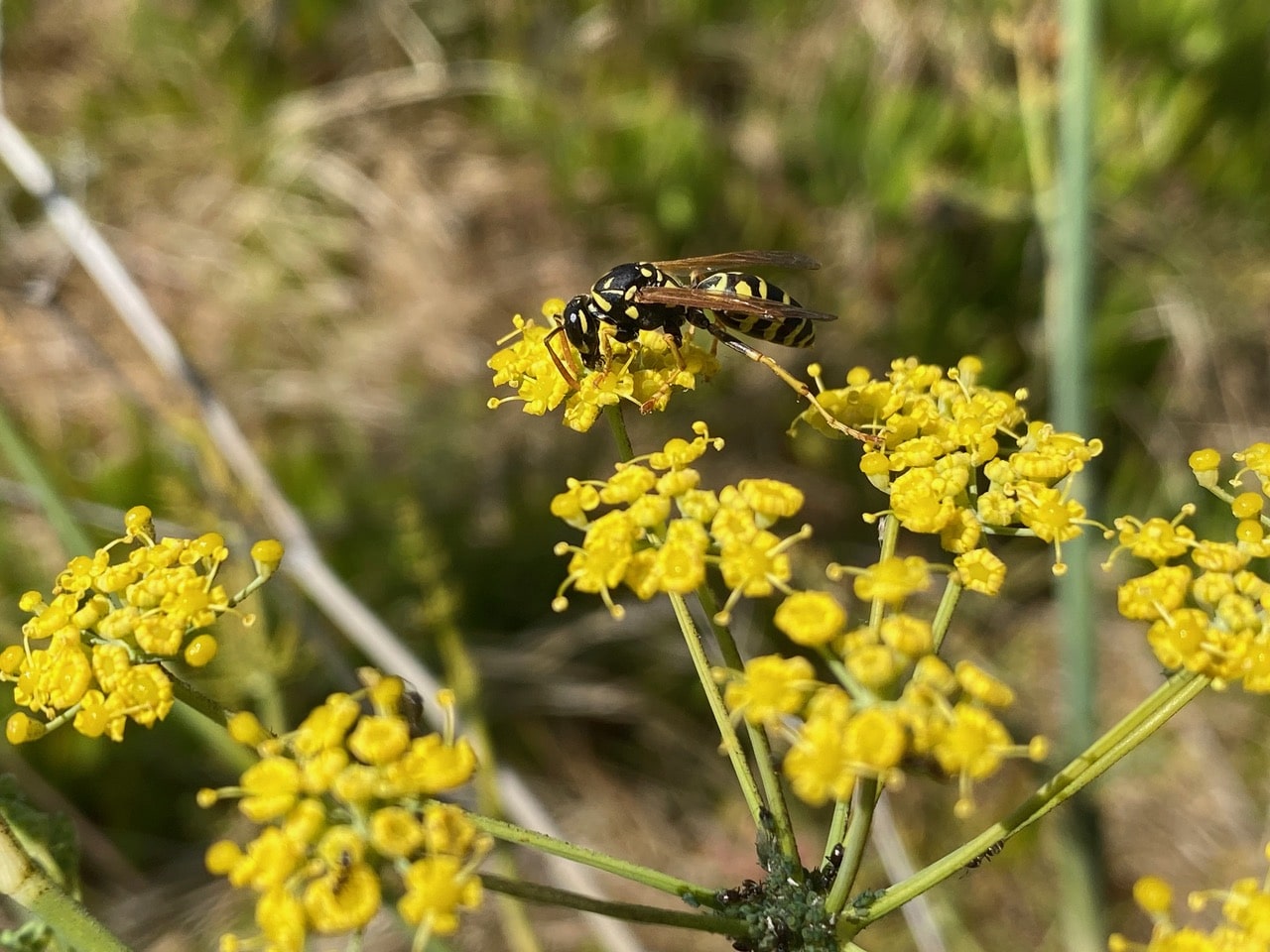
As I am photographing the aphids and ants, a European Paper Wasp lands on the Fennel flower umbel to take nectar.
Native to Europe, the European Paper Wasp, Polistes dominula, is a social insect that produces an annual colony in a paper nest. Individual colonies are established anew each spring. The overwintering stage are mated females (queens). The overwintered queens emerge from sheltered spots in spring and search out sites to establish a new colony. Nests are constructed of paper, produced from chewed wood fibers of weathered fences, porch decks and other similar sources. Larvae are fed crushed insects, usually caterpillars. As the population increases, the original queen increasingly remains in the nest as new workers take over colony activities. A few of the wasps produced later in summer are males and increasing numbers of the females become sexually mature. Mating occurs and the mated females are the surviving overwintering stage. Males and non-reproductive females do not survive winter and the nest is abandoned by late fall. European Paper Wasps will sometimes feed on sweet materials, including honeydew produced by aphids. They may also feed on damaged ripe fruits. Because of their habit of hunting caterpillars, the wasps have become one of the most important natural controls of garden pests.
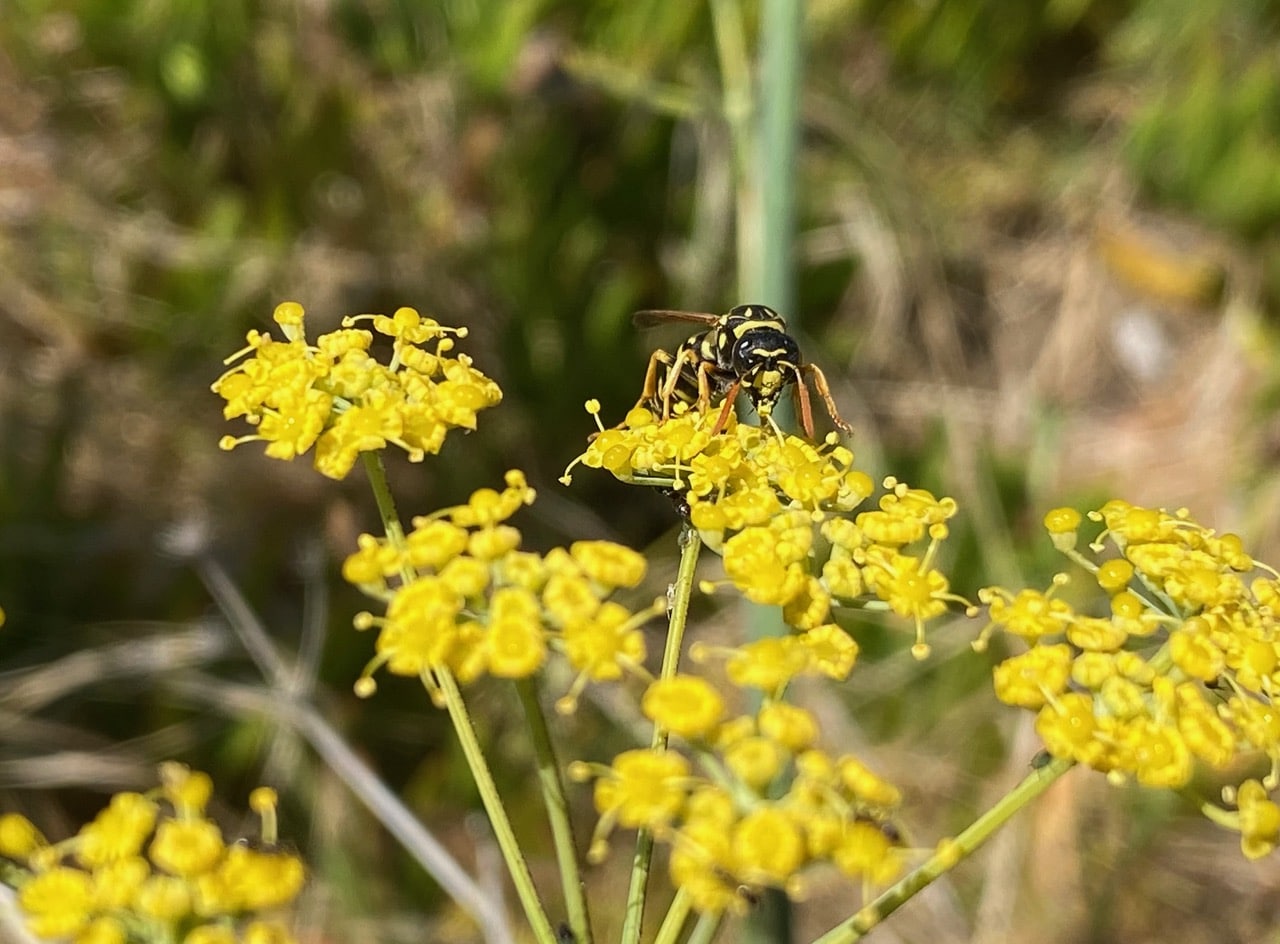
Often mistaken for Yellowjacket Wasps, the European Paper Wasps can be distinguished by their slender body, and their orange-tipped antennae. Yellowjackets have shorter, thicker bodies, and they have black antennae. Paper wasps dangle their long legs when they fly, while the yellowjackets tuck their legs under their bodies when they fly. Paper wasp nests resemble an open honeycomb or upside-down umbrella. They often build their nests on man-made structures such as eaves or lawn furniture. Yellowjacket nests are covered with a surrounding envelope of paper; the nests have a single opening that is often hard to see because the nest is underground.
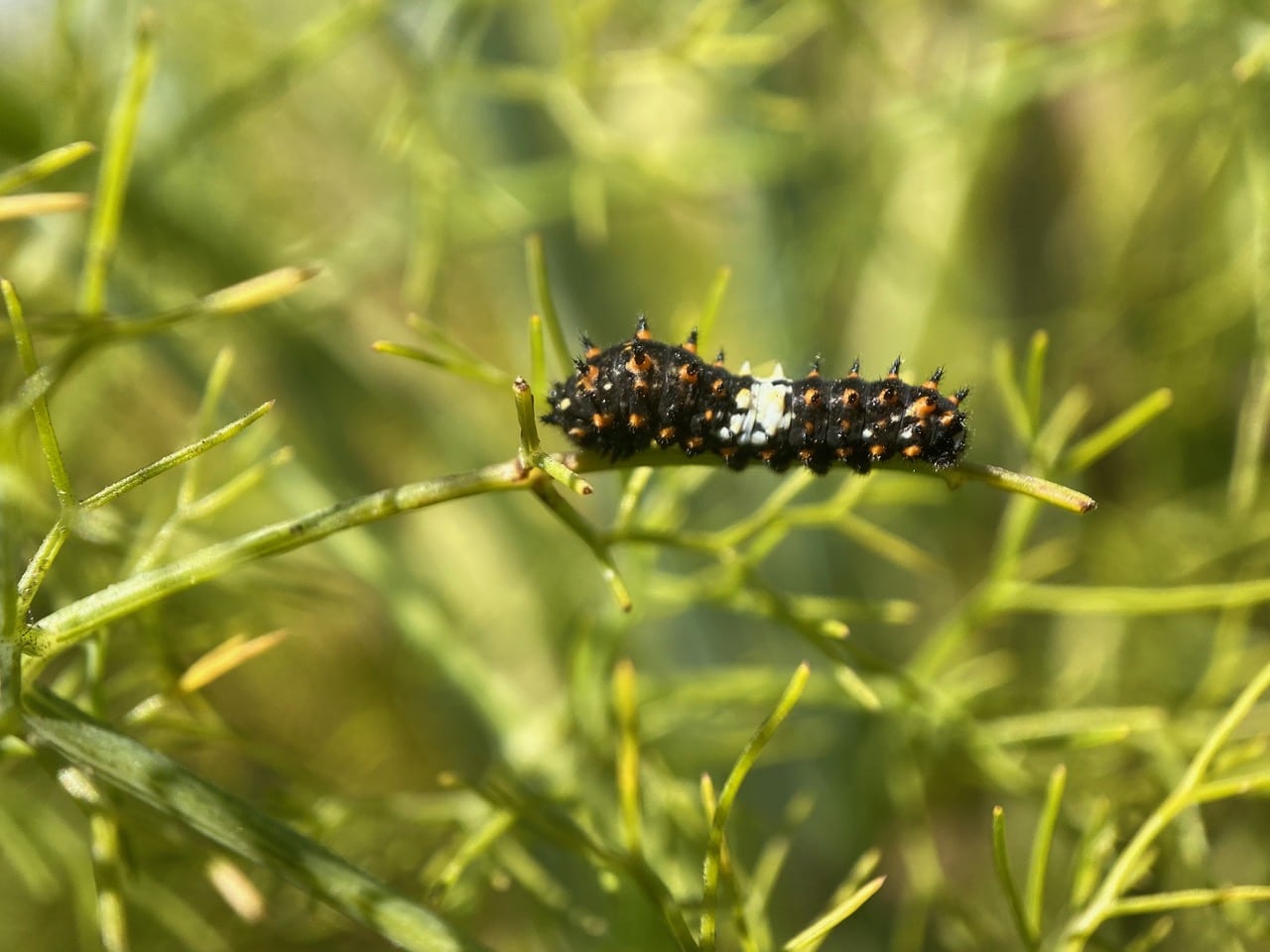
A young caterpillar of the Anise Swallowtail, Papilio zelicaon (family Papilionidae) is resting on a Fennel leaf. It’s my first Anise Swallowtail caterpillar of the year – I had hoped to find one today as I have been seeing the butterflies lay eggs on these Fennel the last time I was here. The caterpillar appears to be a third instar.
Instar is the term given to the developmental stage of an insect between molts. For example, after hatching from the egg an insect is said to be in its first instar. When the insect molts it is then a second instar and so on. Anise Swallowtail caterpillars go through five instars, meaning they molt (shed their skin) four times as they grow and develop.
The Anise Swallowtail, Papilio zelicaon (family Papilionidae), is a common swallowtail butterfly of western North America. It is found in fairly open country, most likely seen on bare hills or mountains, in fields oar at the roadside. Adult females lay eggs singly on the underside of host plant leaves. In the first two instars, the caterpillar is a bird poop mimic – dark brown, almost black, with an irregular white band at its middle. After that it becomes more green at each successive molt until, in the fifth (last) instar, it is predominantly green, with markings in black, orange, and light blue. Its major food plants are members of the carrot family, Apiaceae (including fennel), and also some members of the citrus family, Rutaceae. Young caterpillars eat leaves, while older ones eat flowers.
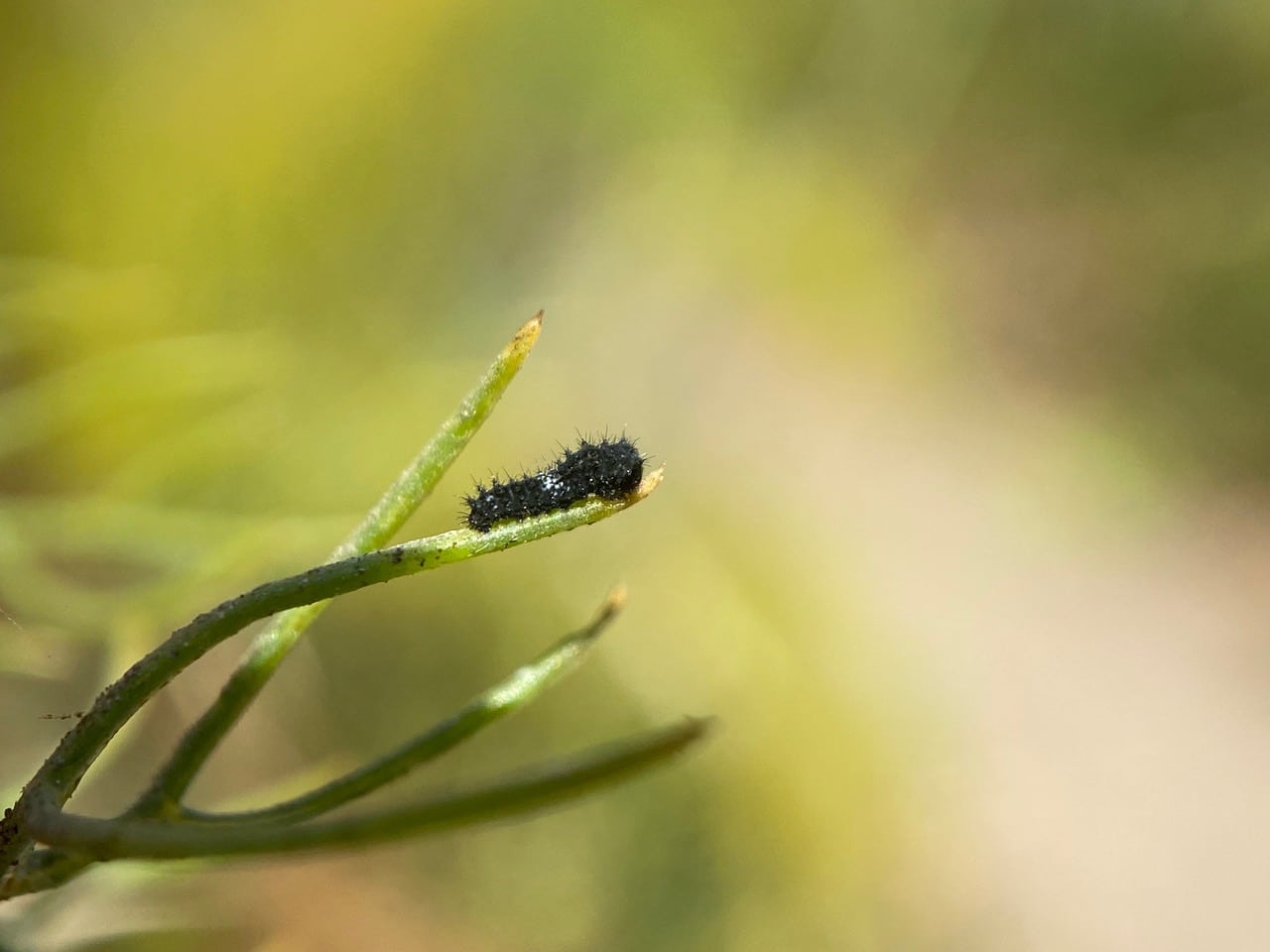
Ooh, here’s a tiny caterpillar. A first instar? It has a patch of white in its mid section, making it look like bird poop. Swallowtail caterpillars are well-known for their bird-poop mimicking larvae in their early instars. The disguise likely keeps the caterpillars safe from hungry birds until they are more mobile. The Anise Swallowtail caterpillar will undergo drastic changes in appearance as it grows, eventually acquiring a green camouflage to blend in with its host plant.
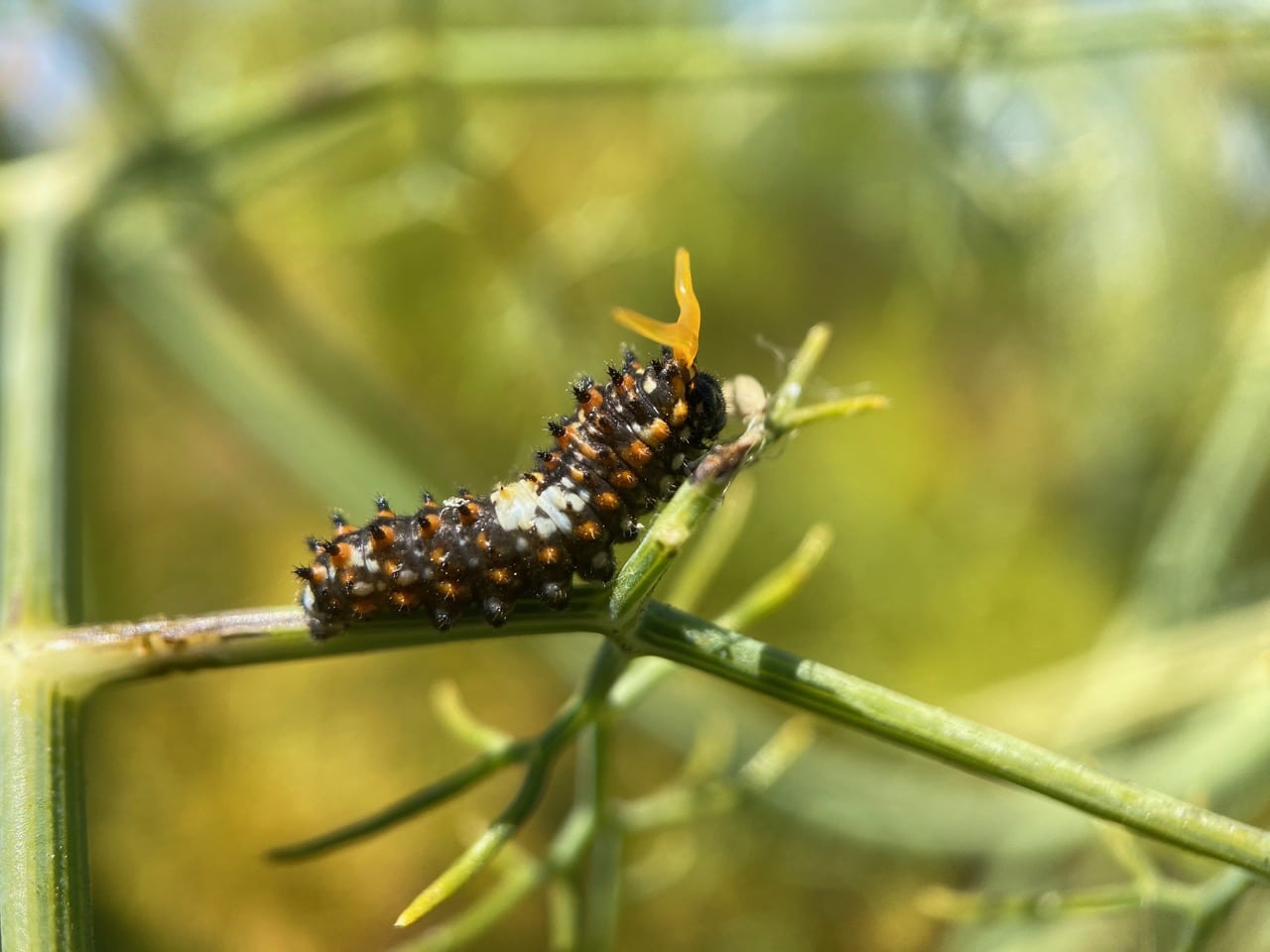
I have to hold the branch steady to photograph this Anise Swallowtail caterpillar against the wind. To my surprise it suddenly extrudes its osmeterium. The caterpillar must have detected the sudden movement and felt threatened.
The osmeterium is a defensive organ found in Swallowtail butterfly caterpillars (family Papilionidae). It is a fleshy, forked structure that can be everted from the caterpillar right behind its head when it feels threatened. When extended, the osmeterium releases a foul-smelling secretion, often containing terpenes (essential oils) extracted from the caterpillar’s host plants.
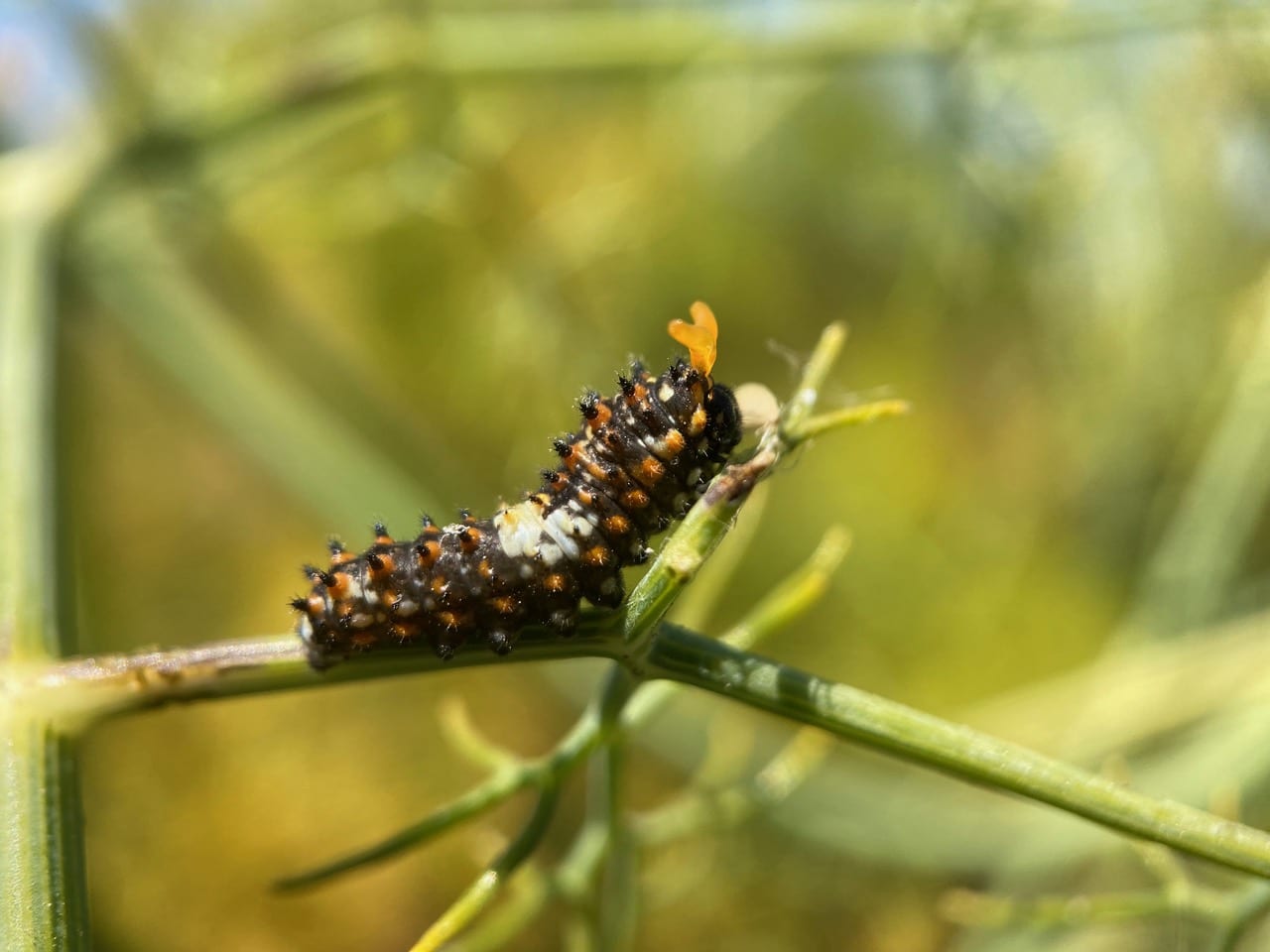
The eye-catching orange osmeterium is quickly retracted.

Uh-oh, this poor baby has fallen prey to a spider!