

Pollinator Post 7/13/24
Brush clearing for fire safety has apparently started early this year. I arrive at Siesta Gate this morning to find that all the California Phacelia, Phacelia californica along the sides of the paved road have been mowed down. The whole stretch is eerily silent from the usual buzz of bumble bees. I wonder if it’s even worth while walking up to the radio tower?
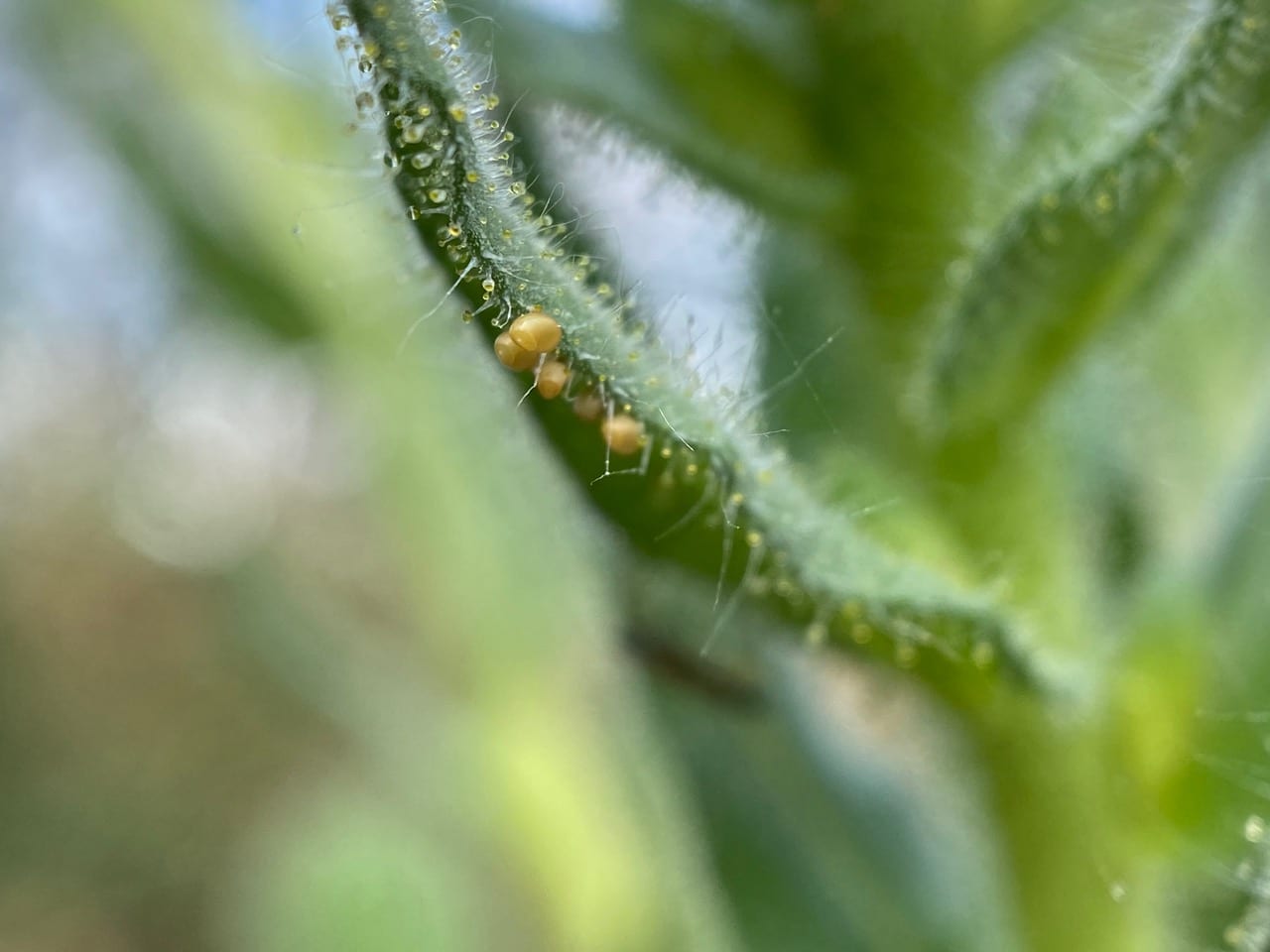
I find these bug eggs on the leaf of a Coast Tarweed, Madia sativa that has been spared the brush clearing.








A bumble bee (California Bumble Bee?) is seeking nectar from a flowerhead of Italian Thistle that is surprisingly left standing. It is the only spot of color I can see in the vicinity.
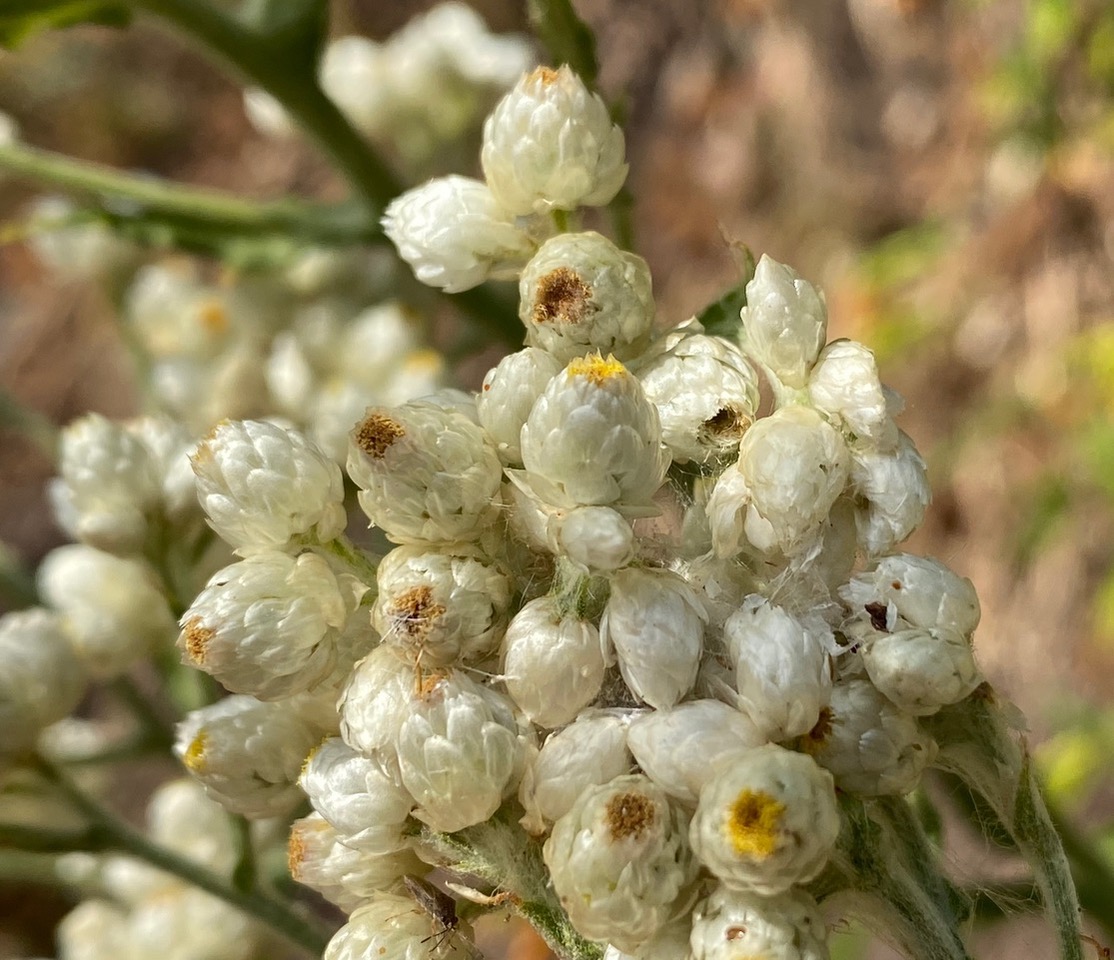
A couple of tall California Everlasting, Pseudognaphalium californicum are spared the clearing as they are growing on a steep slope. That might be a nest of a caterpillar of the American Lady among the rearranged flowerheads. Note that two or three adjacent branches have been unnaturally drawn together.
The flowerheads have been bound together with silk. It is indeed a typical nest of the caterpillar of the American Lady butterfly, Vanessa virginiensis (family Nymphalidae).
American Lady caterpillars are solitary feeders and construct nests from various parts of their host plant. Tiny larvae use leaf hairs to construct tiny nests; larger caterpillars arrange leaves, flower heads, and detritus to form tight shelters. Several structures are typically built during the caterpillar’s development.
Here’s another caterpillar nest with traces of frass (insect poop) at the bottom.
Hey, there are things protruding from holes in the spent calyces of the Sticky Monkeyflower, Diplacus aurantiacus. I recall discovering similar gall insects in the Sticky Monkeyflower on 6/19/22. Since Ron Russo’s field guide to plant galls did not include this gall, I have contacted and sent him some fresh specimens of the galls. Both Ron and I were successful in rearing adult insects from the galls. They were gall flies in the family Cecidomyiidae, possibly new to science. Ron has submitted the specimens to a Cecidomyiid expert to be identified. Since there is a backlog for description for this taxon, we are still waiting for definitive identification of the species. Skyline Gardens might be listed as the “type location” if the fly is indeed a new species!
Close up of the two galled calyces showing empty pupal cases protruding from exit holes. As I have noticed in the past, these galled calyces do not bear flowers as the floral parts have probably been consumed by the gall fly larvae. This is how I learned to recognize the fresh galls – blemished calyces (from egg laying scars) that do not bear flowers.
On the same plant, there is another galled calyx. The protruding papal cases are reminiscent of the gall flies that induce the lumpy bud galls on Coyote Brush, Baccharis pilularis. The gall flies for the two plants are probably related.
Like those that induce the familiar bud galls on Coyote Brush, Baccharis pilularis, the larvae of this species develop inside the calyx of the Sticky Monkeyflower, and burrow to the surface where they develop as partially protruding pupae. Adult flies have been reared out of the galled calyces in 2022. They are apparently a Cecidomyiid species new to science, still awaiting official description and taxonomic identification.
Lying in a longitudinal crease of a Sticky Monkeyflower calyx, a Seed Bug, Kleidocerys franciscanus (family Lygaeidae) has its rostrum sunk into the tissues to feed on the developing seeds.
The defining feature of Hemipterans or “true bugs” is their “beak” or rostrum in which the modified mandibles and maxillae form a “stylet” which is sheathed within a modified labium. The stylet is capable of piercing tissues and sucking liquids, while the labium supports it. The stylet contains a channel for outward movement of saliva and digestive enzymes, and another channel for the inward movement of pre-digested liquid food. The rostrum is usually folded under the body when not in use. Seed bugs are able to feed on seeds by injecting digestive juices into the seeds and sucking up the digested contents as a liquid.

The brush clearing has been done early this year while many of the plants were still in bloom. This is the sight that greets me at the top of the ridge.
Numerous California Everlasting and their flowers lie in shreds along the paved road. I stop by this site where I have watched an American Lady caterpillar weave its nest among the flowerheads.
Even if we survive the fires, how long can we expect to survive without the little creatures that help sustain our ecosystem?
This Coast Tarweed further away from the road has survived the brush clearing. Do you see the caterpillar among the terminal leaves?
Close up of the rear section of the caterpillar of Tobacco Budworm Moth, Chloridea virescens (family Noctuidae).
The Tobacco Budworm, Chloridea virescens, formerly Heliolothis viresens (family Noctuidae) is a native species and is found throughout the eastern and southwestern United States, though it is also known from California. It is principally a pest of field crops, vegetable crops and horticultural plants. Eggs are deposited on flowers, fruit, and terminal growth. Larvae develop through 5-7 instars. Body color is variable. Pupation occurs in the soil. Adult moths are brownish in color, and lightly tinged with green. The front wings are crossed transversely by three dark bands, each of which is often accompanied by a whitish or cream-colored border.
A very pale nymph of the Lygus Bug (family Miridae) scampers away from my camera. It is probably a teneral. A teneral insect is one that has recently molted and its exoskeleton is yet to harden and get its final coloration.
“True bugs” in the order Hemiptera undergo incomplete metamorphosis without a pupal stage. The nymphs, which look like adults, develop through a series of molts, each time getting bigger after shedding their old exoskeleton. At the last molt, they transform into adults with functional wings and reproductive parts.
Members of the family Miridae are also referred to as plant bugs or leaf bugs. Miridae is one of the largest family of true bugs in the order Hemiptera. Like other Hemipterans, Mirids have piercing, sucking mouthparts to extract plant sap. Some species are predatory. One useful feature in identifying members of the family is the presence of a cuneus; it is the triangular tip of the corium, the firm, horny part of the forewing, the hemielytron. The cuneus is visible in nearly all Miridae.

The term lygus bug is used for any member of the genus Lygus, in the family of plant bugs, Miridae. Adult lygus are approximately 3 mm wide and 6 mm long, colored from pale green to reddish brown or black. They have a distinctive triangle or V-shape on their backs. Lygus bugs are known for their destructive feeding habits – they puncture plant tissues with their piercing mouthparts, and feed by sucking sap. Both the physical injury and the plant’s own reaction to the bug’s saliva cause damage to the plant. Many lygus bugs are well-known agricultural pests.
The tiniest of nymph is moving around at a leaf axil of the Coast Tarweed. I am amazed that even at this tender age, the nymph is able to navigate the sticky terrain of the tarweed without getting stuck. From its size and shape, I figure the nymph might be a young Plant Bug, Macrotylus essigi (family Miridae).
Many insects have evolved adaptations that allow them to thrive on the sticky plant surface. These insects tend to be long-legged – in some cases tip-toeing around the surface to carefully avoid getting trapped and in other cases slogging through with strong leg muscles. Some Mirid bugs have specialized hooks on their legs that enable them to latch on to trichomes near the tips so they can walk on top of the trichome canopy and avoid contact with sticky droplets at the tips. Some of these bugs also secrete an oily substance on the underside of their abdomen, so that if they do contact sticky exudates by accident, they can slough it off and move on without becoming entrapped.
Ooh, here’s another bug nymph running around on the flowerheads of Coast Tarweed.
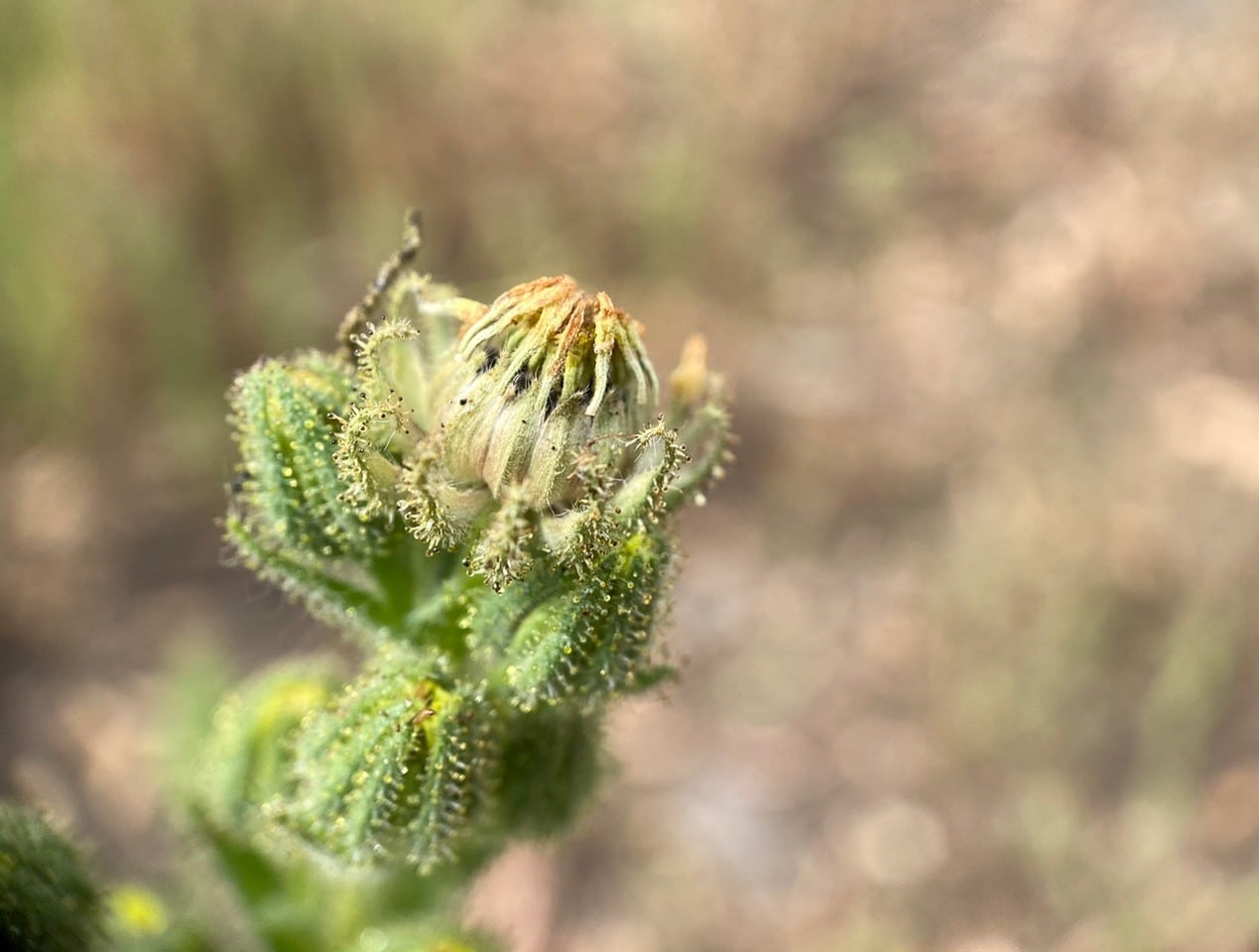
A developing seed head of a Coast Tarweed.
The phyllaries of this seed head have opened up to reveal the black seeds arranged vertically within the central cup. Cost Tarweed is a prolific seeder, each flowerhead producing dozens of seeds. They are easily shaken out of the ripe seed heads by the wind, if they are not already eaten by the birds. In the past, I have often seen large flocks of finches gather on the senescent plants to feed on the seeds.
Here’s a group of seed heads in various stages of maturation.
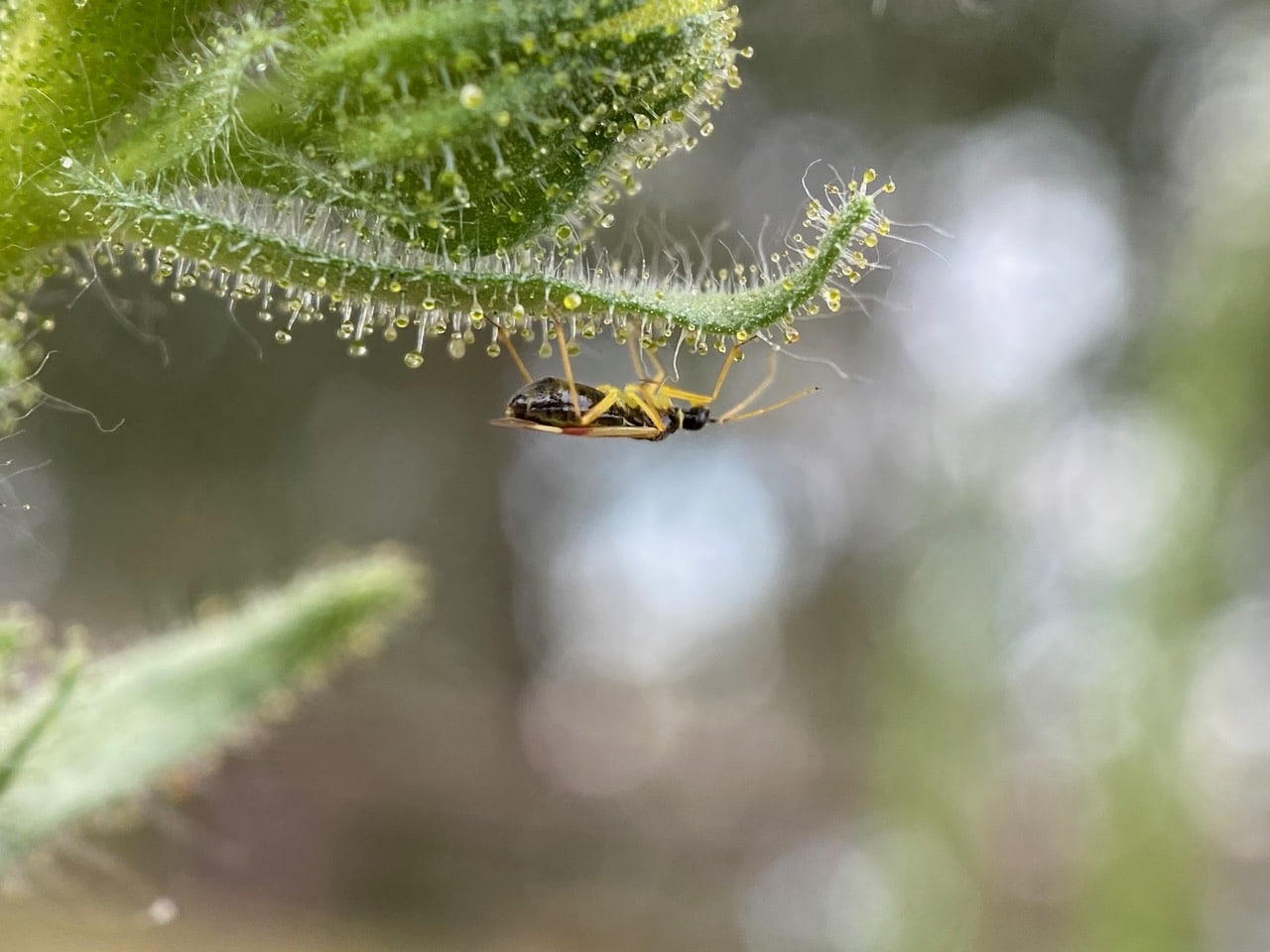
Here’s one of the sticky plant specialists – the Phacelia Plant Bug, Tupiocoris californicus (family Miridae). These bugs navigate the glandular hairs of tarweed with the greatest of ease.
A side view shows that the body of the bug is mostly black. Although there’s little available information about the bug’s biology, I suspect that it is an opportunistic predator – feeding on small insects trapped on the sticky plant.
Nurtured by fog drip from the surrounding oaks and Eucalyptus, a couple of California Phacelia, Phacelia californica are still in bloom. An old Yellow-faced Bumble Bee, Bombus vosnesenskii (family Apidae) is seeking nectar from the fresh flowers, the very last of the season.
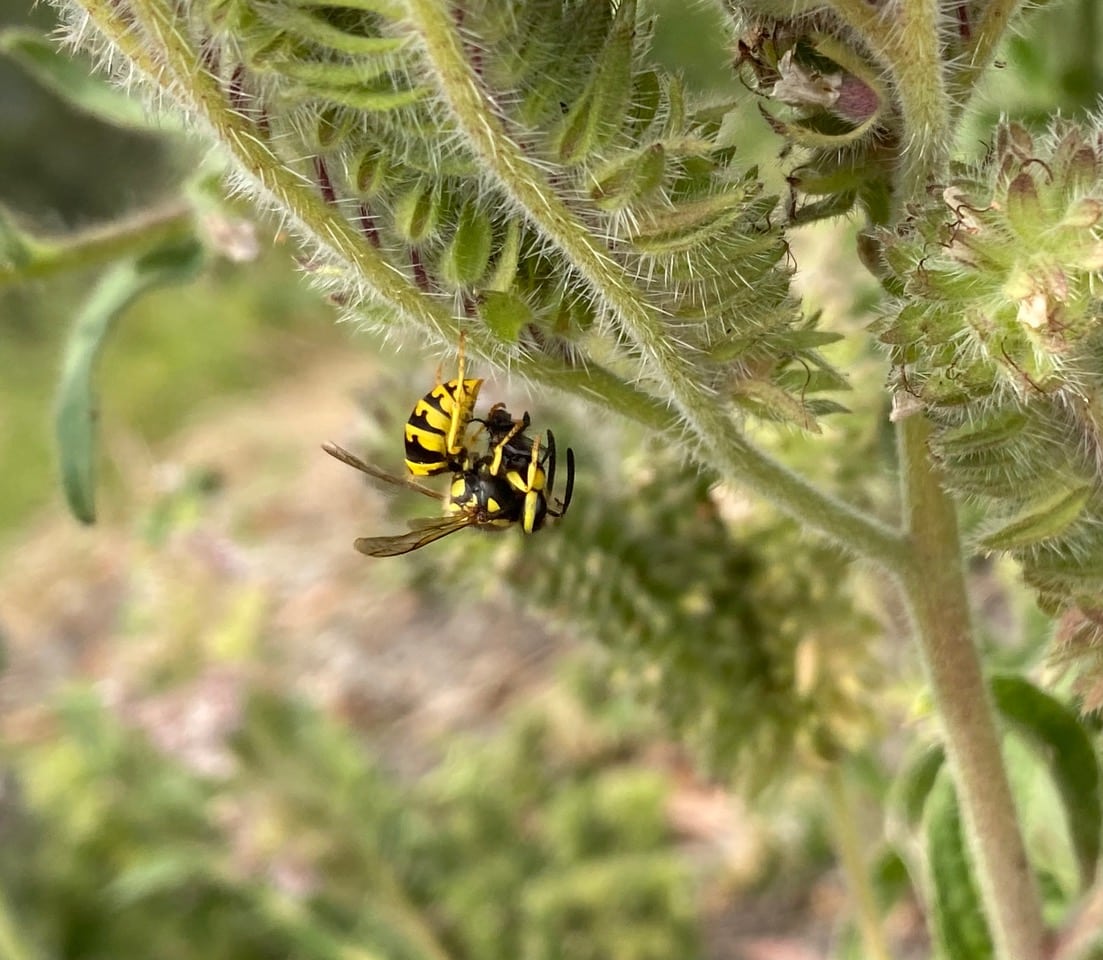
What is that Yellowjacket doing at the base of the developing seed heads of California Phacelia? It appears to be struggling to subdue a prey it has captured.
Indeed, the wasp is holding a prey in its legs. It does not look like a caterpillar. Maybe a young bug?
Yellowjacket is the common name for predatory social wasps of the genera Vespula and Dolicovespula (family Vespidae). Yellowjackets are social hunters living in colonies containing workers, queens, and males (drones). Colonies are annual with only inseminated queens overwintering. Queens emerge during the warm days of late spring or early summer, select a nest site, and build a small paper nest in which they lay eggs. They raise the first brood of workers single-handedly. Henceforth the workers take over caring for the larvae and queen, nest expansion, foraging for food, and colony defense. The queen remains in the nest, laying eggs. Later in the summer, males and queens are produced. They leave the parent colony to mate, after which the males quickly die, while fertilized queens seek protected places to overwinter. Parent colony workers dwindle, usually leaving the nest to die, as does the founding queen. In the spring, the cycle is repeated.
Yellowjackets have lance-like stingers with small barbs, and typically sting repeatedly. Their mouthparts are well-developed with strong mandibles for capturing and chewing insects, with probosces for sucking nectar, fruit, and other juices. Yellowjacket adults feed on foods rich in sugars and carbohydrates such as plant nectar and fruit. They also search for foods high in protein such as insects and fish. These are chewed and conditioned in preparation for larval consumption. The larvae secrete a sugary substance that is eaten by the adults.
The Western Yellowjackets typically build nests underground, often using abandoned rodent burrows. The nests are made from wood fiber that the wasps chew into a paper-like pulp. The nests are completely enclosed except for a small entrance at the bottom. The nests contain multiple, horizontal tiers of combs within. Larvae hang within the combs.