

Pollinator Post 7/13/23 (1)
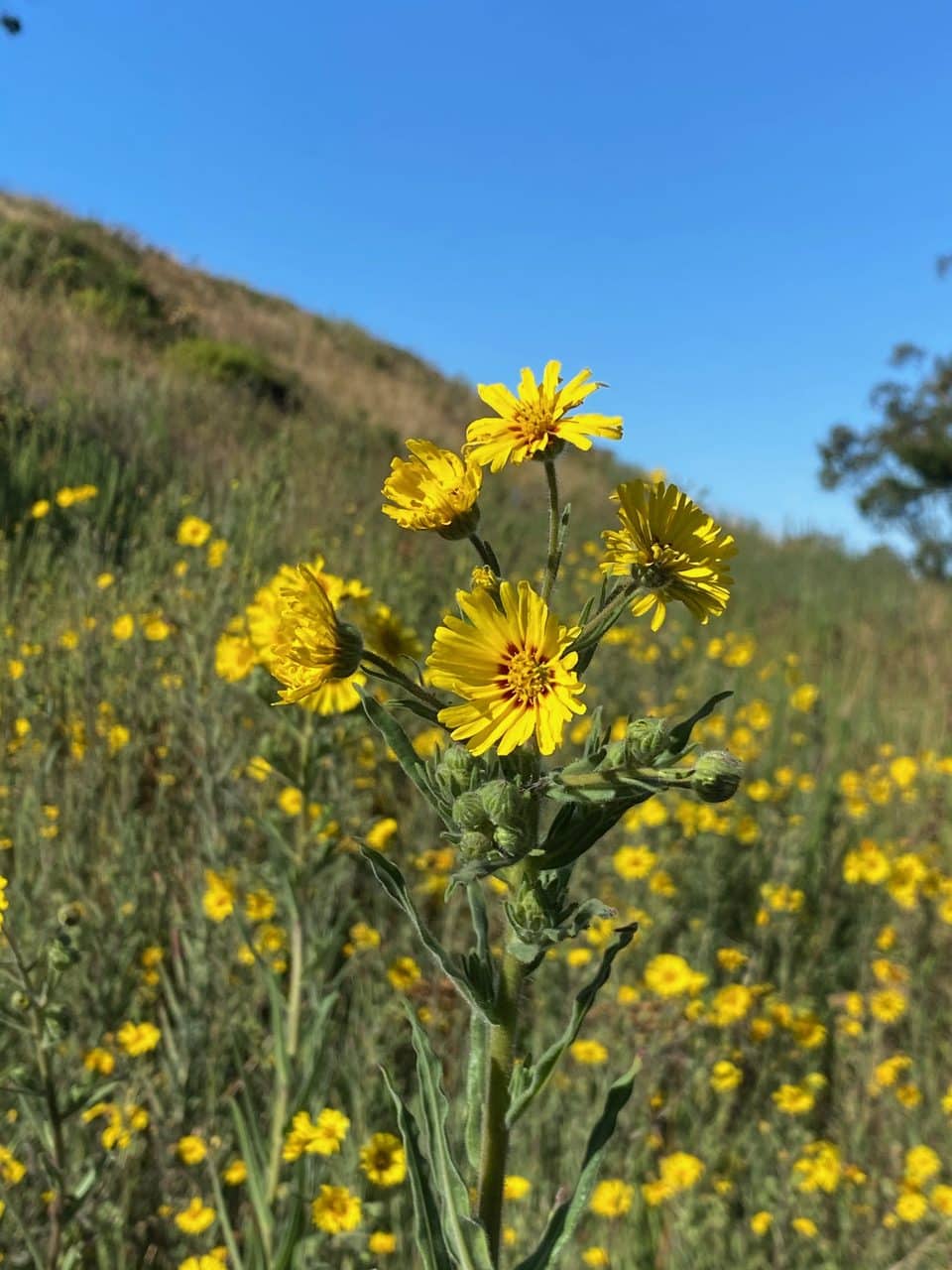
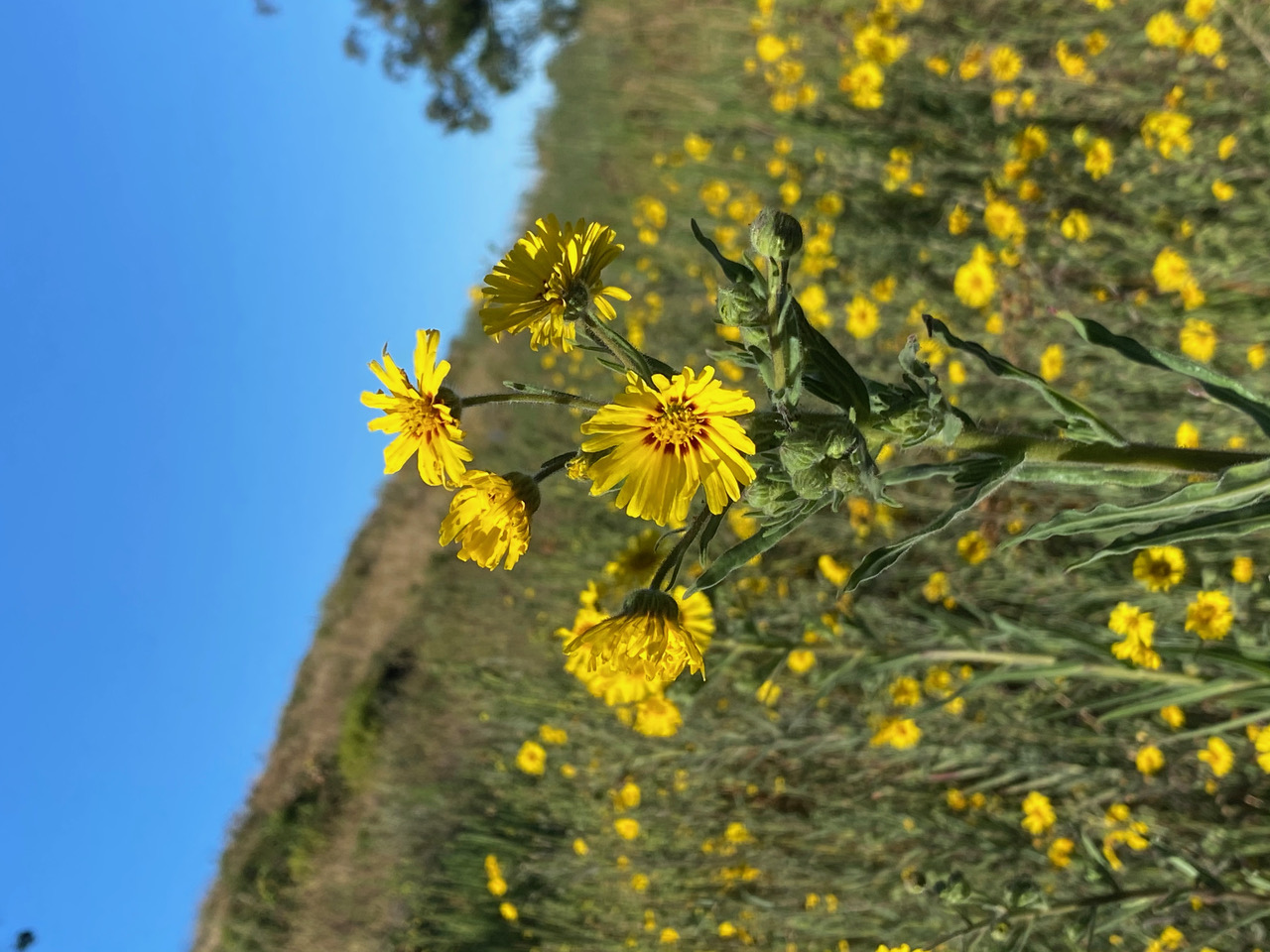
This is a fleeting moment in the morning, when the sun is already bright and the Elegant Tarweed flowerheads, Madia elegans are still open. The flowerheads are closed by mid-morning on most days.

A Spotted Cucumber Beetle, Diabrotica undecimpunctata (family Chrysomelidae) is feeding on a flowerhead of Elegant Tarweed, Madia elegans.
Members of the family Chrysomelidae are commonly known as Leaf Beetles. Adults and larvae feed on all sorts of plant tissues, and all species are fully herbivorous. Many are serious pests of cultivated plants, including food crops. Others are beneficial due to their use in biocontrol of invasive weeds. Chrysomelids are popular among insect collectors, as many are conspicuously colored, typically in glossy yellow to red or metallic blue-green hues, and some have spectacularly bizarre shapes. Photos of Leaf Beetles (Family Chrysomelidae) · iNaturalist
Native to North America, the Spotted Cucumber Beetle can be a major agricultural pest, causing damage to crops in the larval as well as adult stages of their life cycle. Larvae, sometimes known as rootworms feed on the roots of emerging plants. In the adult stage the beetles cause damage by eating the flowers, leaves, stems and fruits of the plant.

It appears the Spotted Cucumber Beetle has done a thorough job on this M. elegans flowerhead. The beetles feed voraciously on the flower parts, but usually leave the red basal portions of the ligules (petal-like bracts of the ray florets) untouched. Does the red pigment repel herbivores?
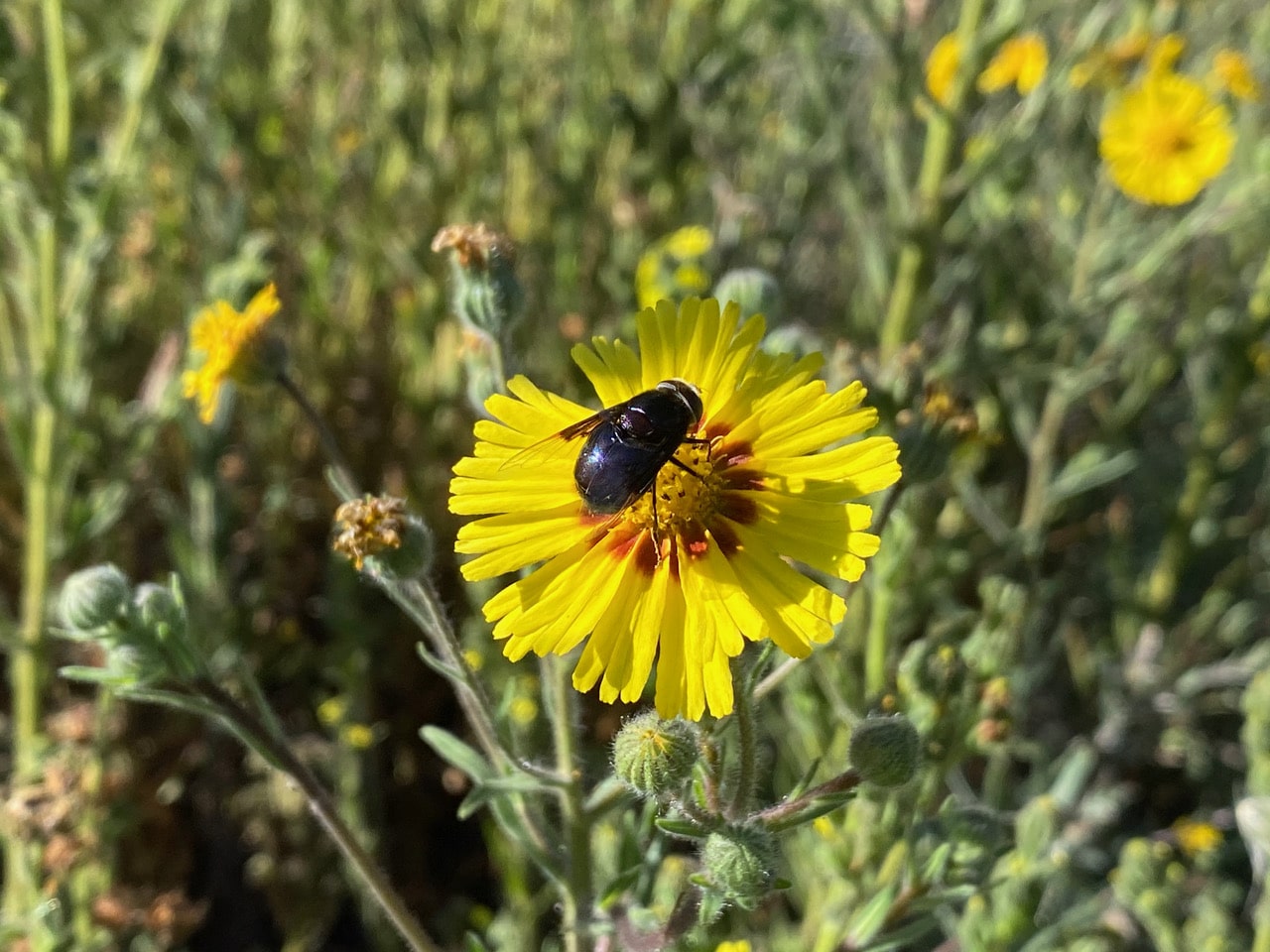
A large, shiny black insect buzzes through the tarweed patch. First mistaken for a Carpenter Bee, its true identity is revealed as soon as it lands on a flowerhead. It is no bee, it’s our largest hover fly – the Purple Bromeliad fly, Copestylum violaceum (family Syrphidae).
Copestylum is one of the largest genera of New World hover flies, almost all of which occur exclusively in the Americas. The flies have a distinctive “snout”, plumose arita and distinctive wing venation. Adult flies visit flowers for nectar and pollen. Larvae develop in various kinds of decaying organic matter (rotting cactus pads, etc.) and other natural water-filled cavities.
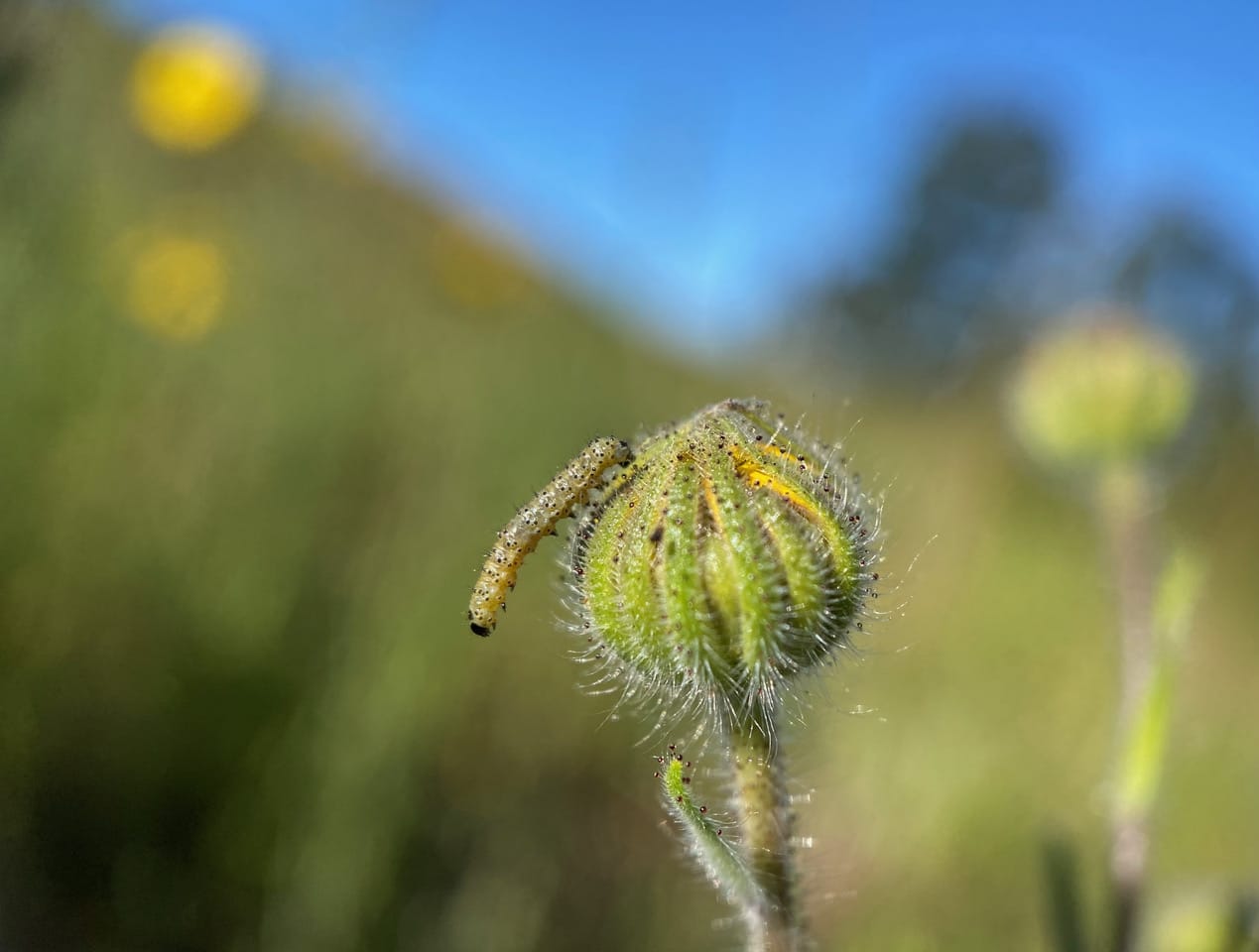
A tiny caterpillar of the Small Owlet Moth, Heliothodes diminutiva (family Noctuidae) is testing its boundaries on an immature flowerhead of Elegant Tarweed.
The moth is a specialist on members of the Asteraceae. The larvae feed on the reproductive parts of flowers and immature seeds.
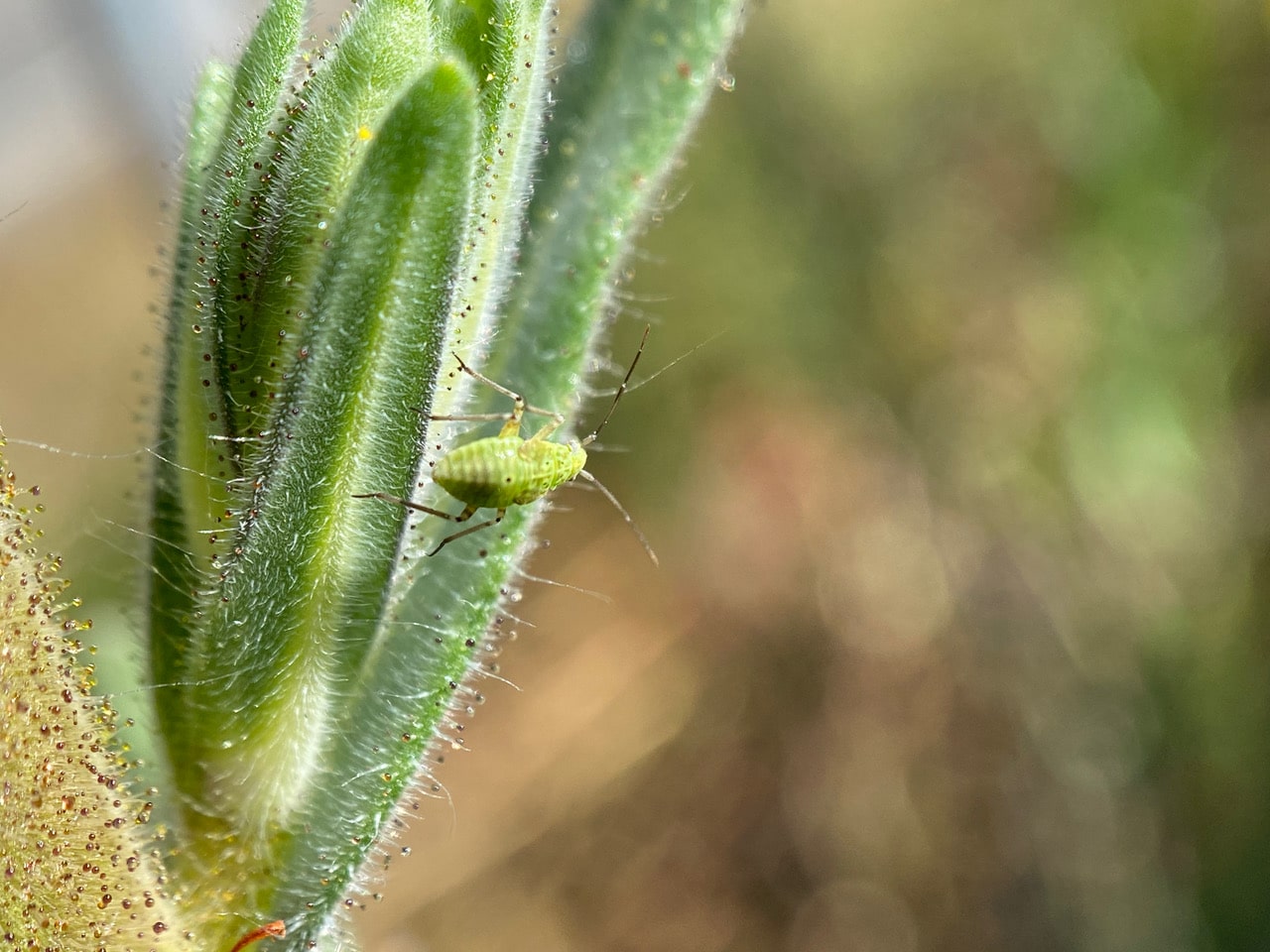 A nymph of the Lygus Bug, Lygus sp. (family Miridae) is walking on the foliage of Elegant Tarweed.
“True bugs” in the order Hemiptera undergo incomplete metamorphosis without a pupal stage. The nymphs, which look like adults, develop through a series of molts, each time getting bigger after shedding their old exoskeleton. At the last molt, they transform into adults with functional wings and reproductive parts.
The term lygus bug is used for any member of the genus Lygus, in the family of plant bugs, Miridae. Adult lygus are approximately 3 mm wide and 6 mm long, colored from pale green to reddish brown or black. They have a distinctive triangle or V-shape on their backs. Lygus bugs are known for their destructive feeding habits – they puncture plant tissues with their piercing mouthparts, and feed by sucking sap. Both the physical injury and the plant’s own reaction to the bug’s saliva cause damage to the plant. Many lygus bugs are well-known agricultural pests.
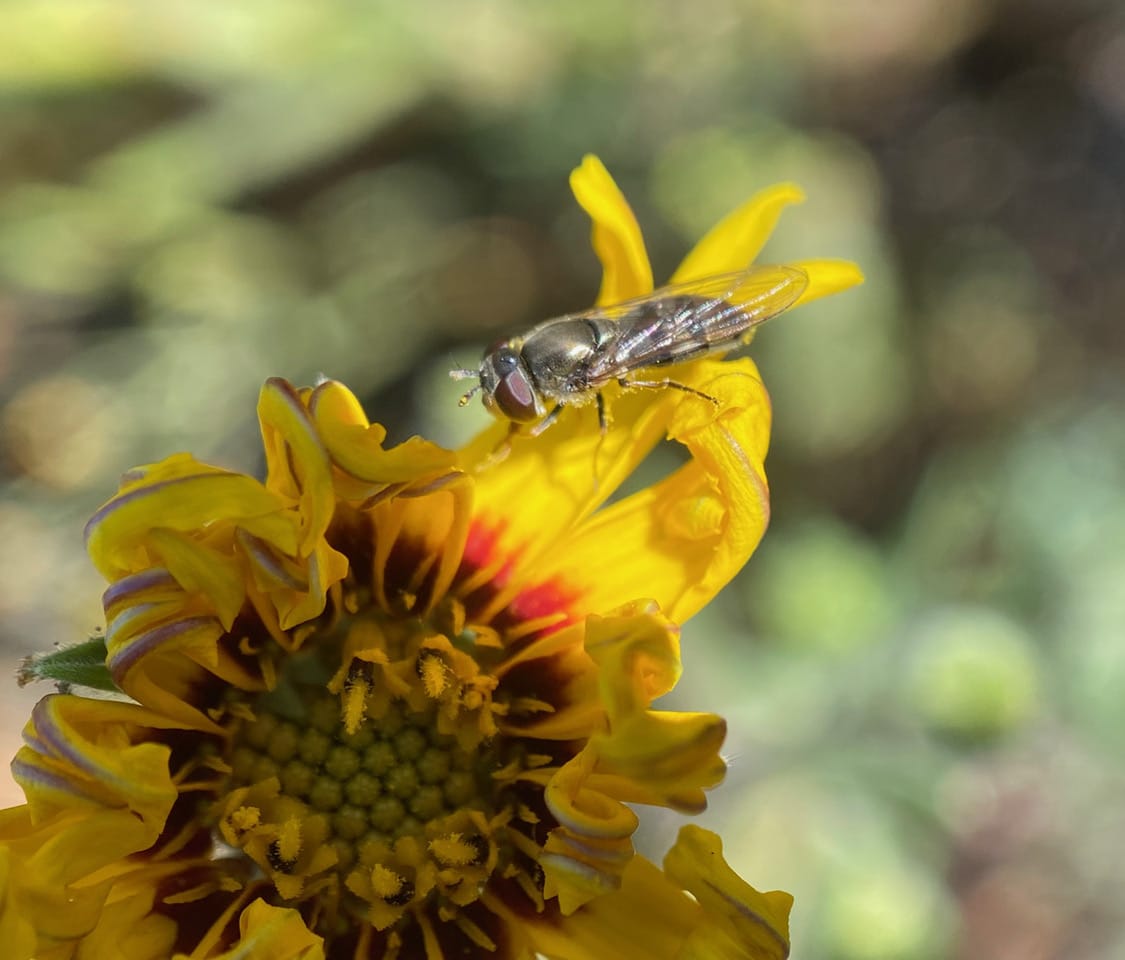
A Sedgesitter, Platycheirus sp. (family Syrphidae) has landed on a flowerhead of Elegant Tarweed.
Platycheirus species are distinct from most other hover flies in that they are not colorful, but have a dusky, metallic sheen. Platycheirus is found in grass and herb vegetation. Adults of many species feed on pollen of wind-pollinated plants, such as Salix, Plantago, Poaceae, Cyperaceae, but they visit other flowers also. Many stay active during cold and rainy weather. Larvae feed on aphids.
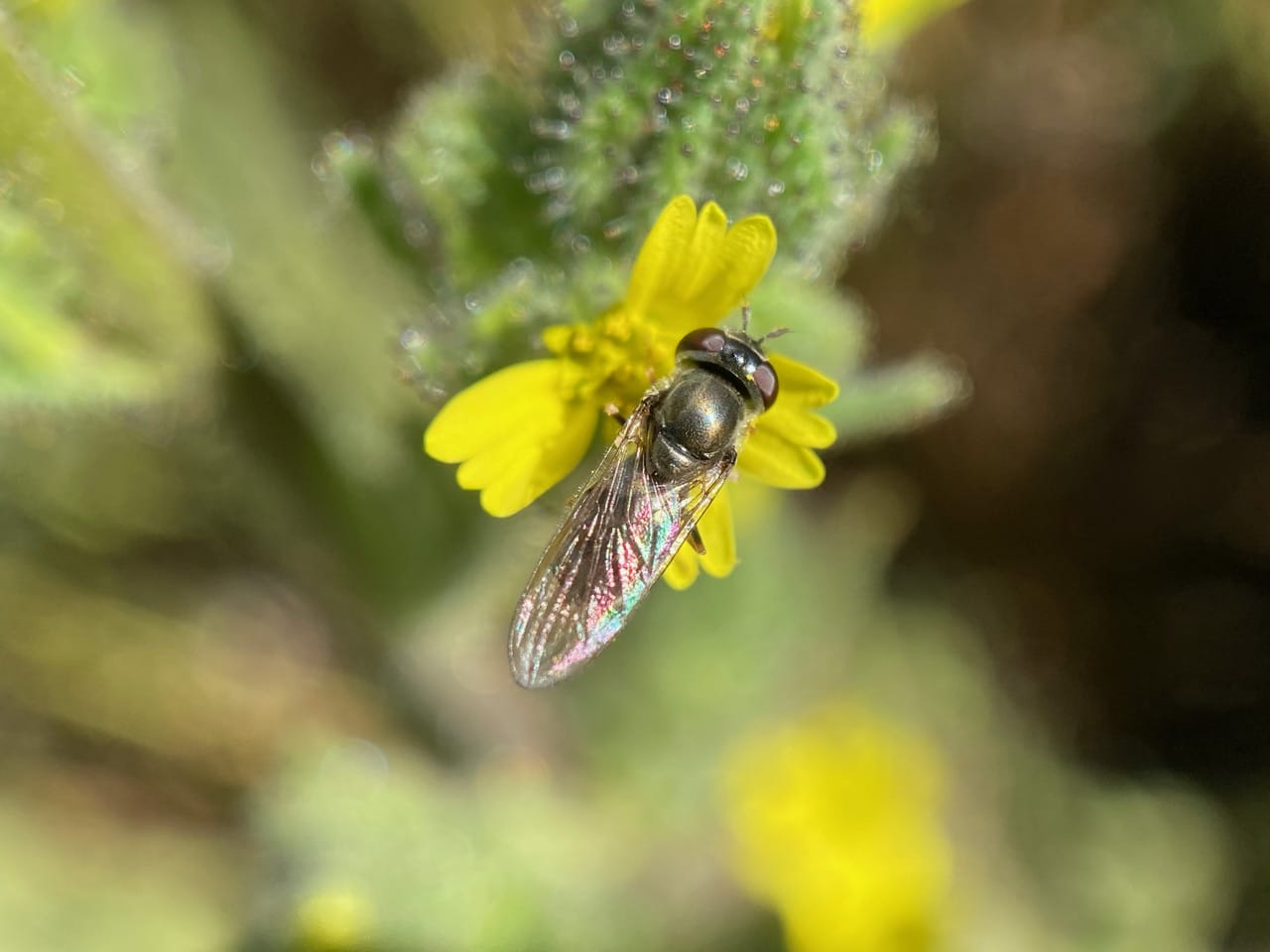
A female Sedgesitter, Platycheirus sp. (family Syrphidae) visits a flowerhead of Coast Tarweed, Madia sativa. The sexes of most hover flies can be determined by the placement of the eyes. Males have holoptic eyes that meet along a central line on top of the head, while the females’ compound eyes are set apart with a gap in between.

A yellow Crab Spider is waiting in ambush on a flowerhead of Elegant Tarweed.
Members of the family Thomisidae do not spin webs, and are ambush predators. The two front legs are usually long and more robust than the rest of the legs. Their common name derives from their ability to move sideways or backwards like crabs. Most Crab Spiders sit on or beside flowers, where they grab visiting insects. Some species are able to change color over a period of some days, to match the flower on which they are sitting.

A pair of Scentless Plant Bugs (family Rhopalidae) is mating on a cluster of flowerheads of Coast Tarweed. They are the largest among the numerous “true bugs” or Hemiptera found on the sticky plant.
Rhopalidae are a family of true bugs in the order Hemiptera. They differ from the related Coreids in lacking well-developed scent glands. All are plant feeders, using their piercing-sucking mouthparts. They live for the most part on weeds, and are not considered economically important.
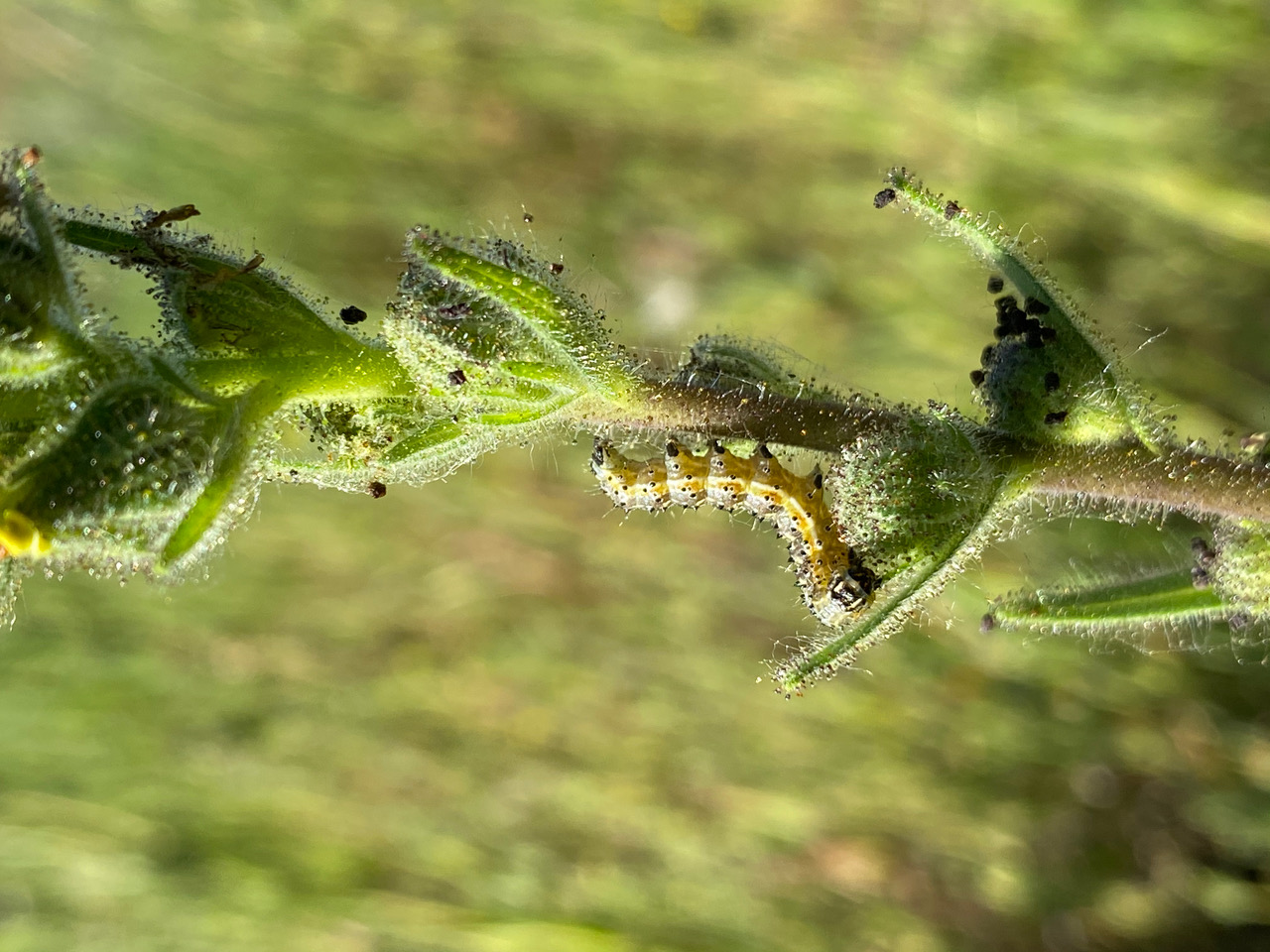
A young caterpillar of the Small Owlet Moth, Heliothodes diminutiva (family Noctuidae) is feeding on an immature flowerhead of Coast Tarweed. Note the frass (insect poop) left on the sticky plant.
The Small Heliothodes Moth, Heliothodes diminutiva (family Noctuidae) is day-active. It is found from California, through Oregon to Washington, most often on plants in the family Asteraceae, especially tarweeds.

A Bee Fly (family Bombyliidae) has landed to feed on the flowerhead of Elegant Tarweed. A golden halo surrounds its body as its prodigious hairs reflect sunlight.
The Bee Flies belong to the family Bombyliidae. Adults generally visit flowers for nectar and pollen, some being important pollinators. Larvae generally are parasitoids of other insects. When at rest, many species of bee flies hold their wings at a characteristic “swept back” angle. The adult females usually deposit eggs in the vicinity of possible hosts, quite often in the burrows of beetles or ground-nesting bees/wasps. Bombyliidae parasitism is not host-specific, but rather opportunistic, using a variety of hosts. Adult females of the genus Villa lay eggs in mid-air and flick them towards the nest entrances of their hosts. They typically have an eversible pouch near the tip of their abdomen known as a sand chamber, which is filled with sand grains gathered before egg laying. These sand grains are used to coat each egg just before their aerial release, presumably to improve the female’s aim by adding weight.
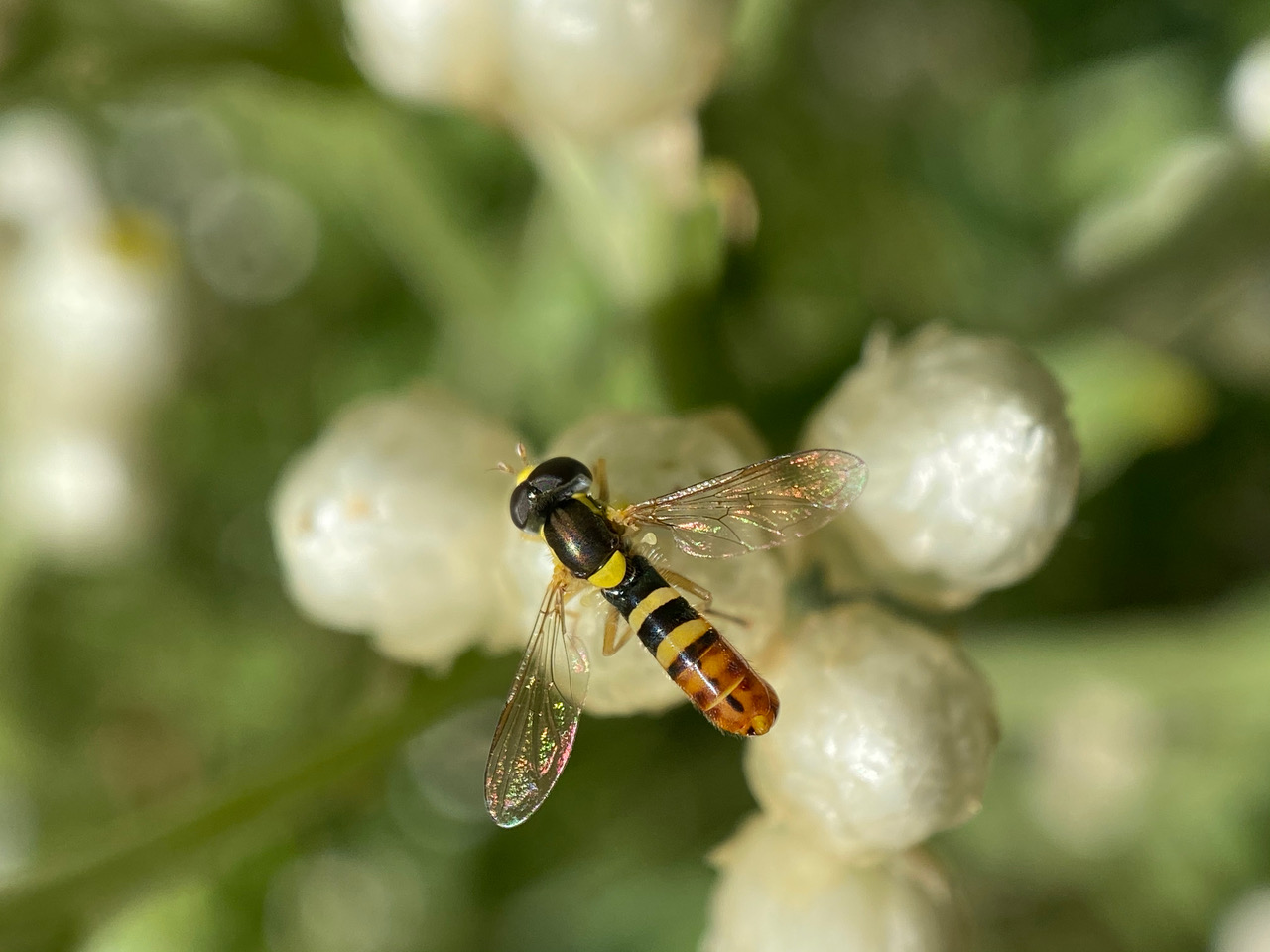
A male Forked Globetail, Sphaerophoria sulphuripes (family Syrphidae) lands on a flowerhead of California Everlasting, Pseudognaphalium californicum. The males of this species of hover fly is easily identified by their slim, elongate, straight sided abdomen tipped in red. The genitals are curled under the tip of the abdomen, forming a bulbous structure that gives rise to the common name, Globetail.
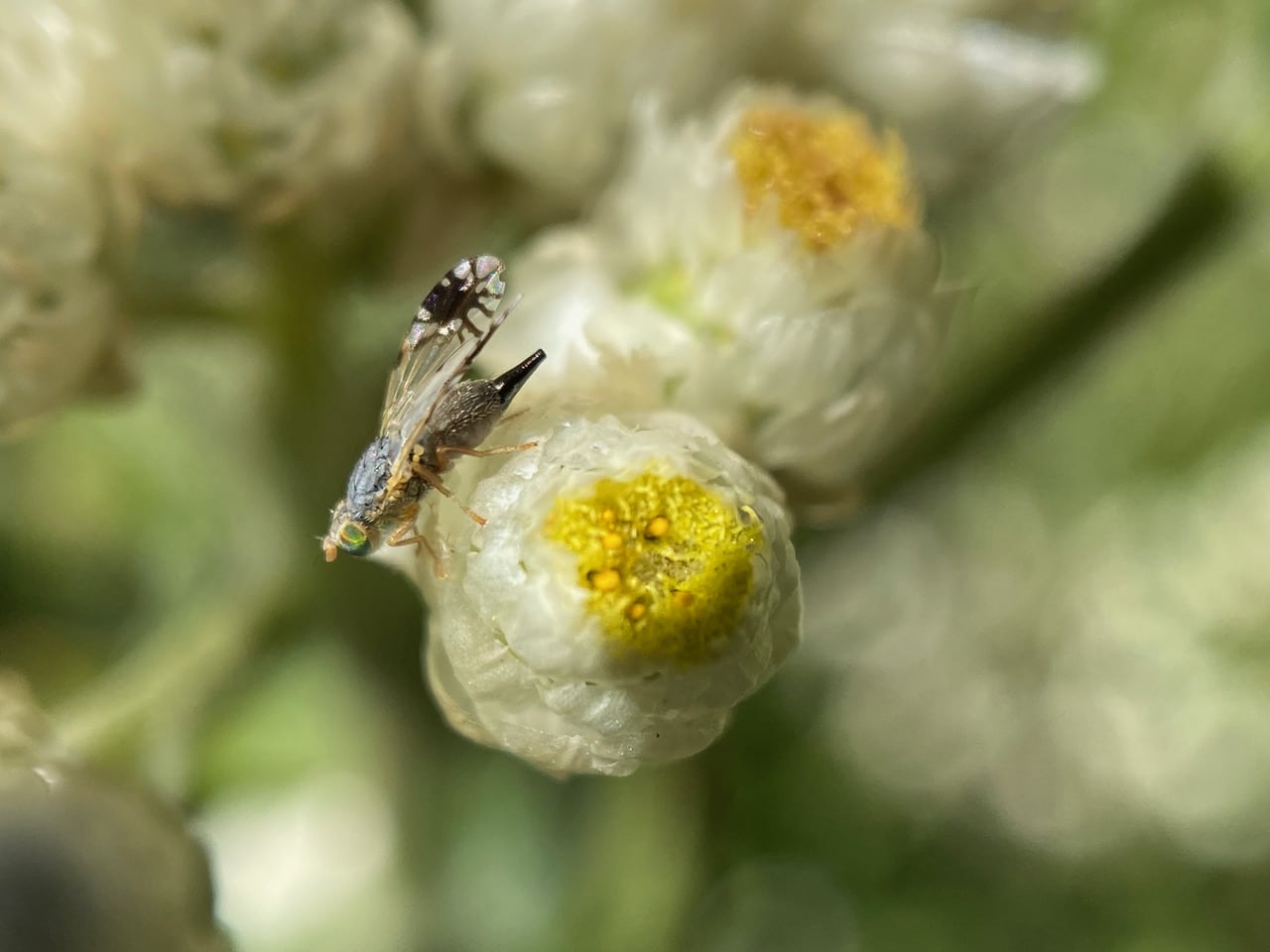
I am happy to report that this species of Fruit Flies commonly seen on the California Everlasting has been identified by a Tephritidae expert as Trupanea californica. The species uses the flowerheads of many species of Gnaphalium and related genera.

This female Trupanea californica seems to be feeding on the newly exposed flowers of California Everlasting.

Female Fruits Flies are easily distinguished by the presence of an oviscape – the pointy structure at the tip of their abdomen. The oviscape is the basal part of the ovipositor, the non-retractile sheath that protects the ovipositor. It remains exposed when the ovipositor is withdrawn and not in action.
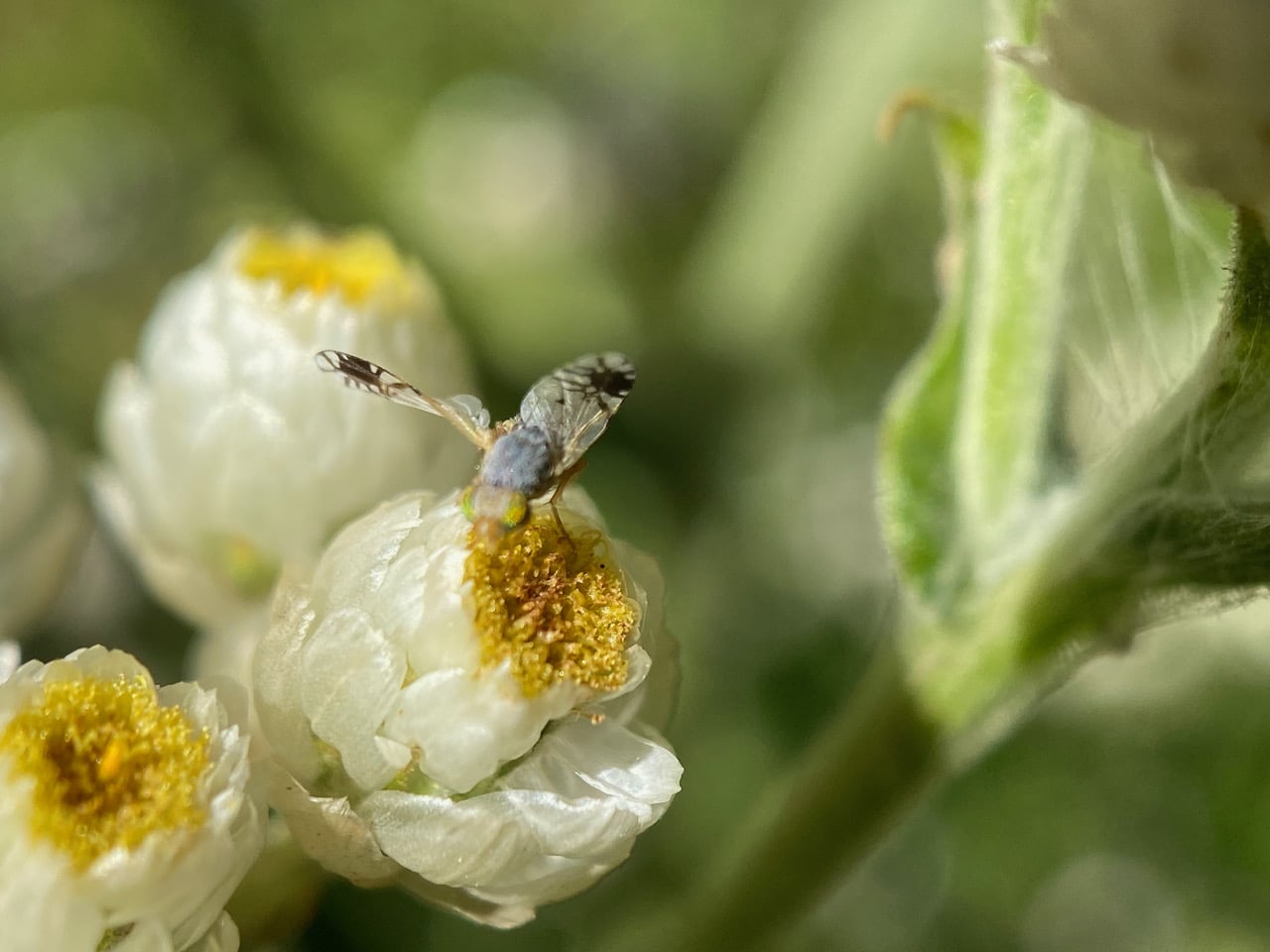
The female is slowly waving her picture wings alternately in a figure-8 motion. Is she trying to attract a mate?
The behavior ecology of Tephritid fruit flies is of great interest to biologists. Some fruit flies have extensive mating rituals or territorial displays, using their ornate wings. The adult fruit flies are often found on the host plant and feed on pollen, nectar, rotting plant debris, or honeydew. The larvae are almost all phytophagous. Females deposit eggs in living, healthy plant tissue using their telescopic ovipositors. Here, the larvae find their food upon hatching. The larvae develop in leaves, stems, flowers, seeds, fruits, and roots of the host plant, depending on the species. Some species are gall-forming.
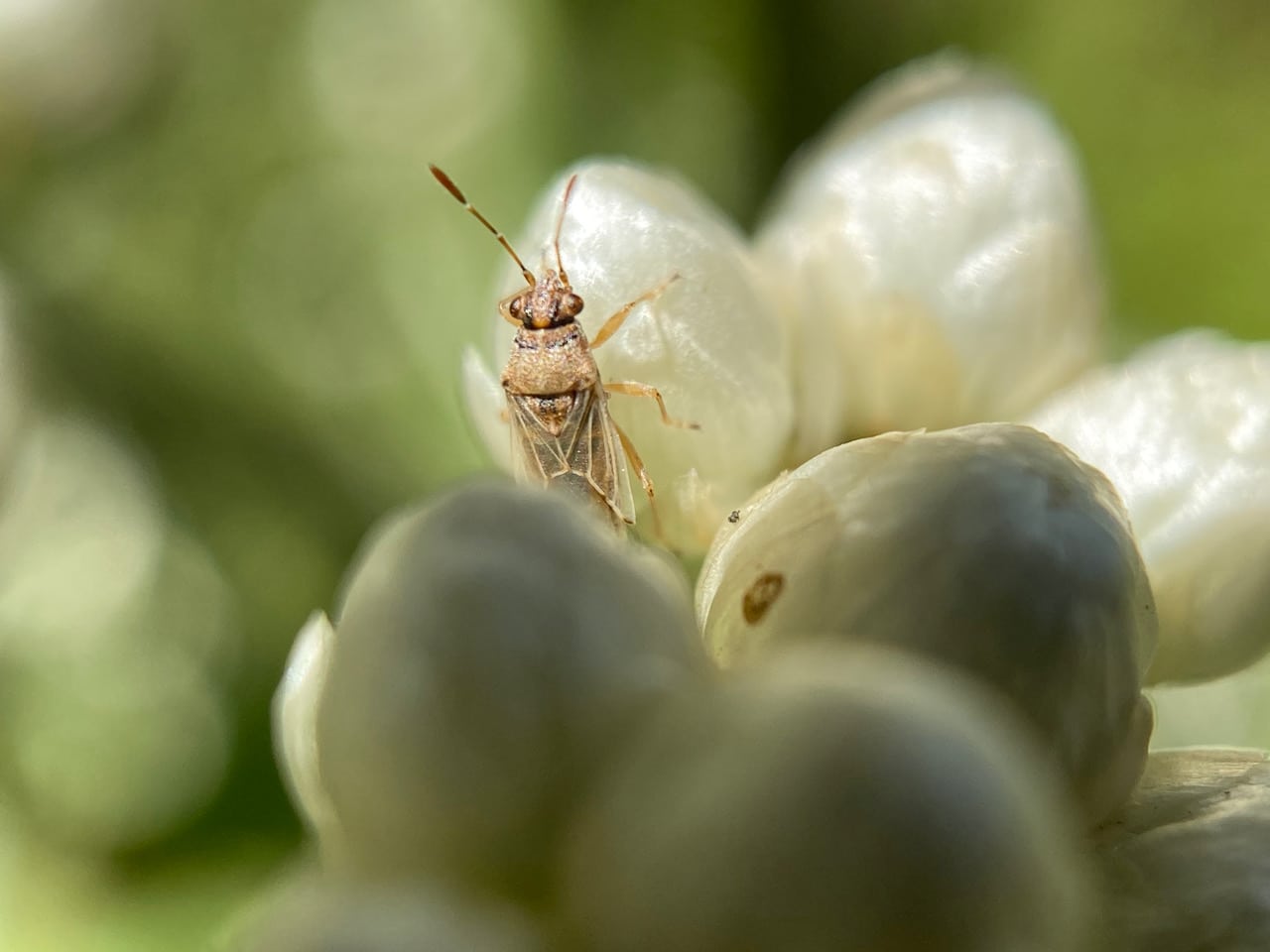
A False Cinch Bug, Nysius raphanus (family Lygaeidae or seed bugs) is roaming the inflorescence of California Everlasting flowerheads.
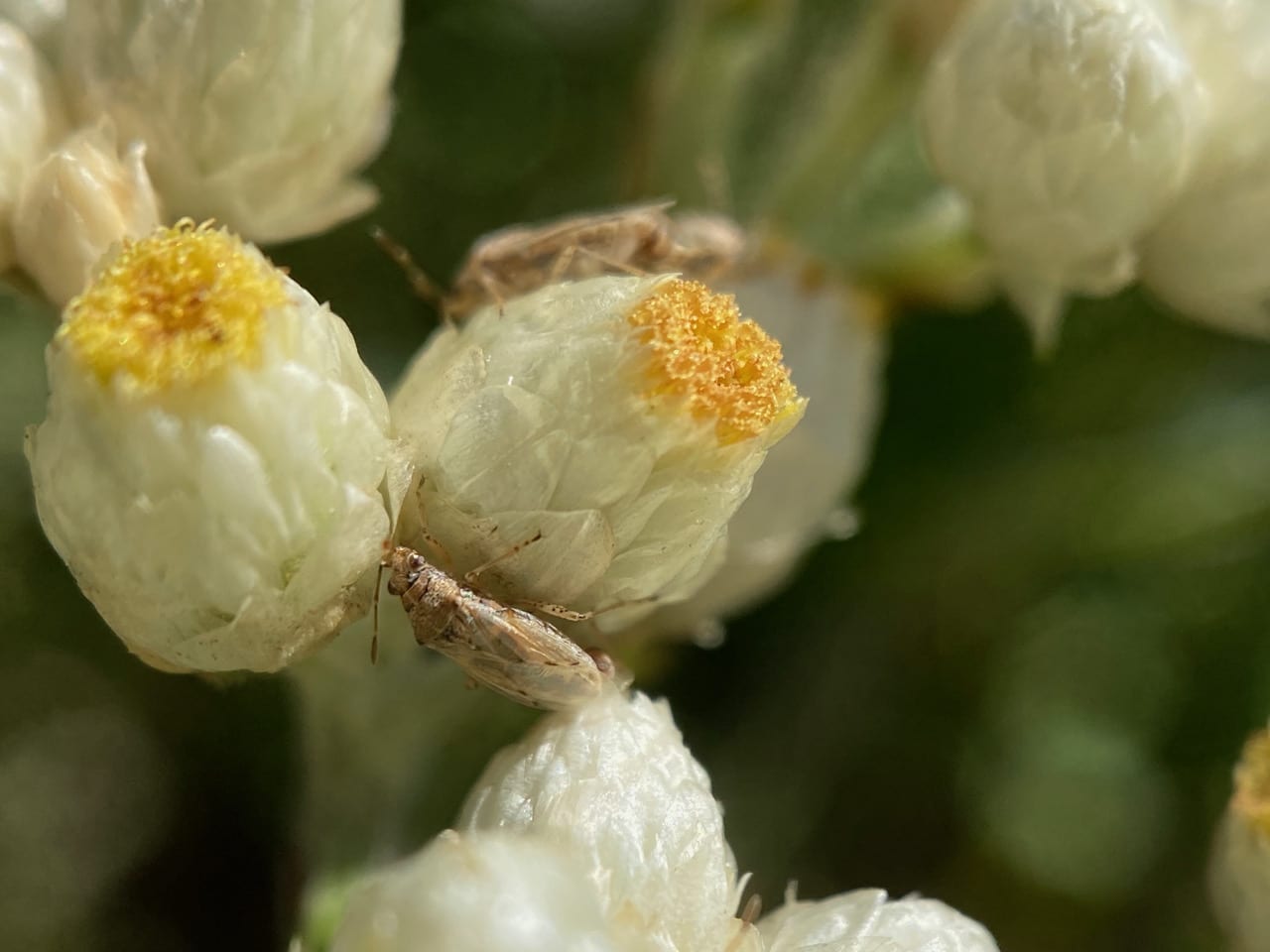
Nysius raphanus is commonly found within grassy or weedy fields, pastures, and foothills. Each spring, once the plants in these areas dry up, the False Cinch Bug migrates to find new places to feed. When populations are high in wet years, the bugs can become a nuisance for gardeners and farmers.
False Cinch Bugs spend the winter as nymphs and adults, usually in uncultivated areas beneath debris or in plants, often feeding on mustards or other winter annual plants. As new spring plant growth increases, so do the populations of False Cinch Bugs. Adults lay eggs in soil cracks or loose soil around plants. After hatching, nymphs feed on weeds, especially mustards, molt three times, and develop into adults in about three weeks. There can be several generations a year.
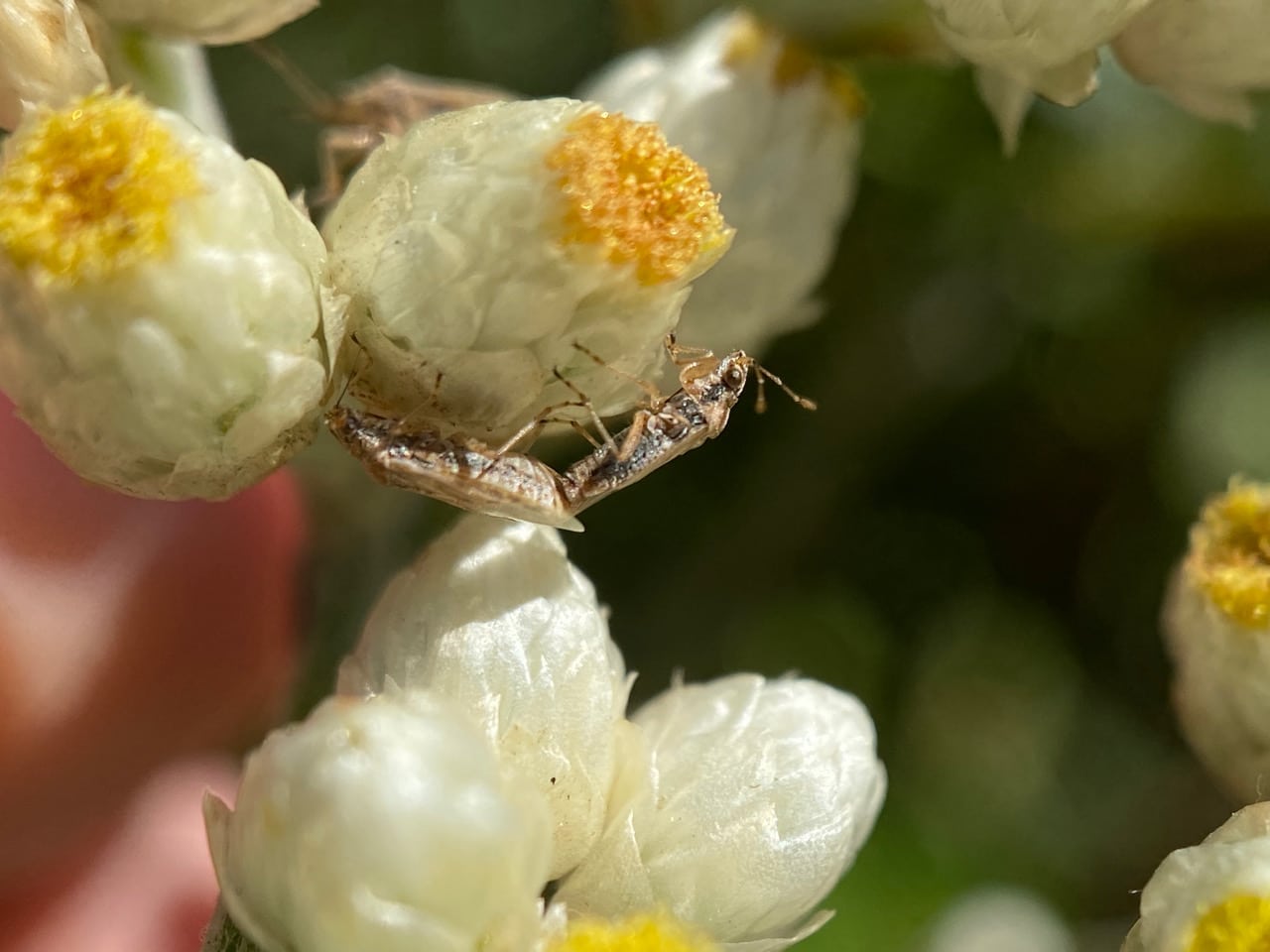
The False Cinch Bugs are everywhere on this California Everlasting, many of them mating.
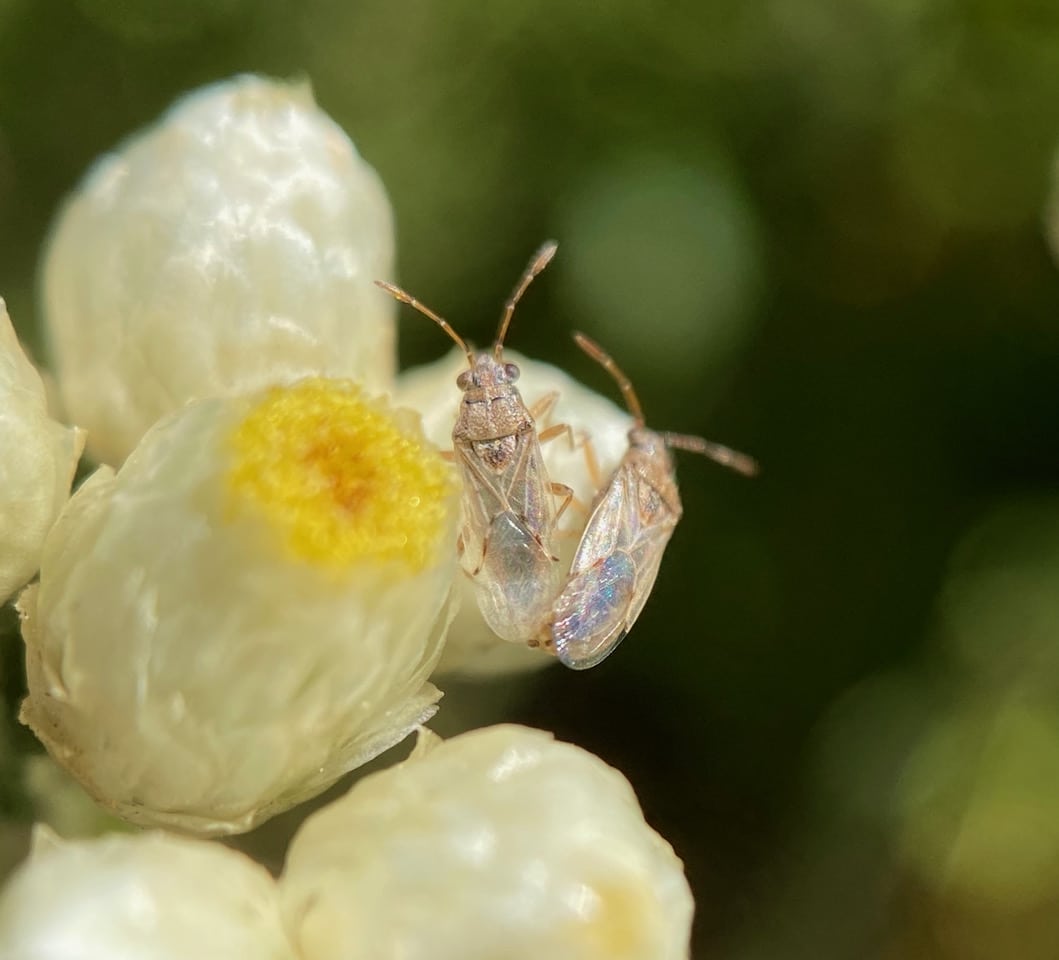
False Cinch Bugs are grayish-brown, slender, and about 1/8 to 1/6 in. long. Like many other insects in the order Hemiptera, their forewings are partly thickened and partly membranous so when folded, the tips of the wings overlap, forming a fairly well-defined X on the back of the body.
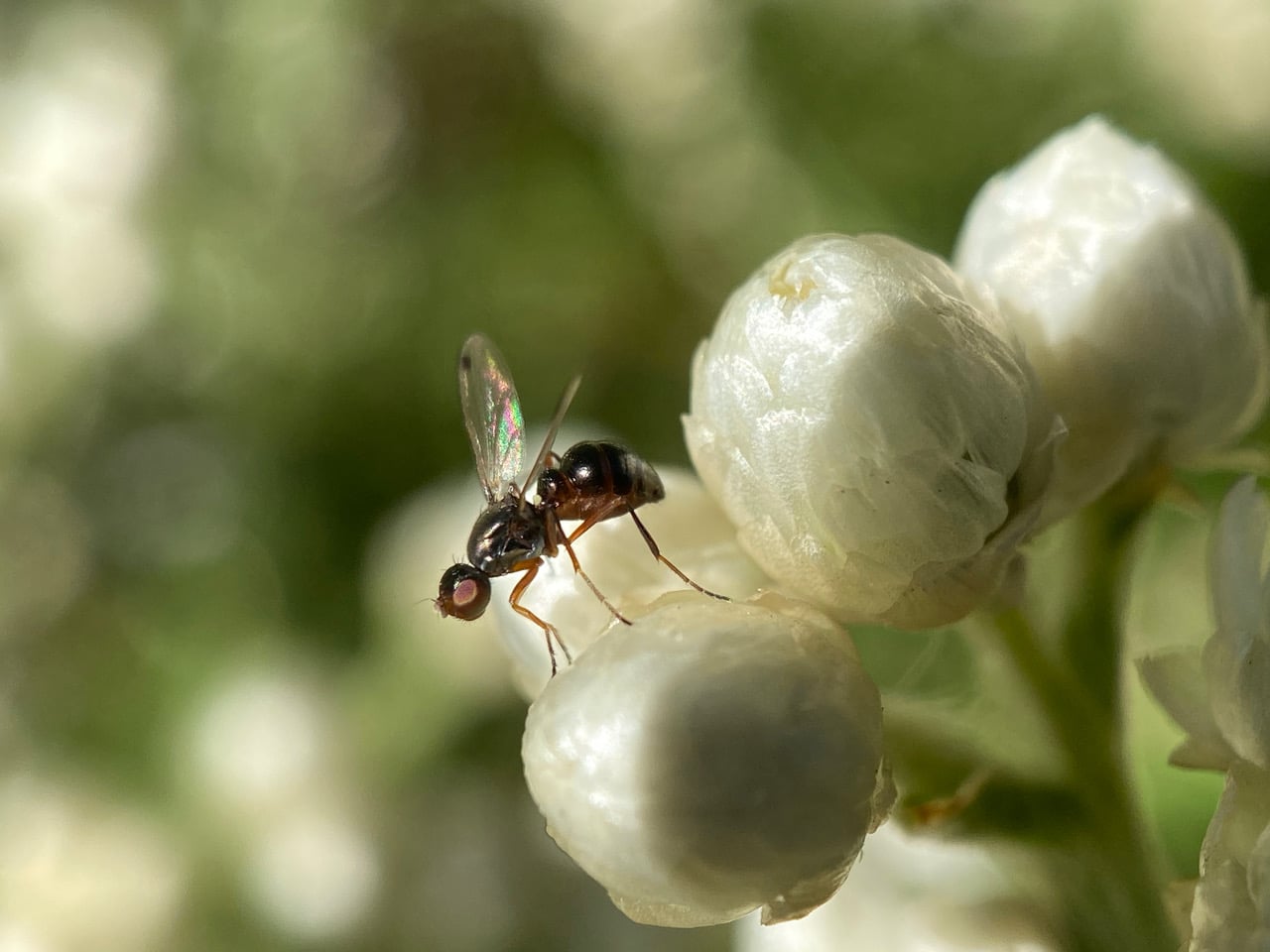 Now that I have gotten to know the Black Scavenger Flies (family Sepsidae) I find them everywhere, every time I come to the garden! They are as commonplace as the ants they resemble.
 Over 300 species of Sepsidae are described worldwide. They are usually found around dung or decaying plant and animal material. Many species resemble winged ants, having a “waist” and glossy black body. The head is rounded. Many Sepsidae have a curious wing-waving habit made more apparent by dark patches at the wing tip. Adult flies are found mostly on mammal excrement, where eggs are laid and larvae develop, and on nearby vegetation, carrion, fermenting tree sap, and shrubs and herbs. Revolting as their dietary habits might seem, these flies serve a vital function in the ecosystem as decomposers/recyclers of organic matter.
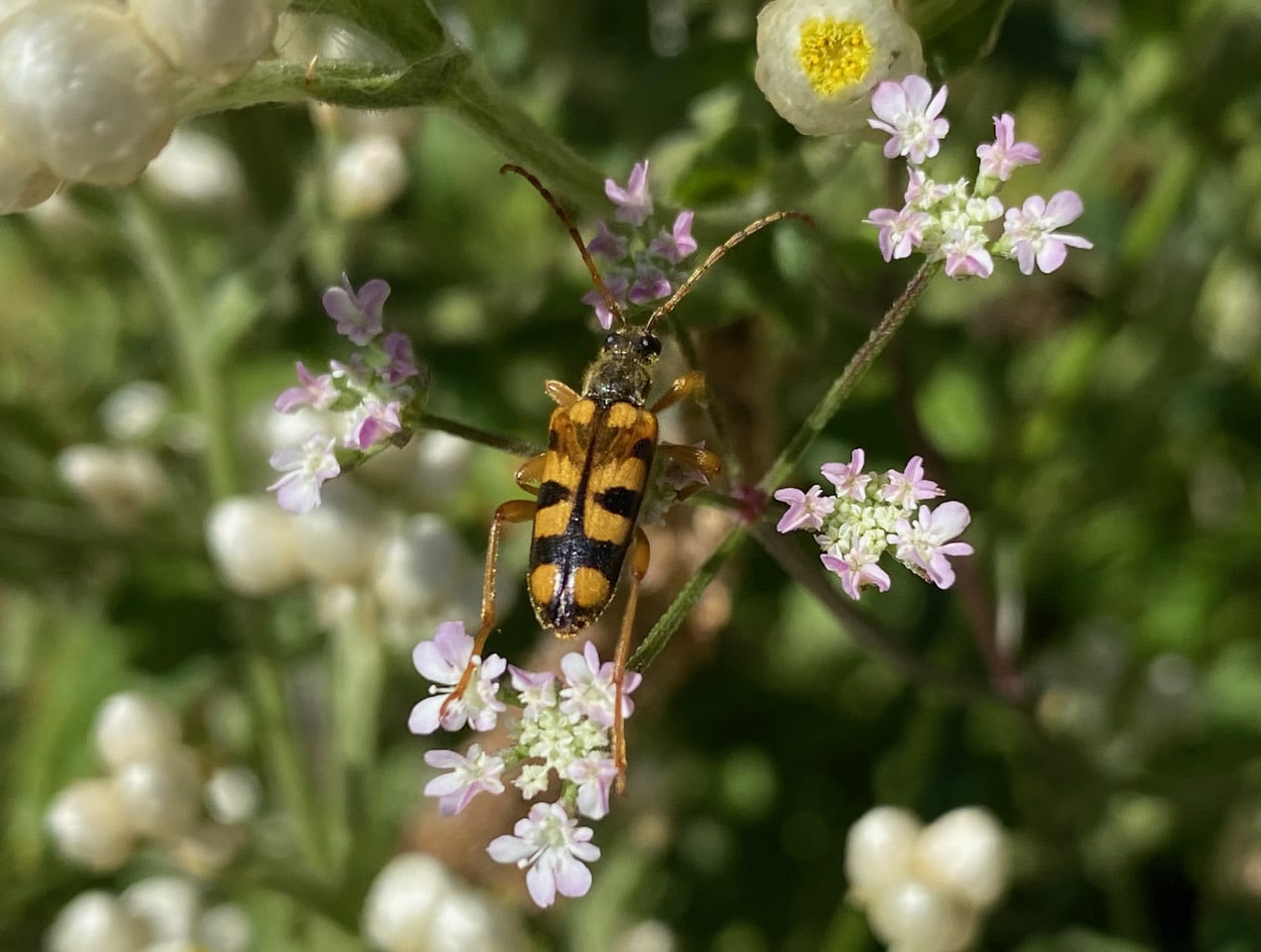
A Flower Longhorn Beetle, Xestoleptura crassipes (family Cerambycidae, subfamily Lepturinae) is foraging on a flower umbel of the weedy Torilis arvensis (family Apiaceae).
These beetles are usually found on flowers where they feed on pollen and nectar, and are considered pollinators. They have a particular affinity for the umbel flowers of the carrot family, Apiaceae.
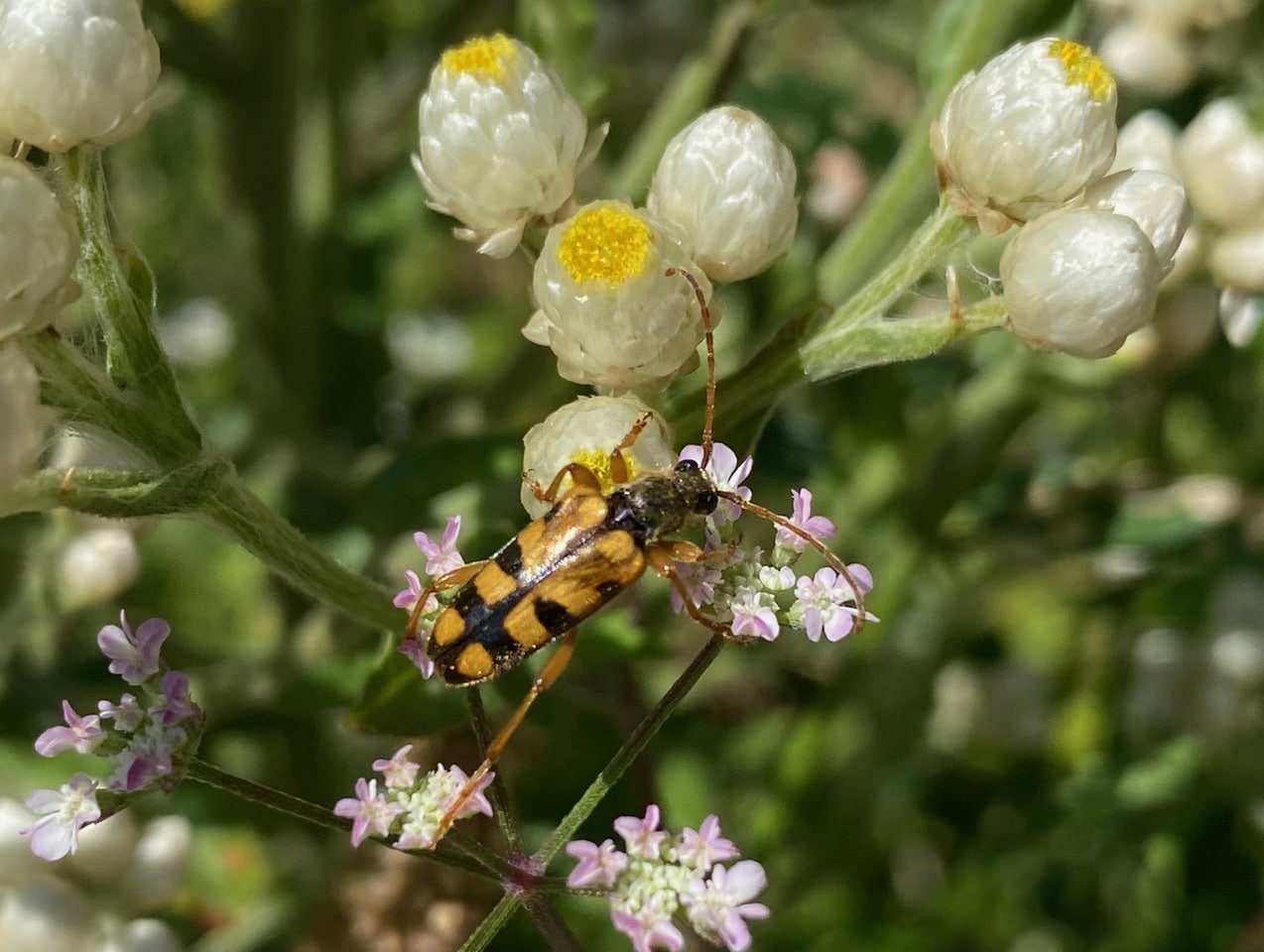
Most species of Flower Longhorn Beetles have a narrow body and very long legs. They also share the family trait with other Cerambycids of having very long antennae. The beetles spend their larval days as borers, just like other Cerambycids. However they are not considered pests, as they select trees that are stressed, dying, or dead.
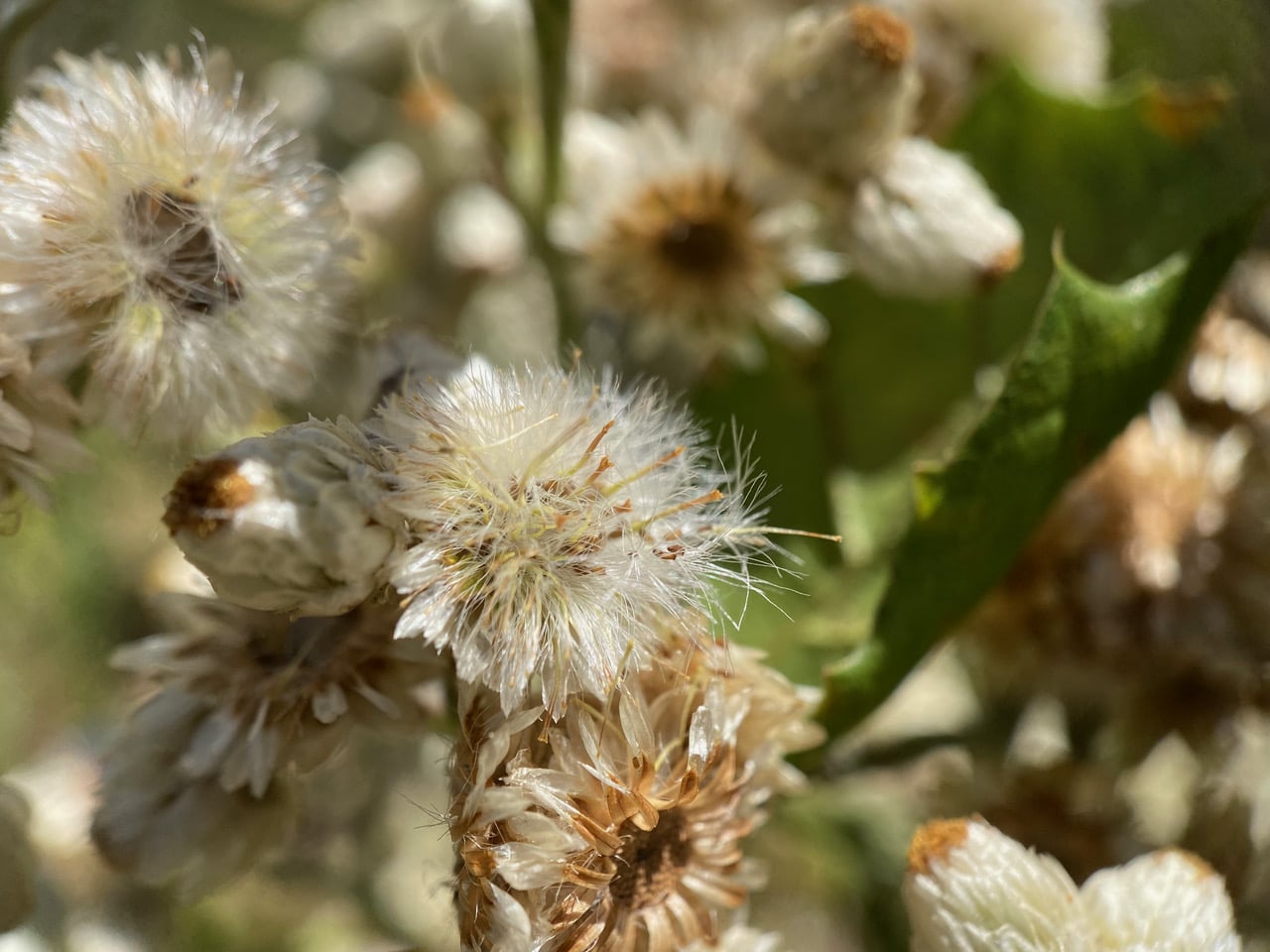
The California Everlasting, Pseudognaphalium californicum has gone to seed! Many flowerheads have opened up to disperse seeds attached to silky plumes (pappus).
In Asteraceae, the papppus is the modified calyx, the part of an individual floret, that surrounds the base of the corolla tube in flower. It functions as a wind-dispersal mechanism for the seeds.