

Pollinator Post 7/12/26 (2)
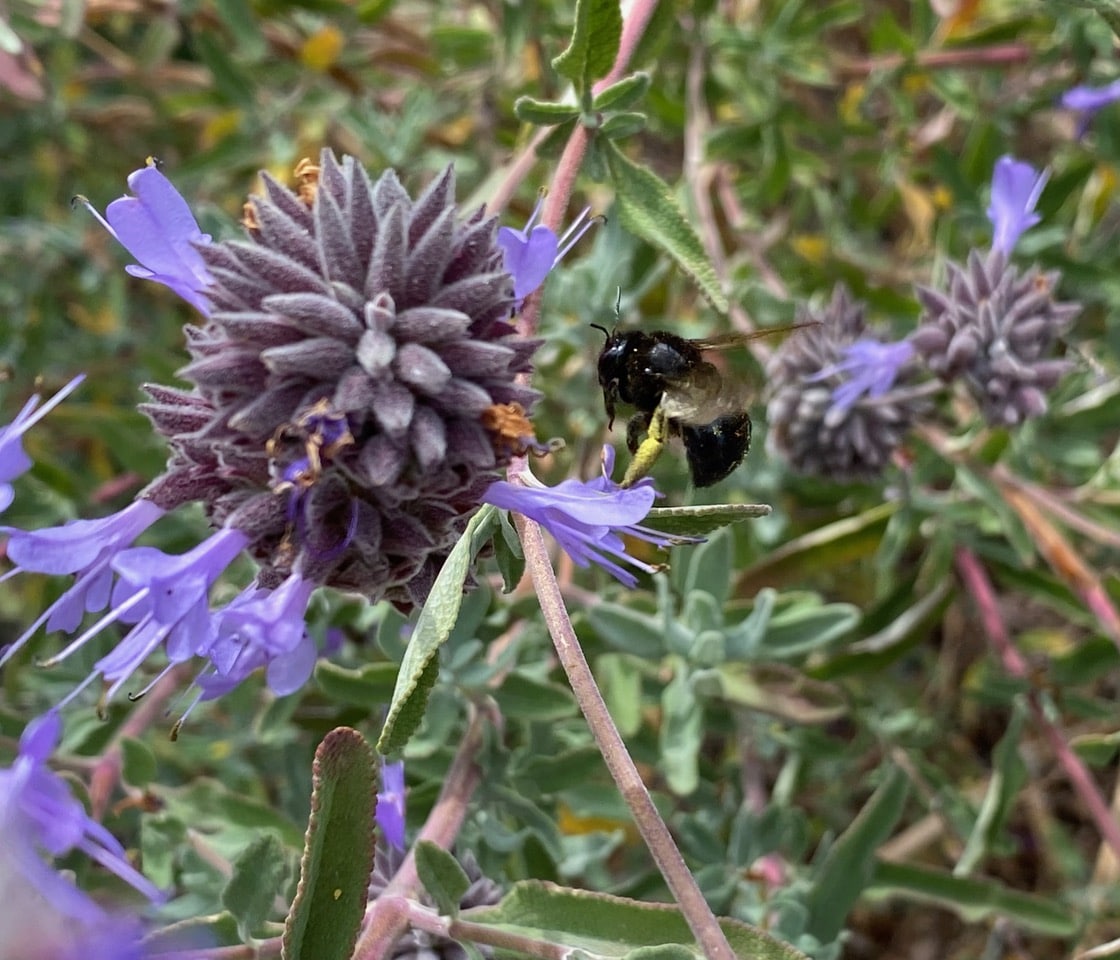
A loud buzzing alerts me to the approach of a female Foothill Carpenter Bee, Xylocopa tabaniformis ssp. orpifex (family Apidae). Here she comes, landing on a flower of Amethyst Bluff Sage, Salvia leucophylla ‘Amethyst Bluff’. Note the yellow pollen on her hind legs.
The common name “carpenter bees” derives from their nesting behavior; nearly all species burrow into hard plant material such as dead wood or bamboo. These robust bees are often mistaken for bumble bees. The simplest way to tell them apart is that most carpenter bees have a shiny abdomen, whereas bumble bees abdomens are completely covered with dense hair. Males of some species of carpenter bees have a white or yellow face, unlike bumble bees, while females lack the bare corbicula (pollen baskets) of bumble bees; the hind leg is entirely hairy and includes the scopa.
Carpenter Bees are traditionally considered solitary bees, though some species, including our Foothill Carpenter Bee, have simple social nests in which mothers and daughters may cohabit. Carpenter Bees make nests by tunneling into wood, bamboo and similar hard plant materials. They vibrate their bodies as they rasp their mandibles against the wood, each nest having a single entrance which may have many adjacent tunnels. The entrance is often a perfect circular hole measuring about 0.6in. on the underside of a beam, bench, or tree limb. Carpenter Bees do not eat wood; they discard the bits of wood, or reuse the sawdust to build partitions between cells. The tunnel functions as a nursery for brood and storage for the pollen/nectar upon which the brood subsists. Carpenter can be timber pests, and cause substantial damage to buildings.
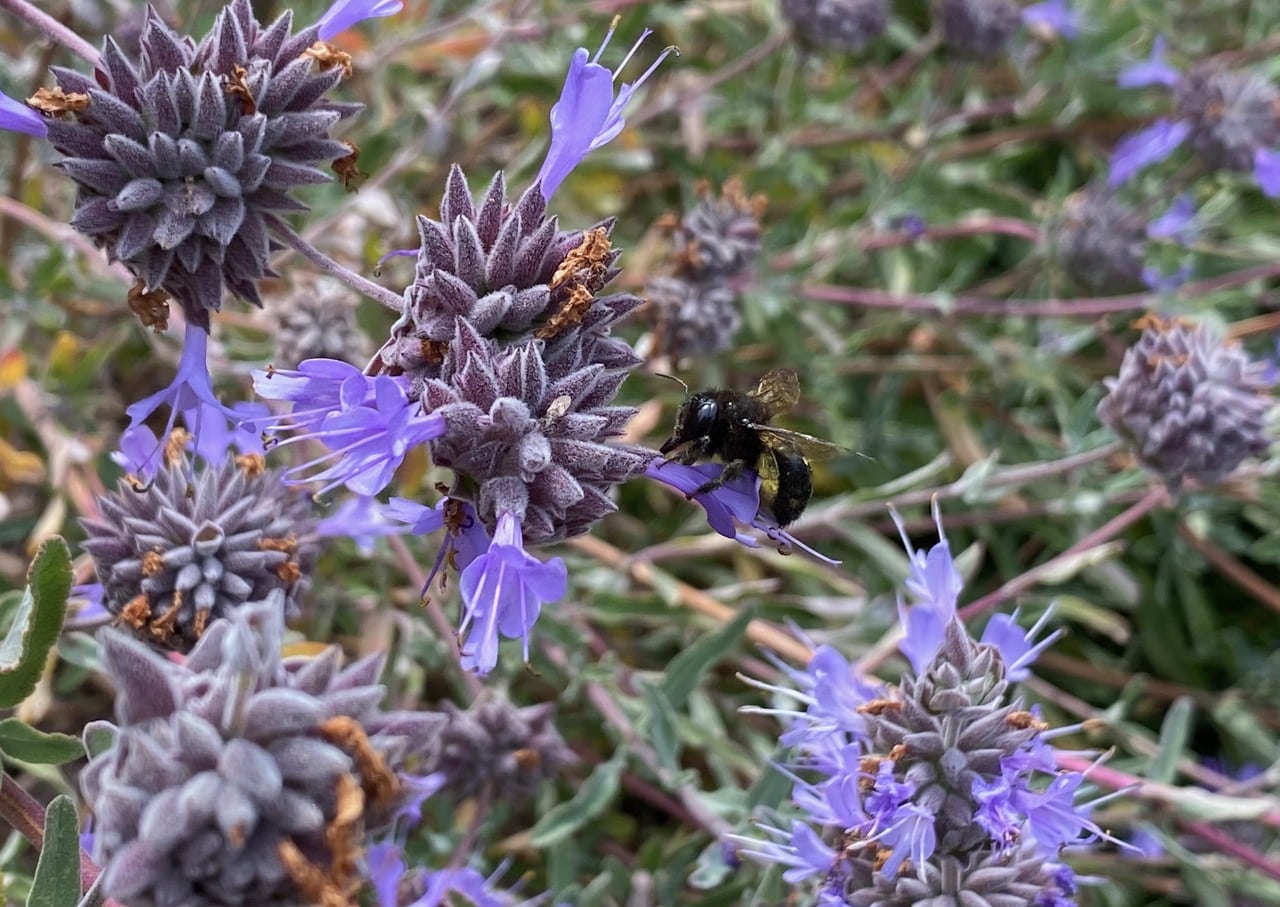
The bee is obviously too large to enter the corolla of the flower. Instead she lands on the outside of the flower, and using her powerful mandibles, quietly cuts a slit near the base of the flower to access nectar directly. I follow her breathlessly as she zips through the patch, stopping to “rob” nectar from several flowers in quick succession.
Carpenter Bees have short mouthparts and are important pollinators on some open-faced or shallow flowers. They also are important pollinators of flowers with various forms of lids, such as Salvia species, and some members of the Fabaceae such as Lupinus. Many Carpenter Bees are known to “rob” nectar by cutting slits on the sides of flowers with deep corolla that they cannot enter. In doing so, the bees can access the nectar directly with their short tongue. This move precludes contact with the reproductive parts of the flower, and results in no pollination.
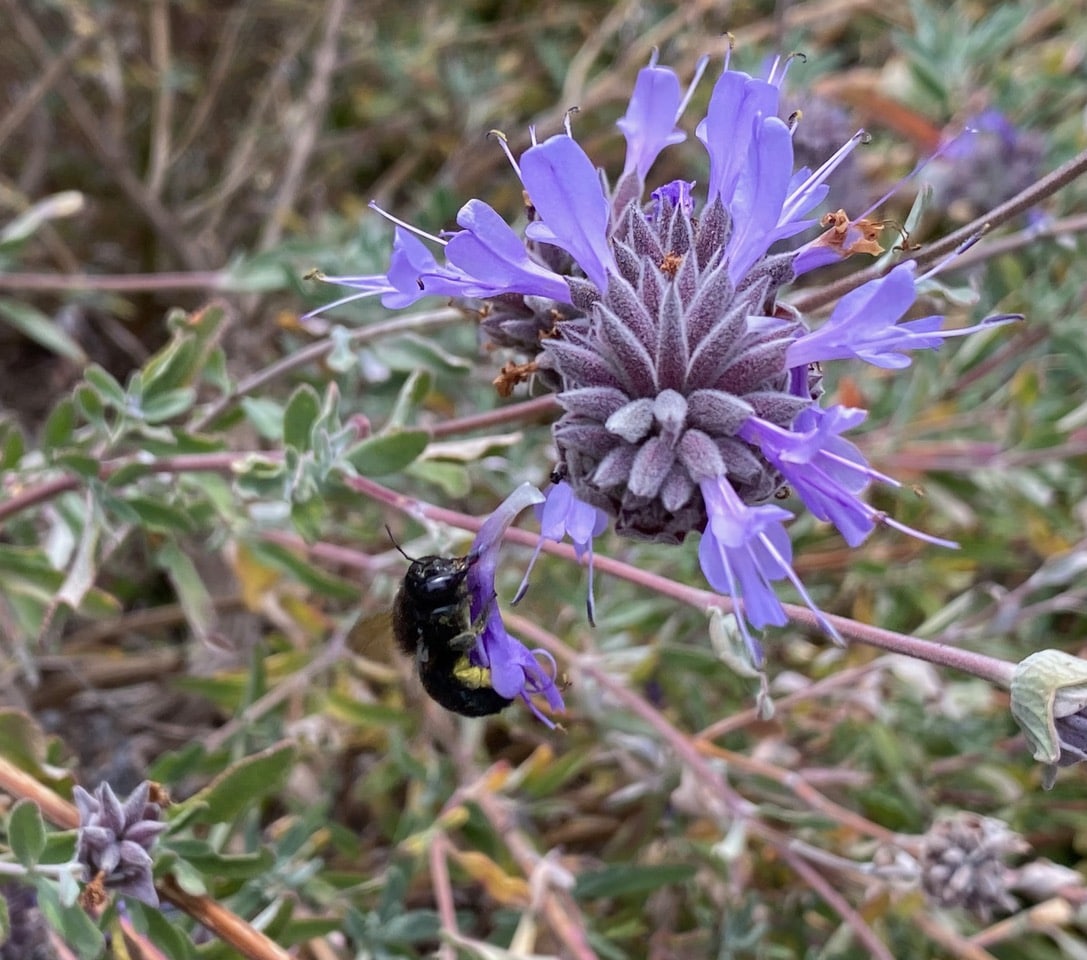
Oops, the flower falls off as the bee is robbing nectar!
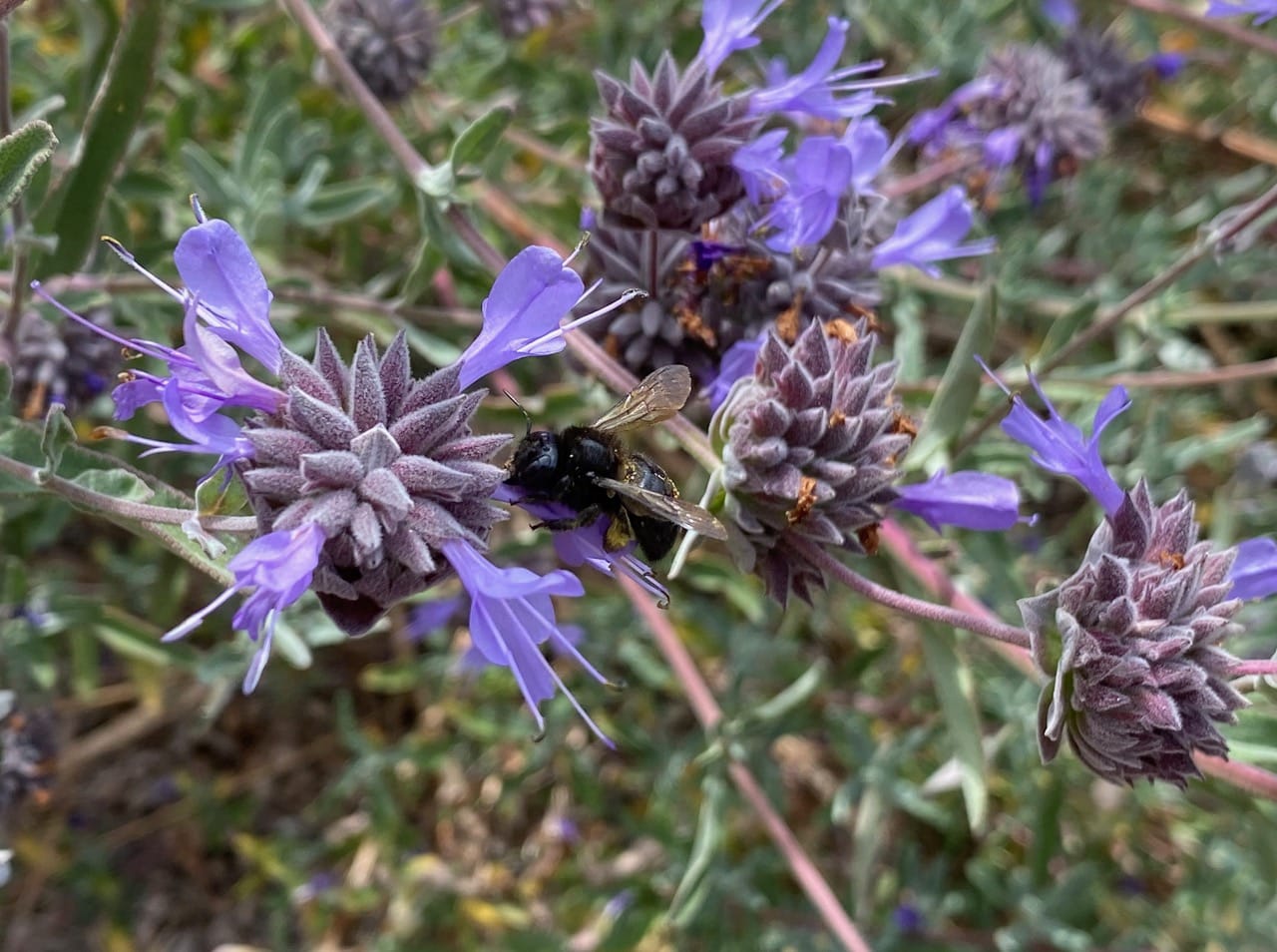
Here’s another view of nectar robbing. I am impressed by the speed and agility of the bee as she zips through the dense thicket of branches and flowers with ease. Each clandestine stop takes only a few seconds.

Since big bees rob nectar, and little bees, such as the Sweat Bees (family Halictidae) and Masked Bees (Hylaeus) collect pollen from individual anthers without touching the stigma, essentially robbing pollen and contributing no pollination, who then pollinates the Salvias? Many of our New World Salvias are adapted for hummingbird pollination. As the bird hovers to probe the tubular flower for nectar with its long bill, the protruding stamens dab pollen on its head or chest. At the next flower, the pollen on the bird may be picked up by the protruding stigma.

Stepping into the backyard, I am astonished by what I see. With so many natives in bloom, Jenny and Craig’s backyard is looking lush and colorful. It’s hard to believe that this garden is only 2 years old.

The area around the pond is especially festive. I linger a while here to enjoy the sound of the trickling water, and to watch for dragonfly or damselfly activity.

A Large Milkweed Bug, Oncopeltus fasciatus (family Lygaeidae) is resting among the terminal leaves of a Narrowleaf Milkweed, Asclepias fascicularis. Unlike the last time I saw them, these plants are now free of aphids. Natural predators and parasitoids must have taken care of the light infestation. I briefly look for Monarch caterpillars on the milkweed, but find none.
Milkweed Bugs are Seed Bugs (family Lygaeidae) in the insect order of “true bugs”, Hemiptera. The bold red-and-black coloration of the bug serves as aposematic warning to potential predators of its distastefulness and toxicity. Like the Monarch butterflies, Oncopeltus sequesters the toxic compounds of milkweeds. The bugs undergo incomplete metamorphosis, with five instars before reaching adulthood. The nymphs and adults all feed on milkweed using their piercing-sucking mouthparts. Adults are capable of penetrating the seed pod with their proboscis and injecting digestive juices. All stages of development can be found on the plants in mid to late summer. Adults live for about one month. The insect overwinters as an adult.
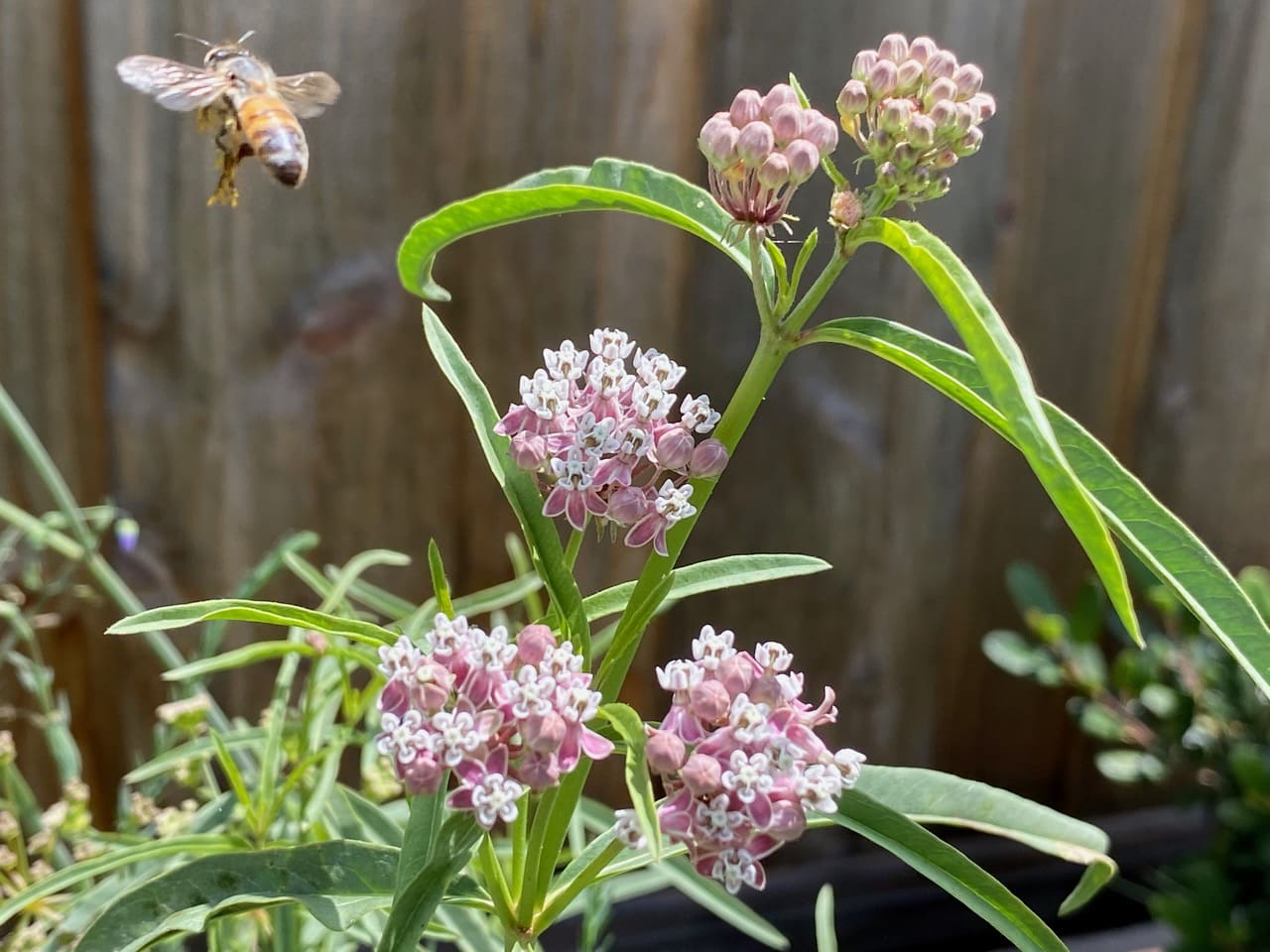
In the corner of the backyard, the small patch of Narrowleaf Milkweed has started to bloom, attracting some Honey Bees. This patch too is free of aphids!
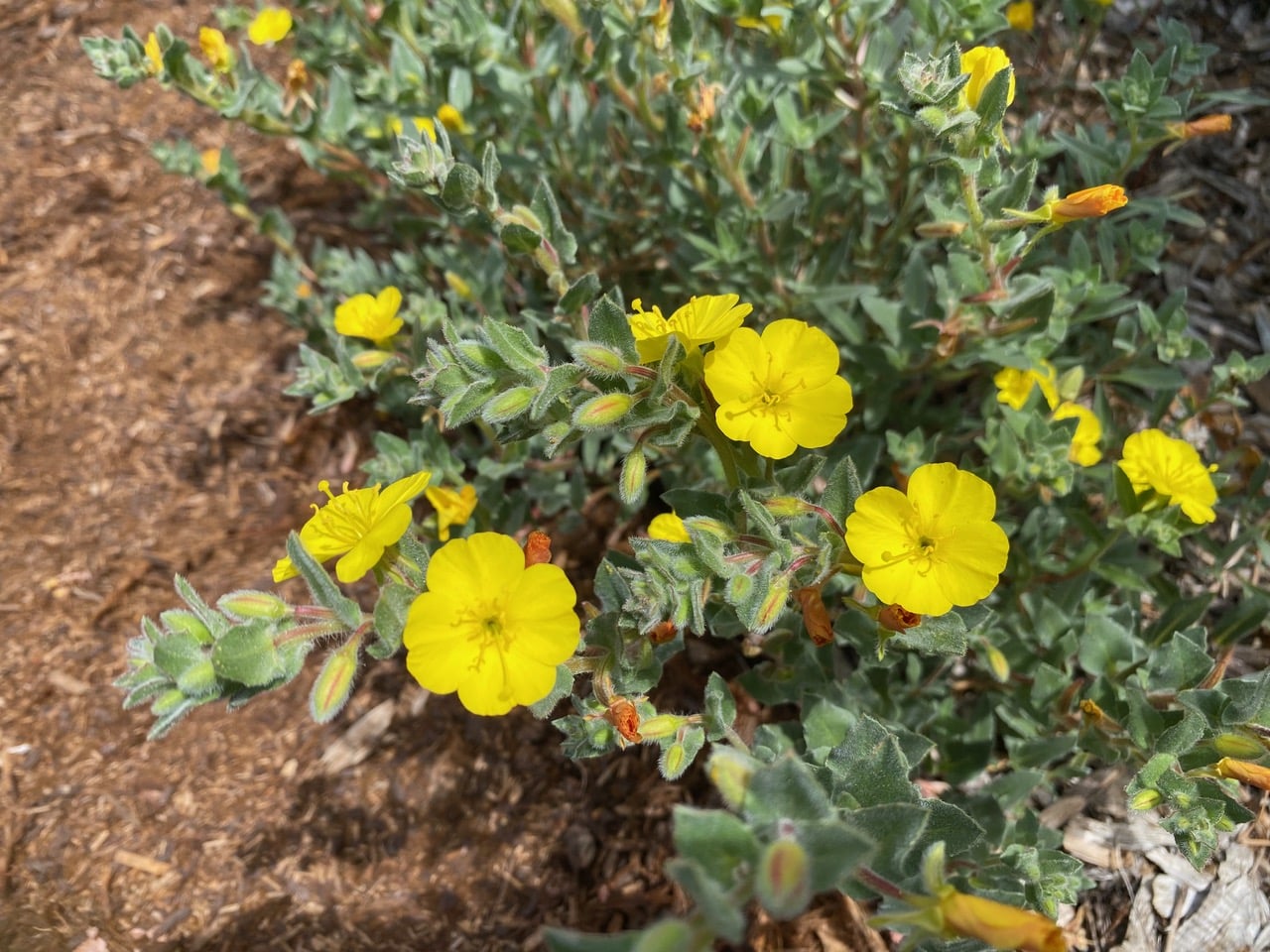
The Beach Evening Primrose, Camissoniopsis cheiranthifolia serves as a beautiful ground cover along the path. The sprawling plants are blooming profusely with their sunny yellow flowers.
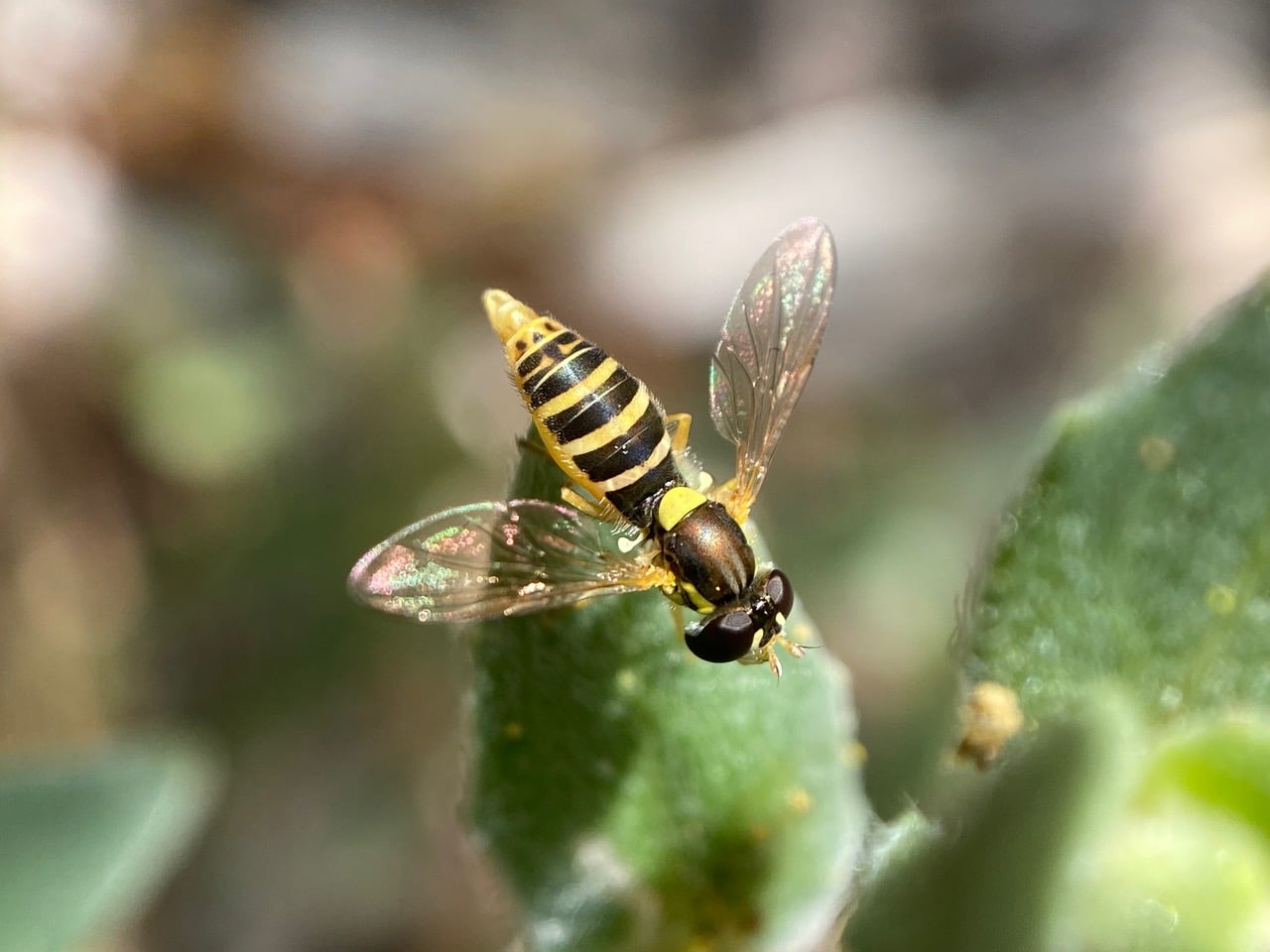
A female Forked Globetail, Sphaerophoria sulphuripes (family Syrphidae) lands on a leaf of the Beach Evening Primrose. The gravid female is searching for a place to lay her eggs.
The Forked Globetail, Sphaerophoria sulphuripes (family Syrphidae) is a hover fly native to western North America. Adults visit flowers for nectar and pollen. Larvae feed on aphids and other soft-bodied insects. There is marked sexual dimorphism in the species – the males have a slender abdomen with a reddish, swollen tip.

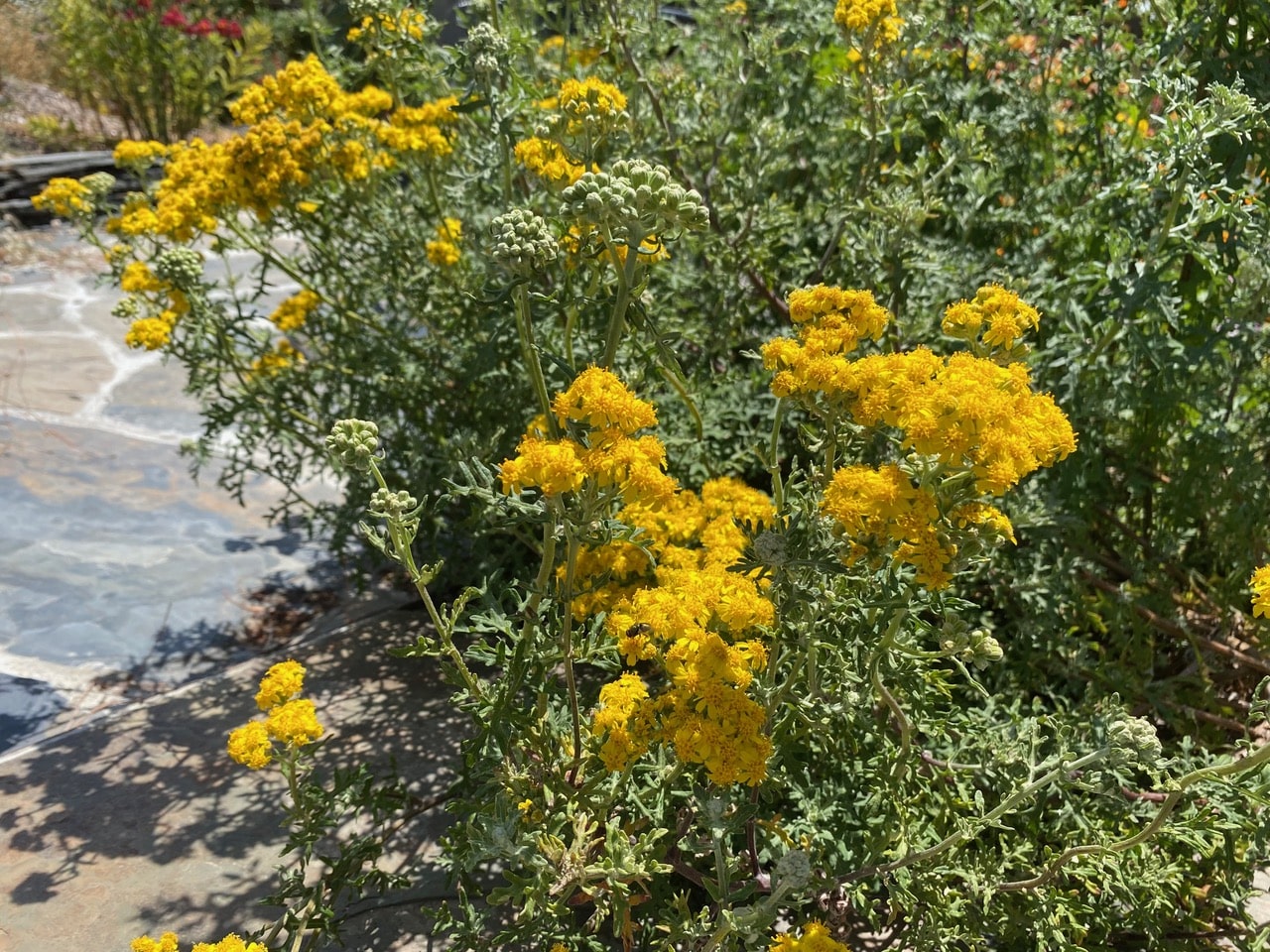
I have not noticed this Seaside Woolly Sunflower, Eriophyllum staechadifolium in the backyard the last time I visited, before the flowers appeared. I know I can find all sorts of insects on its composite flowers.

A Eurasian Drone Fly, Eristalis arbustorum (family Syrphidae) is foraging on an inflorescence of Seaside Woolly Sunflower.
The Eurasian Drone Fly, Eristalis arbustorum is an abundant species of hover fly that occurs throughout the northern hemisphere, including Europe, North Africa and North India. It was introduced to North America in the mid 1800’s and is now ubiquitous throughout much of the United States and Canada. The common name “drone fly” refers to its resemblance to the drone of the honeybee. The Eurasian Drone Fly is found in a diversity of habitats, including wetland, forests, montane tundra, as well as farmland, urban parks and gardens. It visits the flowers of a wide range of low-growing plants and shrubs. The larvae are aquatic, occurring in shallow, nutrient rich standing water and in cow manure and compost heaps. Also known as “rat-tailed maggots”, the larvae have a siphon on their rear end that acts like a snorkel, helping them breathe under water. The siphon can be several times the length of the larva’s body. The larvae are saprophagous, feeding on bacteria in stagnant water rich in decomposing organic matter.
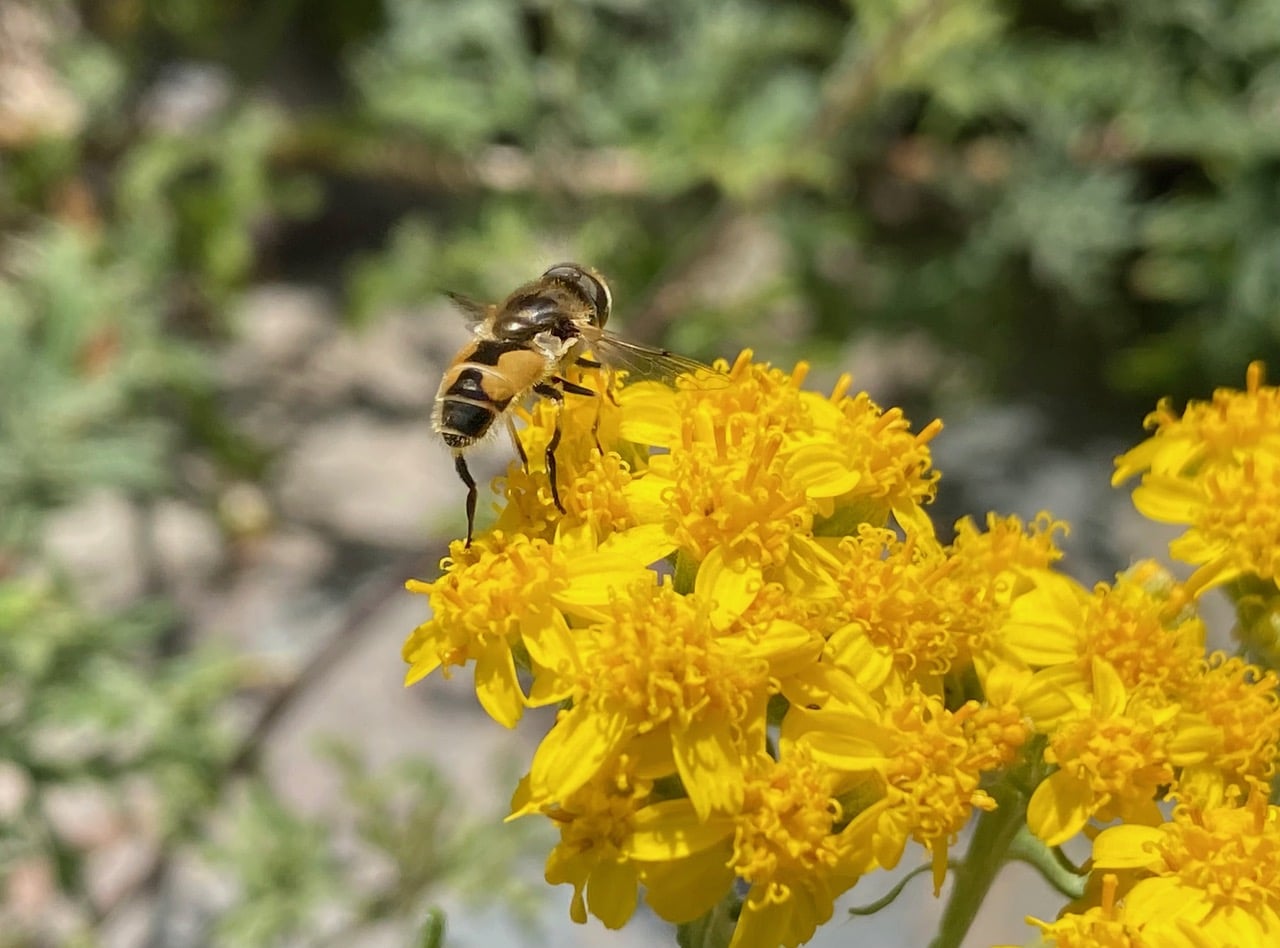
The hover fly has much larger patches of yellow on its abdomen now than I can recall seeing them in the spring.
The amount and size of the yellow patches on the abdomen of Eristalis arbustorum are heavily governed by the temperature it experiences during its pupal stage of development. This phenomenon is a prime example of adaptive phenotypic plasticity. Because cooler temperatures allow more dark melanin pigments to form, individuals that develop in the cooler spring months generally emerge much darker, while summer generations are much paler and yellower. This color variation plays a role in both thermoregulation and mimicry. Being darker helps the fly heat up faster in chilly spring weather, while being yellower during the summer helps them mimic wasps and avoid predators.
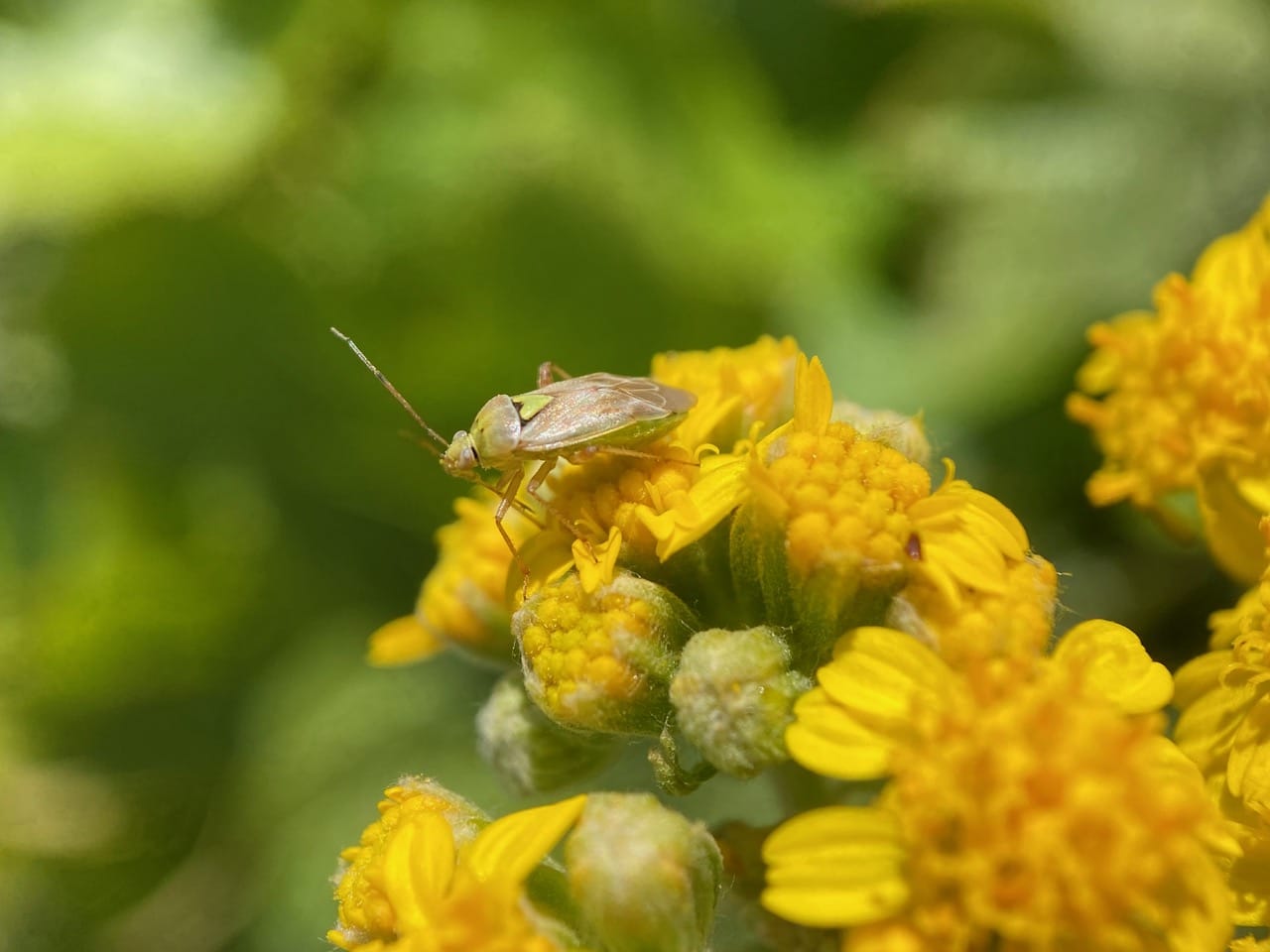
Its needle-like rostrum extended vertically, a pale Lygus Bug, Lygus sp. (family Miridae) is feeding on an inflorescence of Seaside Woolly Sunflower.
Lygus Bugs are small (6-7 mm long), oval-shaped plant bugs (family Miridae), ranging in color from pale green to yellowish-brown or dark brown. They feature a prominent, triangular “V” shape in the center of their back and have long, spindly antennae. Nymphs are wingless, generally pale green, and resemble aphids but lack the backward-facing tubes (cornicles) on their abdomen. They are fast-moving and larger nymphs often have five black spots on their backs. Lygus Bugs are major agricultural pests. They have a massive host range, primarily feeding on flowering crops and common weeds, which act as reservoirs before the insects migrate to commercial fields. Both adults and nymphs use piercing-sucking mouthparts to feed on new growth, buds, and seeds. Their feeding causes severe plant damage, including flower drop, discolored leaves, and deformed fruits or seeds.
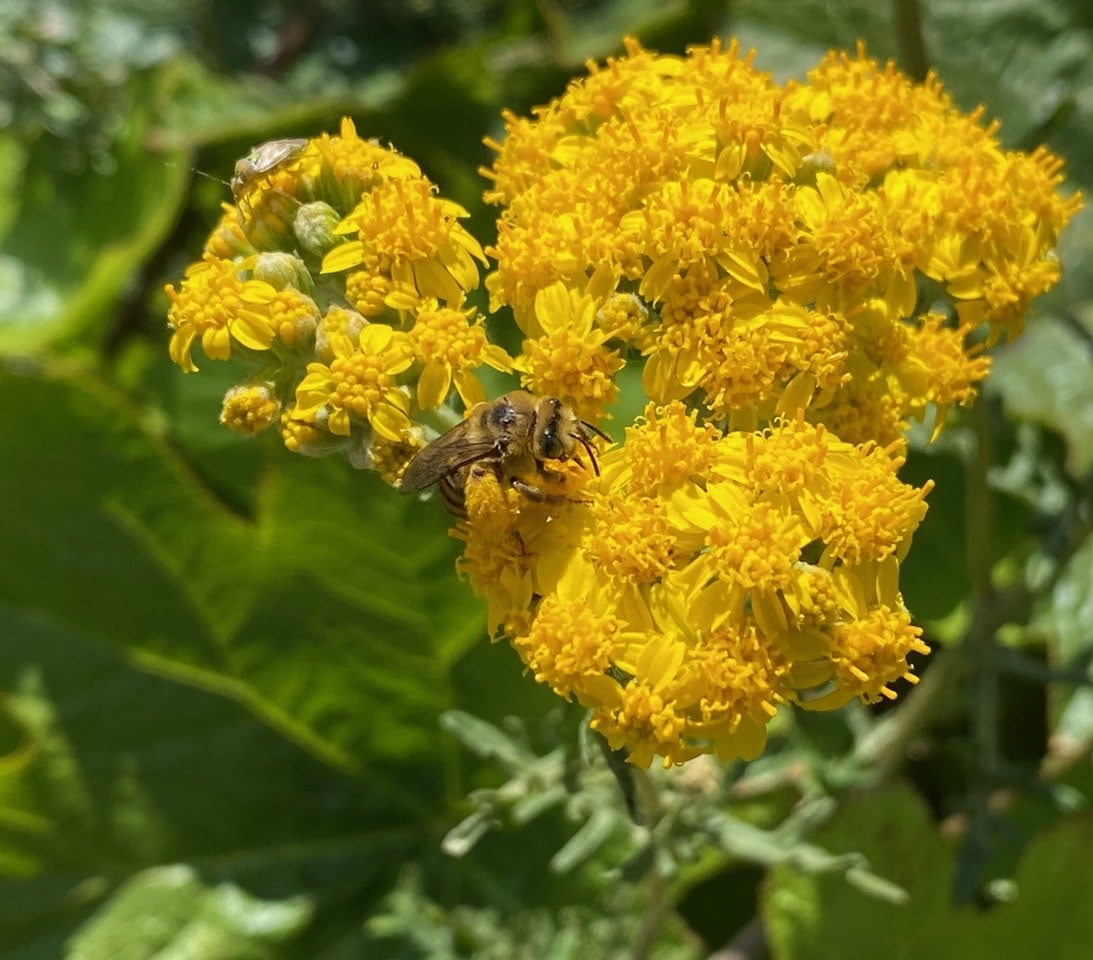
As I am photographing the Lygus Bug, a female Summer Longhorn Bee, Melissodes sp. (family Apidae) suddenly lands on the same inflorescence. Melissodes are pollen specialists on Asteraceae flowers – the females only gather pollen from plants in the sunflower family to provision for their young.

As the female slowly moves around on the cluster of flowers, I can see the fluffy scopae on her hind legs filling up with pollen.
Scopae are specialized, brush-like mats of dense hair on female bees used to collect, hold, and transport pollen back to the nest. They rely on two main mechanisms: plumose hairs (branched, feather-like strands) that trap pollen grains mechanically, and electrostatic attraction. In most solitary bees, these long, stiff hairs are located on the hind legs (specifically on the tibia and femur). Female bees use their legs and body movements to groom and pack the powdery pollen into these brushes. Because scopae are strictly used for gathering larval provisions, they are completely absent in male bees. They are also absent in parasitic “cuckoo bees”, which lay their eggs in the nests of other species and rely on the host’s stored food.
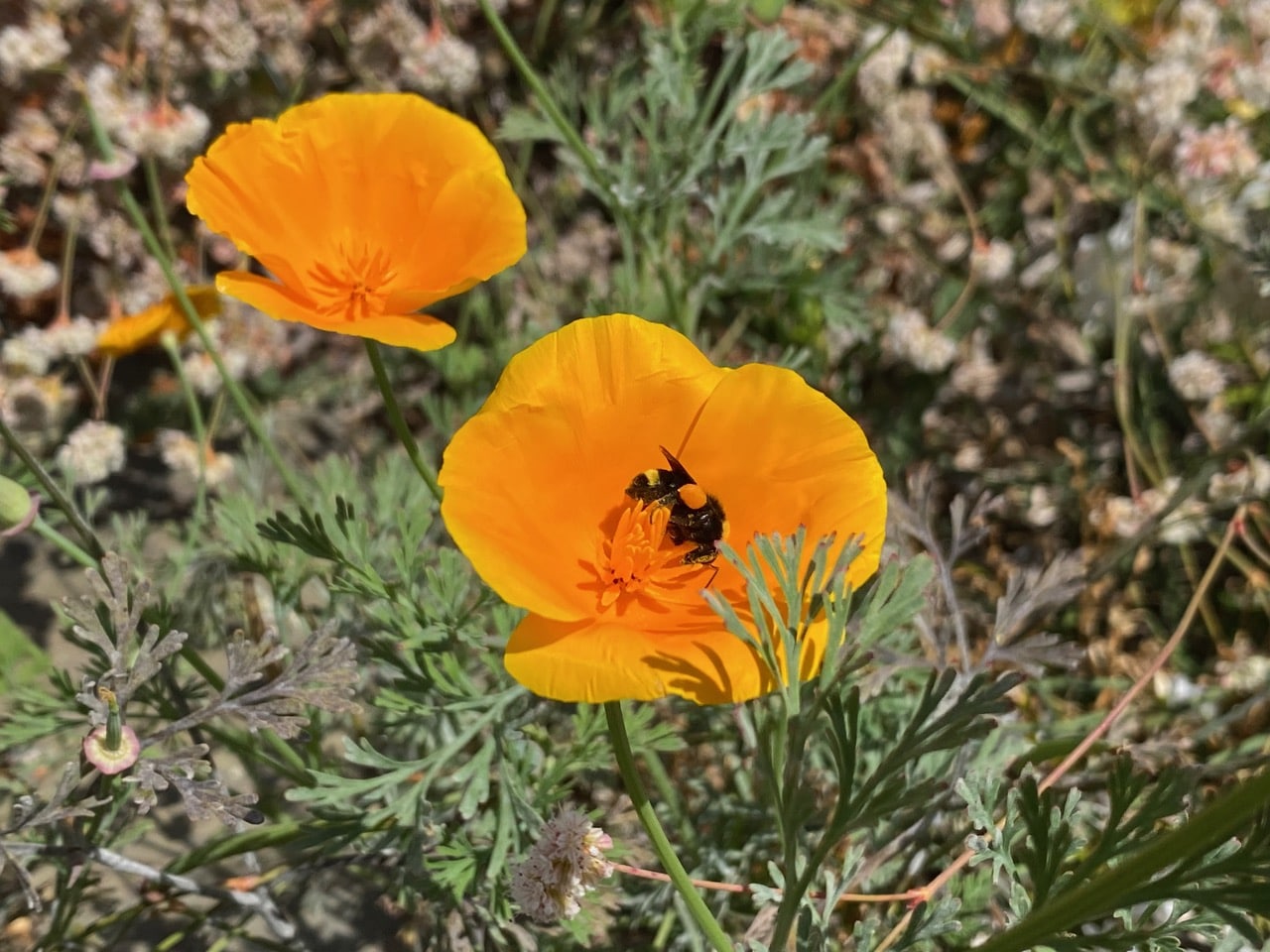
A Yellow-faced Bumble Bee, subgenus Pyrobombus (genus Bombus, family Apidae) is gathering pollen from the anthers of a California Poppy, Eschscholzia californica. She has a big load of pollen in her corbiculae (pollen baskets).
The pollen collecting apparatus in Apidae bees, which include honey bees and bumble bees, is commonly called a “pollen basket” or corbicula. This region is located on the tibia of the hind legs and consists of hairs surrounding a concave region. After the bee visits a flower, she begins to groom herself and brushes the pollen down toward her hind legs and packs the pollen into her pollen basket. A little nectar mixed with the pollen keeps it all together like putty, and the stiff hairs surrounding the pollen basket hold it in place. Remarkably bees are able to fly while carrying up to a third of their body weight in pollen.
.jpg)

A Metallic Sweat Bee, Lasioglossum (Dialictus) sp. (family Halictidae) is foraging on an inflorescence of Red-flowered Buckwheat, Eriogonum grande var. rubescens.
Lasioglossum species are found worldwide, and they constitute the largest bee genus. The subgenus Dialictus are the most likely to be seen in the U.S., with over 300 species of these tiny metallic bees. The majority of Lasioglossum are generalists. Because they are so abundant throughout the flowering season, the bees are often important pollinators. Their sheer numbers are enough to achieve excellent pollination of many wild flowers, especially of plants in the Asteraceae, which have shallow floral tubes that are easily accessed by these minute bees.
Lasioglossum exhibit a range of social behaviors; the genus includes solitary, communal, semi social, primitively eusocial, and even parasitic species. Almost all Lasioglossum in the U.S. nest in the ground. Generally these nests are built in the spring by fertilized females (called foundresses) that spent the winter in hibernation. In social species, the foundresses behave much like the queen bumble bees – they lay the first batch of eggs that develop into the first generation of female workers. The nest grows with each additional generation of bees. Later broods may consist of both males and females. They mate, and at the end of the season the fertilized females hibernate til the following spring, repeating the life cycle of the colony.

A patch of California Goldenrod, Solidago velutina ssp. californica is blooming gloriously by the side fence.
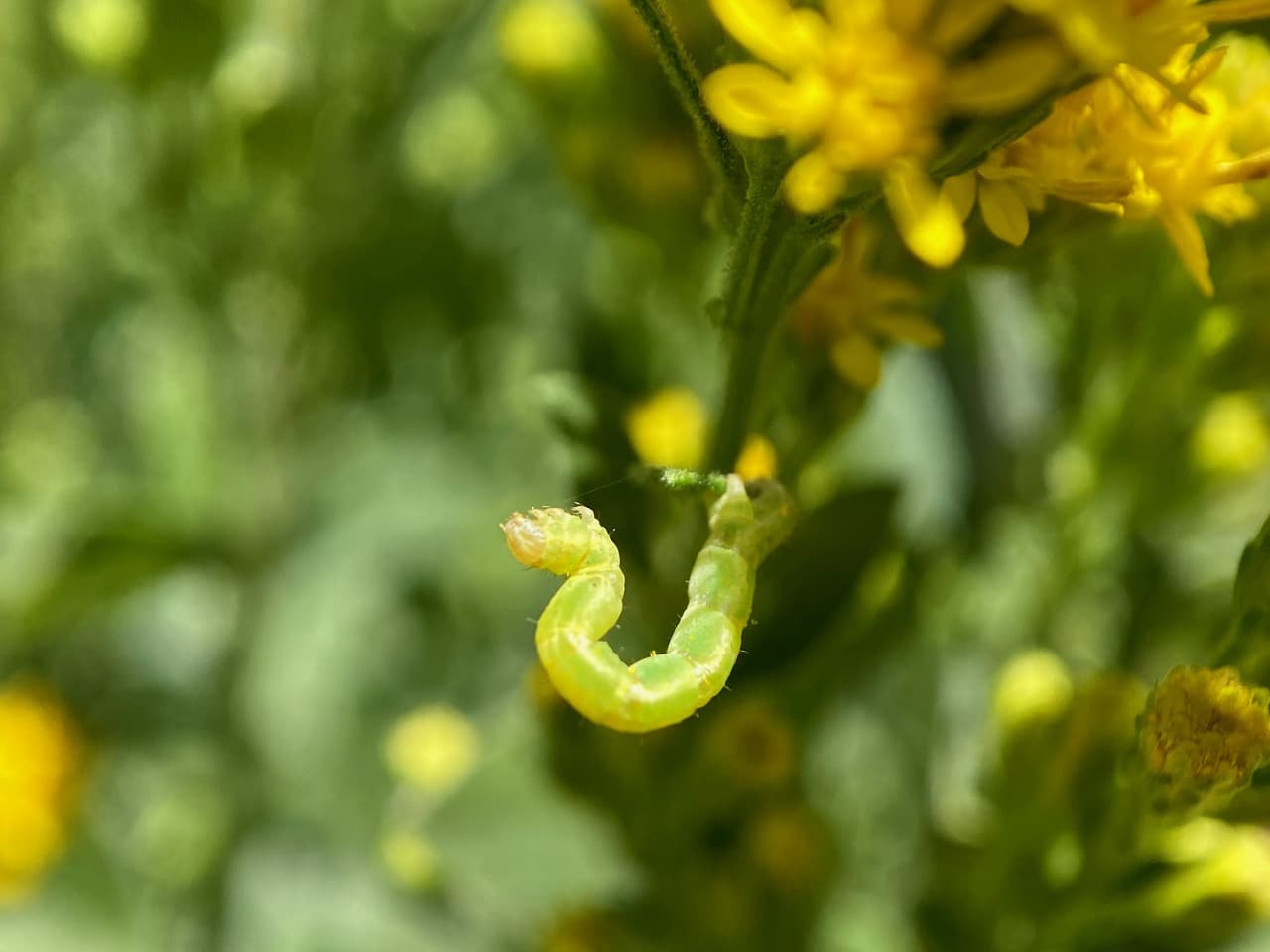
I am disappointed to find little insect activity on the goldenrod flowers. Spotting a small movement under a cluster of flowers, I zoom in on a plump, green Inchworm that has reared up from a leaf. Note the three pairs of true legs right behind its head, and the absence of prolegs along the length of its body. I am not sure what kind of moth caterpillar it is.
Inchworms are also called loopers and measuring worms. The majority of the inchworms are the larvae of moths in the family Geometridae. The name comes from the Greek “geo” for earth and “metro” from measure, because the caterpillars seem to be measuring the surface on which they are walking.
All caterpillars have three pairs of jointed legs behind their heads. These legs are called true legs because they will become the six legs of the adult butterfly or moth. There are additional appendages, called prolegs, along their bodies. Prolegs are not true legs, they are just outgrowths of the body wall and will be lost at metamorphosis. They have little hooks on their soles to help the caterpillar walk and grip onto things.
Most caterpillars have five sets of prolegs, four in the middle of the body and one pair at the hind end. Inchworms have the normal six true legs but only two or three pairs of prolegs, all located at the tail end of the body, with none in the middle. When an inchworm walks, it moves its tail-end prolegs up behind its true legs, causing the center of its body to loop upward. Then it stretches its front end forward to take another step.
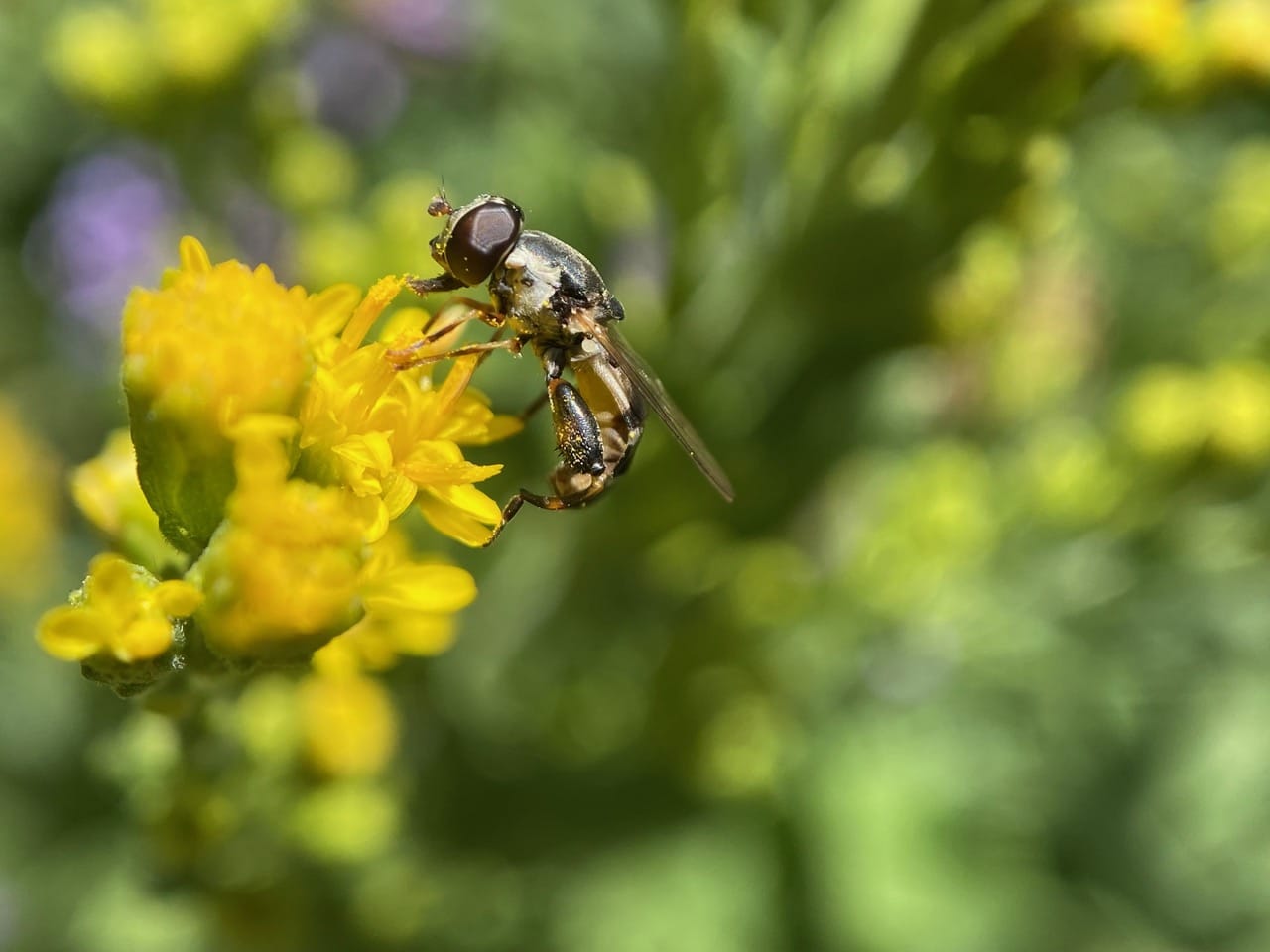
A Thick-legged Hover Fly, Syritta pipiens (family Syrphidae) has landed to sample pollen on a cluster of flowers of California Goldenrod. Note its much enlarged hind femur.
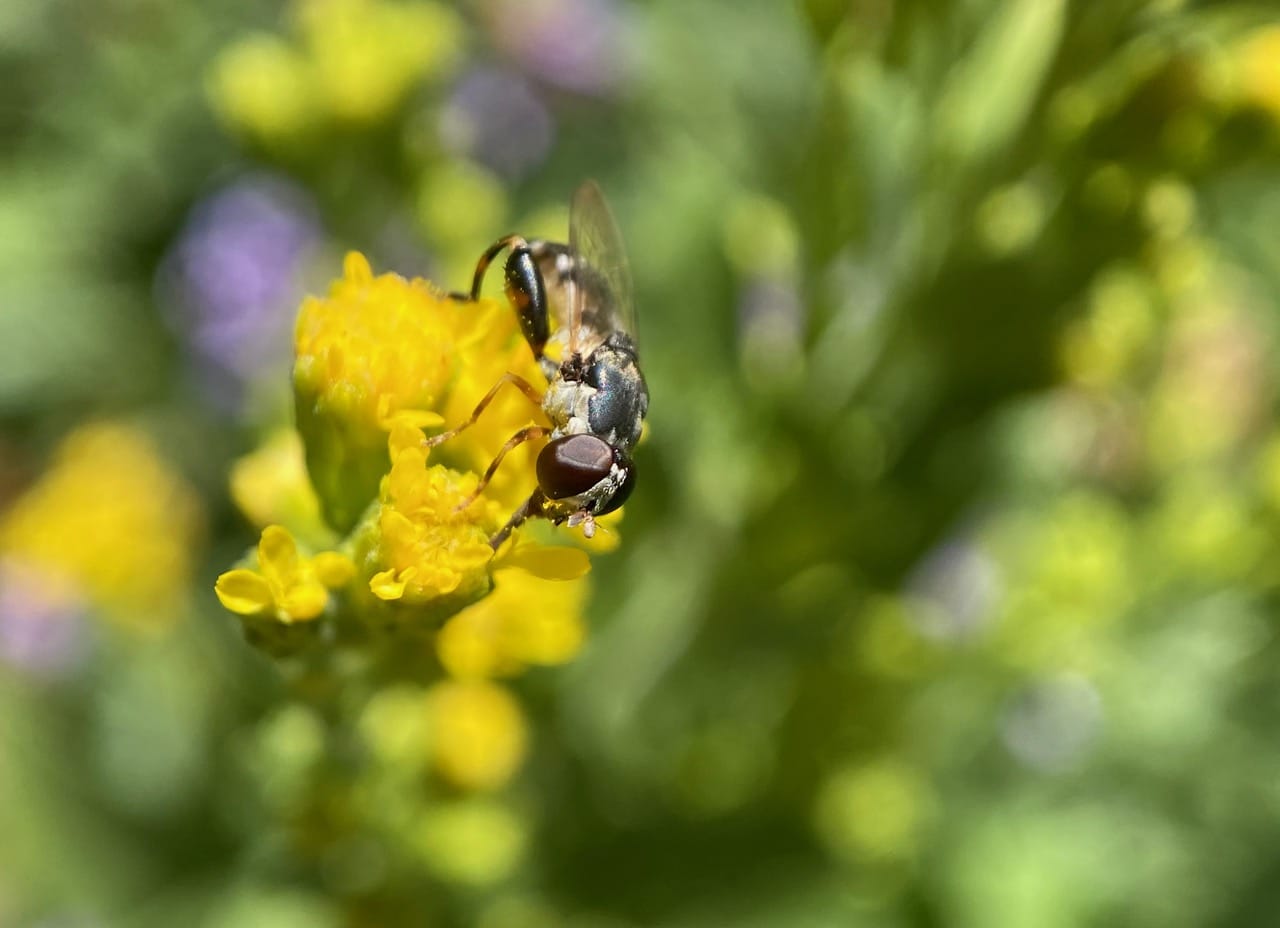
Syritta pipiens originates from Europe and is currently distributed across Eurasia and North America. They are fast and nimble fliers. The fly has an elongate body about 6.5 – 9 mm long, and has distinctly enlarged hind femora which gives it its common name. The species flies at a very low height, rarely more than 1 m above the ground. Adults visit flowers – males primarily to feed on nectar, and females to feed on protein-rich pollen to produce eggs. The species is found wherever there are flowers. It is also anthropophilic, occurring in farmland, suburban gardens, and urban parks. Larvae are found in wetlands that are close to bodies of freshwater such as lakes, ponds, rivers, ditches. Larvae feed on decaying organic matter such as garden compost and manure. Males often track females in flight, ending with a sharp dart towards them after they have settled, aiming to attempt forced copulation. Syritta pipiens primarily overwinters in the larval stage, entering a dormancy state (diapause) as 3rd instar larvae, usually hidden in damp decaying plant matter, compost, or manure. The larvae complete their development and pupate in the spring, emerging as adults from March through November. While they do not migrate hundreds of miles, Syritta pipiens shows seasonal localized abundance, peaking in mid-summer. Adults continually disperse to find new, ephemeral breeding and feeding sites.