

Pollinator Post 7/12/26 (1)

Three days ago, when I walked this stretch of Thompson Ave. in Alameda, I have encountered dozens of male Summer Longhorn Bees, Melissodes sp. (family Apidae) mobbing a patch of Coreopsis flowers. I have wondered where these males have slept. It would be fun to find their sleeping aggregations. Taking advantage of similar cloudy conditions, I venture out to the same neighborhood this morning.
Alas, today is a much warmer day, and by the time I get to the spot, all the bees are already flying around. This male lands momentarily to sip nectar from a Coreopsis flowerhead.
The Summer Longhorn Bees, Melissodes sp. (family Apidae) are medium to large bees, stout-bodied, usually with gray hair on the thorax and pale hair bands on the abdomen. Males usually have yellow markings on their faces and have very long antennae from which their common name is derived. They are active May to September, with peak flight in late June to early August. The females prefer flat, bare ground for digging their solitary nests, though they sometimes nest in aggregations. Pollen is transported in scopae on the hind legs. Pollen loads are often copious and brightly colored and thus very distinguishable. Melissodes are specialists on Asteraceae – females gather pollen from flowers of Aster, Bidens, Coreopsis, Cosmos, Encelia, Gaillardia, Helianthus, and Rudbeckia ssp.
Male bees do not participate in nest construction, so at the end of the day they don’t have a home to return to. They usually sleep out in the open, mainly on vegetation. The male Longhorn Bees are well-known to gather and sleep in aggregations. Apparently there is safety in numbers – when one is attacked by a predator, the others are alerted right away and are able to escape.

A Monarch butterfly, Danaus plexippus (family Nymphalidae) has landed on some garden shrubbery. The butterfly must have traveled from a distance. I have never seen any Milkweed in the front gardens on this street, but maybe someone has them in the backyard.
While they can take nectar from a wide variety of flowers, Monarch females will only lay their eggs on milkweed because it is the only food source their caterpillars can digest. The plant also provides crucial chemical defenses; the larvae ingest and sequester milkweed toxins (cardiac glycosides), making them unpalatable and poisonous to predators throughout their life. Female monarchs have adapted specialized receptors on their legs and antennae to taste and detect the specific chemical signatures of milkweed, ensuring they never misplace their eggs. The adults utilize aposematism – the use of bright, contrasting colors to warn predators of toxicity. Their iconic orange and black wings signal that they are unpalatable and potentially harmful, allowing them to survive encounters with birds and other animals.

A European Paper Wasp, Polistes dominula (family Vespidae) is searching high and low on a Lantana plant, probably hunting for caterpillars.
Native to Europe, the European Paper Wasp, Polistes dominula, is a social insect that produces an annual colony in a paper nest. Individual colonies are established anew each spring. The overwintering stage are mated females (queens). The overwintered queens emerge from sheltered spots in spring and search out sites to establish a new colony. Nests are constructed of paper, produced from chewed wood fibers of weathered fences, porch decks and other similar sources. Larvae are fed crushed insects, usually caterpillars. As the population increases, the original queen increasingly remains in the nest as new workers take over colony activities. A few of the wasps produced later in summer are males and increasing numbers of the females become sexually mature. Mating occurs and the mated females are the surviving overwintering stage. Males and non-reproductive females do not survive winter and the nest is abandoned by late fall. European Paper Wasps will sometimes feed on sweet materials, including honeydew produced by aphids. They may also feed on damaged ripe fruits. Because of their habit of hunting caterpillars, the wasps have become one of the most important natural controls of garden pests.
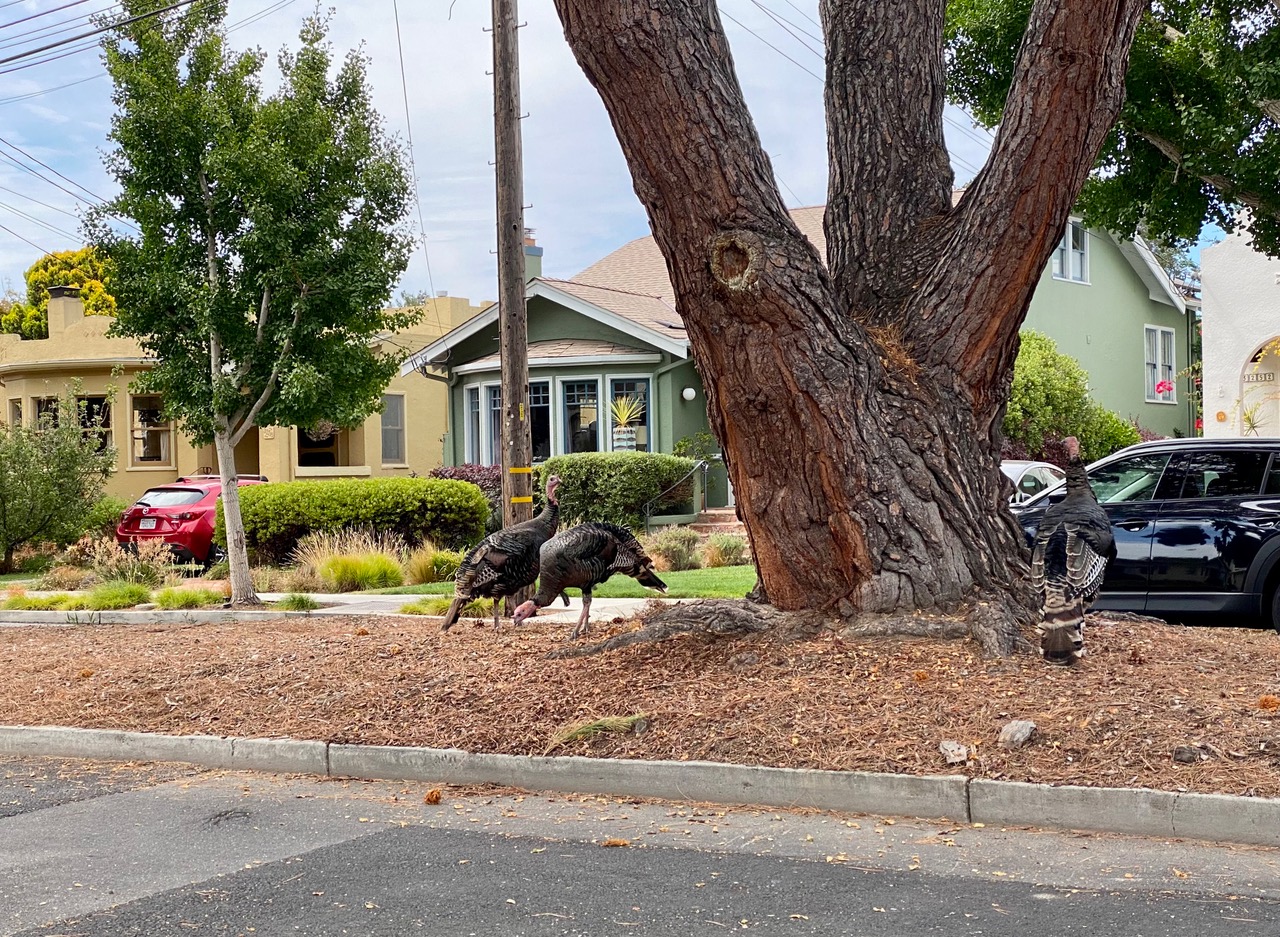
When I look up, I realize that I have company. A small flock of Wild Turkeys is slowing making its way across the road, lingering on the median under the large trees to preen themselves.
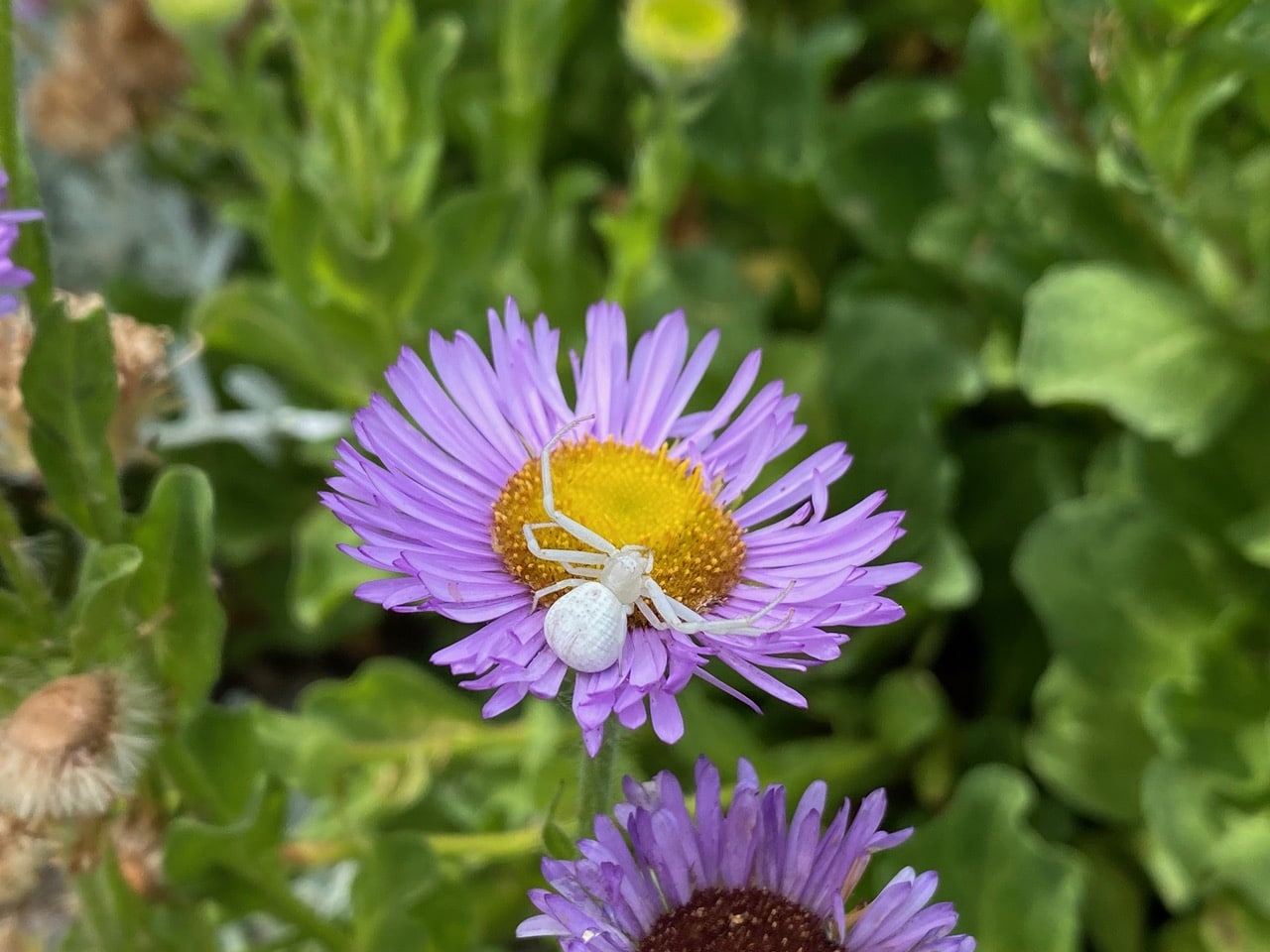







It doesn’t take me long to get to Jenny and Craig’s garden. The large Crab Spider, Misumena sp.(family Thomisidae) I saw 3 days ago is still in the same spot, having only moved to an adjacent, fresher flower. I think her chances of nabbing a pollinator is much improved here.
Crab Spiders (family Thomisidae) do not spin webs for trapping prey. They are ambush predators that sit and wait on or by flowers to grab the insect that blunders into the reach of their extra long front legs. These spiders are usually yellow or white. This ultimately depends on the flower on which these ambush predators are hunting (active camouflage). They have the ability to change between these colors based on their surroundings, using visual cues. The color change is not immediate, but takes place over days or weeks.
There’s another trick that the spider might be playing that we are not aware of because we cannot see in the ultraviolet (UV) spectrum of light. It’s been discovered that Crab Spiders reflect UV light strongly. Most insects, notably bees, see UV well, and favor sunlit flowers while foraging. Experiments have shown that flowers that have crab spiders sitting on them actually garner more insect visits than those that don’t! It is thought that perhaps color camouflage in the visible spectrum helps the spiders avoid vertebrate predators (birds, lizards, etc.), while the UV reflectance is useful for attracting insect prey.
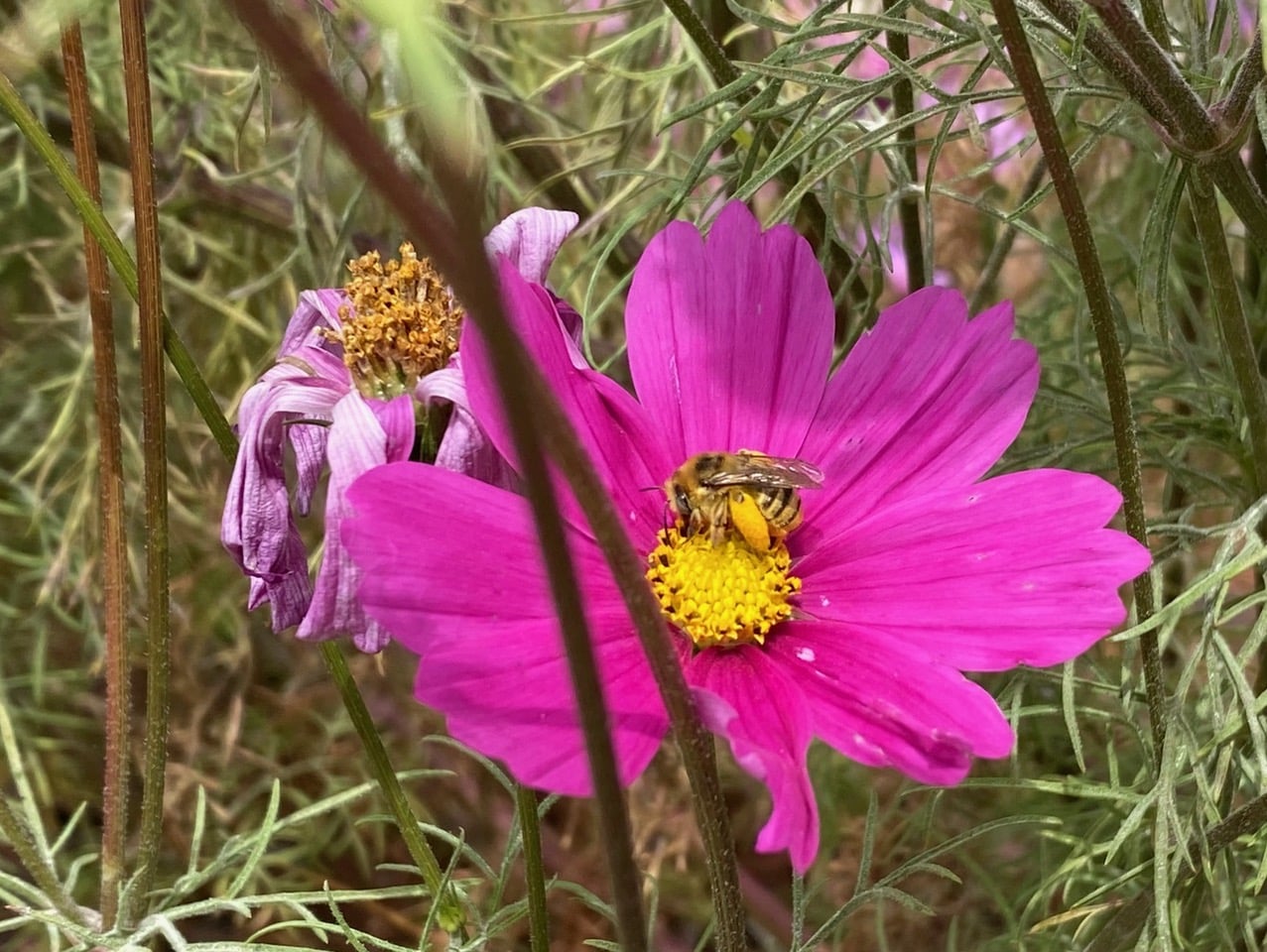
A female Summer Longhorn Bee, Melissodes sp. (family Apidae) is foraging on a Cosmos flowerhead. Note the large load of pollen in her prodigious scopae (special pollen collecting hairs). When you see a bee carrying this huge load of pollen in the summer, you are likely to be correct in assuming it is a female Melissodes. No other bees in our area have such impressive scopae (except for the Bindweed Turret Bees, Diadasia bituberculata, which are not as commonly seen).
A similar bee on that other Cosmos flowerhead does not have large scopae on its hind legs…
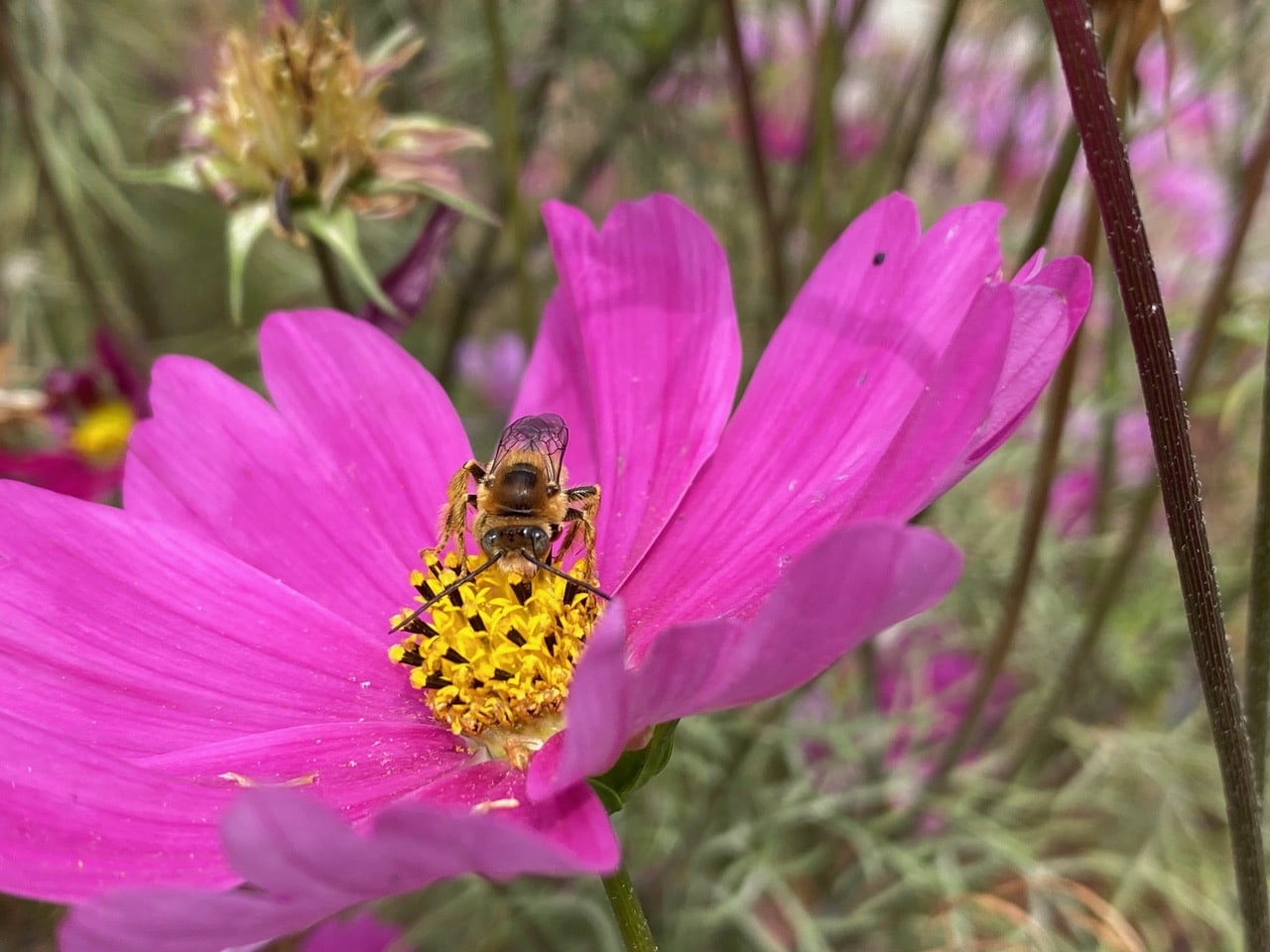
….. That’s because it is a male Summer Longhorn Bee, Melissodes sp. (family Apidae). Males do not collect pollen to provision for the young, neither do they have the equipment for the job.
Males do visit flowers for nectar, and in doing so may pick up pollen incidentally that is transferred to subsequent flowers they visit. They can be good pollinators too.
The Coyote Mint, Monardella villosa is blooming in profusion. At my approach, a female Summer Longhorn Bee taking nectar on an inflorescence suddenly lifts off into the air. Since she is a pollen specialist on Asteraceae (sunflower family), she was not collecting pollen from the Coyote Mint (mint family, Lamiaceae).
A Honey Bee, Apis mellifera (family Apidae) is reaching deep into an inflorescence of Coyote Mint. She too, seems to be seeking only nectar. Pollen is borne on the long stamens that protrude from the tightly packed flowers.
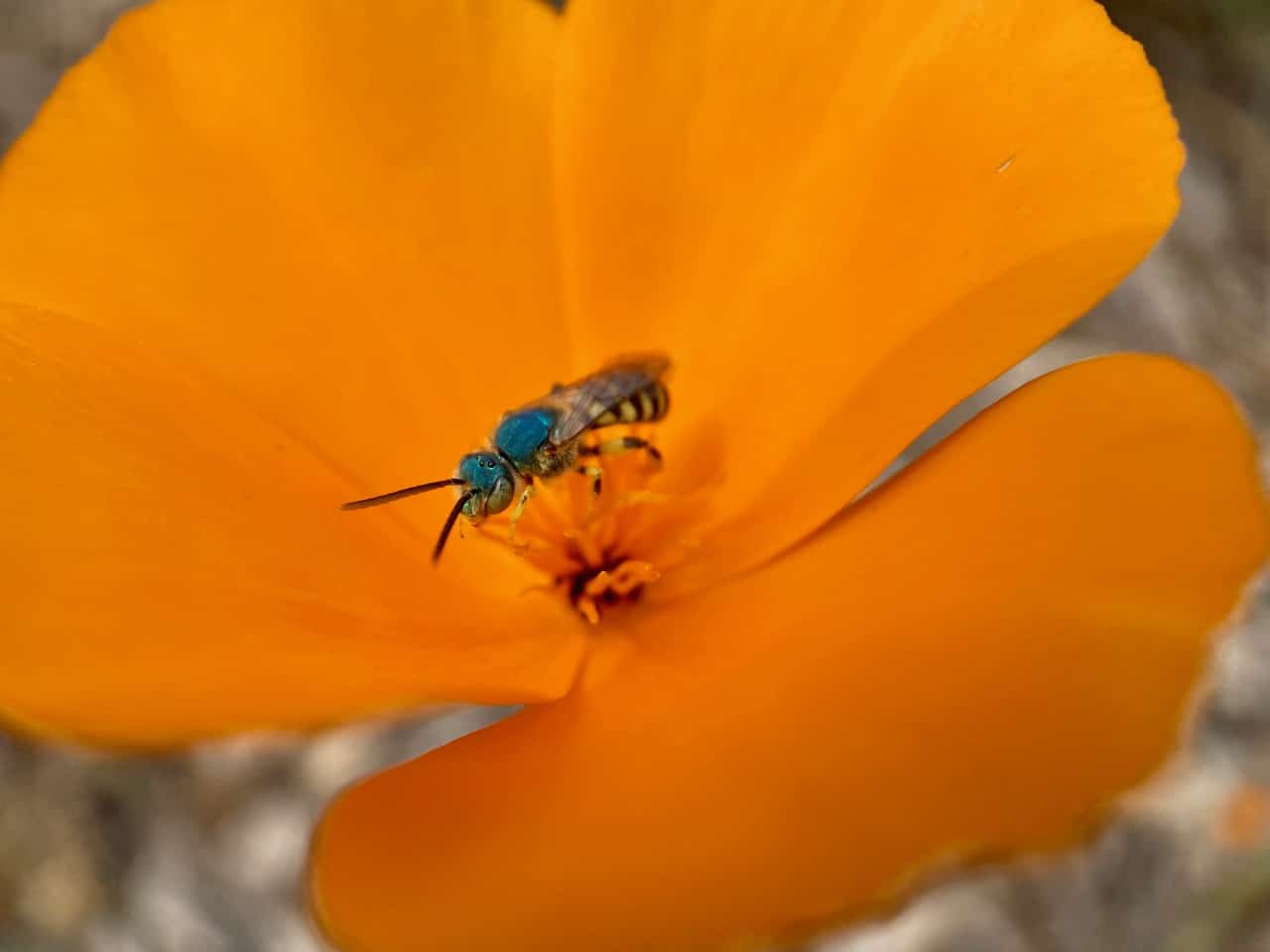
A male Fine Striped Sweat Bee, Agapostemon subtilior (family Halictidae) is exiting a California Poppy. Males do not collect pollen, so what was he doing in the flower? California Poppy does not produce nectar.
The same bee enters the next poppy flower and forages on the anthers. I am rather surprised to see this – do these adult bees feed on pollen? Pollen is usually considered high-protein food that bees gather for their young.
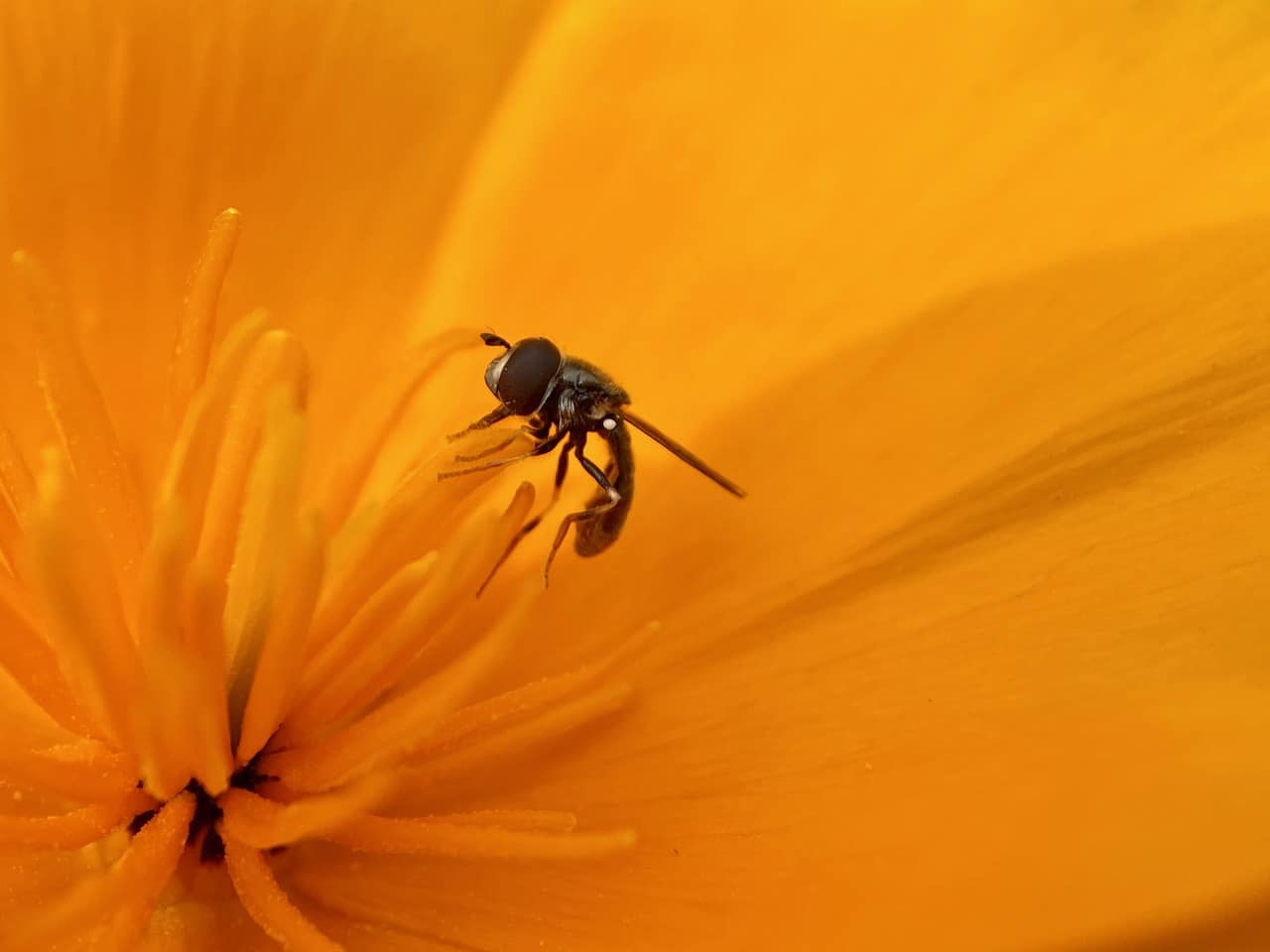
The small insect feeding on the anthers of the poppy flower is easily recognizable from its mere silhouette. The minute size of the fly, the oversized head and hunched posture are characteristic of the Common Grass Skimmer, Paragus haemorrhous (family Syrphidae).
The Common Grass Skimmer, Paragus haemorrhous (family Syrphidae) is the smallest hover fly I know, measuring only about 4 mm in length. The species has a world-wide distribution, found in unimproved grasslands, dune grass, open areas and pathsides in forest, and meadows. Adults visit flowers for nectar and pollen. Larvae feed on aphids on low herbaceous plants.
Photos of Common Grass Skimmer (Paragus haemorrhous) · iNaturalist
Whoa, what’s a pollinator to make of this? Do insects get sensory overload, like I do? Photographing insects is not going to be easy in this busy corner of Jenny and Craig’s front yard!
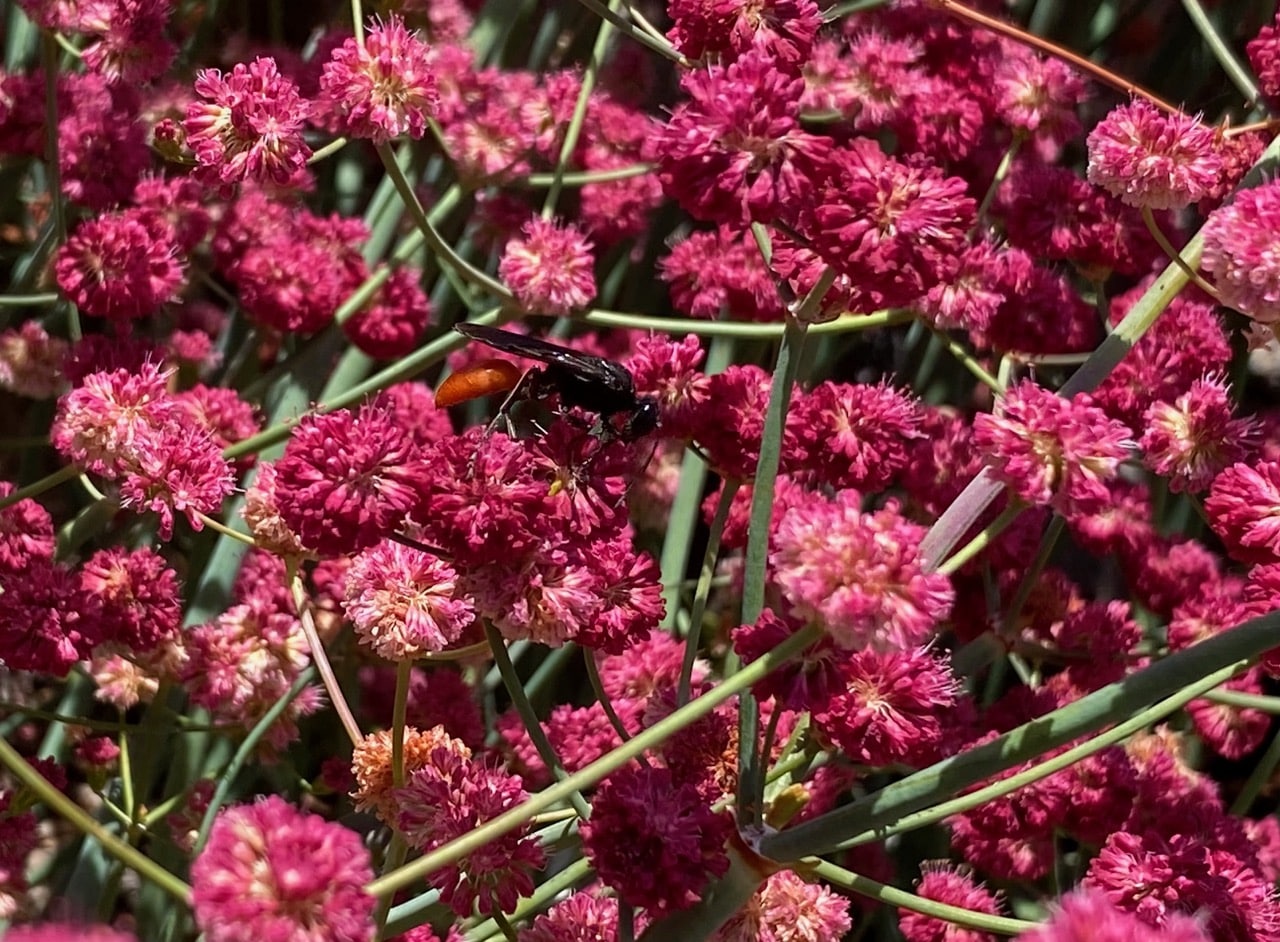
A large black wasp with orange abdomen is hardly visible among the riot of flowers of the Red-flowered Buckwheat, Eriogonum grande var. rubescens.
Amazingly iNaturalist’s Computer Vision is able to detect the insect and correctly identify it as a Thread-waisted Burrowing Wasp, Sphex lucae (family Sphecidae).
The Sphecidae are solitary wasps with elongated and narrow first abdominal segment, giving rise to the common name Thread-waisted Wasps. Sphex lucae is a widespread western species, ranging from WA in the north, south to CA, and east to TX. The species exhibits sexual dimorphism – females are black with a red abdomen, while the males are all black. Adults visit many types of flowers for nectar. Females hunt katydids and grasshoppers as food for their young. The wasp excavates a single-celled burrow in the soil in advance of hunting activities. She drags her paralyzed prey back to the burrow, laying a single egg on the victim. The nest entrance is then sealed and the process is repeated. Males of this species spend nights in sleeping aggregations in sheltered places such as beneath a rock overhang.
Is that a male Sphex lucae coming around the buckwheat inflorescence?

The all-black wasp sure looks like a male Sphex lucae, but the shape of the abdomen is wrong, and instead of iridescent black wings, this wasp has smokey brown wings. Pale soft hairs appear like an aura around its thorax and head. It is a Mexican Grass-carrying Wasp, Isodontia mexicana (family Sphecidae). I think this is the first time the charismatic species is documented for this garden!
The Mexican Grass-carrying Wasp, Isodontia mexicana is a species of wasps belonging to the family Sphecidae. It is mainly found throughout North America, but has become established in Europe. Like others in the Sphecidae family, Grass-carrying Wasps have a very narrow section (thread waist) connecting their abdomen to their thorax. The adults grow up to 18-20 mm long, the body is completely black, thorax is quite hairy and the wings have a smoky-brown color. They are often seen from early summer through September. Females are larger and emerge as adults later in the season than males. The wasps frequent woodland edges, gardens, meadows, old fields and farms.
After emerging from their natal nest, females mate with males and begin nest construction. These wasps build their nests in preexisting cavities such as hollow stems or in other natural cavities, often reusing the nests of other species. Females typically use pieces of grass to line their nests and make divisions inside the cavity for the developing larvae. Using her mandibles, the female wasp cuts a grass blade, then flies back to her nest carrying it in her mandibles. She coils the blades to form partitions between the brood cells or to plug the end of the nest cavity.
Isodontia mexicana mainly preys on grasshoppers (usually katydids, Tettigoniidae species) or tree crickets (Gryllidae species) to feed their young. The female stings the victim, then clutching the paralyzed prey underneath her, she carries it back to the nest. Once a brood cell is provisioned with enough prey, she lays an egg. When the food provisions are entirely consumed, each larva spins a cocoon in which it overwinters in prepupal or pupal state. Development continues the following spring with the adults emerging in July.
An American Sand Wasp, Bembix americana (family Crabronidae) is foraging on the flowers of Red-flowered Buckwheat.
Sand wasps in the genus Bembix are familiar and common throughout North America, digging their burrows in dunes, on beaches, and other habitats with loose, deep sand. The female rapidly kicks out large quantities of sand using a “tarsal rake” of spines on each front leg. The burrow is excavated before the wasp goes hunting. Bembix are generalist, opportunistic hunters. True flies in the order Diptera are the usual prey. A victim is paralyzed or killed by the wasp’s sting, and is then flown back to the nest. Most species will lay an egg on the first victim, while some species lay an egg in the empty cell before starting to hunt. Once the egg hatches, mama wasp brings flies to her larva as needed. This “progressive provisioning” is rare in the insect world. When the larva reaches maturity, mama wasp closes the cell. Inside, the larva spins an oblong cocoon, weaving sand grains into the structure and resulting in a hardened capsule. Overwintering takes place as a prepupa inside this cocoon, but there are usually two generations a year.
Male sand wasps often engage in an elaborate flight ritual called “sun dances”. Males emerge before females, and fly erratically at dizzying speed one or two inches above the ground attempting to detect virgin females about to emerge from their underground nests. Both sexes are often seen taking nectar at flowers, especially from Asteraceae family. Bembix wasps are often victims of other insects such as cuckoo wasps (Chrysididae), velvet ants (Mutillidae), satellite flies (Sarcophagidae), bee flies (Bombyliidae), and thick-headed flies (Conopidae).
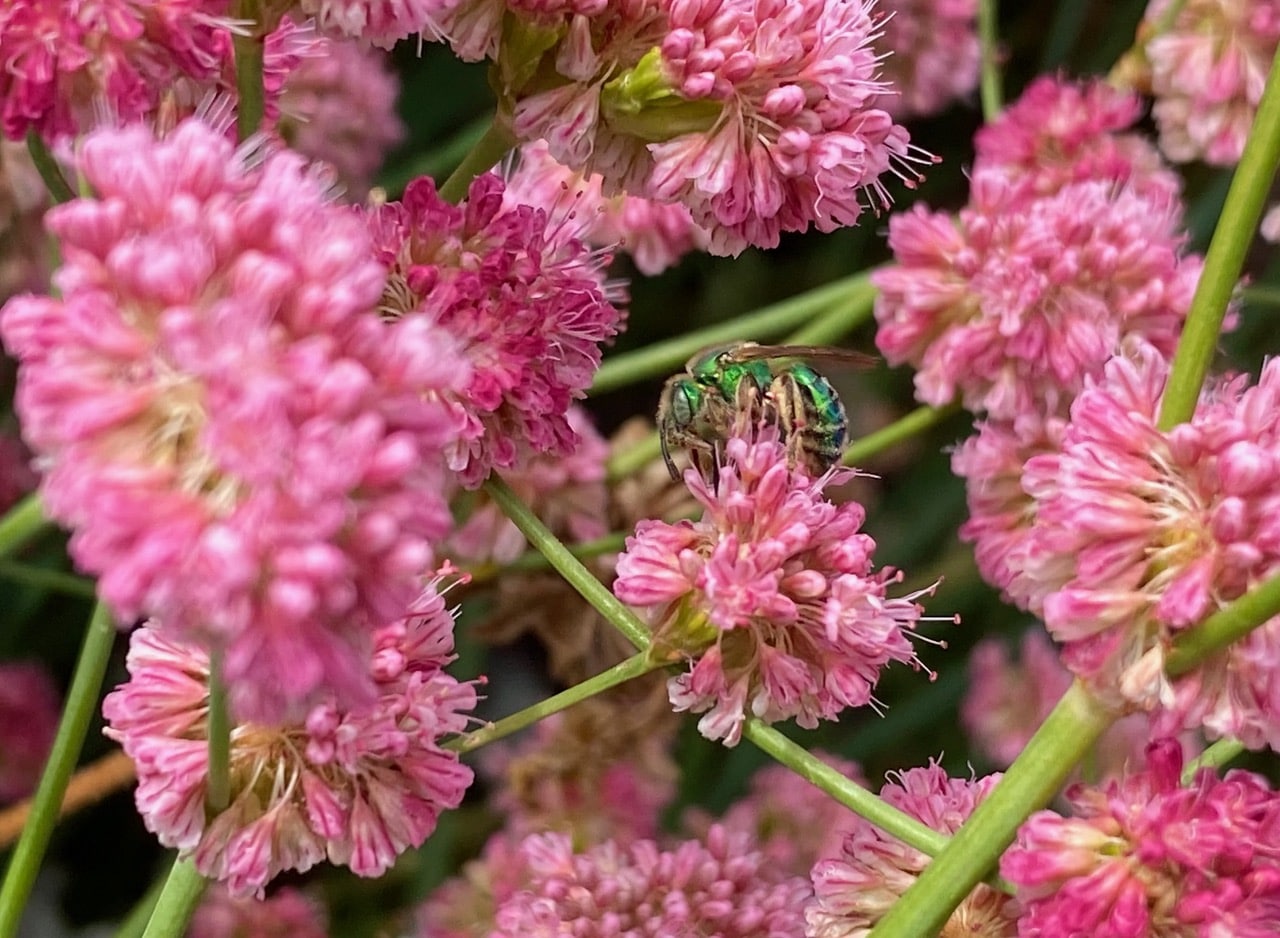
A female Fine Striped Sweat Bee, Agapostemon subtilior (family Halictidae) is taking nectar on an inflorescence of Red-flowered Buckwheat, Eriogonum grande var. rubescens.
The Fine Striped Sweat Bee, Agapostemon subtilior is a small, widespread species found across North America. They are active from late spring to fall, with all-green females measuring roughly 11 mm, and males (slightly smaller) displaying a black-and-yellow striped abdomen. Like other Agapostemon bees, they are solitary ground-nesters, and are polylectic, foraging from a wide variety of flowers.