

Pollinator Post 7/12/25 (2)

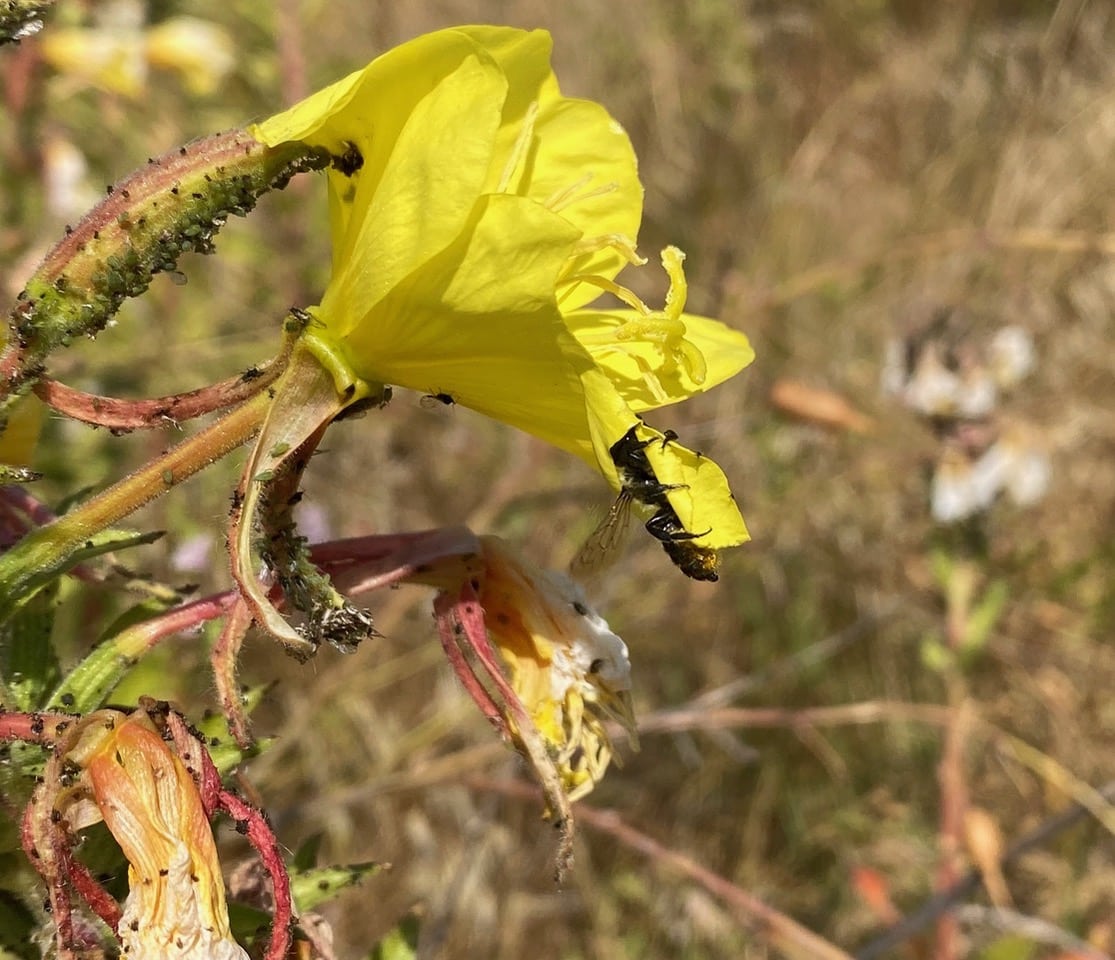
As I look up, I spot a dark insect enter a Tall Evening Primrose flower and head for nectar at the base.
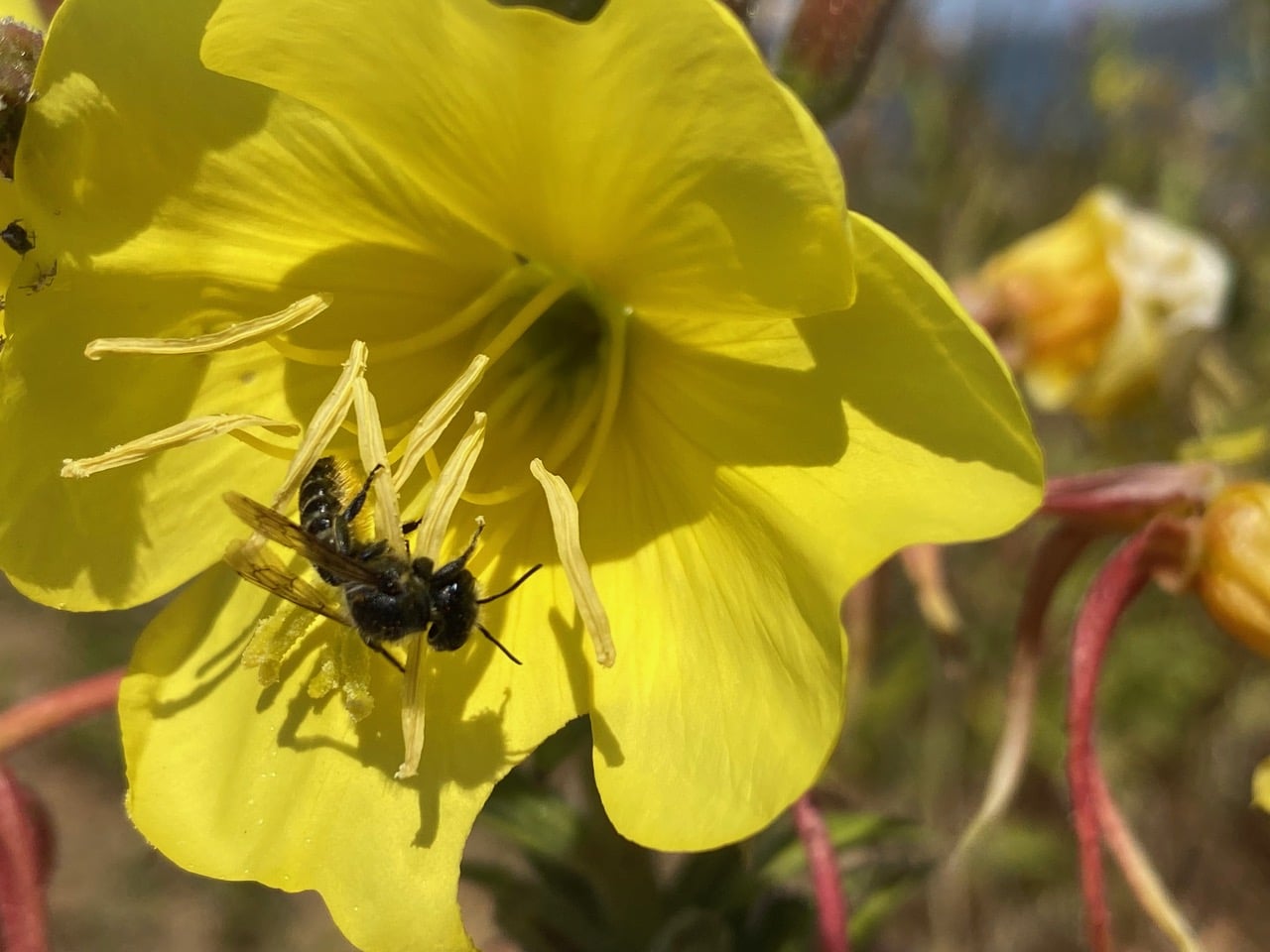
As the bee emerges it clings to the stamens for a moment. Note the brush of short yellowish hairs under its abdomen. It is a member of the family Megachilidae! Note that the anthers of the flower are clean. There’s hardly any pollen left in them, little of the sticky, stingy pollen attached to viscin threads typical of evening primrose.
The family Megachilidae includes some of our charismatic bees such as the Leafcutter Bees (Megachile), the Mason Bees (Osmia), and the Woolcarder Bees (Anthidium). Their common names reflect the materials with which the bees build their nest cells (leaves, soil, plant fibers respectively). The scientific name Megachilidae translates as “large lipped” in Greek, referring to their large lips and strong jaws that are well-suited for collecting of nest-building materials. The family represents 15-20% of named species of bees. They are all solitary bees, and most build their nests in above-ground cavities. Characteristic traits of this family are their typically elongated labrum, and the way the females carry pollen – in a scopa (special pollen-collecting hairs) on the underside of the abdomen. (The labrum, often called the “upper lip”, is a flap-like structure that helps hold food in place during feeding. It is located at the front of the insect’s head, above the mouth opening.) The motion of Megachilidae in pollen gathering is energetic and swimming-like; this agitation releases large amounts of pollen from the flower’s reproductive structures.
Because they are mostly above-ground nesters and more easily attracted to artificial nests, megachilid bees (especially Osmia) are extensively studied for their commercial possibilities.

iNaturalist has helped identify the bee as the Silver-tailed Petalcutter, Megachile montivaga (family Megachilidae).
Leaf-cutter Bees, Megachile sp. (family Megachilidae) are stout-bodied, usually with pale hair on the thorax and stripes of white hairs on the abdomen. Females usually have a triangular abdomen with a pointed tip, and males’ faces are covered with dense, pale hair. Flight season is from May into September, with peak activity from June to August. Solitary females construct nests in tubular cavities, including hollow stems, tree holes, and abandoned beetle burrows in wood. Many use holes drilled into wood, straws, or other manufactured tunnels. Females cut pieces from leaves or flower petals for use in the construction of brood cells. Most Megachile females are generalists when foraging for pollen. Pollen is transported in dense scopa on the underside of the abdomen.
The Silver-tailed Petalcutter, Megachile montivaga (family Megachilidae) is found from California to Nova Scotia, south to Mexico, Illinois and North Carolina. Females measure 11-13 mm, and has yellowish ventral abdominal scopa. Males are smaller, 9-11 mm. Flight time is June to September. The species collects petals, rather than leaves, for nest building. The bee may preferentially nest in soil, uncommon compared to most members of the subgenus Megachile.
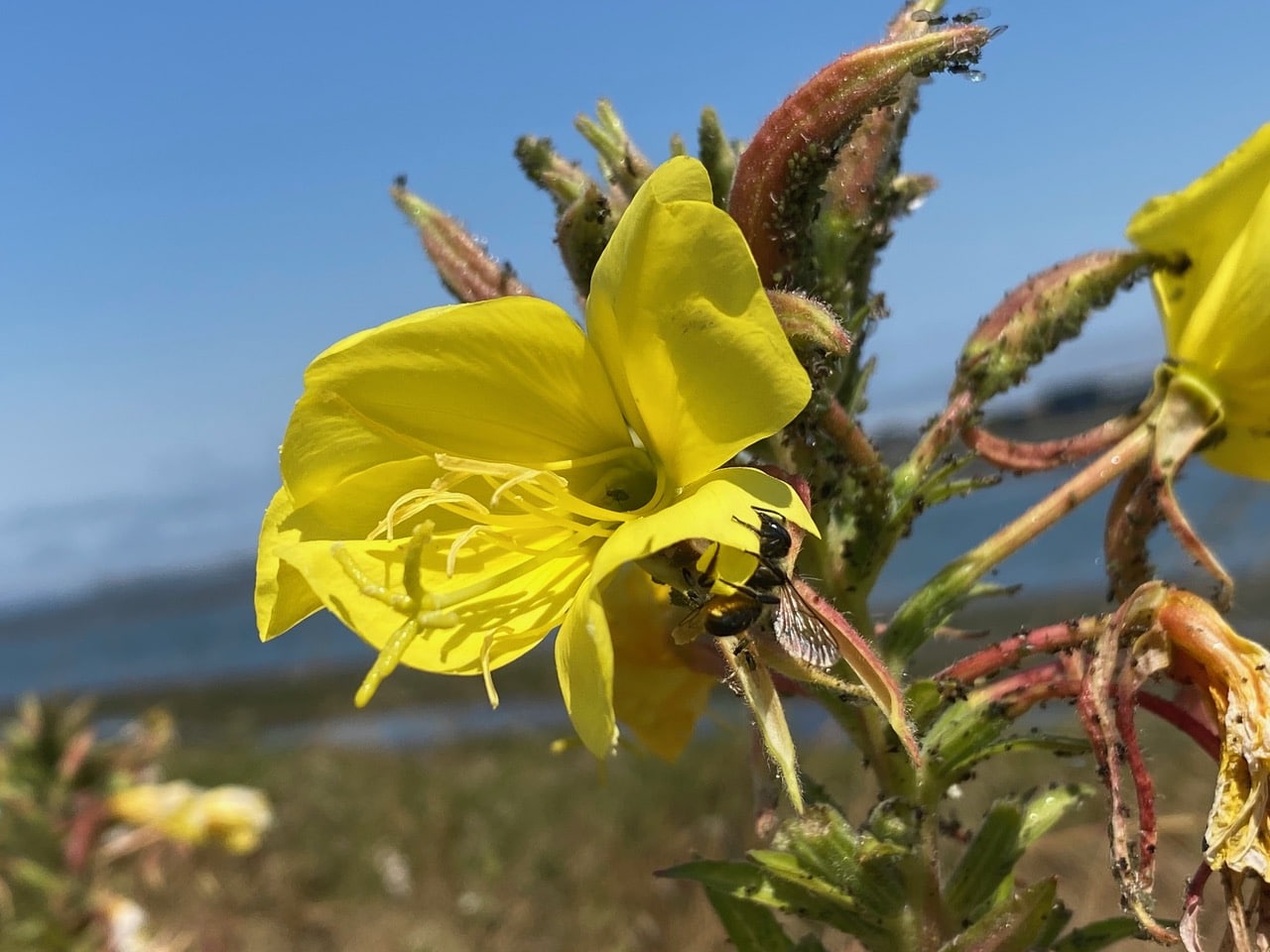
The bee next flies to another flower. Clinging to the edge of a petal, she cuts the petal with her mandibles! Wow, I have been waiting for this moment for years! I had hoped to see a Leaf-cutter bee cut leaf, but never dreamed that I would see a Petalcutter cut petal!

She grasps the rounded piece she has cut with all her legs…
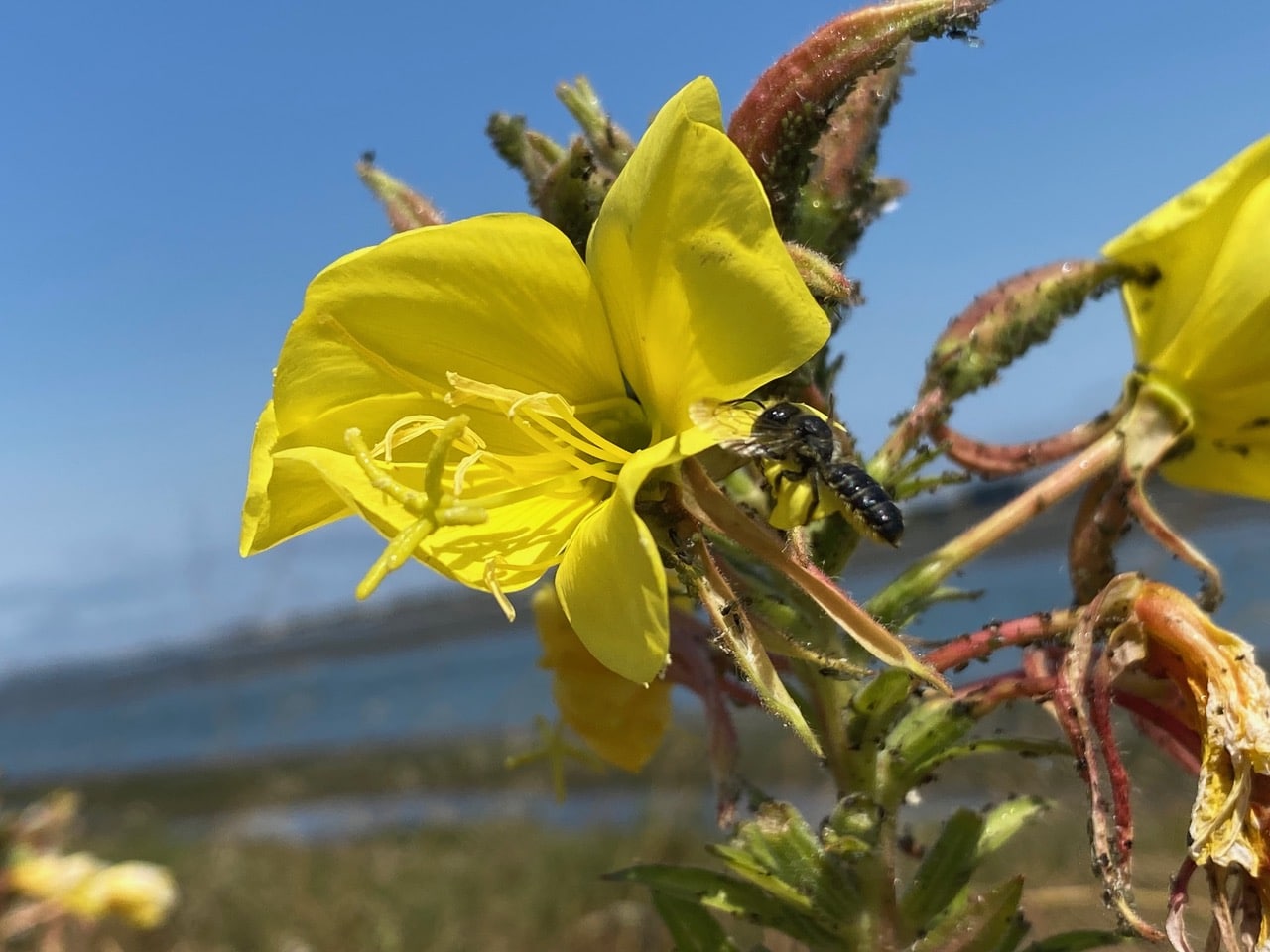
…. and off she flies with the slightly rolled piece under her! Back at the nest, she will use the cut petal to line her nest cell.
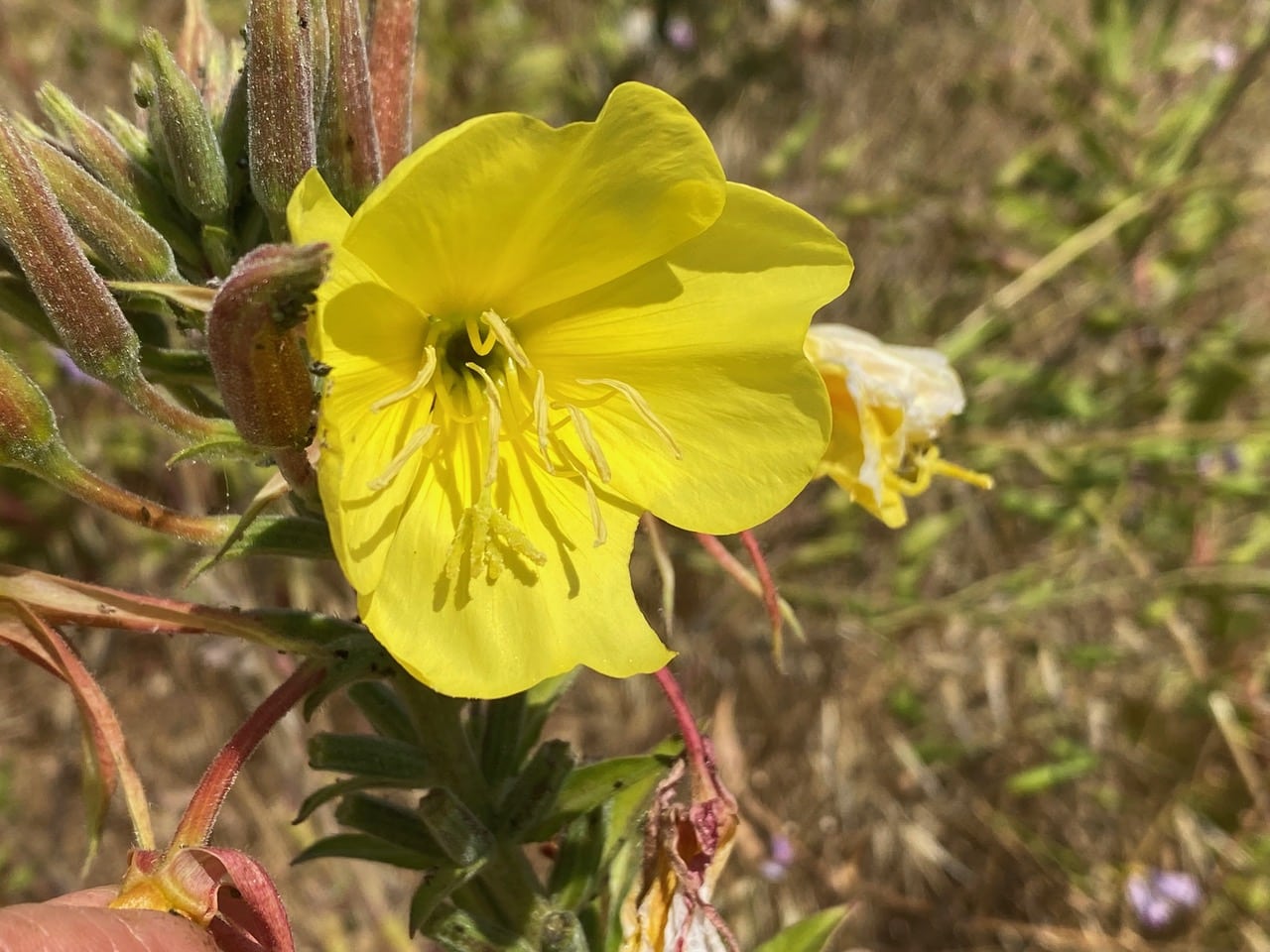
I look around to take stock of how many of the Evening Primrose flowers have been cut. Here’s one.
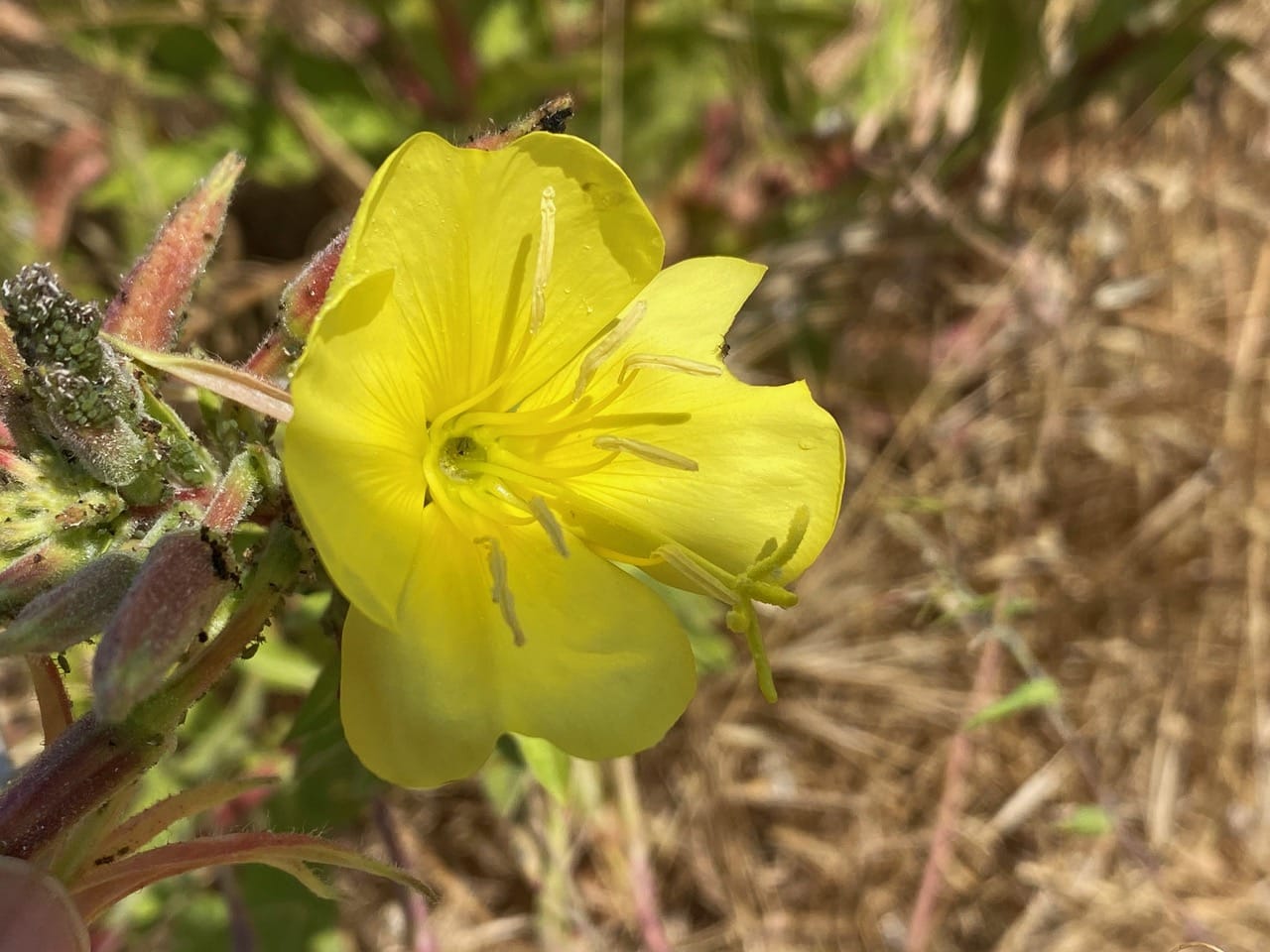
Another cut petal…

Just about every fresh flower has had at least one piece cut out of a petal. The Petalcutters have been busy here!

A Silver-tailed Petalcutter, Megachile montivaga (family Megachilidae) has landed on a Tall Evening Primrose leaf to clean her tongue.
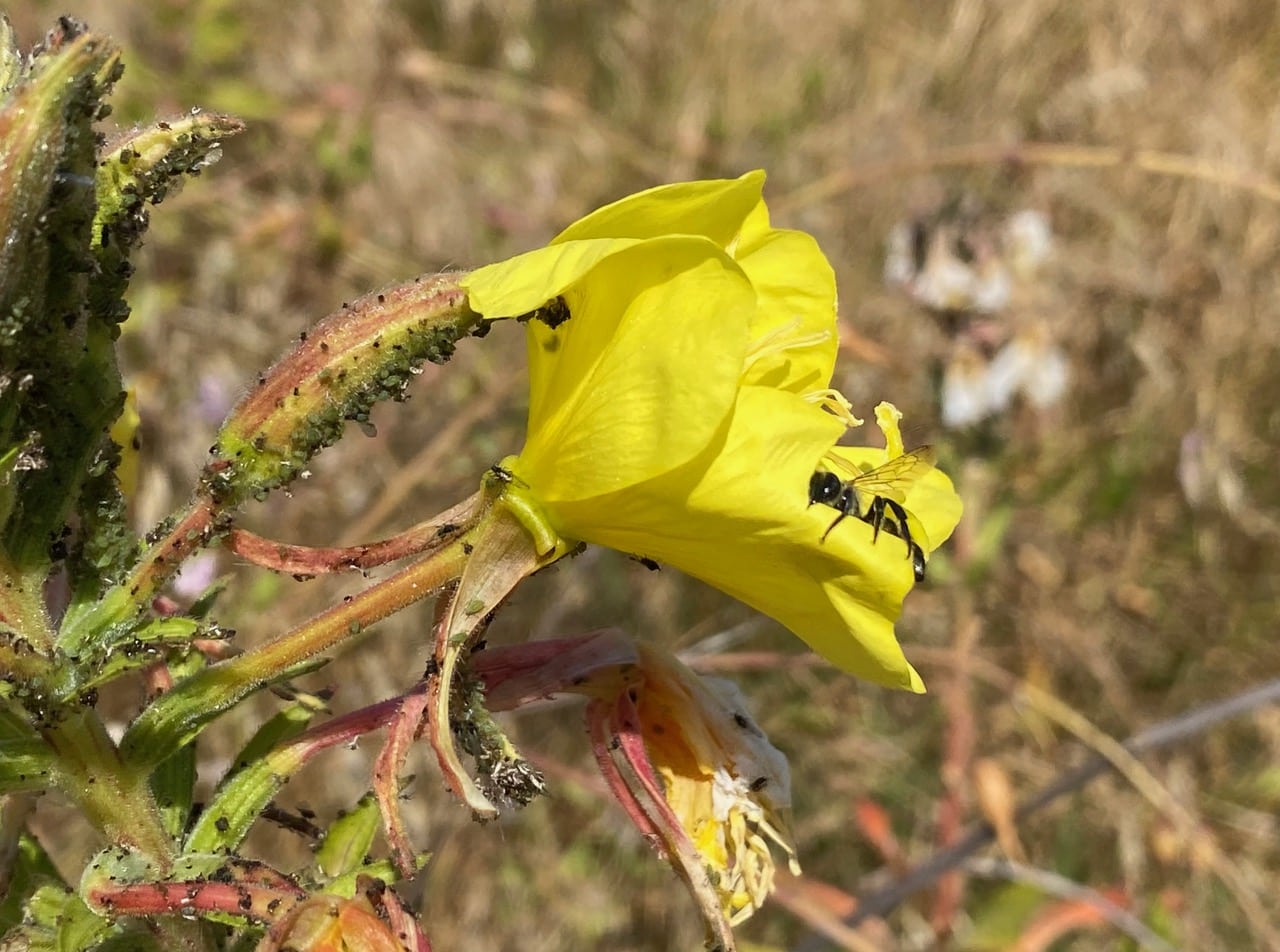
Unbelievably, I am treated to a second demonstration – a Petalcutter bee is cutting a petal of a Tall Evening Primrose flower!

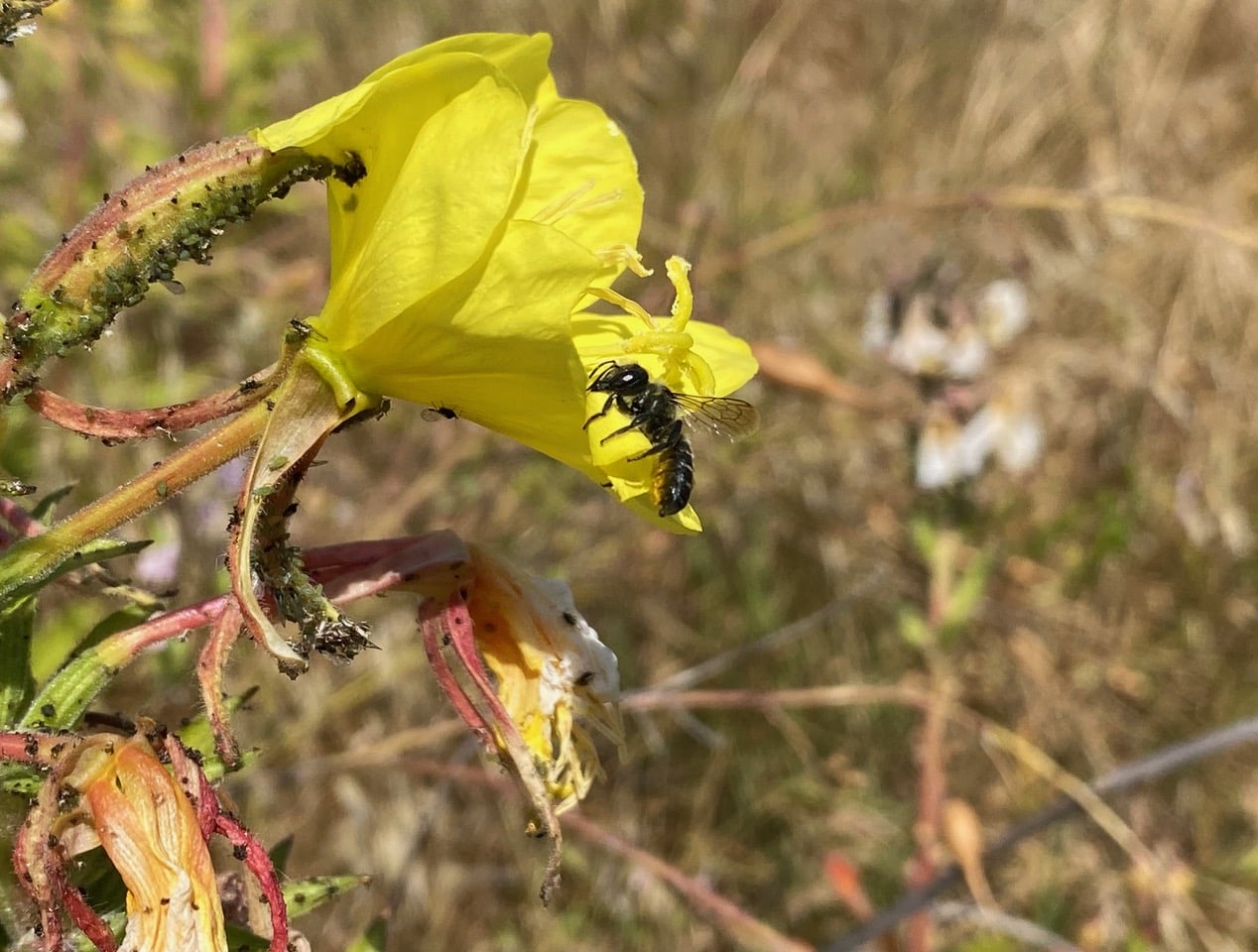
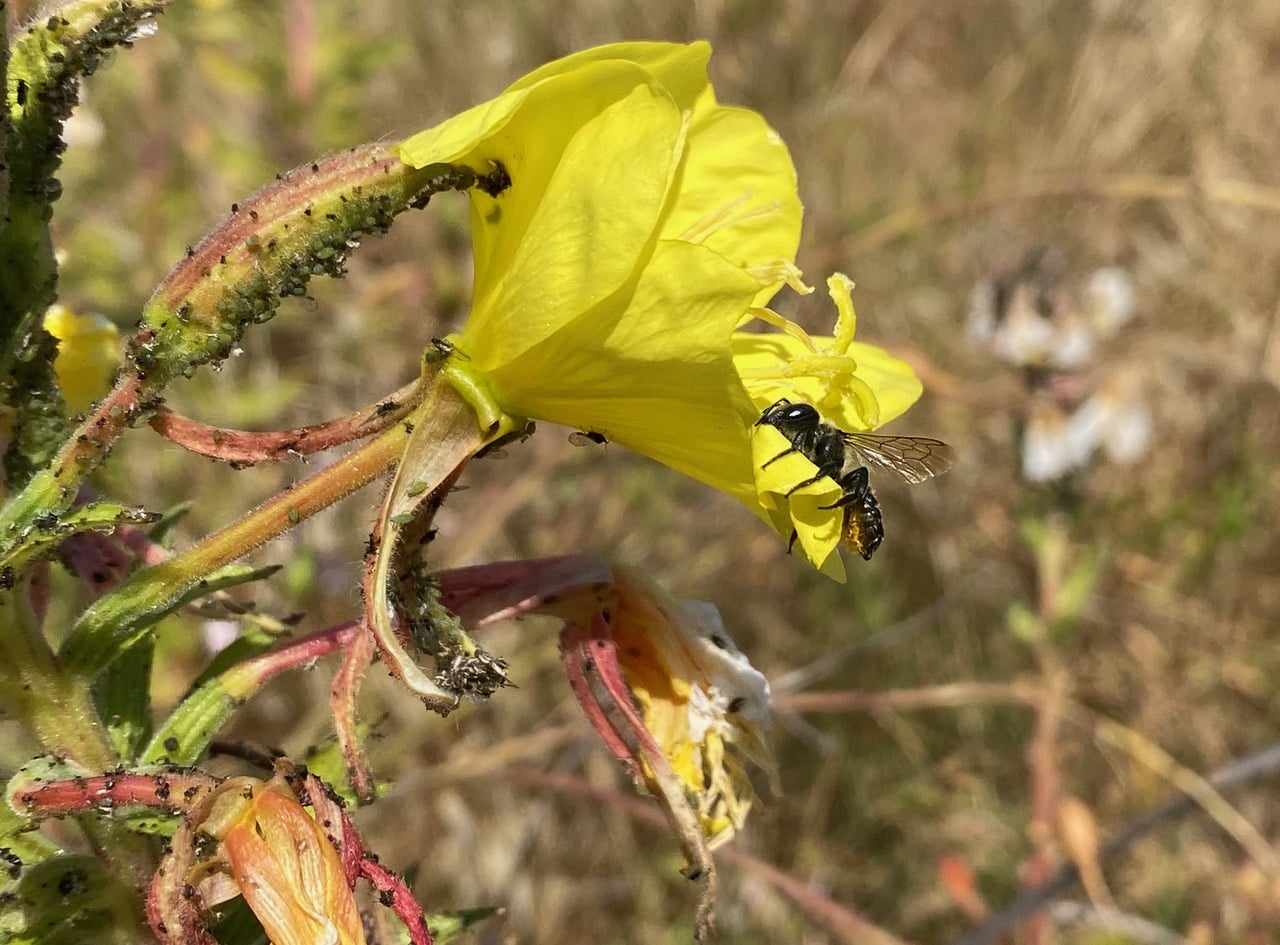

The bee starts to clasp and roll the cut piece as it is about ready to fall off.
There, all ready to go! Amazing agility and skill!

American Sand Wasps, Bembix americana (family Crabronidae) swarm over the bare ground around the trail which is pocked with their half-moon-shaped nest entrances. I watch as a wasp enters one of these.
Sand wasps in the genus Bembix are familiar and common throughout North America, digging their burrows in dunes, on beaches, and other habitats with loose, deep sand. The female rapidly kicks out large quantities of sand using a “tarsal rake” of spines on each front leg. The burrow is excavated before the wasp goes hunting. Bembix are generalist, opportunistic hunters. True flies in the order Diptera are the usual prey. A victim is paralyzed or killed by the wasp’s sting, and is then flown back to the nest. Most species will lay an egg on the first victim, while some species lay an egg in the empty cell before starting to hunt. Once the egg hatches, mama wasp brings flies to her larva as needed. This “progressive provisioning” is rare in the insect world. When the larva reaches maturity, mama wasp closes the cell. Inside, the larva spins an oblong cocoon, weaving sand grains into the structure and resulting in a hardened capsule. Overwintering takes place as a prepupa inside this cocoon, but there are usually two generations a year.

After a while, the bee emerges from the hole, and proceeds to cover it up, kicking sand to back fill the hole. Is she done provisioning that nest for good? Has her larva reached maturity and ready to pupate? The entrance is sealed to protect her young from predators and parasites. Progressive provisioning is a long-term maternal commitment – I don’t know how the mama wasps do it.
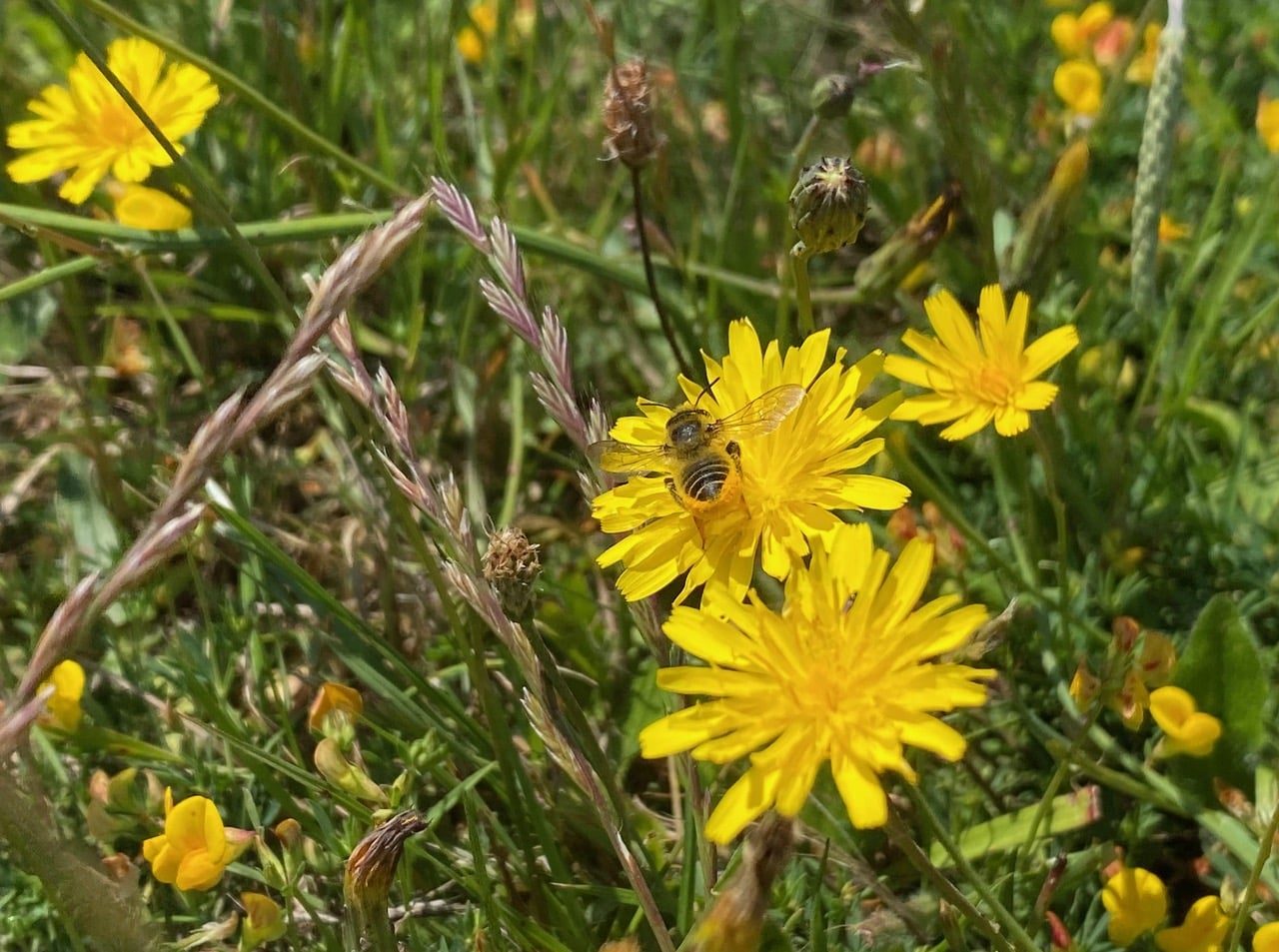
Hey, here’s a second species of Leafcutter Bee for the day! It is the more common Western Leafcutter Bee, Megachile perihirta (family Megachilidae). The female lands on a Catsear flowerhead, her abdominal scopa already filled with yellow pollen.
The Western Leafcutter Bee, Megachile perihirta is native to western North America, often inhabiting meadows and orchards. The species name “perihirta” refers to the large extent of hairs on the bee. It is one of the most conspicuous native leafcutters in Western North America, especially along the Pacific Coast. It is a stout-bodied bee, about the size of a honey bee; females typically measure 11-13 mm in length, while males are slightly smaller, ranging from 10-12 mm. The bee visits flowers from numerous plant families.

The bee then flies down to take nectar from the small flowers of Birdsfoot Trefoil, Lotus corniculatus. Most bees are not particular about their nectar sources.
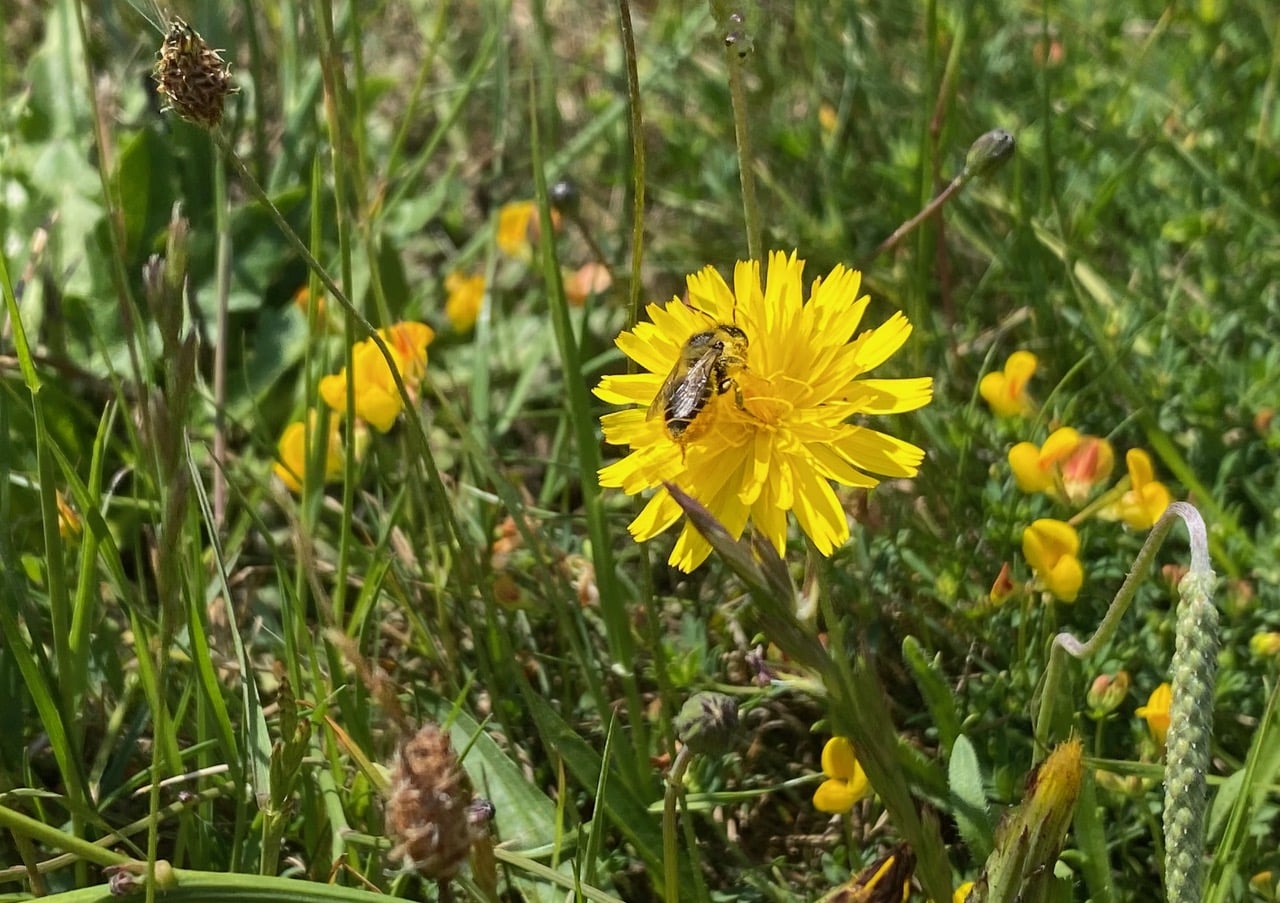
Then she’s back on the Catsear flowers. It’s endless fun watching the Leafcutter bees.
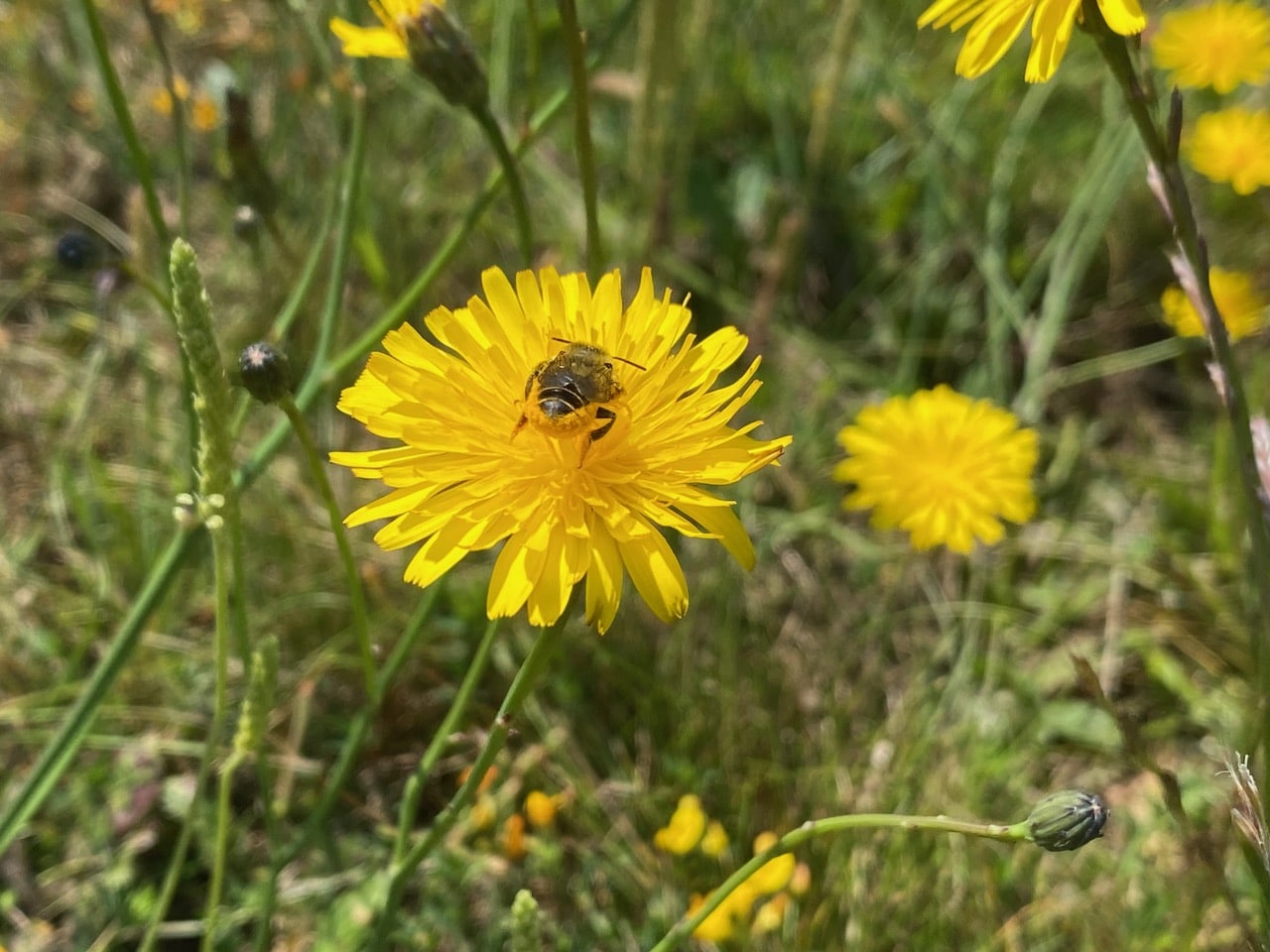
The tilted rear end of the female Leafcutter Bee shows a full load of pollen on the underside of her abdomen. It is often hard to see when the pollen color matches the color of the flower the bee is on.