

Pollinator Post 7/12/25 (1)

Air quality has improved significantly, and I am happy to be able to visit Shoreline Park on Bay Farm Island this morning.
I walk the narrow trail right along the shoreline. The hardy Oregon Gumweed, Grindelia stricta has recovered well from the winter storms.

Studded with gum-filled buds, Grindelia promises a good season ahead.

I stop to check the white foamy masses on this Grindelia. Looks like five young Spittlebugs have made their homes on this plant. Some of the foam masses have dried up and disintegrated – maybe the adults have emerged?
The foam mass is made by a nymph of a bug called the Spittlebug (superfamily Cercopoidea). Like the adults, the nymphs use their piercing, sucking mouthparts to feed on plant juices. The nymph produces a cover of foamed-up plant sap reminiscent of saliva, hence the common name of spittlebug. Whereas most insects that feed on sap feed on the nutrient-rich fluid from the phloem, Spittlebugs tap into the much more dilute sap flowing upward via the xylem. The large amount of excess water that must be excreted and the evolution of special breathing tubes allow the young spittlebug nymphs to grow in the relatively protective environment of the spittle. Symbiotic bacteria in the insects’ digestive system provides them with the essential amino acids that their diet lacks. The foam serves a number of purposes. It hides the nymph from the view of predators and parasites, and it insulates against heat and cold, and protects the delicate nymphs from desiccation. Moreover, the foam has an acrid taste that deters predators.

Checking out a Spittlebug foam mass on a leaf axil of Grindelia, I find a brown exuvia (exoskeleton shed during molting) clinging to the stem above the foam. Mature nymphs leave their foam mass for their final molt into an adult.
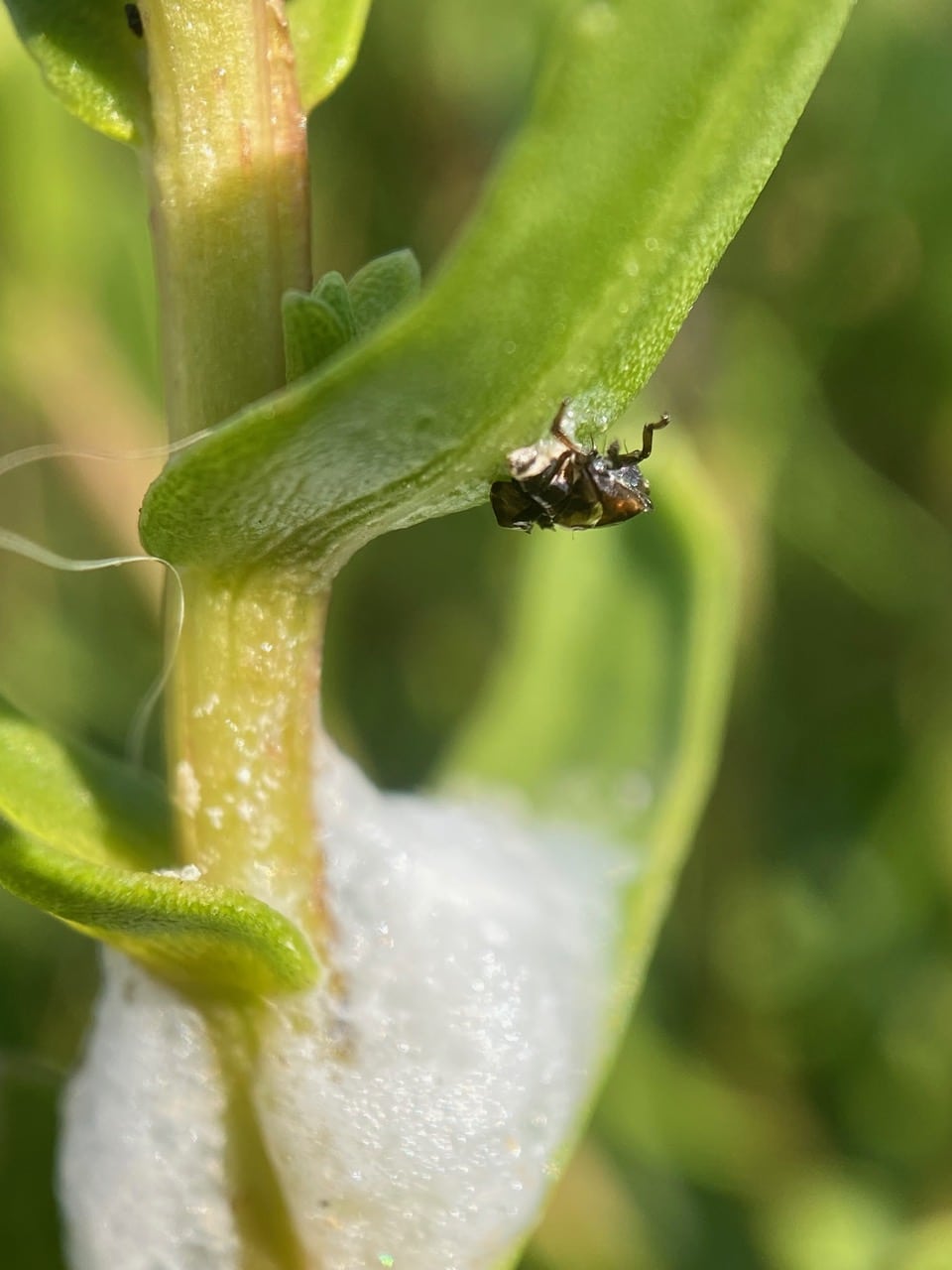
Here’s another exuvia.
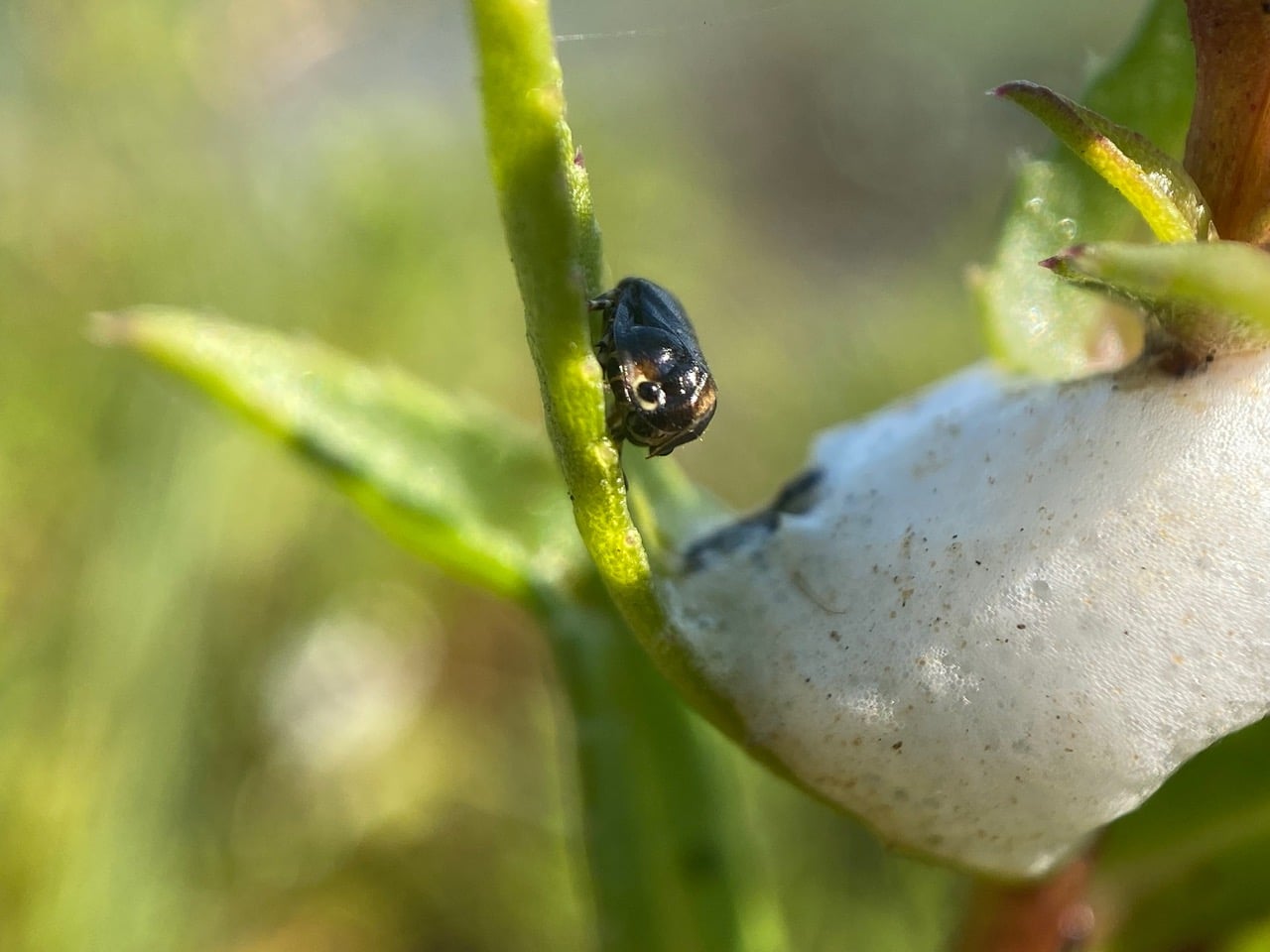
Hey, that’s not an exuvia. It’s an adult Spittlebug, Complex Clastoptera lineatocollis (family Clastopteridae) on a leaf next to its former home. Don’t be fooled by that shiny, eye-like structure on the side of the insect. It is actually on the bug’s hind wing, masquerading as an eye.

I gently pull the leaf down to get a closer look at the little creature. It is mostly black, with dark red eyes, yellow-and-black banded legs, and that false eye-spot on the wing in the rear. Both the front and rear end of the insect are similarly shaped – it’s easy to imagine how a predator might be fooled into thinking that the the Spittlebug would run away in the direction of the fake eyes.
Adult spittlebugs are commonly called Froghoppers. The Froghopper is a “true bug” in the order Hemiptera. Froghoppers are champion jumpers among insects, out-performing even the fleas. The bug can leap the human equivalent of a skyscraper without a running start! The muscles in its hind legs act like a “catapult” to release energy explosively. Its athletic prowess not withstanding, the Froghopper is better known for its young, the “spittle bugs”. The nymphs produce foamy white masses on plants within which they feed on plant sap. Froghoppers have piercing-sucking mouthparts, and feed on plant sap as both nymphs and adults. A recent report claims, “Froghoppers are the super-suckers of the animal world. The tiny insects produce negative pressures equivalent to people sucking a 100-meter-long straw.” So the little bug has two titles under its belt – champion jumper, and super-sucker!

There’s a small stand of Tall Evening Primrose, Oenothera elata (family Onagraceaae) growing on the edge of the shoreline, right above the water.

Most of the plants are heavily infested with aphids, and many of the flowers will never see the light of day


Greenish aphids cover most of this flower bud, which will likely fail to bloom. Numerous Argentine Ants are tending the aphids.
Aphids are small sap-sucking insects in the order Hemiptera. A typical life cycle involves flightless females giving live birth to female nymphs, – who may also be already pregnant, an adaptation called telescoping generations – without the involvement of males. Maturing rapidly, females breed profusely so that the population multiplies quickly. Winged females may develop later in the season, allowing the insects to colonize new plants. In temperate regions, a phase of sexual reproduction occurs in the autumn, with the insects often overwintering as eggs.
The life cycle of some species involves an alternation between two species of host plants. Some species feed on only one type of plant, while others are generalists, colonizing many plant groups. Some ants have a mutualistic relationship with aphids, tending them for their honeydew and protecting them from predators.
Aphids usually feed passively on phloem of plants. Once the phloem vessel is punctured, the sap, which is under pressure, is forced into the aphid’s food canal. Aphids produce large amounts of a sugary liquid waste called “honeydew”. A fungus called sooty mold can grow on honeydew deposits that accumulate on leaves and branches, turning them black.
Ants and aphids share a well-known mutualistic relationship. The aphids produce honeydew, a sugary food for the ants; in exchange, the ants care for and protect the aphids from predators and parasites. Some ants will “milk” the aphids to make them excrete the sugary substance. The ants stroke the aphids with their antennae, stimulating them to release the honeydew. Aphid-herding ants make sure the aphids are well-fed and safe. When the host plant is depleted of nutrients, the ants carry their aphids to a new food source. If predatory insects or parasites attempt to harm the aphids, the ants will defend them aggressively. Some species of ants continue to care for aphids during winter. The ants carry the aphids to their nest for the winter months, and transport them to a host plant to feed the following spring.
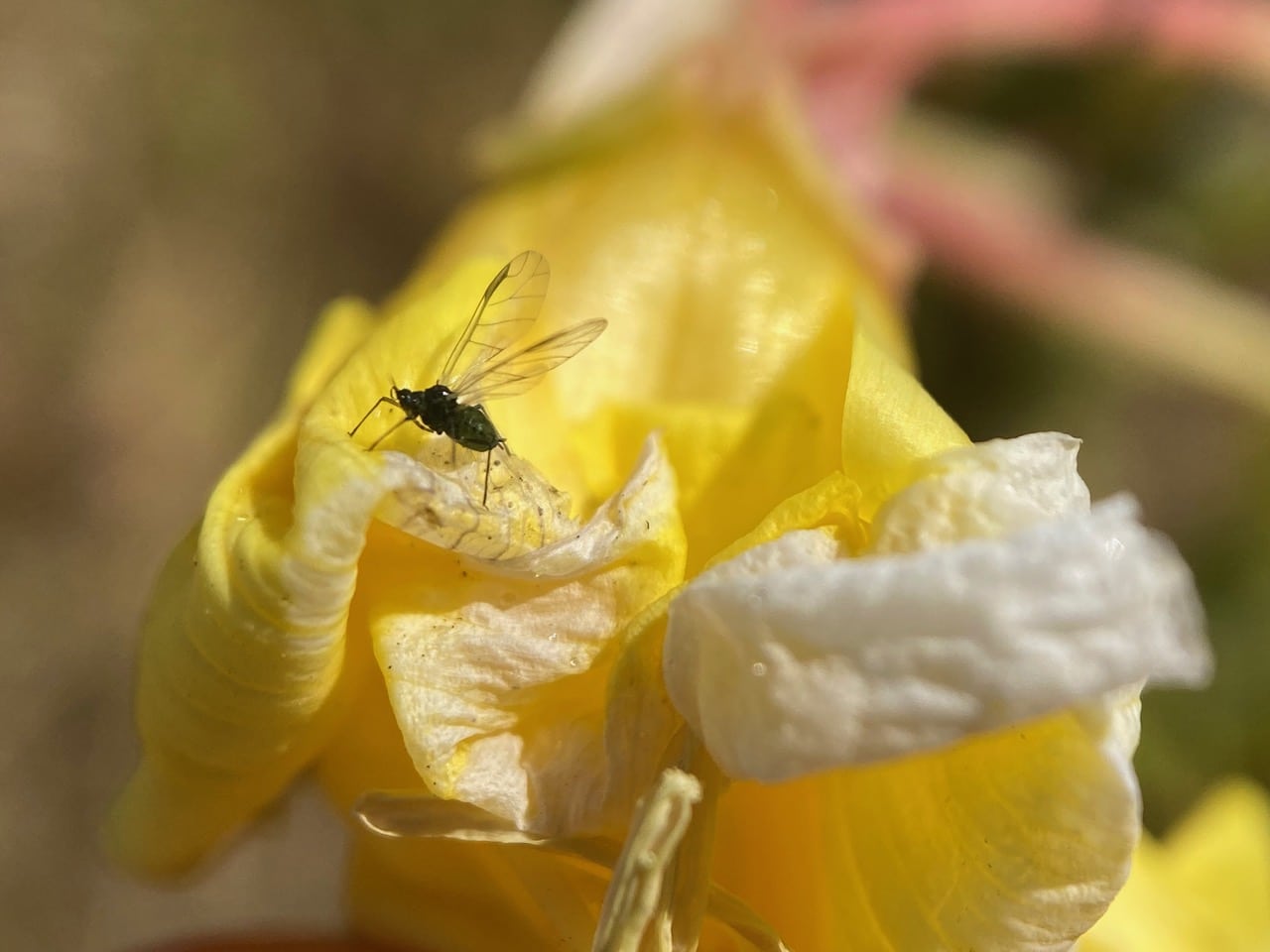
A winged aphid (an alate) is resting on a faded flower of Tall Evening Primrose.
Generally adult aphids are wingless, but most species also occur in winged forms, especially when populations are high or during spring and fall. The ability to produce winged individuals provides the aphids with a way to disperse to other plants when the quality of the food source deteriorates, or when predation pressure is high.

A bloated, brown aphid is resting at the base of an immature fruit of Tall Evening Primrose. It has been parasitized by an Aphid Mummy Wasp.
Aphid Mummy Wasps, Aphidius sp. (family Braconidae) are small wasps, typically less than 1/8 in. long. The female wasp lays a single egg in an aphid. When the egg hatches, the wasp larva feeds inside the aphid. As the larva matures the aphid is killed and becomes bloated and mummified, usually turning tan or golden in color. The adult wasp chews its way out of the mummy leaving a circular hole.
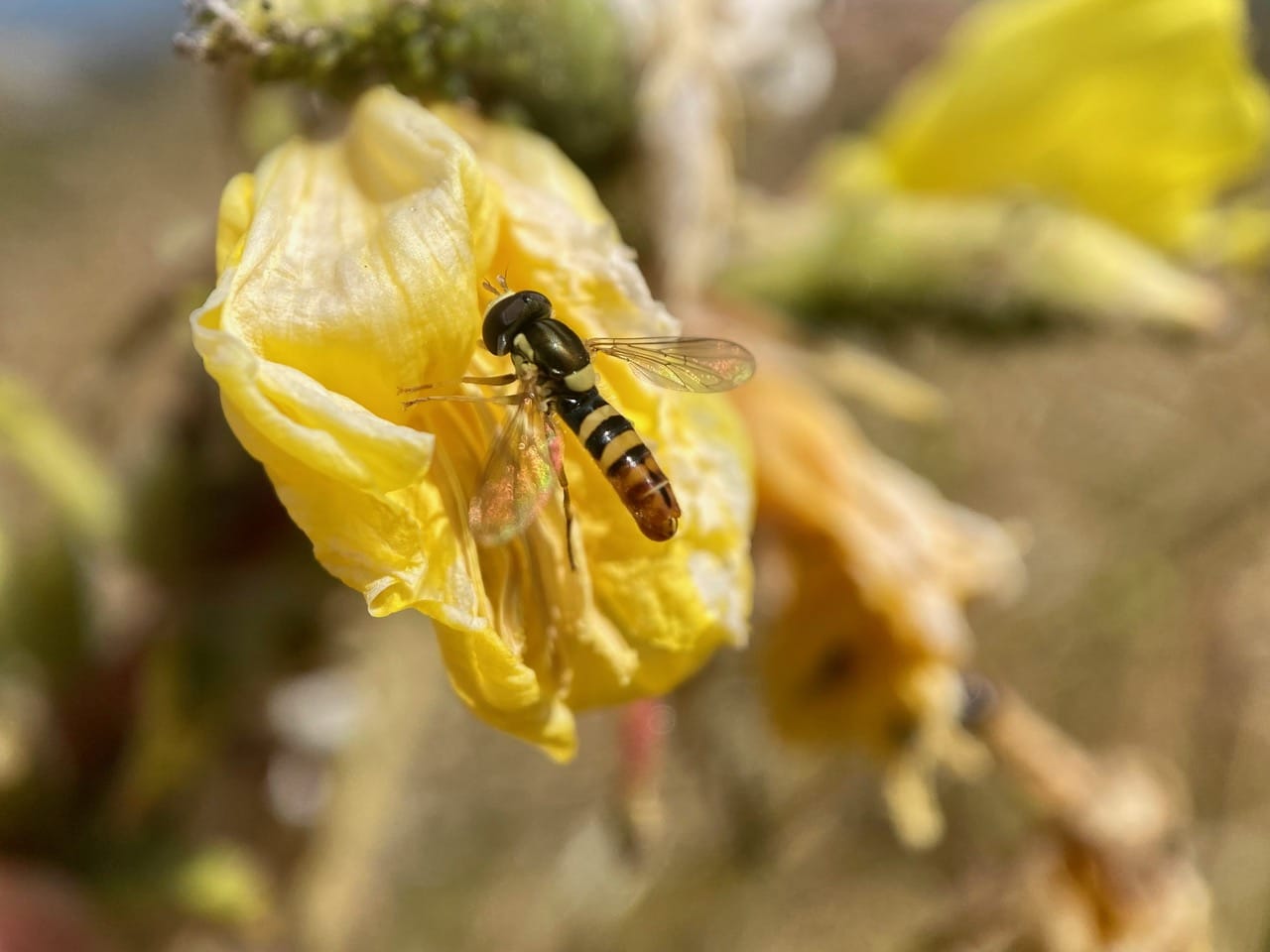
A male Forked Globetail, Sphaerophoria sulphuripes (family Syrphidae) has landed on a spent flower of Tall Evening Primrose.
The species is native to western North America. There is marked sexual dimorphism in the Forked Globetail – the males have a narrow abdomen with a reddish, swollen tip. Adults visit flowers for nectar and pollen. The larvae of Sphaerophoria feed on aphids and other soft-bodied insects.
Forked Globetail (Sphaerophoria sulphuripes) · iNaturalist
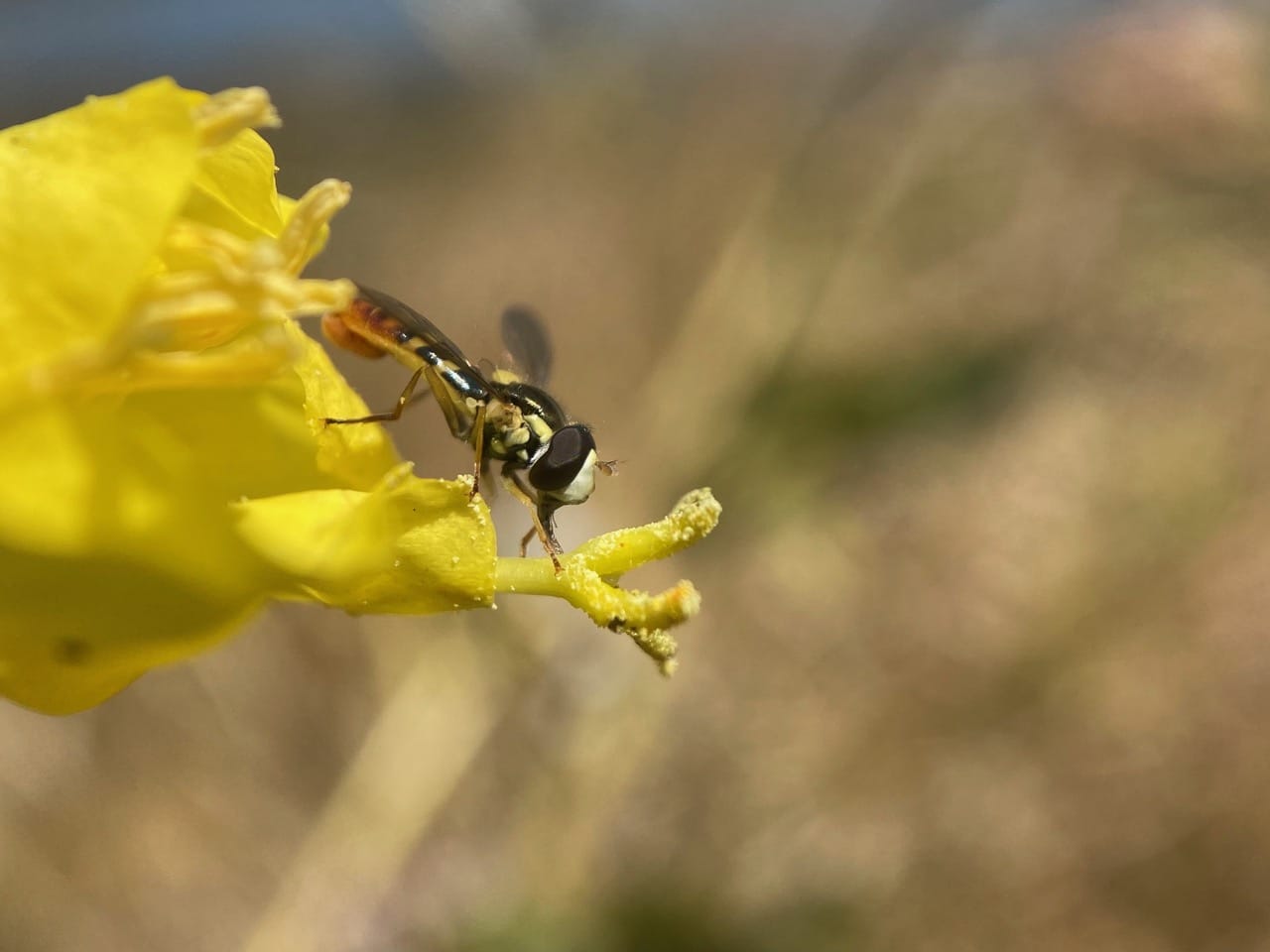
The hover fly is probably feeding on spilled pollen, or aphid honeydew.
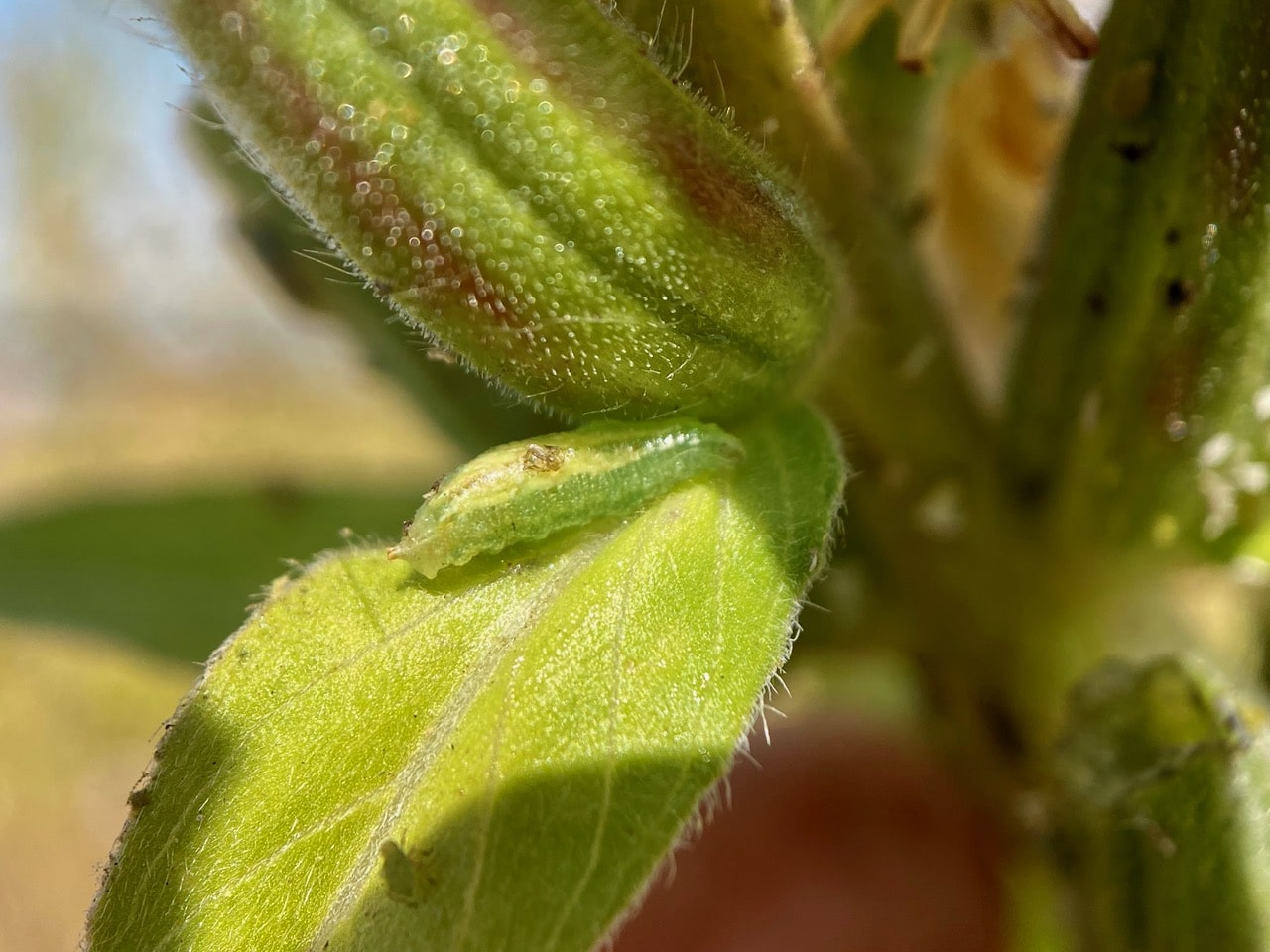
A hover fly larva has tucked itself in the space between a stipule and a developing fruit of Tall Evening Primrose. We are looking at its rear end.
Many species of hover flies have larvae that feed on aphids and other soft-bodied insects. The females seek out aphid colonies on plants to lay their eggs, to ensure that their offspring will have plenty to eat.
Syrphid larvae have no eyes and no legs. They swing their tapered head from side to side in search of prey. When they make contact with a prey, they grab hold of it with their mouthpart, then suck out the victim’s body contents. Depending on species, a Syrphid larva can feed on 100 to 400 aphids before it pupates.

Right above the Syrphid larva, on the developing fruit is a Syrphid pupa! It’s that green, teardrop-shaped structure. The tapered rear end has a pair of snorkel-like structure, while the large, rounded end is the front from which the adult fly will emerge. The little aphid is safe crawling over the hover fly pupa which no longer feeds or moves.

Ah, perfect – an empty Syrphid pupa case from which an adult hover fly has emerged.
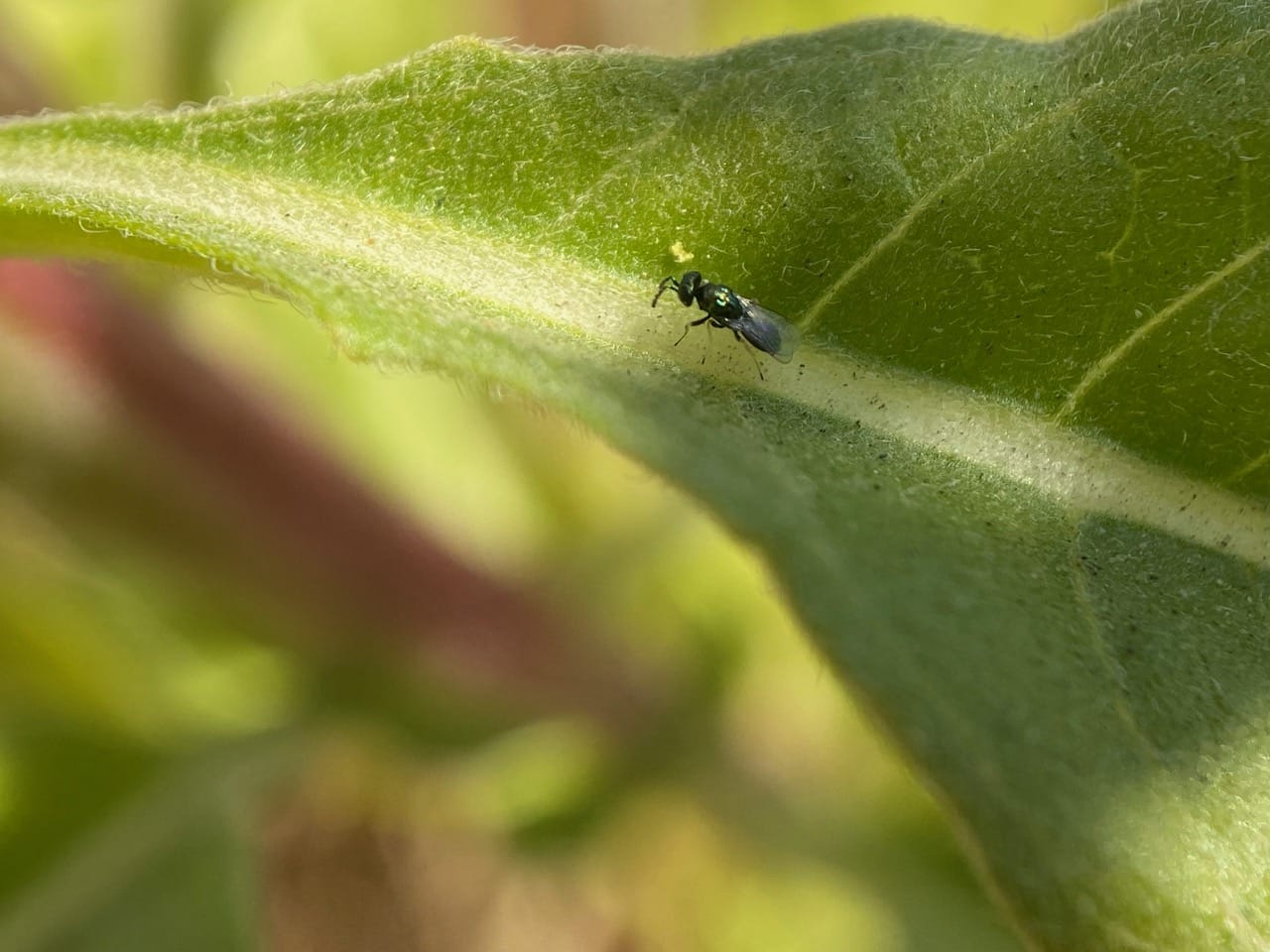
A tiny, metallic wasp is crawling along a leaf of Tall Evening Primrose. It is a Chalcidoid Wasp (superfamily Chalcidoidea).
Most Chalcid species are parasitoids of other insects, attacking the eggs or larval stage of their host, though many other life cycles are known. These hosts are to be found in at least 12 different insect orders including Lepidoptera (butterflies and moths), Diptera (true flies), Coleoptera (beetles), Hemiptera (true bugs), and other Hymenoptera, as well as two orders of Arachnida. When the host is itself a parasitoid, the wasps are referred to as hyperparasitoids. Generally beneficial to humans as a group, chalcidoids help keep various crop pests under control, and many species have been used as biocontrol agents.

A small, glossy black bee emerges from the base of a Tall Evening Primrose flower after taking nectar. It’s a Small Carpenter Bee, Ceratina sp. (family Apidae).
The Small Carpenter Bee genus Ceratina is closely related to the more familiar, and much larger Carpenter Bees (genus Xylocopa). Ceratina are typically dark, shiny, even metallic bees, with fairly sparse body hairs and a weak scopa on the hind leg. The shield-shaped abdomen comes to a point at the tip. Some species have yellow markings, often on the face.
Females excavate nests with their mandibles in the pith of broken or burned plant twigs and stems. While many species are solitary, a number are subsocial. Both male and female carpenter bees overwinter as adults within their old nest tunnels, emerging in the spring to mate. In the spring, this resting place (hibernaculum) is modified into a brood nest by further excavation. The female collects pollen and nectar, places this mixture (called bee bread) inside the cavity, lays an egg on the provision, and then caps off the cell with chewed plant material. Several cells are constructed end to end in each plant stem.

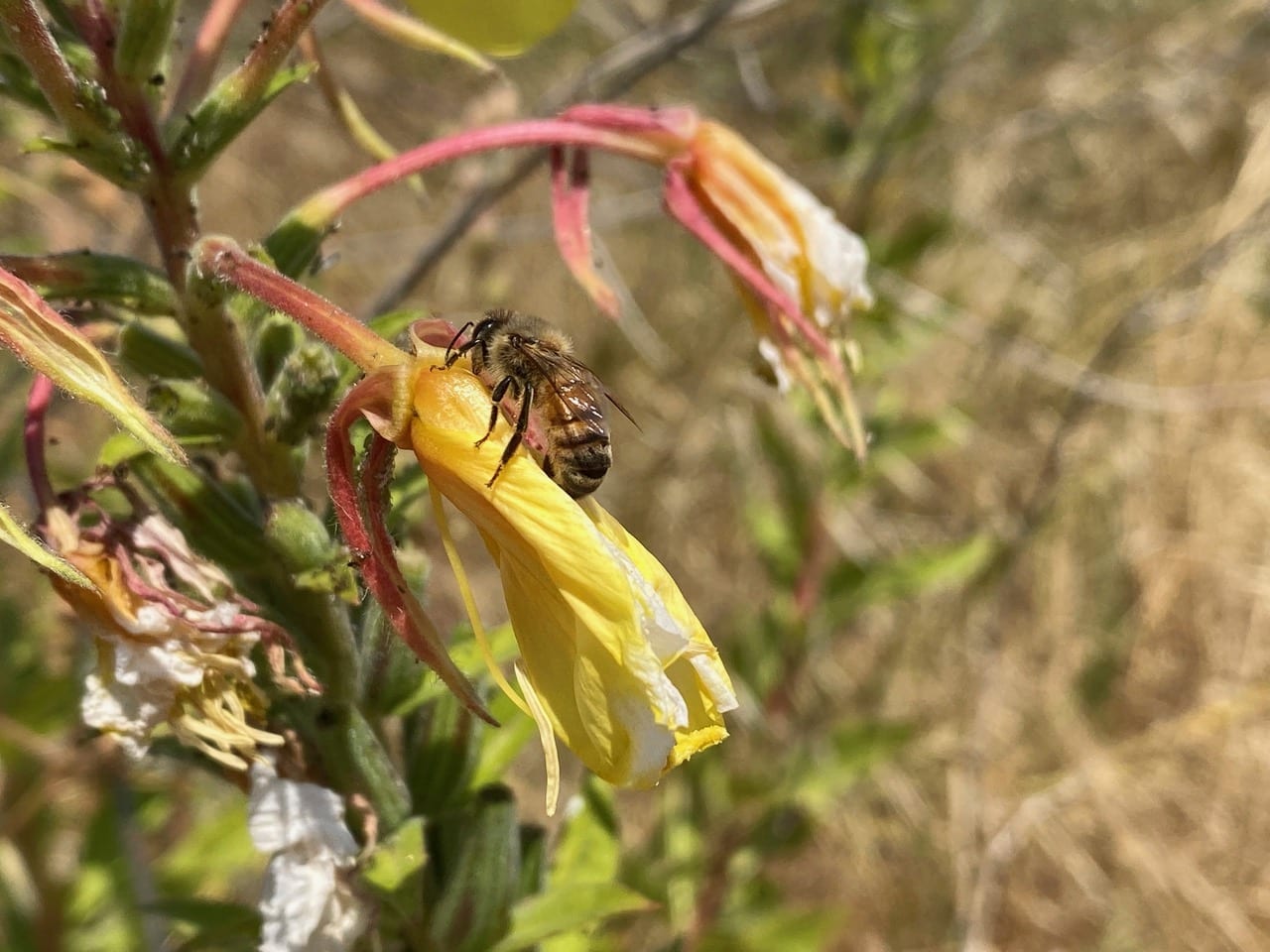
What is the Honey Bee doing on the wilted Tall Evening Primrose flower? Is nectar still being produced by the flower? Maybe the bee is scavenging honeydew excreted by the aphids?

A female Fine Striped Sweat Bee, Agapostemon subtilior (family Halictidae) emerges from the base of the evening primrose flower where she has been taking nectar.
Agapostemon are brightly colored metallic green or blue bees measuring 7 to 14.5 mm long. Most species have a metallic green head and thorax, and black-and-yellow striped abdomen; some females are entirely bright green or blue. Females carry pollen on scopal hairs located on their hind legs. Agapostemon are generalists. Like other members of the family Halictidae, they are short-tongued and thus have difficulty extracting nectar from deep flowers. Males are often seen flying slowly around flowers looking for females. The bees favor flowers with high densities. Females excavate nests in the ground. These are summer to fall bees.
Fine striped sweat bee (Agapostemon subtilior) · iNaturalist
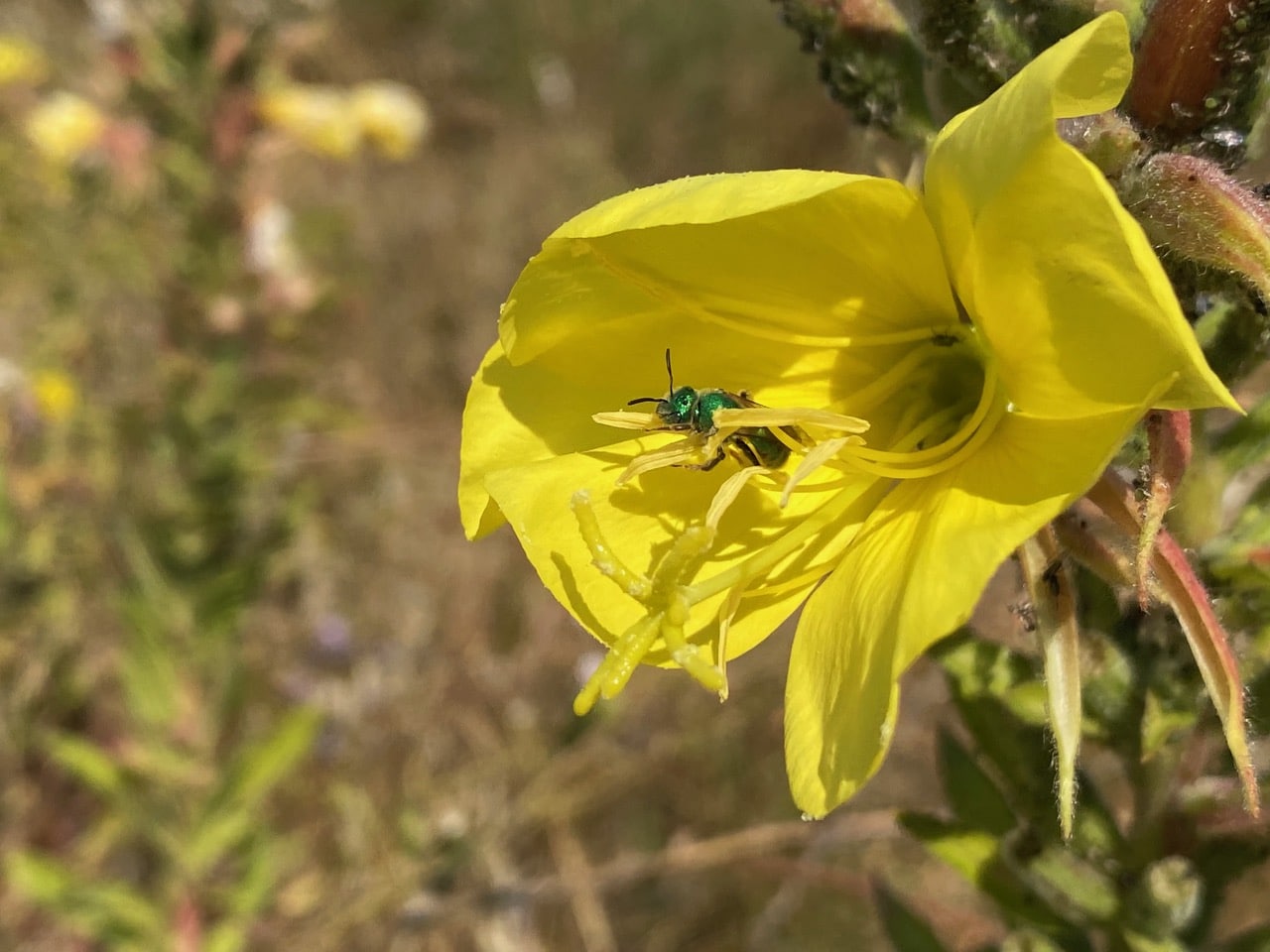
The bee crawls carefully along the stamens. I am surprised to see how clean these stamens are. Their anthers are almost devoid of pollen that is usually held in sticky, stringy viscin threads. Has someone been collecting pollen from these flowers? Pollination of the evening primrose is usually accomplished by Hawk Moths (family Sphingidae) and specialist bees who can manage the unwieldy pollen.
The Tall Evening Primrose, Oenothera elata is usually biennial, completing its life cycle in two growing seasons. It can reach 6 feet in height. Native to California, it is found along roadsides, in moist meadows, or in woodland. At the top of reddish stems are open clusters of 2-4 inch wide yellow flowers with 4 large petals and protruding yellow stamens and 4-branched pistil. The fragrant flowers open at dusk and close up during mid-morning the next day, turning orange with age.
The flowers of Evening Primrose open at night and have most of the characteristics associated with night-pollination by moths: they are large with nectar glands at the bottom of a deep flower cup, and their reproductive parts extend beyond the petals. The pale flowers are visible to night-pollinators; they are also sweetly scented as an additional guide at night. Pollinators brush against the reproductive structures when they go into the base of the flower after nectar. Sphinx moths are the most significant pollinators for the evening primrose that bloom at night. Their long tongues enable them to reach the nectar deep within the flower. As they feed, pollen is transferred from one flower to another. Oenothera elata is also pollinated by specialist bees active at dawn and dusk such as the twilight-foraging Evening Primrose Sweat Bees. These bees have evolved specialized hairs on their legs to collect the distinctive stringy pollen.
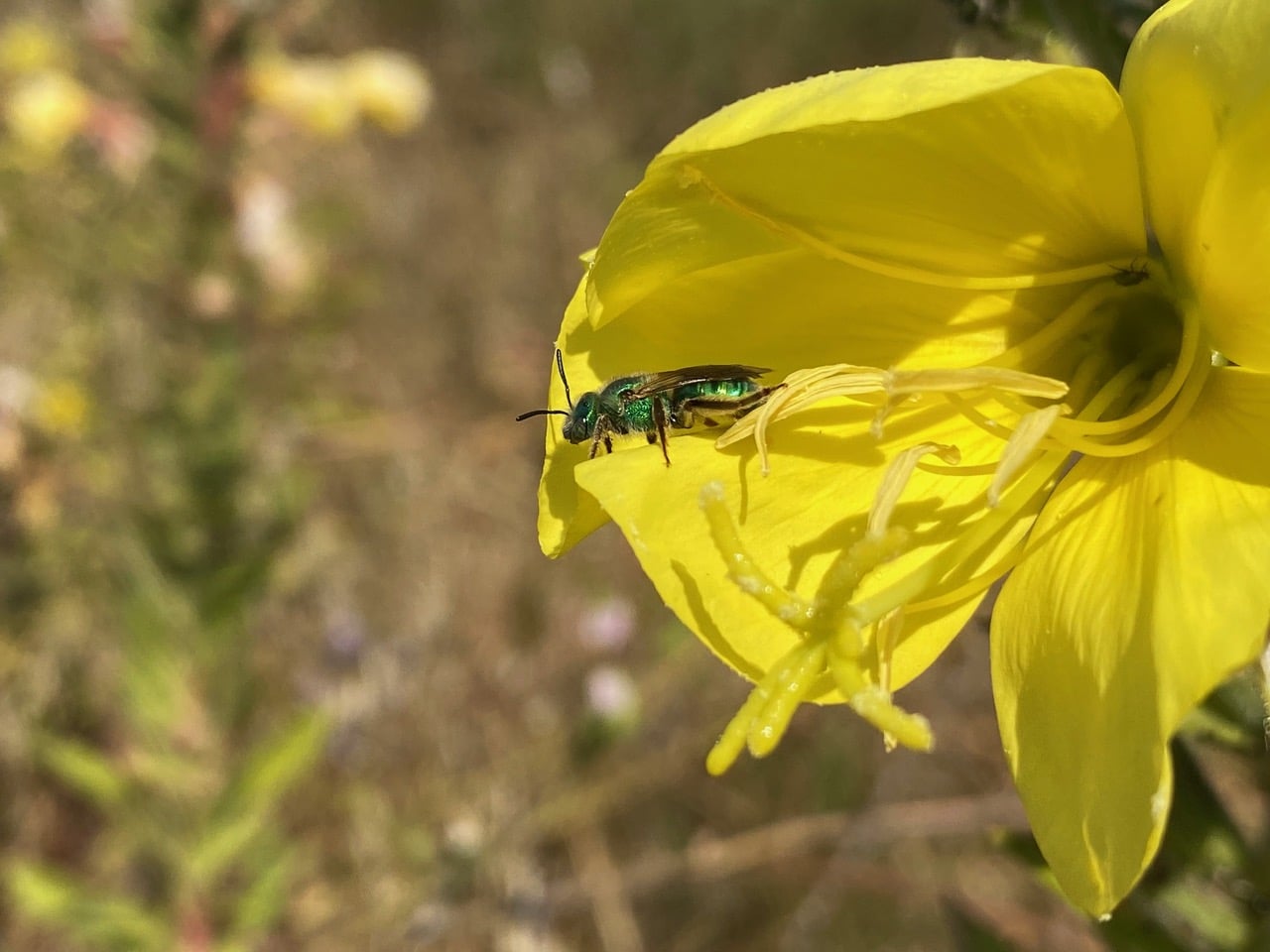
The Sweat Bee manages to fly away clean, without being mired by sticky, stringy pollen.
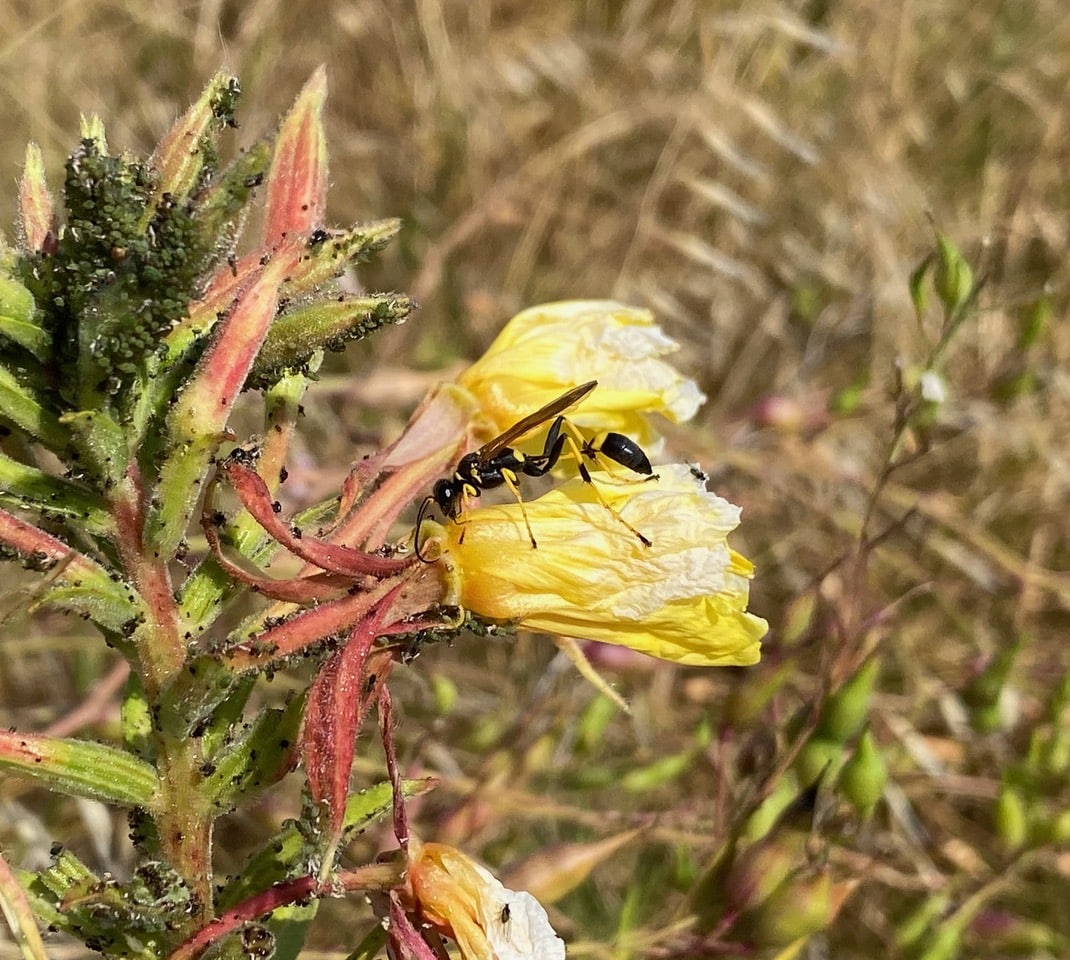
A Yellow-legged Mud-dauber Wasp, Sceliphron caementarium (family Sphecidae) is investigating a wilted Tall Evening Primrose flower. Is she after nectar, or is she hunting spiders?
The Yellow-legged Mud-dauber, Sceliphron caementarium (family Sphecidae) is widespread in the Americas. The species is found in a wide variety of habitats, such as rock ledges, man-made structures, puddles and other water edges. The wasp can reach a length of 24-28 mm. They are generally black with yellow markings, with impossibly long and skinny “waist”. They are solitary parasitoid wasps that build nests out of mud. Females collect mud balls at puddles and pool edges for constructing nests. The nests comprise up to 25 vertically arranged, individual cylindrical cells. Eventually the cells are covered over as a cluster by more mud, forming a smooth structure the size of a human fist. Nest constructed, the female wasp goes hunting for spiders. The prey are stung and paralyzed and placed in the cell, usually 6-15 per cell. A single egg is laid on the prey within each cell. The wasp then seals the cell with a thick mud plug. The larva that hatches out feeds on the spiders, pupates in the cell and emerges as an adult, breaking out of its mud nursery. Adult wasps can be seen in mid-summer feeding on nectar at flowers.