

Pollinator Post 7/11/25 (2)
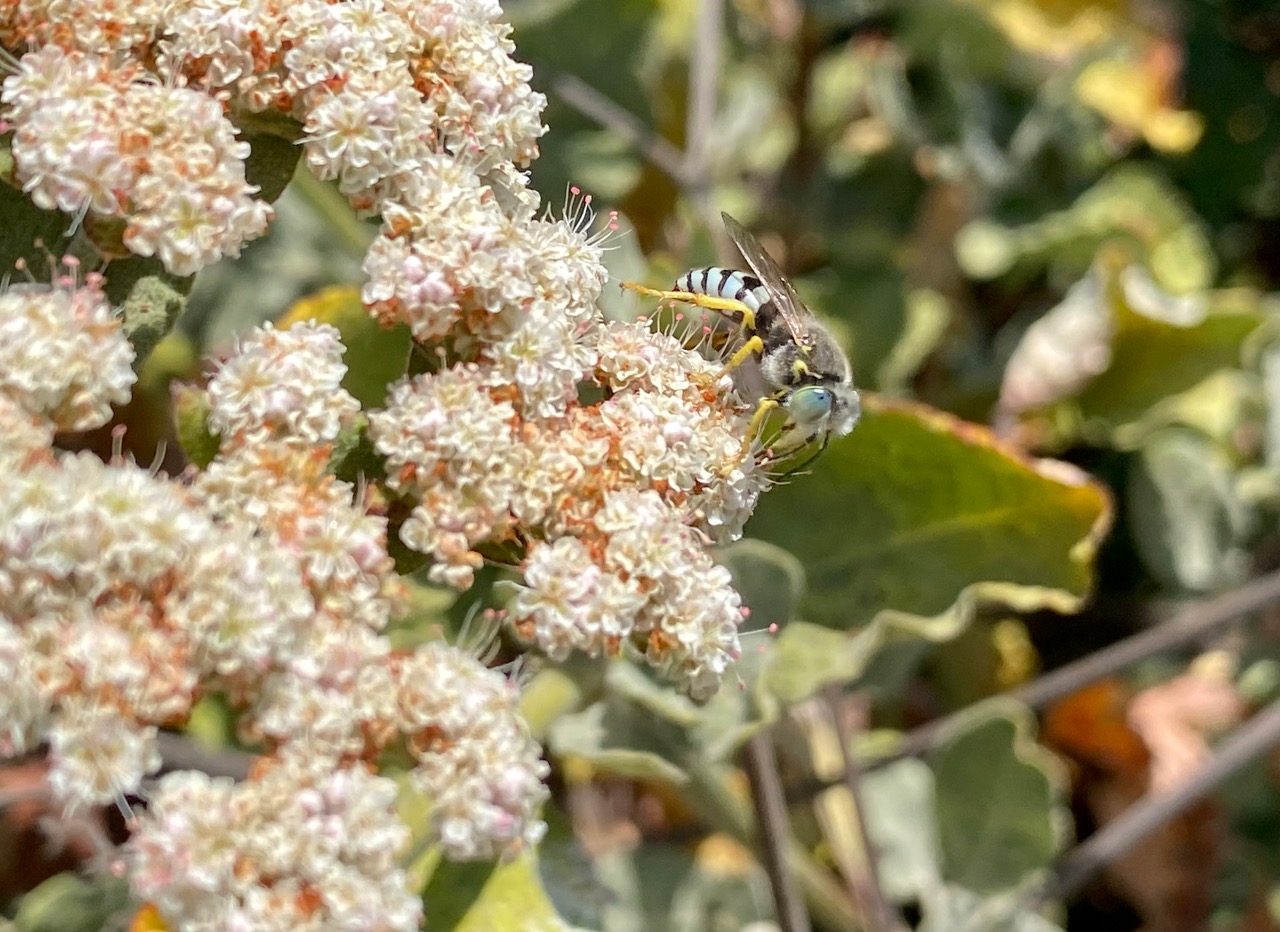
I discover to my delight that the two small, partially hidden shrubs of St. Catherine’s Lace, Eriogonum giganteum in the far corner of Crab Cove’s demonstration garden are in bloom, or have been for a while. As with all other flowers here, the most prevalent insect visitors are the ubiquitous American Sand Wasps, Bembix americana (family Crabronidae).
Sand wasps in the genus Bembix are familiar and common throughout North America, digging their burrows in dunes, on beaches, and other habitats with loose, deep sand. The female rapidly kicks out large quantities of sand using a “tarsal rake” of spines on each front leg. The burrow is excavated before the wasp goes hunting. Bembix are generalist, opportunistic hunters. True flies in the order Diptera are the usual prey. A victim is paralyzed or killed by the wasp’s sting, and is then flown back to the nest. Most species will lay an egg on the first victim, while some species lay an egg in the empty cell before starting to hunt. Once the egg hatches, mama wasp brings flies to her larva as needed. This “progressive provisioning” is rare in the insect world. When the larva reaches maturity, mama wasp closes the cell. Inside, the larva spins an oblong cocoon, weaving sand grains into the structure and resulting in a hardened capsule. Overwintering takes place as a prepupa inside this cocoon, but there are usually two generations a year.
Male sand wasps often engage in an elaborate flight ritual called “sun dances”. Males emerge before females, and fly erratically at dizzying speed one or two inches above the ground attempting to detect virgin females about to emerge from their underground nests. Both sexes are often seen taking nectar at flowers, especially from Asteraceae family. Bembix wasps are often victims of other insects such as cuckoo wasps (Chrysididae), velvet ants (Mutillidae), satellite flies (Sarcophagidae), bee flies (Bombyliidae), and thick-headed flies (Conopidae).

A Mason Wasp, Euodynerus annulatus (family Vespidae, subfamily Eumininae) is foraging on the flowers of St. Catherine’s Lace.
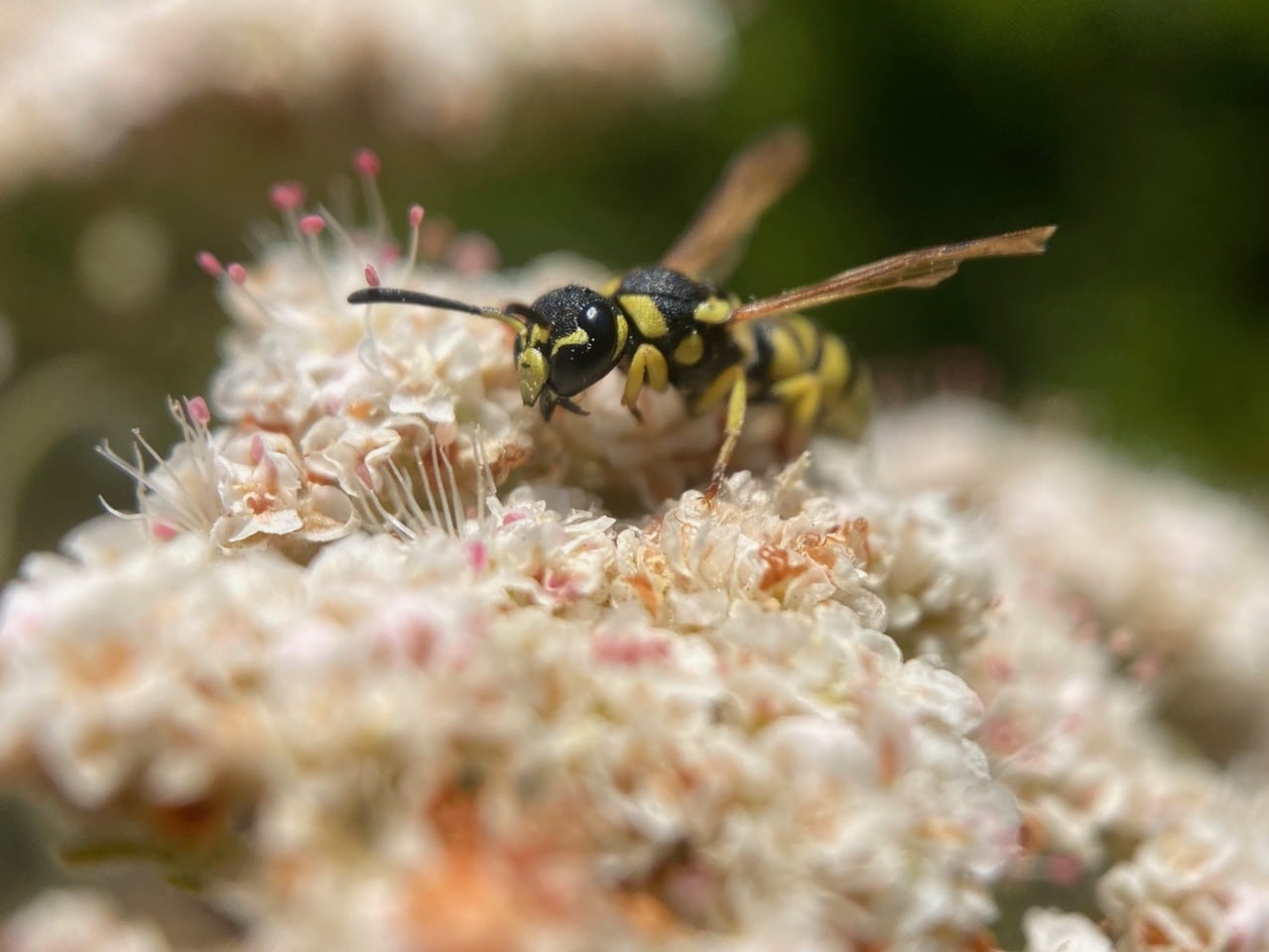
The Mason Wasp, Euodynerus annulatus (family Vespidae, subfamily Eumininae) is a widespread species, found from coast to coast in the United States, south to Mexico, and north into Canada. The color and markings vary considerably among the various subspecies. These are sizable wasps, their fore wings measuring 8.5-10.5 mm. Males can be recognized by the hooked tips of the antennae, and their less robust appearance. Unlike the other Mason Wasps that use pre-existing cavities, or making mud nests, the females of this species excavate burrows. They also extend the tunnel above ground as a curved mud “chimney”. Several individual cells branch from the main burrow underground. The species seem to favor situations close to water, as the female regurgitate water to soften the soil during nest-building. The chimney might help protect against parasites, but it apparently serves as the source of mud pellets to make the final nest closure as well.
The female wasps provision their nests with moth caterpillars as food for their offspring. A single egg is suspended from a short thread attached to the wall of the cell before it is stocked with caterpillars. Usually several caterpillars are placed in each cell. When all cells are provisioned, the nest entrance is sealed. The turret or chimney is deconstructed entirely and the nest entrance made nearly invisible and flush with the surrounding soil. The wasp leaves to begin a new nest.
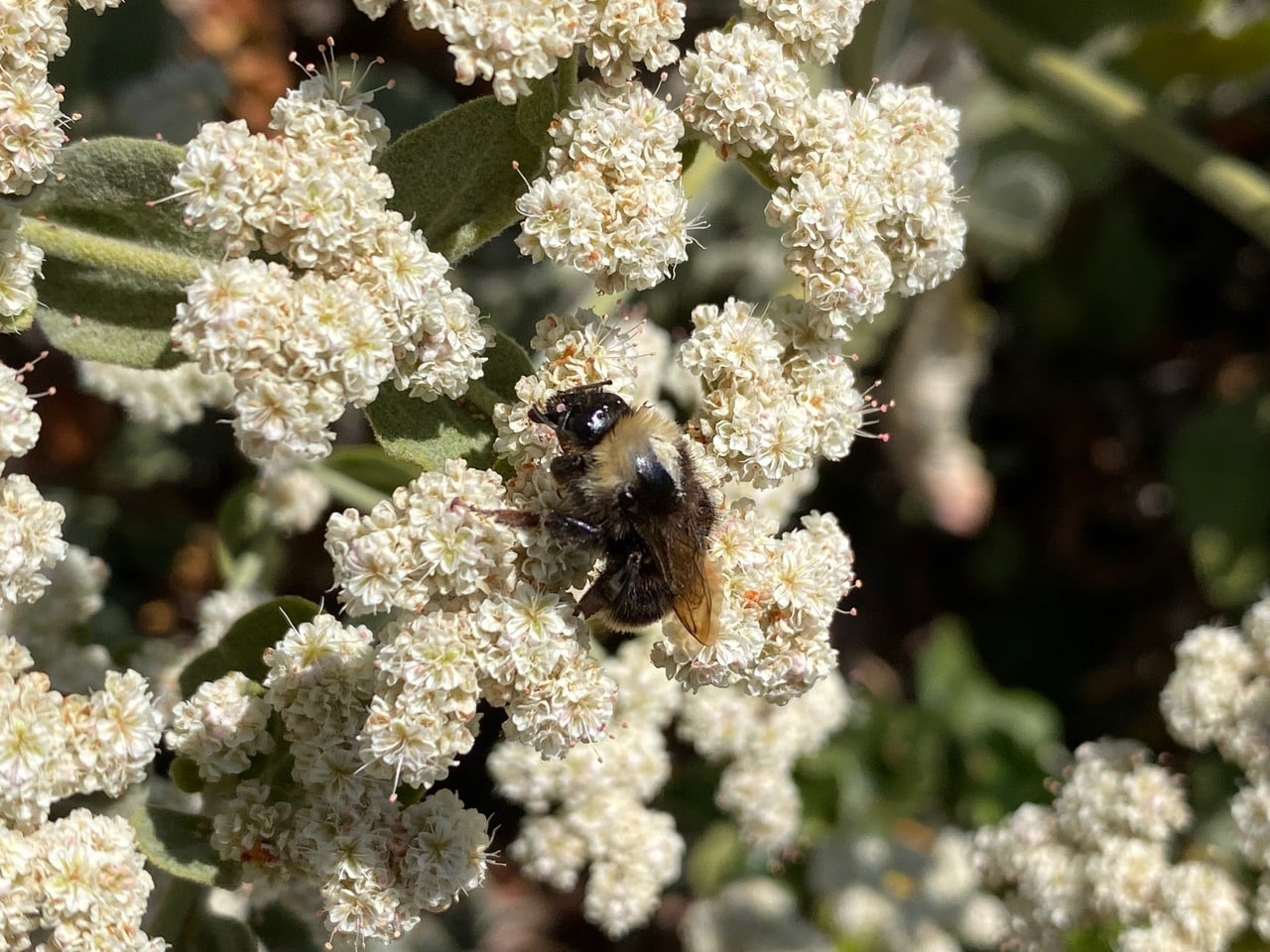
A Bumble Bee with black head (California Bumble Bee, Bombus californicus?) is perched on an inflorescence of St. Catherine’s Lace, cleaning its mouthparts. Is that a big gash on its thorax? What happened?
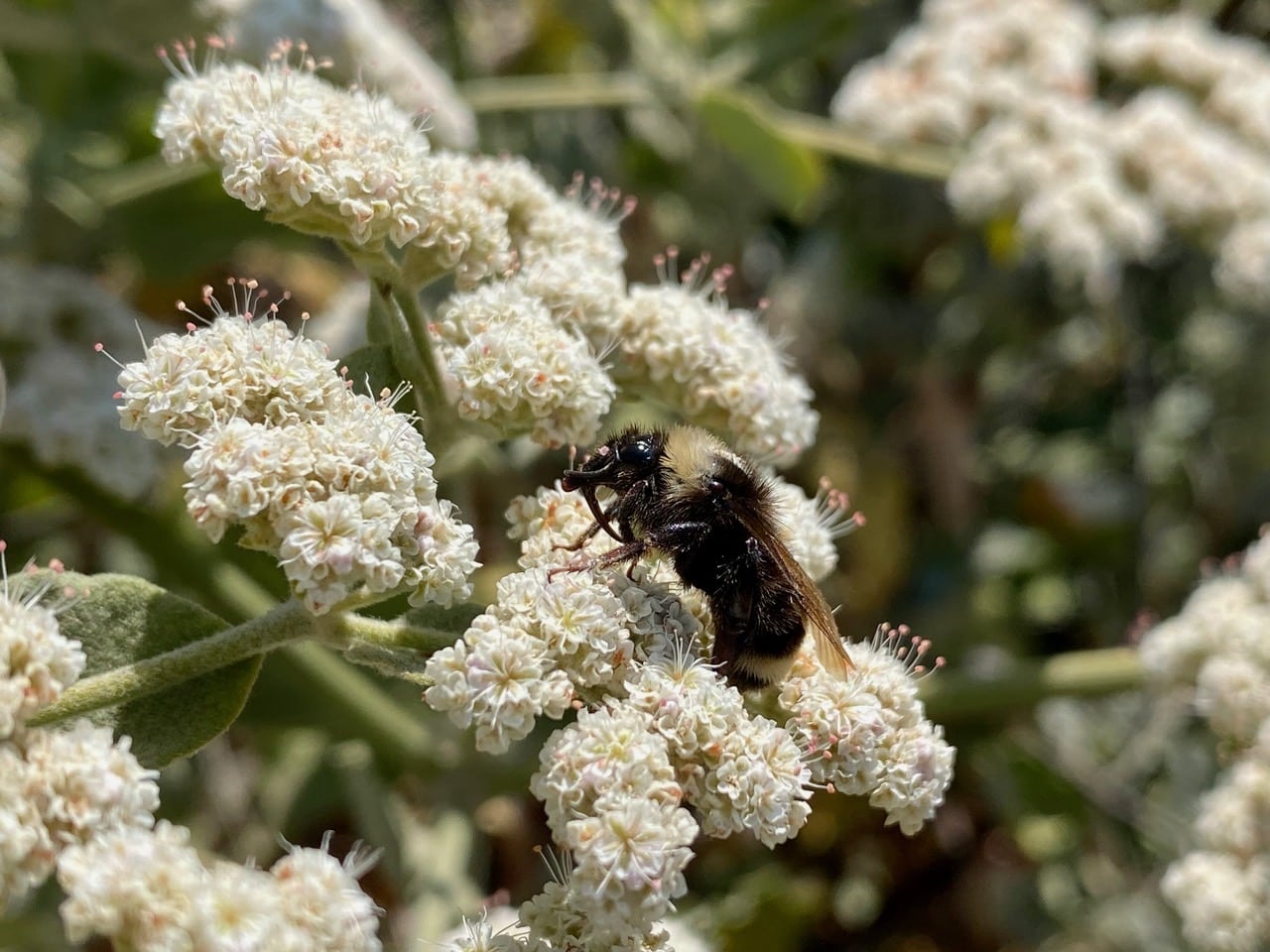
I am given quite a show of the complex structures of the bumble bee’s mouthparts, as the bee slowly extends and retracts them repeatedly. Most of us are unaware of the complex hard infrastructure of the bee’s mouthparts, seeing only the soft, flexible tongue that darts in and out while the bee feeds.

A Honey Bee, Apis mellifera (family Apidae) is foraging on the flowers of St. Catherine’s Lace, her corbiculae (pollen baskets) bulging with pollen.
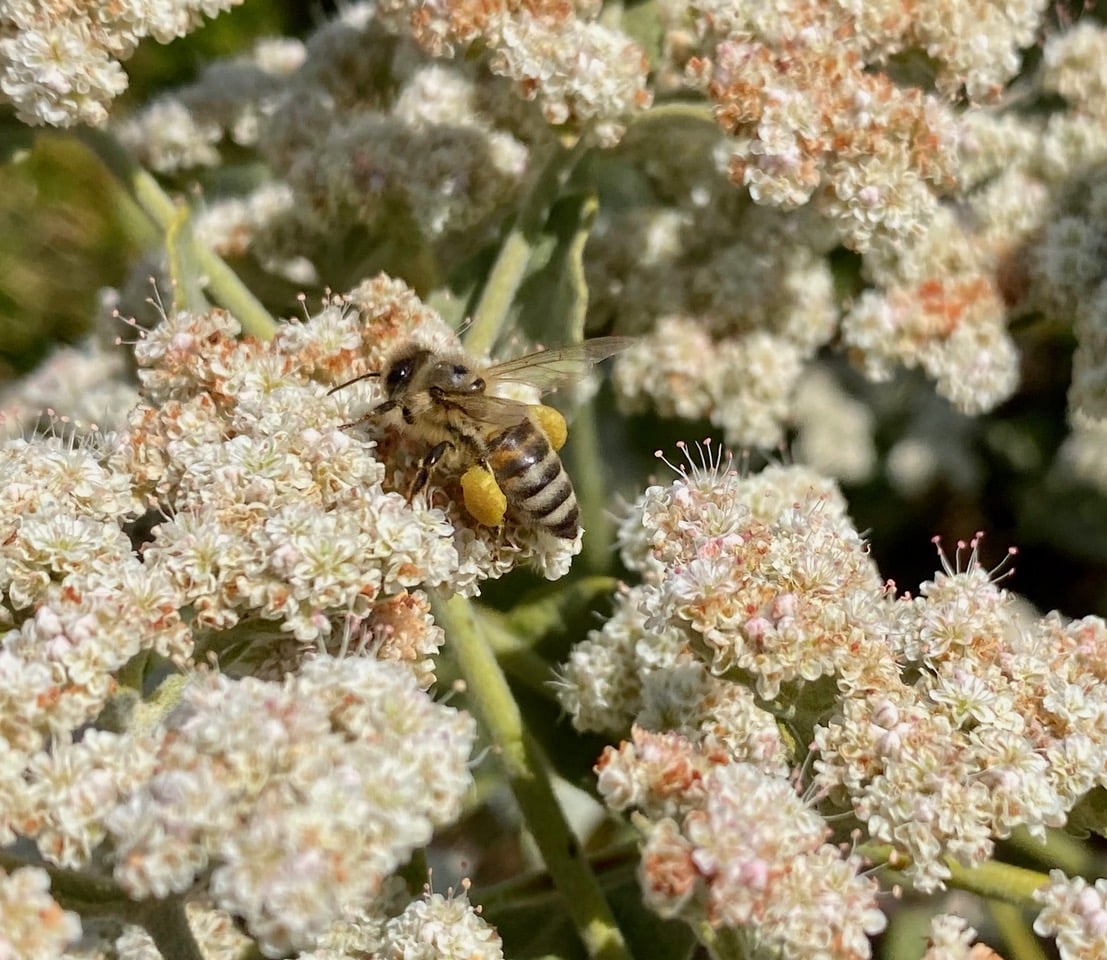
The pollen collecting apparatus in Apidae bees, which include honey bees and bumble bees, is commonly called a “pollen basket” or corbicula. This region is located on the tibia of the hind legs and consists of hairs surrounding a concave region. After the bee visits a flower, she begins to groom herself and brushes the pollen down toward her hind legs and packs the pollen into her pollen basket. A little nectar mixed with the pollen keeps it all together like putty, and the stiff hairs surrounding the pollen basket hold it in place. Remarkably bees are able to fly while carrying up to a third of their body weight in pollen.
.jpg)
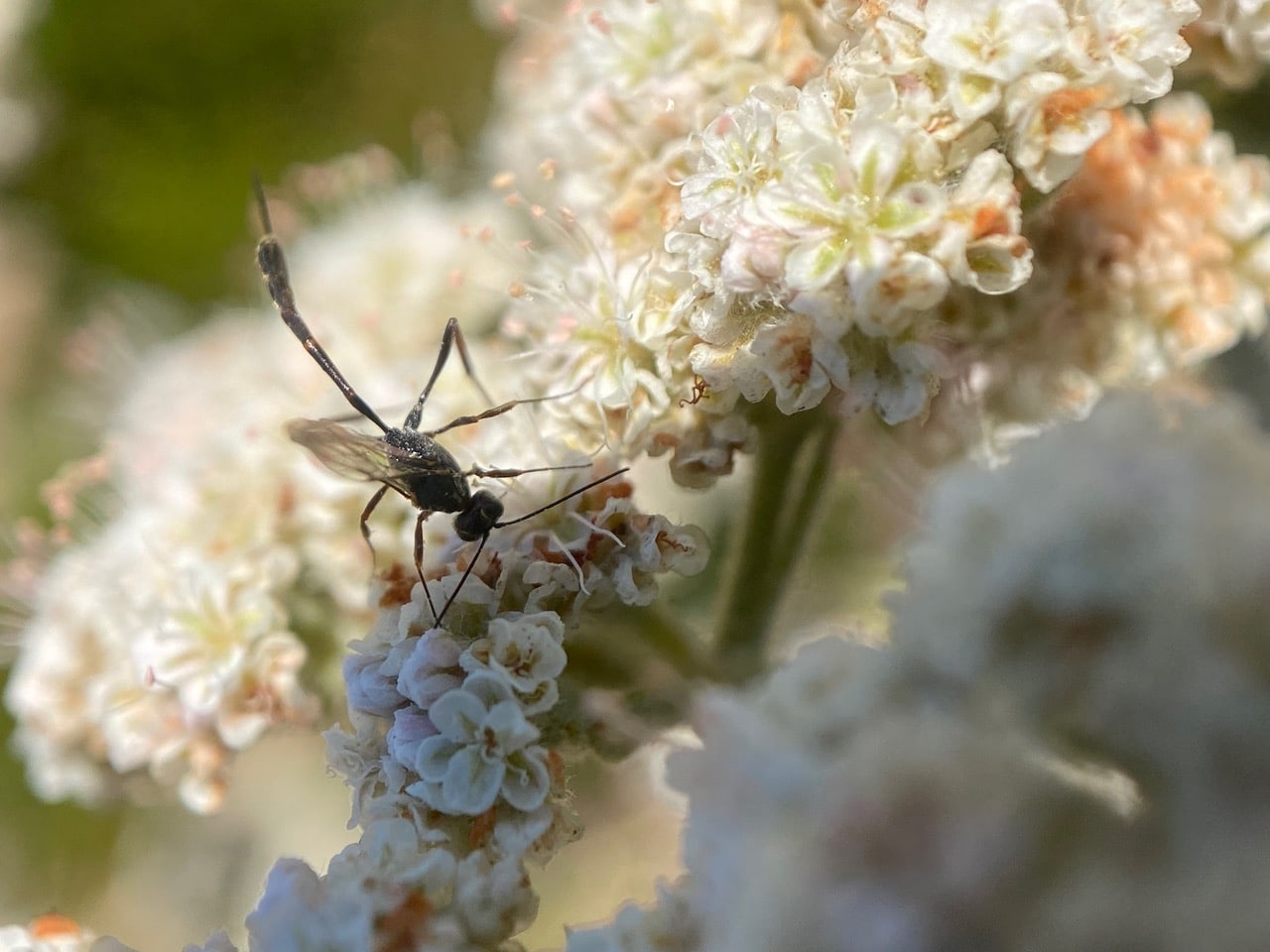
Hey, that’s a Carrot Wasp, Gasteruption sp. (family Gasteruptiidae)!
Gasteruption are wasps in the family Gasteruptiidae, a family of parasitoid wasps with a worldwide distribution. They are small wasps, from 13-40 mm depending on the species, and much of that length owing to the long ovipositor in females of some species. The wasps are so skinny they have been called “flying needles”. The wasp has a pronounced “neck” between head and thorax. The abdomen is attached high up on the thorax, not between hind legs. Hind tibia are swollen.
Adult wasps are most often found at flowers, especially those in the carrot family, Apiaceae, hence their common name of “carrot wasps”. Flight activity peaks in late spring and/or mid-summer. Carrot Wasps are parasitoids of solitary bees and wasps that nest in twigs or borings in wood. The female searches for nests of various solitary bees or wasps, assessing each hole by feeling for vibrations from the larvae moving around inside, as the nest burrow will have been blocked up to protect the larvae. The female wasp needs her long ovipositor to reach the depths of a host’s tunnel and deposit an egg. She pushes her long ovipositor through the blocked-up entrance into the nest cell, depositing her own eggs next to the host larvae. The larva that hatches out prey upon the host eggs, larvae and provisions. Gasteruption wasps have been recorded in the nests of digger bees, plasterer bees, leaf-cutter bees, mud daubers, and pollen wasps.
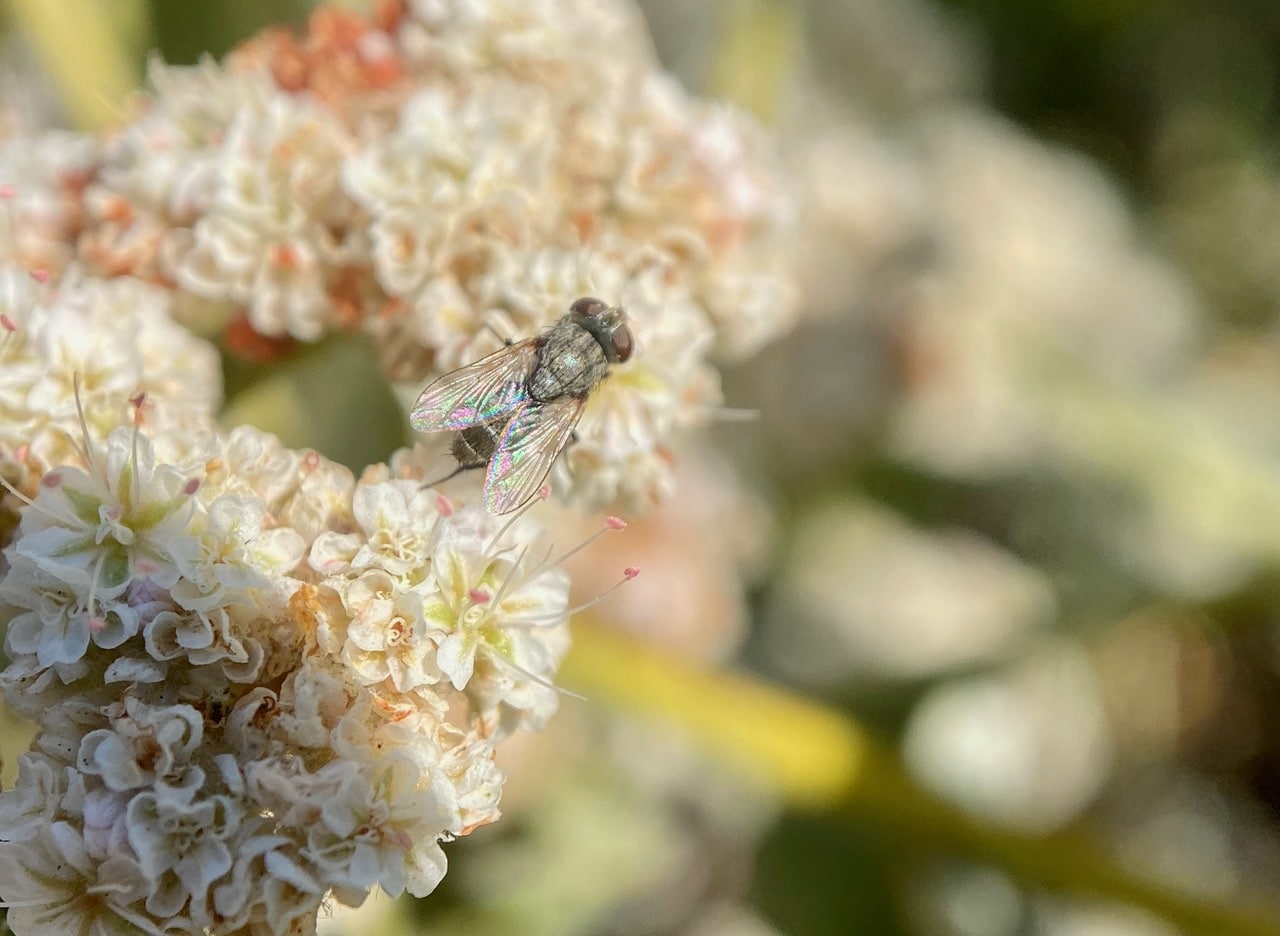
A tiny fly is running around on a cluster of buckwheat flowers. Under magnification I recognize it as a Satellite Fly, Metopia sp. (family Sarcophagidae, subfamily Miltogramminae), often seen lurking around the nest burrows of sand wasps along the shoreline.

Members of the family Sarcophagidae are commonly called Flesh Flies. Many have black and gray longitudinal stripes on the thorax and checkering on the abdomen, red eyes, and a bristled abdomen sometimes with a red tip. They differ from most flies in that they are ovoviviparous, opportunistically depositing hatched or hatching maggots instead of eggs on carrion, dung, decaying material, open wounds of mammals, hence their common name. The adults mostly feed on fluids from animal bodies, nectar, sweet foods, fluids from animal waste and other organic substances. While we may find their habits revolting, Flesh Flies perform important roles in the ecosystem – the larvae as decomposers/recyclers, and the adults as pollinators.
Metopia is not your ordinary Flesh Flies (family Sarcophagidae). Its larvae occupy a special niche. As kleptoparasites, they develop in the nests of bees and wasps, feeding on the provisions that the females have prepared for their own young. The female Metopia enters the nest of its host to deposit its larvae.

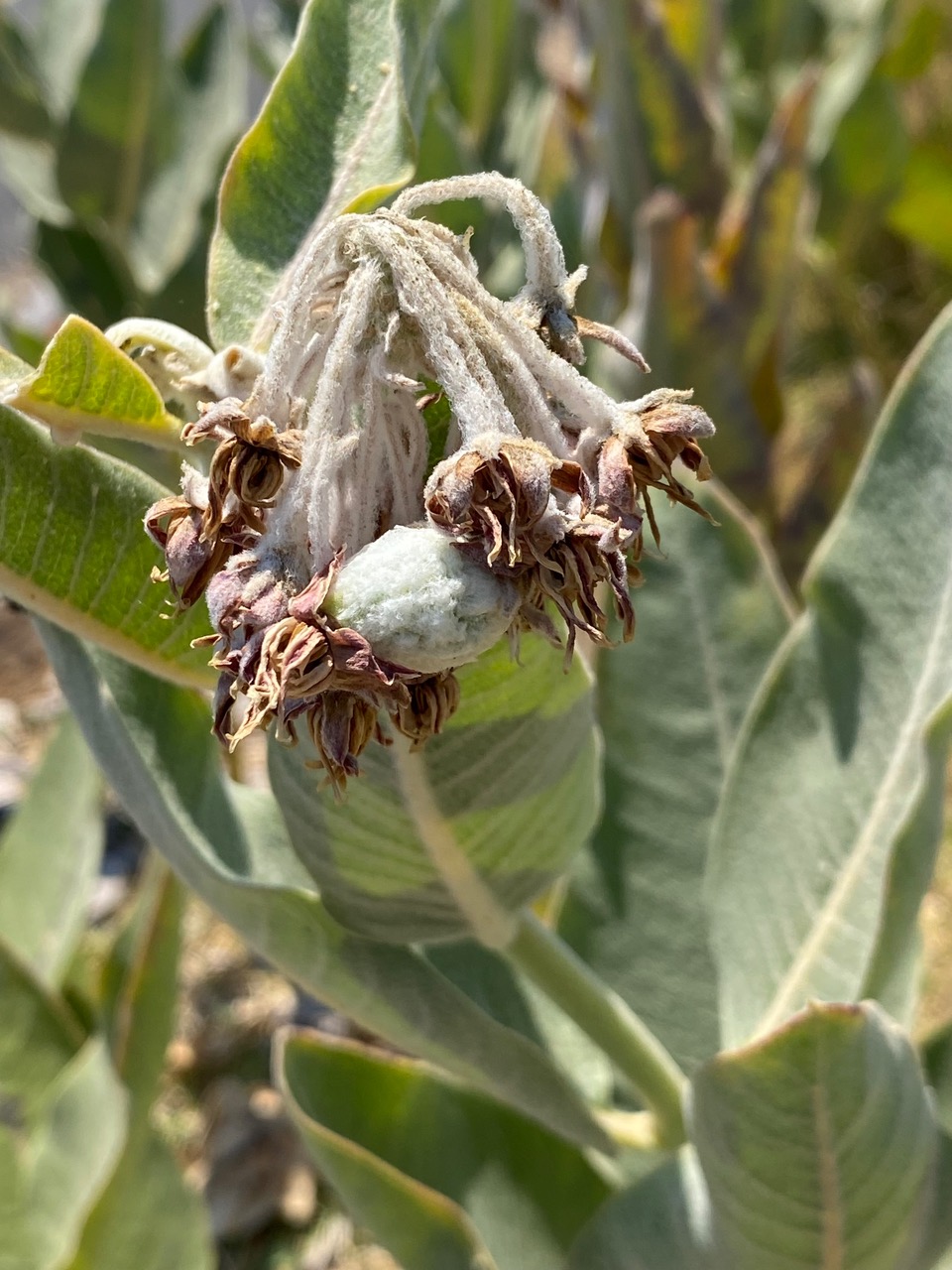
I check on the sad-looking wilted flowers of the Showy Milkweed, Asclepias speciosa, and am delighted to find a fuzzy little fruit growing from the base of a dried flower. From the twenty or so plants in this patch, only a single fruit is produced – a rather dismal yield. Perhaps those Sand Wasps aren’t good pollinators for the milkweed?
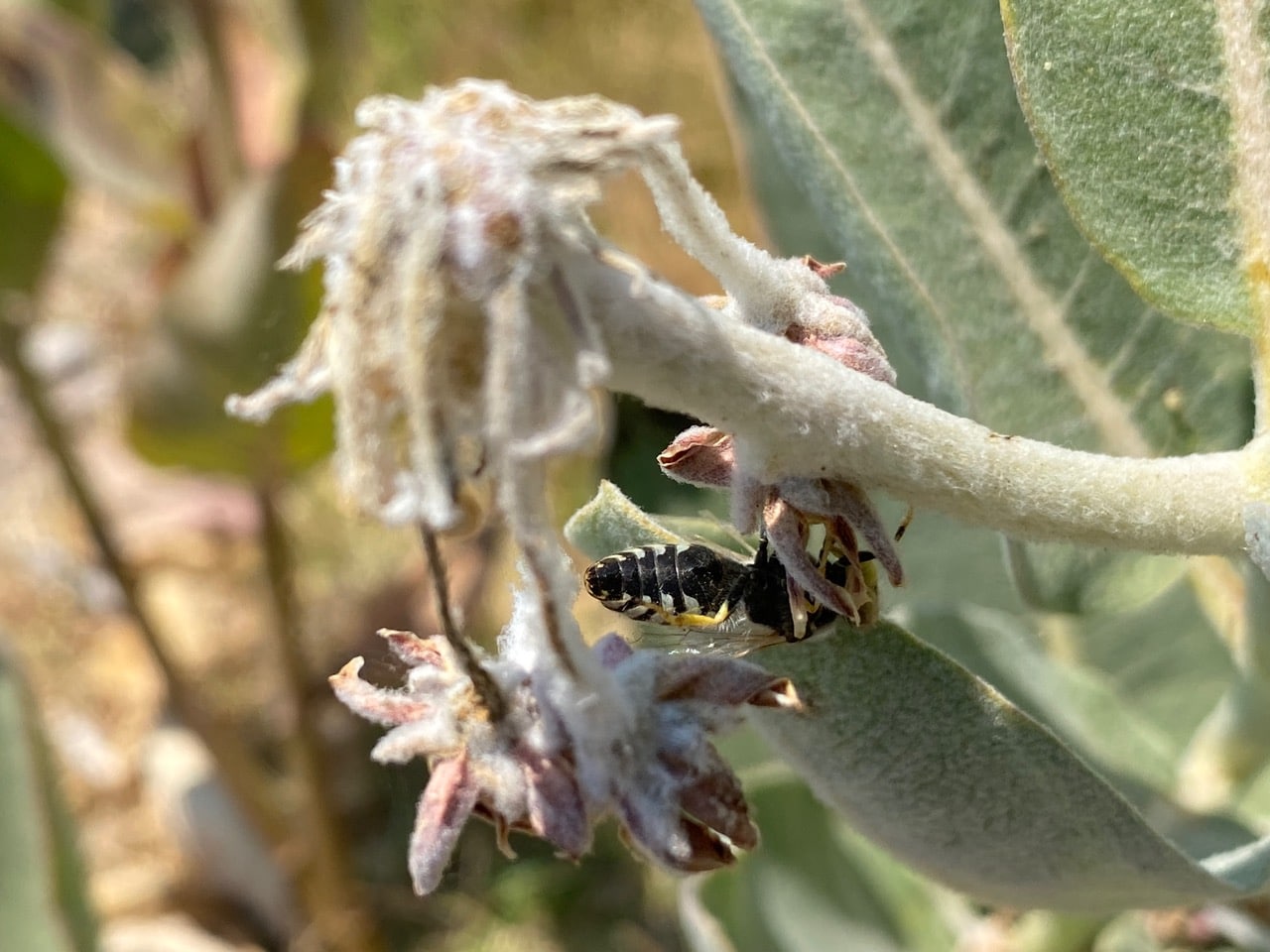
Ooh, there’s that dead American Sand Wasp that I have photographed before, trapped by a milkweed flower. Now it is upside down as the flower has collapsed and is drooping. Those stigmatic slits are a real death traps for the unsuspecting insects, holding on to them tenaciously even as the flower itself has dried up.
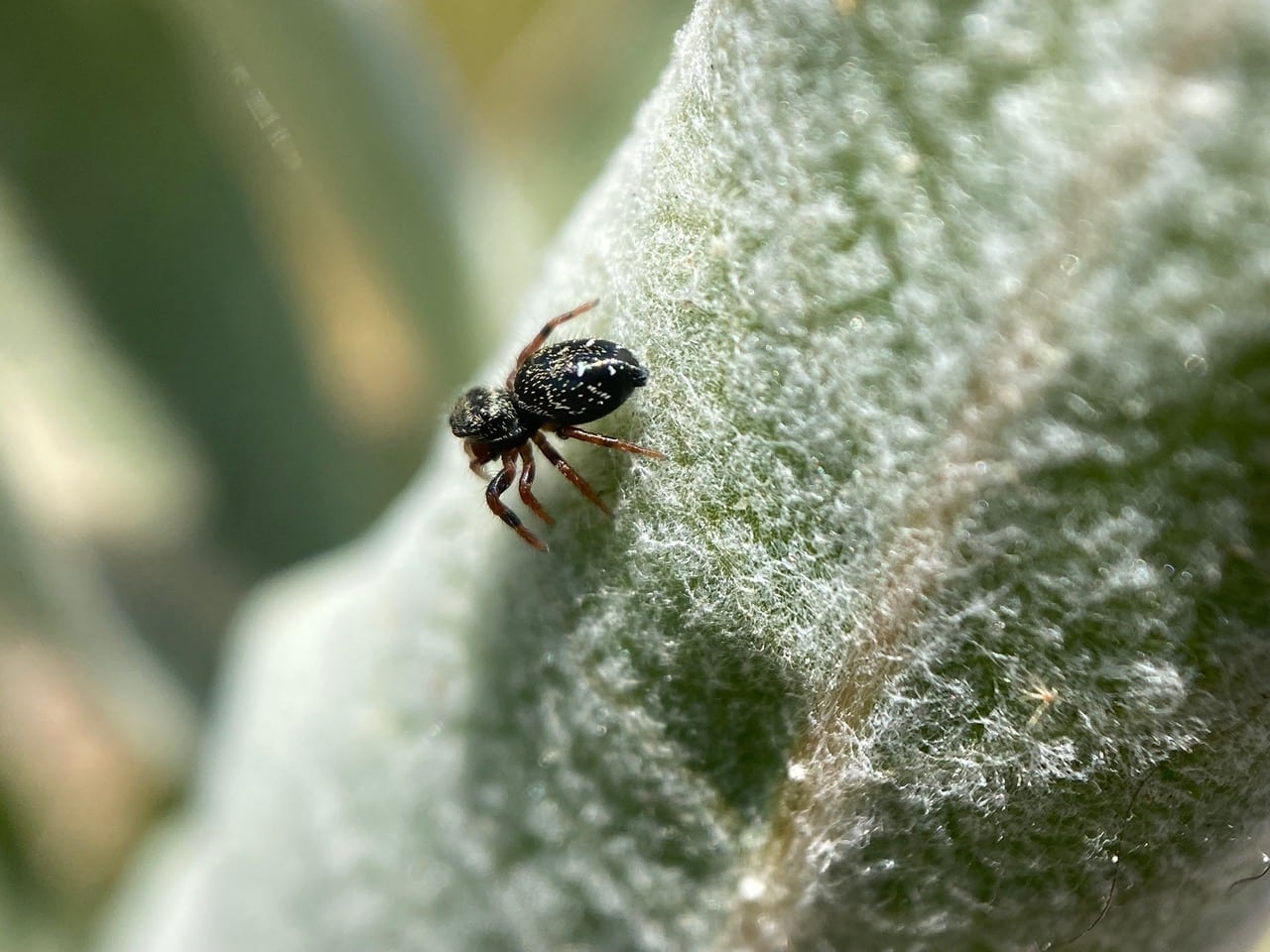
A small Jumping Spider is wandering on the wooly surface of a Showy Milkweed leaf.
Jumping spiders (family Salticidae) are free-roaming hunting spiders. They do not weave a web to catch prey. They stalk, then pounce on their prey. Just before jumping, the spider fastens a safety line to the substrate. It can leap 10-20 times their body length to capture prey. Their movement is achieved by rapid changes in hydraulic pressure of the blood. Muscular contractions force fluids into the hind legs, which cause them to extend extremely quickly. Jumping spiders are visual hunters. Their excellent vision has among the highest acuities in invertebrates. Since all their 8 eyes are fixed in place and cannot pivot independently from the body like human eyes can, jumping spiders must turn to face whatever they want to see well. This includes moving their cephalothorax up and down, an endearing behavior.
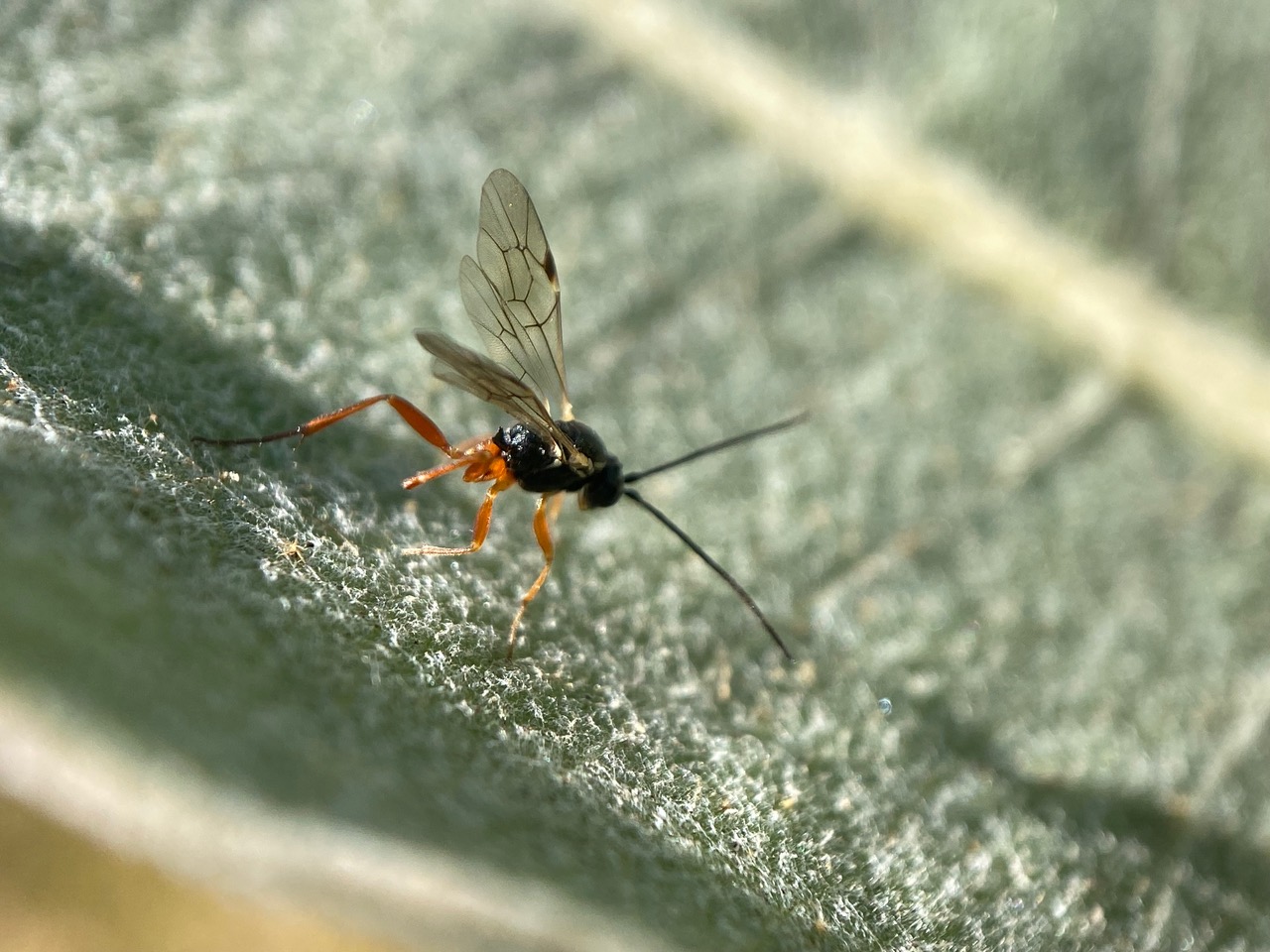
An Ichneumonid Wasp (family Ichneumonidae) is moving around unsteadily on a milkweed leaf. Looking through my macro lens, I am shocked to find that it is completely missing its abdomen, and more than one leg as well. Wow, maybe something happened while it tried to lay an egg on a host? The life of a parasitoid is not necessarily an easy one. Their hosts often put up a valiant fight.
The Ichneumonidae, also known as the Ichneumon Wasps, or Ichneumonids, are a family of parasitoid wasps. They are one of the most diverse groups within the Hymenoptera (the order that includes the ants, wasps and bees) with about 25,000 species and counting. Ichneumon Wasps attack the immature stages of insects and spiders, eventually killing their hosts. They play an important role in the ecosystem as regulators of insect populations.
The Ichneumon Wasps have longer antennae than typical wasps, with 16 segments or more as opposed to 13 or fewer. Ichneumonid females have an unmodified ovipositor for laying eggs. They generally inject eggs either directly into their host’s body or onto its surface, and the process may require penetration of wood. After hatching, the Ichneumonid larva consumes its still living host. The most common hosts are larvae or pupae of Lepidoptera (butterflies and moths), Coleoptera (beetles) and Hymenoptera. Adult Ichneumonids feed on plant sap and nectar. Females spend much of their active time searching for hosts while the males are constantly on the look out for females. Many Ichneumonids are associated with specific prey, and Ichneumonids are considered effective biological controls of some pest species.