

Pollinator Post 7/11/25 (1)

I check on the curbside native plantingings near the visitor center at Crab Cove.
That’s the fuzzy, heart-shaped face of a Cellophane Bee, Colletes sp. (family Colletidae) on the inflorescence of St. Catherine’s Lace, Eriogonum giganteum!

The bee family Colletidae includes generalists and specialists, and they are likely important pollinators of many wildflowers. All Colletidae in North America are solitary ground nesters, but some species nest in large aggregations. There are two major genera of Colletidae in North America: the Masked Bees (genus Hylaeus) and Cellophane Bees (genus Colletes). The most obvious shared characteristics of Colletidae is also the hardest to see: their short tongue. Colletes are moderately hairy, slender bees, ranging in size from 7 to 16 mm. Distinct features include a hairy head and thorax, pale bands of hair on the abdomen, and a heart-shaped head. The eyes of Colletes are angled (rather than being parallel), making the face slightly heart-shaped.
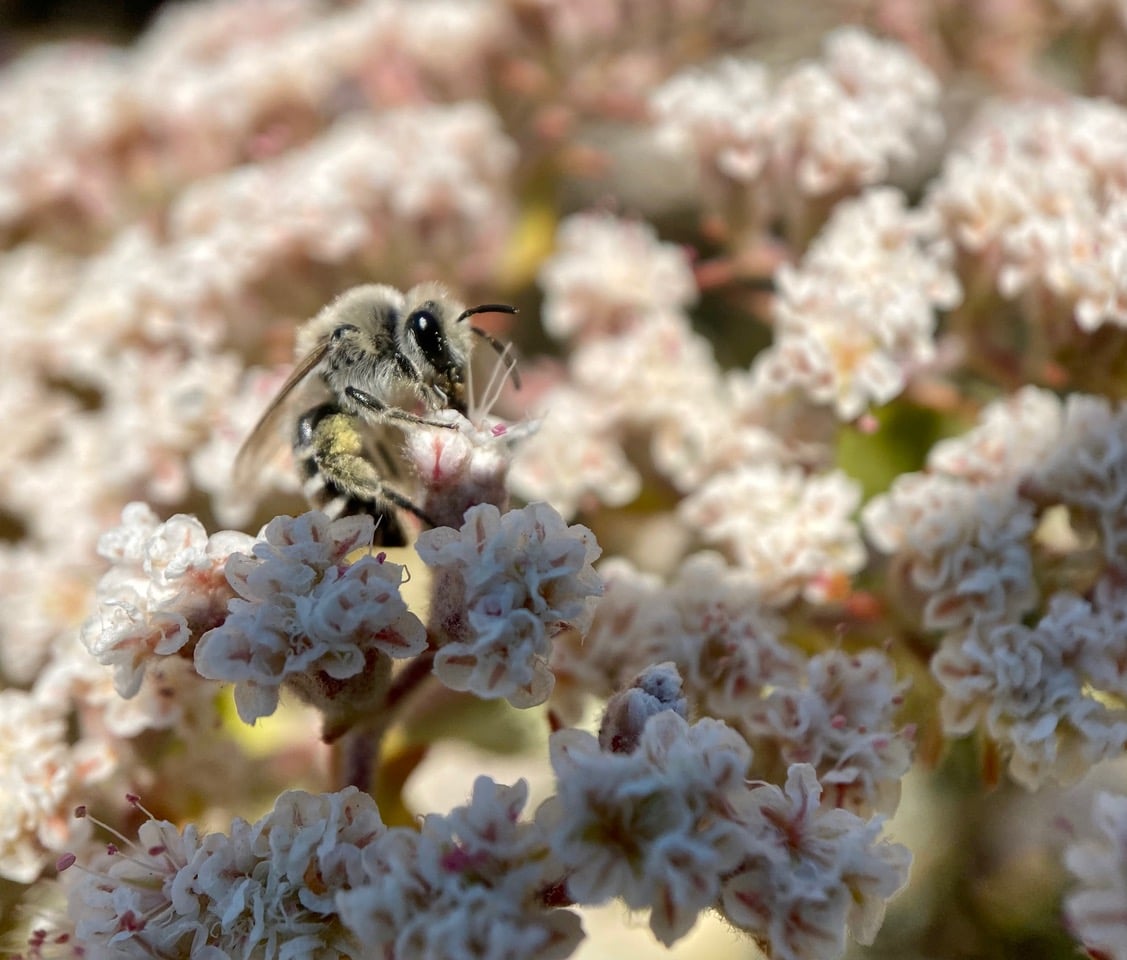
The genus name Colletes means “one who glues”, referring to their habit of applying a glue- or cellophane-like lining to the walls of nest cells, using their specialized tongues. This lining gives rise to their common names: cellophane bees, polyester bees, and plasterer bees. Colletes tongue is unique: short, flat, and forked at the tip. Colletes line their nests with a distinctive cellophane-like substance made from saliva and secretions from the Dufour’s gland on the abdomen. Using their specialized tongue, they paint the walls with saliva, then with secretions from the Dufour’s gland, they add a coat of varnish. This creates a clear covering that is strong, durable, and resistant to mold and water.
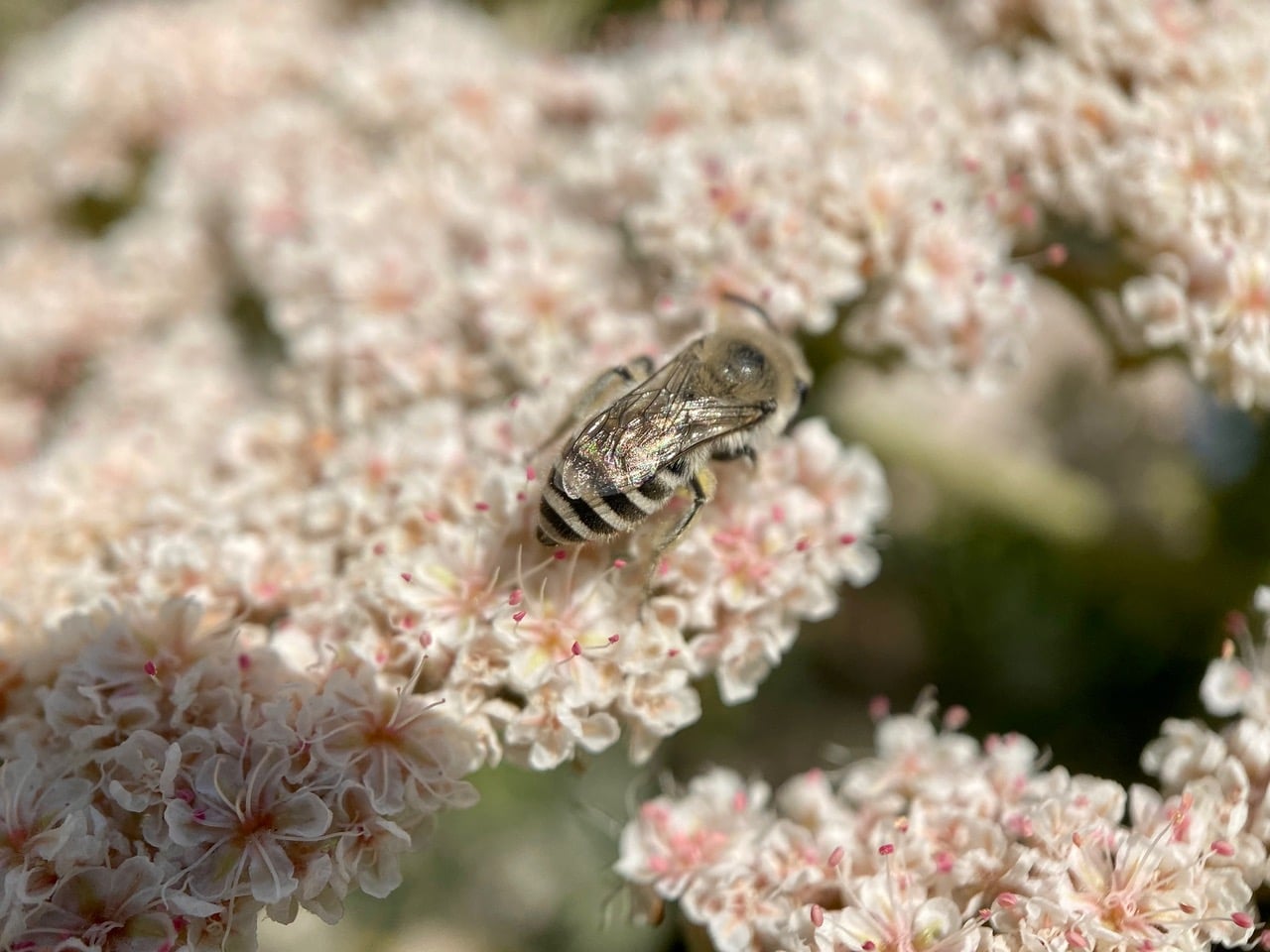
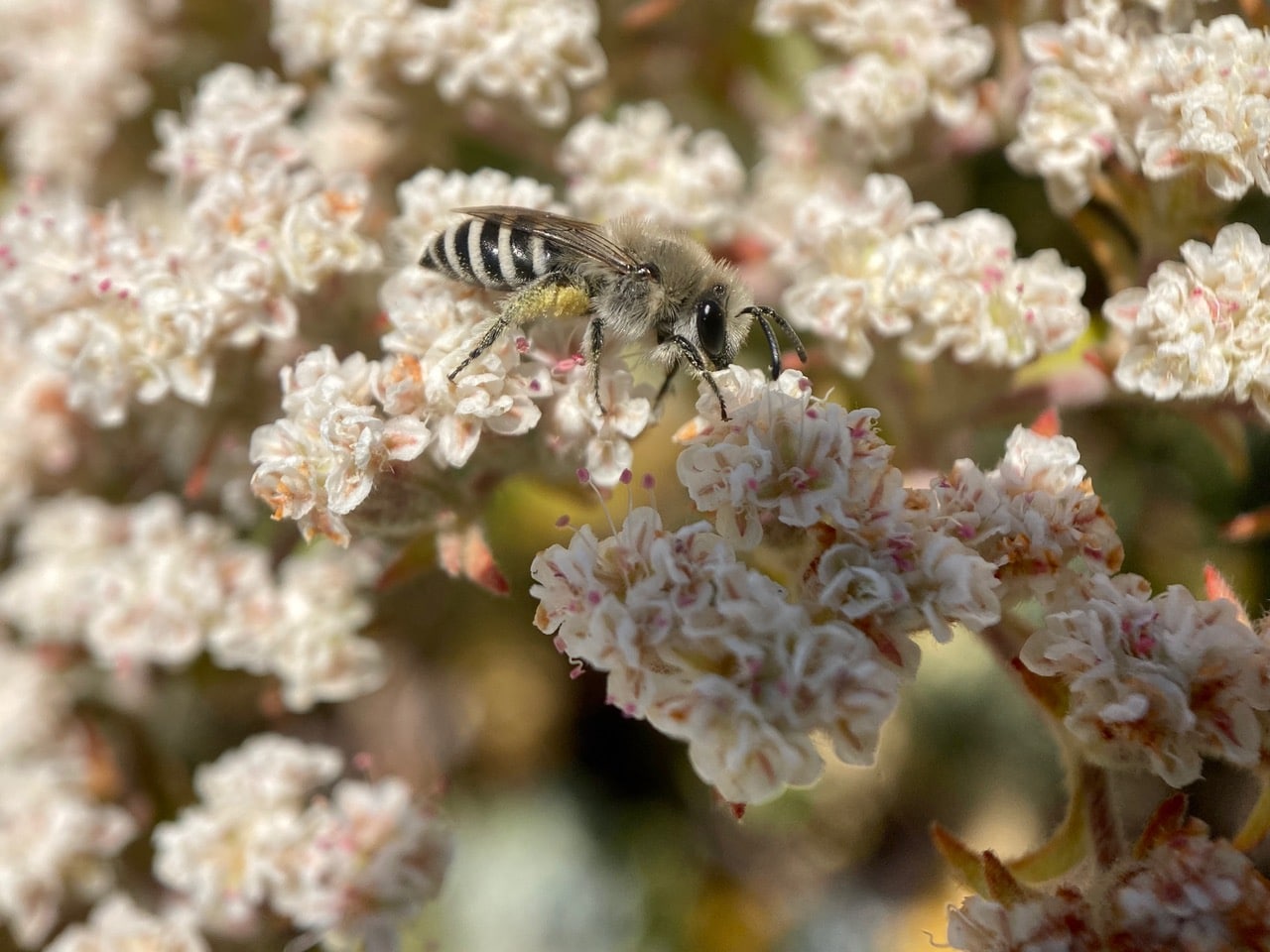
The shallow, open-faced, tightly clustered flowers of St. Catherine’s Lace are perfect foraging ground for these short-tongued bees.
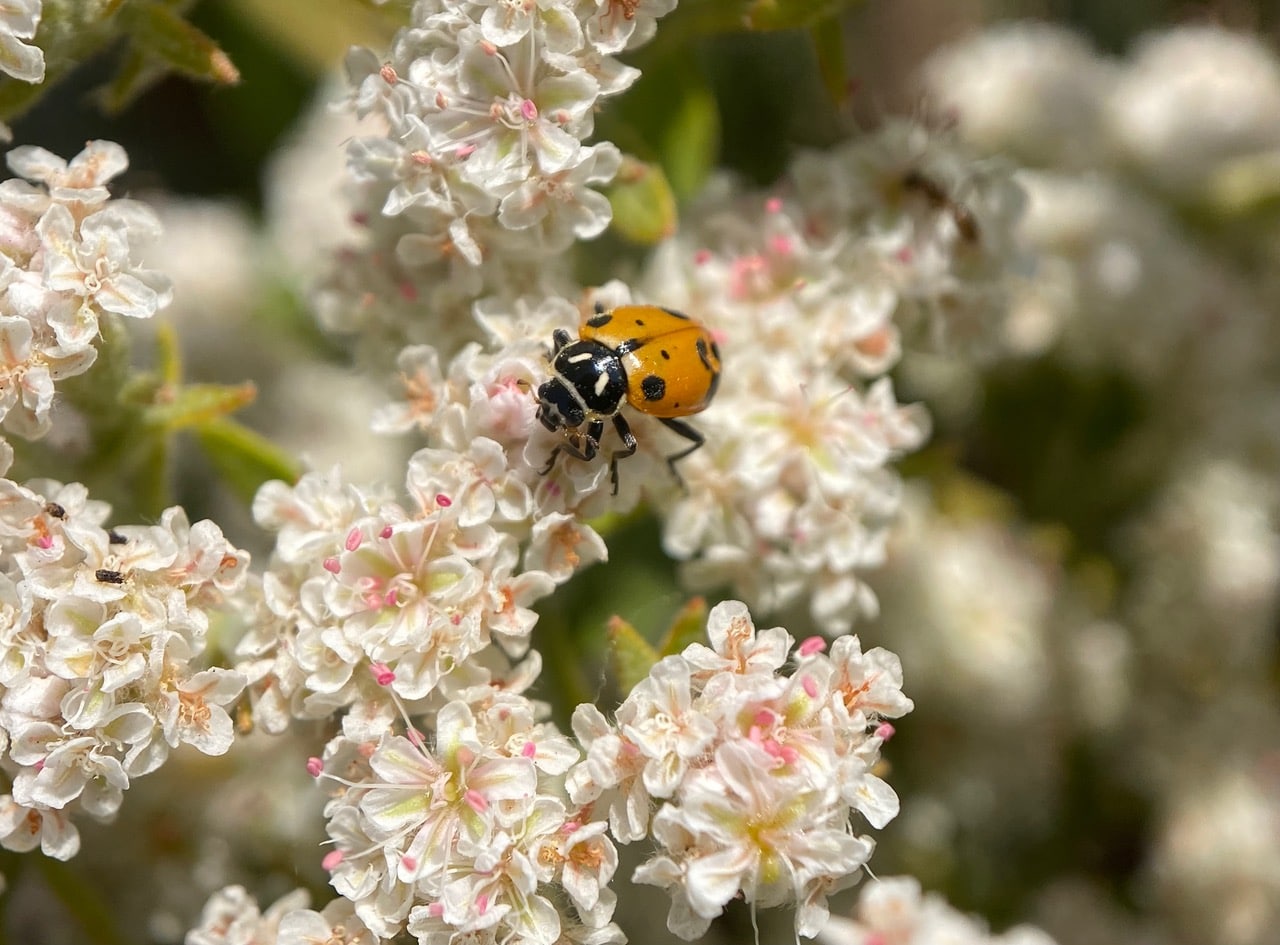
A Convergent Lady Beetle, Hippodamia convergens (family Coccinellidae) is foraging on an inflorescence of St. Catherine’s Lace. Both the adults and larvae of Lady Beetles are voracious predators of aphids and other small, soft-bodied insects. When prey is scarce, the beetles often feed on protein-rich pollen.
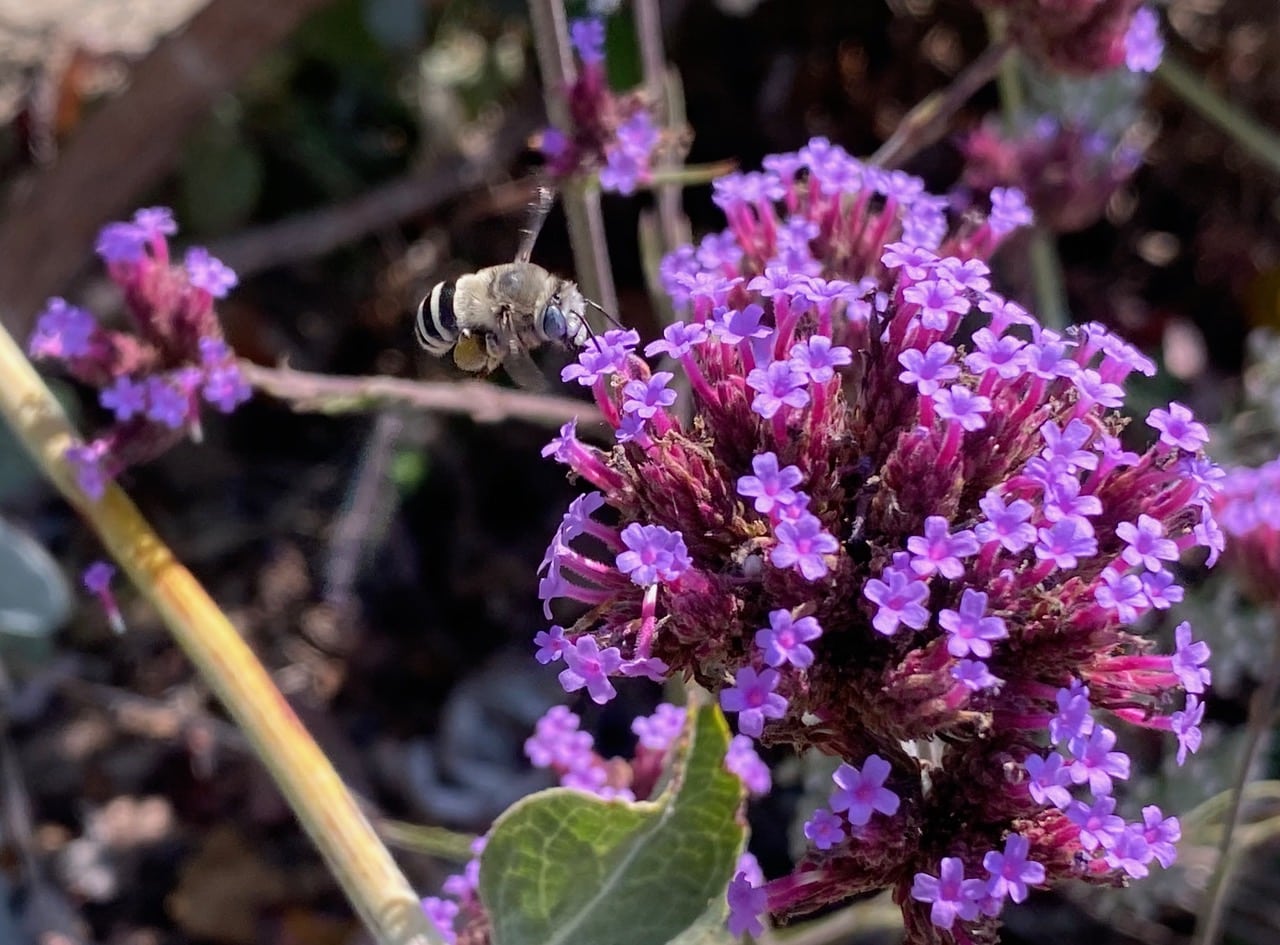
A Short-sun Digger Bee, Anthophora curta (subgenus Micranthophora, family Apidae) is hovering in front of a flower cluster of Purpletop Vervain, Verbena bonariensis.
The bee genus Anthophora, commonly known as Digger Bees, is one of the largest in the family Apidae. All species are solitary, though many nest in large aggregations. Nearly all species construct nests in the soil, either in banks or in flat ground; the larvae develop in cells with waterproof linings and do not spin cocoons. Males commonly have pale white or yellow facial markings, and/or peculiarly modified leg armature and hairs. Members of the subgenus Micranthophora are much smaller in size than the common Anthophora species. A. Curta is only about a third the size of the A. pacifica I am used to seeing in early spring. The general appearance and behavior (frenetic) are, however, similar.
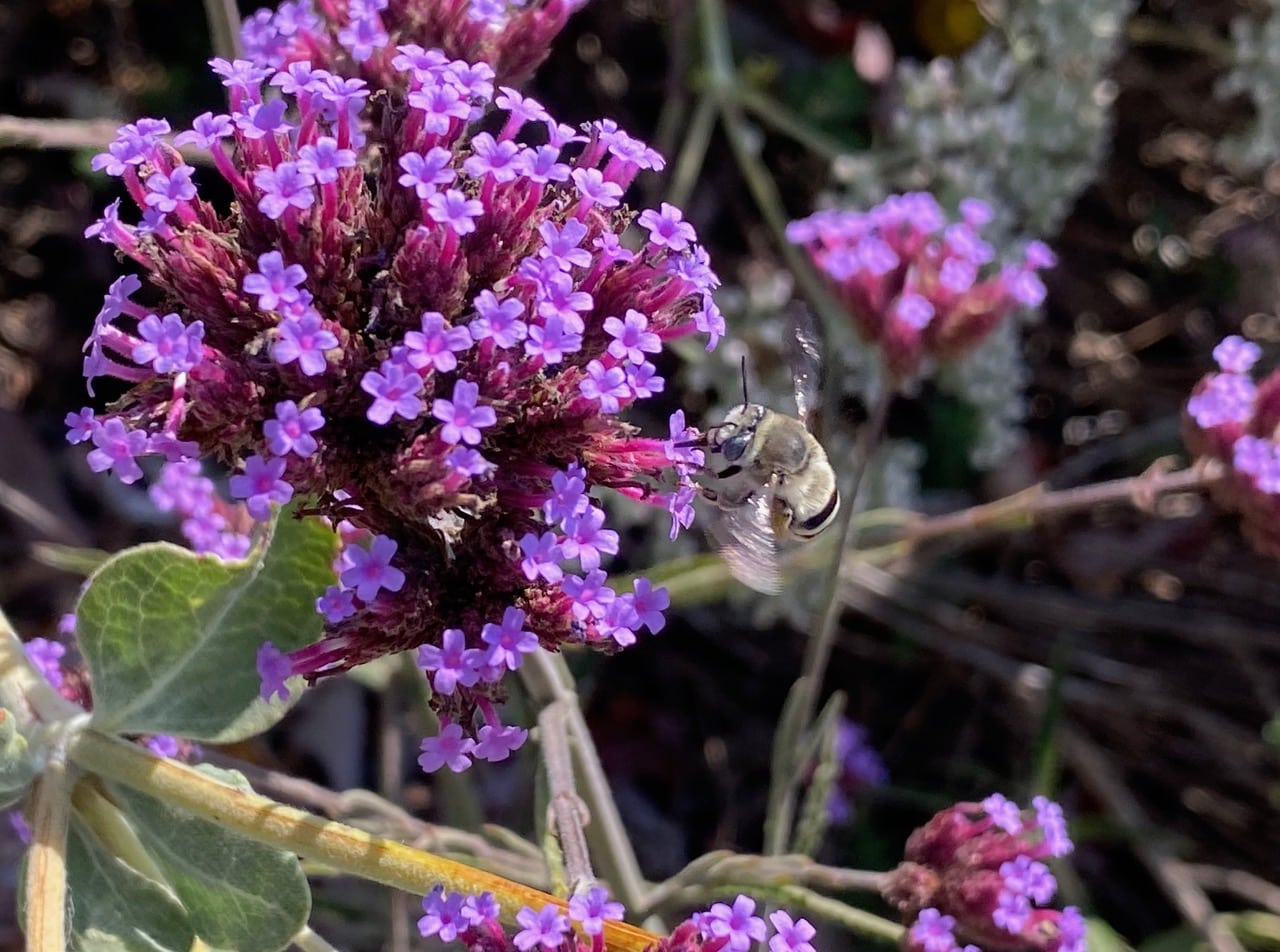
These bees have long tongues that can access nectar in deep-throated flowers. They are agile enough to do so without fully landing on the flowers.
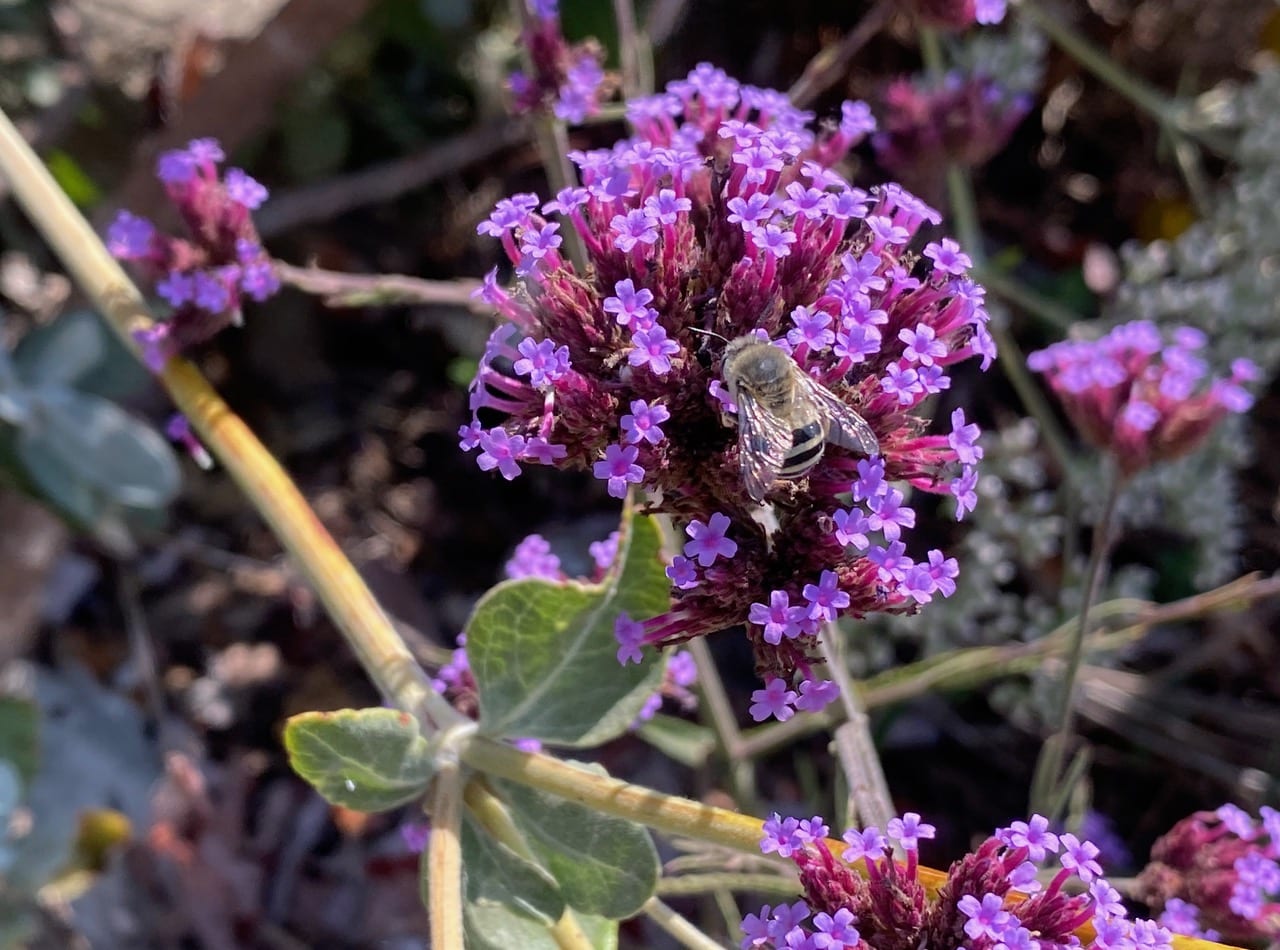
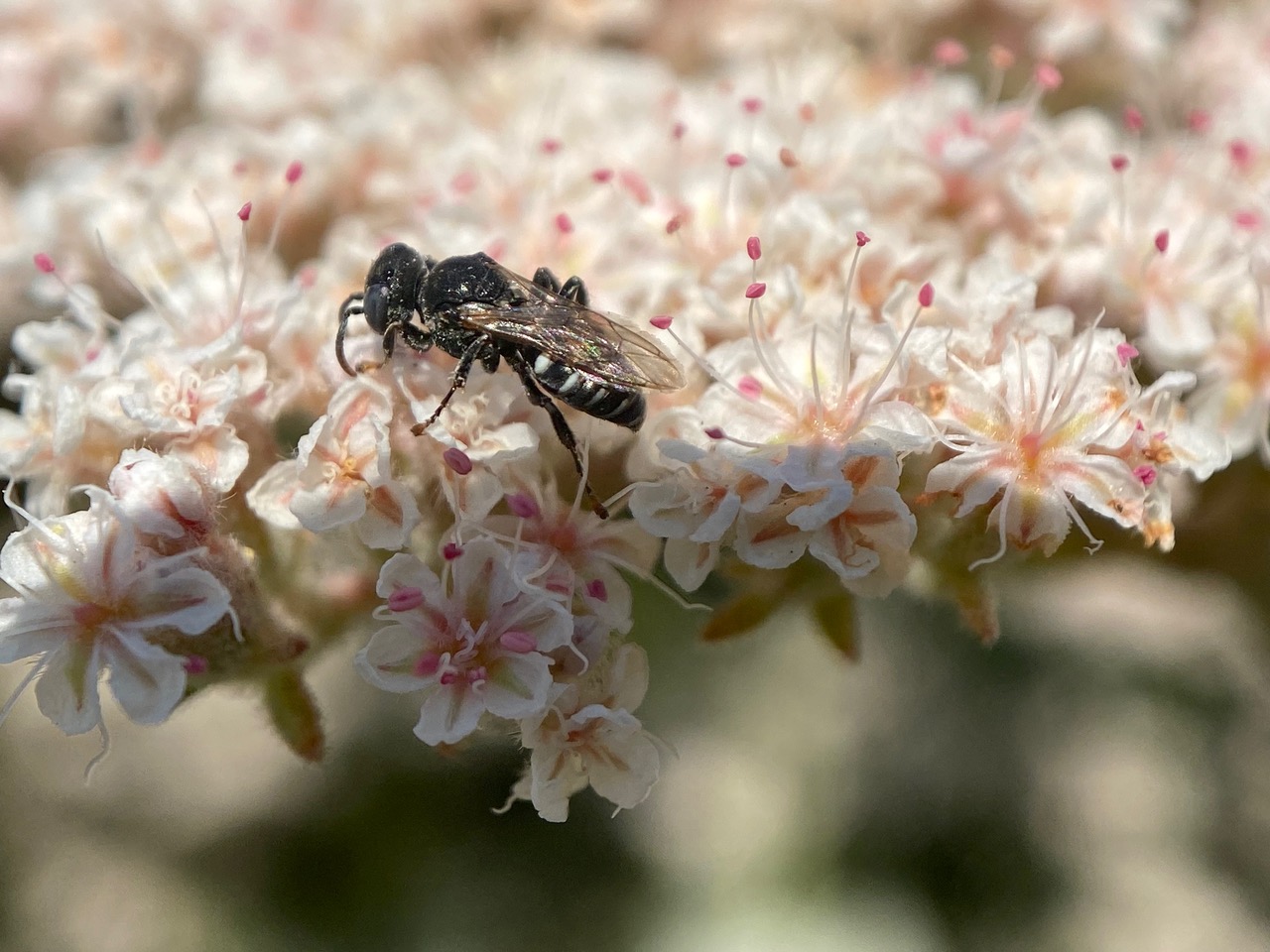
A Prong-backed Fly Hunter Wasp, Oxybelus uniglumis (family Crabronidae) is foraging on an inflorescence of St. Catherine’s Lace.

Note the broken white bands on the black abdomen of Oxybelus uniglumis.
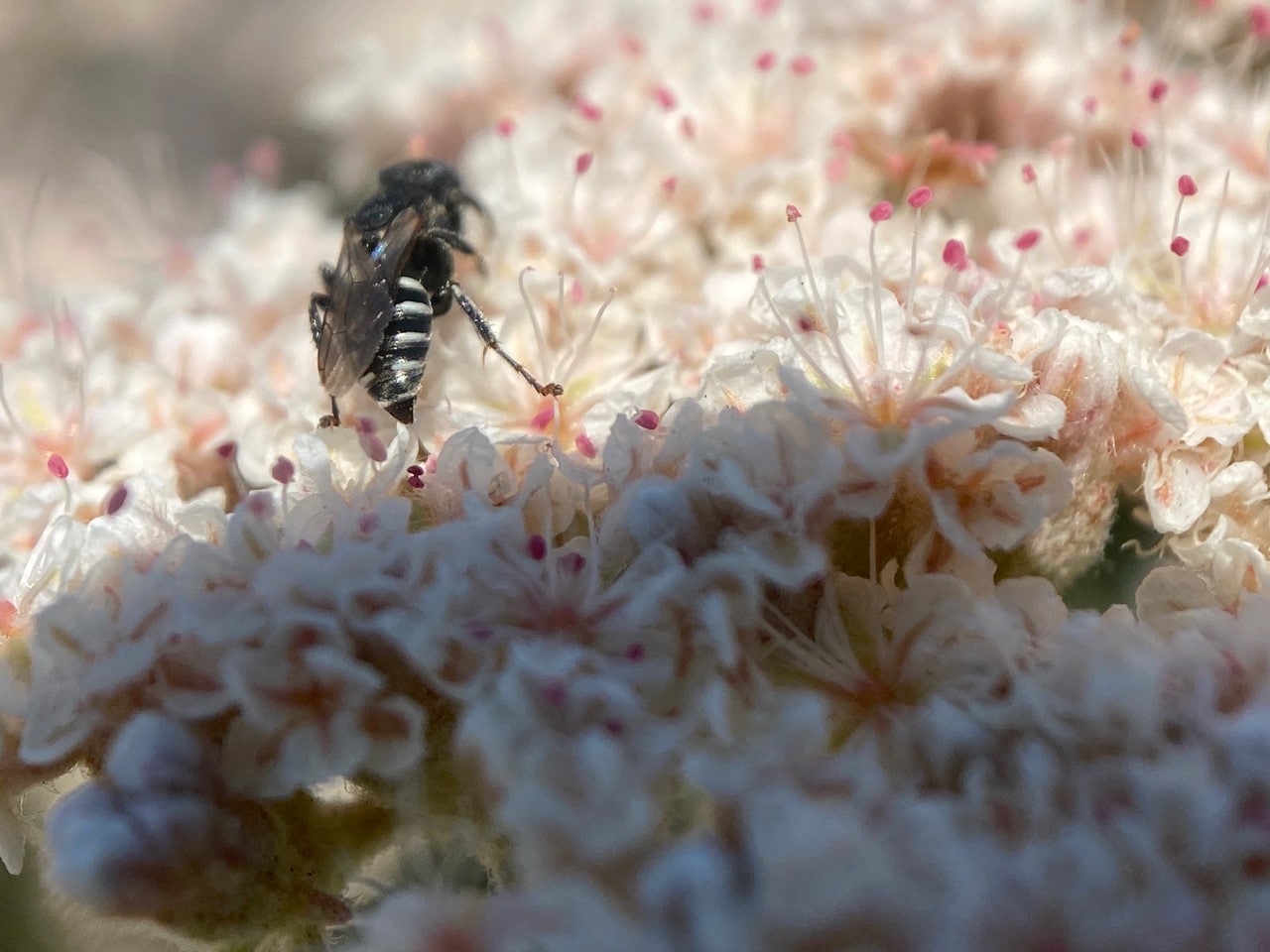

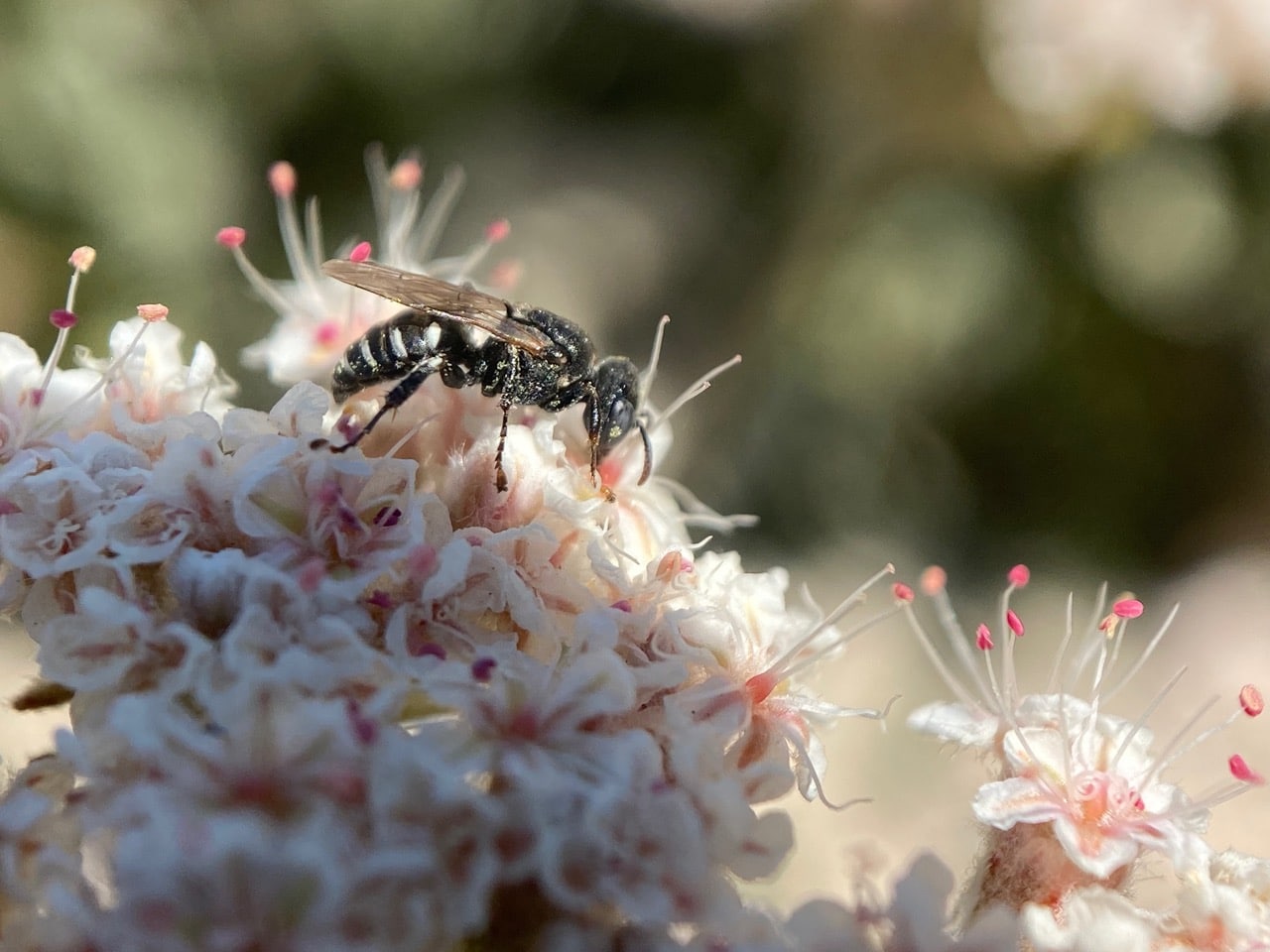
The Prong-backed Fly Hunter Wasp, Oxybelus uniglumis (family Crabronidae) occurs in northeastern North America. Its range also includes California and other western states. It is a small wasp, measuring 5-9 mm. The wasp nests in well-drained, sandy soil in a variety of habitats. A fully provisioned nest has one cell or at most a few cells. The female hunts various kinds of flies on the wing, captures one, then stings it, injecting venom to paralyze it. Rather than transporting the prey clutched beneath her like other small predatory wasps, she instead leaves her sting impaled in the fly while transporting it back to the nest. She lays a single egg on the first fly placed in a nest cell, then adds additional two to nine more flies before backfilling the nest. There is one generation per year, flying between May to early October.

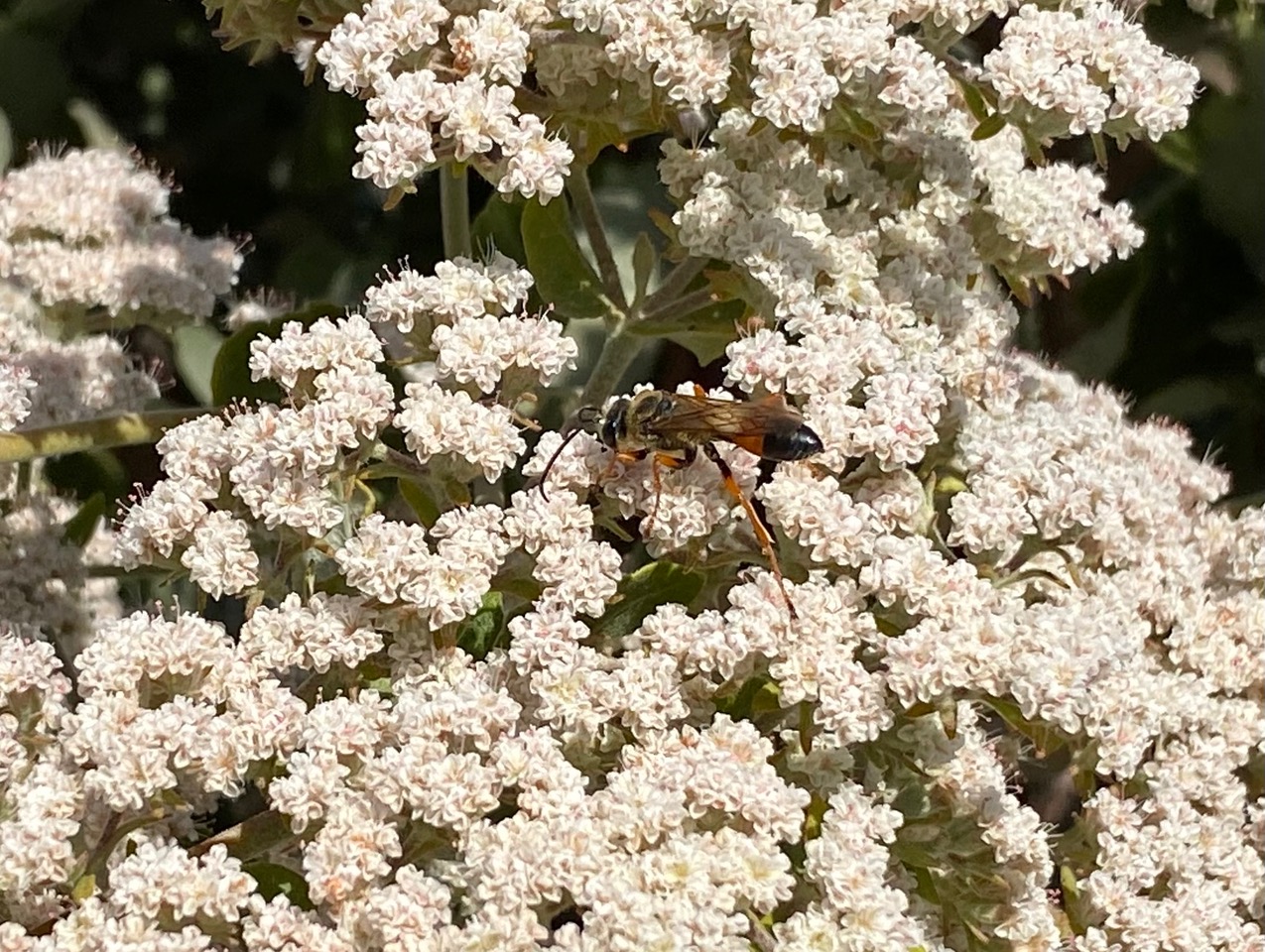
A large, thread-waisted wasp with black-and-orange abdomen is taking nectar from the flowers of St. Catherine’s Lace. It is a Great Golden Digger Wasps, Sphex ichneumoneus (family Sphecidae).

Sphex ichneumoneus, known commonly as the Great Golden Digger Wasp is a wasp in the family Sphecidae. It is identified by the golden pubescence on its head and thorax, its reddish orange legs, and partly reddish orange body. Size 15-27 mm. Found in fields, meadows, the wasp is native to the Western Hemisphere, from Canada to South America. The female digs a chambered tunnel in open ground, and proceeds to stock it with food for her young. She hunts for insects from the family of long-horned grasshoppers that include various crickets, katydids and grasshoppers. She stings to paralyze her prey, then flies or drags it back to the nest. A single egg is laid on the prey. The wasp larvae have fresh food to sustain them until they emerge as adults. One tunnel entrance may lead to as many as eight or ten separate larval chambers. The Great Golden Digger Wasps are not aggressive, but do sting if handled.

A female Forked Globetail, Sphaerophoria sulphuripes (family Syrphidae) hovers over the buckwheat flowers. I have to get a good look at the tip of her abdomen to ascertain that she’s not another similar hover fly, the Diamond Spottail, Fazia micrura.
The Forked Globetail, Sphaerophoria sulphuripes is native to North America. There is marked sexual dimorphism in the Forked Globetail – the males have a narrow abdomen with a reddish, swollen tip. Adults visit flowers for nectar and pollen. The larvae of Sphaerophoria feed on aphids and other soft-bodied insects.
Forked Globetail (Sphaerophoria sulphuripes) · iNaturalist

Here’s a female Oblique Streaktail, Allograpta obliqua (family Syrphidae) with a distinctive abdominal pattern that is hard to mistake for any other hover flies.
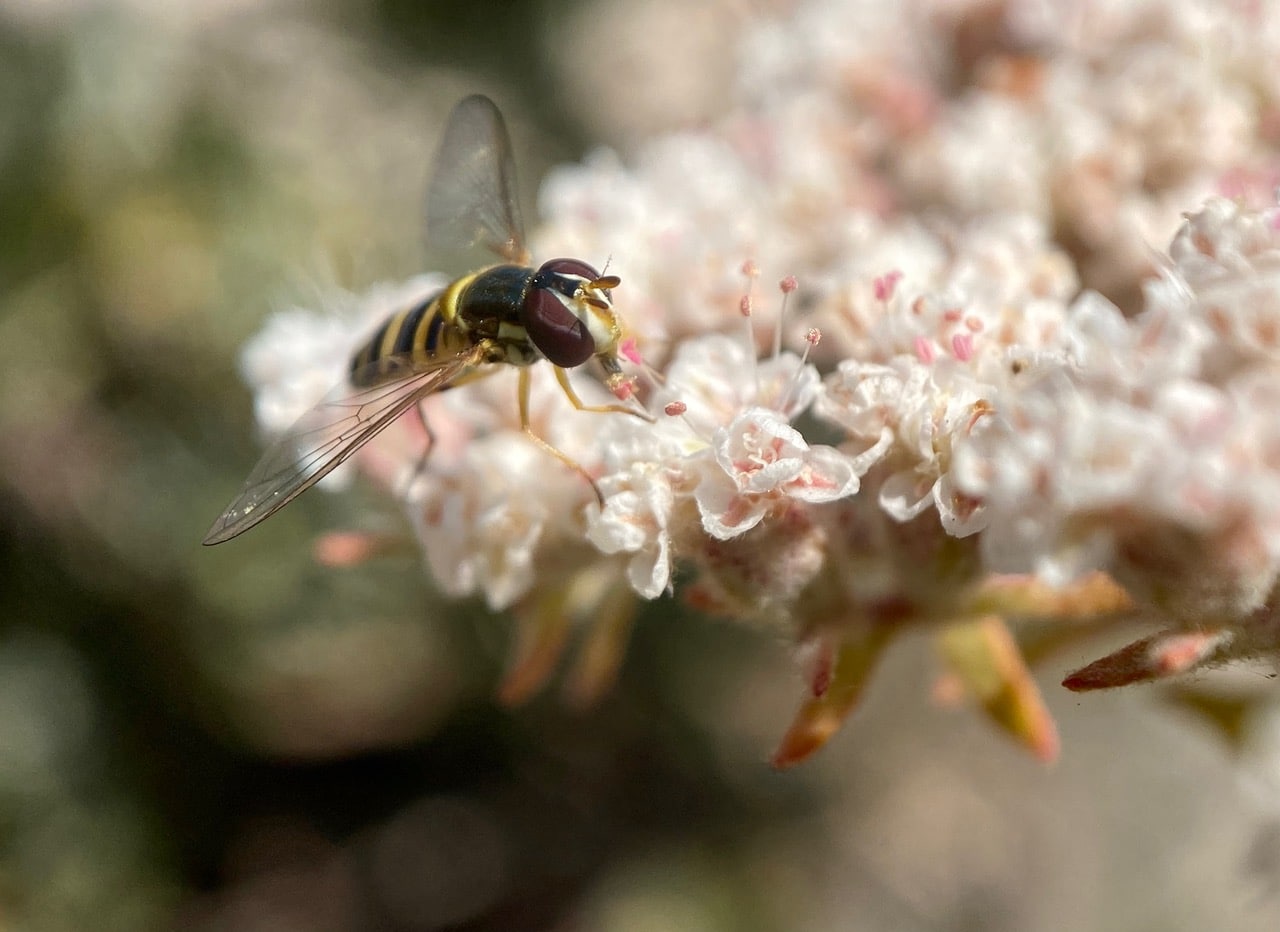
The Oblique Streaktail, Allograpta obliqua (family Syrphidae) is a common North American species of hoverfly. Adults are 6-7 mm long. Females have a tapered abdomen that ends in a pointed tip. Eggs are laid on surfaces of leaves or stems near aphids. The larvae are important predators of aphids. Adults visit flowers for nectar and pollen, and are pollinators.

A female Fine Striped Sweat Bee, Agapostemon subtilior (family Halictidae) is foraging on a flowerhead of Sneezeweed, Helenium puberulum. Note that her body is entirely iridescent green. Note also the scopa (special pollen-collecting hairs) on her hind legs.
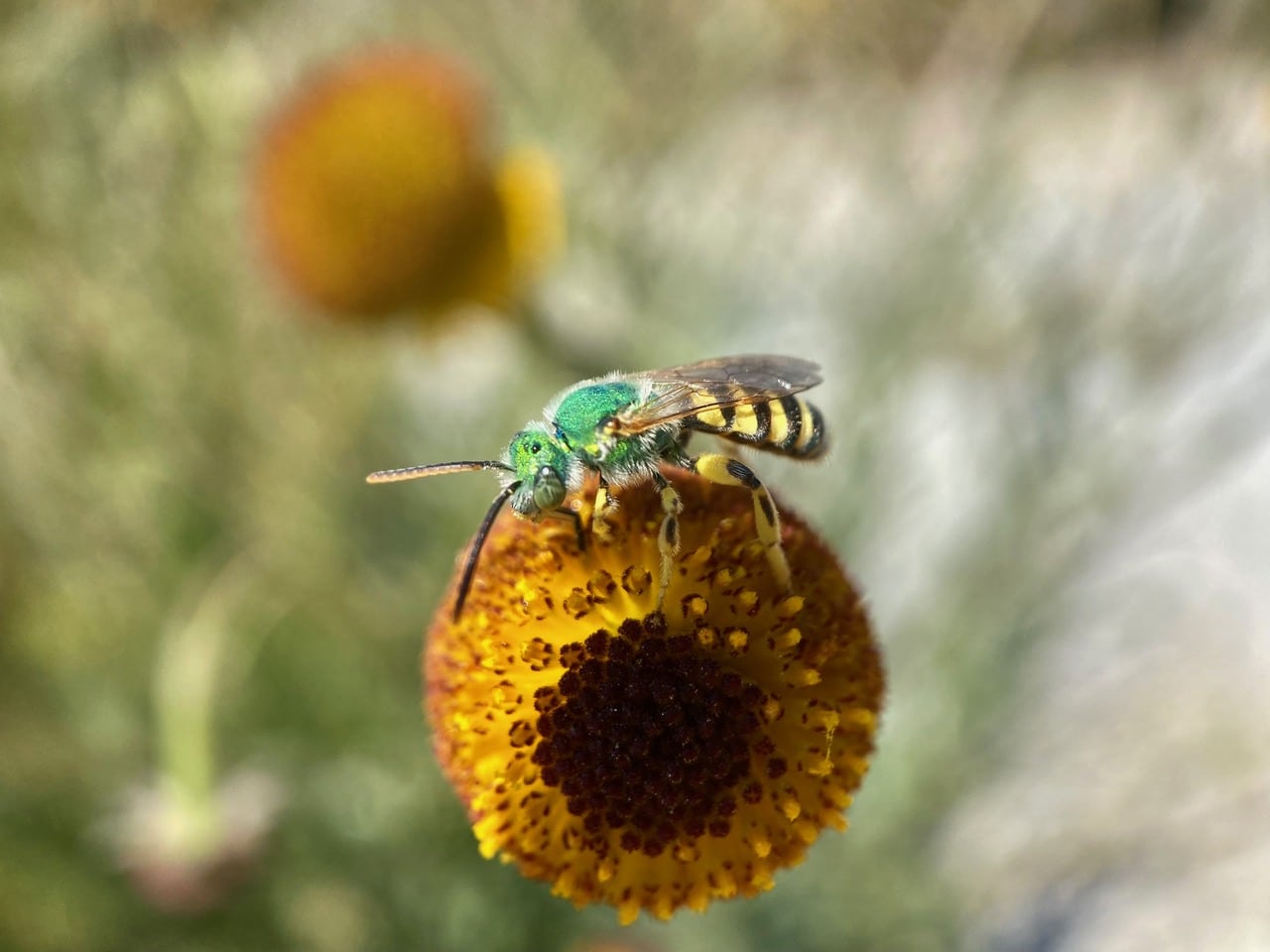
A male Fine Striped Sweat Bee, Agapostemon subtilior (family Halictidae) is foraging on another Sneezeweed flowerhead. Note his black-and-yellow striped abdomen.
Agapostemon are brightly colored metallic green or blue bees measuring 7 to 14.5 mm long. Most species have a metallic green head and thorax, and black-and-yellow striped abdomen; some females are entirely bright green or blue. Females carry pollen on scopal hairs located on their hind legs. Agapostemon are generalists. Like other members of the family Halictidae, they are short-tongued and thus have difficulty extracting nectar from deep flowers. Males are often seen flying slowly around flowers looking for females. The bees favor flowers with high densities. Females excavate nests in the ground. These are summer to fall bees.
Fine striped sweat bee (Agapostemon subtilior) · iNaturalist

A female Short Sun-digger Bee, Anthophora curta is foraging on a Sneezeweed flowerhead.

The bee genus Anthophora, commonly known as Digger Bees, is one of the largest in the family Apidae. All species are solitary, though many nest in large aggregations. Nearly all species construct nests in the soil, either in banks or in flat ground; the larvae develop in cells with waterproof linings and do not spin cocoons. Males commonly have pale white or yellow facial markings, and/or peculiarly modified leg armature and hairs. Members of the subgenus Micranthophora are much smaller in size than the common Anthophora species. A. Curta is only about a third the size of the A. pacifica I am used to seeing in early spring. The general appearance and behavior (frenetic) are, however, similar.

A Beewolf, Philanthus politus (family Crabronidae) is foraging on an inflorescence of St. Catherine’s Lace. It might also be on the hunt for potential prey.

Beewolves (genus Philanthus) are solitary, predatory wasps, most of which prey on bees, hence their common name. The adult females dig tunnels in the ground for nesting, while the territorial males mark twigs and other objects with pheromones to claim the territory from competing males. As with all other spheroid wasps, the larvae are carnivorous, forcing the inseminated females to hunt for bees on which she lays her eggs, supplying the larvae with prey when they emerge. To prevent fungal growth on the stored prey, female Philanthus wasps secrete symbiotic bacteria from specialized antennal glands. Some Philanthus species specialize on certain bee species, others may be generalists that prey on a wide variety of bees. The adults visit flowers for nectar. The best known beewolf is the species that prey on honey bees.
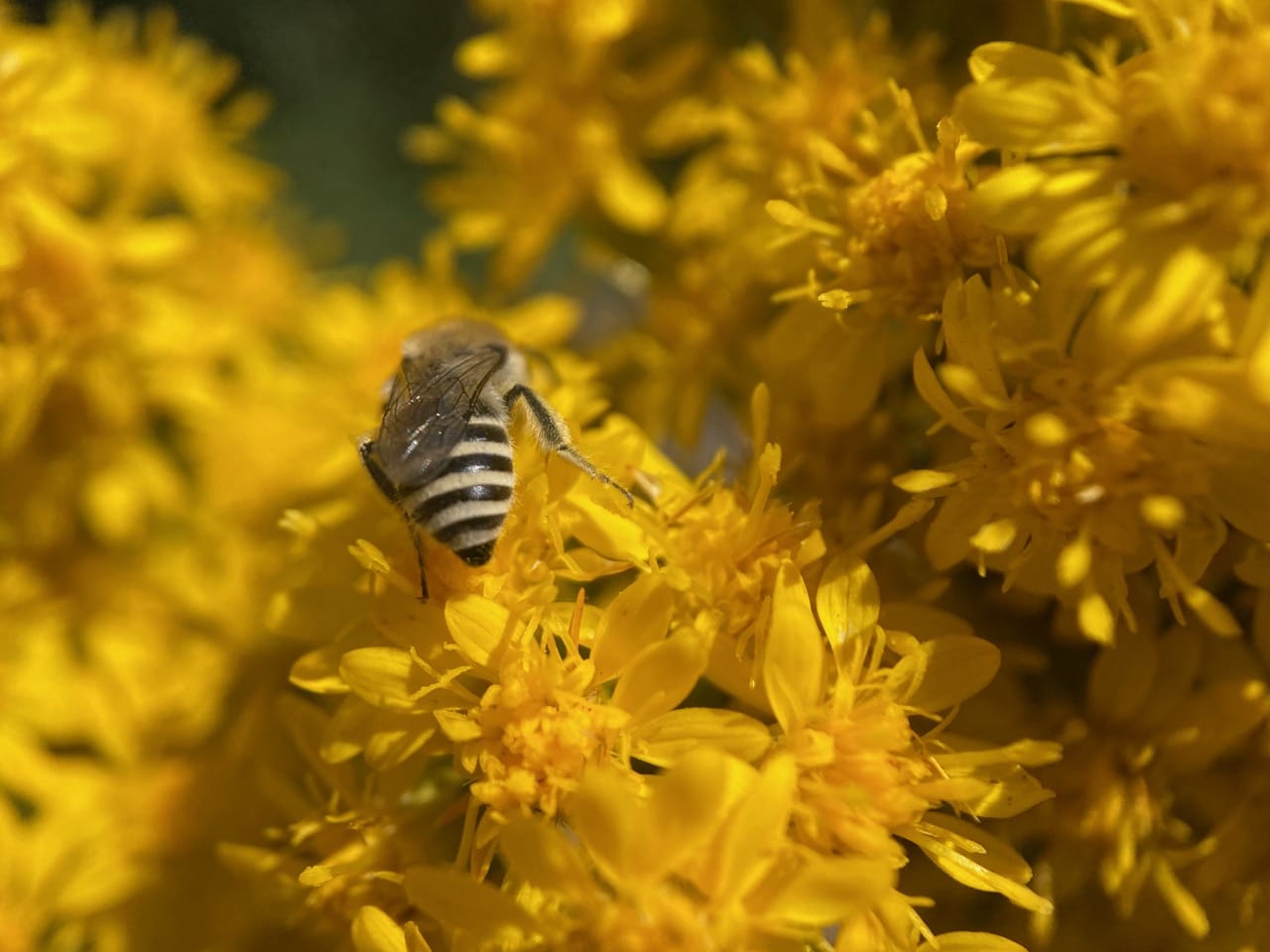
That’s the familiar rear end of a Cellophane Bee, Colletes sp. (family Colletidae). The little bee is foraging among the clusters of flowers of California Goldenrod, Solidago velutina ssp. californica.
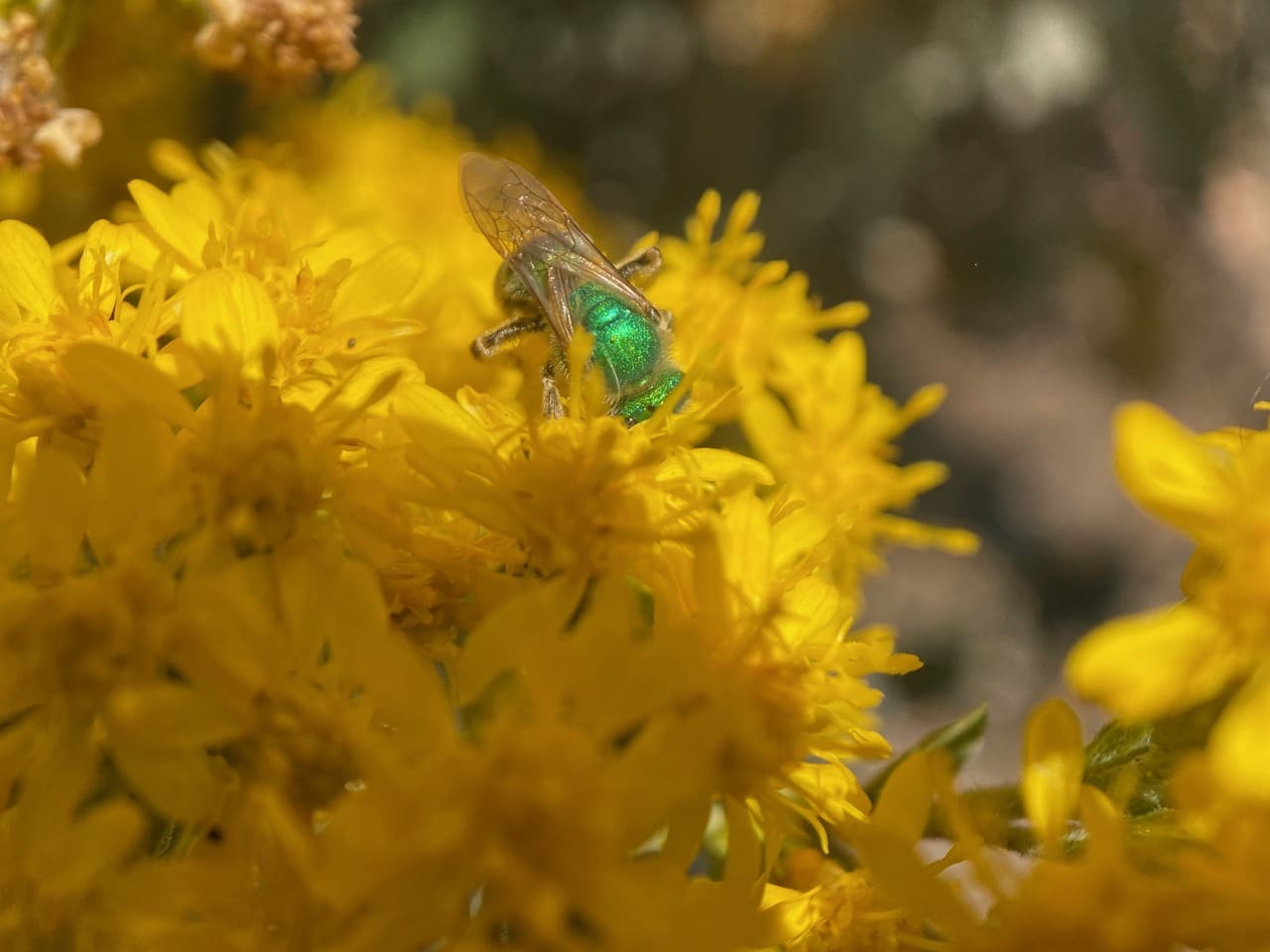
A female Fine Striped Sweat Bee, Agapostemon sp. (family Halictidae) is foraging in the California Goldenrod flowers.
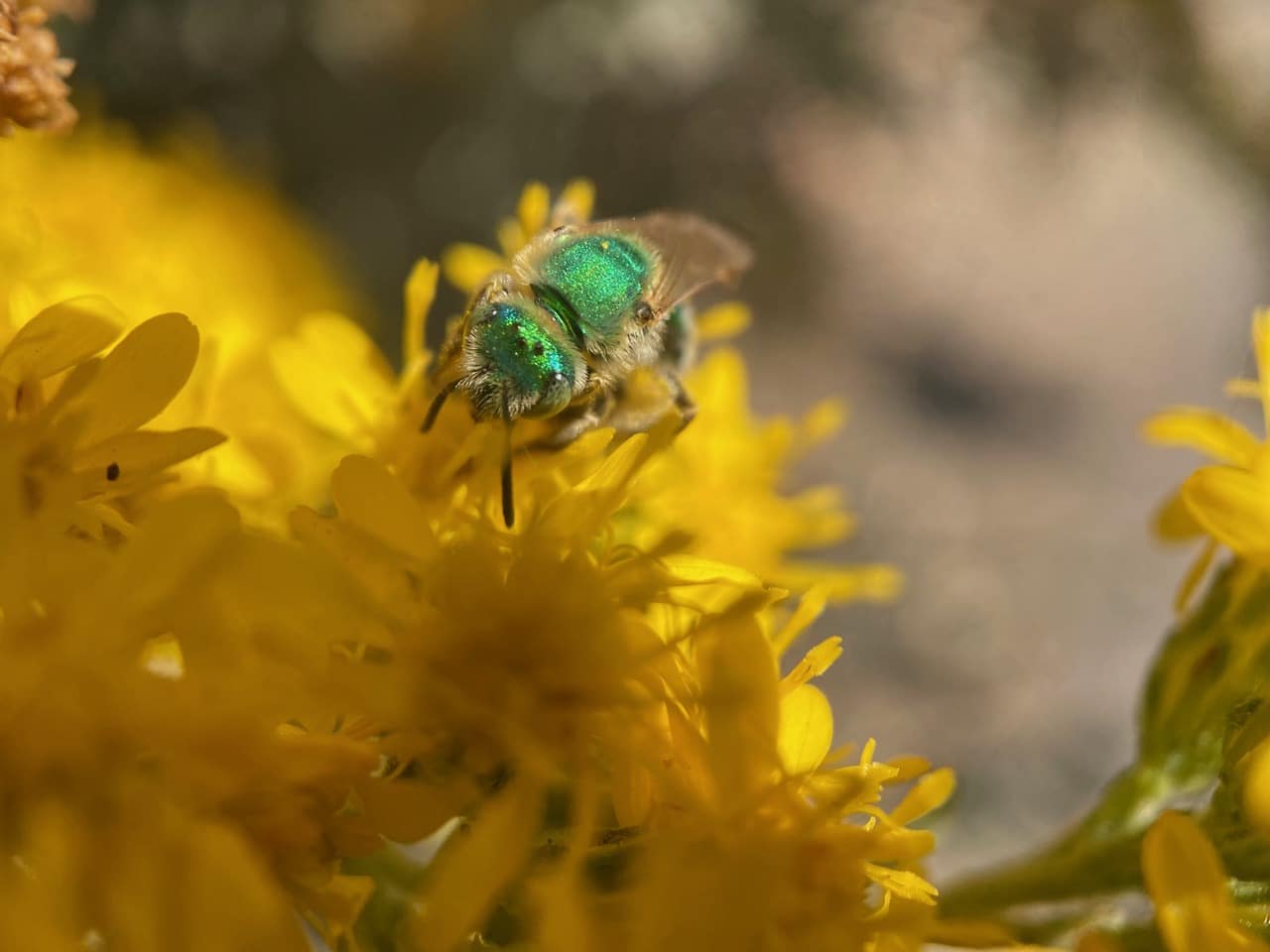
Agapostemon females dig deep vertical burrows in flat or sloping soil, or sometimes in banks. Most species are solitary, but some species nest communally. Up to two dozen females may share a single nest entrance, but each individual builds and provisions its own cluster of brood cells. Where a communal nest gallery shares a single entrance, one bee usually guards the hole, with only her head visible from above ground. Unlike other social bees, in communal bees there is no reproductive division of labor. In cool temperate regions, there is one generation per year, with females active in the early summer and males and pre-diapausing females active in the late summer. Only mated females survive the winter. This is probably because unmated females cannot enter diapause (insect version of hibernation).