

Pollinator Post 7/10/24 (1)
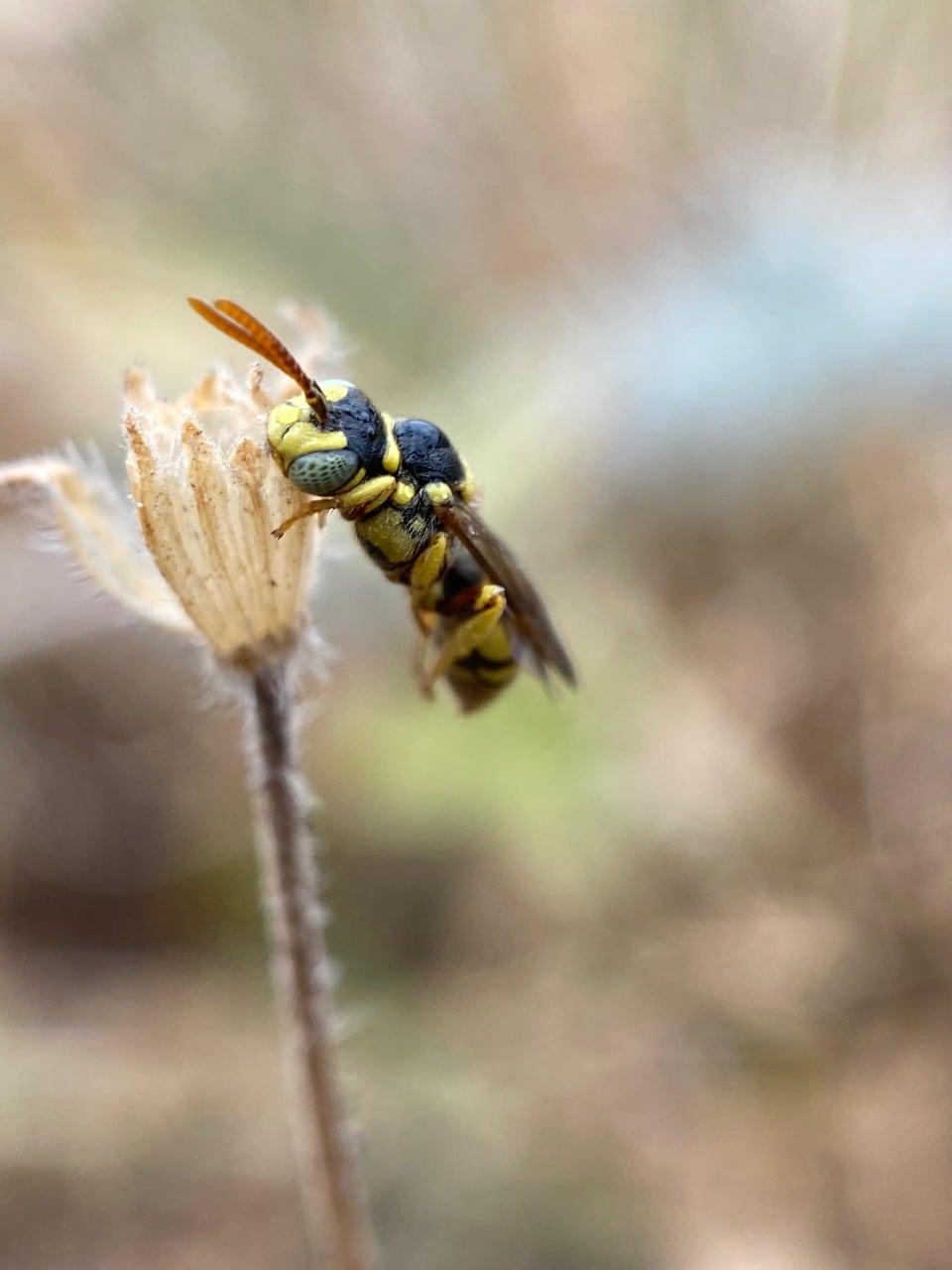
Early this morning I make a run for the parking strip in Alameda to check on the bees before the sun breaks through the clouds.
Only one Suave Nomad Bee, Nomada suavis (family Apidae) is on the short dried up Elegant Tarweed, Madia elegans in the company of the single male Summer Longhorn Bee, Melissodes sp.(family Apidae) this morning. Dew drops still clinging to the top of its head and body, it is anchored to an empty seed cup by its mandibles.
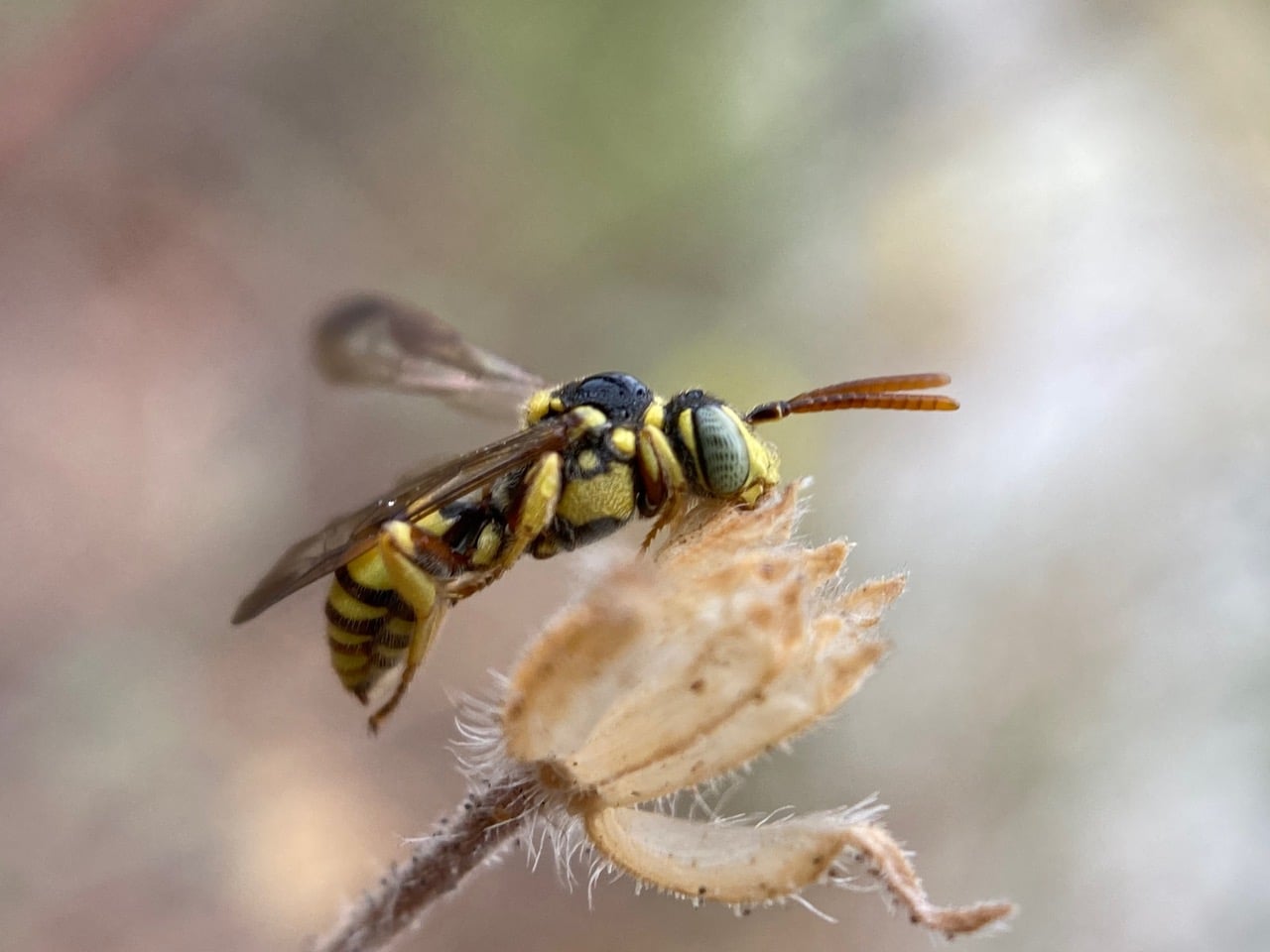
Same nomad bee viewed from a different angle. It doesn’t look like a comfortable way to sleep!
Nomad Bees in the genus Nomada is one of the largest genera in the family Apidae, and the largest genus of Cuckoo Bees. Nomada are kleptoparasites of many different types of ground-nesting bees as hosts, primarily the genus Andrena. They lack a pollen-carrying scopa, and are mostly hairless, as they do not collect pollen to feed their offspring. Adults visit flowers for nectar. The bees are extraordinarily wasp-like in appearance, often with yellow or white integumental markings on their abdomen.
Nomad Bees occur worldwide. All known species parasitize ground-nesting bees, and their habitats and seasonality correlate closely with their hosts. In early spring, females scout out their hosts, searching for nests to parasitize. The female Nomada sneaks into the host’s nest while the resident female is out foraging, then lays eggs in the nest. The parasite larva that hatches out kills the host offspring and feeds on the host’s provisions. This type of parasitism is termed brood parasitism. The parasites pupate in the host cell and finally emerge as adults the following season along with the hosts.

I close in for a look at the bee’s mandibles, but they are not visible. Its eyes wide open, the bee is actually asleep.
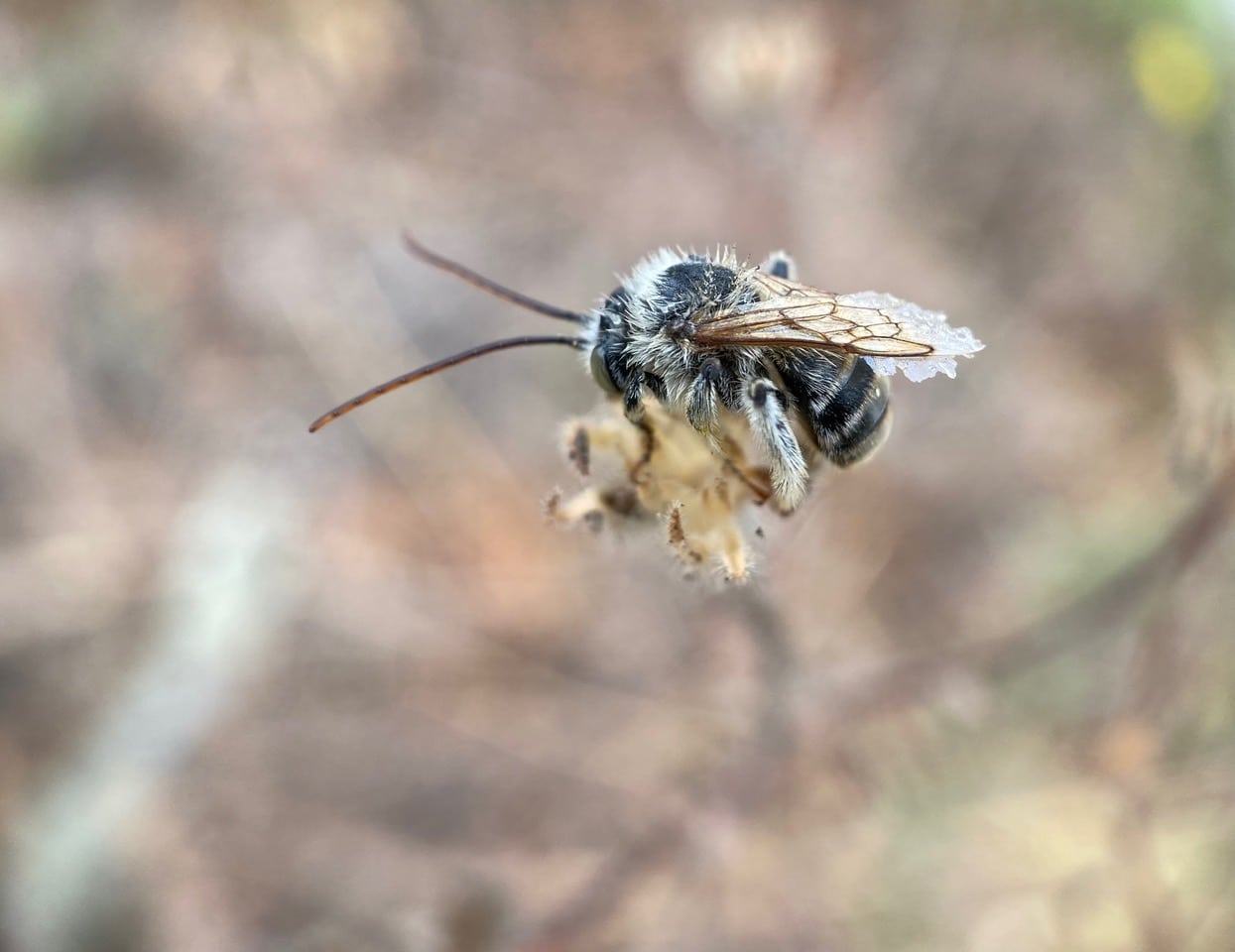
Just five inches above the nomad bee, the male Longhorn Bee is asleep on a seed head on a separate branch. The longhorn is actually quite a bit larger than the nomad bee – I don’t need a macro lens for this shot. He too looks wet from morning dew.
The Summer Longhorn Bees, Melissodes sp. (family Apidae) are medium to large bees, stout-bodied, usually with gray hair on the thorax and pale hair bands on the abdomen. Males usually have yellow markings on their faces and have very long antennae from which their common name is derived. They are active May to September, with peak flight in late June to early August. The females prefer flat, bare ground for digging their solitary nests, though they sometimes nest in aggregations. Pollen is transported in scopae on the hind legs. Pollen loads are often copious and brightly colored and thus very distinguishable. Melissodes are specialists on Asteraceae – females gather pollen from flowers of Aster, Bidens, Coreopsis, Cosmos, Encelia, Gaillardia, Helianthus, and Rudbeckia ssp.

On the other side of the big tree, 13 male Melissodes are still asleep on 5 adjacent Madia seed heads. These bees too look wet. I haven’t realized how much fog Alameda receives.
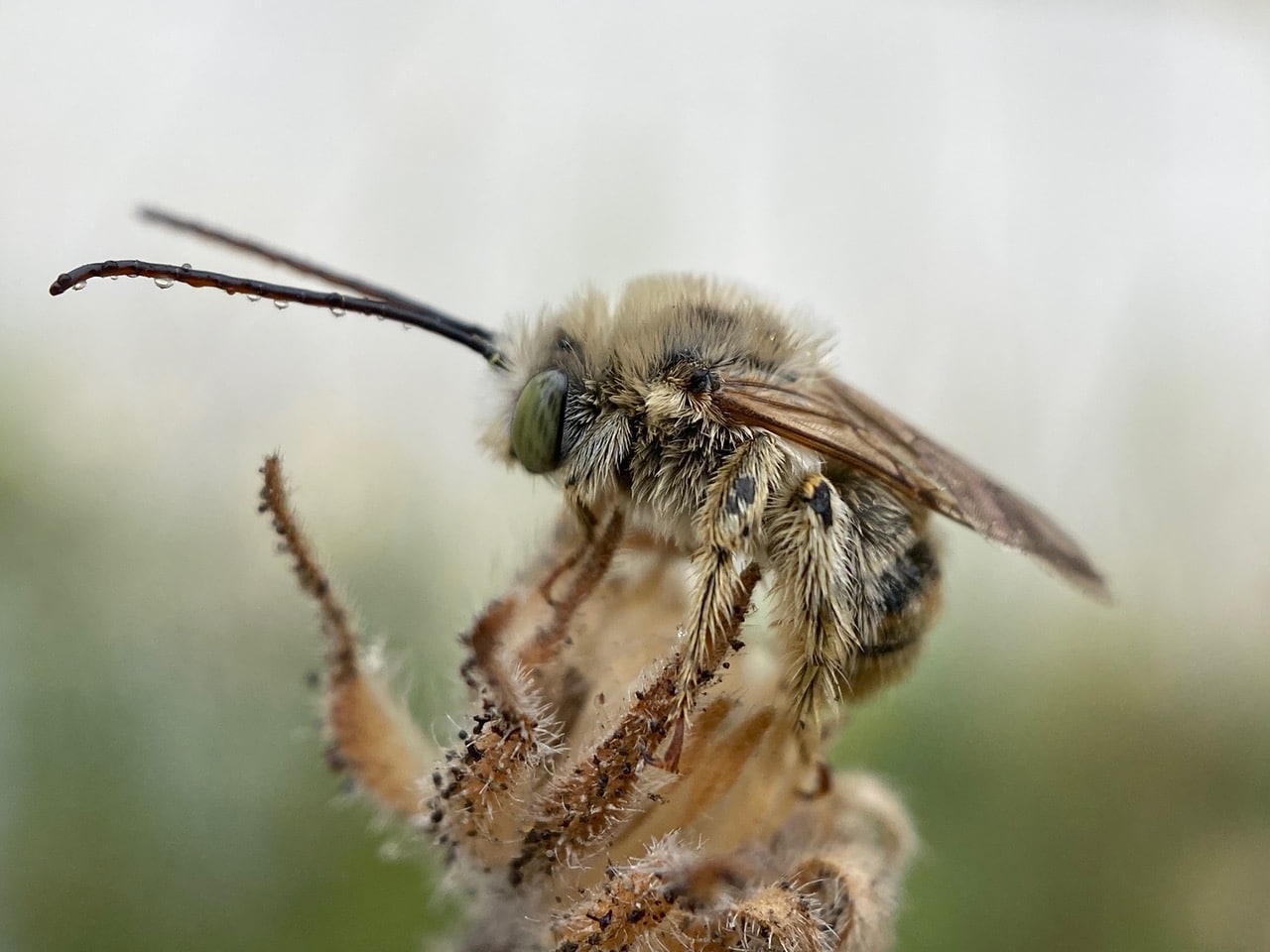
Note condensed moisture on this lone longhorn’s antennae.
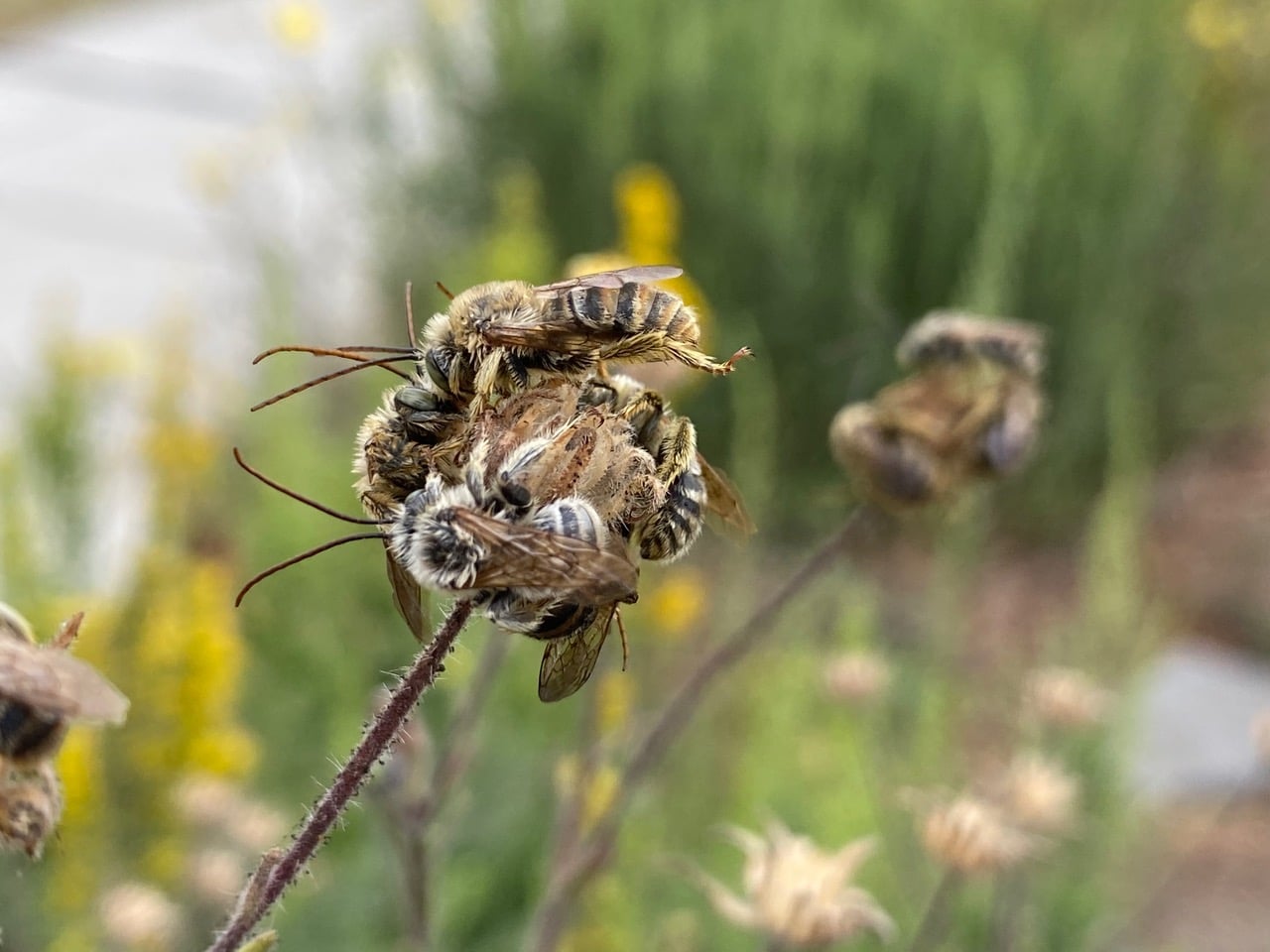
As I am watching the bees, they start to stir and groom themselves. I quickly turn on the video to record their behavior.
As I approached the parking strip on foot earlier, a construction truck disgorged a crew of workers heading into the house. The house is apparently having some work done. In the video you can see men walking in the background. As I lift my head from the camera, I am startled to find a big crane lifting a worker up behind me, apparently to disconnect the electrical wiring overhead. Time to get out of there! Maybe this is why the bees are waking up – they are much more sensitive to the commotion than I am. I hope that the bees and their habitat will survive the construction work.