

Pollinator Post 7/10/23 (4)
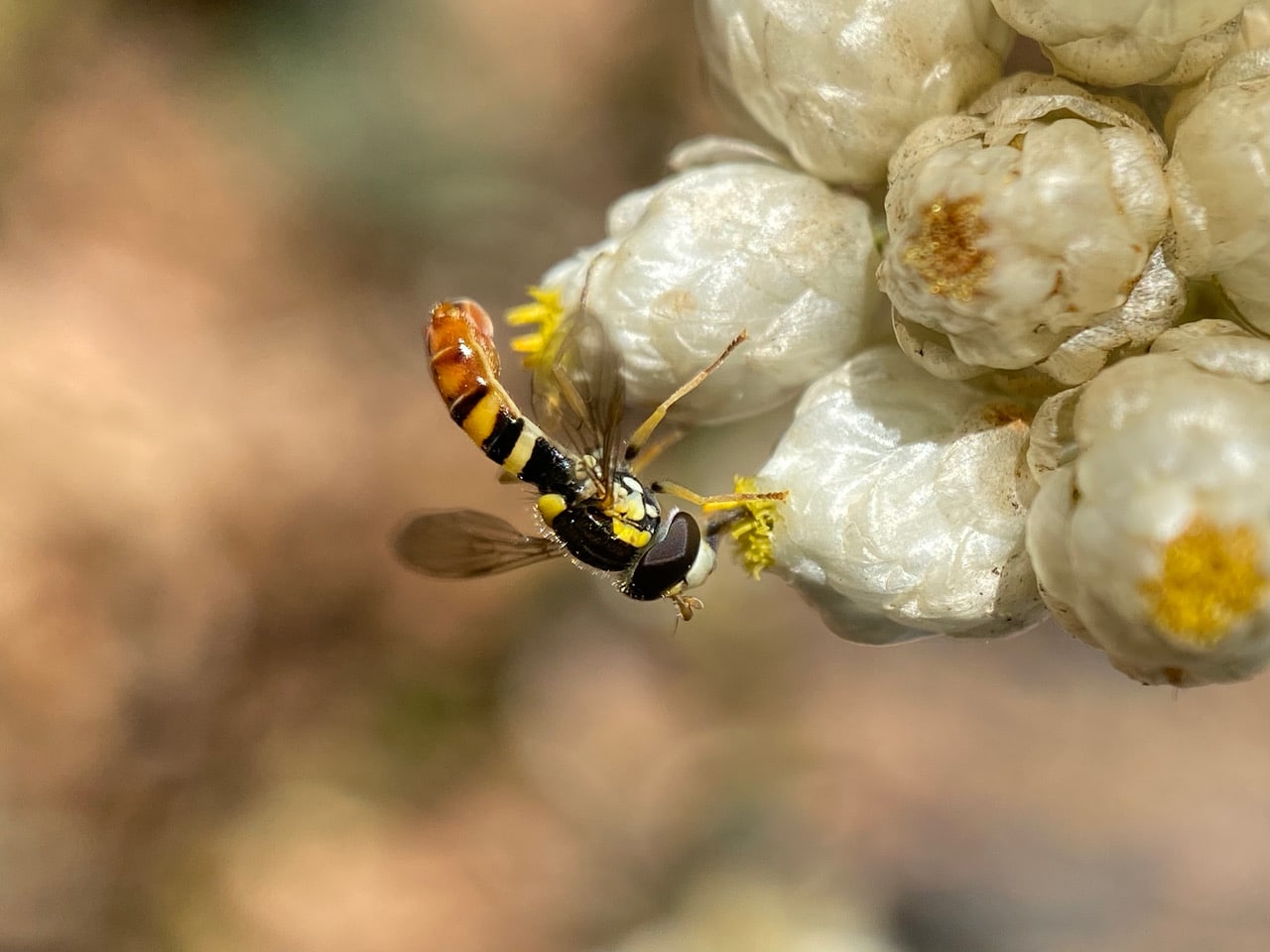
Now that the flowerheads of the California Everlasting, Pseudognaphalium californicum have opened up to expose the tiny flowers within, they are visited by more insects. This male Forked Globetail, Sphaerophoria sulphuripes (family Syrphidae) is inserting its proboscis into a flowerhead to sample the floral treats within. The tiny flowers of the everlasting are probably pollinated by these tiny visitors.

A Woodlouse Fly, Stevenia deceptoria (family Rhinophoridae) is perched on an inflorescence of California Everlasting. These small, slender, black, bristly flies are somewhat related to the Tachinidae. The larvae are mostly parasitoids of woodlice (pill bugs), beetles, spiders and other arthropods, and occasionally snails.
Native to Europe, Stevenia deceptoria is now widespread in the US. The flies are parasitoids of terrestrial woodlice (roly polies) of the order Isopoda (Oniscoidea).


It is a joy to watch bumble bees forage on the California Poppy, Eschscholzia californica. The poppy flowers do not produce any nectar, but offer generous amounts of pollen on those long anthers in an easily accessible bowl-shaped corolla. Most bees would simply get on their side and shimmy through, scraping the pollen off the anthers with their legs and mouthparts.

Sometimes bumble bees would “buzz” or sonicate the anthers to further facilitate pollen release. This they do by disengaging their wings from their flight muscles, and vibrate their body vigorously to loosen the pollen grains. The action is audible as a high-pitch buzz.
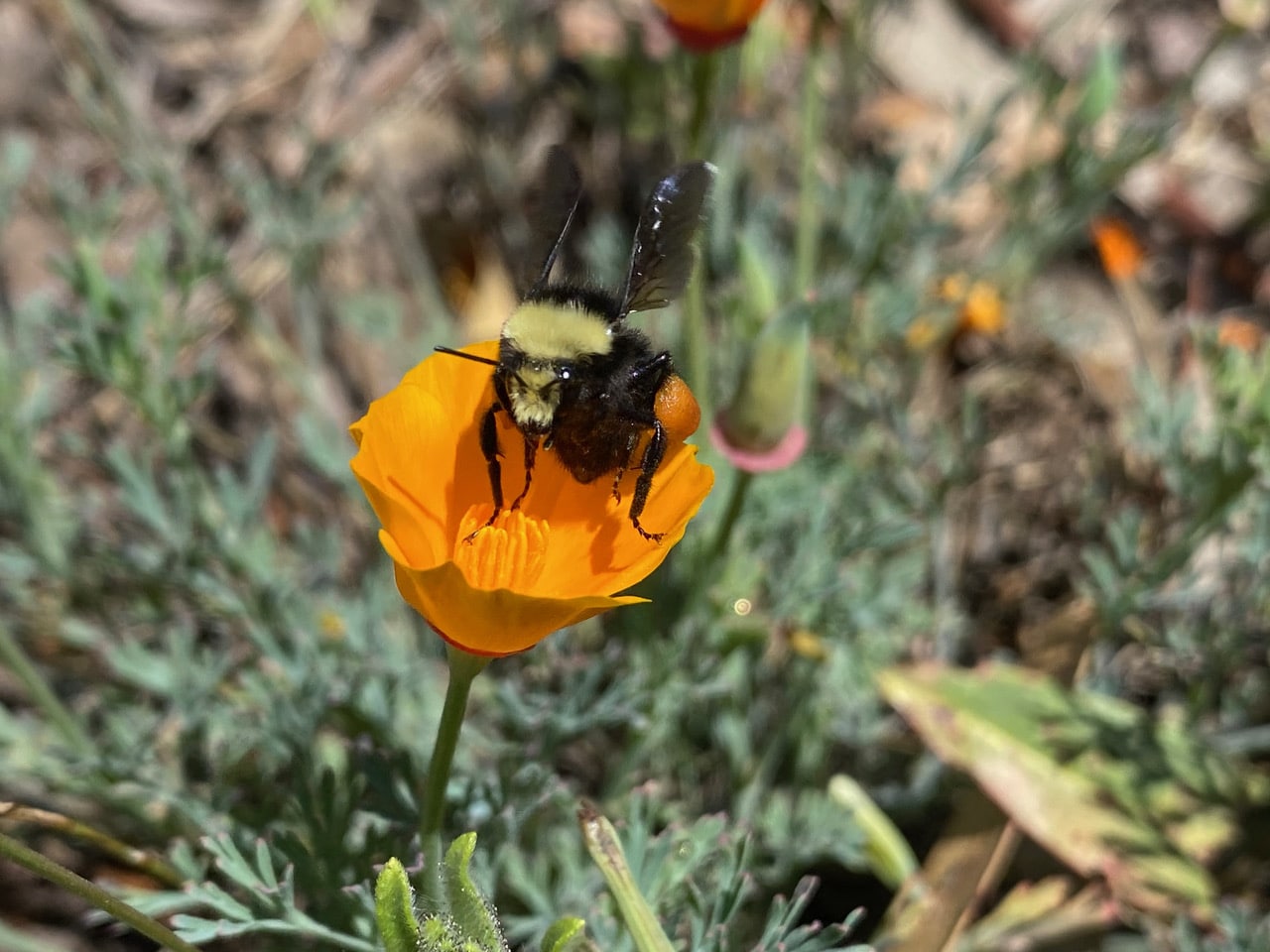
This Yellow-faced Bumble Bee, Bombus vosnesenskii is off to the next flower. She has collected a sizable load of pollen in her pollen baskets.
The pollen collecting apparatus in Apidae bees, which include honey bees and bumble bees, is commonly called a “pollen basket” or corbicula. This region is located on the tibia of the hind legs and consists of hairs surrounding a concave region. After the bee visits a flower, she begins to groom herself and brushes the pollen down toward her hind legs and packs the pollen into her pollen basket. A little nectar mixed with the pollen keeps it all together like putty, and the stiff hairs surrounding the pollen basket hold it in place. A honey bee can fly with a full pollen load that weighs as much as a third of her body weight.
.jpg)

Ooh, that’s a hover fly larva (family Syrphidae) on the back of a leaf of Coast Tarweed, Madia sativa. The tiny pair of yellow snorkel-like structures mark the hind end of the larva. I wonder what it is feeding on? I don’t see any aphids on the plant. The larvae of many Syrphid species are voracious predators of aphids. Syrphid larvae are legless and blind, and depend on their sense of touch to hunt aphids. They swing their head from side to side, and grasp prey that they come into contact with.
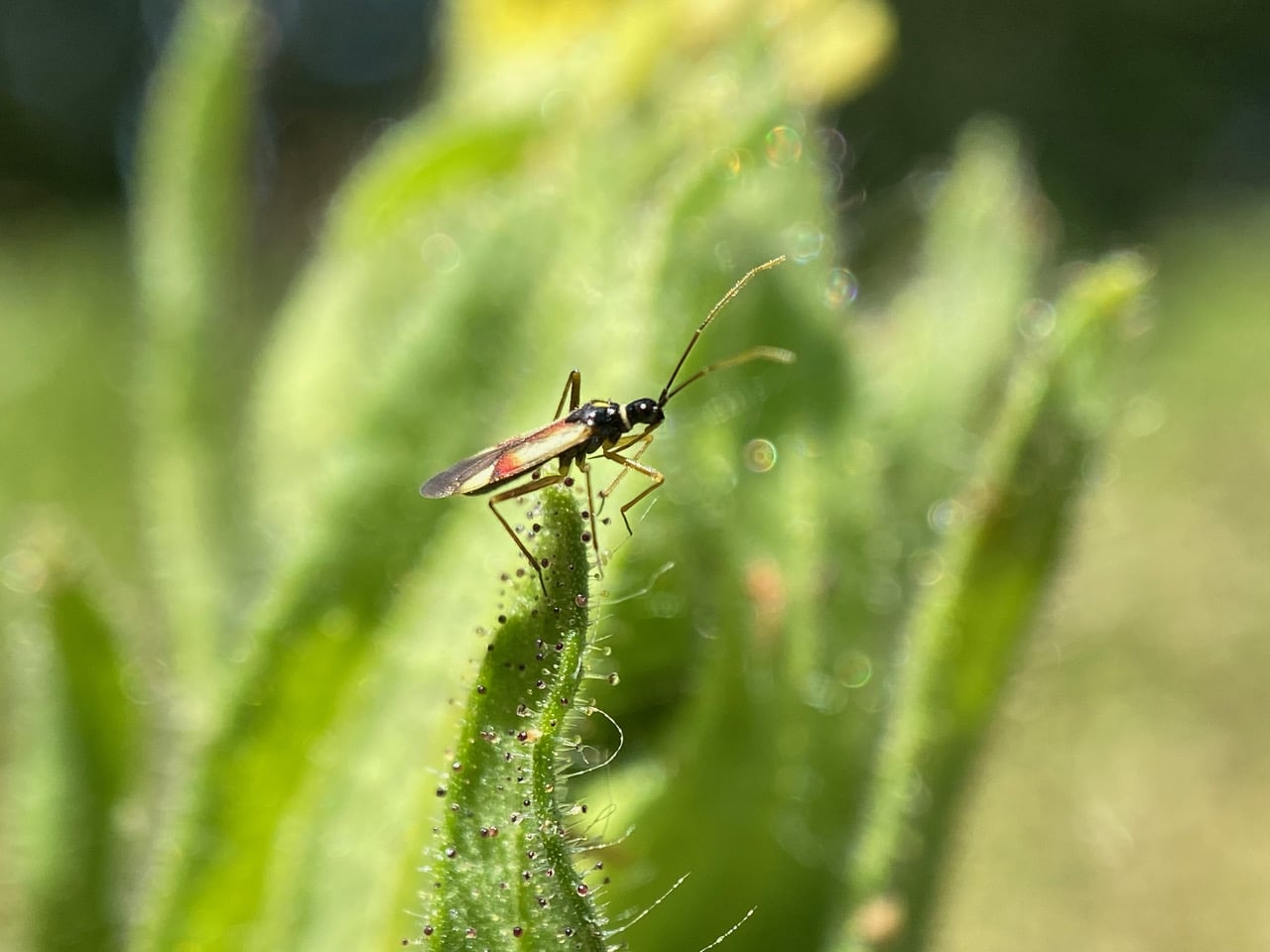
Nimble and light-footed, this tiny Phacelia Plant Bug, Tupiocoris californicus (family Miridae) is well-adapted to live on the sticky Coast Tarweed, Madia sativa. Note the long rostrum (piercing-sucking mouthpart) that is folded under its body.
Mirid bugs are also referred to as plant bugs or leaf bugs. Miridae is one of the largest family of true bugs in the order Hemiptera. Like other Hemipterans, Mirids have piercing, sucking mouthparts to extract plant sap. Some species are predatory. One useful feature in identifying members of the family is the presence of a cuneus; it is the triangular tip of the corium, the firm, horny part of the forewing, the hemielytron. The cuneus is visible in nearly all Miridae.

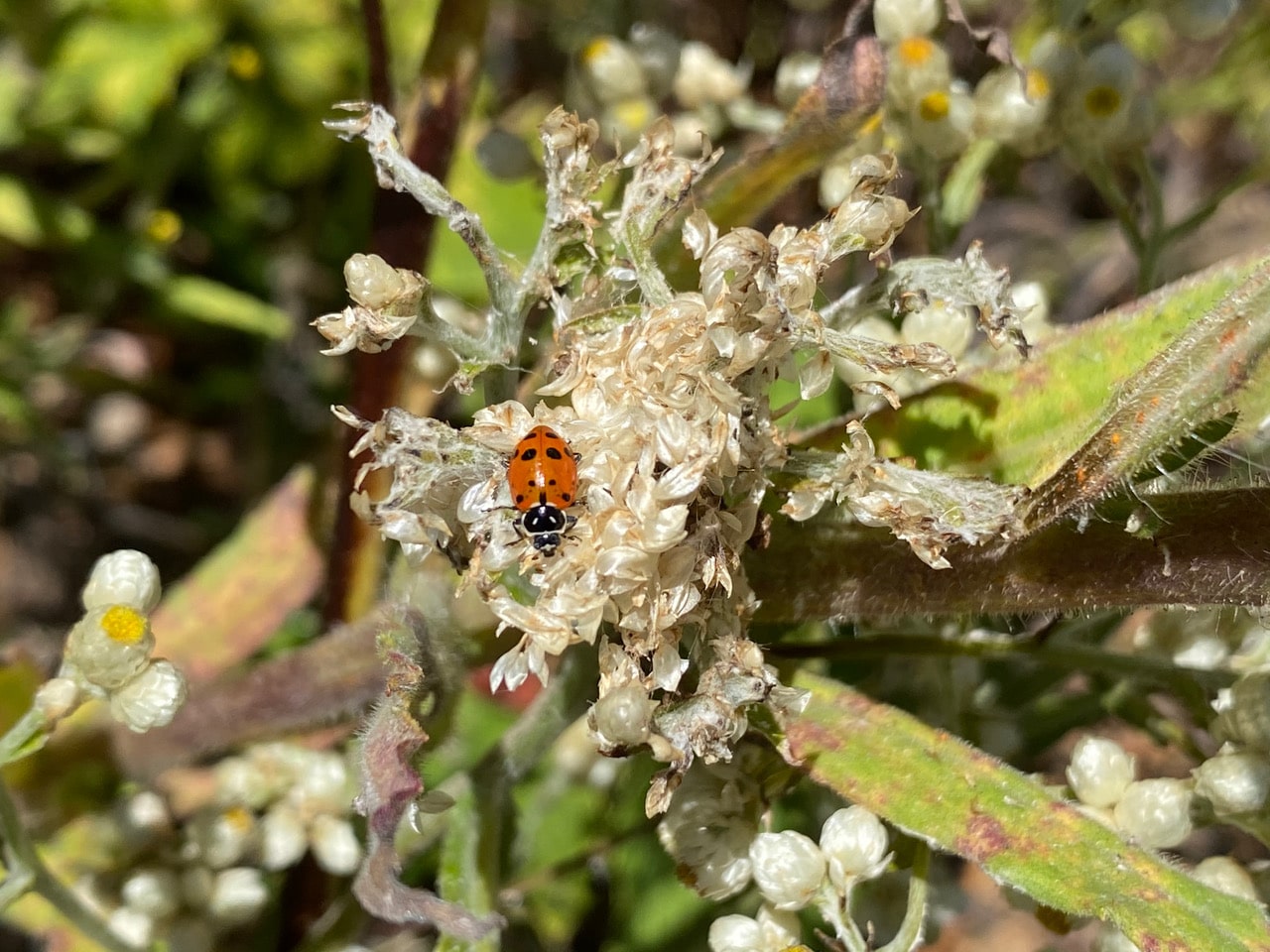 A Convergent Ladybeetle, Hippodamia convergens (family Coccinellidae) is resting on a collapsed nest of the American Lady caterpillar on a California Everlasting, Pseudognaphalium californicum. Both adult and larval ladybeetles are often found on these old nests, apparently foraging on something invisibly small. Mites?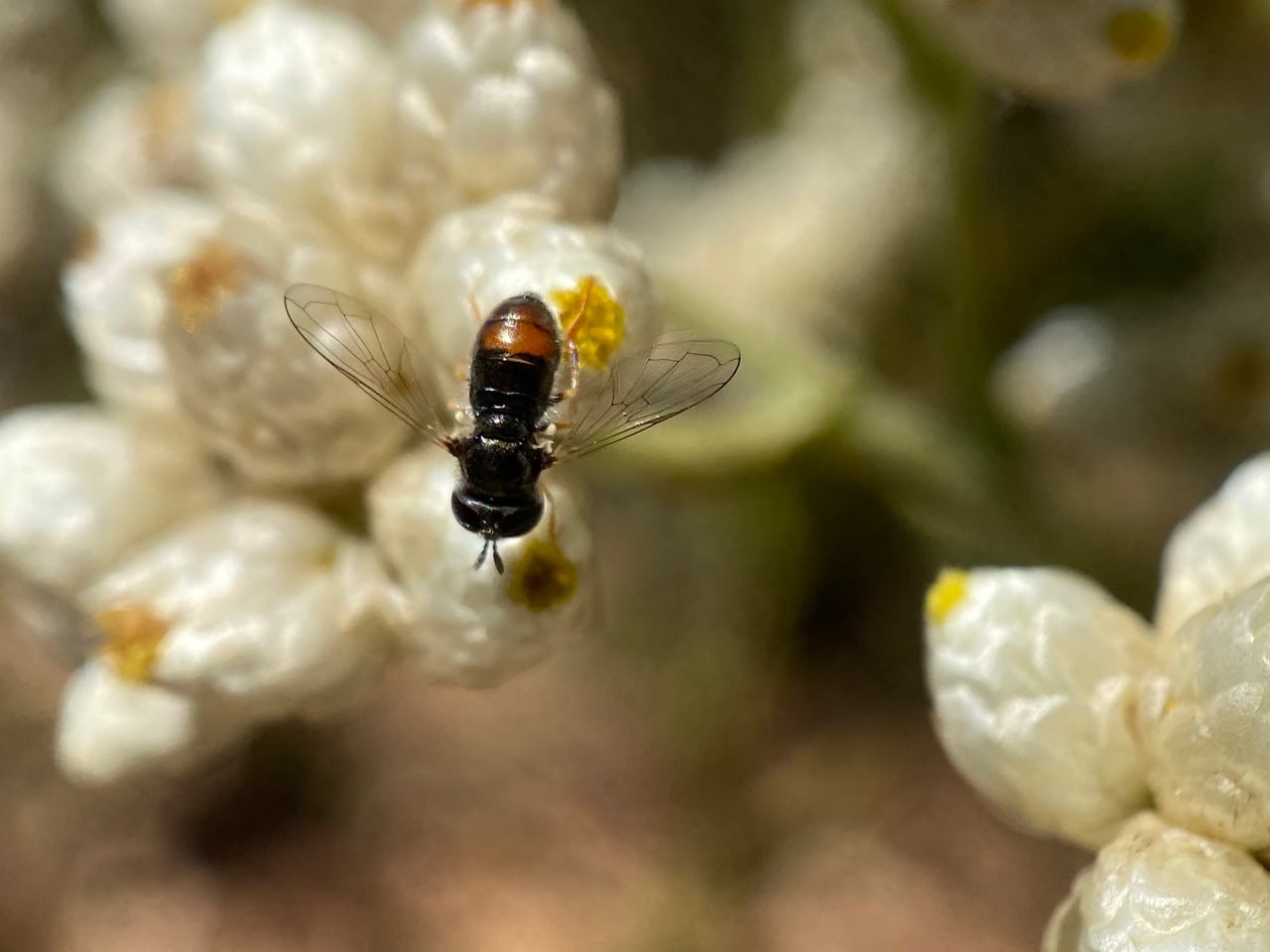
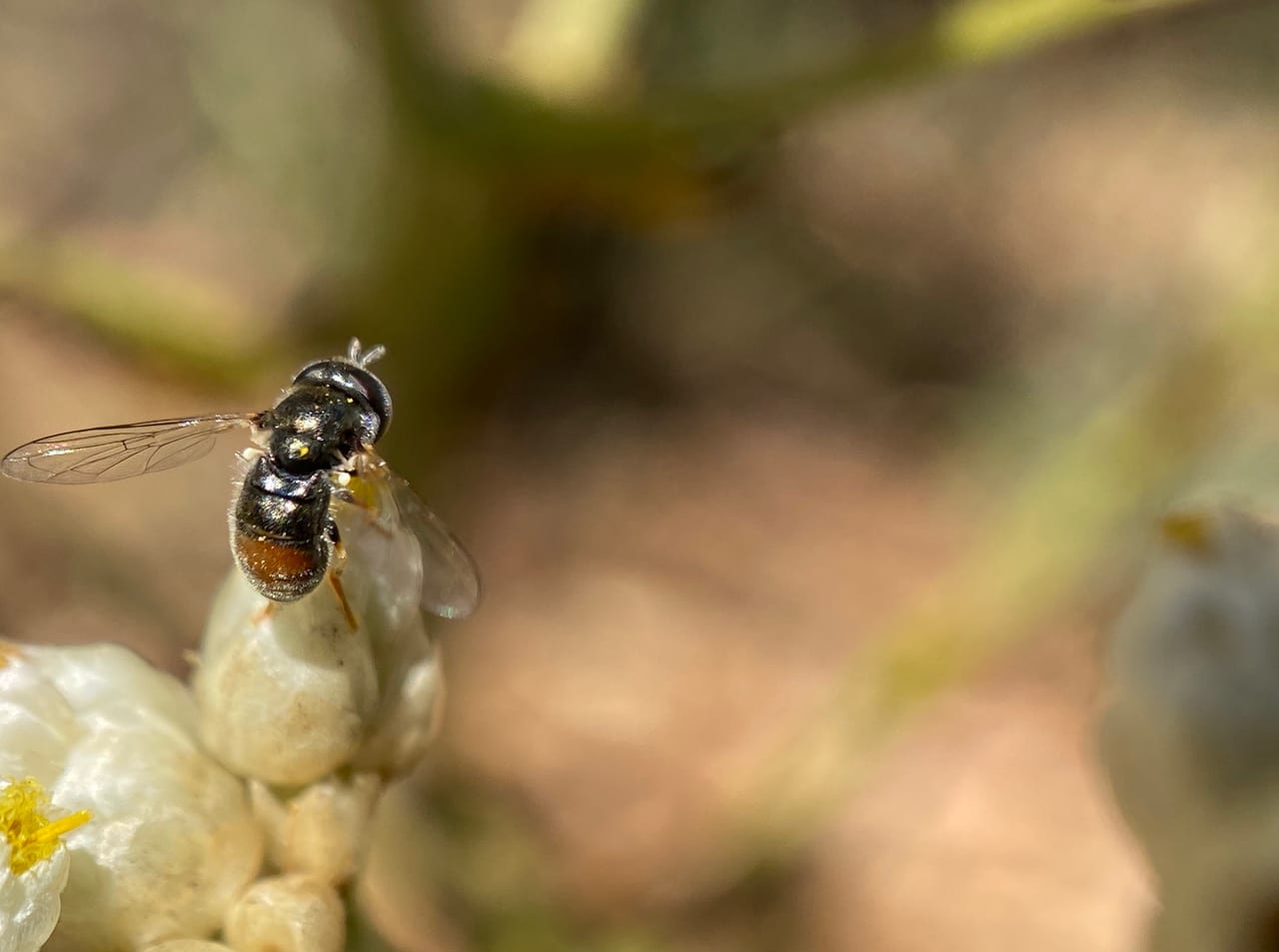
A Black-backed Grass Skimmer, Paragus haemorrhous (family Syrphidae) lands on an inflorescence of California Everlasting. It is probably the smallest hover fly we have a Skyline Gardens, measuring only about 4 mm in length. The species has a world-wide distribution, found in unimproved grassland, dune grass, open areas and pathsides in forest, and meadows. Adults visit flowers for nectar and pollen. Larvae feed on aphids on low herbaceous plants.

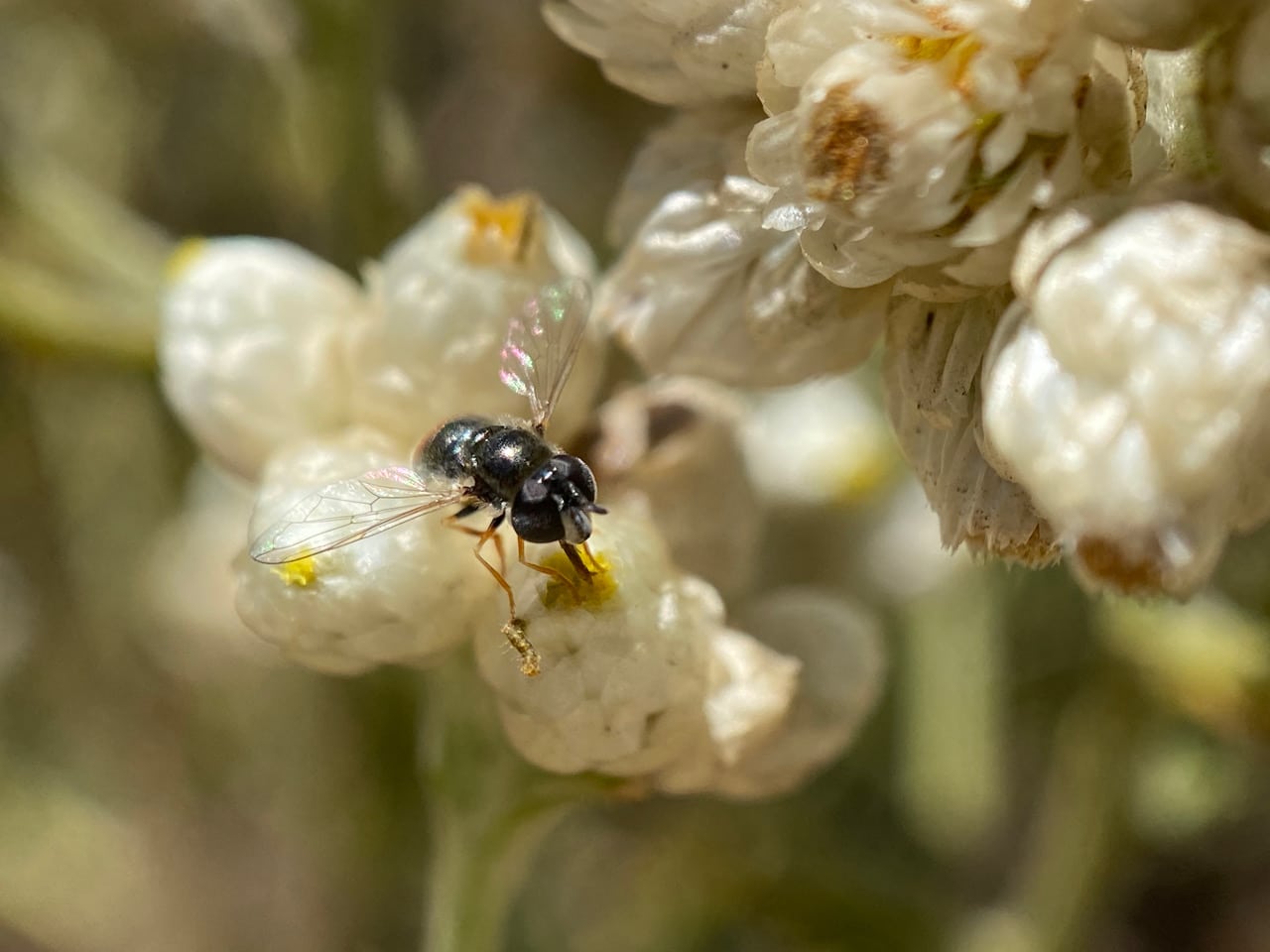
The Black-backed Grass Skimmer is feeding on the flowers of California Everlasting.
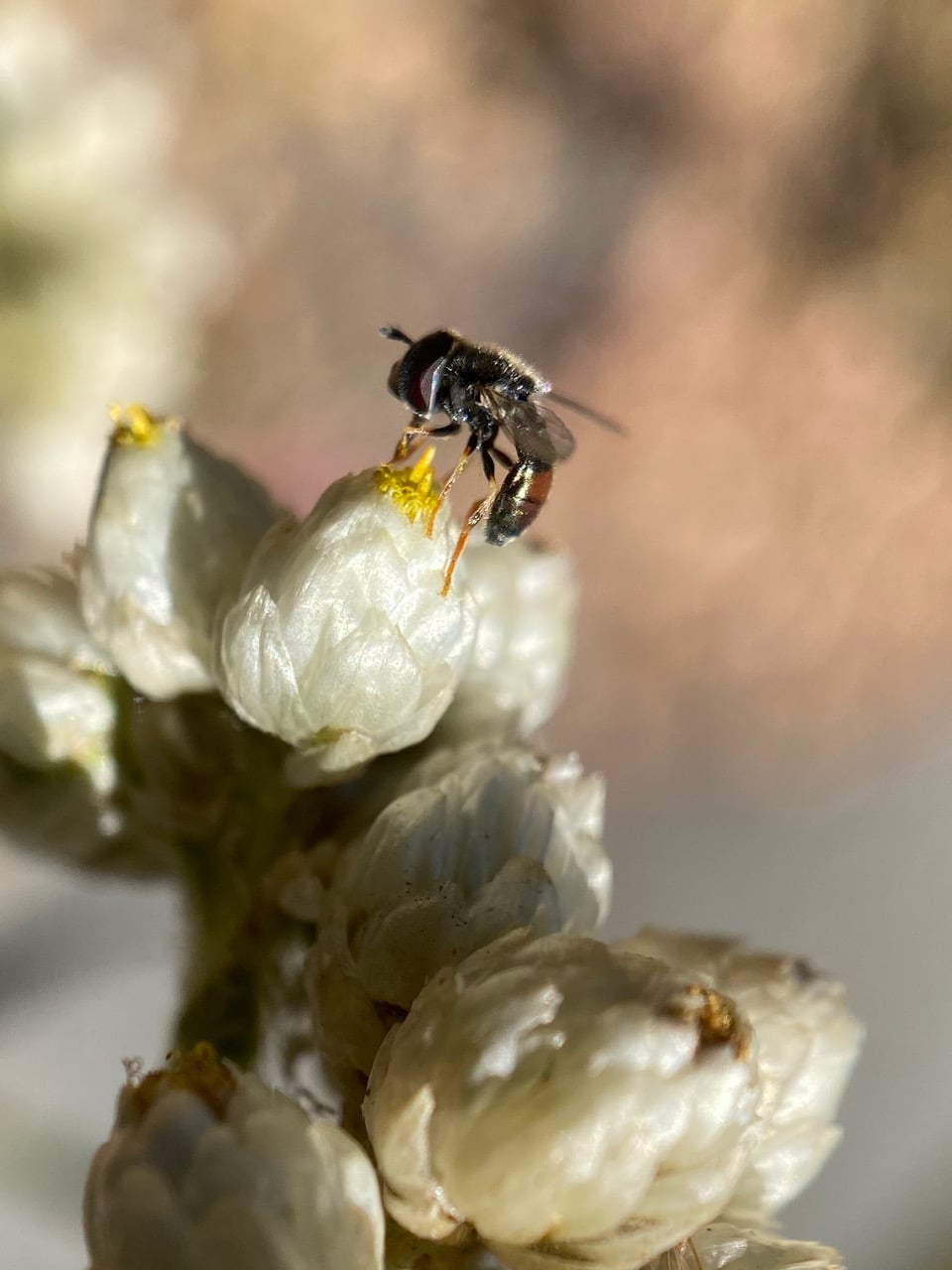
The fly has a characteristic hunched posture with droopy abdomen.
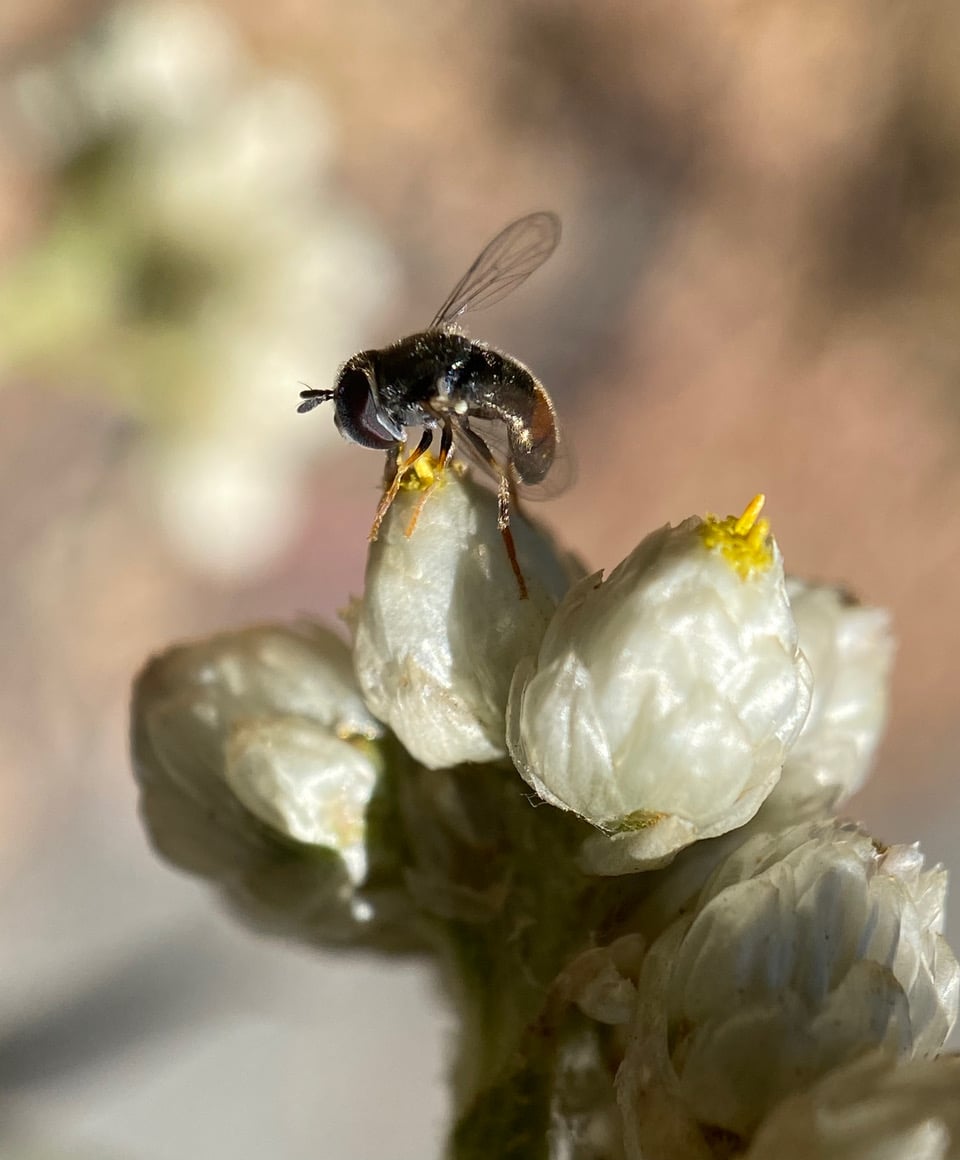


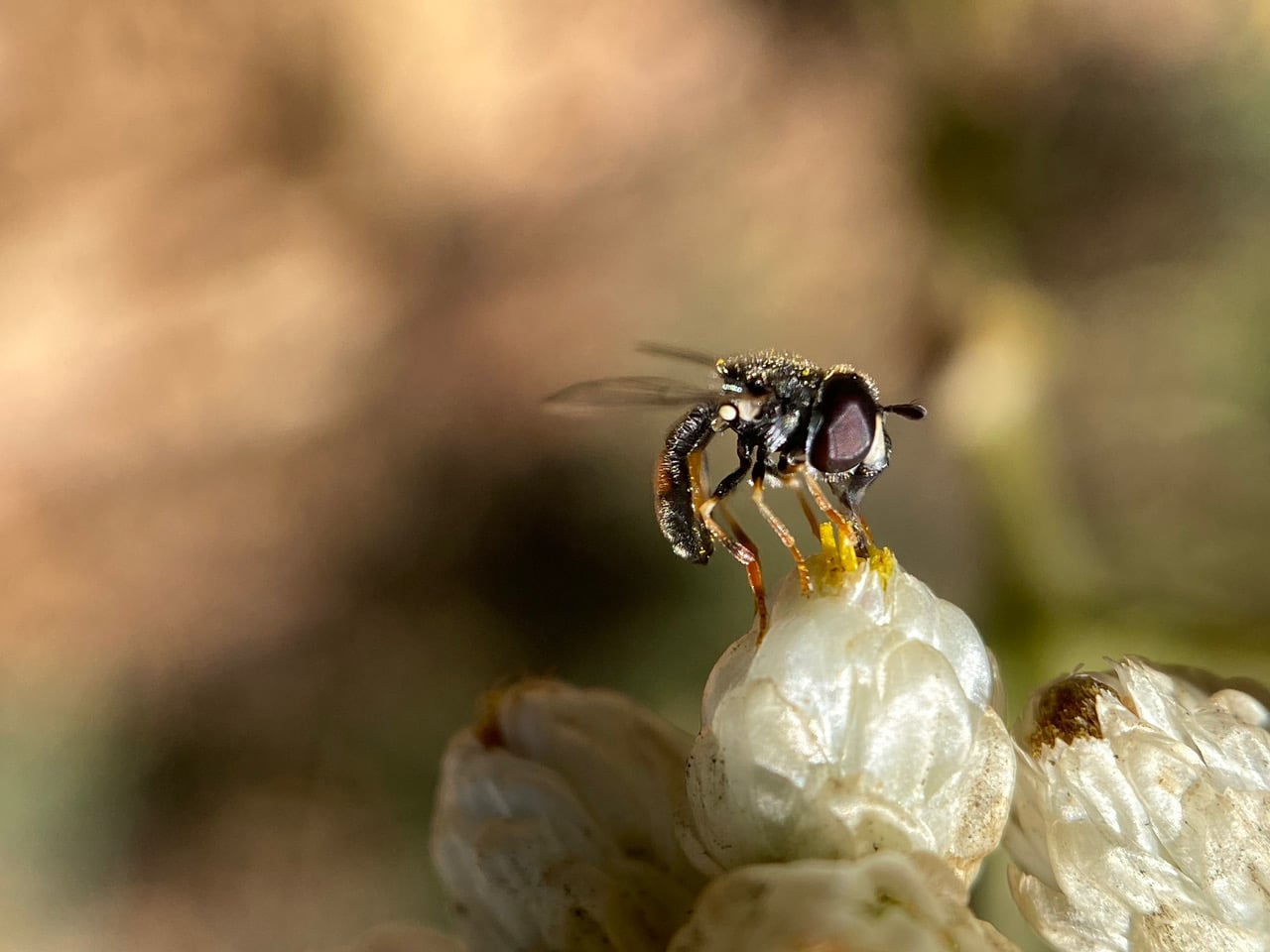

The tiny flowers of California Everlasting seem to be the perfect size for this diminutive hover fly.

A couple of large black insects are flying low over the paved road, chasing each other. They are about the size of queen bumble bees. Occasionally one would land on the road, apparently immune to the heat of the noon day sun. I have observed the same behavior last year at this location – they are Mouse Bot Flies!
The Mouse Bot Fly, Cuterebra fontinella (family Oestridae) is a species of New World skin bot fly. It develops by parasitizing nutrients from its host, typically the white-footed mouse, Peromyscus leucopus. The genus name Cuterebra derives from cutis (Latin for skin) and terebra (for borer). The species inhabits deciduous forests of North America, preferring territories near running water and with low vegetation. C. fontinella flies are territorial insects. Males chase away other males while patrolling their territory by flying in figure-eight and oval patterns. Very dependent on temperature, they congregate above heat-reflecting surfaces on roadsides and near streams. After mating, a female lays one to several thousand eggs, in groups of 5 to 15 per site. Eggs are deposited on vegetation or surfaces near the opening to a rodent burrow. The larvae are moist and stick to the fur of passing rodents. They proceed to find a natural body opening (e.g. mouth, nose, eyes, or anus) to enter the host, and migrate to a subcutaneous site to continue their development. This produces a swelling under the host’s skin called a warble. Within the last 4 or 5 days of development, the larvae begin to enlarge the pore of the warble to make exit through the skin possible. Once outside the host, the larvae burrow into the soil to pupate. Depending on conditions, the process could take a month to several years before the adult fly emerges from the pupal case and starts the cycle again.
Infestation with C. fontinella is usually not fatal. Infested rodents often experience anemia, local tissue damage, and enlarged spleen; infested females produce fewer and smaller litters. Interestingly, infestation actually leads to an increase in life span for the host, a change that is favorable for both the host’s and the parasite’s survival.
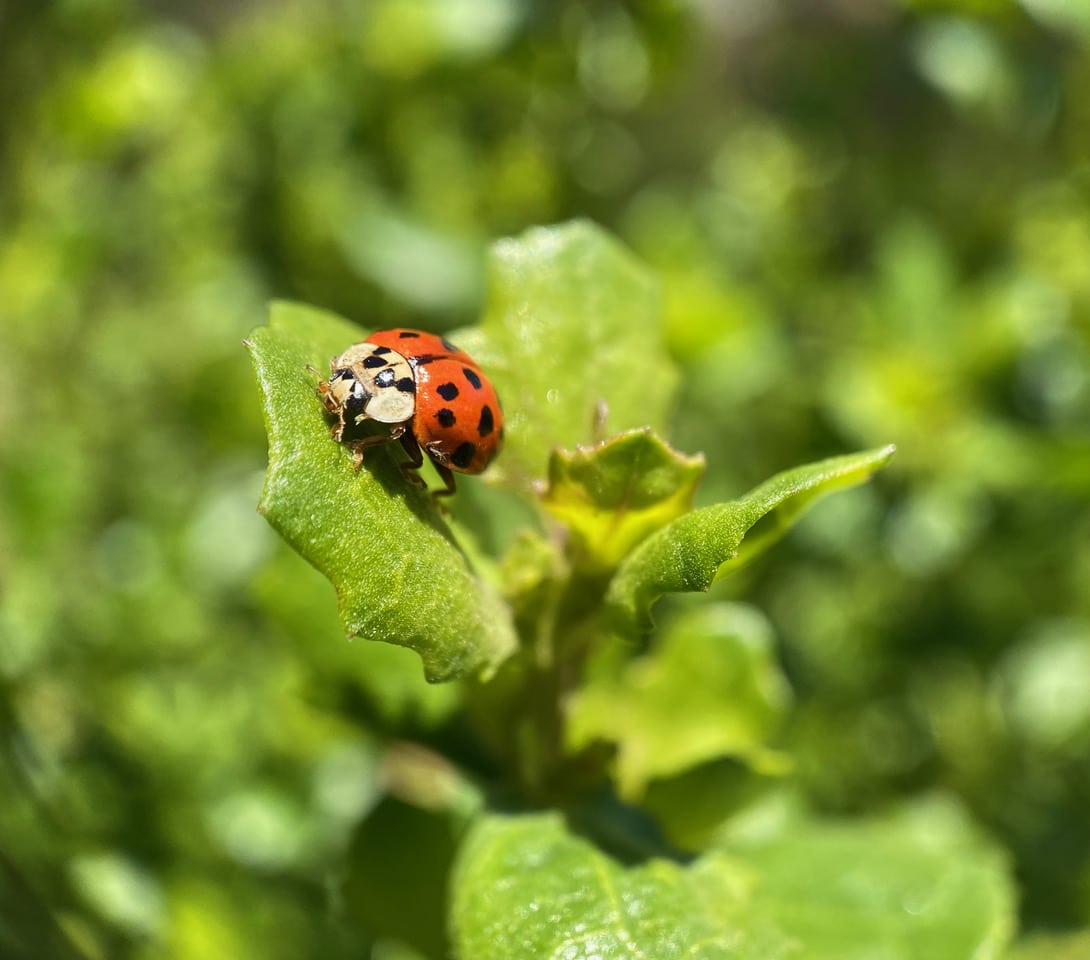
A large, bright red Ladybeetle on a Coyote Brush attracts my attention. It is a species I have not seen at Skyline Gardens before – the Multicolored Asian Ladybeetle, Harmonia axyridis (family Coccinellidae).
The beetle is a voracious predator of arthropod pests such as aphids, mites, thrips, scale and Lepidoptera eggs. Introduced from Asia for biological control of arthropod pests during the twentieth century, it has since become established all over the US. The adult beetles are highly variable in appearance, varying in color as well as the number and size of spots. It is believed that the Multicolored Asian Ladybeetles are aggressive competitors of native ladybeetles. This supposition remains to be proven scientifically. Adult beetles aggregate in high numbers to overwinter, favoring human dwellings. When threatened the beetle produces a yellow viscous, foul-smelling defensive compound, making themselves unwelcome house guests.
