

Pollinator Post 7/1/26

I am walking this short stretch of beach at Crab Cove near the Duck Pond this afternoon. It is rather windy, and I wonder if I’d see any insects.
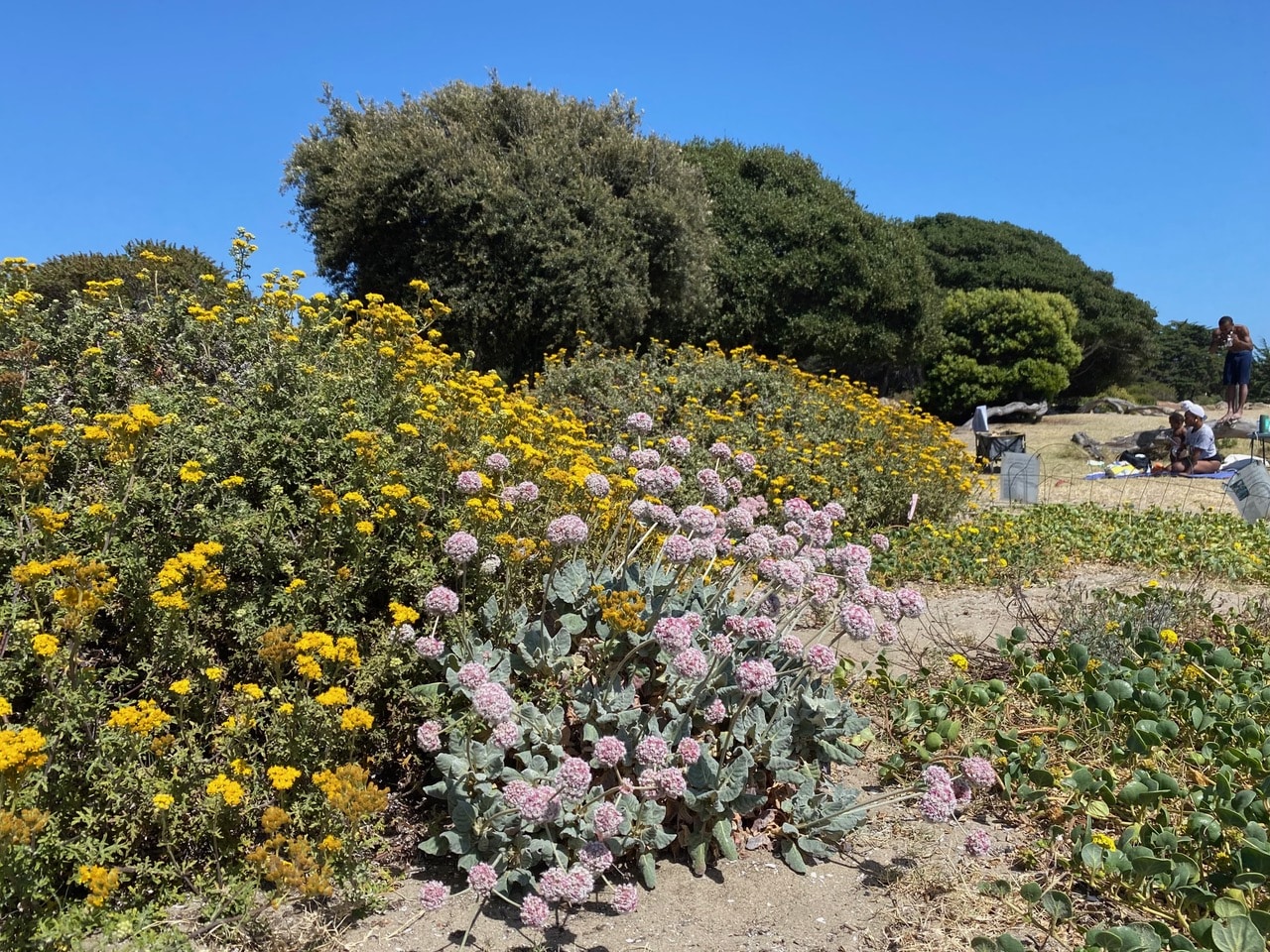
I waste no time getting to the two large shrubs of Seaside Woolly Sunflower, Eriophyllum staechadifolium planted on the upper beach by the park service. Insect magnets, they have provided me with endless entertainment in past summers. I haven’t had a chance to visit them this year since they started to bloom. Much to my delight, there are two robust plants of Coast Buckwheat, Eriogonum latifolium growing beside them, also in glorious bloom. I have not seen these here before – they must have been added this year. Great choice of plants!
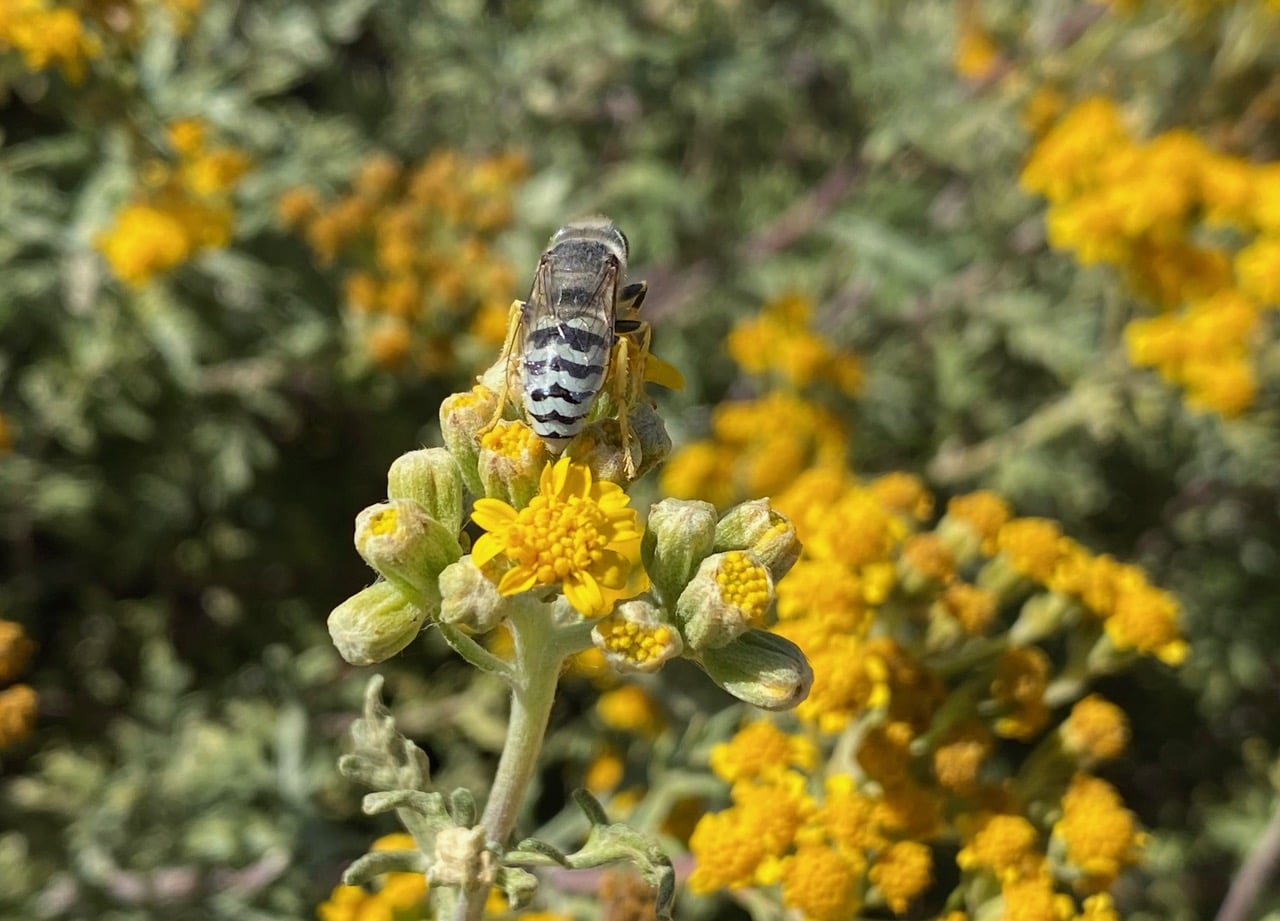
Numerous American Sand Wasps, Bembix americana (family Crabronidae) are zipping about foraging on the busily clustered golden flowers of Seaside Woolly Sunflower. These wasps are easily recognizable from the wavy black-and-white bands on their abdomen. These are formed by pigmentation in their integument (the hard, chitinous plates of the exoskeleton).

Sand wasps in the genus Bembix are familiar and common throughout North America, digging their burrows in dunes, on beaches, and other habitats with loose, deep sand. The female rapidly kicks out large quantities of sand using a “tarsal rake” of spines on each front leg. The burrow is excavated before the wasp goes hunting. Bembix are generalist, opportunistic hunters. True flies in the order Diptera are the usual prey. A victim is paralyzed or killed by the wasp’s sting, and is then flown back to the nest. Most species will lay an egg on the first victim, while some species lay an egg in the empty cell before starting to hunt. Once the egg hatches, mama wasp brings flies to her larva as needed. This “progressive provisioning” is rare in the insect world. When the larva reaches maturity, mama wasp closes the cell. Inside, the larva spins an oblong cocoon, weaving sand grains into the structure and resulting in a hardened capsule. Overwintering takes place as a prepupa inside this cocoon, but there are usually two generations a year.
Male sand wasps often engage in an elaborate flight ritual called “sun dances”. Males emerge before females, and fly erratically at dizzying speed one or two inches above the ground attempting to detect virgin females about to emerge from their underground nests. Both sexes are often seen taking nectar at flowers, especially from Asteraceae family. Bembix wasps are often victims of other insects such as cuckoo wasps (Chrysididae), velvet ants (Mutillidae), satellite flies (Sarcophagidae), bee flies (Bombyliidae), and thick-headed flies (Conopidae).
 The blooms on the same plant are avidly visited by some smaller insects with black-and-white abdomen. These are Cellophane Bees, Colletes sp. (family Colletidae). Unlike the abdomen of the Sand Wasps, the distinct white bands on the abdomen of the bees are formed by dense fringes of hair (setae) outlining the outer edges of the abdominal segments.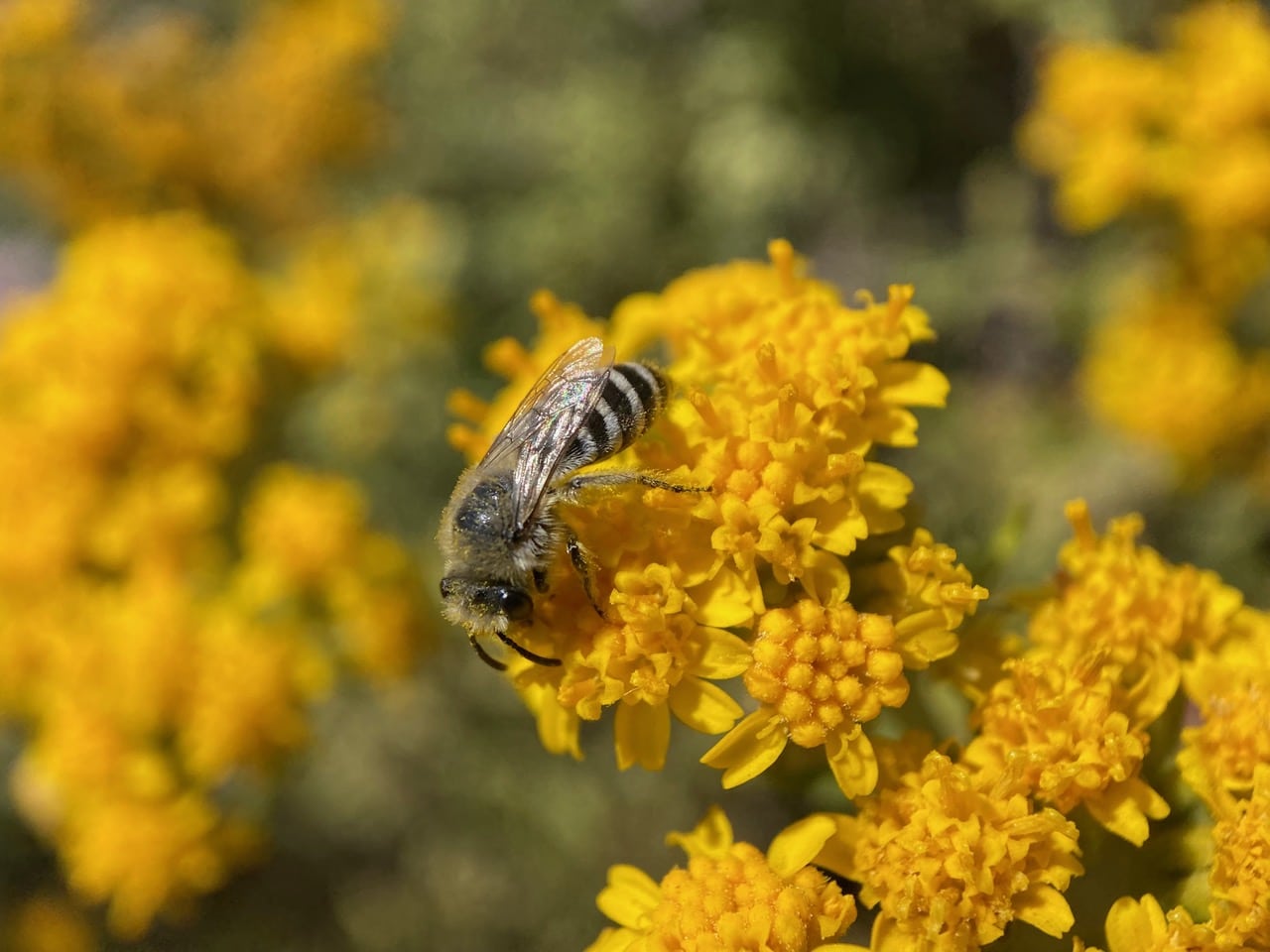
The bee family Colletidae includes generalists and specialists, and they are likely important pollinators of many wildflowers. All Colletidae in North America are solitary ground nesters, but some species nest in large aggregations. There are two major genera of Colletidae in North America: the Masked Bees (genus Hylaeus) and Cellophane Bees (genus Colletes). The most obvious shared characteristics of Colletidae is also the hardest to see: their short tongue. Colletes are moderately hairy, slender bees, ranging in size from 7 to 16 mm. Distinct features include a hairy head and thorax, pale bands of hair on the abdomen, and a heart-shaped head. The eyes of Colletes are angled (rather than being parallel), making the face slightly heart-shaped.
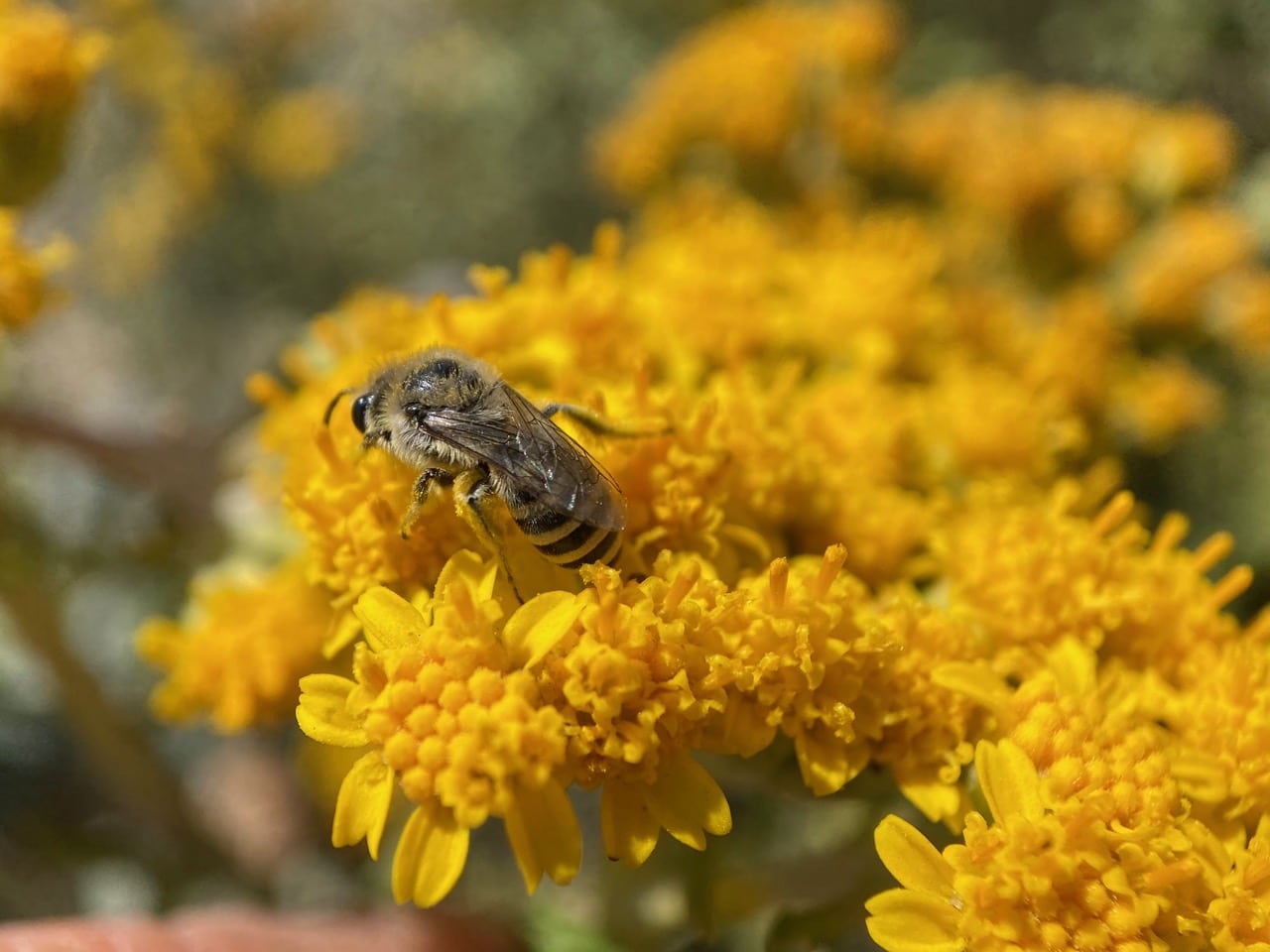
The genus name Colletes means “one who glues”, referring to their habit of applying a glue- or cellophane-like lining to the walls of nest cells, using their specialized tongues. This lining gives rise to their common names: cellophane bees, polyester bees, and plasterer bees. Colletes tongue is unique: short, flat, and forked at the tip. Colletes line their nests with a distinctive cellophane-like substance made from saliva and secretions from the Dufour’s gland on the abdomen. Using their specialized tongue, they paint the walls with saliva, then with secretions from the Dufour’s gland, they add a coat of varnish. This creates a clear covering that is strong, durable, and resistant to mold and water.
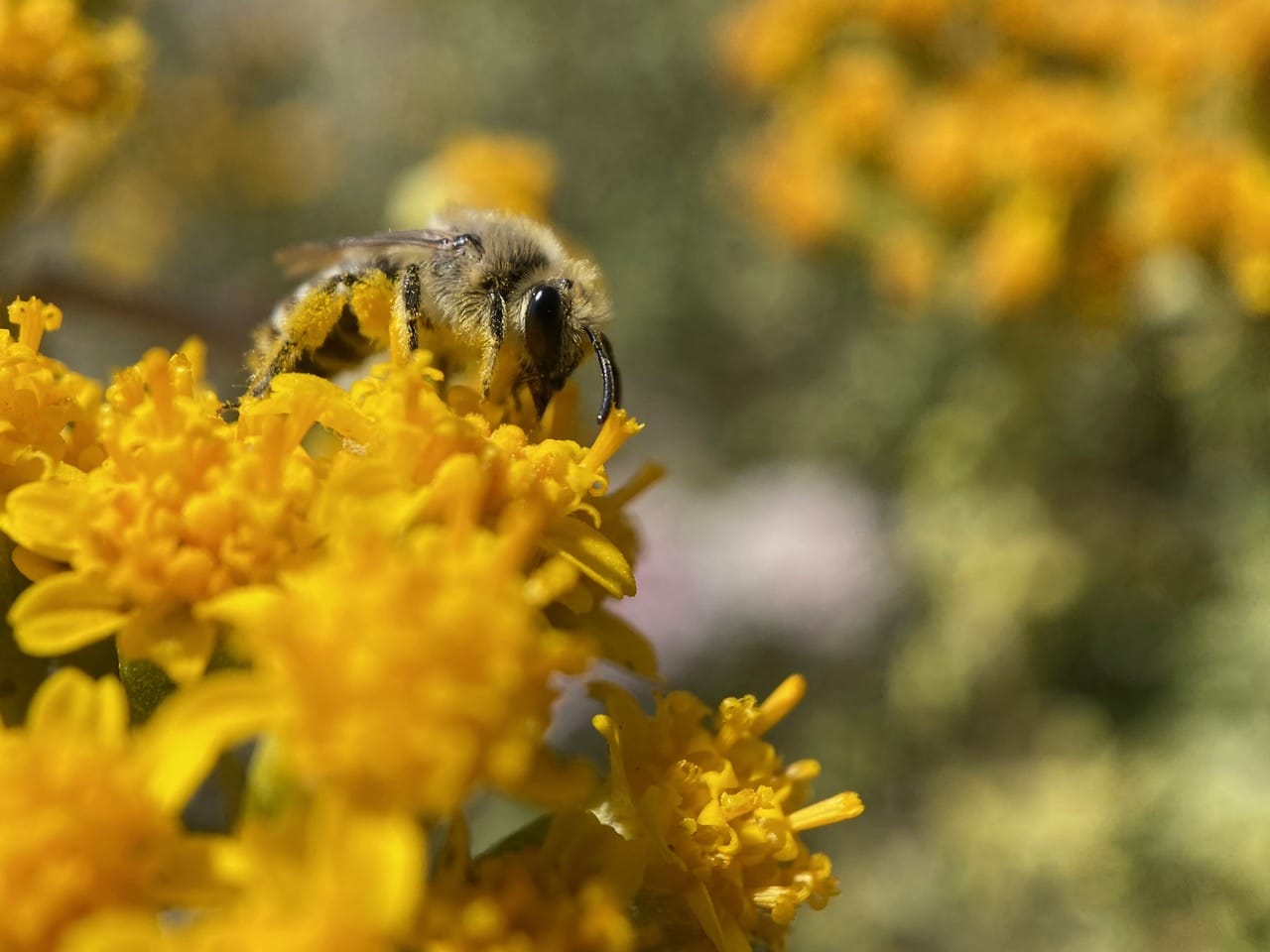
Note that this female Colletes is carrying pollen on the scopa (special pollen collecting hairs) on her hind legs.

Ah, finally, the adorable heart-shaped face of the Cellophane Bee! The eyes of Colletes are angled (rather than being parallel), making the face slightly heart-shaped.

There are so many Cellophane Bees visiting the Seaside Woolly Sunflower, I can spend hours taking their pictures!
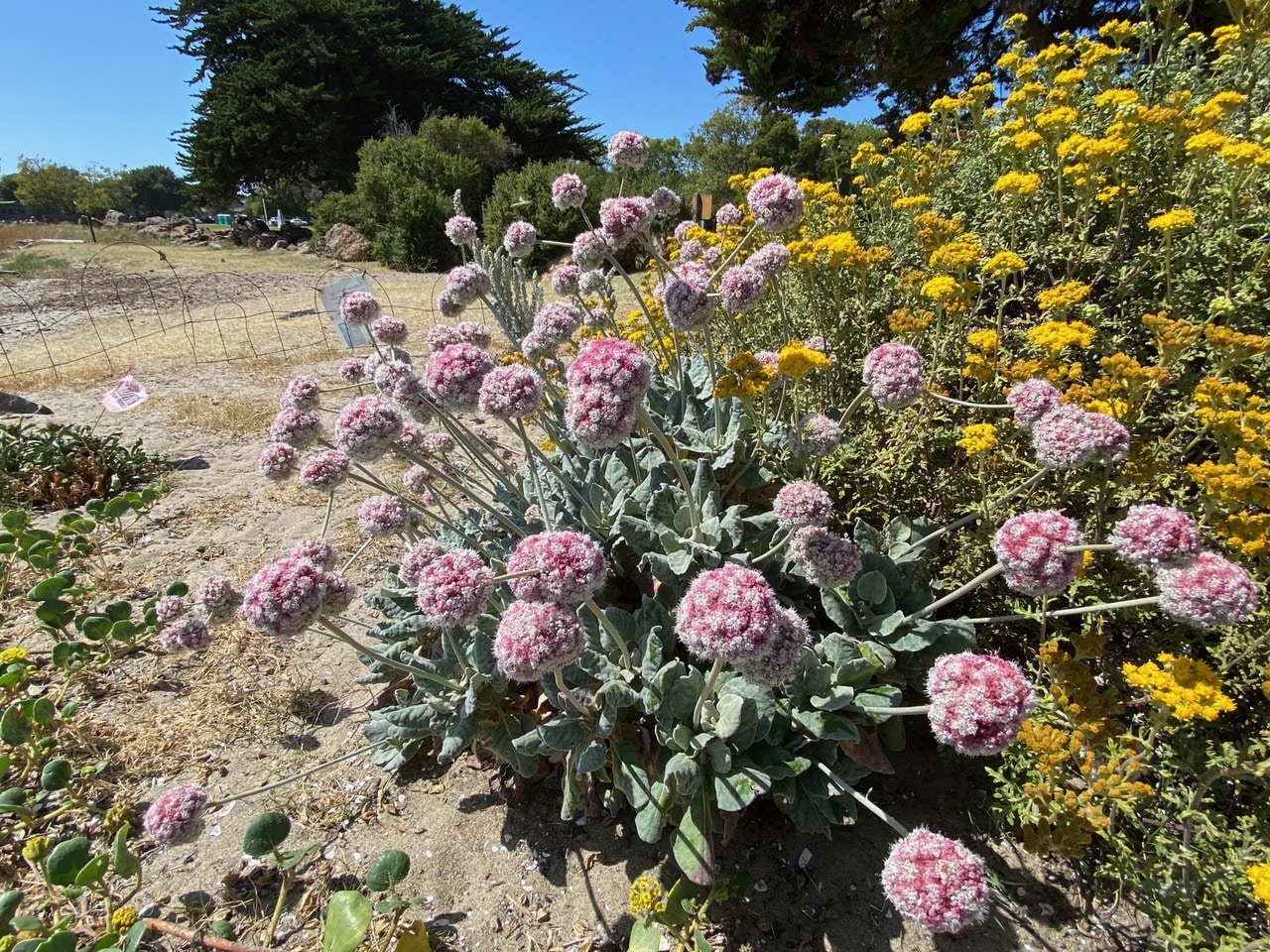
I next turn my attention to the Coast Buckwheat, Eriogonum latifolium.
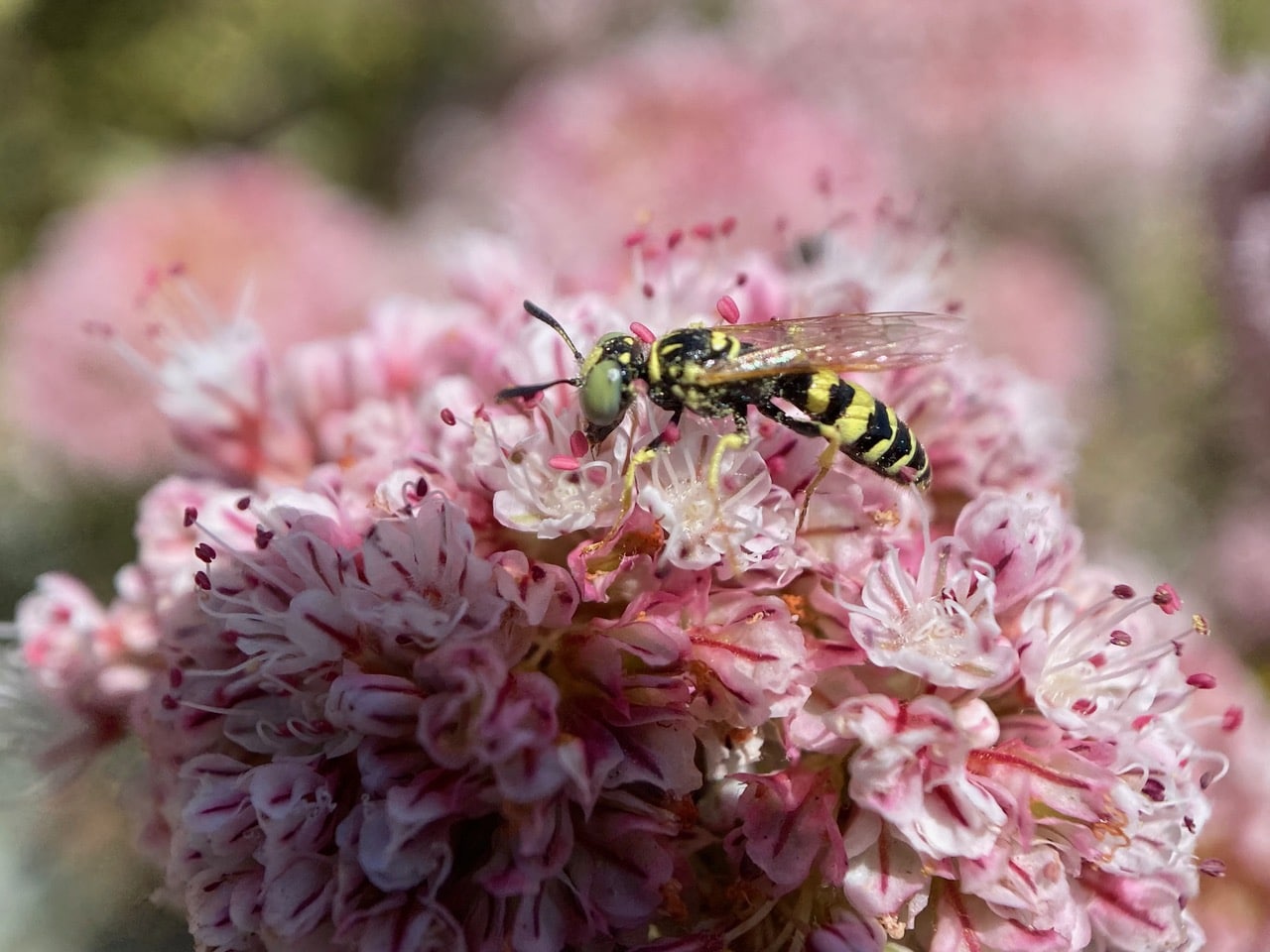
Look, there’s one of my favorite wasps making its way through a cluster of buckwheat flowers! It’s a Beewolf, Philanthus multimaculatus (family Crabronidae).

With strangely elongated body, corrugated abdomen, and over-sized head and eyes, these wasps are suggestive of aliens. Its life style is no less colorful.
Beewolves (genus Philanthus) are solitary, predatory wasps, most of which prey on bees, hence their common name. The adult females dig tunnels in the ground for nesting, while the territorial males mark twigs and other objects with pheromones to claim the territory from competing males. As with all other spheroid wasps, the larvae are carnivorous, forcing the inseminated females to hunt for bees on which she lays her eggs, supplying the larvae with prey when they emerge. To prevent fungal growth on the stored prey, female Philanthus wasps secrete symbiotic bacteria from specialized antennal glands. Some Philanthus species specialize on certain bee species, others may be generalists that prey on a wide variety of bees. The adults visit flowers for nectar. The best known beewolf is the species that prey on honey bees.
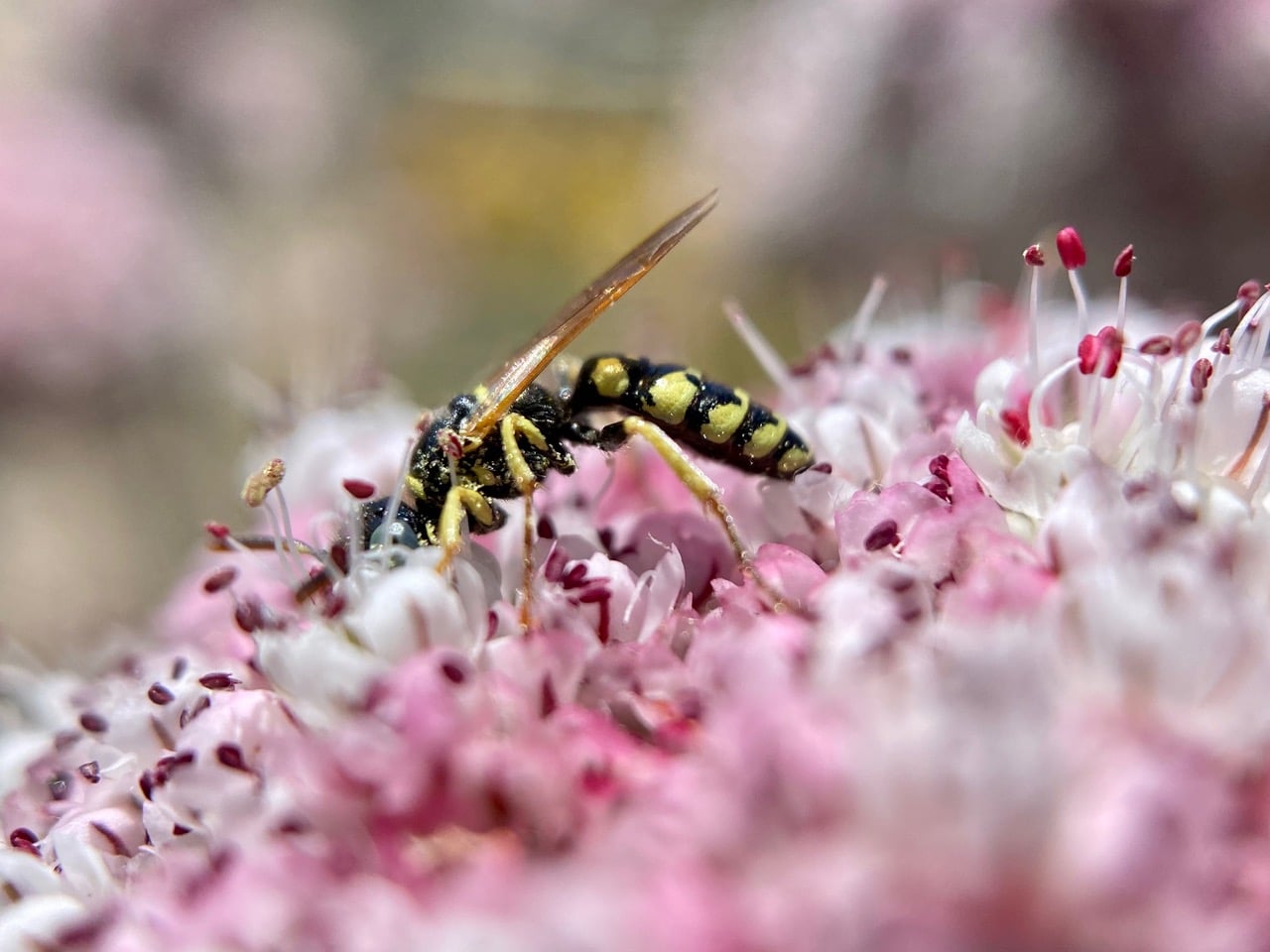
The Beewolves occur on the buckwheat in large numbers. It’s not surprising as the small flowers provide easily accessible nectar for these small wasps who are also constantly on the look out for prey.
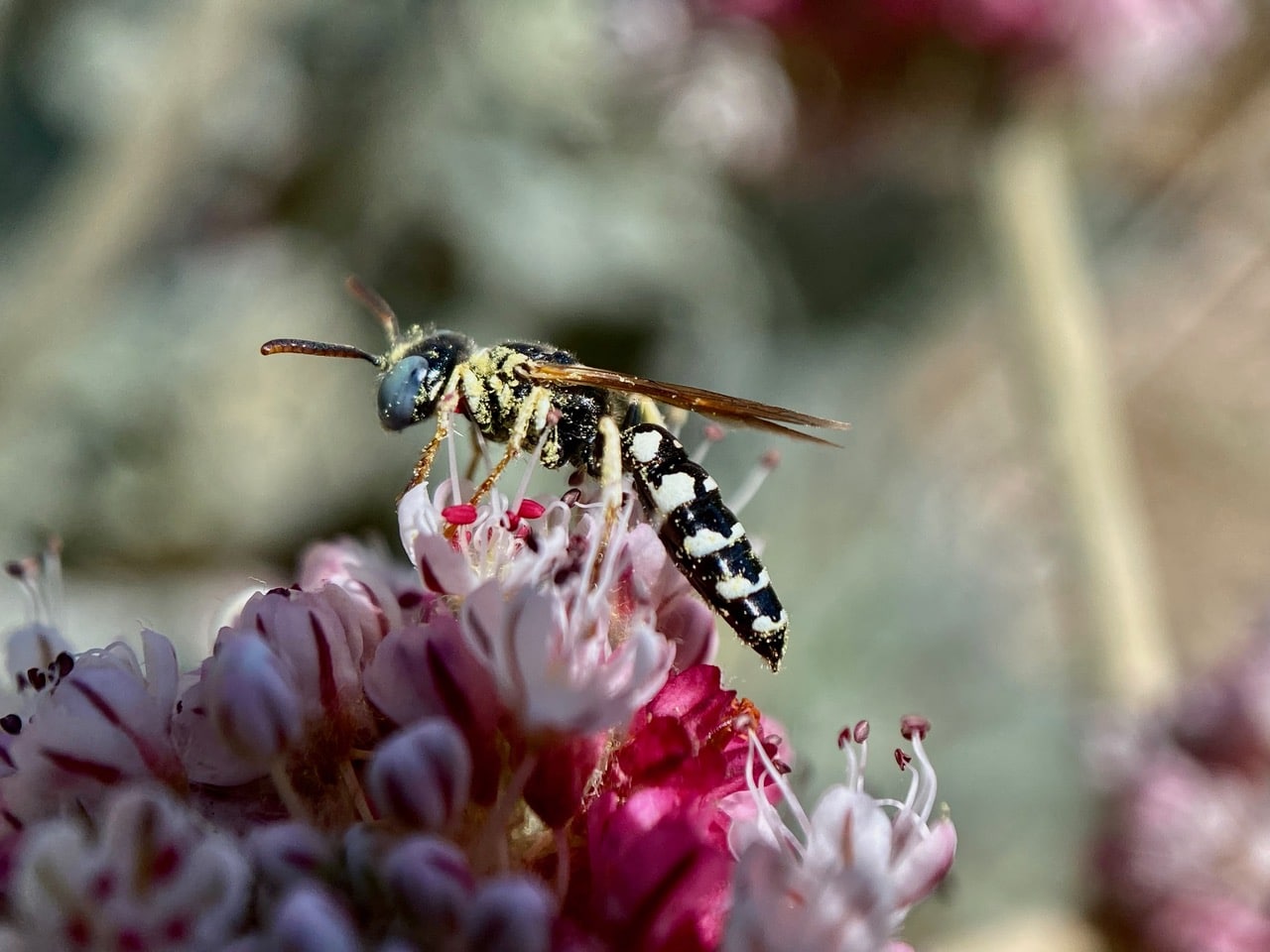
I spot a different species of Beewolf on the same buckwheat. Emerging from a flower, it is covered with pollen. It is slightly larger than P. multimaculatus, and has milky blue eyes and black-and-white abdomen. iNaturalist has helped identify it as Philanthus politus (family Crabronidae).
From what I can gather, both these beewolf species hunt mainly for Sweat Bees (family Halictidae), but will also take Cellophane/ Masked Bees (family Colletidae), Mining Bee (family Andrenidae), and Leafcutter/Mason Bees (family Megachilidae). This seems to violate the Competitive Exclusion Principle in ecology which states that no two species can occupy the exact same ecological niche in the same location indefinitely. Because they require identical resources, they become direct competitors. The species with even a slight advantage will outcompete the other. This usually leads to the weaker species either being locally displaced, driven to extinction, or forced to evolve. It will be interesting to learn the relationship between these two Beewolf species that co-exist side-by-side along the beaches of Alameda. Since they are not prey-specific but hunt for a wide variety of bees/wasps, there is probably little competition between the two species.
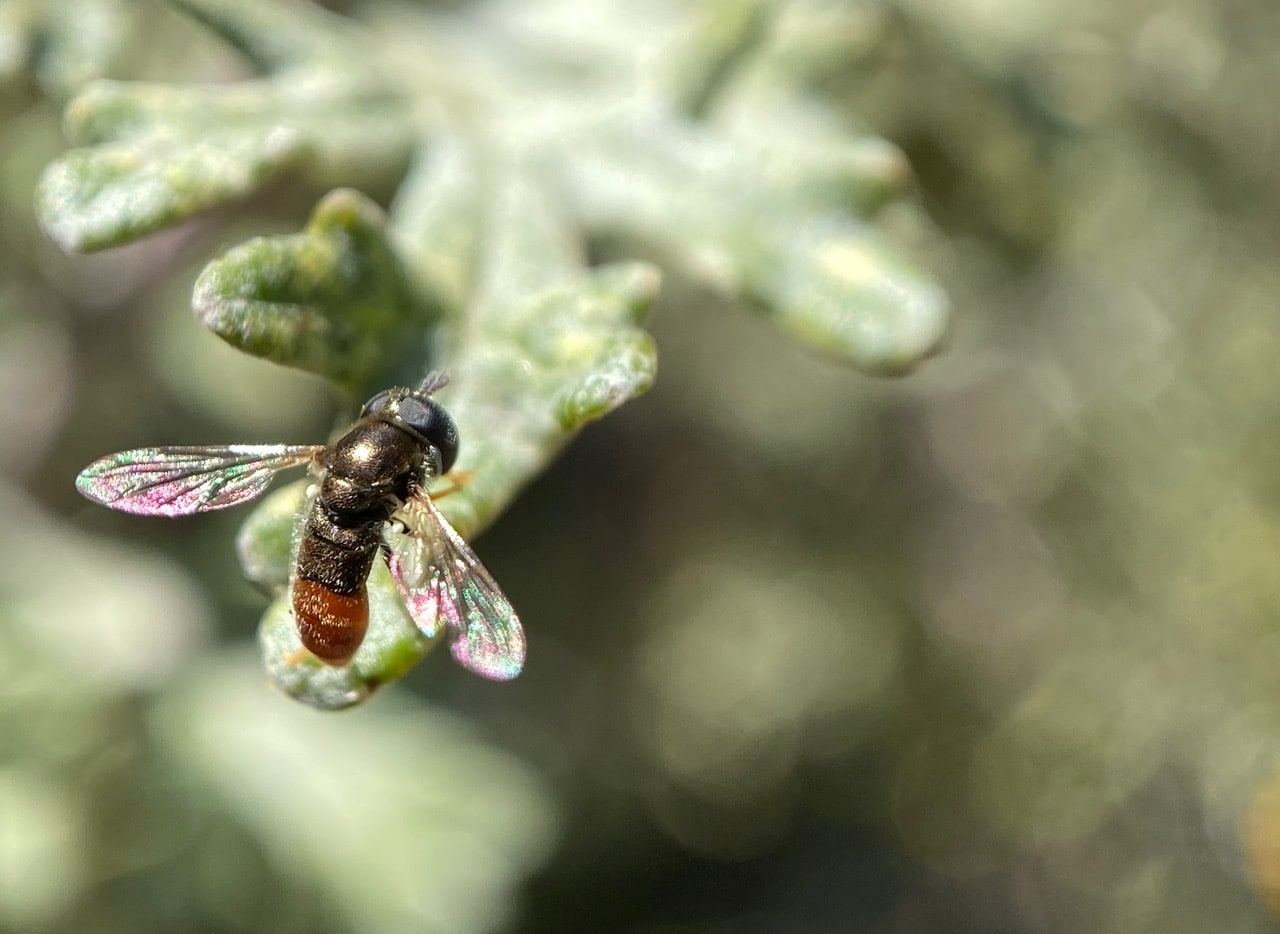
A Common Grass Skimmer, Paragus haemorrhous (family Syrphidae) has landed on a leaf of the Seaside Woolly Sunflower.
The Common Grass Skimmer, Paragus haemorrhous (family Syrphidae) is the smallest hover fly I know, measuring only about 4 mm in length. The species has a world-wide distribution, found in unimproved grasslands, dune grass, open areas and pathsides in forest, and meadows. Adults visit flowers for nectar and pollen. Larvae feed on aphids on low herbaceous plants.
Photos of Common Grass Skimmer (Paragus haemorrhous) · iNaturalist
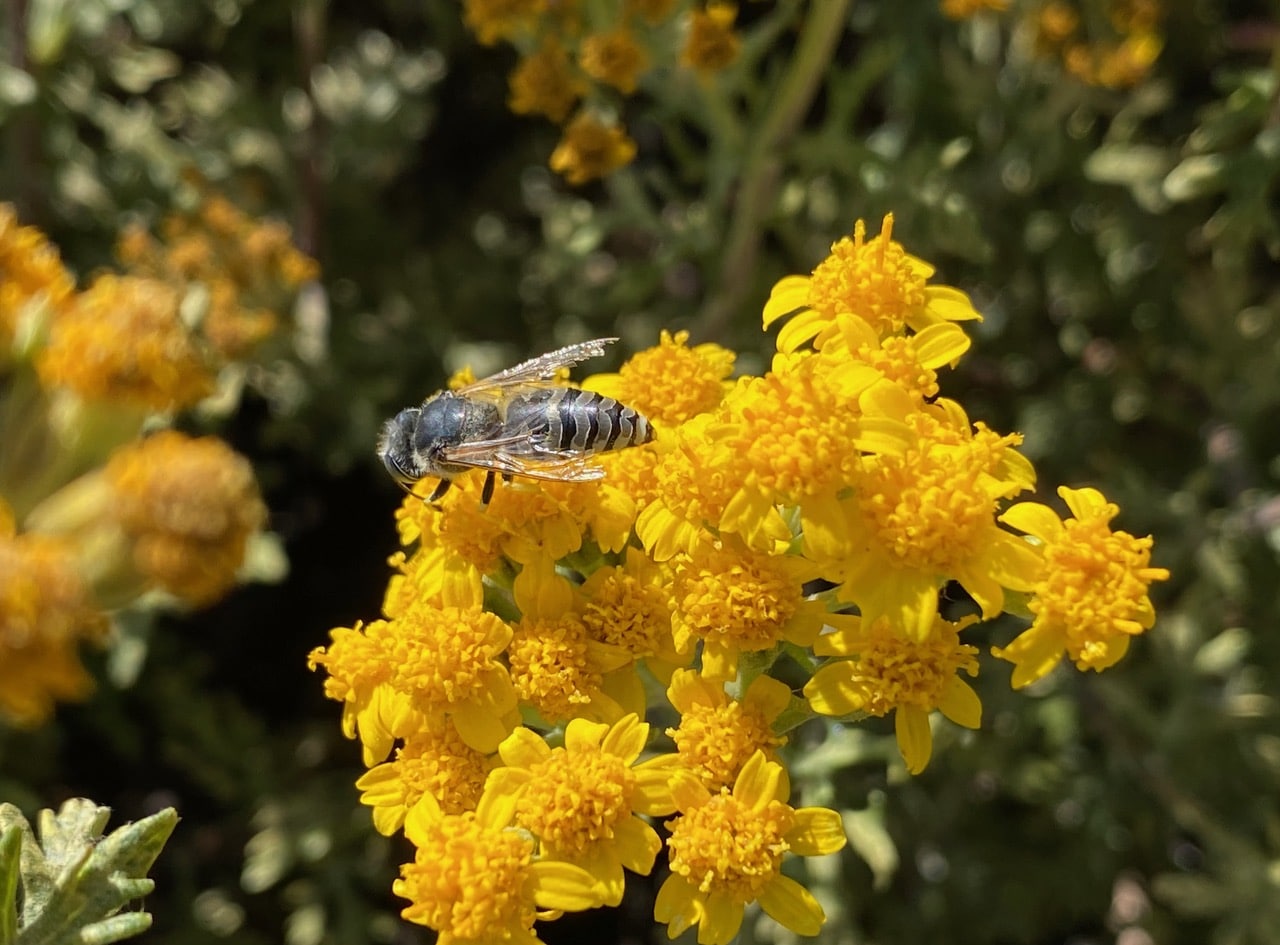
Who is that dark insect? It has gray-and-black wavy lines on its abdomen, and predominantly black thorax.
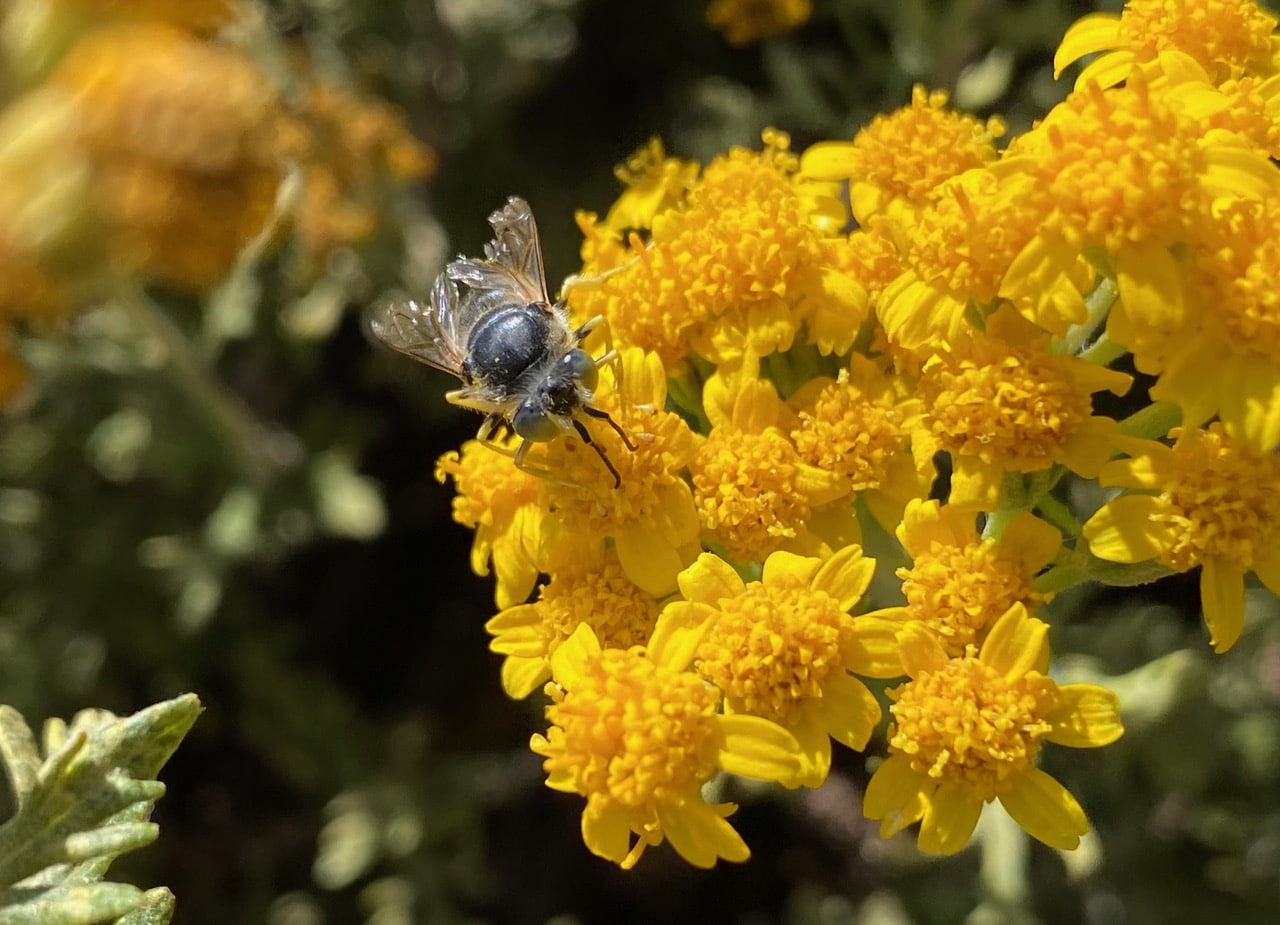
When I examine these pictures closely, I realize that the insect is actually a well-worn American Sand Wasp, Bembix americana (family Crabronidae). The female’s wings are tattered…
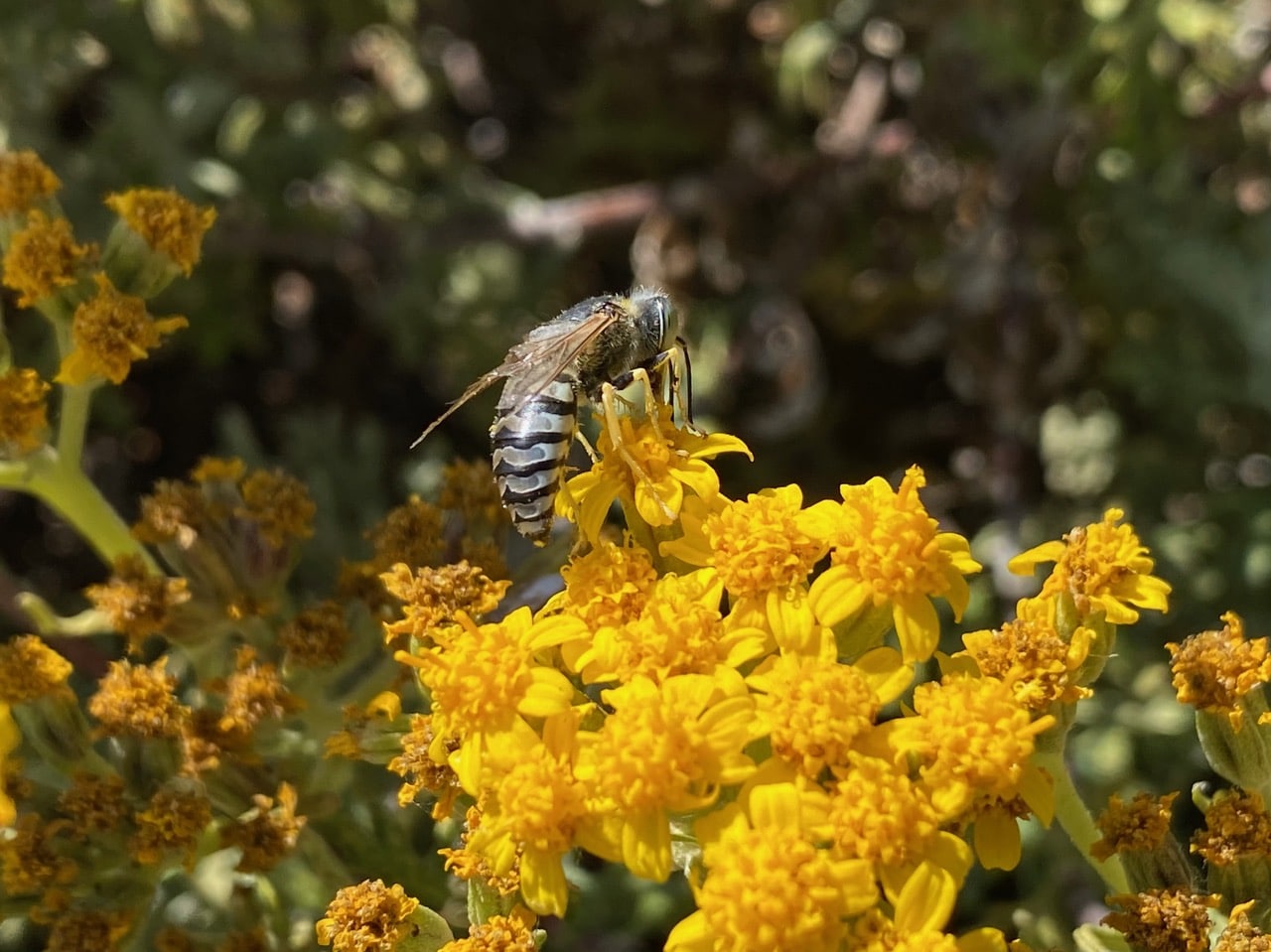
The integument of her abdominal segments is so worn down that the original white bands now appear gray…

Stripped of much hair, her bare thorax now looks black. Wow, I wonder how many burrows this mama sand wasp has dug in her life time, and how many larvae she has provisioned continuously until they pupate. These are amazing, tireless mothers!

A Sandhill Skipper, Polites sabuleti (family Hesperiidae) is taking nectar from the flowers of Seaside Woolly Sunflower.
Skippers are a family, the Hesperiidae, of the order Lepidoptera (butterflies and moths). They are named for their quick, darting flight habits. Most have the antenna clubs hooked backwards like a crochet hook. They also have generally stockier bodies and larger compound eyes than the other butterflies. Their wings are usually small in proportion to their bodies. When at rest, skippers keep their wings usually angled upwards or spread out, and only rarely fold them up completely. Californian species are mostly brown or tan, with black, orange, or yellow markings.
Skipper caterpillars are usually green or brown, sometimes yellowish, never brightly colored. They have a distinctive “collar”, a narrow ring around the body right behind the head. Caterpillars are camouflaged and often hide during the day. Many species make nests of leaves and silk for additional protection. Most North American species feed on grasses, but some common species eat shrubs and trees, especially in the bean family. Most species are limited to a single group of food plants. Adult skippers are only active during the day, but Skipper caterpillars feed mainly when it is dark or partly light.
The Sandhill Skipper, Polites sabuleti is a small, variable butterfly found in Western North America. They frequently inhabit grasslands, lawns, and alkaline meadows, where they feed on nectar and rely on saltgrass (Distichlis) as a larval host.
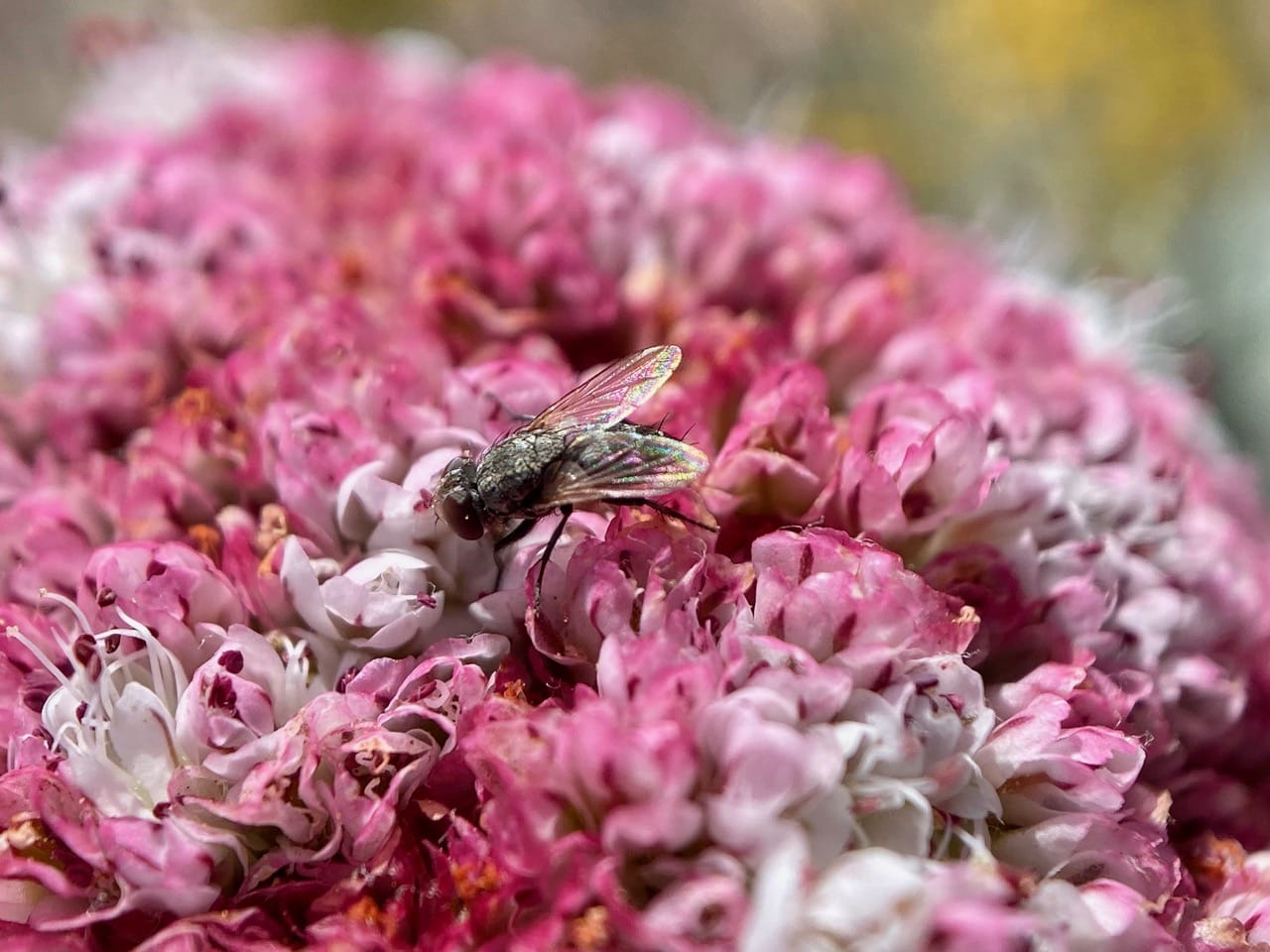
A small fly is moving swiftly on an inflorescence of Coast Buckwheat. It is a Satellite Fly, (family Sarcophagidae, subfamily Miltogramminae).
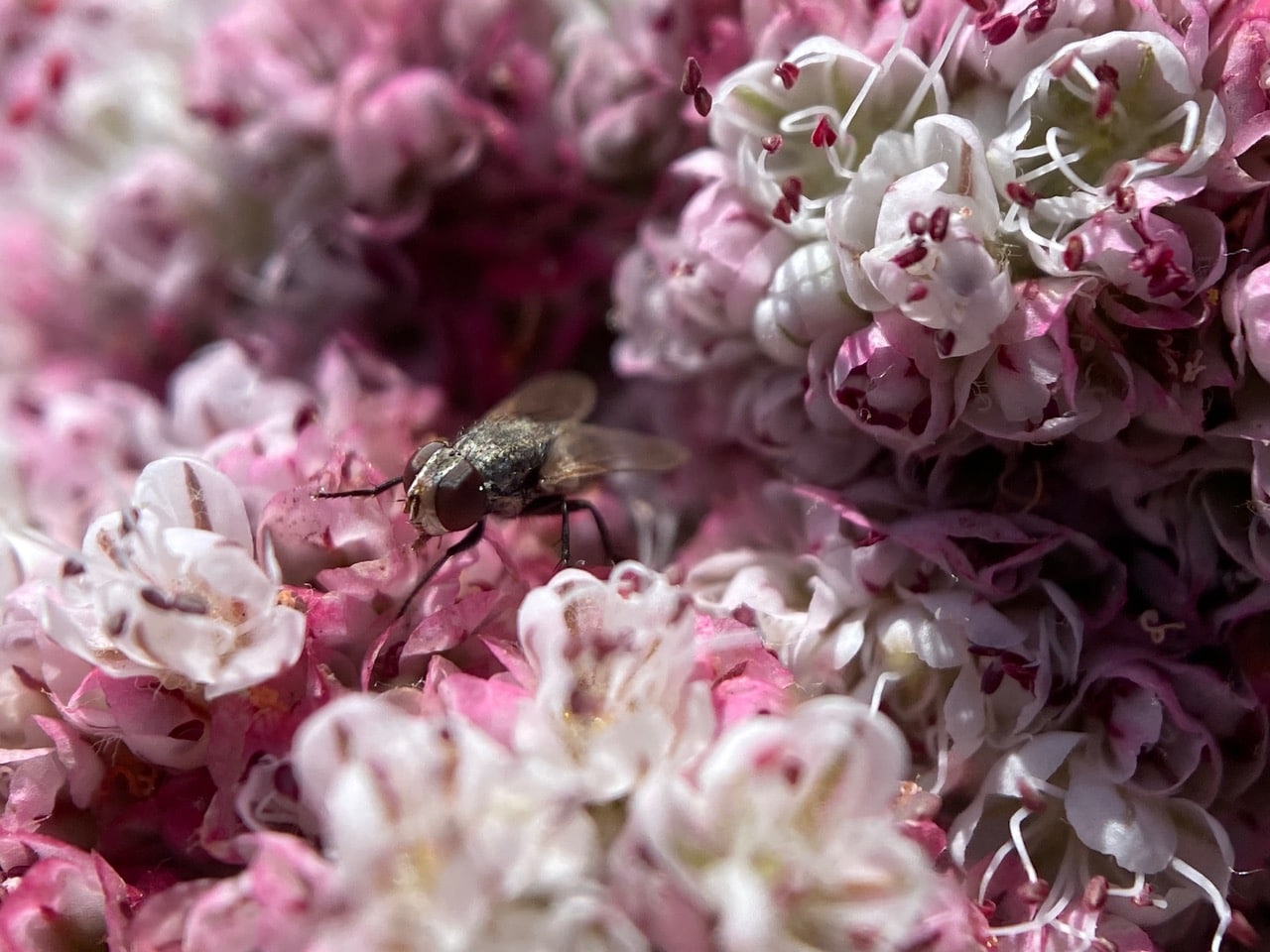

Satellite Flies are members of subfamily Miltogramminae, in the flesh fly family Sarcophagidae. They are notorious for being kleptoparasites, and are often called “satellite flies” or “bee-burglars”. Females utilize the nests of ground-nesting bees and wasps to raise their young, stealing their food.
These small flies are generally found in sandy, light-soil areas like coastal dunes, frequently visiting flowers to feed on nectar. They are small flies (usually 5-12 mm) and are heavily dusted with gray and brown patterning. They have unusually large eyes and low-set antennae. Females stealthily trail behind potential host, often with a narrow range as though tethered to the bee/wasp (hence the name “satellite”). The female sneaks into the nest of bee/wasp to lay her eggs inside the host’s burrow or directly on the host’s paralyzed prey. These can include a variety of arthropods. In some species, the Satellite Fly larviposits in the entrance of the host burrows, and the fly larvae wriggle down the burrow.
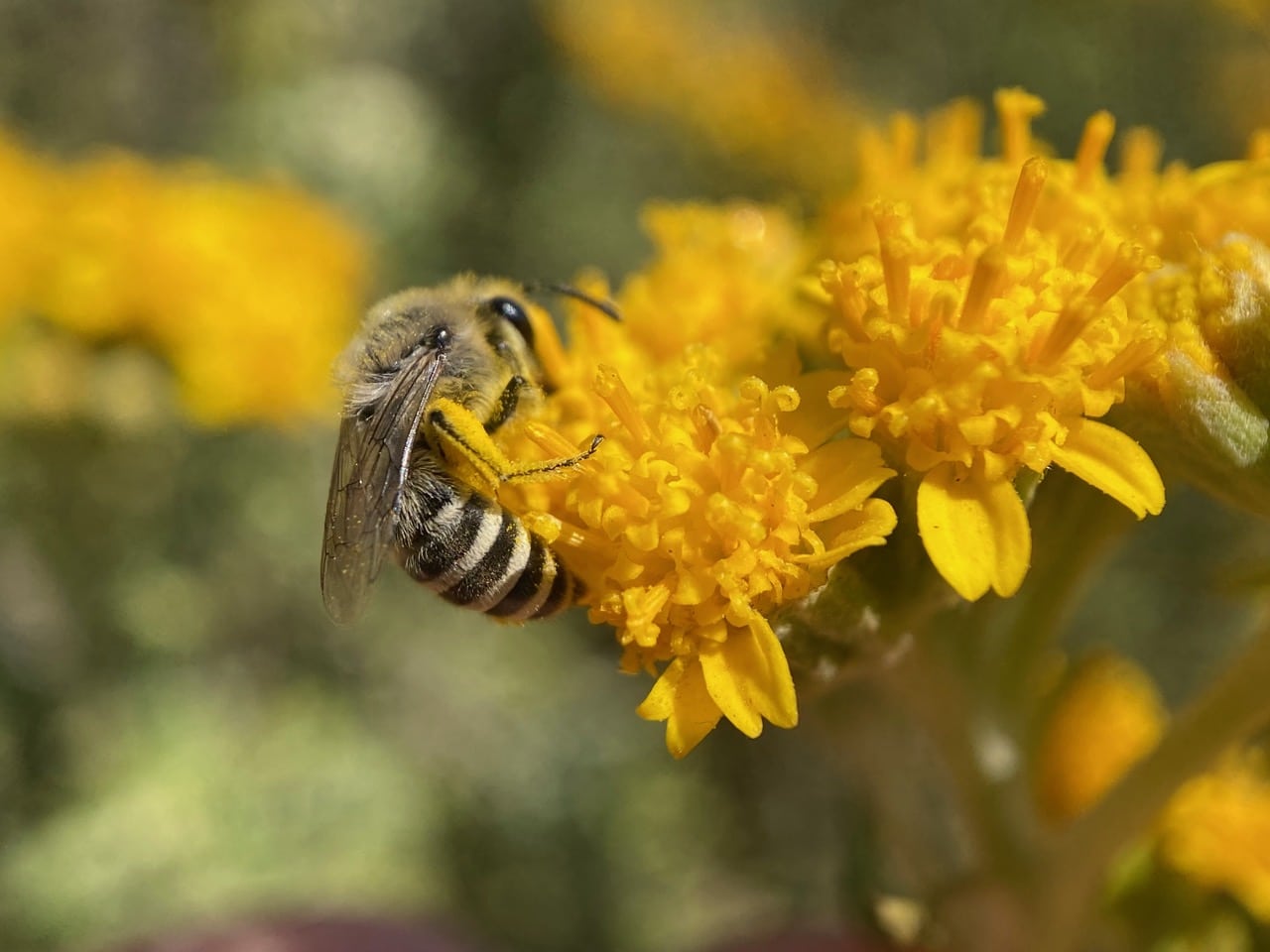
You shouldn’t need further help identifying this little bee now.
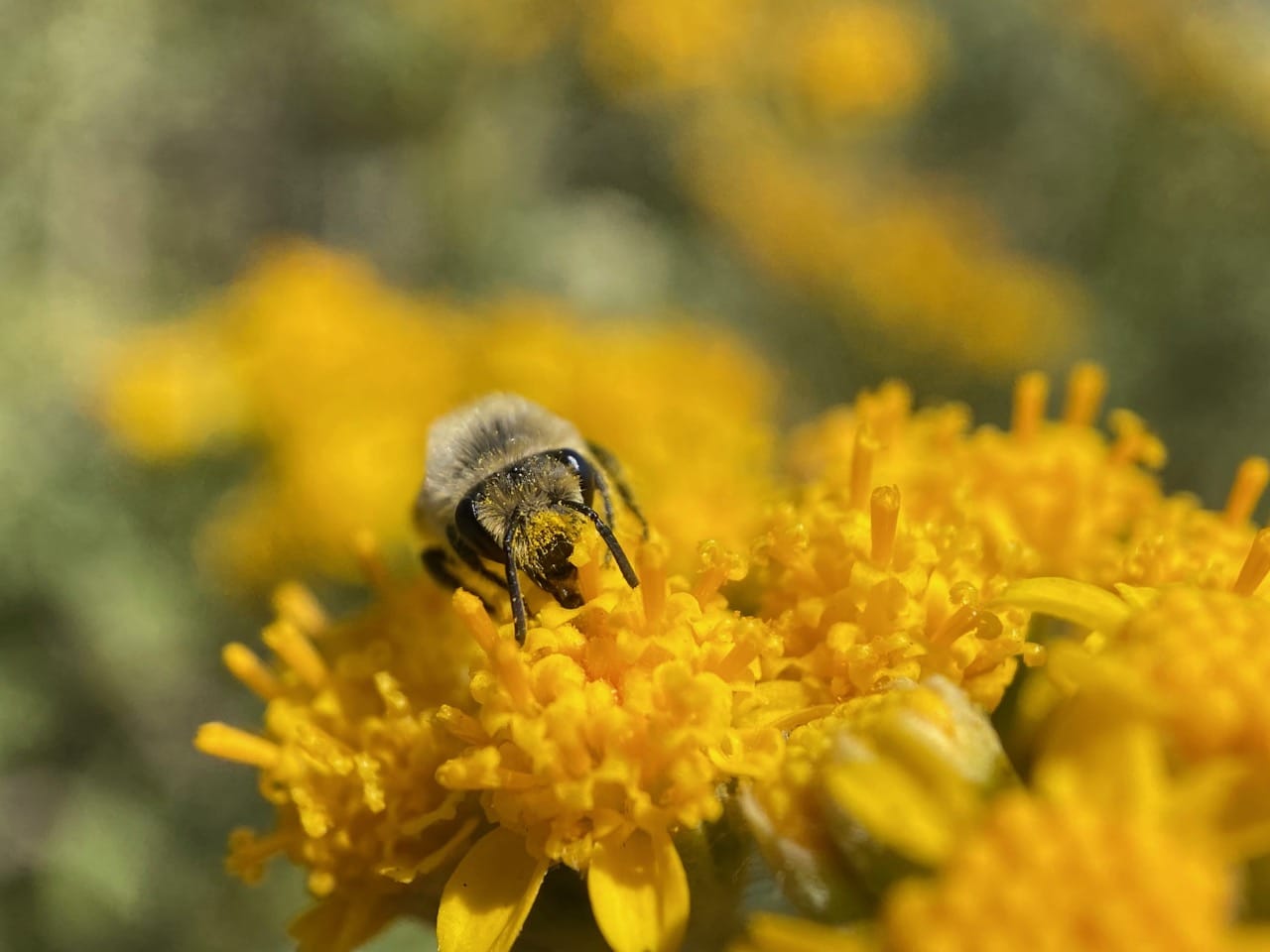
Fuzzy thorax and face, heart-shaped face…..