

Pollinator Post 7/1/25 (3)

Many homes along Bayview Drive have gardens that spill onto the salt marsh beyond their property lines, much to the delight of folks who walk this trail. I stop at a particular garden that is buzzing with insect activity. It is planted with mostly California natives.
A Small Carpenter Bee, Ceratina sp. (family Apidae) is foraging on a flowerhead of Seaside Daisy, Erigeron glaucus. The black bee is so glossy it is hard to see any details.

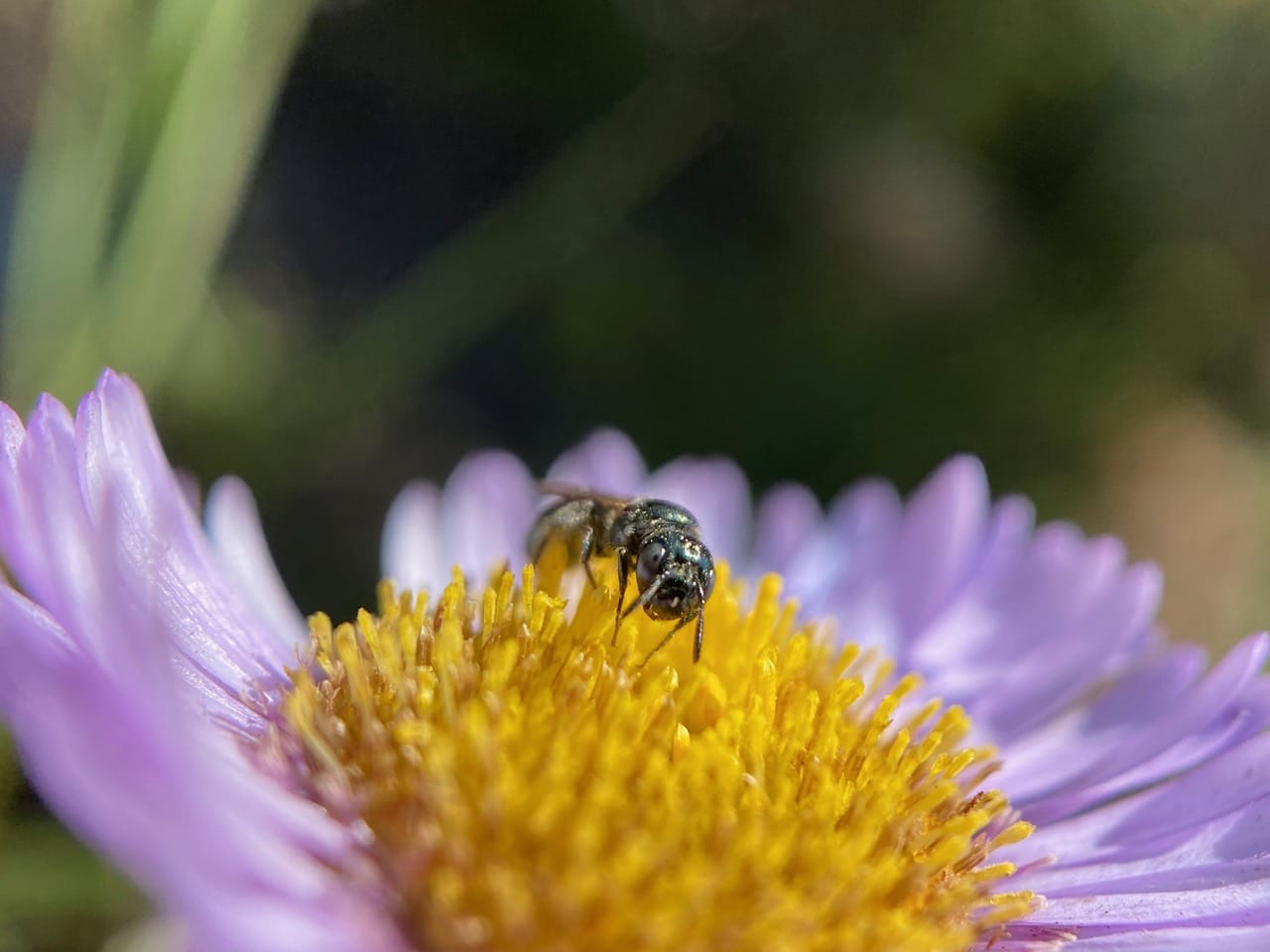



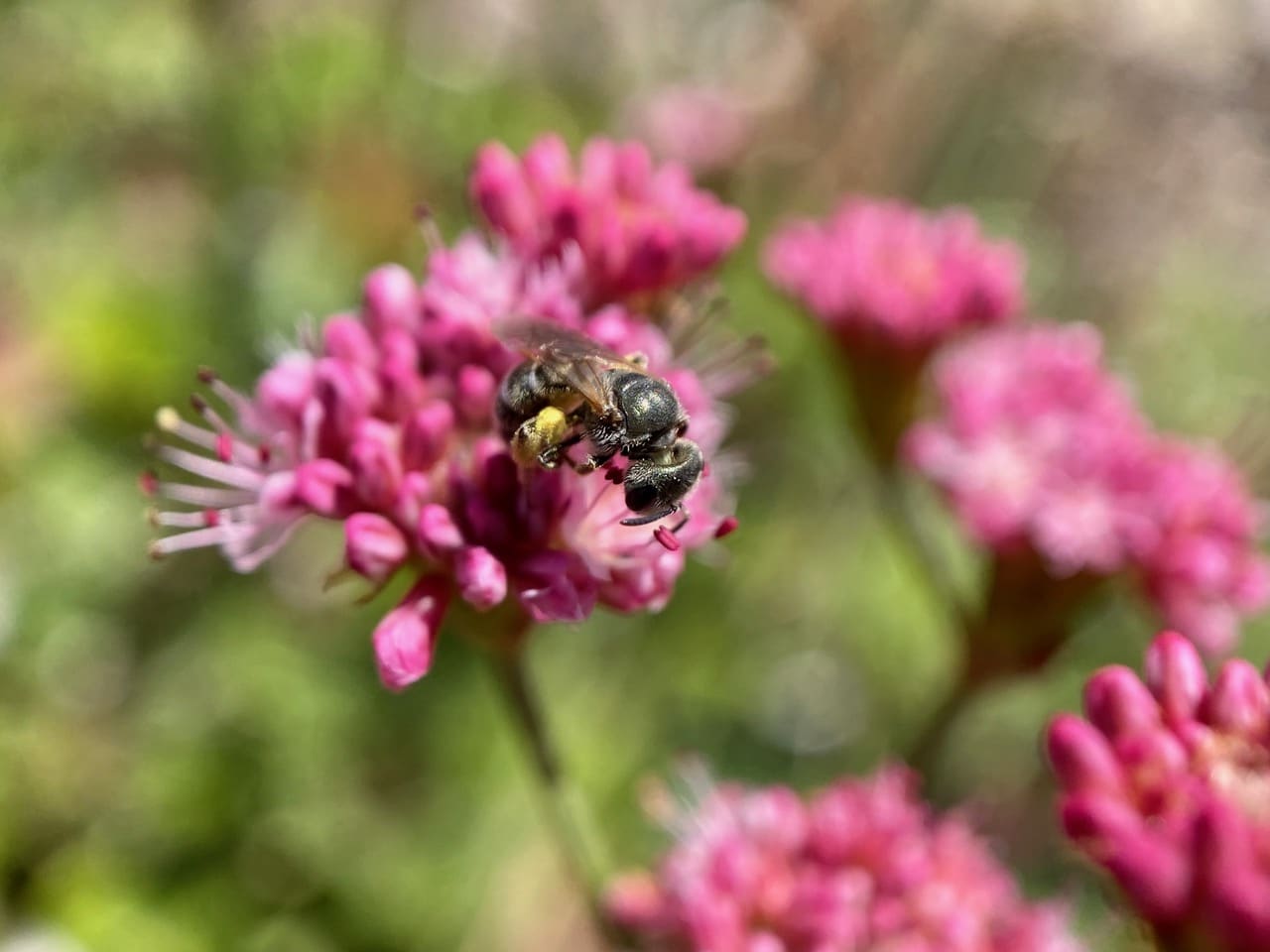
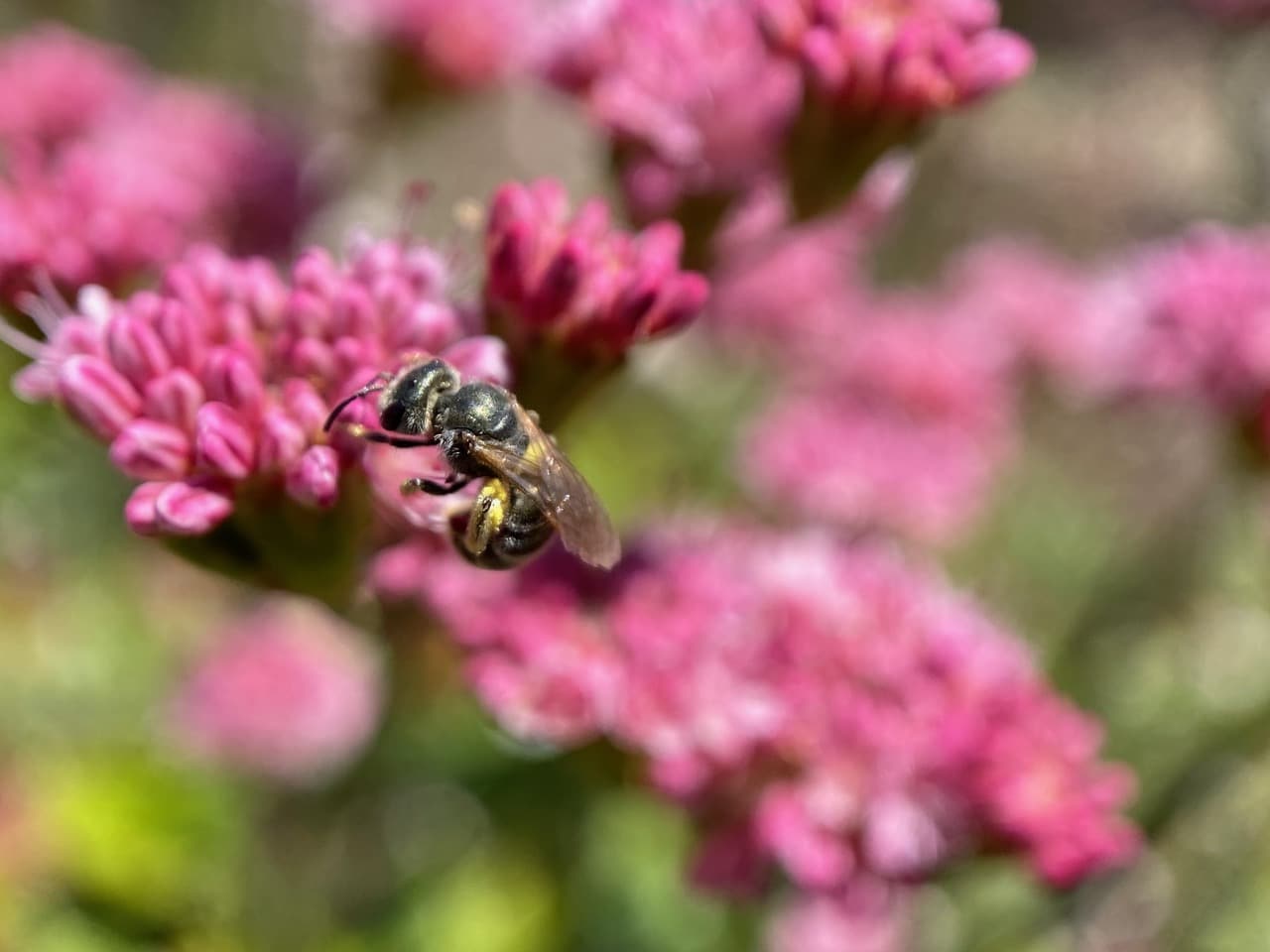







The Small Carpenter Bee genus Ceratina is closely related to the more familiar, and much larger Carpenter Bees (genus Xylocopa). Ceratina are typically dark, shiny, even metallic bees, with fairly sparse body hairs and a weak scopa on the hind leg. The shield-shaped abdomen comes to a point at the tip. Some species have yellow markings, often on the face.
Females excavate nests with their mandibles in the pith of broken or burned plant twigs and stems. While many species are solitary, a number are subsocial. Both male and female carpenter bees overwinter as adults within their old nest tunnels, emerging in the spring to mate. In the spring, this resting place (hibernaculum) is modified into a brood nest by further excavation. The female collects pollen and nectar, places this mixture (called bee bread) inside the cavity, lays an egg on the provision, and then caps off the cell with chewed plant material. Several cells are constructed end to end in each plant stem.

Unlike their larger relatives the Large Carpenter Bee, Xylocopa sp. that chew into wood, the Small Carpenter Bees, Ceratina sp. excavate their nests by tunneling into the soft pith (the spongy center) of dead plant stems, such as those of raspberries, sunflowers, or other shrubs. The female bee will create a linear series of brood cells within the stem, provisioning each cell with pollen and nectar for her offspring. Adult females often overwinter in these excavated stems, either in the completed nests or in partially excavated stems.
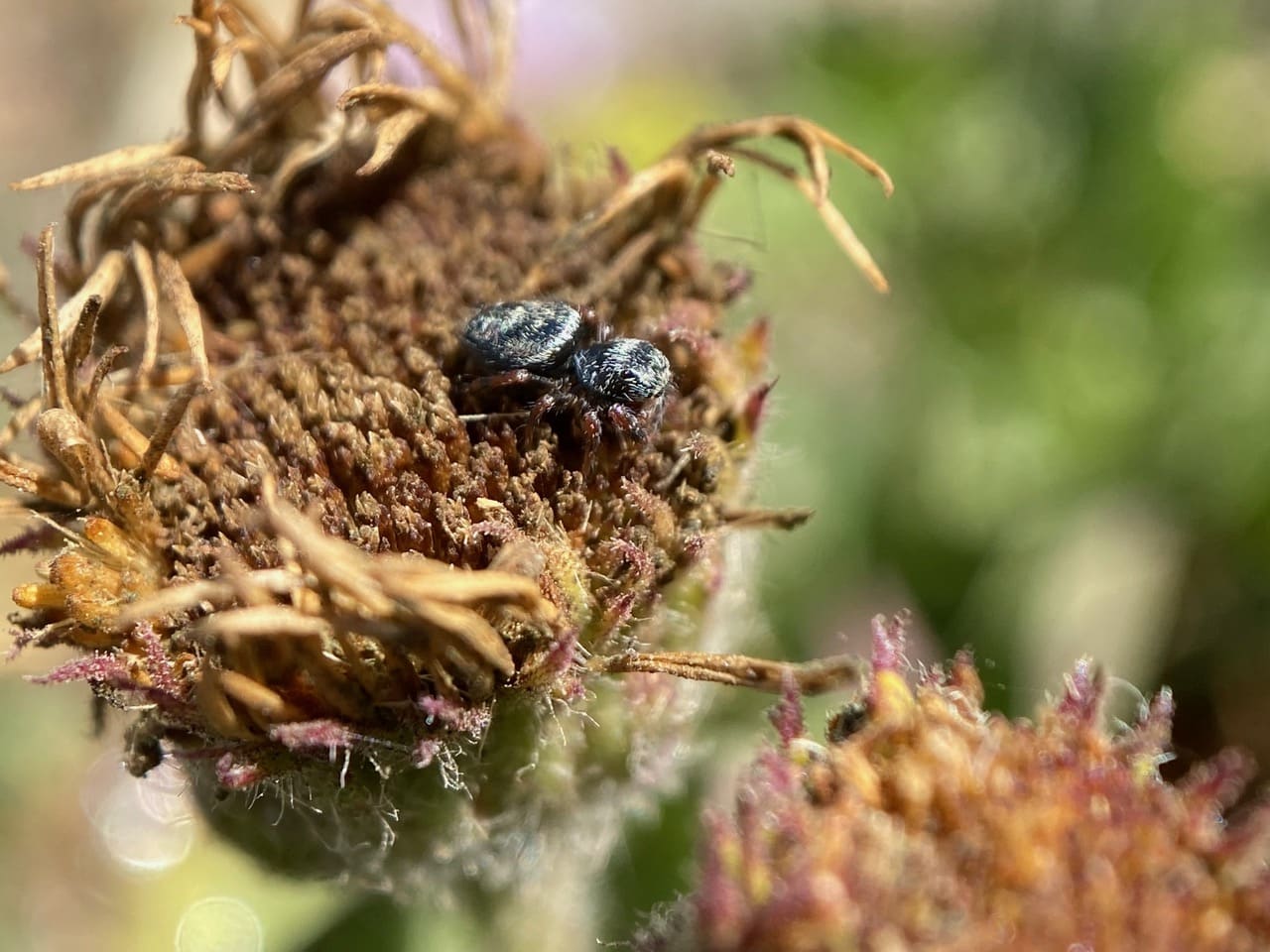
A small Jumping Spider (family Salticidae) is hunting from a dried flowerhead of Seaside Daisy.
Jumping spiders (family Salticidae) are free-roaming hunting spiders. They do not weave a web to catch prey. They stalk, then pounce on their prey. Just before jumping, the spider fastens a safety line to the substrate. It can leap 10-20 times their body length to capture prey. Their movement is achieved by rapid changes in hydraulic pressure of the blood. Muscular contractions force fluids into the hind legs, which cause them to extend extremely quickly. Jumping spiders are visual hunters. Their excellent vision has among the highest acuities in invertebrates. Since all their 8 eyes are fixed in place and cannot pivot independently from the body like human eyes can, jumping spiders must turn to face whatever they want to see well. This includes moving their cephalothorax up and down, an endearing behavior.
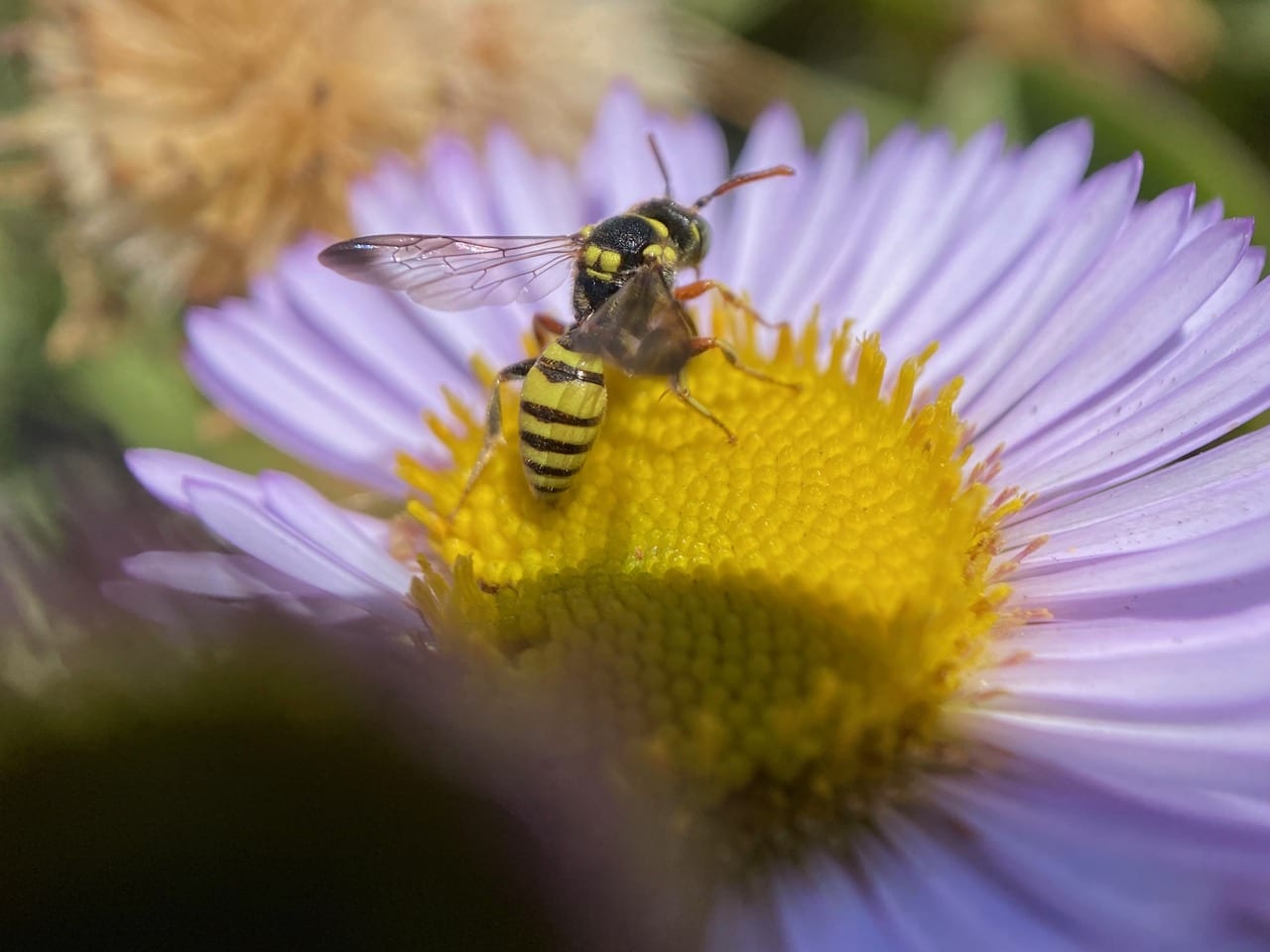
A wasp-like insect has landed on a flowerhead of Seaside Daisy.
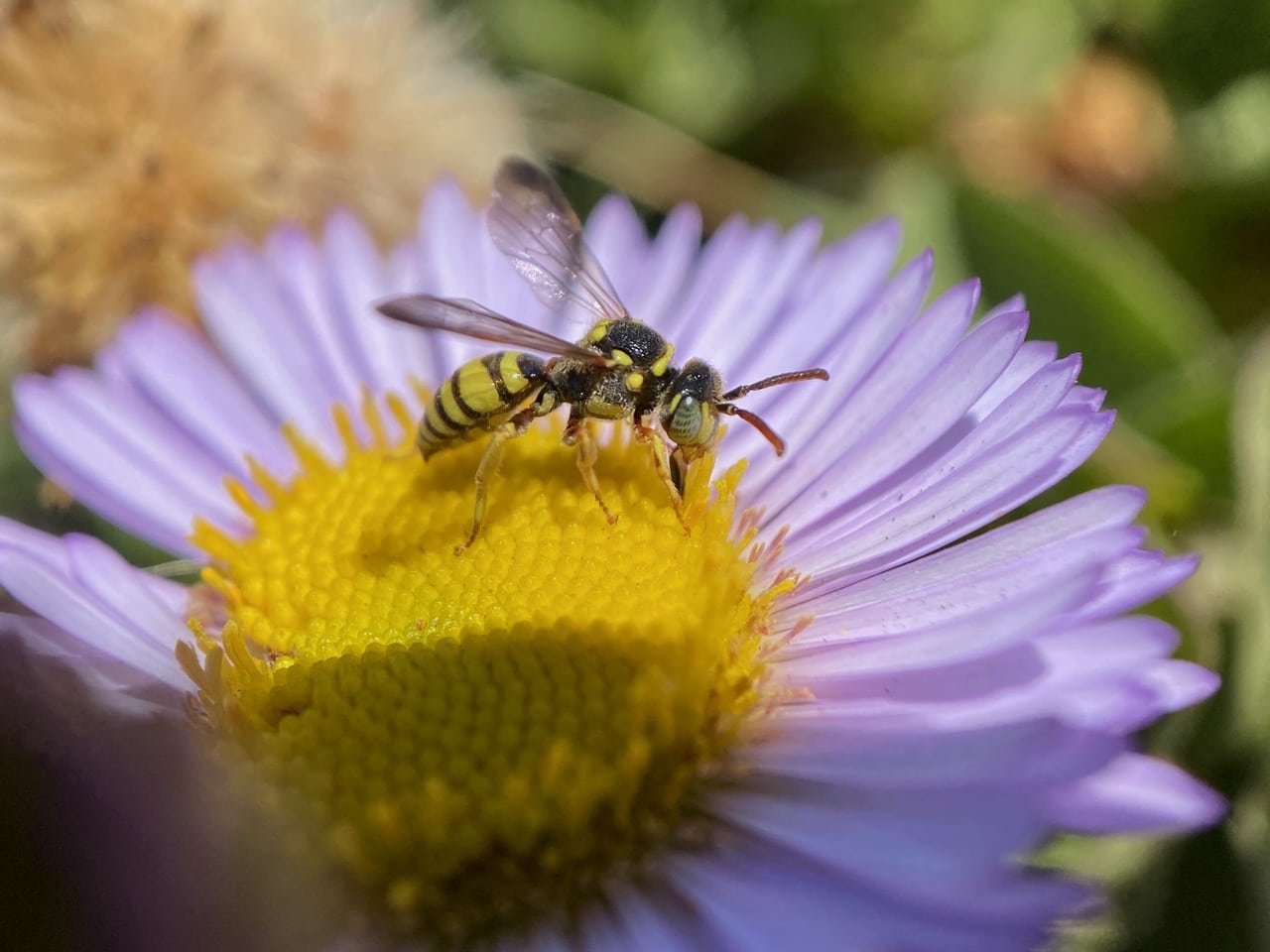
The lack of hairs and its habit of holding its wings up makes this Cuckoo Bee an excellent wasp mimic. I often have to do a double take to ensure that it’s not a Mason Bee that is about the same size.
The mottled blue-green eyes and absence of scopa on the hind legs are also features that give it away. It is a Nomad Bee, Nomada sp. (family Apidae).
Nomad Bees in the genus Nomada is one of the largest genera in the family Apidae, and the largest genus of Cuckoo Bees. Nomada are kleptoparasites of many different types of ground-nesting bees as hosts, primarily the genus Andrena. They lack a pollen-carrying scopa, and are mostly hairless, as they do not collect pollen to feed their offspring. Adults visit flowers for nectar. The bees are extraordinarily wasp-like in appearance, often with yellow or white integumental markings on their abdomen.
Nomad Bees occur worldwide. All known species parasitize ground-nesting bees, and their habitats and seasonality correlate closely with their hosts. In early spring, females scout out their hosts, searching for nests to parasitize. The female Nomada sneaks into the host’s nest while the resident female is out foraging, then lays eggs in the nest. The parasite larva that hatches out kills the host offspring and feeds on the host’s provisions. This type of parasitism is termed brood parasitism. The parasites pupate in the host cell and finally emerge as adults the following season along with the hosts.
While we might shudder at the thought of cuckoo bees in our garden, the presence of cuckoo bees actually indicates a healthy population of their host bees, suggesting a diverse and thriving ecosystem. Parasitism is a natural part of many ecosystems, and cuckoo bees play a role in regulating the populations of their host species. Cuckoo bees, while not collecting pollen for their own young, still visit flowers for nectar and inadvertently pollinate plants in the process. Cuckoo bees are also a food source for other animals, further contributing to the food web.
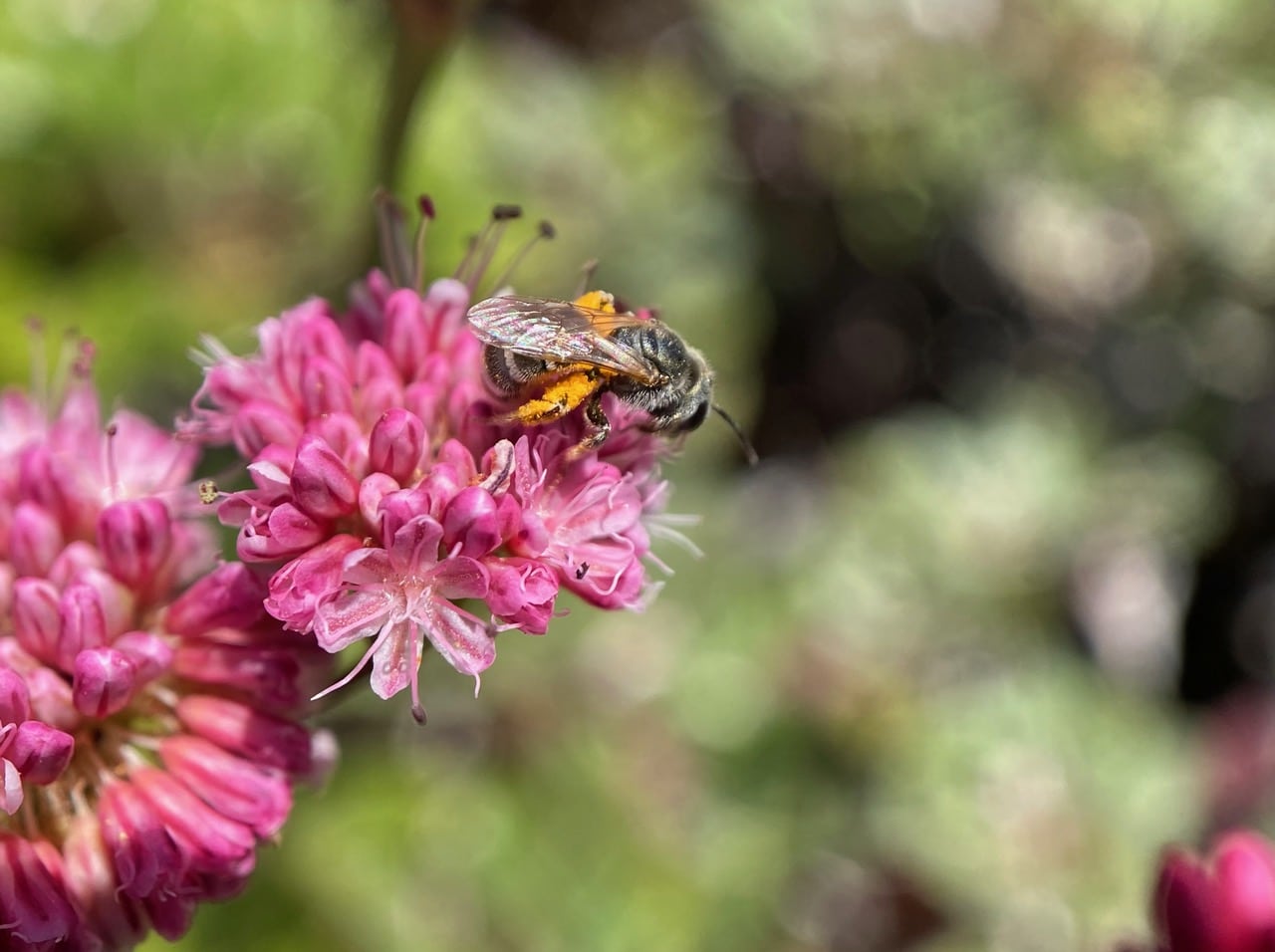
Numerous Tripartite Sweat Bees, Halictus tripartitus (family Halictidae) are foraging on a blooming Red-flowered Buckwheat, Eriogonum grande ssp. rubescens.
Note that pollen is held loosely in the scopal hairs on the hind legs of the sweat bee.
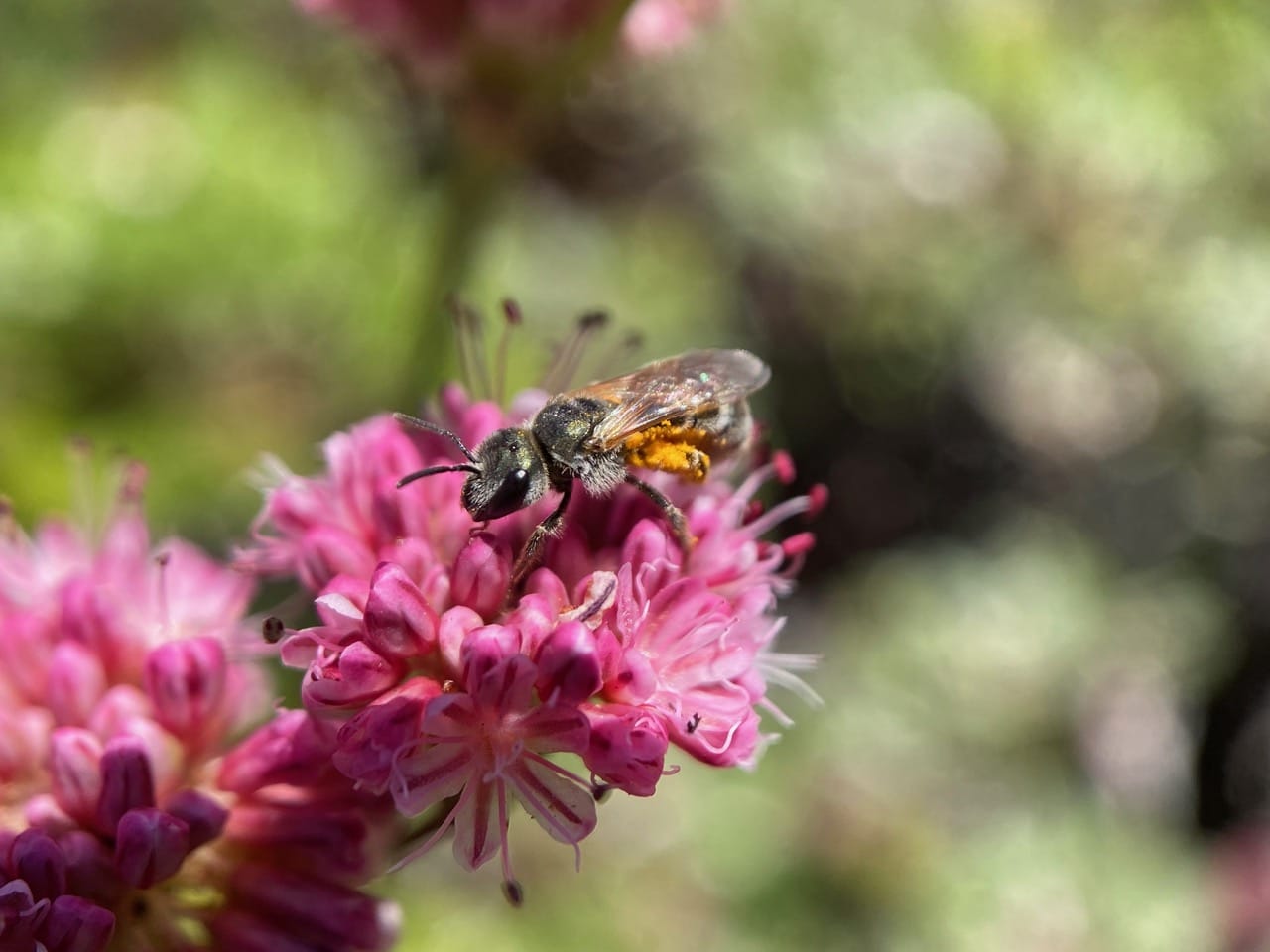
Another Tripartite Sweat Bee, Halictus tripartitus (family Halictidae) is foraging on the buckwheat flowers. It has orange pollen on its scopae, probably gathered from California Poppy.
Halictus tripartitus is a generalist forager, capable of using pollen from many different types of flowers to provision its young. This is probably a major reason why the bee is such a successful species in our area. Its social organization also helps the bees persist through the seasons while different flowers bloom and fade.
Like most sweat bees, Halictus tripartitus females carry their pollen load on the scopae on the hind legs, as well as on the underside of their abdomen.
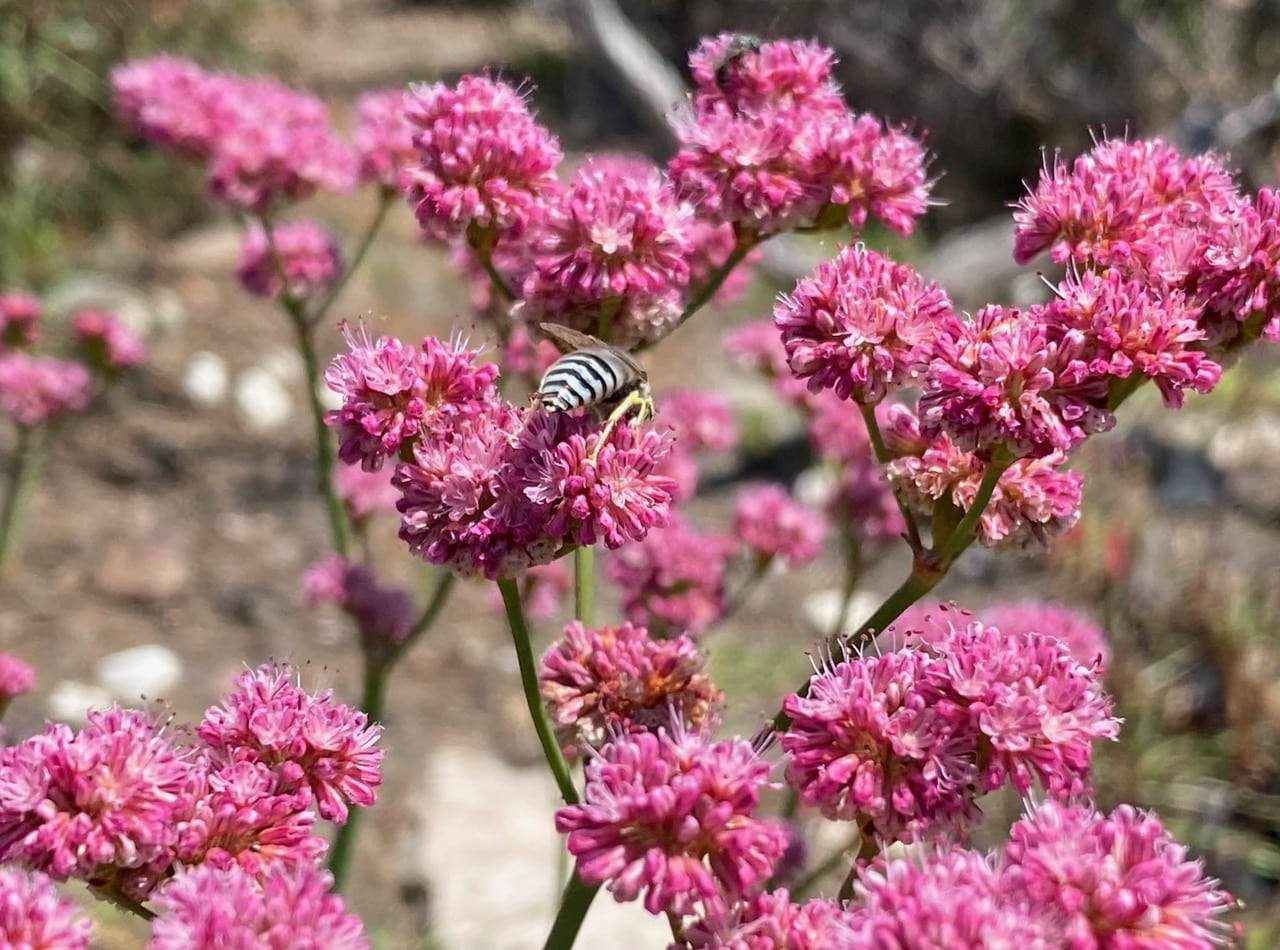
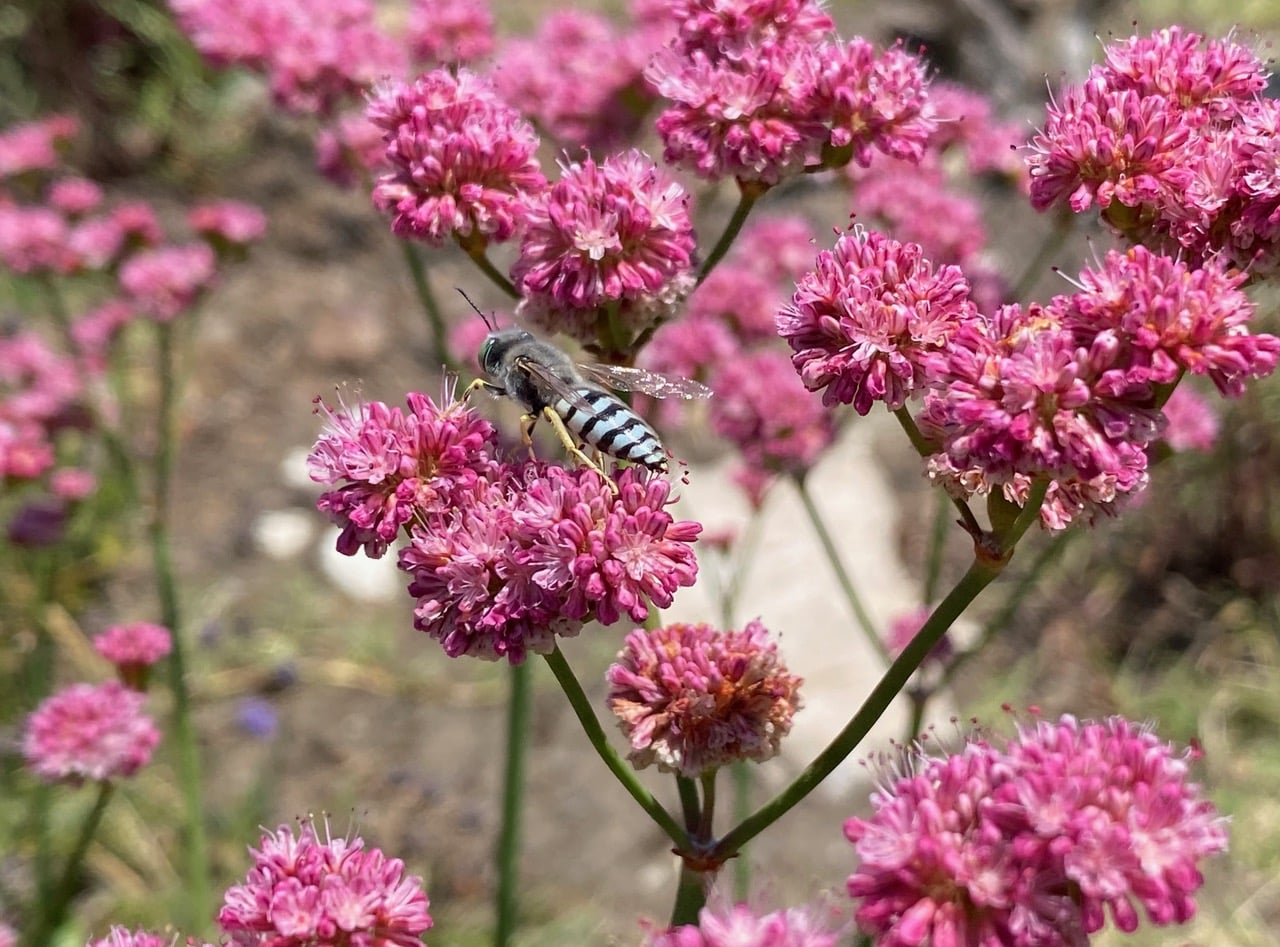
A much larger insect with an abdomen marked with black-and-white wavy lines is the American Sand Wasp, Bembix americana (family Crabronidae), so common along the coast here.
Sand wasps in the genus Bembix are familiar and common throughout North America, digging their burrows in dunes, on beaches, and other habitats with loose, deep sand. The female rapidly kicks out large quantities of sand using a “tarsal rake” of spines on each front leg. The burrow is excavated before the wasp goes hunting. Bembix are generalist, opportunistic hunters. True flies in the order Diptera are the usual prey. A victim is paralyzed or killed by the wasp’s sting, and is then flown back to the nest. Most species will lay an egg on the first victim, while some species lay an egg in the empty cell before starting to hunt. Once the egg hatches, mama wasp brings flies to her larva as needed. This “progressive provisioning” is rare in the insect world. When the larva reaches maturity, mama wasp closes the cell. Inside, the larva spins an oblong cocoon, weaving sand grains into the structure and resulting in a hardened capsule. Overwintering takes place as a prepupa inside this cocoon, but there are usually two generations a year.
Male sand wasps often engage in an elaborate flight ritual called “sun dances”. Males emerge before females, and fly erratically at dizzying speed one or two inches above the ground attempting to detect virgin females about to emerge from their underground nests. Both sexes are often seen taking nectar at flowers, especially from Asteraceae family. Bembix wasps are often victims of other insects such as cuckoo wasps (Chrysididae), velvet ants (Mutillidae), satellite flies (Sarcophagidae), bee flies (Bombyliidae), and thick-headed flies (Conopidae).
Two large Yellow-faced Bumble Bees, subgenus Pyrobombus (genus Bombus, family Apidae) are foraging on the Red-flowered Buckwheat. They appear to be this year’s new queens.
Queens are noticeably larger than worker bees, which is one of the easiest ways to distinguish them. Queen bees are fed a more substantial diet during their larval development, contributing to their larger size. The queen’s large size is crucial for her to store enough nutrients to lay a large number of eggs throughout the colony’s lifespan.
Bumble Bees undergo annual life cycles. Near the end of the season, usually in late summer, the colony produces new queens and drones. Bumble Bee queens often mate with multiple males while in flight. The sperm is stored in a specialized structure called the spermatheca after mating. The spermatheca is not just a storage container; it also contains cells that secrete nutrients to nourish and maintain the sperm. This sperm is then used throughout the queen’s lifetime for fertilizing eggs as she establishes and manages her own colony. The males usually do not live long after mating; they die with the workers and the old queen at the end of the season. The mated queen gorges on nectar and pollen, builds up fat reserves, and finds a place to hibernate for the winter. The following spring, she will start a new colony.
A Yellow-faced Bumble Bee in buckwheat heaven.
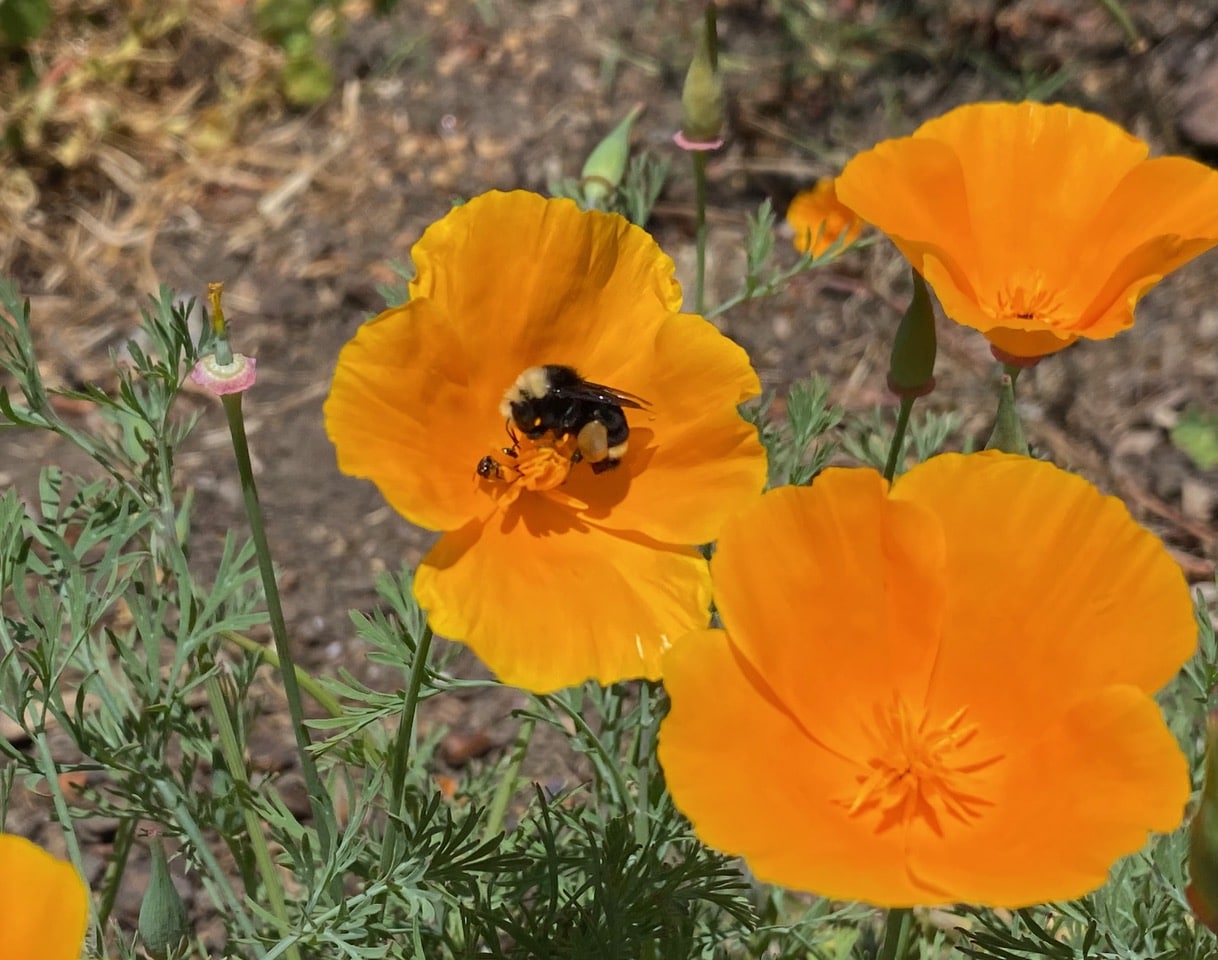
A Yellow-faced Bumble Bee, subgenus Pyrobombus (genus Bombus, family Apidae) is collecting pollen from California Poppy, Eschscholzia californica in the company of a Small Carpenter Bee, Ceratina sp. (family Apidae). Poppy flowers do not produce nectar. The only reward for the pollinators is the generous amounts of pollen.
On the salt marsh, a female Fine Striped Sweat Bee, Agapostemon subtilior (family Halictidae) is foraging on a fresh flowerhead of Oregon Gumweed, Grindelia stricta.
Agapostemon are brightly colored metallic green or blue bees measuring 7 to 14.5 mm long. Most species have a metallic green head and thorax, and black-and-yellow striped abdomen; some females are entirely bright green or blue. Females carry pollen on scopal hairs located on their hind legs. Agapostemon are generalists. Like other members of the family Halictidae, they are short-tongued and thus have difficulty extracting nectar from deep flowers. Males are often seen flying slowly around flowers looking for females. The bees favor flowers with high densities. Females excavate nests in the ground. These are summer to fall bees.
Fine striped sweat bee (Agapostemon subtilior) · iNaturalist
An Anise Swallowtail butterfly is seeking to lay eggs on the foliage of a Fennel, Foeniculum vulgare (family Apiaceae).
While most butterflies are in decline, the Anise Swallowtail, Papilio zelicaon (family Papilionidae) is holding its own, thanks to its adaptability in using easily available non-native host plants, notably the ubiquitous Fennel. Anise Swallowtail primarily rely on plants in the carrot family (Apiaceae) for their larval food source. Native plants like Lomatium species, Angelica, Cow Parsnip, and Yampah are important native host plants. Introduced plants like fennel, carrot, parsley, and dill are also frequently used.
Anise Swallowtail caterpillars feed on plants in the Apiaceae family because these plants contain specific compounds that the caterpillars can utilize for their own defense mechanisms. These compounds, often essential oils like anisic aldehyde or anethole, are converted by the caterpillars into substances that deter predators. The plants also contain chemicals, such as furanocoumarins, which are toxic to many insects and mammals. Anise Swallowtail caterpillars have developed the ability to process these toxins, using them to their own advantage. When threatened, the caterpillars can evert a forked organ behind their head called an osmeterium, which releases a foul-tasting and smelling secretion. This secretion is derived from the sequestered plant toxins.