

Pollinator Post 7/1/25 (2)

I next make the short drive to Elsie Roemer Bird Sanctuary along Alameda Beach.
I walk the narrow trail that runs south-eastward from the Bird Sanctuary, winding its way through salt march vegetation on one side and private homes on the other.






It is low tide. Two Black-necked Stilts forage in a shallow pool while the channel beyond is exposed mudflats all the way to Bay Farm Island.
Hey, a male Summer Longhorn Bee, Melissodes sp. (family Apidae) is foraging on a flowerhead of Bristly Oxtongue!
The Summer Longhorn Bees, Melissodes sp. (family Apidae) are medium to large bees, stout-bodied, usually with gray hair on the thorax and pale hair bands on the abdomen. Males usually have yellow markings on their faces and have very long antennae from which their common name is derived. They are active May to September, with peak flight in late June to early August. The females prefer flat, bare ground for digging their solitary nests, though they sometimes nest in aggregations. Pollen is transported in scopae on the hind legs. Pollen loads are often copious and brightly colored and thus very distinguishable. Melissodes are specialists on Asteraceae – females gather pollen from flowers of Aster, Bidens, Coreopsis, Cosmos, Encelia, Gaillardia, Helianthus, and Rudbeckia ssp.
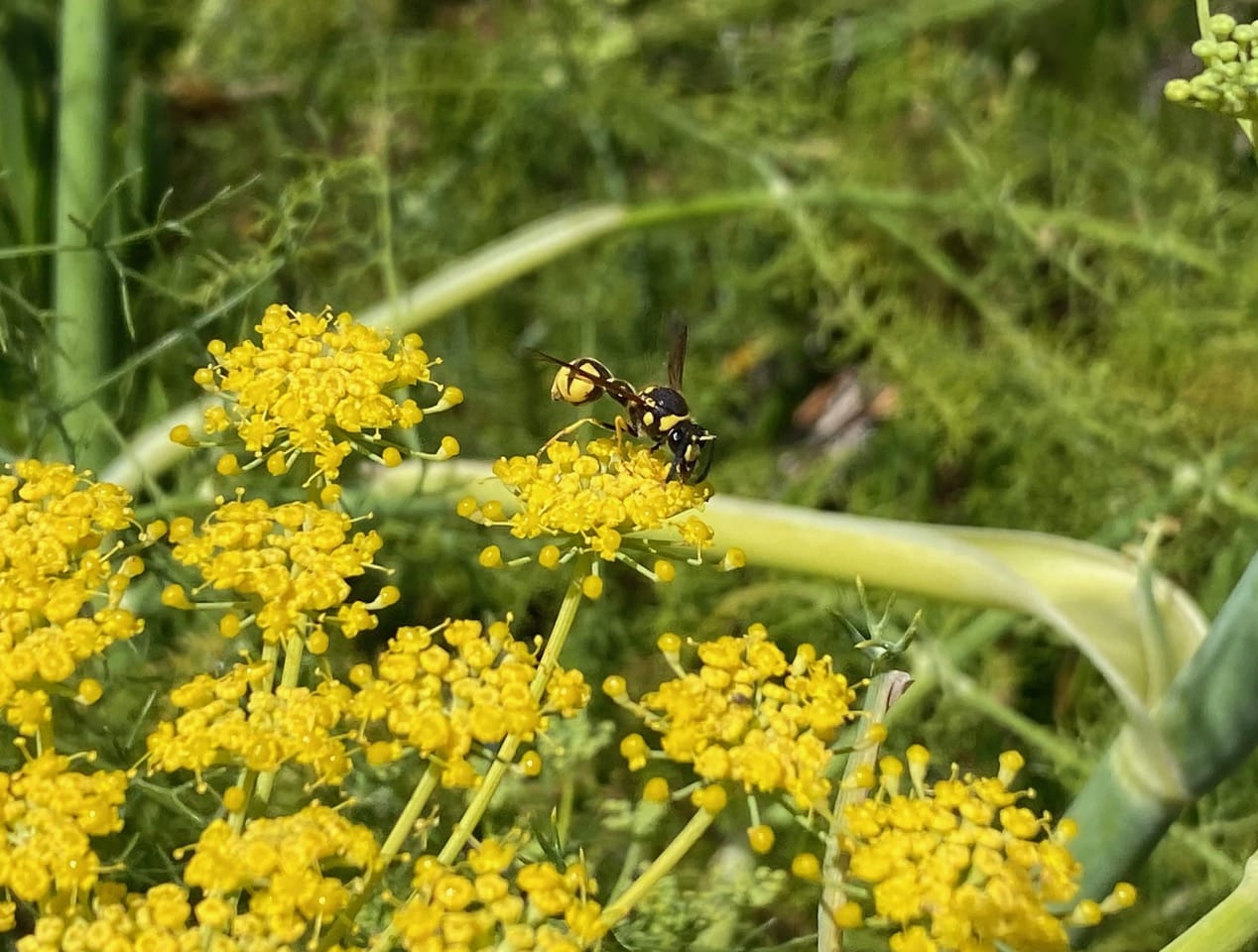
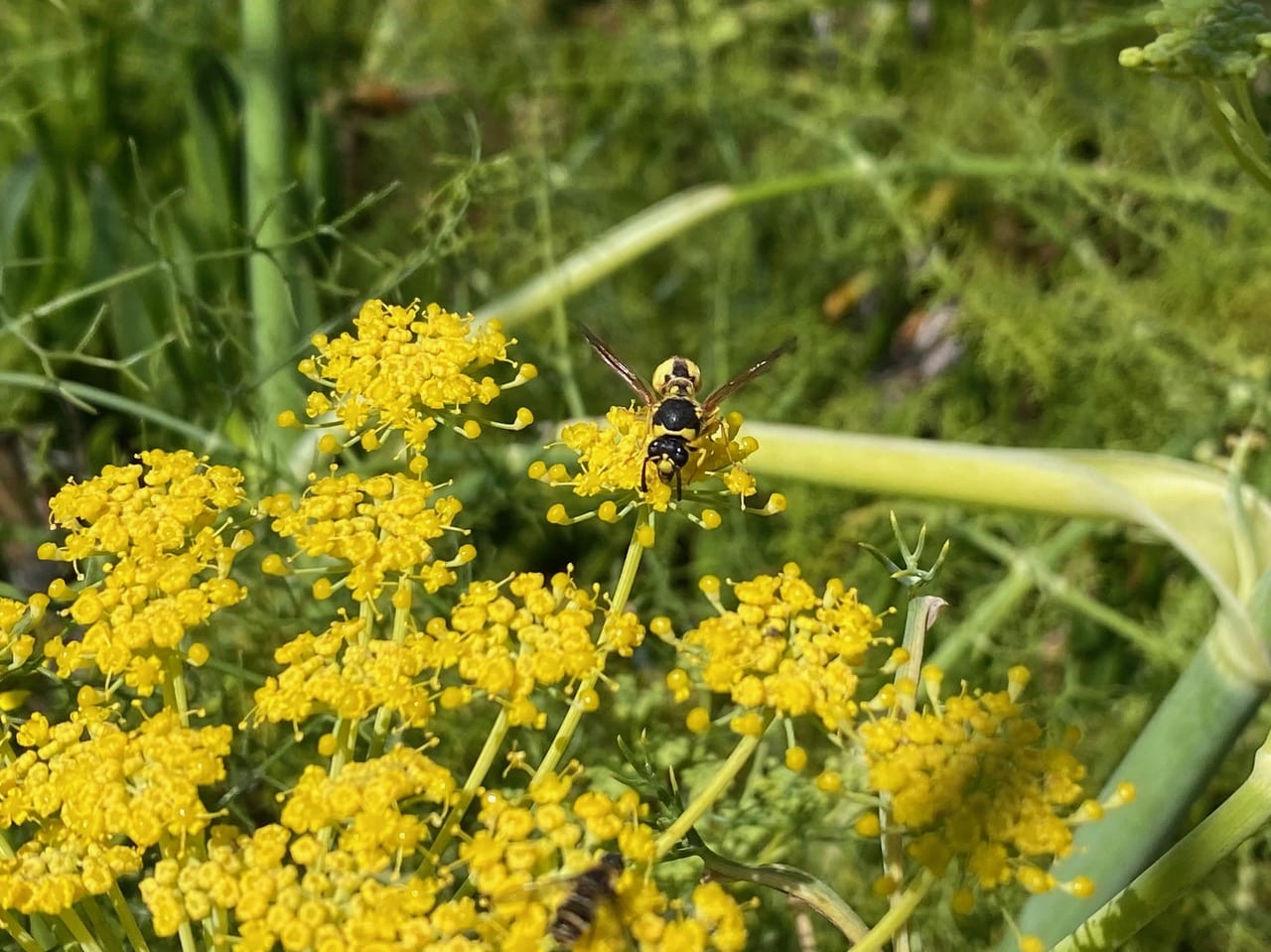
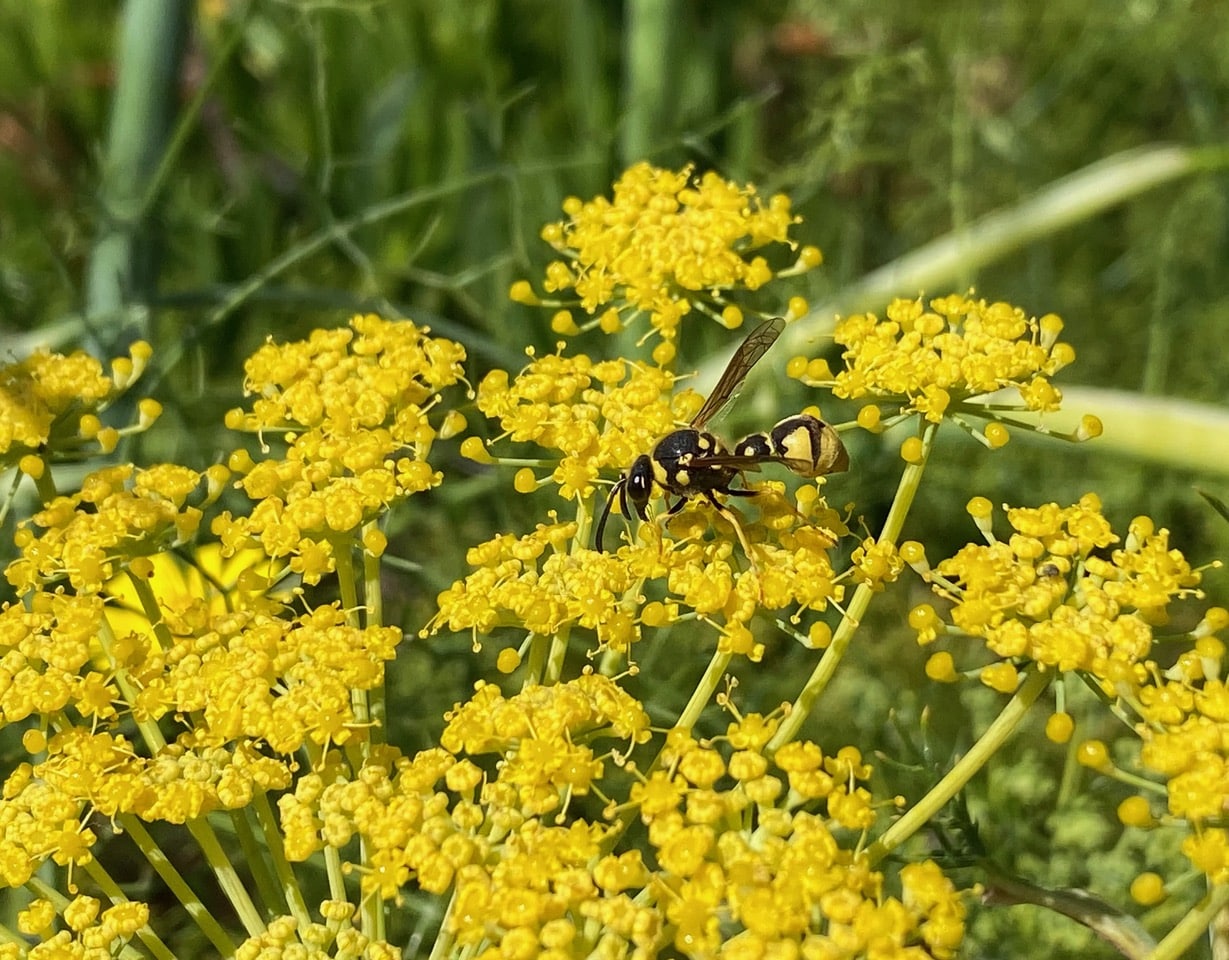
A small, petiolate wasp has landed on an umbel of flowers of Fennel, Foeniculum vulgare. It is a Cross Potter Wasp, Eumenes crucifera (subfamily Eumeninae, family Vespidae).
In entomology, petiole is the technical term for the narrow waist of some hymenopteran insects, such as ants, bees, and wasps in the suborder Apocrita. It is commonly used to refer to the constricted first (and sometimes second) metasomal segment of the abdomen. The plump portion of the abdomen posterior to the petiole is called the gaster. Some Potter Wasps, especially those in the genus Eumenes have a petiole formed by the first two abdominal segments that tapers and links the abdomen to the thorax. The petiole provides flexibility and increased range of motion between the thorax and the abdomen, important for mating, egg laying, and defense.
Potter Wasps (or Mason Wasps), the Eumeninae, are a subfamily of Vespidae. Most eumenine species are black or brown, and commonly marked with strikingly contrasting patterns of yellow, white, orange, or red. Like most vespids, their wings are folded longitudinally at rest.
Eumenine wasps are diverse in nest building. The different species may either use existing cavities (such as beetle tunnels in wood, abandoned nest of other Hymenoptera, or even man-made holes like old nail holes) that they modify, or they construct their own either underground or exposed nests. The nest may have one or several individual brood cells. The most widely used building material is mud made of a mixture of soil and regurgitated water.
All known eumenine species are predators, most of them solitary mass provisioners. When a cell is completed, the adult wasp typically collects beetle larvae, spiders, or caterpillars and, paralyzing them, places them in the cell to serve as food for a single wasp larva. As a normal rule, the adult wasp lays a single egg in the empty cell before provisioning it. The complete lifecycle may last from a few weeks to more than a year from the egg until the adult emerges. Adult potter wasps feed on floral nectar.
Eumenes is a large and widespread genus, mostly occurring in the temperate regions of the Northern Hemisphere. The first metasomal segment is narrow and elongated, creating a “bulbous” appearance to the abdomen.
The Cross Potter Wasp, Eumenes crucifera (subfamily Eumeninae, family Vespidae) is a North American species of solitary wasp found in Canada, the United States, and Mexico. It is named for the distinctive black cross-shaped pattern on a yellow abdomen. These wasps are known for their unique mud nests, which resemble small, vase-like pots. The wasps are typically 3/8 to 3/4 in. long, and have distinctive two-segmented abdomen, with a narrow petiole (stalk) connecting the two segments.
Potter wasps are solitary, with each female constructing and provisioning her own nest. The nests which are often attached to twigs, rocks, or other structures, serve as brood cells for their larvae. The female collects mud, mixing it with water and saliva, and forms it into small balls that she transports to the nest site. Using her mandibles and front legs, she carefully shapes the mud into individual, pot-shaped cells. Once the cell is complete, the wasp hunts and paralyzes caterpillars or other larvae, placing them inside the cell as food for her offspring. A single egg is laid in the cell, usually suspended from the top, and the opening is sealed with a mud plug. The larva develops and feeds on the paralyzed prey, eventually pupating and emerging from the cell as an adult wasp by breaking through the side of the mud nest.
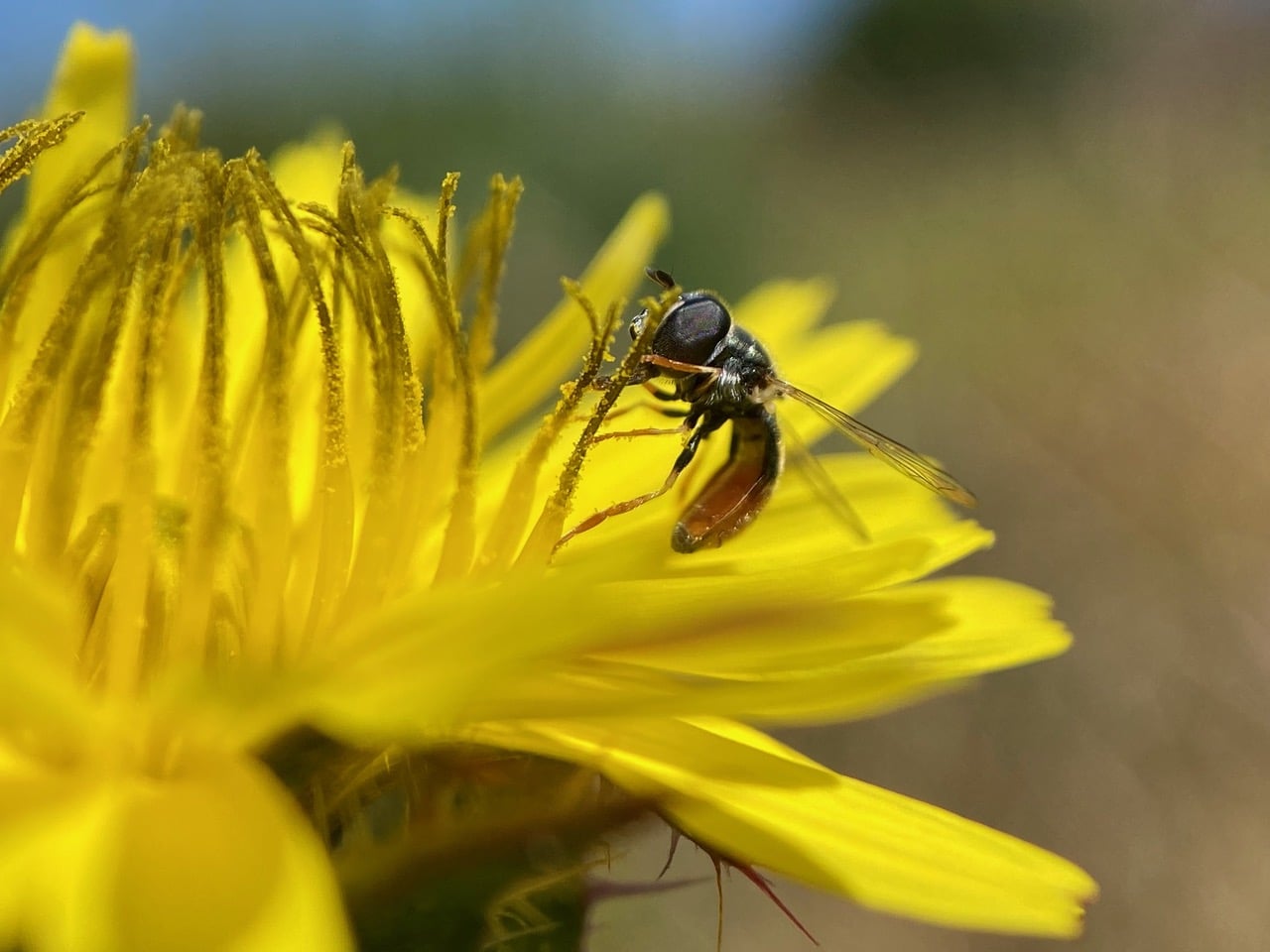
A Common Grass Skimmer, Paragus haemorrhous (family Syrphidae) is feeding on pollen on a flowerhead of Bristly Oxtongue, Helminthotheca echioides.
The Common Grass Skimmer, Paragus haemorrhous (family Syrphidae) is easily the smallest hover fly I know, measuring only about 4 mm in length. The species has a world-wide distribution, found in unimproved grassland, dune grass, open areas and pathsides in forest, and meadows. Adults visit flowers for nectar and pollen. Larvae feed on aphids on low herbaceous plants.
Photos of Common Grass Skimmer (Paragus haemorrhous) · iNaturalist
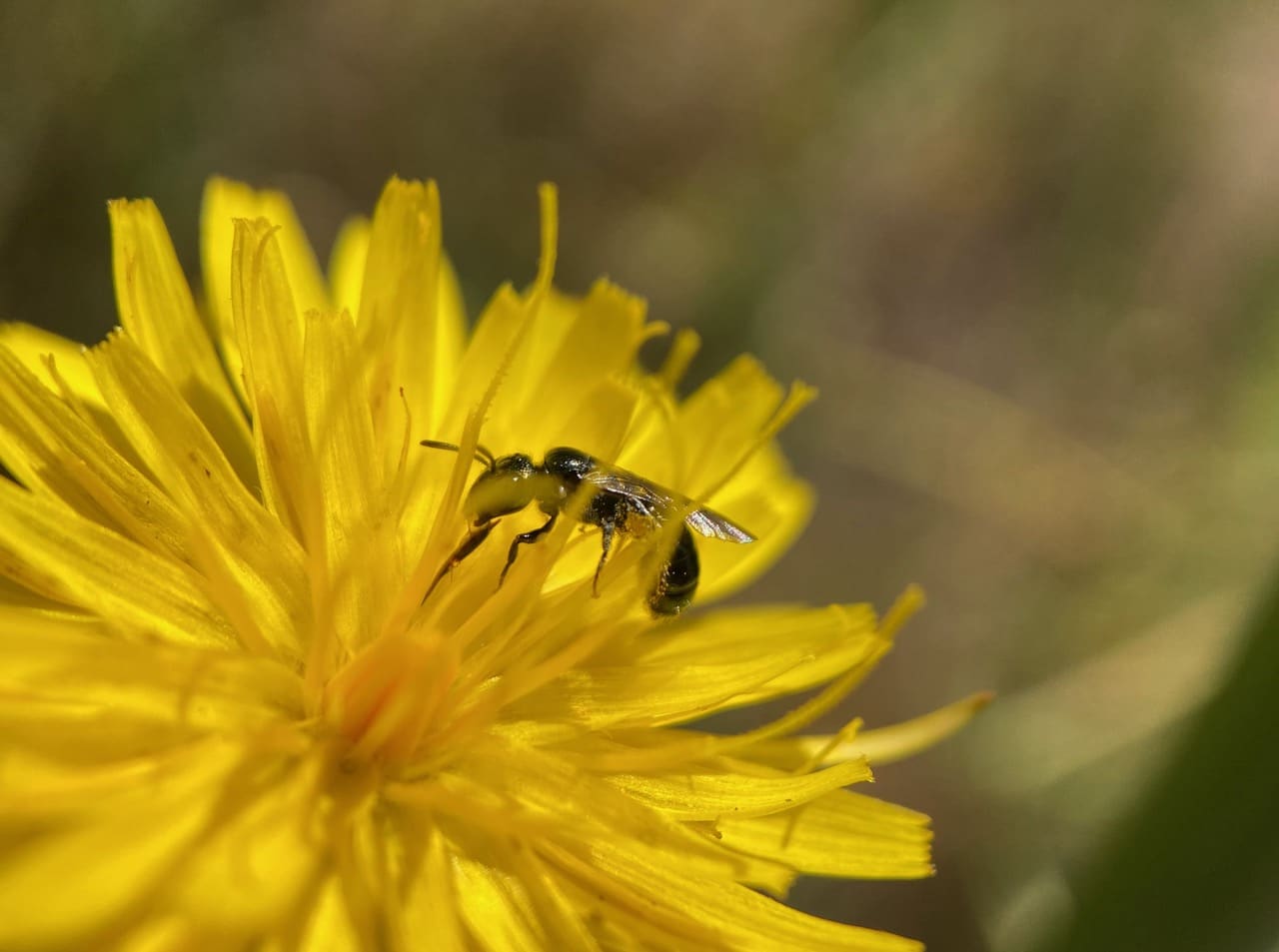
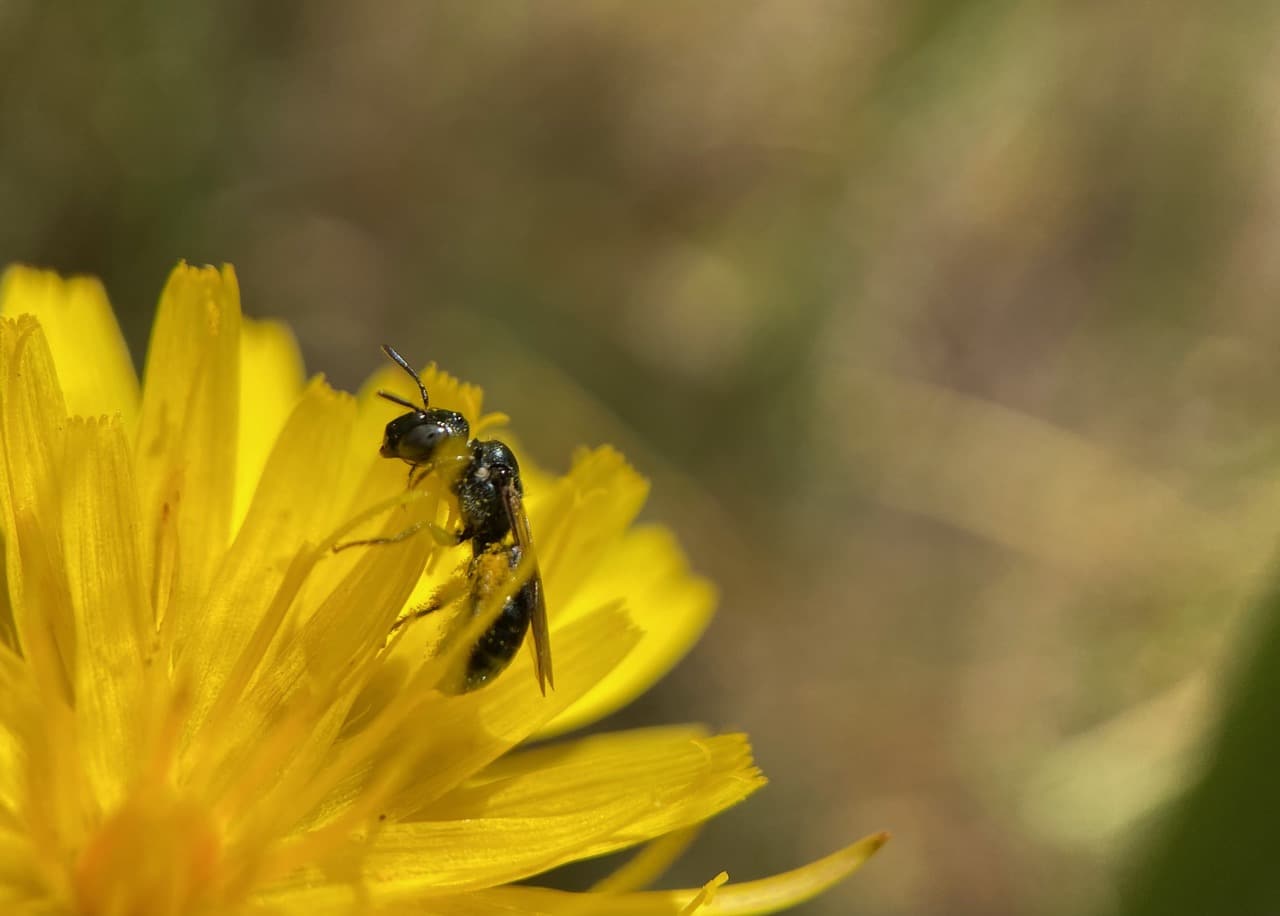
A Small Carpenter Bee, Ceratina sp. (family Apidae) is taking nectar from a Catsear flowerhead. Wow, that’s an impressively long tongue!
The Small Carpenter Bee, genus Ceratina is closely related to the more familiar, and much larger Carpenter Bees (genus Xylocopa). Ceratina are typically dark, shiny, even metallic bees, with fairly sparse body hairs and a weak scopa on the hind leg. The shield-shaped abdomen comes to a point at the tip. Some species have yellow markings, often on the face.
Females excavate nests with their mandibles in the pith of broken or burned plant twigs and stems. While many species are solitary, a number are subsocial. Both male and female carpenter bees overwinter as adults within their old nest tunnels, emerging in the spring to mate. In the spring, this resting place (hibernaculum) is modified into a brood nest by further excavation. The female collects pollen and nectar, places this mixture (called bee bread) inside the cavity, lays an egg on the provision, and then caps off the cell with chewed plant material. Several cells are constructed end to end in each plant stem.

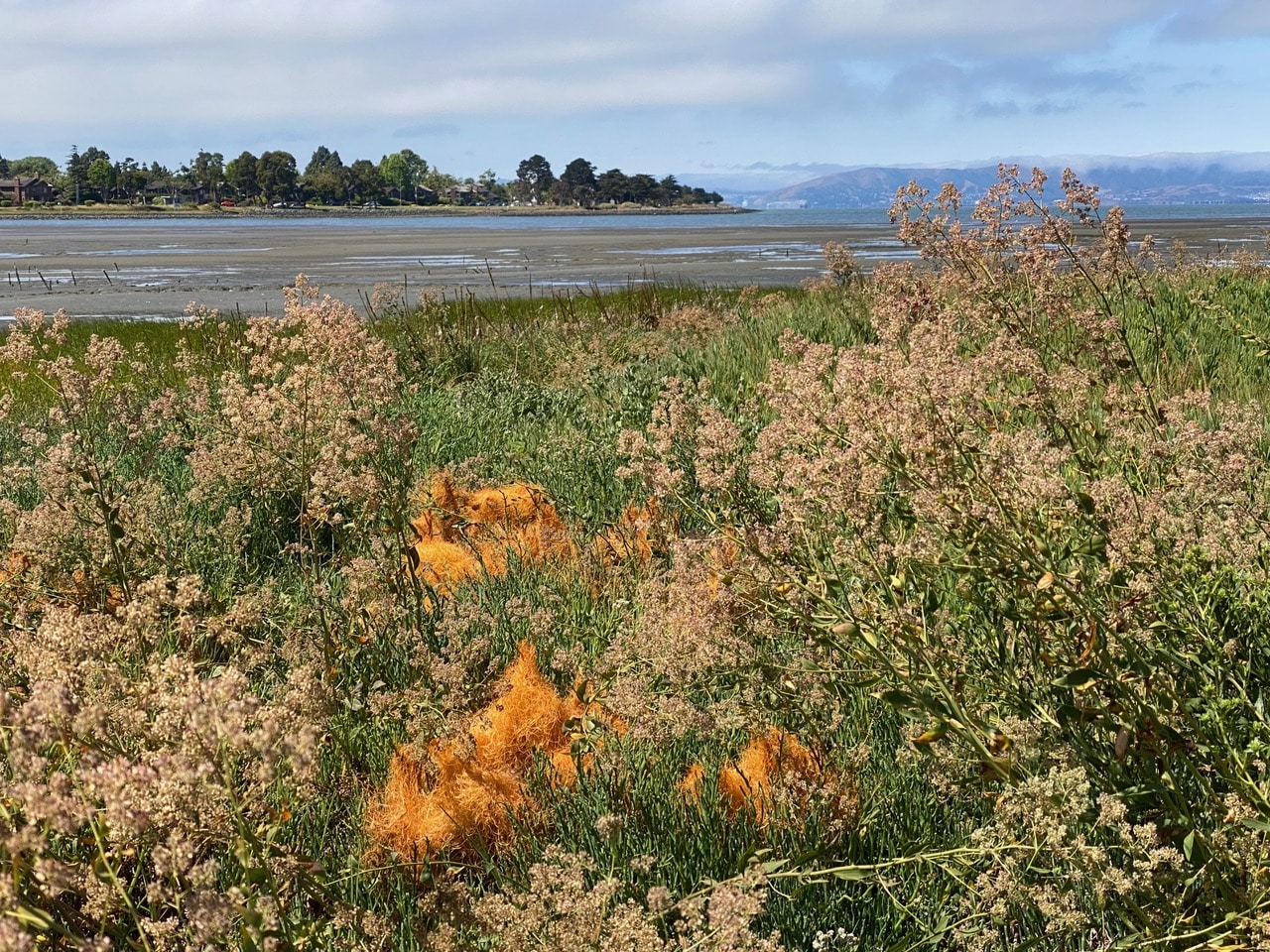
Orange patches of Dodder can be seen growing on the Pickleweed in the lower marsh.
The tangled masses of string-like stems of the parasitic Dodder bear little resemblance to most plants. Dodder is an annual parasitic vine in a single genus, Cuscuta in the family Cuscutaceae. Dodders are obligate parasites, meaning they can’t make a living without their plant hosts. The thin, thread-like, yellow or orange stems grow rapidly entwining and covering their host plants.
The Oregon Gumweed, Grindelia stricta is already starting to bloom on the upper margins of the salt marsh. A Spotted Cucumber Beetle and an unidentified bee are sharing space on a Grindelia flowerhead.
Native to North America, the Spotted Cucumber Beetle, Diabrotica undecimpunctata (family Chrysomelidae) can be a major agricultural pest, causing damage to crops in the larval as well as adult stages of their life cycle. Larvae, sometimes known as rootworms feed on the roots of emerging plants. In the adult stage the beetles cause damage by eating the flowers, leaves, stems and fruits of the plant.
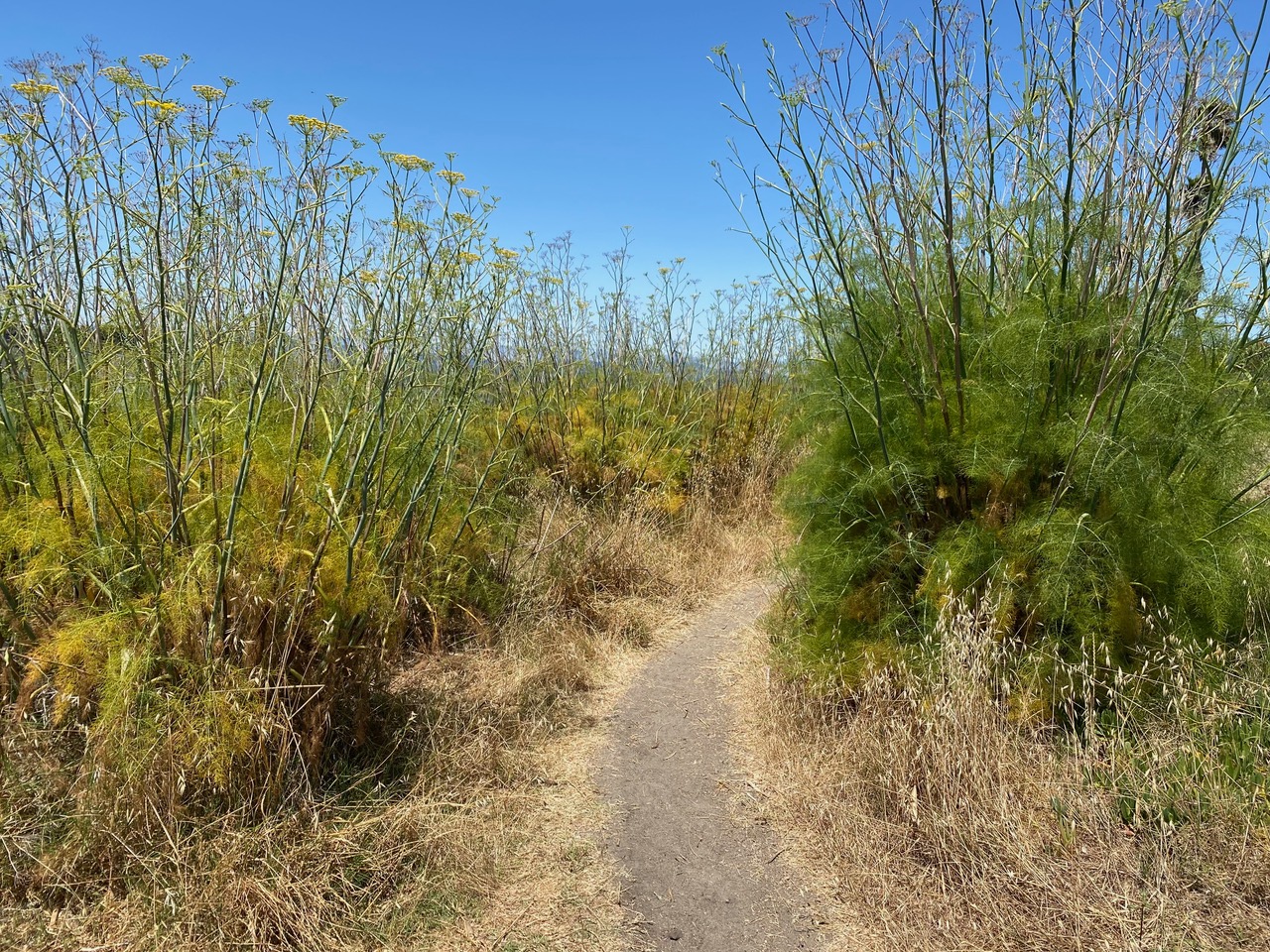
The narrow path winds through a robust stand of Fennel, Foeniculum vulgare.
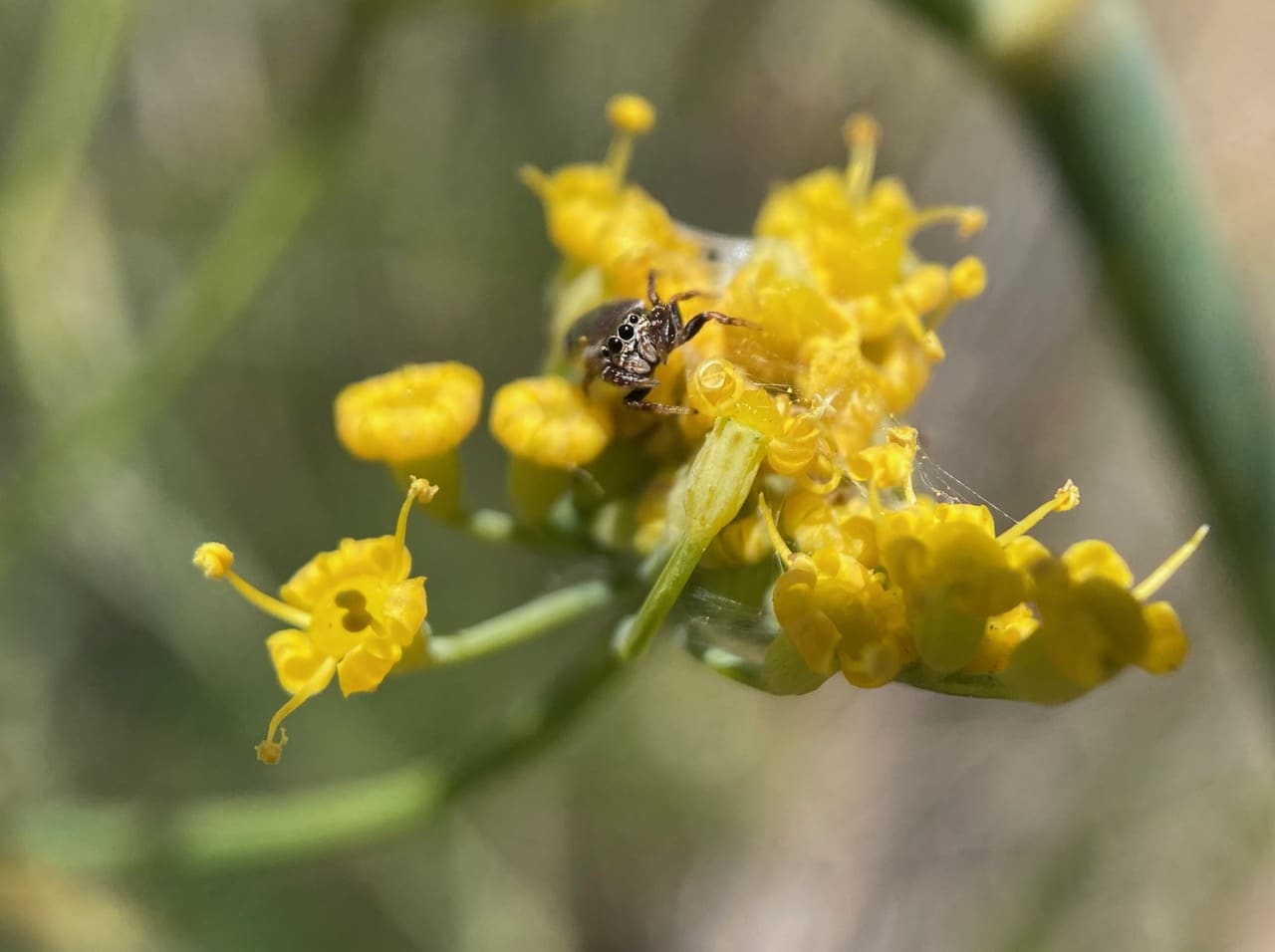
A tiny Jumping Spider (family Salticidae) looks up at me from an umbel of Fennel flowers that have been bound together with silk. Is the spider constructing a shelter for laying eggs?
Jumping spiders (family Salticidae) are free-roaming hunting spiders. They do not weave a web to catch prey. They stalk, then pounce on their prey. Just before jumping, the spider fastens a safety line to the substrate. It can leap 10-20 times their body length to capture prey. Their movement is achieved by rapid changes in hydraulic pressure of the blood. Muscular contractions force fluids into the hind legs, which cause them to extend extremely quickly. Jumping spiders are visual hunters. Their excellent vision has among the highest acuities in invertebrates. Since all their 8 eyes are fixed in place and cannot pivot independently from the body like human eyes can, jumping spiders must turn to face whatever they want to see well. This includes moving their cephalothorax up and down, an endearing behavior.
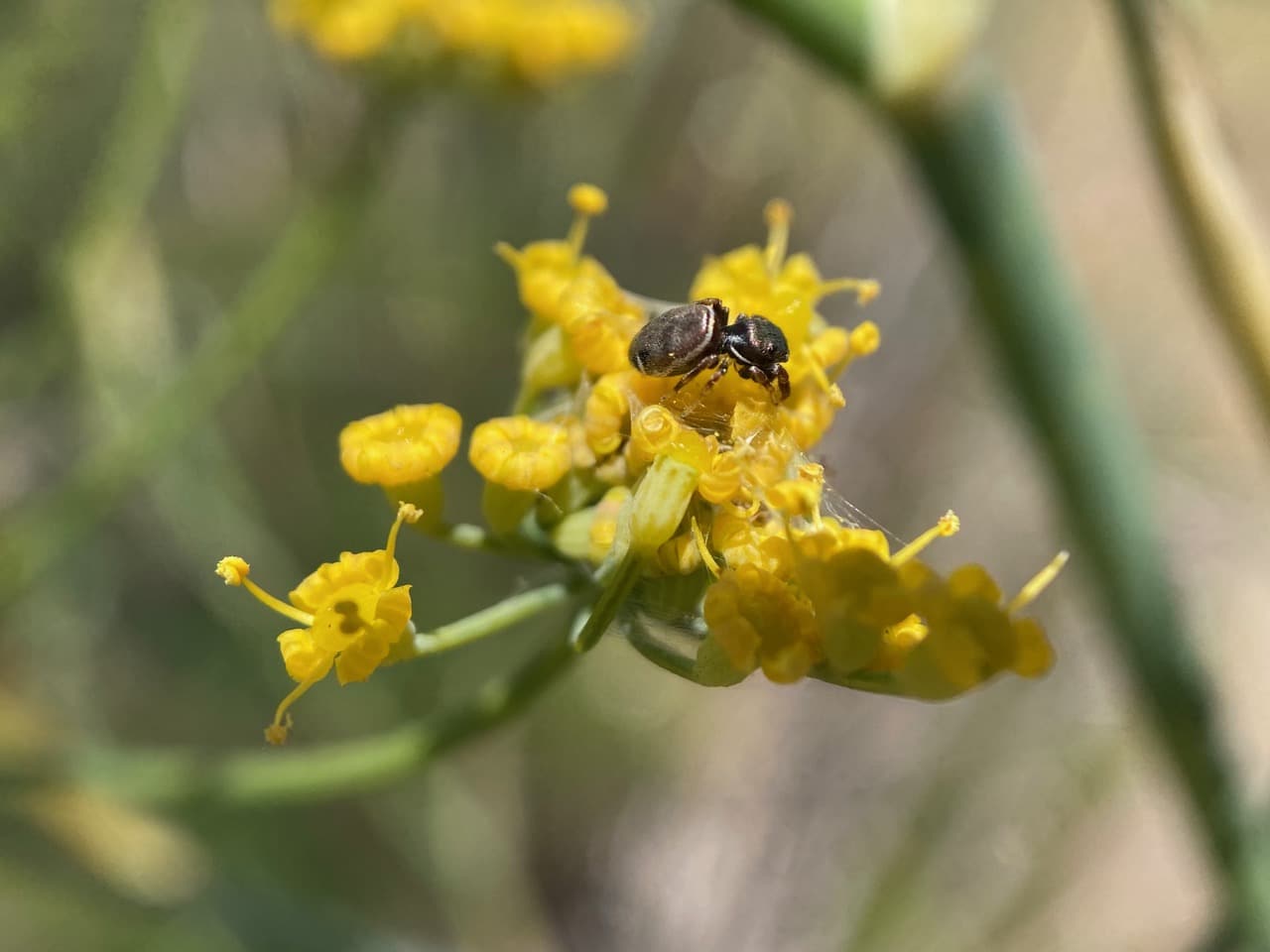
The spider returns to her work.
The shelters built by jumping spiders serve not just for resting or molting, but also as vital spaces for the reproduction process, providing protection and care for their offspring. After mating, female jumping spiders constructs a nest, often described as a silk tent or hammock, where she will lay and guard her egg sac. She lays her eggs in a fluffy silk sac. The nest serves as a secure retreat for the spiderlings during their early stages of life, shielding them from predators and harsh weather condition. The mother jumping spider remains with the egg sac and guards it diligently, sometimes not even leaving to eat or drink during this time. Spiderlings stay within the nest, and disperse after their first molt to find food and establish their own territories.

Ooh, it’s a resplendent female Buttonhook Leafbeetle Jumping Spider, Sassacus vitis (family Salticidae). Aware of my prying camera, she refuses to run away, but stays put on her shelter.
It is often difficult to tell whether a particular spider is an adult or an immature, judging by size alone. In the jumping spiders in the genus Sassacus, the adults are only about 3-5 mm. The genus name Sassacus was the last chief of the Pequot Indians, a Native American tribe of the Connecticut Valley that was vanquished in a war with English settlers in 1637. The iridescent color and very compact appearance of these spiders leads scientists to suspect that they are mimics of certain leaf beetles in the family Chrysomelidae. Many Chrysomelids don’t taste good, as they feed on poisonous plants and sequester those plant toxins for their own defense. They advertise their distastefulness to predators with bold black and white, yellow, orange, or red color patterns, or with brilliant metallic colors. One of the defining characteristics of the genus is the very short legs. The fourth pair of legs is still the thickest, with one or two pairs of spines, used in tackling prey. Like most jumping spiders, Sassacus engages in visual courtship displays. The twitching abdomen also produces an auditory stimulus as the male waves his front legs to garner the female’s attention.
Sassacus vitis is native to North America, with a range spanning from Canada to Panama. It is a small jumping spider with iridescent gold abdomen and white ring around the anterior surface of abdomen. Body is covered with golden scales. Males are 3.5 mm long, females 4.5 mm. The name vitis is Latin for “grapevine”. The spider is commonly found on shrubs and vines and in fields. Best known as a common resident of vineyards.

A Tripartite Sweat Bee, Halictus tripartitus (family Halictidae) is foraging on a flower umbel of Fennel.
Halictus is found worldwide; they are most common in the Northern Hemisphere. All are generalists, foraging from a wide variety of flowering plants. Many species are social and produce several generations per year. This is not surprising as most blooming plants are season-specific; a bee that requires pollen and nectar across multiple seasons would not thrive as a specialist. All Halictus in North America nest in the ground, often in aggregations; and they may nest in the same area for decades.
The species H. tripartitus is primitively eusocial, meaning it has a social structure that is less complex than highly social insects like honey bees, but more advanced than solitary bees. The bees form annual colonies in the soil, where some workers are capable of reproducing. Only potential queens overwinter, then provision a worker brood in the spring, with at least one worker brood produced before males and new queens emerge. These bees are known to nest in aggregations, often in flat, bare ground. They visit and pollinate a wide variety of flowers.
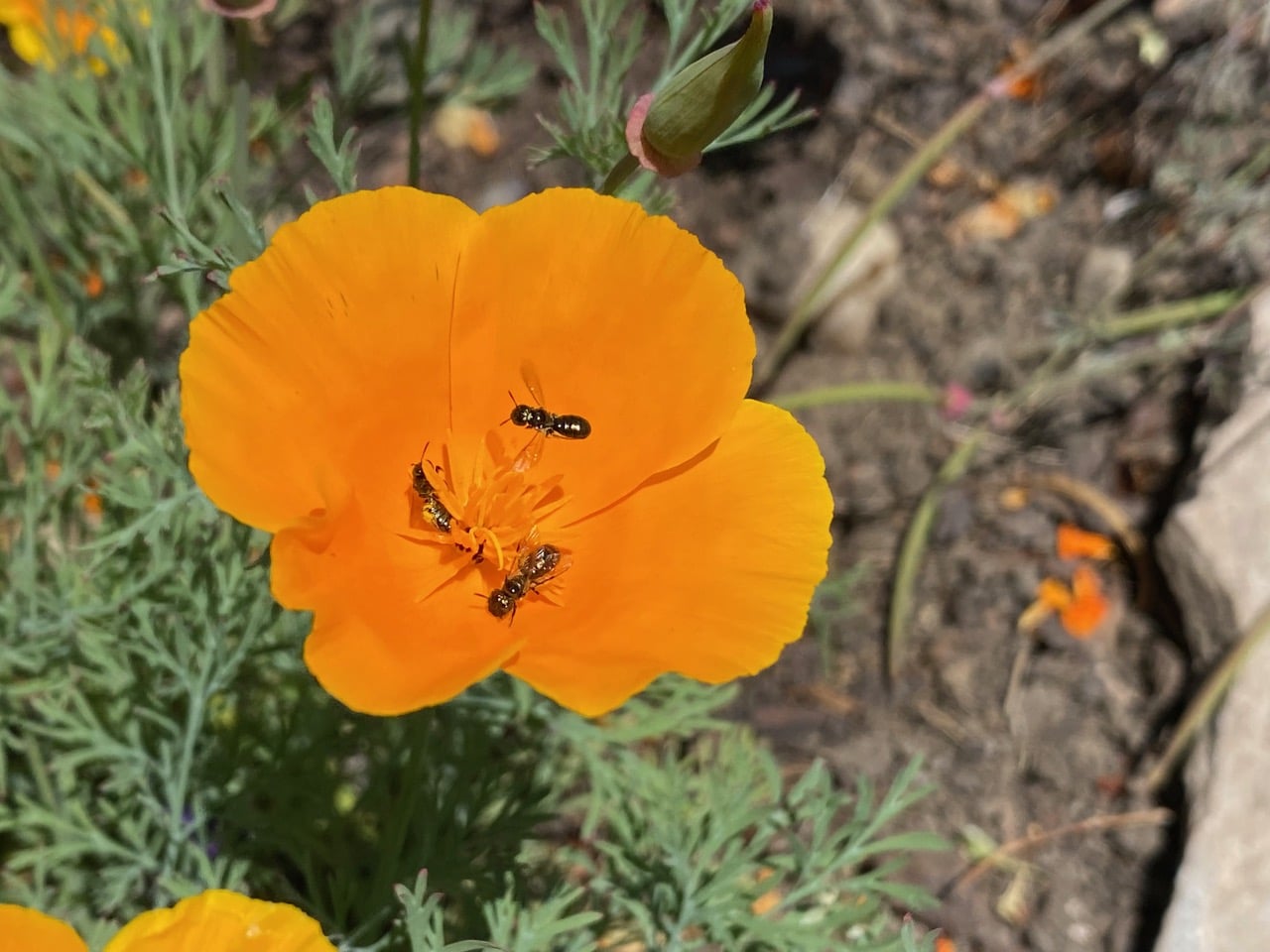
The Small Carpenter Bees, Ceratina sp. (family Apidae) seem to be everywhere. Here, three are foraging on a California Poppy, Eschscholzia californica.
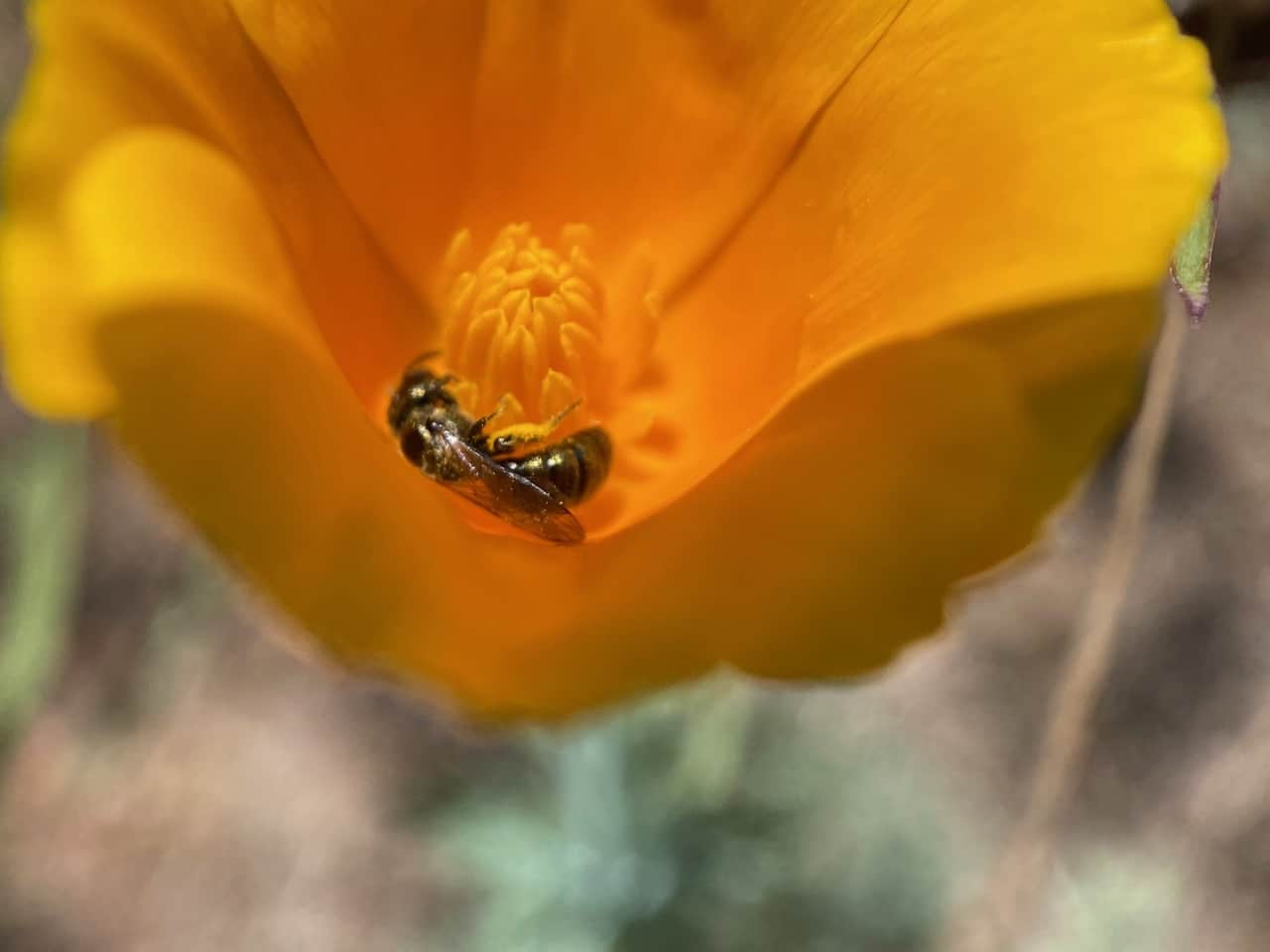
Poppy flowers generally do not produce nectar, but offer generous amounts of pollen for their pollinators.