

Pollinator Post 6/9/23 (1)

The cloudy morning necessitates an afternoon outing again.
How time flies! The Pacific Ninebark, Physocarpus capitatus is already in fruit! The globular clusters of white flowers have been replaced by reddish 3 to 5-chambered fruits. The unique fruit is an inflated glossy red follicle which turns dry and brown and then splits open to release the seeds.

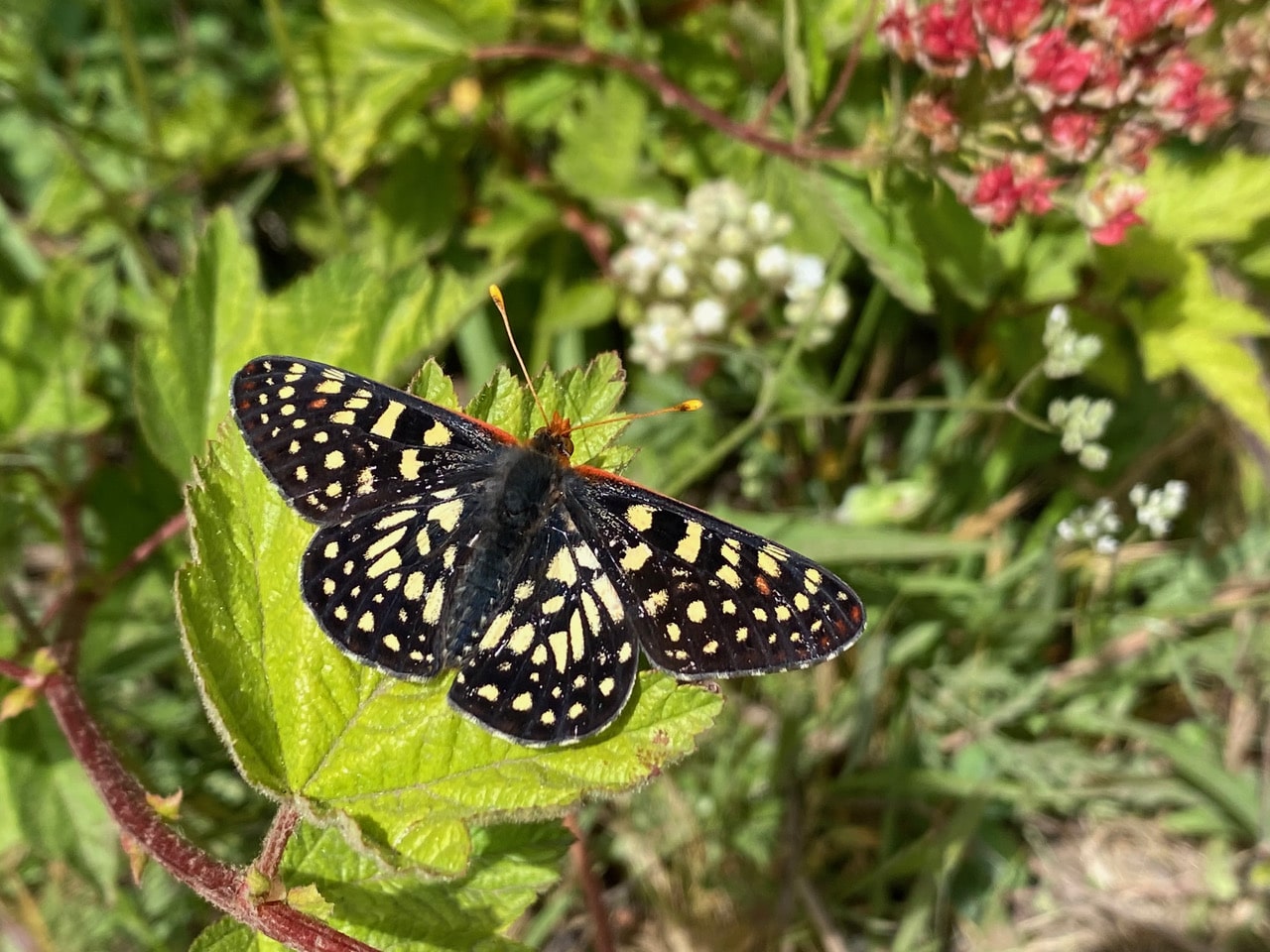 There is an abundance of Variable Checkerspot butterflies, Euphydryas chalcedona (family Nymphalidae) on the wing. They are often seen courting lately.


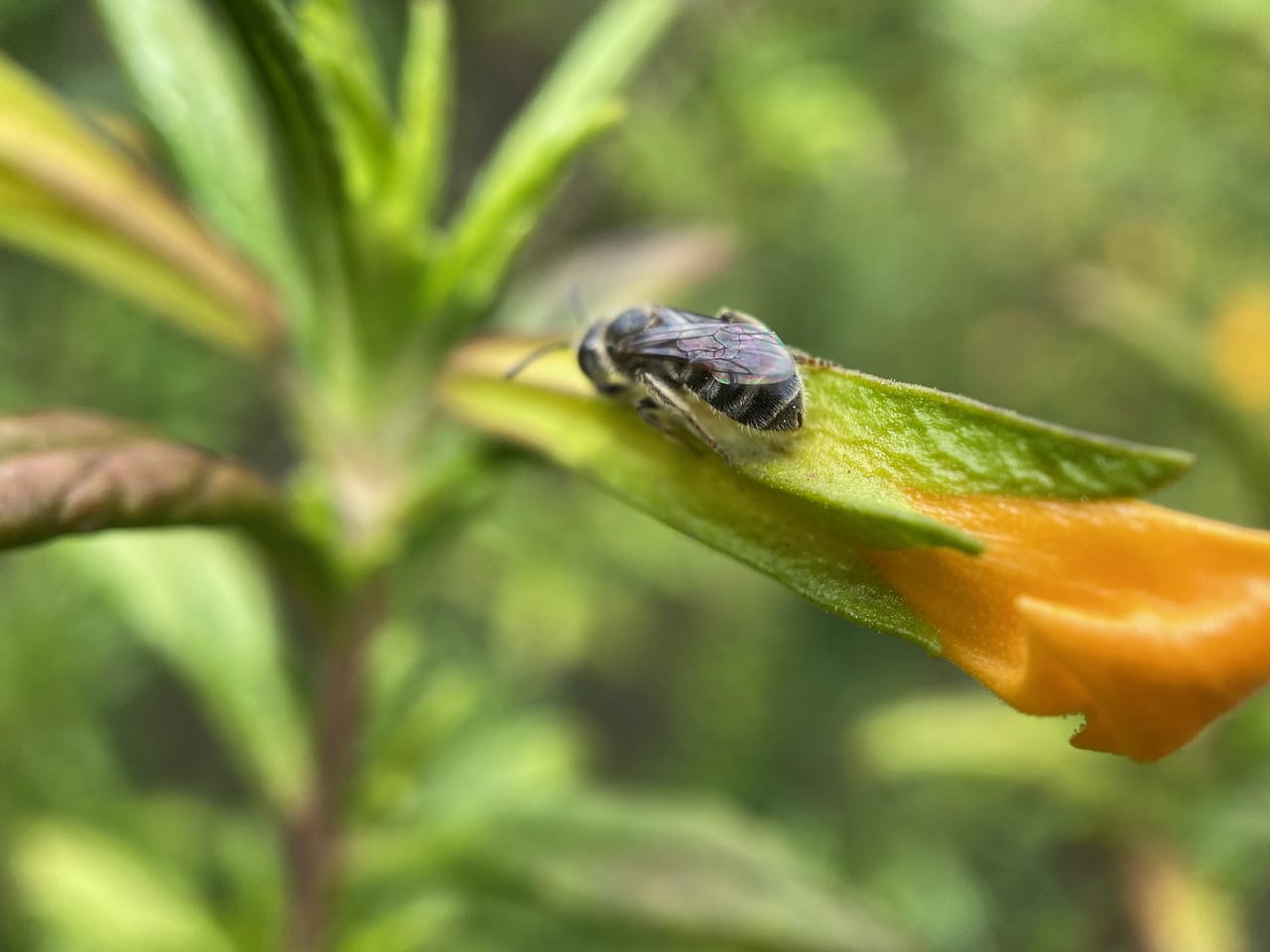

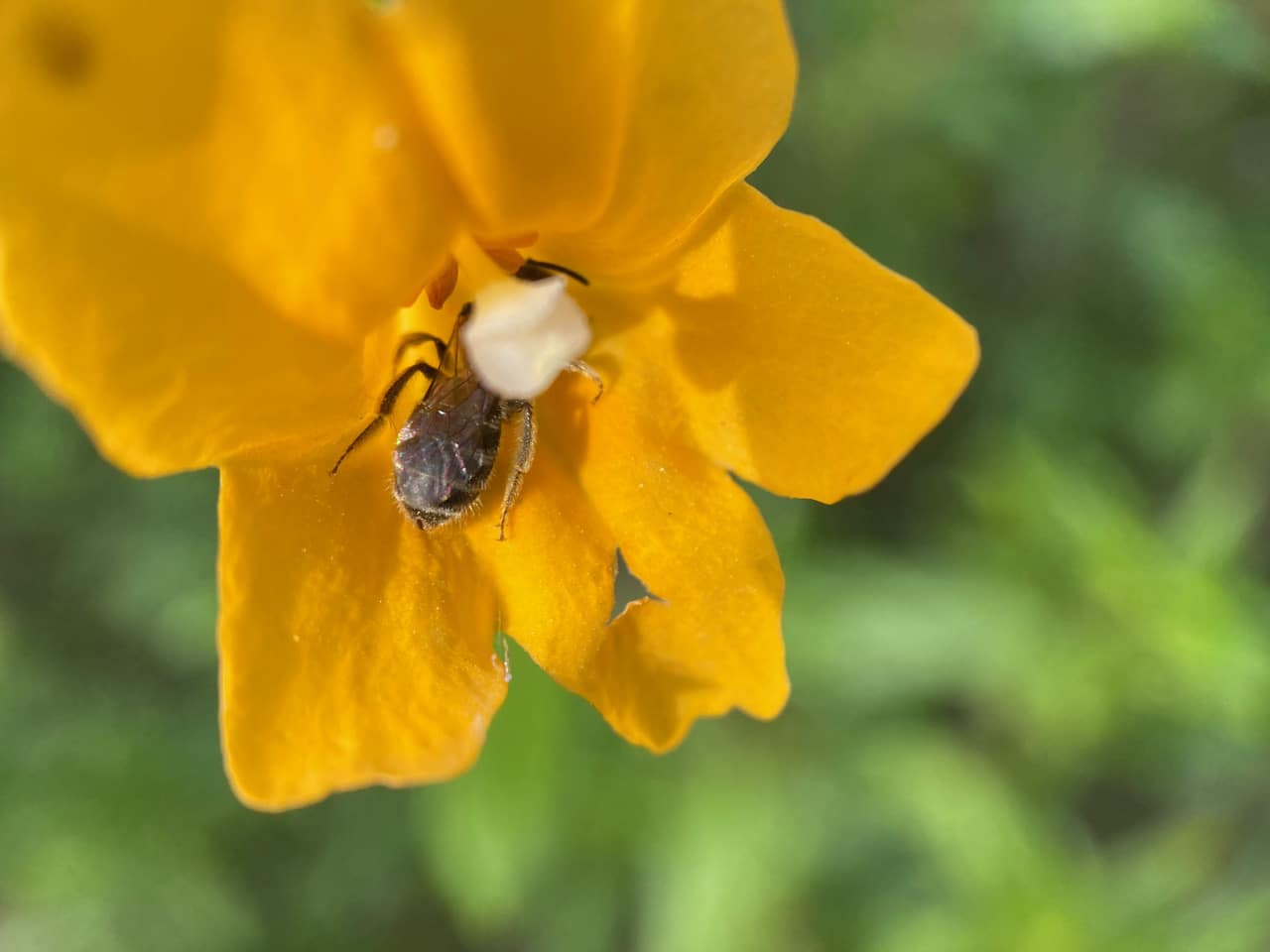 Many of these bees are visiting the Sticky Monkeyflowers today.




The remaining Pacific Ninebark flowers are still crawling with small insects. Most I see today are the False Flower Beetles, Anaspis sp. (family Scraptiidae), feeding on nectar and pollen.
False Flower Beetles, Anaspis atrata (family Scraptiidae) are commonly found in western North America. The adults are found on flowers, sometimes in large numbers, but are also found on foliage. The larvae are typically found under the bark of dead trees.
There is an abundance of Variable Checkerspot butterflies, Euphydryas chalcedona (family Nymphalidae) on the wing. They are often seen courting lately. The Variable Checkerspot is found across western North America. The butterfly occupies a wide range of habitats, including sagebrush flats, desert hills, prairies, open forests and alpine tundra. Males perch or patrol around larval host plants to encounter females. Eggs are laid in large groups on underside of leaves of host plants. Host plants include California Bee Plant, Scrophularia californica, and Sticky Monkeyflower, Diplacus aurantiacus. These plants provide the caterpillars with iridoid glycoside, a chemical that imparts unpalatable taste to birds, protecting the caterpillars from predators. Larvae feed in large, loose groups on the host plants. They enter diapause (hibernation) in sheltered sites under bark or dead branches, in hollow stems and in rock crevices. Pupation begins in early to mid April and the adult flight season begins between mid-April and May and continues into June. The adults feed exclusively on nectar, and have a life span of about 15 days.
A brisk afternoon breeze sends the last seeds on a puffball of the California Dandelion, Agoseris grandiflora into the air. Each sharp-pointed, ribbed seed is aided on their magical flight by a parachute of silvery pappus (technically, the modified calyx).
A Bumble Bee Hover Fly, Volucella bombylans (family Syrphidae) is resting on a leaf of a young Bay Tree. I have often seen this fly along this stretch of Skyline Trail, but it has always been very elusive. Why is it so cooperative today? Perhaps because it is missing a good part of its right wing? Masquerading as a bee has failed to fool its predator! I’m relieved that the fly can still take flight easily after this picture is taken.
The Volucella bombylans complex comprises numerous hover flies that are bumble bee mimics, also known as Bumble Bee Hoverflies. These flies look like a bumble bee with a furry black and yellow body, but they are given away by their heads, plumed antennae, large eyes and a single pair of wings. Fast fliers, the adults feed on nectar and pollen, with a preference for blue and yellow flowers. The females lay eggs in the nests of bumble bees and social wasps. The larvae live as scavengers on the bottom of the host’s nest, feeding on waste and dead host larvae.
This provides a glimpse into a different larval niche from what most folks know about Syrphid Flies. We are familiar with the many Syrphid species that have larvae that feed on soft-bodied insects such as aphids. Quite a few other species have larvae that are aquatic filter-feeders that live in decomposing organic matter. Overall, the Syrphid larvae display a degree of habitat diversity that is unusually broad for a single family of Diptera.
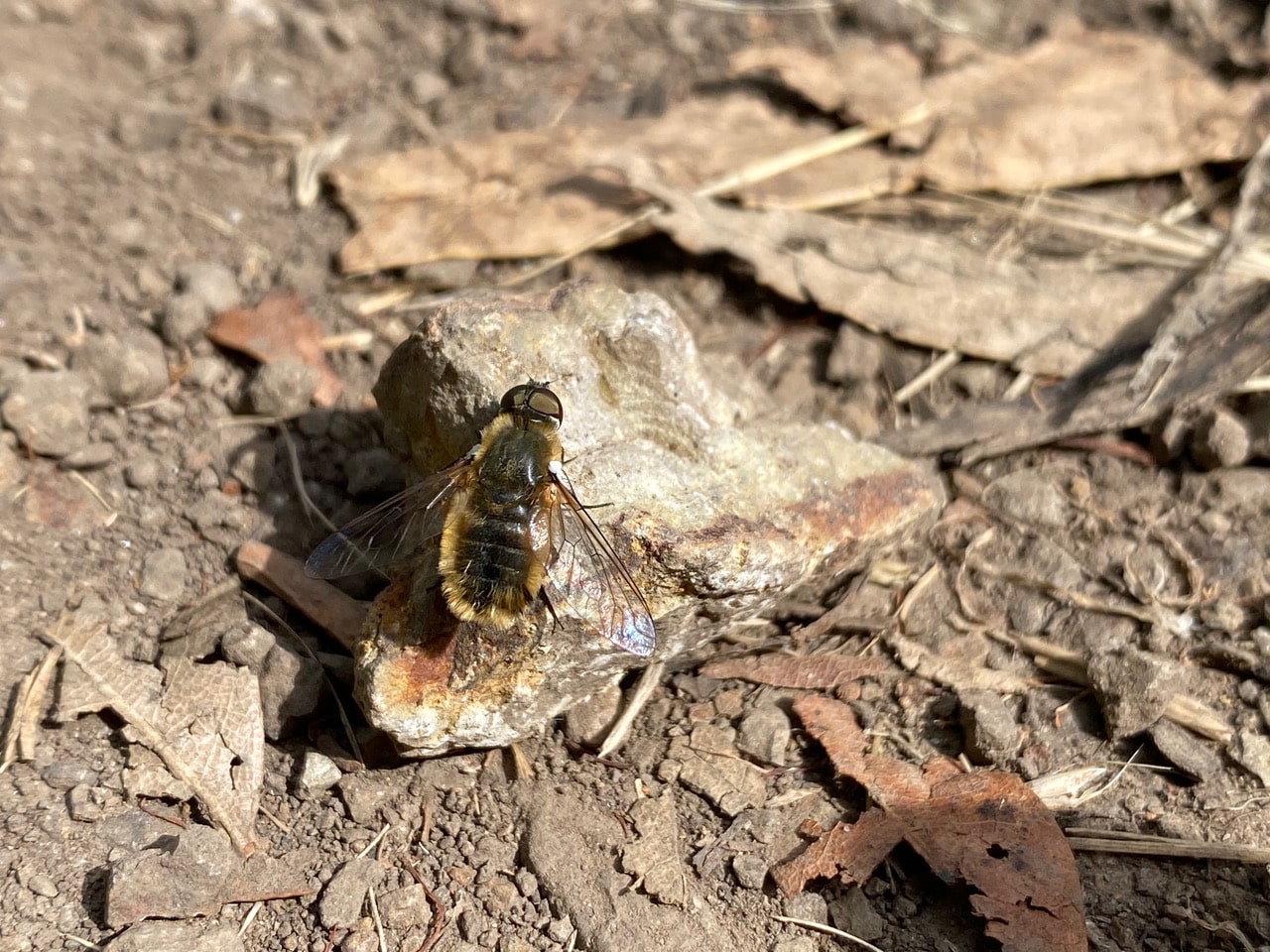
I am also lucky to get a picture of this Bee Fly, Villa sp. (family Bombyliidae) today. Many of these Bee Flies have been seen flying low and landing on the trail lately. They are exasperatingly wary of the camera.
The Bee Flies belong to the family Bombyliidae. Adults generally visit flowers for nectar and pollen, some being important pollinators. Larvae generally are parasitoids of other insects. When at rest, many species of bee flies hold their wings at a characteristic “swept back” angle. The adult females usually deposit eggs in the vicinity of possible hosts, quite often in the burrows of beetles or ground-nesting bees/wasps. Bombyliidae parasitism is not host-specific, but rather opportunistic, using a variety of hosts. Adult females of the genus Villa lay eggs in mid-air and flick them towards the nest entrances of their hosts. They typically have an eversible pouch near the tip of their abdomen known as a sand chamber, which is filled with sand grains gathered before egg laying. These sand grains are used to coat each egg just before their aerial release, presumably to improve the female’s aim by adding weight.
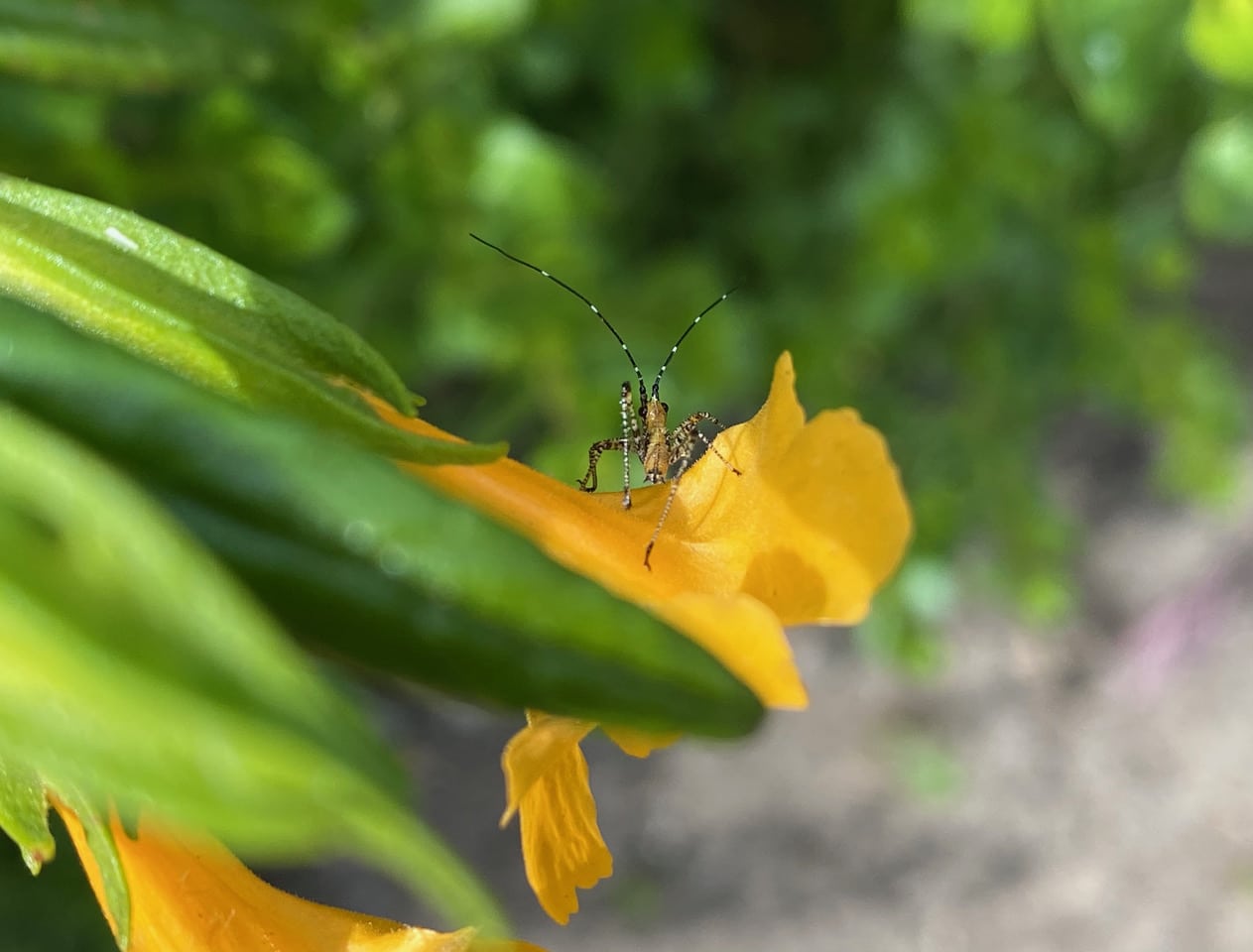
What a cutie! The young nymph of a Scudder’s Bush Katydid, genus Scudderia is posing atop a Sticky Monkeyflower. I am particularly charmed by its white-spotted long antennae.
Scudderia is a genus of katydids in the family Tettigoniidae. They are sometimes called bush katydids and are 30-38 mm in length. They are mostly found in North America. They are herbivores, with nymphs feeding primarily on flowers and adults preferring woody deciduous plants.
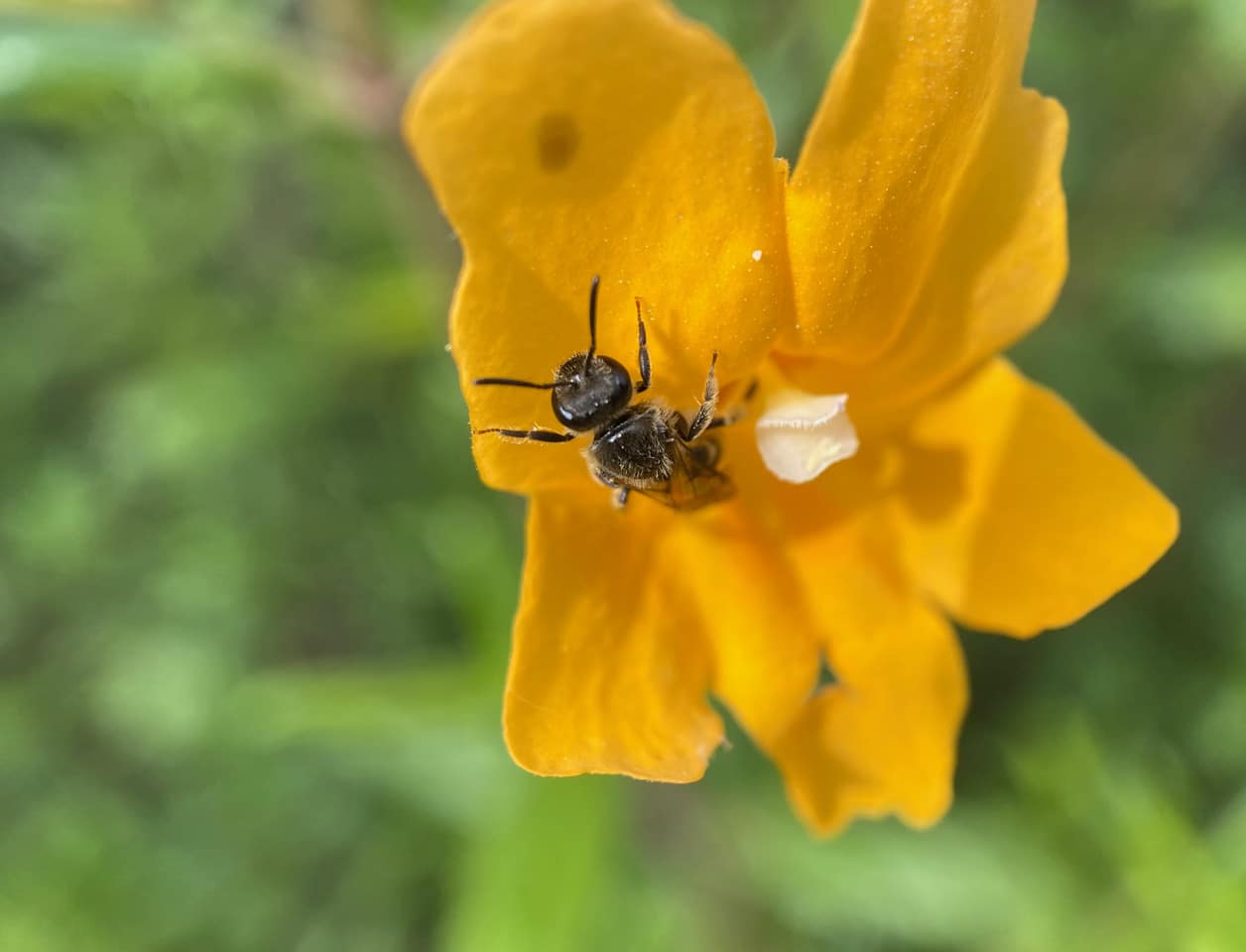
A little bee appears to be resting on the calyx of a Sticky Monkeyflower. Judging from the arrangement of the bands of hairs on its abdomen, it is probably a Sweat Bee in the genus Halictus.
The bee finally stirs and moves around, giving me a good look at the rest of its body. Yes, I think it is a Halictus!
Many of these bees are visiting the Sticky Monkeyflowers today. Sweat Bees, members of the worldwide family Halictidae, are so-named because they are attracted to human perspiration. They probably lap up sweat for the salt content. The genus Halictus have bands of hair on the outermost edge of the termites of their abdomen. Females carry pollen on brushes of hair (scopa) on their hind legs. Most Halictus are generalist foragers. They use a wide range of plants from Asteraceae to Scrophulariaceae. They are very common on Asteraceae in summer and fall.
Almost all Halictus in North America are semi-social ground nesters. Daughters in social colonies remain in the nest and help care for the young. Halictus tripartitus is partly eusocial, with gynes (reproductive females or queens) and workers.
Halictus enjoys a long flight season. Individual species can often be seen from spring to early fall. This is due in part to their semi-sociality. A single nest can be established in spring and continue to reproduce through to fall.
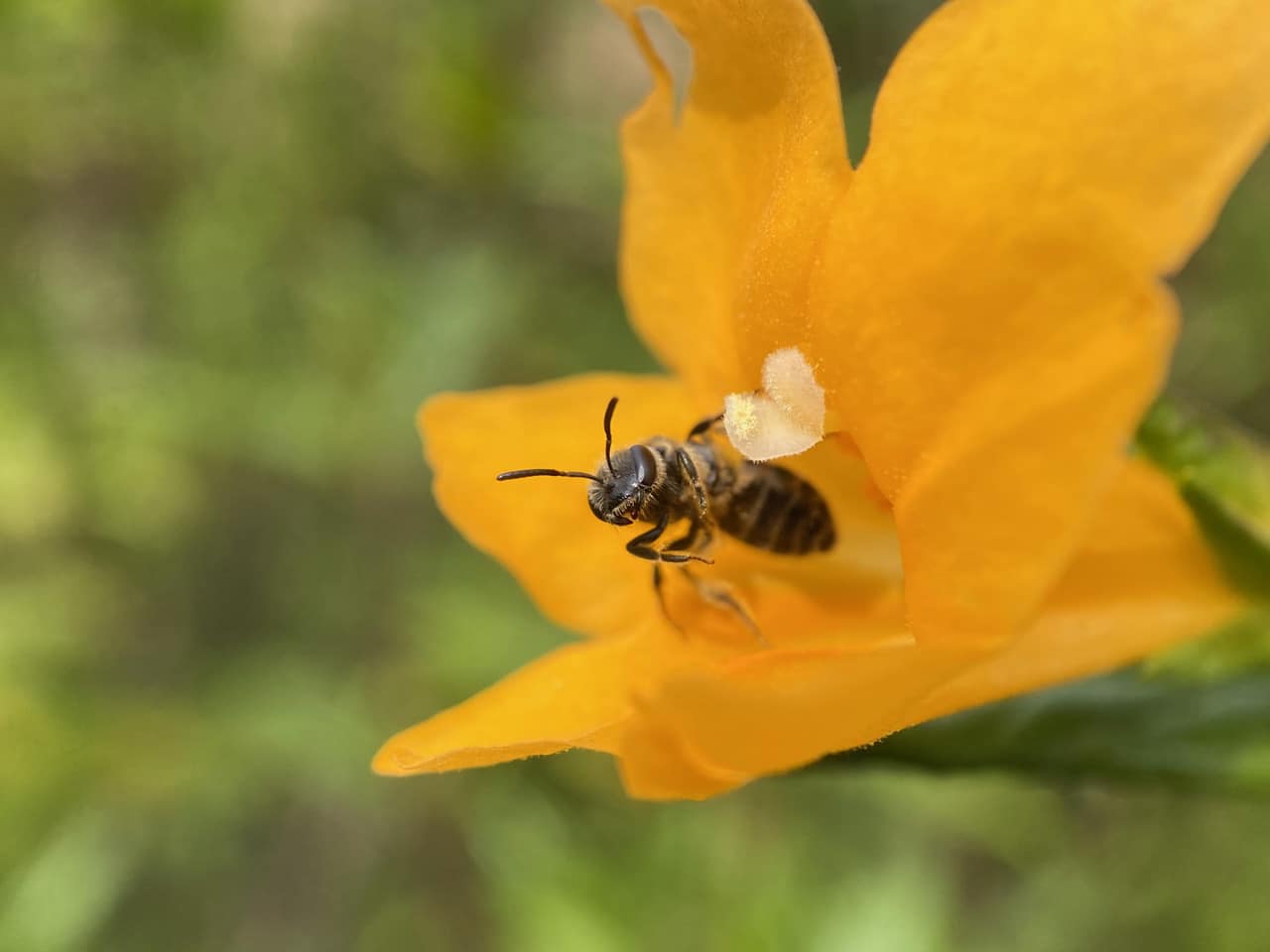
Here’s a good look at the bee’s face as it exits a Sticky Monkeyflower.
A Sweat Bee, Halictus sp. (family Halictidae) is coming out of another Sticky Monkeyflower. She hasn’t gathered pollen from this flower, but spent quite some time deep in the floral tube. Halictids have short tongues, but this bee is small enough to access the nectar at the base of the flower.
On to the next flower!
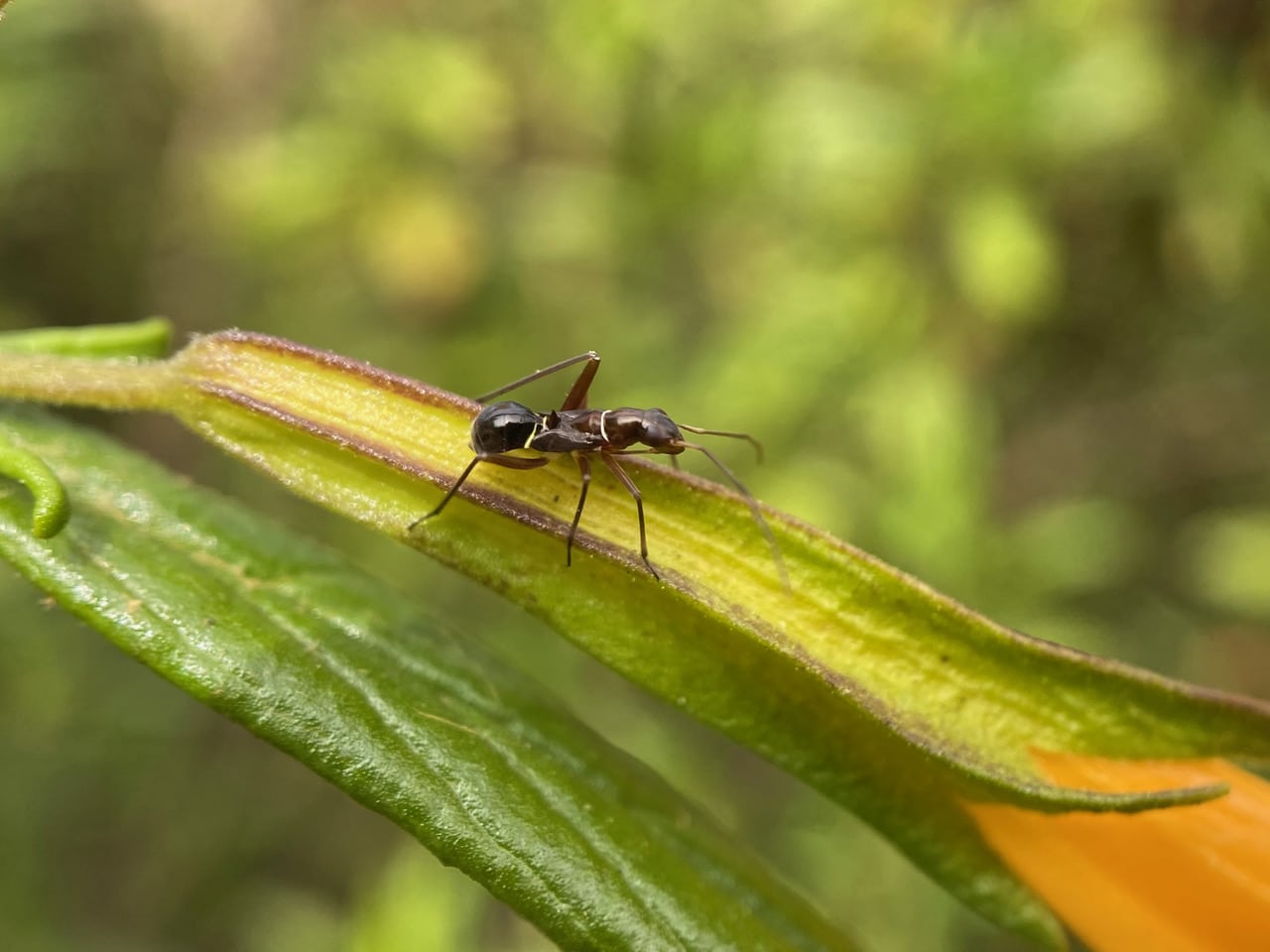
Ooh, here’s that ant-mimic nymph of the Plant Bug, Closterocoris amoenus (family Miridae). Almost all the nymphs and adults of this species I have encountered are on the Sticky Monkeyflower.
Mirid bugs are also referred to as plant bugs or leaf bugs. Miridae is one of the largest family of true bugs in the order Hemiptera. Like other Hemipterans, Mirids have piercing, sucking mouthparts to extract plant sap. Some species are predatory.
Ant mimicry or myrmecomorphy is mimicry of ants by other organisms. Ants are abundant all over the world, and potential predators such as birds and wasps normally avoid them as they are either unpalatable or aggressive. Spiders are the most common ant mimics. Additionally, many insects from a wide range of orders and families mimic ants to escape predation (protective mimicry), while others mimic ants anatomically and behaviorally to hunt ants in aggressive mimicry.
Cradled in the folds of the calyx of a Sticky Monkeyflower, a Seed Bug, Kleidocerys franciscanus (family Lygaeidae) is well positioned to feed on the developing seeds in the ovary using its piercing-sucking mouthparts.
The Lygaeidae are a family in the order Hemiptera (true bugs). Hemiptera means “half-wing”, referring to the unique front pair of wings, which are leathery near their base and membranous towards the tips. Most species hold their wings flat over their backs with the two membranous portions overlapping. This combined with a triangular structure called a scutellum (located between the attachment sites of the two front wings) creates an X-shaped pattern on the back of many species.
The family Lygaeidae is commonly referred to as seed bugs. However, while many of the species feed on seeds, some feed on sap or seed pods, others are omnivores and a few are carnivores. Lygaeidae are oval or elongate in body shape and have four-segmented antennae. They are distinguished from Miridae (plant bugs) by the presence of ocelli, or simple eyes.
Herbivorous bugs in the order Hemiptera feed on plants through a proboscis, a hypodermic-needlelike structure they use to probe into plant tissue and drink up plant fluids. Seeds are predigested with injected digestive enzymes, then sucked up through the same mouthparts.
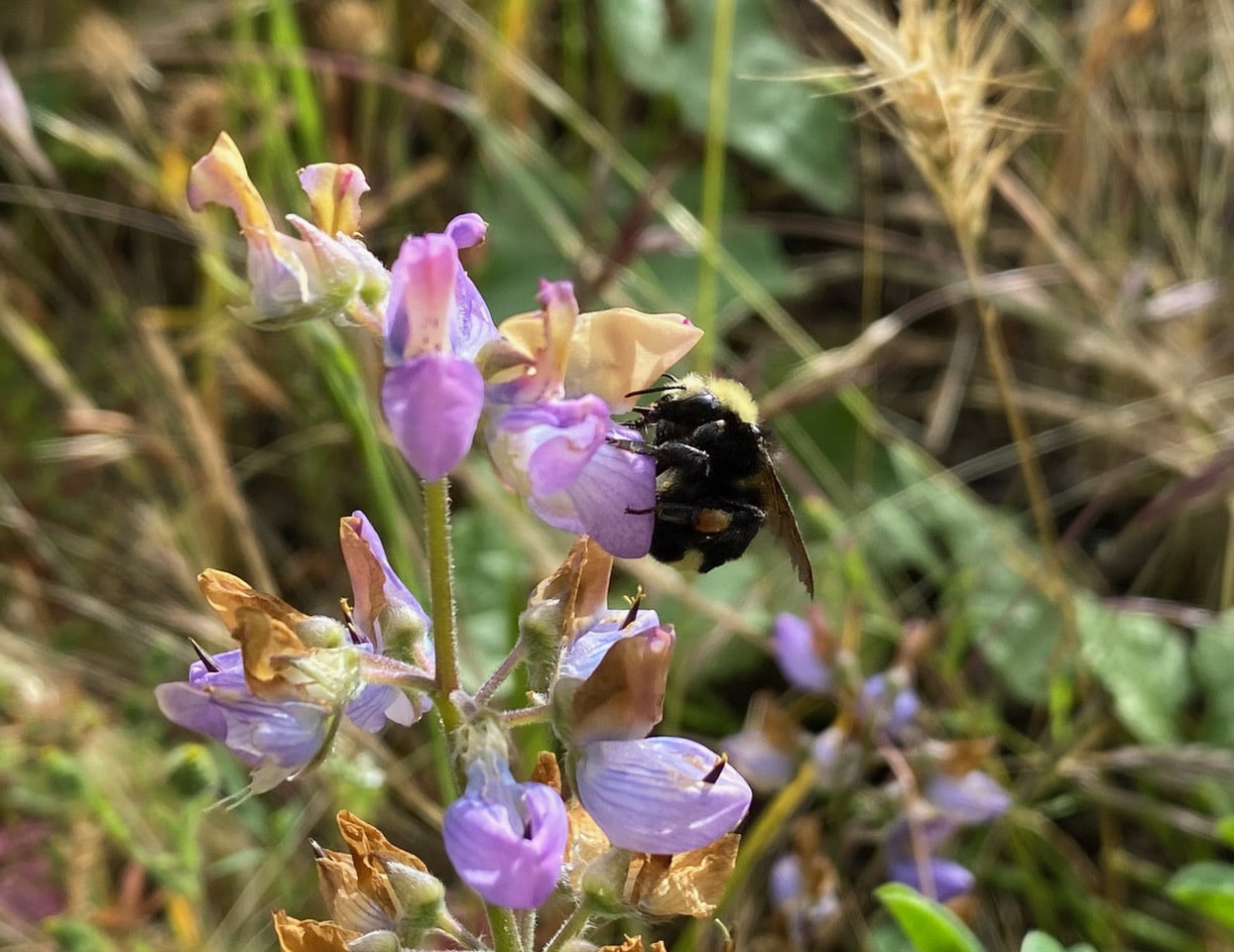
A Yellow-faced Bumble Bee, Bombus vosnesenskii is taking nectar from the fading flowers of Broadleaf Lupine, Lupinus latifolius growing in dappled shade along Skyline Trail.
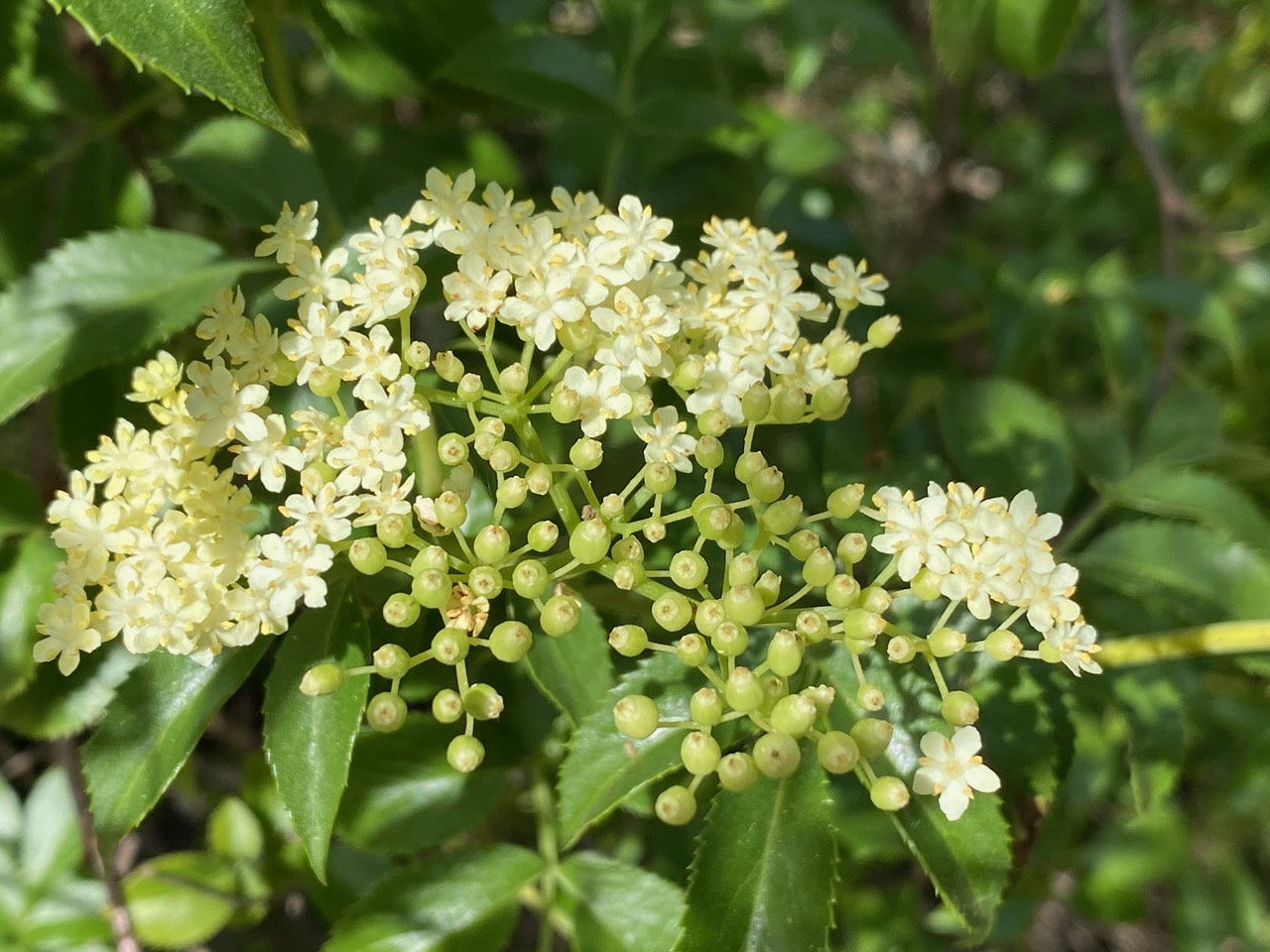
I have hardly ever seen insects visit the flowers of the Blue Elderberry, Sambucus nigra ssp. caerulea, and yet the plants are already developing fruits. I wonder if the flowers are pollinated by nocturnal insects while we sleep?
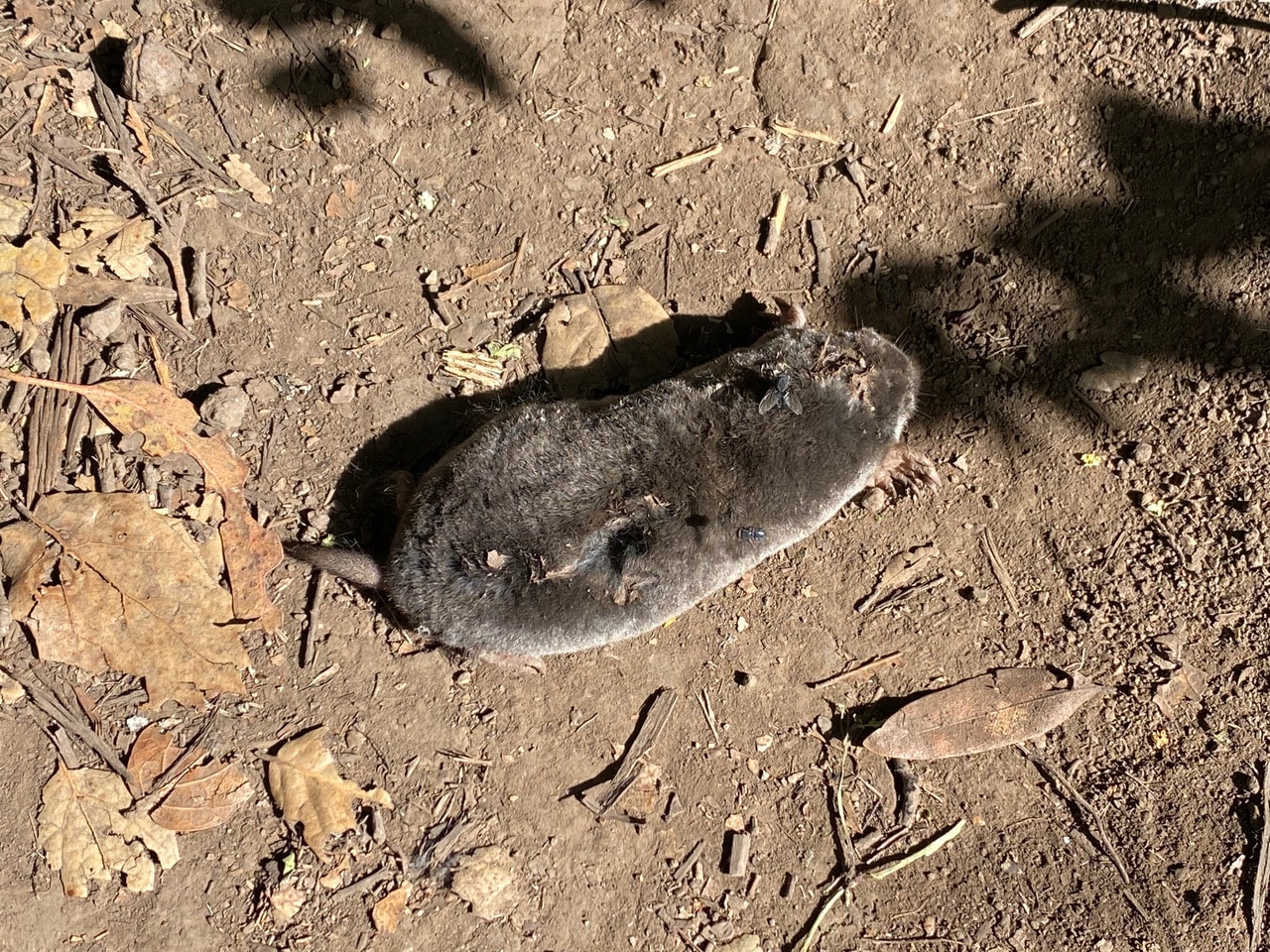
A dead mole lies across the trail. There seems to be a bite wound on its back, but no blood. Flesh Flies and Blow Flies are already gathering on the relatively fresh carcass.
Moles are highly specialized digging machines. They have long, tubular body, no external ears, and their limbs are short and held close to the body. They have broad shovel-like forelimbs that allow them to power through soil.
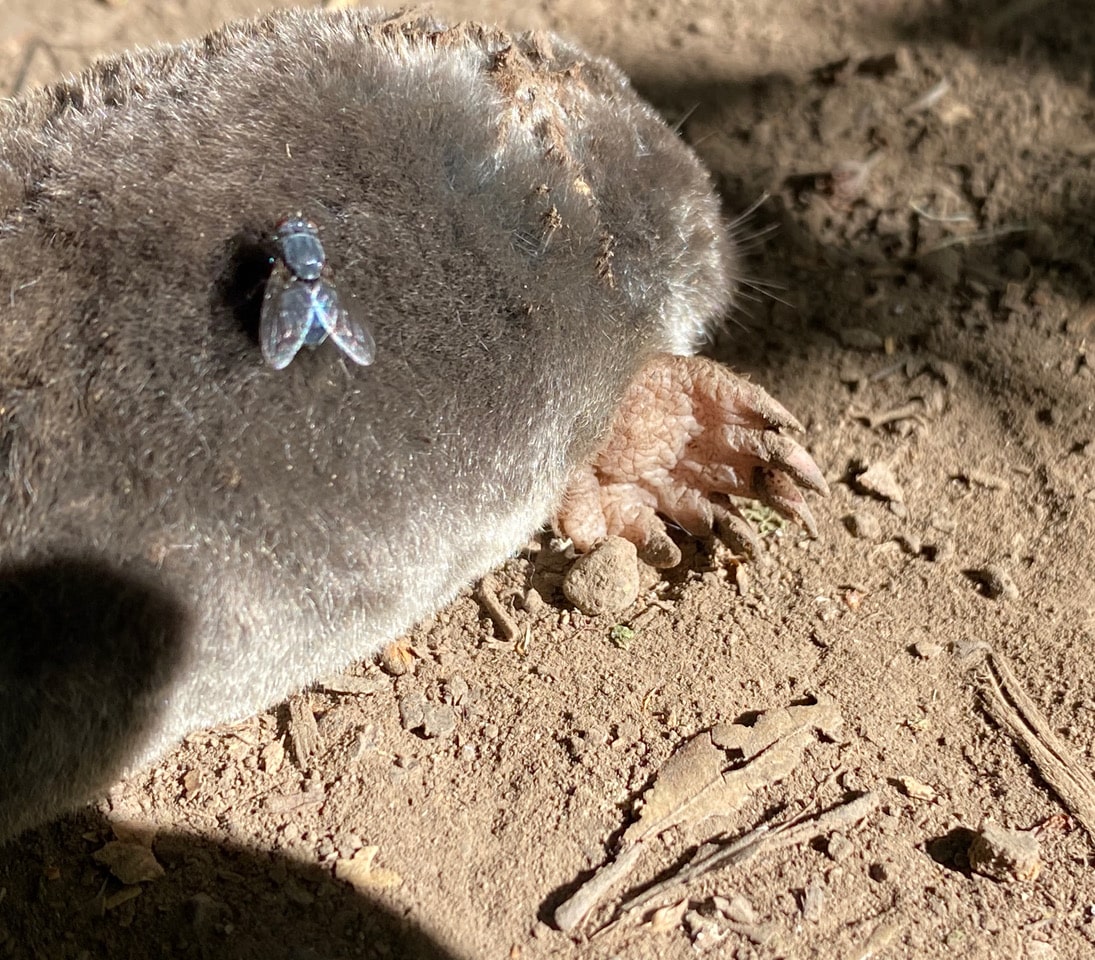
I take a closer look at the mole’s front paw. It is a living spade. Moles have an extra “thumb”, called a prepollex, actually a modified, extended wrist bone. This outer thumb does not have any moving joints. The extra bone is rigid and extends the width of the mole’s palm, enabling the little mammal to dig its underground tunnels more efficiently. Amazing!
Most North American moles are insectivorous. Their diet is mostly insects and other invertebrates, including earthworms, centipedes, millepedes, snails, slugs, grubs, ants, sowbug, termites, beetles, and crickets. Moles make a significant contribution to the health of the landscape. Their extensive tunneling and mound building mixes soil nutrients and improves soil aeration and drainage.
A Darkling Beetle, also known as Stink Beetle, Eleodes sp. (family Tenebrionidae) is making its way across the trail.
Darkling Beetles are abundant in both diversity and numbers in the western United States, especially in the deserts. The beetles are often found under logs and in other detritus. They primarily feed on detritus of grasses and forbs. They are best known for their comical, yet effective defense tactics. When alarmed, they lift their rear ends skyward by bending their front legs and extending their rear legs. They spray a reddish brown exudate, an oily, stinky secretion. Most animals know to avoid contact with the Darkling Beetles. The larger species can spray a distance of 10-20 inches, and some can spray multiple times if necessary.
The forewings or elytra of the Darkling Beetle are permanently sealed together over their body. This renders them flightless throughout their entire life. Perhaps the most fascinating characteristic of the Darkling Beetle is its ability to create water metabolically. The beetles do not need an external water source to survive.
Darkling beetle larvae are collectively referred to as false wireworms. They are often found inside rotting stumps, logs and underneath rocks. They seek shaded and protected areas with a good supply of plant material to feed on. Like the adults, they are mainly scavengers/decomposers.