

Pollinator Post 6/8/25 (1)

After a cloudy morning, Fred and I go for an early afternoon walk at Crab Cove. I decide to check out a small patch of sidewalk planting at the end of McKay Road, a stone’s throw from the visitor center.
The Coyote Mint, Monardella villosa is blooming gloriously, and there’s a pandemonium of insect activity. The bees and wasps are literally bumping each other off the flowerheads. It’s a challenge to focus on anything.

A huge queen Yellow-faced Bumble Bee, subgenus Pyrobombus (genus Bombus, family Apidae) is foraging on a Coyote Mint flowerhead. She has a bit of purplish pollen in her corbiculae (“pollen baskets”). She is one of this year’s new crop of gynes (fresh queens) destined to establish new colonies next year. I didn’t know that gynes collect pollen. I guess she needs the practice, since she will have to take care of herself and feed her first brood of offspring when she emerges from hibernation next spring.
Bumble bees are social and live in colonial hives. Many of the large individuals seen early in the season are queens. They are the only members of their colony to survive the winter, hibernating until the days begin to warm and their host plants are in bloom. These queens have mated before they went into hibernation. Now their first order of business is to each find a nesting site (usually an abandoned rodent burrow), lay eggs, brood and nurture the first batch of workers. Henceforth, the queens stay behind in the hive to concentrate on laying eggs while the workers take on hive duties and foraging. At the end of the season, usually in late summer, the colony produces gynes and drones (males). These mate with others from neighboring colonies. The mated queens go off to find a safe place to hibernate through the winter, while the rest of the colony, including the old queen dies. And so the cycle is repeated.
Queens are noticeably larger than worker bees, which is one of the easiest ways to distinguish them. Queen bees are fed a more substantial diet during their larval development, contributing to their larger size. The queen’s large size is crucial for her to store enough nutrients to lay a large number of eggs throughout the colony’s lifespan.
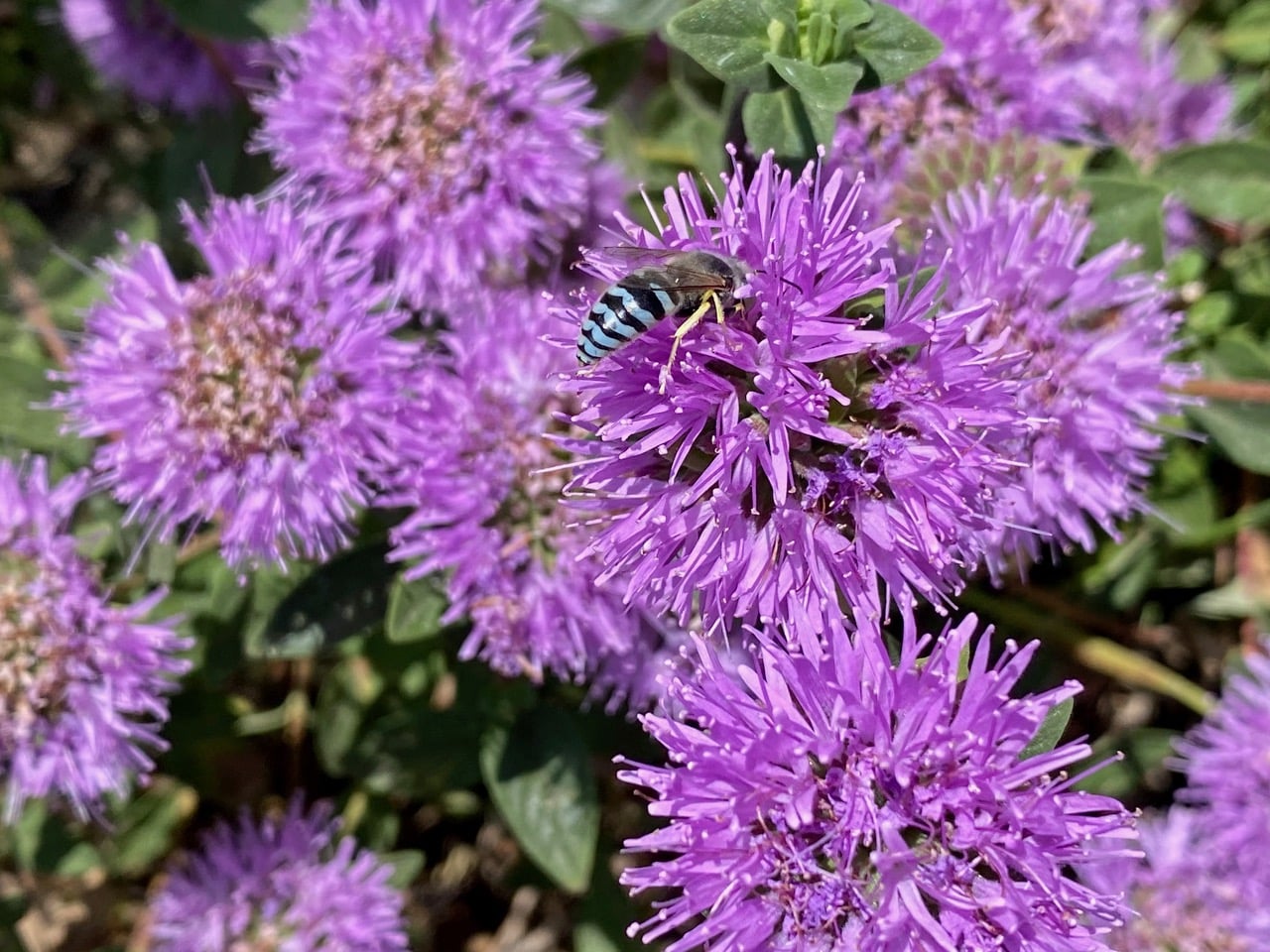
Causing the most commotion in this patch of Coyote Mint are the American Sand Wasps, Bembix americana (family Crabronidae). They dive bomb any insect that lands on a flowerhead.

Sand wasps in the genus Bembix are familiar and common throughout North America, digging their burrows in dunes, on beaches, and other habitats with loose, deep sand. The female rapidly kicks out large quantities of sand using a “tarsal rake” of spines on each front leg. The burrow is excavated before the wasp goes hunting. Bembix are generalist, opportunistic hunters. True flies in the order Diptera are the usual prey. A victim is paralyzed or killed by the wasp’s sting, and is then flown back to the nest. Most species will lay an egg on the first victim, while some species lay an egg in the empty cell before starting to hunt. Once the egg hatches, mama wasp brings flies to her larva as needed. This “progressive provisioning” is rare in the insect world. When the larva reaches maturity, mama wasp closes the cell. Inside, the larva spins an oblong cocoon, weaving sand grains into the structure and resulting in a hardened capsule. Overwintering takes place as a prepupa inside this cocoon, but there are usually two generations a year.
Male sand wasps often engage in an elaborate flight ritual called “sun dances”. Males emerge before females, and fly erratically at dizzying speed one or two inches above the ground attempting to detect virgin females about to emerge from their underground nests. Both sexes are often seen taking nectar at flowers, especially from Asteraceae family. Bembix wasps are often victims of other insects such as cuckoo wasps (Chrysididae), velvet ants (Mutillidae), satellite flies (Sarcophagidae), bee flies (Bombyliidae), and thick-headed flies (Conopidae).
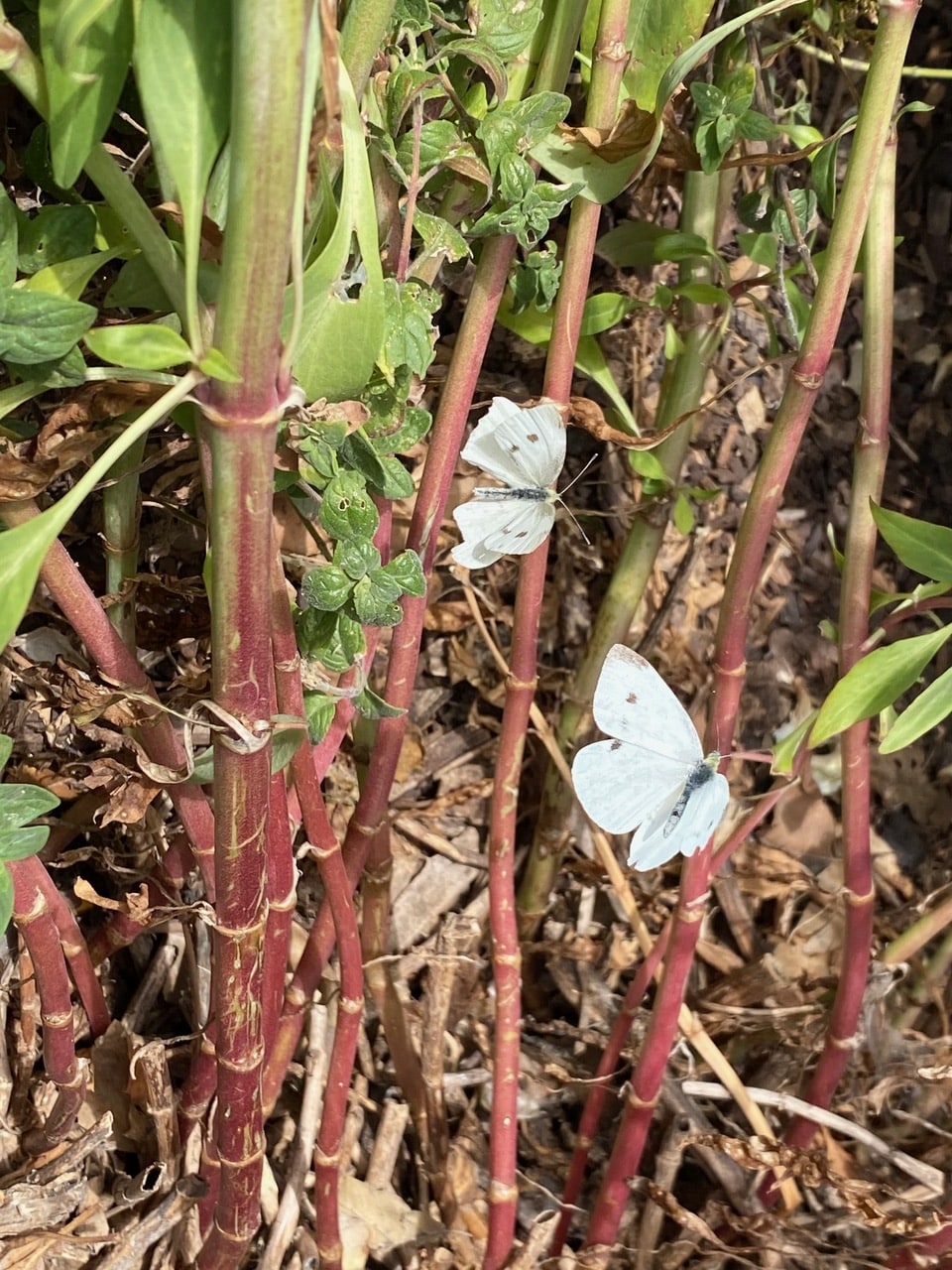
While i’m trying to photograph a female Cabbage White butterfly perched in the underbrush, a male suddenly turns up. The pair lifts into the air and flutters around each other in a delightful spiraling dance. Which is the male, and which the female? The male (on the right) has one black spot on its upper forewing, while the female has two.
The cabbage white, Pieris rapae (family Pieridae) was introduced to the US along with European cabbage imports in the 1860’5. The caterpillars feed on plants in the mustard or Brassicaceae family, and occasionally some in the caper family. The butterflies have a darkened, yellowish underside of the hind wings, which enables them to heat up quickly in the sun. The butterfly’s white wings reflect ultraviolet light, which we can’t see but the butterflies can. To our eyes the butterflies seem plain and drab, but to each other, females are a gentle lavender and males shine with a deep royal purple. Brighter males are more attractive to females and the color’s strength reflects the amount of protein the males consumed as caterpillars. During mating, male butterflies transfer nutrients to the females in the form of infertile sperm, a nuptial gift which will enhance the female’s life expectancy and fertility. A male with a higher quality diet can afford to be brighter and to produce bigger and more nutritious nuptial gifts.

A Cabbage White butterfly lands on a Coyote Mint flowerhead to take nectar. Is this butterfly male or female?
The Coyote Mint, Monardella villosa exhibits some of the pollination syndromes of butterfly flowers. Butterfly pollination syndromes, also known as psychophily, describe the specific flower characteristics that have evolved to attract and facilitate pollination by butterflies. Butterflies are attracted to bright colors, particularly pink, red, orange and purple. The small Monardella flowers are tightly clustered, providing a landing platform for the butterflies. Monardella flowers are a good source of nectar. The individual flowers on each flowerhead are tubular, requiring precision insertion of mouthparts to access the nectar. Butterflies have a long, flexible proboscis that they can aim into these flowers. What’s more, at each sitting, a butterfly’s flexible proboscis can probe multiple flowers, saving on energy and time traveling from flower to flower. As I bend down to take pictures, I can smell the strong minty scent coming off the plant. I am not sure if the scent is attractive to butterflies.

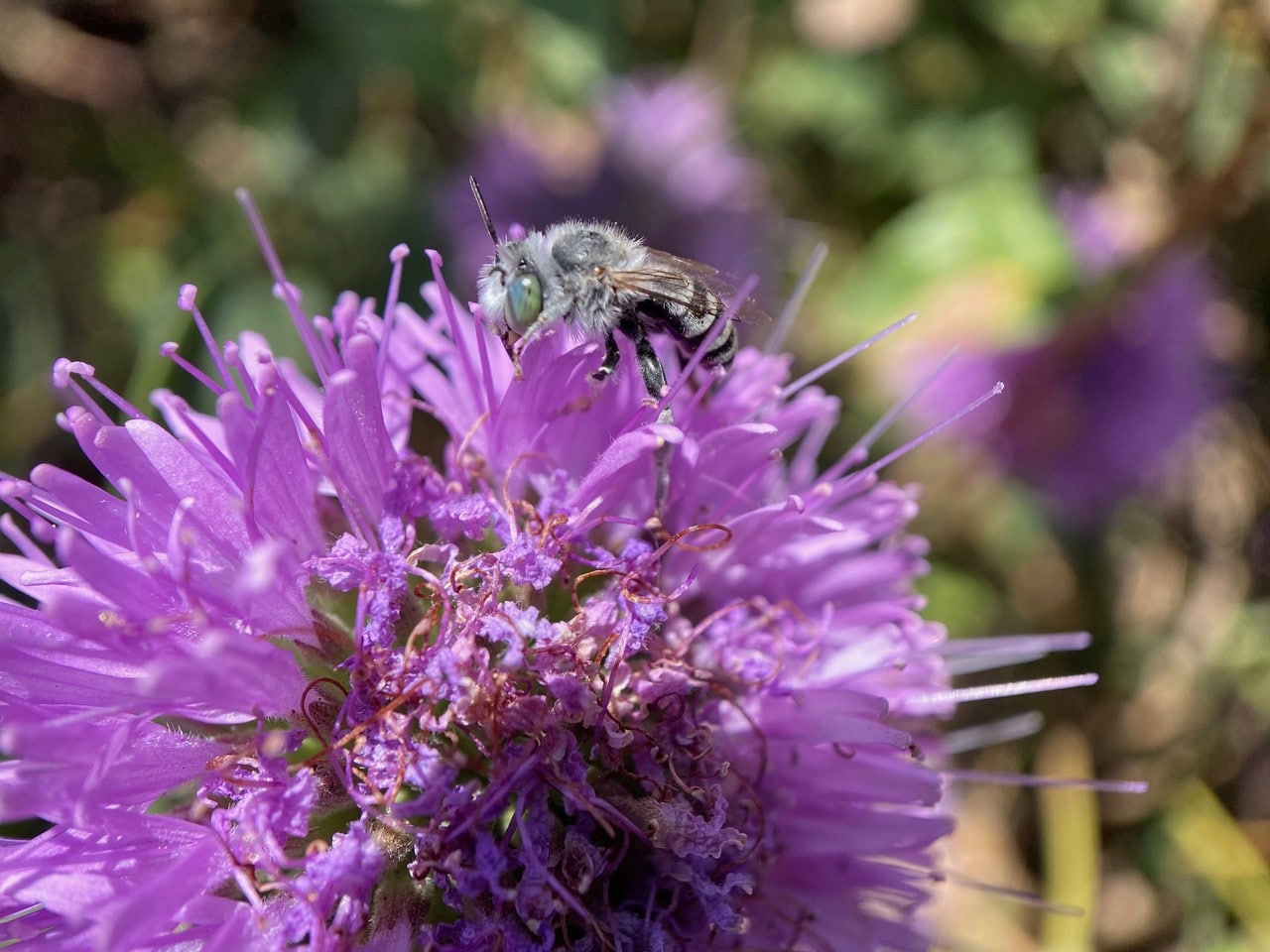
A small stout bee with pale milky blue eyes and black-and-white banded abdomen is foraging on a Coyote Mint flowerhead. A bee specialist on iNaturalist has helped identify the bee as a Short Sun-digger Bee, Anthophora curta (subgenus Micranthophora, family Apidae). The species is native to North America, and prefers dry, desert-like habitats.
The bee genus Anthophora, commonly known as Digger Bees, is one of the largest in the family Apidae. All species are solitary, though many nest in large aggregations. Nearly all species construct nests in the soil, either in banks or in flat ground; the larvae develop in cells with waterproof linings and do not spin cocoons. Males commonly have pale white or yellow facial markings, and/or peculiarly modified leg armature and hairs. Members of the subgenus Micranthophora are much smaller in size than the common Anthophora species. A. Curta is only about a third the size of the A. pacifica I am used to seeing in early spring. The general appearance and behavior (frenetic) are, however, similar.

It takes focused effort for a bee this size to reach down through a forest of flowers to access the nectar. Anthophora bees generally have long tongues that allow them to access nectar and pollen in deep-throated or tubular flowers which are out of reach of other bees. Most of the Digger Bees I am seeing today seem to be males, with long antennae.

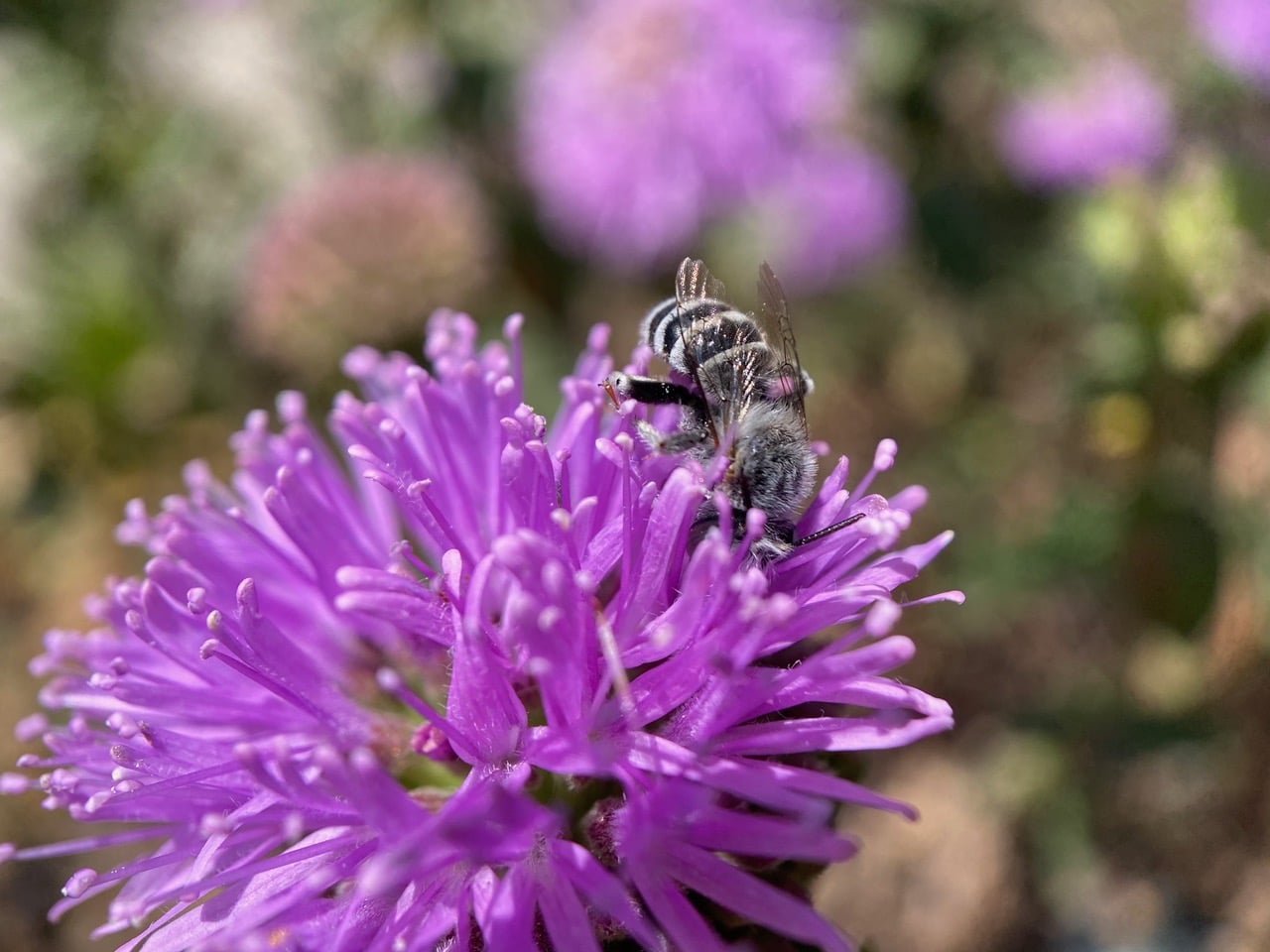
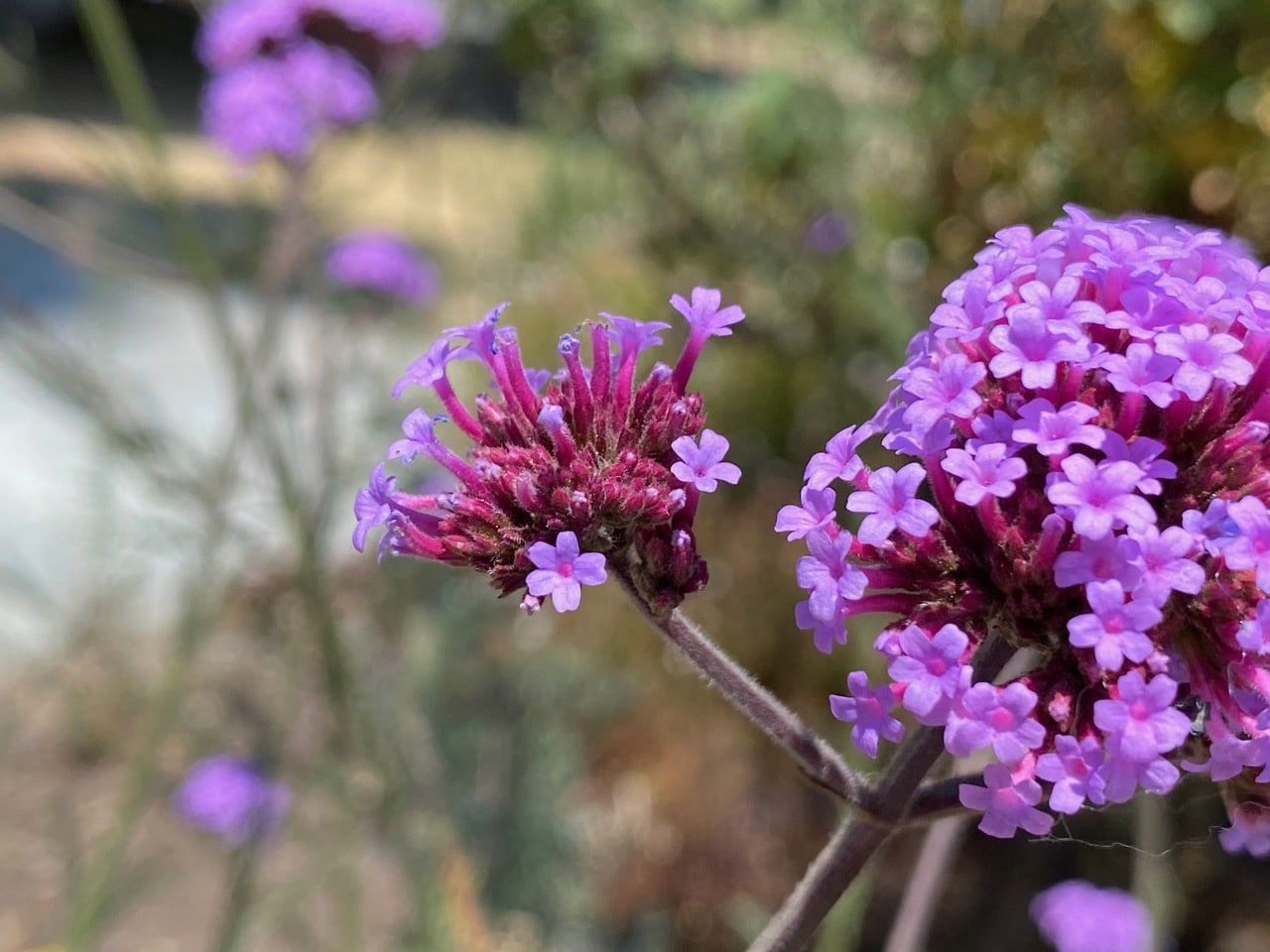
Growing right next to the Coyote Mint is a Purpletop Vervain, Verbena bonariensis with large clusters of small purple tubular flowers.
The Purpletop Vervain, Verbena bonariensis is native to South America and has been introduced to North America as an ornamental garden plant. Its purple/lavender flowers on tall, open, airy branches are a strong pollinator magnet, attracting butterflies, bees, and hummingbirds. It is also a host plant for the Buckeye Butterfly. Blooming from summer to fall, it provides consistent supply of nectar for pollinators at a time when many plants have gone dormant. It is a low-maintenance perennial that thrives in full sun to partial shade and is drought-tolerant and deer resistant.
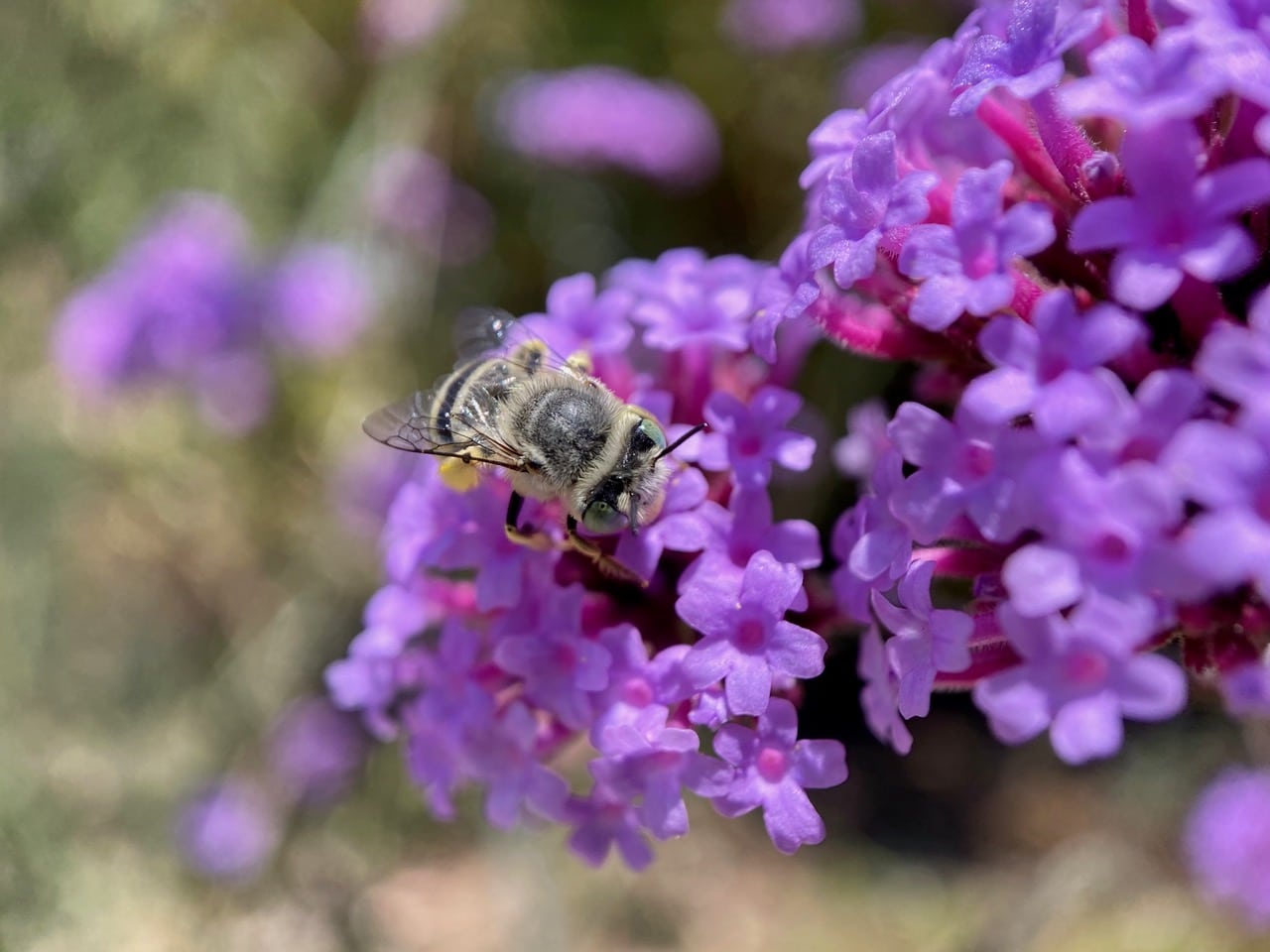
Ooh, I think that’s a female Short Sun-digger Bee, Anthophora curta (subgenus Micranthophora, family Apidae) foraging on the Purpletop Vervain. Note that she has a bit of yellow pollen in the scopae of her hind legs.

What interesting hairy face! Can her tongue reach the nectar at the bottom of those tubular flowers?
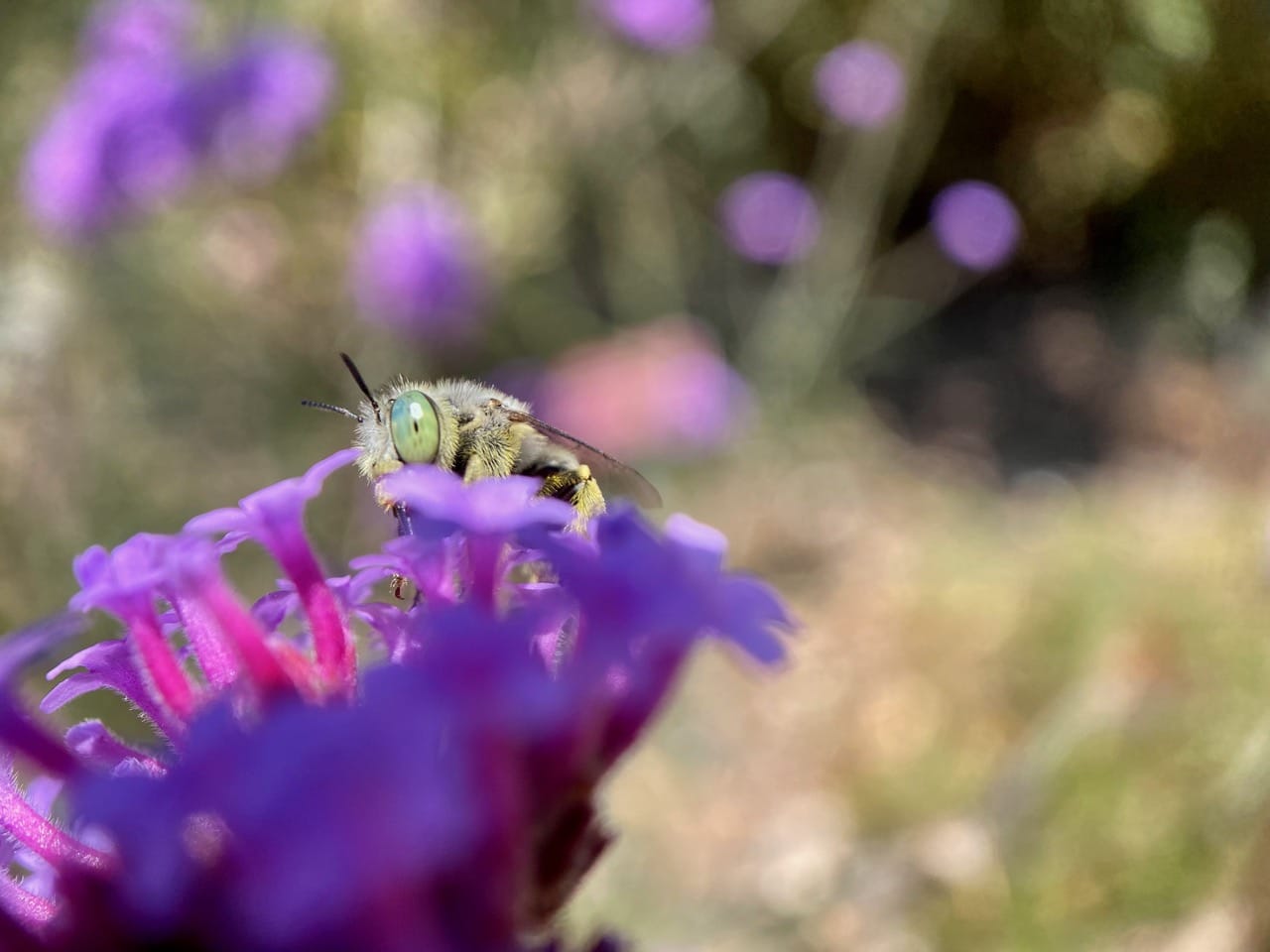
Her large mottled blue-green eyes give her a startled look. Note the short antennae of the female.

Her hairs appear more yellow than the males’, or are they coated with yellow pollen?

A Small Carpenter Bee, Ceratina sp. (family Apidae) has landed on the long, protruding stamens of the Coyote Mint flowers.
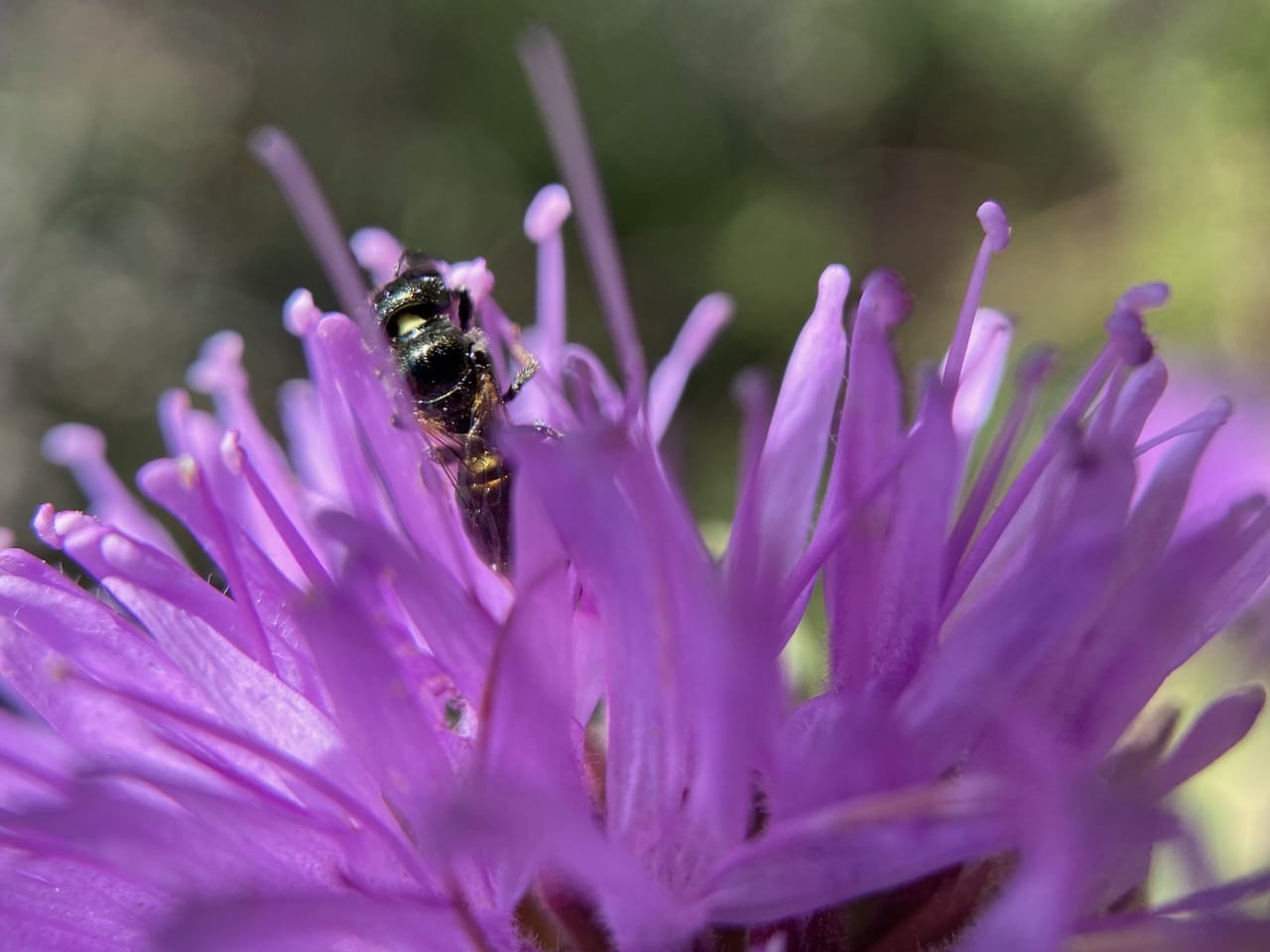
The little bee is collecting pollen from the flowers…

…one anther at a time.
The Small Carpenter Bee genus Ceratina is closely related to the more familiar, and much larger Carpenter Bees (genus Xylocopa). Ceratina are typically dark, shiny, even metallic bees, with fairly sparse body hairs and a weak scopa on the hind leg. The shield-shaped abdomen comes to a point at the tip. Some species have yellow markings, often on the face.
Females excavate nests with their mandibles in the pith of broken or burned plant twigs and stems. While many species are solitary, a number are subsocial. Both male and female carpenter bees overwinter as adults within their old nest tunnels, emerging in the spring to mate. In the spring, this resting place (hibernaculum) is modified into a brood nest by further excavation. The female collects pollen and nectar, places this mixture (called bee bread) inside the cavity, lays an egg on the provision, and then caps off the cell with chewed plant material. Several cells are constructed end to end in each plant stem.


Hey, I think that is a male Yellow-faced Bumble Bee, subgenus Pyrobombus (genus Bombus, family Apidae). Drones tend to have extra yellow bands on the abdomen. Interestingly the bumble bee colonies are already winding down for the year, producing reproductives – gynes (queens) and drones (males). Drones have short lives, dying soon after mating with the new queens.