

Pollinator Post 6/8/24 (3)
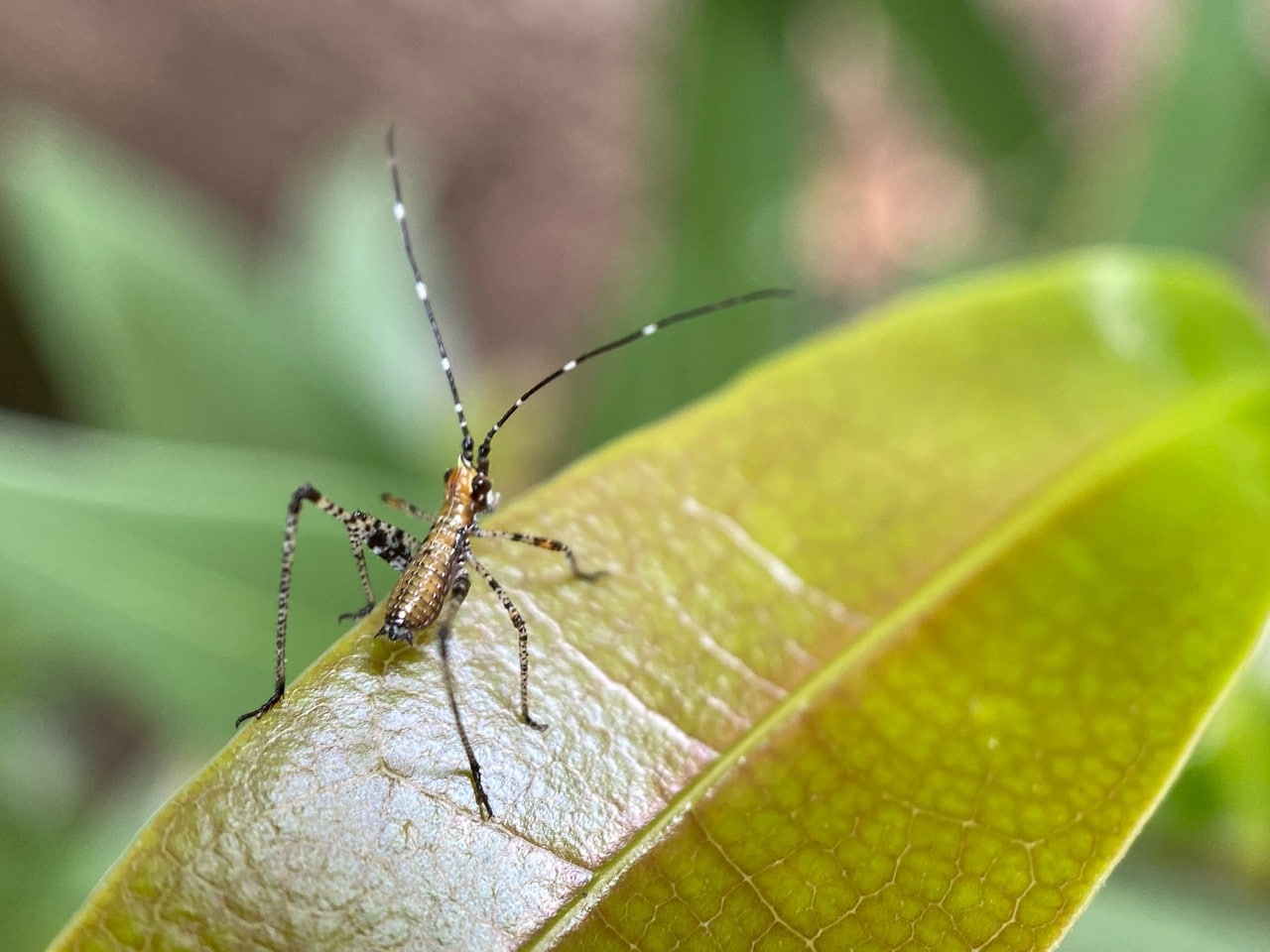
With a soft thud, a tiny nymph of Scudder’s Bush Katydid, Scudderia sp. (family Tettigoniidae) lands on a young leaf of California Bay, Umbellularia californica.
Scudderia is a genus of katydids in the family Tettigoniidae. They are sometimes called bush katydids and are 30-38 mm in length. They are mostly found in North America. They are herbivores, with nymphs feeding primarily on flowers and adults preferring woody deciduous plants.

An Ironclad Beetle, Phloeodes plicatus (family Zopheridae), about 3/4 in long, is standing stock-still in the middle of the trail. It blends in well with the soil, and I would never have noticed it if I weren’t crouching down to take pictures of something else. What a strange looking beetle!
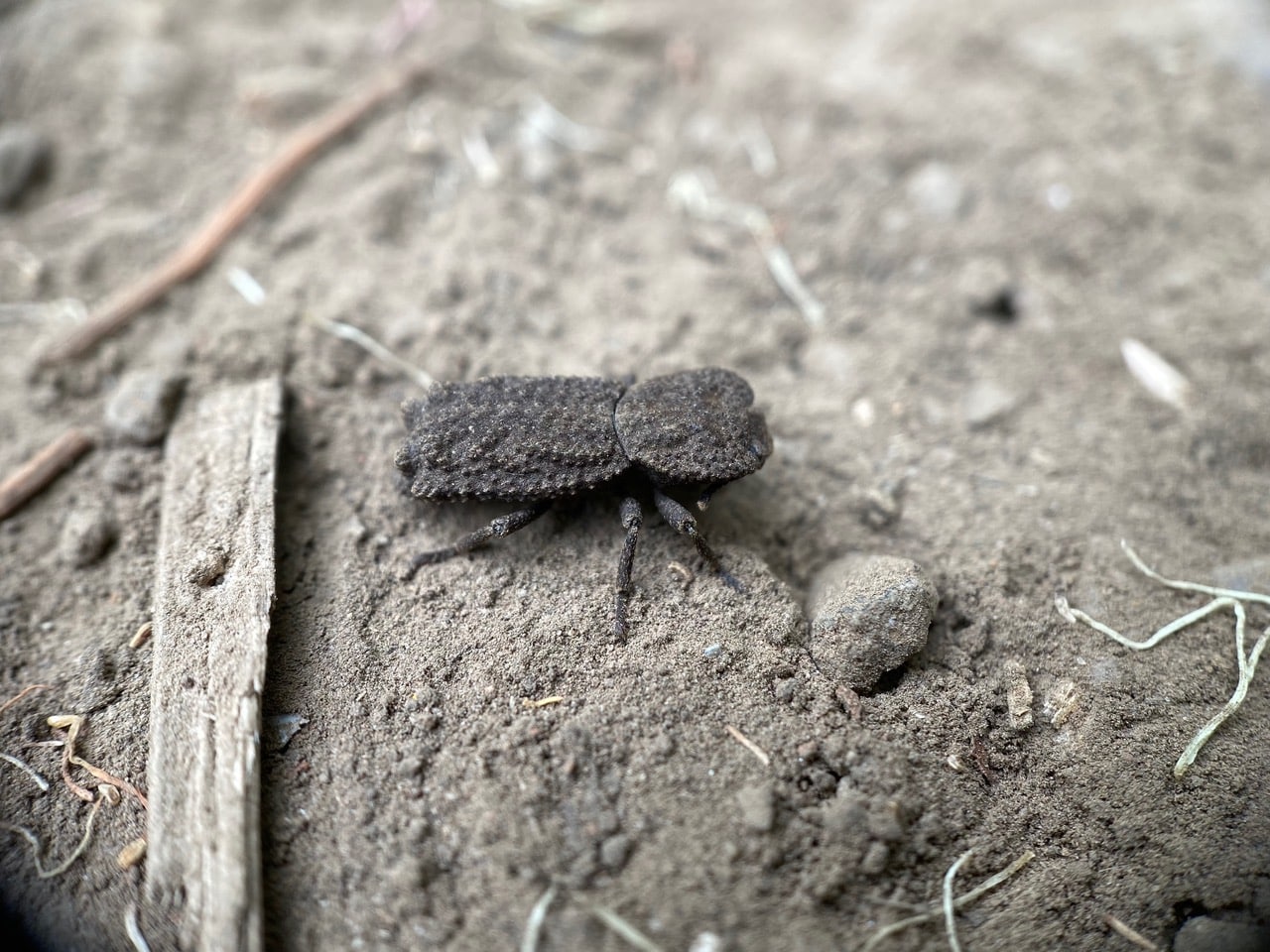
Phloeodes plicatus is an Ironclad Beetle in the family Zopheridae, found primarily on the west coast of North America. A large number feed on rotting wood or the fungus associated with rotting wood. These beetles have fused elytra, so they cannot fly. They are notable for their super-strong armored exoskeleton. A close relative, the Diabolical Ironclad Beetle, Phloeodes diabolicus has been found to survive being run over by a car. Tightly interlocked and impact-absorbing structures that connect pieces of the beetle’s exoskeleton help it survive enormous crushing forces, enabling the flightless beetle to fend off the pecks and nips of birds and rodents.
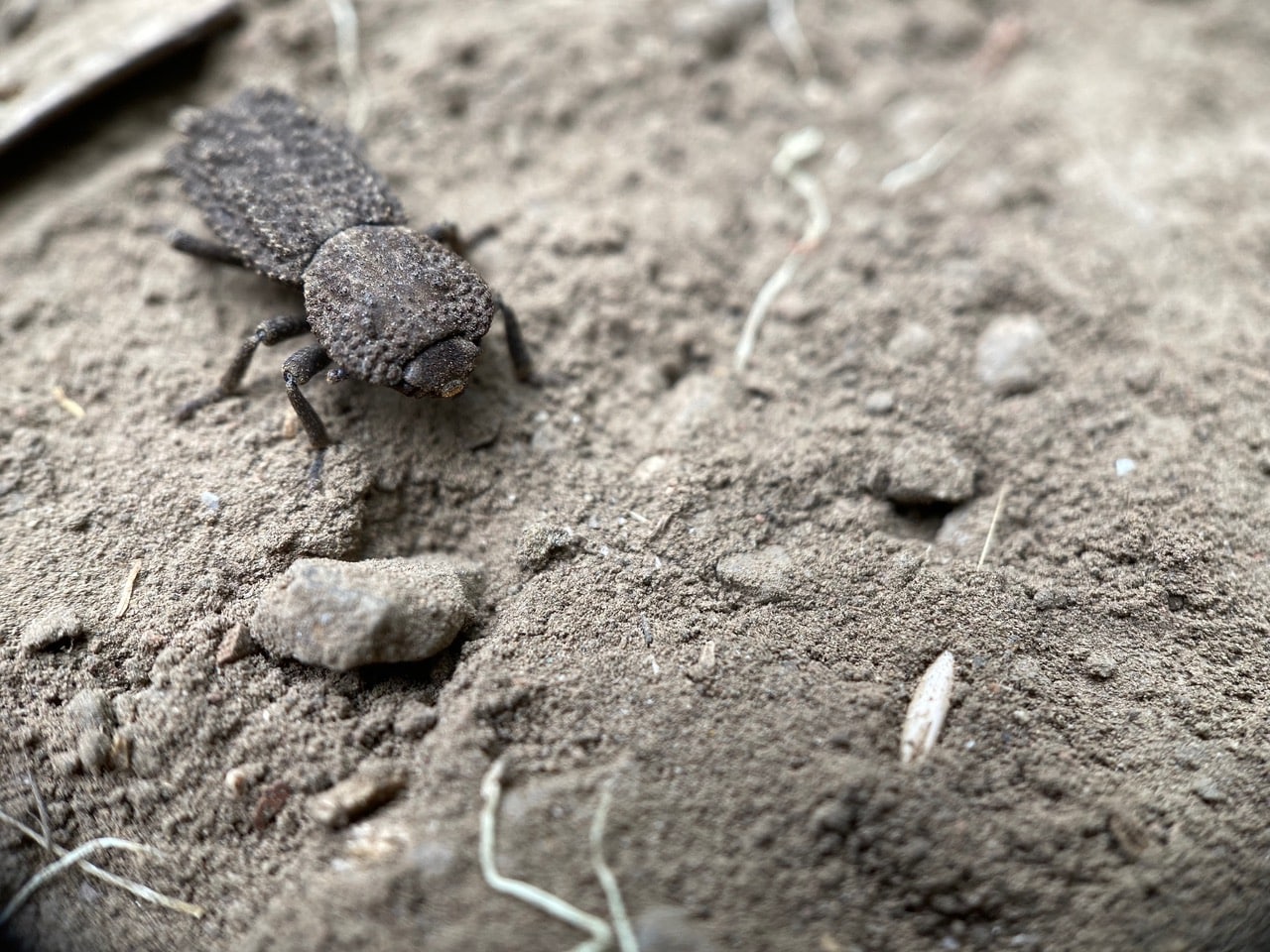
There’s the beetle’s head! Does it ever come out from under the thorax?
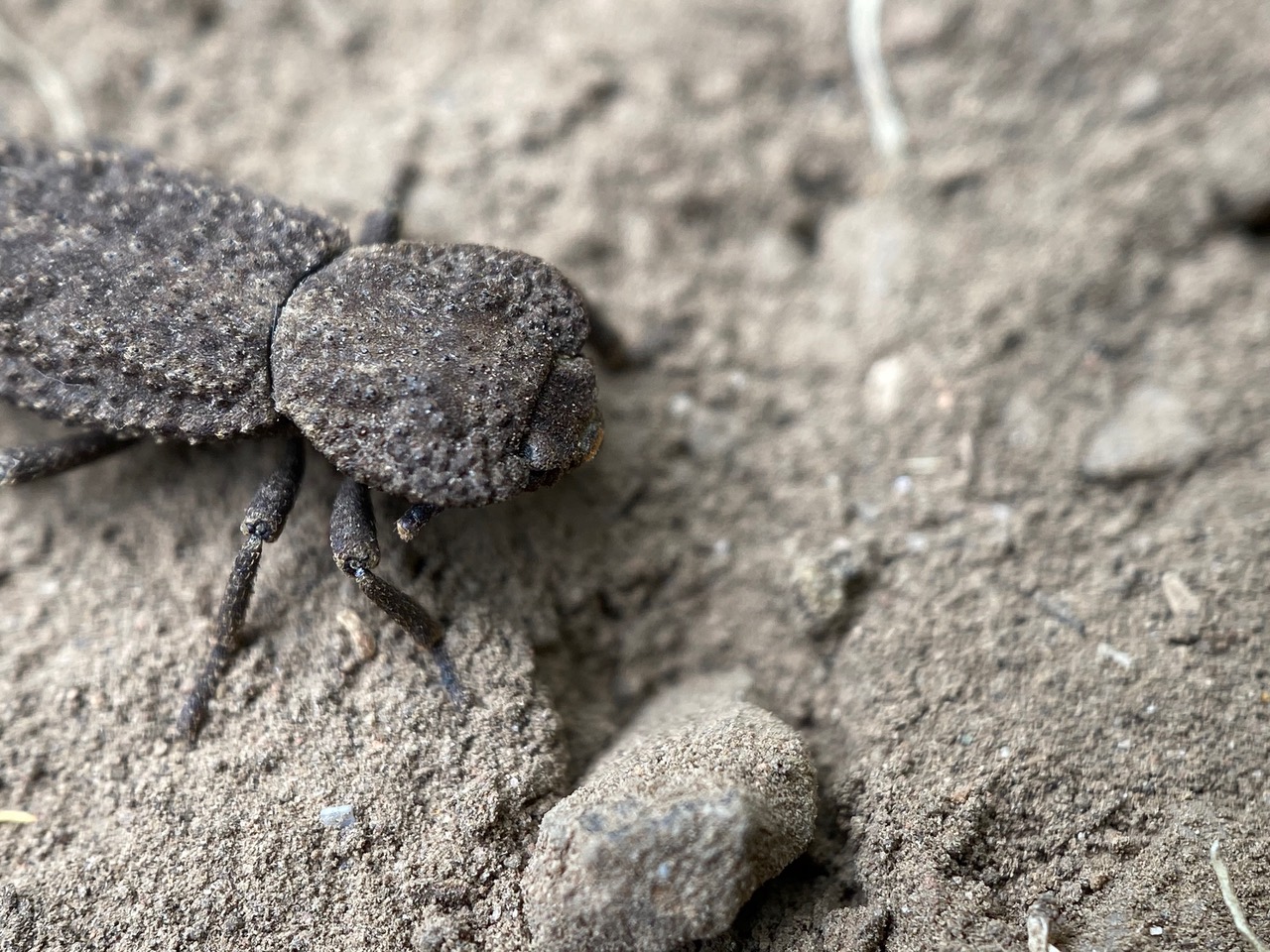
Close up of the head end of the Ironclad Beetle.
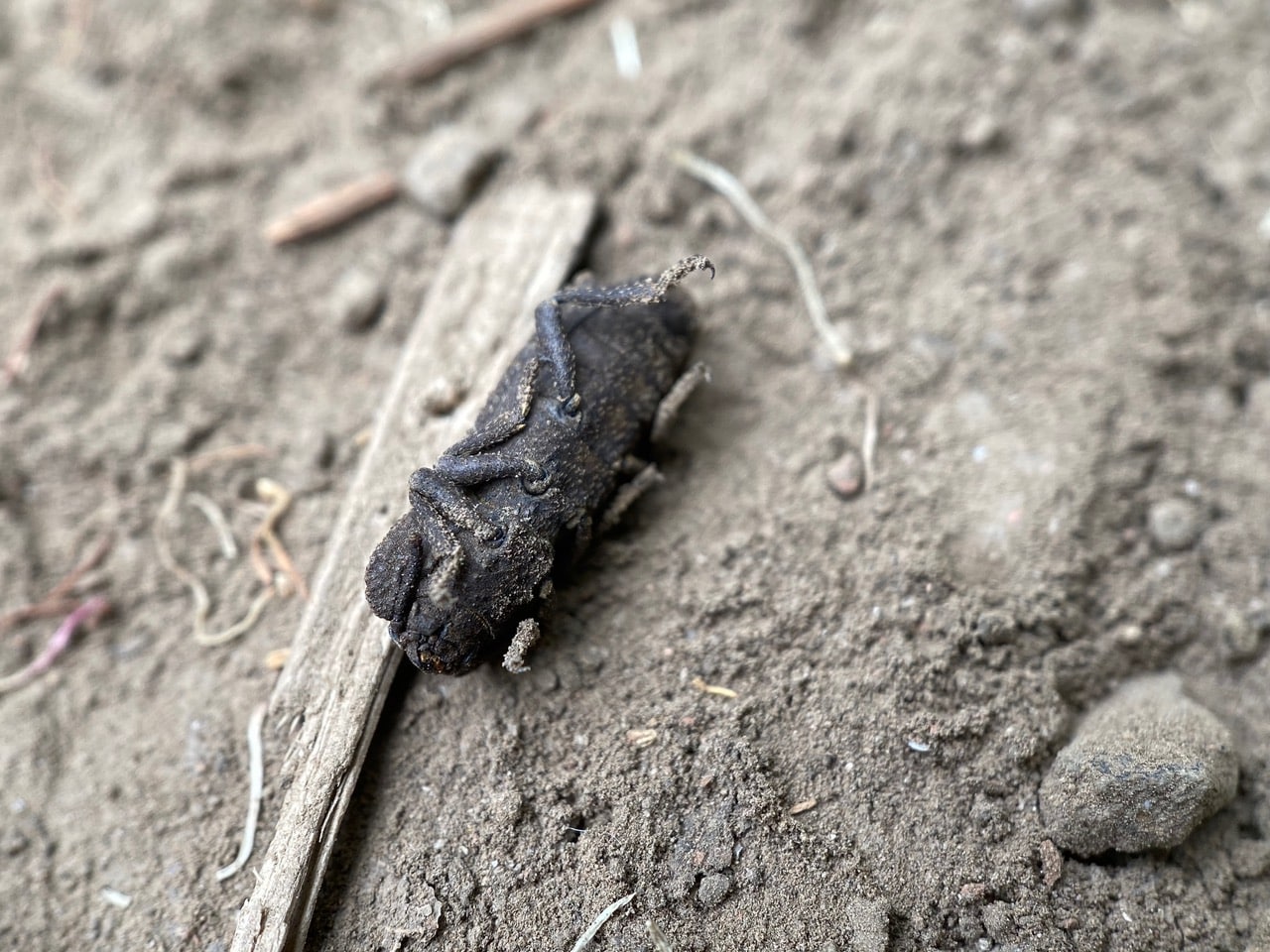
Just inches away I find another Ironclad Beetle, a slightly smaller one. Resting on its side, it is covered with dust, missing parts of its legs, and apparently dead. Has it been run over by cyclists or stepped on? I thought these beetles are indestructible! I scoop both beetles up with a piece of dried leaf and relocate them to the side of the trail.

I inadvertently startle a Western skink basking by the trail. It slithers across the trail in a flash, pausing for a split second for this photo. What a sleek, beautiful lizard!
The Western Skink, Plestiodon skiltonianus is a species of small, smooth-scaled lizard with relatively small limbs. It is widespread in northern California but primarily restricted to the coast in central and southern California. Found in a variety of habitats, this lizard is most common in early successional stages or open areas of late successional stages. The diurnal reptile is active during the warm seasons. The lizards spend much of their day basking in the sun. Their diet ranges widely, including spiders and beetles. The species is secretive and very agile, foraging actively through leaf litter and dense vegetation. It is a good burrower and sometimes constructs burrows several times its own body length. Females take great care of their eggs, guarding the nest until the young leave the nest.
Young Western Skinks have a bright blue tail with color that fades with age. The bright blue tail in juvenile skinks are thought to function as a decoy, diverting the attention of predators to this “expendable part” of the body. Skinks can perform autotomy; if seized by a predator its tail is deliberately cast and wriggles violently to attract attention while the lizard may escape. Skinks reach sexual maturity at around 3 years, and live up to 9 years.
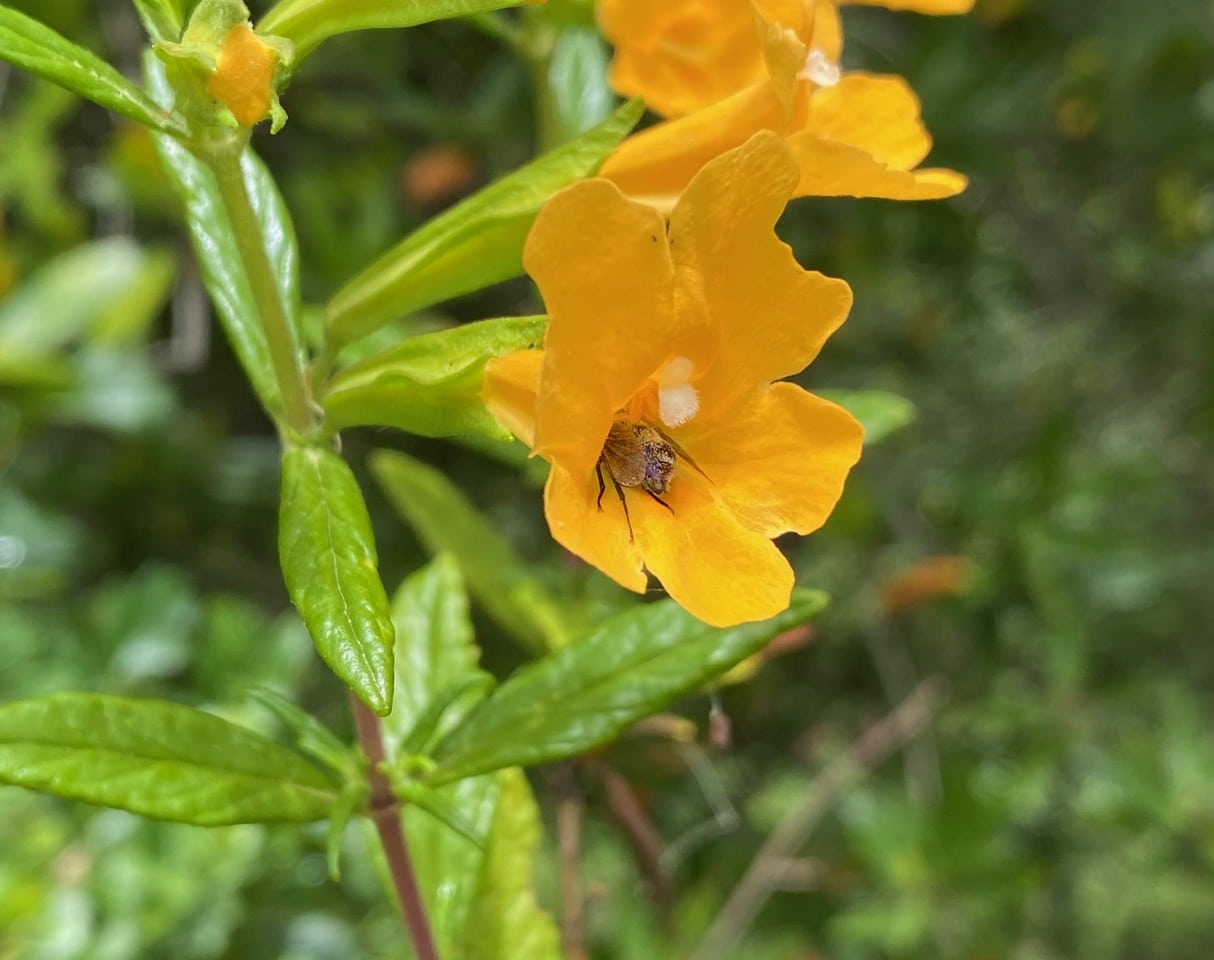
Ooh, there’s a Small-headed fly still sleeping in that Sticky Monkeyflower. We’ll leave this one alone and not wake it up.

A male Variable Duskyface Fly, Melanostoma mellinum (family Syrphidae) is perched on a Sticky Monkeyflower. It is easy to tell the sex of Syrphid flies as the males have holoptic eyes that meet on top of the head. Females have eyes that are set apart.
Melanostoma mellinum is a very common species of hover fly found in many parts of Europe including the Mediterranean basin and North Africa, the East Palearctic, and North America. A small species, their wingspan between 4.7 and 7.0 mm. Very similar to Platycheirus, but can be distinguished by fine details. In M. mellinum, the normally pale halteres turn bright blueish-green in females about to lay eggs.
The species’ preferred habitat include grasslands and moorlands, including those in hilly and mountainous regions. Adults can be found feeding on pollen of grasses and other wind-pollinated plants. Little is known of their biology, but the larvae are suspected to be a general predator of small insects in the leaf litter.
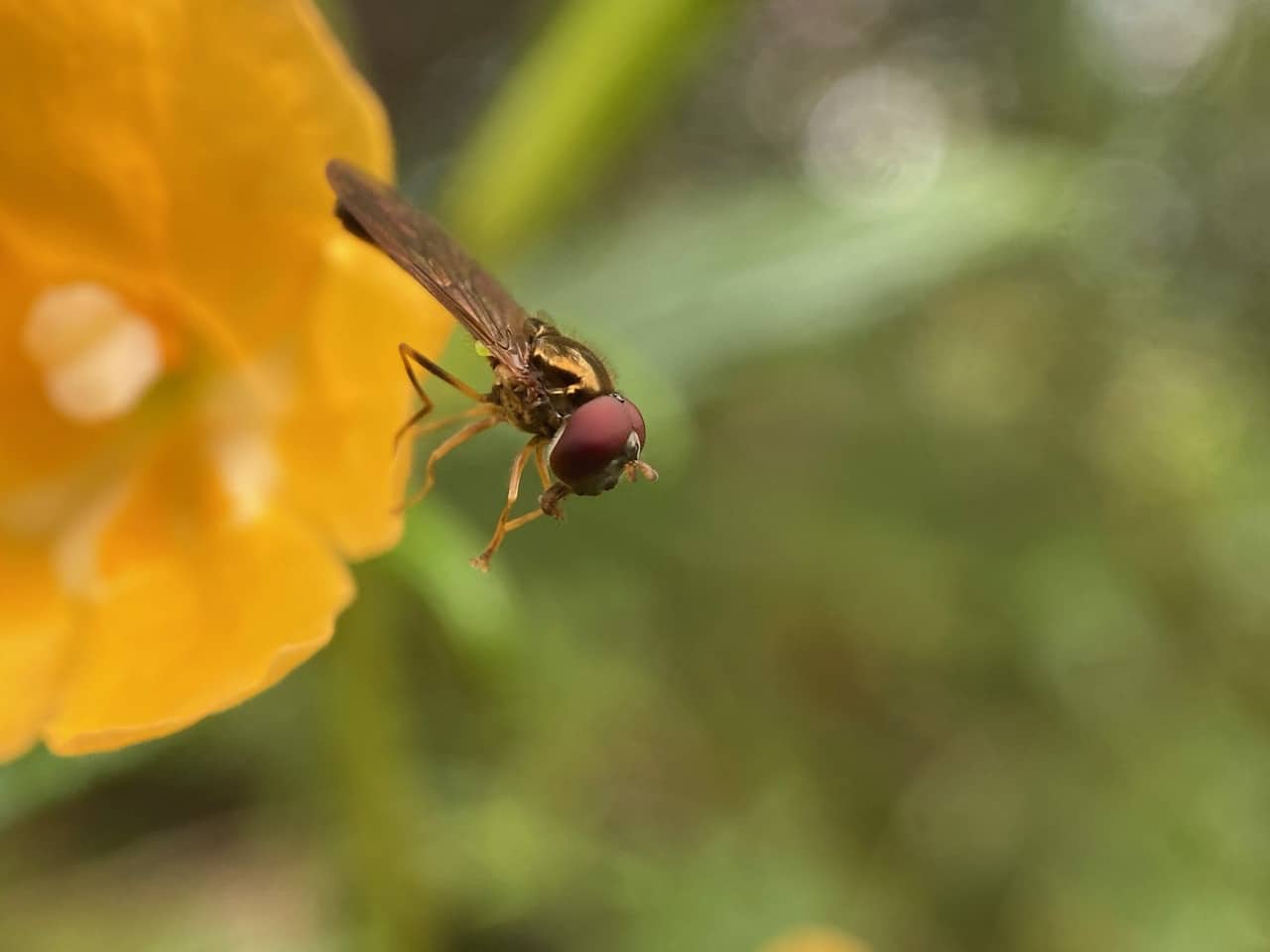
Hanging on the edge of the flower, the fly proceeds to clean its proboscis with its front legs.
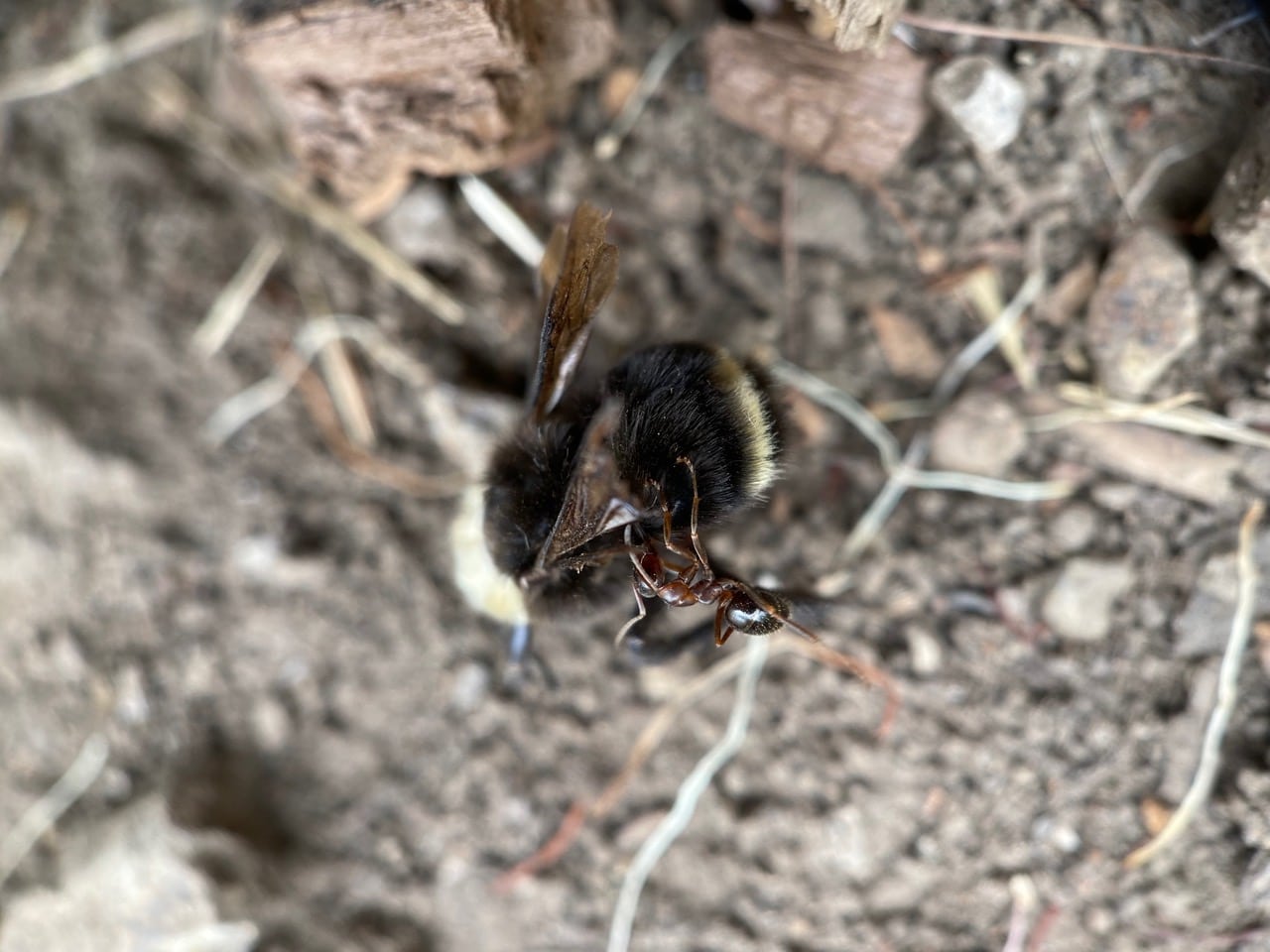
A Carpenter Ant, Camponotus sp. (family Formicidae) is investigating a dead Yellow-faced Bumble Bee lying in the middle of the trail. She will need help from her nest mates to move this huge food item.
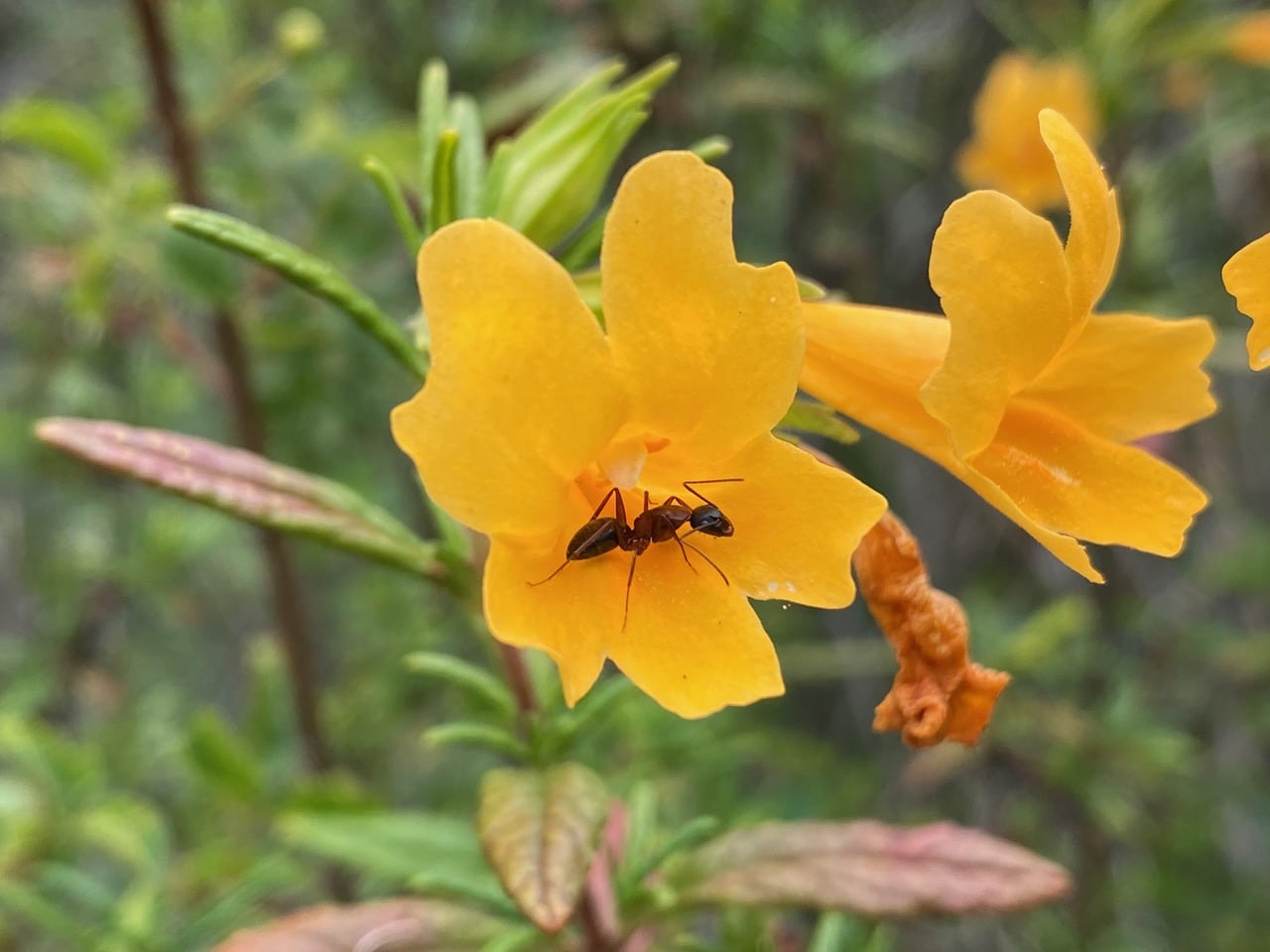
Ironically, what I first took to be an ant-mimicking nymph of the Plant Bug, Closterocoris amoenus (family Miridae) on a Sticky Monkeyflower turns out to be the real thing! It is a Bicolored Carpenter Ant, Camponotus vicinus (family Formicidae). Note that it has geniculate (elbowed) antennae.
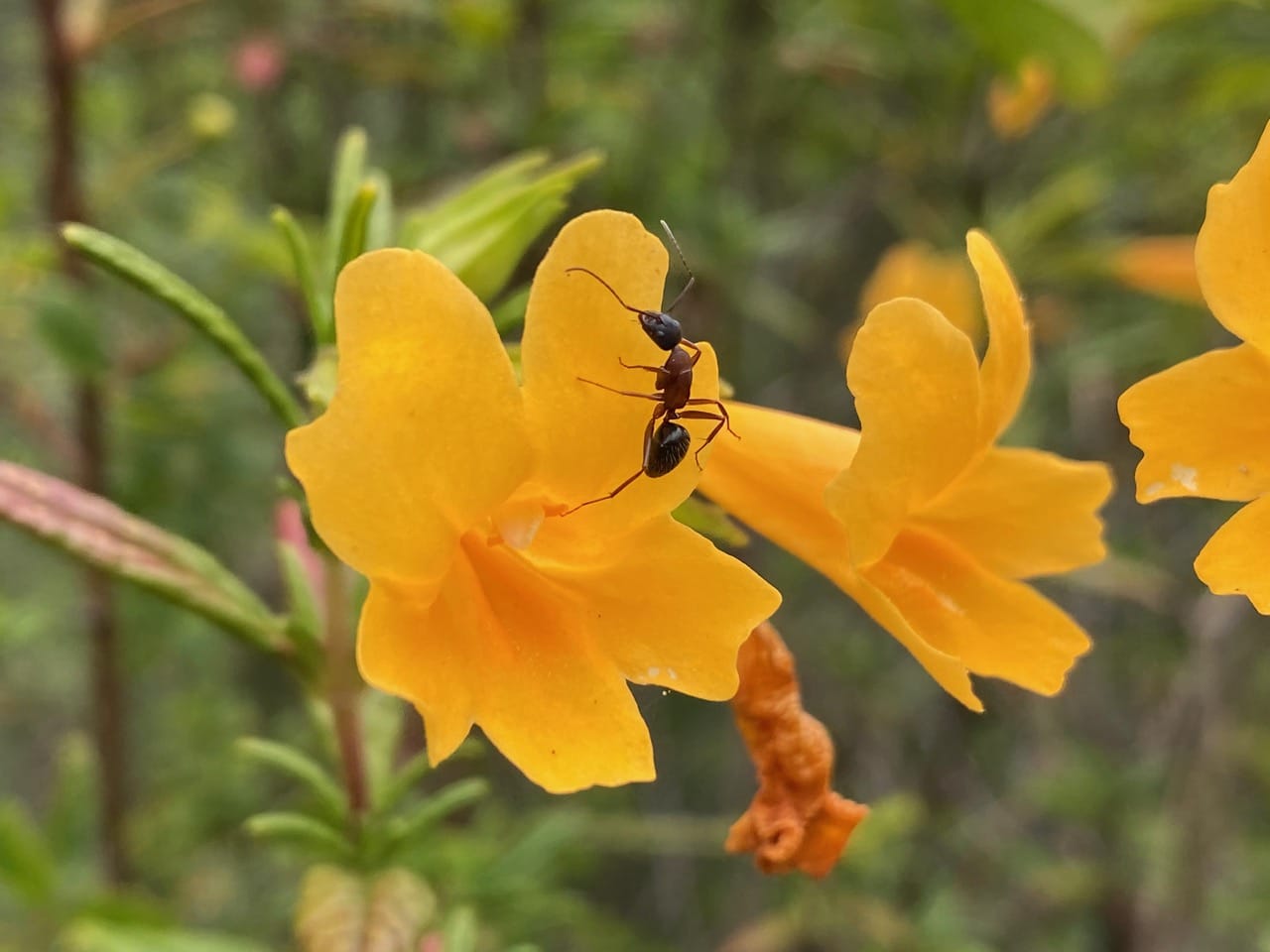
Carpenter Ants are so named for their skill at constructing their homes from wood. These large ants are excavators, not wood feeders. They are among the largest ants in North America, with workers ranging from 1/4 – 1/2 inch long. They have only one bulge at their narrow “waist” (the single node on their petiole)) and an evenly rounded back, when viewed from the side. In established colonies, two castes of sterile workers develop – major and minor workers. The larger major workers defend the nest and forage for food. Minor workers tend to the young and maintain the nest.
Most carpenter ants build their nests in dead or decaying trees or logs, though they may inhabit wooden structures in people’s homes. Camponotus do not eat wood. They are generalist omnivores, and will forage for honeydew, fruits, plant juices, other small insects and invertebrates. Some herd aphids for their honeydew, and will sometimes carry aphids to new plants. Carpenter ants can’t sting but can inflict painful bites with their powerful jaws and spray formic acid into the wound, causing a burning sensation.

A large Yellow-faced Bumble Bee, Bombus vosnesenskii (family Apidae) is lying flat on a Blackberry leaf. I notice rhythmic movements in her abdomen – she is vibrating her muscles to warm up. She appears to be in good shape, not a hair out of place. Is she a fresh gyne (“queen”) that is newly produced by the colony? The new queens will be mating with males soon on their nuptial flights. They will be the only individuals of their colony to overwinter. Waking up from hibernation early next spring, they will be responsible for establishing new colonies by themselves.
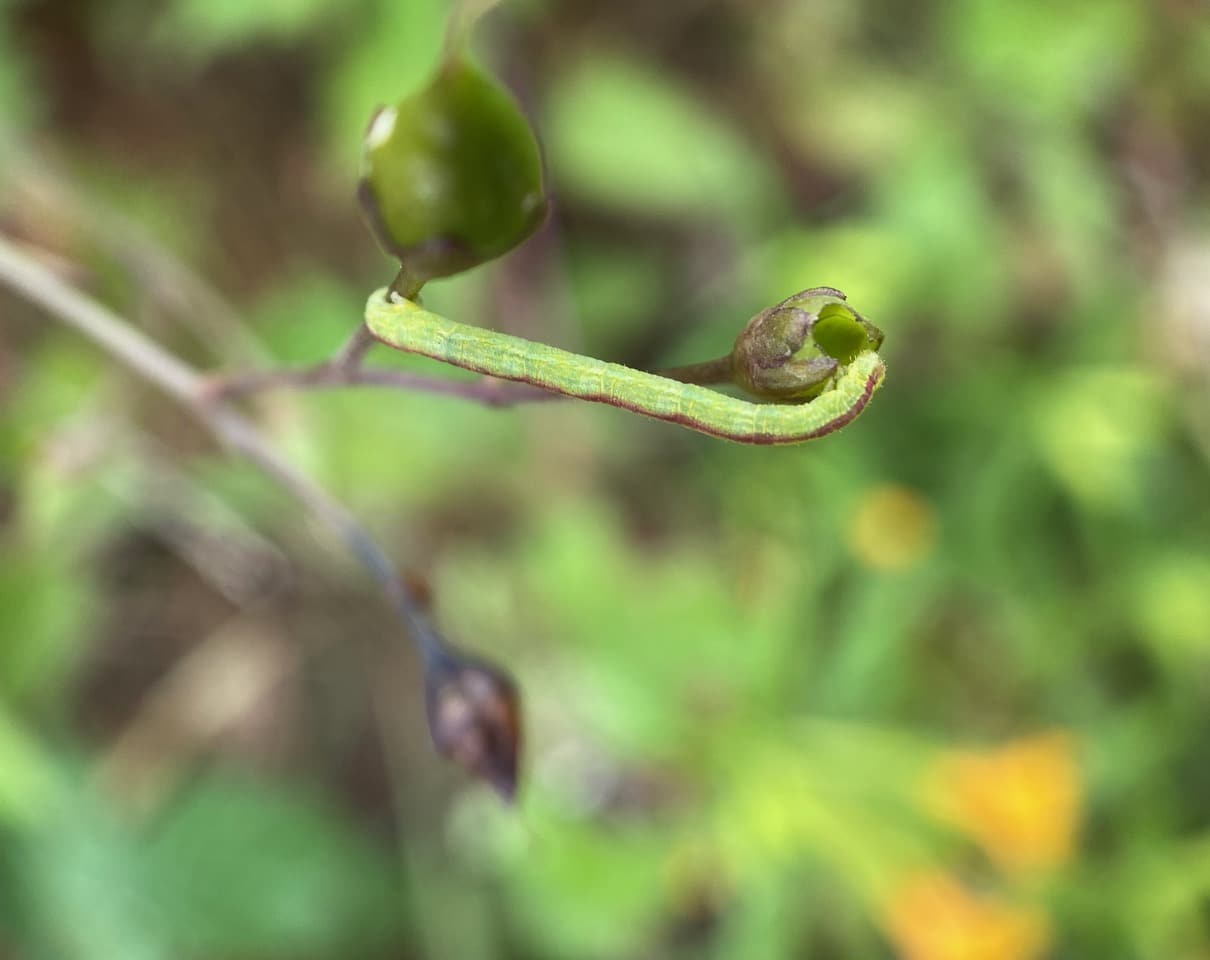
An Inchworm has stretched itself straight to reach the next flower bud of California Bee Plant, Scrophularia californica. Wow, did it hollow out that flower bud?
Inchworms are also called loopers and measuring worms. The majority of the inchworms are the larvae of moths in the family Geometridae. The name comes from the Greek “geo” for earth and “metro” from measure, because the caterpillars seem to be measuring the surface on which they are walking.
All caterpillars have three pairs of jointed legs behind their heads. These legs are called true legs because they will become the six legs of the adult butterfly or moth. There are additional appendages, called prolegs, along their bodies. Prolegs are not true legs, they are just outgrowths of the body wall and will be lost at metamorphosis. They have little hooks on their soles to help the caterpillar walk and grip onto things.
Most caterpillars have five sets of prolegs, four in the middle of the body and one pair at the hind end. Inchworms have the normal six true legs but only two or three pairs of prolegs, all located at the tail end of the body, with none in the middle. When an inchworm walks, it moves its tail-end prolegs up behind its true legs, causing the center of its body to loop upward. Then it stretches its front end forward to take another step.
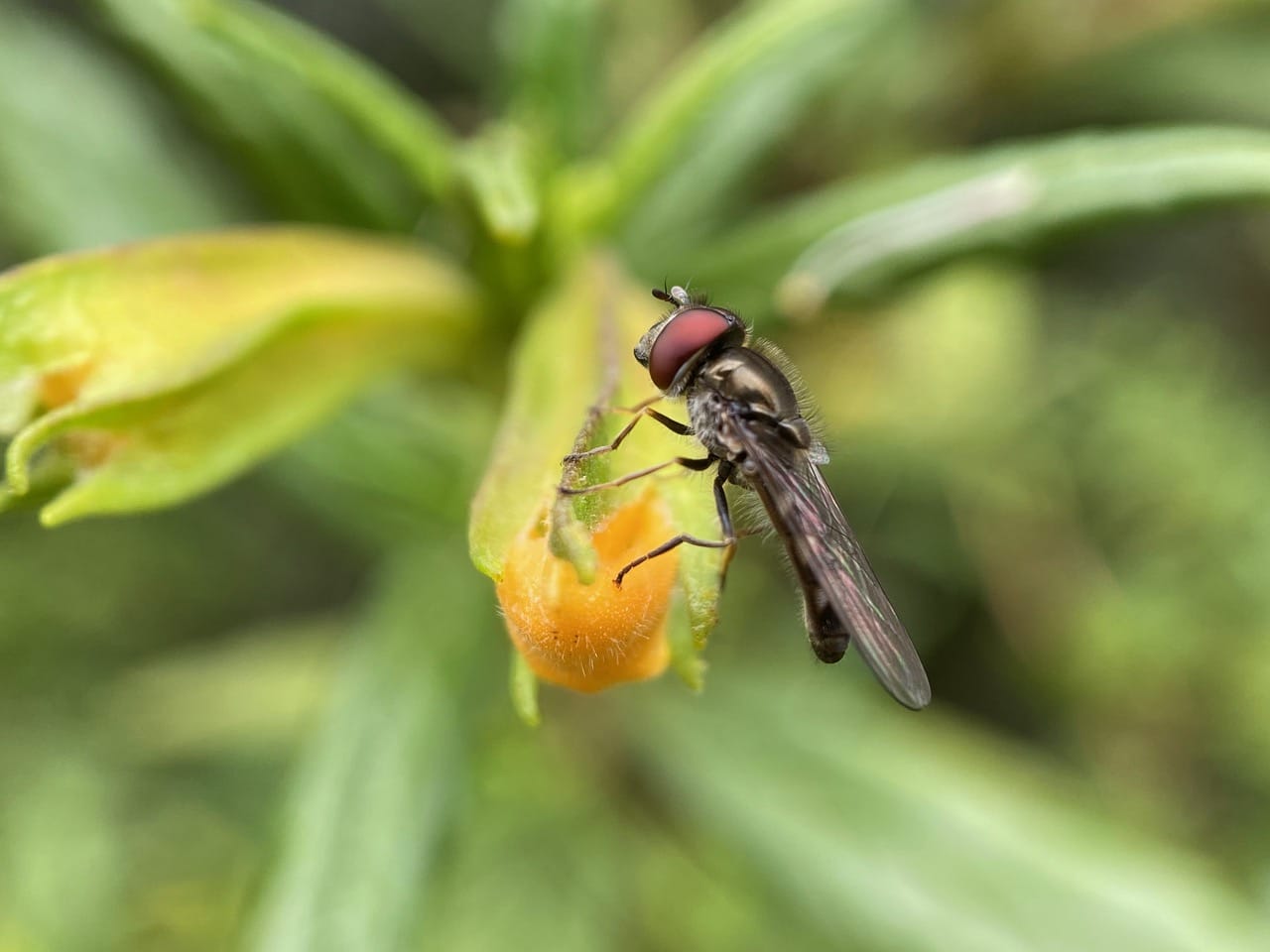
A Sedgesitter, Platycheirus sp. (family Syrphidae) lands on a flower bud of Sticky Monkeyflower.
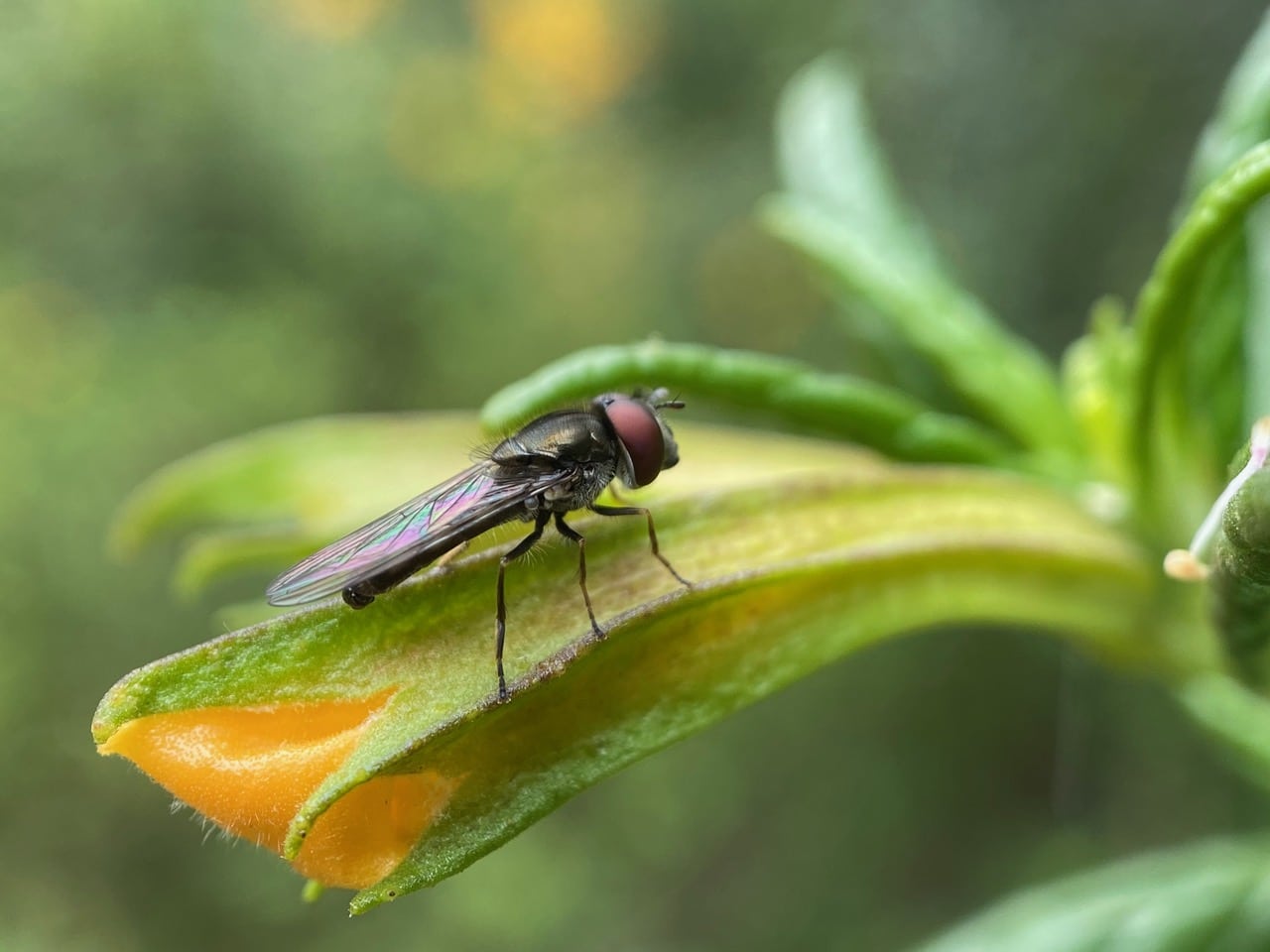
Platycheirus is found in grass and herb vegetation. Adults of many species feed on pollen of wind-pollinated plants, such as Salix, Plantago, Poaceae, Cyperaceae, but they visit other flowers also. Many stay active during cold and rainy weather. Larvae feed on aphids.

A Yellow-faced Bumble Bee, Bombus vosnesenskii is lying motionless on the ground, atop a piece of broken green glass. This bee also looks fresh. What is going on with our bumble bees?