

Pollinator Post 6/8/23 (1)
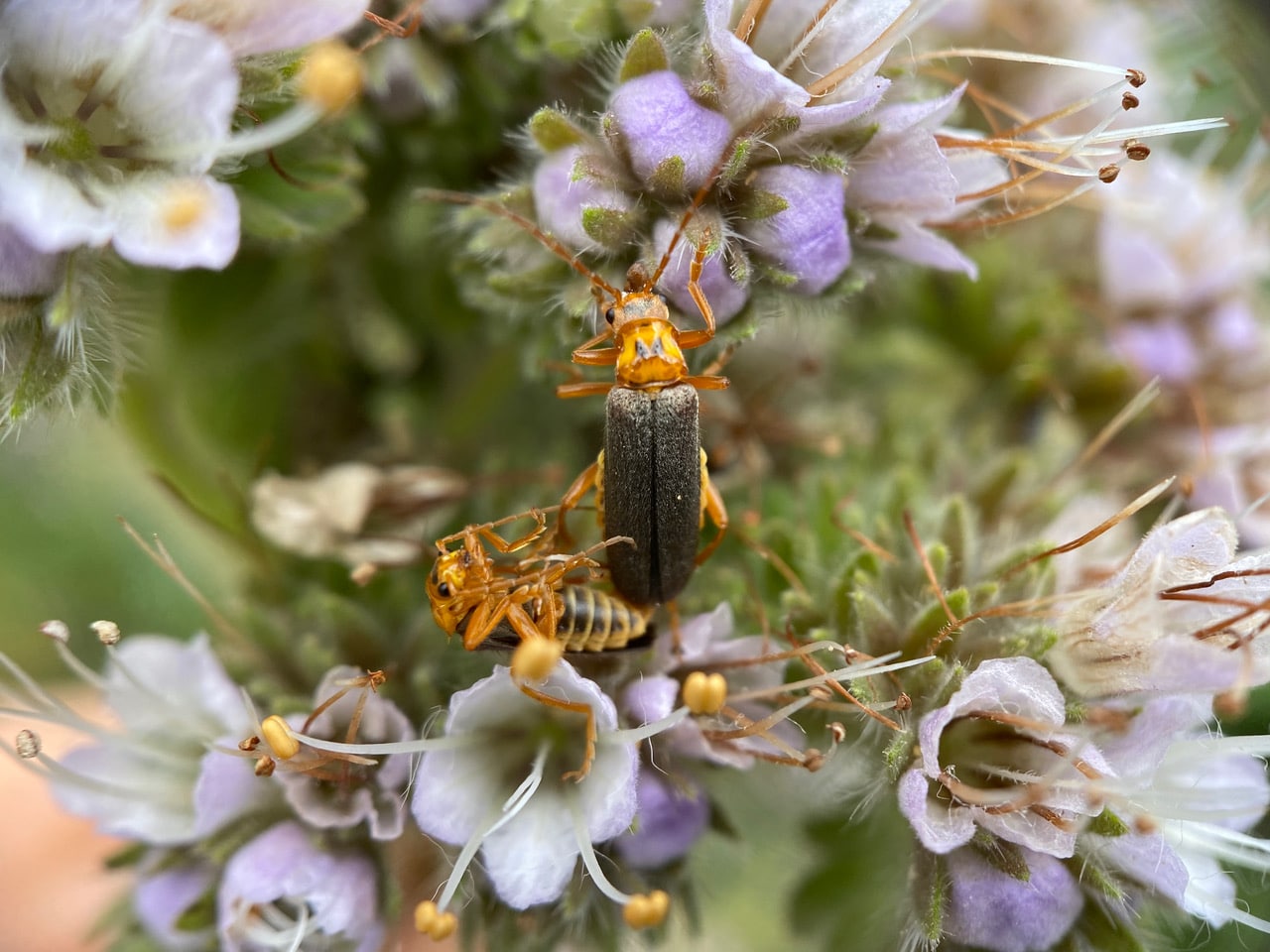
A pair of Soldier Beetles, Cultellunguis americanus (family Cantharidae) is mating while moving around on an inflorescence of California Phacelia, Phacelia californica. The female is dragging along the docile male lying on his back, looking rather uncomfortable. I often see this behavior in this species, but the beetles can engage in sex in a number of positions worthy of the Kama Sutra.

The winds are blowing quite briskly. On the edge of the steep cliff looking east, a Variable Checkerspot butterfly with wings spread wide is plastered against an inflorescence of California Phacelia. It does not budge even as I approach – rather unusual. Is it a victim of a Crab Spider? I cannot get any closer to investigate without tumbling down the cliff. Maybe the butterfly is just waiting to warm up when the sun comes out from behind the clouds?

At 10:05 am I have a moment of deja vous when taking this picture of a Small-headed Fly, Eulonchus sp. (family Acroceridae) sheltering in a Sticky Monkeyflower, Diplacus aurantiacus. Haven’t I taken this shot a couple of days ago around 4 pm? Checking back on the old picture at home, I’m almost sure that it is the same flower. But the same fly? Hasn’t it moved since? Do the flies always return to roost in the same flowers? With such fidelity??
As far as is known, all Acroceridae are parasitoids of spiders. Not just any spiders, but the Mygalomorphs of a more ancient lineage. This Acrocerid species, most likely Eulonchus tristis is known to parasitize the California Turret Spiders. Females lay large numbers of eggs near their host nests. After hatching the young larvae, called planidia seek out the spiders. The planidia can move in a looping movement like an inchworm and can leap several millimeters into the air. When a spider contacts an Acrocerid planidium, the planidium grabs hold, crawls up the spider’s legs to its body, and forces its way through the body wall. Often, it lodges near the spider’s book lung, where it may remain for years before completing its development. Mature larvae pupate outside the host. The Acrocerid adults are nectar feeders with exceptionally long probosces which are folded on the underside of the body when not in use. Acrocerids are rare but can be locally abundant. They are believed to be efficient pollinators for some native plants, including the Sticky Monkeyflowers.
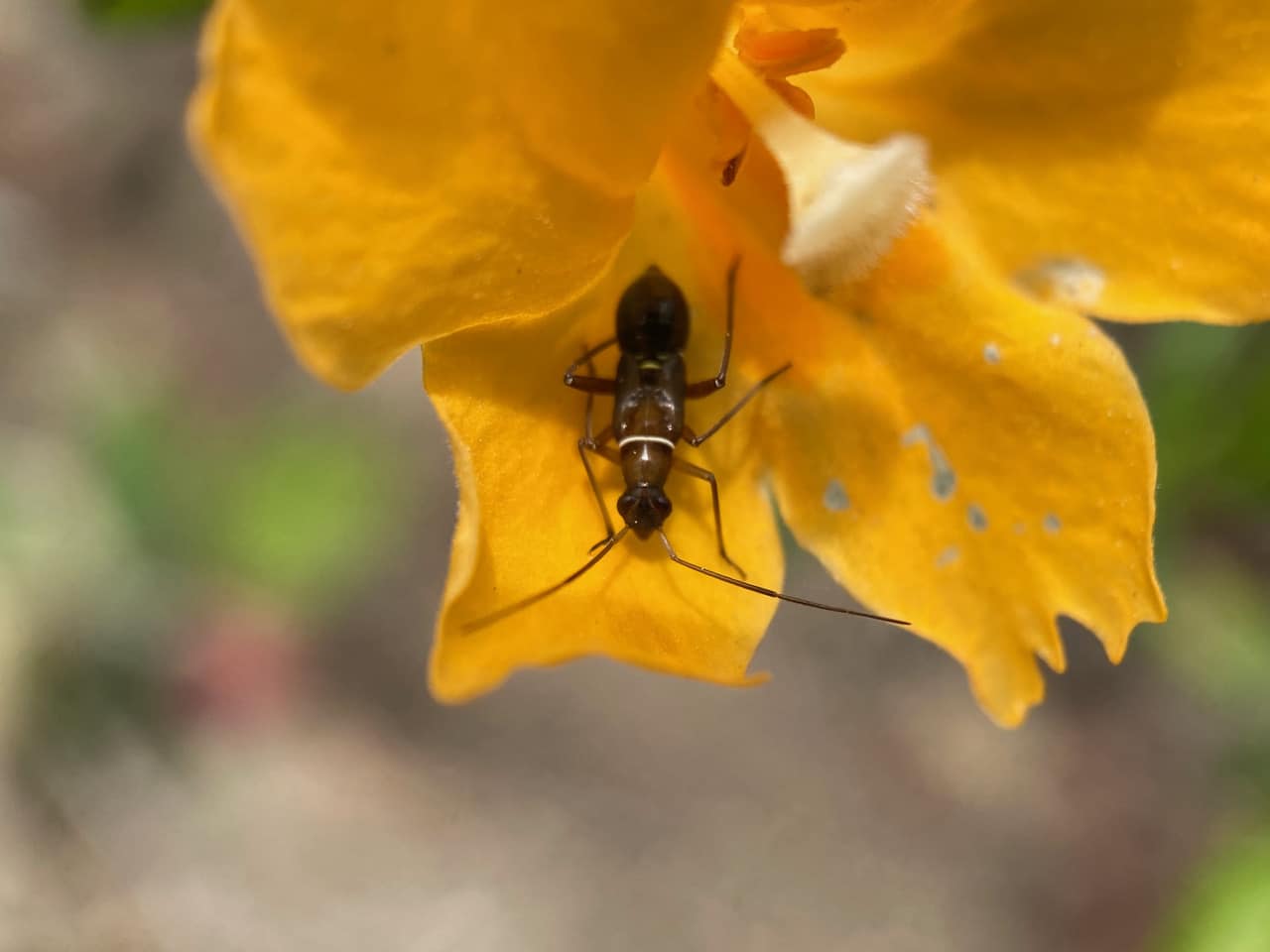
A nymph of the Plant Bug Closterocoris amoenus (family Miridae) is resting on the lower lip of a Sticky Monkeyflower, seeming to enjoy the sun that is just beginning to shine through the clouds. This is how I usually find the adults of this species in the past.
Mirid bugs are also referred to as plant bugs or leaf bugs. Miridae is one of the largest family of true bugs in the order Hemiptera. Like other Hemipterans, Mirids have piercing, sucking mouthparts to extract plant sap. Some species are predatory.
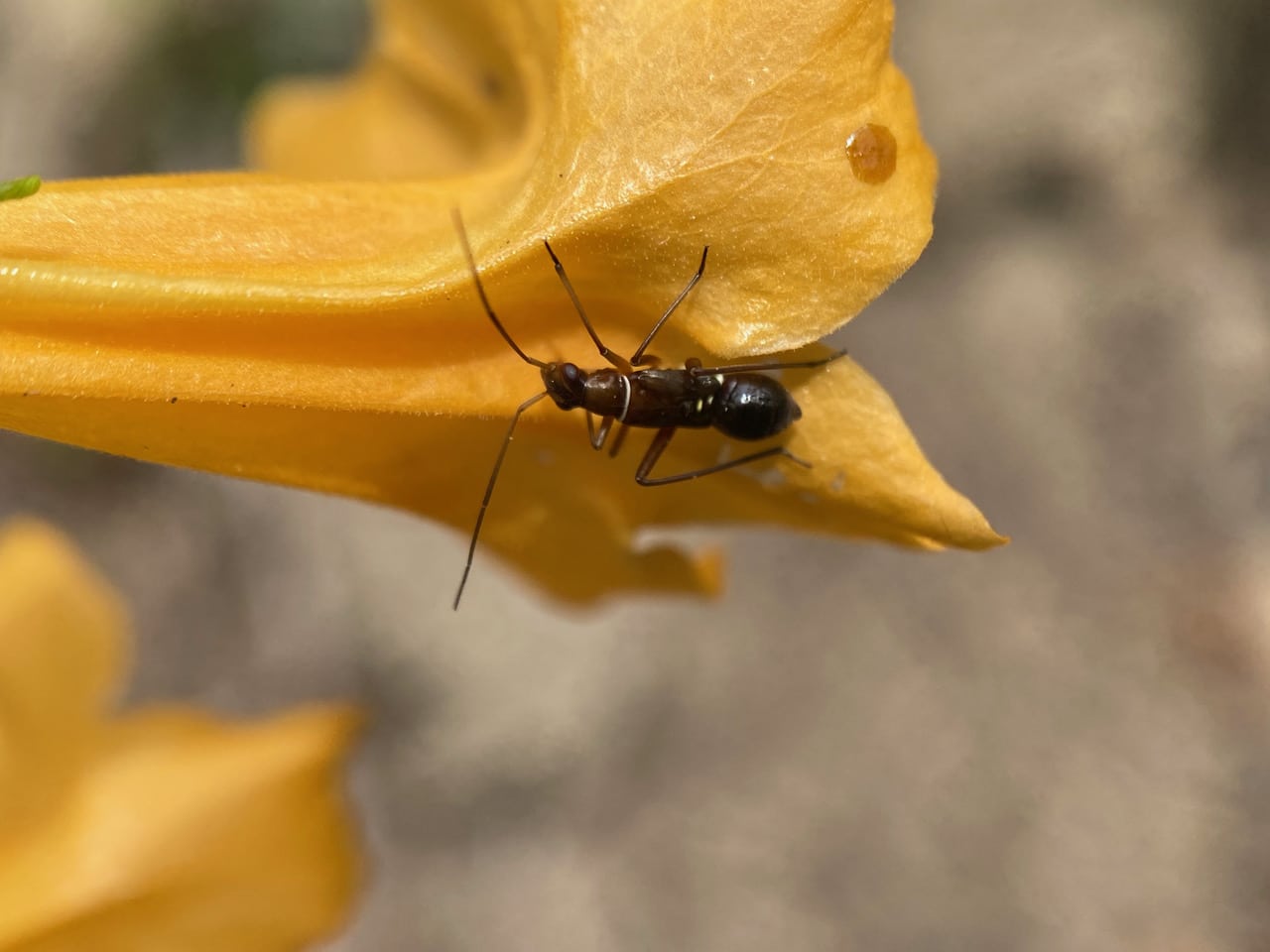
The wary nymph runs to the back of the flower. See any resemblance to an ant?

The nymph clambers up the foliage. Note the wing pads on its thorax. These will eventually develop into full-sized functional wings when the bug turns into an adult.
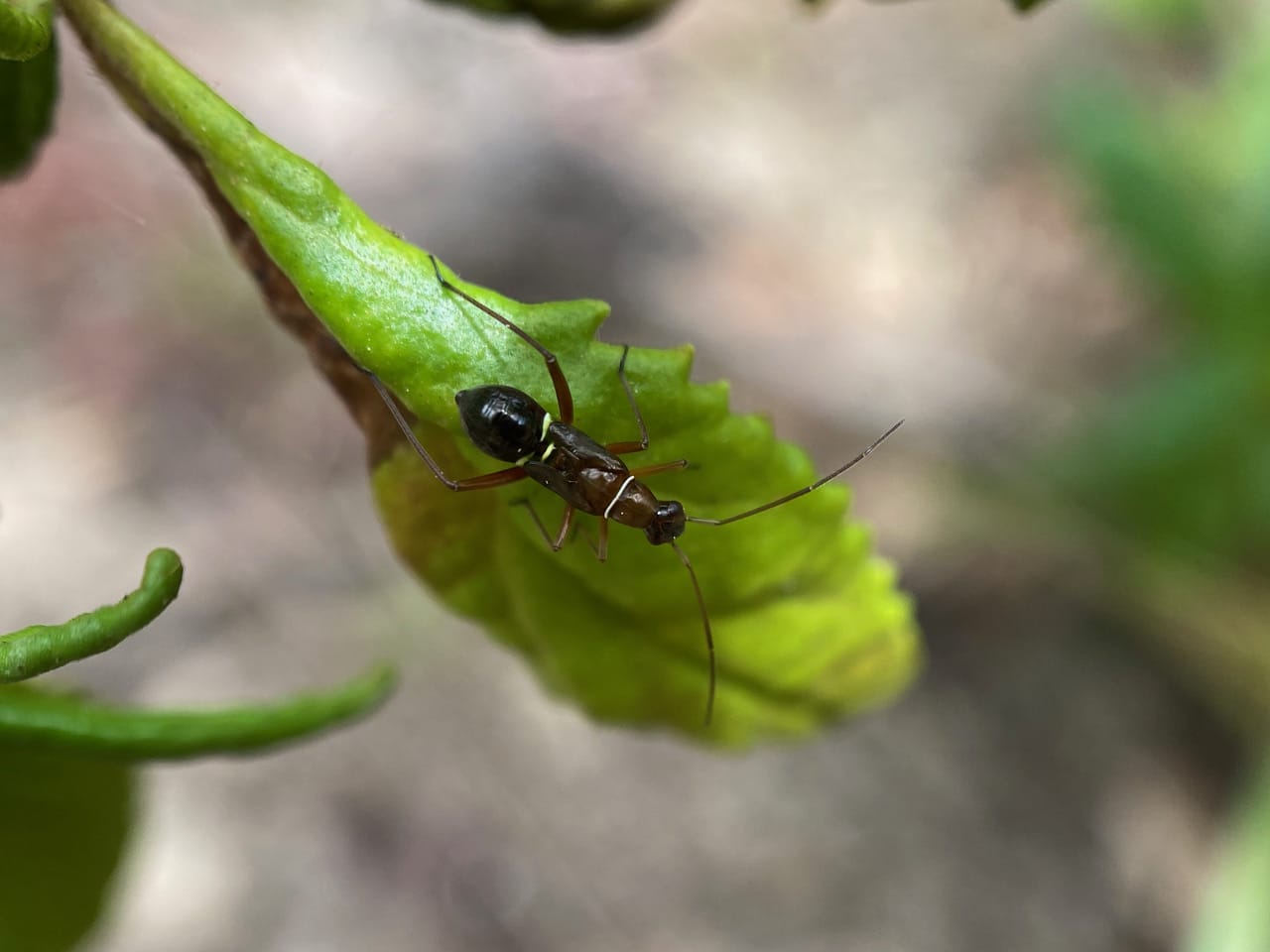
Alas, I never seem to get good enough light on this insect, even when it finally stops running.

This angle of the nymph shows the rostrum (the piercing-sucking mouthpart diagnostic of the order Hemiptera) folded under its body. This is definitely not an ant. The antennae are also a give-away – they are not geniculate (elbowed) as in the ants. Insect antenna forms – BugGuide.Net
Ant mimicry or myrmecomorphy is mimicry of ants by other organisms. Ants are abundant all over the world, and potential predators such as birds and wasps normally avoid them as they are either unpalatable or aggressive. Spiders are the most common ant mimics. Additionally, many insects from a wide range of orders and families mimic ants to escape predation (protective mimicry), while others mimic ants anatomically and behaviorally to hunt ants in aggressive mimicry.

I have never seen such a profusion of California Phacelia before. The plant is especially abundant along the paved road to the Water Tank.

Currently the California Phacelia is blooming side-by-side with the California Poppy, Eschscholzia californica. A bumble bee’s dream!

Hey, that’s no bumble bee! It’s a bumble wanna-bee! The aristate antenna gives it away as a fly. Insect antenna forms – BugGuide.Net
The Bumble Bee Hover Fly, Volucella bombylans (family Syrphidae) is slowly foraging for Phacelia nectar and pollen. It is much calmer than the real bees it mimics.
The Volucella bombylans complex comprises numerous hover flies that are bumble bee mimics, also known as Bumble Bee Hoverflies. These flies look like a bumble bee with a furry black and yellow body, but they are given away by their heads, plumed antennae, large eyes and a single pair of wings. Fast fliers, the adults feed on nectar and pollen, with a preference for blue and yellow flowers. The females lay eggs in the nests of bumble bees and social wasps. The larvae live as scavengers on the bottom of the host’s nest, feeding on waste and dead host larvae.
This provides a glimpse into a different larval niche from what most folks know about Syrphid Flies. We are familiar with the many Syrphid species that have larvae that feed on soft-bodied insects such as aphids. Quite a few other species have larvae that are aquatic filter-feeders that live in decomposing organic matter. Overall, the Syrphid larvae display a degree of habitat diversity that is unusually broad for a single family of Diptera.

A huge female Red-backed Jumping Spider, Phidippus johnsoni (family Salticidae) is sitting on the edge of a California Phacelia inflorescence. (Males of the species have a plain red abdomen.) Judging from the profusion of silk lines criss-crossing the spot, she must have been busy hunting from here.
Salticids are free-roaming hunting spiders. They do not weave a web to catch prey. They stalk, then pounce on their prey. Just before jumping, the spider fastens a safety line to the substrate. It can leap 10-20 times their body length to capture prey. Their movement is achieved by rapid changes in hydraulic pressure of the hemolymph (insect version of blood). Muscular contractions force fluids into the hind legs, which cause them to extend extremely quickly.

I once kept a female Red-backed Jumping Spider as a pet for a few weeks, watching her pounce with incredible precision on the live flies I caught for her. I finally had to let her go when she began to display nesting behavior, ready to lay eggs. My love affair with Salticids persists to this day, and the spiders have always been easy to photograph.
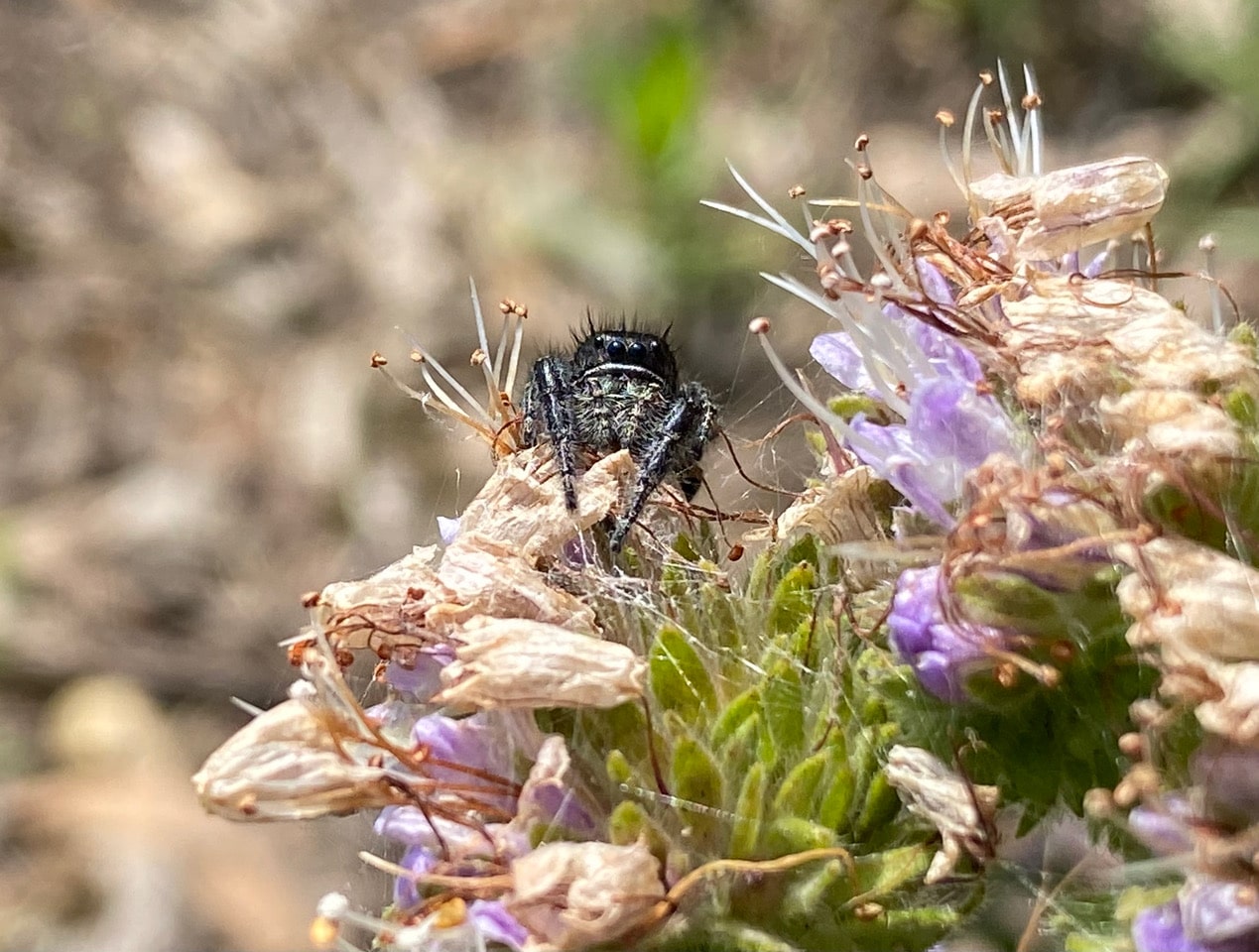
The spider spins around to face me, an endearing behavior typical of these bold and intelligent spiders. The pair of hairy structures below the curved white line on her face are her pedipalps, or palps in short. They are jointed appendages, much like small legs. They are used by the spider to sense objects, shape their webs, and to aid in prey capture and feeding. In male spiders, the pedipalps are also used to deliver sperm during mating.
Jumping spiders have excellent vision, with among the highest acuities in invertebrates. The 8 eyes are grouped four on the face (the two big Anterior Median Eyes in the middle, and two smaller Anterior Lateral eyes to the side), and four on top of the carapace. The anterior median eyes provide high acuity but small field of view, while the other six eyes act like our peripheral vision, with lower resolution but broad field of view. Since all eight eyes are fixed in place and can’t pivot independently from the body like human eyes can, jumping spiders must turn to face whatever they want to see well. This includes moving their cephalothorax up and down, an endearing behavior.


A flash of coppery shine leads my eyes to this fly on the Phacelia flowers. One look, and I know that this is a new species of Hover Fly for me – Yay! At certain angles, it has the dull, dark appearance of the Sedgesitter Hover Fly, Platycheirus sp. But its shape is less elongate, and it has the stripes on the thorax, absent in the Sedgesitter.
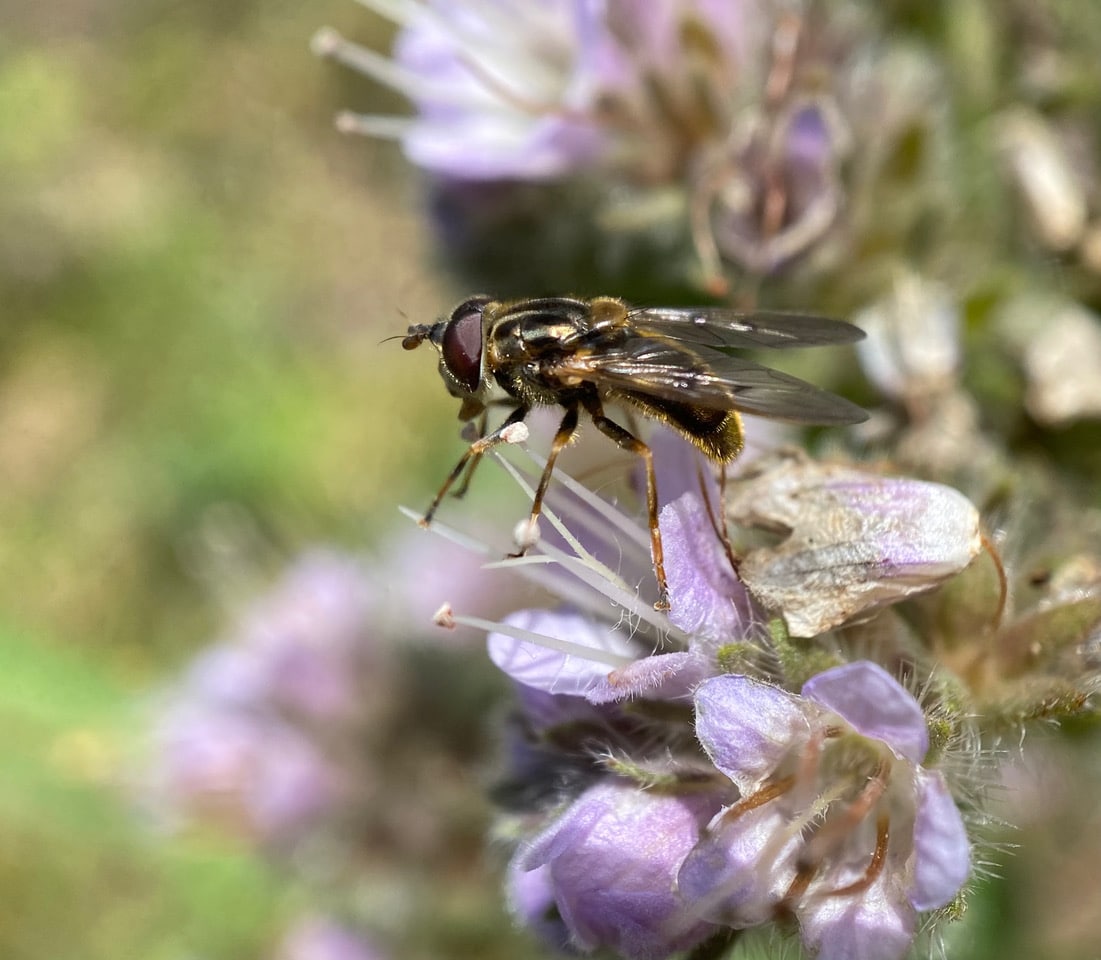
It is an elegant fly with golden hairs lining its body segments.
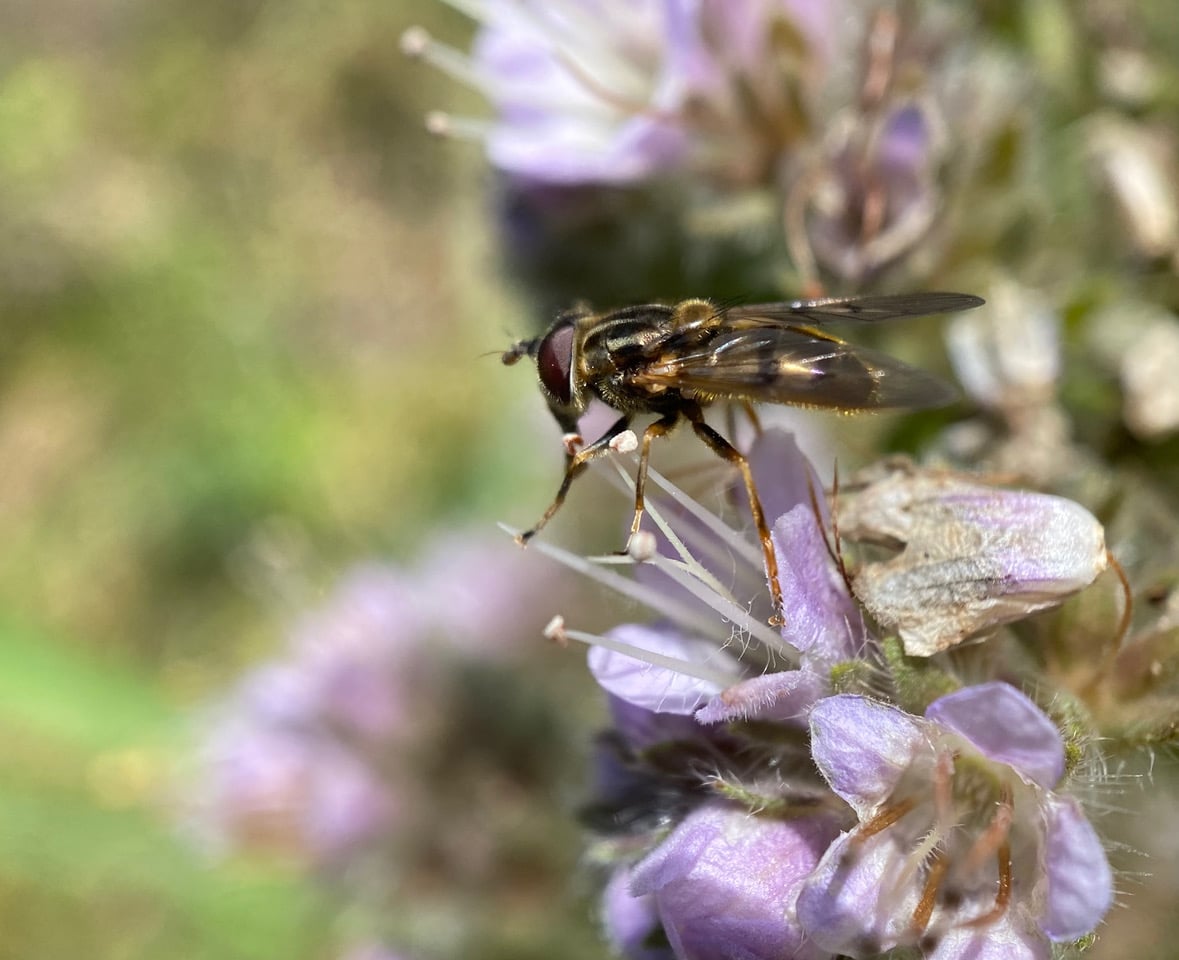
At certain incident angles, the fly’s abdomen lights up in a coppery shine.
iNaturalist has helped identify the fly as the Golden Copperback, Ferdinandea croesus (family Syrphidae). The species is found in western US and Canada. Abdomen is entirely bright bronze-green with dense golden-yellow pile. It belongs to the subfamily Eristalinae, which includes the familiar Drone Flies. Larvae of most Eristalinae feed on decaying organic debris. They are filter feeders in different kinds of aquatic media. They purify water by filtering microorganisms and other products of decomposition.