

Pollinator Post 6/7/26
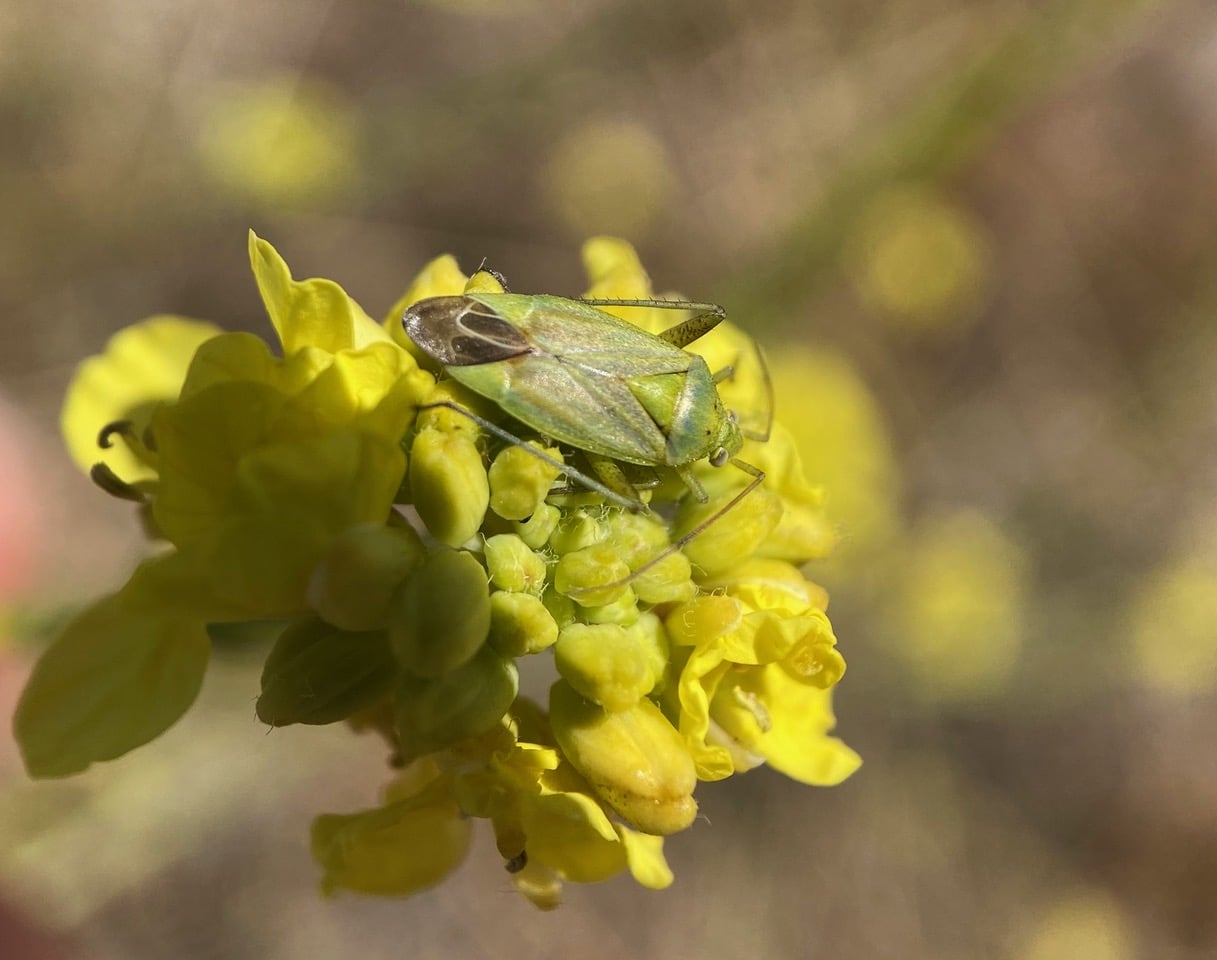
On the Shoreline trail at Bay Farm, a Potato Mirid, Closterotomus norwegicus (family Miridae) is resting on a cluster of Wild Mustard flowers.
The Potato Mirid originated in the Mediterranean region, but is now widespread worldwide. It is an adventive, polyphagous species of bugs belonging to the family Miridae, subfamily Mirinae. This cosmopolitan insect attacks a wide range of herbaceous plants and it is also partly predacious. In New Zealand it developed a taste for young potato plants, which probably accounts for its common name. Like other mirids, the bug possesses a sharp and hard needle-like piercing-sucking mouthparts capable of penetrating tough tissue and sucking nutrients. It feeding activities threatens pistachio nut production in California. The female bugs prefer to lay their eggs on native or introduced legumes, or weeds such as wild mustard and wild radish.
One useful feature in identifying members of the family Miridae or plant bugs is the presence of a cuneus; it is the triangular tip of the corium, the firm, horny part of the forewing, the hemielytron. The cuneus is visible in nearly all Miridae.

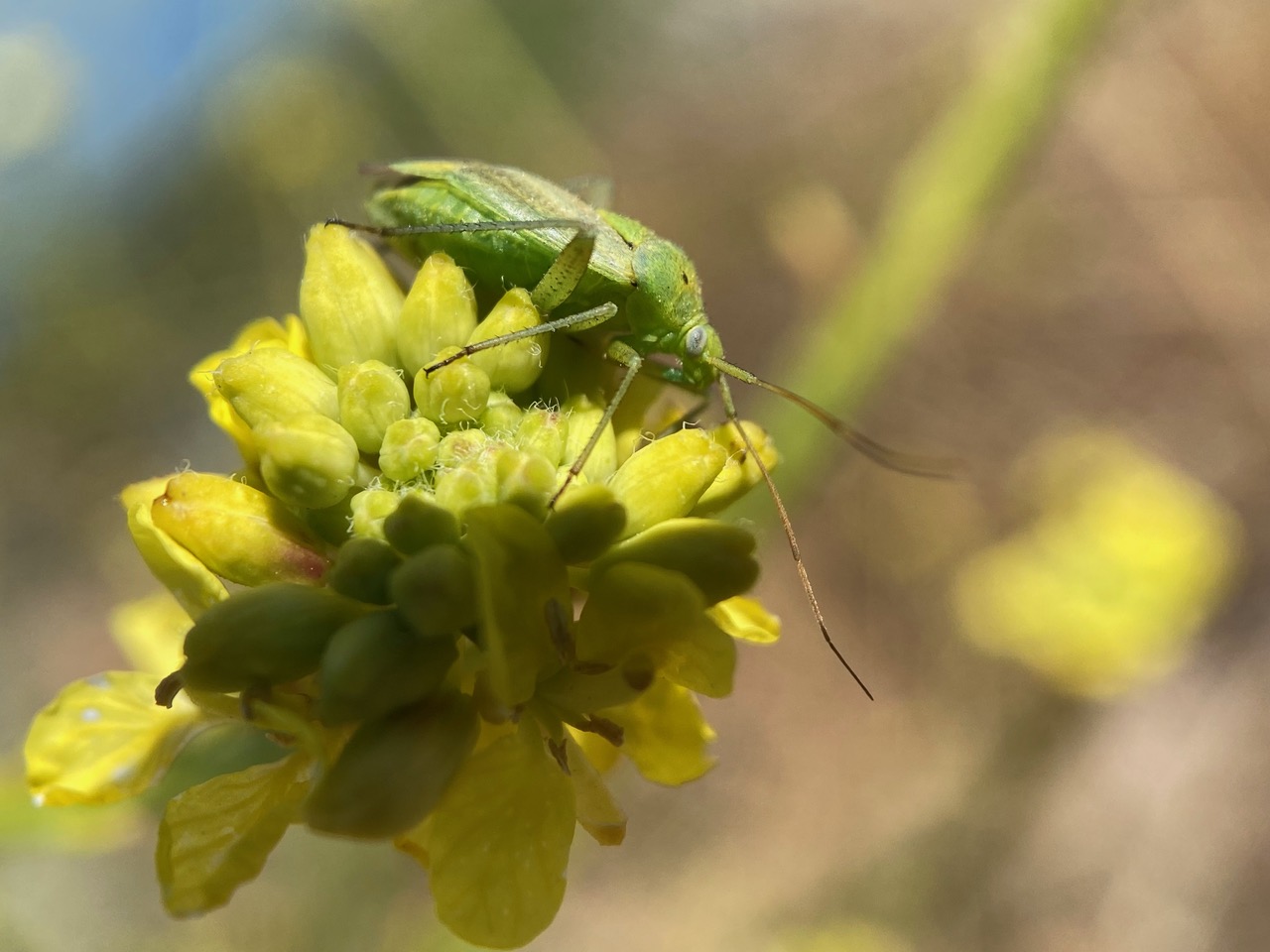
Side view of the same Potato Mirid showing its rostrum that has been folded neatly under its body.
True bugs (insects in the order Hemiptera) are defined by their unique piercing-sucking mouthparts. They use a specialized, straw-like structure called a rostrum (or beak) to puncture host tissues (such as plant stems or animal skin), and extract liquids for nourishment. The rostrum consists of a segmented, sheath-like structure (the modified labium) that houses and protects the feeding stylets when the bug is not eating. It is usually folded neatly underneath the body when not in use. Inside the rostrum are four needle-like structures called stylets. The outer pair (modified mandibles) are often barbed or serrated, used to saw or puncture through the surface of plants or prey. The inner pair (modified maxillae) lock together to form two microscopic tubes: one for injecting saliva and digestive enzymes, and the other for sucking up liquified food.
When the bug feeds, the labium does not pierce the host; instead, it folds or buckles backwards, bending to help guide and support the stylets. The sharp mandibular stylets are used to pierce the tough outer layers of a plant or animal. Saliva containing specialized enzymes is pumped down into the puncture to digest the plant or prey tissues. The bug then uses a muscular pump in its head to suck the predigested, liquified nutrients back up through the maxillae tube.


A little fuzzy bee is taking nectar from a Wild Mustard flower.

Ooh, I recognize that pointy, hairy black-and-white abdomen – it is a Cellophane Bee, Colletes sp. (family Colletidae).

The bee family Colletidae includes generalists and specialists, and they are likely important pollinators of many wildflowers. All Colletidae in North America are solitary ground nesters, but some species nest in large aggregations. There are two major genera of Colletidae in North America: the Masked Bees (genus Hylaeus) and Cellophane Bees (genus Colletes). The most obvious shared characteristics of Colletidae is also the hardest to see: their short tongue. Colletes are moderately hairy, slender bees, ranging in size from 7 to 16 mm. Distinct features include a hairy head and thorax, pale bands of hair on the abdomen, and a heart-shaped head. The eyes of Colletes are angled (rather than being parallel), making the face slightly heart-shaped.
The genus name Colletes means “one who glues”, referring to their habit of applying a glue- or cellophane-like lining to the walls of nest cells, using their specialized tongues. This lining gives rise to their common names: cellophane bees, polyester bees, and plasterer bees. Colletes tongue is unique: short, flat, and forked at the tip. Colletes line their nests with a distinctive cellophane-like substance made from saliva and secretions from the Dufour’s gland on the abdomen. Using their specialized tongue, they paint the walls with saliva, then with secretions from the Dufour’s gland, they add a coat of varnish. This creates a clear covering that is strong, durable, and resistant to mold and water.
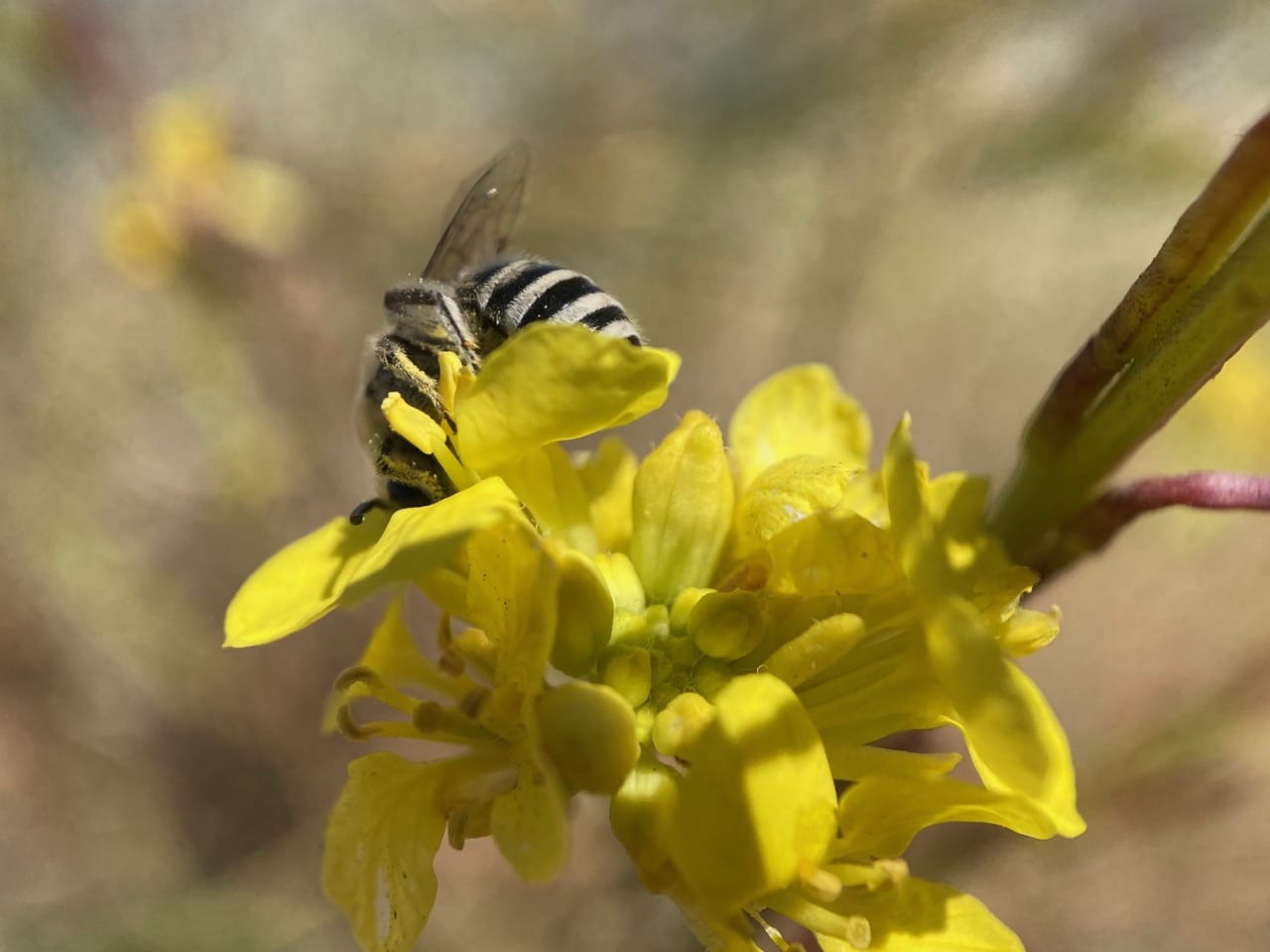
Because of its short tongue, the bee has to reach in deep to access the nectar at the base of the floral tube.

A very small fly has landed on a Coffeeberry leaf. iNaturalist has helped identify it as a Satellite Fly, Metopia sp. (family Sarcophagidae, subfamily Miltogramminae). I often see these flies hang around the nest burrows of the American Sand Wasps and ground-nesting bees, a common behavior observable on the sandy habitats of Alameda.
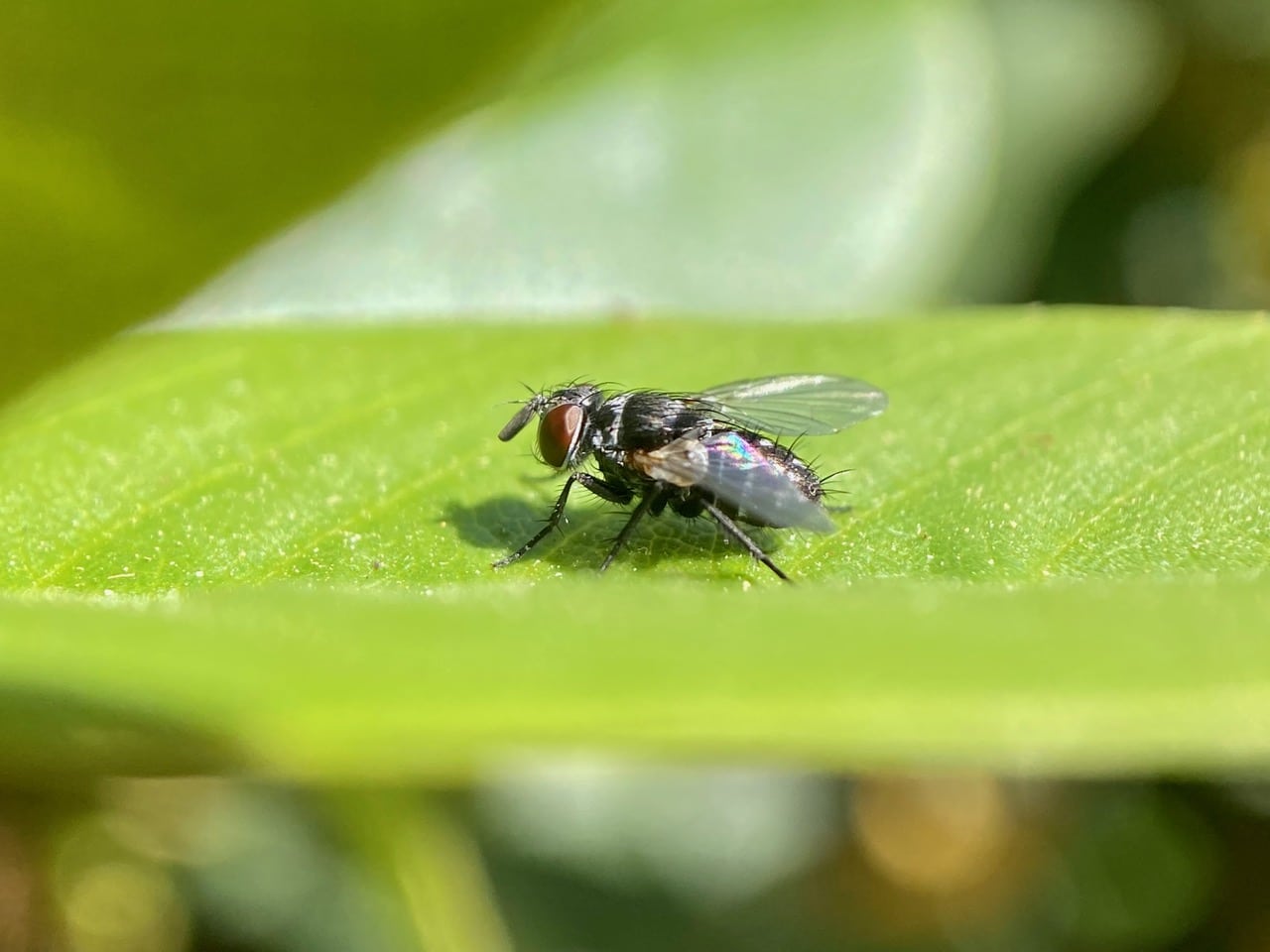
Members of the family Sarcophagidae are commonly called Flesh Flies. Many have black and gray longitudinal stripes on the thorax and checkering on the abdomen, red eyes, and a bristled abdomen sometimes with a red tip. They differ from most flies in that they are ovoviviparous, opportunistically depositing hatched or hatching maggots instead of eggs on carrion, dung, decaying material, open wounds of mammals, hence their common name. The adults mostly feed on fluids from animal bodies, nectar, sweet foods, fluids from animal waste and other organic substances. While we may find their habits revolting, Flesh Flies perform important roles in the ecosystem – the larvae as decomposers/recyclers, and the adults as pollinators.
Metopia is not your ordinary Flesh Flies (family Sarcophagidae). Its larvae occupy a special niche. As kleptoparasites, they develop in the nests of bees and wasps, feeding on the provisions that the females have prepared for their own young. The female Metopia enters the nest of its host to deposit its larvae.
 Argentine Ants are tending a colony of Melon Aphids at the base of the terminal leaves of a California Coffeeberry, Frangula californica.
 The Argentine Ant, Linepithema humile (family Formicidae) is native to Northern Argentina, but it has been inadvertently introduced by humans to many countries, and is now an established invasive species in many Mediterranean climate areas worldwide. The success of the species can be attributed to their lack of aggression between the colonies. There is no apparent antagonism between separate colonies of its own kind, resulting in “super-colonies” that extend across hundreds or thousands of kilometers in different parts of the their range. Genetic, behavioral, and chemical analyses show that introduced Argentine Ants on separate continents actually represent a single global supercolony.
The Argentine Ants are ranked among the world’s worst invasive animal species. In its introduced range, the Argentine ant often displaces most or all native ants and can threaten native invertebrates and even small vertebrates that are not accustomed to defending against the aggressive ants. This can, in turn, imperil other species in the ecosystem, such as native plants that depend on native ants for seed dispersal, or lizards that depend on native ants for food.

Most of the Melon Aphids are found on the underside of tender young leaves. Note the winged aphid on the edge of the leaf.
Melon Aphids, Aphis gossypii, also known as cotton aphids, are tiny (1.0-1.5 mm long), destructive pests that feed on the undersides of leaves. Ranging from light green to nearly black, they suck vital plant fluids, cause severe leaf curling, secrete sticky “honeydew” that leads to black sooty mold, and act as active vectors for plant viruses. Capable of cloning themselves, a single female produces dozens of live young, allowing populations to mature and reproduce in as little as 5-7 days. Winged females are produced for dispersal when the colony is overcrowded or when resources dwindle. Natural predators include lady beetles, lacewings, and parasitic wasps.
 An Argentine Ant is tapping an aphid with its antennae to coax it to release honeydew from its rear end. It takes a lot of patience “milking” these tiny aphids!
Honeydew is a sugar-rich sticky liquid that is secreted by aphids, some scale insects, many other true bugs, and some other insects as they feed on plant sap. When their mouthpart penetrates the phloem, the sugary, high-pressure liquid is forced out of the anus of the insects, allowing them to rapidly process the large volume of sap they imbibe.
Ants and aphids share a well-known mutualistic relationship. The aphids produce honeydew, a sugary food for the ants; in exchange, the ants care for and protect the aphids from predators and parasites. Some ants will “milk” the aphids to make them excrete the sugary substance. The ants stroke the aphids with their antennae, stimulating them to release the honeydew. Aphid-herding ants make sure the aphids are well-fed and safe. When the host plant is depleted of nutrients, the ants carry their aphids to a new food source. If predatory insects or parasites attempt to harm the aphids, the ants will defend them aggressively. Some species of ants continue to care for aphids during winter. The ants carry the aphids to their nest for the winter months, and transport them to a host plant to feed the following spring.
 Several bloated, straw-colored aphids can be seen on the stem below. These are aphids that have been decimated by a parasitoid wasp. Aphid Mummy Wasps, Aphidius sp. (family Braconidae) are small wasps, typically less than 1/8 in. long. The female wasp lays a single egg in an aphid. When the egg hatches, the wasp larva feeds inside the aphid. As the larva matures the aphid is killed and becomes bloated and mummified, usually turning tan or golden in color. The adult wasp chews its way out of the mummy leaving a circular hole.
Ooh, here are many more mummies! The parasitoid wasps have been busy in this aphid colony. The adult wasps have yet to emerge from these mummies.

A Fiery Skipper has landed on a branch tip of Coffeeberry.
Skippers are a family, the Hesperiidae, of the order Lepidoptera (butterflies and moths). They are named for their quick, darting flight habits. Most have the antenna clubs hooked backwards like a crochet hook. They also have generally stockier bodies and larger compound eyes than the other butterflies. Their wings are usually small in proportion to their bodies. When at rest, skippers keep their wings usually angled upwards or spread out, and only rarely fold them up completely. Californian species are mostly brown or tan, with black, orange, or yellow markings.
Skipper caterpillars are usually green or brown, sometimes yellowish, never brightly colored. They have a distinctive “collar”, a narrow ring around the body right behind the head. Caterpillars are camouflaged and often hide during the day. Many species make nests of leaves and silk for additional protection. Most North American species feed on grasses, but some common species eat shrubs and trees, especially in the bean family. Most species are limited to a single group of food plants. Adult skippers are only active during the day, but Skipper caterpillars feed mainly when it is dark or partly light.
Fiery Skippers, Hylephila phyleus (family Hesperiidae) is a small butterfly, with a wingspan of 1.25 to 1.5 in. It can be seen from March to November. Host plants include various species of grasses. Fiery Skipper is the most abundant grass skipper in California, mostly due to its dominance in urban areas, thanks to the ubiquity of the Great American Lawn. Originally found only in North and South America, it has been introduced into Hawaii and Bali.
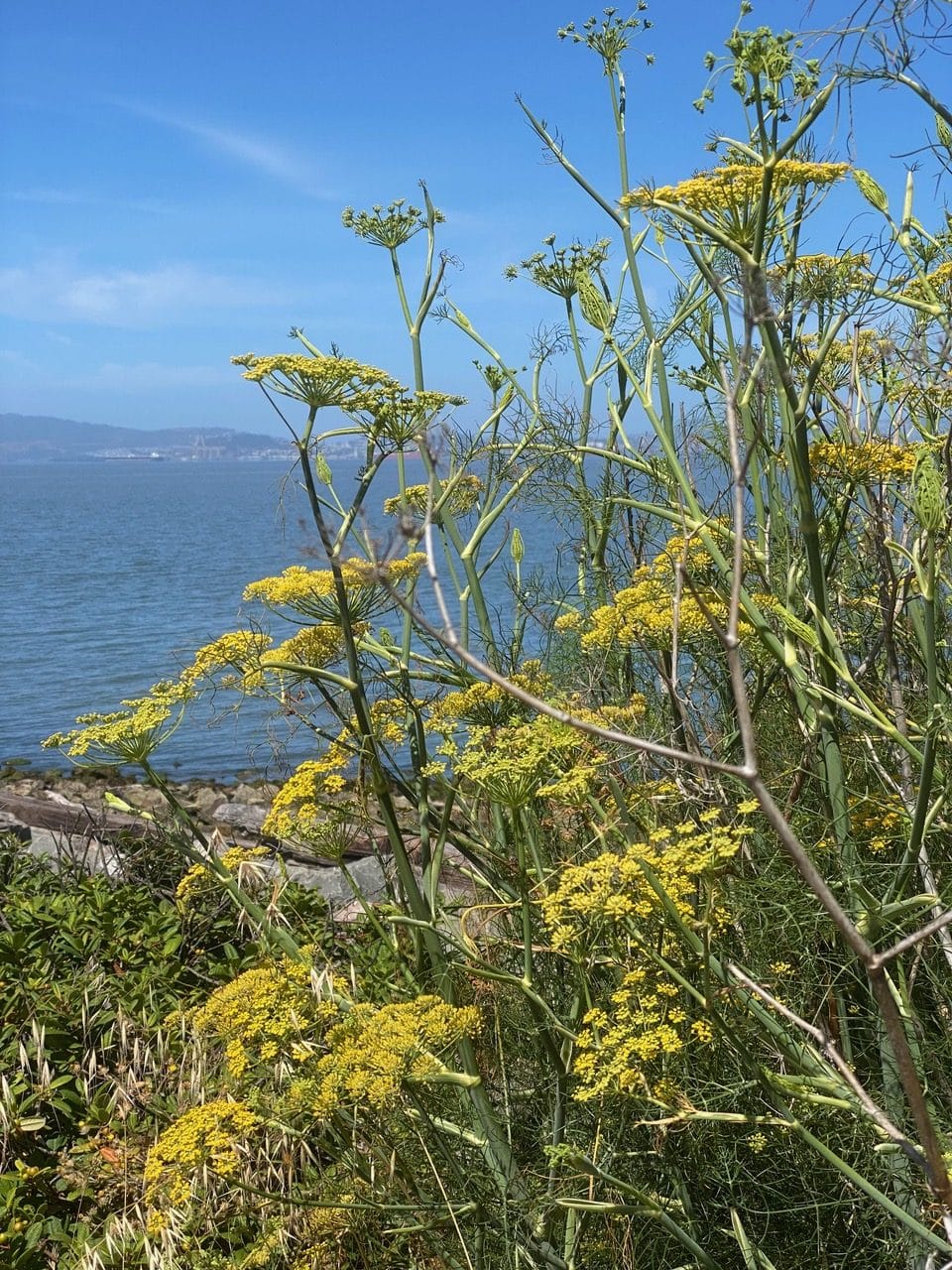
It’s hard to ignore the Fennel, Foeniculum vulgare that is blooming gloriously next to the Coffeeberry.
Native to the Mediterranean, Fennel, Foeniculum vulgare belongs to the carrot family, Apiaceae which includes Anise Swallowtail’s original native host plants, such as Lomatium and Cow Parsnip. Since its introduction to North America, the plant has created a fascinating ecological shift. The butterfly has successfully adapted to using Fennel as a primary larval host plant. Because the invasive Fennel grows aggressively across disturbed areas, it provides a consistent, abundant food source that allows the butterflies to thrive in urban and suburban landscapes. While the plant supports multiple generations of butterflies from early spring through fall, land stewards and native plant conservationists still view Fennel as a threat to local biodiversity. In areas like the San Francisco Bay Area, native plants like Lomatium are crowded out by dense thickets of Fennel, which do not provide the proper habitat for other local insects.
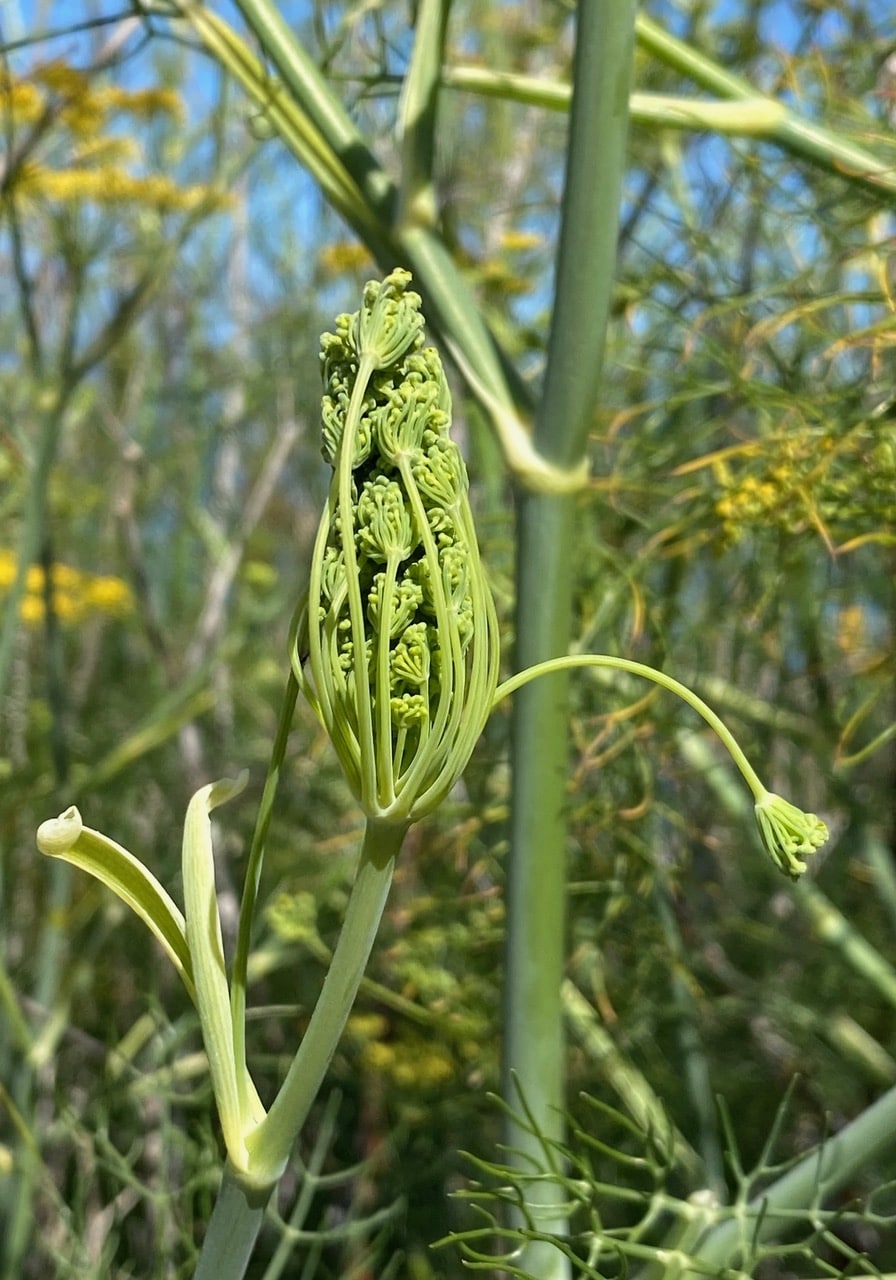
What a thing of beauty it is even before it is fully unfurled! I marvel at the intricacy of an immature umbel of Fennel – note how the varying lengths of the flower stalks enable the compact packing of the smaller umbels within the large umbel.

A large, glossy black wasp is foraging on an umbel of Fennel flowers. It is a male Thread-waisted Burrowing Wasp, Sphex lucae (family Sphecidae).
The Sphecidae are solitary wasps with elongated and narrow first abdominal segment, giving rise to the common name Thread-waisted Wasps. Sphex lucae is a widespread western species, ranging from WA in the north, south to CA, and east to TX. The species exhibits sexual dimorphism – females are black with a red abdomen, while the males are all black. Adults visit many types of flowers for nectar. Females hunt katydids and grasshoppers as food for their young. The wasp excavates a single-celled burrow in the soil in advance of hunting activities. She drags her paralyzed prey back to the burrow, laying a single egg on the victim. The nest entrance is then sealed and the process is repeated. Males of this species spend nights in sleeping aggregations in sheltered places such as beneath a rock overhang.