

Pollinator Post 6/7/25

Breezy afternoon at Shoreline Park, Bay Farm Island. High tide.
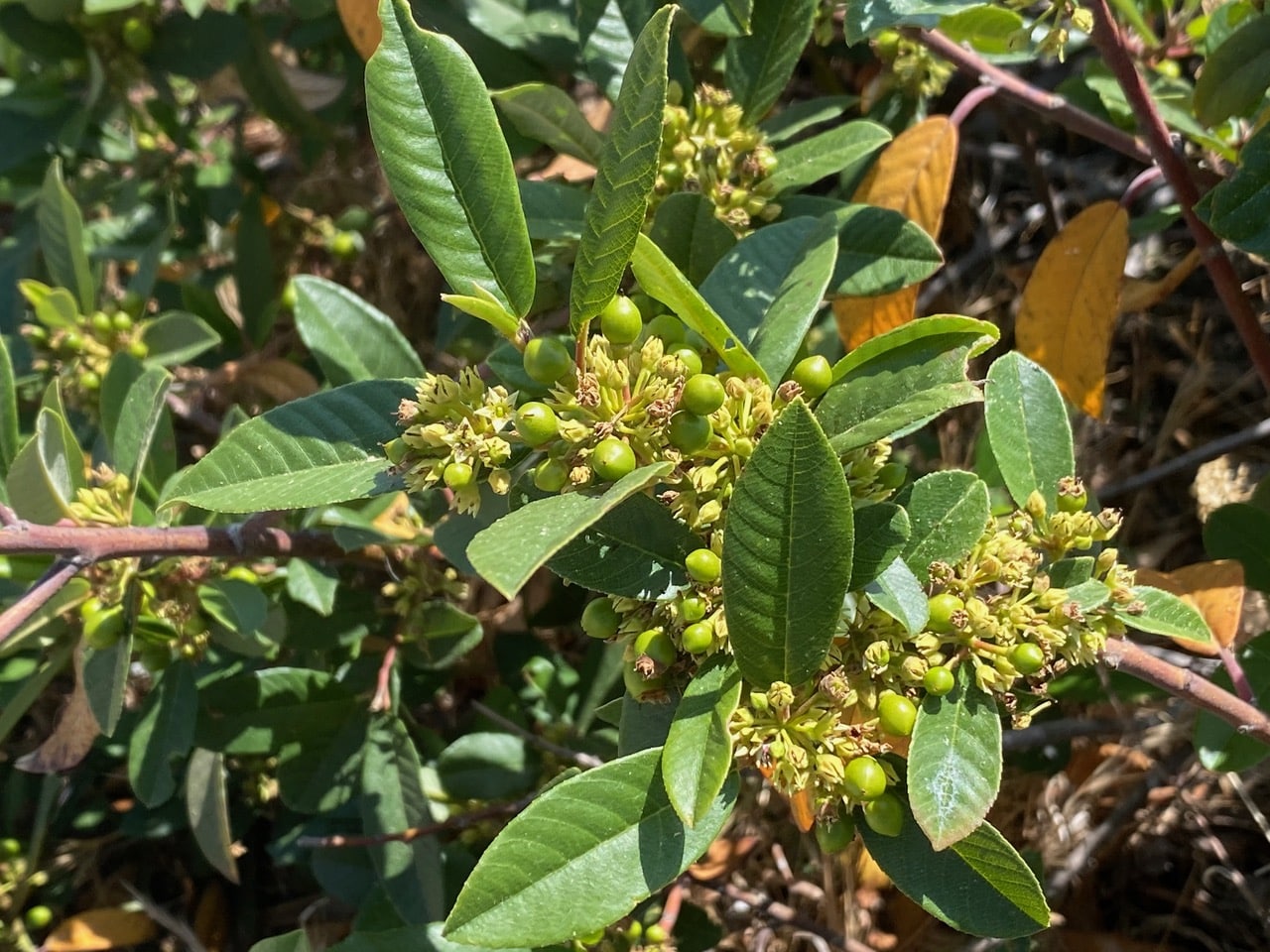






I pause at this big shrub of Coffeeberry, Frangula californica in full bloom on the shoreline embankment above the lapping waves. There is quite a bit of insect activity on the bush, winds not withstanding.
A bumper crop of fruits are already developing on some branches as the flowers fade.
The most conspicuous insects are the large American Sand Wasps, Bembix americana (family Crabronidae). The wasps are chasing each other in flight over the bush, only occasionally landing to refuel on flower nectar.
Sand wasps in the genus Bembix are familiar and common throughout North America, digging their burrows in dunes, on beaches, and other habitats with loose, deep sand. The female rapidly kicks out large quantities of sand using a “tarsal rake” of spines on each front leg. The burrow is excavated before the wasp goes hunting. Bembix are generalist, opportunistic hunters. True flies in the order Diptera are the usual prey. A victim is paralyzed or killed by the wasp’s sting, and is then flown back to the nest. Most species will lay an egg on the first victim, while some species lay an egg in the empty cell before starting to hunt. Once the egg hatches, mama wasp brings flies to her larva as needed. This “progressive provisioning” is rare in the insect world. When the larva reaches maturity, mama wasp closes the cell. Inside, the larva spins an oblong cocoon, weaving sand grains into the structure and resulting in a hardened capsule. Overwintering takes place as a prepupa inside this cocoon, but there are usually two generations a year.
Male sand wasps often engage in an elaborate flight ritual called “sun dances”. Males emerge before females, and fly erratically at dizzying speed one or two inches above the ground attempting to detect virgin females about to emerge from their underground nests. Both sexes are often seen taking nectar at flowers, especially from Asteraceae family. Bembix wasps are often victims of other insects such as cuckoo wasps (Chrysididae), velvet ants (Mutillidae), satellite flies (Sarcophagidae), bee flies (Bombyliidae), and thick-headed flies (Conopidae).
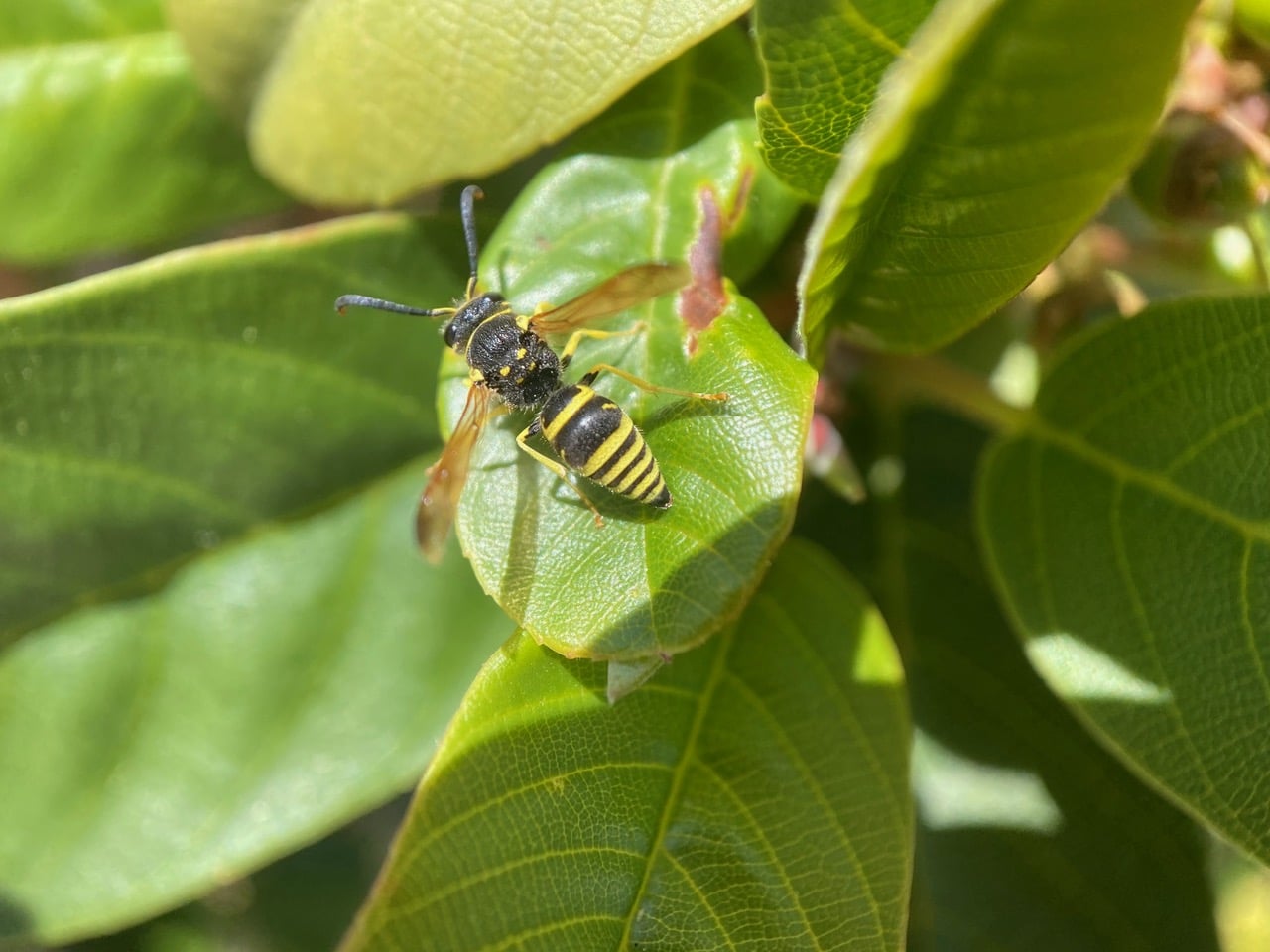
A Mason Wasp, Ancistrocerus bustamente (family Vespidae, subfamily Eumeninae) makes frequent stops at the Coffeeberry flowers, but I only manage to capture a picture as it lands for a split second on a leaf.
Potter wasps (or mason wasps), the Eumeninae, are a cosmopolitan wasp group presently treated as a subfamily of Vespidae. Most eumenine species are black or brown, and commonly marked with strikingly contrasting patterns of yellow, white, orange, or red. Their wings are folded longitudinally at rest. Eumenine wasps are diverse in nest building. The Mason Wasps are species that generally nest in pre-existing cavities in wood, rock, or other substrate. Potter Wasps are the species that build free-standing nests out of mud, often with a spherical mud envelope. The most widely used building material is mud made of a mixture of soil and regurgitated water.
All known Eumenine species are predators, most of them solitary mass provisioners. When a cell is completed, the adult wasp typically collects beetle larvae, spiders, or caterpillars and, paralyzing them, places them in the cell to serve as food for a single wasp larva. As a normal rule, the adult wasp lays a single egg in the empty cell before provisioning it. The complete life cycle may last from a few weeks to more than a year from the egg until the adult emerges. Adult mason wasps feed on floral nectar.
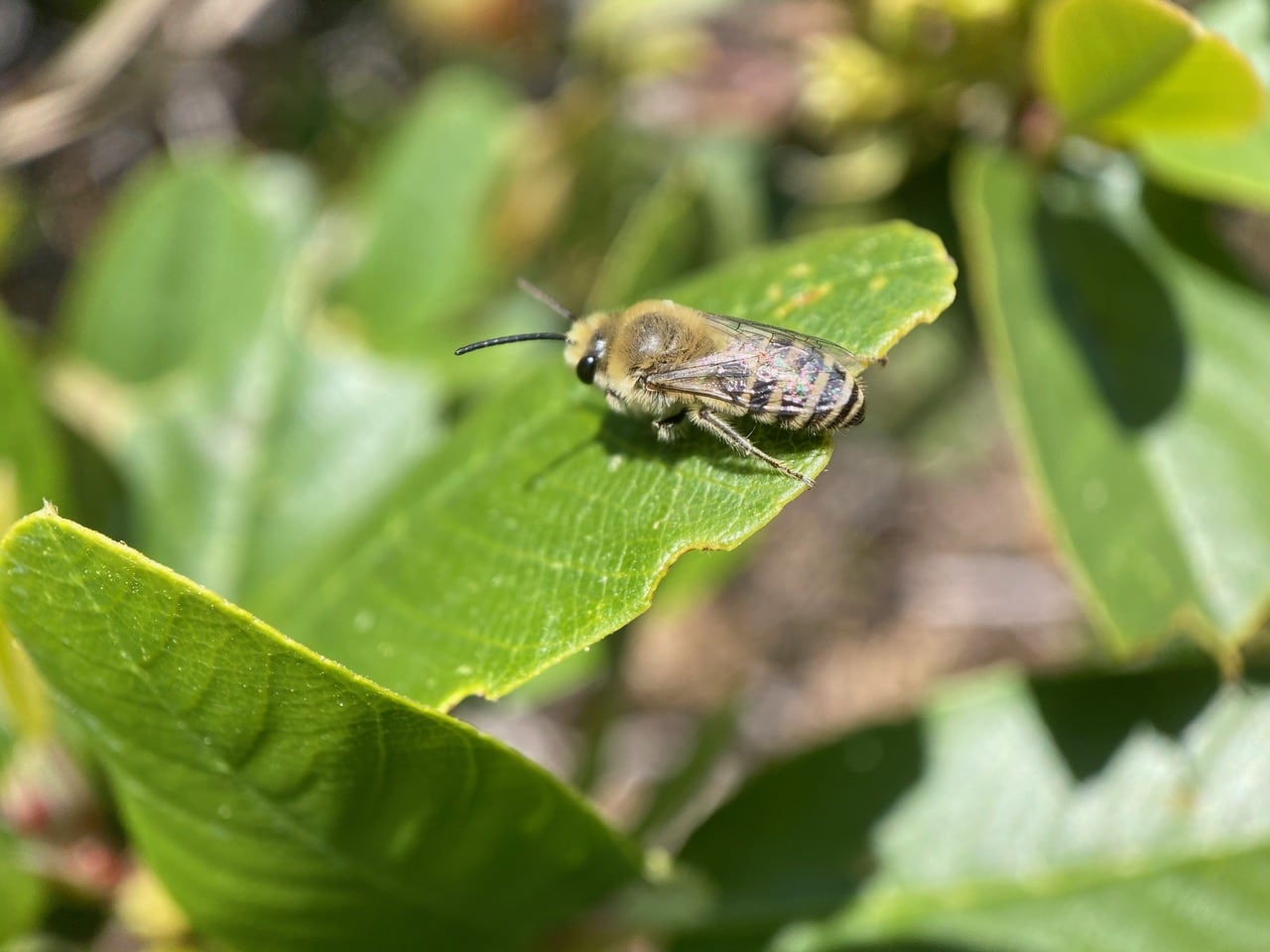
A brief glimpse of a fuzzy little bee as it lands on a Coffeeberry leaf. I think it might be a Golden-haired Miner Bee, Andrena auricoma (family Andrenidae). The ground-nesting bee is found in the western United States, and is relatively rare outside California.
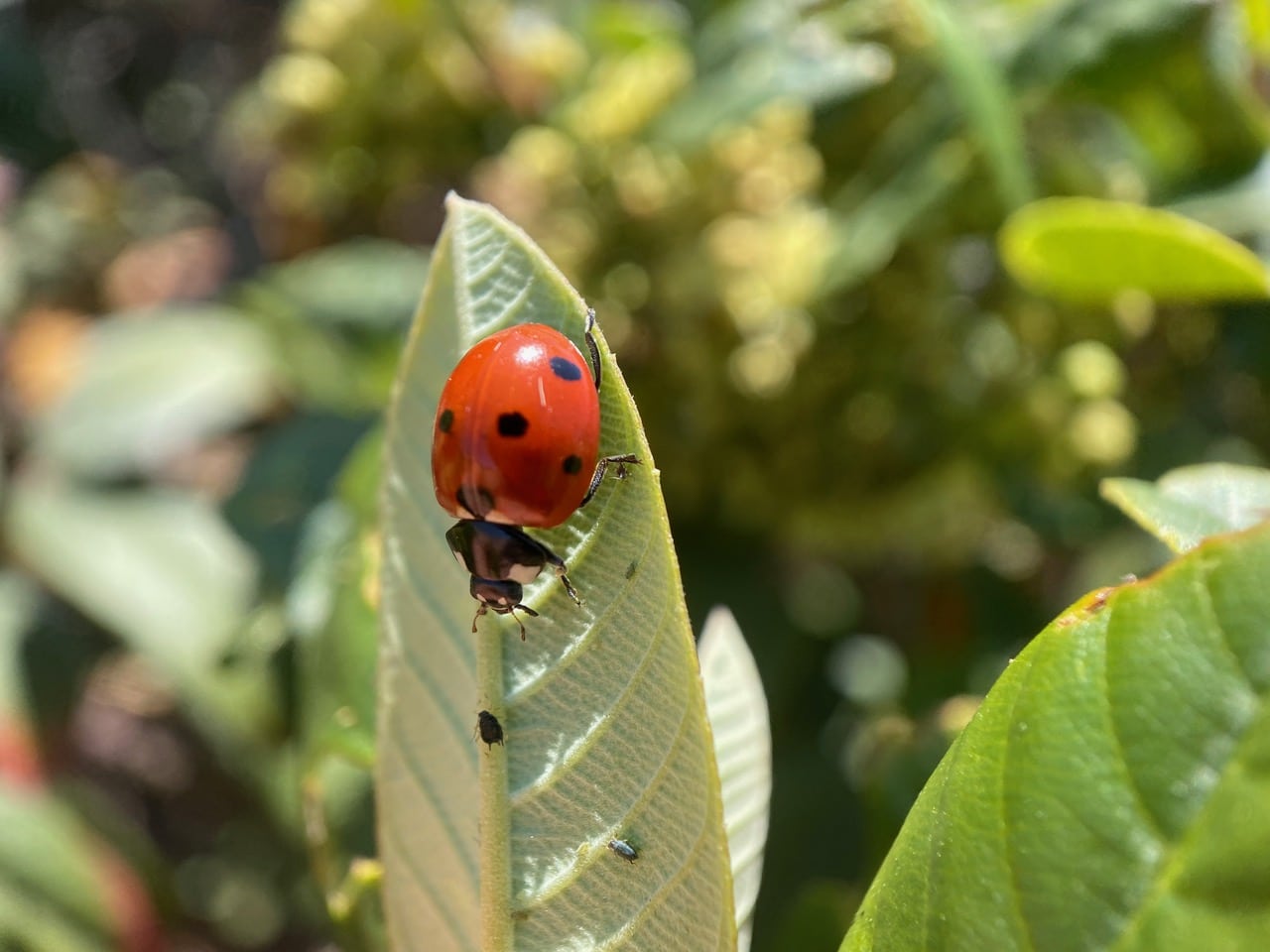
Two different species of Lady Beetles are resting on the same branch of Coffeeberry. The larger one on the left is a Seven-spotted Lady Beetle, Coccinella septempunctata (family Coccinellidae) and the other is our native Convergent Lady Beetle, Hippodamia convergence.
Native to Europe, the Seven-spotted Lady Beetle, Coccinella septempunctata (family Coccinellidae) has been repeatedly introduced to North America as a biological control agent to reduce aphid numbers. It has since spread to many states, where it has outcompeted some native species. The Seven-spotted Lady Beetles are large; adults may reach a body length of 0.5 in. Their distinctive spots and conspicuous colors warn of their toxicity, making them unappealing to predators. When threatened, the beetles can secrete a fluid from joints in their legs which gives them a foul taste.
As I watch, the Seven-spotted Lady Beetle descends to feed on the tiny dark aphids on the tender terminal leaves of Coffeeberry.
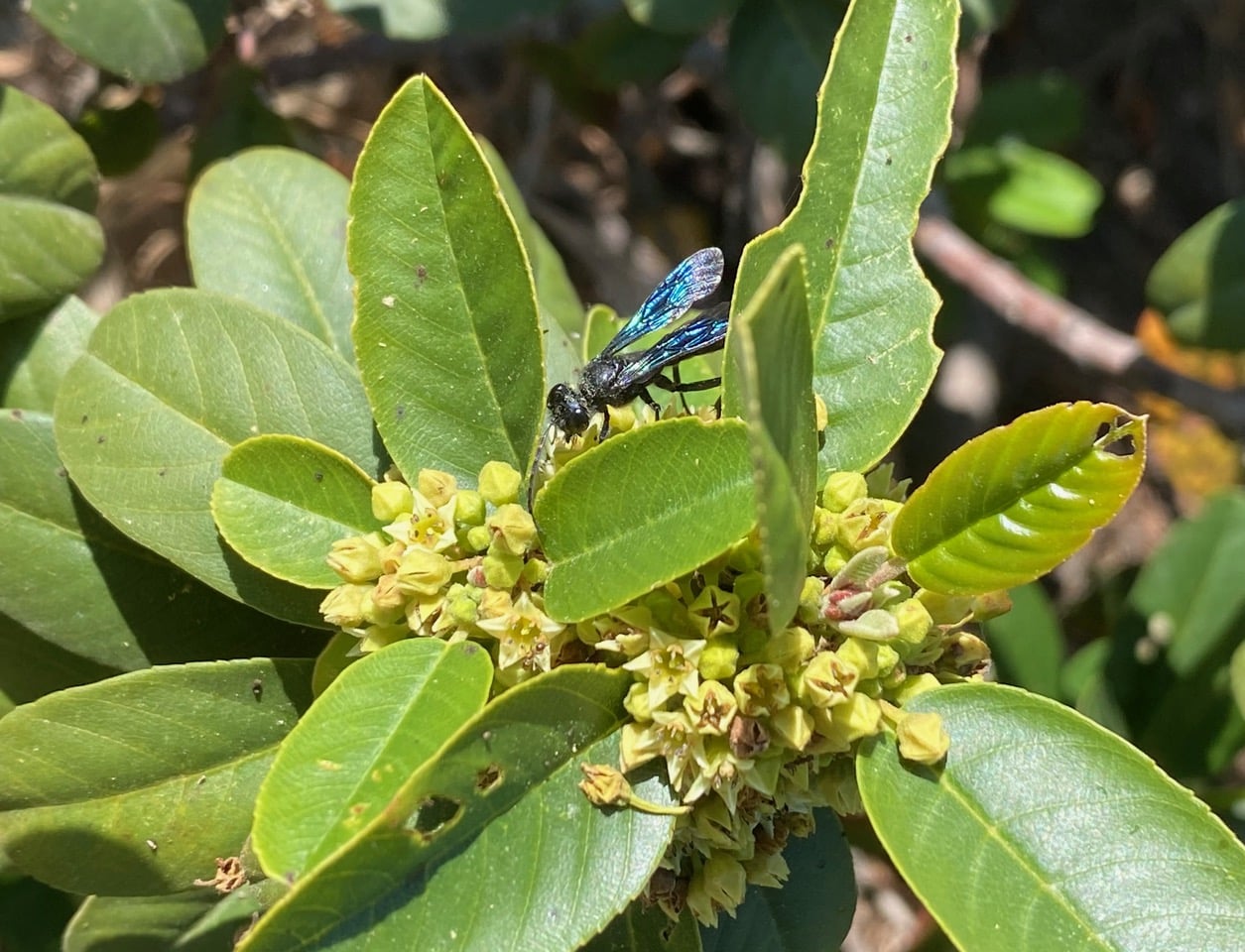
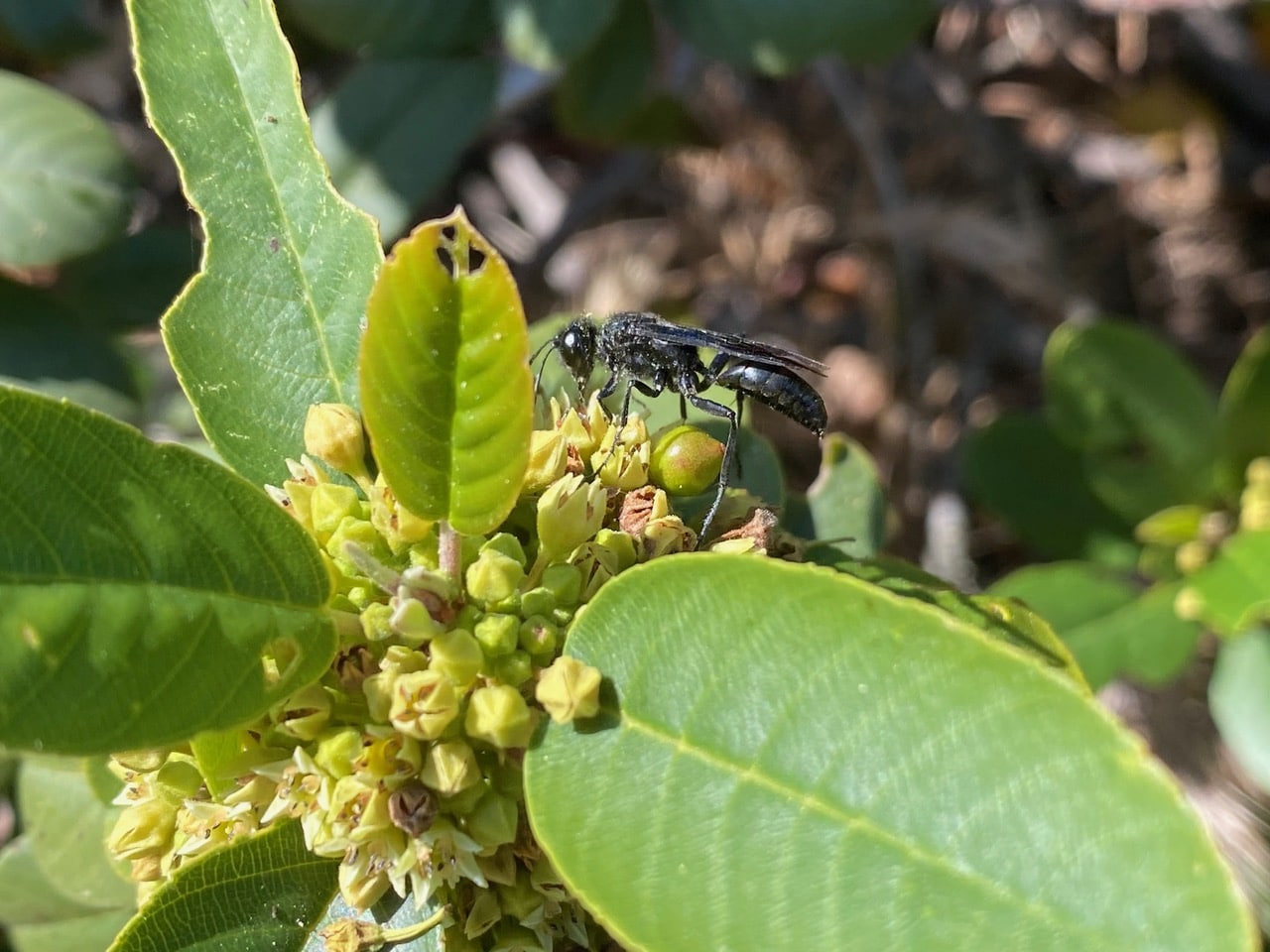
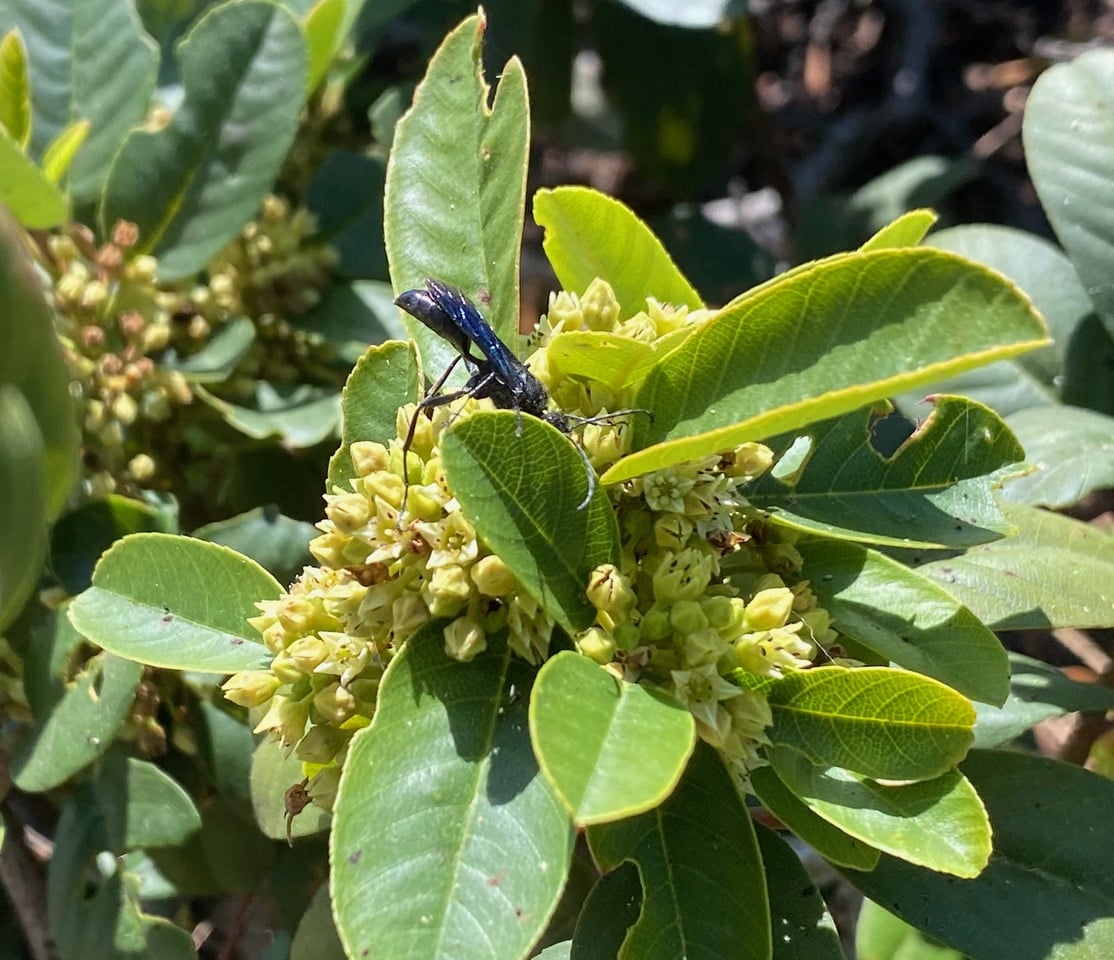
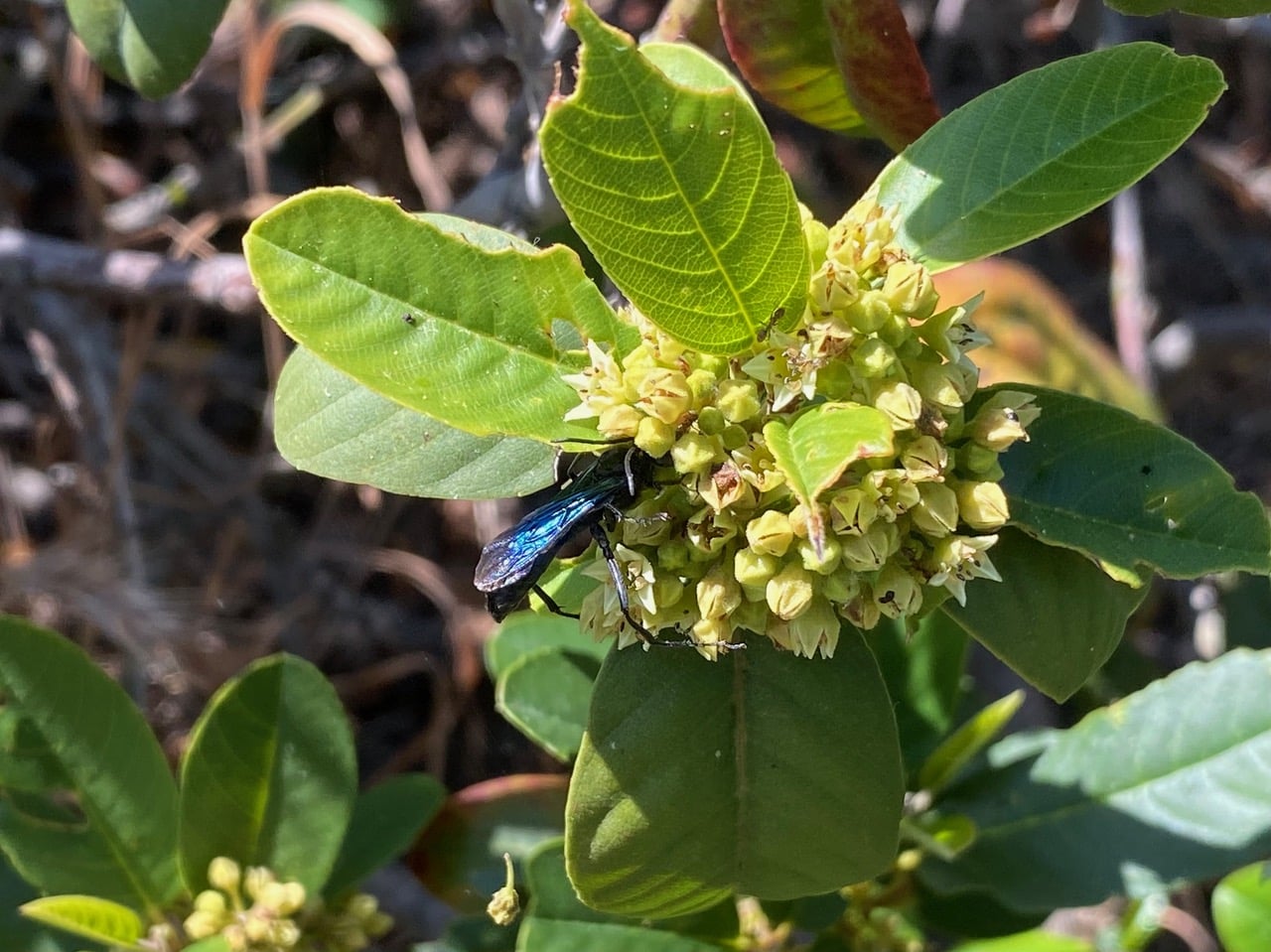
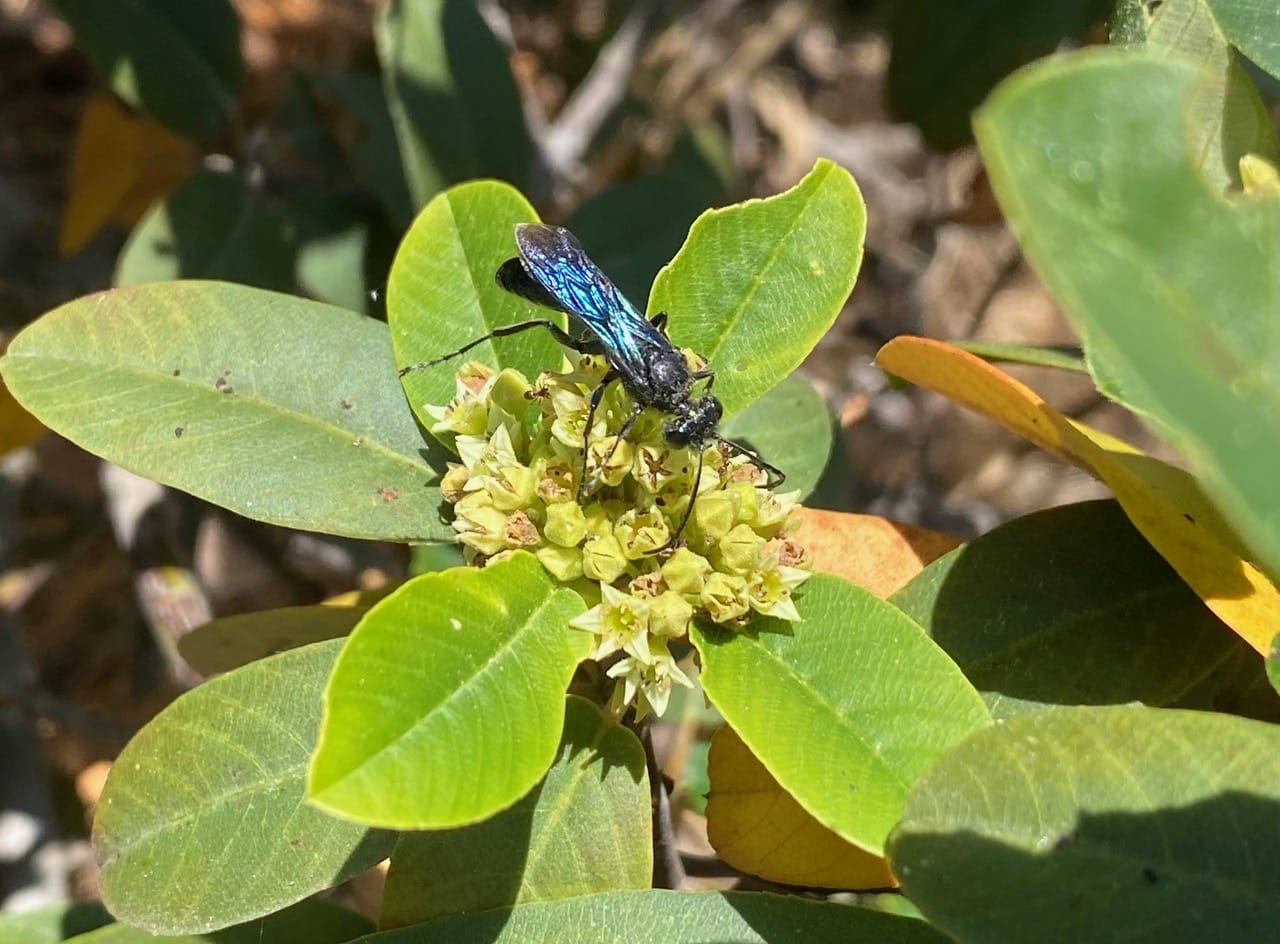
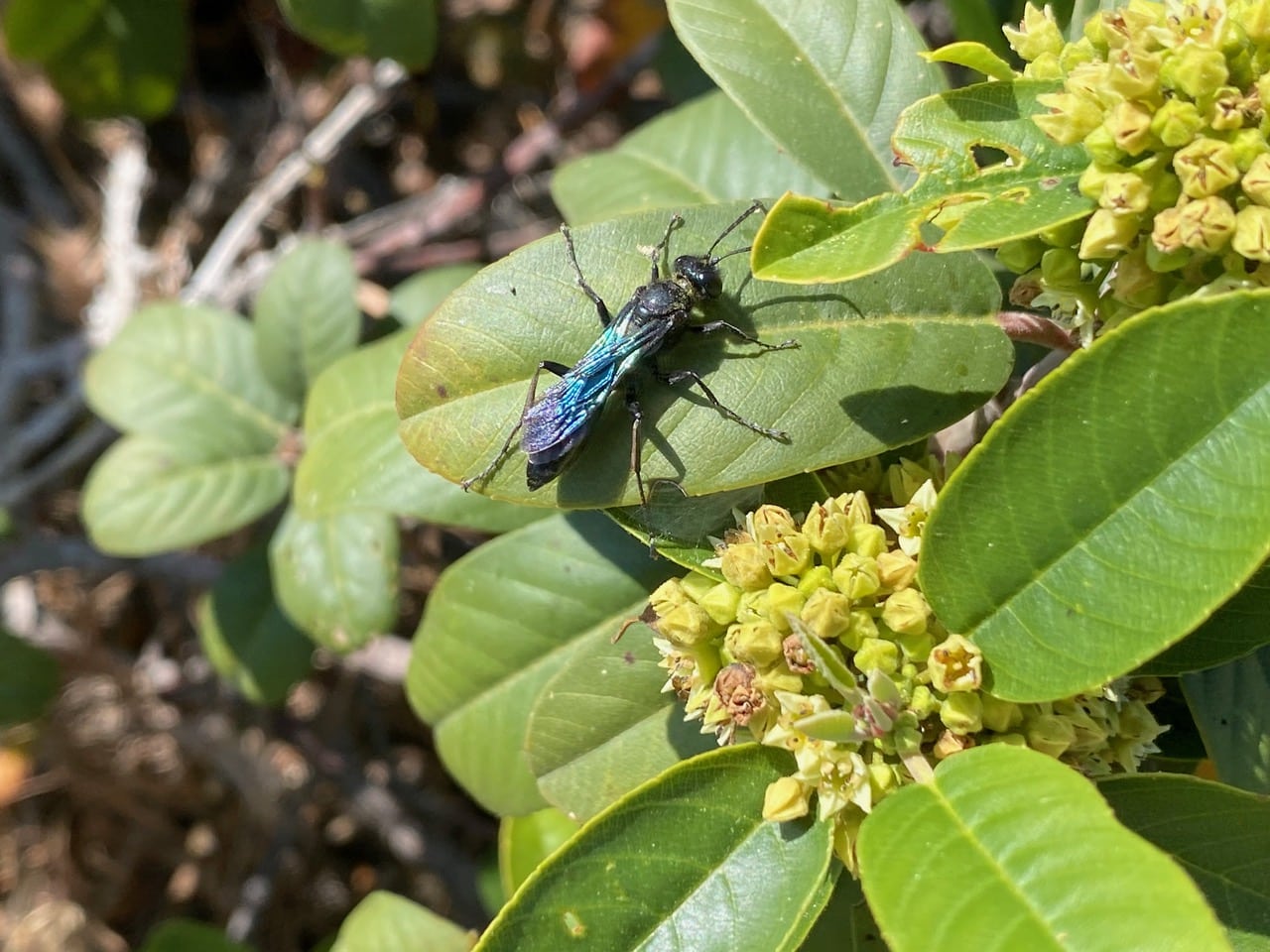
A iridescent blue flash alerts me to the presence of a Great Black Digger Wasp, Sphex pensylvanicus (family Sphecidae) on a cluster of Coffeeberry flowers.
The Great Black Digger Wasps occur across most of the United States, and grow to a size of 0.8-1.4 in. They can commonly be found patrolling flowering plants during the summer. The adults drink nectar from flowers while hunting for prey items for their young.
Like other digger wasps, the Great Black Digger Wasp females build their nests in the ground. The female digs about a foot beneath the soil and creates a series of tunnels using her mouth and spiny legs. The adult females are active hunters that paralyze and carry their prey back to the nest for their brood. Their prey consists of many insects in the Orthoptera order (crickets, katydids, and grasshoppers). Prey are stung three times – once in the neck and twice in the thorax. Although paralyzed, the prey can survive for weeks. The female places a prey insect in each chamber. She then glues an egg to the underside of the prey insect between the first and second pairs of legs. Each of the several chambers in the nest houses a single larva, which consumes 2-6 katydids or grasshoppers. When a brood tunnel is eventually filled up with developing young, a female will seal off the chamber to protect the larvae from parasites or thieves coming to steal her young’s food. To do this, she will often use her head and vibrate her abdomen to tamp down the soil but may also use small tools like a pebble or piece of stick. The larvae will slowly eat away at the prey’s paralyzed body over the course of a week while it is still alive. The larvae pupate and overwinter in their burrows until the following summer when the cycle begins all over again.
Note the long, skinny “waist” characteristic of the family Sphecidae, the Thread-waisted Wasps.
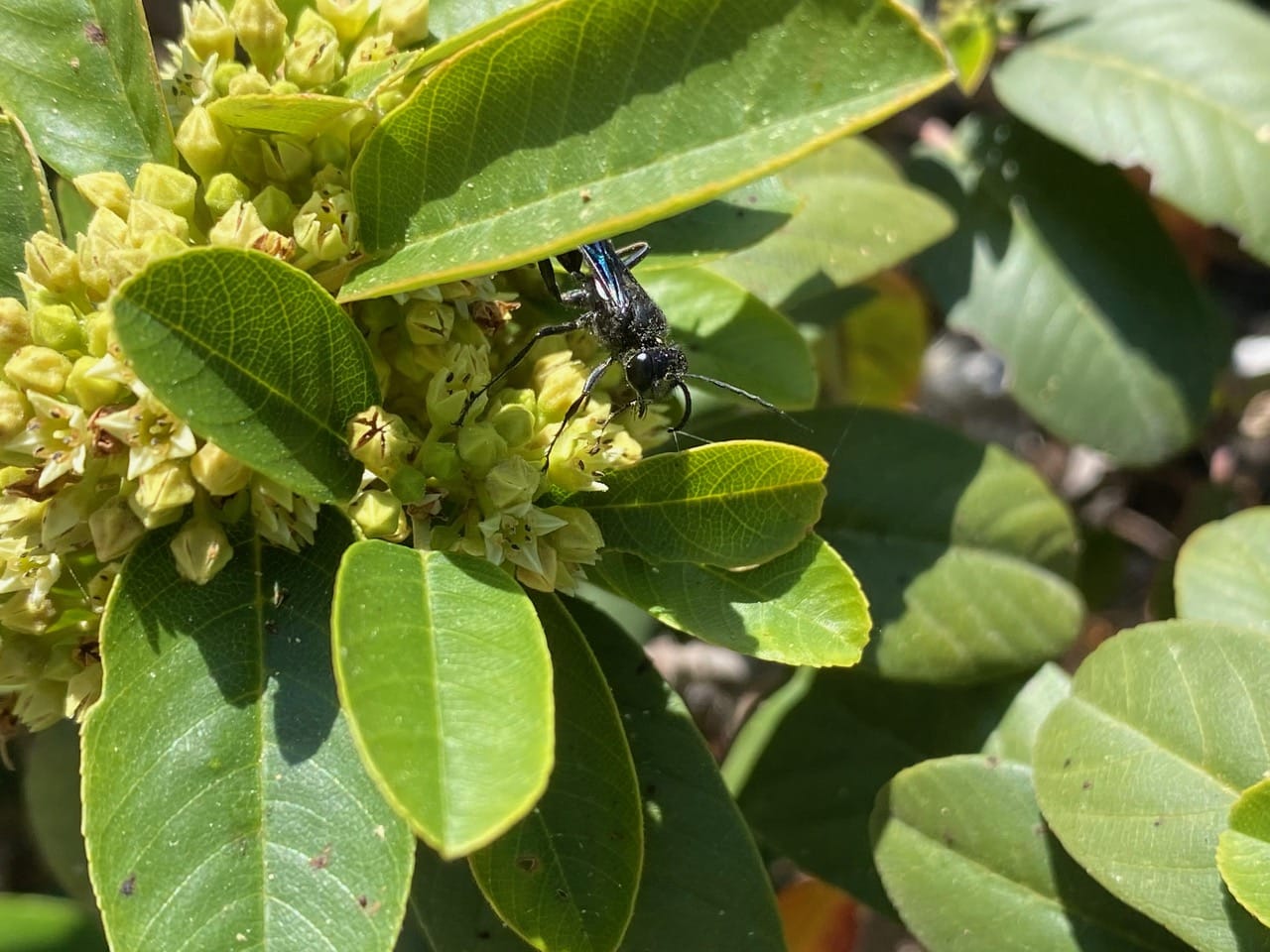
The wasp sticks its head into a cluster of flowers for a long while. Is it searching for prey?
It emerges with pollen stuck to the hairs on its head and thorax. The Great Black Wasp is an important pollinator for many plants that it frequents.
The wasp finally flattens its body on a leaf and lies motionless for a while. I guess even a wasp needs an occasional break.
A tiny, glossy black fly is resting on the tip of a Coffeeberry leaf in the shadows. I recall seeing similar flies on this same Coffeeberry shrub in late April this year. It is a member of the genus Calliopum (family Lauxaniidae)
Some 1800 species of Lauxaniidae have been described. They have a cosmopolitan distribution. Most species inhabit forests, where the adults usually are found sitting on leaves of the moist and shady understory. Lauxaniidae are small flies (2-7 mm in length). They are often rather plump, dull, yellowish-brown or black, or partly lustrous flies. Many species have iridescent reddish/purplish or greenish eyes. Larvae are mostly saprophagous, feeding on decaying vegetation, soil, bird nests, etc. Adults may visit flowers. The North America, the genus Calliopum is only recorded from the West.
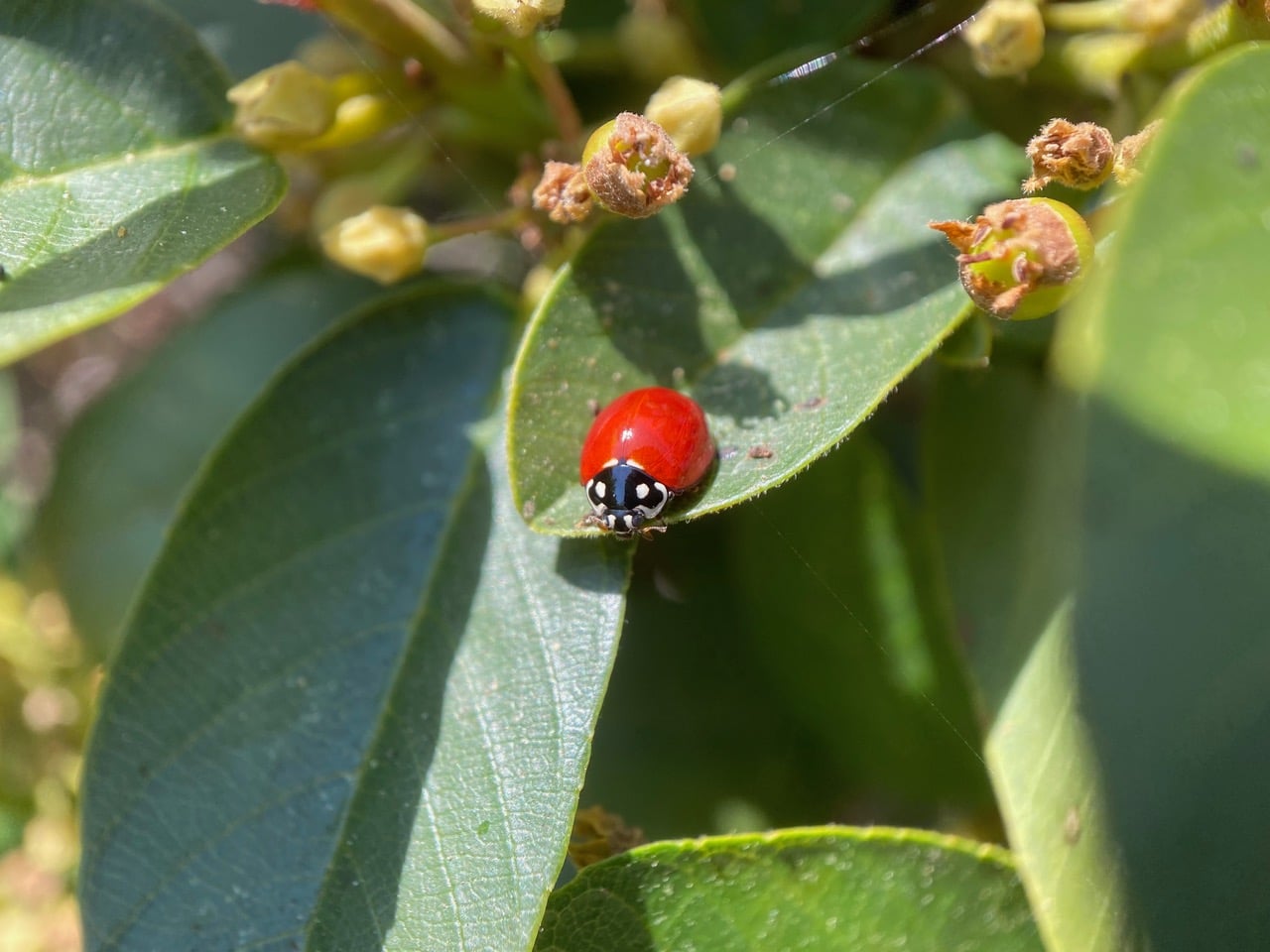
Hey, there’s a third species of Lady Beetles on the Coffeeberry – the Spotless Lady Beetle, Cycloneda sanguinea (family Coccinellidae).
The Spotless Lady Beetle, Cycloneda sanguinea is a widespread species of lady beetle in the Americas. It is a large lady beetle with red, unspotted elytra (wing covers) ranging from 4-6.5 mm long. The black and white marks on the head and pronotum are very distinctive, and they are also gender-specific. What we have here is a female. Males have a short white line between the two white spots on the pronotum. These lady beetles are very often found feeding on aphids on milkweeds, but also occur on a number of other plants.