

Pollinator Post 6/7/24 (1)

This morning, Kathy and I are back visiting Stefanie’s garden in San Leandro. I was so impressed by the diversity of native plants and insects in her beautiful garden that I have requested for a repeat visit. A different set of plants have come into bloom since our last visit on 5/1/24.





 Flowers of the sunflower family, Asteraceae are very attractive to little bees. The flat flowerhead offers a nice landing pad, and in one stop, the bee could gather nectar and pollen from dozens, if not hundreds of florets. The pollen of Asteraceae tends to be moist and clumpy.


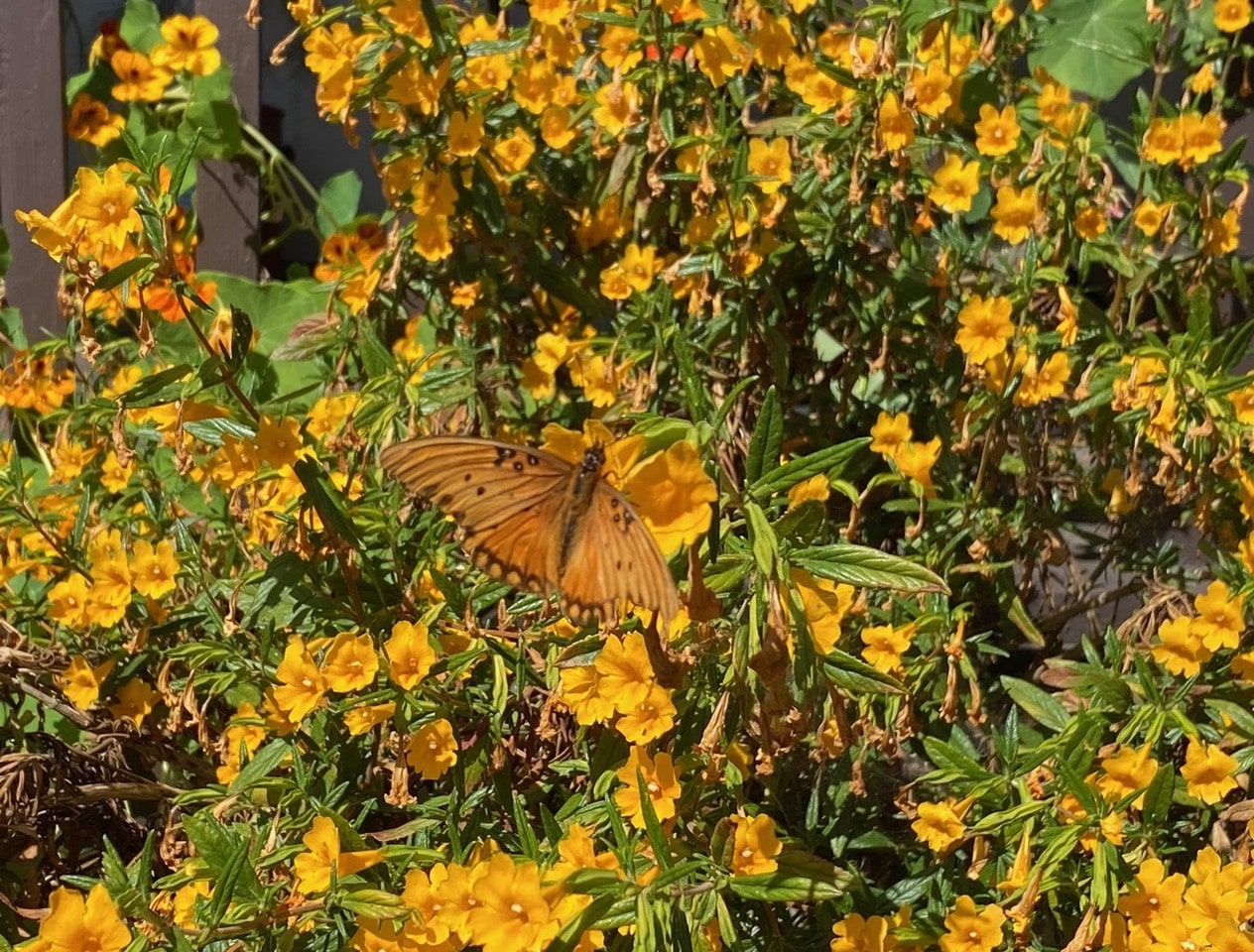
The Sticky Monkeyflower, Diplacus aurantiacus in the front yard is in peak bloom. A faded Gulf Fritillary, Agraulis vanillae (family Nymphalidae) stops for a sip of nectar.
Native to the New World tropics, the butterfly was introduced into southern California in the 19th century, and is now well established in the Bay Area. The butterfly has no native host plant in California and is entirely dependent on introduced species of the tropical genus Passiflora (Passion Flower, Passion Vine). In the Bay Area this butterfly can be seen flying any day of the year, if it is warm and sunny enough.
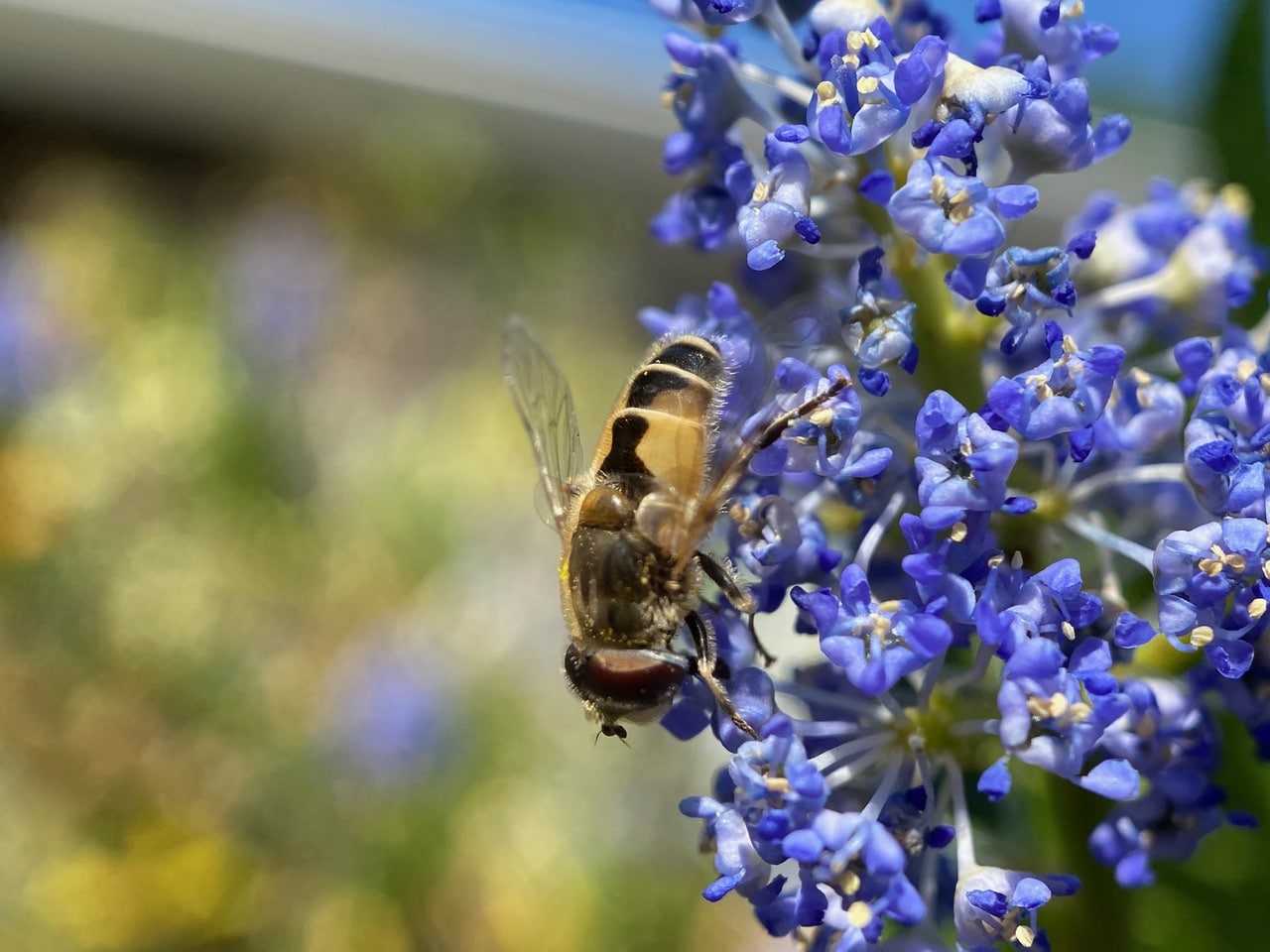
A Black-footed Drone Fly, Eristalis hirta (family Syrphidae) is foraging on an inflorescence of Ceanothus. I almost didn’t recognize the fly as it is more yellow than the ones commonly seen.
Eristalis hirta is a common Western North American species of hoverfly. Hoverflies get their name from the ability to remain motionless while in flight. The adults are also known as flower flies for they are commonly found around and on flowers, feeding on nectar and pollen. They are effective pollinators of a wide range of plants. The larvae of E. hirta are aquatic filter feeders of the rat-tailed type. They are important decomposers/recyclers of organic matter. It has been observed that the larvae that develop in warmer temperatures become adults with more yellow on their abdomen.
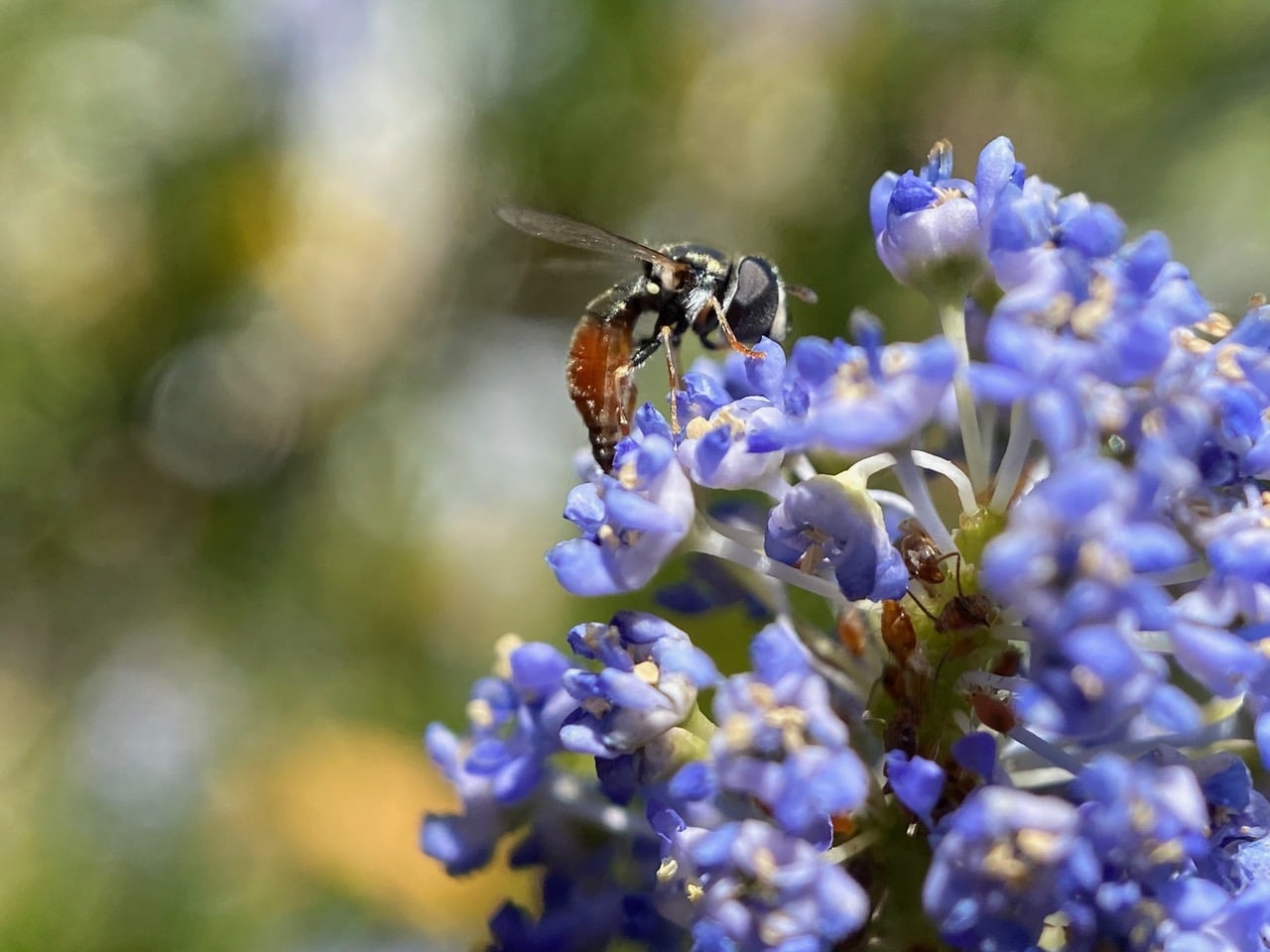
Ooh, I think that Common Grass Skimmer is laying eggs among the Ceanothus flowers. Mama has chosen well – see those brown aphids under the flowers? Her larvae are aphidophagous – when they hatch from the eggs, they will have plenty to eat!
The Common Grass Skimmer, Paragus haemorrhous (family Syrphidae) is easily the smallest hover fly I know, measuring only about 4 mm in length. The species has a world-wide distribution, found in unimproved grassland, dune grass, open areas and pathsides in forest, and meadows. Adults visit flowers for nectar and pollen. Larvae feed on aphids on low herbaceous plants.
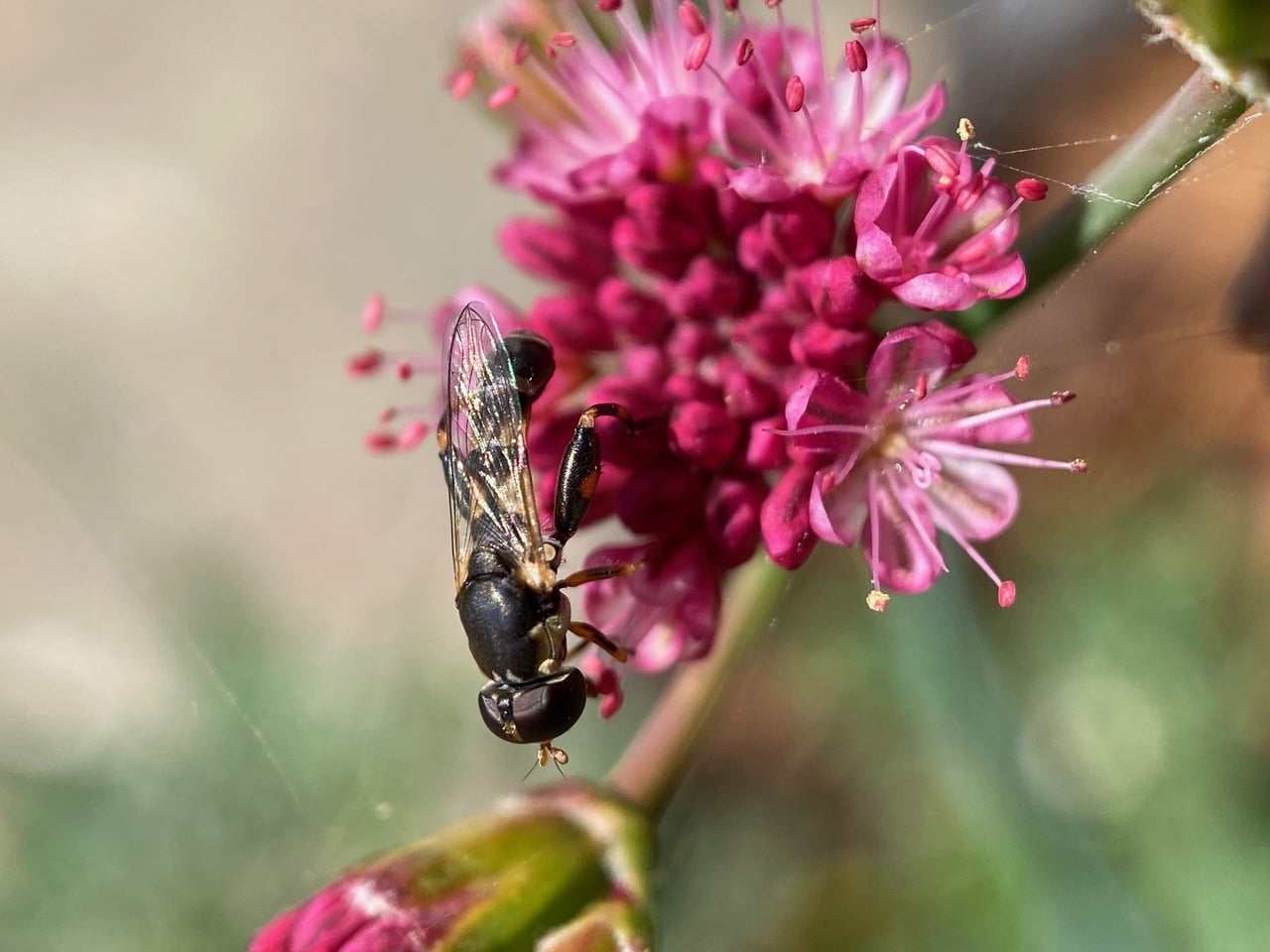
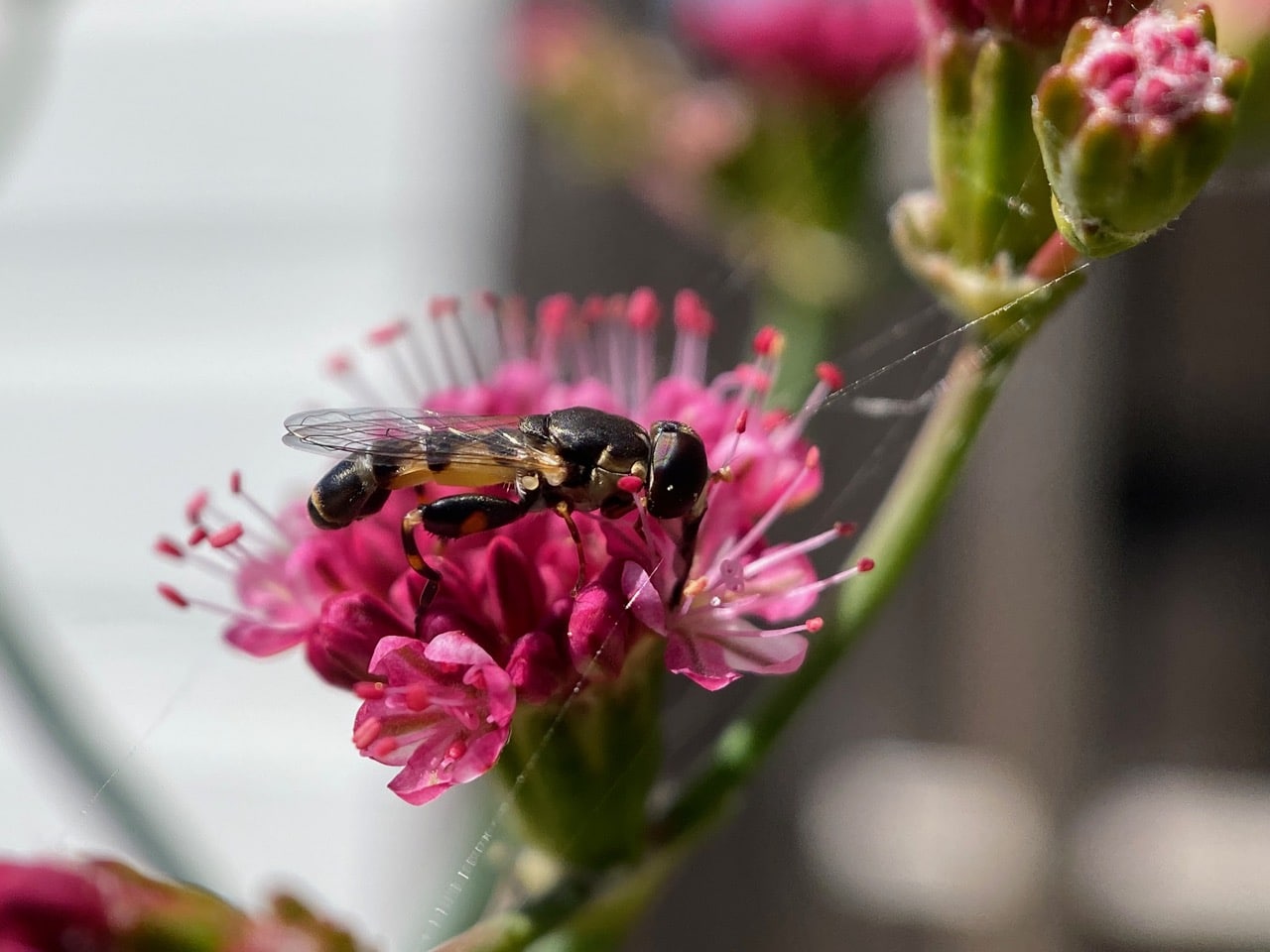
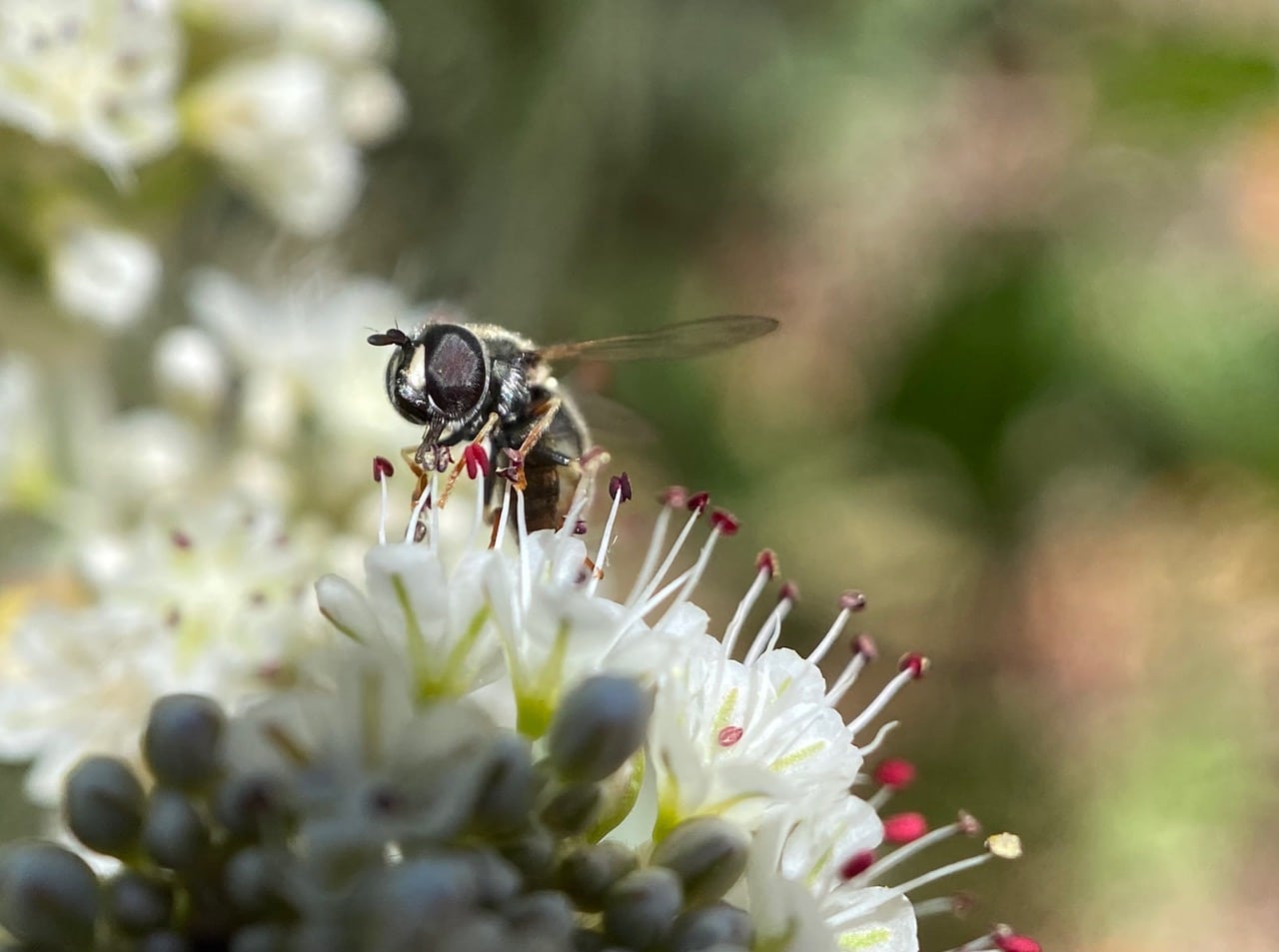
A Thick-legged Hover Fly, Syritta pipiens (family Syrphidae) is foraging on a clustered flowers of Red-flowered Buckwheat, Eriogonum grande var. rubescens.
Syritta pipiens originates from Europe and is currently distributed across Eurasia and North America. They are fast and nimble flyers, and their larvae are found in wet, rotting organic matter such as garden compost, manure, and silage. The flies are important pollinators for a variety of flowering plants.
The Thick-legged Hover Flies are often found on flowers, where the adult males primarily feed on nectar and adult females eat protein-rich pollen to produce eggs. The common name comes from the fly’s distinctively broad femora. The fly is about 6.5 -9 mm long. The species flies at a very low height, rarely more than 1 m above the ground. Males accurately track females, aiming to attempt forced copulation.
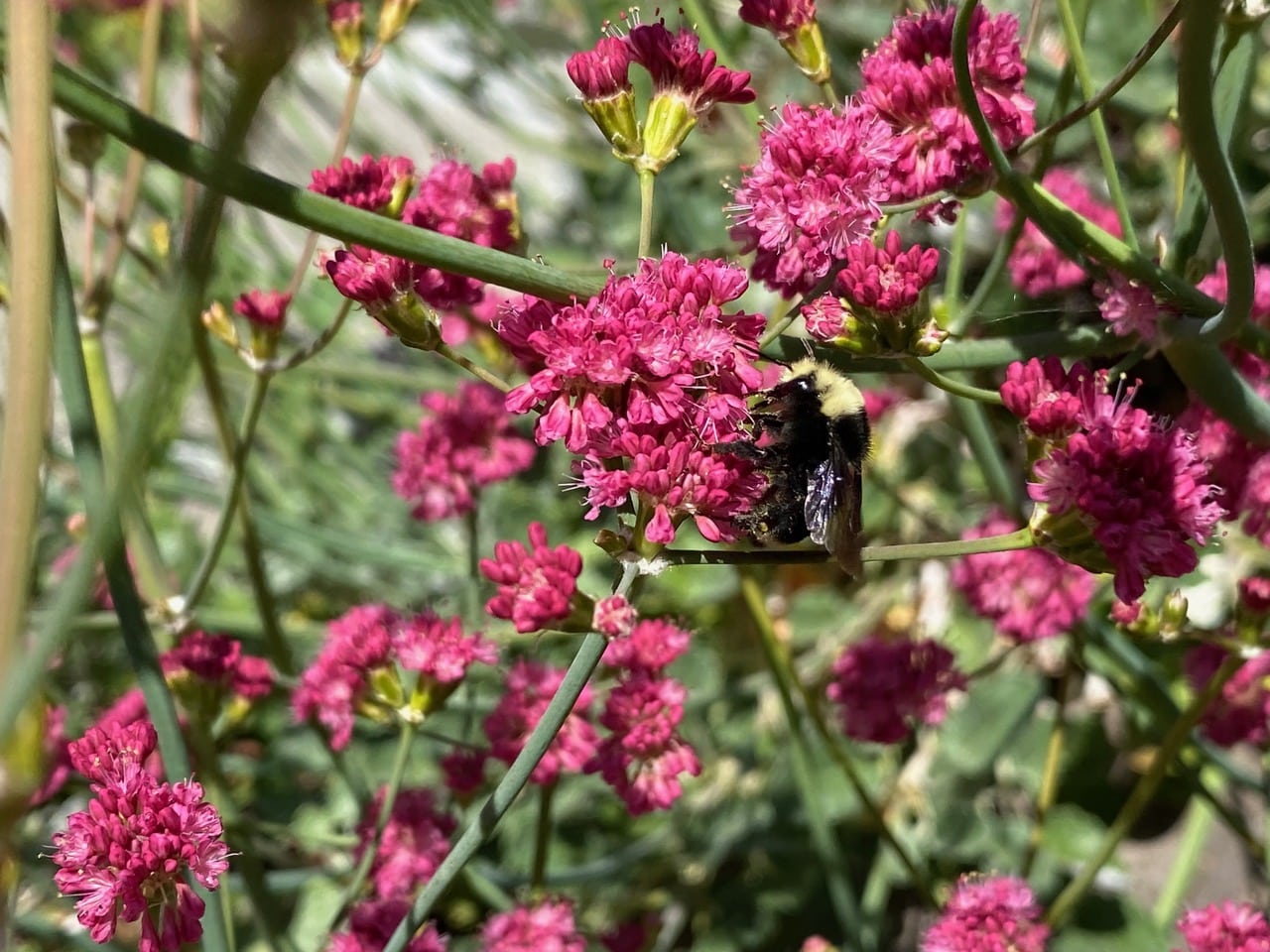
A Yellow-faced Bumble Bee, Bombus vosnesenskii (family Apidae) is taking nectar from the flowers of Red-flowering Buckwheat.
A False Cinch Bug, Nysius raphanus (family Lygaeidae or seed bugs) is perched on a ray flower of Pacific Aster, Symphyotrichum chilense.
Nysius raphanus is commonly found within grassy or weedy fields, pastures, and foothills. The bugs spend the winter as nymphs and adults, usually in uncultivated areas beneath debris or in plants, often feeding on mustards or other winter annual plants. Each spring, once the plants in these areas dry up, the False Cinch Bug migrates to find new places to feed. There can be several generations a year. When populations are high in wet years, the bugs can become a nuisance for gardeners and farmers.
A Common Grass Skimmer, Paragus haemorrhous (family Syrphidae) lands on a young flowerhead of Gum Plant, Grindelia sp.
The furrow at the tip of her abdomen tells us that the little bee is a Furrow Bee, Halictus sp. (family Halictidae).
The furrow, only present in females, distinguishes the genus Halictus from the related and similar genus Lasioglossum. This is the reason why Halictus are sometimes called Furrow Bees. The furrow on the last tergite (top segment of the abdomen) is referred to as a ‘rima’. The purpose of this feature is unknown.
Halictus is found worldwide; they are most common in the Northern Hemisphere. All are generalists, foraging from a wide variety of flowering plants. Many species are social and produce several generations per year. This is not surprising as most blooming plants are season-specific; a bee that requires pollen and nectar across multiple seasons would not thrive as a specialist. All Halictus in North America nest in the ground, often in aggregations; and they may nest in the same area for decades.
A Plant Bug, Orthops scutellatus (family Miridae) is roaming an inflorescence of Yarrow, Achillea millefolium.
Mirid bugs are also referred to as plant bugs or leaf bugs. Miridae is one of the largest family of true bugs in the order Hemiptera. Like other Hemipterans, Mirids have piercing, sucking mouthparts to extract plant sap. Some species are predatory. One useful feature in identifying members of the family is the presence of a cuneus; it is the triangular tip of the corium, the firm, horny part of the forewing, the hemielytron. The cuneus is visible in nearly all Miridae.

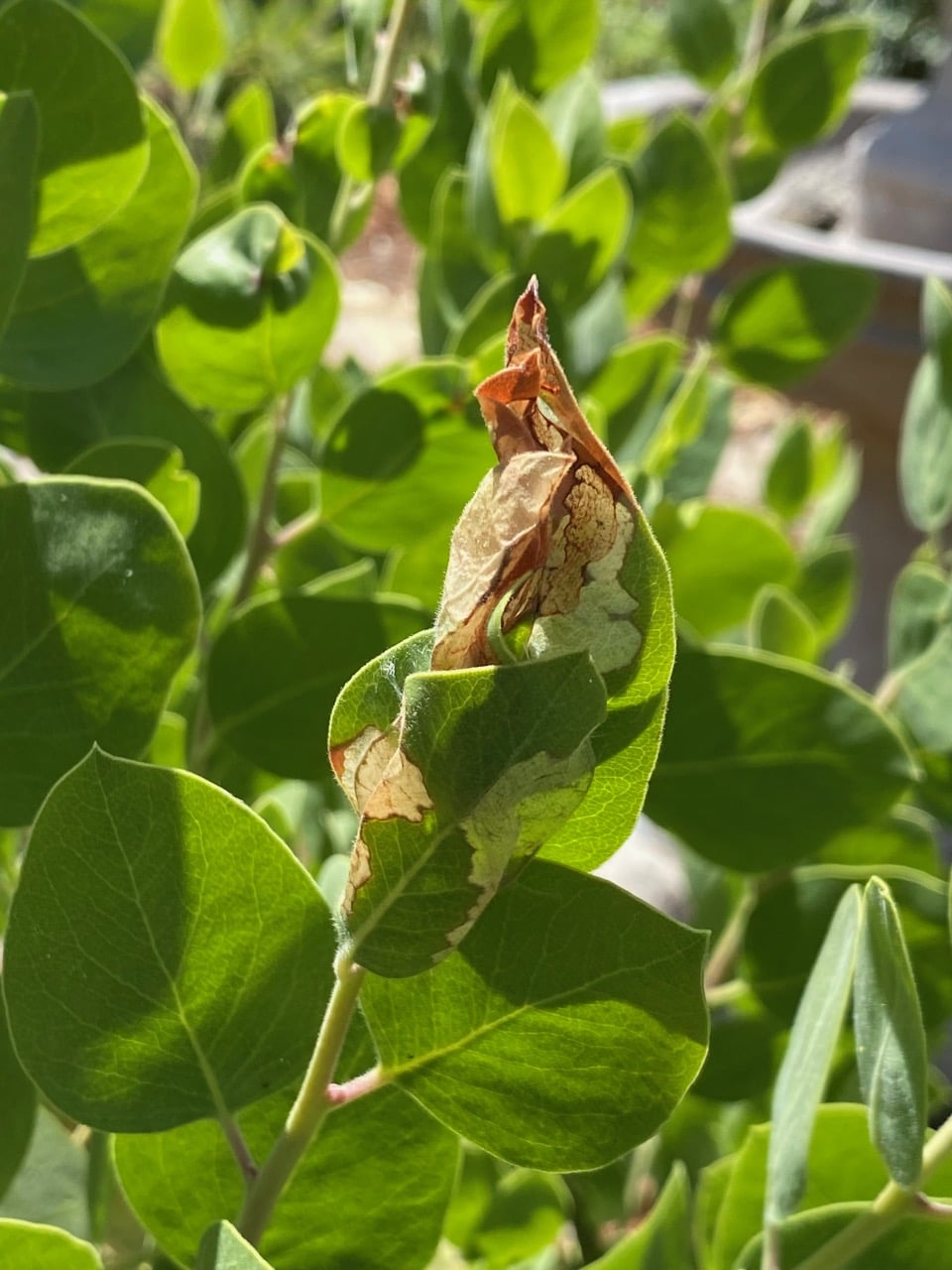
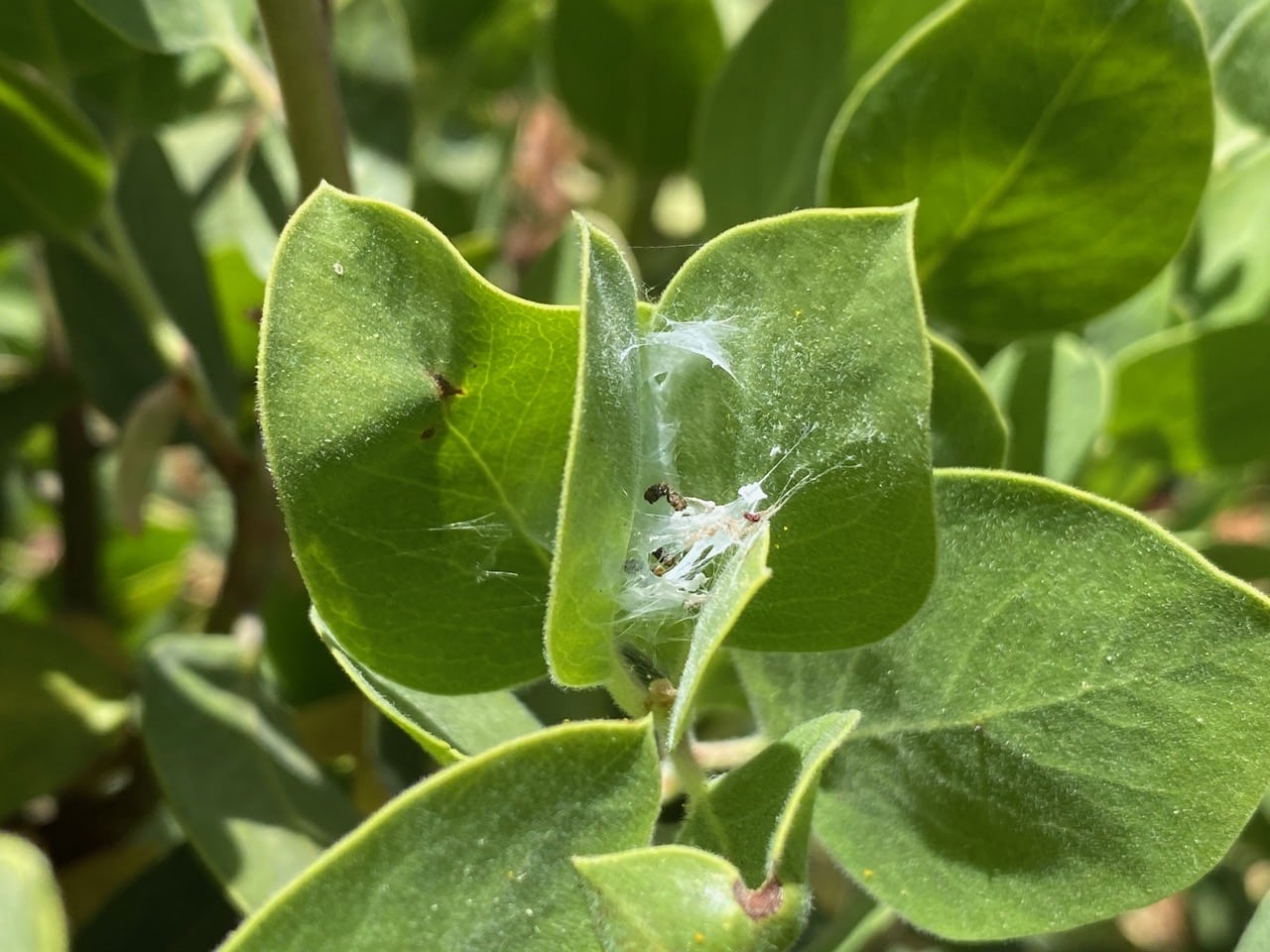
The terminal leaves of this Manzanita have been loosely bound together with silk. Fresh and old feeding scars can be seen on the bound leaves. Who’s responsible?
On an adjacent branch, the webbed terminal leaves have been torn open (probably by a bird), showing the cavity inside with some frass (insect poop). The leaf shelter was probably constructed by a Tortrix Moth caterpillar (family Tortricidae).
Members of the family Tortricidae are commonly known as tortrix moths or leafroller moths. Many are economically important pests. The typical resting posture of the adult is with the wings folded back, producing a rather rounded profile. Tortricid moths are generally small, with a wingspan of 3 cm or less. Many species are drab and have mottled and marbled brown colors. Larvae of some species feed by boring into stems, roots, buds or seeds. Others feed externally and construct leaf rolls.
Leaf shelter-builders, either leaf-tiers or leaf-rollers, do not manipulate leaves directly but use their silk to draw plant surfaces together. The caterpillars impart potential energy to their silk strands by stretching them beyond their equilibrium length as they are spun out. Axial retraction of the stretched strands then draws the bound plant surfaces together. Although a single stretched strand exerts only a minuscule force, the combined force generated by many such strands attached to the same opposable plant surfaces is substantial and allows the caterpillars to manipulate leaves many times their size and mass.
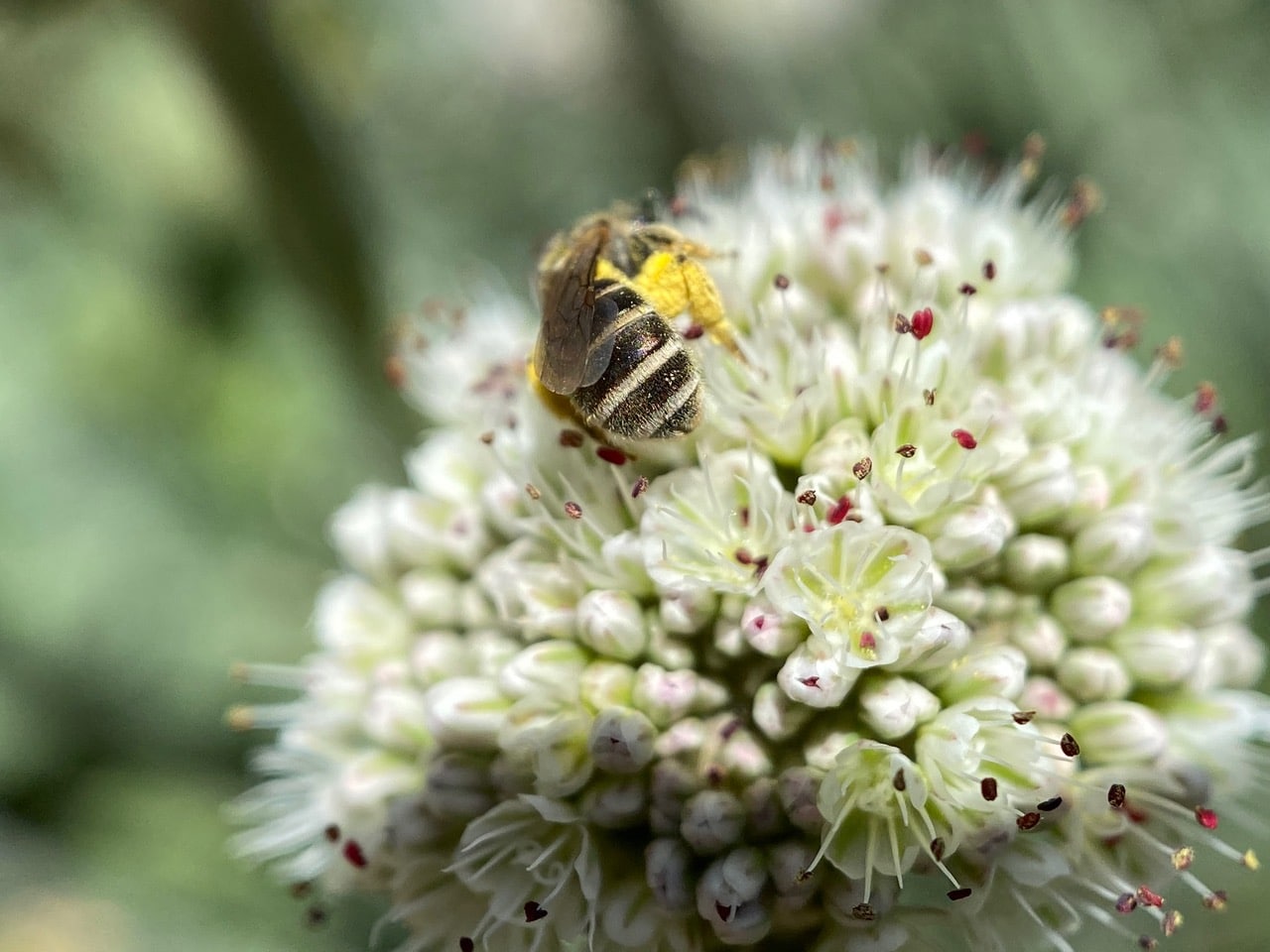
A bee is foraging on a cluster of flowers of the Nude Buckwheat, Eriogonum nudum. Ooh, I see hints of a furrow on the last tergite of the bee’s abdomen. It is most likely a Furrow Bee, Halictus sp. (family Halictidae). These bees are extremely prevalent in this garden today, found on many different flowers.
The little bee has stowed away the pollen she has gathered into the scopae on her hind leg as well as on the underside of her abdomen. This is typical of the Sweat Bees (family Halictidae).
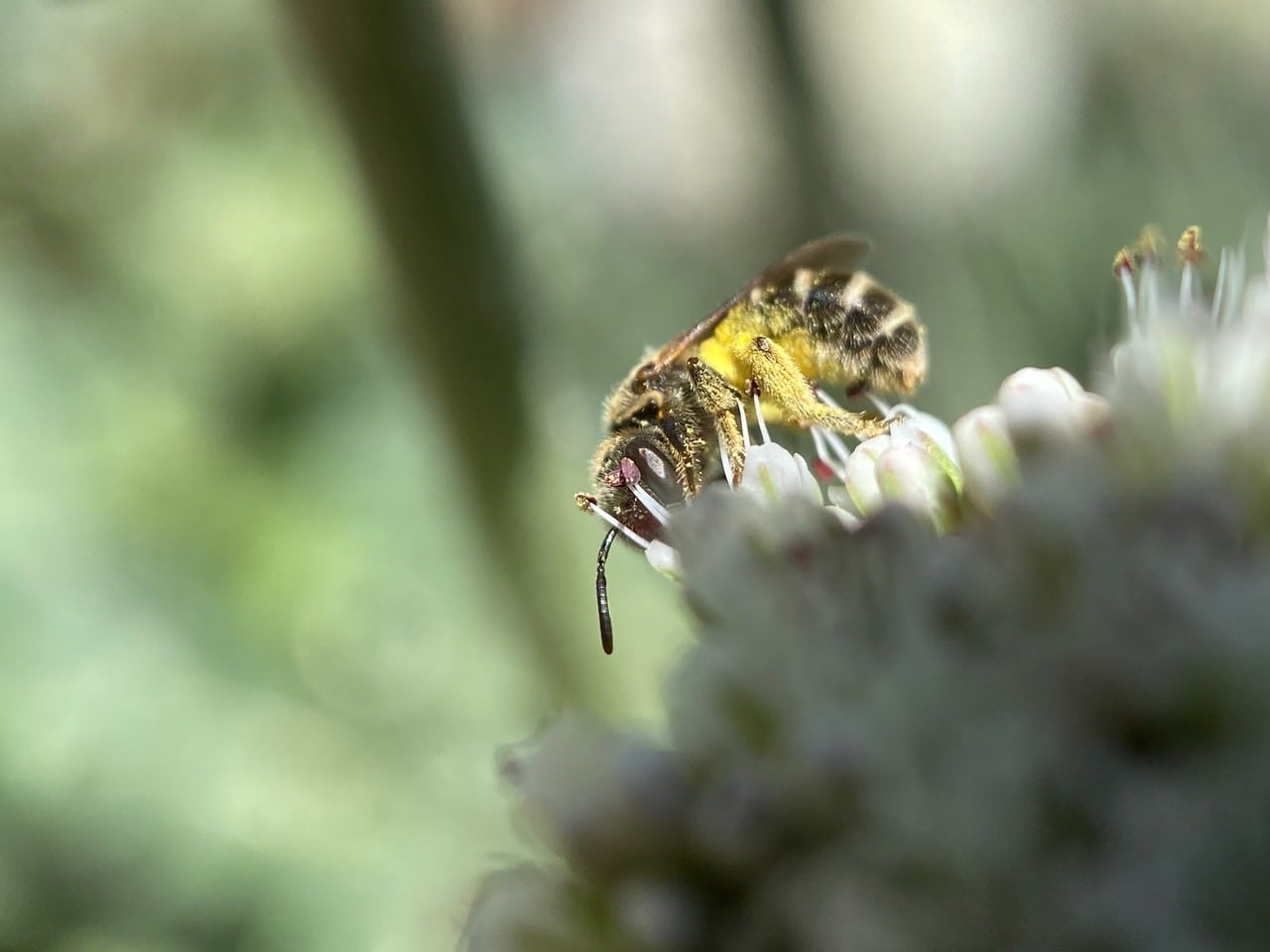
Its head buried in the flowers of Nude Buckwheat, a little black bee is probing for nectar. Although I can’t see her face, I am willing to bet that she is a Masked Bee, Hylaeus sp. (family Colletidae). Note that there’s some yellow markings on her legs, but most telling of all – there’s no scopa on her hind legs. Female Hylaeus do not carry pollen externally. Instead, they stow the nectar and pollen they gather in a crop, a part of their gut.
Hylaeus (family Colletidae) are shiny, slender, hairless, and superficially wasp-like bees. They are small, 5 to 7 mm long, usually black with bright yellow or white markings on their face and legs. These markings are more pronounced on the males. Hylaeus do not carry pollen and nectar externally, they instead store their food in the crop and regurgitate it upon returning to their nests. They are primarily generalist foragers. Hylaeus are short-tongued, but their small body size enables them to access deep flowers. Hylaeus nest in stems and twigs, lining their brood cells with self-secreted cellophane-like material. They lack strong mandibles and other adaptations for digging, using instead pre-existing cavities made by other insects.
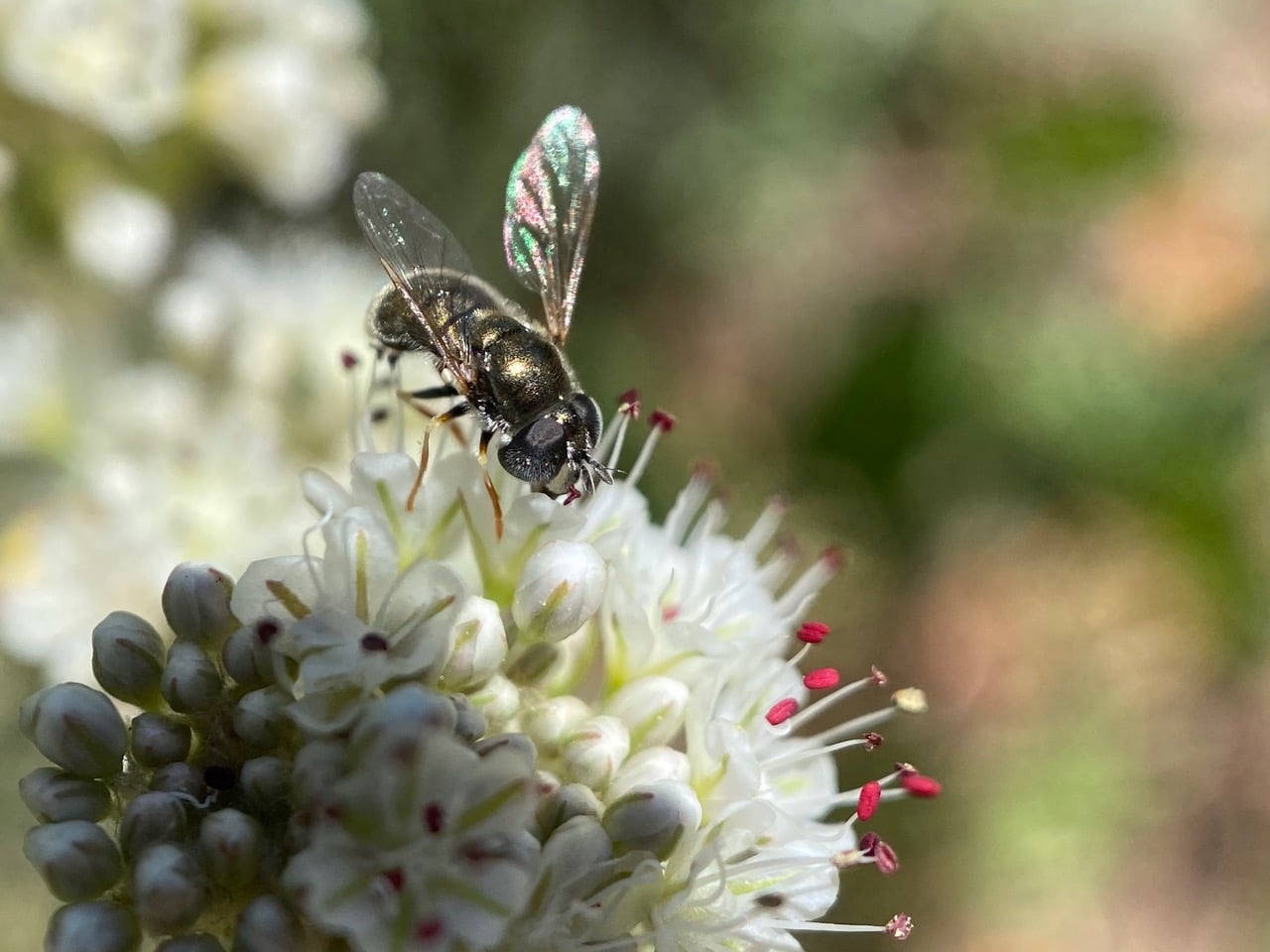
Another Common Grass Skimmer, Paragus haemorrhous (family Syrphidae). This one is foraging on a cluster of Nude Buckwheat flowers. She has no red on her abdomen, unlike the others we commonly see. I know she is female from her eyes – they are set apart. Male hover flies have holoptic eyes that meet on top of the head.
She is now feeding on pollen from the anthers of the flowers.
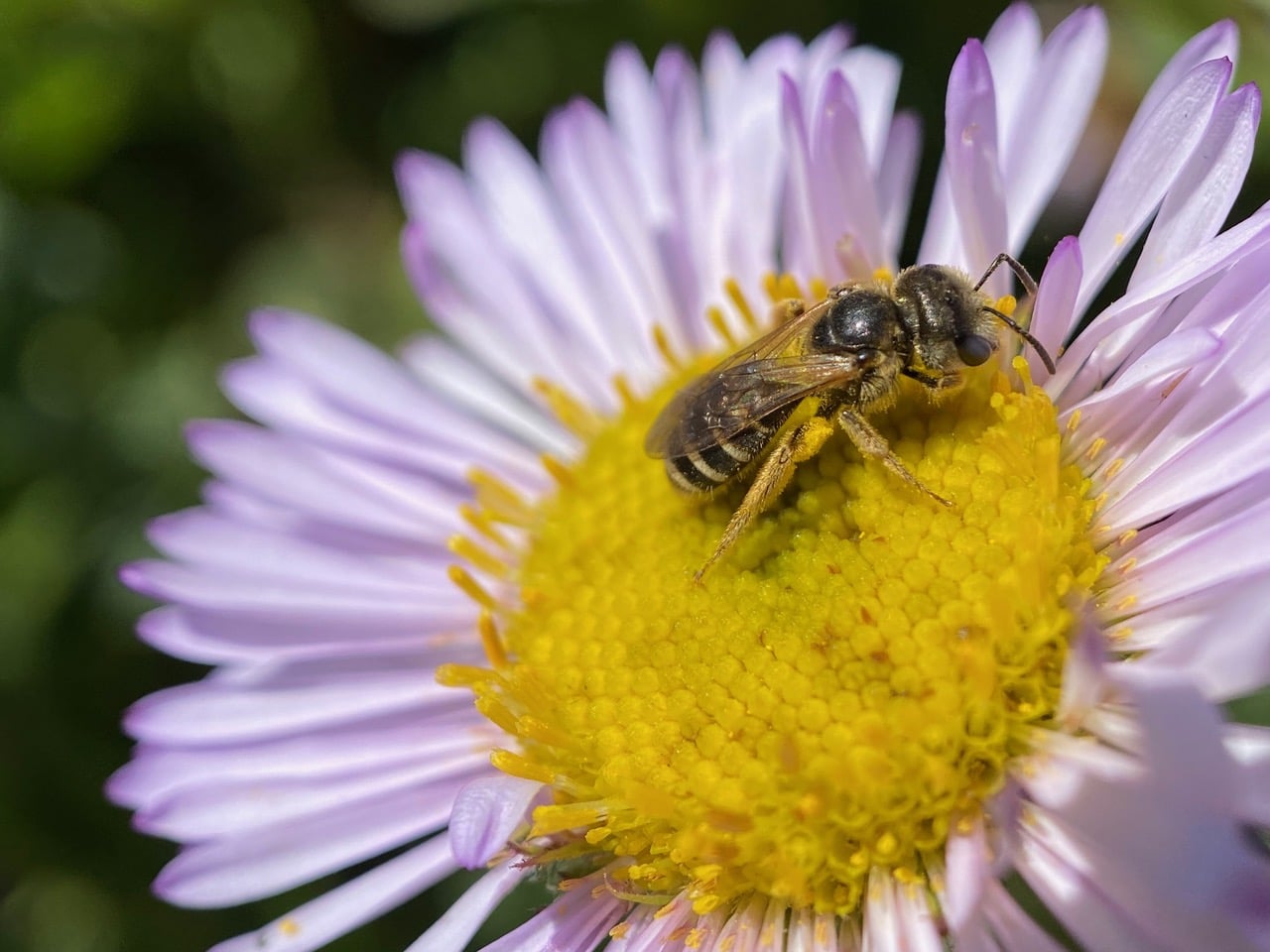
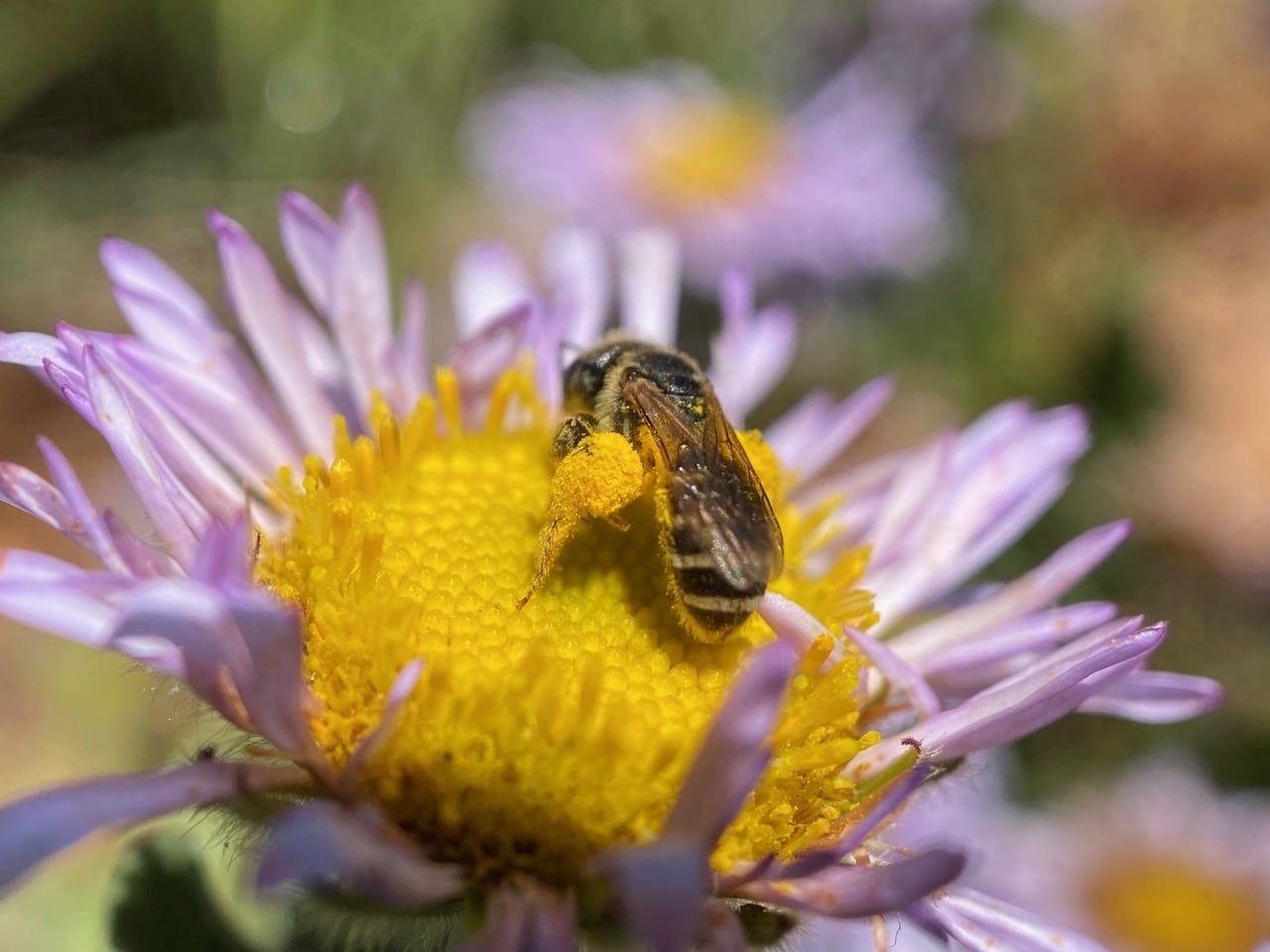
A Sweat Bee, Halictus sp. (family Halictidae) is foraging on a flowerhead of Seaside Daisy, Erigeron glaucus. Look at the size of the pollen load on her scopa!
Flowers of the sunflower family, Asteraceae are very attractive to little bees. The flat flowerhead offers a nice landing pad, and in one stop, the bee could gather nectar and pollen from dozens, if not hundreds of florets. The pollen of Asteraceae tends to be moist and clumpy. Pollenkitt is a sticky covering found on the surface of pollen grains. It is also sometimes called “pollen coat”. It is found in some plant families more often than others, but it is especially common in plants that are pollinated by insects. Because of this scientists believe that one of the major functions of pollenkitt is to help the pollen stick to the insect pollinators. The pollen from many wind-pollinated plants, such as grass, is much drier and not nearly so sticky. The insects benefit from lots of pollen that is easy to carry home. What’s more, pollenkitt contains lipids, proteins, and phenolic compounds that are important to bee health. For the plant, pollenkitt may prevent the pollen from blowing away or drying out, or it may protect the pollen from ultra-violet radiation and certain pathogens.
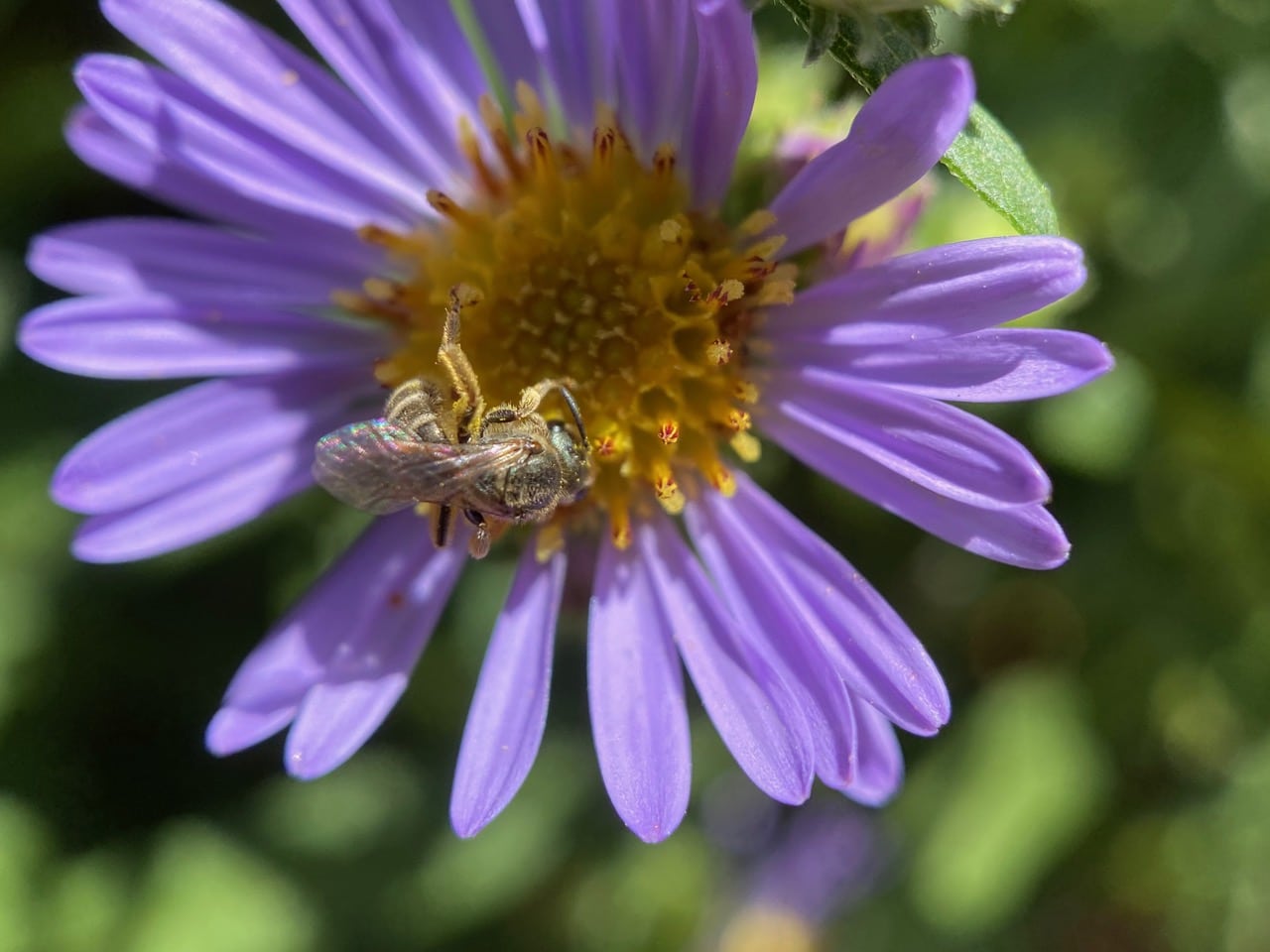
Here’s a Sweat Bee working on another Seaside Daisy flower.
And another…
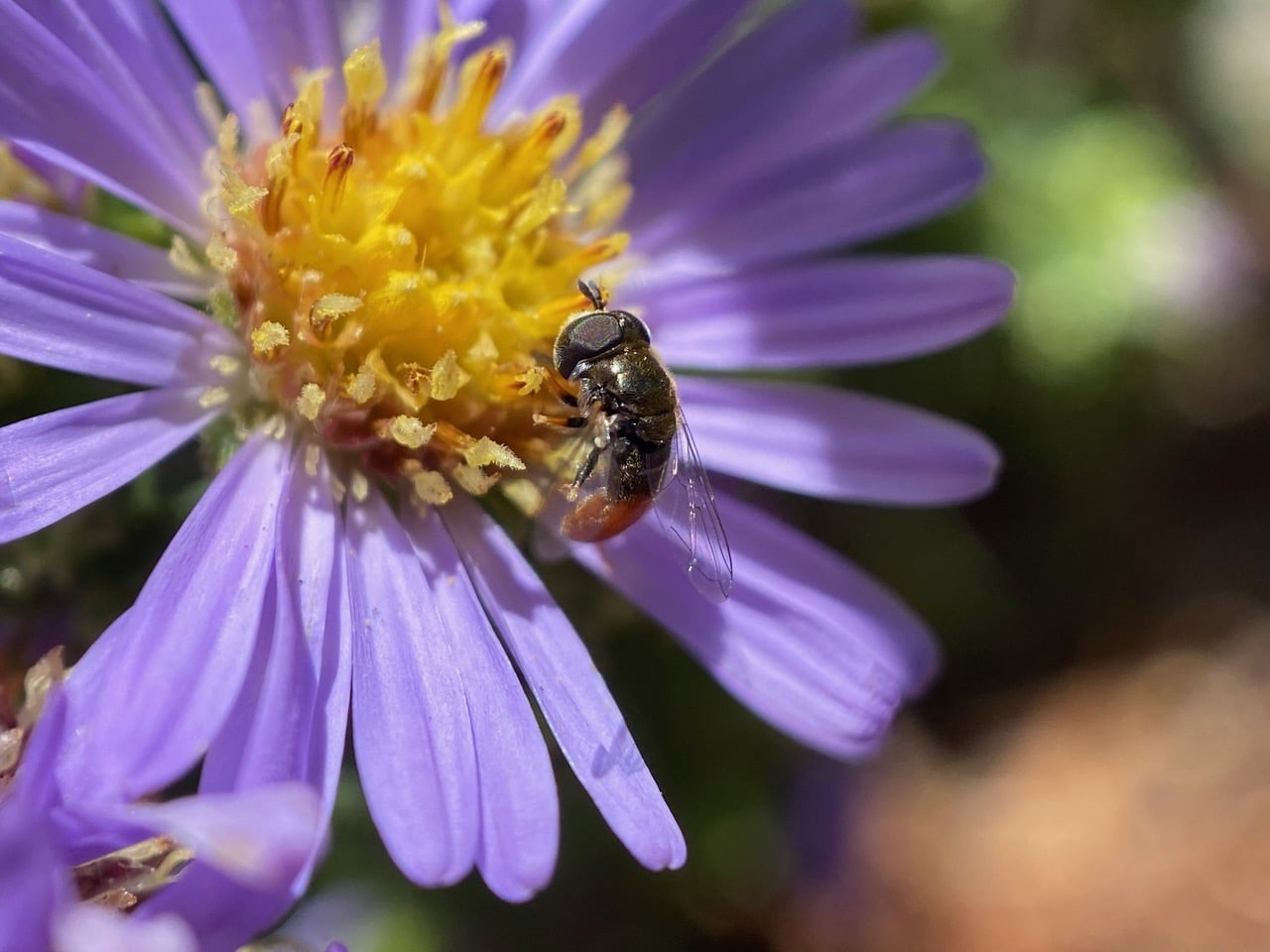
A Common Grass Skimmer, Paragus haemorrhous (family Syrphidae) visits the flowers of Seaside Daisy. This flowerhead is at the stage where the styles (female parts) are starting to push through the anther tubes of the flowers. This is called Secondary Pollen Presentation, unique to the Asteraceae.
In Asteraceae, what is commonly mistaken as a “flower” is in fact not a single flower, but an inflorescence of numerous flowers, packed in the center of the flowerhead or capitulum. The individual flowers or florets are star-shaped, and made of 5 fused petals. The flowers clustered in the middle are called disc flowers, while the ones on the rim are called ray flowers. The latter have an irregular corolla – tubular at the base but elongated on the outside into a generally flat projection, the ray, or ligule. The rays are the petal-like parts. Asteraceae
Flowers in the sunflower family have another unusual feature: secondary pollen presentation. Each individual flower is roughly tubular in shape, and, the anthers are tucked inside the tube facing the interior of the flower. Members of the sunflower family are protandrous, meaning the male parts mature before the female parts. The flower relies on the female parts to bring the pollen out of the floral tube and into the environment where the pollinators can access it. In many cases, the style acts like a tiny piston, literally pushing the pollen out into the world. After some time, the style splits at the tip and each side curls back on itself to reveal the stigmatic surface. Only at this point are the female parts of the flower mature and ready to receive pollen. With luck, much of the flower’s own pollen would have been collected and taken away to other plants by pollinators. Self-pollination is thus avoided.
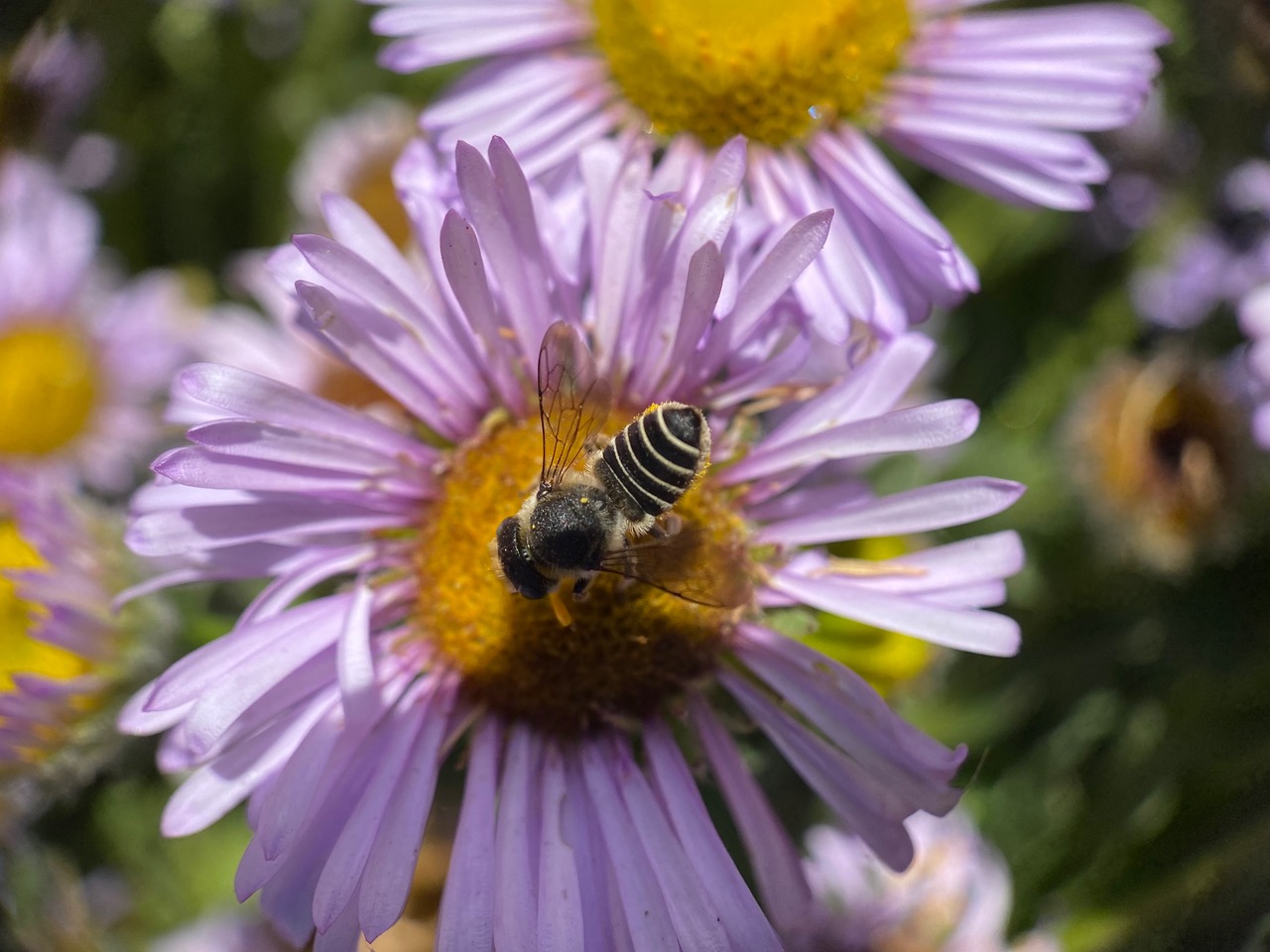
Kathy Kramer got this nice photo of a female Leaf-cutter Bee, Megachile sp. (family Megachilidae) foraging on a Seaside Daisy flowerhead. The bee has her abdomen tipped upward in a typical pollen collecting posture of the Lea-cutter bees. Their scopae are on the underside of the abdomen.
Another photo by Kathy, showing the scopa on the underside of the female Leaf-cutter Bee’s abdomen. The bee is just beginning to fill her scopa with yellow pollen.