

Pollinator Post 6/6/25
Afternoon at Crab Cove. One of my favorite stops at Crab Cove is the small patch of native planting on the upper beach. The blooming Seaside Woolly Sunflower, Eriophyllum staechadifolium attracts all kinds of insects – there are always surprises.

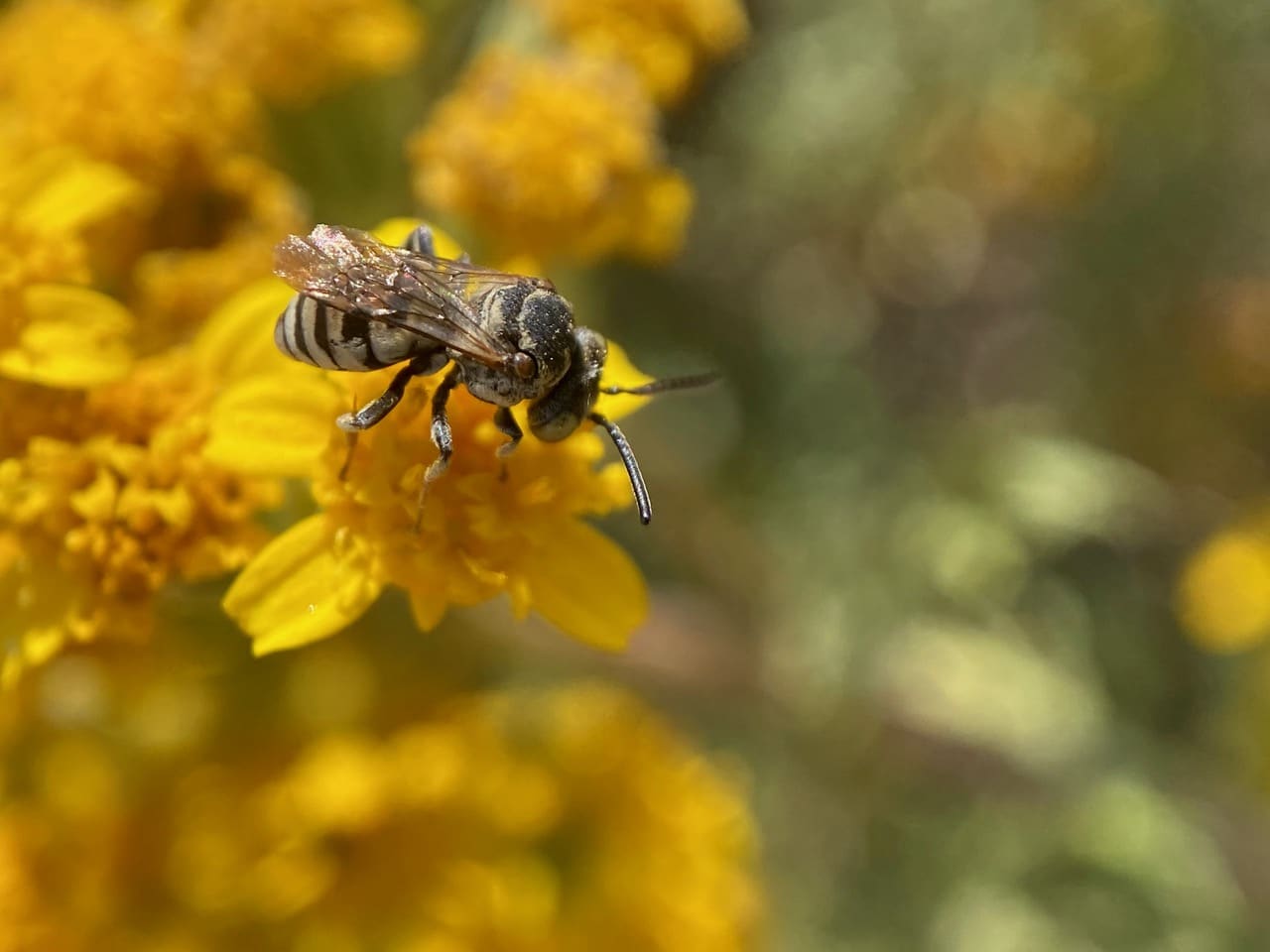
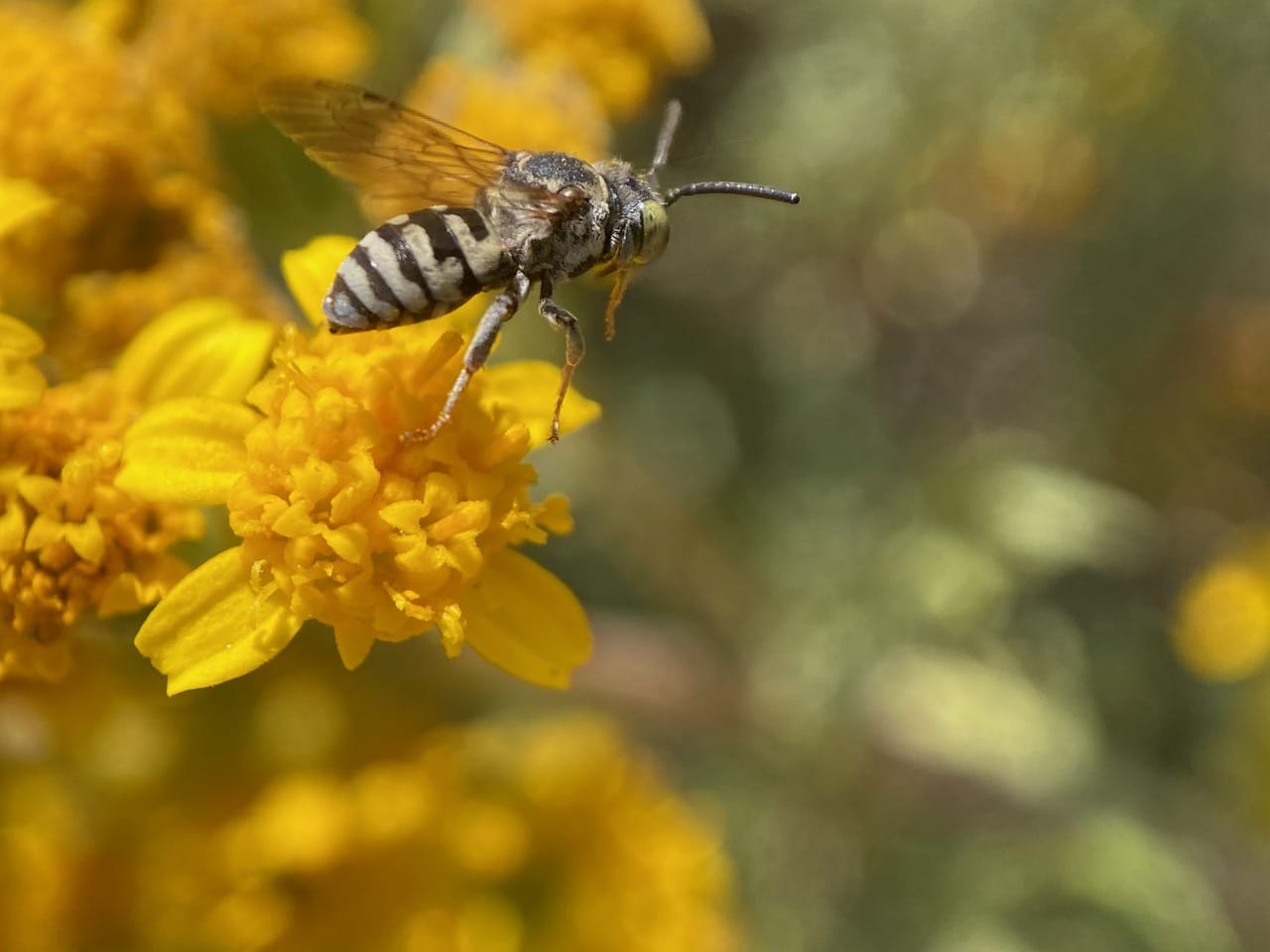
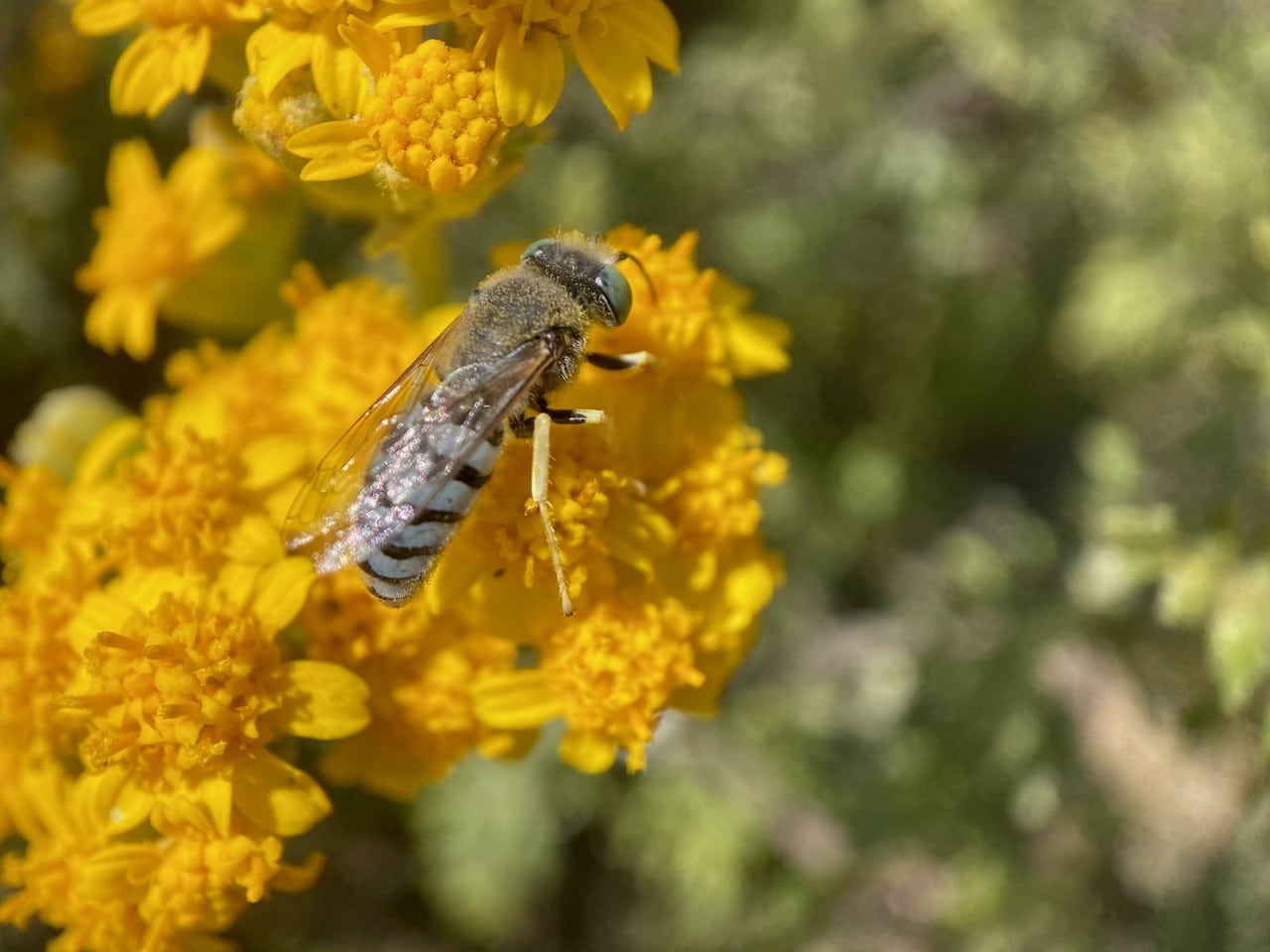
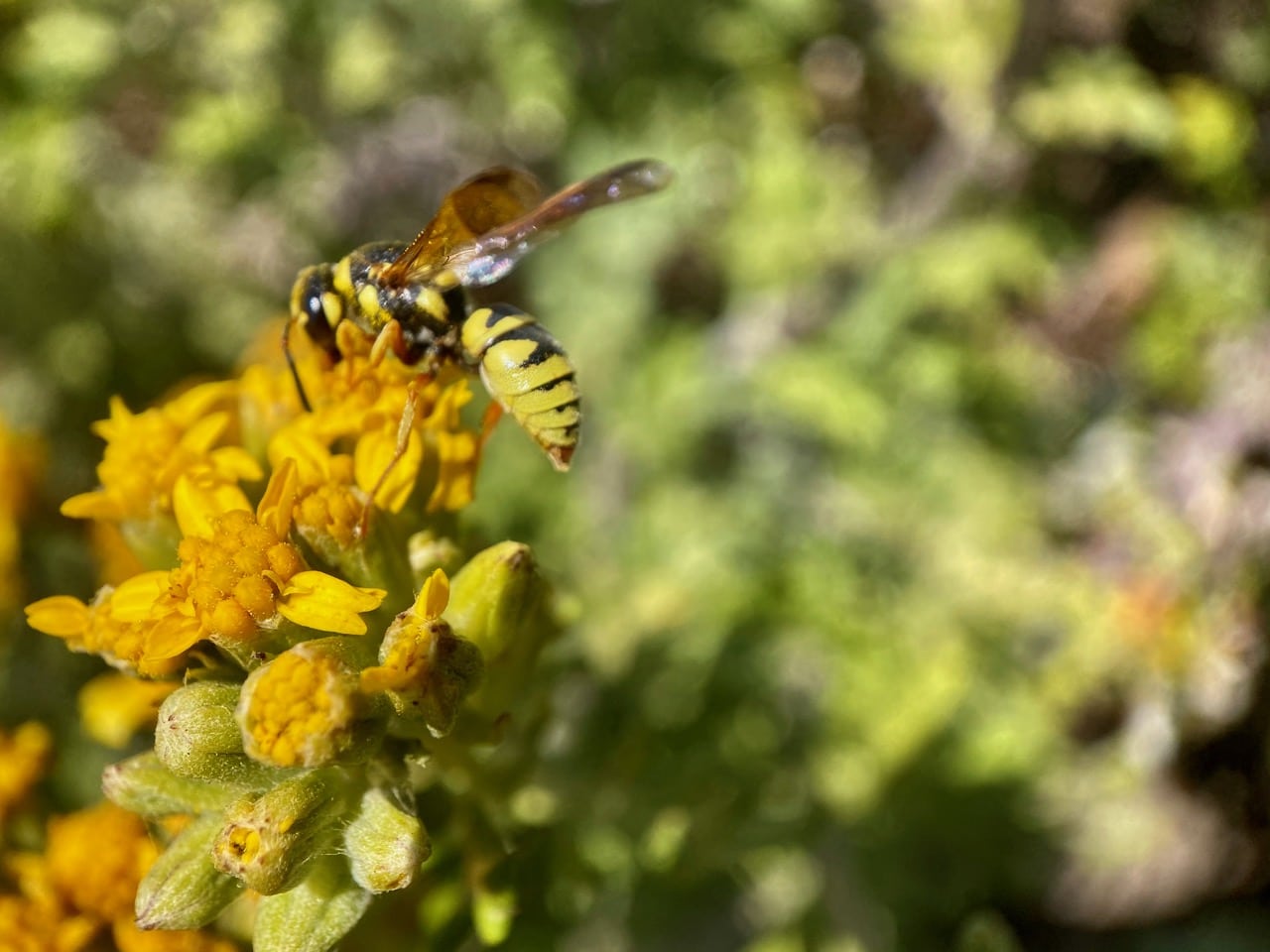


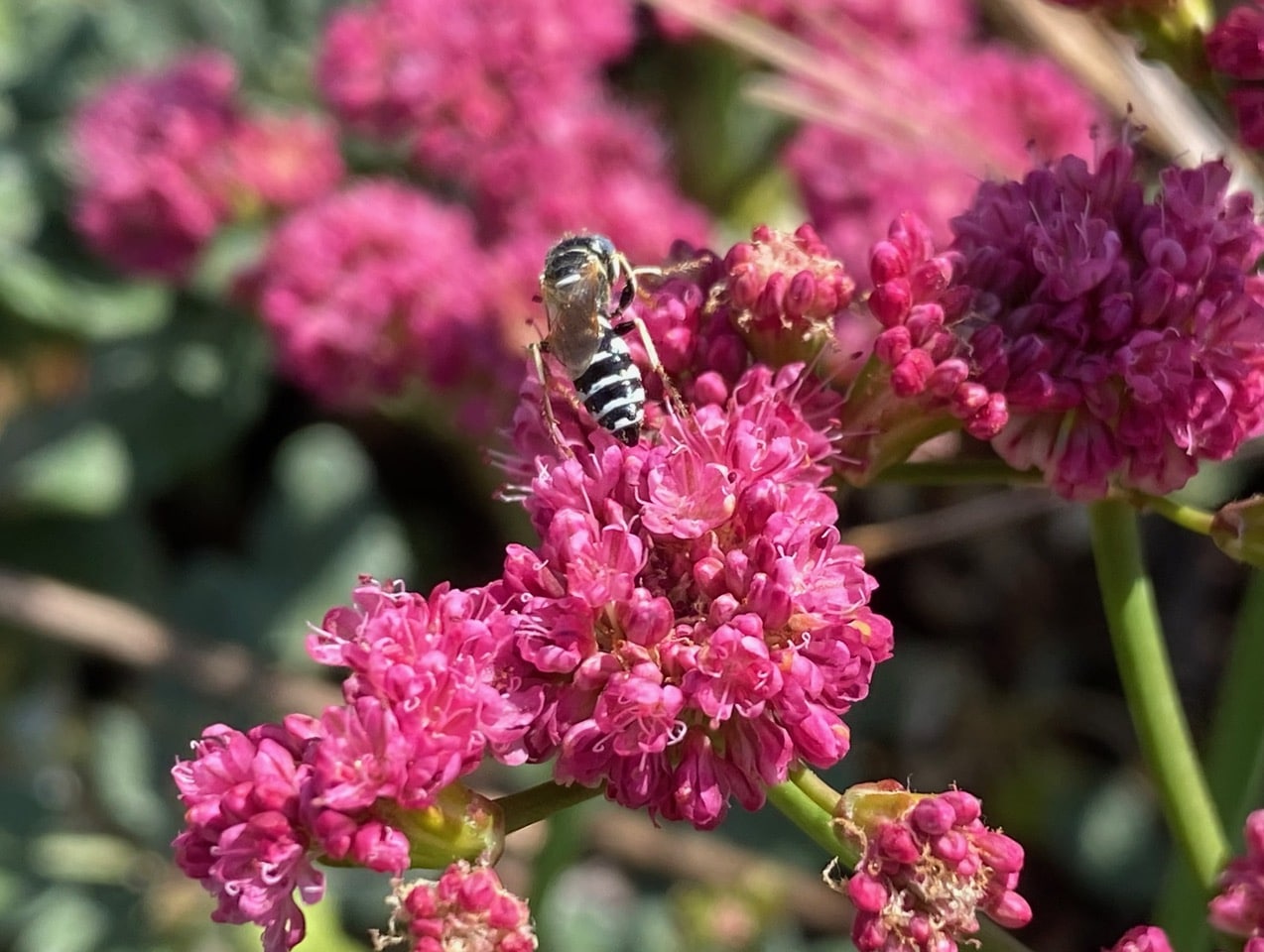

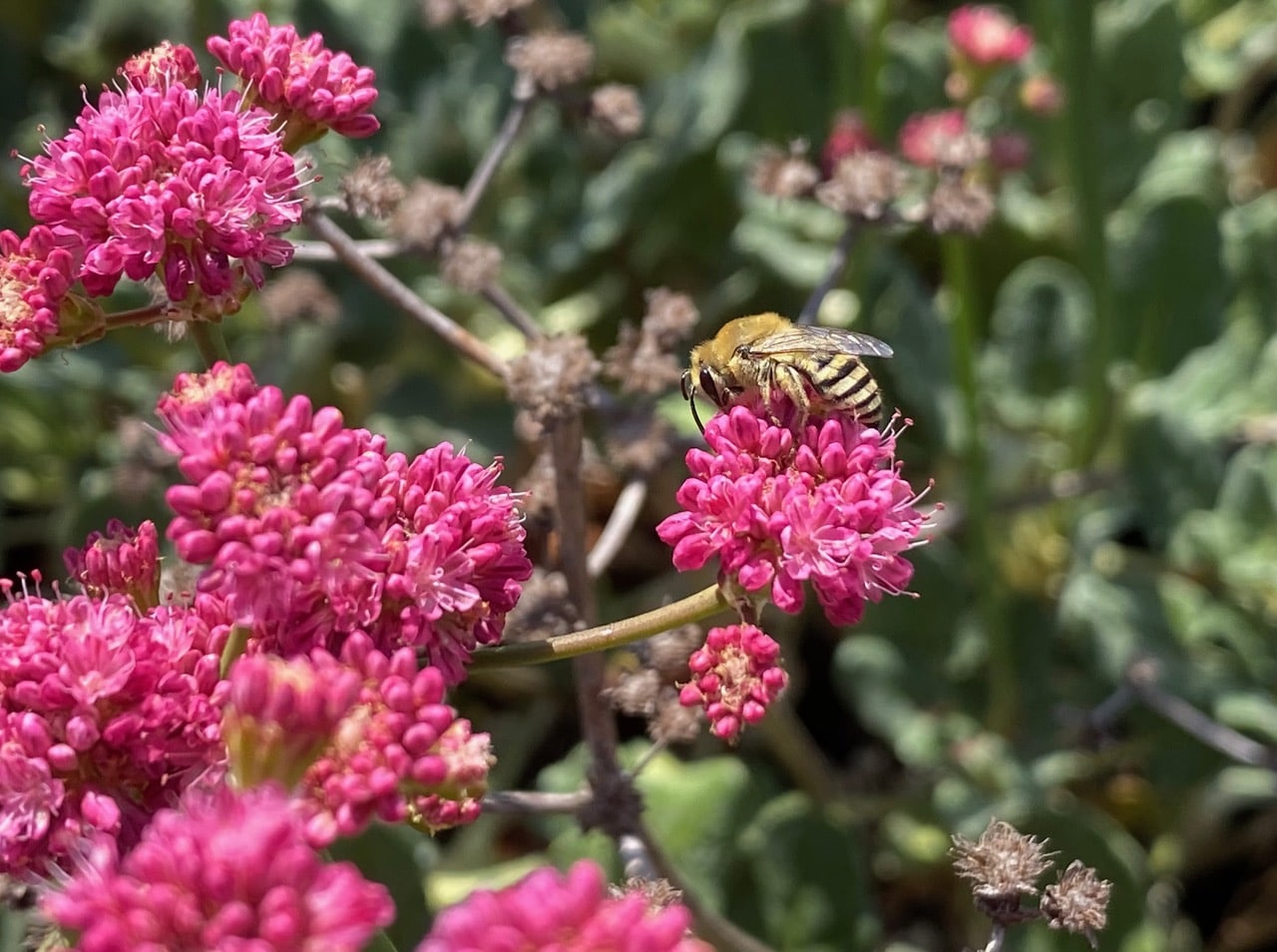
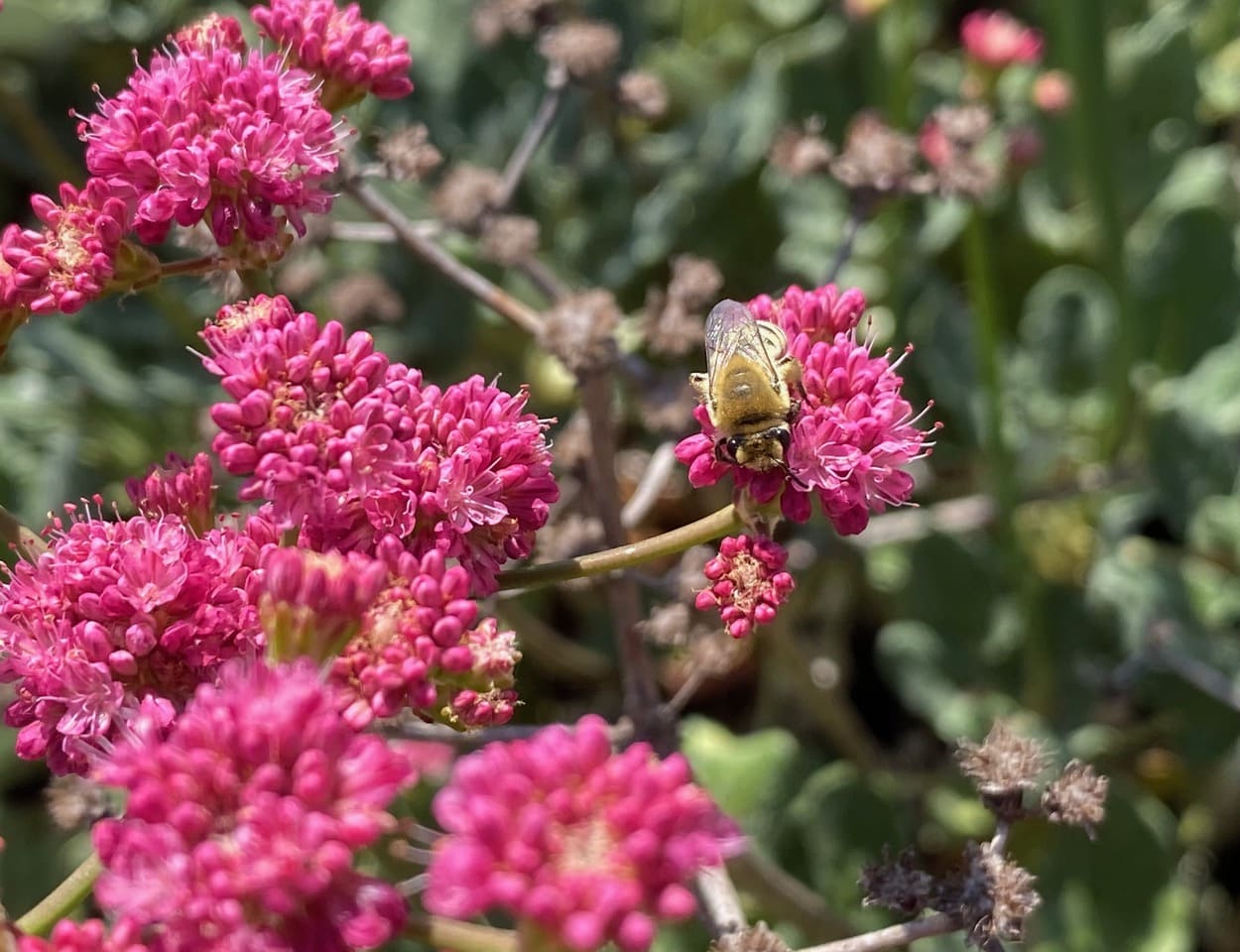
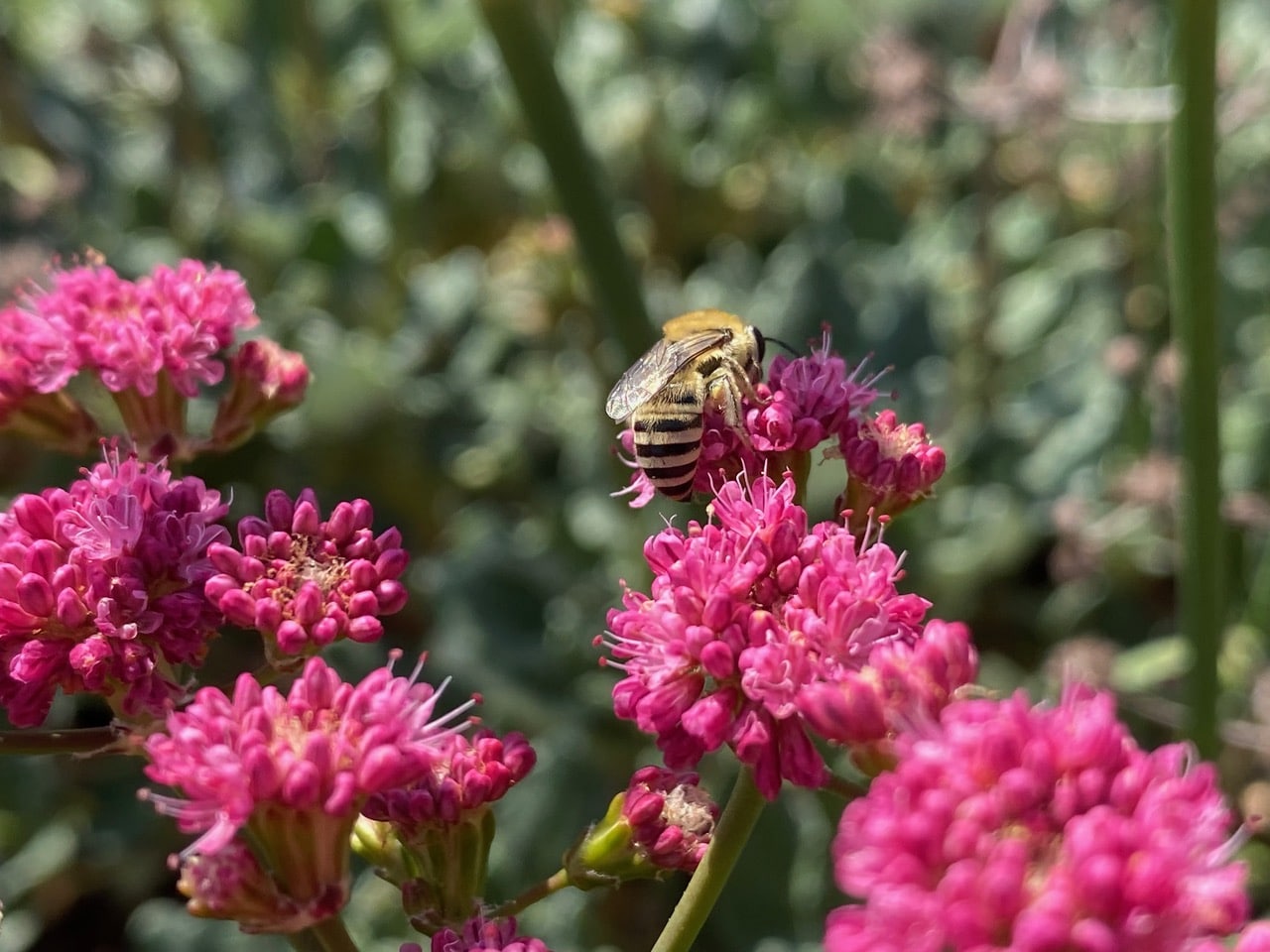

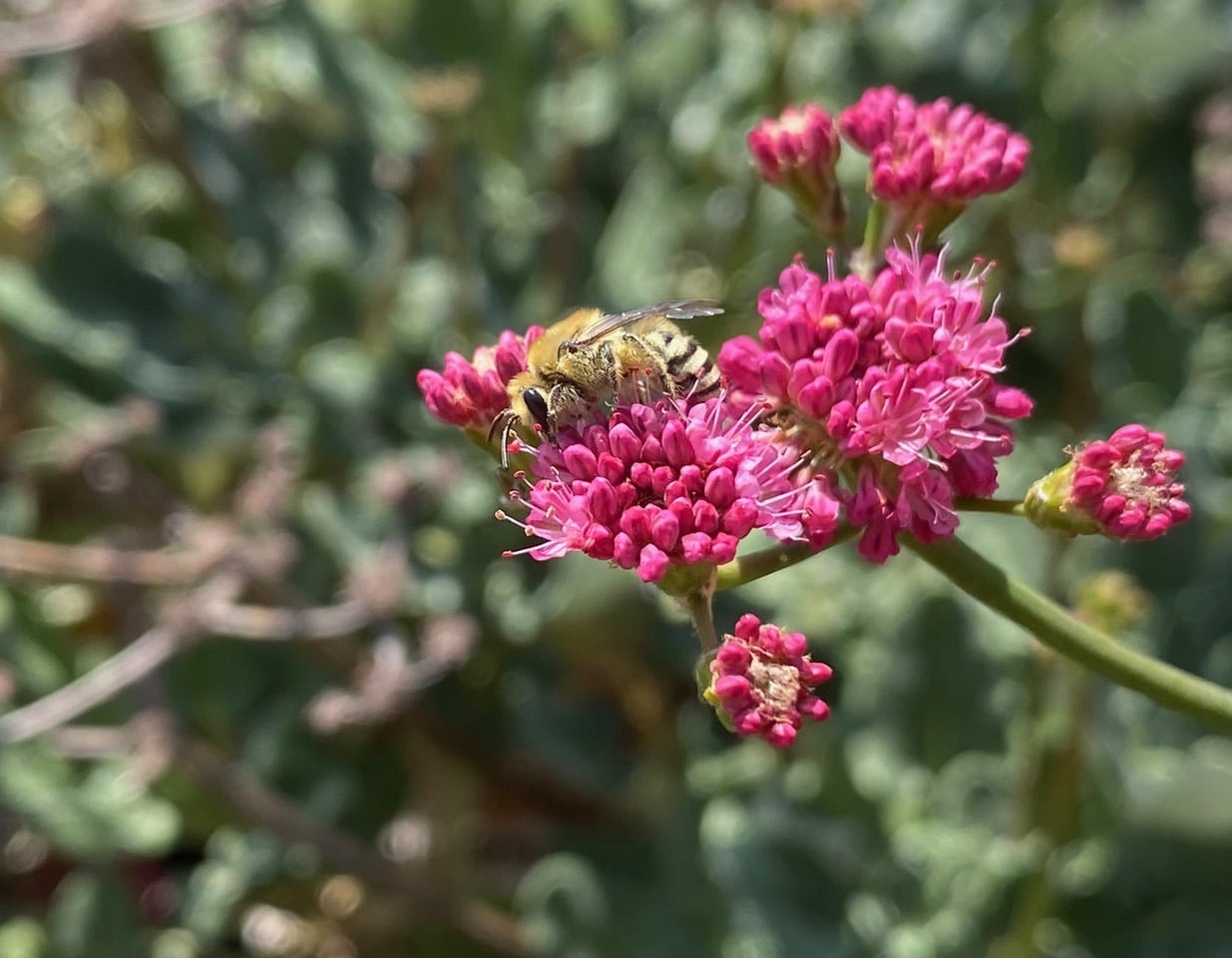
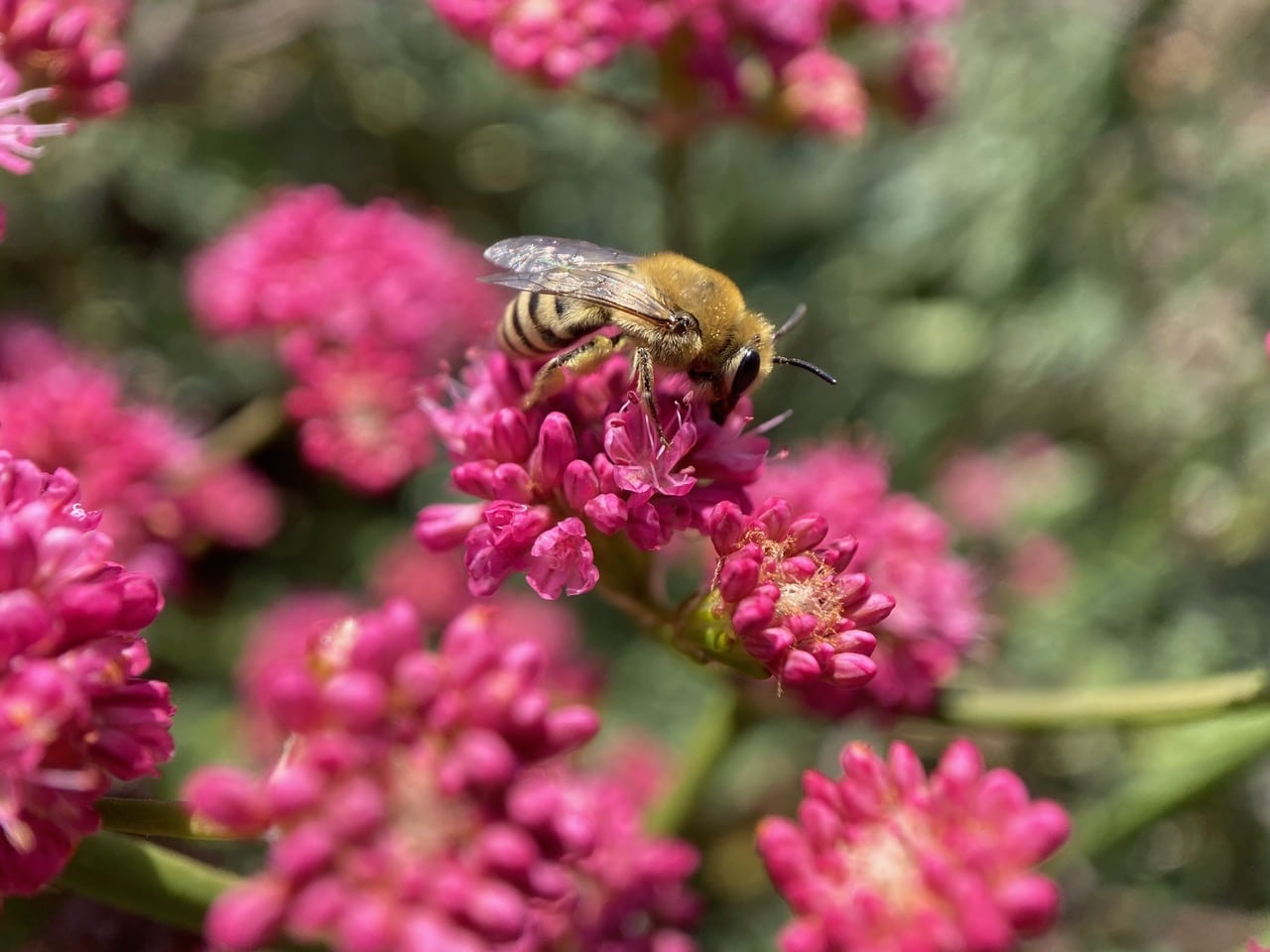
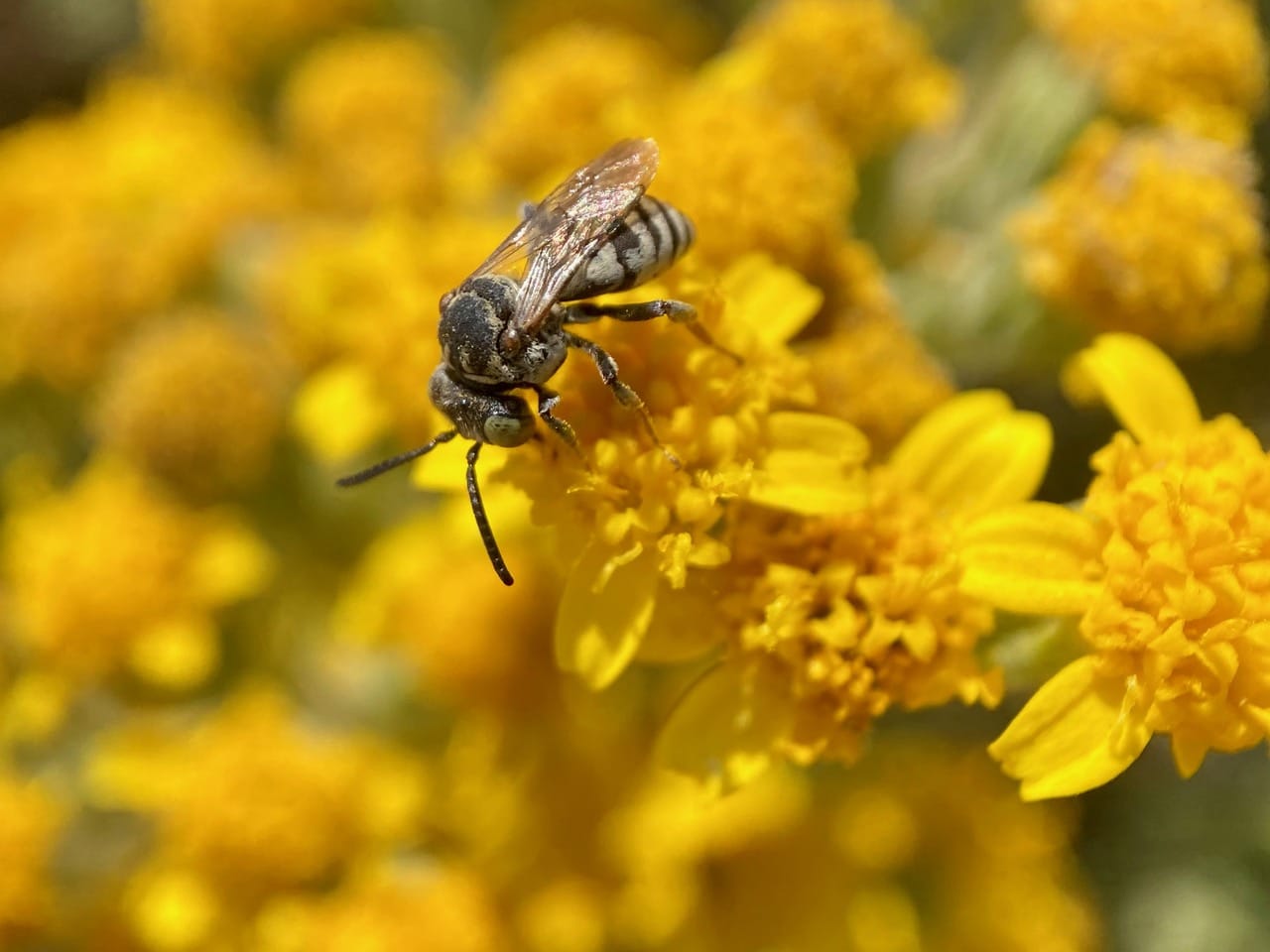
A Least Cellophane-cuckoo Bee, Epeolus minimus (family Apidae) is taking nectar from the tightly clustered flowerheads of Seaside Woolly Sunflower, Eriophyllum staechadifolium .
Epeolus is a genus of cuckoo bees in the family Apidae. They are often known as variegated cuckoo bees. The species is uncommon to rare, and has strong patterns of black and white on the thorax and abdomen. These patterns are made of tiny fat hairs lying flush with the integument or “skin”of the bee. The species within Epeolus are medium-sized bees with bright patterns. All known species of Epeolus are kleptoparasites of mining bees of the genus Colletes. The female enters the nest excavated by the host and lays an egg in an unsealed cell. The Epeolus larva then consumes the egg of the host bee and then feeds on the pollen the Colletes bee provisioned the cell with for her offspring. Colletes bees line their nest cells with a cellophane like covering which they exude from the Dufour’s gland to protect the cell from moisture and fungal infection. Female Epeolus bees have spines on the end of their abdomens which they use to pierce U-shaped holes in this covering so that she can oviposit between its layers; she also secretes a small amount of glue to attach her egg to the cell.
Epeolus minimus is among the most widespread and commonly collected Epeolus species in North America.
The predominant insects visiting the Seaside Woolly Sunflower are the American Sand Wasps, Bembix americana (family Crabronidae). While they are an important species in this beach ecosystem, I have learned to ignore them as they tend to stir up the other insects that land on the flowers.
Sand wasps in the genus Bembix are familiar and common throughout North America, digging their burrows in dunes, on beaches, and other habitats with loose, deep sand. The female rapidly kicks out large quantities of sand using a “tarsal rake” of spines on each front leg. The burrow is excavated before the wasp goes hunting. Bembix are generalist, opportunistic hunters. True flies in the order Diptera are the usual prey. A victim is paralyzed or killed by the wasp’s sting, and is then flown back to the nest. Most species will lay an egg on the first victim, while some species lay an egg in the empty cell before starting to hunt. Once the egg hatches, mama wasp brings flies to her larva as needed. This “progressive provisioning” is rare in the insect world. When the larva reaches maturity, mama wasp closes the cell. Inside, the larva spins an oblong cocoon, weaving sand grains into the structure and resulting in a hardened capsule. Overwintering takes place as a prepupa inside this cocoon, but there are usually two generations a year.
Male sand wasps often engage in an elaborate flight ritual called “sun dances”. Males emerge before females, and fly erratically at dizzying speed one or two inches above the ground attempting to detect virgin females about to emerge from their underground nests. Both sexes are often seen taking nectar at flowers, especially from Asteraceae family. Bembix wasps are often victims of other insects such as cuckoo wasps (Chrysididae), velvet ants (Mutillidae), satellite flies (Sarcophagidae), bee flies (Bombyliidae), and thick-headed flies (Conopidae).
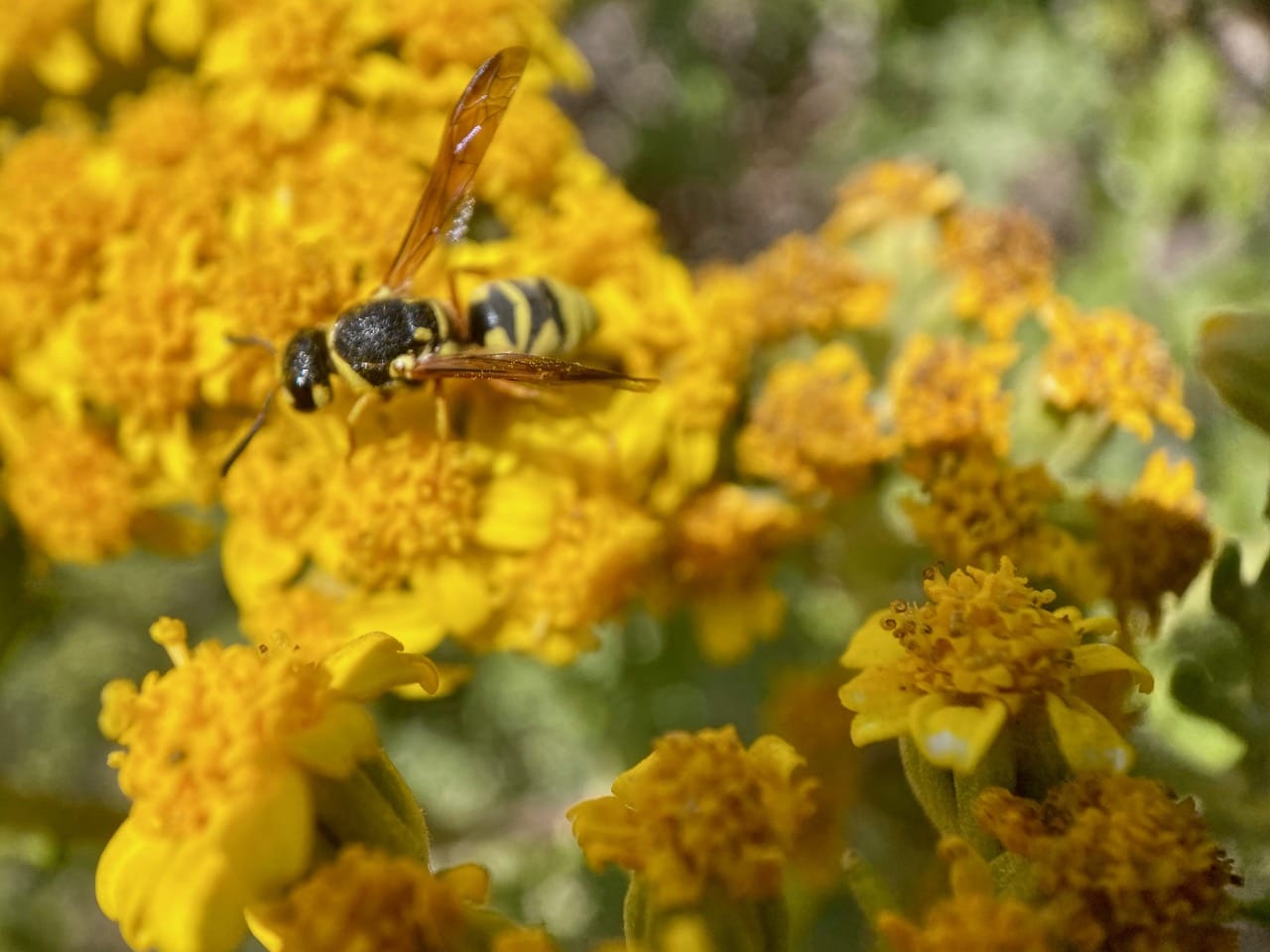
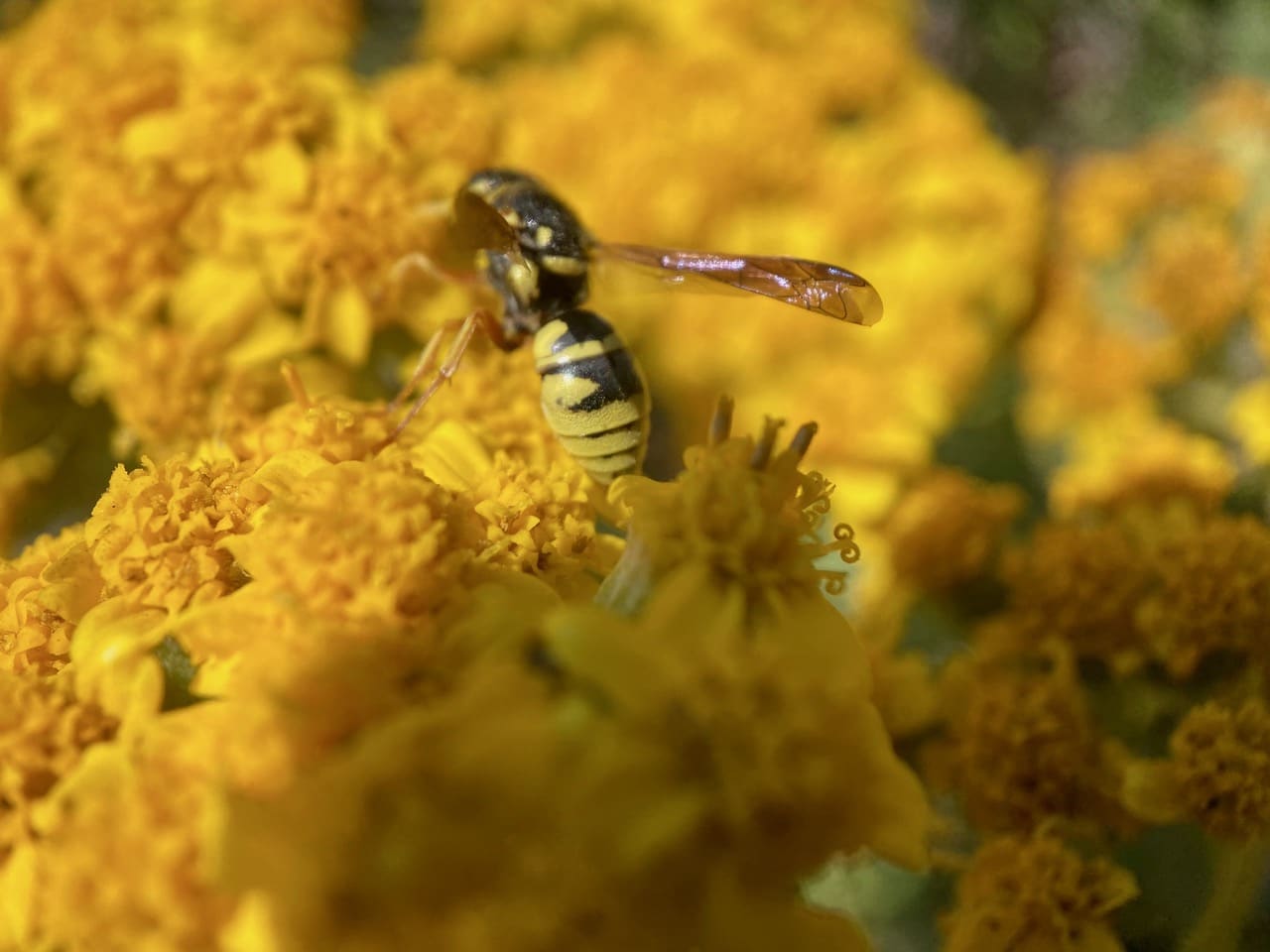
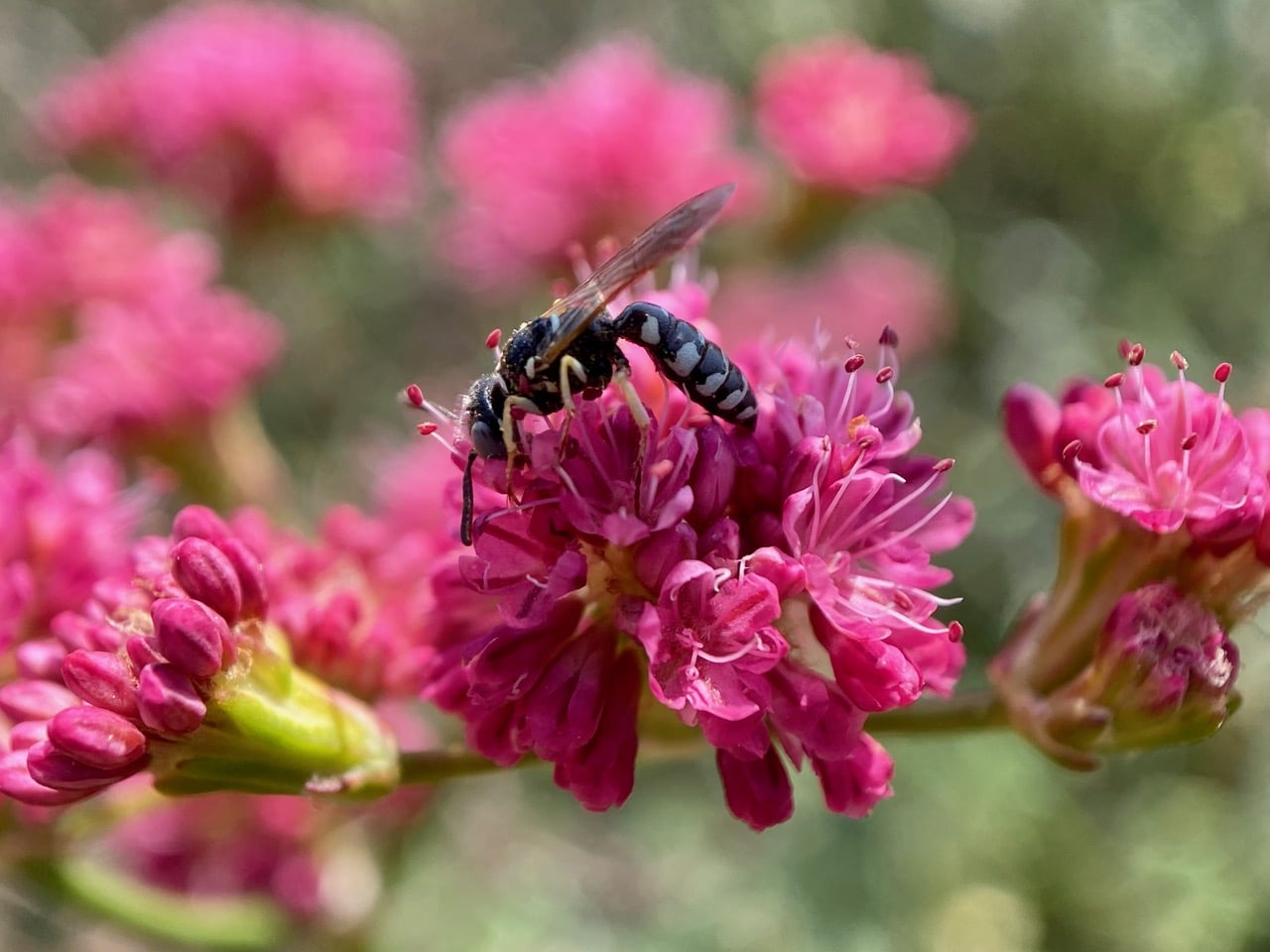
A Mason Wasp, Euodynerus annulatus (family Vespidae, subfamily Eumeninae) is foraging on the flowers of Seaside Woolly Sunflower.
The Mason Wasp, Euodynerus annulus (family Vespidae, subfamily Eumininae) is a widespread species, found from coast to coast in the United States, south to Mexico, and north into Canada. The color and markings vary considerably among the various subspecies. These are sizable wasps, their fore wings measuring 8.5-10.5 mm. Males can be recognized by the hooked tips of the antennae, and their less robust appearance. Unlike the other Mason Wasps that use pre-existing cavities, or making mud nests, the females of this species excavate burrows. They also extend the tunnel above ground as a curved mud “chimney”. Several individual cells branch from the main burrow underground. The species seem to favor situations close to water, as the female regurgitate water to soften the soil during nest-building. The chimney might help protect against parasites, but it apparently serves as the source of mud pellets to make the final nest closure as well. Eventually, the turret is deconstructed entirely and the nest entrance made nearly invisible and flush with the surrounding soil.
The female wasps provision their nests with moth caterpillars as food for their offspring. A single egg is suspended from a short thread attached to the wall of the cell before it is stocked with caterpillars. Usually several caterpillars are placed in each cell. When all cells are provisioned, the nest entrance is sealed. The turret or chimney is deconstructed entirely and the nest entrance made nearly invisible and flush with the surrounding soil. The wasp leaves to begin a new nest.
While the wasp seems busy taking nectar, she might also be on the look out for moth caterpillars among the flowers to provision her nest for the young.
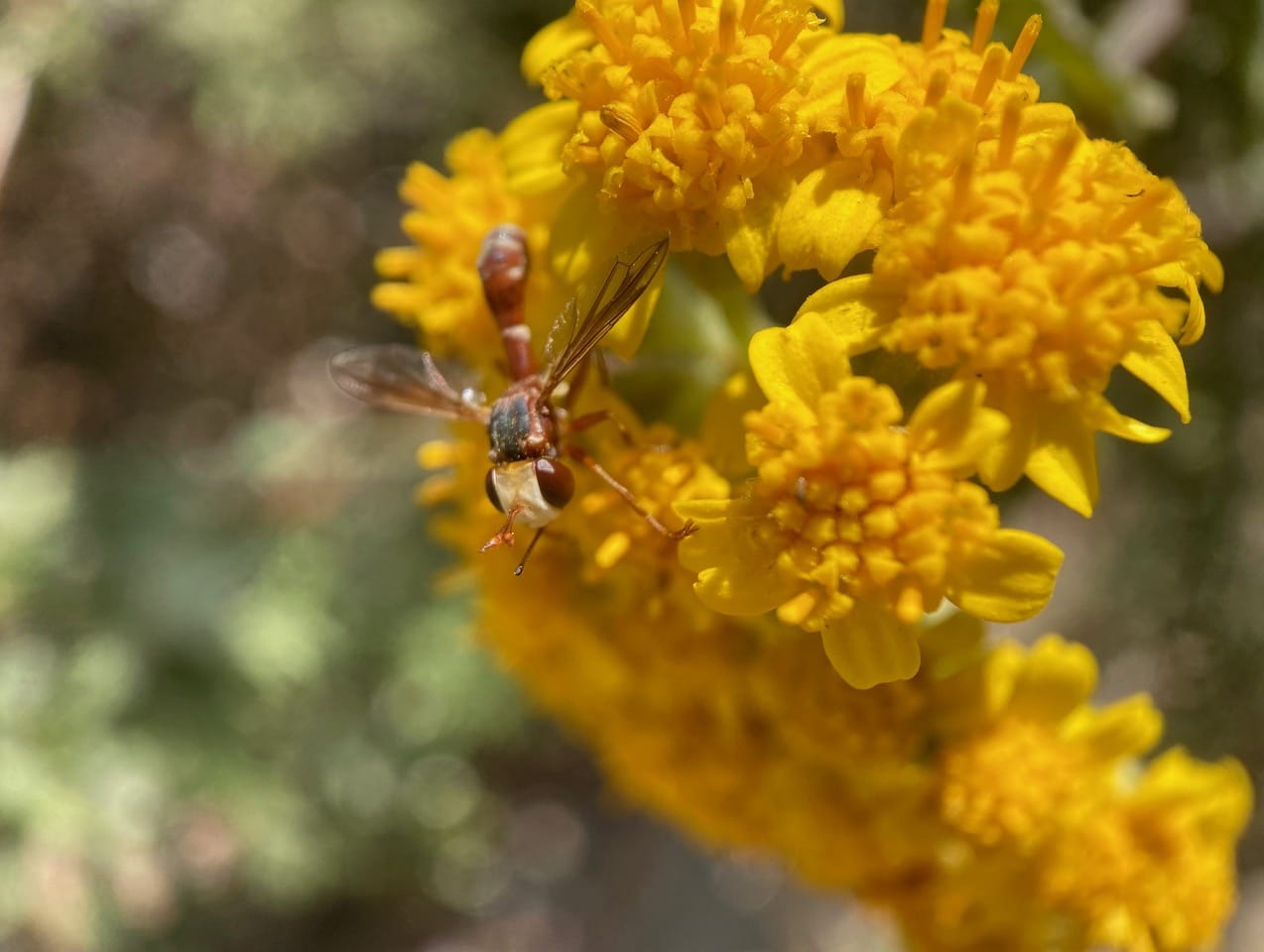
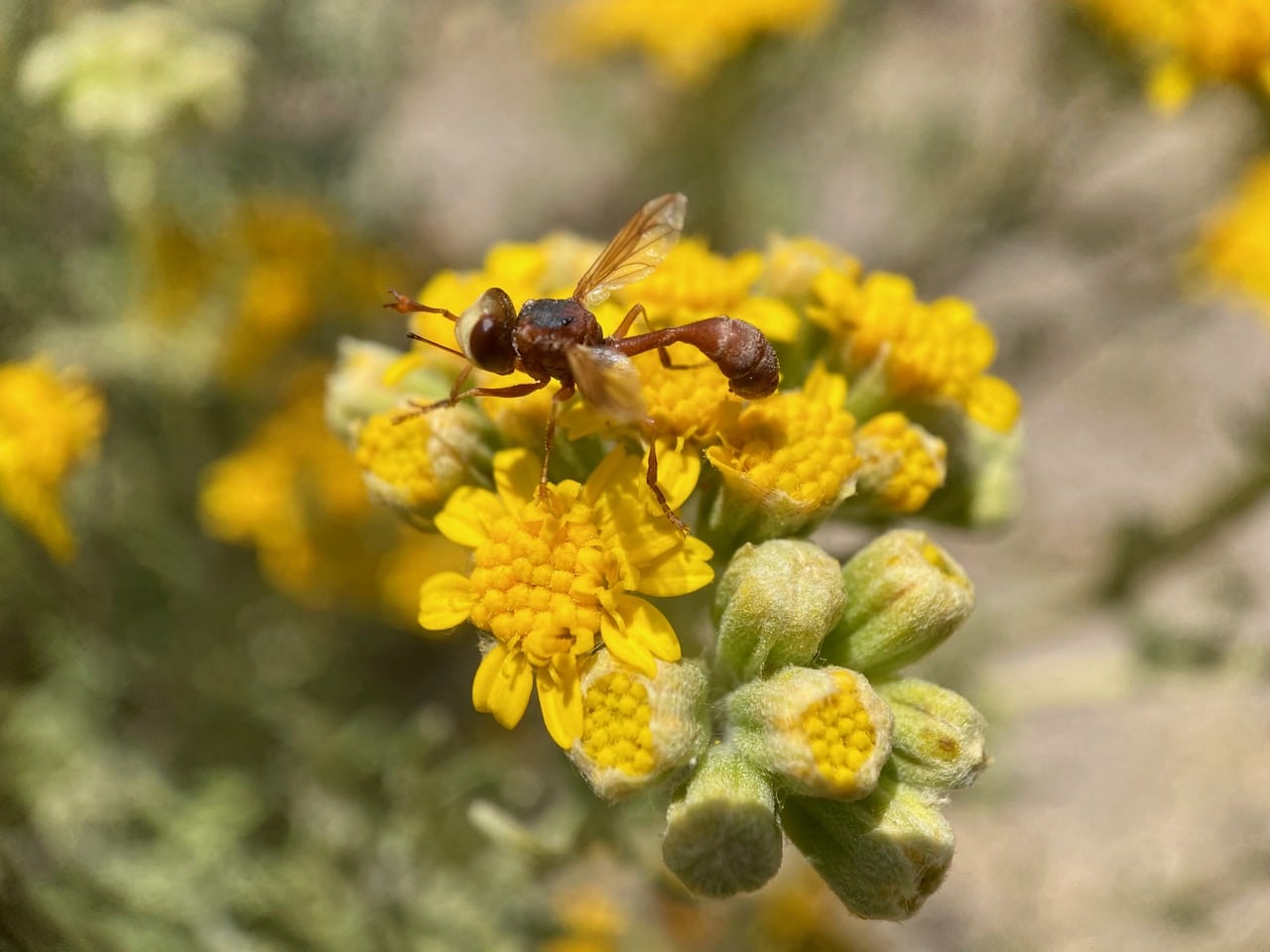
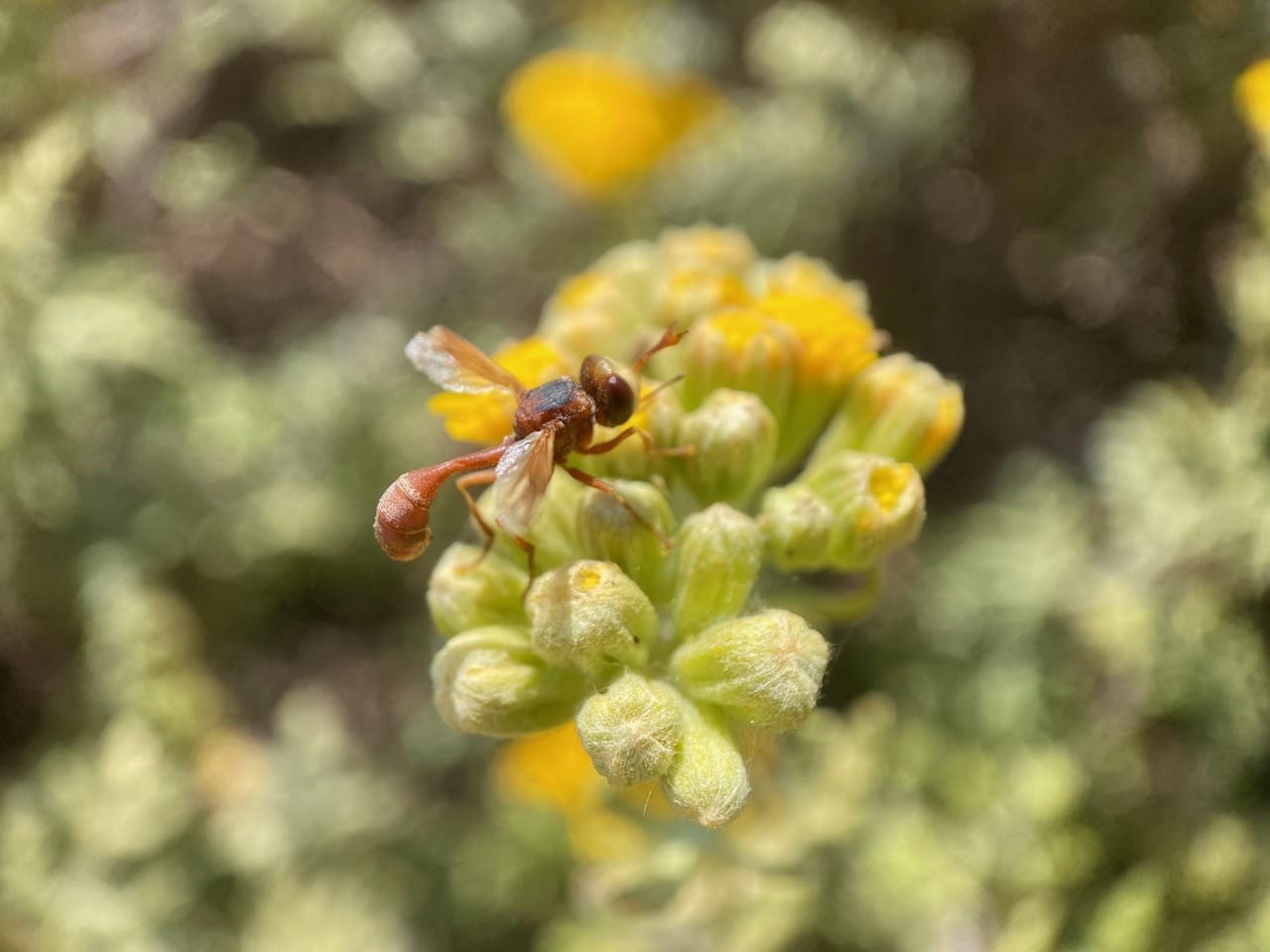
Ooh, here’s a new species for this spot! The strange creature looking up at me is a Thick-headed Fly, Physocephala burgessi (family Conopidae).
The small and little-known family of Conopidae, commonly called the Thick-headed Flies, are distributed worldwide. Remarkable mimics of wasps and bees, the flies are frequently found at flowers, feeding on nectar with their long probosces. The larvae of all Conopids are internal parasitoids, mostly of aculeate (stinging) Hymenoptera (wasps, bees). Adult females aggressively intercept their hosts in flight to deposit eggs. Vulnerable foraging bees are likely the most susceptible to parasitism by Conopids. The female’s abdomen is modified to form what amounts to a “can opener” to pry open the segments of the host abdomen as the egg is inserted. The fly larva feeds on the host from the inside out. The bee host continues to live, and is able to fly throughout the duration of the larval developmental period. The vast majority of parasitized bumble bees bury themselves by burrowing into the ground right before they die. This behavior does not matter to the bees – they are doomed. But it is critical for the flies – if the host dies underground, the fly is sheltered from the elements, predators and parasites. Pupation occurs in the abdomen of the now deceased bee host. The adult fly typically emerges after overwintering in the abdominal puparium of the bee.
The life spans of parasitized bumble bees are not significantly shortened, though as the parasitoid grows, the bee can’t carry home as much nectar. Bumble bees will chill, literally, to put off the inevitable, seeking cooler spots, even sleeping outside at night to slow the growth within them. If many of the workers in a colony are infested, future queens may be smaller in size and may not have enough energy to get through the winter.
These flies are such good mimics of wasps that I tend to mistake them for wasps. Their reddish brown coloration is rather distinctive though.
Wow, there seems to be quite a number of the Conopids on the Seaside Woolly Sunflower today! It’s not surprising as this is prime hunting ground if you’re after bees and wasps.
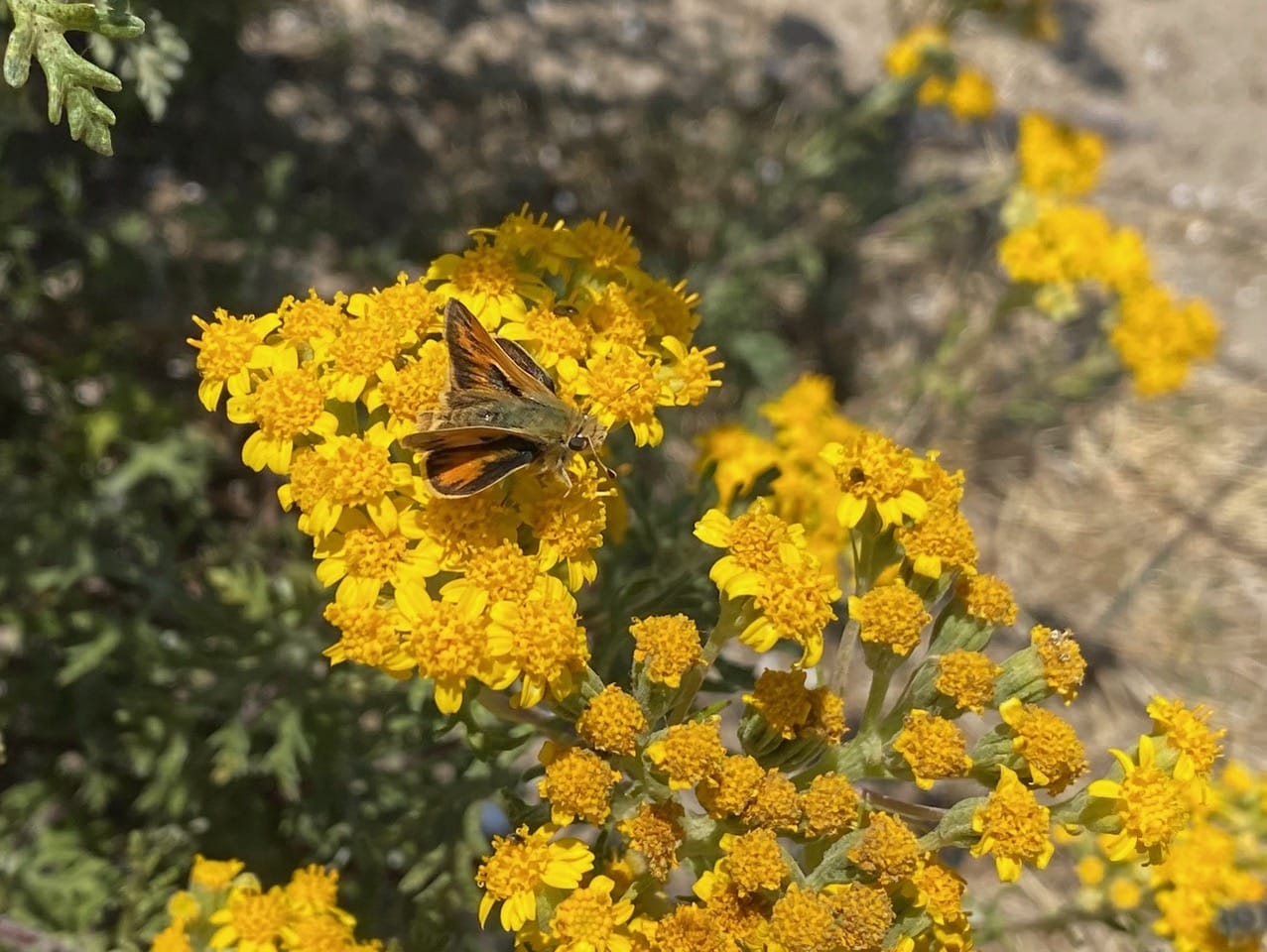
A Sandhill Skipper, Polites sabuleti (family Hesperiidae) has landed on an inflorescence of Seaside Woolly Sunflower.
Skippers are a family, the Hesperiidae, of the order Lepidoptera (butterflies and moths). They are named for their quick, darting flight habits. Most have the antenna clubs hooked backwards like a crochet hook. They also have generally stockier bodies and larger compound eyes than the other butterflies. Their wings are usually small in proportion to their bodies. When at rest, skippers keep their wings usually angled upwards or spread out, and only rarely fold them up completely. Californian species are mostly brown or tan, with black, orange, or yellow markings.
Skipper caterpillars are usually green or brown, sometimes yellowish, never brightly colored. They have a distinctive “collar”, a narrow ring around the body right behind the head. Caterpillars are camouflaged and often hide during the day. Many species make nests of leaves and silk for additional protection. Most North American species feed on grasses, but some common species eat shrubs and trees, especially in the bean family. Most species are limited to a single group of food plants. Adult skippers are only active during the day, but Skipper caterpillars feed mainly when it is dark or partly light.
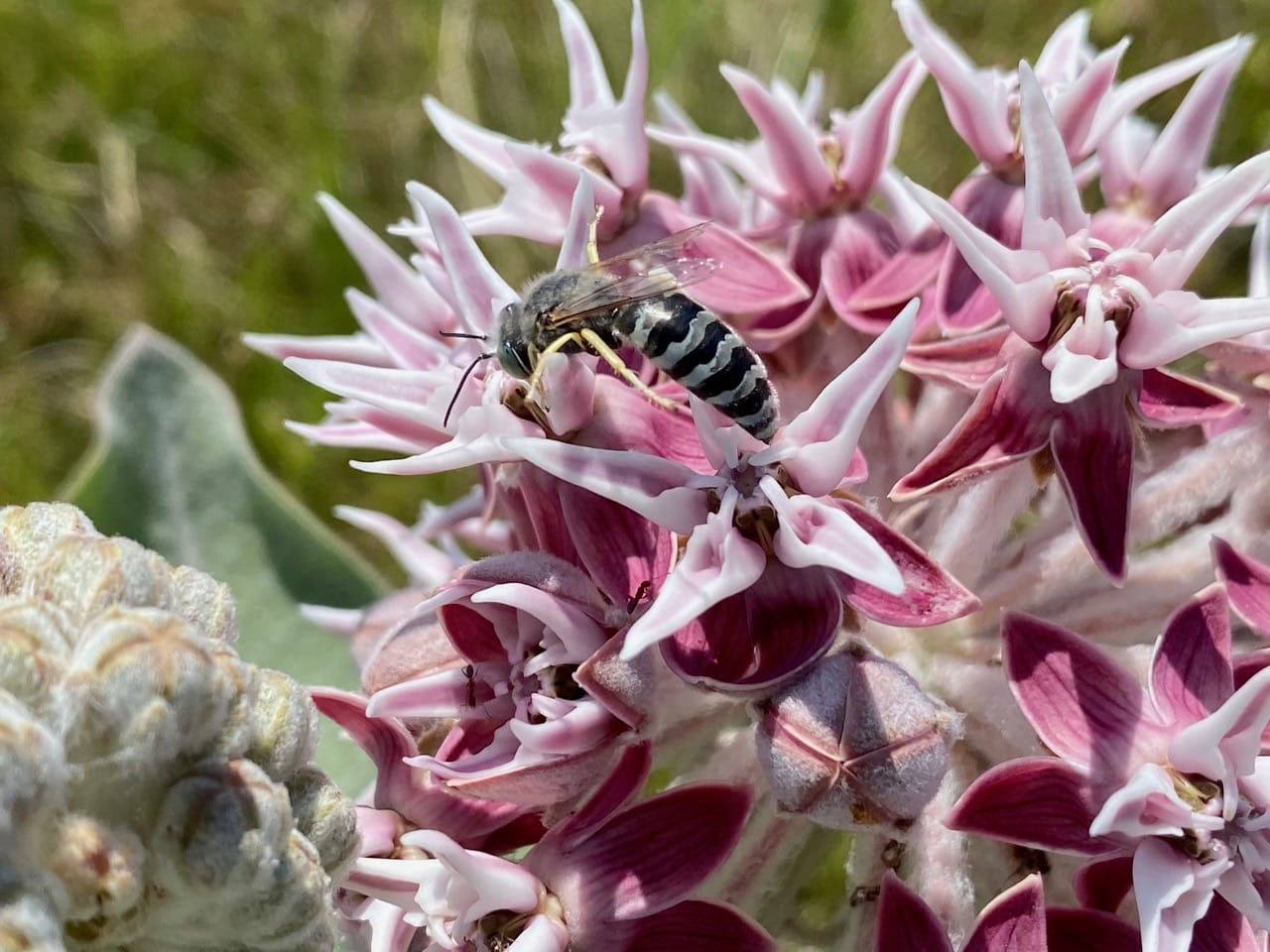
As with the other plantings at Crab Cove, the American Sand Wasp, Bembix americana (family Crabronidae) dominates the scene at the native garden where Showy Milkweed is blooming profusely. I wonder if the large wasps are good pollinators for the milkweed? Should its leg accidentally slip into one of the flower’s treacherous stigmatic slits, surely the wasp is robust enough to pull out the pollinia without being trapped? I watch as closely as I can, but fail to see any wasp with pollinia attached to its legs. I also keep an eye out for dead insects or insect legs trapped on the flowers. None that I can find – all is well.
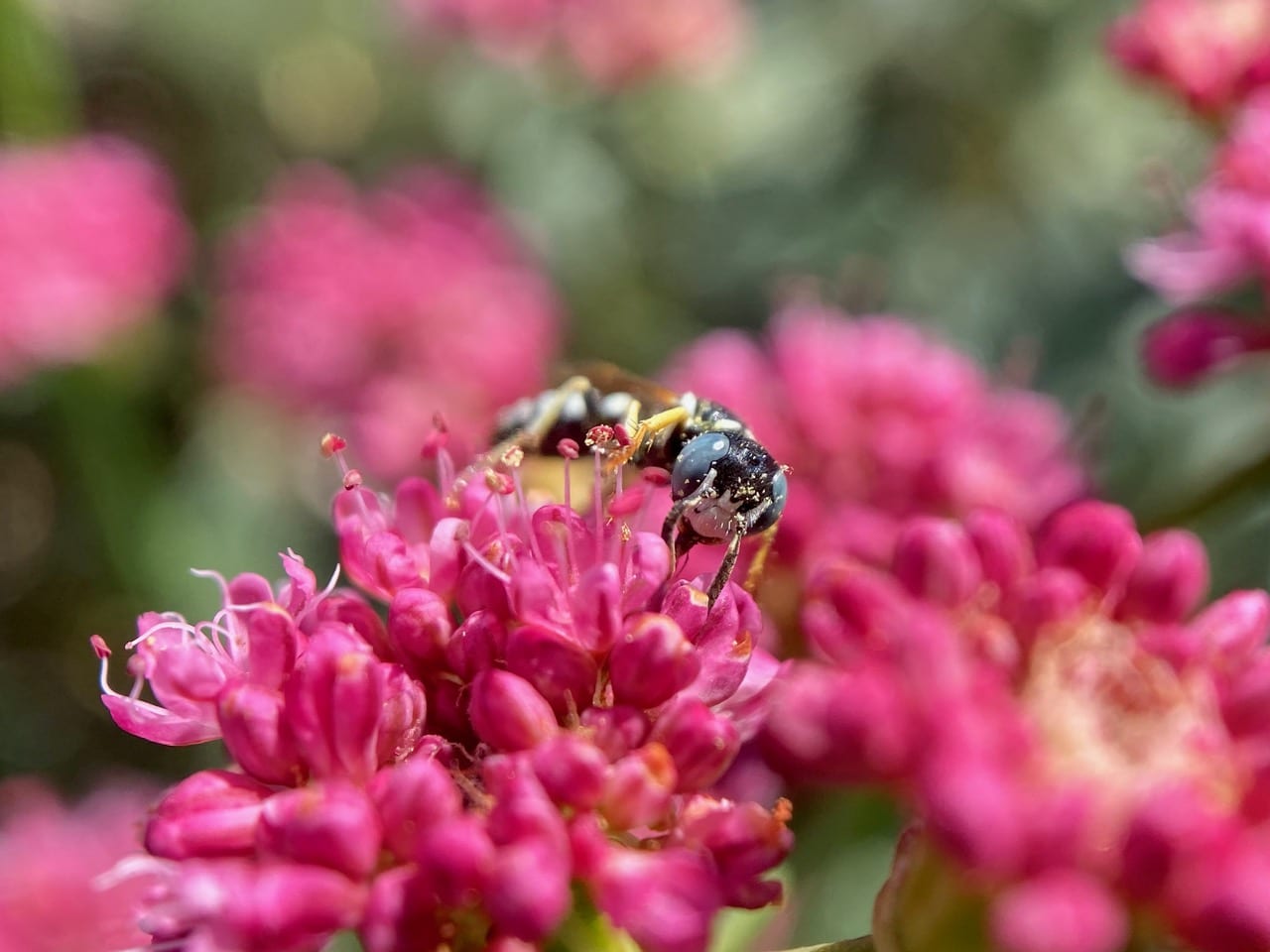
A small wasp is foraging on the flowers of Red-flowered Buckwheat, Eriogonum grande var. rubescens. It is a Beewolf, Philanthus politus (family Crabronidae).
Beewolves (genus Philanthus) are solitary, predatory wasps, most of which prey on bees, hence their common name. The adult females dig tunnels in the ground for nesting, while the territorial males mark twigs and other objects with pheromones to claim the territory from competing males. As with all other spheroid wasps, the larvae are carnivorous, forcing the inseminated females to hunt for bees on which she lays her eggs, supplying the larvae with prey when they emerge. To prevent fungal growth on the stored prey, female Philanthus wasps secrete symbiotic bacteria from specialized antennal glands. Some Philanthus species specialize on certain bee species, others may be generalists that prey on a wide variety of bees. The adults visit flowers for nectar. The best known beewolf is the species that prey on honey bees.
Its face and milky-blue eyes are peppered with pollen as the Beewolf wades through the small flowers probing for nectar.
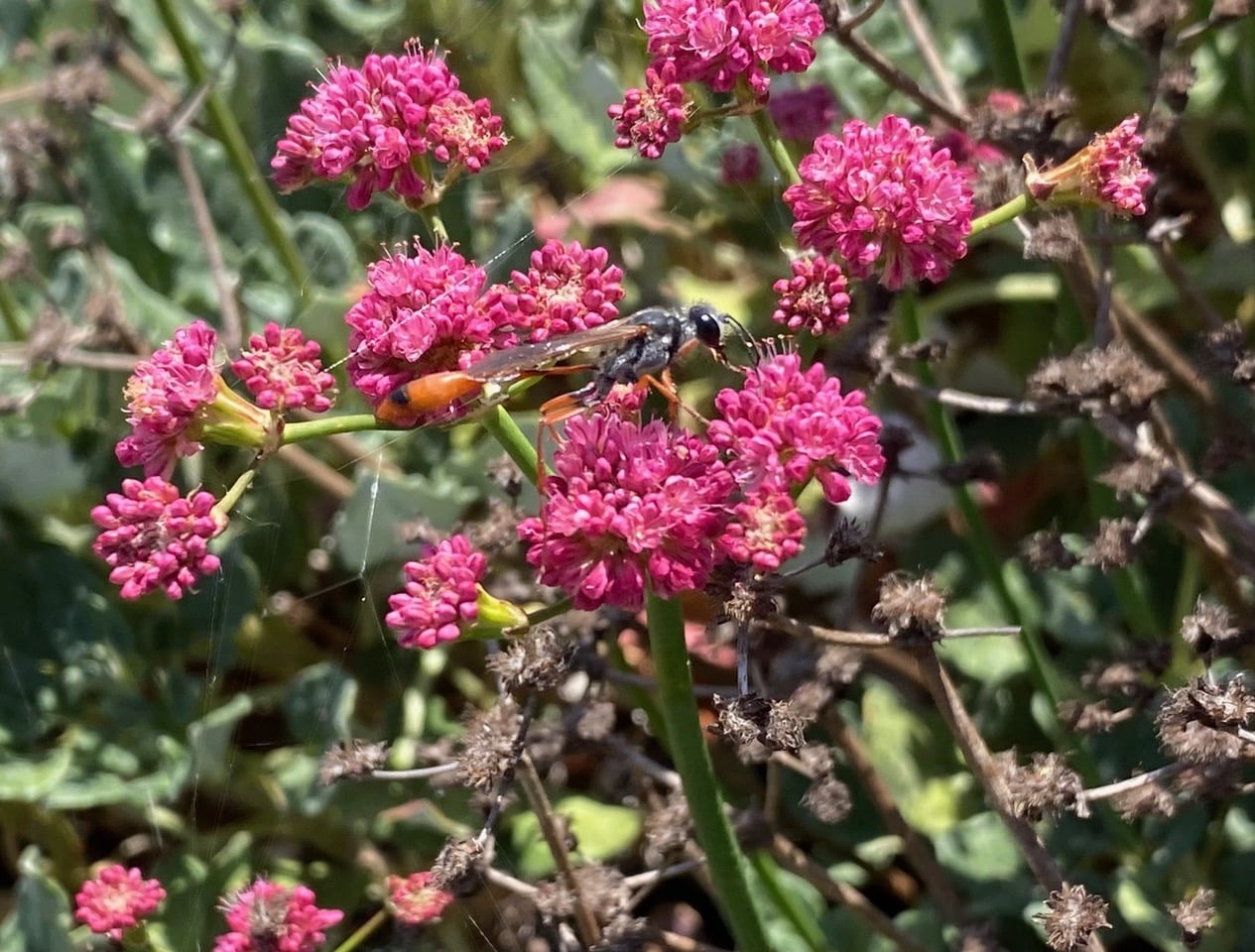
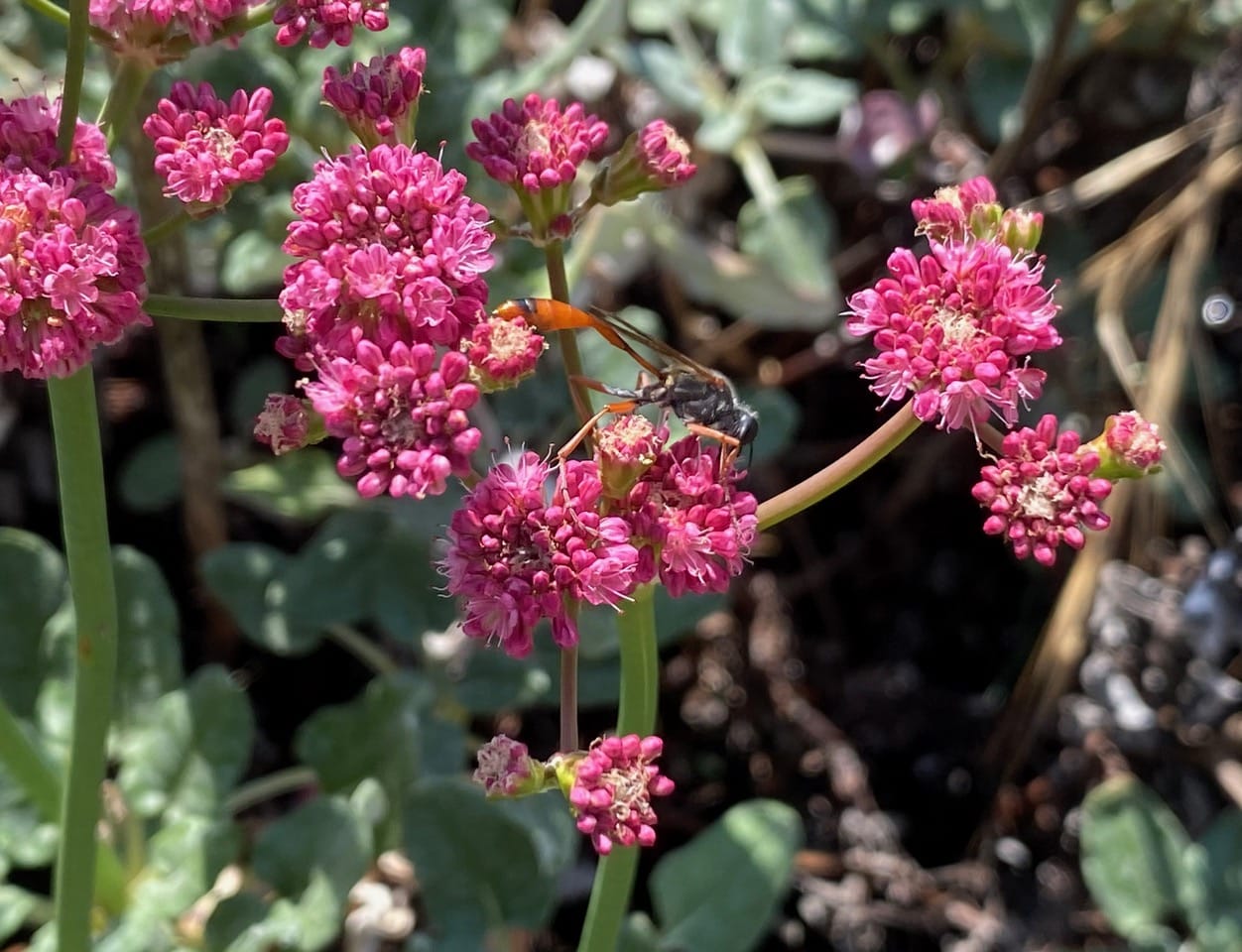
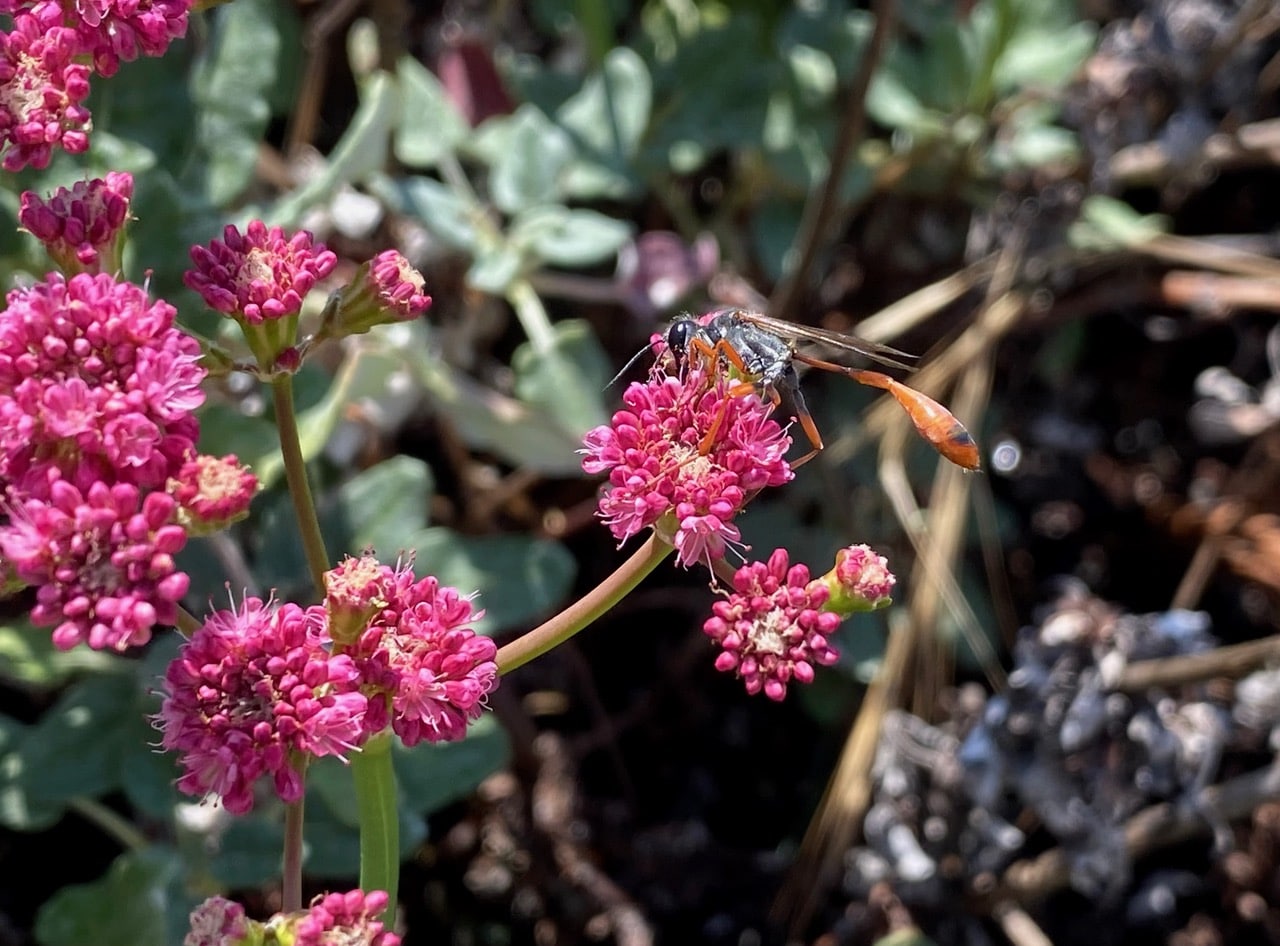
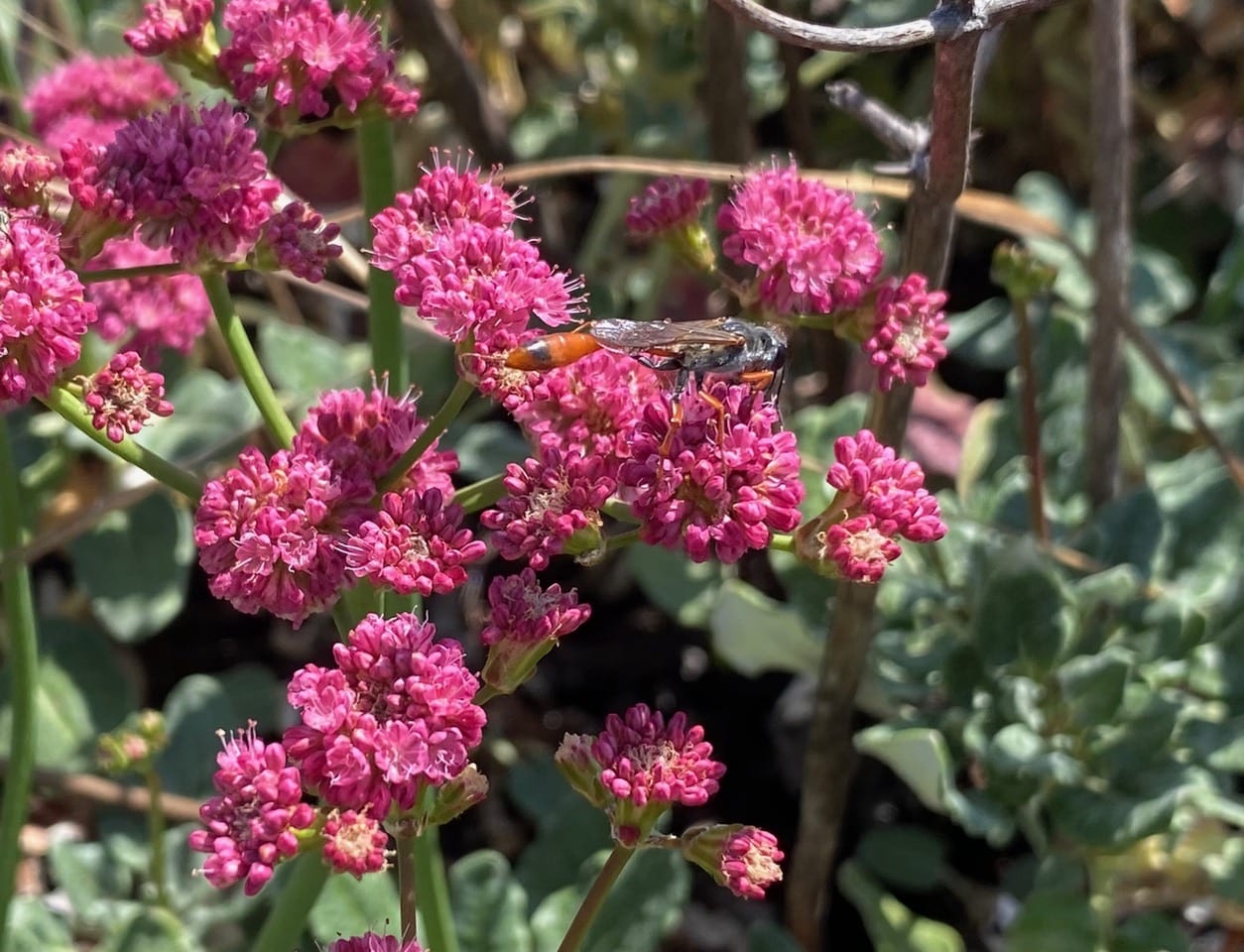
Hey, that’s a Thread-wasted Wasp on the Red-flowered Buckwheat! While the buckwheat attracts a diversity of insects, the red-flowered species is one of the most challenging flowers on which to see them. It is almost impossible to track the red abdomen of the wasp while it moves through those busy red flowers!
Ammophila aberti is a species of Thread-waisted Wasp in the family Sphecidae. It is found in western and central North America, from southern Canada to Mexico, in open, semi-arid habitats.
The female digs its nest in firm sand or muddy areas. While digging, the wasp emits a buzz that can be heard from over four meters away. It flies and drops the excavated soil away from the burrow. Ammophila aberti is somewhat of a generalist in that it uses a wide variety of Lepidopteran species in provisioning its nests. Females prey on caterpillars from a number of different families of moths and butterflies, including Geometridae, Noctuidae, Pyralidae, Hesperiidae, and Pieridae, provisioning up to 10 caterpillars per nest. The female always closes the burrow entrance when she leaves to hunt. The temporary closure is achieved by pulling a pebble over the opening and pushing sand over it. After the nest has been fully provisioned, the wasp closes the burrow again by jamming pebbles inside it and kicking soil and sand down. Once the fill material is level with the surface, the wasp uses a rock to tamp down the material. Prey stealing is common from other wasps in the nesting aggregation. A female returning to her burrow with her catch may be attacked by one or more others of her kind that try to wrest the caterpillar from her. No wonder she is so security-minded.
A Yellow-faced Bumble bee, subgenus Pyrobombus (genus Bombus, family Apidae) is foraging on an inflorescence of Red-flowered Buckwheat.
Hello, who’s this little bee that shines like gold in the sunlight?
Note the rows of pale hairs lining the inner margins of the bee’s compound eyes. Look like part of a facial fovea? Perhaps the bee is a Miner Bee, Andrena sp. (family Andrenidae)?
The facial fovea of Andrena bees are distinct velvety depressions on their faces, line with pale hairs, between the eyes and antennae. These features are a key identifying characteristic for this bee genus. The function of the facial fovea is not fully understood, but it may play a role in sensory perception or visual processing.
Bees in the family Andrenidae, commonly called miner bees or mining bees, are solitary ground-nesters. Andrenids are fairly small bees, usually dark-colored, and often banded. They are identified by the dense bristles (scopae) at the bases of the legs and the shin-like sections (tibias) of the legs, as well as by certain creases and grooves on the face and head and by unique wing venation. Many Andrenids resemble wasps – slender with long abdomen.
Most andrenids are specialist pollinators whose life cycle is timed to correspond precisely to the blooming of specific flowers.
A Golden-haired Miner Bee, Andrena auricoma (family Andrenidae)?
The Golden-haired Miner Bee, Andrena auricoma (family Andrenidae) is found in western United States, and is relatively rare outside California. The female bees are 8-10 mm in length, and males are 6-9 mm long. The bees are generalist foragers, visiting flowers from many plant families.
What a beautiful little bee!