

Pollinator Post 6/6/23 (3)
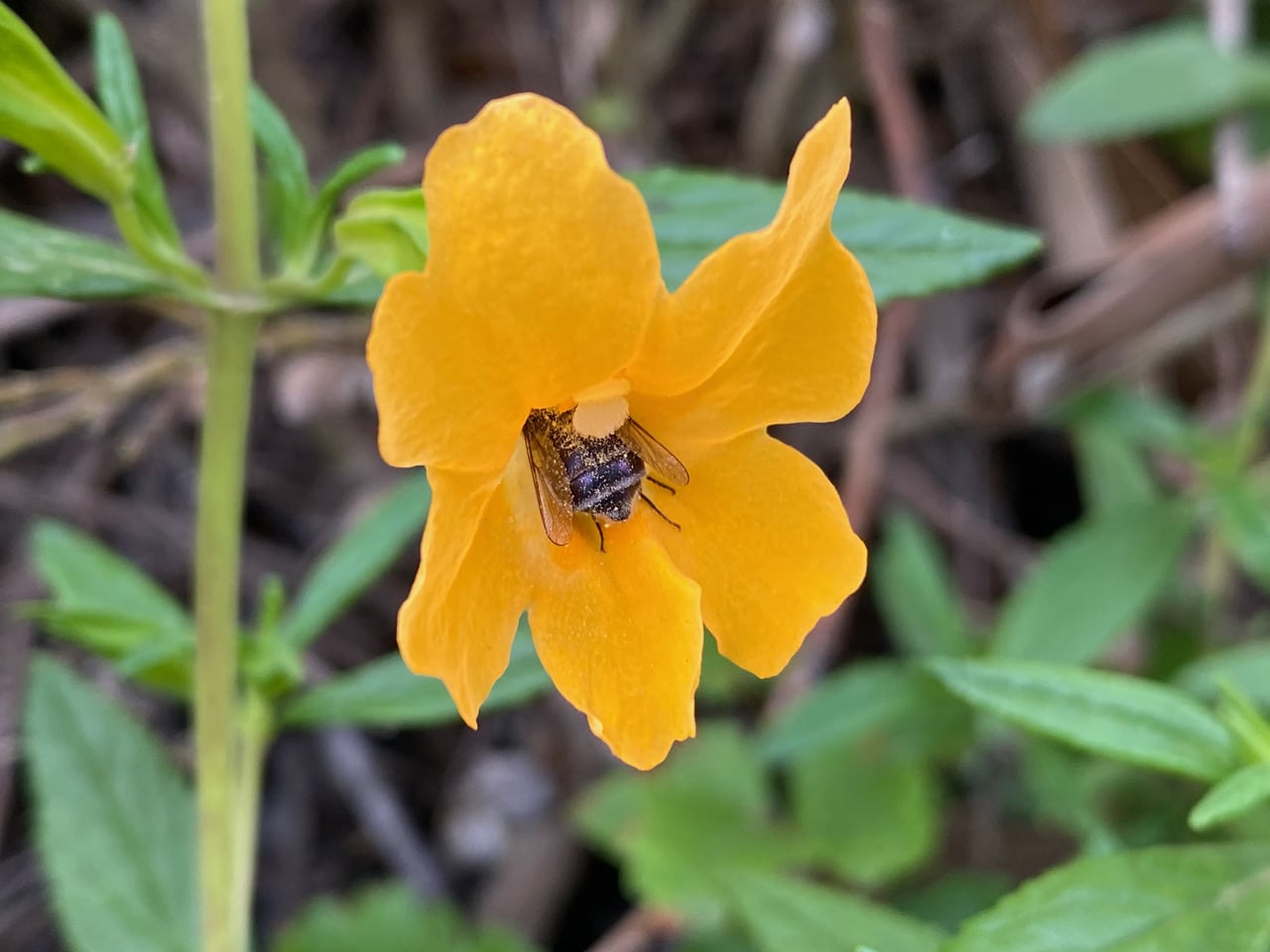
It’s a few minutes before 4 pm, and a Small-headed Fly, Eulonchus sp. (family Acroceridae) has already settled down in its overnight roost – the floral tube of a Sticky Monkeyflower, Diplacus aurantiacus. Note the dusting of pollen on its back.
As far as is known, all Acroceridae are parasitoids of spiders. Not just any spiders, but the Mygalomorphs of a more ancient lineage. This Acrocerid species, most likely Eulonchus tristis is known to parasitize the California Turret Spiders. Females lay large numbers of eggs near their host nests. After hatching the young larvae, called planidia seek out the spiders. The planidia can move in a looping movement like an inchworm and can leap several millimeters into the air. When a spider contacts an Acrocerid planidium, the planidium grabs hold, crawls up the spider’s legs to its body, and forces its way through the body wall. Often, it lodges near the spider’s book lung, where it may remain for years before completing its development. Mature larvae pupate outside the host. The Acrocerid adults are nectar feeders with exceptionally long probosces which are folded on the underside of the body when not in use. Acrocerids are rare but can be locally abundant. They are believed to be efficient pollinators for some native plants, including the Sticky Monkeyflowers.
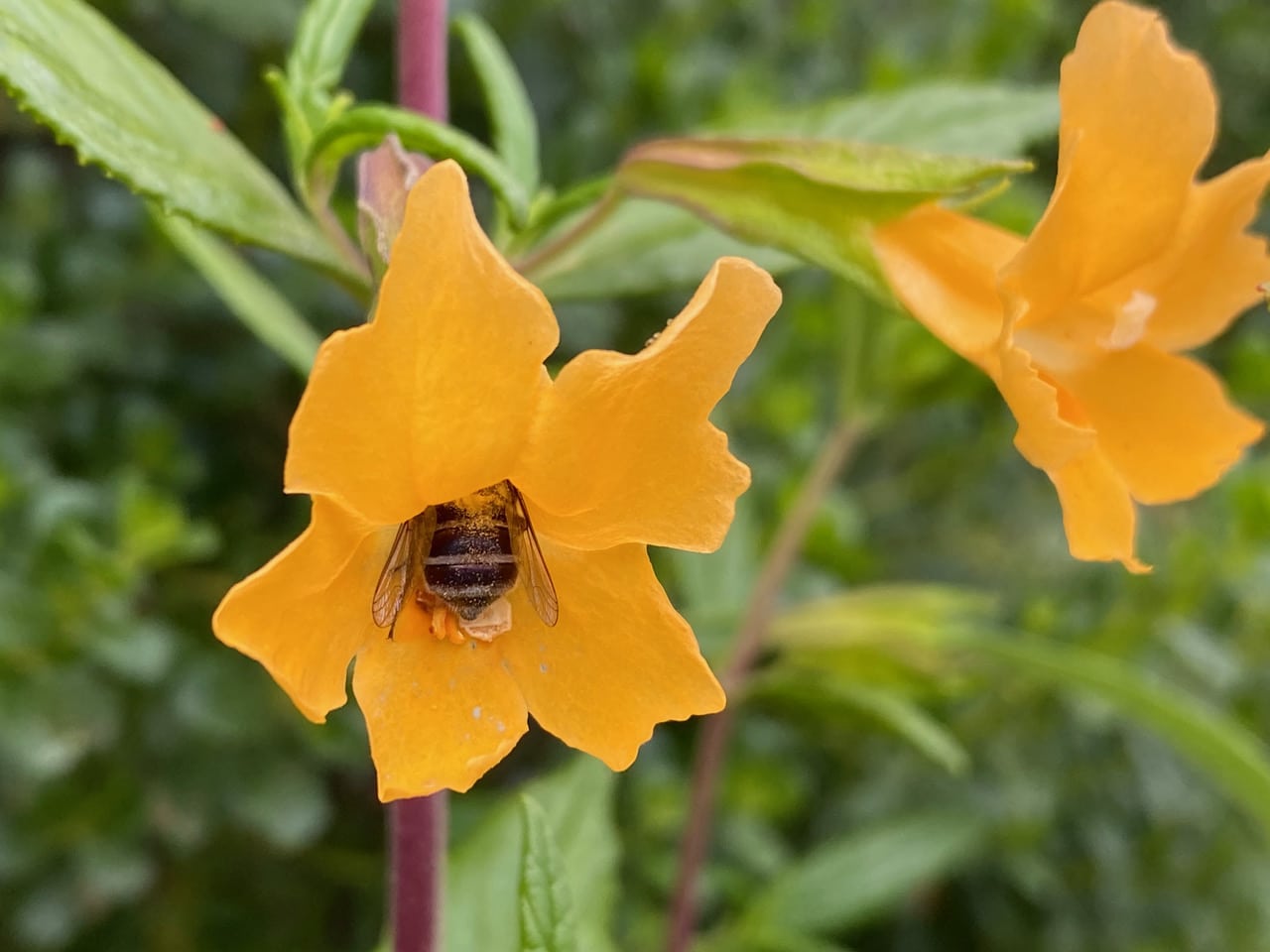
Here’s another one just a few yards away. How did the Small-headed Fly manage to settle on the stigma of the flower?
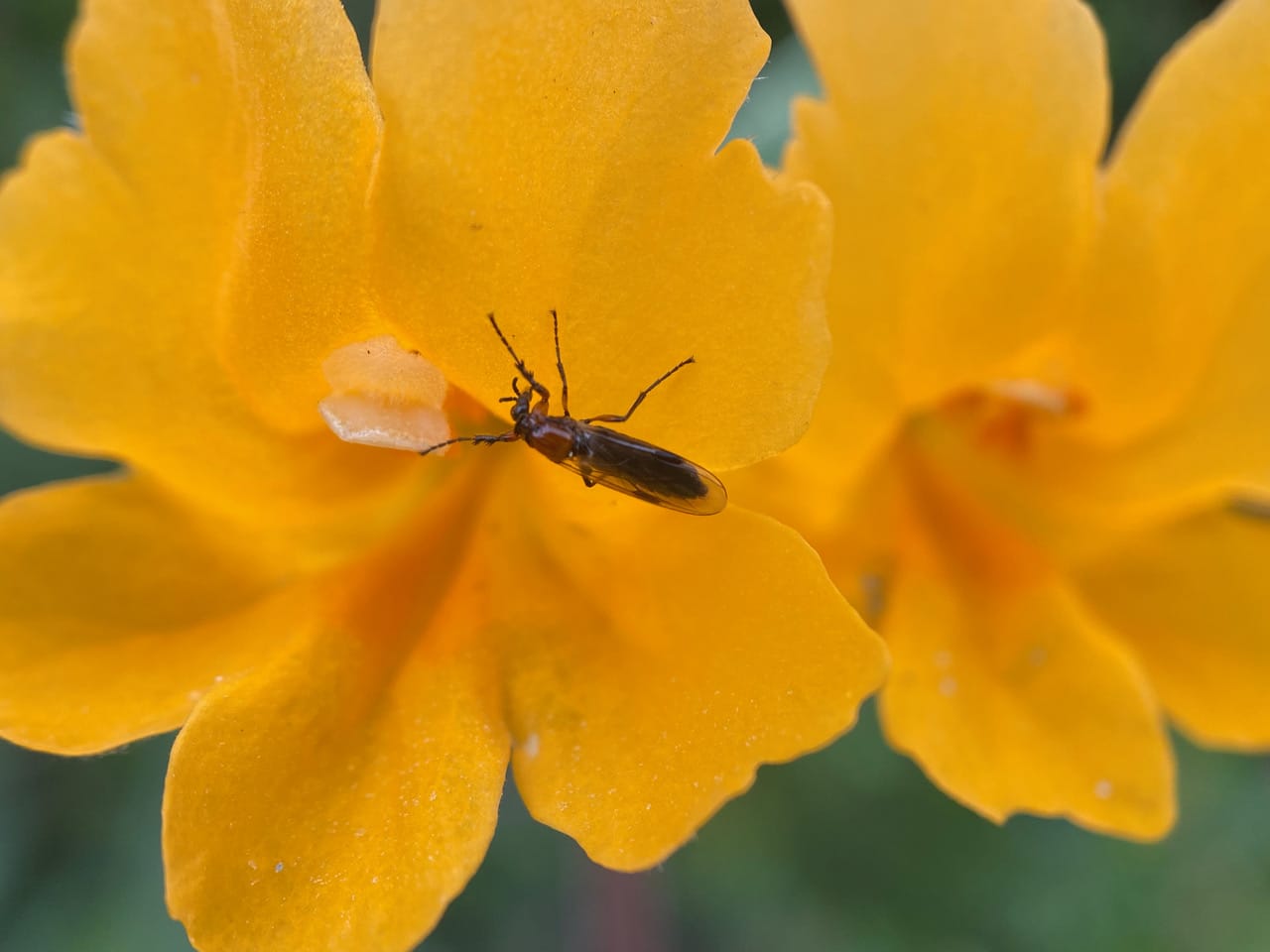
The March Flies (family Bibionidae) get on everything. They are sure enjoying a long season this year! This female has landed on a Sticky Monkeyflower.
March Flies (family Bibionidae) generally live in wooded areas and are often found on flowers – adults of some species feed on nectar, pollen, and honeydew, while adults of other species don’t feed at all; and in either case, they are very short-lived. They are considered important pollinators in orchards. They are also important food for other insects and spiders

A aposematically colored bug on the inflorescence of California Everlasting, Pseudognaphalium californicum catches my eye. I can tell it is a “true bug” in the order Hemiptera from the piercing-sucking mouthparts that is folded up under its body. Aposematism (Greek, apo = away, somatic = sign) is the use of warning coloration to inform potential predators that an animal is poisonous, venomous, or otherwise dangerous.
The defining feature of Hemipterans is their “beak” or rostrum in which the modified mandibles and maxillae form a “stylet” which is sheathed within a modified labium. The stylet is capable of piercing tissues and sucking liquids, while the labium supports it. The stylet contains a channel for outward movement of saliva and digestive enzymes, and another channel for the inward movement of pre-digested liquid food. The rostrum is usually folded under the body when not in use.

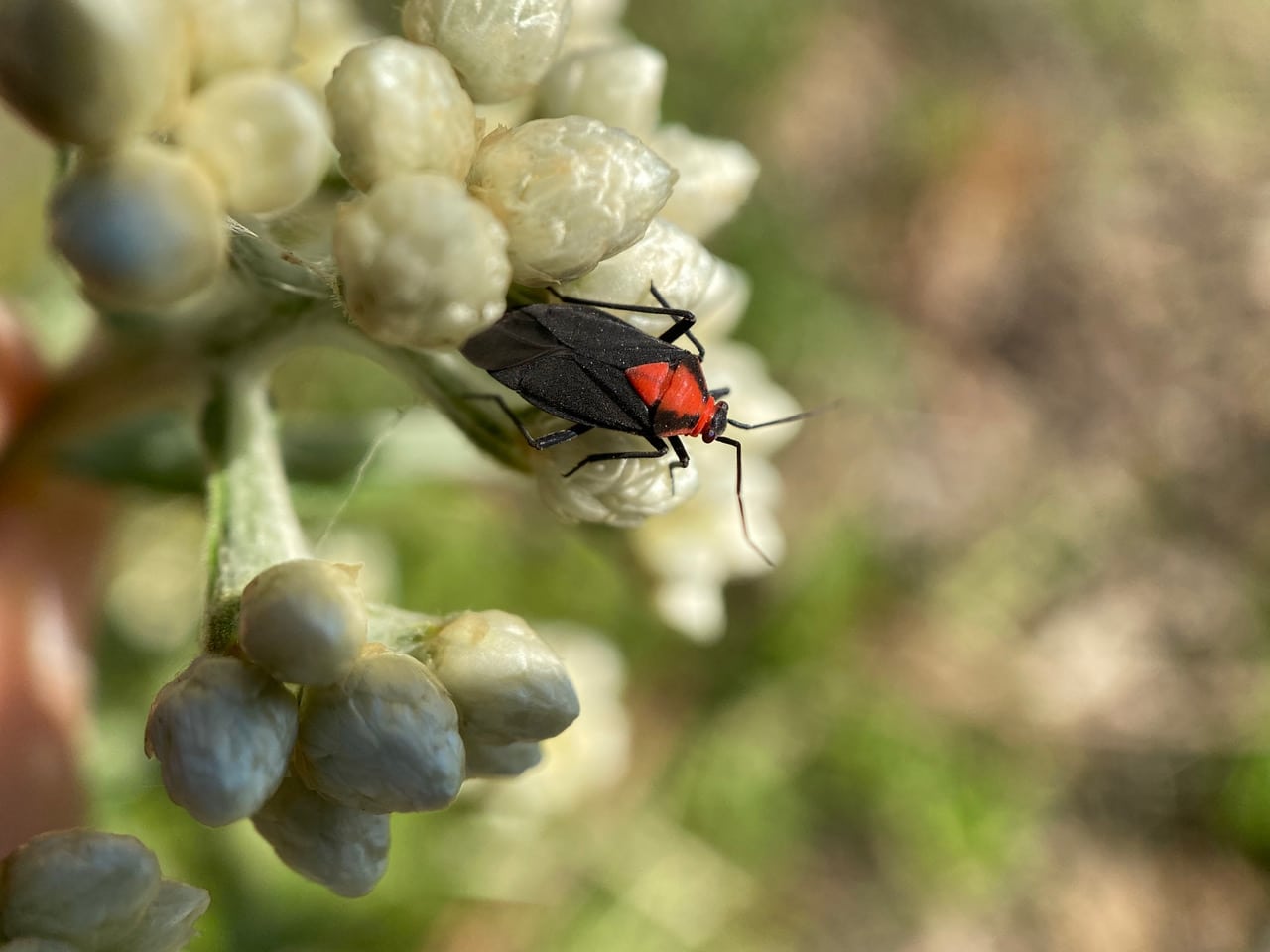
What a pretty pattern on its black back! If you squint hard enough you might see the cuneus on the tips of the bug’s forewings. That feature identifies the bug as a Plant Bug in the family Miridae.
Mirid bugs are also referred to as plant bugs or leaf bugs. Miridae is one of the largest family of true bugs in the order Hemiptera. Like other Hemipterans, Mirids have piercing, sucking mouthparts to extract plant sap. Some species are predatory. One useful feature in identifying members of the family is the presence of a cuneus; it is the triangular tip of the corium, the firm, horny part of the forewing, the hemielytron. The cuneus is visible in nearly all Miridae.


The side view of the Plant Bug shows its rostrum folded under its body. Apparently the whole body of the bug is red.
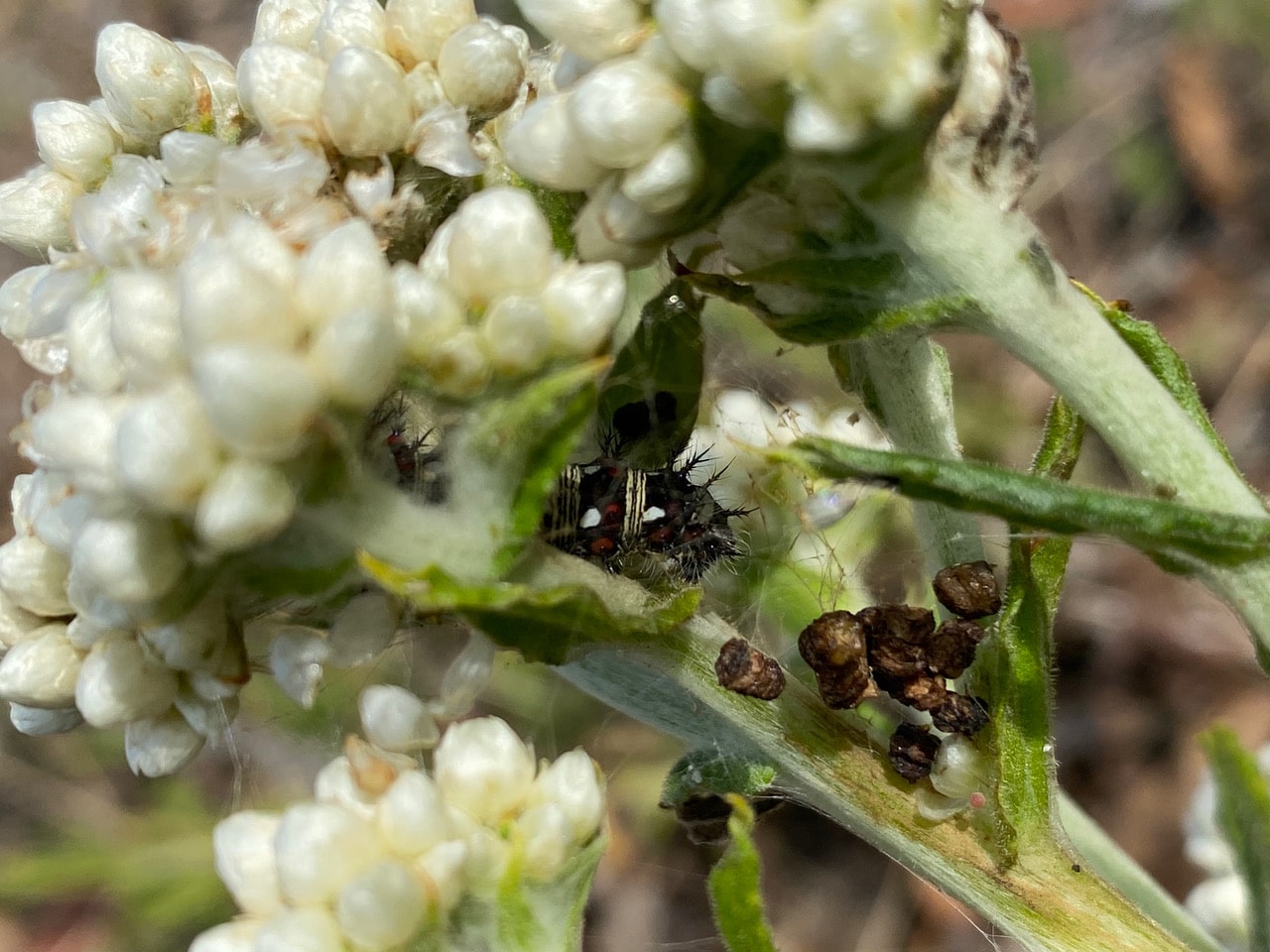
Checking on the caterpillar nests on the California Everlasting, I can actually see parts of a caterpillar at the base of one nest. Note the frass (insect poop) to the right. The caterpillar has the typical colors and markings of an American Lady larva, Vanessa virginiensis (family Nymphalidae).
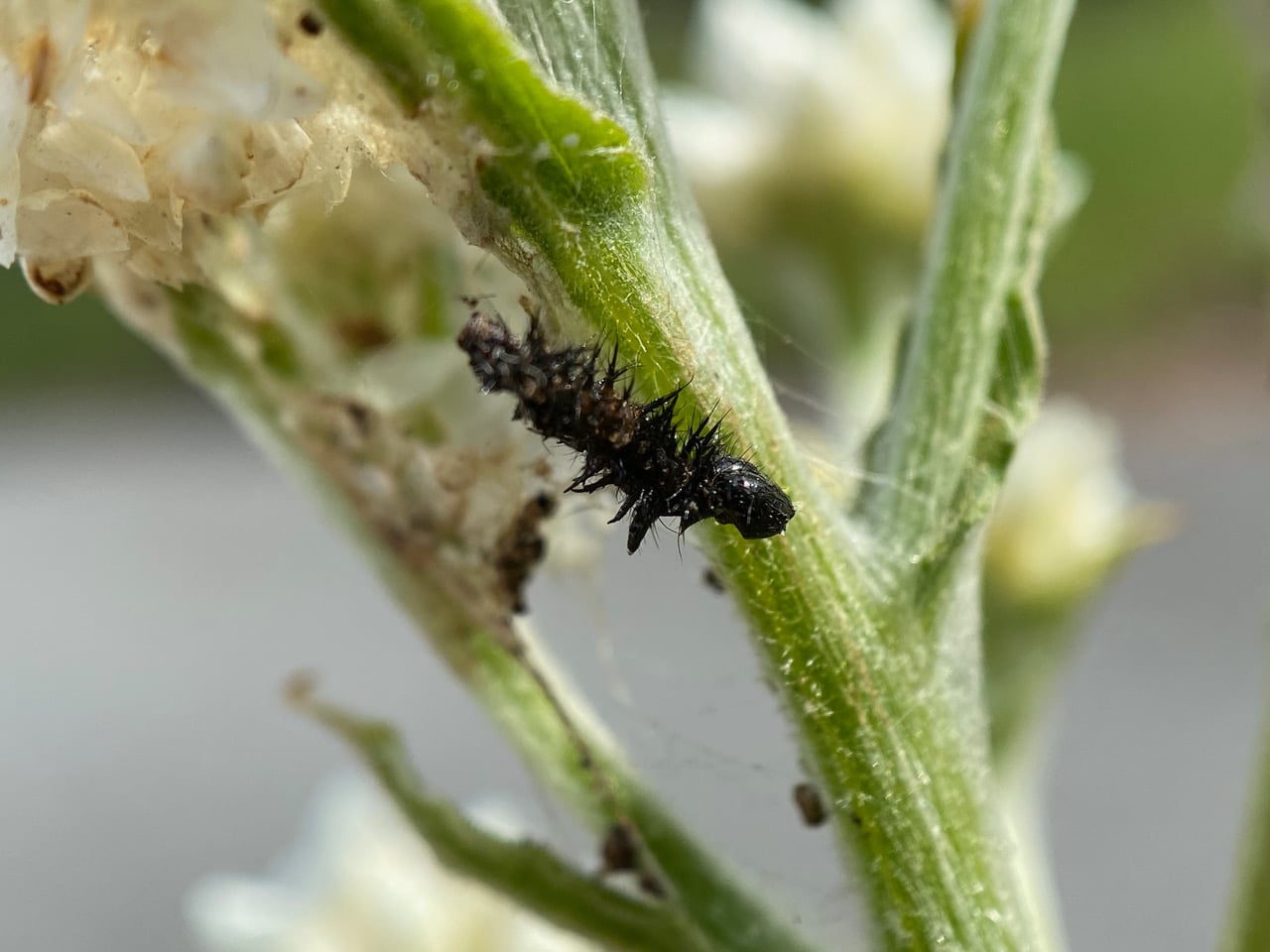
Below another nest I find this dark spiky mass. It is the exuvia of the caterpillar, complete with a head capsule!
An exuvia (plural exuviae) is the cast-off outer skin of an insect after a molt. The caterpillars of American Lady butterfly molt four times before pupating, acquiring a bigger exoskeleton after each molt.
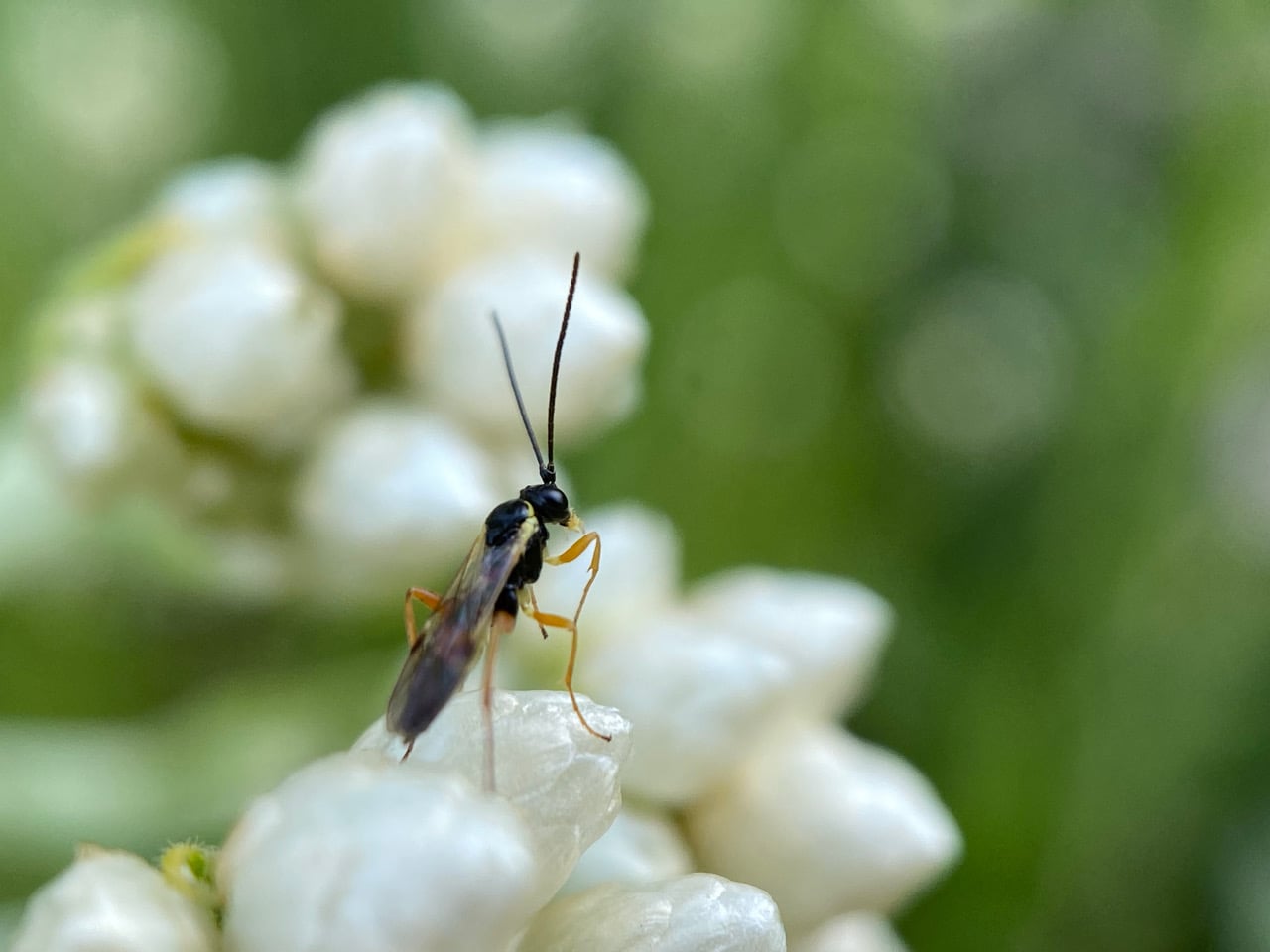
Uh-oh, a parasitoid wasp, either a Braconid or an Ichneumonid is exploring the flowerheads of California Everlasting. Is it searching for a host?
The superfamily Ichneumonoidea comprises the two largest families within Hymenoptera: Ichneumonidae and Braconidae, both with a cosmopolitan distribution. Members of the two families are distinguished by wing venation. Ichneumonoids are solitary wasps, and the vast majority are parasitoids; the larvae feed on or in another insect, eventually killing it. In general, ichneumonoids are host specific, and only attack one or few closely related host species. Many species use polydnaviruses to suppress the immune systems of their host insects.
The female Ichneumonoid wasp finds a host and lays an egg on, near, or inside the host’s body. Upon hatching, the larva feeds either externally or internally, killing the host when it is ready to pupate.
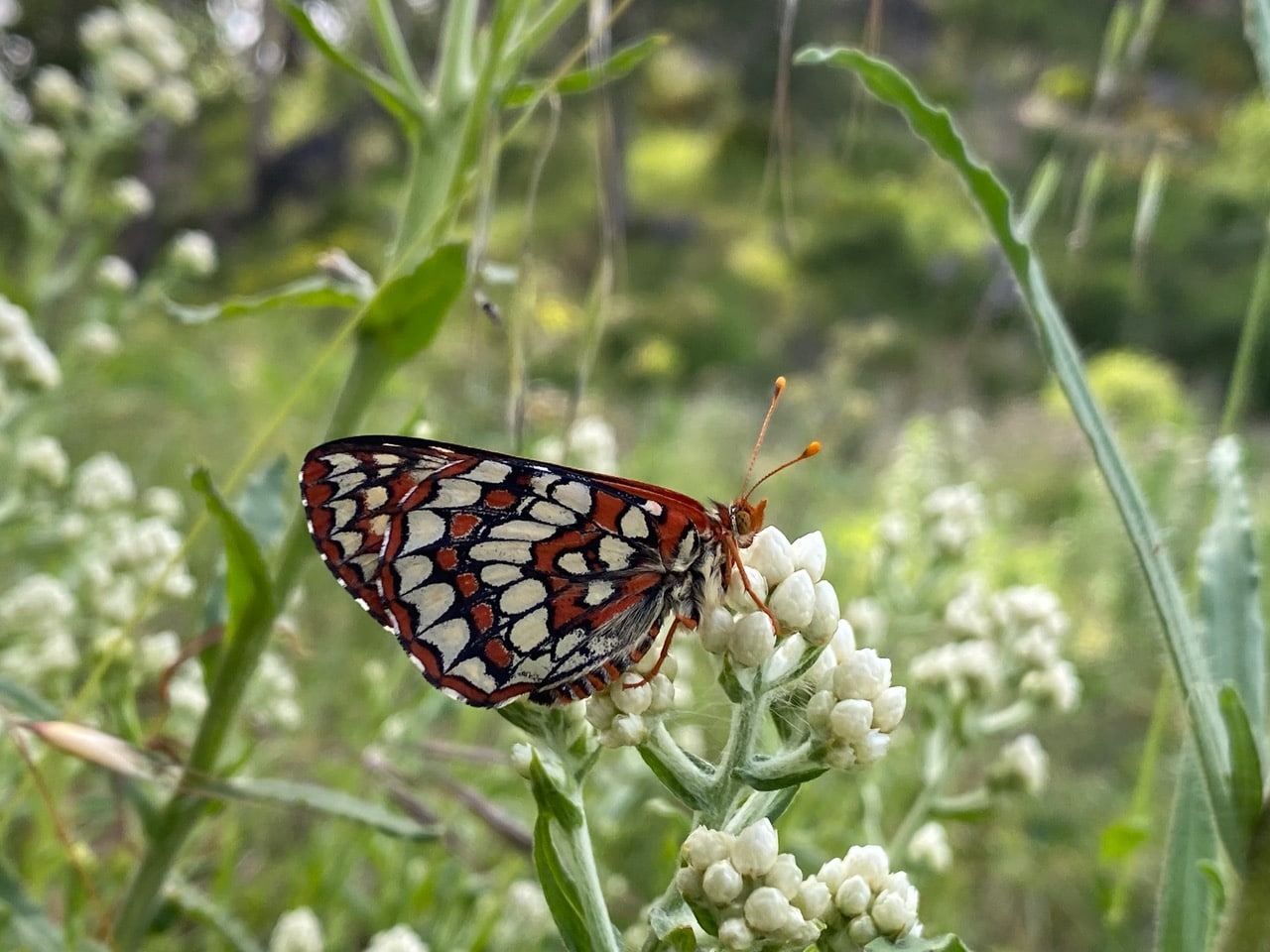
A Variable Checkerspot Butterfly, Euphydryas chalcedona (family Nymphalidae) is resting motionless on a cluster of flowers of California Everlasting.
The Variable Checkerspot is found across western North America. The butterfly occupies a wide range of habitats, including sagebrush flats, desert hills, prairies, open forests and alpine tundra. Males perch or patrol around larval host plants to encounter females. Eggs are laid in large groups on underside of leaves of host plants. Host plants include California Bee Plant, Scrophularia californica, and Sticky Monkeyflower, Diplacus aurantiacus. These plants provide the caterpillars with iridoid glycoside, a chemical that imparts unpalatable taste to birds, protecting the caterpillars from predators. Larvae feed in large, loose groups on the host plants. They enter diapause (hibernation) in sheltered sites under bark or dead branches, in hollow stems and in rock crevices. Pupation begins in early to mid April and the adult flight season begins between mid-April and May and continues into June. The adults feed exclusively on nectar, and have a life span of about 15 days.
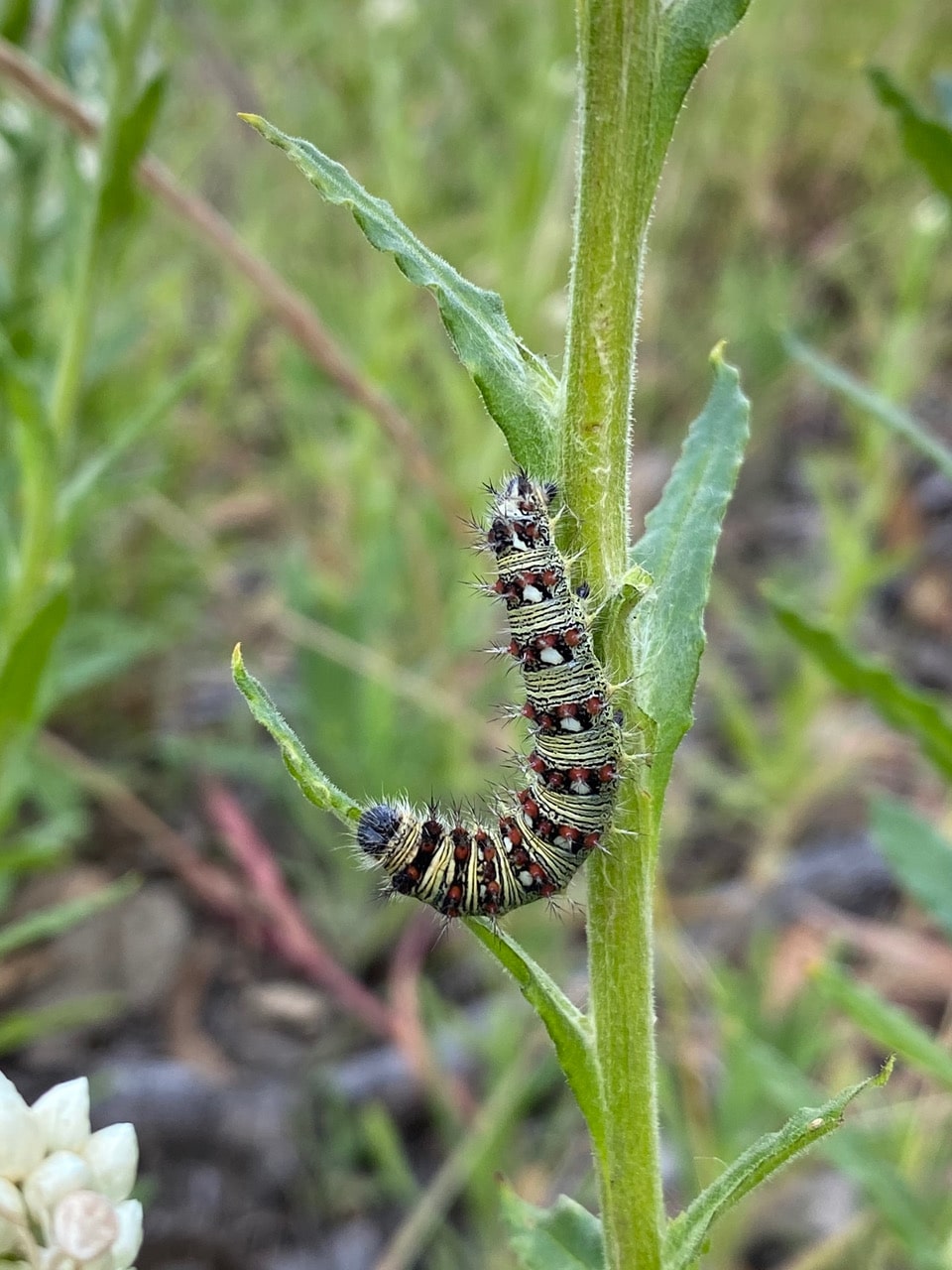
I have been peeking through the caterpillar nests in hopes of seeing the caterpillars in them. And here is a mature caterpillar of the American Lady out in the open! Has it left its nest to feed or is it looking for a place to pupate?