

Pollinator Post 6/5/25 (2)

A Sedgesitter, Platycheirus sp. (family Syrphidae) is perched at the entrance of a Bee Plant flower, Scrophularia californica, probing for nectar with its proboscis without having to enter the small flower.
Platycheirus is found in grass and herb vegetation. Adults of many species feed on pollen of wind-pollinated plants, such as Salix, Plantago, Poaceae, Cyperaceae, but they visit other flowers as well. Many stay active during cold and rainy weather. Larvae feed on aphids.

Ooh, what a delightful find – a Hummingbird nest built at the crotch of a Thimbleberry shrub, Rubus parviflorus. The chicks must have fledged, given the stretched state of the nest, and the disheveled fluffy materials lining the bowl-shaped nest. Hummingbird nests are held together with spider silk that can stretch to accommodate the growing chicks. They are decorated and camouflaged with bits of collected lichen on the outside. As the nest is stretched, the lichen pieces spread apart.
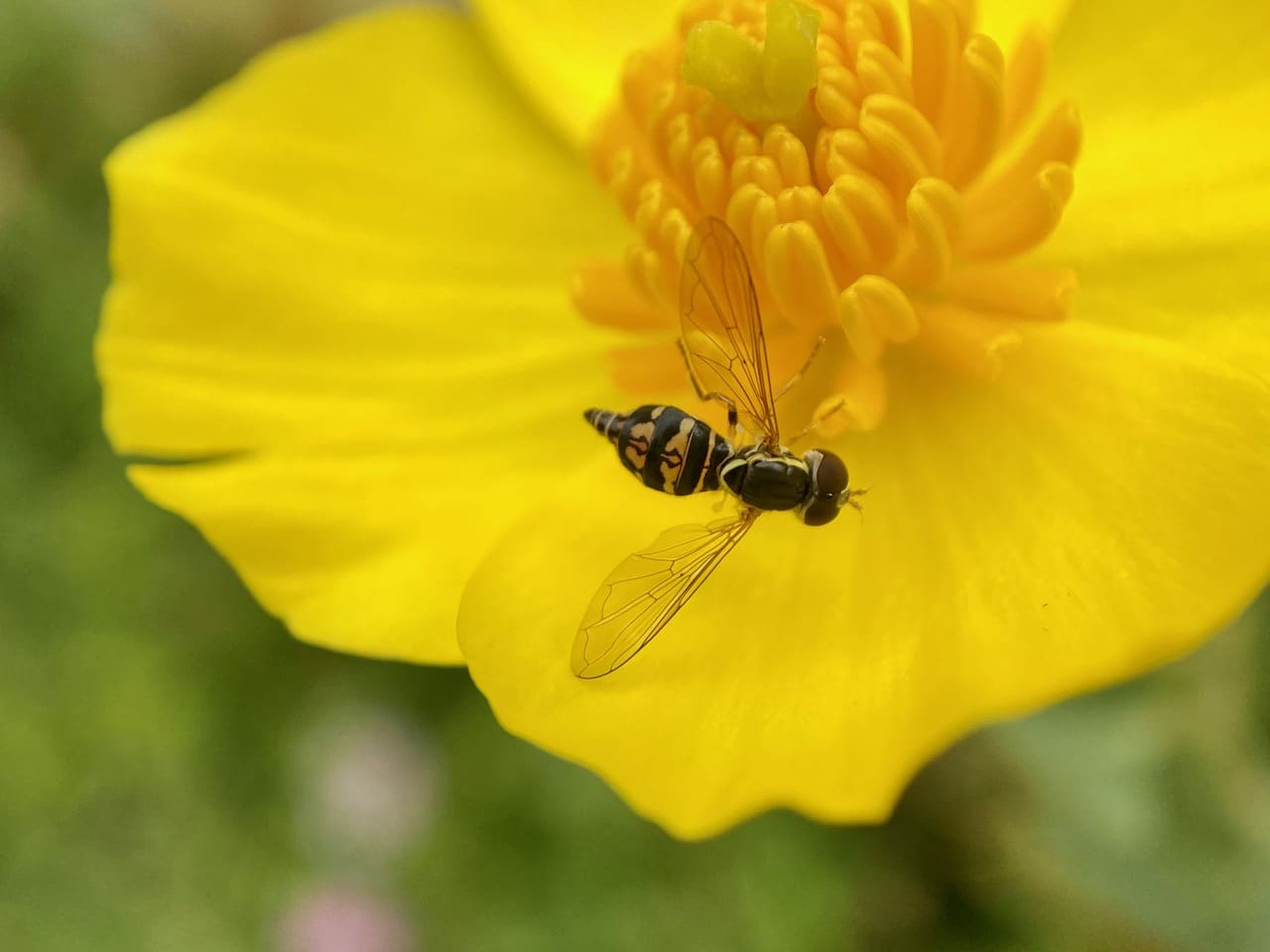
A female Western Calligrapher, Toxomerus occidentalis (family Syrphidae) visits a flower of Bush Poppy, Dendromecon rigida. As poppies generally do not produce nectar, the little hover fly must be foraging for pollen which is offered in copious amounts by poppy flowers.
Hover Flies, also called flower flies or Syrphidae flies, make up the insect family Syrphidae. The adults of many species feed mainly on nectar and pollen, and are often seen hovering and nectaring at flowers. They are important pollinators of flowering plants in many ecosystems worldwide. The larvae feed on a wide range of foods. In many species, the larvae are insectivores and prey on aphids, thrips, and other plant-sucking insects. In other species, the larvae are saprotrophs, eating decaying plant and animal matter in the soil or in ponds and streams.
Many species of Hover Flies exhibit Batesian mimicry; they are brightly colored, with bands of yellow resembling the bees and wasps. The mimicry provides the fly with some measure of protection from potential predators, although the flies are harmless and lack a sting.

Toxomerus is a very large genus of Hover Flies. They are found in North and South America. The majority of species are only 6-9 mm in length. They are notable for their mimicry of stinging Hymenoptera to avoid predators. Their unique abdominal patterns are diagnostic at the species level within the genus. There is marked sexual dimorphism – the females have a broader abdomen with lighter coloration and pattern. Most larvae feed on soft bodied insects, such as aphids; a few feed on pollen. Adults feed on the pollen of a wide range of flowers. A female can lay up to hundreds of eggs at a time and will place them where prey or pollen food sources are readily available. They can be found in a wide variety of habitats, often in dense ground cover.
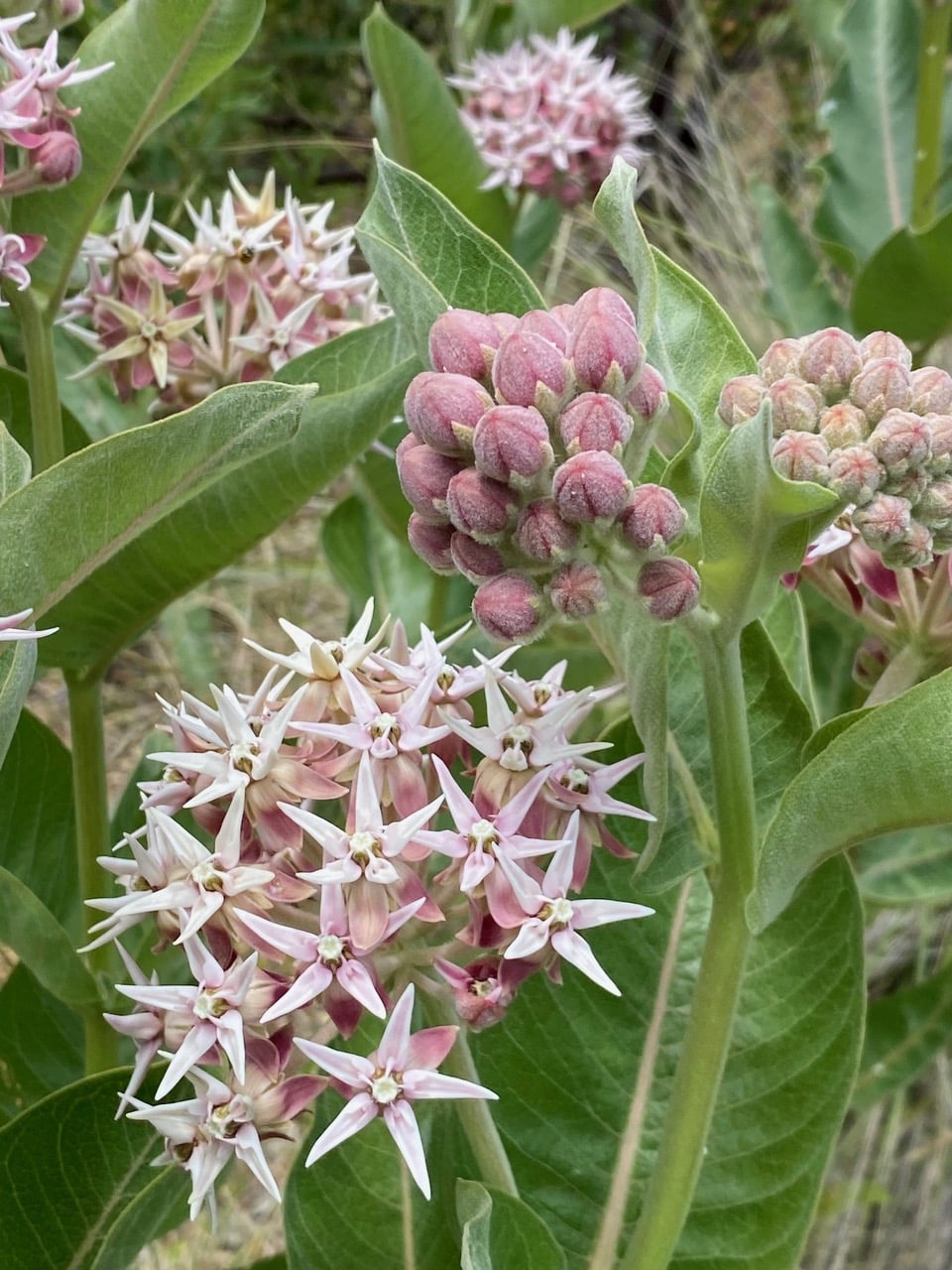
The Showy Milkweed, Asclepias speciosa is blooming gloriously in the garden. I look for Monarch eggs and caterpillars, but find none.
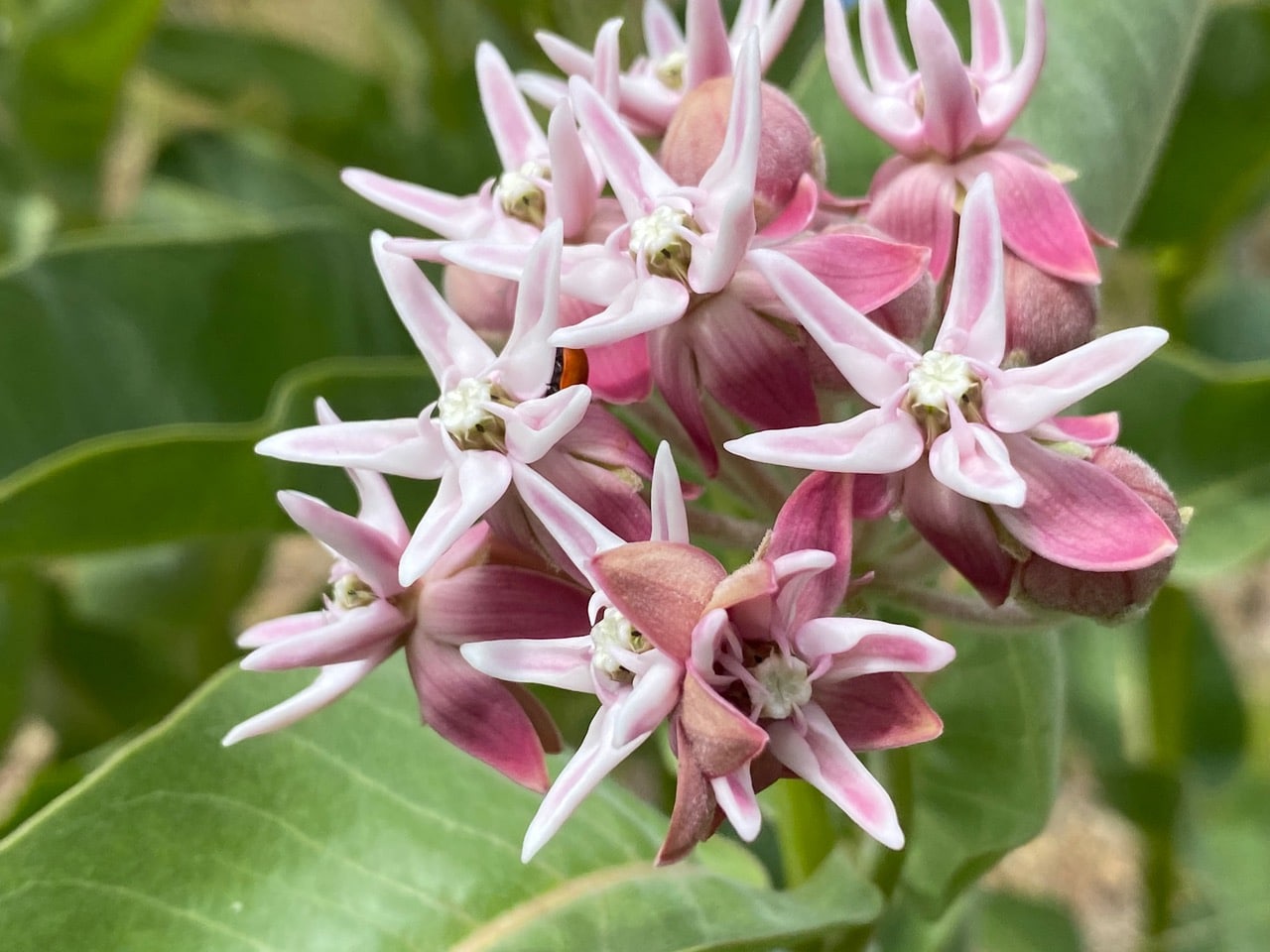
The anatomy of milkweed flower boggles the mind, as its structure and parts are complex and unique. The flower has a calyx, corolla, and corona, which surround a central gynostegium. The gynostegium consists of fused male (stamens) and female (pistils) parts. The corolla is the outer and lower part of the flower and resemble petals. In the Showy Milkweed, the corolla is dark pink, and bent backwards (reflexed). The corona is the showy, star-like upper part of the flower that is paler in color. Five cup-shaped hoods make up the corona, holding copious amounts of nectar. Each hood has a curved horn arising from the base.
Unlike most flowers that dispense loose pollen, milkweeds package their pollen into a single waxy sac called pollinia. On the periphery of the gynostegium are five narrow slits called stigmatic slits where the pollinia are held. Insects, drawn to the nectar, may be snagged by the pollinia when their legs or tongue slip into the slits. Struggling to free itself, the insect may pull the pollinia out of the slit. When the insect visits another flower, the pollinia may be inserted into the stigmatic slit of the new flower, accomplishing cross-pollination. This pollination method is highly specialized, and while it ensures cross-pollination, it can come at a cost to the pollinator. Smaller insects unable to remove the pollinia can become trapped or lose a limb in the process. Dead insects or insect legs are often found trapped in the stigmatic slits of milkweed flowers. Because of their relatively large size, the flowers of Showy Milkweed require relatively large insects for effective pollination.
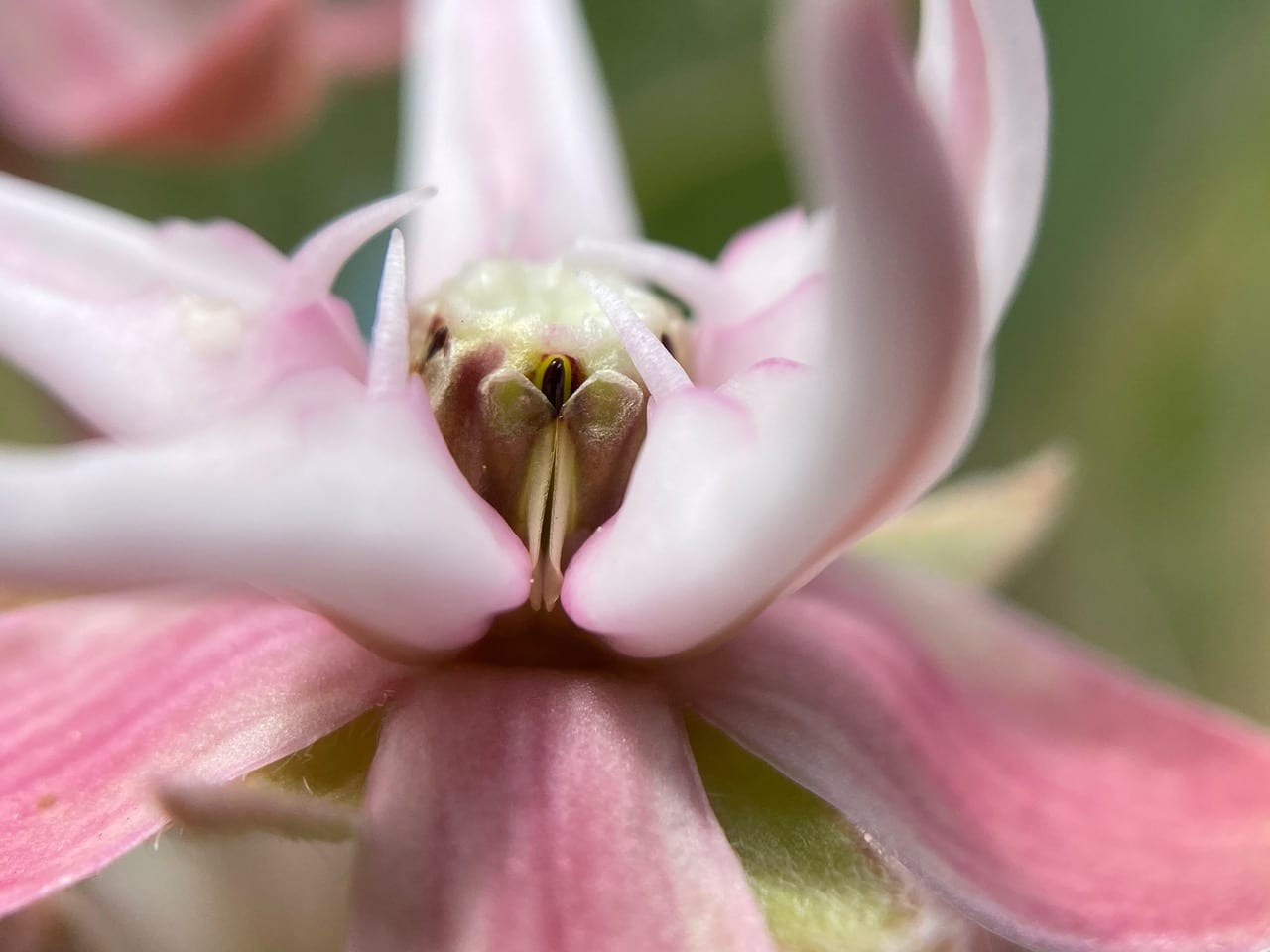
Close-up of a stigmatic slit between two hoods of the corona. A pair of pollinia is hidden behind the slit. The shiny black structure is the corpusculum that holds the pair of pollinia together like a saddle bag.
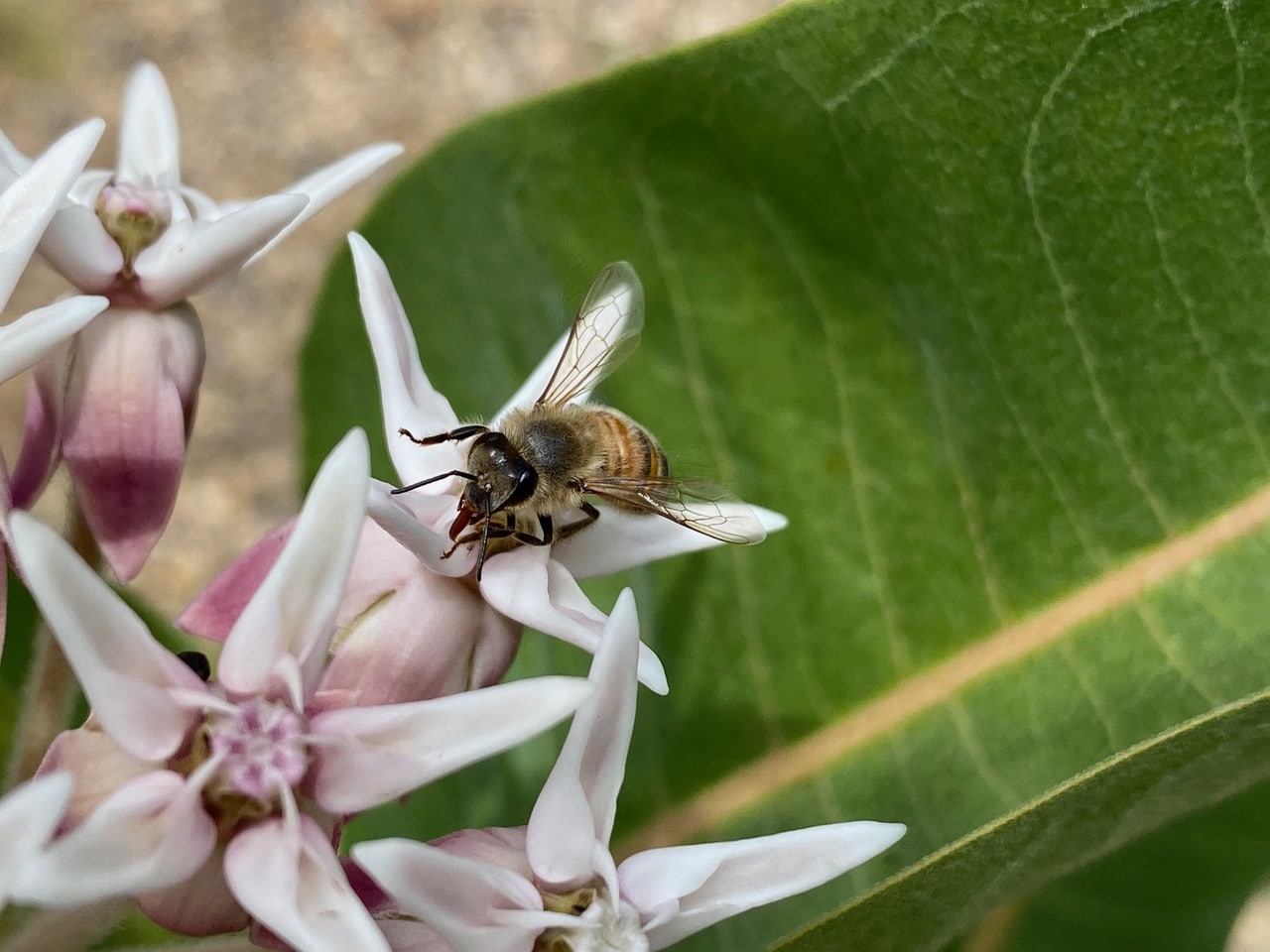
Its tongue extended, a Honey Bee, Apis mellifera (family Apidae) is taking nectar from a hood of the milkweed flower.

Note where this Honey Bee has inserted its tongue – the hood where there is a pool of nectar.

A Black-tailed Bumble Bee, Bombus melanopygus (family Apidae) is taking nectar from a hood of a milkweed flower, while its left front leg is close to a stigmatic slit.
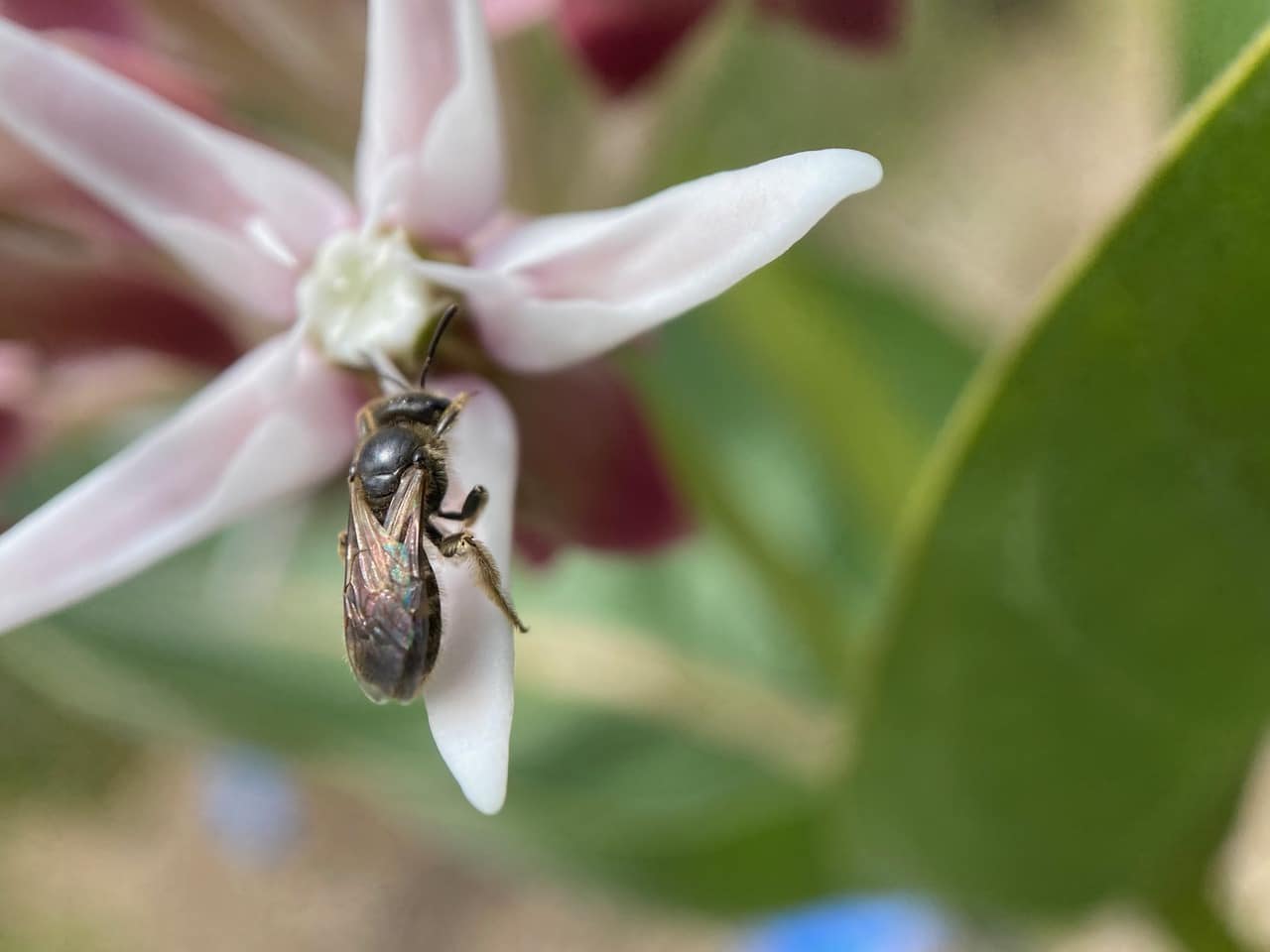
A Metallic Sweat Bee, Lasioglossum (Dialictus) sp. (family Halictidae) has landed on a milkweed flower.
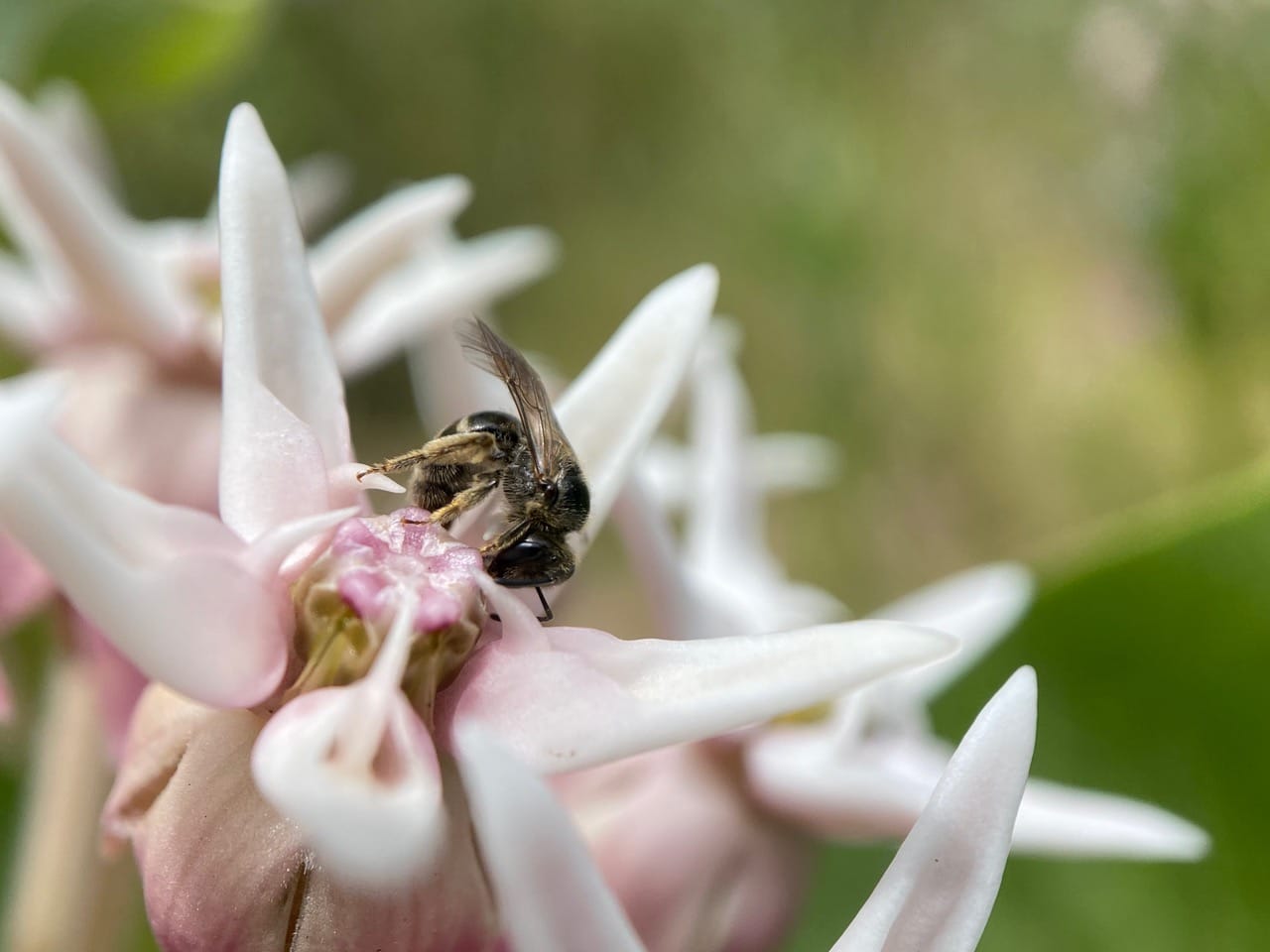
The small bee struggles to reach the nectar in a hood.

For insects this size, being snagged by a pollinia in a stigmatic slit may have fatal consequences.
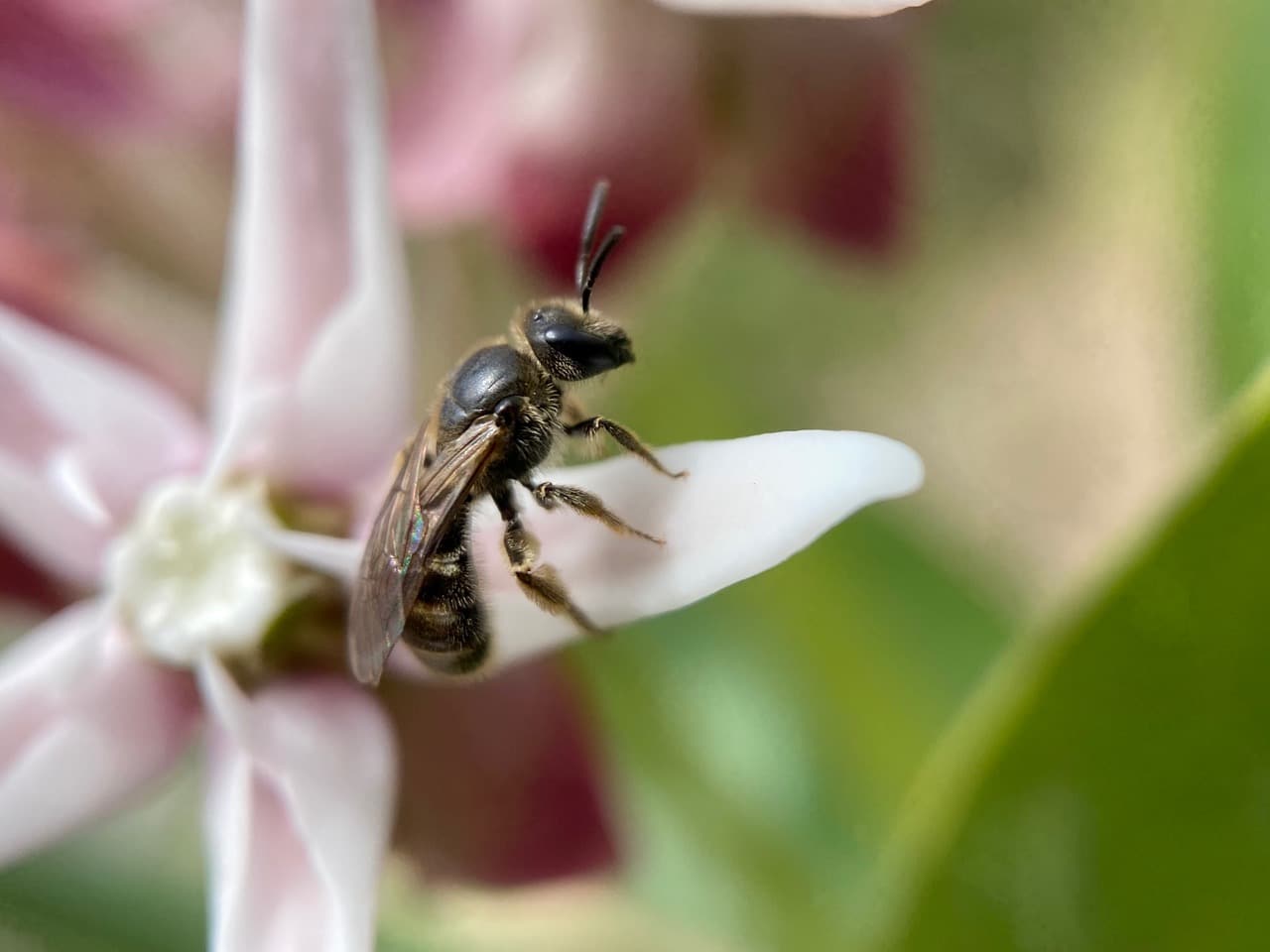
Ah, I’m glad the bee has survived the hazards of foraging on a milkweed flower.

I notice a Black-tailed Bumble Bee running clumsily on a milkweed leaf, toting something yellow in its right front leg. A close look shows that it is indeed a milkweed pollinia.

The exhausted bee comes to rest at the tip of the leaf, offering a clear view of the yellow pollinia in her right front leg.
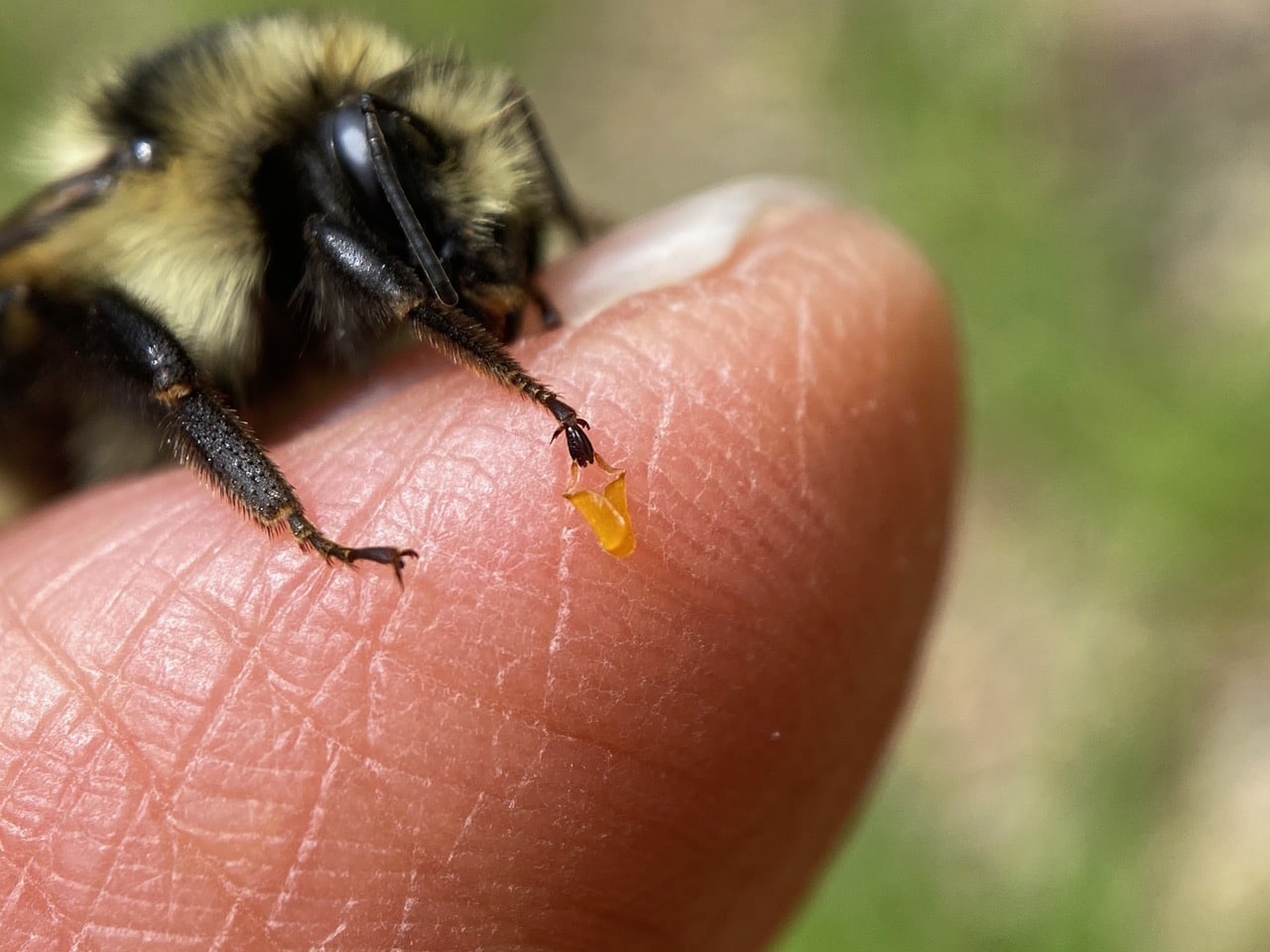
The disoriented bee eventually walks onto my left thumb that was holding the leaf. Note the yellow pollinia that has fastened itself onto the bee’s leg by the black corpusculum. I subsequently discover that the bee actually has another pollinia attached to her left hind leg, shown in the following video:
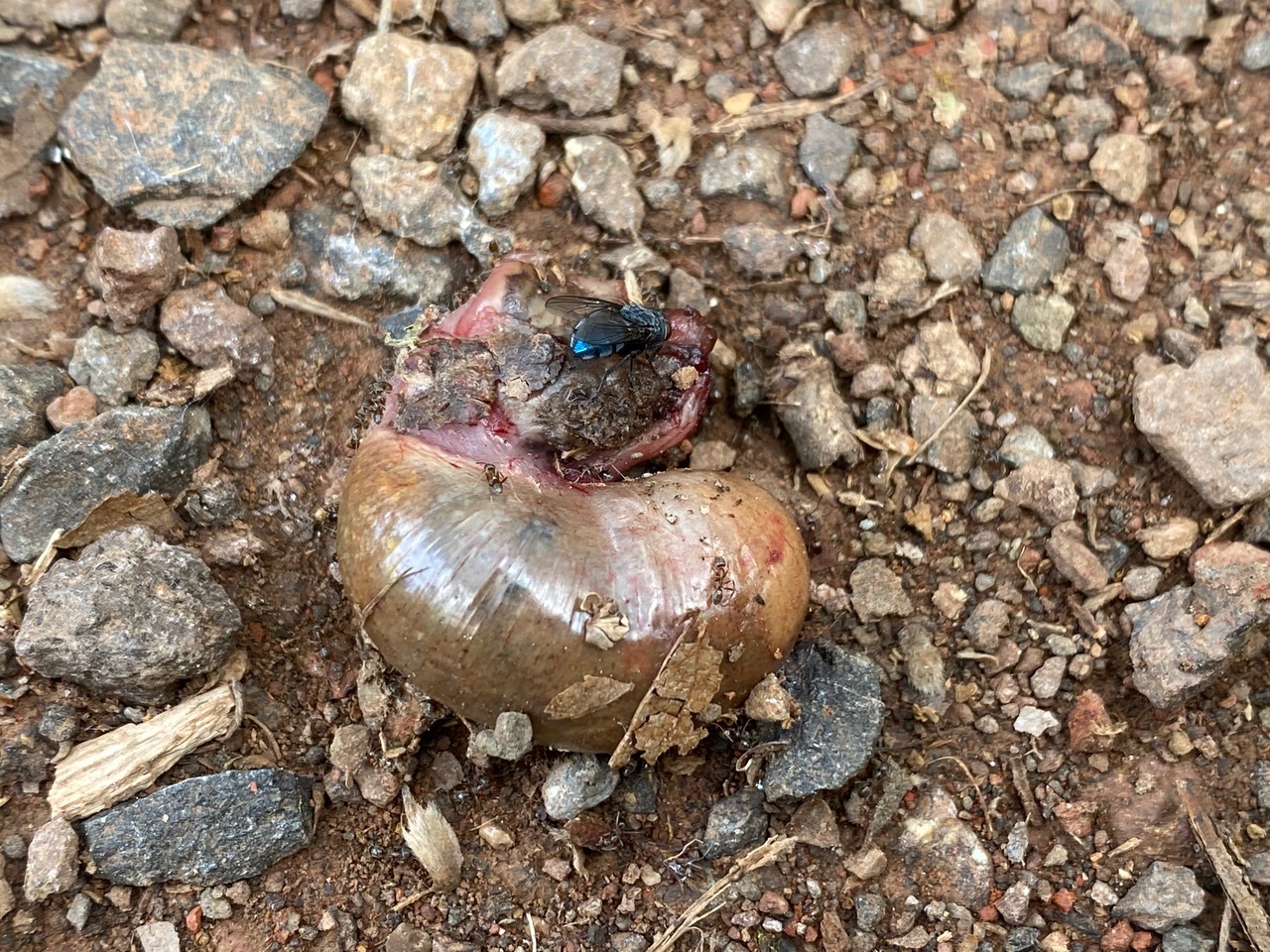
Some entrails lay in the middle of the path. I recognize it as possibly a rabbit’s stomach. Many predators, especially the strictly carnivorous felines usually discard their prey’s guts, as these contain bacteria that are not compatible with their own digestive system. A Blow Fly (family Calliphoridae) and several Argentine Ants, Linepithema humile (family Formicidae) have already arrived to partake of the feast. What would we do without these scavengers/clean-up crew that recycle organic matter?
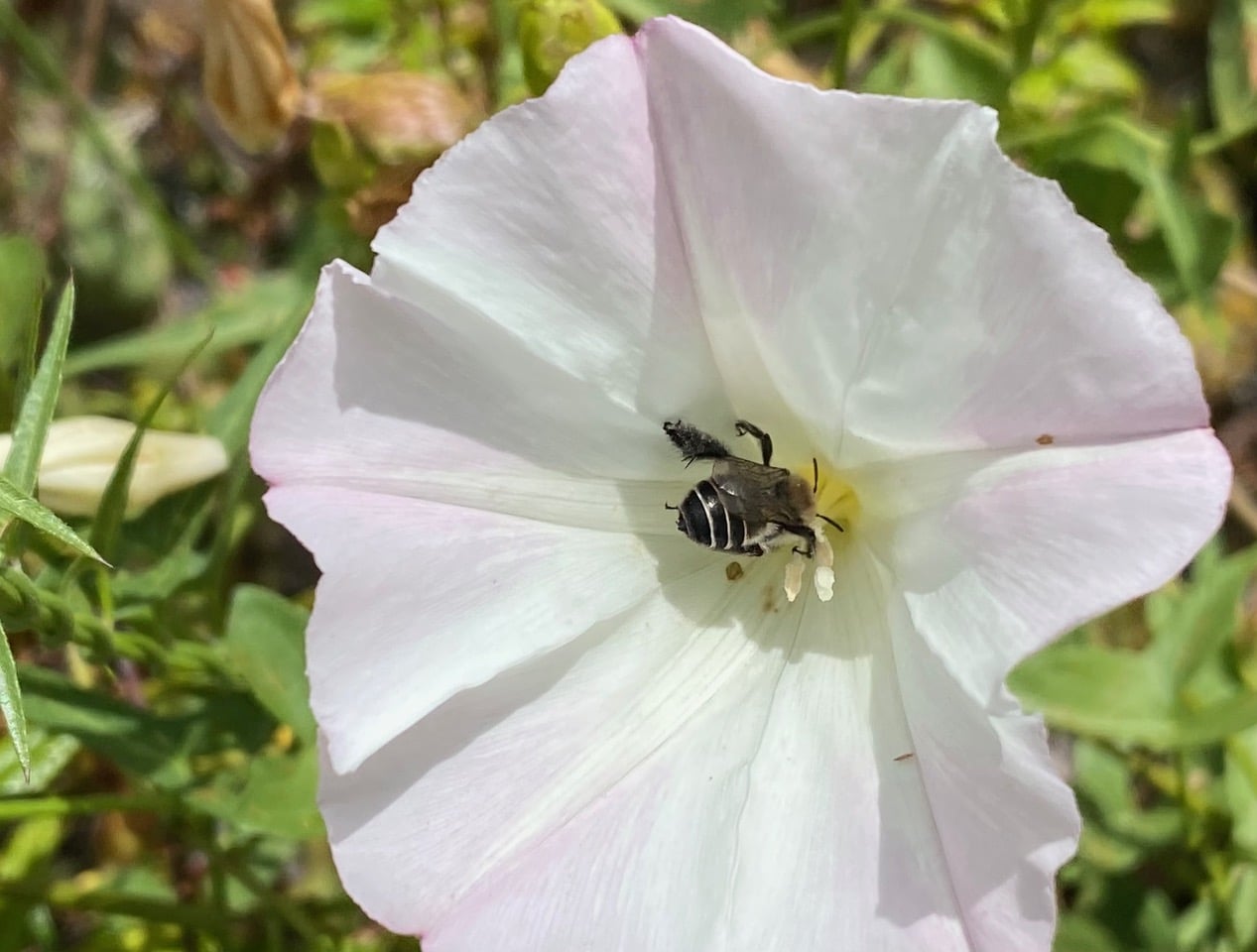
Hey, the Morning Glory has started to bloom, and the large white flowers are attracting some bees. Most noticeable are their hind legs with dark shaggy hairs.
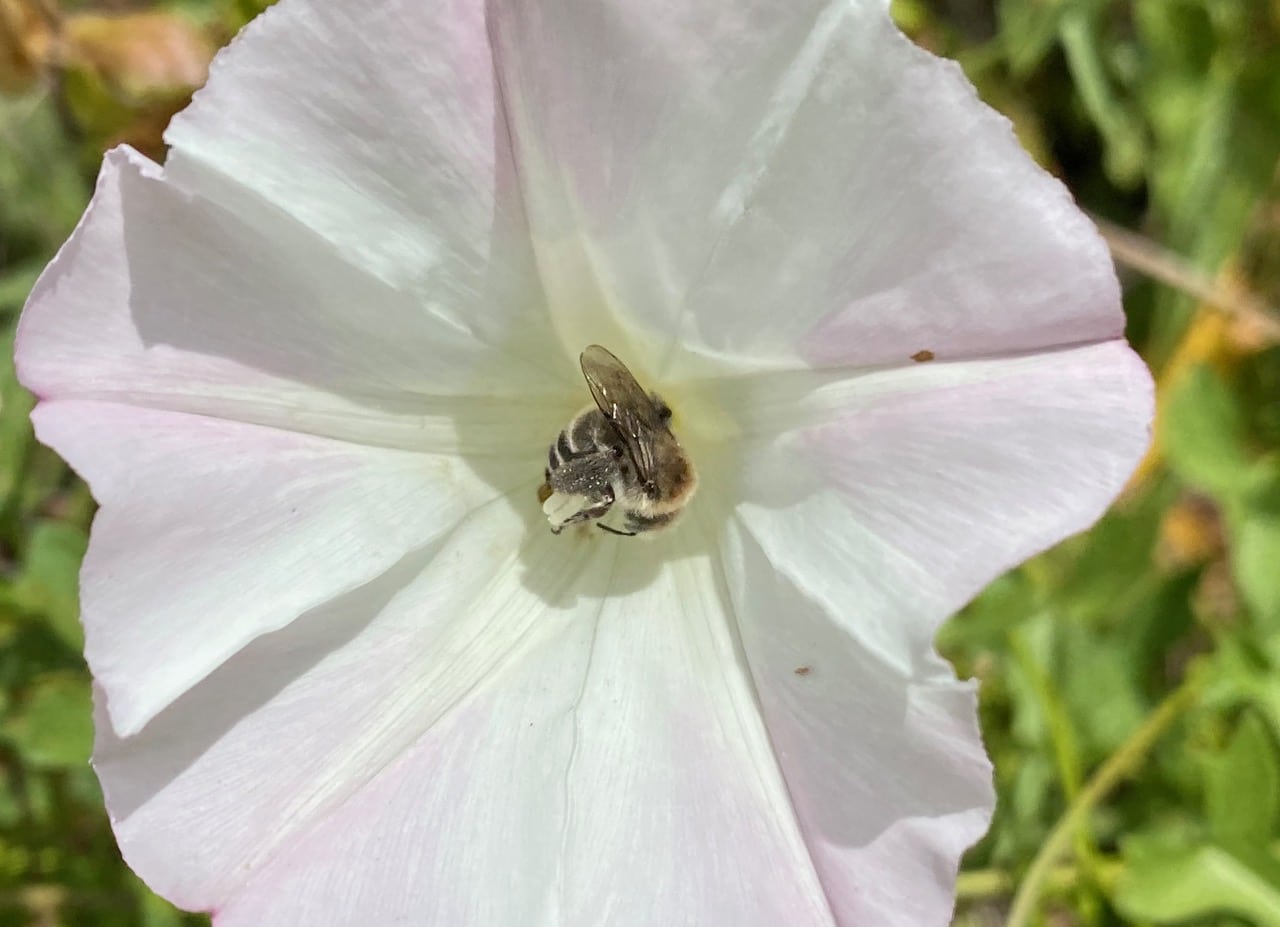
The bee wraps its body around the stamens, moving vigorously to collect pollen.
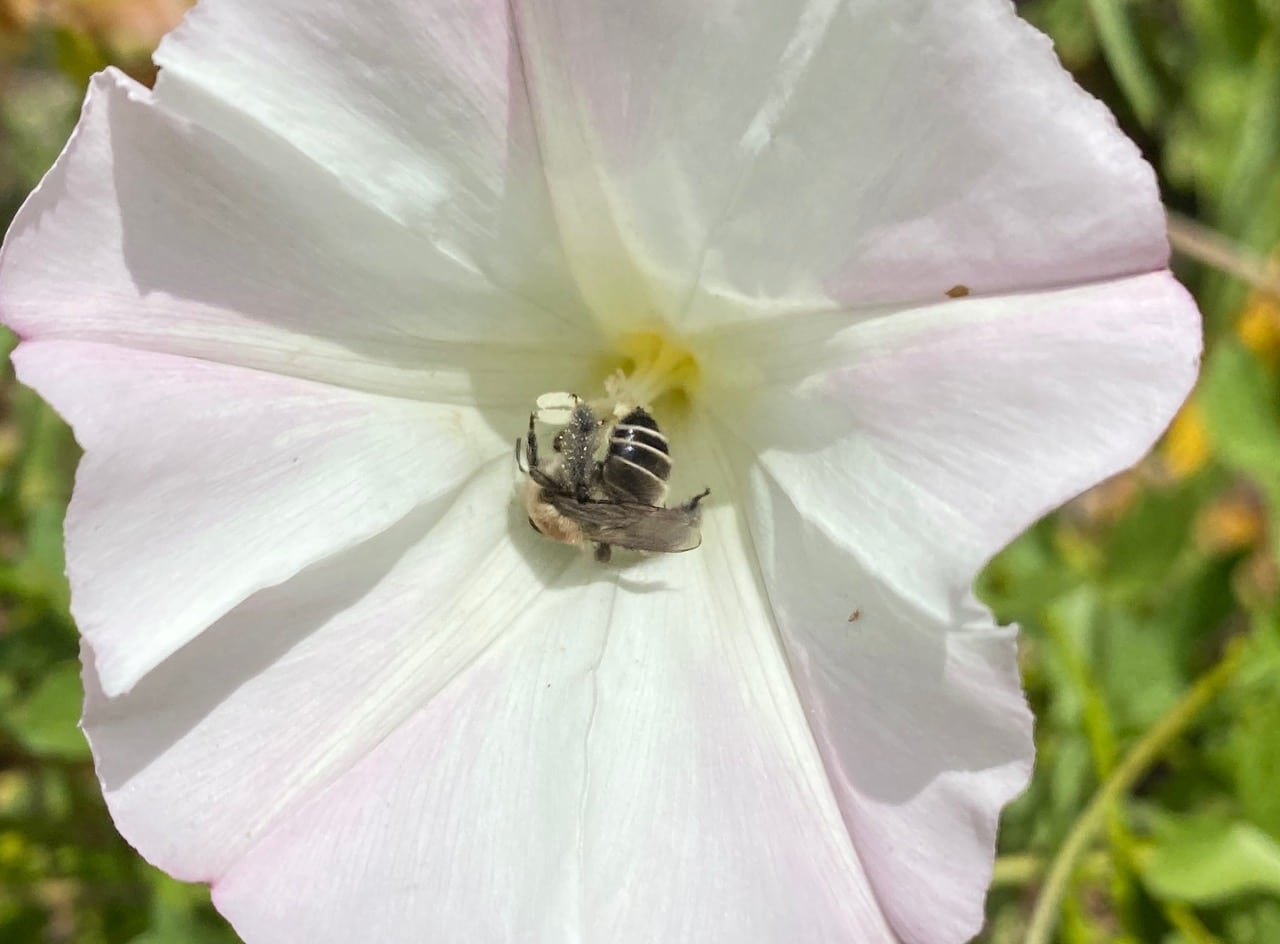
White pollen grains begin to dot the bee’s gray scopae as she works the anthers diligently.
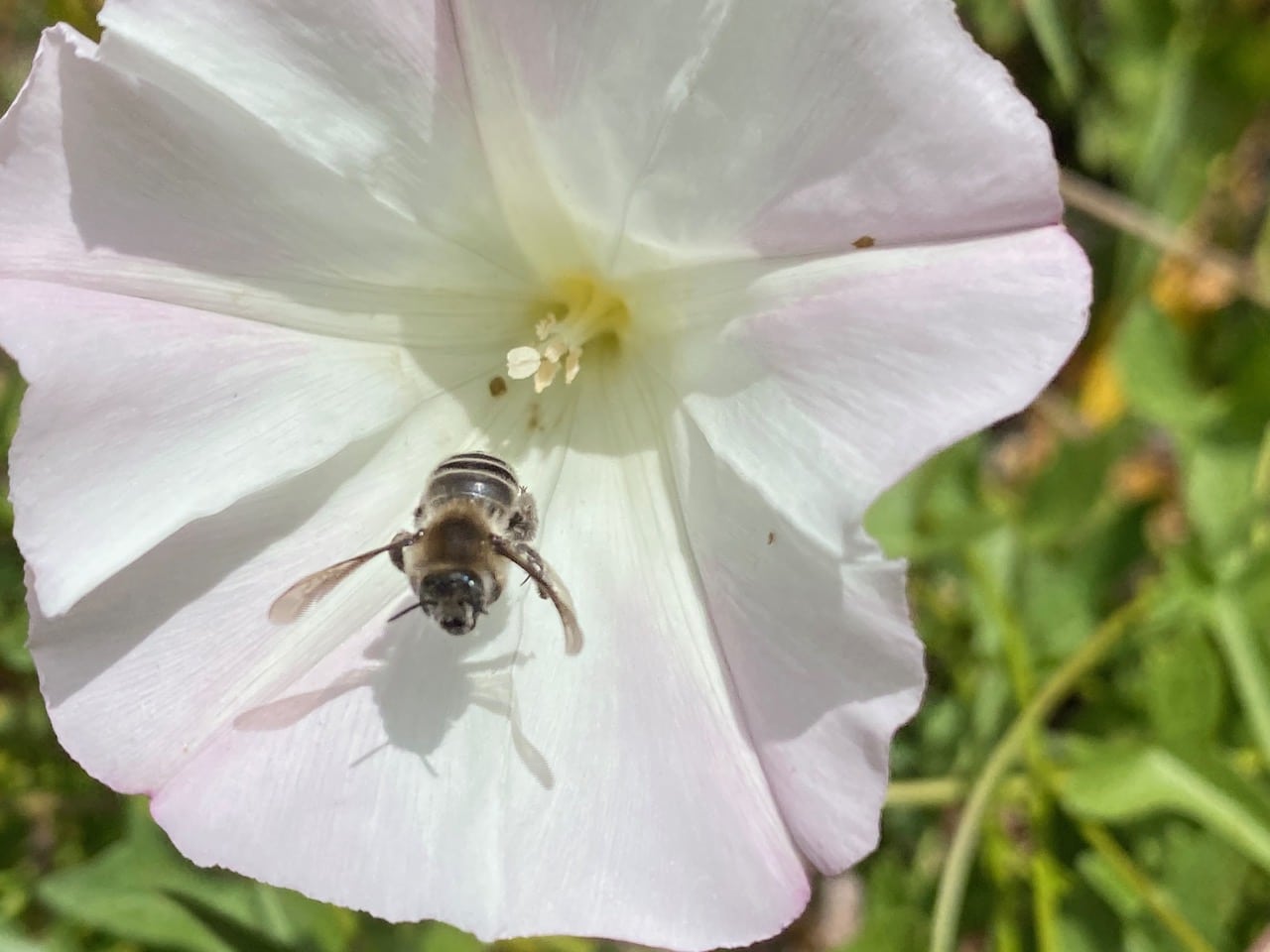
Off she goes to another flower! iNaturalist has helped identify the bee as the Bindweed Turret Bee, Diadasia bituberculata (family Apidae).
Diadasia is a genus of bees in the family Apidae. Its species are oligolectic, specialized on a relatively small number of plant species. Their host plants include asters, bindweeds, cacti, mallows, and willow herbs. Members of this genus are often attacked by a variety of parasitoids from the families Bombyliidae, Mutilidae,Ripiphoridae and Meloidae.
Native to California, the Bindweed Turret Bees, Diadasia bituberculata dig underground nests. As an anti-parasitoid strategy, females construct turrets to cover their burrow entrances, hence their common name of turret or chimney bees. The species exhibits a high degree of pollen specialization, primarily relying on pollen from the genus Calystegia, and its close relatives in the Convulvulaceae or bindweed family. Oligolectic pollinators play an important role in the ecosystem, as they can be highly effective at transferring pollen between specific plant species.
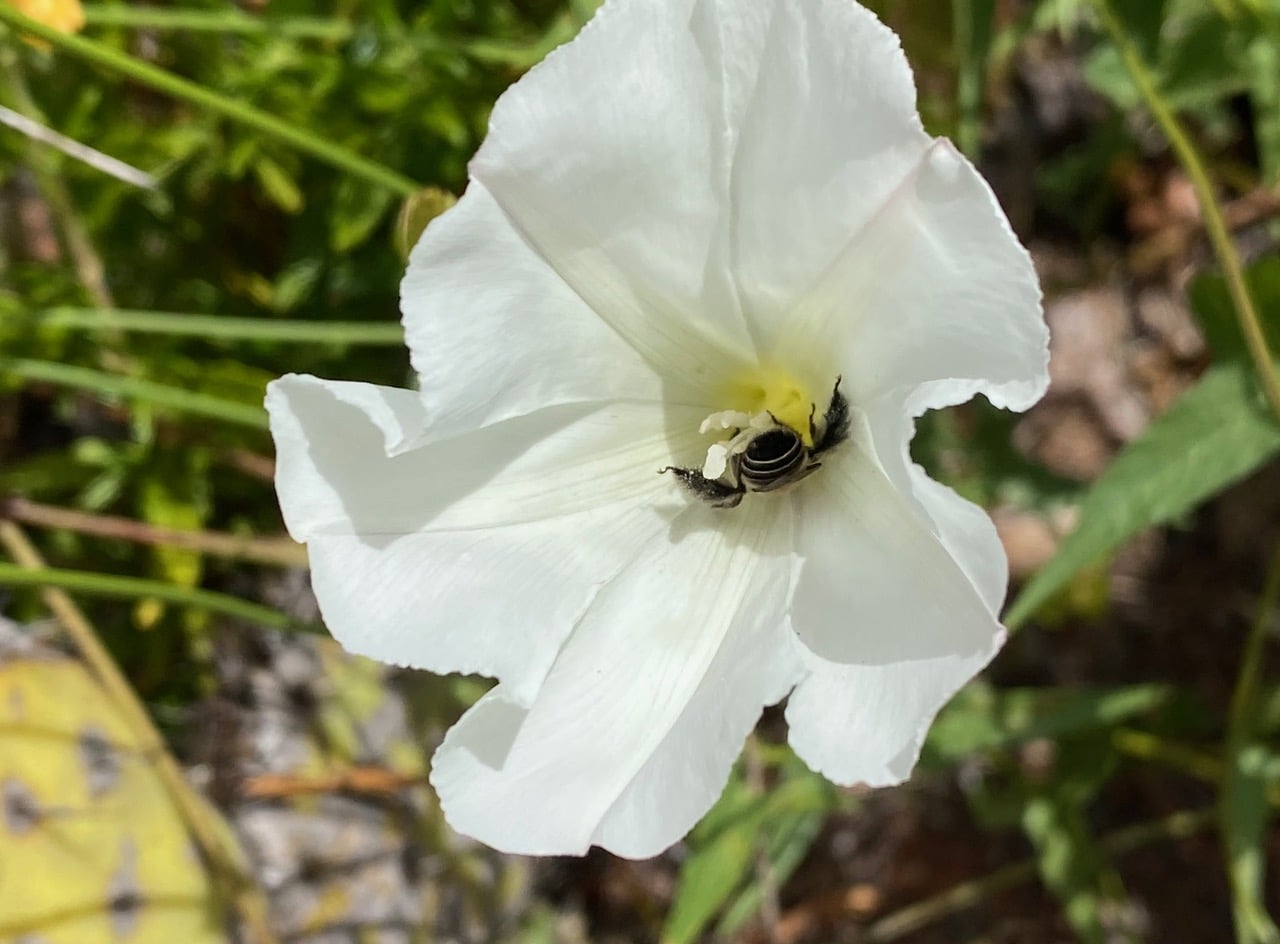
Another Bindweed Turret Bee dives straight to the bottom of a Morning Glory flower, apparently to take nectar.

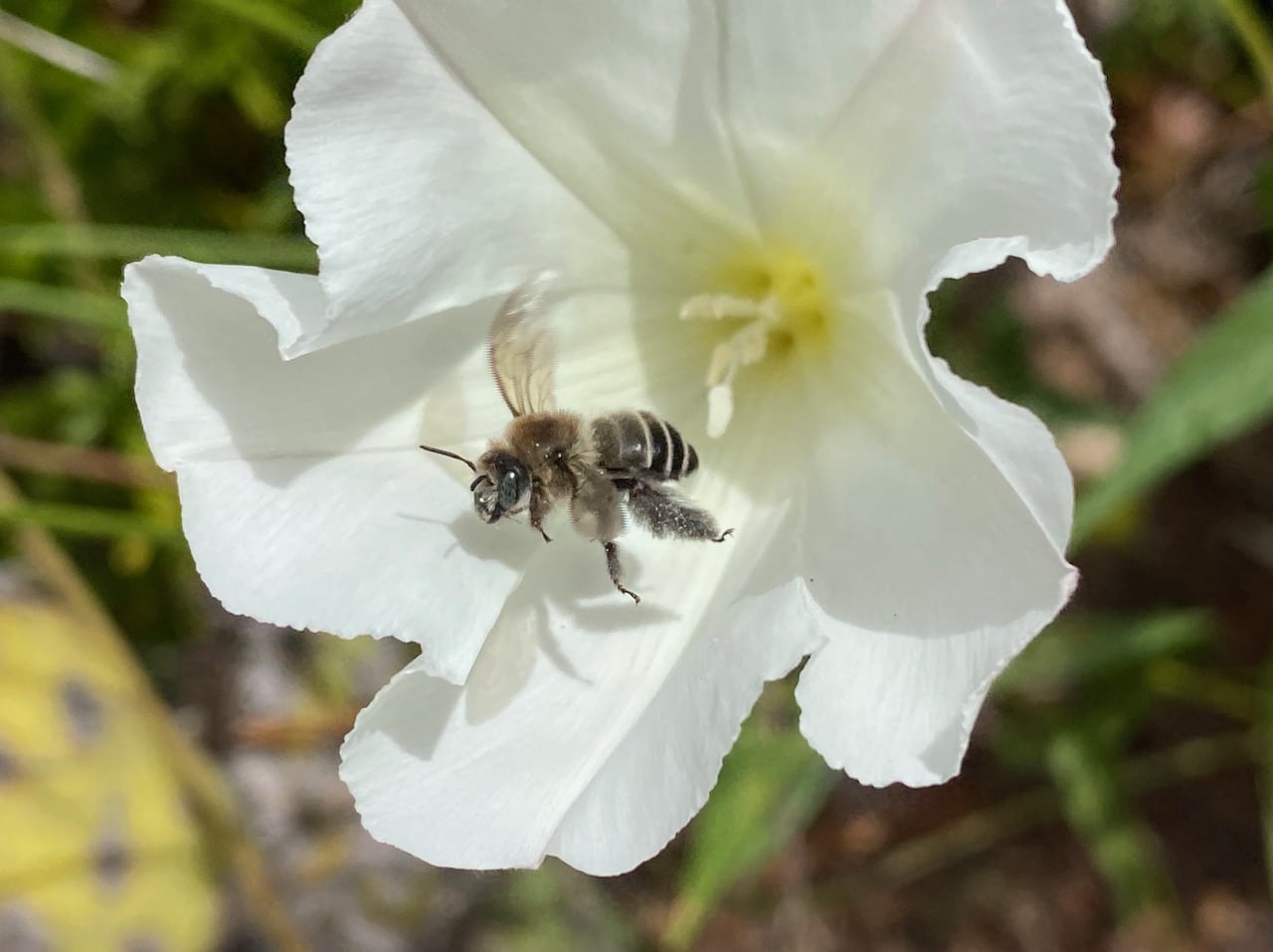
Off she goes to the next flower!