

Pollinator Post 6/5/25 (1)
I arrive at the Regional Parks Botanic Garden on this cool, overcast morning before 10 am. The only active insects at this hour seem to be the bumble bees.
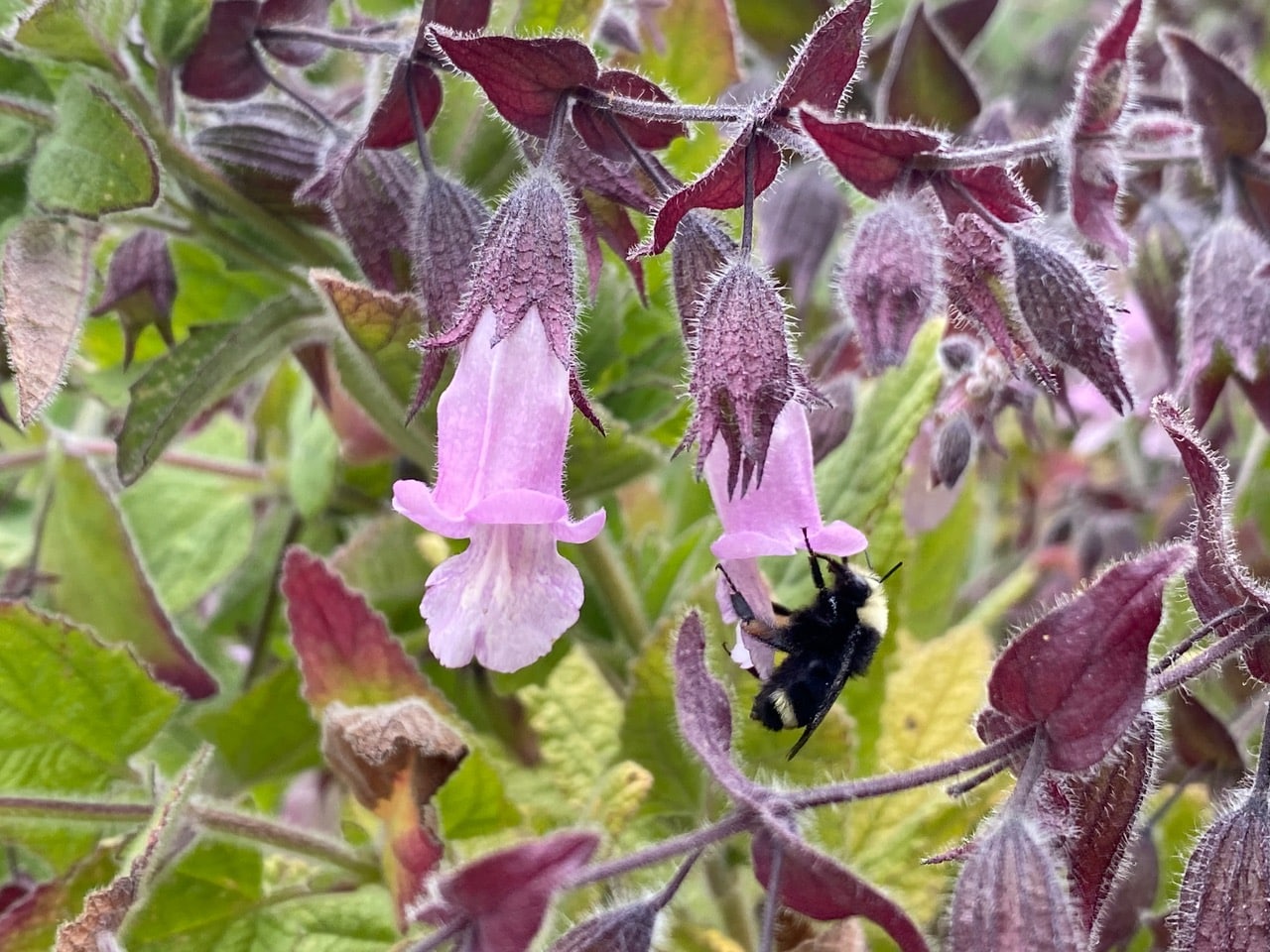
A few Yellow-faced Bumble Bees, subgenus Pyrobombus (genus Bombus, family Apidae) are foraging on the Fragrant Pitcher Sage, Lepechinia fragrans in bloom near the front gate.
The lower lip of the pendant flower serves as a convenient landing pad for the visitors.
Softly hairy and strongly fragrant, the evergreen shrub is endemic to California, growing in open areas in chaparral, in dry ravines, on rocky slopes and ridgetops. The lavender, wide-mouthed, tubular flowers are subtended by dark purple calyces. The plant blooms in mid to late spring, attracting bumble bees and hummingbirds, and hosts two species of moth and butterfly.
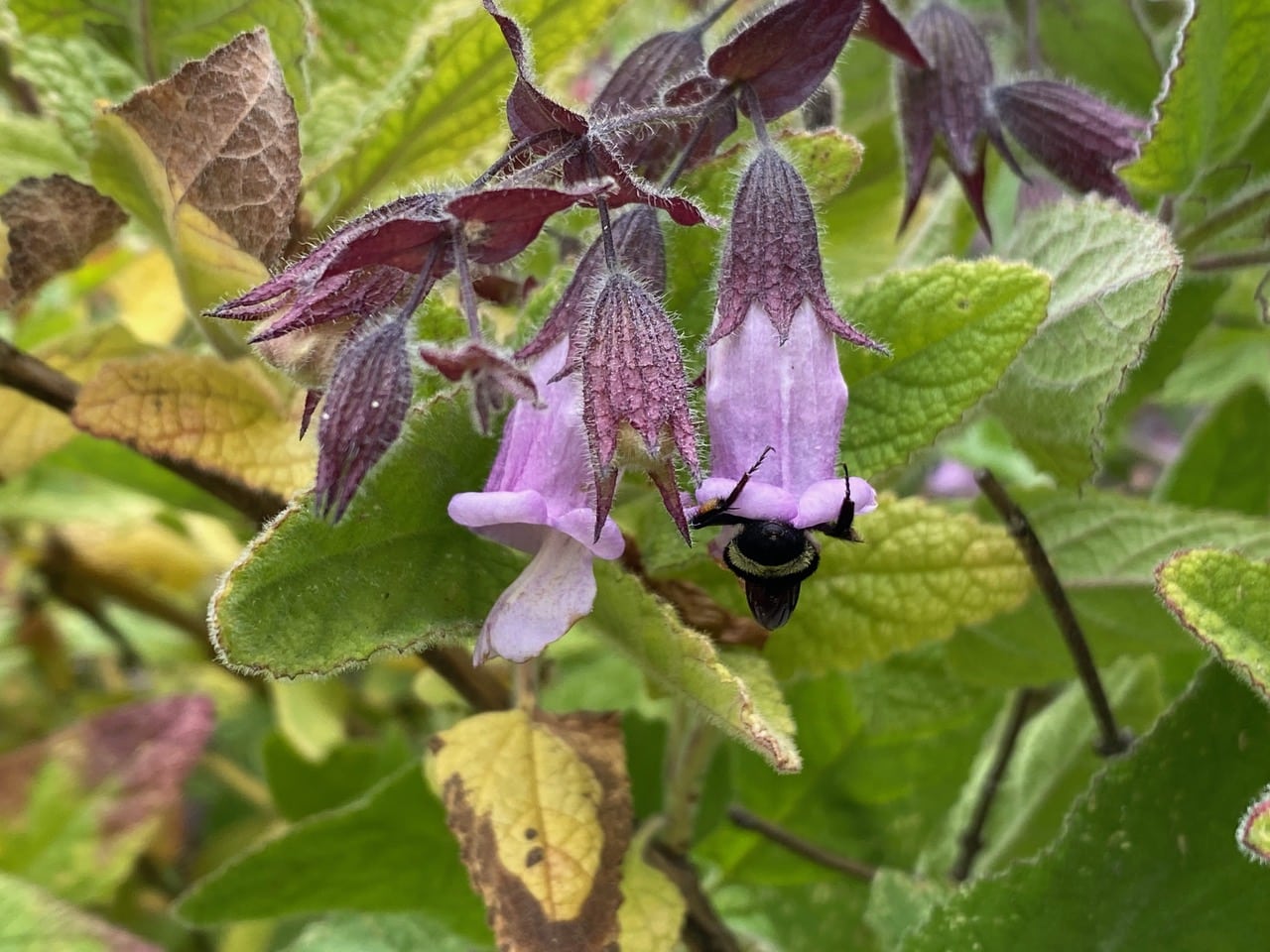
A Yellow-faced Bumble Bee is entering a Fragrant Pitcher Sage flower.
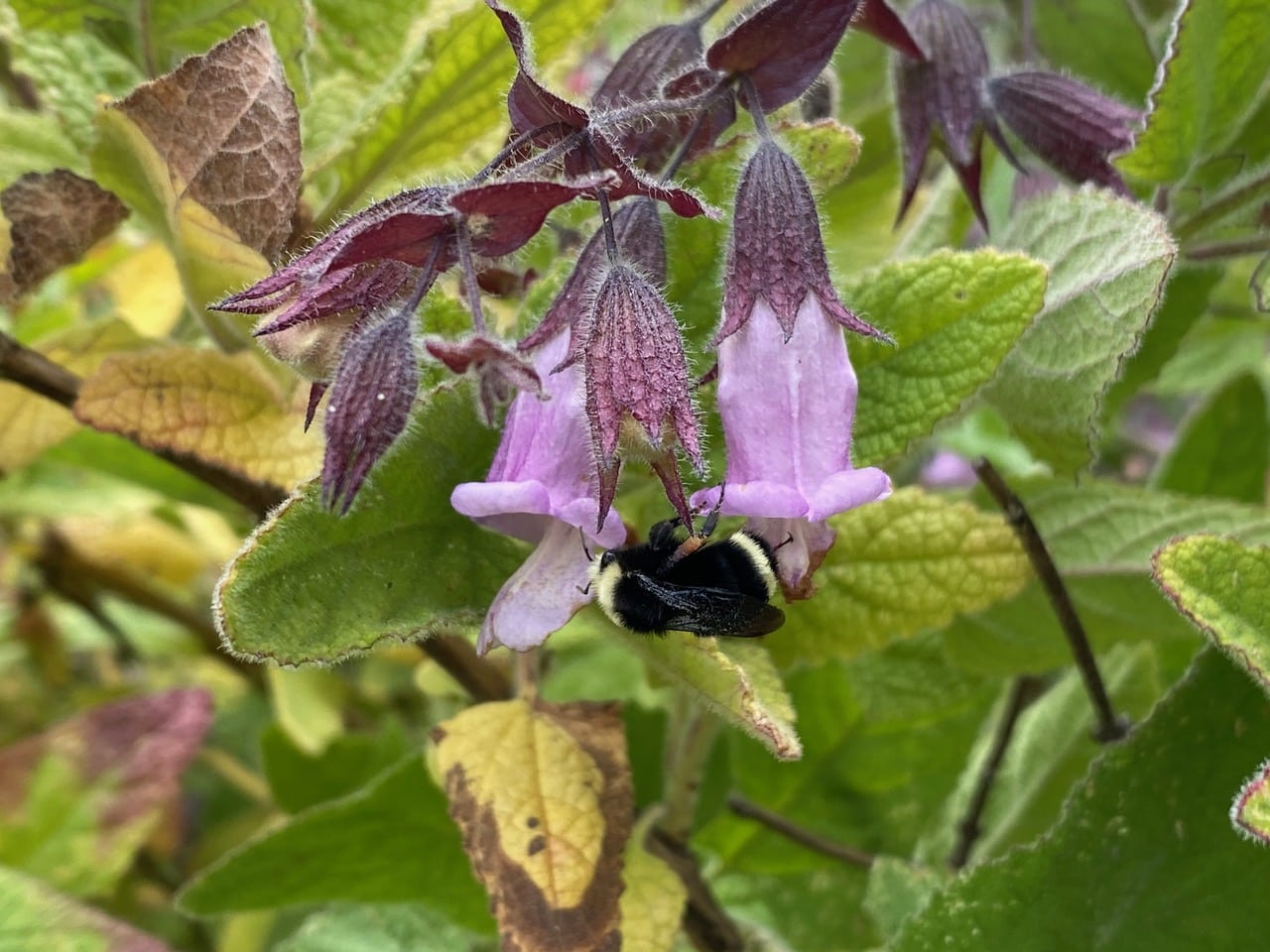
Exiting the flower, the bee clambers onto an adjacent flower.
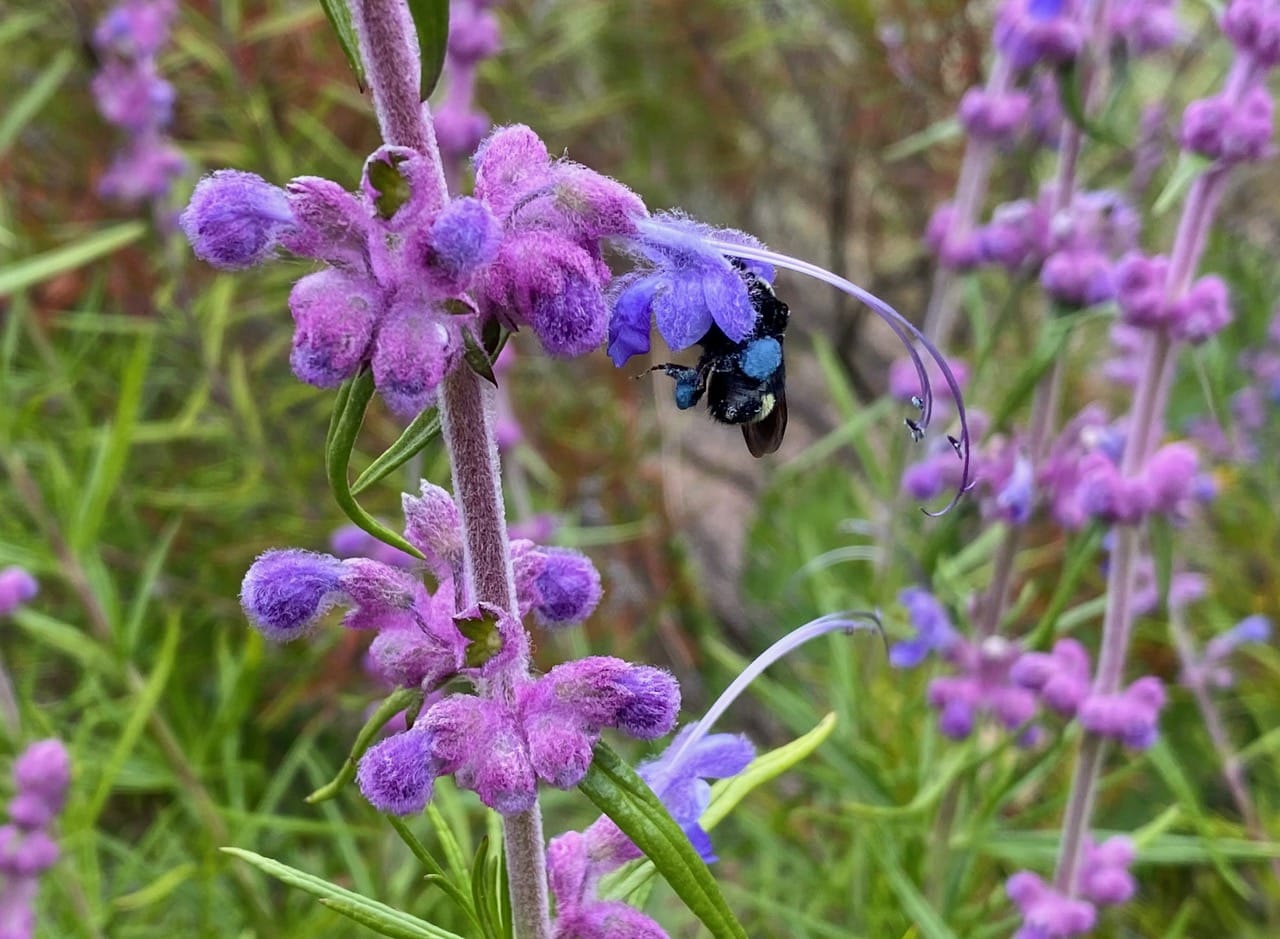
The bumble bees are also visiting the flowers of the Woolly Bluecurls, Trichostema lanatum. The bees are so heavy that they invariably make the flower droop when they land. This, however does not cause the long reproductive structures of the flowers to touch the bee. The flowers are more likely pollinated by hummingbirds that frequently visit them. While hovering in front of the flowers to take nectar, the bird’s body may come in contact with the long, curving stamens and style. Hey, what about the bright blue pollen on the bee’s corbiculae (“pollen baskets”)? Woolly Bluecurls flowers do have blue pollen, but how do the bumble bees collect it?
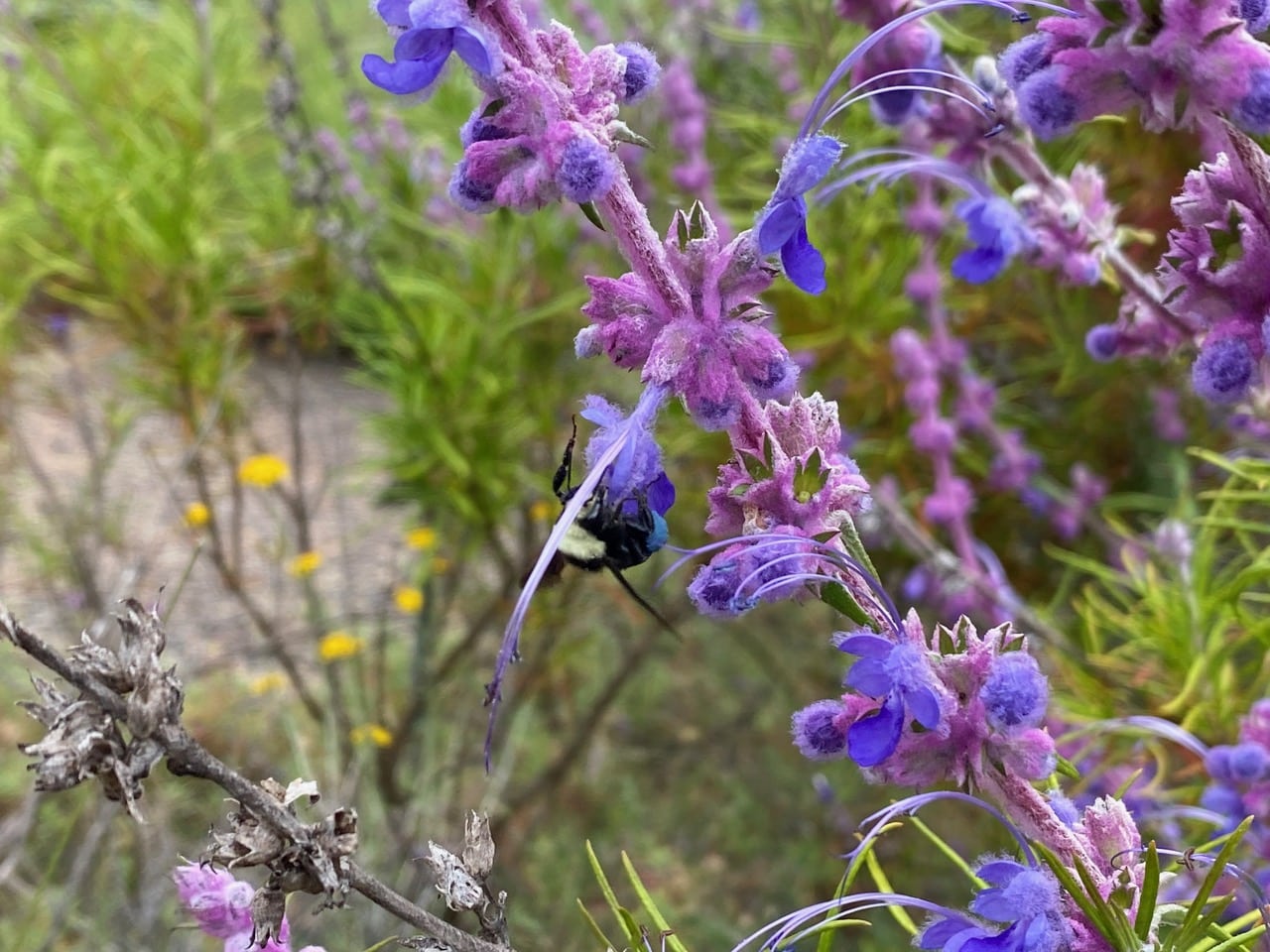
A Yellow-faced Bumble Bee is taking nectar from a Woolly Bluecurls flower.

Then it grabs the long, curving stamens above it and glides down towards the anthers in one swift movement. This is the first time I have ever observed this behavior! The bumble bees do collect pollen from the Woolly Bluecurls flowers!
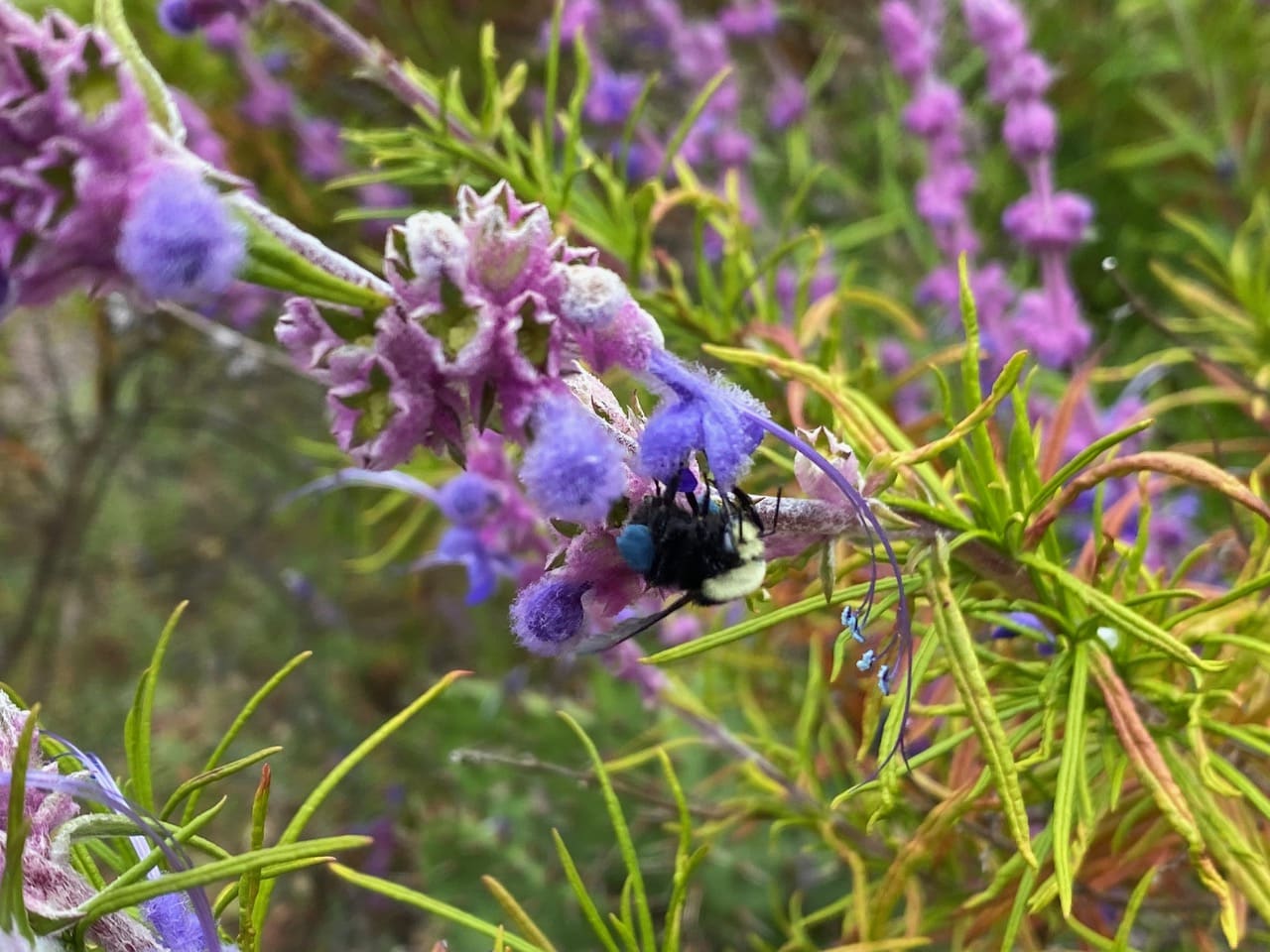
Watch this behavior again. The bee is taking nectar from another flower. Note the bright blue pollen on the hanging anthers.
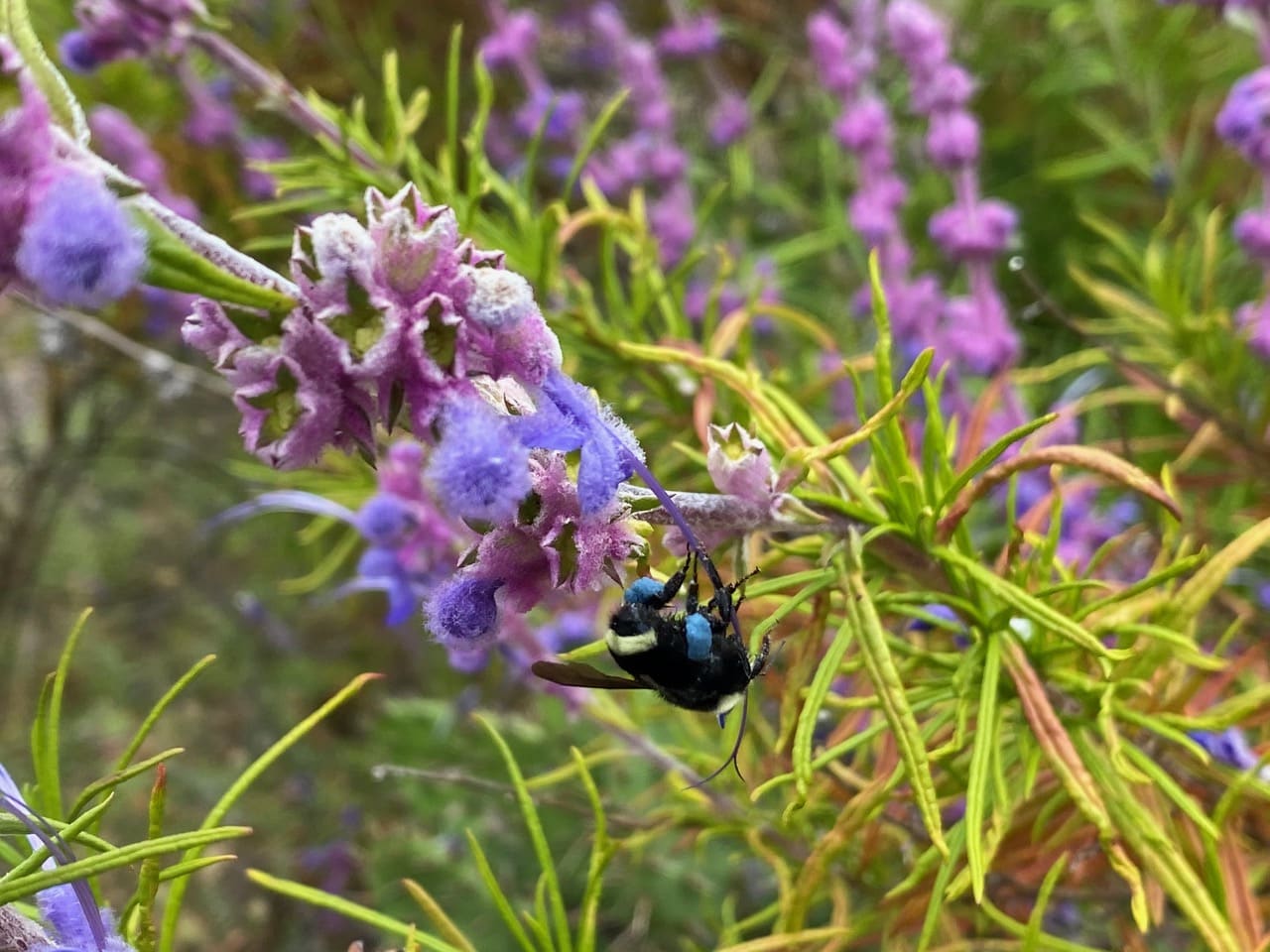
It is a miracle that I manage to catch the action as the bee slides down the stamens to gather pollen at the tips. Bravo, Bumble Bee!

As the morning warms up, the Prickly Pear Cactus flowers, Opuntia sp. begin to open up. I glimpse a stout bee resting motionless on the green stigma in the middle of a flower. Is it still asleep?
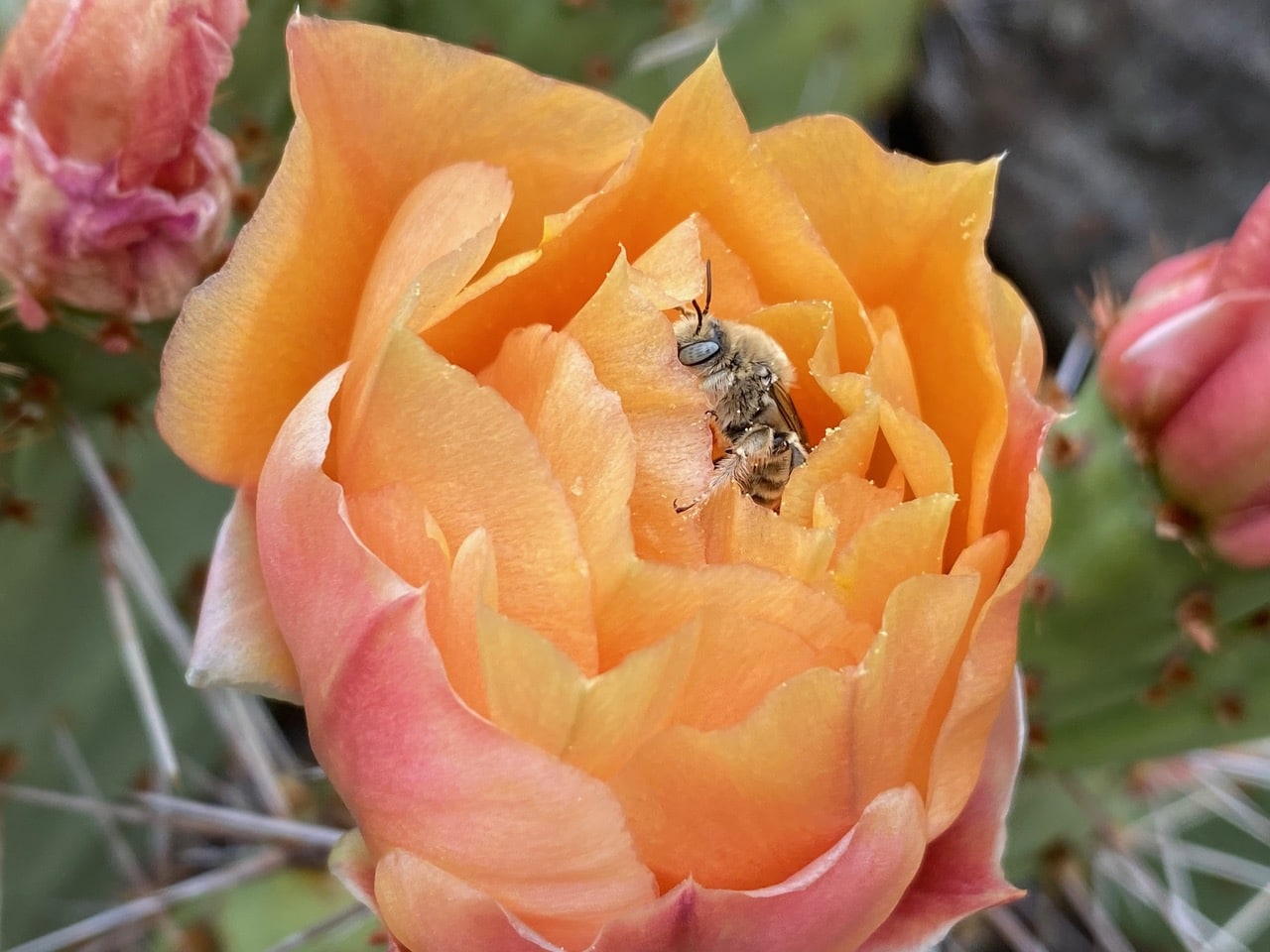
In the next patch of Opuntia, a similar bee is climbing out of an apricot-colored flower that is barely open.

The bee is sturdily built like a bumble bee. It grooms itself in the sunlight and surveys the garden from the top of the cactus flower.

Speckled with pollen, two bees emerge from an Opuntia flower. iNaturalist has helped identify the bees as Cactus Chimney Bees, Complex Diadasia australis, members of the genus Diadasia.
The most well-known species within this complex is Diadasia rinconis (family Apidae). Karine Aigner was awarded Wildlife Photographer of the Year in 2022 for her photo entitled “The Big Buzz”, featuring D. rinconis during raucous mating. The species is found in Central America and North America. In the Sonoran Desert, D. rinconis is considered the “cactus bee” as it feeds almost exclusively on a number of Sonoran Desert cactus species, its life cycle revolving around the flowering of the cacti. The bees are ground nesters, often constructing chimney-like structures at the burrow entrance, hence the name “chimney bees”. Females have bushy scopae (pollen-collecting hairs) on their hind legs, and distinctive brushes of long hairs on their forelegs. Males often have elongated hind legs.
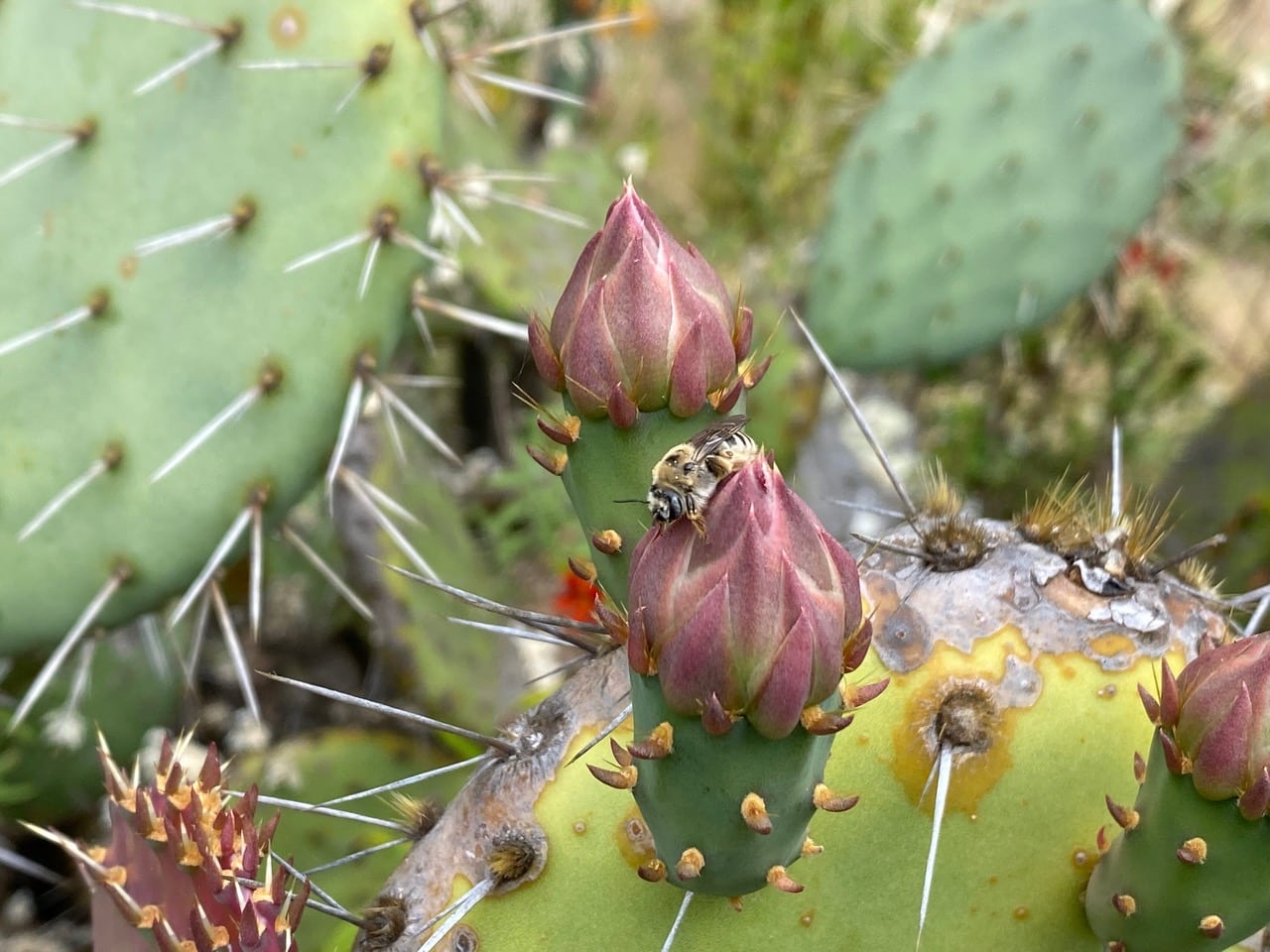
A Diadasia flies out of a Prickly Pear Cactus flower and lands on a flower bud to rest.
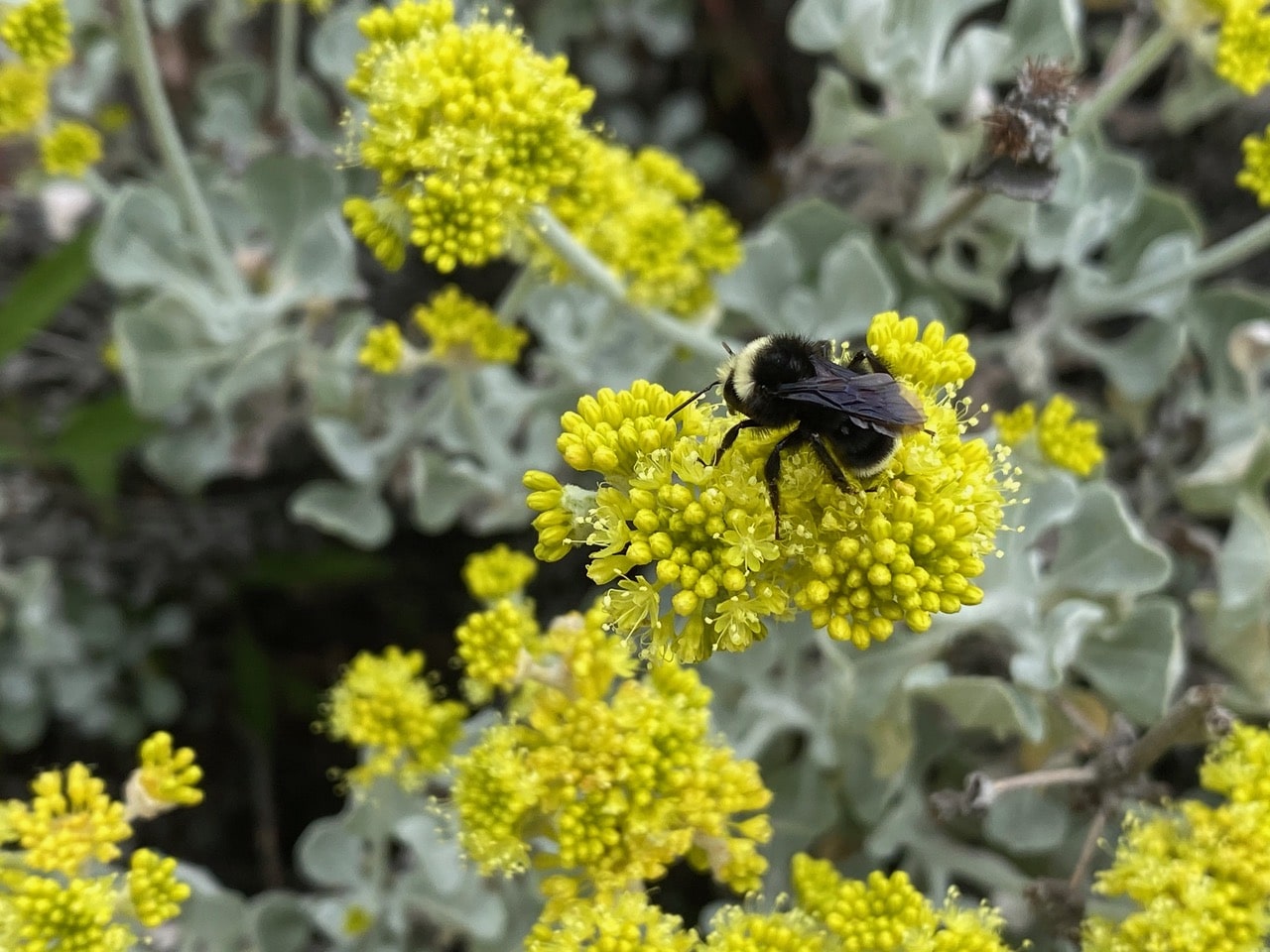
A Yellow-faced Bumble Bee is resting on a young inflorescence of Sulphur Buckwheat, Eriogonum umbellatum just starting to bloom. Many of the bumble bees seen lately are large, pristine individuals, probably this year’s new crop of queens.
Bumble bees are social and live in colonial hives. Many of the large individuals seen early in the season are queens. They are the only members of their colony to survive the winter, hibernating until the days begin to warm and their host plants are in bloom. These queens have mated before they went into hibernation. Now their first order of business is to each find a nesting site (usually an abandoned rodent burrow), lay eggs, brood and nurture the first batch of workers, all females. Hence forth, the queens stay behind in the hive to concentrate on laying eggs while the workers take on hive duties and foraging. Bumble bees are among the most cold tolerant bees, and are usually the first bees we see out foraging. In late summer, the colony begins to produce new queens and drones (males). These mate with members of other colonies. The males and the rest of the colony dies, including the old queen. The newly mated queens find a place to hibernate; they emerge in early spring the following year to establish new colonies.
Queens are noticeably larger than worker bees, which is one of the easiest ways to distinguish them. Queen bees are fed a more substantial diet during their larval development, contributing to their larger size. The queen’s large size is crucial for her to store enough nutrients to lay a large number of eggs throughout the colony’s lifespan.

The rare and endangered Sessile-leaved Yerba Santa, Eriodictyon sessilifolium is blooming profusely. I have never noticed the plant as I have not walked this path in all these years I have been visiting the garden.
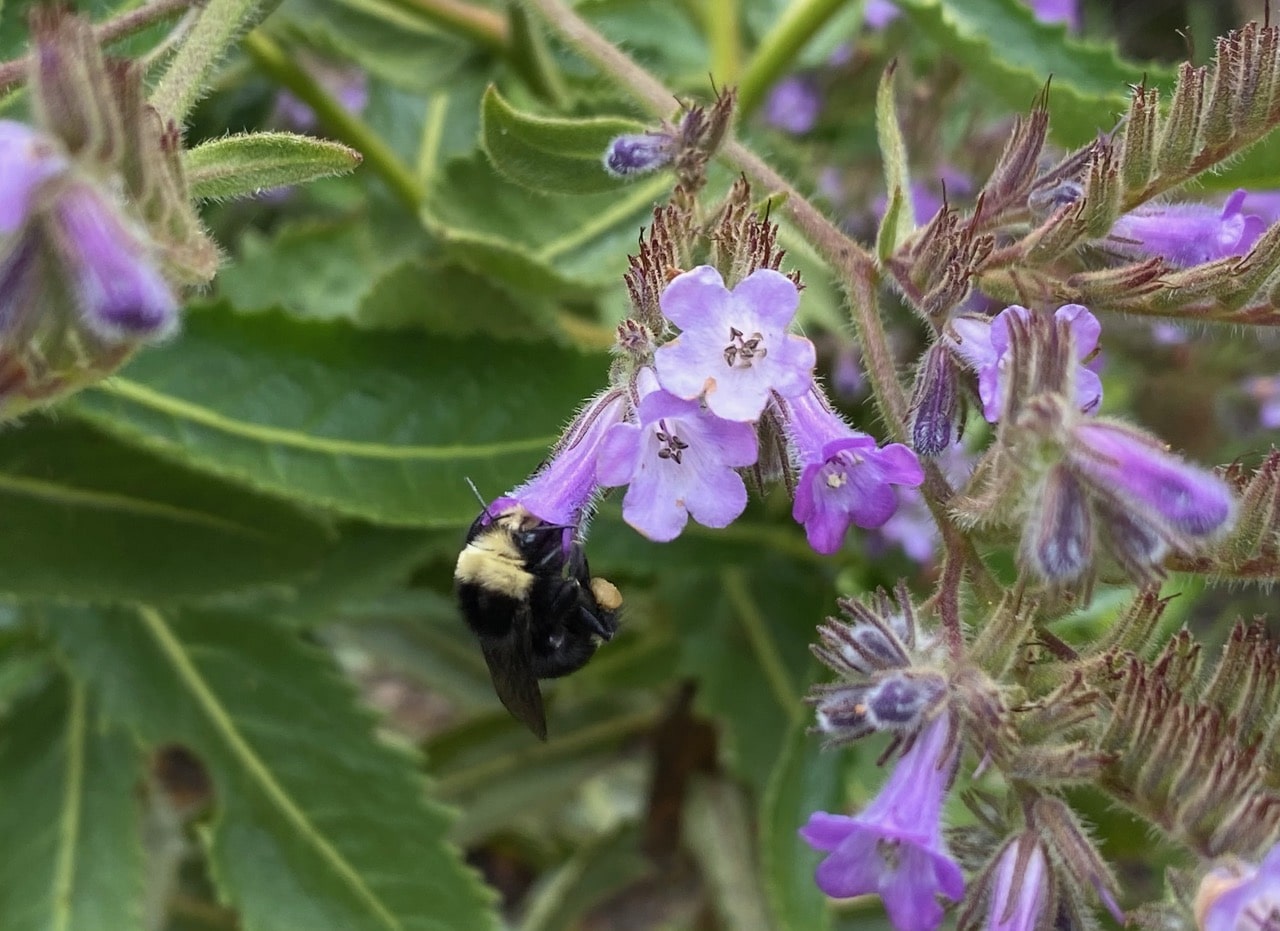
Bumble Bees have long tongues, and are able to access nectar in some long, tubular flowers.
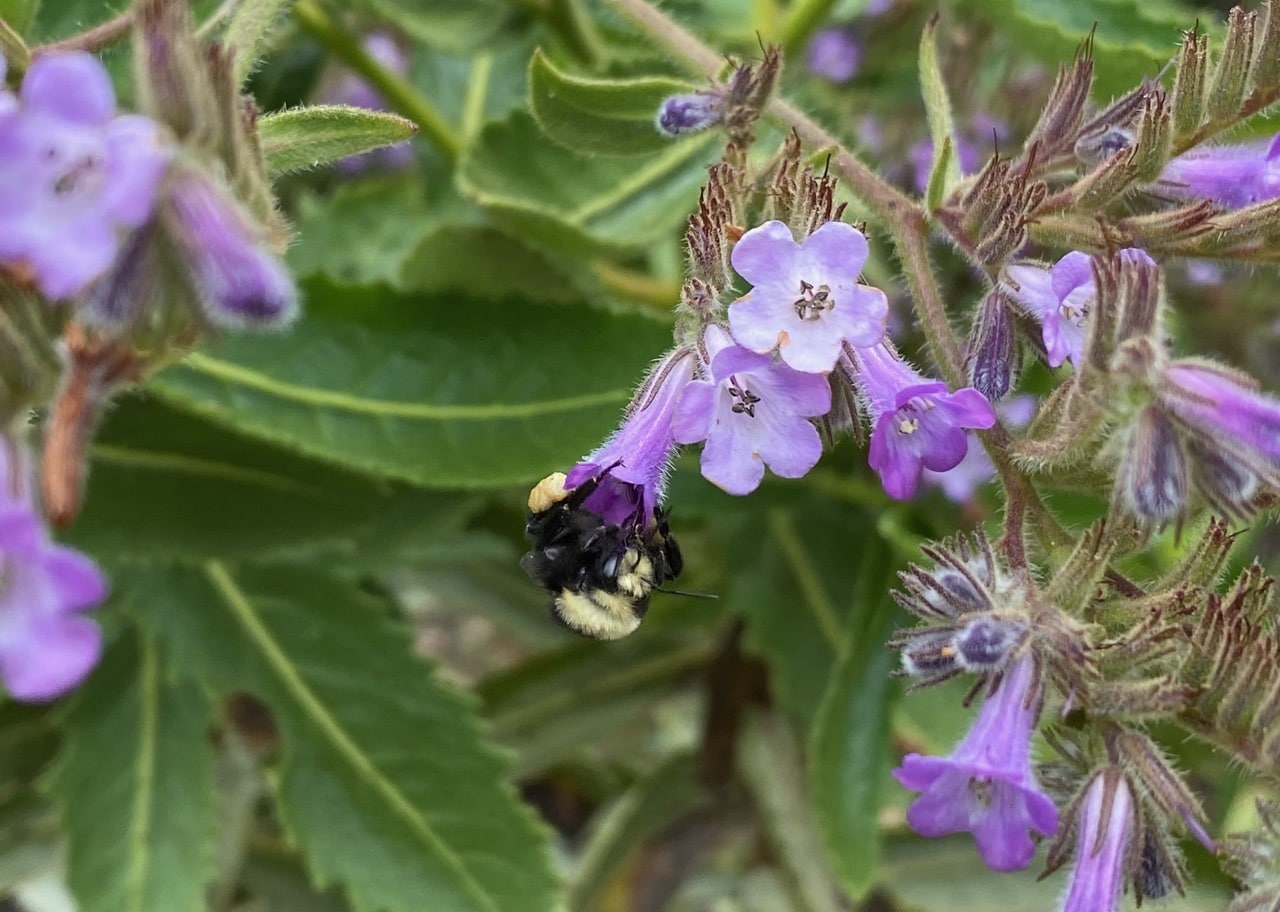
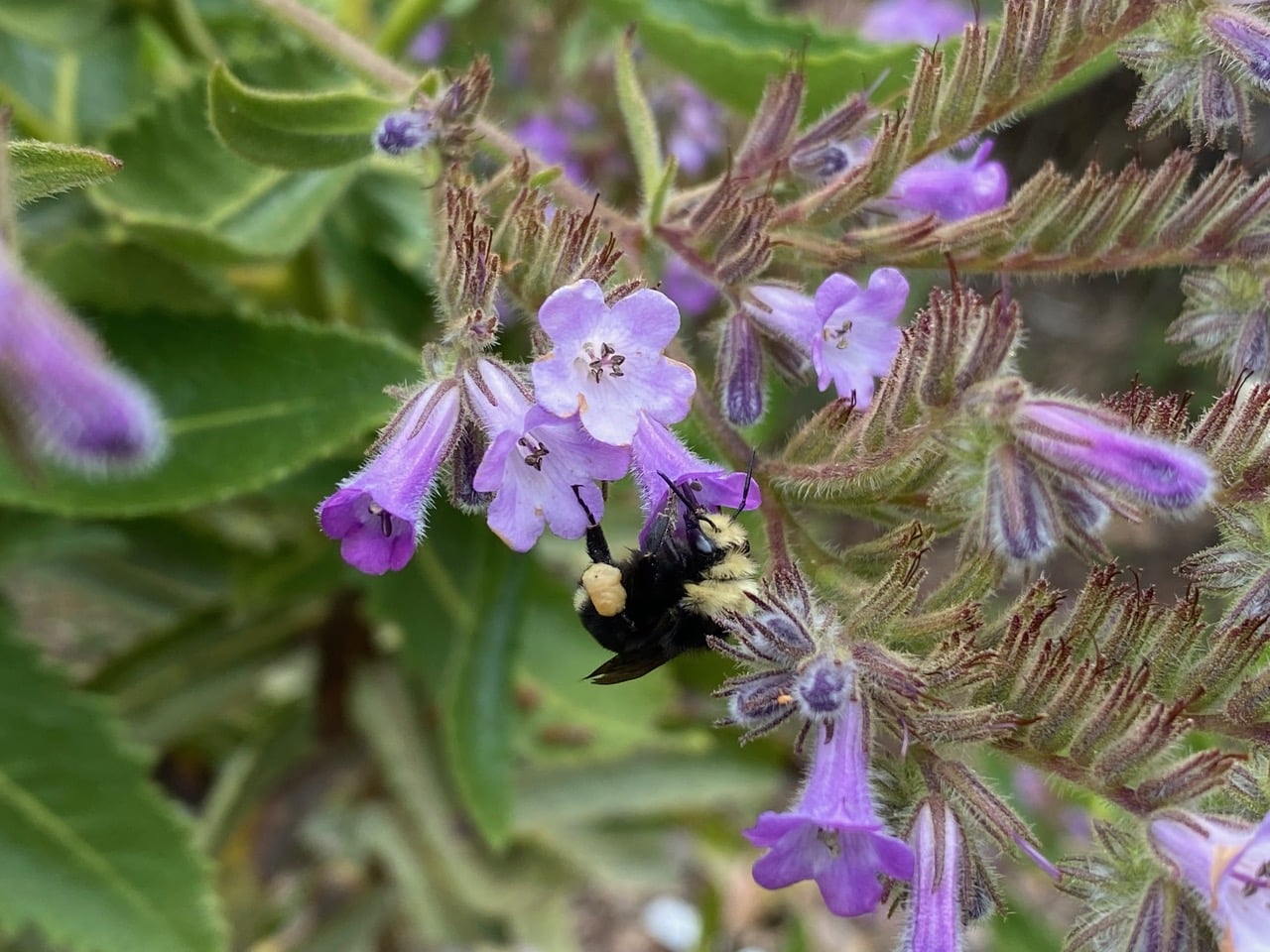
The Yerba Santa flowers are closely clustered enough that the bee does not have to fly between them.


What a bizarre sight! A female Western Lynx Spider, Oxyopes scalaris (family Oxyopidae) is guarding her silken egg sac that she has attached to the entrance of a Yerba Santa flower, plugging it. Nobody is going to enter this flower now!
Lynx Spiders (family Oxyopidae) can be distinguished from other families by their distinctive hexagonal eye arrangements and the prominent spines on their legs. Most species make little use of webs, instead spending their lives as hunting spiders on plants. Many species frequent flowers in particular, ambushing pollinators. They are active during the day hunting insects sometimes larger than themselves. Their long, spiny bristles form a “basket-like” cage that may assist in capturing prey and providing the spider with some protection. Lynx spiders are fast runners and leapers with good vision. Females fasten their egg sacs to twigs or leaf or suspended in a web in grass tufts. The females fiercely guard their egg sacs – they hold the sac between their legs, protecting it from predators, until the spiderlings hatch, often for up to several weeks. Some species even help the young emerge by tearing open the egg case.
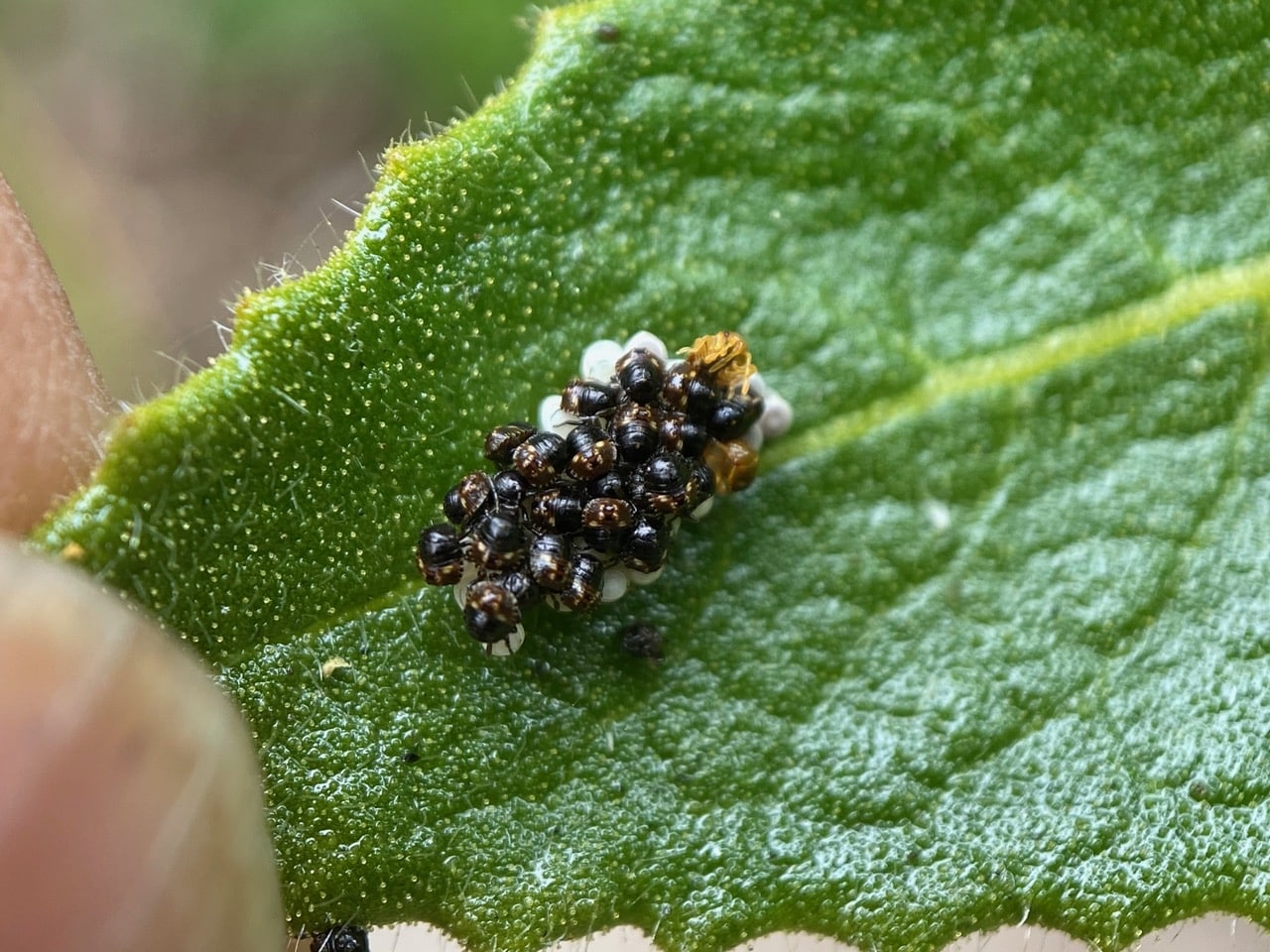
Near the tip of a Yerba Santa leaf, a clutch of Stink Bug eggs have hatched into dark, shiny nymphs, with two light-colored ones still emerging. At this stage, the hatchlings look more like beetles than bugs.
Stink Bugs belong to the family Pentatomidae, in the order Hemiptera or “true bugs”. As hemipterans, the pentatomids have piercing-sucking mouthparts, and most are phytophagous, including several species that are severe pests on agricultural crops. Both nymphal and adult stink bugs feed on plant fluids by inserting their needlelike mouthparts into stems, leaves or seed pods. While feeding, they inject materials into the plant to aid in digestion and sap removal. Penetration by the mouthparts can cause physical damage, much like stabbing the plant with a fine needle.
All Pentatomids have 5-segmented antennae (hence their family name, Penta – five and tomos – section.) They generally have a large triangular scutellum in the center of the back. The adult is generally shield-shaped when viewed from above. The common name of Stink Bug refers to their ability to release a pungent defensive spray when threatened, disturbed, or crushed.
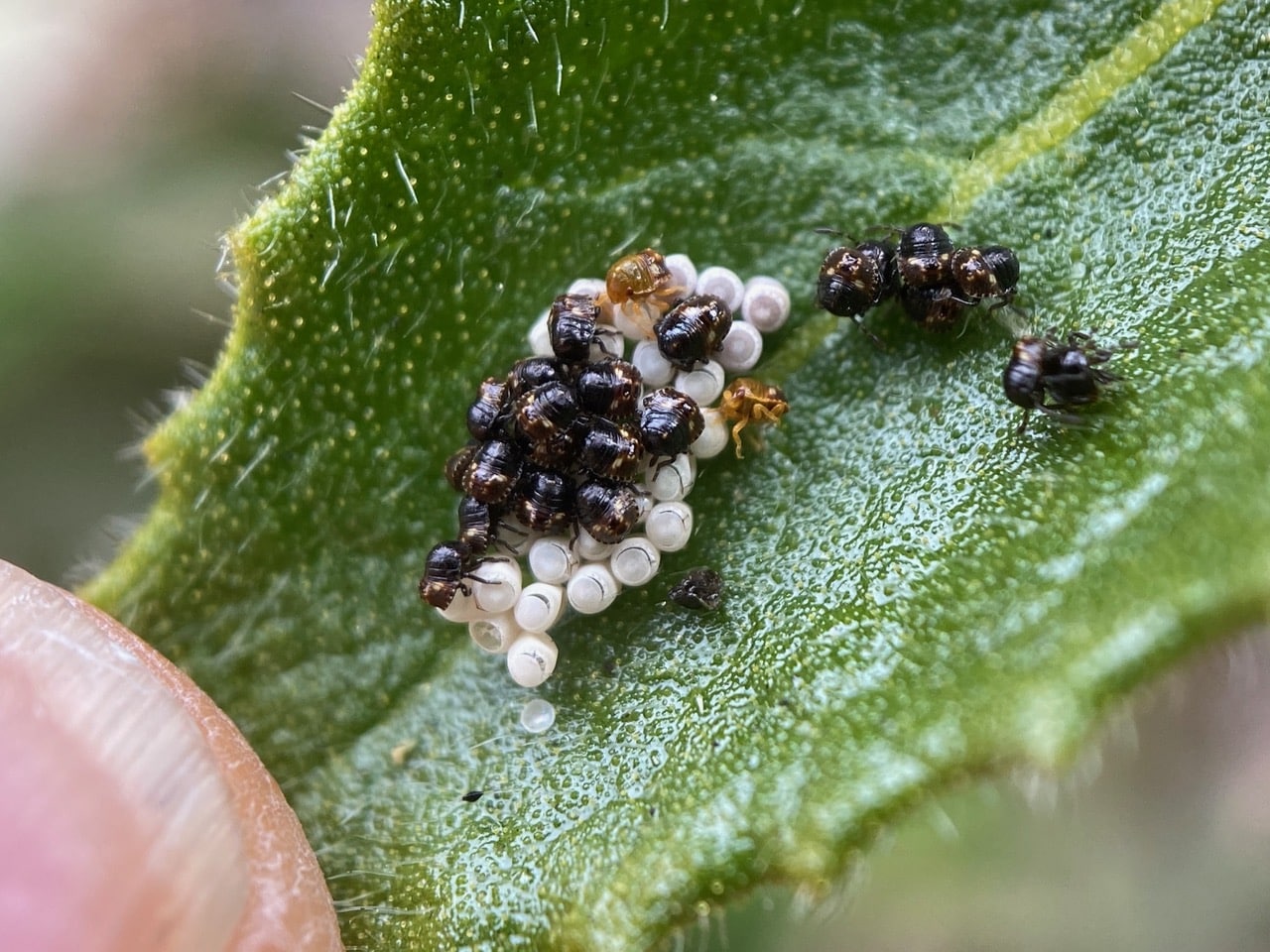
Sensing my disturbance gripping the leaf, the baby Stink Bugs begin to disperse. Note their empty egg shells. Stink Bug eggs are typically barrel-shaped, with pop-tops. The eggs hatch synchronously, and the nymphs stay together until their first molt.