

Pollinator Post 6/4/23 (1)
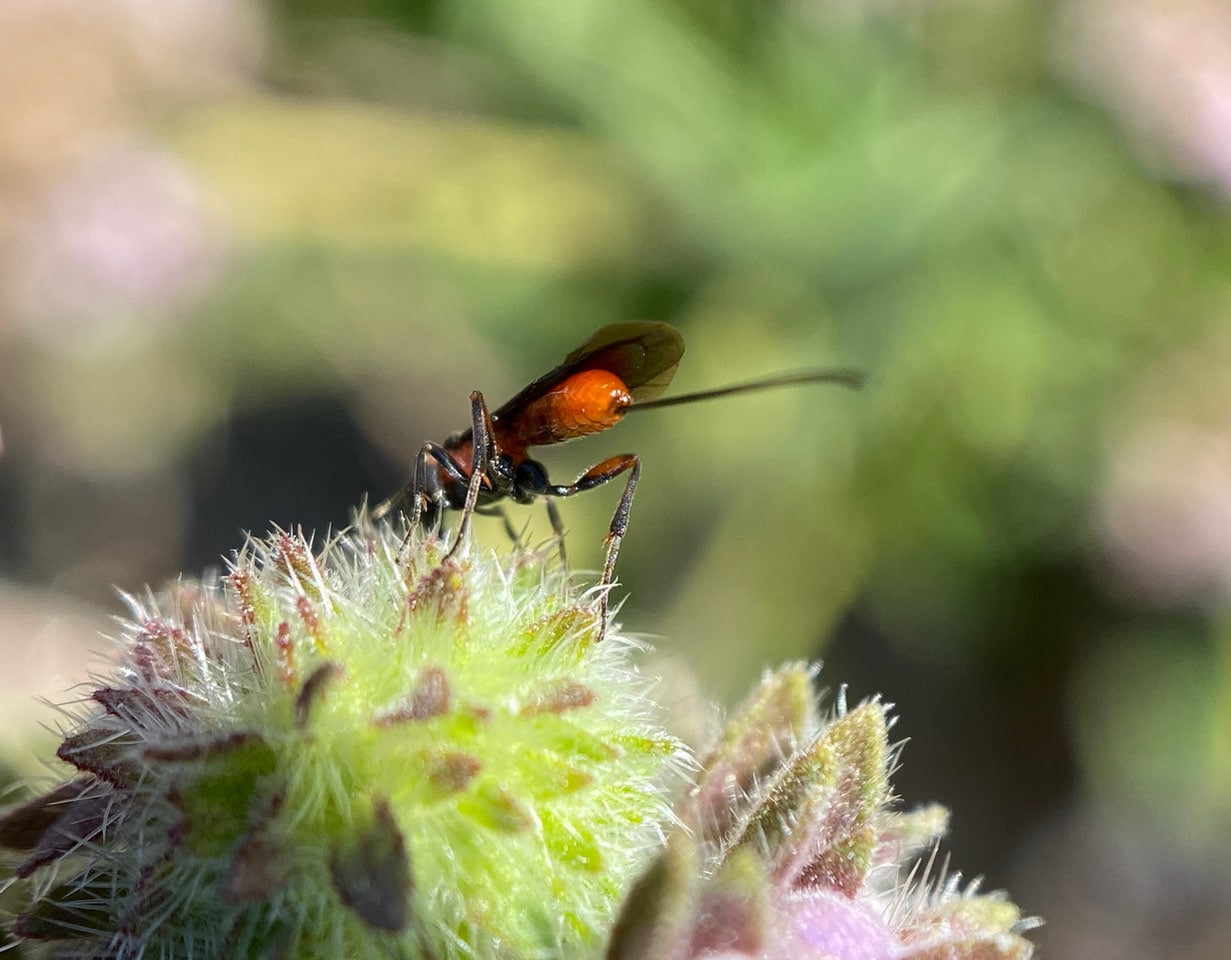
Look, a parasitoid wasp with a long ovipositor is roaming all over an inflorescence of California Phacelia, Phacelia californica! The morning promises to be an exciting one.
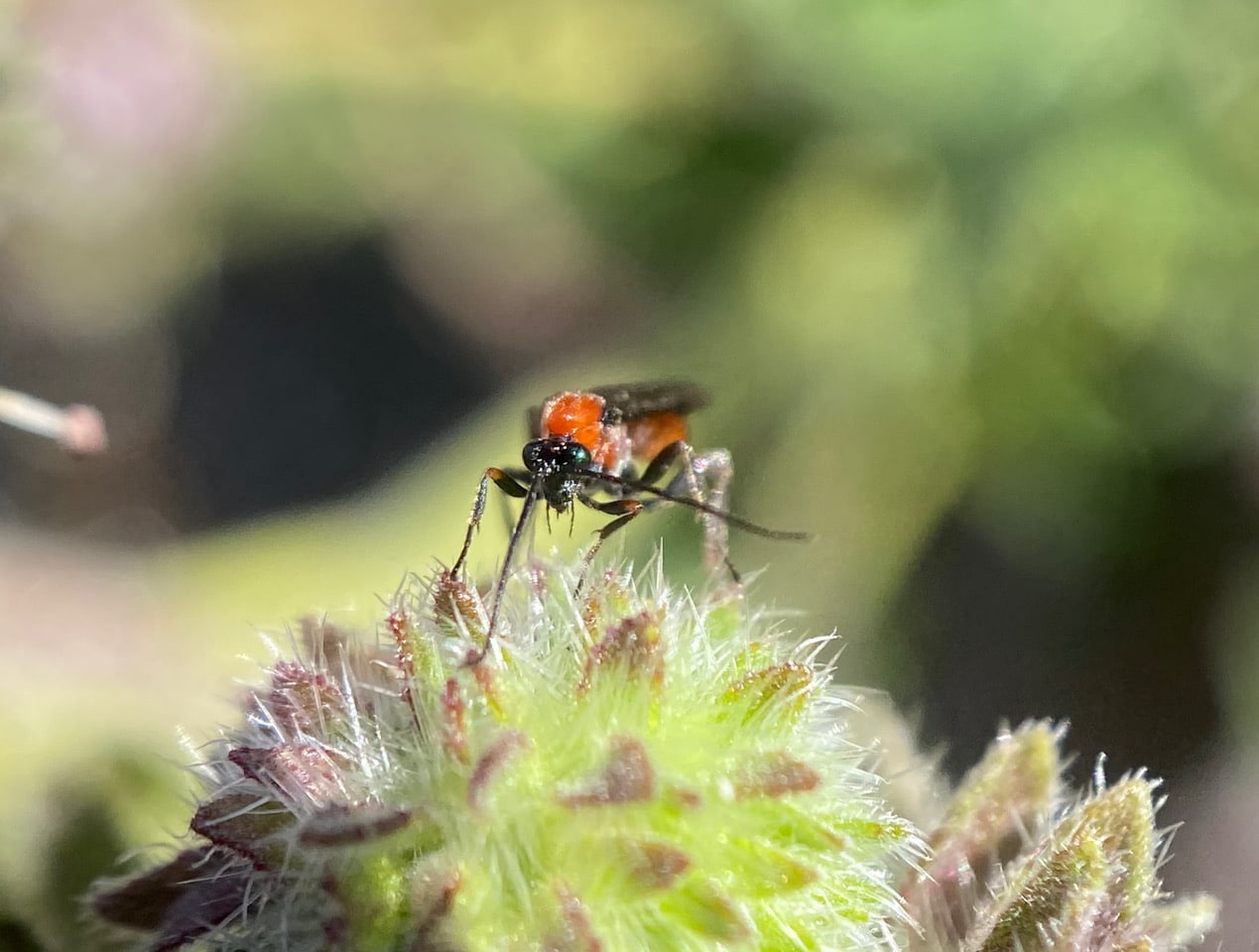
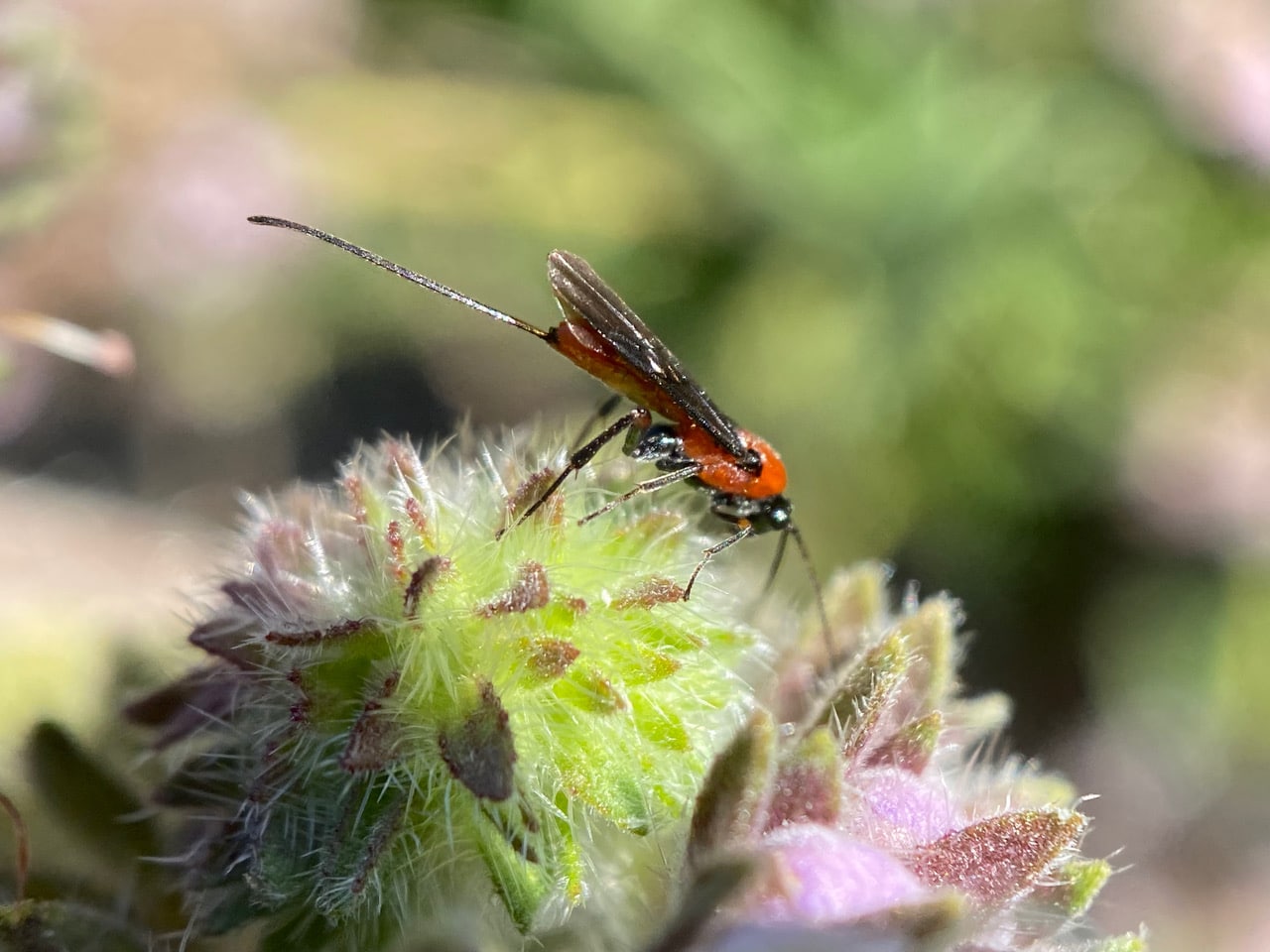
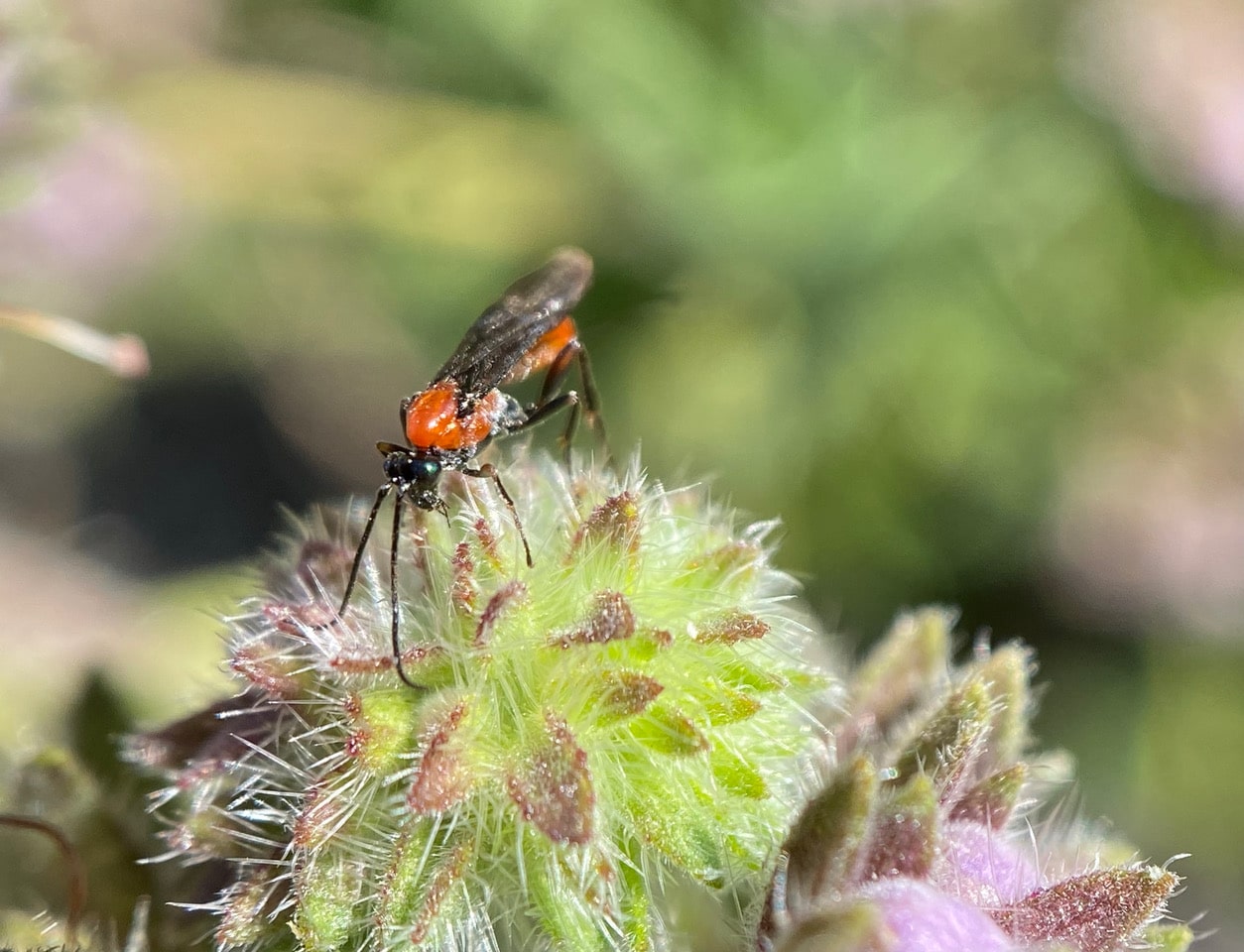
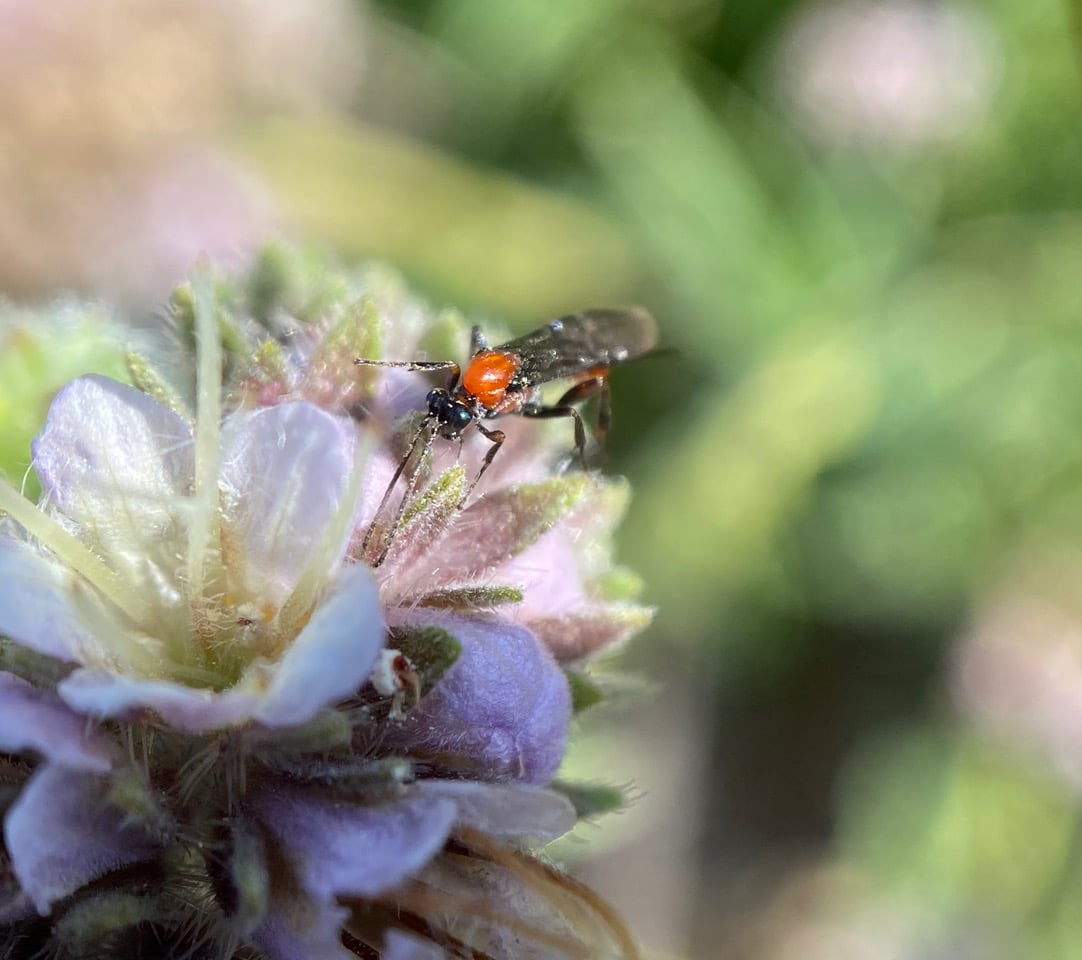
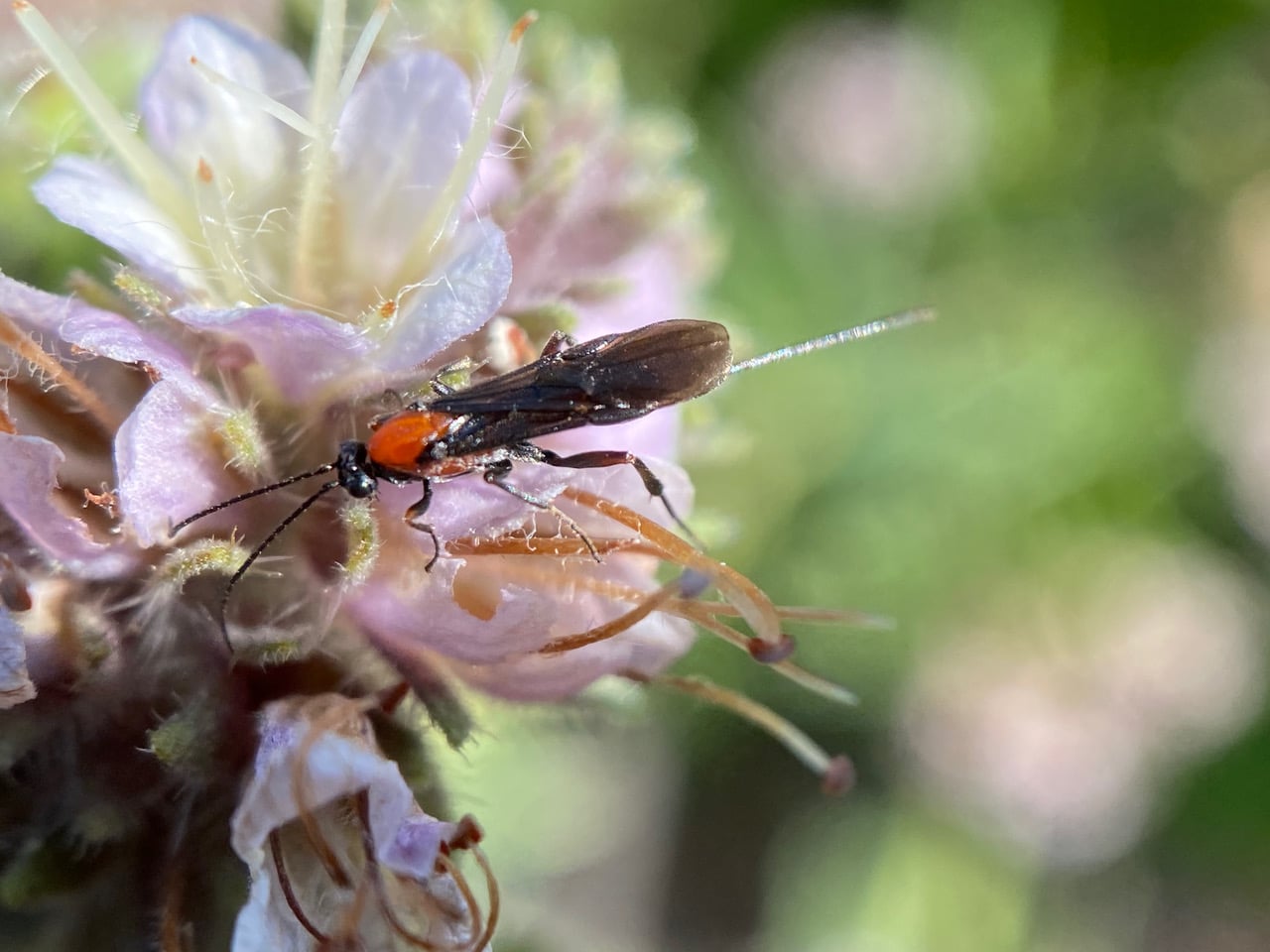
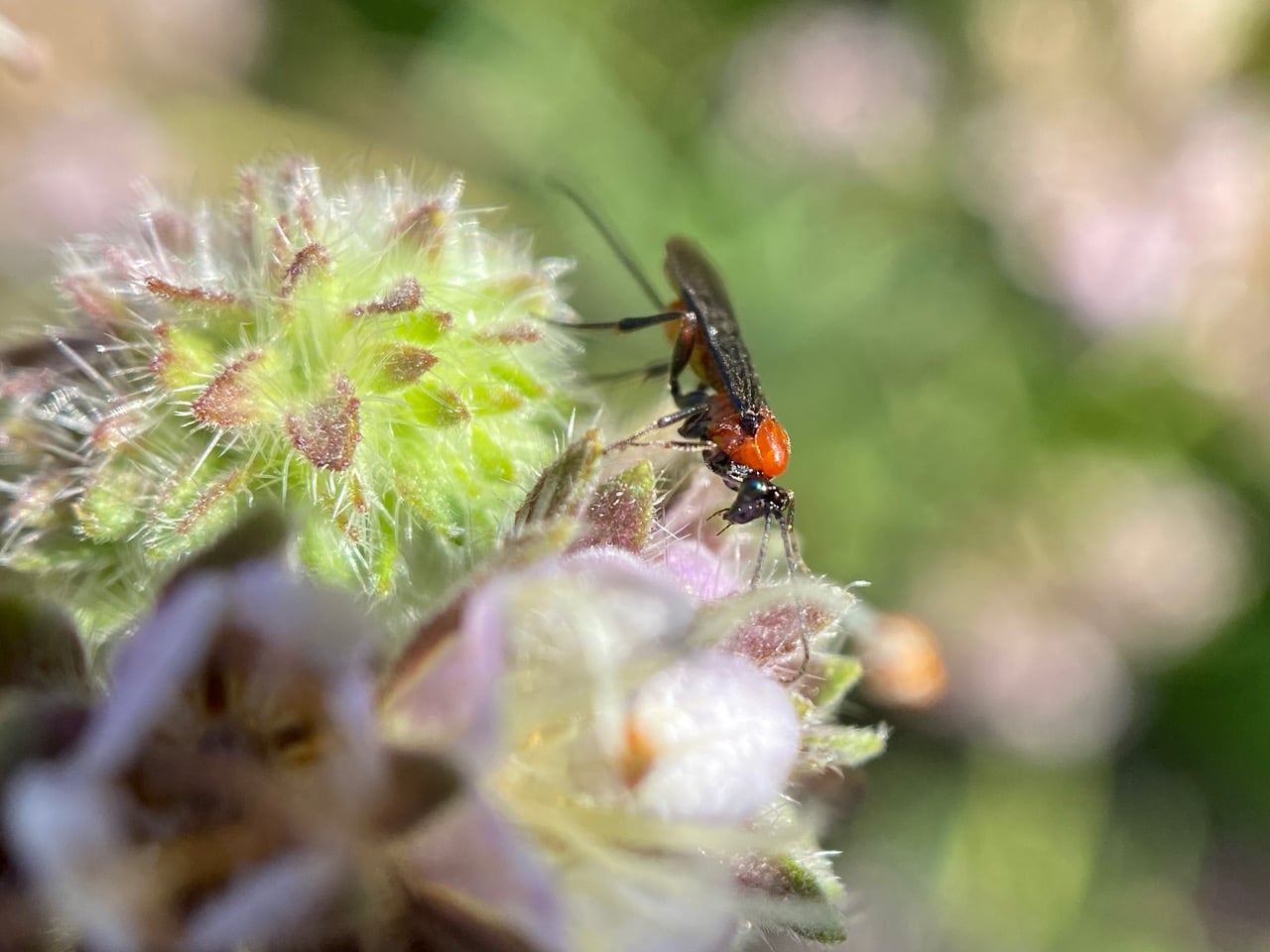
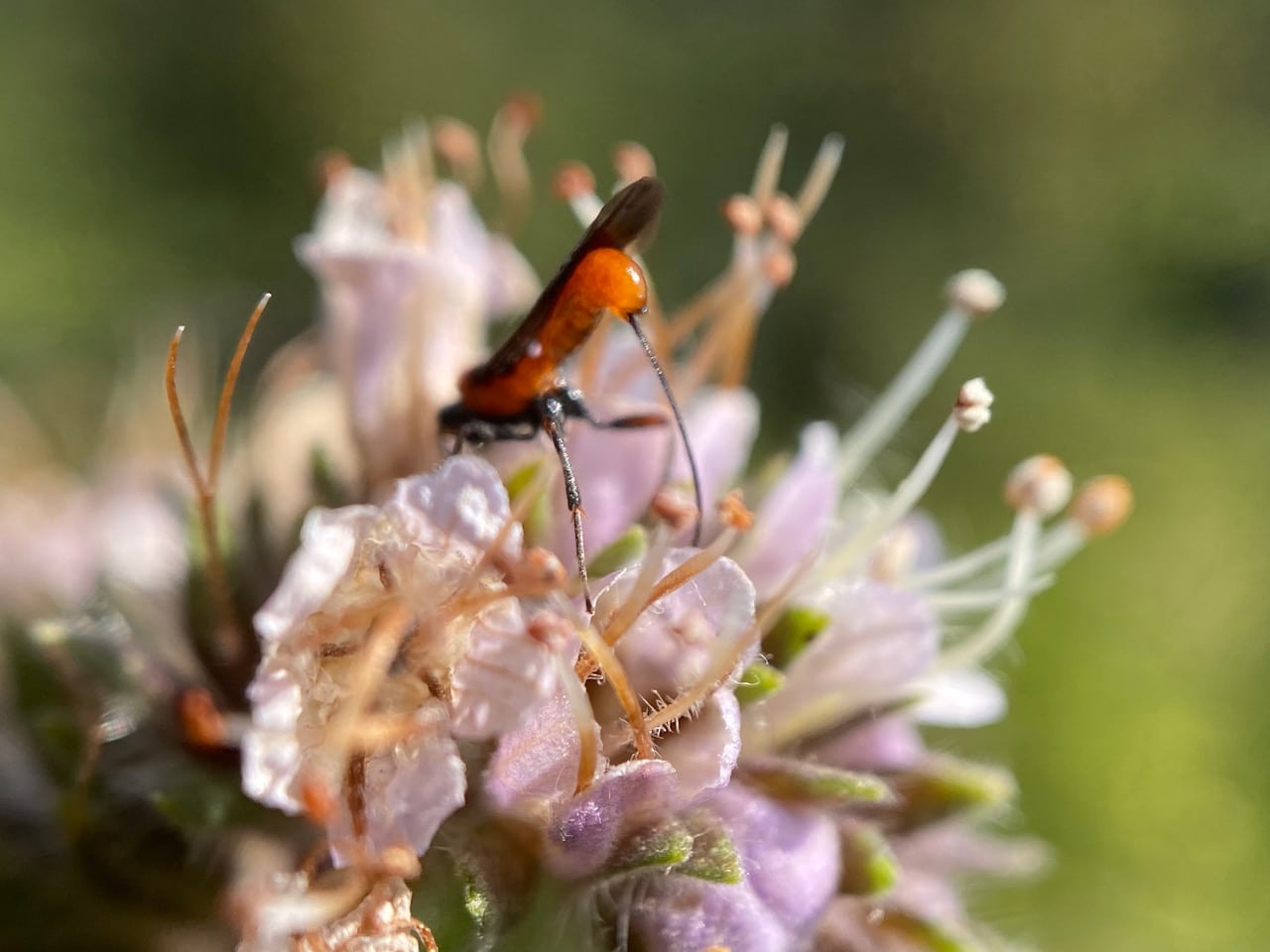
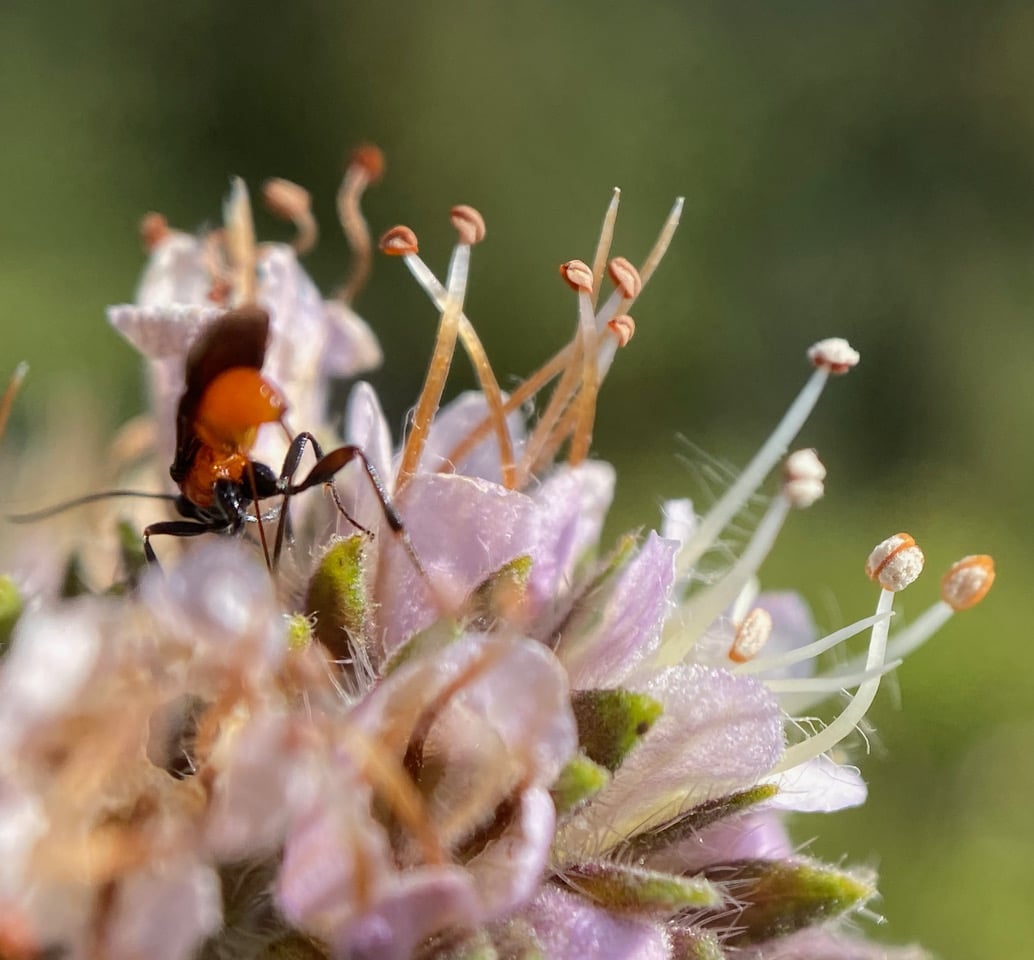
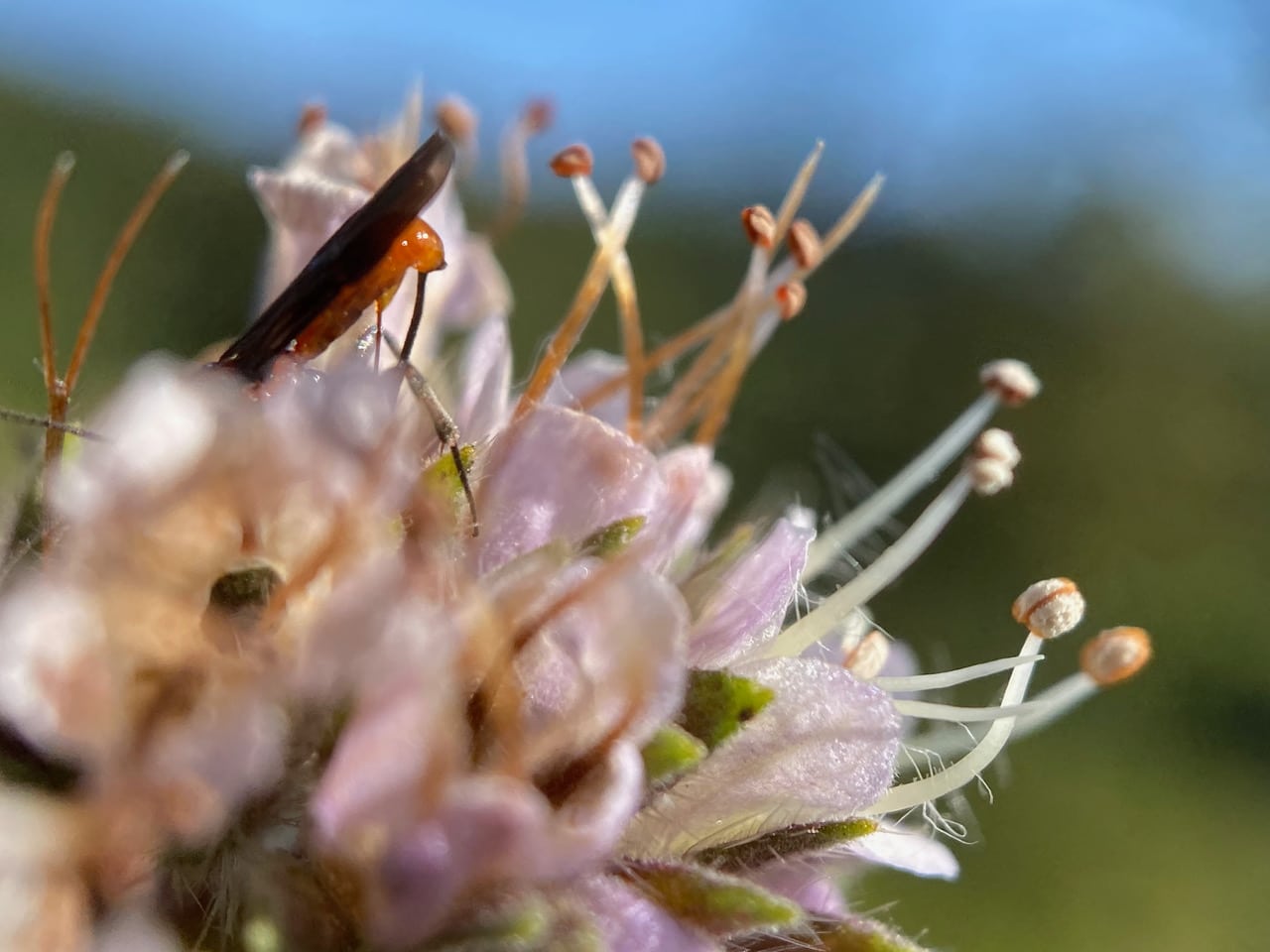
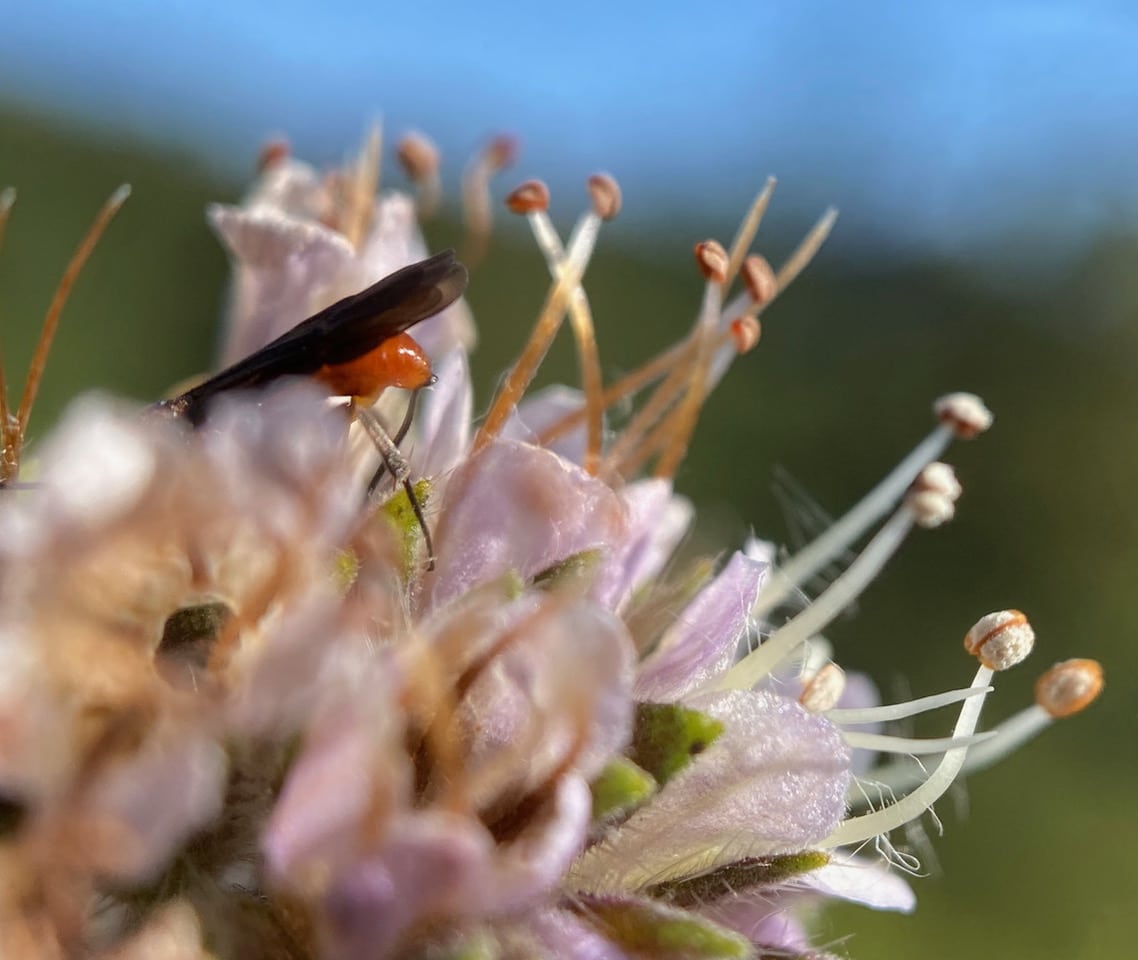
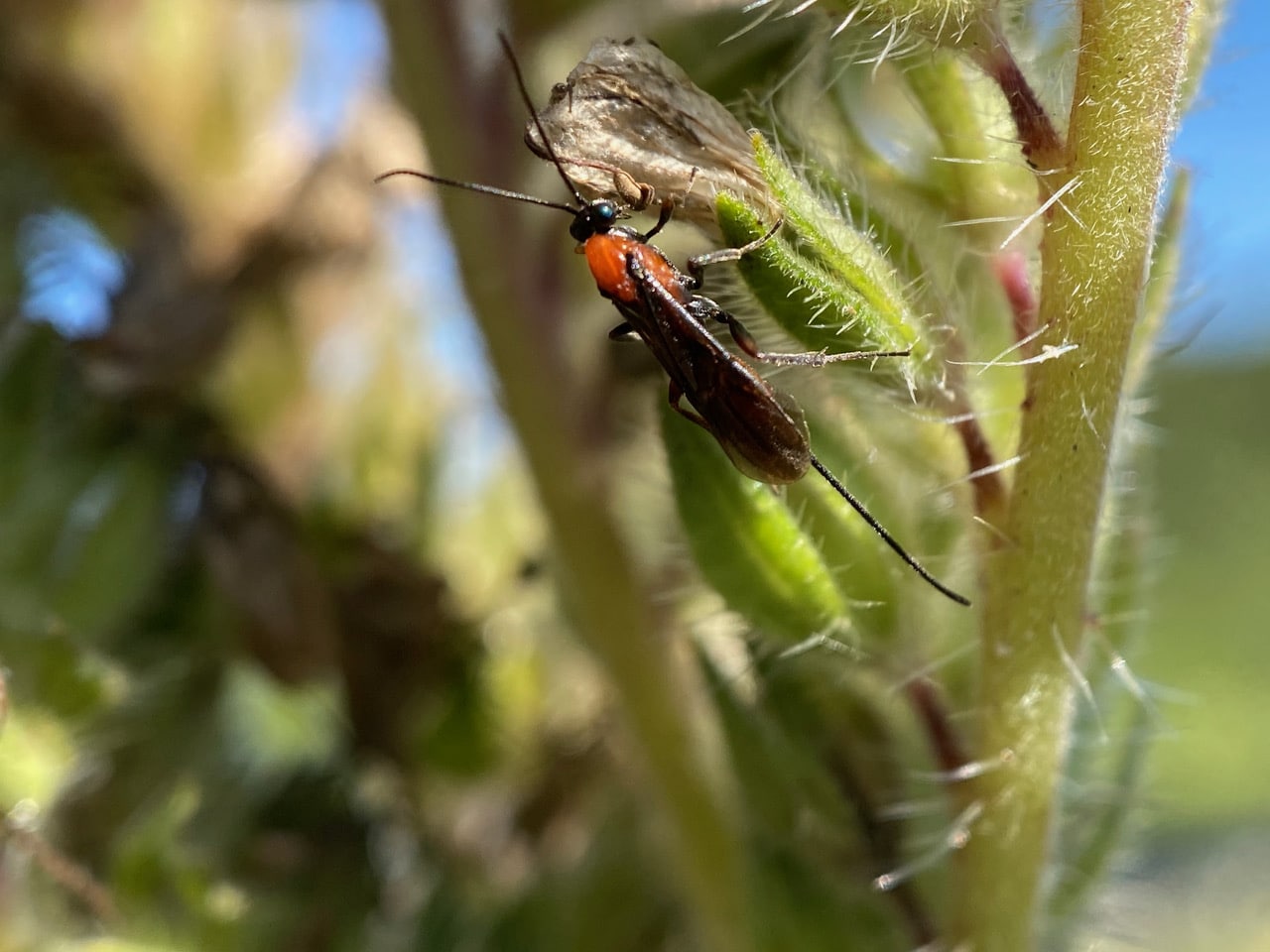

The Braconid Wasp (subfamily Agathidinae, family Braconidae) has her head down most of the time, her long antennae tap-tapping on the bracts and flower buds, in an apparent effort to locate a host.
The Braconidae are a family of parasitoid wasps. After the closely related Ichneumonidae, braconids make up the second-largest family in the order Hymenoptera, with about 17,000 recognized species. Females often have long ovipositors to lay eggs on or in their hosts. The larvae of most braconids are internal primary parasitoids of other insects, especially the larval stages of Coleoptera, Diptera, and Lepidoptera. Generally, the braconid life cycle begins when the female wasp deposits her eggs in the host insect, and the braconid larvae develop in the host body, eating it from the inside out. When the wasp larvae are ready to pupate, they may do so in or on the host insect. The new generation of adult braconid wasps emerges from their cocoons and begins the life cycle again.
Braconid wasps use a remarkable weapon to disable the defenses of their host insects – a virus. These parasitic wasps coevolved with polydnaviruses (read poly-DNA-virus), which they carry and inject into the host insects along with their eggs. The virus attacks the host’s immune system and renders it unable to encapsulate the wasp egg; it also halts the host’s development, so it can’t pupate and transform into an adult. Amazingly, the “bracovirus” also changes the host’s metabolism so that it can survive longer without food or water – thus ensuring a nurturing environment for all the young wasps to come.
Agathidinae is a subfamily of braconid parasitoid wasps. Some species have been used in biological control programs. Agathidines are among the larger and more colorful braconids. Diurnal members of this subfamily often possess aposematic (warning) coloration. All Agathidines are koinobiont endoparasitoids of caterpillars. Most attack concealed caterpillars, such as those that use silk to tie leaves together. Most are solitary, laying only one egg in each host caterpillar.
She has finally located a host! Raising her rear end, she is trying to release her ovipositor from its black sheath.
See the actual ovipositor? It is orange in color and does not emerge from the tip of her abdomen, but anterior to it.
Both the orange ovipositor and its black sheath can be seen here. The wasp is angling the ovipositor towards the host.
There, the wasp has lowered her body, probably injecting her egg into the host.
The Braconid Wasp flies to another phacelia inflorescence.
She goes tap-tapping with her antennae again, trying to locate another host. A mother’s job is never done!
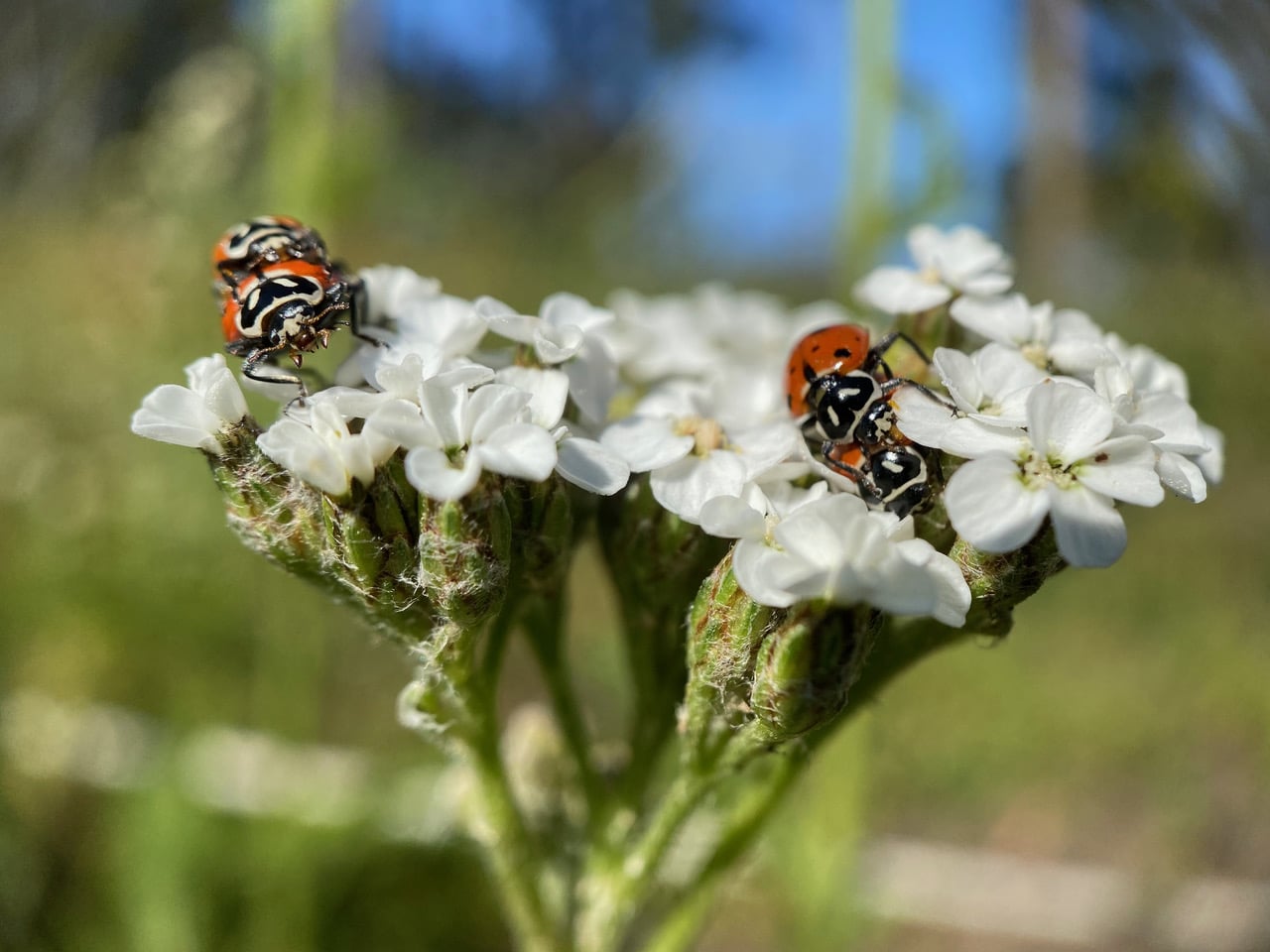
Perhaps finding two pairs of mating Ladybeetles on the same Yarrow inflorescence warrants a picture?
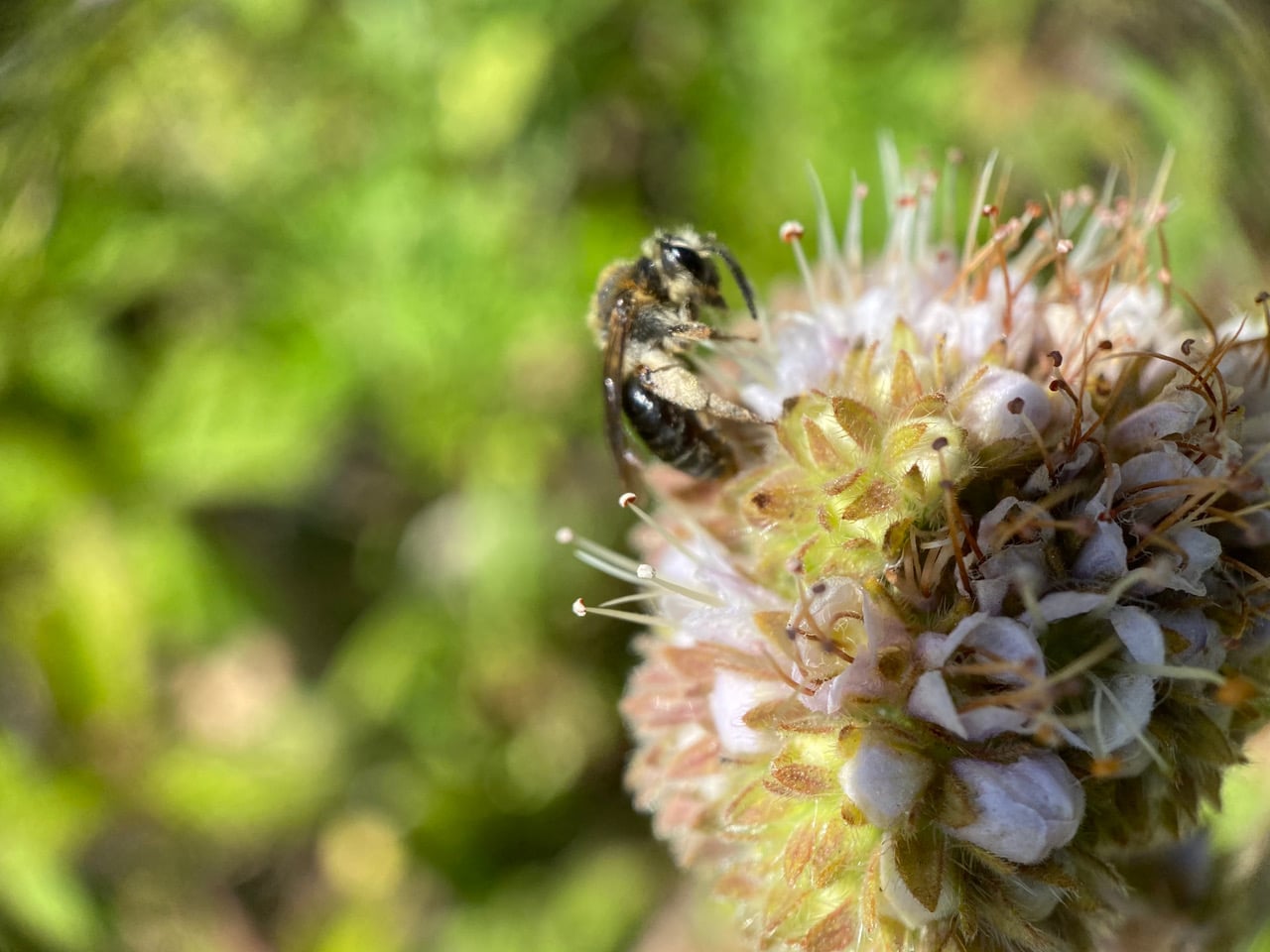
Even a blurry image can be instructive in bee identification. A bee has landed on an inflorescence of California Phacelia to forage. From her long abdomen, and the way that pollen is packed in her scopae, I surmise that she is probably a Mining Bee in the Family Andrenidae. Her scopa spans almost the full length of her hind leg, extending to her “armpit”.
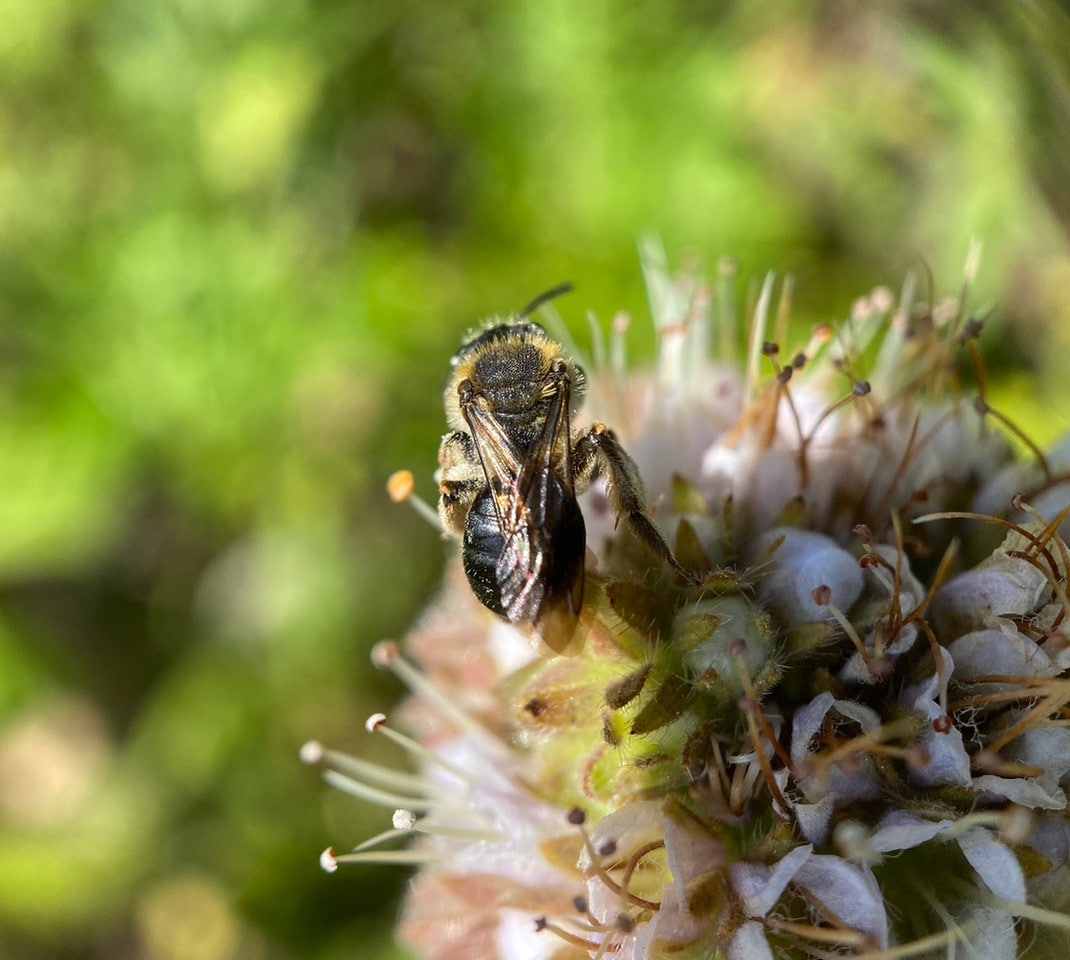
A well-worn bee, missing quite a bit of her hair.
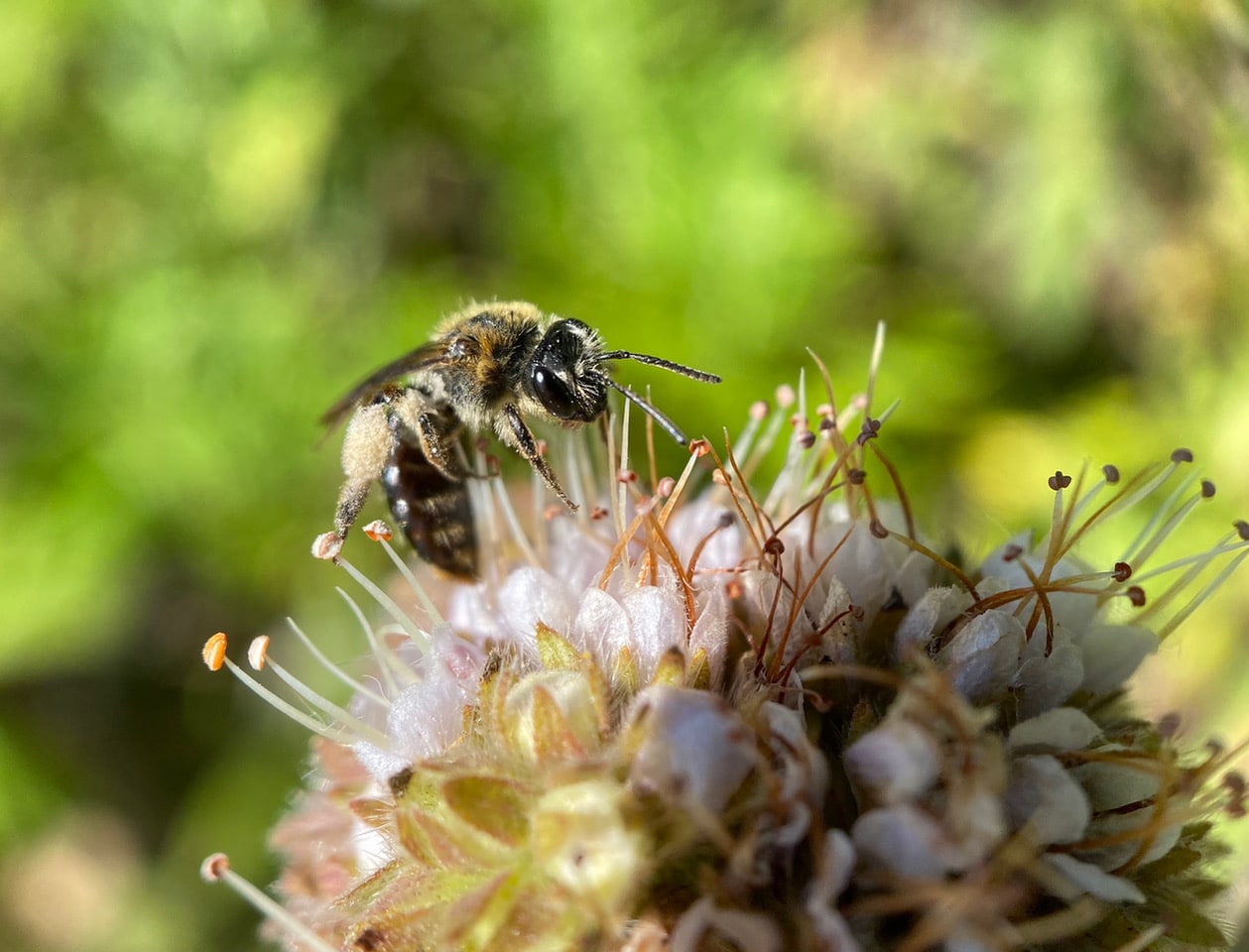
With this view showing the bee’s facial fovea (hair-lined depression between her eyes), we can further narrow her down to the genus Andrena (family Andrenidae).
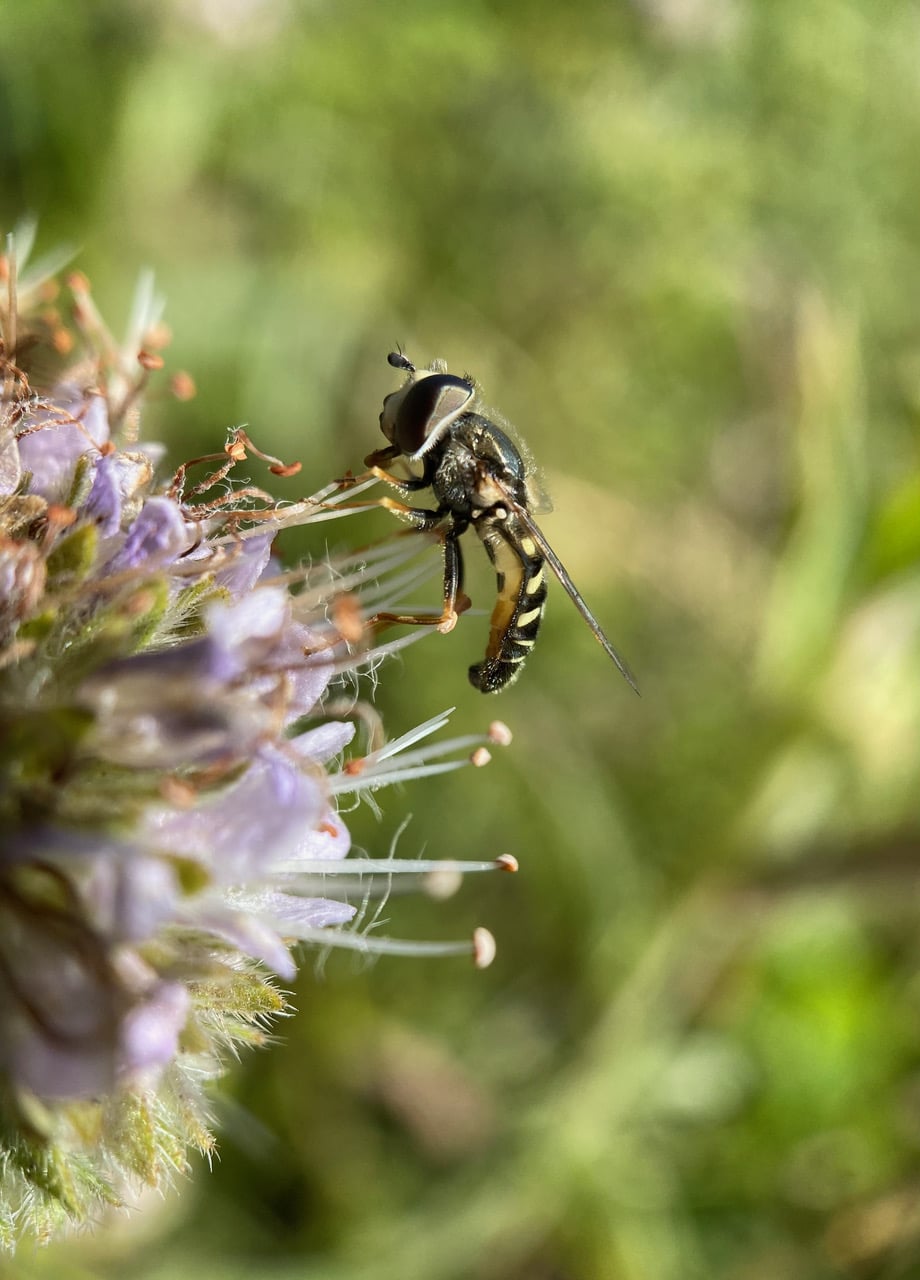
A female Large-tailed Aphideater, Eupeodes volucris (family Syrphidae) is feeding on the pollen of California Phacelia. The side profile shows her concave abdomen.
Hover Flies, also called flower flies or Syrphid flies, make up the insect family Syrphidae. The adults of many species feed mainly on nectar and pollen, and are often seen hovering and nectaring at flowers. They are important pollinators of flowering plants in many ecosystems worldwide. The larvae feed on a wide range of foods. In many species, such as this Large-tailed Aphideater, the larvae are insectivores and prey on aphids, thrips, and other plant-sucking insects. In other species, the larvae are saprotrophs, eating decaying plant and animal matter in the soil or in ponds and streams.
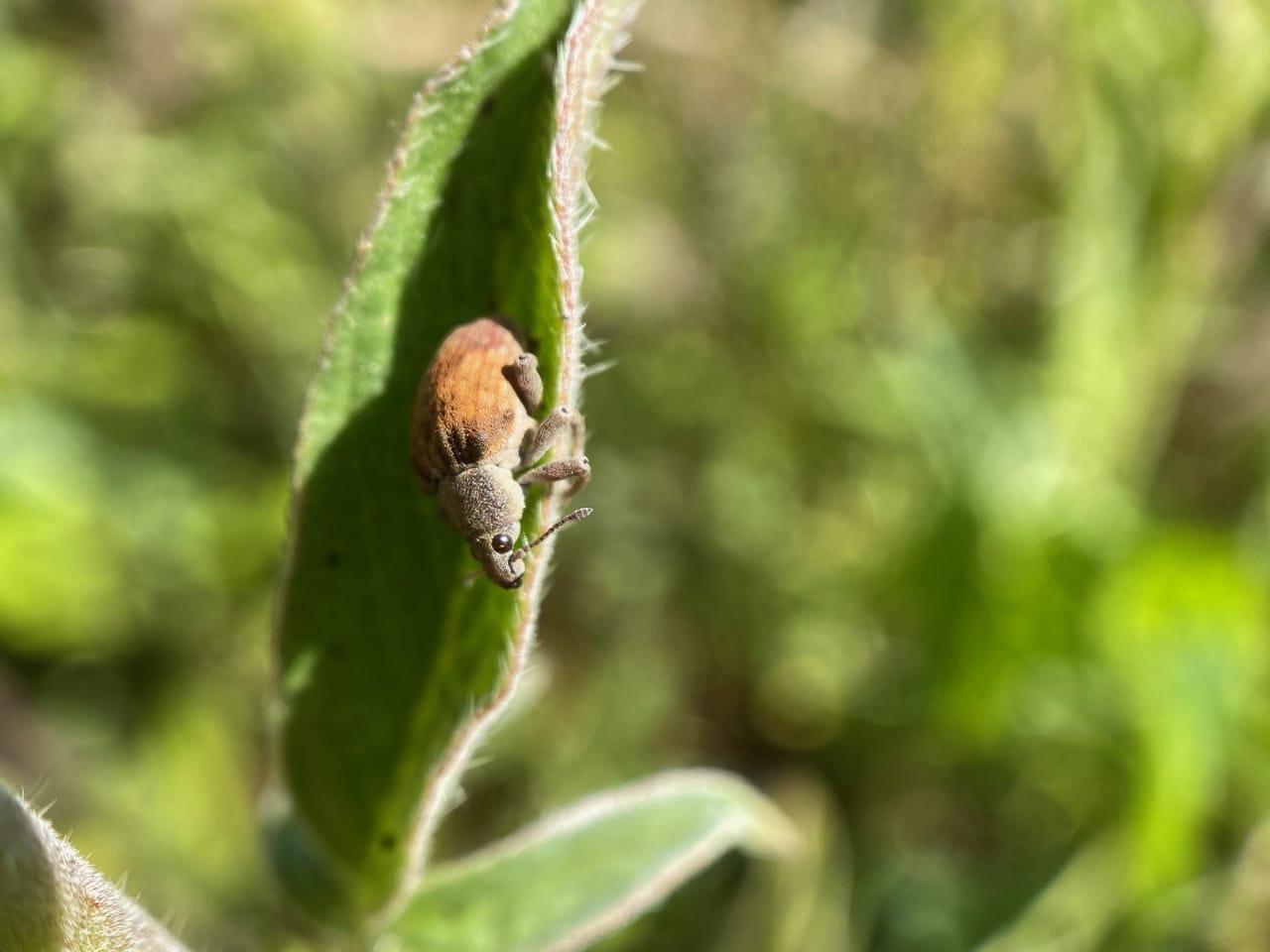
A Eucalyptus Snout Beetle,Gonipterus platensis (family Curculionidae) is enjoying the morning sun on a California Phacelia leaf.
Weevils, family Curculionidae, are also called snout beetles. Curculionidae is one of the largest beetle families (about 40,000 species). Most weevils have long, distinctly elbowed antennae that may fold into special grooves on the snout. The snout is used not only for penetration and feeding but also for boring holes in which to lay eggs. The mouthparts are quite small and located at the end of the rostrum (snout), designed for chewing. Many weevils have no wings, while others are excellent fliers. Most are less than 6 mm in length. The majority of weevils feed exclusively on plants. The fleshy, legless larvae of most species feed only on a certain part of a plant – i.e., the flower head, seeds, fleshy fruits, stems, or roots. Many larvae feed either on a single plant species or on closely related ones. Adult weevils tend to be less specialized in their feeding habits. The family includes some very destructive agricultural pests.
Eucalyptus trees are the only hosts for the Eucalyptus Snout Beetle. The beetle is endemic to Australia where Eucalyptus trees are native, but it has spread around the world where Eucalyptus is found. Adult female Eucalyptus Snout Beetles lay about two hundred eggs in batches of about ten in grey colored capsules, attached to the leaves. Upon hatching, the larvae feed on leaves and young shoots. After three molts, the larvae drop to the ground to pupate in the soil. The weevil is of little economic significance in Australia where it has natural enemies. This is not the case where the trees have been introduced. Adult weevils feed mostly on leaves and the soft bark of twigs while the larvae feed mostly on leaves. Repeated defoliation may cause the splitting and death of branches or even whole trees. The weevil is able to disperse by flight.
The appearance of our weevil on the Phacelia is most likely incidental. It was probably blown from the surrounding Eucalyptus grove.
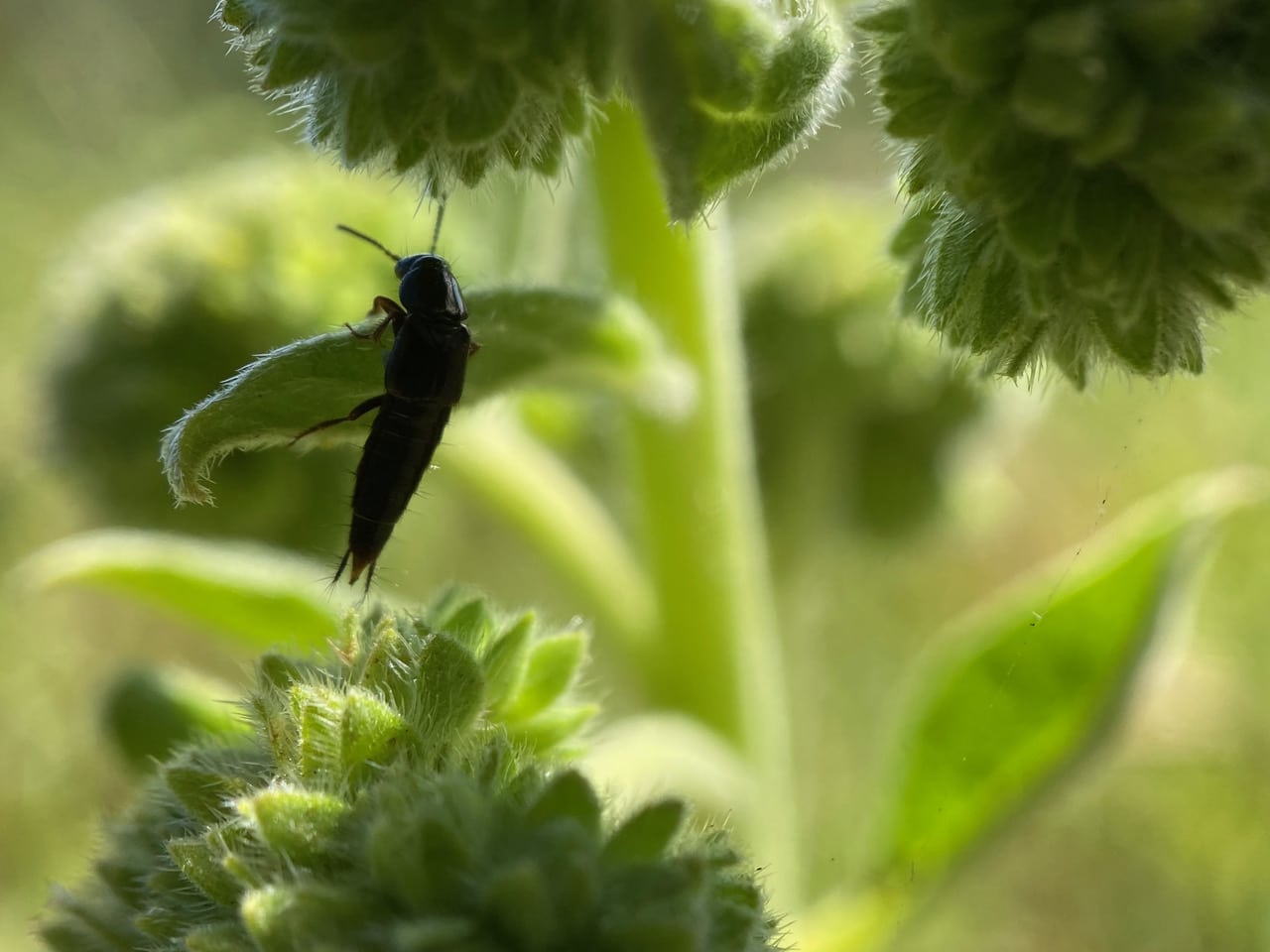
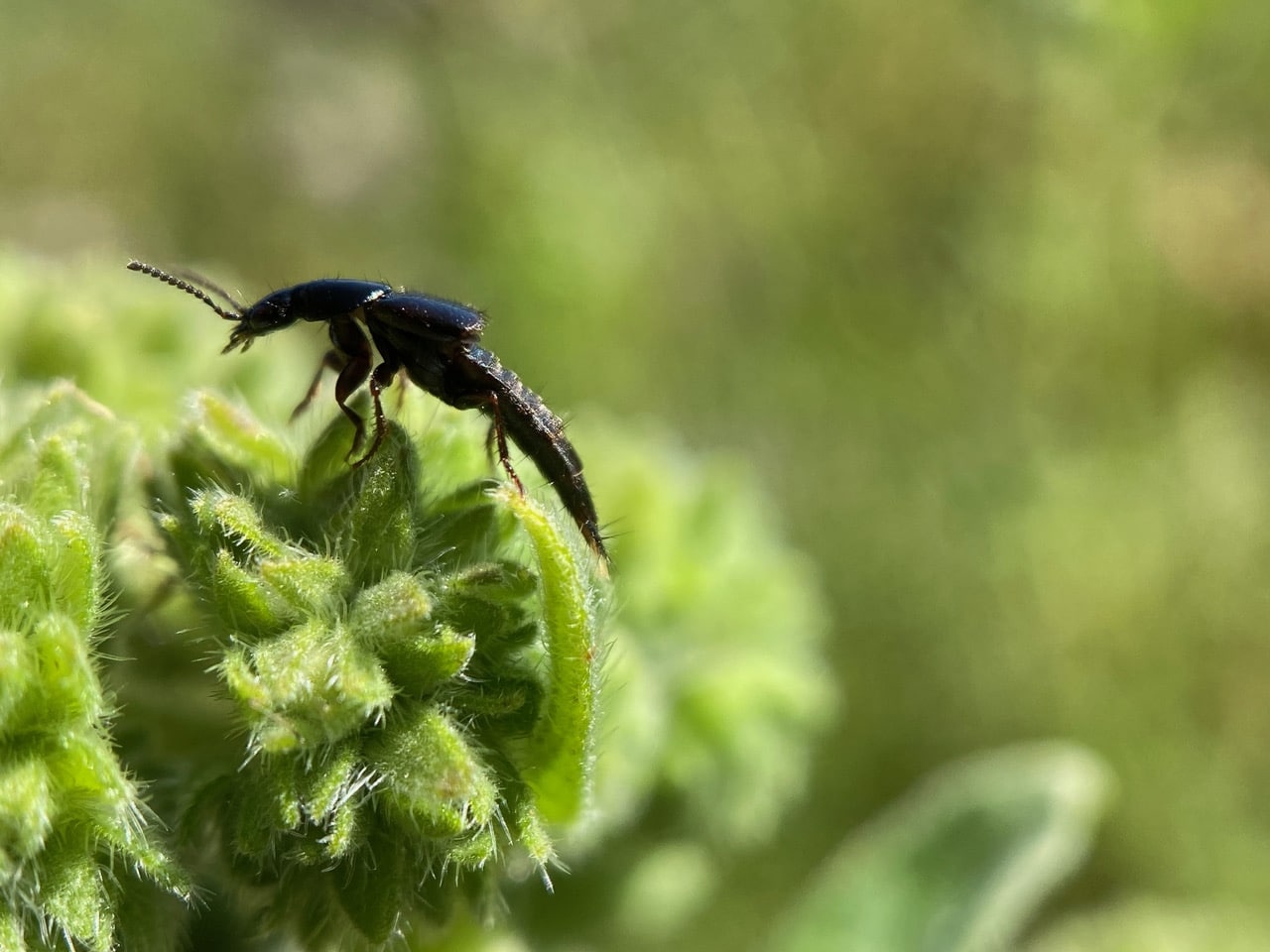
An elongate black insect is moving around in the shadows among the foliage of California Phacelia.
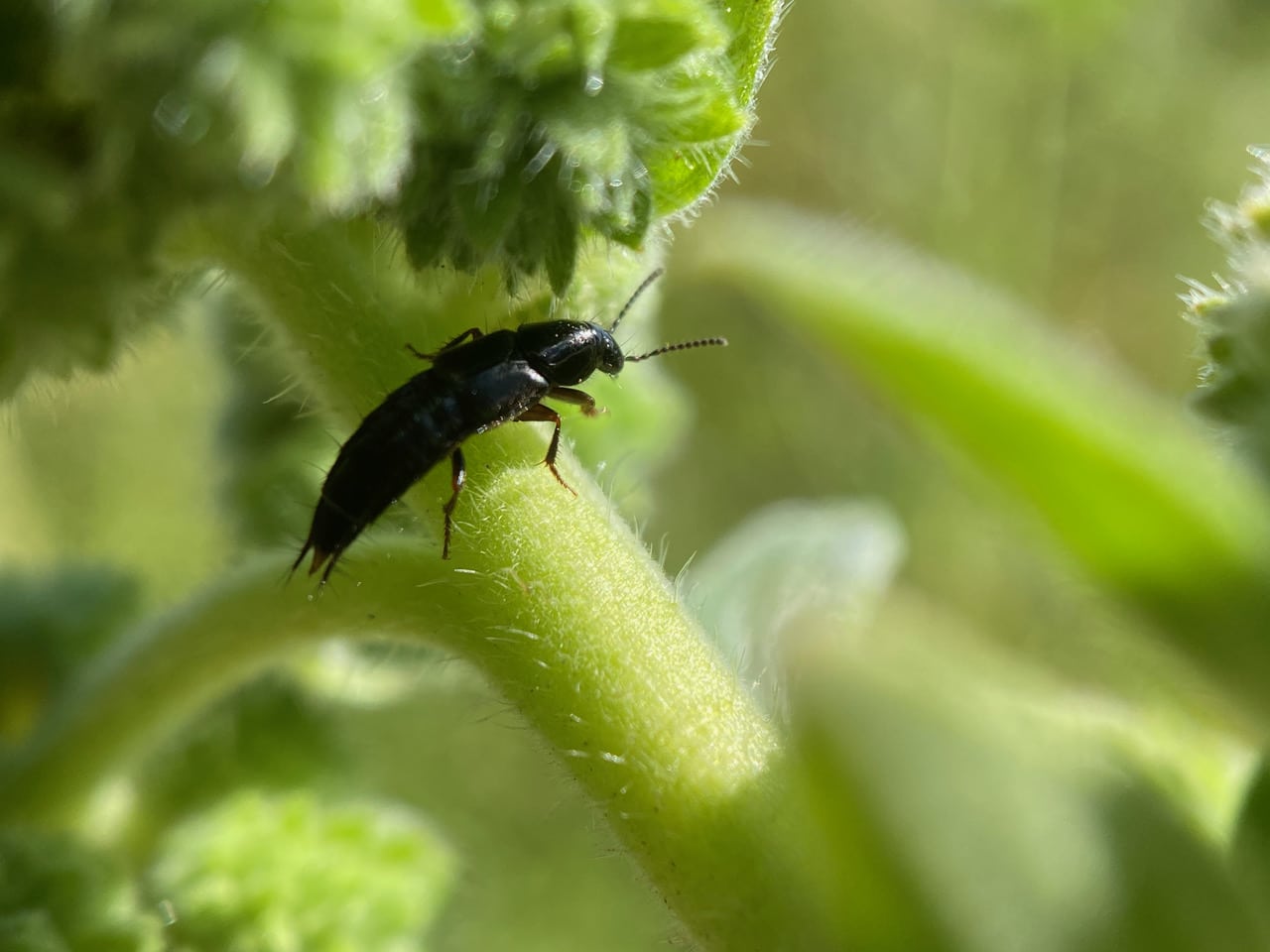
The insect finally emerges onto an immature inflorescence. The lighting is better, and I can tell that it is a Rove Beetle (family Staphylinidae) from its bizarrely short elytra and the long exposed abdomen.
The family Staphylinidae is the largest family of North American beetles, with about 4000 species. Most are small and of cryptic habits and although common, the group as a whole is not well studied. Most rove beetles are predators of insects and other invertebrates, living in forest leaf litter and similar decaying plant matter. Some species are predaceous as both adults and larvae; the larvae of some species are parasitoids; many others are probably scavengers.
Rove Beetles are easily recognized by their slender, usually black or brown body, shortened front wings (elytra) that may look like pads on the abdomen, and behavior of curling the tip of the abdomen upwards when disturbed or running. Adults are usually strong flyers. Most species are nocturnal, but a few are active during the day.
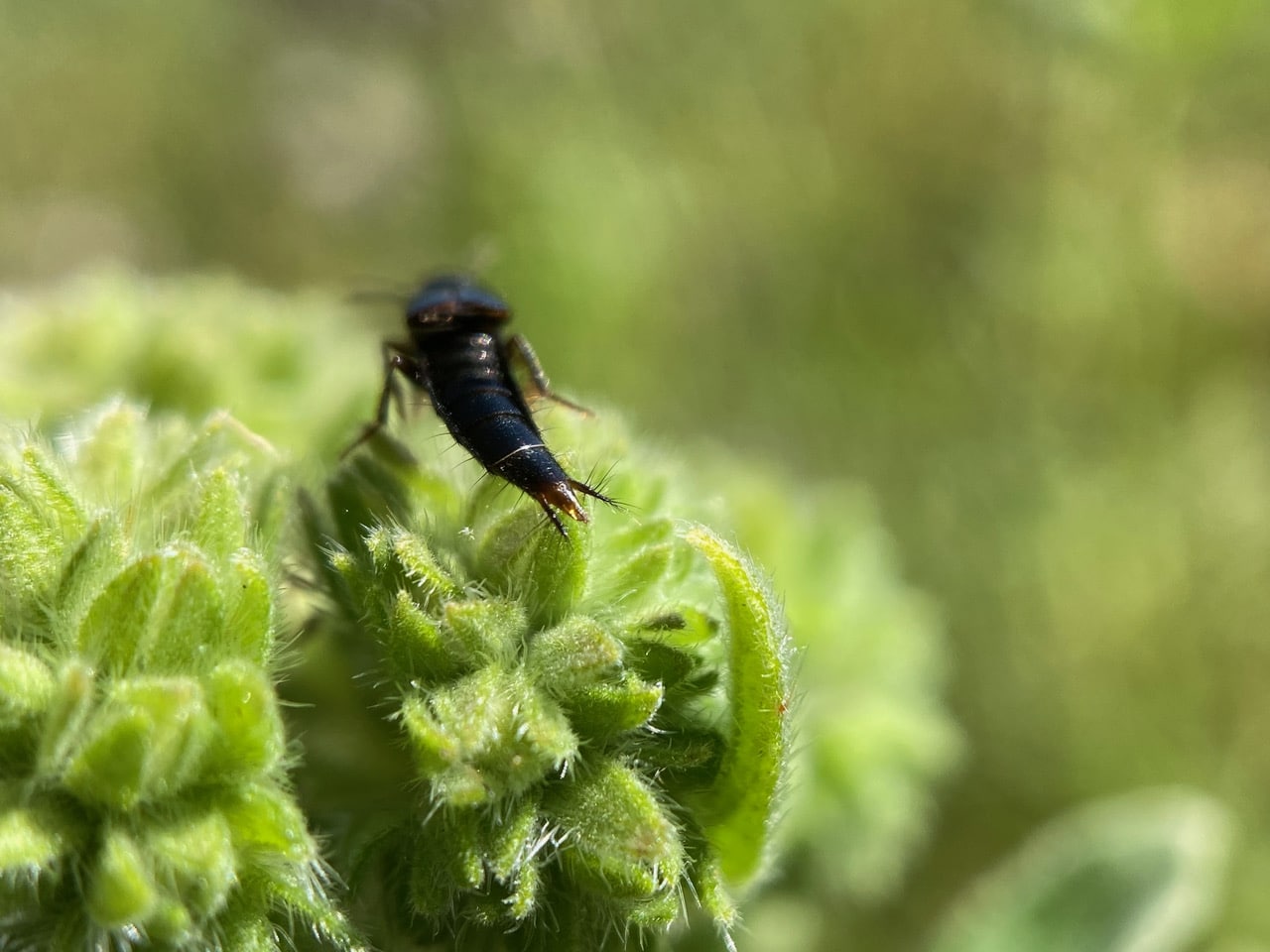
The only good picture I have of the insect is a fleeting look of its tail. Amazingly, from these shadowy images, iNaturalist’s Computer Vision (AI) managed to identify the insect to the genus Quedius ! This is the third, and largest species of Rove Beetles we have found at Skyline Gardens this spring.